Thursday, July 8, 2010

Rima Birt and Rupes Recta


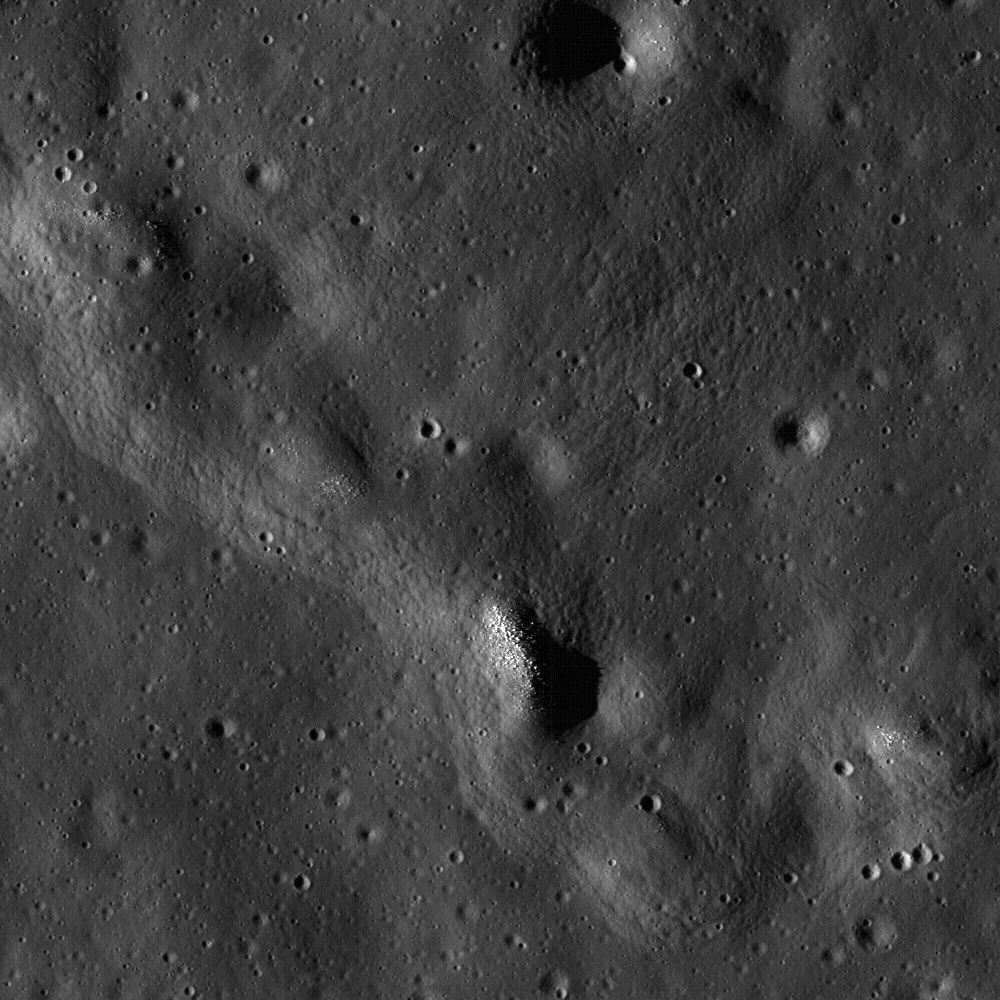
Cobra's Head of Rima Birt - An uncorrected montage of the left and right frames of LROC Narrow Angle Camera observation M177555153 (Resolution = 67 cm per pixel, from 42.1 km; LRO orbit 2457, January 8, 2010). One of two Lunar Reconnaissance Orbiter Camera (LROC) NAC images in the Second Release to the Planetary Data System that put a new and extraordinary light on a familiar Near Side feature and its surroundings. The observation above, of the cobra head of Rima Birt was imaged in the local evening Sun, only 8 degrees above the western horizon and making the interior of the Rima appear deceptively deep. The distance from the eastern edge of that interior shadow and the feature rim to its east (right) is approximately 800 meters [NASA/GSFC/Arizona State University].

We're grateful to Chuck Wood once again, erstwhile curator of Lunar Picture of the Day (LPOD) for being first to call our attention to the latest, now relatively rare, addition to the Kaguya Image Gallery.

On Wednesday, July 7, under the headline "Wow," Chuck linked to a JAXA MPEG calling it "a remarkable digital flyover of the Straight Wall area" of southeast Mare Nubium.

Though previously available via the JAXA Channel on YouTube, the MPEG rendition of Terrain Camera data gathered by Japan's first lunar orbiter provides better resolution, and it's just as breathtaking.


JAXA (Kaguya/SELENE-1) Terrain Camera and laser altimeter data made possible this virtual view south along the long length of Rupes Recta, part of a remarkable video flyover tour of the area released to the Kaguya Image Gallery, July 5, 2010. The rim of 17km diameter Birt crater rises above the west plain, dominating the southern horizon [JAXA/SELENE].


For scale, the Cobra Head of Rima Birt at the top of this posting can be seen here at center left, in this view from Japan's SELENE-1 lunar orbiter over southwest Mare Nubium. Immediately to east of Rima Birt is 17 km Birt crater, with it's relatively steep slopes supporting Birt A. On the right is the 134 km Rupes Recta, the "Straight Wall." The first HDTV camera to orbit the Moon also flew on Kaguya that swept up more than one outstanding view of the area. Late mission Kaguya HDTV showed the region from progressively lower orbits.

Chuck Wood, author of The Modern Moon: A Personal View (Sky Publishing, 2004), is to be congratulated for reminding us to search through the recent Second Release of LROC images to look for any LRO Narrow Angle Camera close-ups of Rupes Recta, the famous "Straight Wall." A search after the First Release in March turned up nothing, other than preliminary unformatted Wide Angle Camera sessions.

Despite their very real scientific value, their precision and beauty, LROC Wide Angle Camera observations are worth waiting for.

The Rupes Recta region, near the center of the Near Side as seen from Earth, is among the most observed and photographed areas of the Moon. Few are the amateur astronomers on Earth, usually after acquiring their probably more powerful second telescope, who hasn't marveled at their first naked eye view of "Huygens' Sword," or "the Railroad," the 134km long, 490 meter high rift, roughly centered 22.1°S, 352.2°E.


Le Mur droit - An example of the quality of "amateur" photographs of Straight Wall region, as seen from Earth. The area was the subject of "Ancient Thebit and Huygens' Sword," by Charles A. Wood, Sky & Telecope [LPOD/January 11, 2004]..


Our second search of the PDS uncovered two strategically placed LROC Narrow Angle Camera observations, extreme close-ups of noted features, in the vicinity of the Straight Wall (leaving us hungry for more).

Each was gathered in the First Quarter of 2010, and were therefore among those observations in the Second Release of LRO photograpy from LRO announced by LROC principal investigator Marc Robinson, June 21.

One is of the southern half of Rima Birt, and it provided the montage at the top of this post. The cobra head feature can be compared with other less-detailed views of this feature in this post. A second image, viewed in a high sun, has the relief in the long shadows of early morning and late afternoon, slices directly through the Wall's center.


An angled slice through the heart of the Rupes Recta, under a higher Sun (f=33.44° in LRO orbit 3151, March 3, 2010). The 700 meter crater at center predates the rift, and it may have witnessed a gentle transition to its present state. The bright feature on it's eastern interior (see below) is a slide of material once on it's east rim, material originally deep below the progenitor impact's center. Yet another opportunity presents itself for future geologists to take advantage of a ready-made excavation [NASA/GSFC/Arizona State University].

From Lunar Pioneer 4
A closer look at the crater straddling the Straight Wall at 21.6°S, 352.2°E, The character of each half of the plain divided by the rift appears to be similar. Also, at this point in the montage consisting of the right and left frames of LROC NAC M122264663, their overlapping fields of view are joined very close to the location of the rift, so subtle differences in hue might be mistaken for a true appearance [NASA/GSFC/Arizona State University].

Preliminary, low-resolution LRO laser altimetry (LOLA) data clearly picks up the half-kilometer difference in elevations of the plain on either side of Rupes Recta [NASA/GSFC].

Searching for the Moon's Mantle

Red symbols on this map of lunar crustal thickness show where the Kaguya team have identified deposits of olivine [JAXA/SELENE].

Paul D. Spudis
The Once & Future Moon
Smithsonian Air & Space Blogs


We’ve studied and examined the Apollo samples of the lunar maria (pronounced MAR-ee-uh) for thirty years but despite the thorough search of these collections, we have never found a sample of the deep mantle from which these lavas were formed. How might such a deeply seated rock find its way to the surface? Large basin-creating impacts on the Moon might have dug through tens of kilometers of crust (down into its deepest layers) to excavate samples of the mantle. Another occurrence of mantle samples is as small chunks of rock included in lava. Fragments of rock may be ripped away during the ascent of the dense, liquid magma and become inclusions in the solidified lava flows; these “stranger” rocks are called xenoliths. Despite an exhaustive search of the Apollo samples, no samples of the mantle have been found, either as a fragment of basin ejecta or as a xenolith in the mare basalts.

If no one has ever seen it, how do we know what the lunar mantle looks like? The properties and composition of planetary interiors are inferred by indirect evidence. Seismometers left on the surface by Apollo crews measured the velocity of seismic waves inside the Moon, an indirect measure of the density of the deep interior. The density of the mantle is high enough so that common surface rocks cannot make up a significant portion of it; the rocks must contain large amounts of the minerals olivine and pyroxene. In addition, the mantle rocks were partially melted to make the mare basalts that cover the surface in places. The chemical composition of these lavas show they were made by melting a rock rich in magnesium and iron. Finally, xenoliths of the Earth’s mantle are sometimes found entrained in lavas – these pieces are made up of the olivine-pyroxene rock peridotite (after the mineral olivine (the gem form is peridot) that makes up most of it.) So the idea that the rocks of the mantle are olivine-rich is a well-grounded concept for which we have abundant independent evidence.

Now a new scientific paper concludes that fragments of the mantle (the dense magnesium- and iron-rich portion of the Moon that lies below 70-100 km depth) are exposed on the surface, brought up from depth by the impact of giant asteroids 4 billion years ago. Such a finding would indeed be significant, as geologists always seek rocks from the deep interior to aid our understanding of the Moon’s structure and composition. Data from the orbiting Japanese Kaguya mission shows that olivine is present in the surface deposits of some lunar craters. But how do they go from this observation to the interpretation of lunar mantle? Basically, they mapped out the occurrences of these olivine deposits and found that many of them occur within the rims of large impact basins. Based on models produced from gravity mapping, the crust of the Moon is thought to be thin here and the mantle is close to the surface. Thus, these large impact basins could have excavated chunks of the mantle, throwing them out onto the surface of the Moon.

Why is the mineral olivine important? Olivine is a silicate mineral rich in magnesium and iron; it forms one of the basic, silicate building blocks of the rocky planets. In magma (liquid rock), olivine crystallizes first and its composition is a key indicator of the composition of the magma. Current prevailing wisdom is that the early Moon was largely molten (the “magma ocean” phase); whether it was completely molten or merely liquid in its outer portion is uncertain, but in such a huge system of liquid rock, olivine is the earliest mineral that crystallizes. Being dense, crystallizing olivine would sink in the liquid magma, slowly accumulating deep in the Moon. As the entire Moon solidified, these “cumulate” layers of olivine and other iron-rich minerals would make up the mantle. Later, the mantle partially re-melted, creating liquids that erupted onto the surface as basalt lava and formed the dark lowland plains – the maria.

So how does the Kaguya interpretation hold up on examination? Estimates of crustal thickness are of the current Moon, after the basins formed. There is no particular reason to suppose that a given basin-forming impact occurred in terrain of thin crust – the crust is thin here because the basin formed. True enough, some of these impact features are very large – the Imbrium basin, a large crater on the western near side, is well over 1000 km in diameter, large enough to have punched through the thickest sections of the crust, one would think. Indeed, Imbrium is one of the sites that the Kaguya team propose as having excavated mantle. So they are finding these areas in the places where one might expect to find them.

Olivine is a very common mineral and abundant in the lunar crust. A curious fact is that olivine grains in lunar highland rocks tend to have high amounts of calcium, a minor element but a key diagnostic of the crystallization environment. In Earth rocks, olivine formed at depth has very low concentrations of calcium. My colleague, the late Graham Ryder concluded that the olivine crystals in dunite (a rock made up almost completely of olivine) from the Apollo 17 site – a sample proposed as a piece of the lunar mantle – likely came from the accumulation of crystals at a depth of only a few kilometers, far shallower than the tens of kilometers depth to the mantle.

Because the Kaguya spectral mapper is detecting only the presence of olivine, we cannot distinguish between pure olivine and olivine crystallized with plagioclase, what lunar scientists call troctolite. Troctolite is common in the Apollo highland samples, but is a relatively rare rock on Earth. It consists of (more or less) equal parts olivine and plagioclase, a calcium- and sodium-rich silicate mineral. Troctolites make up some of the most deeply derived rocks found in the Apollo collections, but all studied to date seem to be of crustal, not mantle, provenance. There is no objective evidence that the olivine seen by Kaguya is not derived from troctolites and/or dunites of crustal (not mantle) origin.

The long held desire of lunar scientists to sample deeper levels of the Moon is understandable, but we must proceed cautiously. Just as a sample return mission to the floor of the largest basin on the Moon is no guarantee that we will obtain the rocks needed to answer questions about early cratering history, the new finding of abundant olivine on the Moon does not mean that pieces of the mantle are lying on the surface, awaiting collection by some future mission. The Kaguya findings are intriguing and very interesting, but not definitive evidence for the presence of mantle fragments on the lunar surface.

Wednesday, July 7, 2010

Wayne Hale announces NASA retirement


Wayne Hale
NASA Blogs

"All Good Things"

A personal note today. After long consideration I have filed my retirement papers and will be leaving NASA and the US Civil Service on July 31. Let me hasten to add that this is a personal decision based mainly on family considerations - which I needn’t enumerate here today.

Working at NASA has been a lifelong dream; I often tell people that I would have paid them to let me in the door rather than the other way around. It has been a privilege and an honor to work in this place and with these people. The achievements that we have made together will have lasting significance for all humankind. I want to especially thank my many wonderful co-workers who are so dedicated, innovative, and hard working. I wish them every success in the future with all my heart.

I have a few days left, I may even post another blog or two. But for today I leave you with a passage that summarizes feelings so similar to my own that it is uncanny. Mark Twain (Samuel Clemens) wrote a wonderful book about his favorite career as a steamboat pilot, “Life on the Mississippi.” It is enormously funny, but taking a reflective turn this serious passage summarizes – far better than I could – the feelings of any professional at the end of a long and wonderful career. So make the translation from rockets to steamboats and read all the way to the end.

Read the post, HERE.

LROC: Landmark Linné of Serenitatis


Linné crater (2.2 km diameter) is a beautifully preserved young mare crater. Small white arrows indicate layering preserved just below the rim; these rock outcrops probably represent discrete lava flow deposits (View the full-sized Featured Image, HERE [NASA/GSFC/Arizona State University].

Mark Robinson
LROC News System

Since the Moon has no atmosphere, no wind, and no rain, features on the surface are preserved for millions of years. The exact age of Linné crater is not known, although it is thought to be less than ten million years old. The new LROC images show a richness of detail that confirm this young age.

The small black arrows on the rim point out small delicate fractures (lower left of opening image) formed as the crater walls slumped inward. Also note the frozen impact melt flows amongst the boulders strewn along the steep inner wall (large white arrow, close up below).


Full resolution close-up of LROC Narrow-Angle Camera observation M122129845, showing melt debris flows and earlier layering preserved from the impact event that formed Linné, excavating its location in west Mare Serenitatis. (Resolution = 48.4 cm per pixel, from 41.86 km in LRO orbit 3132, March 2, 2010) [NASA/GSFC/Arizona State University].

The new views provided by LROC show us that each crater has its own story to tell - no two are the same. Linné crater formed in a thick deposit of mare basalt. Typically young craters in mare have large numbers of boulders strewn around their outside flanks.


At roughly one meter per pixel resolution, the LROC Mosaic of both the left and right Narrow Angle Camera frames of observation M122129845, detail of boulders and other noted features distinct to Linné are still visible. Linné was named for Swedish doctor and naturalist Carl von Linné (1707-1778), founder of the Academy of Stockholm and, according the authors of the Virtual Moon Atlas, "inventor of a nomenclature of vegetable and animal species." They further recommend it as a "very interesting formation" for amateur observers while noting Linné "was the object of controversies during 19th century" because, some insisted, its form routinely changed, most likely the mistaken interpretation of altered appearances due to changes in angles of incidental solar illumination [NASA/GSFC/Arizona State University].


Reduced resolution (~2 meter pixel scale) mosaic of Linné; context for the location of the higher resolution images above. Linné (27.7°N, 11.8°E) is a landmark for amateur observers equipped with 200mm reflecting telescopes. As with most such observations, Linné is most easily spotted when highlighted in stark relief by lengthened shadows near local sunrise or sunset, five days after a Full Moon or six after New Moon, respectively. (Charles A. Wood, steadfast curator of the indispensable Lunar Picture of the Day (LPOD) website, has at least four excellent Earth-side images of Linné, contributed by their talented creators, in the extensive LPOD Photo Gallery [NASA/GSFC/Arizona State University].

As you explore the full resolution NAC mosaic look for boulders outside the crater -- they are few and far between. Perhaps the local basalts were deposited as very thin layers, so there are no thick solid materials from which to produce boulders? We can see layering in the crater walls, so this hypothesis is certainly plausible. Examine the ejecta field: what causes the dune-like structures? Did the impact ejecta travel low across the surface? Did pre-existing obstacles somehow aid in "dune" formation? At a future opportunity the LROC team plans on acquiring a stereo observation of this fascinating crater to allow detailed topographic analysis of these landforms so scientists can get to the root of these questions.

Perhaps future explorers will use the LROC images and topographic maps to plot out geologic traverses! Examine Linné crater and plan out what you think would be the best spots to visit. Could an astronaut safely travel down into the crater? If so, what would you look for on the walls and on the floor?

Tuesday, July 6, 2010

Second Generation ATHLETE lunar vehicle


The second generation ATHLETE lunar vehicle with mock habitat as payload [NASA/JPL].

Matt Heverly, Jaret Matthews,
Matt Frost & Chris McQuin
NASA/JPL/California Institute of Technology

Proceedings of the 40th Aerospace Mechanisms Symposium, (pg. 317-326)

NASA/Kennedy Space Center, May 2010

The Tri-ATHLETE vehicle is the second generation of a wheel-on-limb vehicle being developed to support the return of humans to the lunar surface. This paper describes the design, assembly, and test of the Tri-ATHLETE robotic system with a specific emphasis on the limb joint actuators. The design and implementation of the structural components is discussed, and a novel and low cost approach to approximating flight-like cabling is also presented. The paper concludes with a discussion of the “second system effect” and other lessons learned as well as results from a three week long field trial of the vehicle in the Arizona desert.

In order to establish a continual human presence on the Moon we must develop assisting infrastructure that can carry cargo as well as provide mobility to the astronauts for exploration and the development of a central, but not necessarily fixed, lunar base. The Tri-ATHLETE vehicle system is a new form of two cooperative robotic vehicles that can act individually or physically connect together through a structural pallet to transport and manipulate cargo.

The basis of the ATHLETE (All Terrain Hex Limed Extra Terrestrial Explorer) robot is the wheel-on-limb vehicle concept. This hybrid mobility platform enables the vehicle to traverse at high speeds across benign terrain, as well as enabling walking, by locking the wheels and using them as feet, on extreme terrain. This vehicle architecture also allows for manipulation since the vehicle is stable on three or more wheels. Non-adjacent limbs can be lifted and used to interact with the environment.

A tool mechanism at the end of the limb, attached to the wheel hub, allows for interchangeable tools, such as a gripper or an auger, to be used for manipulation. This unique vehicle design allows for significant weight savings over a traditional planetary roving vehicle that must have large wheels to allow for low ground pressure as well as high torque wheel actuators since the vehicle cannot walk in extremely soft or steep terrain.


Tri-ATHLETE lunar vehicle Michelin Lunar Wheel impacting a 10-cm rock [NASA/JPL].

The ATHLETE project started in March of 2005. The first generation vehicle was completed in October of that same year. This 1000-kg, 2-m tall vehicle was developed rapidly with the intent of providing a hardware platform to aid in the development of the robotic system’s software. This software development vehicle ended up performing five field tests in natural terrain throughout the United States.

These field tests enabled the team to test the vehicle’s capabilities such as traversability over soft terrain, walking, repelling, and manipulation in unstructured environments.

From this first prototype several new capabilities were discovered and several vehicle deficiencies were revealed.

Review the presentation (PDF), HERE.

LADEE Architecture & Mission Design

Updated 1238 UT 6 July 2010
The precursor Lunar Atmosphere and Dust Environment Explorer (LADEE) lunar orbiter (2012) [NASA/ARC].

Butler Hine, Stevan Spremo, Mark Turner
NASA Ames Research Center

Robert Caffrey
NASA Goddard Space Flight Center

The Lunar Atmosphere and Dust Environment Explorer (LADEE) is a Lunar science orbiter mission currently under development to address the goals of the National Research Council decadal surveys and the recent "Scientific Context for Exploration of the Moon" (Final Report, 2007) to study the pristine state of the lunar atmosphere and dust environment prior to significant human activities.

LADEE will determine the composition of the lunar atmosphere and investigate the processes that control its distribution and variability, including sources, sinks, and surface interactions. LADEE will also determine whether dust is present in the lunar exosphere, and reveal the processes that contribute to its sources and variability.

These investigations are relevant to our understanding of surface boundary exospheres and dust processes throughout the solar system, address questions regarding the origin and evolution of lunar volatiles, and have potential implications for future exploration activities.


The LADEE mission will use a Minotaur V launch vehicle with WFF as the launch site (Pad 0B). The expected launch date is late 2012. The Minotaur V is a new launch vehicle, and is evolved from the Minotaur IV design. It includes a new 3-4 interstage, new stage 5 avionics cylinder, stage 5 spin/de-spin, PAF, and the STAR 37 motor. The first three stages of the Minotaur IV, in turn, are based on the highly successful Peacekeeper Missile [NASA/ARC].


LADEE employs a highheritage science instrument payload including a neutral mass spectrometer, ultraviolet spectrometer, and dust sensor. In addition to the science payloads, LADEE will fly a laser communications system technology demonstration that could provide a building block for future space communications architectures.

LADEE is an important component in NASA's portfolio of near-term lunar missions, addressing objectives that are currently not covered by other U.S. or international efforts, and whose observations must be conducted before large-scale human or robotic activities irrevocably perturb the tenuous and fragile lunar atmosphere. LADEE will also demonstrate the effectiveness of a low-cost, rapid-development program utilizing a modular bus design launched on the new Minotaur V launch vehicle. Once proven, this capability could enable future lunar missions in a highly cost constrained environment.

Review a recent paper (PDF) HERE, describing LADEE objectives,
mission design, and technical approach.

Monday, July 5, 2010

Wrinkle ridge in Oceanus Procellarum


Exposed boulders are clustered on the crest of a sharply defined wrinkle ridge, much like sprinkles on an ice cream cone. Image width is 272 meters, and illumination is from the lower left in LROC NAC M117881169R (See the full-sized Featured Image, HERE.) [NASA/GSFC/Arizona State University]

Lillian Ostrach
LROC News System

The sinuous wrinkle ridge above is a small part of a larger wrinkle ridge, which in turn is part of a larger wrinkle ridge network located in southwestern Oceanus Procellarum. Wrinkle ridges are tectonic features resulting from compressive stresses and are of particular interest to scientists. The wrinkle ridge featured today has a well-defined broad rise (or ridge) and with numerous superposed wrinkles. In addition, boulders litter the crest of the ridge in some places, and most likely they eroded out of the fractured and faulted basalt forming the wrinkle ridge. However, when looking at the full LROC NAC image, there are only a few places along the wrinkle ridge where boulders are observed. No one really seems to know why boulders are present on some ridges but not others - a question lunar scientists are attempting to answer using LROC NAC data!


Backing up from the floor of Procellarum's Deep South, the complexities of the wrinkle ridge system here comes into view, part of an ancient preserve of transitory viscosities, long past. Evidence appears to show more than one event, more than a single interaction of materials, inside and out of the inundated, oblong Damoiseau L crater, immediately to the south [NASA/GSFC/Arizona State University].


Still higher, up to an "LRO's-eye-view" at 43.67 kilometers and the juxtapositions the right and left frames of LROC NAC M117881169 observation, January 11, 2010 (LRO orbit 2505) can be seen. This view also demonstrates a marked improvement in LRO photography over a relatively recent low-resolution background image [NASA/GSFC/Arizona State University/Google Earth v.5].

Just to the north of the WAC context image, there is a small wrinkle ridge ring (not nearly as large as the one in Mare Crisium). This wrinkle ridge ring formed when the compressive stresses creating the wrinkle ridge were changed by the presence of a buried crater. Tectonic features are influenced by regional, large-scale stresses (many 100s of km) and localized, smaller-scale stresses (10s of km). The presence of long wrinkle ridges in the mare are primarily the result of the regional stresses, probably caused by the weight of many layers of extruded basalts. The formation of tectonic features can also be influenced by local stresses, which may result from the presence of a particular geologic feature such as a buried crater or a hill. When features such as these exist, their localized stresses are greater than the large-scale regional stresses. This change in dominating stress field explains how a wrinkle ridge ring forms.


LROC WAC M117881131M context image of wrinkle ridges in southwestern Oceanus Procellarum. Arrow points at the portion of wrinkle ridge visible in today's Featured Image. Scene is ~82 km across [NASA/GSFC/Arizona State University].

How many boulder fields can you find on the wrinkle ridge in the full LROC NAC frame?

DesertRaTS testing Electrodynamic Dust Shield


Figure 1. shows an example of a lunar architecture that is being evaluated at DesertRaTS.

Calle & Immer, et.al.
Electrostatics and Surface Physics Laboratory
ASRC Aerospace
Florida Institute of Technology
Oklahoma Baptist University


NASA is developing a Habitat Demonstration Unit (HDU) to investigate the feasibility of lunar surface technologies and lunar ground operations. The HDU will define and validate lunar scenario architecture through field analog testing. It will contain a four-port vertical habitat module with docking demonstration capabilities. The Electrodynamic Dust Shield (EDS) is being incorporated into the HDU to demonstrate dust removal from a view-port and from a door prior to docking procedures. In this paper, we will describe our efforts to scale up the EDS to protect a viewport 20 cm in diameter. We will also describe the devel-opment of several 20 cm × 25 cm EDS patches to demonstrate dust removal from one of the HDU doors.

NASA has designed and built a Pressurized Excursion Module (PEM) for a Lunar Habi-tat Demonstration Unit (HDU), a full scale lunar habitat prototype, to perform analog testing of the lunar environment in desert locations. The Desert Research and Technolo-gy Study (RaTS), a series of analog tests that NASA has held at several different desert locations for several years, allows the Agency to run through potential “day in the life” scenarios at a lunar outpost with prototype equipment. These analog tests provide engi-neers and scientists with insights into the utilization of the different systems so that the exploration architecture and the operation concepts can be refined. The HDU will be operated during a 14- to 21-day mission at the 2010 DesertRaTS event planned for Black Point Lava Flow in Arizona.

The PEM has four doors with docking demonstration capabilities. Each door contains a 21-cm diameter viewport. During docking activities with the Lunar Electric Rover (LER), which contains a similar door, the two doors open inward. Any dust accumulating on the surface of these doors must be removed prior to docking.

The Electrodynamic Dust Shield (EDS) technology that NASA has been developing as an active dust removal system during the past several years is being used to demonstrate dust removal from the PEM door. A transparent EDS system has also been installed on one of the viewports to maintain it dust-free during the DesertRaTS activities.


Figure 6. Photographs of the 20-cm diameter transparent EDS for the PEM viewport during laboratory tests. JSC-1A stimulant dust was deposited in a relatively uniform fashion, as shown at the top. The photograph below it shows the EDS after activation. Dust has been removed to the region outside the electrode grid. These tests were performed with the EDS sitting horizontally in a glove box.

In this paper, we describe the development of the different EDS systems installed on the PEM and the demonstration tests planned for DesertRaTS. We also describe scale up plans for future HDU demonstrations.

Review the research (PDF), HERE
Proceedings ESA Annual Meeting on Electrostatics 2010

LOLA's Sea of Crises


NASA GSFC - Located in the northeast quadrant of the lunar near side, Mare Crisium is a Nectarian aged basin that spans 740 km. LOLA data reveal that the floor of Mare Crisium is approximately 1.8 km below lunar datum, or "sea level," the Moon's global average elevation - while the outer rim is about 3.34 km above lunar datum.

Lava flow features are prominent enough in this mare that they can be seen in the LOLA topographic data (see arrows in image for locations of some of these features).

Two Soviet missions landed in Mare Crisium in the 1960's and 70's. Luna 24 landed in Mare Crisium in 1976 and returned samples from the lunar surface to Earth.


Brighter shades represent higher elevations in this early release of LOLA data showing the outer rings of the ancient impact. Palus Somni and the rays of Proclus on the basin's western extremes, so familiar to observers on Earth, are not so distinct in this digital elevation model [NASA/GSFC/MIT].

Luna 24's predecessor, Luna 15, was less successful. It crash-landed in Mare Crisium in 1969.

Mare Crisium is also the location of Luna City - a fictional city featured in the book "The Moon is a Harsh Mistress."

View the LRO/LOLA Crisium Image of the Week, July 2, 2010:
+ View Image | + High Resolution


All or parts of eleven LROC wide-angle camera surveys and at least as many narrow-angle camera frames, contribute to this montage-in-progress centered on the Constellation Region of Interest at the confluence of wrinkle ridges near Dorsum Termier. The southern half of Mare Crisium is shown in stark relief. A wallpaper-sized image is available HERE [NASA/GSFC/Arizona State University/Google Earth].

Graphite found in Apollo 17 sample

A. Light microscopy image of 72255,89. (B) Higher magnification image of transition from light to dark material in area shown in (A). (C) Raman spectra of three types of graphite analyzed in the sample [A. Steele, et al].

Nancy Atkinson
Universe Today

Long-held secrets continue to be unlocked from the Moon. Researchers taking a new look at a rock brought back by the Apollo 17 mission have discovered graphite in the form of tiny whiskers within the lunar sample. Just like the recent finding of water on the Moon, it was previously thought that any carbon present in the Apollo rocks came from terrestrial contamination from the way the lunar samples were collected, processed or stored. Andrew Steele, who led a team from the Carnegie Institution's Geophysical Laboratory said the graphite could have come from carbonaceous impactors that struck both the Moon and Earth during the Late Heavy Bombardment, approximately 4.1 to 3.8 billion years ago, and if so, could provide a new and important source of information about this period in the solar system's early history.

"We were really surprised at the discovery of graphite and graphite whiskers," Steele said. "We were not expecting to see anything like this."

The tiny graphite whiskers or needles were found in multiple spots within a specific area of lunar sample 722255 from the Mare Serenitatis impact crater in the Taurus-Littrow region, indicating that the minerals are in fact from the Moon and not just contamination.

Read the article, HERE.

Congressional Support Grows For Heavy-Lift

Frank Morring, Jr. & Irene Klotz
Washington, Cape Canaveral
Aviation Week

A small groundswell is rising in Congress for a faster start on the heavy-lift launch vehicle President Obama says he wants, but it may be swamped by the backwash from growing irritation over NASA’s sluggish production of justification for its “game-changing” new approach.

A bipartisan gang of 62 House members wants Obama to initiate “the immediate development and production of a heavy-lift launch vehicle that, in conjunction with the Orion crew exploration vehicle, may be used for either lunar or deep-space exploration.”

Their June 22 letter to Obama, circulated by Rep. Frank Wolf (R-Va.), follows word from Sen. Bill Nelson (D-Fla.) that a new NASA authorization with at least some bipartisan support would include both a heavy-lifter and a crew exploration vehicle leveraging “the workforce, contracts, assets and capabilities of the shuttle, Ares I and Orion efforts.”

But, while some lawmakers appear ready to compromise with the White House on ending the Constellation program that has been funding Orion, the Ares I crew exploration vehicle and other follow-ons to the retiring space shuttle fleet, other space leaders are moving in completely different directions.

Read more HERE.

NASA budget gets a boost

Bart Jansen
Florida Today

WASHINGTON — A key House panel agreed Tuesday to accept President Barack Obama's proposed funding increase for NASA but without taking a position on changing the agency's course.

The House appropriations subcommittee governing NASA unanimously approved $19 billion for the fiscal year starting Oct. 1, a nearly $276 million increase from the current year.

But approval came with a requirement that the House and Senate science committees, which have strongly opposed Obama's budget, agree on a NASA policy before the money is spent.

"Unfortunately, a determination about the direction of the space program has been effectively put on hold for well over a year," said Rep. Alan Mollohan, D-W.Va., who heads the subcommittee.

Congress has been unable to approve a budget blueprint for spending this year, so committees are starting to decide on spending without knowing precise amounts. Lawmakers could take the rest of the year negotiating a dozen spending bills that govern NASA and the rest of the federal government.

The panel's top Republican, Rep. Frank Wolf of Virginia, said it might be unrealistic to think Congress will approve a NASA policy this election year.

"We need a strong American space program," Wolf said. "I hope we can find a compromise because we need it."

More HERE.

Friday, July 2, 2010

'Potentially ice-rich' crater in Rozhdestvenskiy

NASA Radar returns first high-resolution view of an unusual crater near Moon’s north pole

Investigators for Mini-RF, the synthetic aperture radar on-board NASA’s Lunar Reconnaissance Orbiter (LRO), recently imaged a potentially ice-rich crater near the north pole of the Moon.

Located at 85°N, 193.4°E, this permanently shadowed crater, about 8 km in diameter, is on the floor of the larger, more degraded 177 km Rozhdestvenskiy. With no sunlight to warm the crater floor and walls, ice brought to the Moon by comets or formed through interactions with solar wind appears to have collected there.


The crater was first identified as a region of interest during India's (ISRO) Chandrayaan-1 mission in2009, when it was seen to exhibit unusual radar properties consistent with the presence of ice.

With a resolution 10x better than the radar aboard Chandrayaan-1, LRO's Mini-RF allows NASA to see details of the crater’s interior.

In particular the circular polarization ratio (CPR) measures polarization characteristics of radar echoes, which give clues to the nature of the surface materials.

The inset figure shows a colorized CPR image of the crater. Red pixels have CPR values greater than 1.2. The CPR values inside the crater are almost all greater than 1, while CPR values outside the crater are generally low (much less than 1).

Regions with CPR greater than 1 are relatively rare in nature, but are commonly seen in regions with thick deposits of ice, such as Martian polar caps or the icy Galilean satellites. These are also seen in rough, blocky ejecta around fresh, young craters but in that occurrence scientists also observe high CPR outside the crater rim.

This crater has high CPR inside but low CPR outside. The Mini-RF team plans to examine data from the other LRO instruments, particularly temperature and topographic measurements, to better characterize the environment and setting of these unusual features near the poles of the Moon.

Global context map (Virtual Moon Atlas v.4) shows the location of recently noted lunar north pole craters. Nearby, permanently shadowed region (PSR) within Hermite may feature the coldest temperatures yet recorded in the entire Solar System. Goldshmidt, at a relatively lower latitude, has demonstrated a unusually high water signature in daylight.

Thursday, July 1, 2010

LROC PDS Release 2


A better view of the Constellation Region of Interest at Mare Crisium (10.8°N, 58.6°E), improved by the additional release to the Planetary Data System (PDS) of Lunar Reconnaissance Orbiter Camera (LROC) imagery through March 15, 2010. Stretching toward the southeast the prominent Dorsum Termier wrinkle ridge steadily (and very, very slowly) sheds boulders originally pushed up by the migration of unevenly cooled sheets of volcanic melt. The LROC spotlight was on the field of view at center foreground when a portion of LROC NAC M119469420LE was the LROC Featured Image, March 11, 2010. The Right-hand frame from that same session (M119469420RE), swept up January 30, 2010 (LRO orbit 2740), doubles that field along the original image east boundary. The texture of mountains in the distance, the inner ring along the southern edge of Crisium basin, is made possible with the addition of LROC Narrow-Angle Camera and Wide-Angle Camera images gathered under varying degrees of illumination. Full size view (1920 x 1110), HERE [NASA/GSFC/Arizona State University].

Mark Robinson
Principal Investigator
Lunar Reconnaissance Orbiter Camera

LROC News System

The LROC team released images acquired from January 1, 2010 through March 15, 2010. This release contains 51,070 LROC EDR products, which has a total volume of 6 TBytes and 50,972 CDR products totaling 11 TBytes.

For this release the NAC-R was mirrored (left-to-right) to match the orientation of the NAC-L (newly released data as well as all of the NAC-Rs of the prior release). This change was implemented for user convenience. Additionally the index file was modified for each product (EDR and CDR) adding new fields to aid in understanding NAC image orientation. A full description of the NAC-R to NAC-L orientation has been added to appendix (C) of the LROC SIS.

The second LROC PDS release, totaling 17 TBytes of data, is now posted on NASA’s Planetary Data System. Images are available from the LROC image gallery.

LSF 2010 Registration Deadline is July 12

NOTE: Registration for the 3rd Annual Lunar Science Forum (LSF) will close at 5:00 p.m. on Monday, July 12.

Registration is separate from abstract submission, so please make sure you have registered for the Forum. Registration is free and can be completed by following the link on the Lunar Science Forum website:http://lunarscience2010.arc.nasa.gov/

The NASA Lunar Science Institute (NLSI) is pleased to announce the 3rd annual NASA Lunar Science Forum, to be held July 20-22, 2010, at the NASA Ames Conference Center, Moffett Field, California.

This year's forum will feature sessions on scientific results from the Lunar Reconnaissance Orbiter (LRO) and Lunar Crater Observation and Sensing Satellite (LCROSS), as well as the Annual Shoemaker medal and associated keynote lecture. As in past years, science sessions are structured to report on both recent results and future opportunities for lunar science, education and outreach.

The conference will review the state of knowledge of, and opportunities for science:
Of the Moon: Study the nature and history of the Moon (including research on lunar samples) to learn about this specific object and thereby provide insights into the evolution of our solar system.

On the Moon: Investigate the effects of the lunar environment on terrestrial life and the equipment that supports lunar inhabitants, and the effects on the lunar environment of robotic and human presence.

From the Moon: Use the Moon as a platform for performing scientific investigations, including observations of the Earth and other celestial phenomena that are uniquely enabled by being on the lunar surface.
Sessions are structured to report on recent results and anticipate future opportunities for lunar science. Presentations on elements of education and public outreach are included to better understand how lunar exploration can be used to stimulate public interest in space exploration and improve science literacy.

Catch up on details, HERE.

LEAG 2010 abstract deadline extended

The abstract deadline for the annual meeting of the Lunar Exploration Analysis Group (LEAG) 2010 has been extended to Wednesday, July 7, 2010, at 5:00 p.m. U.S. Central Daylight Time.

Clive Neal
University of Notre Dame

The 2010 Annual Meeting of the Lunar Exploration Analysis Group will be held September 14–16, 2010, at the Holiday Inn Capitol, 550 C Street, SW, Washington DC. The hotel is conveniently located near the L’Enfant Plaza Metro (6th and Maryland Street exits) and within a short walking distance to NASA Headquarters.

The focus of the meeting will be using the Moon as a target for solar system exploration, science, commerce, education, and technology development.

The three-day meeting will promote community discussion and provide input to the questions to be addressed. As in previous years the meeting sessions will be populated through a combination of invited and contributed talks, and will be a blend of science, exploration, resources, and commercial activities.

Questions that will be addressed include:
* How can data from lunar missions be used to develop future concepts for lunar and solar system exploration?

* What are the recent breakthroughs in lunar science and how do they influence future lunar and solar system robotic missions?

* How can commercial partnerships be fostered in the robotic exploration of the Moon?

* What are the main technology developments needed to enable a sustainable lunar and solar system exploration program?

* How can the Moon be used as a target for solar system exploration, science, commerce, education, and technology development?
Oral sessions, which will be held in Columbia Ballroom I, will be composed of both invited and contributed talks. Contributed abstracts are highly encouraged and should be centered on the key questions.

Contributed abstracts will also form poster sessions scheduled for Tuesday and Wednesday evenings, September 15 and 16.

Catch up on the details, HERE.

Field analog testing of of In-Situ Resource Utilization for Moon & Mars exploration

Outpost-scale O2 from regolith - Among ISRU hardware field-tested by NASA, the Canadian Space Agency, Carnegie Mellon University & NASA JPL, PILOT hydrogen reduction, water electrolysis and bucketdrum excavator [NASA JSC/NASA KSC].


Sanders & Larson
NASA JSC

The NASA project to develop In-Situ Resource Utilization (ISRU) technologies, in partnership with commercial and international collaborators, has achieved full system demonstrations of oxygen production using native regolith simulants. These demonstrations included robotic extraction of material from the terrain, sealed encapsulation of material in a pressurized reactor; chemical extraction of oxygen from the material in the form of water, and the electrolysis of water into oxygen and hydrogen for storage and reuse.

These successes have provided growing confidence in the prospects of ISRU oxygen production as a credible source for critical mission consumables in preparation for and during crewed missions to the moon and other destinations. Other ISRU processes, especially relevant to early lunar exploration scenarios, have also been shown to be practical, including the extraction of subsurface volatiles, especially water, and the thermal processing of surface materials for civil engineering uses and for thermal energy storage.

This paper describes these recent achievements and current NASA ISRU development and demonstration activity. The ability to extract and process resources at the site of exploration into useful products such as propellants, life support and power system consumables; and radiation and rocket exhaust plume debris shielding, known as In-Situ Resource Utilization or ISRU, has the potential to significantly reduce the launch mass, risk, and cost of robotic and human exploration of space.

The incorporation of ISRU into missions can also significantly influence technology selection and system development in other areas such as power, life support, and propulsion. For example. the ability to extract or produce large amounts of oxygen and/or water in-situ could minimize the need to completely close life support air and water processing system cycles, change thermal and radiation protection of habitats, and influence propellant selection for ascent vehicles and surface propulsive hoppers.

While concepts and even laboratory work on evaluating and developing ISRU techniques such as oxygen extraction from lunar regolith have been going on since before the Apollo 11 Moon landing, no ISRU system has ever flown in space, and only recently have ISRU technologies been developed at a scale and at a system level that is relevant to actual robotic and human mission applications.

Because ISRU hardware and systems have never been demonstrated or utilized before on robotic or human missions, architecture and mission planners and surface system hardware developers are hesitant to rely on ISRU products and services that are critical to mission and system implementation success.

To build confidence in ISRU systems for future missions and assess how ISRU systems can best influence and integrate with other surface system elements, NASA, with international partners, are performing analog field tests to understand how to take advantage of ISRU capabilities and benefits with the minimum of risk associated with introducing this game-changing approach to exploration.

This paper will describe and review the results of four analog field tests (Moses Lake in 6/08, Mauna Kea in 11/08. Flagstaff in 9/09; and Mauna Kea in 1/10) that have begun the process of integrating ISRU into robotic and human exploration systems and missions, and propose future ISRU-related analog field test activities that can be performed in collaboration with international space agencies.

NASA Scientific and Technical Information knowledge base
COSPAR 2010 - 38th Scientific Assembly
Bremen, Germany, July 18, 2010

View the detailed presentation (PDF) HERE.

Malice, Mischief and Misconceptions

Paul D. Spudis
The Once & Future Moon
Smithsonian Air & Space

The space community has fractured since the disastrous roll out of NASA’s “new direction.” Preceding the administration’s budget announcement, endless delays and rampant speculation about administrators, rockets, and program design and direction kept people guessing. The current trench warfare is not a pretty sight, but it is not unexpected given the lack of a clear direction. Word has it that more detail will come out early next week, adding yet another layer to this growing space onion. The undirected, unfocused, unproductive spin cycle NASA (and the entire space community) has twirled around in for the last 18 months is instructive. It is real time, 20/20 insight on how the new direction will play out during the proposed five-year study hall being scheduled for NASA to find their “right stuff.”

The latest attempt to explain NASA’s new direction is an article published in Space.com by Clara Moskowitz. She tries to “correct” some alleged “misunderstandings” about the Obama administration’s new direction and budget for NASA. Her article quotes several space luminaries, who opine that the new path is simply “not understood” by a few petulant detractors who stubbornly refuse to accept Flexible Path as advertised. Responding to the criticism that the new path was conceived in secret by a small cabal without detailed thought, Moskowitz quotes my friend Jim Oberg as saying that the administration’s space proposal is “extremely similar” to a report issued by the International Astronautical Academy (IAA) and so (in effect) the new direction has been studied extensively by an “international astronautical group.”

"Many in the blogosphere continue to insist to those who know better that the new direction does include the Moon. By rejecting the Moon as a destination with such trite and unthinking casualness, the administration’s proposal has left those who understand the national economic, scientific and security implications of lunar return reeling."
The IAA report Oberg referred to was an outgrowth of NASA’s Decadal Planning Team activities in the early 2000’s and was being prepared for publication just as the 2004 Bush administration’s Vision for Space Exploration (VSE) was announced. There was no interaction between these two strategic plans. I re-examined the IAA report to see how closely it tallies with the Obama Administration’s proposed new direction for NASA and more significantly, how they both differ from the VSE (a direction endorsed by Congress and both political parties in 2005 and 2008).

I find that the general outline of the IAA report corresponds to the proposed new direction quite closely. Both the IAA report and the administration’s budget propose a “flexible path” approach for human journeys beyond low Earth orbit. Both plans outline a variety of possible destinations, including the Sun-Earth Lagrangian points, near-Earth asteroids, Phobos and Deimos (the moons of Mars), and finally the surface of Mars. The IAA report does not address transport to and from LEO, the starting point of these missions, but acknowledges that commercially procured transport of people and cargo is highly desirable.

A glaring difference between the IAA report and the administration’s budget proposal is that the IAA report specifically recognizes the Moon’s surface as a valid objective (as does the VSE). Many in the blogosphere continue to insist to those who know better that the new direction does include the Moon. By rejecting the Moon as a destination with such trite and unthinking casualness, the administration’s proposal has left those who understand the national economic, scientific and security implications of lunar return reeling. One could be forgiven for concluding that there is some mischief in how these reports are being conflated.

The stubborn high cost of exploration beyond Earth's Gravity Well can be overcome using lunar resources.
Oberg is correct in that there is commonality between the activities described in this report and the purported activities promised by the “new direction.” But the administration’s proposal did not go “through years of analysis, modification, and critiques by a worldwide team.” The IAA report retains the Moon as a destination and does not discard the national spaceflight system immediately in favor of a non-existent commercial transport system – it ignores the Earth to LEO segment completely. Neither the impact on our national aerospace industrial base and workforce, nor the bureaucratic effects of an unclear and indeterminate direction to NASA’s productivity were considered by the IAA report – or are considered by the administration’s new path, for that matter. The Obama administration has offered to assist the thousands of displaced aerospace workers affected by the new direction.

Let us examine the objectives of the IAA flexible path versus those of the VSE. The IAA report states that this plan is undertaken to “articulate a vision for the scientific exploration of space in the first half of the 21st Century” and that “scientific objectives are used to determine the destinations for human explorers” (IAA report, Executive Summary, page 3). Moreover, the report states (as does the new direction) that although many destinations are envisioned, “the ultimate goal [is the] establishment of a human presence on Mars for science and exploration.” To this end, all technology development, infrastructure creation and scientific exploration are undertaken with the goal of humans on Mars as the ultimate end point.

In contrast, the VSE was undertaken to “to advance U.S. scientific, security, and economic interests through a robust space exploration program.” This included the “implementation of a sustained and affordable human and robotic program to explore the solar system and beyond, to extend human presence across the solar system, starting with a human return to the Moon by the year 2020 in preparation for human exploration of Mars and other destinations, to develop the innovative technologies, knowledge, and infrastructures both to explore and to support decisions about the destinations for human exploration, and promote international and commercial participation in exploration to further U.S. scientific, security, and economic interests.” The Moon is the necessary starting point for what is (in essence) the doorway into our entire Solar System.

The purpose of lunar return under the VSE is not to collect rocks or relive past space glories. Simply put, because we can’t take everything with us, humans must learn to use what we find in space to create new space faring capabilities, starting on the Moon. And our goals are not simply Mars, but everywhere – wherever human presence is needed or desired. Using the resources of the Moon (specifically, making consumables and propellant from lunar materials) enables routine access to all of space – not merely for science, but for economic and national security interests as well.

Oberg’s statement that the new direction for NASA received detailed study and thought, follows from his evaluation: 1) of the amount of study put into the IAA report; and 2) that the IAA report and the new path are equivalent. I do not deny the former, but strongly question the latter. Unlike the IAA report, flexible path as articulated in the new budget proposal not only eliminates the lunar surface as a destination (one chosen by the VSE specifically for its ability to enable new and greater space faring capability) but it also has a much narrower rationale: scientific study of Mars as opposed to the Vision’s objective of creating an extensible, reusable space faring infrastructure to conquer the budget-busting limitations imposed by our residence at the bottom of the gravity well of the Earth.

No understanding of Earth can be complete without a proper study of the Moon.
The administration’s proposed program for NASA indefinitely defers trips to destinations that have gravity wells. It is shortsighted and limited. The IAA report (and the new direction) focuses heavily on scientific aims while the VSE seeks to advance human exploration for “scientific, security and economic interests.” Architects of NASA’s new direction may not have understood or appreciated (or approved of) the objectives of the VSE, but those who read and understood the original reports and documents did. The VSE was about incrementally expanding the reach of people and machines by learning how to use the inexhaustible materials and energy of space, starting with the nearest, most accessible place beyond LEO that has what we need: the Moon. Breakthroughs and new understanding of the world and space around us rise to the fore and challenge us when we explore the unknown.

Civilizations thrive and advance when not in retreat. The administration’s chaotic proposal for NASA retreats from human space exploration. Many in the space community have serious doubts and concerns about this new direction. Labeling these doubts and concerns as “misconceptions” does not make the new direction valid nor change the reality that we are in danger of losing our capability as a space faring nation.

Passive, self-leveling lunar-landing gear


Troy B. Rippere
Gloria J. Wiens

University of Florida

Once the lunar lander has touched down on the moon problems can occur if the crew module is not level. To mitigate, compliant landing gear provide a solution that would allow the module to be leveled once it has landed on some ground slope. The work presented here uses compliant joints, or flexures, for each leg of the module and optimizes the mechanics of these flexures such that the module can be passively leveled over a range of landing slopes.
"Among other potential issues caused by landing on a slope, such as difficulties while offloading cargo, is the concern of “fly-out” problems during ascent from the lunar surface.

"By considering the lunar module and its four deployable legs as a single spatial mechanism, the legs can be designed in a novel manner with the objective of passive self-leveling in mind."
Additionally, to avoid issues associated with lubricating joints this problem can be approached using compliant joints, or flexures, which are thin members that provide the relative rotation between two adjacent rigid members through bending.

Preliminary results suggest that for landing on a slope of up to 12 deg the effective slope of the module can be reduced to a maximum of 2.5 deg.

NASA scientific and technical information knowledge base
40th Aerospace Mechanisms Symposium
Cocoa Beach, Florida, May 12, 2010

Read the (PDF) abstract, HERE.

Radiation effects on materials on the Moon

Rojdev, O'Rourke & Koontz, et.al.
NASA Johnson Space Center

NASA is focused on developing technologies for extending human presence beyond low Earth orbit. These technologies are to advance the state-of-the-art and provide for longer duration missions outside the protection of Earth's magnetosphere.

One technology of great interest for large structures is advanced composite materials, due to their weight and cost savings, enhanced radiation protection for the crew, and potential for performance improvements when compared with existing metals. However, these materials have not been characterized for the interplanetary space environment, and particularly the effects of high energy radiation, which is known to cause damage to polymeric materials. Therefore, a study focusing on a lunar habitation element was undertaken to investigate the integrity of potential structural composite materials after exposure to a long-term lunar radiation environment. An overview of the study results are presented, along with a discussion of recommended future work.

NASA Scientific and Technical Information knowledge base
National Space and Missile Materials Symposium
Scottsdale, Arizona, June 28, 2010

View the presentation slides (PDF) HERE.