Showing posts with label LADEE. Show all posts

Friday, June 26, 2015

LADEE analysis maps lopsided meteoric dust cloud

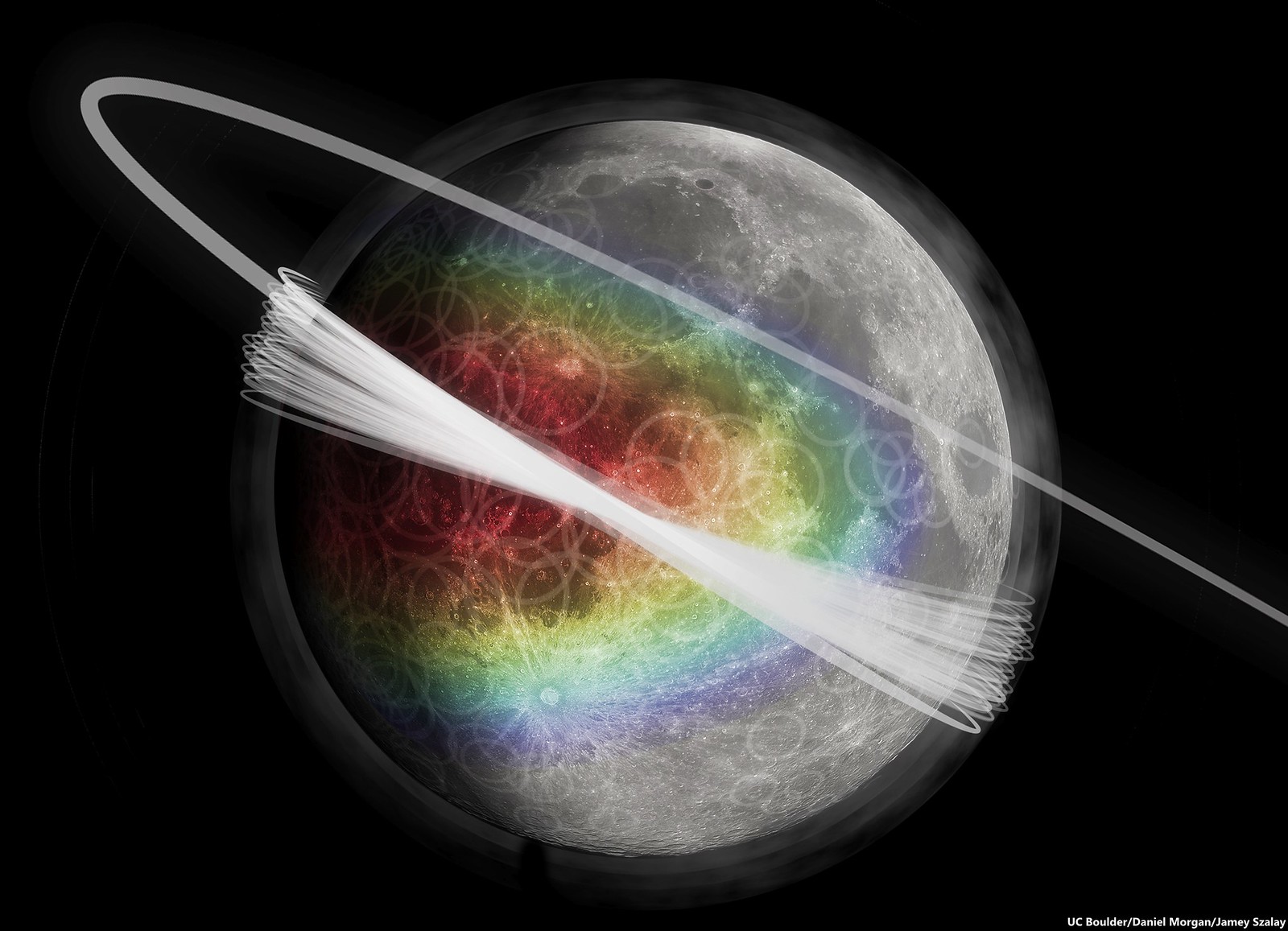
Artist's conception of the lunar dust exosphere surrounding the moon. The color represents the amount of material ejected from the surface, showing a peak in the apex direction. A haze of dust is shown around the moon. Gray faded circles are overlaid on the lunar surface to represent the random nature of the primary impactors. An artist's conception of the LADEE orbital inclination is also shown [UC Boulder/Daniel Morgan/Jamey Szalay].
Darryl Waller
Sharon Lozano
NASA Ames

New science results from NASA’s LADEE mission (Lunar Atmosphere and Dust Environment Explorer) indicate the Moon is regularly engulfed in a permanent, but lopsided and transitory, dust cloud increasing in density during encounters with cometary debris, like those producing the Geminids, according to a new study led by University of Colorado Boulder.

"Knowledge about the dusty environments in space has practical applications," said CU-Boulder physics Professor Mihály Horányi. "Knowing where the dust is and where it is headed in the solar system could help mitigate hazards for future human exploration, including dust particles damaging spacecraft or harming astronauts."

The cloud was discovered using data from a detector on board LADEE called the Lunar Dust Experiment (LDEX) designed and built by CU-Boulder. LDEX charted more than 140,000 impacts during the six-month survey launched in September 2013. NASA’s Ames Research Center in Moffett Field, California was responsible for spacecraft design, development, testing and mission operations.

“The LDEX team has been painstakingly analyzing their data since the LADEE mission ended on April 18, 2014,” said LADEE project scientist at Ames, Rick Elphic. “Their results answer one of the big LADEE science questions: is there a dust component to the tenuous lunar atmosphere?  And if so, why is it there?” 

According to Horányi, the cloud is primarily made up of tiny dust grains kicked up from the moon’s surface by the impact of high-speed, interplanetary dust particles. A single dust particle from a comet striking the moon’s surface lofts thousands of smaller dust specks into the airless environment, and the lunar cloud is maintained by this sometimes predictable process of regolith "gardening."

“Identifying this permanent dust cloud engulfing the moon was a nice gift from this mission,” said Horányi, the principal investigator for the LDEX instrument and lead author of the study. “We can carry these findings over to studies of other airless bodies, like the moons of other planets and the asteroids.”
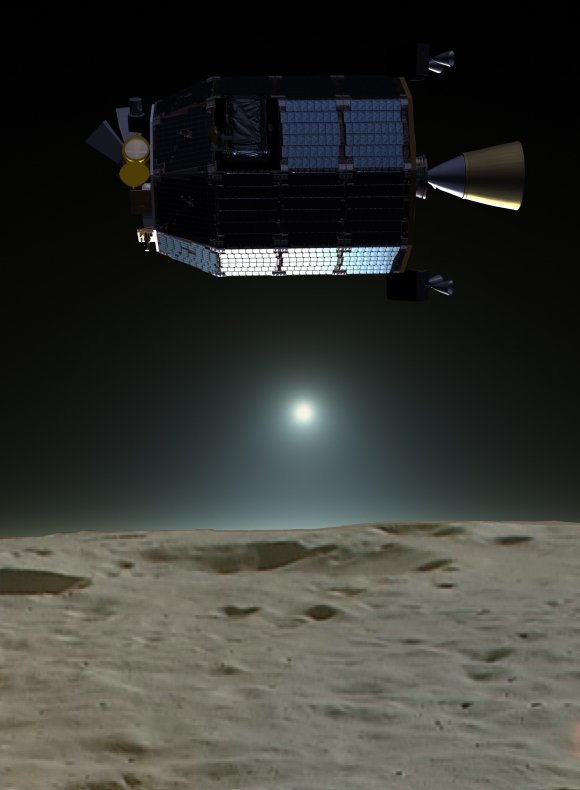
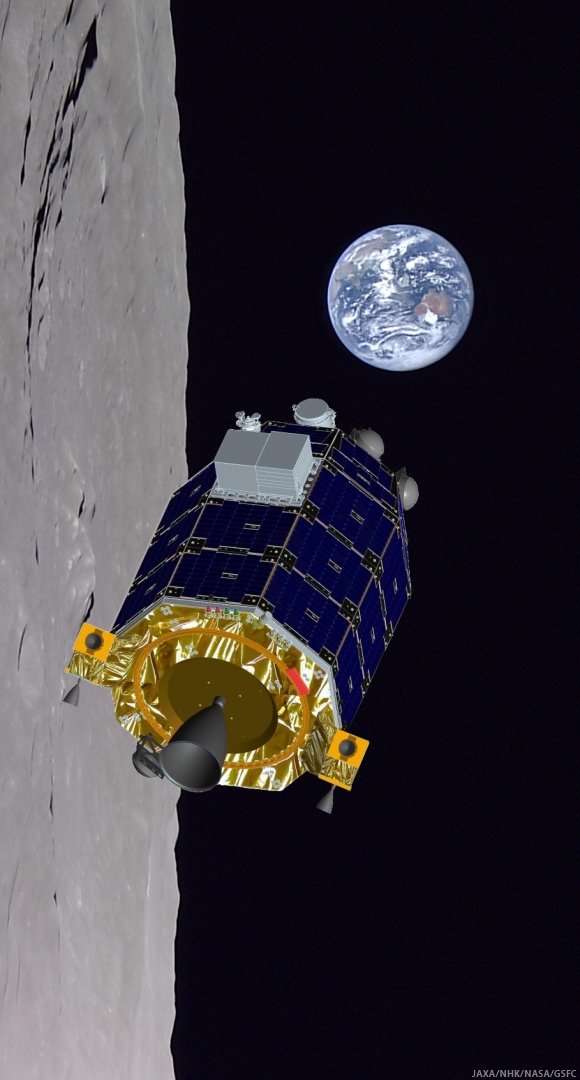
Artist's composite showing LADEE spacecraft in close orbit [NASA/JAXA/LP].
A paper on the subject appears in the June 17 issue of Nature. Co-authors Jamey Szalay, Sascha Kempf, Eberhard Grun and Zoltan Sternovsky from CU-Boulder, Juergen Schmidt from the University Oulu in Finland, and Ralf Srama from the University of Stuttgart in Germany.

The first hints of a cloud of dust around the moon came in the late 1960s when cameras functioning overnight aboard the unmanned moon lander Surveyor 7 captured bright glow hours ahead of lunar sunrise. Not long after astronauts in lunar orbit described a significant glow above the lunar surface when approaching sunrise, phenomenon brighter than the sun by itself should have been able to produce over a body with only a trace, essentially non-existent, atmosphere.

Because these new findings do not square with the Apollo reports of a thicker, higher dust cloud, conditions back then may have been somewhat different. The dust on the moon -- which is dark and sticky and regularly dirtied the suits of moonwalking astronauts -- was created over several billion years as interplanetary dust particles incessantly pounded the rocky lunar surface.

Apollo 17 commander Gene Cernan's sketches and description of horizon glow and streamers observed in lunar orbit in December 1972 [NASA].
Many of the cometary dust particles impacting lunar surface are traveling at thousands of miles per hour in a retrograde, or counterclockwise orbit around the sun, the opposite orbital direction of the solar system’s planets. This causes high-speed, near head-on collisions with the dust particles and the moon’s leading surface as the Earth-moon system travel together around the sun.

Related LADEE Posts:
LADEE impact crater found (October 29, 2014)
First Science from LADEE (45th LPSC, March 18 2014)
LADEE's (star tracker) images of the Moon (February 14, 2014)
LADEE economy adds 28 days to mission (February 5, 2014)
LROC captures LADEE from 9,000 meters (January 30, 2014)
Red Moon, Blue Moon Dwayne DayThe Space Review (December 3, 2013)
LADEE begins collecting data (November 22, 2013)
LADEE transitioning out of commissioning phase (November 6, 2013)
Apollo 12 ALSEP first to measure dust accumulation (November 21, 2013)
Chang'e-3 & LADEE: The Role of Serendipity (October 31, 2013)
LADEE LLCD sets new data record (October 25, 2013)
Measuring almost nothing, looking for the almost invisible (October 16, 2013)
LADEE legacies (September 7, 2013)
LADEE Prelaunch Mission Briefing (September 6, 2013)
ESA prepares for LADEE (July 31, 2013)
LADEE arrives at Wallops Island (June 5, 2013)
LADEE ready to baseline dusty lunar exosphere (June 5, 2013)
First laser comm system ready for launch on LADEE (March 16, 2013)
LADEE project manager update (February 6, 2013)
The Mona Lisa test for LADEE communications (January 21, 2013)
Toxicity of lunar dust (July 2, 2012)
Expectations for the LADEE LDEX (March 23, 2012)
The Dust Management Project (August 9, 2010)
LADEE architecture and mission design (July 6, 2010)
DesertRatS testing electrodynamic dust shield (July 5, 2010)
Dust transport and its importance in the origin of lunar swirls (February 21, 2010)
Dust accumulation on Apollo laser reflectors may indicate a surprisingly fast and
more dynamic lunar exosphere
 (February 16, 2010)
NASA applies low cost lessons to LADEE (January 18, 2010)
Nanotech advances in lunar dust mitigation (August 19, 2009)
Moon dust hazard influenced by Sun's elevation (April 17, 2009)
LADEE launch by Orbital from Wallops Island (April 14, 2009)
Understanding the activation and solution properties of lunar dust
for future lunar habitation
 (March 2, 2009)
Respiratory toxicity of lunar highland dust (January 19, 2009)
Toxicological effects of moon dust (June 25, 2008)
Moon dust and duct tape (April 22, 2008)

Wednesday, October 29, 2014

LADEE impact crater found

LADEE impact site on the eastern rim of Sundman V crater, the spacecraft was heading west when it impacted the surface. The image was created by ratioing two images, one taken before the impact and another after the impact. The bright area shows the impact point and the ejecta (things that have changed between the time of the two images). The ejecta form a V shaped pattern extending to the northwest from the impact point. Ratio constructed with LROC images M1163066820RE and M1101816767RE [NASA/GSFC/Arizona State University].
Mark Robinson
Principal Investigator
Lunar Reconnaissance Orbiter Camera (LROC)
Arizona State University

The Lunar Atmosphere and Dust Environment Explorer (LADEE) was launched from Wallops Island on 6 September 2013 at 11:27 EDT and was visible over much of the eastern coast of the United States. The spacecraft was 2.37 m (7.8 ft) high and 1.85 m (6.1 ft) wide with a mass of 383 kg (844 lb) including the fuel.

After expending most of its fuel during its successful exploration of the Moon the spacecraft had a mass of about only 248 kg (547 lb) when it impacted the surface.

Artist's rendition of the LADEE spacecraft in orbit around the Moon [NASA/JAXA/LP].
Originally LADEE was placed into a retrograde, near-equatorial orbit to study the Moon's surface bound exosphere and dust environment. Since the Apollo era of exploration several conflicting ideas and observations concerning the existence (or not) of near-surface and high altitude dust were debated, and thus one of LADEE’s key science goals was to search for dust particles high above the surface (no dust was found).

LADEE's engines were fired on 11 April 2014 to adjust the orbit in such a way as to guarantee a farside impact if the spacecraft did not survive the 15 April 2014 eclipse. There was a small worry that if the spacecraft failed during the eclipse and was uncontrollable, it might impact near one of the Apollo sites. Over the subsequent 7 days, the low point in LADEE's orbit decreased resulting in an impact on 18 April 2014.

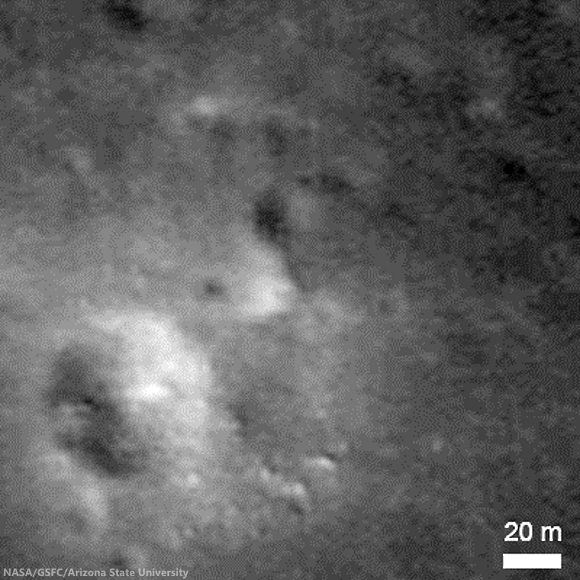
Before and after images of the LADEE impact site [NASA/GSFC/Arizona State University].
As it passed over the western limb as seen from the Earth, the spacecraft impacted the eastern rim of Sundman V crater (11.85°N, 266.75°E). The impact site (11.8494°N, 266.7507°E) is about 780 m from the crater rim with an altitude of about 2590 m, and was only about 295 meters north of its originally predicted location (based on tracking data).

Like the LADEE spacecraft, the impact crater is small, greater than 3 meters in diameter, barely resolvable by the LROC NAC. Based on impact models, a crater of only about 1.8 m (6 ft) diameter is expected. The crater is very small because, as impacts go, LADEE had a low mass and a low density (0.43 g / cm3 vs. larger than 3.0 g / cm3 for an ordinary chondrite meteorite), and was traveling at only a tenth the speed (1699 m/sec - 3800 mph) of an average asteroid.

LADEE impact crater (centered of image) has a distinctive hour-glass albedo pattern indicative of low angle impacts. Bright material extends to the northwest, while only a minor amount was ejected to the southeast; NAC M1163066820RE [NASA/GSFC/Arizona State University].
Because it is so small, the crater is hard to identify among the myriad of small fresh craters that dot the lunar surface. However, as images had been acquired of the impact region before the impact occurred, they could be compared with images acquired after the impact to identify the crater.

Since NAC images are so large (250 megapixels) and the new crater is so small the LROC team coregistered the before and after images (called a temporal pair) and then divided the after image by the before image. In this manner any changes to the surface stick out like a beacon! For the LADEE crater the ejecta forms a triangular pattern primarily downrange (to the west) extending more than 200 meters from the impact site. There is also a small triangular area of ejecta uprange but it extends only about 20-30 meters. The ejecta pattern is oriented WNW consistent with the direction the spacecraft was traveling when it impacted.

Zoomed-in view of the impact site, image is 200 m across, NAC M1163066820RE [NASA/GSFC/Arizona State University].
Explore the catalog of LROC close-ups of lunar spacecraft landing and impact sites, HERE.

Related LADEE Posts:
First Science from LADEE (45th LPSC, March 18 2014)
LADEE's (star tracker) images of the Moon (February 14, 2014)
LADEE economy adds 28 days to mission (February 5, 2014)
LROC captures LADEE from 9,000 meters (January 30, 2014)
Red Moon, Blue Moon Dwayne DayThe Space Review (December 3, 2013)
LADEE begins collecting data (November 22, 2013)
LADEE transitioning out of commissioning phase (November 6, 2013)
Apollo 12 ALSEP first to measure dust accumulation (November 21, 2013)
Chang'e-3 & LADEE: The Role of Serendipity (October 31, 2013)
LADEE LLCD sets new data record (October 25, 2013)
Measuring almost nothing, looking for the almost invisible (October 16, 2013)
LADEE legacies (September 7, 2013)
LADEE Prelaunch Mission Briefing (September 6, 2013)
ESA prepares for LADEE (July 31, 2013)
LADEE arrives at Wallops Island (June 5, 2013)
LADEE ready to baseline dusty lunar exosphere (June 5, 2013)
First laser comm system ready for launch on LADEE (March 16, 2013)
LADEE project manager update (February 6, 2013)
The Mona Lisa test for LADEE communications (January 21, 2013)
Toxicity of lunar dust (July 2, 2012)
Expectations for the LADEE LDEX (March 23, 2012)
The Dust Management Project (August 9, 2010)
LADEE architecture and mission design (July 6, 2010)
DesertRatS testing electrodynamic dust shield (July 5, 2010)
Dust transport and its importance in the origin of lunar swirls (February 21, 2010)
Dust accumulation on Apollo laser reflectors may indicate a surprisingly fast and
more dynamic lunar exosphere
 (February 16, 2010)
NASA applies low cost lessons to LADEE (January 18, 2010)
Nanotech advances in lunar dust mitigation (August 19, 2009)
Moon dust hazard influenced by Sun's elevation (April 17, 2009)
LADEE launch by Orbital from Wallops Island (April 14, 2009)
Understanding the activation and solution properties of lunar dust
for future lunar habitation
 (March 2, 2009)
Respiratory toxicity of lunar highland dust (January 19, 2009)
Toxicological effects of moon dust (June 25, 2008)
Moon dust and duct tape (April 22, 2008)

Friday, February 14, 2014

LADEE's first images of the Moon

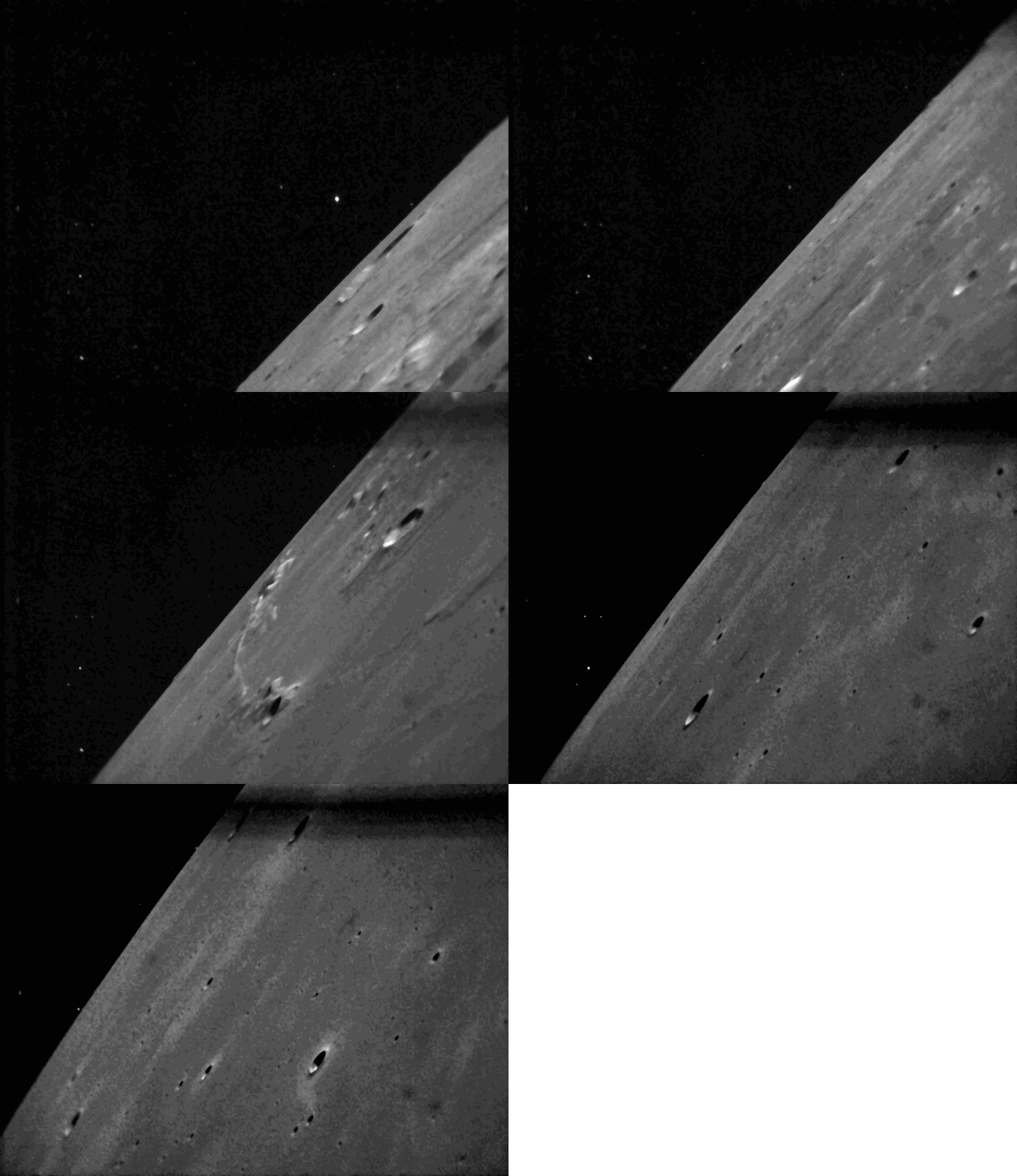
Series of LADEE star tracker images show the starfield against which the spacecraft baselines the data it collects eclipsed by the Moon below, as the short-lived mission's orbit skirts the northern edge of the Aristarchus plateau [NASA/ARC].
Rachel Hoover
NASA Ames Research Center

Earlier this month, NASA's Lunar Atmosphere and Dust Environment Explorer (LADEE) observatory successfully downlinked images of the moon and stars taken by onboard camera systems, known as star trackers. This is the first time the LADEE team commanded the spacecraft to send these pictures back to Earth.

The main job of a star tracker is to snap images of the surrounding star field so that the spacecraft can internally calculate its orientation in space. It completes this task many times per minute. The accuracy of each of LADEE's instruments' measurements depends on the star tracker calculating the precise orientation of the spacecraft.

"Star tracker cameras are actually not very good at taking ordinary images," said Butler Hine LADEE project manager at NASA's Ames Research Center in Moffett Field, California "But they can sometimes provide exciting glimpses of the lunar terrain."

Given the critical nature of its assignment, a star tracker doesn't use ordinary cameras. Star trackers' lenses have a wide-angle field of view in order to capture the night sky in a single frame.

The images shown here were acquired on February 8, 2014, around 2345 UT, while LADEE was carrying out atmospheric measurements. The series of five images were taken at one-minute intervals, and caught features in the northwestern hemisphere of the moon. LADEE was traveling approximately 100 km per minute along its retrograde semi-equatorial orbit. All images were taken during lunar night, but with Earthshine illuminating the surface.

The initial image captured the smooth-floored crater Krieger (22.86 km, 29.02°N, 314.39°E) on the horizon, with 7 km Toscanelli in the foreground.

The second image shows Wollaston P, about 4 km across near the horizon, and the southeastern flank of the lunar mountain Mons Herodotus.

The third image caught a minor lunar mountain range Montes Agricola, the northwest frontier of the Aristarchus Plateau, as well as the flat-floored crater Raman, about 10 km in diameter.

Image four in the series captures 6 km Golgi and 5 km Zinner.

The final image views craters Lichtenberg A (6.9 km, 28.9°N, 299.89°E) and Schiaparelli E (4.9 km, 27.12°N, 297.93°E) in the smooth mare basalt plains of western Oceanus Procellarum.

LADEE (nomenclature)
Location of LADEE Star Tracker Cameras in relation to its primary components [NASA/LEAG].
The star trackers will operate while LADEE continues to measure the chemical composition of the atmosphere, collect and analyze samples of lunar dust particles in the atmosphere and hope to address a long-standing question: Was lunar dust, electrically charged by sunlight, responsible for the pre-sunrise glow above the lunar horizon observed during several Apollo missions? And who knows? The star trackers may help answer that question.

Wednesday, February 5, 2014

LADEE economy adds 28 days to mission

NASA's LADEE, last of the unmanned Constellation precursor missions, in retrograde orbit "baselines" the dusty fallout of the Moon's tenuous exosphere ahead of lunar sunrise [NASA/ARC/JAXA/Dana Berry].
Rachel Hoover
NASA Ames Research Center

NASA's Lunar Atmosphere and Dust Environment Explorer (LADEE) has been approved for a 28-day mission extension. The spacecraft is now expected to impact the lunar surface on or around April 21, 2014, depending on the final trajectory.

The extension provides an opportunity for the satellite to gather an additional full lunar cycle worth of very low-altitude data to help scientists unravel the mysteries of the moon’s atmosphere.

"The launch vehicle performance and orbit capture burns using LADEE's onboard engines were extremely accurate, so the spacecraft had significant propellant remaining to enable extra science," said Butler Hine, LADEE project manager at NASA’s Ames Research Center in Moffett Field, California, where the mission was designed, built, tested, and its day-to-day operations are managed. "This extension represents a tremendous increase in the amount of science data returned from the mission."

The small, car-sized robotic probe launched Sept. 6, 2013, from NASA's Wallops Flight Facility on Wallops Island, Virginia, and has been orbiting the moon since October 6.

On November 10, LADEE began gathering science data and on November 20, the spacecraft entered its science orbit around the moon's equator at an altitude between 12 to 60 kilometers; a unique position that allows the spacecraft to frequently pass from lunar day to lunar night, approximately every two hours. This vantage provides data about the full scope of changes and processes occurring within the moon's tenuous atmosphere.

"The science team has already established a baseline of data for the tenuous lunar atmosphere, or exosphere, and dust impacts," said Rick Elphic LADEE project scientist at Ames. "One cool thing about this extension is that we plan to fly LADEE at only a few kilometers above the lunar surface. This will be much lower than we’ve been before."

Using a set of three instruments, scientists are able to measure the chemical composition of the atmosphere, collect and analyze samples of lunar dust particles in the atmosphere and hope to address a long-standing question: Was lunar dust, electrically charged by sunlight, responsible for the pre-sunrise glow above the lunar horizon detected during several Apollo missions?

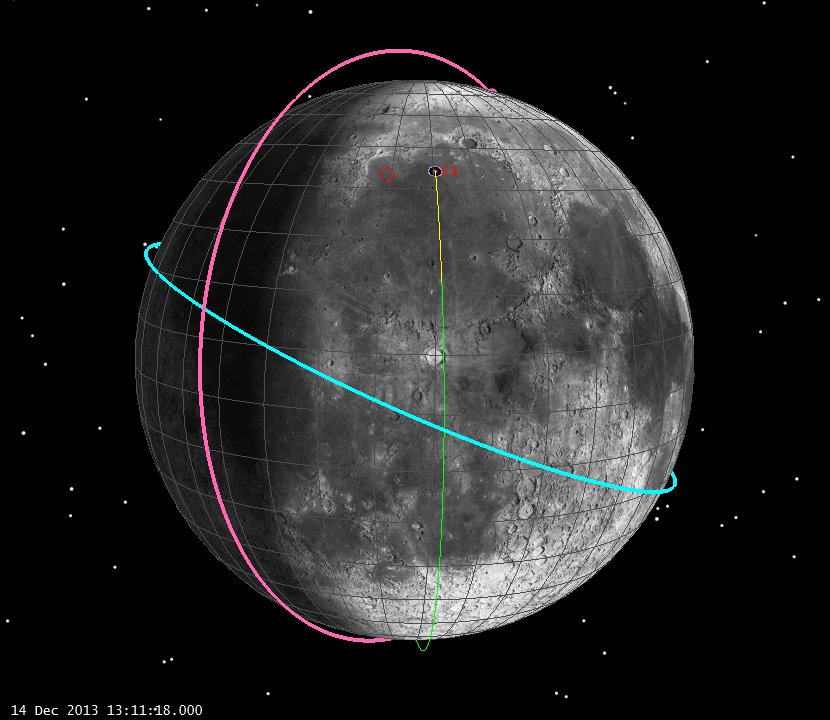
Relative orbital positions of LRO (red), LADEE (blue) and Chang'e-3 only minutes prior to the latter's landing in Mare Imbrium, December 14 ["Post-Landing look at Chang'e trajectory," The Astrogator's League (astrogatorsleague.com)].
Specifically, the Neutral Mass Spectrometer (NSM) operates while pointing in different directions to look for atoms and molecules in the lunar atmosphere from a variety of sources, and has measured helium, neon, and argon-40; three noble gases. The Ultraviolet-Visible Spectrometer (UVS) has peered over the lunar horizon to look for the glow of atoms, molecules and dust in the lunar atmosphere and has made measurements of atmospheric sodium and potassium at lunar sunset, sunrise and noon. The Lunar Dust Experiment (LDEX) recorded dust impacts as soon as its cover opened and has measured the dust tossed up by a fairly steady "rain" of meteoroids on the lunar surface. LDEX occasionally sees an increase in dust impacts due to meteoroid showers, such as the Geminids, and "dust bursts" that may be due to LADEE flying through plumes kicked up from nearby meteoroid impacts.

Detailed information about the structure and composition of the thin lunar atmosphere and whether dust is being lofted into the lunar sky will help researchers understand other bodies in the solar system, such as large asteroids, Mercury and the moons of outer planets.

LADEE was built using an Ames-developed Modular Common Spacecraft Bus architecture, a general purpose spacecraft design that allows NASA to develop, assemble and test multiple modules at the same time. The LADEE bus structure is made of a lightweight carbon composite with an unfueled mass of 547.2 pounds.

NASA's Science Mission Directorate in Washington funds the LADEE mission. Ames manages the overall mission and serves as a base for mission operations and real-time control of the probe. NASA's Goddard Space Flight Center in Greenbelt, Maryland, catalogues and distributes data to a science team located across the country and manages the science instruments. NASA's Marshall Space Flight Center in Huntsville, Alabama manages LADEE within the Lunar Quest Program Office.

Related Recent Posts:
LROC captures LADEE from 9,000 meters (January 30, 2014)
Red Moon, Blue Moon Dwayne Day, The Space Review (December 3, 2013)
LADEE begins collecting data (November 22, 2013)
LADEE transitioning out of commissioning phase (November 6, 2013)
Apollo 12 ALSEP first to measure dust accumulation (November 21, 2013)
Chang'e-3 & LADEE: The Role of Serendipity (October 31, 2013)
LADEE LLCD sets new data record (October 25, 2013)
Measuring almost nothing, looking for the almost invisible (October 16, 2013)
LADEE legacies (September 7, 2013)

Thursday, January 30, 2014

LROC captures LADEE at 9 km

LADEE 9 km from LRO (LROC NAC)
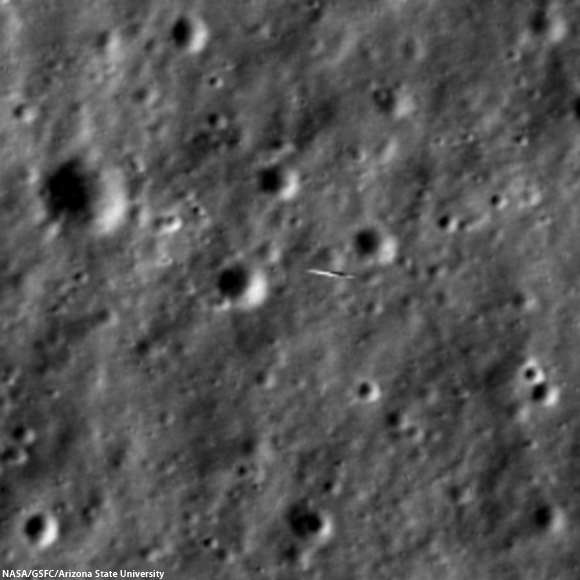
NASA's Lunar Atmosphere and Dust Environment Explorer (LADEE) caught zooming 9-km below LRO, all the more amazing since the spacecraft orbit the Moon in orbits perpendicularly to one another, or 90° out of phase. LROC NAC M1144387511LR  [NASA/GSFC/Arizona State University].
Mark Robinson
Principal Investigator
Lunar Reconnaissance Orbiter Camera (LROC)
Arizona State University

Teamwork! Imaging NASA's Lunar Atmosphere and Dust Environment Explorer (LADEE) spacecraft with LROC required extremely precise timing, worked out by the LADEE, LROC, and LRO operations teams. LADEE is in an equatorial orbit (east-to-west) while LRO is in a polar orbit (south-to-north).

By happenstance the two spacecraft are occasionally very close - on 15 January the two came within 9 km of each other. Since LROC is a pushbroom imager, it builds up an image one line at a time, thus catching a target as small and fast as LADEE is tricky! Both spacecraft are orbiting the Moon with velocities near 1600 meters per second (3600 mph), so timing and pointing of LRO needs to be nearly perfect to capture LADEE in an LROC image.

LADEE 9 km from LRO (LROC NAC)
LADEE smeared out against the lunar background. Image expanded 4x, lunar scene 81 meters wide, LADEE about 2 meters in the long direction [NASA/GSFC/Arizona State University].
LADEE passed directly beneath the LRO orbit plane a few seconds before LRO crossed the LADEE orbit plane, meaning a straight down LROC image would have just missed LADEE. Now is where the careful planning came into play. The LADEE and LRO teams worked out the solution: simply have LRO roll 34° to the west so the LROC detector (one line) would be in the right place as LADEE passed beneath.

As planned at 8:10:51.693 PM EST on 14 January 2014 LADEE entered the NAC field of view for 1.35 milliseconds and a smeared image of the intrepid spacecraft was snapped. LADEE appears in four lines of the LROC NAC-R, and is distorted right-to-left. What can we see in the LADEE pixels in the NAC image?

Geometrically corrected image of LADEE, 4x enlargement[NASA/GSFC/Arizona State University].
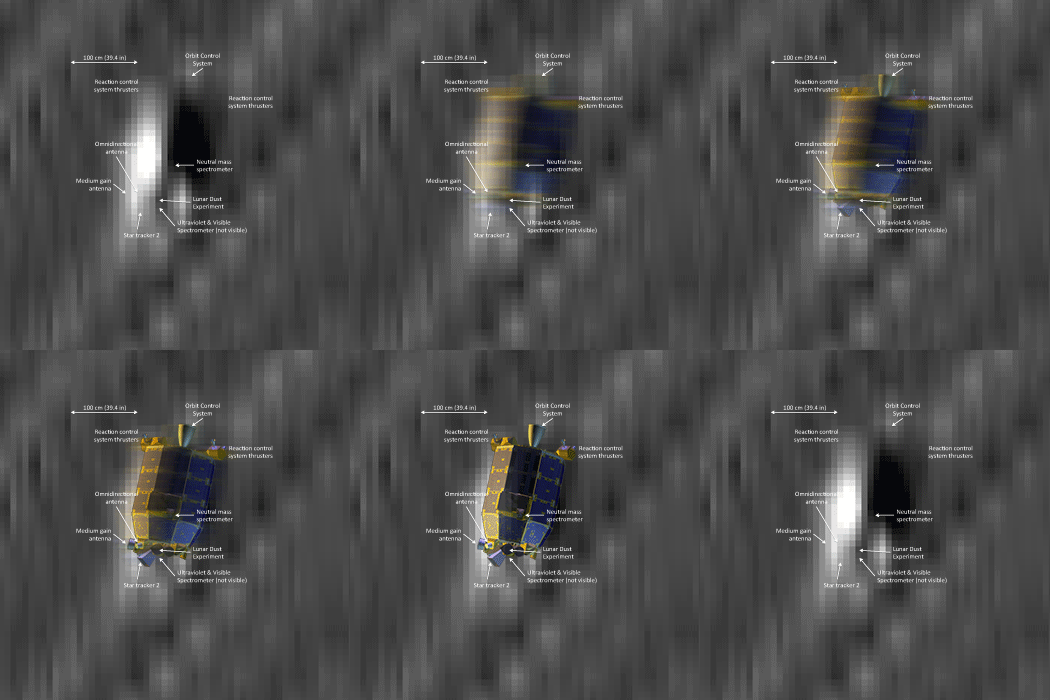
Step one is to minimize the geometric distortion in the smeared lines that show the spacecraft. However, in doing so the background lunar landscape becomes distorted and unrecognizable (see above). The scale (dimension) of the NAC pixels recording LADEE is 9 cm (3.5 in), however, since the spacecraft were both moving about 1600 meters per second the image is blurred in both directions by around 50 cm. So the actual pixel scale lies somewhere between 9 cm and 50 cm, thus even with geometric correction LADEE is a bit blurry. Despite the blur it is possible to find details of the spacecraft, which is about 1 meter wide and 2 meters long. You can see the engine nozzle, bright solar panel, and perhaps a star tracker camera (especially if you have a correctly oriented schematic diagram of LADEE for comparison).

Computer generated image of LADEE oriented and illuminated as
it was during the close pass with LRO
[NASA ARC/LADEE].
LADEE was designed to study the Moon's thin exosphere and the lunar dust environment. An “exosphere” is an atmosphere that is so thin that molecules do not collide with each other. This exosphere is so tenuous that the number of molecules in a given volume at the Moon is less than the number of molecules in the same volume of space outside the International Space Station..

Dissolve animation with NAC image of LADEE and labeled LADEE graphic
degraded to match NAC resolution
[NASA/GSFC/ARC/Arizona State University].
LADEE is still early in its mission. One of the more exciting moments so far was observing how the lunar exosphere changed as the Chinese lander Chang'e 3 set down on the Moon on 14 December 2013. There was concern that the exhaust plume might spread out and mix with native molecules causing a contamination problem for the LADEE measurements, but so far no problem.

Find LADEE in the NAC left/right mosaic, the irregular shape of the image is due to topography and the off-nadir slew (hint: LADEE coordinates sample 9514, line 19827), HERE.

Related LROC Featured Images:
Impact!
Mountains of the Moon

Friday, November 22, 2013

LADEE begins collecting data

NASA Ames / Dana Berry
NASA's Lunar Atmosphere and Dust Environment Explorer (LADEE) spacecraft, in orbit above the Moon, as dust scatters light during lunar sunset [NASA/ARC/JAXA/Dana Berry].
Rachel Hoover
NASA Ames Research Center

NASA's Lunar Atmosphere and Dust Environment Explorer (LADEE) is ready to begin collecting science data about the Moon.

On November 20, the spacecraft successfully entered its planned orbit around the Moon's equator -- a unique position allowing the small probe to make frequent passes from lunar day to lunar night. This will provide a full view of the changes and processes occurring within the moon's tenuous atmosphere.

LADEE now orbits the moon about every two hours at an altitude of 12 to 60 km above the Moon's surface. For about 100 days, the spacecraft will gather detailed information about the structure and composition of the thin lunar atmosphere and determine whether dust is being lofted into the lunar sky.

Scientists will be able to study the conditions in the atmosphere during lunar sunrise and sunset, where previous crewed and robotic missions detected a glow of rays and streamers reaching high into the lunar sky.

“This is what we’ve been waiting for – we are already seeing the shape of things to come,” said Rick Elphic, LADEE project scientist at NASA's Ames Research Center in Moffett Field, California

On November 20, flight controllers in the LADEE Mission Operations Center at Ames confirmed LADEE performed a crucial burn of its orbit control system to lower the spacecraft into its optimal position to enable science collection. Mission managers will continuously monitor the spacecraft's altitude and make adjustments as necessary.

"Due to the lumpiness of the moon's gravitational field, LADEE's orbit requires significant maintenance activity with maneuvers taking place as often as every three to five days, or as infrequently as once every two weeks," said Butler Hine, LADEE project manager at Ames. "LADEE will perform regular orbital maintenance maneuvers to keep the spacecraft’s altitude within a safe range above the surface that maximizes the science return."

In addition to science instruments, the spacecraft carried the Lunar Laser Communications Demonstration, NASA's first high-data-rate laser communication system. It is designed to enable satellite communication at rates similar to those of high-speed fiber optic networks on Earth. The system was tested successfully during the commissioning phase of the mission, while LADEE was still at a higher altitude.

LADEE was launched September 6 on a US Air Force Minotaur V, an excess ballistic missile converted into a space launch vehicle and operated by Orbital Sciences Corporation of Dulles, Virginia. LADEE is the first spacecraft designed, developed, built, integrated and tested at Ames, and it is the first probe launched beyond Earth orbit from NASA's Wallops Flight Facility on the Virginia's Eastern Shore.

NASA's Science Mission Directorate in Washington funds the LADEE mission. Ames manages the overall mission and serves as a base for mission operations and real-time control of the probe. NASA's Goddard Space Flight Center in Greenbelt, Maryland, manages the science instruments and technology demonstration payload, the science operations center and overall mission support. NASA's Marshall Space Flight Center in Huntsville, Alabama, manages LADEE within the Lunar Quest Program Office.

Thursday, November 21, 2013

Apollo 12 ALSEP first to measure dust accumulation

Apollo 12 ALSEP Central Station
Apollo 12 ALSEP, Central Station, with DTREM (Lunar Dust Collector) marked with arrow. Alan J. Bean, EVA-1;  Oceanus Procellarum, November 19, 1969 (AS12-47-6927) [NASA/JSC/ALSJ].
A dataset thought to have been lost, from an ingenious experiment deployed on the Moon by Apollo astronauts more than four decades ago, has been rediscovered and analyzed. As a result, the Lunar Dust Collector deployed as integral to the Apollo 12 ALSEP system, has become the first instrument to record a measurable rate of dust accumulation on the lunar surface. 

The news is timely, of course, coming the beginning of the Lunar Atmosphere and Dust Environment Explorer (LADEE) science mission, and arriving on November 19, the 44th anniversary of the Apollo 12 expedition.

Keith Cowing
Moonviews.com (LOIRP)

The Lunar Dust Detector, attached to the corner of (the ALSEP Central Station, pictured above), left by the Apollo 12 astronauts, made the first measurement of lunar dust accumulation. As the matchbox-sized device's three solar panels became covered by dust, the voltage they produced dropped.

When Neil Armstrong took humanity's first otherworldly steps in 1969, he didn't know what a nuisance the lunar soil beneath his feet would prove to be. The scratchy dust clung to everything it touched, causing scientific instruments to overheat and, for Apollo 17 astronaut Harrison Schmitt, a sort of lunar dust hay fever. The annoying particles even prompted a scientific experiment to figure out how fast they collect, but NASA's data got lost.

AS17-145-22157
Retrieving a surface sample behind boulders on a crater rim at Apollo 17 Science Station 5, Taurus Littrow valley; December 12, 1972 - Lunar module pilot and geologist Harrison Schmitt already carries a substantial sampling of abrasive, fine lunar dust on his moon suit. Schmitt endorsed development of 'dust mitigation' technology as a high priority for program planners prior to establishing 'extended human activity' on the Moon (Eugene Cernan - AS17-145-22157) [NASA/JSC/ALSJ].
Or, so NASA thought. Now, more than 40 years later, scientists have used the rediscovered data to make the first determination of how fast lunar dust accumulates. It builds up unbelievably slowly by the standards of any Earth-bound housekeeper, their calculations show -- just fast enough to form a layer about a millimeter (0.04 inch) thick every 1,000 years. Yet, that rate is 10 times previous estimates. It's also more than speedy enough to pose a serious problem for the solar cells that serve as critical power sources for space exploration missions.

Thursday, November 14, 2013

An update on the ARTEMIS twins

ARTEMIS P1 and P2
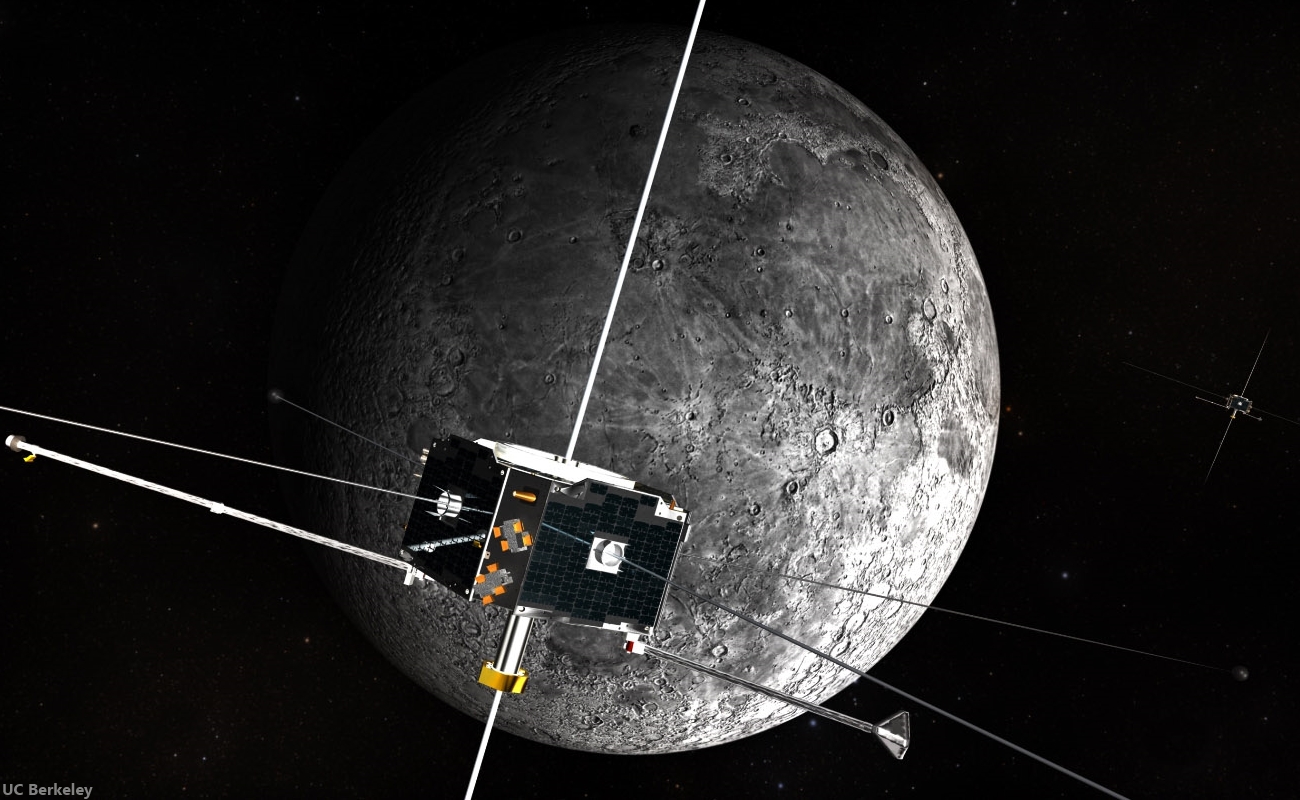
Following three years in lunar orbit ARTEMIS P1 and P2 are in excellent condition. Originally in Earth orbit, both spacecraft have been in lunar orbit since the summer of 2011 and in space since February 2007  [UC Berkeley].
Jasper Halekas
Acting Deputy Principal Investigator ARTEMIS
Space Physics Research Group

Space Sciences Lab
University of California at Berkeley

For those of you who aren't familiar with ARTEMIS, (the Acceleration, Reconnection, Turbulence, and Electrodynamics of the Moon's Interaction with the Sun mission) is an on-going "mission of opportunity," utilizing two of the original five-spacecraft heliophysics constellation THEMIS mission, "re-tasked" to study the interaction of the Moon and it's space plasma environment. 

The two ARTEMIS spacecraft have now been in elliptical equatorial orbits around the Moon since 2011 and continue to operate flawlessly. Both probes are in very stable orbits, and the health of the spacecrafts and all instruments remains very good.

ARTEMIS twins
A sample of the elaborate year-long transfer of the two "re-tasked" THEMIS probes from Earth orbit to lunar orbit. ARTEMIS P1 was the first spacecraft navigated to, and performing station-keeping operations around, the Earth-Moon L1 and L2 Lagrangian points [UC Berkeley].
Current ARTEMIS lunar investigations are focusing on measuring pickup ions from the exosphere, the electrostatic charging of the surface, the plasma wake, and the interaction of the solar wind with remanent crustal magnetic anomalies. ARTEMIS also uses lunar orbit as a platform to observe the solar wind and (around full Moon) the distant terrestrial magnetotail.

More details on recent studies can be found HERE.

With the LADEE mission about to enter its nominal science orbit, and LRO placing new emphasis on its own measurements of the lunar exosphere, ARTEMIS plays a key role by providing complementary measurements of the solar and terrestrial plasma that acts as both a source and sink for the lunar exosphere, affecting dust released from the lunar surface. Together, these three missions team together to measure the inputs, dynamics, and outputs of the coupled system formed by the Moon's surface, its dusty exosphere and the space environment.

All ARTEMIS data is publicly available on a few-day time scale, and we welcome participation from the community. More information on the mission, instrumentation, data (including summary plots), software, etc. is available from http://artemis.ssl.berkeley.edu, or by contacting the team directly.

Related Posts:
"Dead spacecraft walking" (October 28, 2010)

YouTube demonstration of the re-routing of the two retired THEMIS orbiters to their new bonus mission in lunar orbit.

Wednesday, November 6, 2013

LADEE transitioning out of commissioning phase

LADEE in lunar orbit
Dana Berry's concept of the NASA Lunar Atmosphere and Dust Environment Explorer (LADEE) in low lunar orbit [NASA/ARC].
Rick Elphic
LADEE Project Scientist

Things are going very well on LADEE.  We've spent the last few weeks, following lunar orbit insertion, splitting our efforts between the laser communication (LLCD) demonstration activities and science instrument commissioning.

The lasercomm (Lunar Laser Communications Demonstration, LLCD) activities have been highly successful, with the LADEE space terminal linking up with the ground terminal at White Sands optically in no more than a few tens of seconds, without resorting to commanding through the conventional RF uplink.  Lasercomm has demonstrated downlink rates as high as 622 megabits/sec, and uplinks of 20 megabits/sec.  This downlink rate is sufficient to convey HD video (if LADEE had HD video!).

The three science instruments have been stepping through a series of tests to characterize their performance in orbit around the Moon, and have acquired preliminary science and engineering data in our high, 250-km altitude commissioning orbit.  

The Neutral Mass Spectrometer (NMS) has performed atmospheric ram measurements as well as special operations for looking at atmospheric ions, as well as species sputtered from the lunar surface.  The Ultraviolet-Visible Spectrometer (UVS) has performed a series of calibration activities, including stellar calibrations, solar viewer calibrations, and telescope boresight calibrations.  UVS has also carried out a number of limb scans above the sunset, noon and sunrise limbs.  The Lunar Dust Experiment has been making many measurements at the 250-km altitude, to characterize the particle impact rates and background in this orbit. 

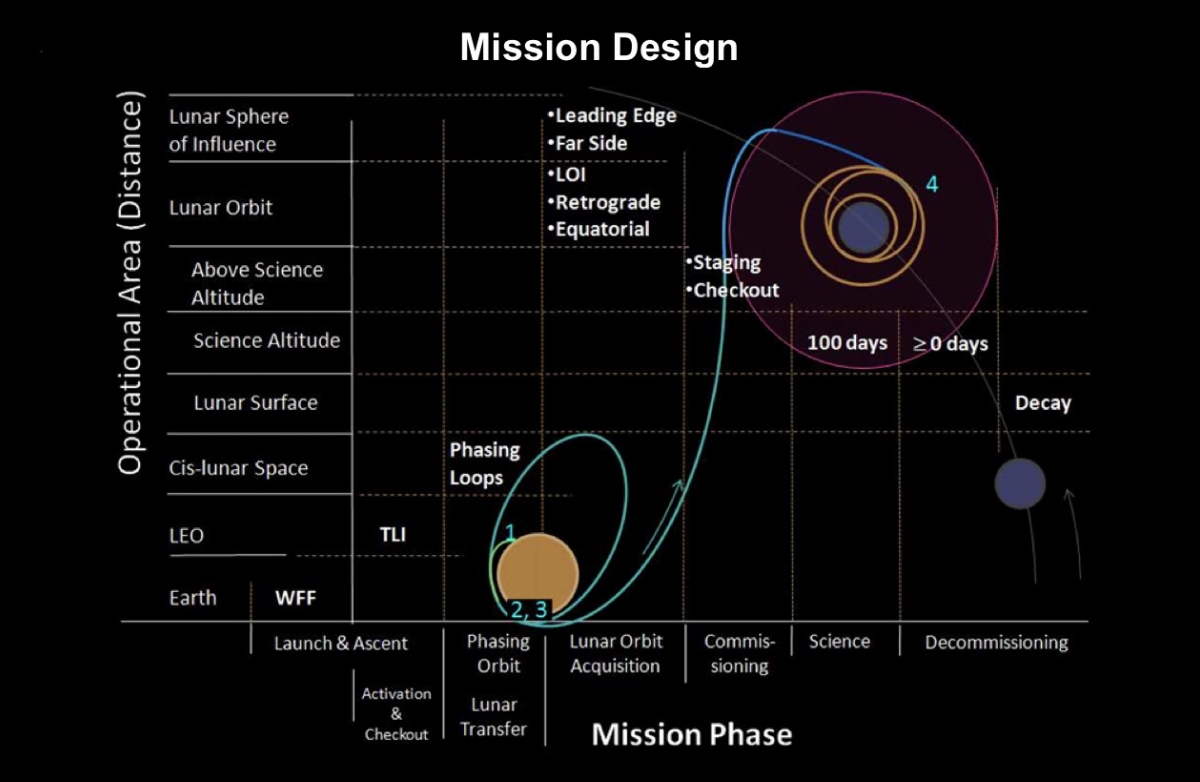
LADEE will soon be transitioning out of commissioning phase, starting with a maneuver to lower periapsis to around 50-km altitude over the sunrise terminator.  This maneuver is planned for Sunday, November 10, at  around 04:30 UT.  Following this maneuver the science instruments will begin taking data in a more science-like configuration.

After a final block of lasercomm testing, LADEE will drop apoapsis to its operational altitude of approximately 100 km over the sunset terminator on November 20, and then LADEE's science mission truly begins in earnest.

You can see more LADEE info at the official site, HERE, and via the Twitter account, HERE.

(HT: Clive Neal & Lunar-L)

Thursday, October 31, 2013

Chang'e 3 & LADEE: The Role of Serendipity

The Chang’E 3 spacecraft sets down on the Moon, and exhaust gas from its descent rockets change the lunar exosphere [NASA/CNSA].
Paul D. Spudis
The Once and Future Moon
Smithsonian Air & Space

The Lunar Atmosphere and Dust Environment Explorer (LADEE) spacecraft is currently circling the Moon.  With the spacecraft safely settled into its observation orbit, the mission science team is busy testing and calibrating its instruments.  This U.S. mission was designed to characterize the lunar “atmosphere” – the extremely tenuous zone of gases that vary in time in the space above the Moon.  Technically called an exosphere, this region contains extremely low concentrations of a variety of elements and compounds, of varied origins and a largely unknown life cycle.  LADEE is designed to monitor and characterize these species, with the goal of identifying the process and sources of the gases and how they vary with time.

Initially a precursor to human lunar return, LADEE was selected for development early in 2008, as we wanted to understand the lunar exosphere before the lunar environment was contaminated by humans.  The LADEE spacecraft is designed to observe the Moon in its natural, pristine state.  However, the very act of going to the Moon inadvertently (though briefly) modifies the lunar atmosphere.  When a spacecraft arrives at the Moon, it uses its on-board rocket engines to brake into lunar orbit or to descend to the surface.  These rockets spew large quantities of exhaust gas into space and as the vehicles get captured into the Moon’s gravity field, so too does this exhaust product.

From estimates drawn on the Apollo landings, the rocket exhaust expended from each Lunar Module temporarily doubled the total mass of the natural lunar atmosphere.  This artificial addition of gases eventually dissipates, driven off by solar interactions and other complex effects.  In time, the Moon resumes its normal state of near-vacuum.  The creation of a temporary artificial atmosphere created by rocket effluent and its subsequent dissipation is imperfectly understood, except to the extent that we know that it happens.  The one-month “commissioning phase” that the LADEE mission is currently experiencing was largely designed to ensure that the exhaust from the orbital braking burn of the spacecraft (and subsequent low-rate out-gassing from the spacecraft) is largely complete.  We want to measure the Moon’s environment, not the products of the craft that brought us there.

But the U.S. will not be the only one conducting a mission at the Moon for the next few months.  The long-planned Chinese robotic mission Chang’E 3 is scheduled for launch to the Moon in early December.  Their lander mission will place a fairly large (1200 kg) spacecraft on Sinus Iridum in the northwestern quadrant of the near side, deliver a small roving vehicle and examine and measure the properties of the lunar surface over the course of several months.  But before it begins its surface mission, the Chang’E 3 spacecraft will burn roughly 2600 kg of rocket fuel in the vicinity of the Moon’s exosphere.  I have not seen any documentation on the fuel this spacecraft will use, but it is highly likely that it will be the chemicals unsymmetrical dimethylhydrazine (UDMH; H2NN(CH3)2) and nitrogen tetroxide (N2O4).  These propellants are widely used in spacecraft because they are liquid at room temperature and can be easily stored in tanks for long periods of time (a requirement for long-duration spaceflight to destinations beyond low Earth orbit).

When UDMH and nitrogen tetroxide are burned in a rocket engine, they produce a variety of exhaust gases; the dominant combustion products are water (H2O), nitrogen (N2), carbon monoxide (CO), carbon dioxide (CO2), and a few trace species, including hydrogen (H2) and hydroxyl (OH).  Expelled by a rocket nozzle, these gases rapidly expand in all directions in the vacuum of space.  Because most of the burn occurs after the spacecraft has been “captured” by the gravity of the Moon, this rocket exhaust is also captured by the Moon.  Thus, exhaust from an orbital or a landing vehicle becomes (temporarily) part of the lunar atmosphere.

If you’re thinking that this “rude” addition of alien gases will mess up the very delicate phenomena that LADEE was designed to map and measure, you’re correct – it does.  You might even expect the scientists of the LADEE team would be very upset at this disruption of their carefully planned measurement strategy.  But you would be wrong.  This problem is actually an opportunity.

If successful, Chang'e 3 will perform the first soft-landing on the
Moon since Luna 24 in1976 and deploy the first lunar rover
 since Lunokhod 2 in 1973 [NASA/CNSA].
The coincidence of Chang’E 3 arriving at the Moon after LADEE has begun observations has developed into a serendipitous occurrence for lunar science.  Because we don’t understand very well how exospheric gases are added to and removed from the Moon, what has landed in our laps is an unplanned (but controlled) experiment.  A known quantity of gases – of known composition – will be added to the lunar atmosphere at a precisely known time, in a precisely known place.  One could have not designed a better experiment to measure how this addition of material is distributed, how its distribution evolves over time, and how these expelled gases dissipate into cislunar space.  Even better, LADEE will have almost a full month to monitor and characterize the lunar atmosphere before Chang’E arrives, thus allowing us to first observe the “natural” Moon and then the “contaminated” Moon and how the lunar atmosphere recovers from its defilement.

None of this was prearranged – the Chinese schedule their missions on the basis of their own time-table and programmatic needs (just as NASA’s lunar goals have changed over the last 5 years).  But because of a fortuitous alignment of schedules, we have a unique opportunity to observe in real time how the Moon works.  Hopefully, the Chinese will provide us with detailed mass numbers of their spacecraft and exactly what variety of fuel it carries, but even if they don’t, physics dictates a certain mass and volume of the exhaust gas and its composition will be measured by LADEE (allowing us to know the type of fuel used).  China’s December lander mission to the Moon will provide our U.S. mission with a welcome bit of  “traffic exhaust,” giving scientists the opportunity to learn more from LADEE than we’d originally envisioned.

Serendipity indeed.

Originally published October 30, 2013 at his Smithsonian Air & Space blog The Once and Future Moon, Dr. Spudis is a senior staff scientist at the Lunar and Planetary Institute. The opinions expressed are those of the author but are better informed than average

Friday, October 25, 2013

LADEE LLCD sets new data record

NASA's Lunar Laser Communication Demonstration (LLCD), onboard the LADEE lunar orbiter, has made history using a pulsed laser beam to transmit data over the 400,000 km between the Moon and Earth at a record-breaking download rate of 622 megabits per second (Mbps).

LLCD is NASA's first system for two-way communication using a laser instead of radio waves. It also has demonstrated an error-free data upload rate of 20 Mbps transmitted from the primary ground station at White Sands, New Mexico to the spacecraft orbiting the moon.

"LLCD is the first step on our roadmap toward building the next generation of space communication capability," said Badri Younes, NASA's deputy associate administrator for space communications and navigation (SCaN) in Washington. "We are encouraged by the results of the demonstration to this point, and we are confident we are on the right path to introduce this new capability into operational service soon."

Since NASA first ventured into space, it has relied on radio frequency (RF) communication. However, RF is reaching its limit as demand for data capacity continues to increase. The development and deployment of laser communications will enable NASA to extend communication capabilities such as increased image resolution and 3-D video transmission from deep space.

"The goal of LLCD is to validate and build confidence in this technology so that future missions will consider using it," said Don Cornwell, LLCD manager at NASA's Goddard Space Flight Center in Greenbelt, Maryland. "This unique ability developed by the Massachusetts Institute of Technology's Lincoln Laboratory has incredible application possibilities."

LLCD is a short-duration experiment and the precursor to NASA's long-duration demonstration, the Laser Communications Relay Demonstration (LCRD). LCRD is a part of the agency's Technology Demonstration Missions Program, which is working to develop crosscutting technology capable of operating in the rigors of space. It is scheduled to launch in 2017.

Wednesday, October 16, 2013

Measuring almost nothing, looking for the almost invisible

hdtv_010_4_l-580x1080
NASA's LADEE spacecraft entered it's 250 km Commissioning phase orbit October 12 [NASA/JAXA].
Paul D. Spudis
The Once and Future Moon
Smithsonian Air & Space

Launched last month from the Wallops Island site, LADEE (for Lunar Atmosphere and Dust Environment Explorer) will spend the next few months orbiting the Moon.  This small spacecraft will attempt to characterize and measure the lunar “atmosphere,” while also looking for dust that might be electrostatically levitated above the surface or thrown into ballistic flight by impacts.

Wait a minute.  Did I say “atmosphere?”  Isn’t the Moon renowned for its lack of an atmosphere?  Indeed it is.  In fact, the 10-12 torr surface pressure of the Moon is a better vacuum than we can achieve with even the most advanced equipment in Earth laboratories.  (For comparison, sea level pressure on the Earth is about 760 torr, making the lunar surface pressure over one hundred trillion times less dense.)  A better term for the tenuous gas near the Moon is “exosphere,” meaning free flying gas molecules that may or may not be gravitationally bound to the Moon.  In such an “atmosphere,” there may be only a few thousand molecules in a cubic centimeter of space. This is very tenuous indeed.
  
After the Commissioning phase of its mission is complete, the spacecraft's current 250 km circular orbit will be reduced further down to within 50 km to begin its 100 day Science Mission [NASA/GSFC].
LADEE is designed to investigate from where these atoms and molecules come.  Presently, we think the lunar exosphere consists mostly of helium, sodium and perhaps argon atoms, each coming from a completely different source.  Helium likely comes from the Sun, as the solar wind continually “breathes” onto the surface of the Moon.  Some atoms stick to surface dust grains but many simply bounce off, randomly moving in the space above the lunar surface.  Easy to detect, lunar sodium has been observed from Earth-based telescopes.  It most likely comes from rocks vaporized by the continual rain of micrometeorites.  At least some fraction of this vaporous sodium must hang around the surface, unable to escape the Moon.  Argon might have a solar wind origin, but at least some of it comes from the natural decay of radioactive potassium in the lunar interior (potassium-40 (40K) decays to argon-40 (40Ar) with a half-life of a bit more than one billion years).  Gases like argon, venting from the interior of the Moon, were observed by subsatellites left in lunar orbit by the departing Apollo spacecraft over 40 years ago (these small spacecraft have long since crashed into the Moon).

Although helium, sodium and argon are the principal expected components of the lunar exosphere, the LADEE team will search for other species.  An interesting possibility is water (H2O) or its related species, hydroxyl (OH).  One of the most surprising results of recent lunar exploration was the discovery of adsorbed (surface) water and hydroxyl on the dust grains of the lunar surface (observed by the Moon Mineralogy Mapper (M3) aboard the Indian Chandrayaan-1 lunar orbiter in 2009).  Occurring in the form of a monolayer of molecules on dust grains in the cooler portions of the Moon, a clear water signal is best seen above latitudes of 65° and increasing in strength (i.e., increasing water abundance) toward each pole.

The surprise from M3 was not only the presence of water but observing that its abundance increases with decreasing surface temperatures.  This means that water being made or deposited on the surface is in motion, with a net movement toward the poles.  Chandrayaan-1 also carried an impact probe with a mass spectrometer.  During the probe’s half-hour descent to the South Pole, it passed through a cloud of water in space, just above the lunar surface.  The water cloud at this high latitude had a density a hundred times higher than at the equator, providing additional evidence that exospheric water is in motion, moving from lower, hotter latitudes towards higher, cooler ones.

LADEE cannot directly measure this water in a neutral state, but if some process ionizes it (e.g., if a water molecule breaks apart into a proton and a hydroxyl by UV radiation from the Sun), it will be visible to the ultraviolet spectrometer aboard the spacecraft.  If the process of water migration on the lunar surface is correct, we should be able to observe exospheric water and by measuring its density with time, track the water migration to higher latitudes.

Lunar Horizon Glow (LHC) observed for several hours following local sunset from Surveyor 7 and its landing site just north of Tycho crater. [NASA].
LADEE will also tackle another controversial issue – the amounts and mechanisms of dust movement on and around the Moon.  During the unmanned Surveyor lander missions over 40 years ago, a strange illumination or glow was observed by television for several hours after local sunset, just above the horizon.  This phenomenon was termed “horizon glow” by surprised Surveyor investigators.  At a loss to explain it, the team postulated that some mechanism was lofting dust up above the surface and this dust was scattering sunlight.  Exactly how the dust was lofted was uncertain; some thought it must be fragments in ballistic flight from distant impacts, while others thought that it might be levitated by electrostatic force, thus “hovering” above the surface.

Schematic of documented species of Lunar Horizon Glow, including mid-lunar night imagery captured by Surveyor 7 (Horanyi, et.al., The Lunar Dust Environment: Expectations for the LADEE Lunar Dust Experiment (LDEX), 43rd Lunar and Planetary Science Conference (2012), #2635.
A few years later, just before his orbiting spacecraft emerged into the daylight side of the Moon, Apollo 17 Commander Gene Cernan observed and sketched an illuminated limb and “streamers” that could be seen extending into space above where the lunar horizon would be.  At the time, this phenomenon was thought to be the same as that seen in the Surveyor pictures, although they have totally different scales (the Surveyor horizon glow must occur within a few meters of the surface, while Cernan’s horizon glow extended many kilometers above the Moon). Dust (probably of lunar provenance) is certainly involved in whatever causes this horizon glow.

Apollo 17 commander Gene Cernan's sketches and description of horizon glow and streamers observed in lunar orbit, December 1972 [NASA].
As the Moon slowly rotates once every 708 hours, the line between the sunlit and dark hemispheres (the terminator) slowly moves across the lunar surface.  The day and night hemispheres have different fluxes of electrons from the solar wind and thus, the presence of the terminator can induce an electrical charge in surface materials.  It is postulated that this charge might levitate smaller dust particles such that they would hover above the surface.  LADEE will attempt to detect and map this dust, both by searching for scattered sunlight with its ultraviolet spectrometer and via the direct detection of dust particles in flight with an instrument on the top of the orbiting spacecraft.

The issue of levitated dust is thought to be relevant to the future habitation of the Moon.  If dust is lofted above the surface by the passage of the terminator, the particles could degrade clean surfaces and create a hazard for inhabitants of the Moon.  Such a process could have major effects near the poles of the Moon, areas that are in the near-constant presence of a day-night terminator.  Although it is unlikely that levitated dust on the Moon is an environmental hazard, we currently are working in near total absence of hard data.  Thus, it makes sense to at least try to make some direct measurements of the dust environment around the Moon to assess the importance of this proposed surface process.

LADEE arrived in lunar orbit last Sunday. We wish it well on its mission to give us fresh (and welcome) data on a poorly understood aspect of lunar processes and history.

Related Posts:
LADEE, in 250 km orbit, begins commissioning phase (October 15, 2013)
LADEE Away! (September 7, 2013)
LADEE legacies (September 7, 2013)
LADEE Prelaunch Mission Briefing (September 6, 2013)
ESA prepares for LADEE (July 31, 2013)
LADEE arrives at Wallops Island (June 5, 2013)
LADEE ready to baseline dusty lunar exosphere (June 5, 2013)
First laser comm system ready for launch on LADEE (March 16, 2013)
LADEE project manager update (February 6, 2013)
The Mona Lisa test for LADEE communications (January 21, 2013)
Toxicity of lunar dust (July 2, 2012)
Expectations for the LADEE LDEX (March 23, 2012)
The Dust Management Project (August 9, 2010)
LADEE architecture and mission design (July 6, 2010)
DesertRatS testing electrodynamic dust shield (July 5, 2010)
Dust transport and its importance in the origin of lunar swirls (February 21, 2010)
Dust accumulation on Apollo laser reflectors may indicate a surprisingly fast and
   more dynamic lunar exosphere
(February 16, 2010)
NASA applies low cost lessons to LADEE (January 18, 2010)
Nanotech advances in lunar dust mitigation (August 19, 2009)
Moon dust hazard influenced by Sun's elevation (April 17, 2009)
LADEE launch by Orbital from Wallops Island (April 14, 2009)
Understanding the activation and solution properties of lunar dust
for future lunar habitation
(March 2, 2009)
Respiratory toxicity of lunar highland dust (January 19, 2009)
Toxicological effects of moon dust (June 25, 2008)
Moon dust and duct tape (April 22, 2008)

Originally published October 4, 2013 at his Smithsonian Air & Space blog The Once and Future Moon, Dr. Spudis is a senior staff scientist at the Lunar and Planetary Institute. The opinions expressed are those of the author but are better informed than average.