Showing posts with label Lunar Lander. Show all posts

Monday, April 20, 2015

Astrobotic strives to be FedEx to the Moon

Astrobotic Griffin lunar lander and Red Rover LR. GLXP Hakuto team announced it has joined in their attempt to win the X-PRIZE contest, riding to the Moon atop a Falcon 9 booster [Astrobotic/CMU]. 
Tim Reyes
Techcrunch

Astrobotic Technology, a leading Google Lunar X-PRIZE competitor, is setting up to become the first delivery service to the Moon.

With a low-cost launch, they now have a lander with the potential for precision landings driven by new system on a chip (SOC) technologies developed by Nvidia with help from General Electric.

Astrobotic knows that space and robotics are not that easy, but at a recent Nvidia-sponsored technology conference, the company’s engineers were presenting technologies that it argues could ease and accelerate the path to the Moon.

And the company is offering anyone — including their X-PRIZE competitors — a ride to the Moon. Safely on the surface they propose a civilized Mad Max road race to the finish line – 500 meters away –  the winner taking  the $20 million grand prize.

To date, only the Japanese team HAKUTO has joined them.

To make their moon mission a reality, the company is blending an interesting mix of old and new into their lander design, the Griffin Lander.

The new includes the Nvidia Tegra K1 chip used initially in its Jetson dev kit. The old is none other than General Electric designing the custom boards based on Tegra K1 and low-cost computer boards they hope will be recognized as a better, cheaper, alternative to existing radiation-hardened electronics costing millions. The Nvidia dev kit costs little more than $300.

Tapping their own wiz-kids from Carnegie-Mellon, Astrobotics is using laser-guided imagery that was developed to compete for the DARPA Grand Challenge for autonomous vehicles. For Astrobotic, the convergence of all of this tech is designed to get them beyond just the Google Lunar X-PRIZE but much more.

Read the featured article, HERE.

Saturday, January 18, 2014

NASA announces partnership opportunities for U.S. commercial lunar lander capabilities

Orion-based lander concept
Other than development of the Ares booster, the only essential program actually tossed under the bus, when Congress and the administration scrapped Constellation, was the Altair lunar lander.  Now NASA will conduct a "Pre-proposal teleconference," January 27, 2014, at 1600 (UT) and proposers will have an opportunity to ask questions about the "Lunar CATALYST" unmanned program, discussed HERE. [NASA].
Trent J. Perrotto
NASA HQ Washington

Building on the progress of NASA's partnerships with the U.S. commercial space industry to develop new spacecraft and rockets capable of delivering cargo, and soon, astronauts to low Earth orbit, the agency is now looking for opportunities to spur commercial cargo transportation capabilities to the surface of the moon.

NASA has released an announcement seeking proposals to partner in the development of reliable and cost-effective commercial robotic lunar lander capabilities that will enable the delivery of payloads to the lunar surface. Such capabilities could support commercial activities on the moon while enabling new science and exploration missions of interest to NASA and the larger scientific and academic communities.

NASA's new Lunar Cargo Transportation and Landing by Soft Touchdown (Lunar CATALYST) initiative calls for proposals from the U.S. private sector that would lead to one or more no-funds exchanged Space Act Agreements (SAA). NASA’s contribution to a partnership would be on an unfunded basis and could include the technical expertise of NASA staff, access to NASA center test facilities, equipment loans, or software for lander development and testing.

"As NASA pursues an ambitious plan for humans to explore an asteroid and Mars, U.S. industry will create opportunities for NASA to advance new technologies on the moon," said Greg Williams, NASA's deputy associate administrator for the Human Exploration and Operations Mission Directorate. "Our strategic investments in the innovations of our commercial partners have brought about successful commercial resupply of the International Space Station, to be followed in the coming years by commercial crew. Lunar CATALYST will help us advance our goals to reach farther destinations."

The moon has scientific value and the potential to yield resources, such as water and oxygen, in relatively close proximity to Earth to help sustain deep space exploration. Commercial lunar transportation capabilities could support science and exploration objectives, such as sample returns, geophysical network deployment, resource prospecting, and technology demonstrations. These services would require the ability to land small (66 to 220 pound, or 30 to 100 kilogram) and medium (551 to 1,102 pound, or 250 to 500 kg) class payloads at various lunar sites.

"In recent years, lunar orbiting missions, such as NASA’s Lunar Reconnaissance Orbiter, have revealed evidence of water and other volatiles, but to understand the extent and accessibility of these resources, we need to reach the surface and explore up close," said Jason Crusan, director of Advanced Exploration Systems at NASA Headquarters in Washington. "Commercial lunar landing capabilities could help prospect for and utilize these resources."

Lunar CATALYST supports the internationally shared space exploration goals of the Global Exploration Roadmap (GER) NASA and 11 other space agencies around the world released in August. The GER acknowledges the value of public-private partnerships and commercial services to enable sustainable exploration of asteroids, the moon and Mars.

Commercial lunar cargo transportation systems developed through Lunar CATALYST could build on lessons learned throughout NASA's 50 years of spaceflight. New propulsion and autonomous landing technologies currently are being tested through NASA's Morpheus and Mighty Eagle projects.

NASA will host a pre-proposal teleconference on Monday, Jan. 27 during which proposers will have an opportunity to ask questions about the announcement. Proposals from industry are due by March 17. The announcement of selections is targeted for April with SAAs targeted to be in place by May.

The Advanced Exploration Systems Division in NASA's Human Exploration and Operations Mission Directorate manages Lunar CATALYST. Advanced Exploration Systems pioneers new approaches for rapidly developing prototype systems, demonstrating key capabilities and validating operational concepts for future human missions beyond Earth orbit.

As NASA works with U.S. industry to develop the next generation of U.S. spaceflight services, the agency also is developing the Orion spacecraft and the Space Launch System (SLS), a crew capsule and heavy-lift rocket to provide an entirely new capability for human exploration. Designed to be flexible for launching spacecraft for crew and cargo missions, SLS and Orion will expand human presence beyond low-Earth orbit and enable new missions of exploration across the solar system, including to a near-Earth asteroid and Mars.

For more information about the announcement and teleconference, visit: http://www.nasa.gov/lunarcatalyst.

trent.j.perrotto@nasa.gov
- (202) 358-1100

Tuesday, December 17, 2013

Rogozin renews call for Russian lunar exploration, base

Luna-Grunt - Rover Configuration
Russia's space program suffered a huge set back to a renewed lunar exploration effort with the loss of the Phobos-Grunt sample return mission in 2011. A joint mission with India designed to ferry the ISRO Chandrayaan-2 lunar rover to the Moon's surface was cancelled and the Grunt standard prototype lander was returned to the drawing board. Above, a 2010 notional view of a Grunt descent stage delivering rover to the Moon [Anatoly Zak/RussianSpaceWeb].
MOSCOW, December 17 (RIA Novosti) – Russia should consider farsighted space projects such as building a manned outpost on the moon, a senior Russian defense official said Tuesday.

“We must formulate practical plans from conceptual projects and fantasies,” said Deputy Prime Minister Dmitry Rogozin, who oversees the defense and space industry.

Rogozin suggested the Russian space agency Roscosmos and the recently launched Future Research Fund (FPI) should work in tandem on developing such projects.

The FPI – patterned on the United States’ Defense Advanced Research Projects Agency – began distributing grants in April to fund farsighted defense projects. The fund will disburse $70 million this year.

“Many organizations are unfortunately stuck in their busy routines and they have no time to stop and think about new projects,” said Rogozin, who made a similar appeal in September last year for a Russian lunar base to reinvigorate the country’s space aspirations.

On Saturday the 140-kilogram Chinese lunar rover Jade Rabbit made the first soft landing of any probe on the moon in nearly four decades. China is the third nation to achieve a soft lunar landing after the US and the Soviet Union.

Related Posts:
A Russian Moon? Dwayne Day, The Space Review (January 28, 2013)
ESA lunar lander axed (November 21, 2012)
Rogozin presses lunar base, Chandrayaan-2 delayed (September 12, 2012)
Soyuz replacement delayed until 2018 - Popovkin (July 19, 2012)
Craters near Lunokhod-1 officially named (July 3, 2012)
Is there money on the Moon?  Joshua E. Keating Foreign Policy (June 21, 2012)
Russian outlines spaceflight plans to 2030 Marcia S. Smith SpacePolicyOnline (April 29, 2012)
Russian Academy plans Lunokhod-3 and 4 (April 9, 2012)
Popovkin: 'To the Moon in Seven Years?' (February 8, 2012)
"Boy, that sure looks like Luna 9!" (December 3, 2011)

Friday, December 6, 2013

Moon Express introduces lunar lander concept

autodesk-20131205-730x449
Moon Express co-founder and CEO Bob Richards shows off model of the MX-1 lunar lander in Las Vegas, Thursday, December 5, 2013 [William Pomerantz].
Mike Wall
Space.com

California-based Moon Express unveiled the blueprint and first artwork of its MX-1 lunar lander on Thursday in Las Vegas, during the last day of the Autodesk University computer-aided design conference. In addition to delivering payloads to the lunar surface, the coffee-table-sized MX-1 could also help service satellites, deploy "cubesats" in orbit and clean up space junk, company officials say.

"We really have tried to create a multifaceted, flexible and scalable spacecraft that can be utilized by other people for a number of different business applications," Moon Express co-founder and CEO Bob Richards told Space.com.

Moon Express designed the MX-1 from the ground up, Richards said. When fully fueled and ready for launch, it will weigh just 1,320 pounds (600 kilograms), with rocket fuel constituting more than 75 percent of the mass.

moon-express-mx1-orbit
Notional view of the Moon Express MX-1 lander and multi-purpose remote operated multi-purpose platform in lunar orbit [Moon Express].
To make the lander so light, engineers employed composite materials and did away with the typical "bus," or structure that supports most spacecraft. Instead, the MX-1's fuel tanks serve as the structure, Richards said.

"With that, we got rid of a huge amount of mass," he said.

The MX-1's main rocket engine will burn hydrogen peroxide, though it also relies on kerosene as an afterburner to accelerate out of Earth orbit and head toward the moon.

The lander will be capable of delivering 132 pounds (60 kilograms) of payload to the lunar surface. Unlike the landers that NASA developed during the Apollo program, the craft has no legs; instead, it will land slowly and softly on one of its empty fuel tanks, whose collapsibility will cushion the blow.

The MX-1's maiden moon flight is slated to occur in late 2015 as part of the $40 million Google Lunar X Prize, an international challenge to land a robot on the lunar surface, have it travel at least 1,650 feet (500 meters) and send data and images back to Earth.

Read the full article HERE.
Read the Moon Express release HERE.

MX1-schem-20131205-575x452
The Moon Express MX-1 'legless' lander platform concept, introduced December 5, 2013 [Moon Express].

Tuesday, December 3, 2013

Red Moon, Blue Moon

Node of the International Lunar Network
The International Lunar Network (ILN) would feature a series of landers built by NASA and other nations to perform seismic surveys of the lunar interior [NASA].
Dwayne Day
The Space Review

Yesterday China launched Chang’e-3 on its way to the Moon, with landing scheduled for December 14. If it succeeds, it will be the first spacecraft to make a soft landing on the Moon in nearly four decades. Although the lander and rover have a modest scientific instrument suite, they are headed for a previously unexplored region of the Moon and will therefore return new and undoubtedly interesting data.

Chang’e-3 will not be alone. NASA currently has two spacecraft—Lunar Reconnaissance Orbiter (LRO) and LADEE—circling the Moon. But although NASA also has several other possible lunar lander missions that it could start building within the next decade, it is unlikely that a NASA spacecraft will join the Chinese on the lunar surface for many years to come.
Read the full article, HERE.

Friday, November 29, 2013

Chang'e-3 launch window opens 1 December 1730 UT

chang-e-3-yutu-2013-670x324
CCTV video still, released August 2013, shows final tests and loading of China's Chang'e-3, the third mission of China's Lunar Exploration Program [CCTV/CNSA].
Joel Raupe 
Lunar Pioneer
 
The China National Space Administration (CNSA) Lunar Exploration Program (CLEP) is gearing up for a nighttime launch of it's third unmanned lunar mission, Chang'e-3, Sunday, December 1 (UT), the first of a series of launch windows beginning 1730 UT, December 1; early Monday morning, December 2, at 1:30 am in Beijing.

Chang'e-3 will be launched aboard a modified Long March 3B booster from Xichang Satellite Launch Center, Suchuan Provence. The long-stated goal of the mission is to perform China's first soft-landing beyond Earth and the first such landing on the Moon in the 21st century, the first since the Soviet mission Luna 24 landed and retrieved a sample from Mare Crisium in 1976.

Presuming a successful launch, early Monday local time, Chang'e-3 will land on the Moon as early as Saturday, December 14, or about 30 hours after local sunrise at the targeted landing zone in Sinus Iridum. A landing early into the two-week-long lunar day will allow the mission to take full advantage of its designed use of solar power.

Sunrise at the intended landing zone, in the vicinity of Laplace A crater (43.74°N, 26.935°W), will begin in the early hours of December 12 (UT).

The mission is also designed to deploy the first remote-operated lunar rover on the lunar surface since the Soviet Luna 21 lander deployed Lunokhod-2 and explored Le Monnier crater in 1973. 

Following a national naming contest with 650,000 online participants, China state news sources report the Chang'e-3 lunar rover has been named Yutu, (Jade Rabbit), after the traditional ethereal attendant to the lunar goddess Chang'e.

Tasks for Yutu include "surveying the moon's geological structure and surface substances while looking for natural resources," said Ouyang Ziyuan, a chief scientist of CLEP, in an interview with Xinhua ("China's lunar probe to land on Moon next month," Mo Hong'e, November 26, ecns.cn).

A detailed summary of the planned landing zone for the Chang'e-3 mission, near Laplace A crater in east Sinus Iridum, was posted HERE, a discussion written by Lunar Reconnaissance Orbiter Camera (LROC) principal investigator Dr. Mark Robinson of Arizona State University, released November 22.

In cooperation with the International Lunar Observatory Association (ILOA) in Hawaii, an ultra-violet telescope will be operated from the Chang'e-3 lander, a first since a small UV instrument was operated on the Moon by the Apollo 16 expedition in 1972.

China's Lunar Exploration Program, initiated in 2004, consists of five planned missions. Chang'e-1 became that nation's first lunar orbiter November 5, 2007 and was deorbited to a reportedly planned impact in Mare Fecunditatis, March 1, 2009.

The highly-successful Chang'e-2 orbiter was launched from Xichang, October 1, 2009 and was inserted into lunar orbit five days later. Chang'e-2 captured orbital photography later assembled into a global, low-angle illumination mosaic of the Moon, said to be the first of its kind. 

While performing orbital maneuvers critical to the planned Chang'e-3 landing in Sinus Iridum, Chang'e-2 captured high-resolution low-perilune photography of Laplace A crater and its vicinity.

Chang'e-2 was afterward maneuvered beyond Cislunar space, leaving lunar orbit  June 9, 2011. Ground controllers moved the spacecraft to an extended stay in and around Lagrangian Point 2 (L2), one of five stable points in the Earth-Moon-Sun system where the influences of the gravity of the three bodies balance each other out. 

L2 space is beyond the Moon, more or less directly over the farside, and it presumably where communications with surface missions beyond line-of-sight of Earth could be at least partially maintained.

4179 Toutatis Chang'e-2 flyby
Chang'e-2 passed to within 3.2 km of the potentially hazardous asteroid 4179 Toutatis in December 2012, traveling at a relative speed of 11.72 kilometers per second [CNSA/Xinhua].
Still underway, having departed L2 for interplanetary space, Chang'e-2 recently returned photographs of its recent very close encounter with potentially hazardous asteroid 4179 Toutatis, December 13, 2012.

After Chang'e-3, China plans at least two additional unmanned lunar missions designed to retrieve samples, Chang'e 4 in 2015 and Chang'e 5 in 2018.

Related Posts:
'Government Penalty' removed from Google Lunar XPRIZE terms (November 7, 2013)
Chang'e-3 and LADEE: The Role of Serendipity (October 31, 2013)
Outstanding animation celebrates China's Chang'e-3 (October 29, 2013)
LROC updates image tally of human artifacts on the Moon (September 25, 2013)
Chang'e-3 officially enters launch phase (August 31, 2013)
Chang'e-3 undergoing thermal vacuum testing (May 9, 2013)
Chang'e-3: China's rover mission (May 4, 2013)
Chang'e-3 lander and rover expected in 2013 (January 10, 2013)
China's grand plan for lunar exploration (October 11, 2012)
ILOA to study deep space from Chang'e-3 (September 11, 2012)
Will China deploys first lunar rover since 1976? (April 29, 2012)
China's Long March to the Moon (January 14, 2012)
China plans lunar research base (May 11, 2011)
PRC continues methodical program (March 8, 2011)
Chang'e-2 arrives in mission orbit (October 9, 2010)
Dispatch from Chang'e-2: Sinus Iridum (October 4, 2010)
Chang'e-2 takes direct approach (October 1, 2010)
Chang'e-2 sets stage for future lunar missions (September 3, 2010)
Chang'e-1 research reported published (July 22, 2010)

Friday, November 22, 2013

A Great Place to Rove: Sinus Iridum and Chang'e 3

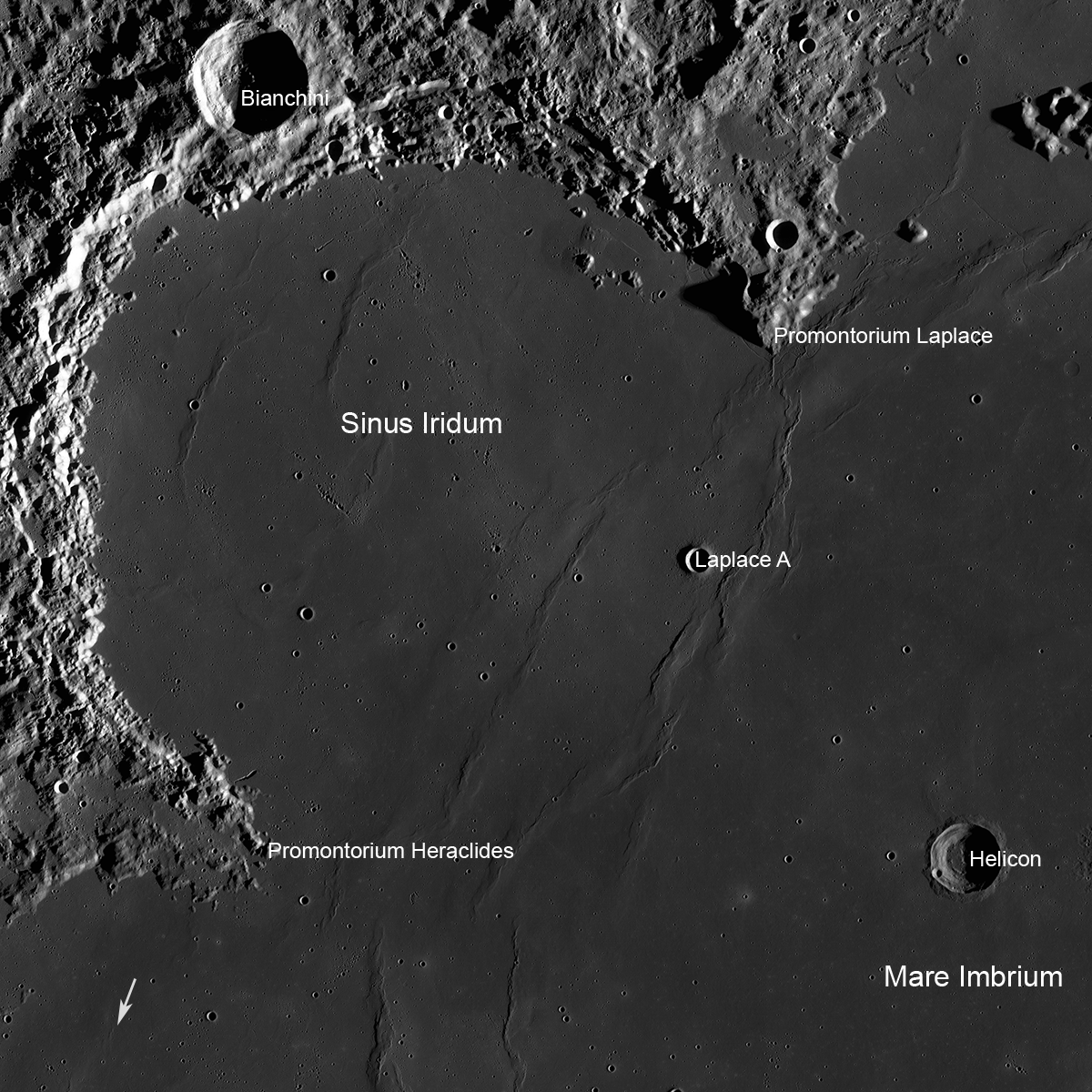
China will launch it's third unmanned lunar probe very early in December. Plans for Chang'e 3 include the first soft landing on the Moon since 1976 and the first rover since 1973. The China National Space Agency (CNSA) has long reported the target for this historic mission is Sinus Iridum, "the Bay of Rainbows," on the northwestern frontier of Mare Imbrium.

Meanwhile, following five years of planning, the NASA orbiter
LADEE has begun a 100 day examination of the Moon's tenuous exosphere, its formal science mission, in low equatorial orbit. It's all but certain both missions will be underway at the same time, leading some to jump to conclusions in reporting the two missions will interfere with one another. But, as Dr. Paul Spudis of the Lunar and Planetary Institute reports, nothing could be further from truth. Read his assessment, HERE.

-
Sinus Iridum
Sinus Iridum - it is likely China will land a rover near Laplace A before the end of 2013. (Arrow shows location of the Soviet Lunokhod 1), LROC Wide Angle Camera mosaic field of view 360 km [NASA/GSFC/Arizona State University].
Mark Robinson
Principal Investigator
Lunar Reconnaissance Orbiter Camera (LROC)
Arizona State University

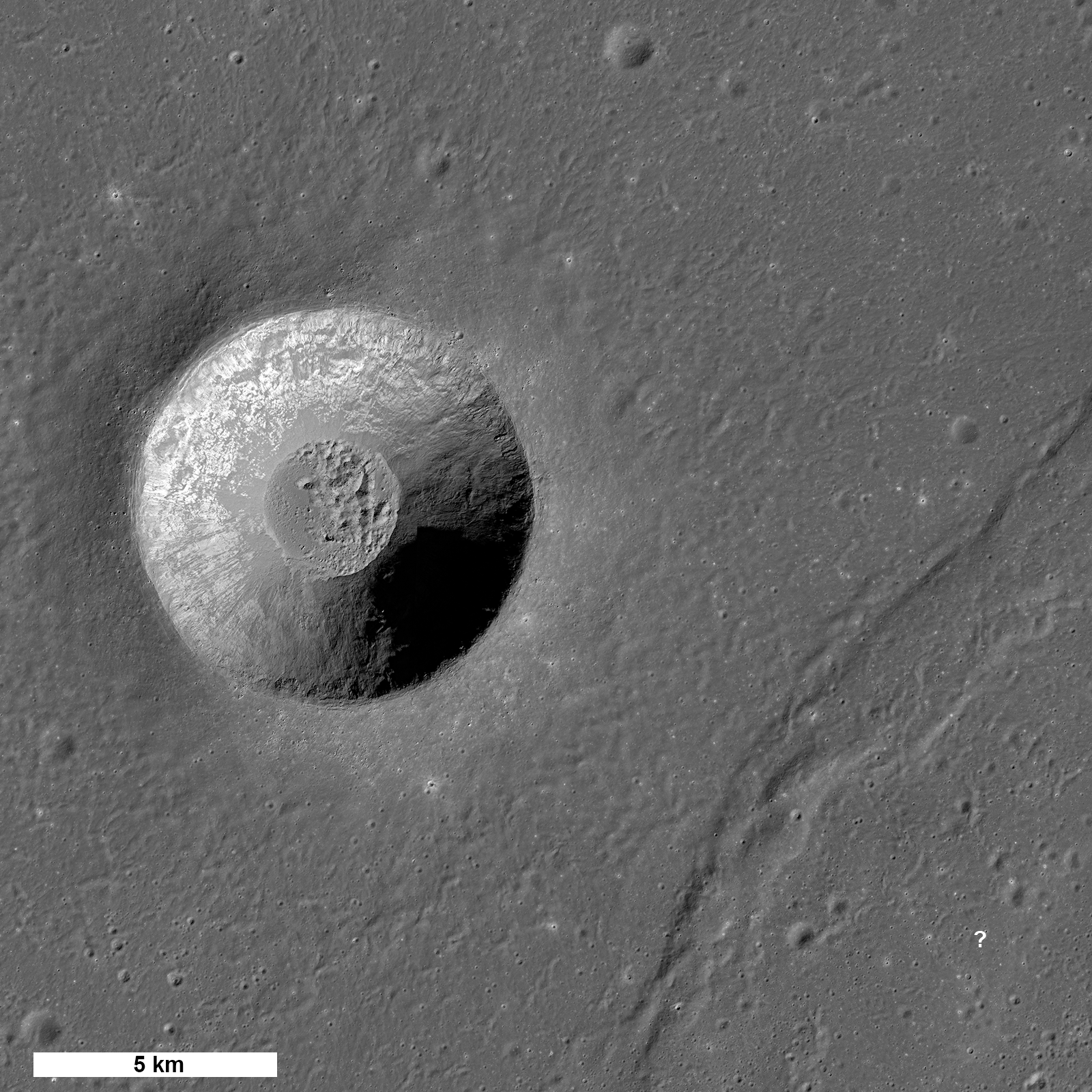
In the near future China will attempt a robotic landing on the Moon, and will deploy a rover. The launch date and landing dates have not been officially announced. The exact landing spot is also not yet publicly designated, but it seems likely the landing will take place in Sinus Iridum, possibly near the fresh crater Laplace A (8 km diameter).

Why this particular spot on the Moon? Likely there are critical engineering constraints in terms of landing site selection as well as important science goals. And there is the dramatic grandeur of the lunar landscape!

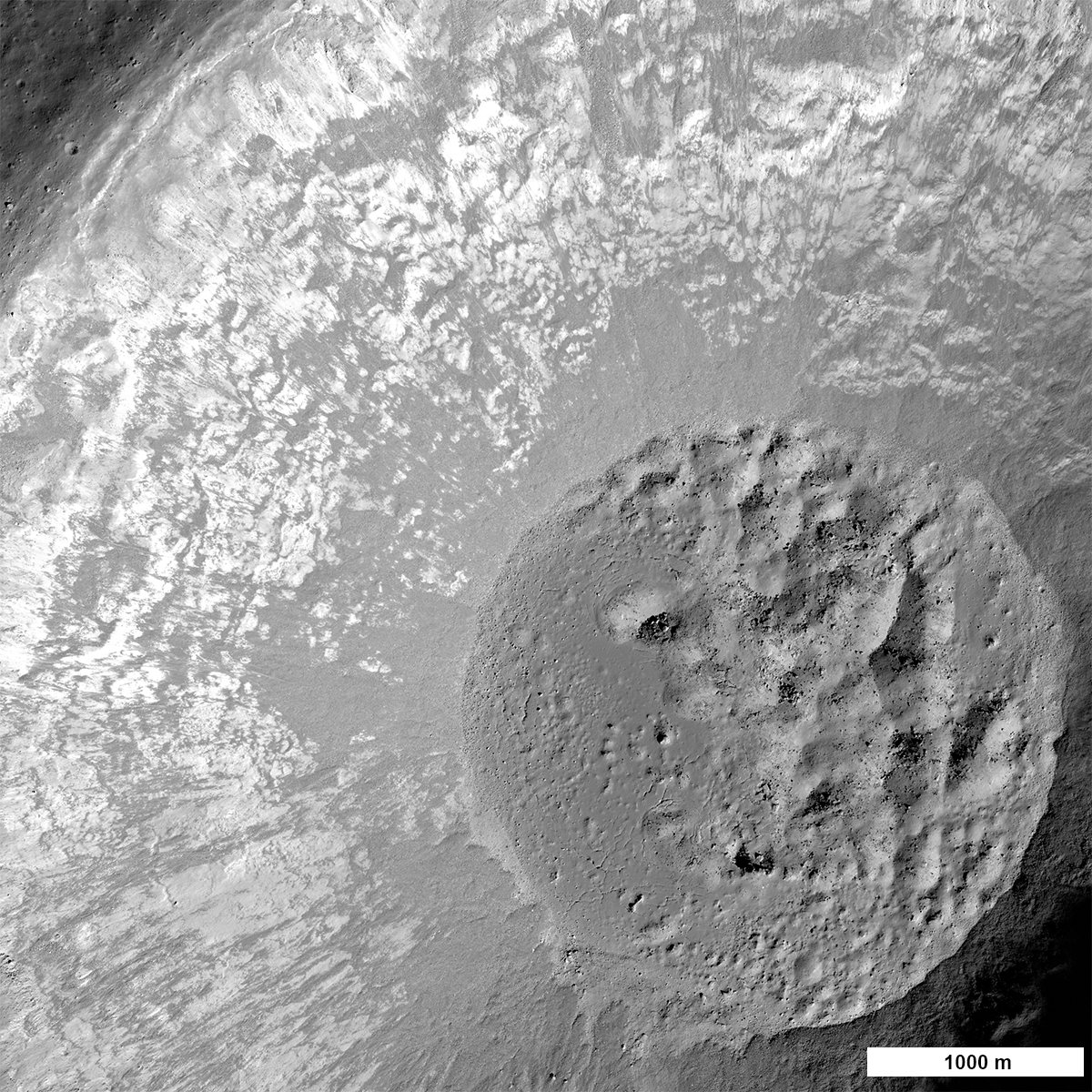
Imagine the first rover-eye view from the crater rim - a sheer drop of 1600 meters at your wheels, and an 8 km view across to the far wall! From LROC NAC images we know rock is exposed in the upper walls and dramatic landslides streamed material down to the crater floor. Speaking of the crater floor - it hosts a now frozen lake of impact melt 2500 meters (1.5 miles) in diameter. Imagine the moments after the crater formed, the floor was a cauldron of molten rock with debris sliding down into the melt, and the crater itself was deforming as the floor uplifted after the initial pressure of the impact was relieved.

Laplace A and wrinkle ridge
Laplace A crater and nearby wrinkle ridge (diagonally across at lower right). The question mark shows a potential landing site from which the rover could traverse northwest across the ridge to the edge of the crater [NASA/GSFC/Arizona State University].
Laplace A is a fascinating scientific target for a rover. It is a great example of a very young crater formed in mare basalt. A rover traversing the crater's ejecta blanket is in essence similar to driving down into the crater (in a geologic sense). We know from studies of terrestrial impact craters (such as Meteor crater) that material ejected from deep in a crater ends up near the rim, and rocks from the pre-impact surface are thrown far from the crater (a crater radius or more). So as a rover drives closer and closer to the rim it can characterize rocks from deeper and deeper below the surface.

Some of the many outstanding questions regarding the nature of the mare basalts include: how thick are individual flows, does the composition of the erupted magma change with time and location, and are pyroclastic (explosive) eruptions intermingled with effusive eruptions? These questions can be directly addressed with the Chang'e 3 rover! No humans or robots have ever visited a fresh crater anywhere near this size on the Moon (or Mars for that matter) so the return from this mission has great potential for advancing our knowledge of the Moon.

Laplace A
LROC NAC view of the interior of Laplace A crater [NASA/GSFC/Arizona State University].
But wait, there's more!

Another key question can be addressed: what is the 3D nature of large contractional ridges on the Moon? The rover is thought to have a ground penetrating radar (GPR) and it just so happens that a large wrinkle ridge (a contractional landform) lies about 10 km east of Laplace A. Although the exact mission plan is not publicly available, one potential scenario is that the lander sets down just east of the wrinkle ridge and deploys the rover. After initial testing of the lander and rover, and geologic characterization of the landing site, the rover could set off to the west towards the crater. As the rover drives up and over the wrinkle ridge the GPR would continuously probe the subsurface, slowly building up a 3D profile down to 100 meters or more (?) beneath the surface. Wrinkle ridges are complex landforms created when mare basalts are compressed, causing them to buckle and break along faults. However, wrinkle ridges have not been fully explored, and the  geometry and number of faults associated with each wrinkle ridge is not known. A subsurface profile of a wrinkle ridge could tell us the number of faults, where the faults are located, and how steeply the faults dip: is it 15°, 30° or 45°?

Chang-E-2-Laplace-A-900
Laplace A as plotted using photography and digital terrain model gathered from the CNSA orbiter Chang'e 2 [CNSA/CLEP].
From LROC images we have mapped the location of all the mare wrinkle ridges, and measured their surface topography, but all we have for the subsurface are models! Soon we may have actual measurements providing a good first step towards interpreting these poorly understood features. Wrinkle ridges are also found on Mercury and Mars, so better understanding a lunar example will help scientists unravel the tectonic story across the inner Solar System. Since only a handful of human and robotic missions have ever landed on the Moon, the results from the Chang'e 3 mission will provide important new scientific insights into our Moon.

Chang-e-2-CCD-LaPlace-full
Full resolution segment of the west wall and rim of Laplace A by Chang'e 2 [CNSA/CLEP].
Once Chang'e 3 has landed, LROC should be able to spot the lander and the rover; LRO will be above Laplace A on 25 December, 22 January, and 18 February.  The LROC team looks forward to posting images of the two vehicles!

Coincidentally, Lunokhod 1 landed only 250 km to the southwest of Laplace A over forty years ago (17 November 1970). This intrepid Soviet rover explored for almost a year and traveled a total distance of 10.5 km. Both the lander vehicle (Luna 17) and the rover can be seen on the surface today.

Perhaps the Chang'e 3 lander and rover will look something like this. Lunokhod 1 rover in its final parking place (38.315°N, 324.992°E) on the surface of Mare Imbrium, 250 km southwest of Laplace A. The Soviet rover, and its French-built laser range reflector array, were lost for four decades until relocated by LRO. The addition of the LLR to astrophysicists on Earth critically improved the accuracy of measurements of the distance to the Moon, bringing the uncertainty to within 3 millimeters. LROC NAC observation M175502049RE, spacecraft orbit 10998, resolution 33 cm per pixel. Original LROC Featured Image, HERE [NASA/GSFC/Arizona State University].
Explore the LROC Featured Mosaic of the Laplace region of interest, HERE.

Related Posts:
Lunar Laser Ranging: The Millimeter Range (November 19, 2013)
'Government landing penalty' removed from Google Lunar Xprize terms (November 7, 2013)
Chang'e 3 and LADEE: The Role of Serendipity, Paul Spudis (October 31, 2013)

Saturday, August 31, 2013

Chang'e-3 officially enters launch phase

Chang'e-2 soft lander deploys first lunar rover in nearly 40 years in this simulation shown on China national television [CNSA].
Zhu Ningzhu
From Xinhua   

"Chang'e-3 has officially entered its launch stage, following its research and manufacture period," said a statement released by the administration after Wednesday's meeting on the mission.

The mission will see a Chinese space probe land on a celestial body for the first time.

"The Chang'e-3 mission makes best use of a plethora of innovative technology. It is an extremely difficult mission, that carries great risk," said Ma Xingrui, head of China's space exploration body and chief commander of the lunar program.

LROC WAC Sinus Iridum Mosaic [NASA/GSFC/Arizona State University]
Sinus Iridum, the "Bay of Rainbows" embayment on the northwestern frontier of Mare Imbrium and likely target for the first soft landing on the Moon since 1976, by China's third unmanned lunar probe Chang'e-3 before the end of 2013. LROC Wide Angle Camera (WAC) mosaic [NASA/GSFC/Arizona State University].
The Chang'e-3 mission is the second phase of China's lunar program which includes orbiting, landing and returning to Earth, following the successes of the Chang'e-2 missions, which include plotting a high-resolution, full-coverage lunar map.

Chang'e-3's carrier rocket has successfully gone through its first test while the launch pad, control and ground application systems are ready for the mission.

Chang'e-3 will be launched from the Xichang Satellite Launch Center in southwest China.

From the Register:

The Chang’e-3 probe, first revealed last year, is a 100kg, six-wheeled rover that will spend three months traversing the lunar landscape under human control. The spacecraft will use the Moon’s gravity to slow down, orbit the satellite, and then soft-land using rocket propulsion.

This will be the first time the Chinese have landed a spacecraft on a non-terrestrial surface and the Chang’e-3 will be a crucial test of both Chinese aeronautics and rocketry control systems. The rover will pave the way for a future manned mission to the Moon, and a possible space colony on the surface.

“The Chang’e-3 mission makes best use of a plethora of innovative technology. It is an extremely difficult mission, that carries great risk,” said Ma Xingrui, head of China’s space exploration body and chief commander of the lunar program.

The first Chang’e probe was launched 2007 and completed a 3D map of the Moon’s surface before being intentionally crashed into the planetoid. Chang’e 2, launched in 2010, carried out further mapping 100km off the Moon’s surface before being directed out to fly by the asteroid Toutatis and is now heading out into the Solar System.

Like NASA’s early rovers on Mars, the Chang’e-3 will be primarily solar powered and will carry a ground-facing radar on its belly capable of penetrating up to 30 meters into the lunar regolith, as well as a alpha particle X-ray spectrometer and an infrared spectrometer.

China plans a manned mission to the lunar surface possibly as soon as 2017 – although he authorities aren’t setting themselves a Kennedyesque deadline and say they’ll go when they are ready. Once there, however, the Chinese government has said it plans to build the first manned lunar outpost, an objective NASA has already abandoned.

Related Posts:

Monday, August 19, 2013

Good things delivered in small packages

Mighty Eagle Aces Exam (NASA, International Space Station, 09/05/12)
Overcast skies didn't deter the "Mighty Eagle," flying high over the historic F-1 test stand and completing a milestone round of flight test objectives, September 5, 2012. One of two NASA robotic prototype landers, the vehicle was flown to an altitude of 30.48 meters and descended gently to a controlled landing during a successful free flight Marshall Space Flight Center in Huntsville, Alabama. Nicknamed the "Mighty Eagle" after one of the characters in the popular "Angry Birds" game, the vehicle is a three-legged prototype,  that resembles an actual flight lander design. It is 1.219 meters high, 2.438 in diameter and, when fueled, weighs 317.5 kg. It's a, so-called, “green” vehicle, 90 percent fueled by pure hydrogen peroxide, guided by an onboard computer [NASA/MSFC].
Paul D. Spudis
The Once and Future Moon
Smithsonian Air & Space


Wanted: lander spacecraft to deliver payloads to the Moon.  Must be cheap and reliable.

NASA recently issued an “RFI” – a Request for Information – a method used by the agency to solicit concepts from various companies and gauge their ability to fulfill a future anticipated need.  In this case, the need is for a small robotic lander, one capable of delivering two classes of payloads to the lunar surface: small (from 30 to 100 kg) and medium (from 250 to 450 kg).

Probably focused near-term with the RESOLVE (Regolith and Environment Science and Oxygen and Lunar Volatiles Extraction) payload, the intent of this RFI is to survey existing capabilities for the commercial delivery of a variety of payloads to the Moon.  RESOLVE is a NASA experiment designed to test and demonstrate some techniques of in situ resource utilization (ISRU) on the Moon, specifically the generation of oxygen and the extraction of volatile elements (such as hydrogen) from lunar soil.  The RESOLVE package consists of several highly integrated experiments designed to collect soil on the Moon, heat this feedstock to various temperatures and measure the amount and type of volatile elements released, and practice some techniques of processing the soil into useful products (such as water or oxygen).

Though we’ve been talking about using off-planet resources for years, this is the first time the agency would fly an experiment designed to evaluate the processes and difficulties involved.  Some of us contend that until it is proven possible (by demonstrating it in space), space-based resource utilization (ISRU) will remain classified as “too risky” to incorporate into an architecture.  Engineers don’t doubt the chemistry or physics behind ISRU, but to evaluate risk and return, they want demonstrations using real hardware versus theoretical concepts and paper studies.

Although it will not answer all ISRU questions, RESOVLE can provide useful data and would be an important milestone.  Our ignorance is particularly vast in regard to the nature of the polar volatile deposits.  Some near-polar sites are under consideration for RESOLVE, but because the lander must be able to communicate with Earth, sites near the poles must be in radio view of Earth.  This eliminates the most promising polar volatile sites (permanently dark, out of radio sight) from consideration, at least for the first mission.  However, we know that water ice occurs in some areas in view of Earth, so careful targeting will permit us to get ground truth for a critical area near the one of poles.

There are a wide variety of possible payloads (scientific and resource utilization) for lunar missions using small landers.  A key priority for the lunar science community has been the deployment of a global network of geophysical instruments.  Such a package would include a seismometer (to monitor and measure moonquakes), a heat flow probe (to take the Moon’s temperature) and other instruments, such as a magnetometer and a laser reflector.  The five-station surface network laid out during the Apollo missions was operational for more than 7 years and gave us a first-order understanding of the nature of the deep lunar interior.  A new global network – widely spaced and operating longer with more stations – would vastly improve on that knowledge.

The success of a network mission necessitates a long-lived power source to operate instruments during the very cold, 14-day lunar night (the Apollo network used nuclear power supplies), along with an inexpensive way to deploy the network stations.  New technologies have developed small, reliable radioisotope generators that operate for many years.  A small lander could deliver geophysical stations across the entire globe; each station is low mass, so the smaller (and presumably cheaper) the lander, the more likely that this mission will be realized.  A global seismic network would decipher the crust and mantle structure of the Moon and could monitor its surface for large impacts.  A precise measurement of lunar heat flow (measuring the abundance of radioactive elements in the Moon) will give us more information about the bulk composition of the Moon and advance our understanding of lunar origin.  Laser ranging will also be useful in addressing some critical geophysical and astrophysical problems.


Project Morpheus vehicle "Morpheus Bravo," executes a successful tether test August 7, 2013 at Johnson Space Center. The combined Morpheus/JPL team met all their objectives including engine ignition, ascent, a 3 meter lateral translation over simulated Mars regolith simulant from JPL to help with plume study, 40 seconds of hover at apex and a slant descent to "landing" using free flight guidance. The entire flight duration was around 80 seconds. All though the Mars surface simulant was not typical for Morpheus test fires, it "sure made for a spectacular show"

Single-point landers, making simple measurements, can investigate the surface composition and geology at select landing sites.  If the landing sites and investigations are carefully chosen, they could significantly advance science by answering key questions.  For example, a critical issue in the cratering history of the Moon is knowledge of the absolute age of some of the youngest craters on the Moon.  The formation of the crater Copernicus marks a key time horizon in lunar history (the Copernican Period).  We know its relative age very well but are uncertain about its absolute age.  A small lander can be sent directly to the crater floor, where the impact melt is exposed and accessible, to analyze crater melt rocks for chemical composition and to learn the nature of the impact target (as well as determining the age of the rock by measuring the radiogenic potassium and argon in the rock). Although the potassium-argon technique is not the most precise method of radiometric dating, it can distinguish among the different proposed absolute ages, which vary over a billion years.  By determining this age more precisely, we will better understand the impact flux in the Earth-Moon system, knowledge that will help us better interpret the surface ages of units on other terrestrial planets.

Small landers could deliver a variety of long-lived assets for future surface operations and resource utilization experiments.  Techniques for making oxygen from lunar soil have been proposed but no comparative demonstration has been done on the Moon.  A small laboratory could be send to the Moon to conduct simultaneous experiments on oxygen manufacture.  The advantage of this experiment would be the use of identical feedstock under identical thermal and time constraints to compare their relative efficacy and identify any problems.  This experiment would fit on a small lander (~ 50 kg capacity) and by using solar power, within the span of a single lunar day (2 weeks) could quickly complete its evaluation.

The larger version of the RFI lander opens up other possibilities.  With a payload capacity on the order of 500 kg, this lander could deliver an advanced, automated surface rover (powered by an RTG – nuclear battery) able to undertake extensive and protracted exploration of the polar cold traps.  Equipped with instruments utilizing well established technology, this rover would characterize the physical, chemical and isotopic make up of the polar volatiles – a task critical for mapping the extent and purity of deposits of water ice on the Moon, and evaluating their mining and extraction potential.

The Canadian Space Agency test platform Artemis, Jr. fitted with NASA's RESOLVE instrument package, Day 3 of field testing on Mauna Kea, Hawai'i, July 2012 [CSA].
At this scale, it’s possible to deliver an ascent vehicle to the Moon to retrieve and return samples to Earth.  Scientists have a long list of desired targets for sample return and the potential for low cost, commercial landers to deliver payloads simply and inexpensively to the Moon could revolutionize our understanding of the Moon’s (and Earth’s) history and processes.  From remote sensing data, we know that many fascinating areas on the Moon display rocks either unrepresented or unrecognized in the existing collections from the American Apollo, Soviet Luna, and lunar meteorite samples.  Samples from the oldest impact feature on the Moon – the floor of the South Pole-Aitken basin – are especially desired.  Although a simple “grab” sample won’t answer all of our questions, rocks from this site could address major questions about the bombardment history of the Moon and the early Earth.

Small lander spacecraft will open up new horizons for science and exploration.  Critical to their success is making them simple, robust and inexpensive.  That’s been a tall order for NASA.  Whether the commercial sector can provide this capability more effectively remains to be seen.

Related Posts:
CHONDROBOT-2: Simple, Efficient Semi-Autonomous Lunar Excavator (January 4, 2013)
Technical Readiness (November 17, 2012)
Marshall's new-generation lunar lander flies again (September 11, 2012)
Update: ISRU mission simulations on Hawai'i (July 30, 2012)
'A RESOLVE to mine the Moon' (July 15, 2012)
KSC shows off RESOLVE, ISRU and lunar analog study platform (June 13, 2012)
Mighty Eagle lander's 100 foot flight at Redstone (November 4, 2011)
New Robotic Lander Prototype skates tests (January 29, 2011)
NASA update: ILN Anchor Nodes and Robotic Lunar Lander Project (August 17, 2010)
Field testing of In-Situ Resource Utilization (July 1, 2010)
The Lunar Quest Program and the International Lunar Network (September 6, 2009)
Spotlight on Carnegie-Mellon's SCARAB (April 10, 2009)

Originally published August 17, 2013 at his Smithsonian Air & Space blog The Once and Future Moon, Dr. Spudis is a senior staff scientist at the Lunar and Planetary Institute. The opinions expressed are those of the author but are better informed than average

Thursday, August 8, 2013

Project Morpheus tether test #28


Morpheus Bravo vehicle executed a successful tether test on August 7, 2013 at Johnson Space Center. The combined Morpheus/JPL team met all test objectives including engine ignition, ascent, a 3 meter lateral translation over simulated Mars soil provided by JPL to help them with a plume study, 40 seconds of hover at the apex, and a slant descent to "landing" using free flight guidance. The entire flight duration was ~80 seconds. All though the Mars soil simulant is not typical for Morpheus test fires, it sure made for a spectacular show.

Project Morpheus Tether Test 21 (May 24, 2013)
Morpheus Unit B first fully integrated hot fire test (May 6, 2013)
Morpheus and ALHAT teams, still hard at work (February 11, 2013)
Morpheus employs ALHAT in teather test #16 (June 13, 2012)
Project Morpheus lander - Soft Abort Test (May 11, 2012)
Morpheus Tether Test #10 (April 9, 2012)
Morpheus Tether Test #8 (March 14, 2012)
Project Morpheus methane Hot Fire Test #5 (February 29, 2012)
Morpheus lander in tethered flight tests (May 7, 2011)  

Wednesday, June 5, 2013

Spinning for the Prize

"The Spirit of California," a design with unique heritage. A spin-stabilized Google Lunar X-Prize contender-that-was [Southern California Selene Group].
Rex Ridenoure
The Space Review

Five years ago, one of the then-active Google Lunar X PRIZE teams quietly signed off, withdrew from the competition, and ceased operations. At the time, it was arguably considered the team to beat in the quest for the prize. This article summarizes that team’s story and highlights a novel advancement in lander architecture derived from this short-lived yet very effective effort.

A long wait

This story starts fifty years ago at Hughes Aircraft Company in Southern California (Culver City), where Dr. Harold A. Rosen, a 37-year-old experienced and clever electrical engineer and radar expert, was leading a small team of engineers putting together what became the first successful series of geosynchronous communications satellites, Syncom. A few years prior, Rosen floated the idea to Hughes management of designing and launching a small, simple spinning satellite to GEO as part of the US response to the USSR’s 1957 Sputnik launch. This project would also serve as a kick-start toward the vision of global GEO satellite connectivity first articulated by Arthur C. Clarke in his seminal 1945 Wireless World article.

Syncom 1 was launched in February of 1963 and achieved the desired orbit, but suffered an immediate electrical failure. Five months later, Syncom 2 was successfully launched and began operating nominally. Syncom 3 repeated the achievement a year later.

 During 1962–1963, while Rosen and his team were immersed in their Syncom work, Hughes was bidding to be the prime contractor for NASA’s planned series of robotic lunar landers, Surveyor. The Caltech/NASA Jet Propulsion Laboratory had already developed a notional design for the lander and was looking to the emergent US space industry to complete the detailed design and then build the spacecraft.

Rosen was asked to peer review his firm’s proposal, and came away unimpressed. “That design was so big and clunky, and so expensive,” he recounted some 45 years later. “I knew back then that there was a much more elegant and cost-effective way to land.”

Read the article at The Space Review, HERE.

Friday, May 24, 2013

Project Morpheus Tether Test 21


This was "the first tether test of the v1.5b," Project Morpheus Bravo vehicle. The video runs about 29 seconds.

"We had a good ignition and climb. However, as the vehicle attempted to stabilize itself it exceeded the internally set boundary limit causing a soft abort."

Thursday, May 9, 2013

Chang'e-3 undergoing thermal vacuum testing

Chang'E-3 begins thermal and hard vacuum testing at the AIT Hall  facility of the China Aerospace Science and Technology Corporation in Beijing [CNSA/CLEP/CSA].
Emily Lakdawalla
The Planetary Society

A member of the NASASpaceflight.com forum has posted a large set of photos taken during Chang'E 3 thermal vacuum testing. They are all watermarked "China Space News" which is, as near as I can tell, a Chinese magazine -- I am hoping that the gigantic watermarks make it okay for me to post them. 

I'm posting them here in the spirit of asking forgiveness rather than permission, because I haven't been able to figure out a way to ask for permission. (EDIT: Here's where the photos were originally posted online.)

Thermal vacuum testing is one of the last major testing programs that a spacecraft has to endure before it is cleared for launch. It is a test that must be performed on the actual spacecraft that is headed for space -- not on an engineering model -- and it has to be done with the spacecraft essentially completely assembled.

Read the full article, links, and more images, HERE.

Related:
Chang'E-3 lander and rover expected in 2013 (January 10, 2013)
'China's grand plan for lunar exploration' (October 11, 2012)
ILOA to study deep space from Chang'E-3 (September 11, 2012)
Will China deploys first lunar rover since 1976? (April 29, 2012)
China's Long March to the Moon (January 14, 2012)
China plans lunar research base (May 11, 2011)
PRC continues methodical program (March 8, 2011)
Chang'E-2 arrives in mission orbit (October 9, 2010)
Dispatch from Chang'E-2: Sinus Iridum (October 4, 2010)
Chang'E-2 takes direct approach (October 1, 2010)
Chang'E-2 sets stage for future lunar missions (September 3, 2010)
Chang-E-1 research reported published (July 22, 2010)

Monday, May 6, 2013

Morpheus Unit B first fully integrated hot fire test


Project Morpheus Hot Fire Test #8: On May 1, the Morpheus concept lander "Bravo Unit" was tested in a "hot fire" configuration, the first fully-integrated test of this second Unit. Built by Armadillo Aerospace, with the aim of developing a cutting edge vehicle for soft-landing 500 kg. payloads on the Moon, Unit A was lost following the failure of a real-time inertia measurement unit in August 2012.

Related Posts:
Morpheus and ALHAT teams, still hard at work (February 11, 2013)
Morpheus employs ALHAT in teather test #16 (June 13, 2012)
Project Morpheus lander - Soft Abort Test (May 11, 2012)
Morpheus Tether Test #10 (April 9, 2012)
Morpheus Tether Test #8 (March 14, 2012)
Project Morpheus methane Hot Fire Test #5 (February 29, 2012)
Morpheus lander in tethered flight tests (May 7, 2011)

Saturday, May 4, 2013

Chang'e-3: The Chinese Rover Mission

The Automatic Lunar Surface Exploring Vehicle, China's planned Chang'e-3 lunar rover, "a solar powered vehicle designed and built by the China Academy of Space Technology (CAST). The six-wheeled rover has a designed life of 90 days to explore three square kilometers, a total mass of 120 kg (with a 20kg payload capacity) designed to travel up to 10 kilometers." Illustration from "Will China deploy the first lunar rover since 1976?" - April 30, 2012.
Steve Nerlich
AmericaSpace.com

Currently scheduled for launch in December 2013, from the Xichang Satellite Launch Center in Sichuan province, the Chang’e 3 mission aims to land a Chinese rover on the Moon. If the mission is successful, it will be the first soft landing on the Moon since the Russian Luna 24 mission in 1976. Overseen by the China National Space Administration, the Chang’e program is following a step-wise approach to lunar exploration that could lead to the first taikonaut stepping onto the Moon by 2025.

The previous Chang’e 1 and 2 lunar orbiting missions, launched in 2007 and 2010, represented the first phase of the Chang’e program. Chang’e 3, to be followed by Chang’e 4, represent the second phase of the program, both involving rovers. The third phase, with Chang’e 5, will be sample-return mission and is currently scheduled for 2017. After that, it is anticipated that a new program will commence, which might culminate in a manned landing.

Chang’e is the name of a Chinese goddess who ascended to the Moon after consuming an immortality pill and there befriended a jade rabbit who was already a lunar resident. The elements of this legend were relayed by NASA to the Apollo 11 crew ahead of the first Moon landing in 1969. Michael Collins famously responded “Okay. We’ll keep a close eye out for the bunny girl”.
Read the full article, HERE.

Thursday, January 10, 2013

The Chang'E-3 lander and rover expected in 2013

The Automatic Lunar Surface Exploring Vehicle, China's planned Chang'e-3 lunar rover, "a solar powered vehicle designed and built by the China Academy of Space Technology (CAST). The six-wheeled rover has a designed life of 90 days to explore three square kilometers, a total mass of 120 kg (with a 20kg payload capacity) designed to travel up to 10 kilometers." LP illustration, "Will China deploy the first lunar rover since 1976? - April 30, 2012.
Emily Lakdawalla
The Planetary Society

One of the missions planned for launch this year is China's Chang'E 3. I had never paid any attention to Chang'E 3 until this week, so I had no idea how large or ambitious it is. Chang'E 3 is a 1200-kilogram, RTG-powered lunar soft lander with a 1-year nominal mission lifetime. On top of that, it includes a 100-kilogram rover equipped with cameras and APXS. The rover has a nominal lifetime of 3 months and range of 10 kilometers. Wow. Here's a cool artist's concept that Glen Nagle put together. Enjoy it -- this is the first time it's been published!

China announced late in 2011 that Chang'E 3 would be a lunar soft lander, to launch in 2013. Computer animations played on Chinese TV around that time (go to the 30-second mark) showed a lander deploying a smaller MER-like, solar-powered rover, with six basket-rimmed wheels and two pairs of cameras on a mast. It is expected to land in Sinus Iridum, an area well surveyed by Chang'E 2.

Read the excellent digest and review, HERE.

A Few Related Posts:
China and the Moon (June 19, 2012)