Showing posts with label wrinkle ridges. Show all posts

Thursday, August 14, 2014

Littered wrinkle ridge in west Mare Nubium

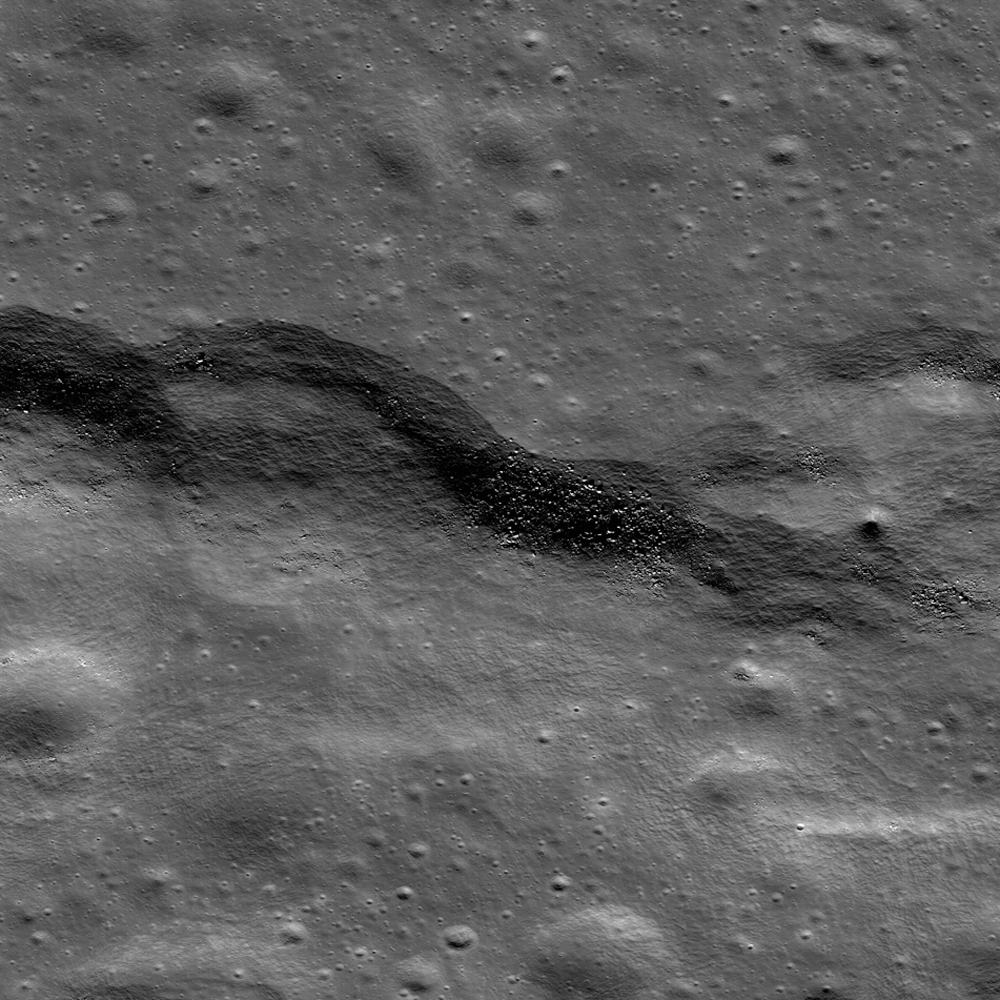
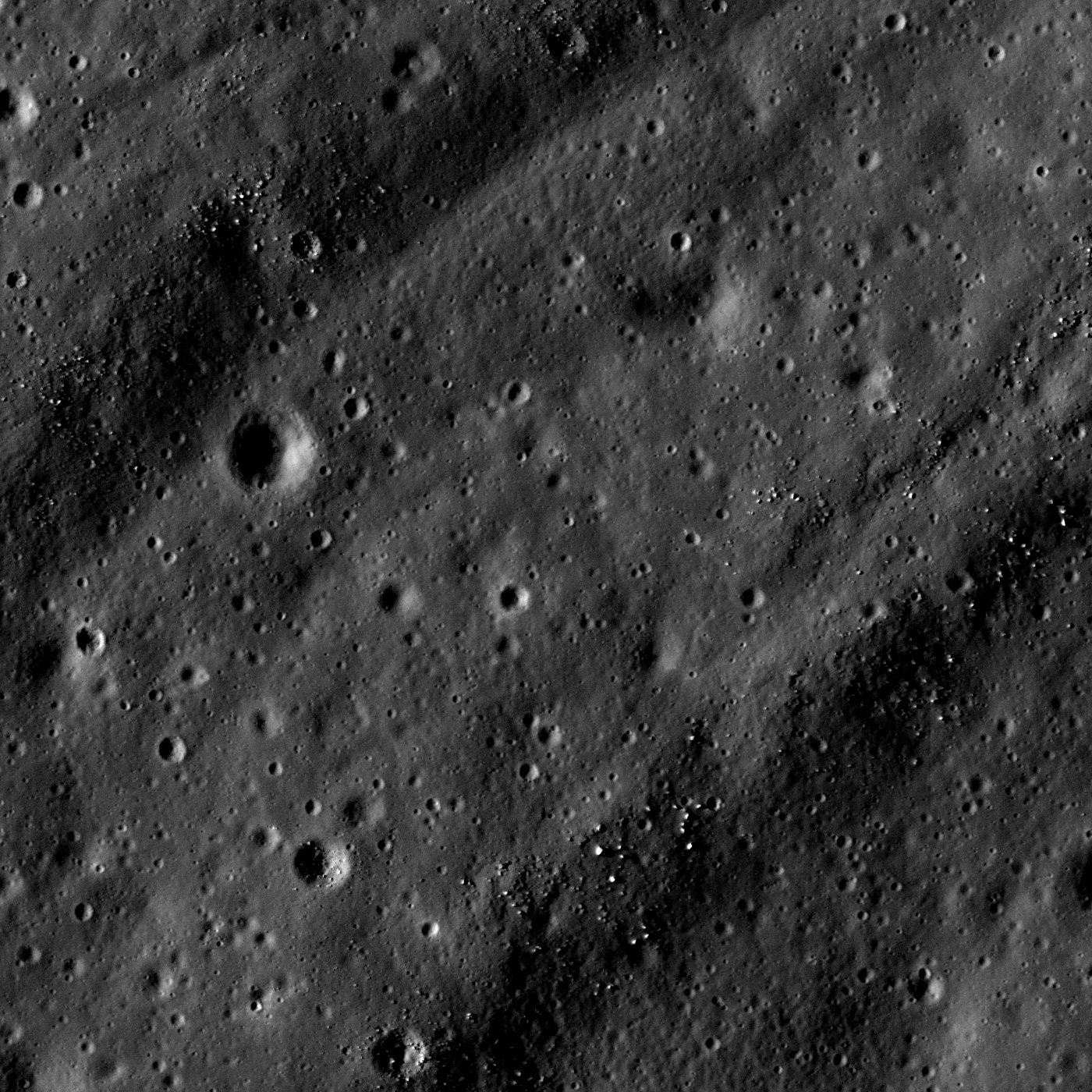
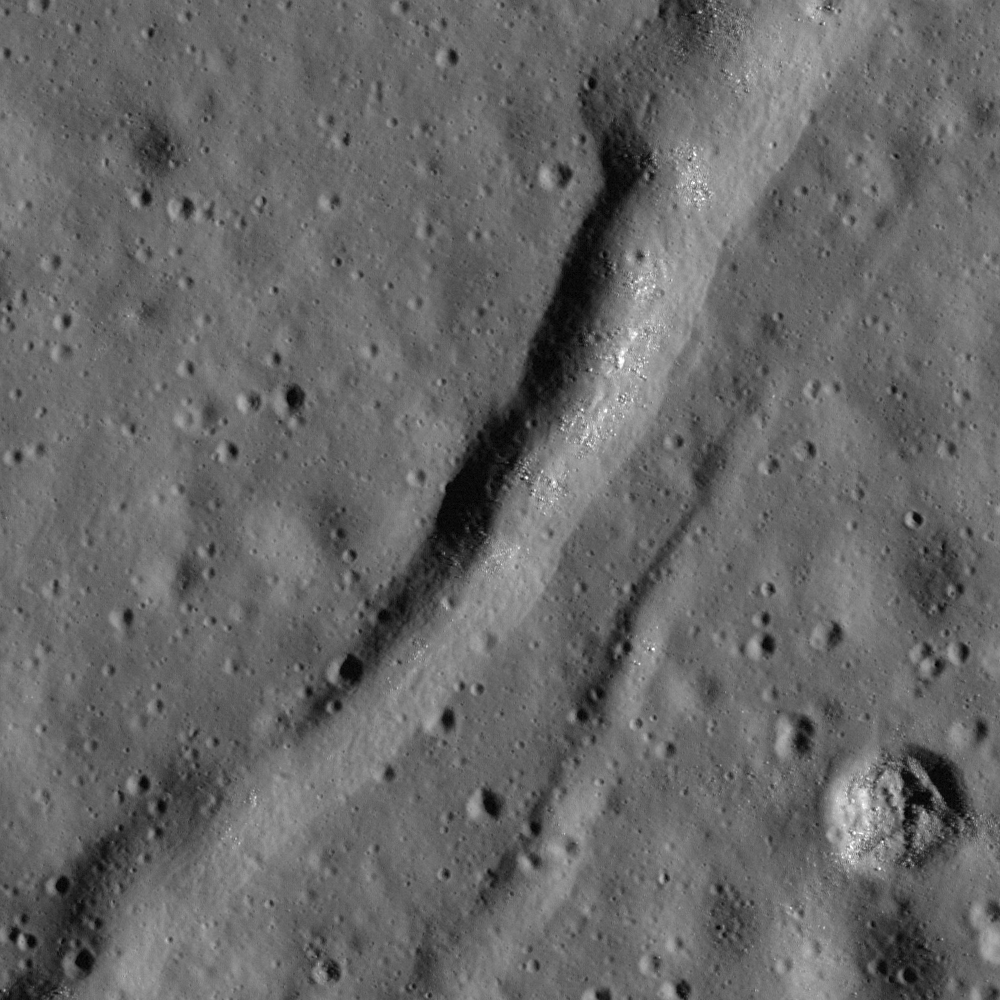
Portion of a wrinkle ridge found in Mare Nubium.  The crest and side of the ridge is lined with high reflectance boulders, likely eroded from the fractured basalts that make up the ridge. 2.4 km wide field of view from LROC NAC mosaic M1144863959LR, LRO orbit 20752, January 20, 2014; 46.33° incidence, resolution 83 cm, from 80.7 km over 19.5°S, 349.04°E [NASA/GSFC/Arizona State University].
Raquel Nuno
LROC News System

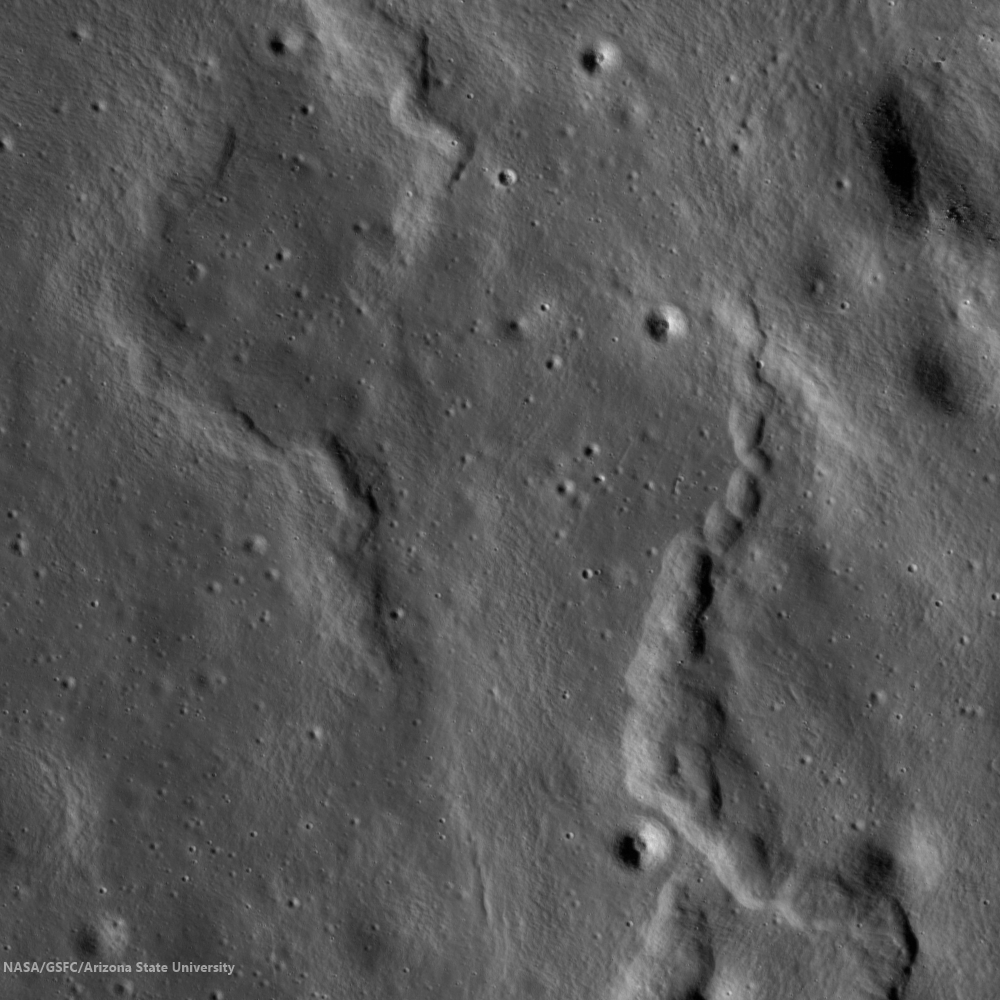
Wrinkle ridges on the Moon are positive-relief tectonic features found predominately in mare, although some even occur inside craters.

Tectonic forces that created the wrinkle ridges were caused by the sinking of high density basalts that poured over the crust (lower density) during the formation of the maria.

In general this sinking stretched the crust on the margins of the maria, forming graben, and compressed the rock in the center of the maria, forming wrinkle ridges. 

The opening image shows a portion of a wrinkle ridge located in Mare Nubium. The slope of this ridge is littered with boulders, which have higher reflectance than the surrounding material. Where do these boulders come from?

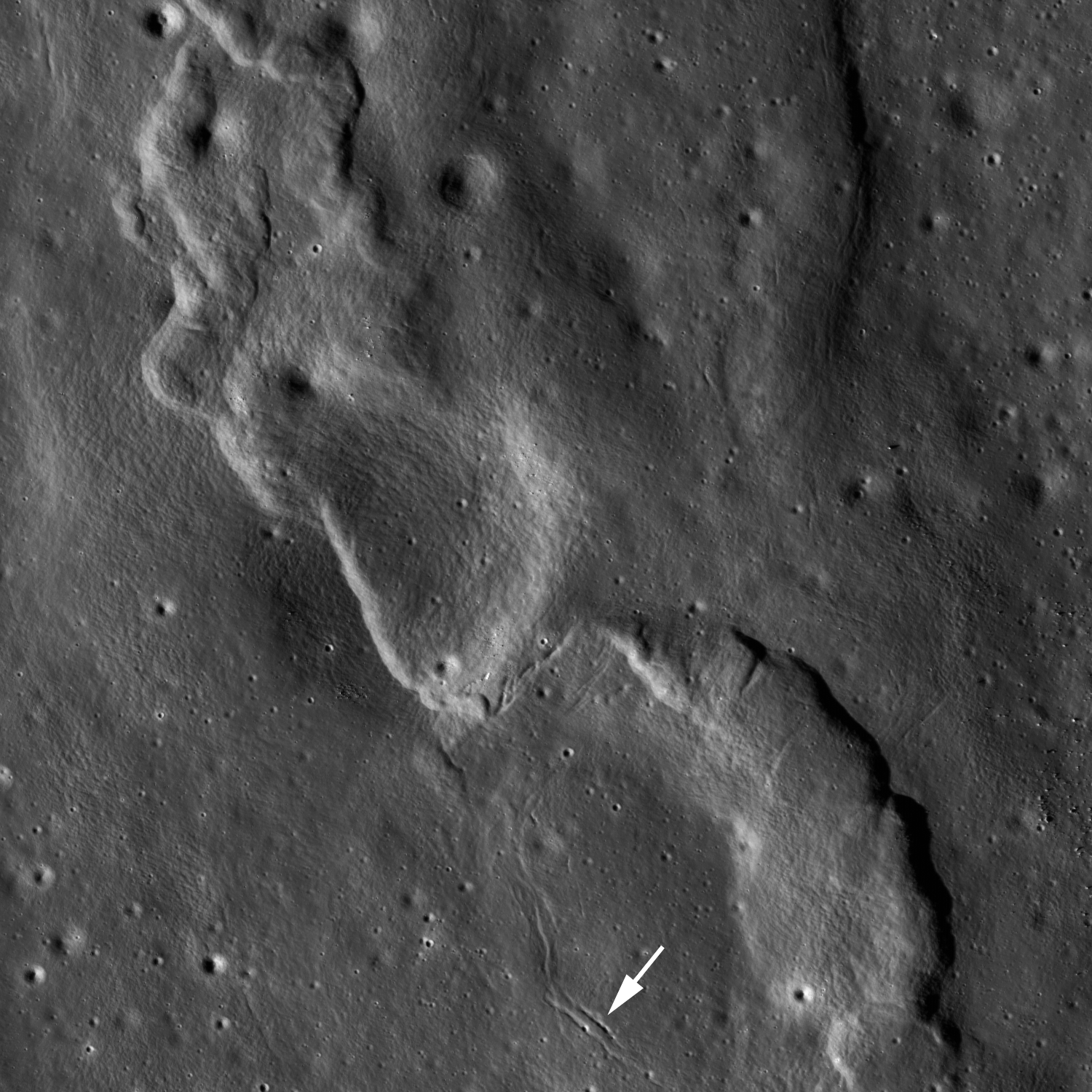
Corrected mosaic of 20000 lines by 10000 samples (of 52224 by 5000 x 2), both the left and right camera frames from LROC NAC observation M1144863959LR, January 20, 2014; from 80.7 km over 19.5°S, 349.04°E [NASA/GSFC/Arizona State University].
They were likely eroded from the fragmented basalt by seismic events from nearby impacts. The bedrock (mare) was pre-fractured during the formation of the wrinkle ridge, thus the boulders' size and shape likely represents these small scale internal fracture patterns. The ridge is still eroding today! New boulders will erode out of the edge of the ridge until there is no more ridge to erode, while the boulders will be turned to dust by micrometeorite bombardment.

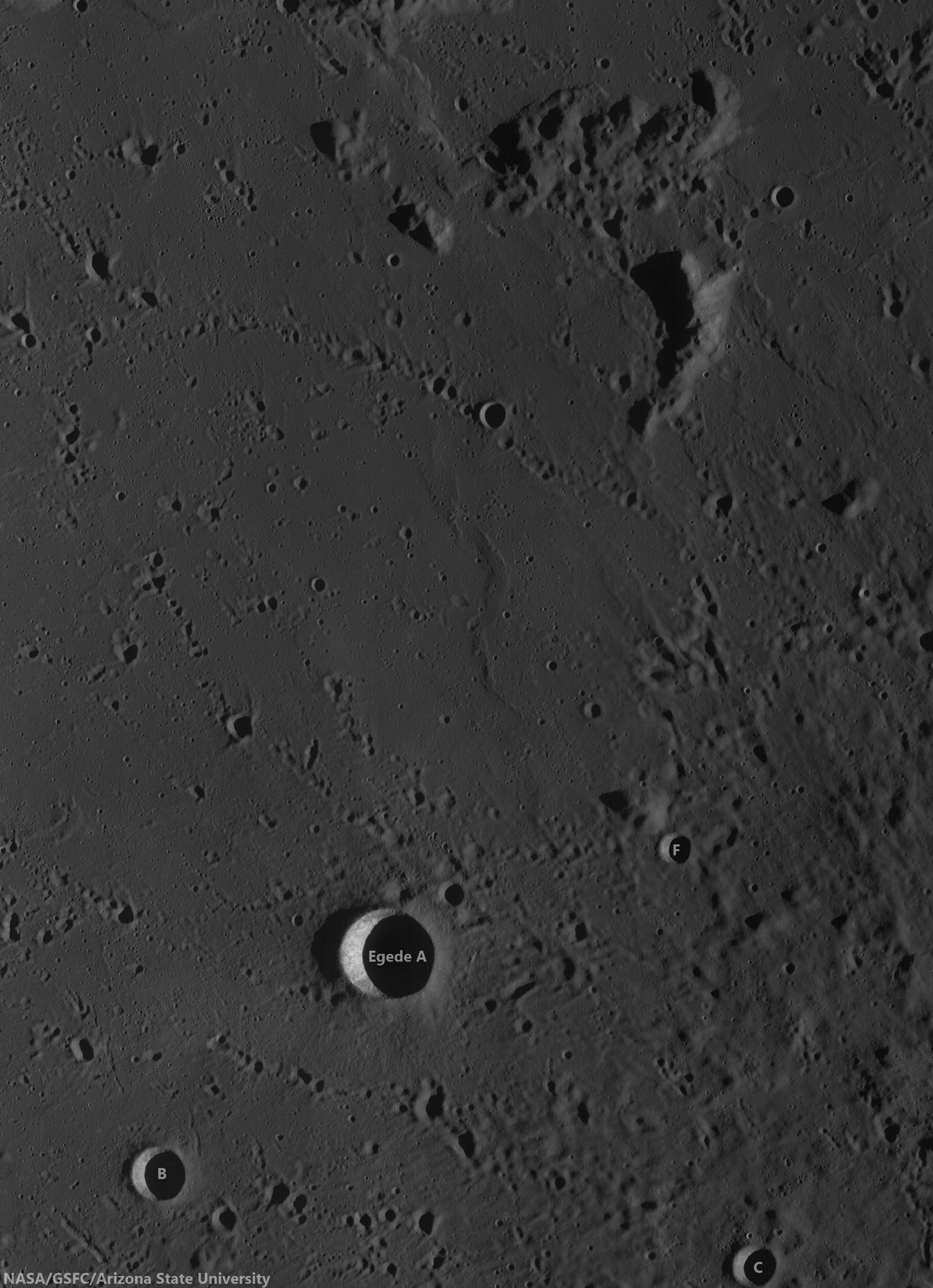
Accepted nomenclature of features of the western portion of Mare Nubium. The arrow designates the location on a prominent wrinkle ridge shown at high-resolution in LROC NAC mosaic M1144863959LR. The field of view is, in turn, a mosaic of LROC Wide Angle Camera (WAC)  monochrome (604 nm) observations (see the full-size WAC mosaic, with inset, HERE) swept up over three sequential orbital passes June 11, 2011, incidence 78.4° at 61.8 meters resolution, from 45.3 km [NASA/GSFC/Arizona State University].
Explore the fill-resolution LROC Narrow Angle Camera mosaic HERE.

Related Posts:
Friday, July 18, 2014

Dorsum Nicol

This tectonic feature was formed as stresses built up in the lunar surface until it gave way. The energy released was immense, and the displaced rock is the north-south trending wrinkle ridge seen today in southeast Mare Serenitatis. LROC NAC-derived digital terrain model, slope angle and recent imagery. Field of view is 4765 meters across [NASA/GSFC/Arizona State University].
Aaron Boyd
LROC News System

Dorsum Nicol is a wrinkle ridge found in southern Mare Serenitatis.

The opening Featured Image is a LROC NAC image, juxtaposed with a slope map, NAC-derived DTM and recent LROC NAC observation of area.

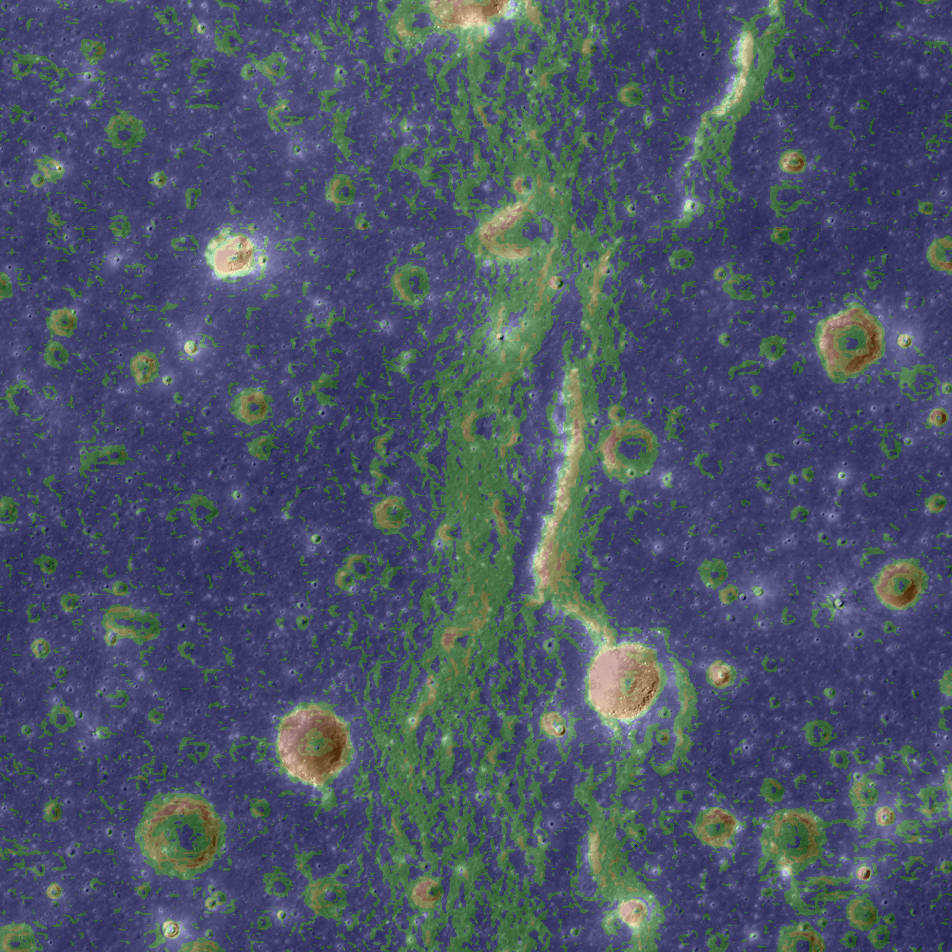
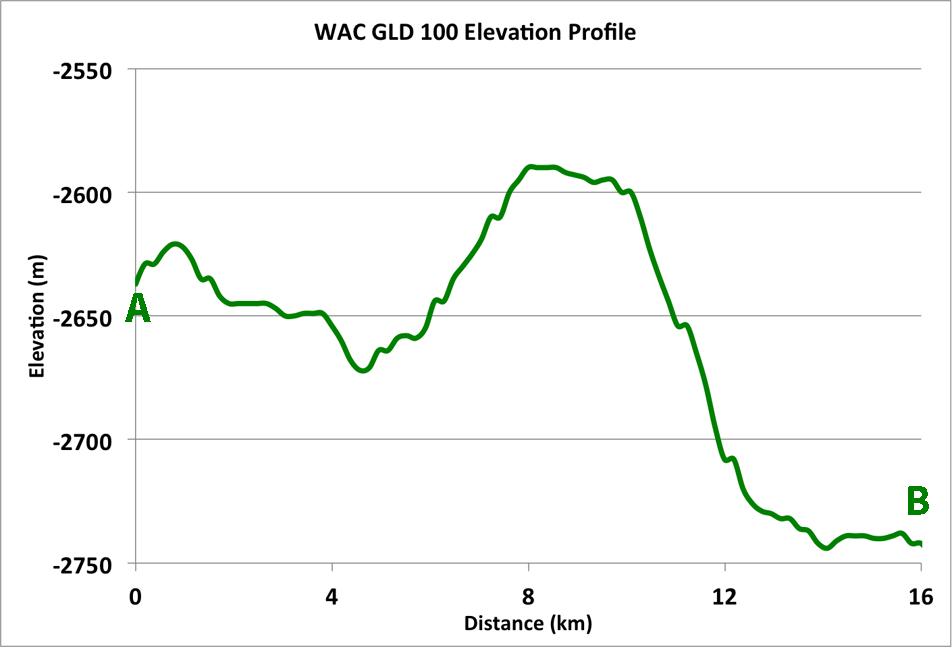
Slope maps are useful to planetary scientists because topographic features like craters and small ridges really stand out. At the  location in the LROC Featured Image field of view, the mare on the west side of the ridge is about 100 meters higher in elevation than the mare on east side of the wrinkle ridge, and the peak elevation is around 50 meters above that (see profile below).

Elevation profile across Dorsum Nicol, at field of view for LROC  Featured Image released July 17, 2014. (Points A and B correspond to A and B in LROC WAC context image, below [NASA/GSFC/Arizona State University].
The difference in elevation between the eastern and western flanks of the ridge could be due to the lunar surface buckling and folding beneath the surface, or it could be from mare fill after the wrinkle ridge was formed.  Dorsum Nicol has a width of 10 km at its widest and 5 km at its narrowest. Take a look at the full feature in the context image below.

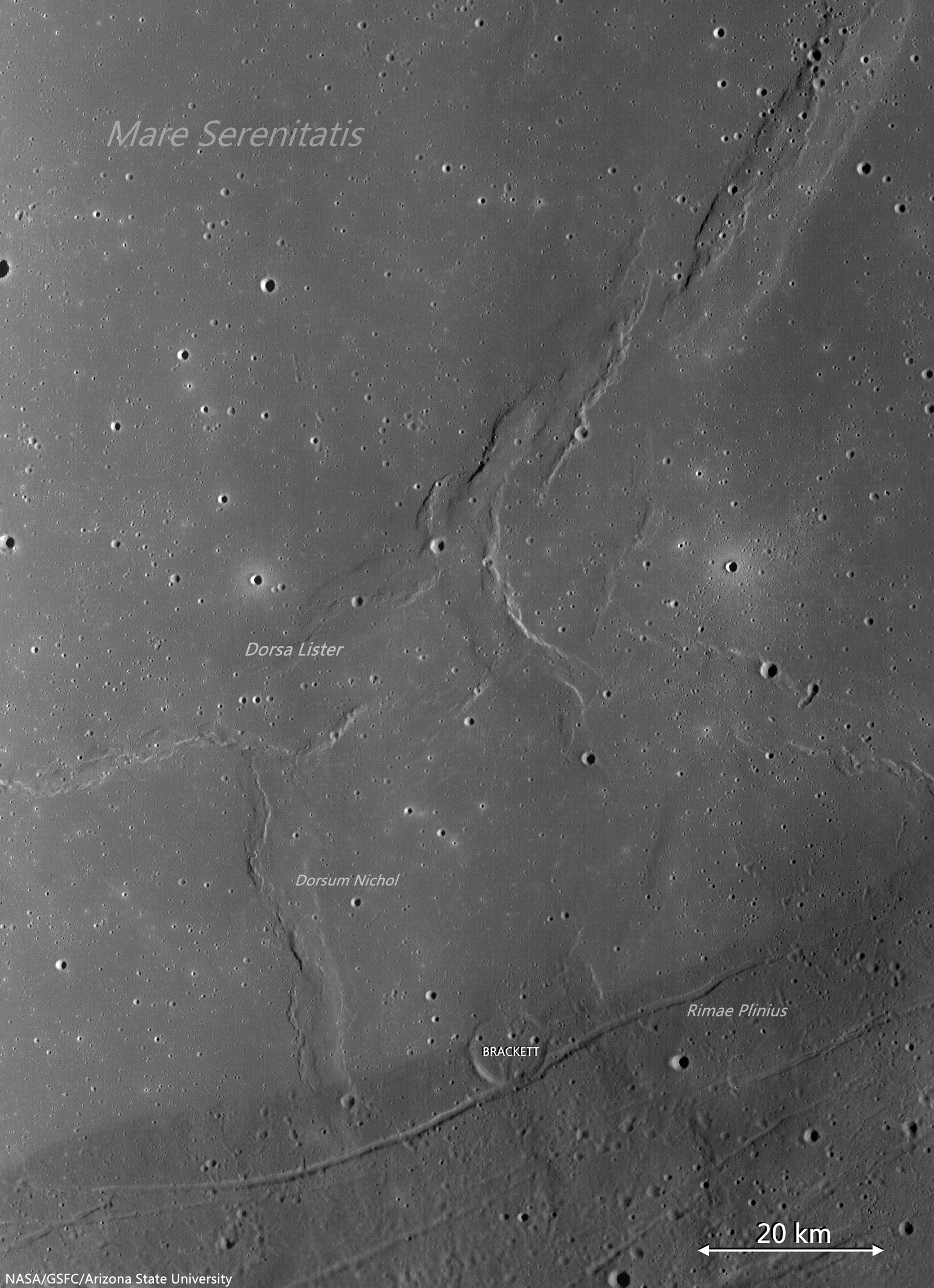
LROC WAC context image of Dorsum Nicol in Mare Serenitatis. The yellow box is the approximate location of today's Featured Image, the red box is the location of the full NAC DTM. A profile taken along the white line from A to B and is shown above. Context image spliced from LROC Wide Angle Camera (WAC) monochrome (604 nm) mosaic of three observations swept up over three sequential orbital passes (LRO orbits 9031-9033) June 8, 2011; incidence 75.86° resolution 58 meters from 42 km [NASA/GSFC/Arizona State University]. [NASA/GSFC/Arizona State University].
Wrinkle ridges are are surface expressions of compressional forces being released; they are seen in all large maria on the Moon. The loading from the massive flood basalts during mare volcanism could have caused the lithosphere to flex because the density of the flood basalts is higher than the anothositic highlands material. Buoyancy forces were at work here, causing viscoelastic relaxation and inducing forces in the mare rock.

Full-sized LROC WAC mosaic, from three sequential passes June 8, 2011. See full size mosaic HERE [NASA/GSFC/Arizona State University].
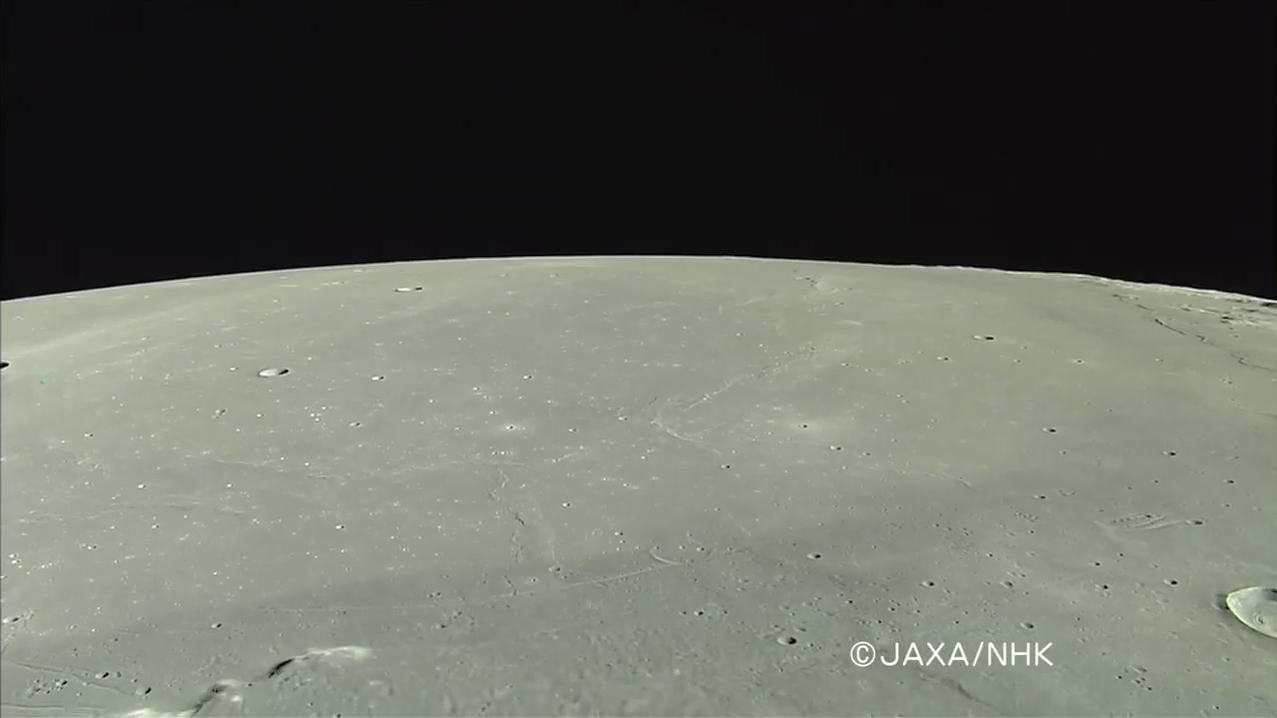
Southwestern Mare Serenitatis in HDTV. Dorsum Nichol (next to the ghost crater Brackett, butted up against Rimae Plinius, together with Dorsa Lister, and in the foreground, the belt of darker basalts encircling the entire impact basin, Rimae Plinius and Promontorium Archerusia are at lower left, a view Harrison Schmitt describes as close to what Apollo expeditions saw in orbit. From a HDTV still, captured from Japan's lunar orbiter Kaguya (SELENE-1) in 2008. See the original release image HERE [JAXA/NHK/SELENE].
These forces caused the once convex surface of the maria to become more planar as time went on. This is a problem because a plane has less area than a curved surface when they are bounded by the same radius. Where was the rock going to go? Well, the maria resisted this change in topology until something broke! Wrinkle ridges are the expression of that thrust fault behavior.

Locating Dorsum Nicol in southeast Mare Serenitatis is easier than actually seeing these features, through a modest telescope. The stacked photograph above, assembled by Astronominsk in Minsk, Belarus, was captured at the best illumination incidence for such a purpose, on June 28, 2009, right after local sunrise, before First Quarter (in an early evening sky, here on Earth). Locating Taurus Littrow valley, the landing site of Apollo 17, and Promontorium Archerusia, along with other features in the contact area between Mare Serenitatis and Mare Tranquillitatis are relatively easy, however, throughout the lunar day [Astronominsk].
Check out the full NAC frame on the the LROC DTM product page, HERE.

Related Posts:

Tuesday, January 21, 2014

Wrinkled? Yes, but how old?

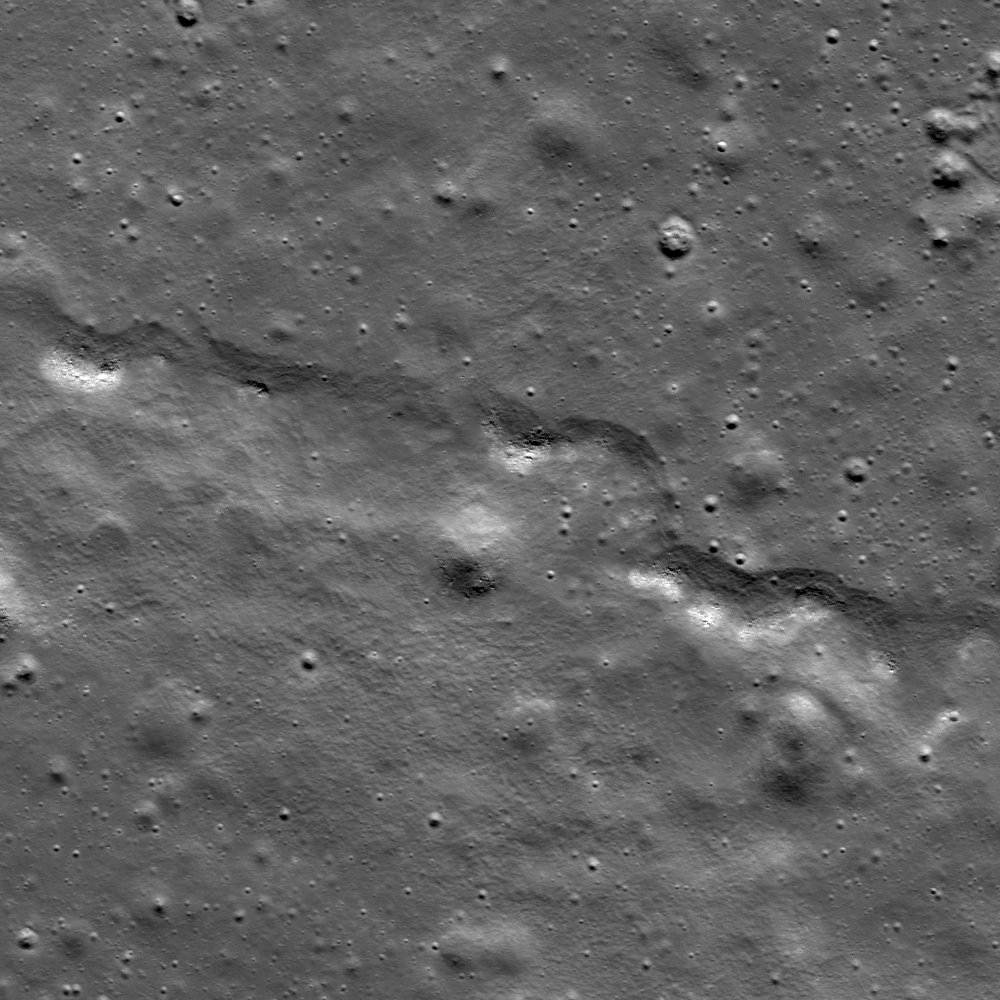
Wrinkle Ridge, Eastern Mare Frigoris
A wrinkle ridge formation in eastern Mare Frigoris (54.430°N, 35.670°E), from a 2 km -wide field of view from LROC Narrow Angle Camera (NAC) observation M139672711R, spacecraft orbit 5717, September 21, 2010; 56.22° incidence angle, resolution 47 cm per pixel from 38.87 km. LROC Featured Image, "Wrinkled, yes, but how old? - Released January 21, 2014 [NASA/GSFC/Arizona State University].
H. Meyer
LROC News System

Wrinkle ridges are not only some of the most striking features that wind their way across the lunar mare, but they are also extremely informative. Wrinkle ridges are the surface expression of tectonic stresses, and from observing the morphology of the ridges, we can interpret the tectonic history of the regions in which they are found.

Mare Frigoris hosts intricate systems of intertwining wrinkle ridges, suggesting a complex history. It is thought that this area was a topographic low that was later filled in with dense mare, causing the less dense anorthosite crust to sag as it underwent isostatic adjustment. The sagging resulted in compression at the surface, and the development of wrinkle ridges. As the crust was compressed it fractured, and long linear stretches of crust were pushed on top of itself thus forming these fascinating ridges.

Wrinkle Ridge, Eastern Mare Frigoris
LROC WAC context image of eastern Mare Frigoris. The full NAC field of view is outlined in red and that of the LROC Featured Image released January 21, 2014 is boxed in yellow [NASA/GSFC/Arizona State University].
The ropy appearance of the ridges in the WAC context image above are a testament to the complex motion that took place within the rock, indicating multiple directions of stress. Though most of the tectonic activity that produced wrinkle ridges in Mare Frigoris is thought to have occurred ~2.6-3.8 billion years ago, recent work suggests that wrinkle ridges may have formed in this region only 1.2 billion years ago. Believe it or not, that is young (for the Moon at least)!

Who knew wrinkles could be useful? Explore the Moon's wrinkles for yourself, HERE

Related Posts:
Bulging Wrinkle
Wrinkle Ridge in Mare Crisium
Wrinkles in Mare Frigoris
Really Wrinkled
Wrinkled Reiner Gamma
Wrinkle Ridge v Impact Crater

Thursday, October 10, 2013

Wrinkles in Mare Frigoris

M181102837R LROC Featured Image, October 10, 2013
A complex wrinkle ridge deforms Mare Frigoris (52.935°N; 11.131°E) Two kilometer-wide field of view from LROC NAC observation M181102837R, LRO orbit 11804, January 13, 2013; 76.04°evening illumination angle of incidence from the west (left), resolution 1.65 meters per pixel from 168.24 km [NASA/GSFC/Arizona State University].
James Ashley
LROC News System

Lunar mare present many excellent examples of wrinkle ridges, where tectonic activity caused the foreshortening of near-surface rocks. The loading of large basins by dense mare basalts is thought to have resulted in isostatic adjustment of the underlying anorthositic crust, leading to buckling and overriding of surface rock units one atop another as compression occurred. The same stresses may also produce extensional (rather than compressional) deformation in adjacent areas. A variety of complex landforms can thus result.

M146911901CN_604nm-580x800
Area shown at high resolution in the LROC Featured Image is designated with a small arrow in this 34.4 km-wide field of view from LROC Wide Angle Camera (WAC) monochrome (604 nm)observation M146911901CE, LRO orbit 6784, December 13, 2010; early morning 78.67° angle of incidence, resolution 59.3 meters per pixel from 43 km. The area of interest is in south central Mare Frigoris. [NASA/GSFC/Arizona State University].
Most of the ridges we see in today's Featured Image are produced by thrust faulting in Mare Frigoris. Just below center in the Featured Image frame, however, is a left-lateral strike-slip fault (also called a sinistral fault). Wrinkle ridges can be lumpy and ropey-looking, not exactly what comes to mind when one thinks of a textbook compressional fault. But in cross section the faulting would be readily apparent (refer again to the links above). Just south of the strike-slip fault are zones of extension where tension cracks have formed (small white arrow in Featured Image).

M146898354CN_604nm_stitch-58b-1782x2458
Further context for the wrinkle ridge in this field of view 107 km wide south central Mare Frigoris, scared by secondary crater streams from Aristoteles crater to the southeast. LROC WAC monochrome mosaic (604 nm) from five sequential orbits captured under local sunrise (emphasizing topography over albedo), LRO orbits 6782-6786, December 14, 2010 averaging a 77° angle of incidence from 43 km [NASA/GSFC/Arizona State University].
Morphologic nuances can be explored elsewhere in the NAC frame. Note the ropey appearance of some of these ridges, again showing that motions within the rock were complex indeed. Other examples of strike-slip faults have been found in association with lobate scarps on the Moon. Recent evidence suggests that shrinkage of the Moon from deeply seated internal cooling may have contributed to the occurrence of some lobate scarps and wrinkle ridges.

M181102837R
More examples of wrinkle ridges from NAC frame M181102837R [NASA/GSFC/Arizona State University].
Explore the full NAC frame HERE.

Additional examples of wrinkle ridges can be found in LROC Featured Image posts, "Really Wrinkled," "Wrinkle Ridge in Mare Crisium," and "Bulging Wrinkle."

Wednesday, March 6, 2013

Wrinkle Ridge vs. Impact Crater

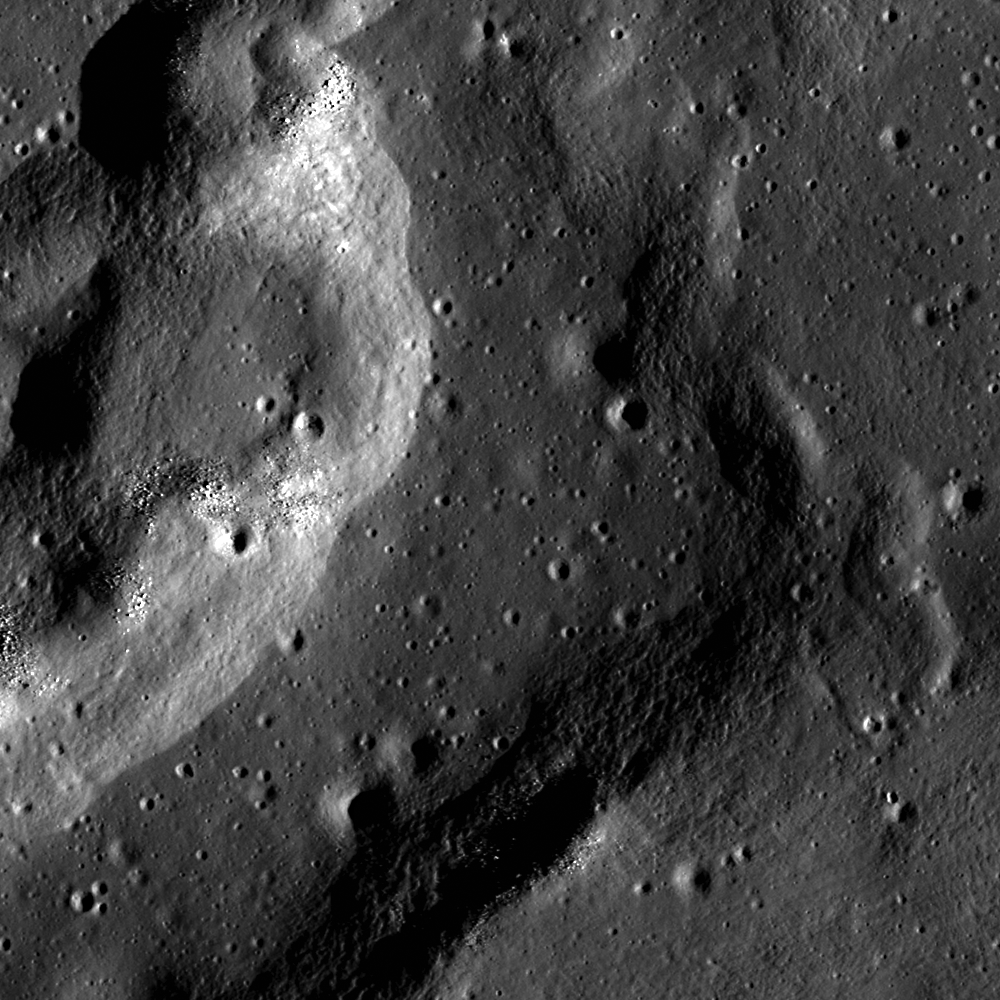
An impact crater, subsequently modified by a wrinkle ridge in Mare Imbrium. Field of view 3.2 meters wide from LROC Narrow Angle Camera (NAC) observation M1114391184R, LRO orbit 16466, February 1, 2013; 1.23 meters resolution [NASA/GSFC/Arizona State University].
Sarah Braden
LROC News System

Stratigraphic relationships in today's Featured Image tell a story of complex geologic events on the lunar surface.

Planetary geologists interpret images taken from orbit and piece together a narrative. Initially a bolide impacted the lunar surface, creating a crater.

Subsequently mare basalt flows buried parts of the impact crater. In the above image you can see darker material around the edges of the crater's rim and also areas where mare basalt material covered parts of the rim and the crater interior. Finally, tectonic deformation created a wrinkle ridge which is better seen in the context image and topography below. Boulders from the wrinkle ridge fell into the impact crater where the edge of the wrinkle ridge intersects with the crater's rim (upper right hand corner of the Featured Image). This impact crater has seen better days!

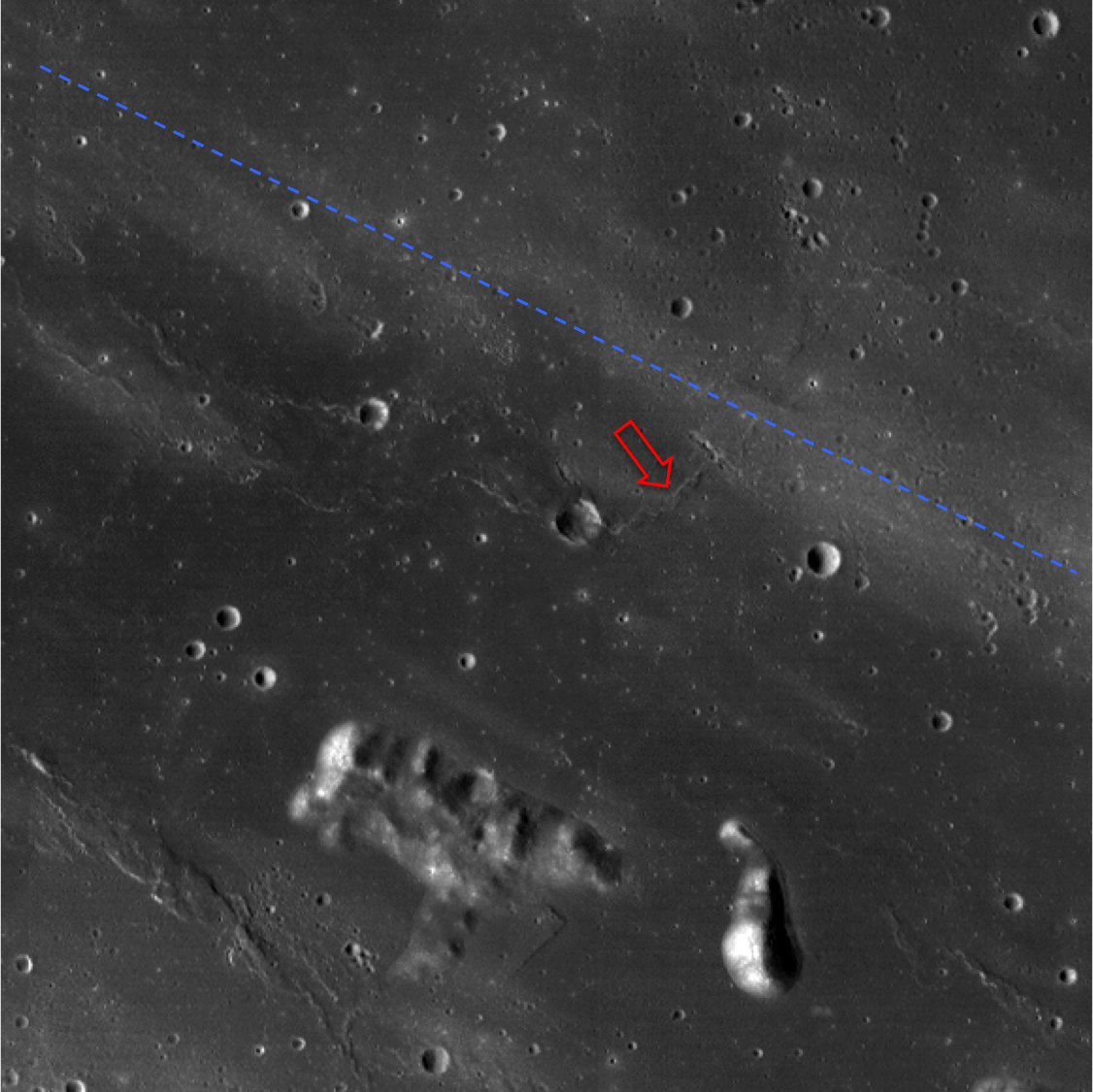
LROC Wide Angle Camera (WAC) context image. The crater from the Featured Image is in the center (SW of the arrow), and the red arrow denotes the wrinkle ridge. The dotted blue line shows the path of ejecta (ray) from Copernicus. Image field of view is 40.8 km across [NASA/GSFC/Arizona State University].
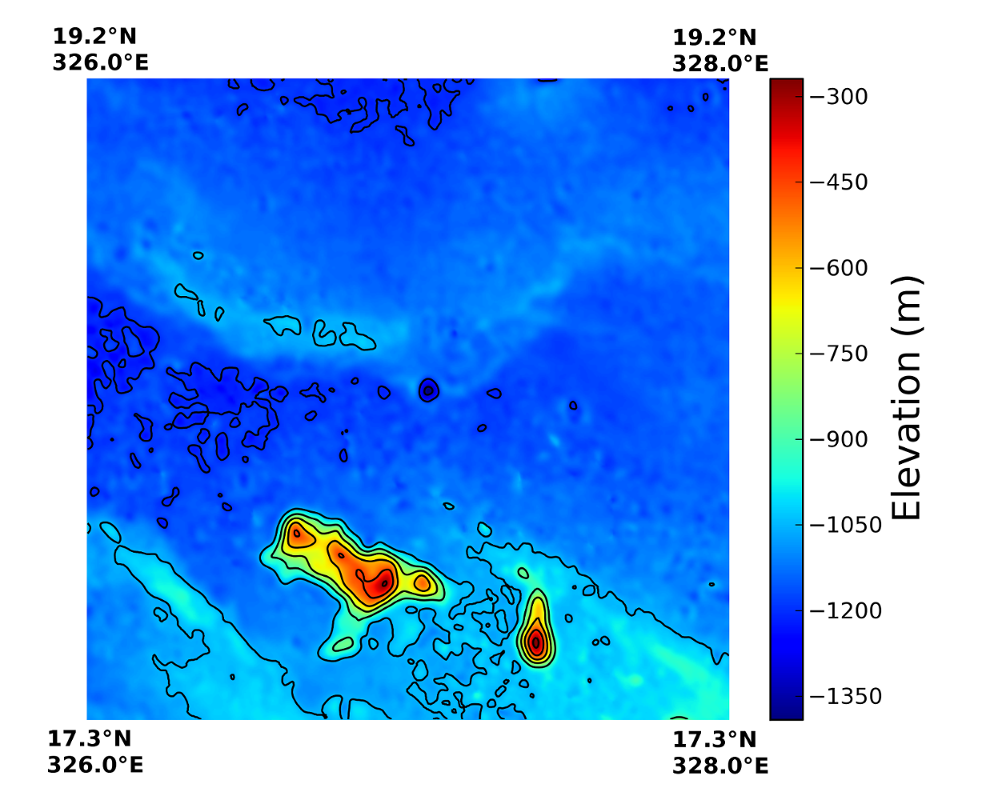
This region is located south of the crater Brayley D at the edge of Mare Imbrium. The crater in the Featured Image is ~2 km in diameter, and ~250 m deep (located at 18.240°N, 327.06°E). The wrinkle ridge is easier to see in the colorized topo image below. It extends from east to west across the mare.

LROC WAC topography showing the same region, contour interval is 140 meters elevation [NASA/GSFC/Arizona State University].
Explore the entire NAC frame to see more of the wrinkle ridge and surrounding mare, HERE.

Related Posts:
Posidonius Y
Boulders in the Sea of Serenity
Up and Down / Back and Forth
A Wrinkly Crater

Wednesday, February 13, 2013

Wrinkle Ridge in Mare Crisium

A complex wrinkle ridge in Mare Crisium at low Sun (angle of incidence 72.8° from the east). Boulders occupy the tops of mounds on the west ridge, and the central depression is more heavily cratered than the ridge. LROC Narrow Angle Camera (NAC) M146573730RE, LRO orbit 6734, December 9, 2010; field of view 700 meters at 89 cm resolution from 43.27 km [NASA/GSFC/Arizona State University].
Drew Enns
LROC News System

Wrinkle ridges are complex structural features that tend to develop in contracting regions of the Moon. Unlike lobate scarps (also contractional structural features), wrinkle ridges are thought to result from a mix of folding and faulting.

A buried thrust fault cuts through the mare, but not completely. Instead of breaking the surface, the fault pushes material upwards and causes the mare to fold over the fault.

This folding leads to a wide variety of wrinkle ridge morphologies. Despite this variation, all wrinkle ridges are made up of a larger ridge with a smaller superposed ridge.

A reproduction from the full 2.3 km-wide field of view, including the area at full resolution in the LROC Featured Image released February 13, 2013. LROC NAC M146573730R [NASA/GSFC/Arizona State University].
LROC Wide Angle Camera context image for the LROC Featured Image, highlighting the anatomy of the wrinkle ridge at 16.09°N, 61.68°E. Several other wrinkle ridges are nearby, each with a distinctive form. There are hints also of ghost craters and the kind of volcanic vent structures characteristic of the Marius Hills [NASA/GSFC/Arizona State University].
So when did all of these wrinkle ridges form?

The law of superposition argues that they must be younger than the mare basalt they deform. The basalts in Mare Crisium range in age from 2.5 to 3.3 billion years old!

These dates come from measuring the radioactive isotopic systems of samples returned by the Soviet Luna 24 mission. If these dates are correct and representative of the surface, the wrinkle ridges here formed after the basalts were deposited. Did the ridges start forming after 2.5 billion years? Probably not. Several mare flows also 'pond' behind wrinkle ridges, so the wrinkles must predate at least some mare material and potentially formed over the same time period. One billion years is a long time to go without tectonic deformation after all. One thing is probable, the wrinkle ridges continued developing after mare volcanism shut off in the area.

Explore more of the wrinkle ridge in the full LROC NAC, HERE.

Related Posts:
Bulging Wrinkle
Tectonics in Mare Frigoris
Relative Age Relationships

Tuesday, January 15, 2013

Really wrinkled wrinkle ridge

A wrinkle ridge in Mare Frigoris deformed the mare. LROC NAC M185963754R, spacecraft orbit 12484, March 9, 2012; image field of view is approximately 1.75 km, resolution 1.69 meters from 173.5 km  [NASA/GSFC/Arizona State University].
Lillian Ostrach
LROC News System

There are many wrinkle ridges throughout the lunar mare. These fascinating ridges are formed when contractional strain causes layers of mare basalt to fracture, a process that deforms the surface. Sometimes the wrinkle ridges are very sinuous and curvy, and other times wrinkle ridges are more linear and less undulatory.

Today's Featured Image highlights a curvy wrinkle ridge in Mare Frigoris (61.492°N, 350.108°E) that is morphologically similar to other wrinkle ridges in this mare, yet today's wrinkle ridge is much smaller than many of the other wrinkle ridges in this region (see WAC context below). Like other wrinkle ridges in the mare, there are some portions of the wrinkle ridge that are covered with boulders and are slightly higher-reflectance than the remaining portion of the wrinkle ridge. Current understanding is that because the wrinkle ridge has a broad rise and a central steeper-sloped ridge, the steepest-sloped portions of the ridge crest fracture and begin to disaggregate and erode before the remainder of the wrinkle ridge.

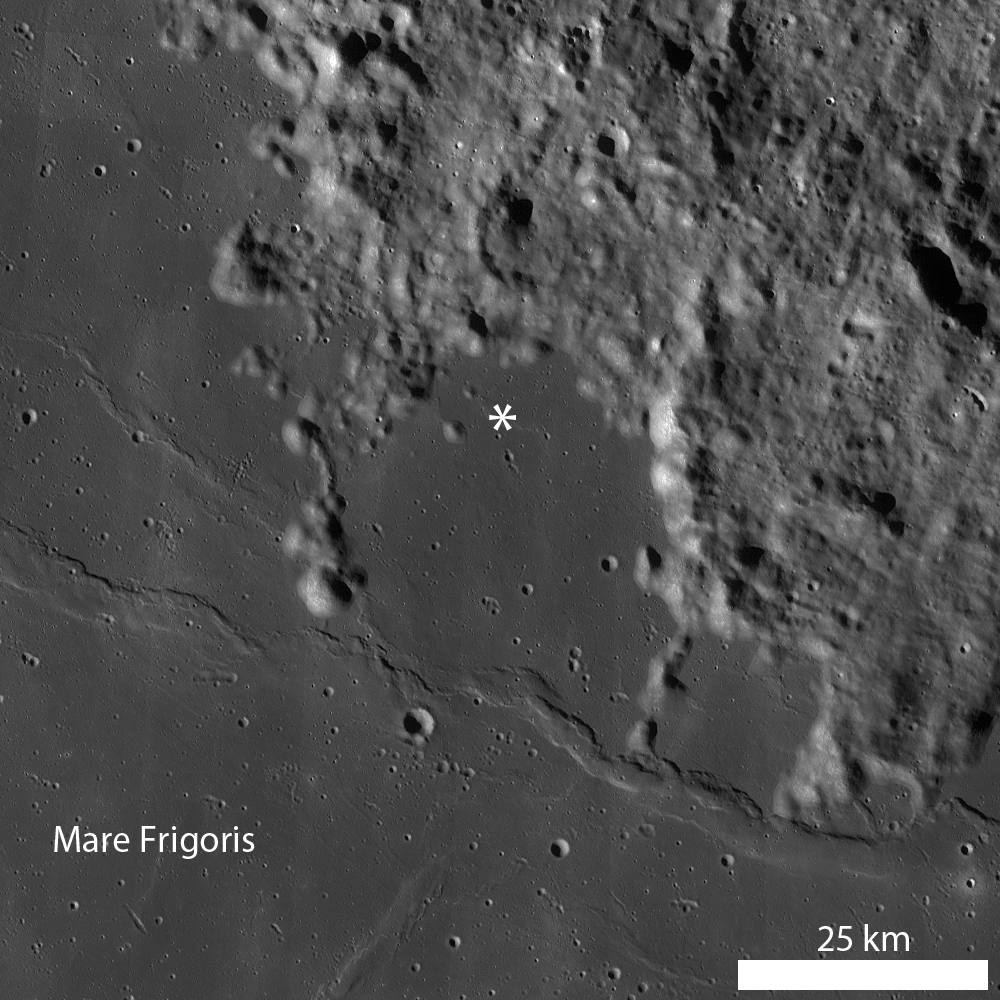
LROC WAC monochrome mosaic of the northern boundary of Mare Frigoris. The Frigoris basalts are heavily deformed by wrinkle ridges of various sizes; asterisk notes location of today's Featured Image [NASA/GSFC/Arizona State University].
Why, compared to other wrinkle ridges in this region, is today's wrinkle ridge so small? Consider the location of the wrinkle ridge in the WAC context image (above). The wrinkle ridge formed within the basalts infilling an old crater and is less than 10 km from the mare-highland boundary. It is possible that the mare-fill is thinner in this area, which would affect the degree to which the basalt could fault. This hypothesis is supported by the presence of several nearby kipukas, which were not covered by the embaying lava and probably affected the contractional strain in this area.

Further support for this hypothesis comes from observations of small wrinkle ridges in some mare-flooded craters that have much less basalt volumes than the flooded nearside basins. However, scientists have not yet identified all the wrinkle ridges in the mare, so it may be that many small wrinkle ridges are widespread that simply were unresolvable in older lunar images! Such an occurrence would make sense, especially when considering the range in sizes of lunar lobate scarps discovered by LROC1!

Do you see any evidence of kipukas affecting wrinkle ridge formation in the full LROC NAC image, HERE?

(1) For two recent publications, please refer to: Watters, T. R. et al., "Evidence of Recent Thrust Faulting on the Moon Revealed by the Lunar Reconnaissance Orbiter Camera," Science, 329, 936-940, 2010. Banks, M. E. et al., "Morphometric analysis of small-scale lobate scarps on the Moon using data from the Lunar Reconnaissance Orbiter," Jrnl. Geophys. Res., 117, E00H11, 2012.

Related Posts:
Boulders in the Sea of Serenity
Tectonics in Mare Frigoris
Forked wrinkle ridge
Wrinkle ridge in Oceanus Procellarum
Relative age relationships

Wednesday, January 9, 2013

Boulders In the Sea of Serenity

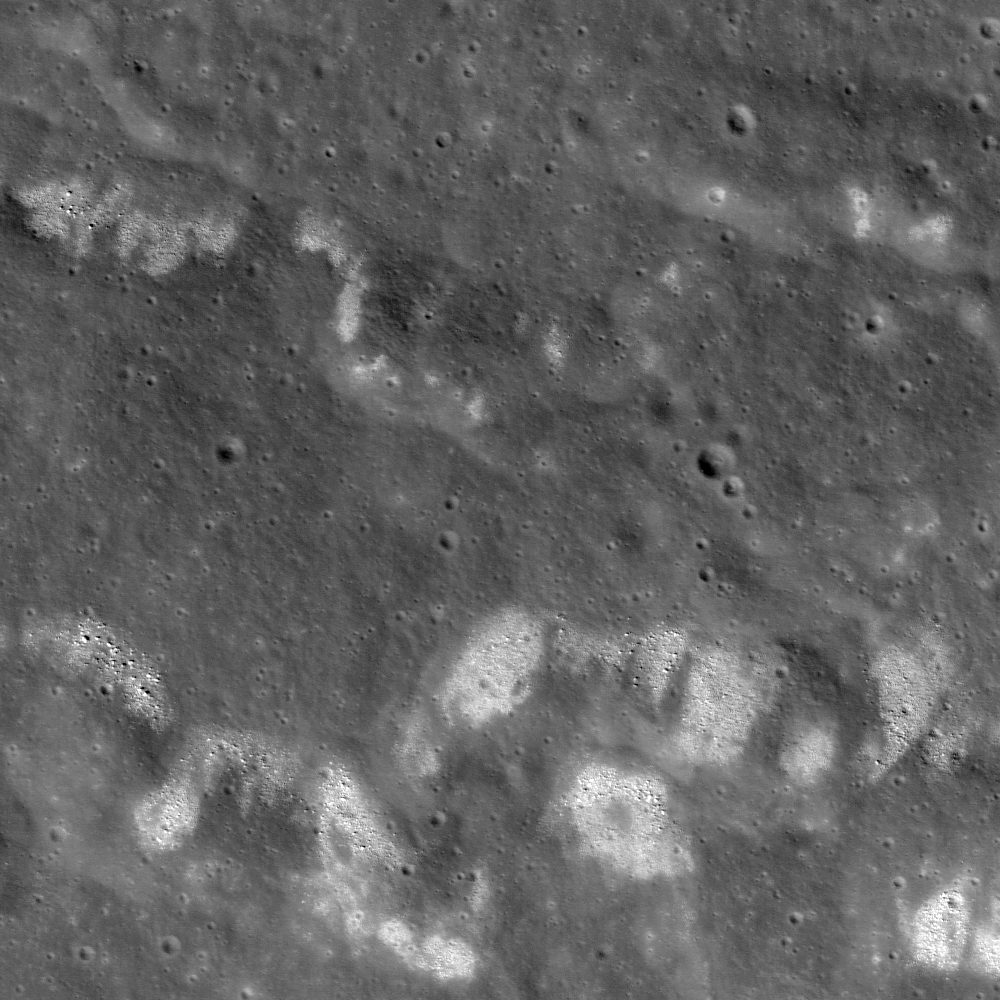
A wrinkle ridge in southwest Mare Serenitatis is littered with boulders and areas of high-albedo, characterized by rough texture. Field of view is approximately 1500 meters across> LROC Narrow Angle Camera frame M106826896L, LRO orbit 884, September 5, 2009; angle of incidence 35.34° at 1.25 meters resolution from 150.42 kilometers [NASA/GSFC/Arizona State University].
Renee French
LROC News System

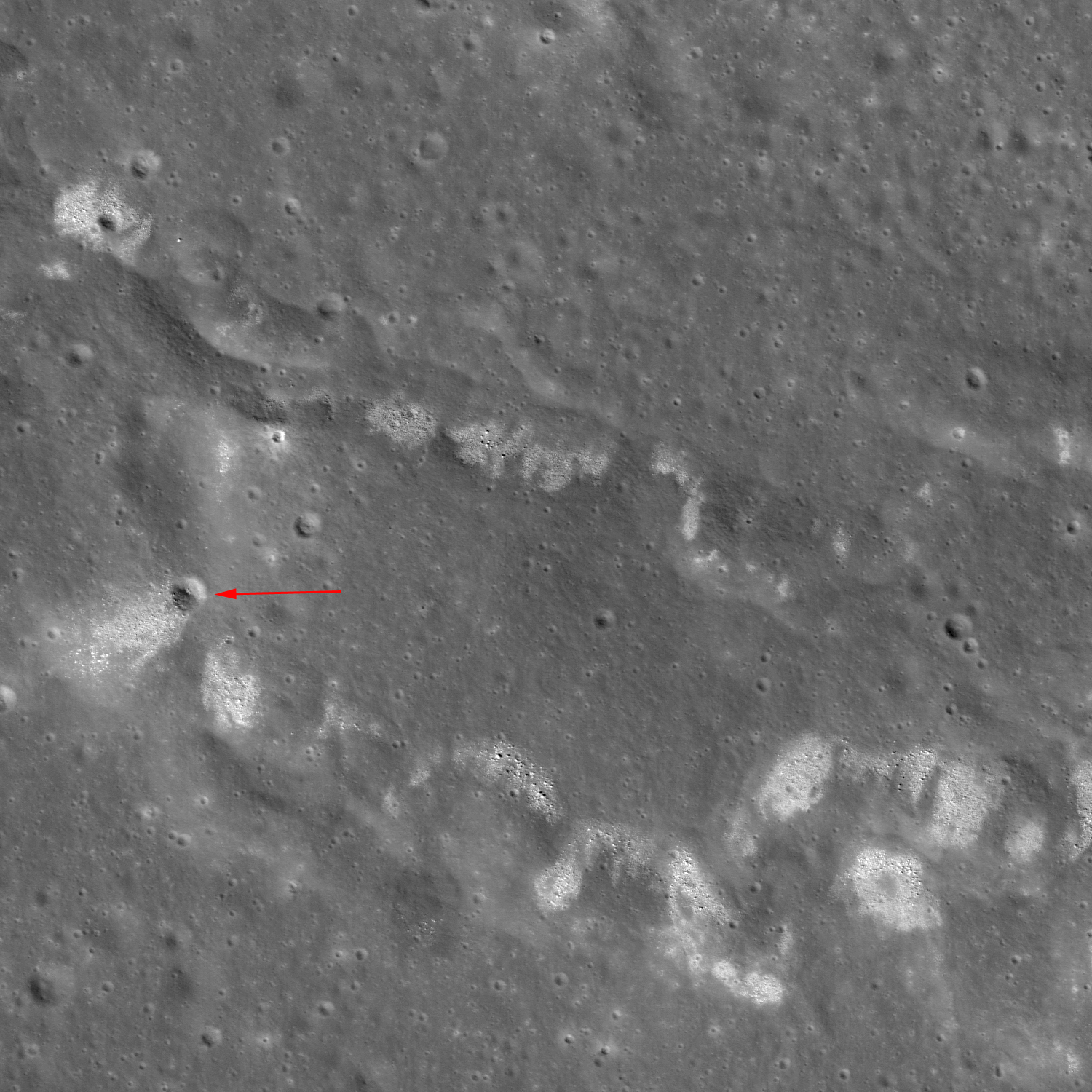
A wrinkle ridge in western Mare Serenitatis (23.448°N, 8.058°E) is one of many in the region that exhibits a high boulder density and high albedo (bright) summit areas. But it isn't the only place this relationship is seen! These bouldered ridges are also observed in Oceanus Procellarum, Mare Humorum, Mare Cognitum, and Mare Nubium, to name a few. Scientists are still uncertain as to why some ridges have these features and others don't, and why this isn't observed along the entire ridge. This ridge seems to be eroding along its slope, rather than the crest, suggesting that the material is coming from the ridge itself. In addition, a small impact crater (red arrow in below image) has excavated boulders and high albedo material, making it more likely that the source is from the ridge and not a product of distant cratering events.

Wider view shows a crater (red arrow) that has excavated the same material eroding out of the ridge.  Field of view approximately 2.3 kilometers across LROC NAC M106826896L [NASA/GSFC/Arizona State University].
There are two ways to describe high albedo on the Moon: either freshly exposed rock and soil, or material with different composition or properties. It is uncertain which description is best for the high albedo observed along these ridges or whether it is a combination of the two. If the boulders and high albedo material have happened because of tectonic activity, then that implies that activity along mare wrinkle ridges has occurred more recently than previously thought. These features need to be studied in more detail in order to fully understand what role they play in lunar history. This is just one of the many surprises that LROC has revealed!

LROC Wide Angle Camera (WAC) 100 meter-per pixel monochrome mosaic in the new and improved LROC WMS image search tool shows the the location of the wrinkle ridge in Mare Serenitatis (yellow arrow) in relation to Apollo 15 landing site near Hadley Rille [NASA/GSFC/Arizona State University].
To view the ridge in more detail, look at the top of the full LROC NAC frame, HERE.

Related Posts:
Zebra Stripes (July 3, 2011)
Bright ridge near Mons Hansteen (April 8, 2011)
Boulder clusters on a ridge crest (March 24, 2011)
Buckland Boulders (March 9, 2011)
Constellation Region of Interest in Mare Tranquillitatis (April 27, 2010)
Wrinkle Ridge Near Montes Teneriffe (December 29, 2009)

UPDATE: A Closer Look. This area of the Serenitatis basin is particularly interesting, under the influence of the extrusive volcanism of Sulpicius Gallus and the unusual elevation slope lower in elevation approaching the southwest basin rim, has been the subject of several earlier posts. As it turns out, for example, we had already, long ago, downloaded the entire 5000 sample by 52224 line NAC image from the Commissioning phase of the LRO mission about three years ago.

In a quick study, again using the continuously improving LROC image search tools, we wanted to see if any higher-resolution LROC NAC observations had been captured since September 5, 2009. Among the overlapping or nearly overlapping LROC NAC Observations we found of this same wrinkle ridge system were at least two perhaps helpful in further illustrating the area of interest.

Barely more than a year after the opening picture was taken, LROC swept over the same region, a bit more to the west of orbit 884, during orbit 5744, and the LROC NAC caught the image above showing the ridge "lobe" visible at lower left in the opening LROC Featured Image. Though Sun was slightly higher in the sky, the spacecraft was 106 kilometers closer, and the image immediately below shows that same ridge "lobe" at 49 cm resolution. LROC NAC M139856476R, angle of incidence 26.26° from 44.33 km [NASA/GSFC/Arizona State University].
The wrinkle ridge "lobe" at full resolution and corrected scale in a 286 meter-wide field of view from LROC NAC M139856476R, orbit 5744, September 23, 2010 [NASA/GSFC/Arizona State University].
While the area in this image does not overlap the left frame of LROC NAC M10682689L, it does overlap the right frame and a part of the same wrinkle ridge system slightly to the east. The field of view is a bit more than 2 kilometers wide, with the area in the white rectangle shown at full resolution immediately below. LROC NAC M126873954R, orbit 3831, April 25, 2010; angle of incidence 34.91° at 48 cm resolution from only 40.48 kilometers [NASA/GSFC/Arizona State University].
Perhaps one of the better close-ups of the boulders gradually being calved from the ridge through mass wasting, another full resolution, this time at a 276 meter-wide field from LROC NAC M126873954R {NASA/GSFC/Arizona State University].

Thursday, August 2, 2012

LROC: Sinuous Ridges on the Slope

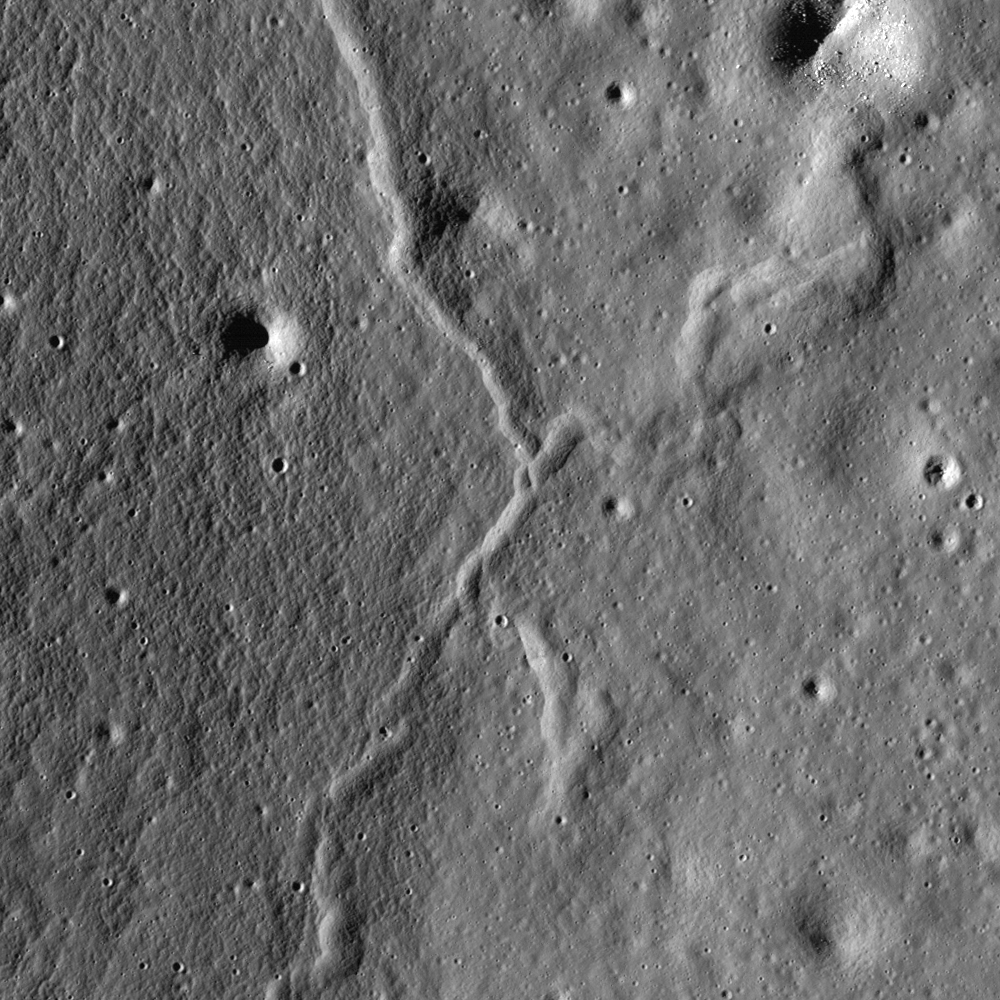
Triple junctions of wrinkle ridges at the western edge of Bolyai crater floor. Image field of view is 1270 meters, LROC Narrow Angle Camera (NAC) observation M134368363L, LRO orbit 4935, July 21, 2010; incidence angle 72.2° at 1.27 meters resolution from 61.04 kilometers. Sunlight is from the west. View the larger (~80%) original LROC Featured Image HERE [NASA/GSFC/Arizona State University].
Hiroyuki Sato
LROC News System

Today's Featured Image involves sinuous ridges observed at the western edge of the mare basalt deposit on the floor of Bolyai crater. Bolyai is a ~100 km diameter crater located at 33.85°S, 126.12°E, about 400 km south of Tsiolkovskiy crater. The northern part of the crater floor is filled by a mare basalt deposit (see WAC context image at the bottom of this post). Notice that the sunlight is from the left side of the image, thus the circular features (craters) are negative relief and sinuous line-features are positive relief.

The ridges show bifurcations at the middle of the image, and two ridge branches extending toward the northeast and southeast of this image gradually become less apparent. The southwestern branch strongly meanders and eventually disappears as well. On the other hand, the northwestern branch extends on the crater slopes all the way along the western boundary of the mare deposit (see the NAC context image below), about 80 to 300 m away from this "shoreline". How did all these ridge systems form? Could they really be "splash marks" like in Tuesday's post, or are they something else?

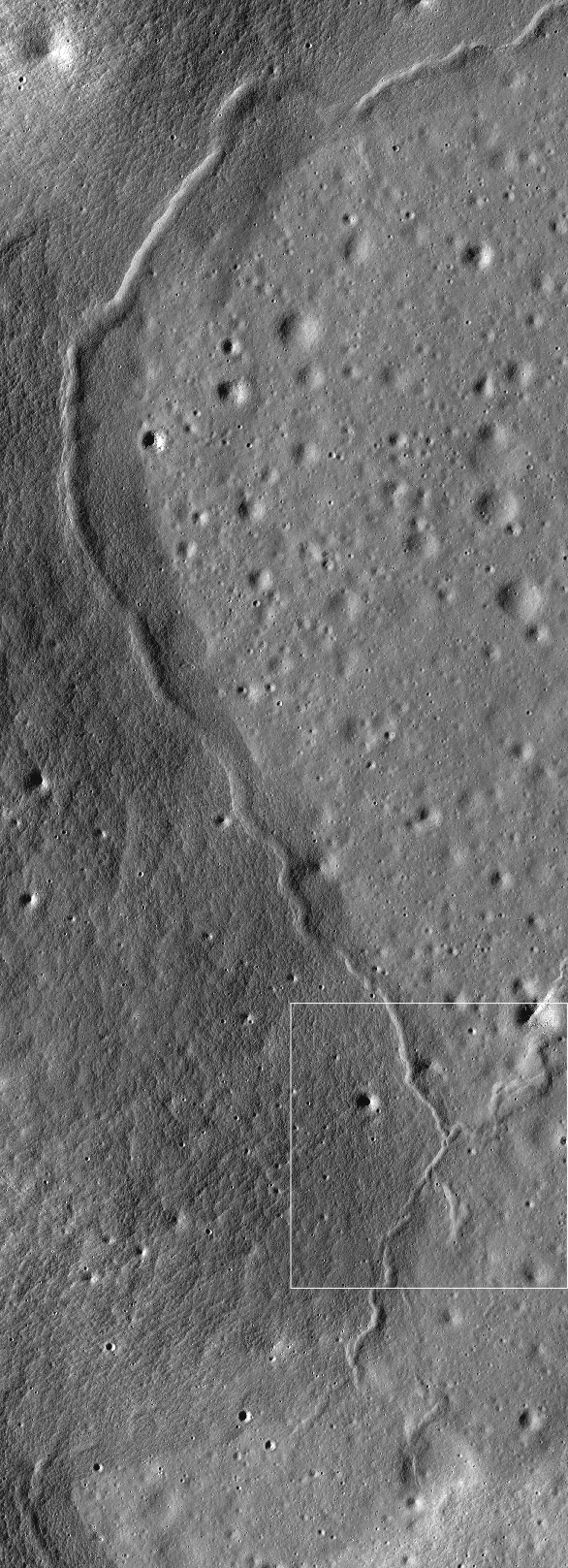
Western edge of mare basalt deposits, traced by wrinkle ridges on the slopes of Bolyai crater wall. A section of the width of LROC NAC frame M134368363L is layered on the Google Earth lunar digital terrain model. Section field of view is approximately 2.4 km across, and the area in the Featured Image is outlined by the white box [NASA/GSFC/JAXA/USGS/ASU].
In many cases, splash marks include boulders that were deposited at the "wave front" of the melt, which is not the case in today's image. The wrinkle ridges, a compressional deformation feature caused by thrust faults, can crosscut each other, which would explain the bifurcation of the ridges in the top image. But then, did the whole western part of the lava pond slip, forming the surrounding wrinkle ridges? Obviously, a series of complicated geologic events happened in this particular mare deposit within Bolyai.

Northern part of Bolyai crater, once again in Google Moon, and as the scene might be viewed from 47 km over a point southeast of the area of interest. LROC Wide Angle Camera (WAC) monochrome (604nm) mosaic stitched from observations gathered during 9 sequential orbital opportunities averaging 46.8 km, and at 62 meters resolution, November 25, 2011. The locations of the full NAC frame M134368363L is outlined by the blue rectangle and the yellow arrow marks the approximate location of the field of view highlighted in the LROC Featured Image released August 2, 2012 [NASA/GSFC/Arizona State University].

Explore this set of sinuous ridges full LROC NAC frame for yourself, HERE.

Related Posts:
Constellation Region of Interest at Mare Tranquillitatis
Wrinkle ridge in Oceanus Procellarum
Stress and pull
Tectonics in Mare Frigoris
Bulging Wrinkle

Friday, June 8, 2012

LROC: 'A Wrinkly Crater'

An unnamed crater deformed by tectonic forces. LROC Narrow Angle Camera (NAC) M183760209L, LRO orbit 12175, February 13, 2012; image field of view 960 meters, resolution 0.8 meters. View the more detailed LROC Featured Image HERE [NASA/GSFC/Arizona State University].
Drew Enns
LROC News System

Wrinkle ridges are one of the most common tectonic features on the Moon, and they are found in the lunar maria. Today's Featured Image focuses on one wrinkle ridge, designated Vitello R from the nearby crater, deforming a small mare crater located just south of Mare Humorum. We can tell the wrinkle ridge, and associated tectonic deformation, is much younger than the mare pond as it cross-cuts and modifies the crater (the crater formed after the mare was deposited). Crater counting indicates Mare Humorum is ~3.5 billion years old, but can we say anything more definite about the timing of this wrinkle ridge's formation? Looking at the entirety of the wrinkle ridge may give us more clues.

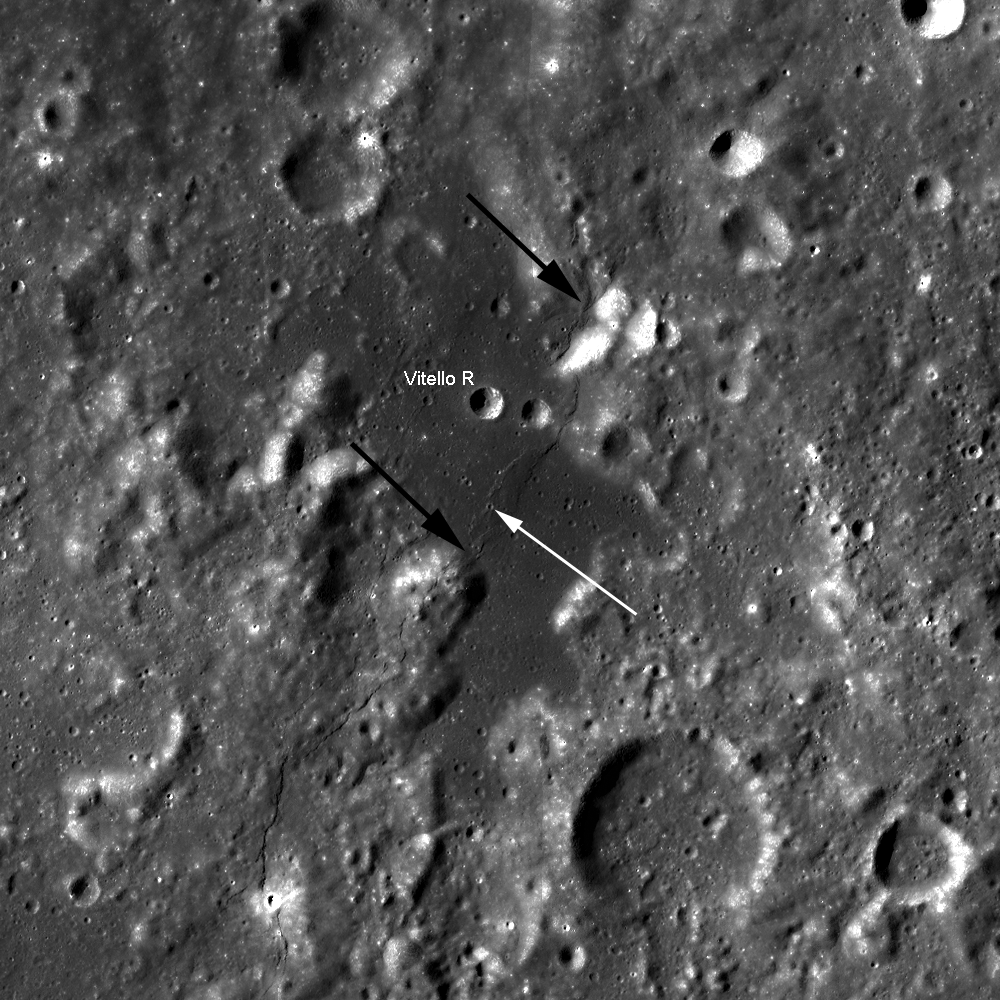
LROC Wide Angle Camera mosaic as context for the LROC Featured Image released June 8, 2012 (FOV marked with white arrow). The wrinkle ridge can be seen transitioning into a lobate scarp when it exits the mare pond (black arrows). Field of view 58 km across. View the 100 km FOV in image accompanying the Featured Image HERE [NASA/GSFC/Arizona State University].

The wrinkle ridge shows a peculiar change in morphology as it crosses from the mare to the nearby highlands. The wrinkle ridge transitions to a lobate scarp both in the north and south! While wrinkle ridges are characterized by a broad arch with smaller associated ridges, lobate scarps are generally asymmetric landforms with a steep scarp face and shallow tailing end. Both landforms are interpreted as the surface manifestation of thrust faulting in different tectonic settings, so the wrinkle ridge and lobate scarps are probably related. A fresh crater in the bottom-left of the context image erases a portion of the western lobate scarp, but everywhere else the scarp deforms the surface. We can then infer from these observations that the wrinkle ridge-lobate scarp is both caused by a single thrust fault and is fairly young!

Explore more of the wrinkle ridge in the full LROC NAC HERE!

Related Posts:
Not Your Average Scarp
Bulging Wrinkle
Tectonics in Mare Frigoris

Thursday, February 2, 2012

LROC: Shield Volcanoes in Lacus Veris

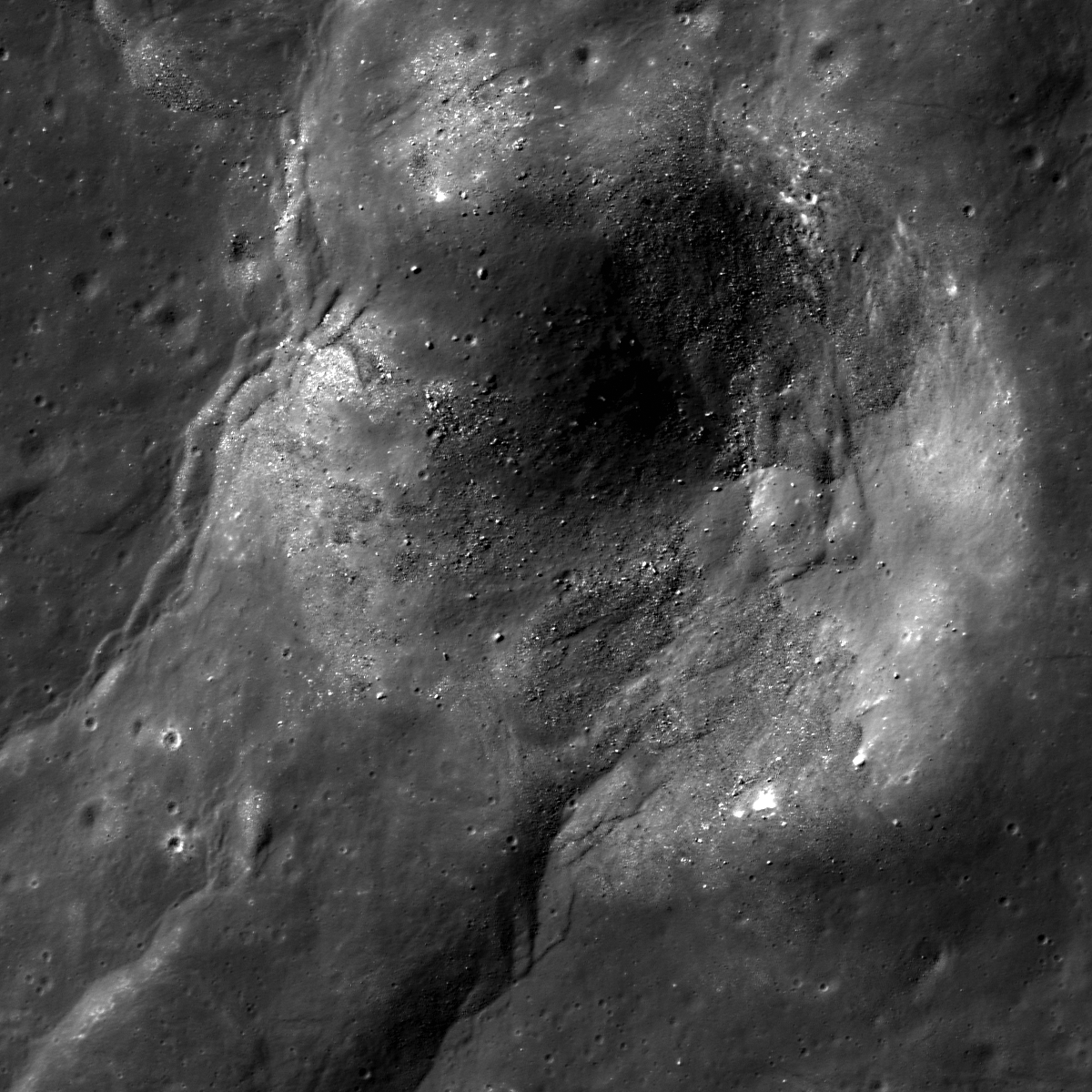
Wrinkle-ridges in mare basalts? Nope! These step-like features are located on the flanks of a shield volcano! (Down-slope to lower right). LROC Narrow Angle Camera (NAC) observation M166406436R, orbit 9657, July 27, 2011; field of view is 728 meters, angle of incidence 60.37° with a resolution of 0.54 meters per pixel from 48.19 km. View the 1400 px original LROC Featured Image HERE [NASA/GSFC/Arizona State University].
Lillian Ostrach
LROC News System

Although volcanism on the Moon was a prevalent process, as evidenced by the voluminous maria, volcanic constructs such as domes and cones are not particularly common. However, several regions including the Marius Hills, the Gruithuisen Domes, and the Compton-Belkovich region exhibit landforms interpreted to be volcanic constructs. Searching for similar morphologic features in LROC NAC and WAC images will help identify other volcanoes. 

On first glance, today's Featured Image may resemble another smooth region of mare with prominent tectonic features. The LROC NAC images are wonderful for studying the morphologic detail of the Moon's surface, but sometimes multiple NACs or LROC WACs are needed to grasp the "big picture" of the geology glimpsed in detail in a single NAC. In this case, we cannot rely solely on the high-resolution NAC image for interpretation of this landform, and must pair our NAC observations with a WAC context image to expand our view. Of course, imaging the whole Moon at NAC resolution would really help, too.

LROC Wide Angle Camera (WAC) monochrome context image of Lacus Veris. Located between the Inner and Outer Rook basin rings, Lacus Veris is one of several small mare deposits located within Orientale basin. Asterisk notes location (17.967°S, 274.792°E) of the opening image; black strips are present on either side of the image because the WAC image is slewed [NASA/GSFC/Arizona State University].
By using knowledge of where on the Moon the Featured Image is and then exploring the LROC WAC context image above, the landforms may be observed more completely. In the WAC mosaic, the step-like features are part of an oblong, irregular bulge near the boundary of the Lacus Veris mare material and the highland material in which Orientale basin formed. The feature is approximately 5 - 6 km wide and the illumination shows that it is topographically higher than the surrounding surface (but the WAC DTM or a NAC DTM could be used to determine how much higher the feature is from its surroundings). There is an ~250 - 400 m wide rift-like fracture or fissure down the middle of the bulge.

Crop from one of the exceptional Terrain Camera images of the area of interest from the vantage of Japan's lunar orbiter SELENE-1 (Kaguya), TC_055_3, released in 2009 [JAXA/SELENE].
These morphological characteristics are very similar to low shield volcanoes, which are formed by the same means as the Hawaiian shield volcanoes but have a much lower height-to-diameter ratio1. So, contrary to many places on the Moon, the Lacus Veris region evidently has notable volcanic constructs! The opening image is located on the distal northeast flank of the shield volcano, and probably represents multiple eruption events since successive eruptions are responsible for building the gently-sloping shields in terrestrial shield volcano eruptions.

Take a look at the full LROC NAC image; can you make observations that would help support or refute the low shield volcano interpretation?

For the seminal scholarly paper discussing this lunar shield volcano in Lacus Veris, please see R. Greeley (1976), Modes of emplacement of basalt terrains and an analysis of mare volcanism in the Orientale Basin, Proc. Lunar Sci. Conf. 7th, 2747-2759.

Related Posts:
Brayley G
Volcanoes in Lacus Mortis
Another small volcano?
Hortensius Domes - Constellation ROI

Wednesday, January 11, 2012

LROC: Bulging wrinkles at Tsiolkovskiy

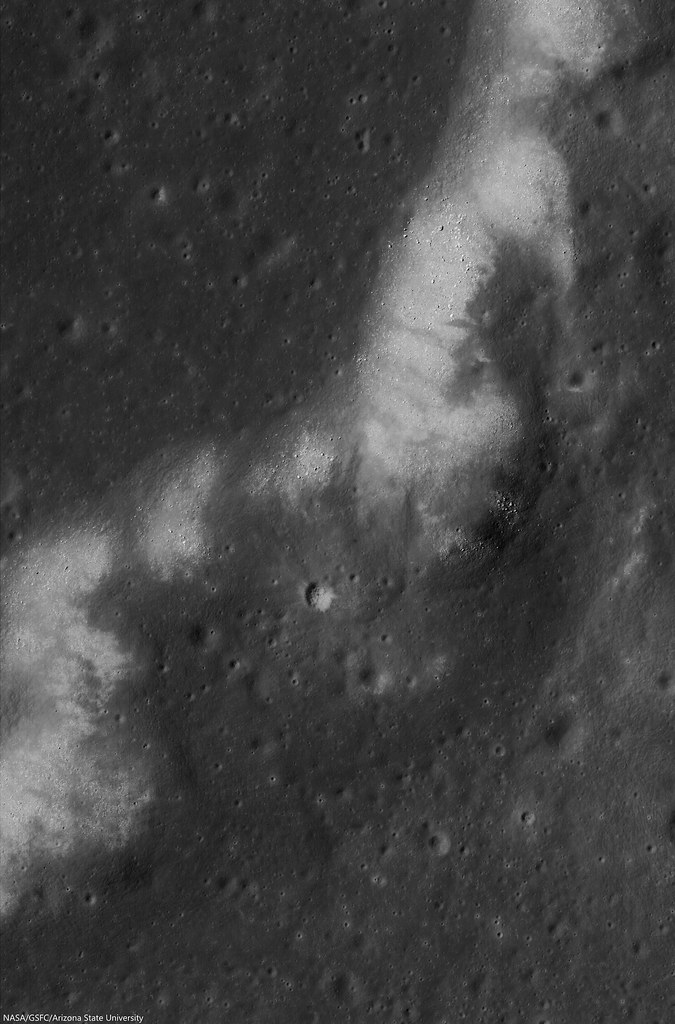
From the complementary left-side frame of the north-northwest interior of Mare Tsiolkovskiy spotlighted January 10, "bulging" and interestingly entwined wrinkle ridges can be seen extending into the prominent farside crater's very flat and expansive floor. Sunlight is from northeast in this slightly "twisted" view of the original Featured Image (which shows a larger field of view 610 meters across) HERE. LROC Narrow Angle Camera (NAC) observation M161475783L, orbit 8930, May 31, 2011, resolution 0.61 meter per pixel from 58.99 kilometers  [NASA/GSFC/Arizona State University].
Hiroyuki Sato
LROC News System

The mare in the Tsiolkovskiy crater looks extremely flat and smooth at first glance. But if you stare carefully, you can find many tectonic features deforming this large plain; extension cracks, classic wrinkle ridges, and special wrinkle ridges that have a convex bulge shape.

Today's Featured Image shows a portion of a narrow "bulging" wrinkle ridge 60 to 100 meters in width, extending in a northeast direction to the edge of the mare. Wrinkle ridges are common in the lunar mare and are believed to be a type of thrust fault. These ridges typically have a steep slope on one side and a shallow slope on the other. In this case, the ridge seems to have a uniform curved shape. Local tectonic conditions such as the thickness of mare, stress direction, and the layer strength affect the final shape of a ridge. Since this ridge has a unique shape, it is now targeted for future NAC stereo imaging. From the new stereo pair, scientists will make a detailed topographic map that will allow tectonic experts to better understand the nature of this feature and add to our knowledge of tectonism on the Moon.

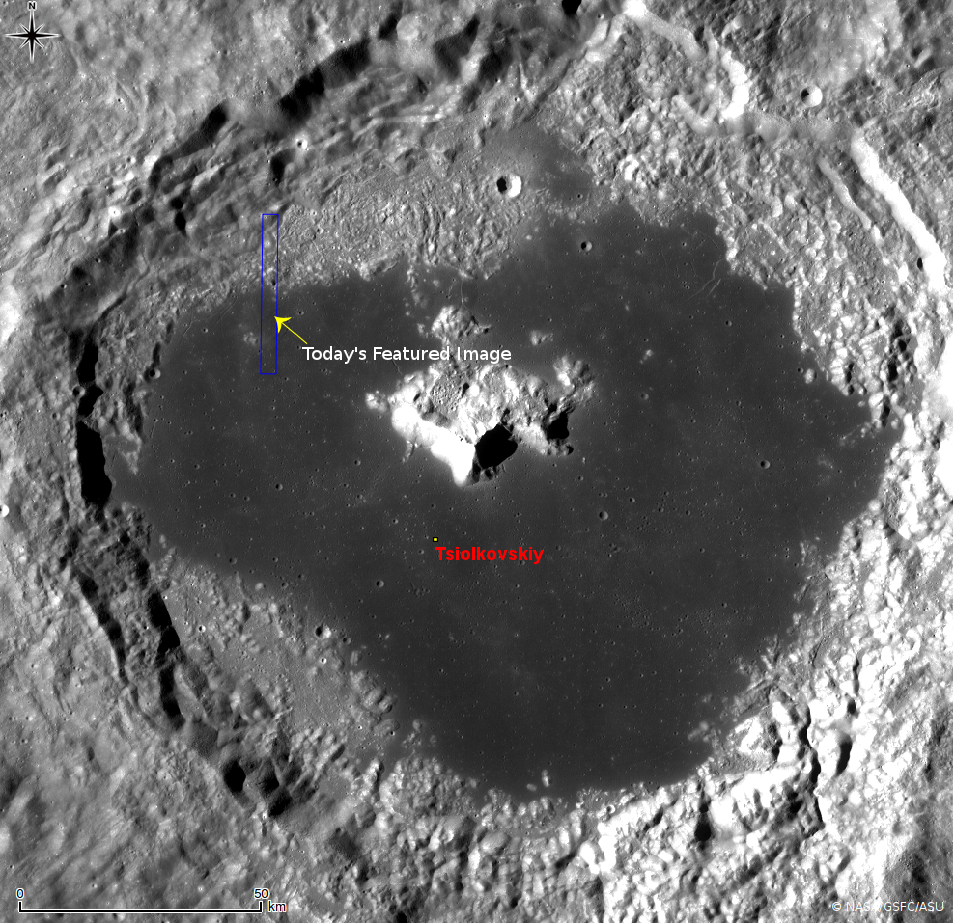
LROC WAC 100 m/pixel monochrome (643 nm) mosaic of the area around northwest Mare Tsiolkovskiy. The area shown at high resolution (white arrow) is near 19.41°S, 127.34°E. View the full-scale WAC context image, and the totality of Tsiolkovskiy's interior HERE   [NASA/GSFC/Arizona State University].

Explore the full length of the "bulging" wrinkle ridge and other nearby tectonic features, HERE.

Related Posts:
Tectonics in Mare Frigoris
Stress and pull
Relative age relationships
Zebra Stripes
Right Angle
Wrinkle ridge in Oceanus Procellarum
Sinuous Chain of Depressions