Showing posts with label NASA Budget. Show all posts

Wednesday, April 10, 2013

General Bolden on the Moon

EDITORIAL : The Space Community experienced a minor brush fire late last week, set accidentally perhaps, by NASA administrator Charles Bolden and his reaction to the National Research Council's congressional-commissioned review of NASA’s "strategic vision."

It’s a sad fact of American politics that the release of the NRC report might have passed largely unnoticed had Bolden been as cryptic about the Moon’s place in NASA’s future as the rest of the administration has been from is beginning.

Instead he confirmed for us one line of reasoning into the administration’s actual rationale for erasing the Moon from National Space Policy, three years ago.

“I don’t know how to say it any more plainly,” Bolden said. “NASA does not have a human lunar mission in its portfolio, and we are not planning for one.”

He warned the next administration not to change course “again” back to the Moon. That would mean, he said, the U.S. would “never again see Americans on the Moon, on Mars, near an asteroid, or anywhere. We cannot continue to change the course of human exploration.”

“NASA will not take the lead on a human lunar mission,” Bolden said. “NASA is not going to the Moon with a human as a primary project probably in my lifetime,” because “we can only do so many things, and NASA’s focus will remain on human missions to asteroids and Mars.”

“All that was 'a given,' three years ago,” Apollo 17 commander Gene Cernan said afterward on Tuesday, perhaps forgetting along with General Bolden, that "going to the Moon as a primary project" has not been a goal of the American government since 1969, and this was never "a primary project" of the Vision for Space Exploration in 2004 or of those who recognize the Moon's strategic and scientific value and who still support restoring the Moon back into scientific context today.

On the surface there did seem little that was new in Bolden’s protests. All the superficial reasons for dropping the Moon as an intermediate objective on the way to Mars spread abroad by the administration and its supporters still make little sense. No one who seriously supported a return to the Moon as an essential objective on the way to Mars ever hoped simply to recreate Apollo. 

And if it’s asteroids you want, the Moon has been an asteroid magnet for about 4.575 billion years.

Aside from the glaring hole left by having had the Moon erased from National Space Policy, three years after the cancellation of Constellation, America's deep space efforts are really little different from what they were at the end of the Bush administration, with little actual progress having been made not already set in motion before President Obama's Inauguration.. 

Aside from the missing Altair lander, and the R&D required to build it, together with a simple recognition of the Moon’s clear strategic value in overcoming tremendous technological challenges facing any manned mission to Mars, very little has actually changed.

The end goal of landing astronauts on Mars, someday, some way, in budgetary “out years,” is still the same, as was retiring the Space Shuttle and planned development and use of commercial transportation to ISS. These were integral to the Vision for Space Exploration introduced in 2004. Though some seem determined to credit the administration with having dreamed up subsidized commercial space, and certainly for popularizing the idea, that too was integral to the VSE and as far as presidents go the initiative dates back to Ronald Reagan.

From a political perspective, with unwitting help from General Bolden, we no longer have to simply make educated guessed as to why the Moon was edited out of NASA’s strategy. As it turns out, it was not the “been there, done that” argument offered by the President, after all..

Bolden has finally confirmed for us one line of investigation into the mysterious missing Moon by simply telling us that the Obama administration just does not want the American governmentto take the leadon any manned return to the Moon.

Thus, it was a political decision, dressed up and oversold with some of the tired arguments originally heard forty years ago.

That's not a crime, of course. Thankfully Bolden has also communicated that the administration is not opposed to "leading from behind" on a manned mission to the Moon, perhaps lead by a different nation, nor does he rule out robotic exploration, though the nation has so far committed only to finishing or fulfilling the precursor robotic lunar missions that were either already underway or already long in the pipeline.

We are genuinely grateful the administration appears unwilling to stand in the way of any commercial manned or unmanned landings in the Moon.

But why this passionate and now very specfic opposition to America leading while exploring and using the Moon as a stepping stone to Mars and as a Rosetta Stone for the rest of the Solar System?

In light of all the other alterations made to the President's 'asteroid initiative' over the past three years, was the administration's unyielding position the original and still primary reason the whole Constellation program was cancelled?

The Moon, and those of us still urging policy makers to take another look at its advantages over manned asteroids exploration, are apparently occasionally being heard in the White House. In the past three years the administration has occasionally floated tantalizing trial balloons, future efforts involving the Moon, but specifically without any  human landing.

One thing is different in the past three years. The small flotilla of remote sensing spacecraft, from Japan, China and India, as well as the U.S. sent to the Moon, and inspired by the lead America had taken with in 2004, after a long national drought five American spacecraft in lunar orbit simultaneously for most of this past year, and planetary scientists have learned more about the Moon since 2004 than in the two decades previous.

This new look at the Moon has by now strongly confirmed the Moon's strategic importance and its usefulness to science, and as a logical support for future manned missions to Mars.
"Just after it has been relegated to a “been there, done that” status, the Moon again shows us we have a lot to learn about its history, physical state and the potential value of its resources. We must take the initiative to learn more as the Moon is crucial in developing and advancing a sustainable space faring infrastructure." -   Paul D. Spudis

Why then, like Arthur C. Clarke’s Europa, are American astronauts to “attempt no landing there?” If we are taking the lead going to Mars, our role in a return to the Moon along that path would seem to be irrelevant.

This much is clear. Leaving the Moon out as an intermediate goal, as a place where America already has a momentary and essential lead, is a stubbornly held position dear to the administration.From Bolden’s statements late last week one might think someone had suggested NASA’s strategy for building a path to Mars should be renamed back to “Constellation.”

Though only occasionally experienced, if America’s history and the nation's storied history of manned space exploration has succeeded in teaching us anything it has taught history has a very tight turning radius.

Monday, January 28, 2013

WSJ Op-Ed calls for scrapping SLS


In an essay in Monday’s issue of the Wall Street Journal, Robert Walker and Charles Miller make a pitch to President Obama: complete the job he started in his first term in handing over space transportation entirely in the private sector. “Just as the government does not design or build automobiles, ships, trains or airplanes, NASA should not be designing, building or launching rockets to go to low Earth orbit,” they argue. 

Specifically, they want the President to kill the Space Launch System, the heavy-lift rocket that emerged from the 2010 compromise about the administration’s policy, saying that those launches should be turned over to the private sector. 

Read the summary, HERE.

Thursday, January 24, 2013

The proper course for lunar exploration (1965)

MOLAB with side-mounted drill and Apollo LEM as conceived in 1964-1965. The MOLAB would have arrived on the moon ahead of the piloted LEM on an unmanned LEM Truck [Bendix/NASA].
David S.F. Portree
Beyond Apollo
WIRED

For a time, Thomas Evans headed up the Advanced Lunar Missions Study Program in the NASA Headquarters Office of Manned Space Flight. By the time of the 11th Annual Meeting of the American Astronautical Society (AAS) in May 1965, however, he had retired from NASA and become a farmer in Iowa. This gave him the freedom to speak his mind about what he felt were the Apollo Program’s shortcomings.

Evans told assembled members of the AAS that “the idea of a manned [landing] on the moon was so spectacular. . .that [it] dominated most pronouncements and thoughts on the space program.” He argued, however, that this objective had “too much the flavor of a stunt to be the final goal of a $20 billion national effort.” Evans maintained that
[Our] situation today is comparable to one which might have occurred during the railroad building era in America a century ago. It is as if the federal government had invested vast sums in the construction of the first railroad spanning the North American continent, but had procurred only a single engine and caboose. . . The first crossing by that engine and caboose would have been a major milestone in man’s progress and would have been greeted with enthusiasm and applause. But then those responsible for the program would have faced a major decision. . .Should the project be stopped? Should the engine-caboose be run repeatedly back and forth across the Continent to constantly remind the world of our great achievement? Or should a further modest investment be made in. . .some freight and passenger cars, to convert the system into something of practical value? Only the last solution would have been tenable then, and only a similar constructive approach would seem acceptable now.
 Evans argued that the Saturn rockets and Apollo spacecraft NASA had under development would provide “an excellent base upon which to build a broad program of manned. . .lunar exploration beyond the first landing.” Evans pointed to statements by President Lyndon Baines Johnson and Vice-President Hubert Humphrey which he said made clear that “the United States fully intends to explore the moon, not merely to visit it.” He also noted that NASA expected to be able to launch six Saturn V rockets per year beginning in 1969.

Read the full article, HERE.

Wednesday, September 19, 2012

Orion and SLS: Where Are They Now?

Amy Teitel
AmericaSpace.com

It’s been a little over a year since NASA announced its intention to build the Space Launch System or SLS, the rocket that will be bigger and more powerful than the Saturn V. Its payload is set to be the Orion Multi-Purpose Crew Vehicle, the Apollo-inspired capsule that is slated to take men to the Moon, Mars, and asteroids at some still-undefined point in the future. Last Wednesday, the Republican Subcommittee on Space and Aeronautics held a hearing to examine ongoing developments of Orion and SLS. The word from NASA is that both projects are moving forward. But schedules are starting to slip, and things will only get worse if the agency faces further budget cuts.

Testifying at the September 12 hearing were Cleon Lacefield, Vice President and Orion Program Manager from Lockheed Martin; Boeing Space Exploration Vice President and SLS Stages Program Manager Jim Chilton; NASA Deputy Associate Administrator for Exploration Systems Development Daniel L. Dumbacher; and Matt Mountain, Director of the Space Telescope Science Institute.

Read the full article, HERE.

Tuesday, July 31, 2012

Newt Space

Paul D. Spudis
The Once and Future Moon
Smithsonian Air & Space
  
During a recent talk to a gathering of students, former House Speaker Newt Gingrich spoke of his longstanding interest in space by mentioning the dust-up over comments he made about a Moon colony during the GOP primary.  He expanded this episode into a teaching moment about the nature of innovation and progress in space.  Gingrich is vigorous in his enthusiasm for space exploration but is not a devotee of the current agency and its programs.  In his considered opinion, we need to re-think our approach to space exploration and use more innovative, non-bureaucratic approaches to develop space systems and capabilities.

A historian by training, Gingrich often uses historical analogies to illustrate his point.  On this occasion, he spoke of the experiences of the Wright Brothers and Samuel P. Langley in the development of the first airplane.  As Gingrich relates it, after several failed attempts the Wright brothers finally achieved flight on December 17, 1903, spending in total about $500.  In contrast, Langley (the recipient of a $50,000 government grant) failed in his attempt to fly when his “aerodrome” crashed into the waters of the Potomac River (the actual amounts spent were “less than $1000” and $70,000 respectively, according to James Tobin’s excellent book on the subject).  That powered aircraft might have military use was not a new idea and the then-recent war with Spain led to a re-examination of our defense posture, with the military eager to fund Langley’s aeronautical experiments.

Gingrich contrasts the “faster, cheaper, better” (and successful) approach of the Wrights to the supposedly bureaucratic, measured failure of Langley and suggests that this incident parallels the current differences between the approach of “New Space” (an umbrella term referring to the variety of current efforts by the private sector to develop spaceflight capability) and our federal civil space program.  In other words, it’s not the lack of resources or technology that’s holding us back – it’s our business model.  He suggests that many of the central tenants of “New Space” (including the offering of prizes as technical incentives and “lean” management models) will accomplish more in space than we’ve received through government programs and for much less expenditure.

First flight of Langley's aerodrome - one second after launch and one second before impact
The historical story is interesting but did Gingrich draw the correct conclusion?  Should the success of the Wright brothers be attributed to how they approached the problem or to how much it cost?  In contrast to Gingrich’s suggestion, Samuel Langley did not represent an enormous, bloated and hidebound bureaucracy.   At the turn of the century, the Smithsonian Institution was not the behemoth it is today.  Langley had been hired as an assistant secretary for international affairs at the Smithsonian.  Secretary Spencer Baird died eight months after Langley reported for work, leaving open that position, which Langley accepted.  He wanted to continue his aeronautical experiments and used the facilities of the Smithsonian (including its shops and technicians) to build and test his flying machines.

Langley built a high-powered internal combustion engine for his aircraft, producing greater horsepower per unit weight than any other effort of the time, including the one used by the Wright brothers.  The failure of Langley’s aerodrome largely resulted from its design; the dihedral cross-section of its wings led to instability in any type of wind.  Wilbur Wright described this problem in a June 1903 talk – an understanding that came from the brothers’ experiments with wing shapes on kites at Kitty Hawk.  The Wright flyer used wing-warping to create control surfaces, which made it possible for a pilot to steer the airplane in variable wind conditions.  The Langley aerodrome was naturally unstable; with its wing shape, any gust or cross-wind rendered the aircraft uncontrollable.  In other words, the success of the Wright brothers was due to a superior technical approach, not to their management model.

For anyone who has dealt with bureaucracy, freedom from the ponderous administrative overhead of a government agency is always an enticing vision.  But in many ways, it is orthogonal to the real issue – what are you trying to accomplish and by what means or mechanism?  The Wrights and Langley both knew what they were trying to do, but only one of them had the correct technical approach.  Their technical choices determined the outcome of their efforts, not the total amount of money spent nor the managerial structure of their respective projects.  If so, can we draw any conclusions from this and apply it to the current model of our national civil space program?  The idea that government cannot do anything right is understandably attractive and in vogue, but not completely borne out by the evidence.

As a counter-example to Gingrich’s history of early aviation, consider a technical development project closer to us in time and memory.  A nuclear ship that has to refuel only every few years has an enormous advantage over one that needs near-constant refueling.  The United States possesses a nuclear navy (both aircraft carriers and submarines) largely because of the vision and persistence of one man, Admiral Hyman Rickover.  A true visionary, Rickover believed that nuclear reactors could be made small enough to fit into a ship and safe enough to entrust the lives of thousands of men to such vessels.  For years he fought the navy and the Defense Department to sell the advantages of nuclear sea power to the Congress and President.  Today we have such a fleet largely because of his vision and determined efforts.  And nobody ever took a poll to see if a nuclear navy would “excite and engage” the public.

Newt Gingrich is a true believer of humanity’s future in space.  I admire his dedication and courage in speaking the truth as he sees it.  However, in this case, I believe he has drawn the wrong lesson from history.  Compelling national interests sometimes require the marshaling of our combined will and resources.  We need a dedicated federal space program with a clear strategic direction and the know-how to pull off difficult technical tasks.  No cult of management or prize money will have us walking again on the Moon or using its resources.

For our country to remain vibrant and strong, it is vital that Americans be called upon to engage in the mental and physical challenges of a national space program, coupled to the realities and challenges inherent in an expanding cislunar territory and new markets.  Our pioneering space legacy needs to be embraced and celebrated through a renewed commitment from our government.  If Americans forfeit this direction and opportunity because their government cannot see the danger in the current path, we will have grievously failed in our promise as a nation and our obligation and duty to future generations..

Originally published at his Smithsonian Air & Space blog The Once and Future Moon, Dr. Spudis is a senior staff scientist at the Lunar and Planetary Institute. The opinions expressed are those of the author and are better informed than average

TASC: NASA 'essential for national security'

Support for NASA and Space Exploration in the U.S., as essential public policy and vital to national security, is not expressed as often or as acutely in the 21st century as it was when the civilian space agency was founded in 1958. Instead, considering the agency in the context of the Cold War, as part of an arms race with the former Soviet Union, is often dismissed as ancient history. The agency's role in serving an essential national security interest is usually, at best, remembered only as secondary to its contributions to the quality of life of Americans.

But in the background, in congressional cloakrooms and committee hearings, NASA's role in service to American national security is paramount, even over and above pork barrel politics, and more now as budgetary constraint becomes less abstract with each increase in the national debt ceiling.

The public voice in support of NASA being vital to American national security is rarely heard above the noise of debates over NASA's future exploration roadmap and over the self-continuity concerns of a vested bureaucracy.

Former U.S. Senator and Apollo veteran Harrison Schmitt and  others, have, on occasion, reminded us that NASA's most basic constitutional reason-for-being is still the role it plays as a vital arm of America's national security.

Now a study has been released by The Analytic Sciences Corporation (TASC) expressing this national security raison d'etre in the context of the 21st century. As a think-tank arm associated with the aerospace industry the think tank behind the study may not be a totally dispassionate one, but it at least puts forward the effort as justifying NASA's expense not as either a museum curator or an enabler purely of the dreams of academia or futurists, but as a federal arm serving an over-arching "compelling state interest."

"For the United States," the study's introduction reads, "maintaining a leadership role in space is an essential component of national security, providing the U.S. and our allies “unprecedented advantages in national decision-making, military operations, and homeland security.”* NASA is essential for national security, not only because of its role in developing new space capabilities and technologies, but also because it is explicitly excluded from military activity by the National Aeronautics and Space Act of 1958. Simply stated, NASA is uniquely positioned to facilitate international collaboration on peaceful uses of space in ways the military cannot.

"This paper explores the important roles of international cooperation, cost-reducing technology development and game-changing innovation, as well as NASA’s role supporting a strong commercial space industry. NASA can improve its national space security posture even during times of budget austerity."

The paper can be read online, HERE, or downloaded as an Adobe Reader (pdf) file, HERE.

* National Security Space Strategy, January 2011, DOD and ODNI

Sunday, July 29, 2012

NASA's Space Launch System Passes Major Agency Review, Moves to Preliminary Design

Artist rendering of the various configurations of NASA's Space Launch System (SLS) together with a quick comparison with the Saturn V (1967-1972) [NASA].
The rocket that will launch humans farther into space than ever before passed a major NASA review Wednesday. The Space Launch System (SLS) Program completed a combined System Requirements Review and System Definition Review, which set requirements of the overall launch vehicle system. SLS now moves ahead to its preliminary design phase.

The SLS will launch NASA's Orion spacecraft and other payloads, and provide an entirely new capability for human exploration beyond low Earth orbit.

These NASA reviews set technical, performance, cost and schedule requirements to provide on-time development of the heavy-lift rocket. As part of the process, an independent review board comprised of technical experts from across NASA evaluated SLS Program documents describing vehicle specifications, budget and schedule. The board confirmed SLS is ready to move from concept development to preliminary design. 

Read the NASA announcement, HERE.

Monday, July 23, 2012

Posey: “Going to the moon should be a goal”

U.S. Rep. Bill Posey (R-FL) attending committee meeting in Washington earlier this year.
Jeff Foust
Space Politics
 

Sunday’s edition of Florida Today features excerpts of an interview with Rep. Bill Posey (R-FL), including some discussion of space policy issues. Posey doesn’t break much new ground here, defending his vote on an appropriations bill that included language calling on NASA to immediately downselect to one or two commercial crew providers. He compares it to building a house on a $100,000 budget: “Do you hire one contractor to build your $100,000 house? Or do you hire four contractors and say, see how far you can go for $25,000 each?”

Read the full post HERE.

Thursday, June 28, 2012

Cancelled: Apollo 15 and Apollo 19

Dr. Thomas O. Paine, NASA Deputy Administrator, January 31-
October 8, 1968; Acting Administrator, October 8, 1968-Mar. 21,
1969; NASA Administrator, March 21, 1969-September 15, 1970
[NASA].
David S. F. Portree
WIRED

On 5 August and 13 August 1970, NASA Administrator Thomas Paine dispatched letters on the future of the U.S. lunar program to the Lunar and Planetary Missions Board (LPMB) and the Space Science Board (SSB) of the National Academy of Sciences National Research Council. In his letters, he outlined three options for curtailing Project Apollo. Of these, the first (Option I) would cancel one Apollo mission, while the others would nix two. The options he described were in part aimed at avoiding a delay in the Skylab Program, which constituted a step toward Paine’s favorite 1970s NASA goal: a 12-man Earth-orbiting space station that would be staffed and resupplied using a fully reusable space shuttle. Members of the LPMB and the SSB held an urgent two-day meeting (15-16 August 1970) in Woods Hole, Massachusetts, to develop a response to Paine’s letters.

By the time the LPMB and SSB met, NASA had flown three manned lunar landing missions: Apollo 11 (16-24 July 1969), which landed off-target on Mare Tranquillitatis; Apollo 12  (14-24 November 1969), which landed close by the derelict Surveyor 3 automated lander on Oceanus Procellarum, thereby demonstrating the pinpoint landing capability essential for geologic traverse planning; and perilous Apollo 13 (11-17 April 1970), which suffered an oxygen tank explosion in its Command and Service Module (CSM) that scrubbed its planned landing at Fra Mauro. Of these, Apollo 11 and Apollo 12 were mainly engineering missions intended to prove the Apollo system, while Apollo 13 had been intended as the first science-focused mission. Paine had canceled one Apollo mission, Apollo 20, in January 1970 so that its Saturn V rocket could launch the Skylab Orbital Workshop into low-Earth orbit. That left six moon landings before the program concluded with Apollo 19.

The program meant to extend piloted lunar exploration deep into the 1970s, the Apollo Applications Program (AAP), had taken repeated funding hits since 1967, and so had abandoned its lunar ambitions, becoming  the strictly Earth-orbital Skylab Program in February 1970. Some concepts proposed for AAP lunar missions – for example, three-day lunar surface stays and a manned roving vehicle – would find their way into Apollo before its end, but when Apollo ended, so would end piloted lunar exploration.

With the goal of a man on the moon by 1970 successfully attained, pressure had begun to build to cancel some or all of the remaining Apollo lunar missions. In the aftermath of the Apollo 13 accident, some policy-makers questioned the wisdom of continuing to place astronauts at risk. Apollo 11 had humbled the Soviets on the technological prestige front of the Cold War; future landings would do little to enhance prestige, they argued, but a single lost crew could erase much of what the U.S. had gained by being first on the moon.

In addition, President Richard Nixon’s Office of Management and Budget was eager to rein in Federal expenditures. By mid-1970, the United States was spending roughly the entire $25-billion cost of the Apollo Program every 10 weeks to wage war in Indochina. Though NASA’s budget had fallen to only about $4 billion in 1970, the agency still constituted a highly visible and thus highly vulnerable target for new cuts.
"In their joint response to Paine, dated 24 August 1970, LPMB chair John Findlay and SSB chair (and Nobel Laureate) Charles Townes reminded Paine that past scientific advisory boards – including one Townes had chaired, which prepared a January 1969 report for then-President-elect Nixon – had advised that NASA should continue manned lunar exploration throughout the 1970s, and that from 10 to 15 manned moon landings should be flown. They cited this when they refused to consider cutting more than one Apollo mission. The Townes Committee had, incidentally, expressly opposed Paine’s large Earth-orbiting station.

"Apollo, they told the NASA Administrator, was of the greatest scientific importance. They explained that “the Apollo missions do not simply represent the study of a specific small planet but rather form the keystone for a near term understanding of planetary evolution.”
In their joint response to Paine, dated 24 August 1970, LPMB chair John Findlay and SSB chair (and Nobel Laureate) Charles Townes reminded Paine that past scientific advisory boards – including one Townes had chaired, which prepared a January 1969 report for then-President-elect Nixon – had advised that NASA should continue manned lunar exploration throughout the 1970s, and that from 10 to 15 manned moon landings should be flown. They cited this when they refused to consider cutting more than one Apollo mission. The Townes Committee had, incidentally, expressly opposed Paine’s large Earth-orbiting station.

Apollo, they told the NASA Administrator, was of the greatest scientific importance. They explained that “the Apollo missions do not simply represent the study of a specific small planet but rather form the keystone for a near term understanding of planetary evolution.” They then wrote that

"We respect the serious fiscal and programmatic constraints…. However, it should be recognized that any reduction in the number of missions will seriously threaten the ability of the total Apollo program to answer first-order scientific questions. We are on the very beginning of a learning curve, and it is clear that the loss of one mission will have much greater than a proportional effect on the instrumented experiments and, more critically, on the design and execution of the geology experiments involving the astronauts."

Findlay and Townes explained that at Woods Hole the LPMB and SSB had considered three options for Apollo’s future, all different from Paine’s three options. Option I was to fly missions 14, 15, 16, and 17 about six months apart, fly missions to the Skylab A Orbital Workshop over a period of about 20 months, and then carry out Apollo missions 18 and 19 six months apart.

Missions 14 and 15 would be H-class walking missions, as had been 12 and 13; 16 and subsequent would be J-class missions. The latter would include a Lunar Module (LM) capable of increased lunar surface stay time, a rover, improved lunar surface experiments, remote sensors on the CSM in lunar orbit, and a CSM-released lunar subsatellite. The long gap between Apollo 17 and 18 would permit lunar scientists to digest data from the previous missions and to design new experiments for the final mission pair. Findlay and Townes noted, however, that the gap might also make Apollo 18 and 19 vulnerable to budget cuts. Paine’s Option I had cut Apollo 15 and flown all the remaining lunar missions before Skylab A.

The LPMB and SSB’s Option II was to cut Apollo 15, fly 14, 16, 17, 18, and 19 about six months apart, and then fly the Skylab A missions. Their Option III was to cut Apollo 15, fly 14, 16, 17, 18, and 19 five months apart, and then fly Skylab A. Paine’s Options II and III had both omitted 15 and 19.

As might be expected, the LPMB and SSB favored their Option I, which cut no missions. If, on the other hand, “retreat from Option I proves unavoidable,” they recommended their Option III. This would, they explained, sacrifice Apollo 15 to save Apollo 19, which, they explained, would include 20% of the Apollo program’s moonwalk time and cover 25% of the total area to be included in Apollo traverses. In addition, by reducing the time between launches, they hoped to limit the costly delay in Skylab A’s launch.

They conceded that most of the experiments planned for Apollo could be carried out even if both Apollo 15 and 19 were cut. However, an automated station in the passive seismic network would be lost, surface samples would not be obtained from two geologically significant locations, and several experiments would be flown only once, so would have no backup. They concluded by reiterating that the cuts Paine envisioned could prevent lunar scientists from answering first-order questions about the moon, and added that “the consequences of such failure for the future of [NASA] and, we believe, for large-scale science in this country are incalculable.”

Read the full article, HERE.

Thursday, May 3, 2012

AIAA Houston: Develop Cislunar Space Next

Spacecraft departs Earth-Moon L1 node for lunar surface mission [AIAA Houston/John Frassanito & Associates].
Paul D. Spudis
AIAA Houston Horizonscover story

"The real debate should not be about launch vehicles or spacecraft or even destinations, but about the long-term purpose of our civil space program. Different rationales have been proposed, including: scientific knowledge, technology development, creating enthusiasm for science and math education, societal inspiration and many others less tangible. Fundamentally, all of these ration-ales (not all of them mutually exclusive) may have merit to a greater or lesser extent, but in times of national fiscal uncertainty, only those projects providing clear practical value and understandable societal benefit have any reasonable expectation of long-term political and fiscal support."

Read the Horizons cover story, HERE..(PDF)

Controllers on Earth operate and maintain a propellant production plant on the Moon [AIAA/MIT/John Frassanito & Associates].

Wednesday, March 21, 2012

GRAIL mission extended

Stephen Clark
Spaceflight Now

NASA has granted an extension of the GRAIL moon mission until December, allowing scientists to complete a more definitive map of the lunar gravity field from a lower orbit, according to agency officials and researchers. The $496 million mission was due to end in June.

The extension was confirmed by Jim Green, head of NASA's planetary science division, and Maria Zuber, the GRAIL mission's principal investigator from the Massachusetts Institute of Technology.

The twin GRAIL satellites entered orbit around the moon Dec. 31 and Jan. 1, then began taking science observations in early March. GRAIL's baseline mission was supposed to last about three months.

Read the full article HERE.

Saturday, March 10, 2012

How the Mars community shot itself in the foot

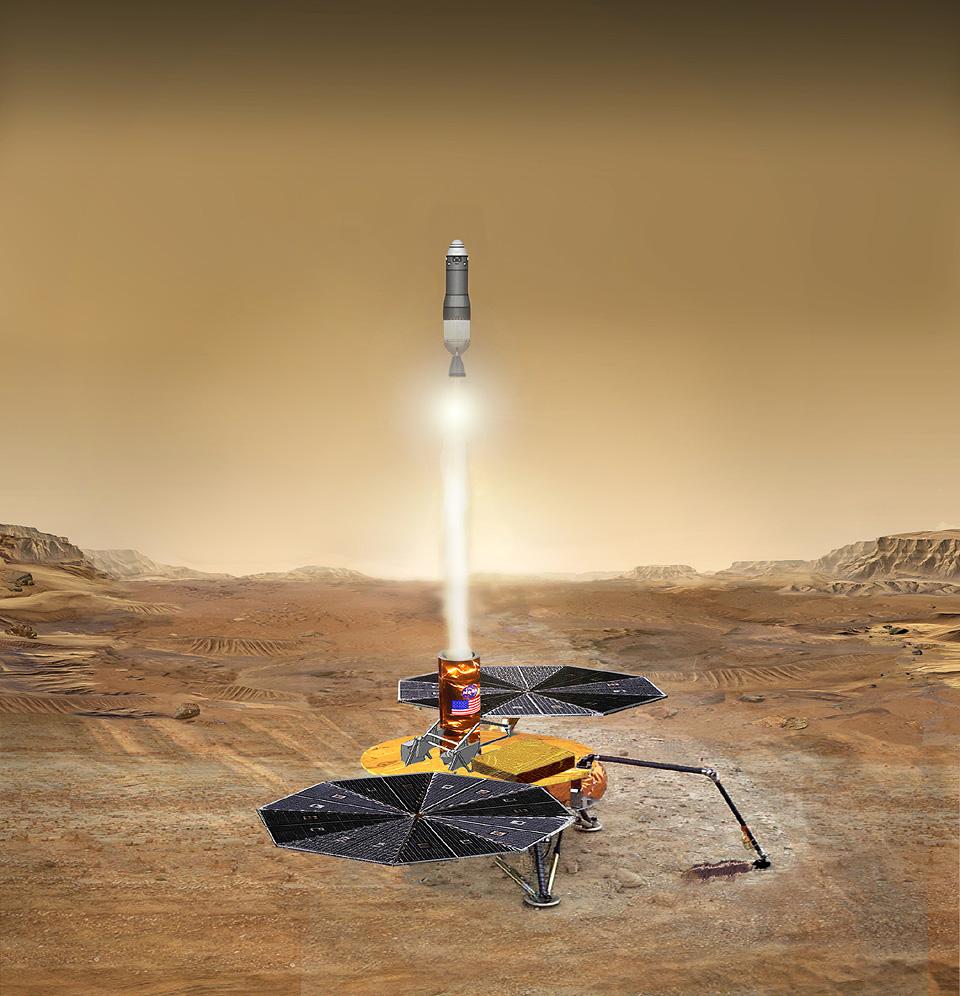
Mars Sample Return (MSR) as envisioned in 2006 [NASA].
Paul D. Spudis
The Once and Future Moon
Smithsonian Air & Space
 
The recent release of the administration’s FY 2013 budget gave some scientists a bit of a shock.  Planetary science (considered a “jewel in the crown” of the space agency) has been identified for cutting, over 20% during the next five years.  A particularly painful cut comes to the agency’s robotic Mars exploration program.  Planned missions in cooperation with the Europeans and future missions designed to lead up to the return of a surface sample from Mars were eliminated from the budget.  In effect, the successful program of Mars missions created after the embarrassing failure of the Mars Polar Lander over a decade ago is being scrapped.

The administration digested the National Research Council (NRC) Decadal Survey in planetary science (released last spring) before writing their new budget.  The study process for this report involves getting the relevant scientific communities to determine and lay out their priorities.  The assumption is that the scientific community can best determine the most relevant goals and questions in planetary science and therefore design mission concepts to address them.  Through a variety of working groups and forums, the desires of the community are made known and a report is written around them.  Typically, planetary scientists organize their working groups around objects of study, such as the inner (rocky) planets, small bodies (asteroids and comets), and giant planets.  For the latest Decadal Survey, the Mars community had its own separate group. Mars is, of course, a rocky, inner planet, and for decades has held sway in the planning process, both for robotic and human missions.

NASA’s highest scientific priority for Mars exploration is to determine if it has now, or has ever had life.  The chosen mission concept to address this question is to return samples of the surface of Mars to the Earth.  This is a very difficult task.  Mars is a big planet with a deep gravity well.  At its closest, it is several tens of millions of miles from the Earth, leaving robotic machines controlled from the Earth with long time delays (up to tens of minutes).  Safely landing on Mars is hard enough – taking off again and navigating back to Earth with samples safely in hand, is at least an order of magnitude more difficult.

Yet the new Decadal Survey made Mars sample return its only priority in the area of Mars science – the report offered no alternative missions for consideration.  Moreover, the sample return mission concept presented by the Decadal Survey required not one, but three separate “Flagship” missions (i.e., those having total costs exceeding $1 billion).  In a complex scenario, the mission concept called for a Mars lander to deliver a rover, explore and collect samples and then store them on the surface.  A second mission years later would rendezvous with the stored samples on the surface of Mars, transfer them to an ascent vehicle, and place the samples in orbit around the red planet.  The third and final mission would rendezvous with this orbital vehicle, dock with it and return the samples to the Earth.  From initial landing to sample return would take over a decade and cost many billions of dollars.  Moreover, in this series of three sequential and very complex missions, one single-point failure could spell the end of the entire effort.

When the Office of Management and Budget (OMB) saw this plan and its price tag, they thought it was too much money for too complicated a mission.  Unfortunately, the Mars subgroup left no “back-up” options in the Decadal Survey – it was do the sample return trio or do nothing.  Hence, the new budget proposes nothing.  Of course, a big part of the reason that this mission trio was a non-starter was to preserve funding for the James Webb Space Telescope (JWST), which at its current estimated $8 billion cost (and counting), effectively makes most other space science endeavors non-starters.

Cry “Havoc!” and let slip the dogs of war!  The planetary science community was stunned.  The Planetary Society organized a letter writing campaign, demanding that Congress intervene and save the “Mars program.”  Scientists complained that their highest priority as expressed in the Decadal Survey had been discarded without any real thought and debate (much as the Vision for Space Exploration had been thrown away two years ago).  In partial response, the agency is setting up an ad hoc group to study some less expensive, interim Mars missions (something that the Decadal Survey should have done).  Presently, all of planetary science is in danger of severe cutbacks.  And the final bill for JWST has yet to be delivered.

The MoonRise mission concept, in its most recent iteration planned in cooperation with the Canadian Space Agency, fulfills the need to obtain a baseline sample of the 4 billion year-old South Pole-Aitken basin, only a small part of which spills over onto the Moon's nearside, in line of sight with flight directors on Earth [NASA/NLSI].
What can be learned from this these events and applied to the exploration of the Moon?  Like the Mars community, the lunar science community has made sample return the centerpiece of their mission wish list.  A South Pole-Aitken (SPA) basin sample return has been proposed as a New Frontiers mission and studied in detail twice over the last nine years – and passed over for selection twice.  Yet the new Decadal Survey once again makes this mission its top priority in lunar science.  Moreover, for this mission to be scientifically successful in its goal of dating the impact that created the SPA basin (the biggest and oldest impact crater on the Moon) it must not only complete the sample return, it must collect samples whose context can be reconstructed and fully understood.  As discussed here previously, given the difficulty of such reconstruction for the Apollo samples (which were carefully documented and collected by trained field observers), an unambiguous outcome for this robotic mission is exceedingly unlikely.

Certainly, returning a sample from the Moon is less difficult than doing it from Mars, so the two tasks are not directly comparable.  Yet, there are a number of missions to both the Moon and Mars that could be done for less money and would significantly advance our understanding of their histories and processes.  For example, an entirely new field of scientific study is the generation, movement and fate of water on the Moon, a problem rich in both scientific and exploration potential.  This new field could be investigated profitably by a series of properly instrumented, small robotic missions.

These issues and questions were known at the time that the Decadal Survey was conducted, so there is little excuse for ignoring them, except for the community’s fixation on sample return missions.  In part, this obsession exists because it provides a large part of the research community with something to do.  NASA money has built many expensive laboratories to analyze extraterrestrial materials and new lunar and planetary samples are needed to keep them operating.  But the full potential of remote, in situ analysis – coupled with careful and clever geological planning – has not been given enough thought by the scientific community.

Will the lunar science community also shoot itself in the foot?  If so, it will simply be finishing a job started by this administration two years ago with the cancellation of the VSE.  Fans of human spaceflight please take note:  the process of undertaking these “Decadal Surveys” has been widely praised and advocated as a model for determining the goals and objectives of the human space program.  Considering the consequences of this latest effort in planetary science, one might want to re-think that scenario.

Originally published March 8, 2012 at his Smithsonian Air & Space blogThe Once and Future Moon, Dr. Spudis is a senior staff scientist at the Lunar and Planetary Institute. The opinions expressed are those of the author and are better informed than average.

Thursday, March 1, 2012

Spudis: Double the Space Budget?

Schematic of Cislunar Space where valuable and reachable goals are available on reasonable timescales [Cislunar Space Next].
Paul D. Spudis
The Once and Future Moon
Smithsonian Air & Space


Astronomer Neil Tyson, a friend dating from the Aldridge Commission, recently appeared on Comedy Central’s Daily Show to promote his new book.  During the program, Neil suggested that NASA’s budget should be doubled.  He made the point that the current total budget for the civil space program is less than one-half of one percent, so doubling the budget would still result in less than one percent spending on space.  Neil believes that a strong, vigorous space program inspires the next generation to take up scientific and technical studies, fields of endeavor vital to our nation’s future.  Initially taken aback, Jon Stewart, the show’s host, ending the segment by proclaiming Tyson his preferred choice for President in 2012.

The very thought of a doubled space budget is one to start the salivary glands of most space cadets watering overtime.  Think of all the missions we could do!  No more either Space Launch System (SLS) or commercial launch – we do both!  No longer either James Webb telescope or Mars missions – we do both!  All issues resolved, all problems solved, all constituencies satisfied.  Right?

A couple of years ago, I wrote an essay stating that more money for NASA was not the answer to their problems.  That post was written when NASA still had a strategic direction – the now-discarded Vision for Space Exploration (VSE).  After this administration terminated the VSE, they endorsed another program called Flexible Path.  No destination was named (though a human mission to one of the Earth-Moon L-points or to a near-Earth asteroid was posited), rather the agency was asked to design generic systems that, in theory, could take us anywhere.  Flexible Path was the course advocated by the Augustine committee, who had been tapped to evaluate NASA’s implementation of the VSE.  Their report claimed that it was not possible to implement the VSE (specifically, the development of the lander needed to return to the Moon) without a one-third increase in the agency budget, so a refocusing of the strategic direction of the agency (one more “flexible” than the VSE) was necessary.

The conclusions of Augustine (specifically, the non-return to the Moon part) were embraced by the administration and early in 2010 the plug was pulled on the VSE.  However, the commercial (COTS) part of the terminated VSE was retained, becoming the primary avenue and focus of NASA funding and development for future cargo and eventual human access to and from low Earth orbit.  The decision to terminate VSE became increasingly controversial as the agency also decided to move forward with the planned shutdown of Shuttle.  In light of the unknowns of commercial launch success or its timetable, it became evident that the delay caused by these decisions would affect our space workforce and the viability of the U.S. space program.  Congress reacted by insisting that the agency develop a new heavy lift vehicle (to ensure human missions beyond low Earth orbit), a program now underway known as the Space Launch System (SLS).  Until one (if any) of these systems come on line (projected to be in 5-10 years) we must purchase human LEO access from the Russians.

More money might alleviate some near term issues with certain missions (such as ExoMars, the now-canceled joint NASA-ESA mission to Mars), but as Neil Tyson suggests, would that give us a fundamentally different and better space program?  More funding would enable more activity, but to do what?  As we no longer have a reasonable, near-term strategic goal (and I do not count empty promises of human Mars missions 30 years in the future as such), more money might accelerate progress on some programs, but money alone will never establish a healthy and vigorous space program.

What has held us back from creating a strong space program?  I contend that it is the lack of any strategic direction, by which I mean not simply a goal, but a believable goal, one that combines clear and pressing societal value with attainable, decadal timescales, at costs at or less than their projected budget line.  Under the existing operational template, most proposed space goals satisfy one or two, but not all conditions.

In space, as in most federal programs, throwing money at a problem may be necessary, but is seldom sufficient.  A doubled space budget would likely produce more studies, additional staff meetings, endless Powerpoint charts and countless and interminable management training retreats.  NASA’s productive engineering segment will continue to shrink as bureaucratic overhead continues to swell.  A program without a direction, no matter how well funded, creates nothing but waste.

We must not retreat from our role as a viable space faring nation. If we become complacent and lose our place in history, there is no assurance that the values and liberty we cherish here will follow humanity into the new frontier of space, or even remain strong here at home.  Money alone does not measure the health of a program or a nation.  NASA and the United States urgently need a believable, strategic space goal.

Today the U.S. space program is moving rapidly toward oblivion. Can it be saved?  I myself go back and forth debating this critical question.  Today I think it is possible.  If reason is the ability to draw conclusions from what is evident, faith is the ability to believe in things unseen or not proven.  I must have faith – it sure as hell can’t be reason.

Originally published March 1, 2012 at his Smithsonian Air & Space blog The Once and Future Moon, Dr. Spudis is a senior staff scientist at the Lunar and Planetary Institute. The opinions expressed are those of the author and are better informed than average.

Thursday, July 21, 2011

U.S. Space Shuttle program ends


An unprecedented view of the space shuttle Atlantis and the ionization of its re-entry into Earth's atmosphere, "appearing like a bean sprout against clouds and city lights," on its way home, July 21, 2011. Photographed by Expedition 28 from the ISS. Pre-dawn airglow over Earth can be seen in the background [NASA].


0957 UT, 21 July 2011: Atlantis returns to Earth for the final time, bringing an end to the program after more than thirty years, after 200 orbits and 8.5 million km. It was the 25th night landing and 78th landing at KSC, only the 133rd landing since 1981. MET: 12 days, 18 hours, 28 minutes and 50 seconds. Since April 12, 1981, 355 individuals from 16 countries flew 852 times aboard the shuttle, deploying 180 payloads, including satellites, returned 52 payloads from space and retrieved, repaired or redeployed seven spacecraft. STS-135 was the 33rd and final flight for Atlantis after totaling 307 days in space, 4,848 orbits and 872.3 million kilometers (roughly 48.49 light minutes or 5.8 AU) [NASA].

Thursday, March 3, 2011

Discarding Shuttle: The Hidden Cost


NASA spending as fraction of federal budget by year, in constant dollars. From NASA Is On An “Unsustainable Trajectory,” Jeffrey Ellis, The Thinker, September 9, 2009.

Paul D. Spudis
The Once & Future Moon
Smithsonian Air & Space

On February 15, 2011 a symposium entitled “U.S. Human Spaceflight: Continuity and Stability” was held at Rice University’s James A. Baker Institute of Public Policy. Organized by George Abbey, the resident space expert at the Baker Institute, one might have suspected that it would be Shuttle-centric and indeed, it was. Many pertinent points relevant to the current discussion about NASA’s human space program and its future (or lack thereof) came out of the presentations at this symposium.

The program featured several speakers, all of whom played major roles in the Shuttle program. I found comments by Robert F. “Bob” Thompson most interesting. Bob Thompson is one of the true “old guard” – an original member of Bob Gilruth’s Space Task Group at NASA Langley, a group pre-dating the Mercury Program. Thompson was head of the Apollo Applications Program (Skylab) and the first manager of the Space Shuttle program. Many of his remarks resonate strongly with points I have made here and elsewhere about serious problems being dismissed or ignored in the unseemly rush to re-vamp NASA from an operational space flight agency into a check-writing bureaucracy for New Space endeavors.

Thompson’s theme was a considered and educated look at what discarding the country’s Space Shuttle Program means. Both his talk and the talk by Howard DeCastro (Shuttle Program Manager at the United Space Alliance, which operates the Shuttle system for NASA) carefully outlined the history of the Shuttle program and the possibility of flying the Shuttle commercially until a new system becomes available, thereby retaining our national spaceflight capability. They covered the many compromises made both in Shuttle’s conception and in its execution, as well as its unique capabilities. The Shuttle can both deliver and retrieve payloads from space; it is a fully integrated transport and servicing system in low Earth orbit. The famous Hubble Space Telescope would be a useless piece of junk instead of a national treasure without the Shuttle missions that first allowed for the repair of its defective vision and then returned to service the instrument in space multiple times over the ensuing decade.

An often ignored but critically important issue is the supporting infrastructure for spaceflight. Thompson made the analogy that when people see a Shuttle Orbiter, they really are seeing just the “tip of an iceberg.” The Shuttle is more than an orbiter vehicle; it is also the servicing facilities at the Cape that process and prepare the orbiter for launch. It is the ET fabrication facilities at Michoud and the SRB plant at Promontory as well as the Space Shuttle Main Engine (SSME) that has performed flawlessly over the 133 flights to date. It is the mobile crawler and the launch towers at Pad 39-A. And it is the trained cadre of people that put all the pieces together and make them work in concert to deliver and return people and equipment from space. Thompson rhetorically encompassed his argument thusly: The Shuttle is a “dumb vehicle that cost too much” but is a “fully functional part of a space transportation system – an 18-wheel, extended cab work vehicle.” He told the audience that Orion, Soyuz and Progress were more like “taxis” and “pickup trucks.” He said that the Constellation vehicles (chosen to implement the 2004 Vision) were bad decisions, followed on now by an even worse decision.

Thompson used a familiar graphic, the chart showing NASA’s fraction of the annual federal budget over decades (see above). The large spike centered around 1966 represents peak spending for the Apollo program. Thompson made two specific observations about this graph. First, Richard Nixon (who took office in 1969) is often damned as the President who “killed Apollo.” But the graph shows that the ramp-down in spending for Apollo began two years earlier in 1967, in Lyndon Johnson’s administration. The Vietnam War required some of NASA’s money, so Apollo-Saturn production managers were told to build the equipment needed to fulfill Kennedy’s decadal goal and shut down thereafter.

Additionally, Thompson made the very significant point (one usually ignored by many engaged in space policy debates) that the “Apollo spike” paid for the infrastructure – the buildings, laboratories, test and training facilities, and launch systems – that Apollo used and that the Shuttle uses to this day. By terminating the Shuttle with no follow-on, the fate of most of this infrastructure is the scrap heap. Note that the “Apollo spike” in funding happened forty years ago. To design and build the supporting infrastructure for human spaceflight in the mid-1960s, we annually spent ten times the fraction of the budget that we do now. Given the reality of the nation’s finances, NASA will be lucky if they can continue to get one-half of one percent of federal spending per year. This does not seem to be a good time to throw away three functioning Shuttle orbiters, thereby discarding a working national space faring capability, one carefully built and paid for over the last 50 years.

Several New Space companies are working on vehicle designs, which, if successful in creating a replacement space “work vehicle,” will need their own supporting infrastructure. These efforts will necessitate creating all the facilities mentioned above for their vehicles and systems. The cost of any given single launch is rolled into one number, but it must cover a multitude of expenses. Amortized over many decades, they may eventually pay for it all, but only if they can get enough business to fly their vehicles regularly and often. With NASA as their principal customer, will enough flights be purchased to take these New Space companies to the level they need in order to make a profit and survive?

Finally, Thompson asked, what is exploration if not living and working in space and contributing to the economy? He understands that exploration is more than going somewhere and planting a flag or collecting some rocks. Each time NASA launches a Shuttle, it puts 100 tons in space. By replacing the orbiter body with a cargo faring, we are creating a heavy lift launch vehicle. This Shuttle side-mount launch vehicle is something that fits the requirements placed on NASA for a new heavy lift vehicle. Its reliability has been consistently improved over the course of more than 30 years of flight experience and is more than adequate for many different kinds of missions throughout cislunar space. This is where the focus of our space program ought to be – and a zone of space specifically mentioned in the new agency authorization.

Preserving, adapting and using what we already have is smarter than destroying capability and starting again from scratch. We are putting faith in the emergence of space systems that will do what we want, when and where we want. We are told that to nurture and foster other providers of space access, we must throw away the bird in our hand and plant a revolutionary new bush, hopeful that it will grow and attract a variety of new birds. I leave it to you to decide the wisdom of such a restrictive course. Plant the bush but don’t throw away the only bird we now hold. We must be fully conscious about the realities of non-existent systems and preserve the space transportation capability on which America can rely.


Dr. Spudis has just published "Blogging the Moon," a collection of postings to his Smithsonian Air & Space blog "The Once & Future Moon."

Friday, January 14, 2011

HEFT, Lies and Videotape


Cost and Schedule of Shuttle sidemount compared with HEFT alternatives. This is the only HLV option that meets all legal requirements and fits within the budget and schedule assumptions of HEFT. Data derived from SSP Study NSTS 60583, dated June 8, 2010.

Paul D. Spudis
The Once & Future Moon
Smithsonian Air & Space

A real comedy of errors and misunderstandings collided this week between the new NASA Authorization Act of 2010 and the agency’s Human Exploration Framework Team (HEFT) Congressionally mandated 90-day report (their initial findings on how to implement agency direction). Thought flush with the usual beautiful graphics and platitudes, the report’s bottom line is that under the existing budget and schedule, the agency cannot make the new heavy lift launch vehicle specified in the new authorization bill. In other words, you can’t get there from here. Can’t be done. Period.

Reading through the new report is an exercise in déjà vu for space policy geeks. It reads very much like the Exploration Systems Architecture Study (ESAS) of 2005. No big surprise, when one realizes that many of the people who wrote that report are involved in the new one. But more than that, the sense of a previous life stems from the rocket design that has resulted from this effort. It looks remarkably similar to the rocket that resulted from the previous effort, the late and not-so-lamented Ares family of heavy lifters. As you may recall, a key conclusion of the oft-cited Augustine Committee report was that the existing program of record (Project Constellation, a.k.a. Ares rocket) was unaffordable without infusions of significant quantities of new money.

Did NASA get a big infusion of cash? No. So no one should be surprised that the same people, working under the same assumptions within the same agency and technology base as the Project Constellation people would reach the same conclusions. In fact, most were not surprised. But apparently, many in the United States Senate did expect a different answer. Or did they?

We now enter the political Hall of Mirrors in which what people say they want isn’t necessarily related to what they really want or don’t want. Let us see if we can chart a path through the maze of motives, desires and statements to fully understand exactly what’s going on. Please stay with me on this until the end; I will try to make things clear.

Seven years ago, we had the Vision for Space Exploration (VSE), a statement of strategic direction in space. The VSE called for returning Shuttle to flight after the Columbia accident, completing construction of the ISS, the building of a new space transportation system, a return to the Moon (“with the goal of living and working there for increasing periods of time”) and finally, human missions to Mars and “other destinations.” After the VSE was announced, NASA “implemented” it by completing steps 1 and 2. Step 3 was started, outlining an architecture and design for a new human spacecraft and new launch vehicles (the ESAS). We never progressed beyond that, although many departments, universities and international partners dug in and began conducting studies of work and instruments needed to live on the Moon.

It is a fool’s errand to design architectures and new space vehicles if you do not know what your mission is. You can design and build a space system without an objective but as it must satisfy many different purposes, it tends to not satisfy any of them particularly well. From the beginning, NASA leadership didn’t acquaint itself with why they were tasked with lunar return, even though the VSE founding documents are quite clear on the purpose and activities associated with lunar return. Because of this strategic confusion, it was largely assumed by many that we would do on the Moon what we did 40 years ago – explore, collect samples, and leave as soon as possible (that last activity being particularly favored within the agency). To accommodate this activity, the Ares launch vehicles were designed to conduct a lunar mission with two launches – the Ares I, which would put the crew vehicle in low Earth orbit and the Ares V, which carried all the other pieces. Additionally, NASA never lost sight of its desire for Mars, so Ares V was sized at a payload capacity of 160 tons, overkill for a lunar mission but thought to be the right number for a human Mars mission, staged completely from the surface of the Earth (whether that’s true is another story).

As Ares rocket development costs rose, other pieces of the lunar return architecture were discarded. Eventually, we had a large rocket-building program but its purpose had become diffuse and nebulous (in 2009, the acting Administrator of NASA told Congress in testimony that he did not know what going to the Moon meant).

Curiously, the new NASA Authorization Act of 2010 was remarkably specific about the requirements of a new heavy lift vehicle the agency had been directed to build. It was to use Shuttle hardware to “the extent practicable” and initially carry 70-100 tons but designed such that it could be stretched to a lift capacity of 130 tons. Where did these numbers come from? It’s not clear, but here’s an interesting coincidence: 130 tons was the lift the capacity of the old Saturn V (118,000 kg = 260,000 pounds = 130 tons). NASA has interpreted the new Congressional language as meaning metric tons (2200 lbs) but the simple language of the law says “tons” (1 ton = 2000 lbs). One might suspect that the calculus was that heavy lift in days of old (Saturn V) meant 130 tons, so that’s what “heavy lift” should be.

In the absence of any specific mission, the payload capacity of your launch vehicle is entirely academic. But this “requirement” has had some serious ramifications. Last summer, a study group at Johnson Space Center released a report (Preliminary Report Regarding NASA’s Space Launch System and Multi-Purpose Crew Vehicle, Pursuant to Section 309 of the NASA Authorization Act of 2010 (P.L. 111-267), SSP Study NSTS 60583, dated June 8, 2010) showing how a heavy lift vehicle could be built and flown under the then-current run out budget (any new budget for NASA is pure guesswork at this stage). It resurrects an old concept of replacing the Shuttle orbiter on the existing stack with a payload fairing and engine pod. This configuration, called Shuttle Side-Mount (updated from the old “Shuttle-C” concept) was not considered by the HEFT study team, but meets the specific language of the new authorization. The advantage of SSM is that, as it is a minimal modification of the existing stack, it uses all of NASA’s existing launch and processing infrastructure – launch pads, mobile crawlers, scaffolding in the VAB and fabrication facilities in Michoud and Utah. SSM initially carries about 80 metric tons (70 (63.3 metric) to 100 (90.7 metric) tons) and can be stretched to meet the 130 ton (118 metric tons) legal requirement with minimal modification (for example, adding 5-segment (instead of 4-segment) Solid Rocket Boosters, 4 Shuttle Main Engines, extended External Tank). So in fact, SSM meets all the technical, budgetary, safety and schedule requirements set out in the NASA Authorization Act of 2010.

So as Oliver Hardy would say, here’s another fine mess we’ve gotten ourselves into. NASA creates an unaffordable architecture (ESAS) to implement the VSE. The response by the new administration is to cancel the VSE and replace it with promises of more distant goals at some nebulous time in the far future. Congress directs the agency to build an HLV anyway, but the vehicle has no mission, so they pull out the specs of the last HLV America flew. NASA responds by saying they can’t do it on the money and schedule specified, even though they themselves have in hand a report that shows how it can be done. Moreover, the agency still claims it doesn’t know why anyone would want to go to the Moon, despite having been shown repeatedly that what we do there will create new space faring capability.

You just gotta love this business.

Monday, October 11, 2010

Creature of Congress


Still from the suddenly-lonely, remotely-operated color television camera on Apollo 17's lunar rover, minutes after the launch and departure of Cernan & Schmitt, December 14, 1972. Recent Narrow-Angle Camera (LROC) images from NASA's Lunar Reconnaissance Orbiter demonstrate the Apollo-era artifacts on the Moon appear undisturbed [NASA/A17-ASJ].

The Authorized Version

Paul D. Spudis
The Once & Future Moon
Smithsonian Air & Space

NASA’s new authorization bill (S.3729) was passed by Congress before they cleared out of town and will soon be signed by the President, codifying into law the federal government’s formal abandonment of the Vision for Space Exploration. In its place is a mish-mosh of platitudes, entitlement programs, pontificating blither about “unique” missions, commercial aerospace welfare and most significantly, an utter lack of direction for our national space program.

I’ve already heard the reaction to the sentiments above, as the space blogosphere has hashed and rehashed space access, space direction and space pork and now is left with – what? Defensively, we’re told, “The new bill does too have direction!! We’re going to Mars! We’re going to a near-Earth asteroid!! We’ll develop new, “game-changing, leap-ahead” technologies to make spaceflight easier and cheaper – that will take us there sooner! The commercial sector will develop new, ultra-affordable launch vehicles to allow the movement of humanity into space!” They will just … “Make it so.”

A statement that “Mars is the ultimate destination” is not programmatic direction, but rather an exhausted platitude, unsupported by any facts in evidence. We do not now have the technology, the will or the national wealth to expend on a human Mars mission and will not for decades. The idea that some new “magic beans” technology will spontaneously arise to enable a human mission is technically illiterate. The quasi-religious belief by some in the efficacy of “New Space” efforts to provide routine and inexpensive access to LEO is touching, but unsupported by any evidence. It is certainly true that many NASA programs have cost more and taken longer then promised or planned, but that’s been the nature of the space business since its founding 50 years ago. At least NASA had a track record of building and flying spacecraft, under a variety of difficult technical and fiscal conditions. But for now, NASA’s manned space workforce has been told to make tracks for other employment.

The likely effect of the proposed new “direction” for NASA by this administration has been apparent to many of us for some time now – the end of human spaceflight by this nation. Although some of us suspect that this shattering of a national capability is all quite deliberate, motives do not matter at this stage. The new authorization bill makes some significant changes to the administration’s proposal. The only pertinent question is, can pieces of the space program be picked up and re-assembled again, sometime in the future after years of destructive non-activity? It is in this vein that I want to examine some of the language of the new authorization bill.

The most prescriptive part of the new authorization is its language dealing with a new NASA-developed heavy lift launch vehicle (HLV) and a Multi-Purpose Crew Vehicle (MPCV), replacements for the now-terminated Project Constellation. The launch vehicle description reads as though the authors of the bill had some solution (or range of solutions) in mind, a surmise supported by the requirement that the agency use “existing Shuttle parts and infrastructure to the maximum extent possible.” The specific requirement is for a vehicle with a payload capacity of 70 to 100 metric tonnes to LEO, capable of growth to 130 mT, including a possible “Earth departure stage.” It is further specified that this vehicle be capable of launching the MPCV into orbit and to supply cargo and crew to the ISS.

The crew vehicle description is a little more vague, as befits a spacecraft with no defined mission. Although it is specified that the MPCV shall be capable of conducting missions beyond LEO, its primary mission seems to be crew and cargo delivery to the ISS. In addition, it must be capable of supporting “rendezvous, docking, extra-vehicular activity” and “servicing of assets” in “cislunar space” (interesting wording that). The bill goes on to define the intent of this provision in another section (804) related to making space-based telescopes (like the James Webb telescope at Earth-Sun L-2) serviceable by humans. But by using the term “cislunar,” it may well be that something else might be lurking in the background.

The prefacing language in the bill (the seven “findings” of the Senate) is even more interesting (Section 301a). Cislunar space is mentioned in 4 of the 7 provisions of the prefacing section; human lunar surface presence is mentioned in 3 of those 7 sections. Strange language for an authorization bill that “abandons the Moon as a destination,” as claimed in many press reports. What should we make of this unusual language and phrasing?

I think that the bill’s provisions for a NASA-developed HLV and crew spacecraft reflect a fundamental ambivalence on the part of Congress for the “new direction” adumbrated by the administration last spring. It would seem some healthy skepticism exists as to whether a purely commercial solution to human LEO access is possible or even desirable. In addition, although the President is now famous for remarking that a return to the Moon is pointless because “we’ve been there,” someone on the Hill fortunately recognized the lack of understanding embodied in that statement.

The bill’s wording about human access to “cislunar space,” as well as the mention of “in situ resource utilization” indicates that some in Congress are not blind to the wealth of knowledge recently acquired showing that the poles of the Moon contain abundant water – material useful to those countries willing to go after it in order to achieve affordable space faring capability and routine access to cislunar space, where all advanced countries’ satellite assets reside.

In short, I detect in the new authorization bill the hand of someone in the bowels of the committees – a staffer perhaps – who has perceptively salvaged a slender thread of capability for the use of some future national leader, one that supports a robust American space program. I note that the authorization calls for a report in 90 days on how the agency proposes to implement the new plan. Somebody will be watching them.