Showing posts with label Lunar Samples. Show all posts

Wednesday, December 18, 2013

Chang'e-5 lunar sample mission on for 2017

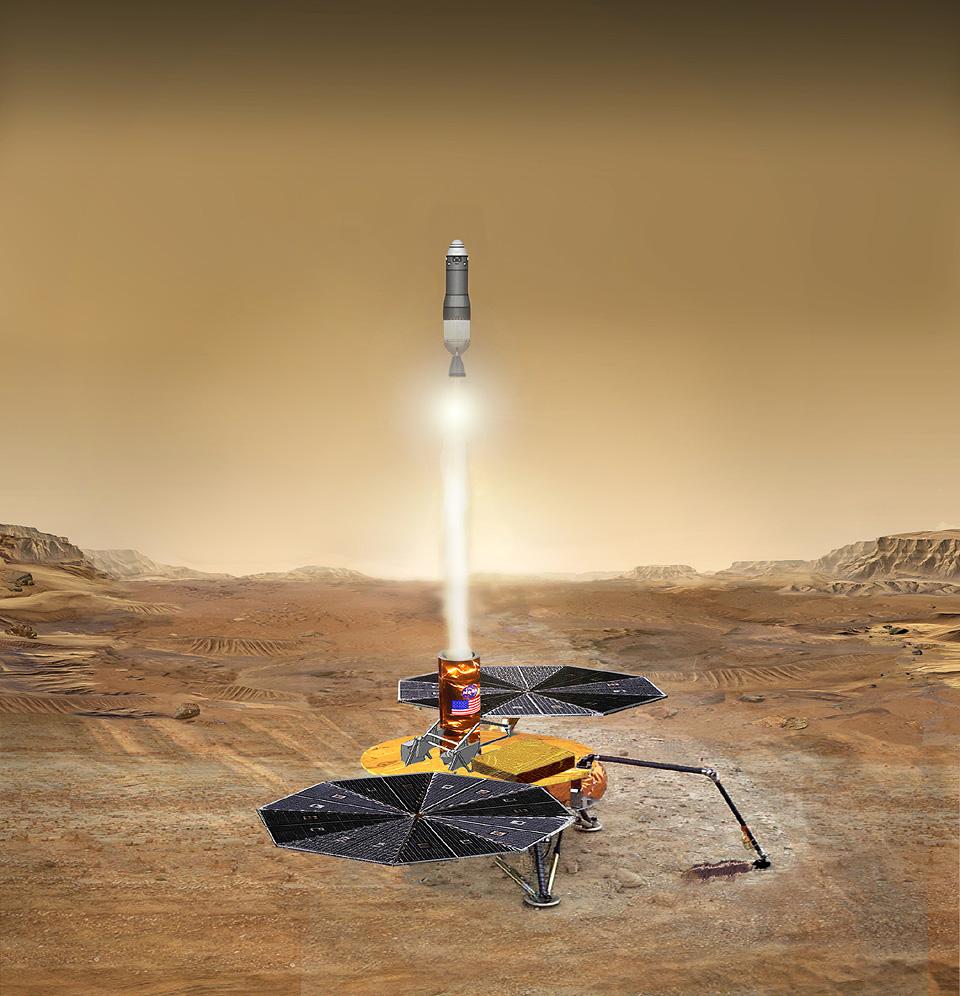
Chang'e-5 ascent stage
A preliminary notional view of the Chang'e-5 ascent stage on departure from the lunar surface. Officials of China's Lunar Exploration Program (CLEP) have confirmed the sample return mission is scheduled for 2017.
Global Times (Beijing) -China has announced the next step in its lunar exploration program will be carried out by a new moon probe, Chang'e-5, expected to launch in 2017.

This follows the successful soft-landing of the Chang'e-3 probe on the lunar surface Saturday evening.

"The research and development of Chang'e-5 is proceeding smoothly at present and we expect it to be finished and ready to launch in 2017," announced Wu Zhijian, spokesman for the State Administration of Science, Technology and Industry for National Defense at a press conference Monday.

The third and final stage of the unmanned missions to sample the lunar surface is expected to be completed by 2020, using the Chang'e-5 and 6 lunar probes, which will be able to return samples to Earth, said Wu.

This is also the last phase of the China Lunar Exploration Program as a part of the National Guideline for Medium and Long-term Plan for Science and Technology Development (2006-20) issued by the State Council in 2006.

China has completed the first two phases of the program, said Wu.

The first phase was achieved when the Chang'e-1 lunar orbiter launched in 2007, while the second phase was marked as complete when the Chang'e-3 lunar probe and its moon rover separated and took photos of each other on the extraterrestrial body on Sunday.

By Monday morning, five of the eight exploratory devices on Chang'e-3 had been put into operation to survey the lunar surface topography and geology, said Zou Yongliao, an engineer from the Chinese Academy of Sciences

M177x3C_604nm-anot-580x800
LROC Wide Angle Camera (WAC) monochrome (604 nm) mosaic of a 35.7 km-wide parcel of the Laplace F - Le Verrier region in north central Mare Imbrium, marking the December 14, 2013 landing site of China's Chang'e-3. From a 200 km-long field of view swept up in three sequential orbits, December 5, 2011; a sunrise angle of incidence of 76° at 61.5 meters resolution, from 44.7 km [NASA/GSFC/Arizona State University].
"The program's third phase will be more difficult because many breakthroughs must be made in key technologies such as lift-off from the moon's surface, sampling encapsulation, rendezvous and docking in lunar orbit, and high-speed Earth re-entry, which are all new to China," said Wu.

The Chang'e-4 probe, which served as a backup for Chang'e-3, will now be used to test the new techniques for the mission's third phase.

Scale model Yutu
Scale model of the six-wheeled robotic moon rover 'Yutu' (Jade Rabbit), without the, by-now familiar, gold foil thermal blankets. Picture taken at the Beijing Aerospace Command and Control Center [Xinhua].
In response to questions of international cooperation concerning lunar exploration, Wu noted that China is always positive in maintaining good cooperation with other regions and organizations. Data collected through the Chang'e-1 and Chang'e-2 probes is accessible to scientists from across the world, according to Wu.

Wu pointed out that China's exploration will follow the consistent aim of the peaceful use of outer space, which will promote new breakthroughs in high-technology development.

"Despite our current progress, China still lags behind space giants like the US and Russia in many aspects. We need to work harder and move faster," Wu said.

Friday, May 10, 2013

Earth and Moon share primal water source, raising problems for Giant Impact origin hypothesis

Backscatter electron image of a lunar melt inclusion from Apollo 17 sample 74220, enclosed within an olivine crystal. The inclusion is 30 µm in diameter. Skeletal crystals within the melt inclusion are a fine mixture of olivine and ilmenite. Dark area in the lower-left is an ion microprobe sputter crater [John Armstrong, Geophysical Laboratory, Carnegie Institution of Washington].
PhysOrg

The water found on the moon, like that on Earth, came from small meteorites called carbonaceous chondrites in the first 100 million years or so after the solar system formed, researchers from Brown and Case Western Reserve universities and Carnegie Institution of Washington have found.

Evidence discovered within samples of moon dust returned by lunar crews of Apollo 15 and 17 dispels the theory that comets delivered the molecules.

The research is published online in Science Express today.*

The discovery's telltale sign is found in the ratio of an isotopic form of hydrogen, called deuterium, to standard hydrogen. The ratio in the Earth's water and in water from specks of volcanic glass trapped in crystals within moon dust match the ratio found in the chondrites. The proportions are far different from those in comet water.

The moon is thought to have formed from a disc of debris left when a giant object hit the Earth 4.5 billion years ago, very early in Earth's history.

Scientists have long assumed that the heat from an impact of that size would cause hydrogen and other volatile elements to boil off into space, meaning the moon must have started off completely dry.

But recently, NASA spacecraft and new research on samples from the Apollo missions have shown that the moon actually has water, both on and beneath its surface.

By showing that water on the moon and Earth came from the same source, this new study offers yet more evidence that the moon's water has been there all along, or nearly so.

"The simplest explanation for what we found is that there was water on the proto-Earth at the time of the giant impact," said Alberto Saal, a geochemist at Brown University and the study's lead author. "Some of that water survived the impact, and that's what we see in the moon."

Recent research, Saal said, has found that as much as 98 percent of the water on Earth also comes from primitive meteorites, suggesting a common source for water on Earth and the moon. The easiest way to explain that, Saal said, is that the water was already present on the early Earth and was transferred to the moon.

The finding is not necessarily inconsistent with the idea that the moon was formed by a giant impact with the early Earth, but presents a problem. If the moon is made from material that came from the Earth, it makes sense that the water in both would share a common source, Saal said. However, there's still the question of how that water was able to survive such a violent collision.

"Our work suggests that even highly volatile elements may not be lost completely during a giant impact," said Van Orman. "We need to go back to the drawing board and discover more about what giant impacts do, and we also need a better handle on volatile inventories in the moon."
Read the full article, HERE.


*Hydrogen Isotopes in Lunar Volcanic Glasses and Melt Inclusions Reveal a Carbonaceous Chondrite Heritage, A.E. Saal, et al. Science Express, 2013.

Wednesday, February 13, 2013

Geological sampling and planetary exploration

Representation of Luna 24, lifting off from Mare Crisium after collecting a drill sample for return to Earth. For many years to come, this will be the only way certain kinds of critical testing can be done [RussianSpaceWeb/Anatoly Zak].
Paul D. Spudis
The Once & Future Moon
Smithsonian Air & Space

Samples are currently making news for NASA’s planetary exploration program.  Last August, the rover Curiosity, equipped with a package of laboratory instruments, landed on Mars.  On February 9th the rover’s robotic arm drilled its first hole in a rock selected by scientists.  In their attempt to gain more information about Mars, scientists will use the rover’s science package to remotely analyze these samples on the martian surface.  The results will give them some fairly detailed knowledge on the chemical and mineral make up of these rocks.  But what else can we possibly learn from samples?

Geologists in general and planetary scientists in particular often emphasize that “such and such” cannot be known for certain “until we obtain samples” of some planetary surface or outcrop.  What is this obsession with samples?  Why do (some) scientists value them so highly and exactly what do they tell us?  Answers to this question (for there is not a single, simple one) are more involved than you might think.

With today’s technology providing us with only the most rudimentary information, sample analyses made remotely on a distant planetary surface is limited.  Some of the things we want to know, such as the formation age of rocks, can only be discovered with high precision, careful laboratory work.  That’s a tall order for remote systems.  For example, one of the most common techniques used to “date” a rock’s age requires the separation of individual minerals that make up the rock.  Next, the ratio of minute trace elements and their isotopes in each grain must be determined.  Assuming that the rock has not been disturbed by heating or a crater shock event, this information can be used to infer an age of formation.  If we can convince ourselves that the rock being studied is representative of some larger unit of regional significance, we can use this information to reconstruct the geological history of the region and eventually, the entire alien world.  So sample analysis is an important aspect of geological exploration.

As I have written previously, we used images to geologically map the entire Moon, noting its crater, basin and mare deposits, and their relative sequence of formation.  When the first landing missions were sent to the Moon, great emphasis was placed on obtaining representative samples of each landing site.  It was thought that such samples could be studied in detail in Earth laboratories and then extrapolated to the larger regional units shown on the geologic maps.  With few exceptions, this approach worked pretty well.  As we moved from the landing sites on the maria (ancient lava flows) into the complex highlands, the “context” of the samples – their relation to observed regional landforms or events – became more obscure.  A lunar highland rock is typically a complex mixture of earlier rocks, sometimes showing evidence for several generations of mixture, re-fragmentation, and re-assembly.  Loose samples lying on the surface were collected from the highlands, none of them were sampled “in place” (i.e., from bedrock).  Although this is also true of the rocks from the maria, we observed bedrock “in place” at most of the mare sites and may have actually collected at least one sample from lava bedrock at the edge of Hadley Rille near the Apollo 15 site.

None of the highland samples possess the same degree of contextual certainty as the mare samples.  This fact, coupled with their individual complexity, sometimes leads to consternation over exactly what the samples are telling us.  It doesn’t help that the Moon’s early history was itself very complex, with magmas solidifying, lavas erupting, volcanic ash hurled into space and laid down in bedded deposits.  On top of all those processes were cratering events that mixed and reassembled everything into a complex geologic puzzle, a virtual stew of processes and compositions that hold clues to billions of years of the Moon’s (and Earth’s) history.  Nonetheless, we can still perceive most of the story of the Moon’s history, enough at this point to tell us that without those lunar samples in hand, we would be well and truly ignorant of even its most important events and basic processes.  The fixation with sample return stems from the science community’s belief that with just a few more carefully selected samples from some key units, all that is now dark will be made light.

There may be severe consequences to the science community’s insistence on the primacy of sample return.  The most recent “decadal survey,” the ten-year community study that gives NASA our wish lists for missions and exploration, made a sample return from Mars the centerpiece and sine qua non of future robotic missions.  The NRC report was so emphatic in its insistence that it might be paraphrased as saying, in effect, “Give us a Mars sample or give us death!” (with apologies to Patrick Henry).  Alas, that formulation may be more apt than anyone desired, as proposed out year budgets for the next five years of NASA funding cuts planetary exploration by almost 30% – a landscape of shifting priorities that raises questions and uncertainty for the future.

Robotic sample return missions to large bodies like the Moon or Mars are expensive because they consist of multiple spacecraft – a lander, which softly places the spacecraft on the surface, a device (such as a rover) to collect and store the samples and an ascent vehicle to bring the sample back to Earth.  While none of these functions individually are exceedingly difficult to achieve, all of them (done correctly and in proper sequence) add up to a substantially difficult, complex mission profile.

Among the more recent artist's representation of the high-priority MoonRise mission, ascending from South-Pole Aitken basin [NASA/JPL].
In the space business (as with most endeavors), more difficult and complex means that more money is required.  Moonrise, a proposed robotic mission to return about a kilogram of sample from the far side of the Moon, was projected to cost around one billion dollars.  A Mars sample return mission consisted of three separate missions: one to land, collect and store the samples, another one to retrieve those samples and place them into orbit around Mars, and a final mission to return the samples to Earth.  With each step costing up to several billion dollars, such a technically challenging Mars sample return mission would be unaffordable.

Although samples have many advantages over remote measurements, those benefits must be weighed against the cost and difficulty of obtaining them.  Perhaps the complete extent of what can be accomplished remotely has yet to be fully explored.  As mentioned above, absolute ages are key information that we get from samples.  Several dating techniques could be adapted to a remote instrument; these methods may not be the most precise imaginable, but they might be of adequate precision to answer the most critical questions.  On the Moon, we do not know the absolute age of the youngest lava flows in the maria; age estimates range from as old as ~ 3 billion years to as young as less than 1 billion years.  In such a case, a measurement with 10-20% precision is  adequate to resolve the first-order question:  When did lunar volcanism cease?  In addition, such a result would enable us to calibrate the cratering curve for this part of lunar history, a function that is widely used to infer absolute ages throughout the Solar System.  A solid result obtained from a robotic lander – even such a relatively imprecise one – would have important implications for lunar volcanic processes, thermal history, impact flux, and bulk composition.

Complex robotic operations in space are always dicey, especially when attempting something for the first time.  Samples are a key part of a planetary scientist’s toolbox but their acquisition is difficult, time-consuming and expensive.  Samples from robotic missions are more likely to have ambiguous context, thus rendering less scientific value.  Scientifically useful sample collection may remain problematic until people can physically go to exotic places in space and fully use their complex cognitive skills.  This trade-off between cost and capability must be carefully considered when weighing future exploration alternatives and desired outcomes.

Previous Relevant Posts:
Humans and field work
Lunar robotic sample return
Mars sample return
The Last Sampler: Failure, then Success
India hopes to join JPL Moonrise mission to SPA
Moonrise SPA sample-return mission and Washington University

Just publishedThe Clementine Atlas of the Moon, Revised Edition, an updated atlas and reference guide to lunar features, by Ben Bussey and yours truly.

Originally published at his Smithsonian Air & Space Magazine blog "The Once and Future Moon," Dr. Spudis is a senior staff scientist at the Lunar and Planetary Institute. The opinions expressed are those of the author and are better informed than average.

Tuesday, September 18, 2012

Libyan lunar fragment on the auction block

Dar al Gani 1058, 1815 gram lunar meteorite discovered in Libya in 1998, at 27.375°N, 16.184444°E.
Clara Moskowitz
SPACE.com

A piece of lunar meteorite is on sale at auction, and experts estimate the final price will tally at keast $340,000. The rock, called Dar al Gani 1058, is the largest piece of the moon ever to be auctioned, according to Heritage Auctions, which is handling the sale.

The 4-pound (1815 grams) meteorite is also the fourth-largest chunk of the moon available to the public, since the moon rocks collected by Apollo astronauts were never put up for sale.

"When it comes to the market for moon rocks, size does matter — but so does origin," said Robert Pearlman, editor of space history and artifacts site collectSPACE.com, a SPACE.com partner and contributor.

Moon rocks retrieved by human-made robotic probes, such as those sent by the United States and the Soviet Union, fetch higher prices than lunar meteorites, because collectors value the history they represent, he said.
"For example, three seed-sized pieces of the moon that were brought back to Earth by a Russian robotic probe in 1970 were sold at auction 30 years later for $442,500," Pearlman told SPACE.com. "And while the moon rocks recovered by the Apollo astronauts are considered National Treasures and have never been awarded to individuals, hypothetical appraisals have suggested even a 1-gram sample could be worth millions."

Read the full article, HERE.

Friday, August 24, 2012

A Cheap Date

The MoonRise mission concept, in its most recent iteration, in cooperation with the Canadian Space Agency. The mission should fulfill a need to obtain a baseline sample of the 4 billion year-old South Pole-Aitken basin, only a small part of which spills over onto the Moon's nearside in line of sight with flight directors on Earth [NASA/NLSI].
Paul D. Spudis
The Once and Future Moon
Smithsonian Air & Space
  
Returning samples to Earth for analysis is one of planetary sciences’ holiest of grails. Although many different, complex measurements on returned samples are possible, one of the most important ones – from the standpoint of geologic study – is to determine the age of a rock.  Ages are determined by obtaining precision measurements of the amounts of different isotopes of certain elements (some of which are radioactive and decay at known rates).  By comparing the ratio of these radioactive elements to their daughter products, the amount of time that has elapsed since the rock formed can be calculated and thus, the age of that rock can be inferred.  If we know from which regional unit the rock comes, we can infer the ages of major events in planetary history.  This is one of the principal reasons why planetary scientists crave samples from other worlds.

We’ve determined the ages of most of the more than 380 kg of rock and soil samples returned from the Moon during Apollo.  Using that information and the geological mapping of the Moon from photographs, we were able to deduce the time sequence of major lunar and Earth-Moon system events.  Broad-scale, regional relations determined by remote mapping allowed us to identify the relative timing and significance of major units, while the returned rock samples allowed us to assign absolute ages to those same units.  The method proved so effective in reconstructing lunar history, that sample return became an idée fixe of the planetary science community, who strongly desired applying this approach to another planet.  Because questions surrounding its potential as a reservoir of life and because its nature permits the landing, retrieval and return (barely) of samples, Mars, with its complex, well mapped surface geology, was the object of most immediate interest.

When the planetary community wrote its recent “decadal survey” (a report outlining the highest priority robotic missions to undertake in the coming ten years), sample return came in as the highest priority for Mars (so high, that in effect, the decadal study told NASA to do a Mars sample return or do nothing).  Once Mars sample return was studied in detail, cost became an issue.  NASA robotic missions are classified according to the cost category they fall under.  The most expensive missions are “Flagship” missions, whose costs exceed $2 billion (the current MSL “Curiosity rover Flagship mission cost about $2.6 billion).  A Mars sample return would require not one but three separate Flagship-class missions: one to rove and collect the samples, another to launch the samples into orbit around Mars, and finally a mission to collect those samples from Mars orbit and return them to the Earth.  Using a variety of scenarios, the effort would cost over $10 billion, with a possible price tag exceeding $20 billion.  This staggering cost quickly shelved Mars sample return while planetary scientists scrambled for something to fill in a possible multi-decadal gap with no mission.

The question became, “Can a different and cheaper approach begin to address some of the key issues for which sample return is thought to be essential?”  Although many kinds of measurements can be done on returned samples, radiometric dating is one of the most critical and one thought to be possible only in laboratories on the Earth.  By using the absolute age of a single unit to bracket the timing of a host of different units mapped from remote sensing data, a single rock from a surface outcrop of a clearly defined unit of regional significance might enable us to calibrate the geologic time scale of Mars.
So the question before us is, “Is it possible to measure the absolute age of a rock remotely?”
Several groups around the country have been investigating the possibility of creating a small, portable laboratory for radiometric dating.  These instruments could be miniaturized and flown aboard a future robotic rover.  Rocks could be selected for analysis as the vehicle roams across the planet.  If such a rover were sent to areas of known geological context (e.g., a large, regional lava flow), rocks dated by the rover would define an absolute age for the flow.  A large lava flow would have numerous impact craters on it (the more densely a surface is cratered, the older it is).  For Mars, we now have to estimate (i.e., guess) how old its units are by comparing crater densities with those for lava flows on the Moon (from which the Apollo astronauts returned samples).  Although this approach is better than nothing, Mars has had its own cratering history and direct comparison to lunar history may not be valid.  A few solid absolute ages for lavas of widely varying age on Mars could “tie down” the cratering curve, such that we would not only date the flows we visit, but we could with precision, confidently estimate the ages of many other geological units not visited.

Indicative of a healthy and engaged science community, not all are convinced that ages obtained from an automated lab would be as useful as the high precision results that would be obtained from state-of-the-art terrestrial laboratories.  But a collection of imprecise ages from a variety of different units on Mars is better than no dates from any unit at all.  Given the astronomical costs and high technical risk of robotic sample return from Mars, the idea that we might be able to measure ages remotely looks increasingly attractive and practical.  This technique could also be applied to other planetary objects.  A properly equipped rover could make numerous measurements of the ages of craters and lava flows over a wide area on the Moon, where such information could be tied into the existing high-quality (but incomplete) lunar time scale.  Remote age dating would also be useful on planets from which launch of a sample return vehicle is nearly impossible, such as Venus (with a dense atmosphere and a very high surface gravity).

As sample return missions escalate in cost and difficulty, we should investigate how much can be learned about a planet’s history short of sample return.  A properly equipped robotic rover could blaze a new “Lewis and Clark Trail,” traversing large distances and making precision measurements along the way – returning information of inestimable value for a relatively low price.

Originally published at his Smithsonian Air & Space blog The Once and Future Moon, Dr. Spudis is a senior staff scientist at the Lunar and Planetary Institute. The opinions expressed are those of the author and are better informed than average.

Related Posts:
How the Mars community shot itself in the foot (March 10, 2012)
LROC: The Soviet lunar sampling missions (March 16, 2012)
The Last Sampler: Failure, then Success (March 17, 2012)
LROC: Retracing the steps of Apollo 15 / Constellation ROI (April 17, 2010)
The Rosetta Stone of the Solar System (November 19, 2009)
The Keepers of the Moon (July 8, 2008)

Tuesday, July 17, 2012

'Barnstorming' Giordano Bruno

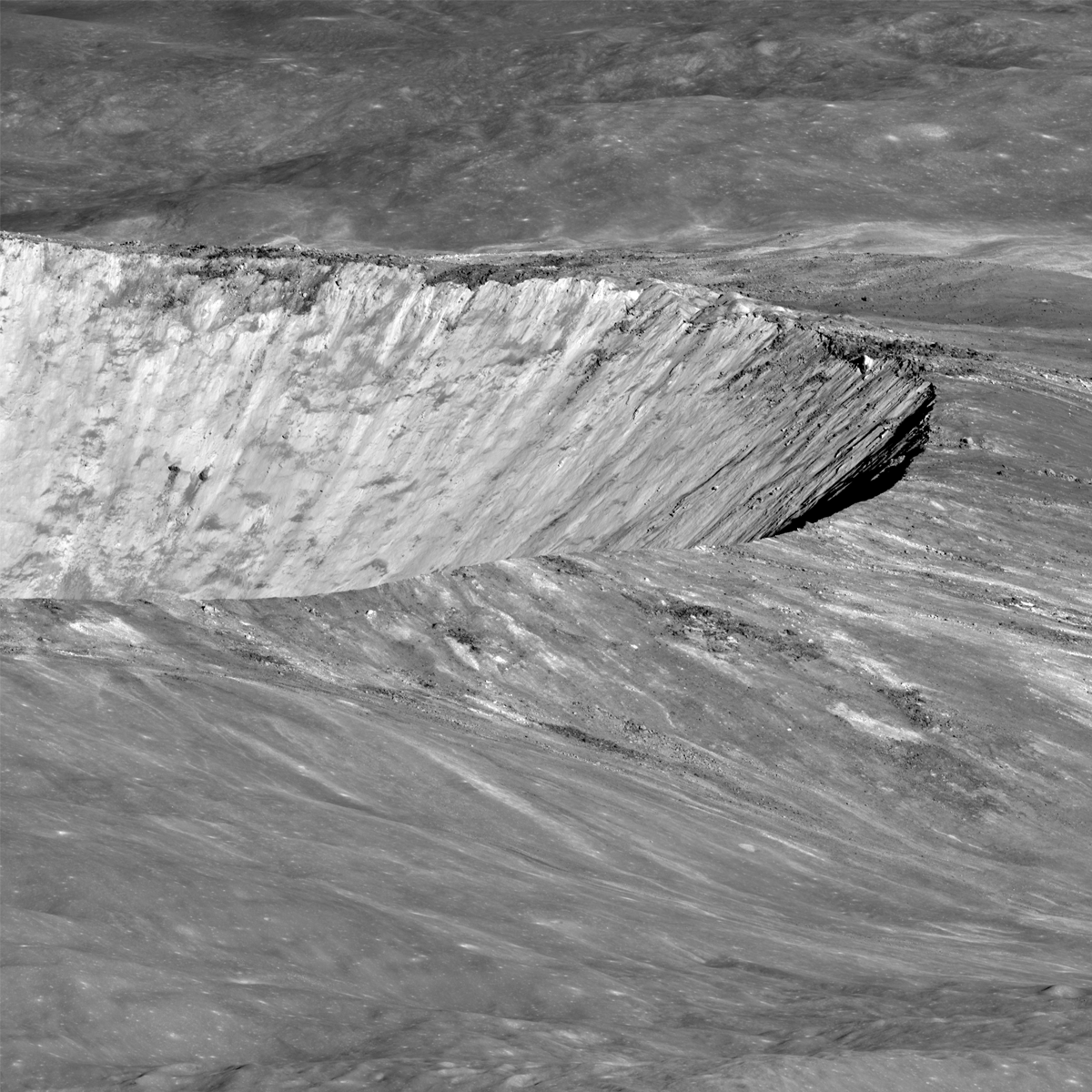
A Very Oblique View of Giordano Bruno - Southern rim of Giordano Bruno crater seen obliquely (79°) from 53 km altitude, small portion of mosaic of LROC Narrow Angle Camera (NAC) frames M119245930L & R (LRO orbit 2707, January 27, 2010; subsampled by a factor of three; Slew angle -74° 4.2 meters resolution). View the full size LROC Featured Image, HERE [NASA/GSFC/Arizona State University].
Marc Robinson
Principal Investigator
Lunar Reconnaissance Orbiter Camera (LROC)
Arizona State University

LROC has captured many sensational views of the crater Giordano Bruno. We return again and again to this rayed beauty because it is a nearly pristine example of the effects of impacts on the lunar surface. It displays an immense ejecta blanket with beautiful secondary craters and is an excellent illustration of how rocks melted by impacts flow and pond. The crater also exposes fresh highland material, with minimal effects from space weathering. Today's Featured Image, captured by slewing the spacecraft 79° to the east, provides another sensational view that helps us understand the impact process, and until astronauts visit Giordano Bruno, gives a view about as close as you can get to standing on the surface to the west of the crater.

Giordano Bruno south wall detail - Full resolution detail of the steep inward dipping wall of Giordano Bruno [NASA/GSFC/Arizona State University].
In the detail above, you can see the crater's steep wall and a flap of what appears to be impact melt that goes right up to, and over, the edge. In regions like this, it is likely that as molten rock was ejected from the crater and deposited on the exterior, the crater's shape was still changing. A portion of what was originally the rim has likely slumped down into the crater. Small debris slides continue to expose bright, fresh material on the walls. In the wider, reduced-resolution view below, the extent to which the impact event resurfaced its surroundings is clear. The foreground shows the detailed patterns left by the ejecta and secondary craters as they swept across the surface, smoothing and mantling the original topography. In the distance of the background, you can make out darker areas within the bright terrain - these are likely areas that the continuous ejecta blanket and rays did not completely cover, so the mature soil remains at the surface.

A wider, reduced resolution view of Giordano Bruno and its ejecta blanket. Click on the image above to enlarge, or below for a full resolution version of this image [NASA/GSFC/Arizona State University]
Scroll through all of the details of this beautiful impact crater - the full-resolution version of today's Featured Image is not to be missed, HERE.

Be sure to check out the YouTube video:


Check out the full resolution version of the movie.
Download it for yourself, HERE. (Barnstorming_Giordano_Bruno.mov - 85.0 MB)

Previous LROC Views of Giordano Bruno:
Sunset Over Giordano Bruno
The Big Picture
Outside of Giordano Bruno
Fragmented Impact Melt
Delicate Patterns in Giordano Bruno Ejecta
Impact Melt Flows on Giordano Bruno

Saturday, July 7, 2012

LROC: Sunset Over Giordano Bruno

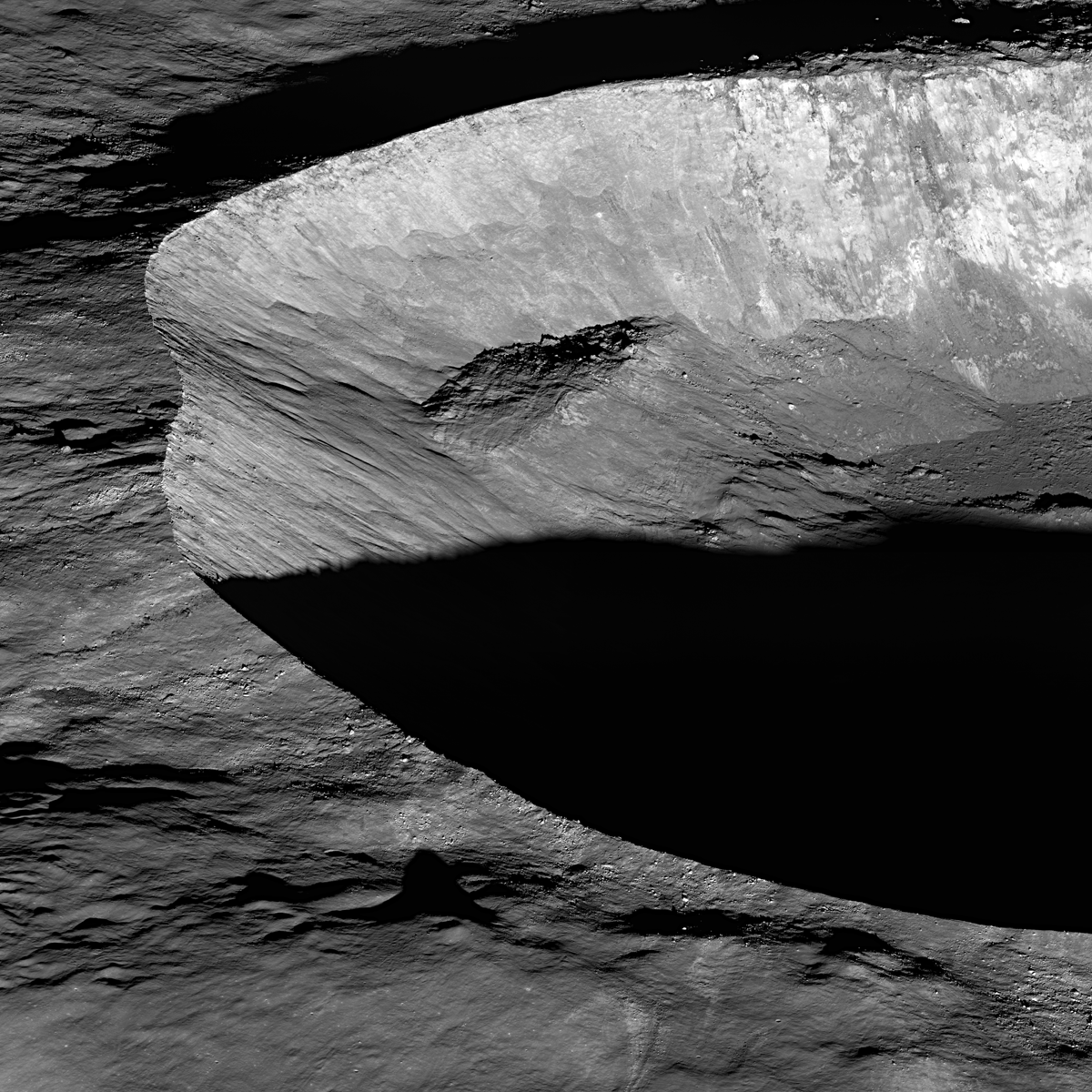
Slump terrace in the northern half of Giordano Bruno crater seen at sunset, from an altitude of 54 km. Terrace is 4800 meters wide, LROC Narrow Angle Camera (NAC) M165190579LR, LRO orbit 9478, July 13, 2011; spacecraft slew 60° at 1.37 meters resolution. View the full-size LROC image release, HERE [NASA/GSFC/ Arizona State University].
Mark Robinson
Principal Investigator
Lunar Reconnaissance Orbiter Camera
Arizona State University

The exact age of formation for Giordano Bruno crater is not known. Legend has it forming sometime in the 12th century, and more recent crater counts have this beautiful crater forming up to 10 million years ago.

Crater counts must be more accurate than legend, right?

Perhaps, but one of the new results from analysis of LROC images is that self-secondaries (sometimes called auto-secondaries) may be more pervasive than previously thought.

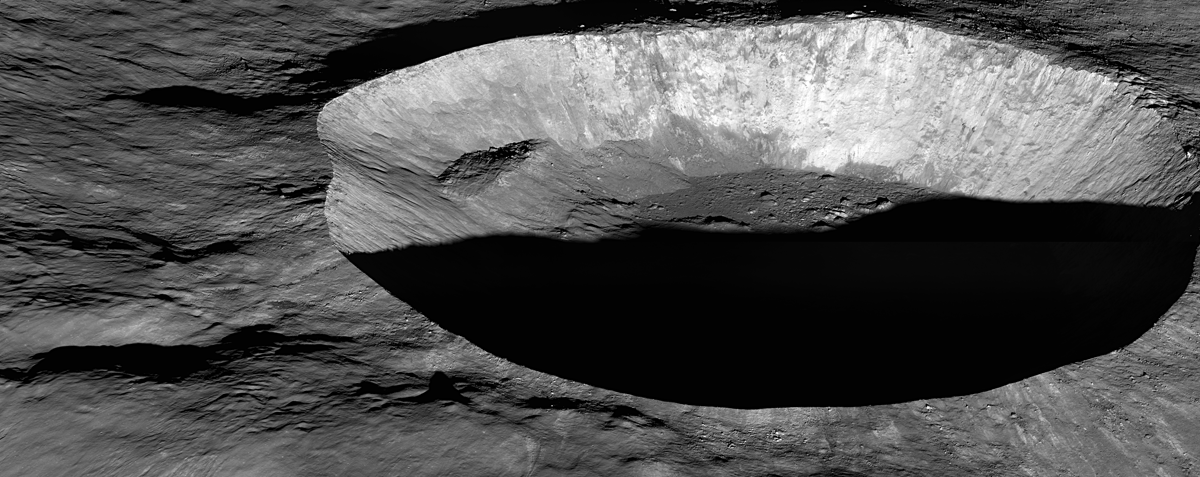
Subsampled version of NAC oblique view of Giordano Bruno crater (21 km diameter). View the full-size LROC image release, HERE [NASA/GSFC/ Arizona State University].
A self-secondary crater forms as late stage ejecta lands on top of early ejecta, all from the same impact event. In this case the impact that formed Giordano Bruno crater. So despite the best efforts of the lunar science community, all we know is that this fascinating crater formed no later than 10 million years ago and no earlier than 18 June 1178. How can we get to an unambiguous answer; what is the exact age of formation of Giordano Bruno? The answer is simple, radiometric age dating of rocks that melted during the impact! When a rock is melted and then recrystallizes its radiometric clock is reset, thus all we need to do is collect a sample of the abundant impact melt rocks either from the floor or flanks of Giordano Bruno.

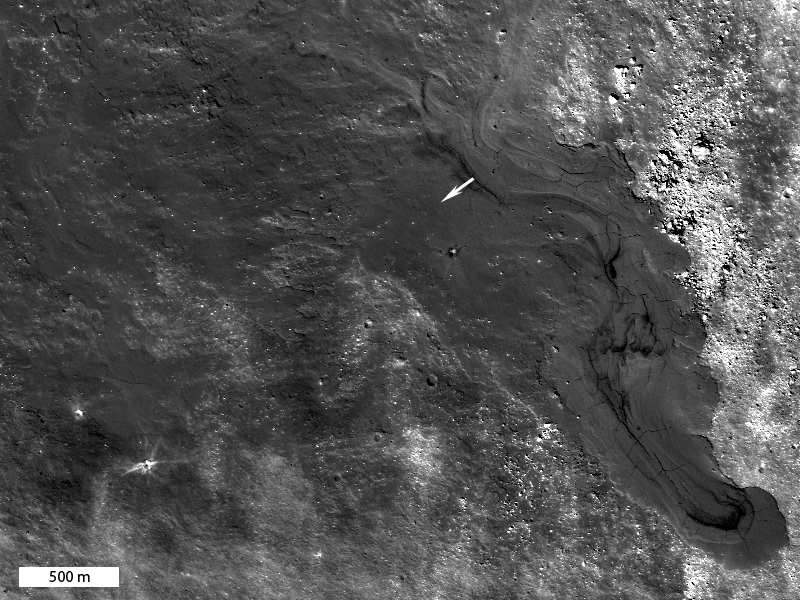
Impact melt deposit on south flank of Giordano Bruno crater, arrow indicates center of landing site (35.47°N, 102.86°E) shown at full resolution below. View the full-size LROC image release, HERE [NASA/GSFC/Arizona State University].
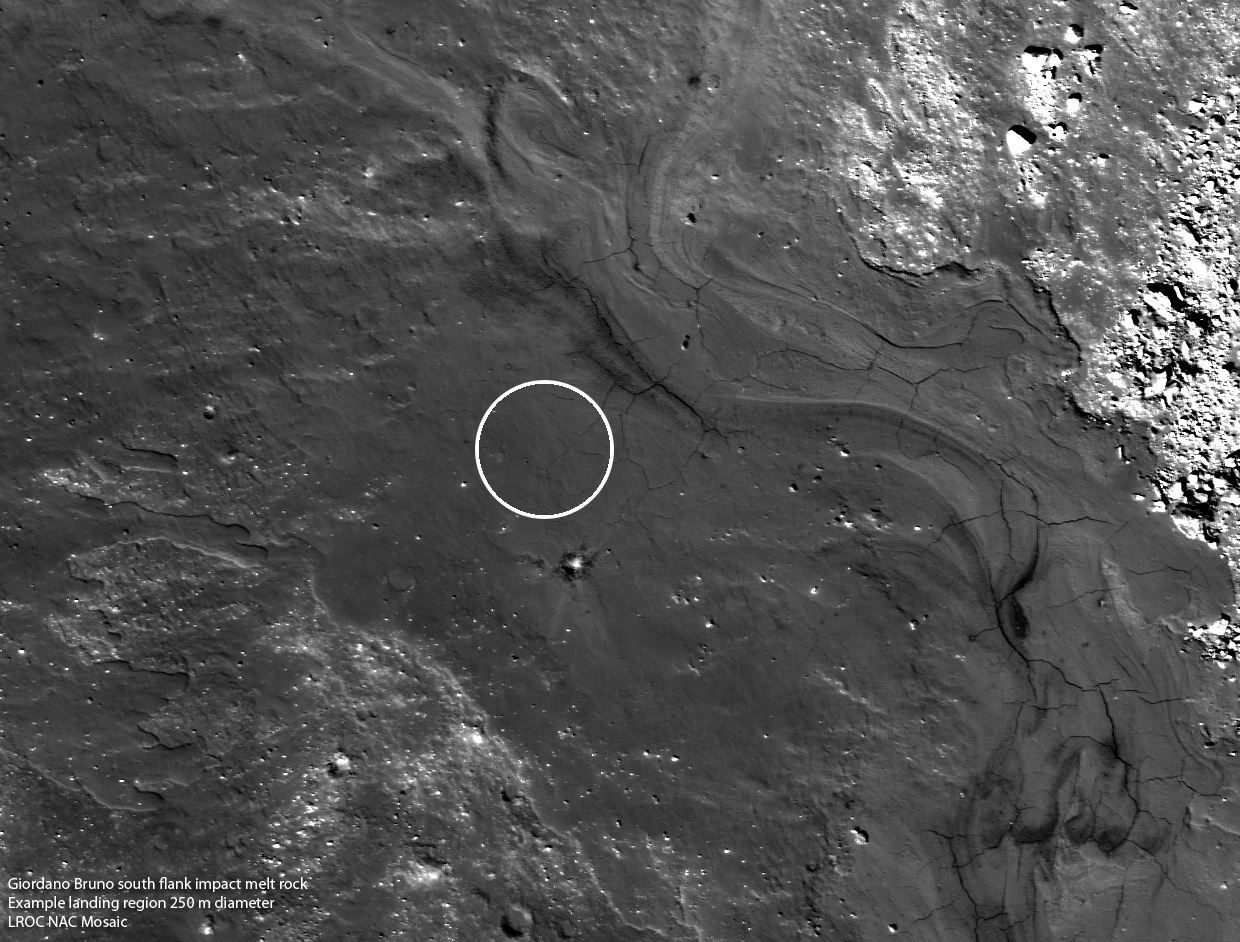
In terms of planetary missions, collecting such a sample is relatively straightforward (although no planetary spacecraft missions are simple): land, scoop, return. First scientists and engineers find the safest landing spot on an impact melt deposit. My favorite is just outside the crater, on the crater's southern rim (visit last week's Featured Image mosaic of Giordano Bruno crater). This large area provides numerous 100 meter size landing spots on now frozen deposit of impact melt. Next, you have to build the sample return spacecraft and land it safely on the Moon. This is no small feat, but keep in mind that the Soviet Union did this successfully three times almost four decades ago. While on the surface, key supporting measurements would be acquired; images, spectral measurements, magnetic properties, and perhaps information about surface radiation exposure to help design safer spacecraft and spacesuits for future astronauts. Finally, after no more than a lunar day on the surface, a sample is scooped up and then returned to Earth. What would we learn? Of course, we'd learn about the age of formation of Giordano Bruno crater, but also much more.

Example landing spot (250 meter diameter circle) on now frozen impact melt. View the full-size LROC image release, HERE [NASA/GSFC/Arizona State University].
This new knowledge will help crater counting experts understand the importance of self-secondary craters on very young craters. A new calibration for these youngest craters could be obtained, thus making age estimates for all other young craters on the Moon more reliable. Additionally this part of the Moon is far from the Imbrium basin and the KREEPy region from where all the Apollo and Luna samples were returned. So this precious sample would be our first look at unsampled highlands terrain, the oldest portion of the Moon's crust. All-in-all, this site is a prime candidate for an automated precursor sample return - lets go!

Be sure and check out the amazing details in the full resolution complete oblique mosaic of Giordano Bruno crater.

Previous LROC Giordano Bruno Featured Images
The Big Picture
Outside of Giordano Bruno
Fragmented Impact Melt
Delicate Patterns in Giordano Bruno Ejecta
Impact Melt Flows on Giordano Bruno
Young Giordano Bruno

A possible landing site on the south flank of the relatively fresh, much studied crater Giordano Bruno (22.13km, 35.92°N, 102.74°E) LROC Wide Angle Camera (WAC) mosaic from four sequential orbits, February 23, 2010, angle of incidence 49.62° at 76.2 meters resolution, from 54 km. [NASA/GSFC/Arizona State University].

Monday, May 14, 2012

Gutheinz searches for commemorative samples

Piece of rock Rafael Navarro, a former Colombian toy manufacturer, contends came from the moon, photographed in Buffalo, Texas. Navarro has placed rock fragments in the accompanying small plastic box for sale on eBay, seeking $300,000. Joe Gutheinz, a former NASA investigator practicing law outside Houston, is investigating Navarro's claim as he hunts for moon rocks, some missing from the collected retrieved by the twelve American astronauts who walked on the lunar surface between 1969 and 1972 [Michael Graczyk / AP]
Michael Graczyk
Associated Press

The dark suit and tie Joe Gutheinz wore set him apart from other customers inside a Texas eatery where the usual attire is jeans and cowboy hats.

An appetite for down-home cooking wasn't what brought the former NASA investigator to the Pitt Grill recently. He was on a quest to identify and maybe recover some of the rarest treasure brought to Earth and then lost: moon rocks.

"We're educating the states and countries of the world about how much they're worth on the black market and we need to increase the security in museums and need to put them back on display," Gutheinz said.
The rock samples were collected by the dozen American astronauts who walked on the lunar surface between 1969 and 1972. U.S. states, territories, the United Nations and foreign governments received them as gifts. The samples, which also were loaned to museums and given to scientists for research, range from dust particles to tiny pebbles.

"A lot of them are in storage. And we need to put them in an inventory control system. And that's what's really lacking," said Gutheinz, a Houston lawyer who also teaches college classes in investigative techniques.

Read the full article HERE.

Saturday, March 10, 2012

How the Mars community shot itself in the foot

Mars Sample Return (MSR) as envisioned in 2006 [NASA].
Paul D. Spudis
The Once and Future Moon
Smithsonian Air & Space
 
The recent release of the administration’s FY 2013 budget gave some scientists a bit of a shock.  Planetary science (considered a “jewel in the crown” of the space agency) has been identified for cutting, over 20% during the next five years.  A particularly painful cut comes to the agency’s robotic Mars exploration program.  Planned missions in cooperation with the Europeans and future missions designed to lead up to the return of a surface sample from Mars were eliminated from the budget.  In effect, the successful program of Mars missions created after the embarrassing failure of the Mars Polar Lander over a decade ago is being scrapped.

The administration digested the National Research Council (NRC) Decadal Survey in planetary science (released last spring) before writing their new budget.  The study process for this report involves getting the relevant scientific communities to determine and lay out their priorities.  The assumption is that the scientific community can best determine the most relevant goals and questions in planetary science and therefore design mission concepts to address them.  Through a variety of working groups and forums, the desires of the community are made known and a report is written around them.  Typically, planetary scientists organize their working groups around objects of study, such as the inner (rocky) planets, small bodies (asteroids and comets), and giant planets.  For the latest Decadal Survey, the Mars community had its own separate group. Mars is, of course, a rocky, inner planet, and for decades has held sway in the planning process, both for robotic and human missions.

NASA’s highest scientific priority for Mars exploration is to determine if it has now, or has ever had life.  The chosen mission concept to address this question is to return samples of the surface of Mars to the Earth.  This is a very difficult task.  Mars is a big planet with a deep gravity well.  At its closest, it is several tens of millions of miles from the Earth, leaving robotic machines controlled from the Earth with long time delays (up to tens of minutes).  Safely landing on Mars is hard enough – taking off again and navigating back to Earth with samples safely in hand, is at least an order of magnitude more difficult.

Yet the new Decadal Survey made Mars sample return its only priority in the area of Mars science – the report offered no alternative missions for consideration.  Moreover, the sample return mission concept presented by the Decadal Survey required not one, but three separate “Flagship” missions (i.e., those having total costs exceeding $1 billion).  In a complex scenario, the mission concept called for a Mars lander to deliver a rover, explore and collect samples and then store them on the surface.  A second mission years later would rendezvous with the stored samples on the surface of Mars, transfer them to an ascent vehicle, and place the samples in orbit around the red planet.  The third and final mission would rendezvous with this orbital vehicle, dock with it and return the samples to the Earth.  From initial landing to sample return would take over a decade and cost many billions of dollars.  Moreover, in this series of three sequential and very complex missions, one single-point failure could spell the end of the entire effort.

When the Office of Management and Budget (OMB) saw this plan and its price tag, they thought it was too much money for too complicated a mission.  Unfortunately, the Mars subgroup left no “back-up” options in the Decadal Survey – it was do the sample return trio or do nothing.  Hence, the new budget proposes nothing.  Of course, a big part of the reason that this mission trio was a non-starter was to preserve funding for the James Webb Space Telescope (JWST), which at its current estimated $8 billion cost (and counting), effectively makes most other space science endeavors non-starters.

Cry “Havoc!” and let slip the dogs of war!  The planetary science community was stunned.  The Planetary Society organized a letter writing campaign, demanding that Congress intervene and save the “Mars program.”  Scientists complained that their highest priority as expressed in the Decadal Survey had been discarded without any real thought and debate (much as the Vision for Space Exploration had been thrown away two years ago).  In partial response, the agency is setting up an ad hoc group to study some less expensive, interim Mars missions (something that the Decadal Survey should have done).  Presently, all of planetary science is in danger of severe cutbacks.  And the final bill for JWST has yet to be delivered.

The MoonRise mission concept, in its most recent iteration planned in cooperation with the Canadian Space Agency, fulfills the need to obtain a baseline sample of the 4 billion year-old South Pole-Aitken basin, only a small part of which spills over onto the Moon's nearside, in line of sight with flight directors on Earth [NASA/NLSI].
What can be learned from this these events and applied to the exploration of the Moon?  Like the Mars community, the lunar science community has made sample return the centerpiece of their mission wish list.  A South Pole-Aitken (SPA) basin sample return has been proposed as a New Frontiers mission and studied in detail twice over the last nine years – and passed over for selection twice.  Yet the new Decadal Survey once again makes this mission its top priority in lunar science.  Moreover, for this mission to be scientifically successful in its goal of dating the impact that created the SPA basin (the biggest and oldest impact crater on the Moon) it must not only complete the sample return, it must collect samples whose context can be reconstructed and fully understood.  As discussed here previously, given the difficulty of such reconstruction for the Apollo samples (which were carefully documented and collected by trained field observers), an unambiguous outcome for this robotic mission is exceedingly unlikely.

Certainly, returning a sample from the Moon is less difficult than doing it from Mars, so the two tasks are not directly comparable.  Yet, there are a number of missions to both the Moon and Mars that could be done for less money and would significantly advance our understanding of their histories and processes.  For example, an entirely new field of scientific study is the generation, movement and fate of water on the Moon, a problem rich in both scientific and exploration potential.  This new field could be investigated profitably by a series of properly instrumented, small robotic missions.

These issues and questions were known at the time that the Decadal Survey was conducted, so there is little excuse for ignoring them, except for the community’s fixation on sample return missions.  In part, this obsession exists because it provides a large part of the research community with something to do.  NASA money has built many expensive laboratories to analyze extraterrestrial materials and new lunar and planetary samples are needed to keep them operating.  But the full potential of remote, in situ analysis – coupled with careful and clever geological planning – has not been given enough thought by the scientific community.

Will the lunar science community also shoot itself in the foot?  If so, it will simply be finishing a job started by this administration two years ago with the cancellation of the VSE.  Fans of human spaceflight please take note:  the process of undertaking these “Decadal Surveys” has been widely praised and advocated as a model for determining the goals and objectives of the human space program.  Considering the consequences of this latest effort in planetary science, one might want to re-think that scenario.

Originally published March 8, 2012 at his Smithsonian Air & Space blogThe Once and Future Moon, Dr. Spudis is a senior staff scientist at the Lunar and Planetary Institute. The opinions expressed are those of the author and are better informed than average.

Tuesday, February 21, 2012

ESRF X-rays illuminate lunar interior

Image of artificial moon rock sample, measuring about half
millimeter across, made with an electron microprobe at ambient
temperature after the experiment with X-rays. The fragmenta-
tion of the sample occurred when it was extracted from the
small diamond cylinder in which it had been melted under high
pressure and temperature [ESRF/Nature].
Does the Moon still have even a small, warm liquid core? The answer can only be apparent indirectly, behind its dance movements and the combined angular momentum of it juggled components; the Moon’s anisotropy. If, as investigators now claim, the Moon’s outer surface is still shrinking or, in some cases, stretching, other outward evidence of even a small warm and liquid core can only be discovered indirectly. Why, for example, is any evidence of volcanism on the Moon’s surface at least a billion years old?

A science team in the Netherlands claims to have discovered one answer, the natural buoyancy of molten but poorly mixed constituent materials closer to the Moon’s core. The world’s press is reporting their more subtle investigation, using X-rays, with headlines about future lunar volcanism, which contrasts with their own press release and it's secondary headline:

Deep lunar magma is too heavy to produce active volcanoes

"Scientists have now identified a likely reason for this peaceful surface life: the hot, molten rock in the Moon's deep interior could be so dense that it is simply too heavy to rise to the surface like a bubble in water. For their experiments, the scientists produced microscopic copies of moon rock collected by the Apollo missions and melted them at the extremely high pressures and temperatures found inside the Moon. They then measured their densities with powerful X-rays. The results are published in the Journal Nature Geosciences on 19 February 2012.

"The team was led by Mirjam van Kan Parker and Wim van Westrenen from VU University Amsterdam and comprised of scientists from the Universities of Paris 6/CNRS, Lyon 1/CNRS, Edinburgh, and the European Synchrotron Radiation Facility (ESRF) in Grenoble.

Exploded schematic of the high-pressure cell
assembly for the ESRF synchrotron  X-ray
experiment. The artificial moon rock samples
(orange) were placed inside the ring-shaped, natural
diamond sample holder (grey), and surrounded by
a large disk-shaped container (red) [ESRF/Nature].
"The driving force for vertical movement of magma is the density difference between the magma and the surrounding solid material, making the liquid magma move slowly upwards like a bubble. The lighter the liquid magma is, the more violent the upward movement will be.

"To determine the density of lunar magma, Wim van Westrenen and his colleagues synthesised moon rock in their laboratory in Amsterdam, using the composition derived from Apollo samples as their “recipe”. The pressures and temperatures close to the core of the Moon are more than 45,000 bar and about 1500 degrees. It is possible to generate these extreme conditions with small samples, heating them with a high electric current while squashing them in a press. By measuring the attenuation of a powerful synchrotron X-ray beam at the (European Synchrotron Radiation Facility) in Grenoble, traversing the sample both solid and molten, the density at high pressure and high temperature could be measured.

 “We had to use the most brilliant X-ray beam in the world for this experiment because the magma sample is so tiny and confined in a massive, highly absorbing container. Without a bright beam of X-rays, you cannot measure these density variations”, says Mohamed Mezouar from the ESRF.

"The measurements at the ESRF were combined with computer simulations to calculate the magma density at any location in the Moon.

"Nearly all the lunar magmas were found to be less dense than their solid surroundings, similar to the situation on Earth. There is one important exception: small droplets of titanium-rich glass first found in Apollo 14 mission samples produce liquid magma as dense as the rocks found in the deepest parts of the lunar mantle today. This magma would not move towards the surface.

"Such titanium-rich magma can only be formed by melting titanium rich solid rocks. Previous experiments have shown that such rocks were formed soon after the formation of the Moon at shallow levels, close to the surface. How did they get deep into the mantle? The scientists conclude that large vertical movements must have occurred early in the history of the Moon, during which titanium-rich rocks descended from near the surface all the way to the core-mantle boundary. “After descending, magma formed from these near-surface rocks, very rich in titanium, and accumulated at the bottom of the mantle – a bit like an upside-down volcano. Today, the Moon is still cooling down, as are the melts in its interior. In the distant future, the cooler and therefore solidifying melt will change in composition, likely making it less dense than its surroundings. This lighter magma could make its way again up to the surface forming an active volcano on the Moon – what a sight that would be! – but for the time being, this is just a hypothesis to stimulate more experiments”, concludes Wim van Westrenen."

Reference: Mirjam van Kan Parker, et al., Neutral buoyancy of titanium-rich melts in the deep lunar interior, Nature Geoscience advanced online publication, 19 February 2012

Wednesday, February 8, 2012

Finding lost Moon rocks is his mission

Joseph Gutheinz, a retired NASA investigator and self-appointed moon rock hunter, stands before the lunar samples vault at Space Center Houston. (James Nielsen, Houston Chronicle / February 8, 2012)
Tranquillitatis mare basalt sample
entrusted to North Carolina and
found in NC Dept. of Commerce
desk drawer four decades later
[Charlotte Observer].
Molly Hennessy-Fiske
Los Angeles Times

Alaska's moon rocks disappeared on Sept. 6, 1973.

A fire set by an arsonist had torn through the state transportation museum in Anchorage, where the four rocks had been on display.

The fragments, each smaller than a pea, were among 48 pounds of lunar material retrieved four years earlier by astronauts aboard Apollo 11. President Nixon gave samples to each state to celebrate man's first walk on the moon.

The Alaska museum curator's stepson, 17-year-old Arthur Coleman Anderson, sneaked inside the disaster scene to poke through the debris. He came across a Lucite ball mounted on a walnut plaque featuring the state flag. Inside the ball were four rocks.

Anderson figured the plaque, once cleaned up and polished, would make a neat souvenir. And so, as clean-up crews set about their work, he walked away with a national treasure.

It would be nearly 37 years before he attracted the attention of the moon rock hunter.

State of Ohio's four 'pea-sized' Apollo 11
samples display; gift from President Nixon
similar Alaska's, eventually lost for 37 years.
"I hate incompetence," Joseph Gutheinz said. He was in his Houston-area law office, seated at a desk adorned with a silver-and-black globe labeled "moon rock hunter."
It irks Gutheinz, an Army veteran, retired NASA investigator and the son of Camp Pendleton Marines, that authorities have allowed hundreds of lunar rocks to disappear or fall into the hands of businessmen, dictators and thieves.

It is illegal for individuals, even astronauts, to own moon rocks. The U.S. distributed samples to states and nations as signs of goodwill — symbols of extraordinary human achievement intended to be displayed — and many of them are unaccounted-for.

Hundreds of rocks that NASA loaned to researchers have also been lost or stolen over the years, the space agency's inspector-general reported in December.

"To me, NASA's missions to the moon have been a tribute to the best of mankind, and NASA's handling of the moon rocks recovered by our astronauts has been lacking," Gutheinz said.
Read the full Los Angeles Times feature story HERE.
Friday, January 27, 2012

Remnant magnetism hints at once-active lunar core

A piece of lunar sample 10020, a rock that appears to carry
the signature of a past magnetic field on the moon [NASA].
John Matson
Scientific American

The moon of today is a static orb with little to no internal activity; for all intents and purposes it appears to be a dead, dusty pebble of a world. But billions of years ago the moon may have been a place of far more dynamism—literally.

A new study of a lunar rock scooped up by Neil Armstrong and Buzz Aldrin during their Apollo 11 mission indicates that the ancient moon long sustained a dynamo—a convecting fluid core, much like Earth's, that produces a global magnetic field. The age of the rock implies that the lunar dynamo was still going some 3.7 billion years ago, about 800 million years after the moon's formation.

That is longer than would be expected if the lunar dynamo were powered primarily by the natural churning of a cooling molten interior, as is the case on Earth. The moon's small core should have cooled off rather quickly and put an end to any dynamo-generated magnetic field within a few hundred million years. So researchers may have to explore alternate explanations for how a dynamo could be sustained—explanations that depart from thinking of the lunar interior in terms of Earthly geophysics.

A standard-issue, Earth-like dynamo "would have died out on the moon much, much before 3.7 billion years ago," says Erin Shea, a graduate student in geology at the Massachusetts Institute of Technology and lead author on a study in the January 27 issue of Science. "We have to start thinking outside the box about what generates a lunar dynamo."
A lunar sample collected by Apollo astronauts suggests that other-Earthly geophysics drove the moon's churning interior
Using a high-resolution magnetometer, the researchers found that the lunar sample indeed formed in the presence of a magnetic field, perhaps even one as strong as Earth's magnetic field today. "What this sample tells us is that at some point the moon did have a dynamo," Shea says. "This magnetic field lasted much longer than we had considered before."

A similar paleomagnetic study in 2009 by some of Shea's co-authors demonstrated the presence of a lunar dynamo some 4.2 billion years ago. That is just at the cusp of what would be possible with an Earth-like dynamo driven by a cooling interior alone. "Even then it's not trivial," says Ian Garrick-Bethell, a planetary scientist at the University of California, Santa Cruz (U.C.S.C.), who was the lead author of the 2009 study.
Read the full online article HERE.

Friday, January 6, 2012

Tranquillityite found on Earth for first time

Tranquillityite. Last of three minerals isolated on Earth originally identified in samples returned from the Moon in 1969. Researchers report discovery of tranquillityite for the first time on Earth at six sites in Western Australia.
Ben Grubb
Sydney Morning Herald

Australian scientists have discovered a rare mineral previously known only to be found in lunar rock samples and used it to date an Earth rock which formed over a billion years ago.

Named tranquillityite after the Sea of Tranquility, where astronauts landed on the Moon in 1969, researchers discovered the substance in rocks collected from six sites in Western Australia.

Tranquillityite was first discovered in rocks brought back from the moon soon after the first Apollo mission, along with two other substances - armalcolite and pyroxferroite. Both substances were found in Earth rocks within a decade or so of the 1969 Apollo mission but the third, tranquillityite, wasn't found on Earth until now.

Read the full story HERE.

Tuesday, November 8, 2011

Hadley Rille and the Mountains of the Moon

NASA Lunar Reconnaissance Orbiter (LRO) rolled to capture a dramatic oblique view of the Apollo 15 landing site 26.1°N, 0.25°E on the plains of Hadley Rille Delta. Hadley Rille, a great chasm in the lunar surface, carves through the center of this scene. Explore the full size LROC image HERE. LROC Narrow Angle Camera (NAC) observation M165842369, orbit 9574, July 20, 2011 [NASA/GSFC/Arizona State University].
Samuel Lawrence
LROC News System

On 20 July 2011 (coincidentally, the 42nd anniversary of the first steps humans took on another world) the NASA Lunar Reconnaissance Orbiter was commanded to roll to the east, allowing the Lunar Reconnaissance Orbiter Camera to obliquely observe Hadley rille and the Apollo 15 landing site. One of humanity's greatest voyages of exploration, the adventures of mission commander David Scott, lunar module pilot James Irwin, and command module pilot Al Worden transformed our understanding of the Moon and the Solar System. The shadow of the descent stage of the Lunar Module Falcon is visible, as is that of NASA's first lunar roving vehicle. Additionally, the sampling stations explored by the Apollo 15 astronauts are easy to pick out.

Full scope of the LROC NAC oblique frames detailed HERE. Hadley Rille is about 1.2 km wide. The whole scene is 28 kilometers from left-to-right [NASA/GSFC/Arizona State University].
Apollo 15 was the first of three long-duration “J-missions”; more would have flown had the Apollo program not been brought to a premature conclusion in 1972 after the Apollo 17 mission. The J-missions featured heavily instrumented command and service modules, improved spacesuits to promote crew agility, upgraded lunar landing vehicles, and the electric Lunar Roving Vehicles (or LRVs) to expand the crew's range on the surface. Prior to the mission, the Apollo 15 crew received extensive geoscience training, which (along with the increasingly capable hardware) resulted in an extraordinary bounty of scientific results. Apollo 15 was also the only lunar mission where all crewmembers were graduates of the University of Michigan and United States Air Force officers (the lunar module, Falcon, was named after the mascot of the United States Air Force Academy, and the Apollo 15 command module Endeavour is now on permanent display at the National Museum of the U. S. Air Force in Dayton, OH).

LROC NAC mosaic from M170538271, sampled at 2 meter pixel scale (from the original 0.5 m) showing area where lunar sample 15555, "Great Scott," was collected (Station 9A) west of the Apollo 15 landing site. View the larger original 2 meter image prepared for this essay HERE [NASA/GSFC/Arizona State University].
Astronauts Scott and Irwin spent almost three days exploring the Hadley-Apennine valley, traversed over 28 kilometers (17 miles) using the first lunar rover, and collected over 77 kilograms (170 pounds) of priceless lunar materials, including the famous “Genesis Rock”, a piece of the primordial lunar crust. While Scott and Irwin explored the surface, command module pilot Worden used the extensive instrument suite aboard the command module Endeavour to successfully complete a complex series of orbital observations. You can view digital scans of the original Apollo 15 flight films taken by Endeavour's Fairchild Mapping Camera at the Arizona State University Apollo Digital Image Archive

The geologically complex Apollo 15 site is a high priority target for future human lunar exploration, and consequently was one of the Constellation Regions of Interest that were a focus of LROC observations during the LRO Exploration Systems Mission Directorate mission (the 1st year of LRO operations). Thanks to the exploration of the Apollo 15 astronauts, we now have a well-defined set of scientific questions that can only be addressed through a future human sortie mission to the Hadley-Apennine region. In addition, recovering materials from the descent stage of Falcon would provide valuable information to present-day engineers about how materials survive on the lunar surface for long periods of time.

Edge of Hadley rille where lunar sample 15555 (Station 9A) was collected, August 2, 1971. The disturbed soil at 9A are the foot prints and LRV tracks left by Scott & Irwin, 40 years ago, testifying to the intensive study and sampling at this site. See the larger image prepared for this essay, from an observation not due for release until December, HERE [NASA/GSFC/Arizona State University].
On Saturday, November 5, as part of the School of Earth and Space Exploration's annual Earth and Space Exploration Day, Arizona State University unveiled a display featuring a piece of Apollo Lunar Sample (ALS) 15555, a mare basalt collected by Col. Scott about 12 meters from the rim of Hadley rille at Station 9A. This lunar rock is the largest and one of the most intensively studied samples collected by the Apollo 15 astronauts, and is predominantly composed of silicate minerals such as olivine, pyroxene, and plagioclase. The bulk composition of 15555 is thought to represent a primitive volcanic melt and has been used for experimental and theoretical studies related to the geologic origin of lunar basalts. Planetary scientists use information gleaned from such analyses to gain key insights into how terrestrial planets like the Moon and Earth form and evolve. Sample 15555 has also been used for critical tests designed to help perfect and calibrate methods of radiometric age dating employed by different laboratories around the world.

On their third EVA, before sampling 15555, Col. Scott took a picture of its location and immediately handed the camera to Jim Irwin, who then captured a series of shots for a standard panorama of Station 9a. The three legged gnomon was placed beside the sample so scientists could later determine its orientation of the rock on the surface [NASA, AS15-82-11164].
What is a mare basalt and what is its significance? The lunar mare basalts are very similar to terrestrial basalts. If you drove up to Sunset crater outside Flagstaff AZ, you can find basalt. If you go to Hawaii, Iceland, India, Ethiopoa and many other countries you can find basalt. The oceanic crust on the Earth is composed of basalt. If you visit Mars you will likely land on basalt or basalt derived sediments. If you land on Venus - same! The Dawn spacecraft is right now orbiting an asteroid, Vesta, that is composed of basalt. Basalt is common in the Solar System. The fascinating fact about basalts is that they represent a sample of the upper mantle. We can't get to the mantle directly, but nature provides us with samples of the deep interior (mantle) in the form of basalt. Volcanism is the delivery truck! Since the mantle makes up most of the mass of the Earth, Mars and the Moon we must have samples of the mantle to understand each body as a whole. You can think of 15555 as a piece of the Moon's interior, even though it was picked up on the surface.

Apollo Lunar Sample 15555 on display at the Lunar Reconnaissance Orbiter Camera Science Operations Center [E. Speyerer, Arizona State University].
A generous loan to Arizona State University from the NASA Lyndon B. Johnson Space Center, this 76 gram (2.7 ounces) piece of mare basalt will be displayed in the Lunar Reconnaissance Orbiter Camera Science Operations Center Visitor Gallery. This stunning and unique lunar sample display will enable visitors to view and learn about an amazing piece of our Moon, while just a few meters away, behind a glass partition, the LROC team is sending commands to LROC and receiving images in return that enable scientists and engineers to plan for future human and robotic exploration of the Moon.

We heartily encourage anyone interested in space exploration to come view this priceless American treasure and learn how lunar scientists around the world are pioneering your future in space. The work we do at LROC is tremendously exciting, but ultimately, it is the human passion for discovery that drives this enterprise.

Explore the complete NAC oblique image of the Hadley-Apennine valley!


Visit the LROC Science Operations Center

Read more about the Apollo 15 landing site
in previous LROC Team posts
:

Layers Near Apollo 15 Landing Site (30 August 2011)
Retracing the Steps of Apollo 15: Constellation Program Region of Interest (16 April 2010)
LROC's First Look at the Apollo Landing Sites (17 July 2009)
Lunar Highs and Lows (22 July 2008)
The Mighty Apennine Mountain Range (30 September 2008)
Hadley-Apennine: the Apollo 15 Landing Site (14 November 2007)

Further Related Posts:

40th Anniversary of Apollo 15 celebrated at Kennedy Space Center
Al Worden award with Moon Rock
Kaguya captures Hadley Rille

Hadley Rille Valley of Palus Putredinis on the Imbrium side of the Apenninus mountain ridge, 1971 landing site of the Apollo 15 expedition. LROC Wide Angle Camera (WAC) mosaic from 7313 and 7314, January 24, 2011; resolution 53 meters, incidence angle 65.77° from 36.36 kilometers [NASA/GSFC/Arizona State University].