
Should those on Earth control and restrict the use of off-Earth real estate or should people use and profit from what they find in space? We have conducted reconnaissance and mapping of celestial bodies for centuries using telescopes, orbital and landing spacecraft, and (forty years ago) explored it with people. Earth’s scientists have studied the returned data and we’ve dreamed of returning to the Moon and to new places where humanity has never set foot. Entrepreneurs and social engineers see a time in the near future when we will make that next step and they each hold somewhat different views — some want to develop and capitalize on their investment, some want to preserve and permit only limited access.
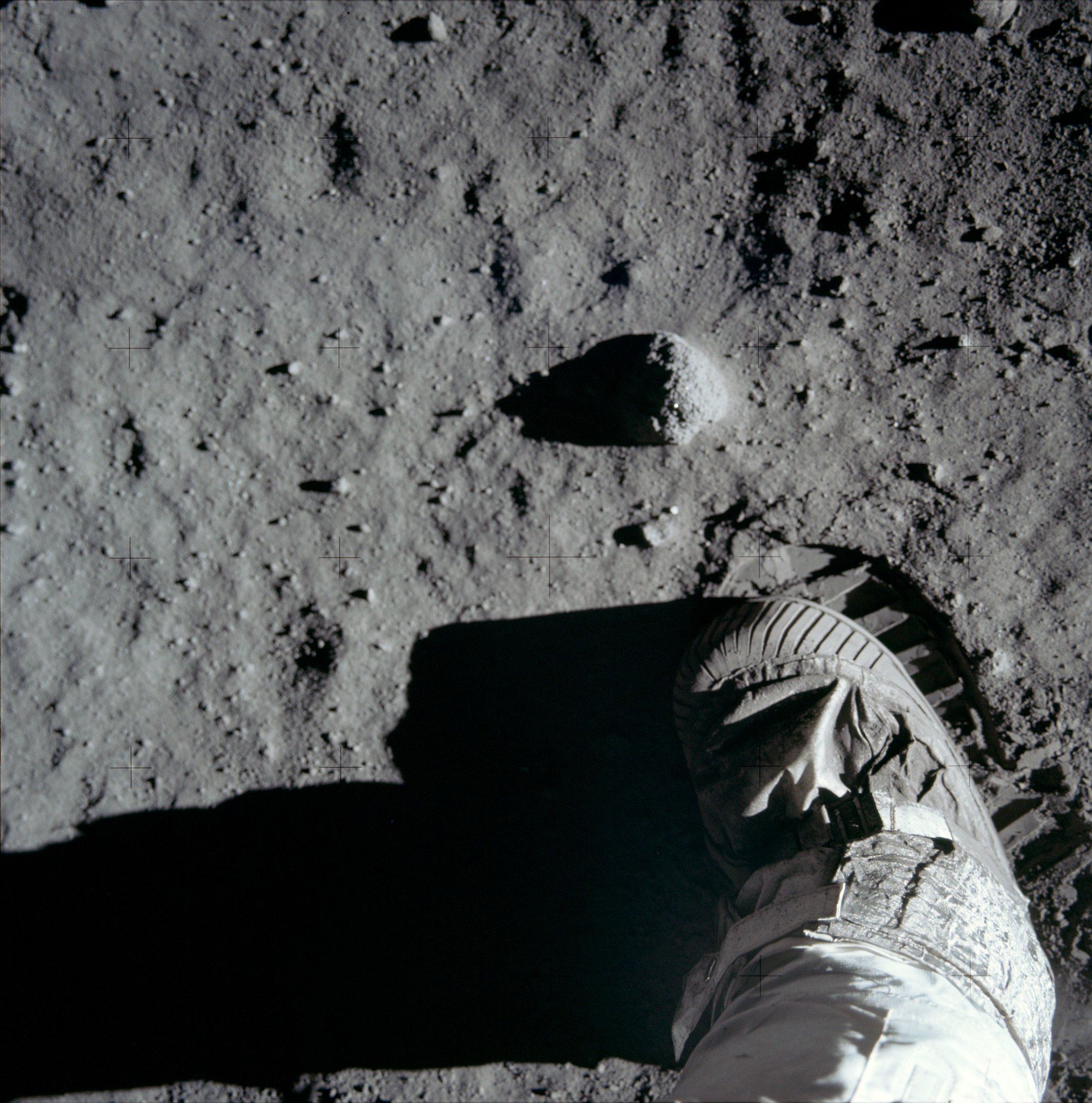 |
| Soon after following Neil Armstrong down the descent stage ladder Apollo 11 lunar module pilot Buzz Aldrin snaps his own footprint. Left undisturbed, average levels of micrometeorite "gardening" will erase these first direct human contacts with the lunar surface in 2 million years. These individual first foot prints, however, were probably erased by subsequent steps minutes later. [NASA/JSC]. |
The Once and Future Moon
Smithsonian Air & Space
In a recent Popular Science article, Veronique Greenwood argues for having the Moon declared an “International Park – an off-World Heritage site.” And not just the Apollo sites but all 14 million square miles of the lunar surface. Greenwood likes the legal model of Antarctica, an entire continent that the nations of the world agreed to not develop but use solely for scientific study. Understanding that profit motives will be behind the drive to the Moon, she allows there may be carve-outs for mining (after environmental impact studies) but legally, the Moon will be protected as a preserve for history and science, serving as the template for human expansion beyond the Moon. She doesn’t want it “damaged.”
Greenwood’s concerns stem from her belief that humans (even when they’re careful) “tromp all over things” and that without government preservation and oversight, cultural artifacts on the Moon (such as the Apollo 11 crew’s “One Small Step” footprints and various “important craters”) are in danger of destruction. She argues that “because the Moon was part of Earth until 4.5 billion years ago” (a proposition not yet established), the United Nations should have legal sovereignty over its use and disposition. She notes that the 1979 Moon Treaty was never ratified (“flopped spectacularly”), a presumed “victim of the Cold War era.” In fact, the treaty’s “flop” had nothing to do with the Cold War – a concerted lobbying effort by various space advocacy groups (such as the L-5 Society) was largely responsible for the Senate’s refusal to ratify it. No nation that had space faring capability at that time ratified the Moon Treaty.
Her article illustrates that the “green” anti-development worldview has expanded to include opposition to unfettered space utilization. Because we’re not dealing with anything green, I suggest that we dub the lunar environmentalists “Grays.” Stemming from their belief that humans are harming the Earth, the Grays fear that it is not right to allow unrestricted access and development of the Moon. Fifty years after those interloping Apollo astronauts tromped on, drove over and kicked up a lot of dust on the Moon, a more enlightened humanity will return to peacefully – and carefully – explore its surface and, in the words of the National Park Service, “Taking only photographs, leaving only footprints.” If environmental impact studies allow it, some limited mining activity might be permitted, presumably to pay for these Luna Park overseers.
The analogy to Antarctica, beloved of academics, is of limited value in this instance. The reason nations of the world do not bother to mine or drill for oil in Antarctica is that there are alternative and cheaper sources of oil and minerals that do not require the costly build up of infrastructure in that challenging environment. Such is not true for the Moon; the alternative to using the resources of the Moon is to bring everything you need with you from the deep gravity well of the Earth. With launch costs of thousands of dollars per pound (and unlikely to come down significantly for the foreseeable future), it makes good sense to look for and obtain as much of the required “dumb mass” (i.e., air, water, shielding and propellant) needed for extended presence from “local” sources – the extraterrestrial bodies themselves. Launch from Earth should be reserved only for high information density items – high-technology equipment, instruments and people. The raw materials of space will provision us – and we need to learn how to do it out there, starting with the Moon. You cannot lock up new territory and then expect entrepreneurs to invest their capital in getting you there.
While Greenwood uses Antarctica as a model for the Moon, in my mind, a better analogy is Alaska, a vast area (656,424 square miles) of great natural beauty and abundant resources. Alaska serves a multitude of purposes, including mining, fishing, oil and gas production, tourism, recreation and settlement, as well as maintaining and protecting vast reserves of national and state wilderness. No one could call Alaska a decimated paradise or an industrial wasteland – it is an immense landscape with room for every imagined activity, commercial and non-commercial. It is a harsh place, yet one where self-reliant humans migrated for profit, play and its wide-open spaces. It also has the virtue of being part of a self-governing republic, not an “administrative area” controlled by international bureaucrats. And yet, even though the land has been developed and used, the people have conserved, protected and managed the landscape and resources of the state. But Greenwood points to the Antarctica “peaceful and scientific use of” model, whereby the U.N. would own and control the Moon, thereby setting a precedent for the rest of the Solar System. Talk about throwing cold water on pioneering outer space! Greenwood’s suggestions certainly do that.
Setting aside the obvious objection that the United Nations has not shown any particular management capability (nor does it possess the ability to oversee natural resources 250,000 miles from Earth), a more important objection to this proposal is the negative impact it will have on investment toward the development and support of commercial space activity. If advocates of commercial spaceflight think dealing with the federal government is difficult, they haven’t seen anything until they start dealing with a U.N. authority. Greenwood wants “important craters” protected from defacement by ATVs, but that begs the question as to who decides which craters are “important,” what needs to be protected, and who gets those limited mining rights? Would she leave these environmental assessments and commercial allocation judgments in the hands of U.N. decision makers and arbitrators?
The basic problem with the attitude of the Grays is that it is misdirected. There is no “ecology” to preserve on the Moon because there is no life there. The only thing that can be preserved is the Moon’s pristine state – an ancient surface unsullied by the tread of endless footprints. It would take tens of thousands of years, if then, (since few would live on the Moon) to put a footprint on every square meter of the lunar surface, an area greater than the continent of Africa. Even the most rare and valuable terrains on the Moon – the water-containing areas near the poles – are enormous regions, hundreds of square kilometers in extent, containing tens of billions of tons of water ice and other valuable deposits. As these materials are the most accessible and useful products in near Earth space, they are crucial to the creation of new space faring capability.
If the entire territory of the Moon is designated the property of Earth with U.N. oversight, we will handicap ourselves from becoming a space faring species. We must learn how to use what we find in space to create new capabilities. Even the most ardent developers would not object to preserving the historical sites of the first impacts of spacecraft on the Moon (Luna 2), the first soft-landers (Luna 9 and Surveyor 1), and of course, the site of the first human landing on another world (Apollo 11). But the rest of the Moon should be open to exploration, development and use. It is wrong to restrict the use and development of whole new worlds in order to assuage the overly emotional and misguided aesthetic sensibilities of the Grays, as opposed to opening up of a frontier that can be profitably used and enjoyed for the benefit of all humanity.
Originally published November 8, 2013 at his Smithsonian Air & Space blog The Once and Future Moon, Dr. Spudis is a senior staff scientist at the Lunar and Planetary Institute. The opinions expressed are those of the author but are better informed than average.
Greenwood’s concerns stem from her belief that humans (even when they’re careful) “tromp all over things” and that without government preservation and oversight, cultural artifacts on the Moon (such as the Apollo 11 crew’s “One Small Step” footprints and various “important craters”) are in danger of destruction. She argues that “because the Moon was part of Earth until 4.5 billion years ago” (a proposition not yet established), the United Nations should have legal sovereignty over its use and disposition. She notes that the 1979 Moon Treaty was never ratified (“flopped spectacularly”), a presumed “victim of the Cold War era.” In fact, the treaty’s “flop” had nothing to do with the Cold War – a concerted lobbying effort by various space advocacy groups (such as the L-5 Society) was largely responsible for the Senate’s refusal to ratify it. No nation that had space faring capability at that time ratified the Moon Treaty.
Her article illustrates that the “green” anti-development worldview has expanded to include opposition to unfettered space utilization. Because we’re not dealing with anything green, I suggest that we dub the lunar environmentalists “Grays.” Stemming from their belief that humans are harming the Earth, the Grays fear that it is not right to allow unrestricted access and development of the Moon. Fifty years after those interloping Apollo astronauts tromped on, drove over and kicked up a lot of dust on the Moon, a more enlightened humanity will return to peacefully – and carefully – explore its surface and, in the words of the National Park Service, “Taking only photographs, leaving only footprints.” If environmental impact studies allow it, some limited mining activity might be permitted, presumably to pay for these Luna Park overseers.
The analogy to Antarctica, beloved of academics, is of limited value in this instance. The reason nations of the world do not bother to mine or drill for oil in Antarctica is that there are alternative and cheaper sources of oil and minerals that do not require the costly build up of infrastructure in that challenging environment. Such is not true for the Moon; the alternative to using the resources of the Moon is to bring everything you need with you from the deep gravity well of the Earth. With launch costs of thousands of dollars per pound (and unlikely to come down significantly for the foreseeable future), it makes good sense to look for and obtain as much of the required “dumb mass” (i.e., air, water, shielding and propellant) needed for extended presence from “local” sources – the extraterrestrial bodies themselves. Launch from Earth should be reserved only for high information density items – high-technology equipment, instruments and people. The raw materials of space will provision us – and we need to learn how to do it out there, starting with the Moon. You cannot lock up new territory and then expect entrepreneurs to invest their capital in getting you there.
"There is no “ecology” to preserve on the Moon..."
 |
| One of the best LROC NAC surveys of the artifacts of Apollo 11, observation M175124932R, from only 24 km overhead, November 5, 2011. From the LROC Featured Image Apollo 11 collection [NASA/GSFC/Arizona State University].. |
The basic problem with the attitude of the Grays is that it is misdirected. There is no “ecology” to preserve on the Moon because there is no life there. The only thing that can be preserved is the Moon’s pristine state – an ancient surface unsullied by the tread of endless footprints. It would take tens of thousands of years, if then, (since few would live on the Moon) to put a footprint on every square meter of the lunar surface, an area greater than the continent of Africa. Even the most rare and valuable terrains on the Moon – the water-containing areas near the poles – are enormous regions, hundreds of square kilometers in extent, containing tens of billions of tons of water ice and other valuable deposits. As these materials are the most accessible and useful products in near Earth space, they are crucial to the creation of new space faring capability.
If the entire territory of the Moon is designated the property of Earth with U.N. oversight, we will handicap ourselves from becoming a space faring species. We must learn how to use what we find in space to create new capabilities. Even the most ardent developers would not object to preserving the historical sites of the first impacts of spacecraft on the Moon (Luna 2), the first soft-landers (Luna 9 and Surveyor 1), and of course, the site of the first human landing on another world (Apollo 11). But the rest of the Moon should be open to exploration, development and use. It is wrong to restrict the use and development of whole new worlds in order to assuage the overly emotional and misguided aesthetic sensibilities of the Grays, as opposed to opening up of a frontier that can be profitably used and enjoyed for the benefit of all humanity.
Originally published November 8, 2013 at his Smithsonian Air & Space blog The Once and Future Moon, Dr. Spudis is a senior staff scientist at the Lunar and Planetary Institute. The opinions expressed are those of the author but are better informed than average.


