Showing posts with label Lunar Precursor Robotics. Show all posts

Tuesday, December 3, 2013

Red Moon, Blue Moon

Node of the International Lunar Network
The International Lunar Network (ILN) would feature a series of landers built by NASA and other nations to perform seismic surveys of the lunar interior [NASA].
Dwayne Day
The Space Review

Yesterday China launched Chang’e-3 on its way to the Moon, with landing scheduled for December 14. If it succeeds, it will be the first spacecraft to make a soft landing on the Moon in nearly four decades. Although the lander and rover have a modest scientific instrument suite, they are headed for a previously unexplored region of the Moon and will therefore return new and undoubtedly interesting data.

Chang’e-3 will not be alone. NASA currently has two spacecraft—Lunar Reconnaissance Orbiter (LRO) and LADEE—circling the Moon. But although NASA also has several other possible lunar lander missions that it could start building within the next decade, it is unlikely that a NASA spacecraft will join the Chinese on the lunar surface for many years to come.
Read the full article, HERE.

Tuesday, October 15, 2013

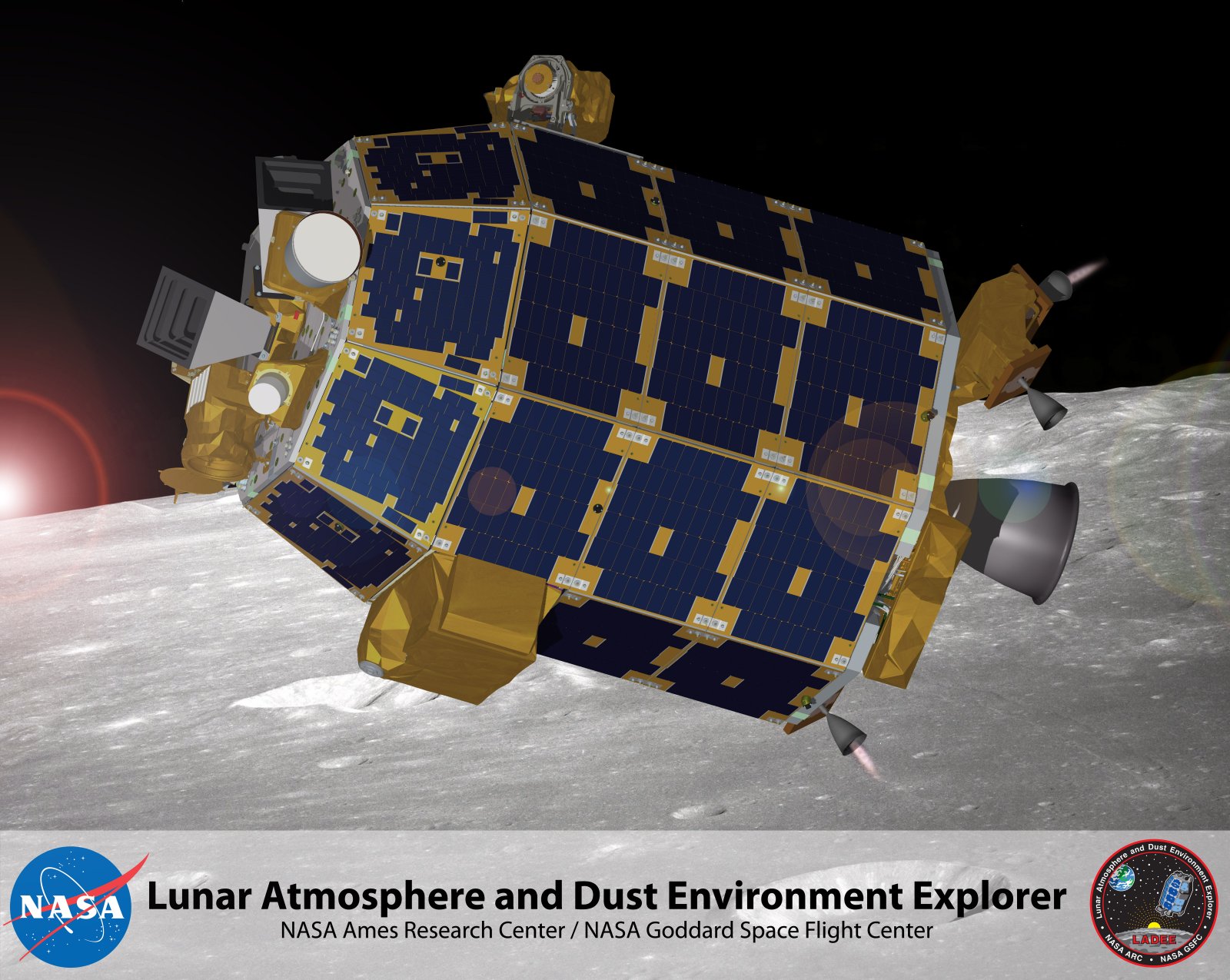
LADEE, in 250 km orbit, begins commissioning phase

LADEE, last of the Constellation precursor missions, officially entered a highly eccentric orbit around the Moon on October 6, after a month gradually increasing its orbital apogee around Earth to meet up with the Moon's gravimetric Sphere of Influence. Following critical maneuvers October 9 and 12, LADEE is now inserted into a low circular lunar orbit below 250 km to begin the Commissioning phase of its mission, still shy of a much lower Nominal mission orbital altitude below 50 km. [NASA/ARC].
Related Posts:
LADEE Away! (September 7, 2013)
LADEE legacies (September 7, 2013)
LADEE Prelaunch Mission Briefing (September 6, 2013)
ESA prepares for LADEE (July 31, 2013)
LADEE arrives at Wallops Island (June 5, 2013)
LADEE ready to baseline dusty lunar exosphere (June 5, 2013)
First laser comm system ready for launch on LADEE (March 16, 2013)
LADEE project manager update (February 6, 2013)
The Mona Lisa test for LADEE communications (January 21, 2013)
Toxicity of lunar dust (July 2, 2012)
Expectations for the LADEE LDEX (March 23, 2012)
The Dust Management Project (August 9, 2010)
LADEE architecture and mission design (July 6, 2010)
DesertRatS testing electrodynamic dust shield (July 5, 2010)
Dust transport and its importance in the origin of lunar swirls (February 21, 2010)
Dust accumulation on Apollo laser reflectors may indicate a surprisingly fast and
   more dynamic lunar exosphere
(February 16, 2010)
NASA applies low cost lessons to LADEE (January 18, 2010)
Nanotech advances in lunar dust mitigation (August 19, 2009)
Moon dust hazard influenced by Sun's elevation (April 17, 2009)
LADEE launch by Orbital from Wallops Island (April 14, 2009)
Understanding the activation and solution properties of lunar dust
for future lunar habitation
(March 2, 2009)
Respiratory toxicity of lunar highland dust (January 19, 2009)
Toxicological effects of moon dust (June 25, 2008)
Moon dust and duct tape (April 22, 2008)

Saturday, September 7, 2013

LADEE legacies

LADEE approaches lunar orbit insertion
In planning since 2008, LADEE's reason-for-being emerged from mapping science goals believed essential before any permanent manned presence on the Moon's surface could begin. Fortunately, like LRO, LCROSS and GRAIL, planning and development were well underway and within budget when Congress eventually scrubbed the Constellation brand and manned Altair lander [NASA].
Like "The Blind Men and the Elephant" the most important moving part of many riding along with LADEE to the Moon very much depends on your personal perspective.

What might seem a low-priority mission, accompanied by an appropriate degree of "hype," and has modest fundamental goals under the banner of experimental modular designs and revolutionary high speed communications, - only a 100 day science mission, LADEE has been in development for more than five years. The advanced vehicle also carries with it hopes of some that go back nine times that period, covering a lot of political ground and many changes, even over the relatively short time since its framing and approval.

Gene Cernan's Dusty Spacesuit
Gene Cernan (by Harrison Schmitt) at the close-out of the third and final EVA of Apollo 17, and the last manned visit to the Moon in December 1972. The commander's spacesuit is blackened by exceeding fine lunar dust, more than just a problem of appearances, a real hazard that might have caused hatch and spacesuit seals to fail on a longer surface mission. Constellation planners understood they needed to get a handle on mitigating the hazard posed by omnipresent dust while also gaining an better understanding of the dynamics of a primal airless Moon and its surface before humans return to stay [NASA/JSC].
Few watching the LADEE/Minotaur V launch, critical for Orbital Sciences Corporation, from Wallops Island, are likely to be reminded that the mission owes its existence to the catastrophic loss of Space Shuttle Challenger ten years ago. But it is possible to appreciate the things NASA logically wants emphasized without forgetting LADEE is the beginning of the end of the defunct Constellation program that so many wanted dead and buried in 2009.

LADEE is the last of the unmanned precursor missions once believed essential before "extended human activity" on the Moon could begin. The absolutely remarkable Lunar Reconnaissance Orbiter (LRO) will likely still be orbiting the Moon for a few years after LADEE's mission-terminating guided impact a few months from now, but none of these 21st century American unmanned lunar missions are likely to have have occurred before today without the initial political will put in motion after the report of the Challenger Accident Investigation Board (CAIB).

LRO, LCROSS, GRAIL and now LADEE each owe their reason for being to the loss of a second Space Shuttle and crew in 2003.

LADEE Slides (LEAG 2011 Lunar Exosphere Model (After Halekas))
Very simple schematic of the lunar exosphere. The Moon's surface turned out to be a very dynamic place, after all, with water and exotic metals and volatiles trapped in permanent shadow and also hiding in plain sight [Halekas/LEAG/NASA].
If you've seen the movie footage of Neil Armstrong immediately after setting that first boot on the Moon, backing away from the ladder tethered to the spacecraft then you may have guessed there once was real fear that he might just suddenly disappear in a bog of dust.

Such concern had mostly been dispelled by July 1969, though, after none of the successful unmanned Surveyor landers had encountered anything other than a hard-packed lunar surface. And yet the Moon was correctly presumed to be a very dusty place, constantly "gardened" by micrometeorites (and some not so micro) together with energetic cosmic and solar radiation. Without direct samples, however, no one correctly guessed just how "fine" the dusty powder on the lunar surface could be.

By the time Gene Cernan climbed back into the Apollo 17 lunar module in late 1972 at the end of the program another hazard from this dust had become apparent instead. Rather than sinking into feathery banks of fluffy snowbanks astronauts had to deal instead with a film of electrostatic-charged, clinging and microscopic glassy razor blades. It smelled like gun powder and got into everything, and seemed impossible to clean.

The dark dust of the Moon's immediate surface threatened hatch seals, it scared and tore into spacesuits and, following EVA close-outs became lodged in every conceivable place on an astronaut's body, including up their noses, in their lungs and also lingering in their softest places.

Clearly, "dust mitigation," by then long acknowledged as a real mission and health hazard, came forward as a priority science goal when before new lunar surface expeditions could be carried out. It is accepted as a similar threat to manned travel to Mars, and to the asteroids.

All models of what has become known as a "dynamic" rather than "static" lunar surface include production and trapping of volatile compounds once thought essentially non-existent on the Moon. The speed of this production, it's true dynamics, badly need to be studied before we can return to the Moon with impunity.

Every time an unmanned spacecraft (or a manned lunar module) has landed or taken off from the Moon it's certain some of the dust propelled away by exhaust reaches escape velocity. A larger part of this spiny cloud is put into orbit or on a ballistic path carrying these particles all over the lunar surface. LADEE is designed to establish some natural baseline for this dust before humans start stirring things up. The impact of spacecraft is comparable to the occasional larger natural impact, but hot gas exhaust and its effects is something new.

Painted On Procellarum
The delicate bright dust lanes of the Reiner Gamma "swirl albedo" phenomena, stretching at least 550 km southwest from the dormant volcanic Marius domes to the western frontier of Oceanus Procellarum. Seen here in an LROC WAC mosaic from 2010 under early morning shadows. Detailed laser altimetry confirms little to no topographic component, though it does closely correlate with a well-mapped anomalous crustal magnetic field that must be older than exposure to the Sun and space weathering would allow the surface here to remain so bright. Migration of dust, alternately charged and discharged, dislodged by micro-bombardment is alternately attracted and repelled, here, by the local magnetic field lines, keeping the new dust constantly renewed and gathered no more than a meter or so deep [NASA/GSFC/Arizona State University].
Whether or not this was really a guesstimate or hard science, by the time Congress seriously committed to return to the Moon to stay investigators had acknowledged that a kind of primal state existed there that was worth scientific study for its own sake, before human engaged in any "extended activity." And herein is the compelling interest for funding the LADEE mission. It's one way of discovering the state of the lunar exosphere, its dynamics in and out of Earth's extended magnetic field, under a traveling solar incidence, and through a good sampling of lunar days and nights before things inevitably get busy.

The hyperfast laser-based communications and modular spacecraft design for LADEE will be much talked about in reports about this mission, over the next few days and months. That's "all good," as they say, but it might be worth it to also remember the mission's origins going back before Surveyor or Apollo and also offer at least some thanks to the crew of Columbia. We owe the recent renewed short burst in lunar exploration and our added knowledge of the Moon directly to the loss of that spacecraft and crew.

Lunar Horizon Glow from Clementine (1994)
Another lunar mission (and one of only two American missions to the Moon between 1972 and 2009) was also justified as a test platform for new technologies. Now "lost and gone forever," Clementine (1994) spent a year in lunar orbit operated by both NASA and the U.S. Department of Defense. Here Clementine's star-tracking camera finally definitively photographed the "horizon glow" caught previously in the lunar night from the surface by Surveyor 7 and described by Apollo astronauts in lunar orbit twenty years before. This is the phenomena, believed to be back-lit lunar dust, that LADEE is designed to directly sample [NASA/DOD].
And whenever humans eventually return to the Moon for their inevitable extended stay, they will owe much of their preparation to that spacecraft and crew.

Related Posts:
LADEE Prelaunch Mission Briefing (September 6, 2013)
ESA prepares for LADEE (July 31, 2013)
LADEE arrives at Wallops Island (June 5, 2013)
LADEE ready to baseline dusty lunar exosphere (June 5, 2013)
First laser comm system ready for launch on LADEE (March 16, 2013)
LADEE project manager update (February 6, 2013)
The Mona Lisa test for LADEE communications (January 21, 2013)
Toxicity of lunar dust (July 2, 2012)
Expectations for the LADEE LDEX (March 23, 2012)
The Dust Management Project (August 9, 2010)
LADEE architecture and mission design (July 6, 2010)
DesertRatS testing electrodynamic dust shield (July 5, 2010)
Dust transport and its importance in the origin of lunar swirls (February 21, 2010)
Dust accumulation on Apollo laser reflectors may indicate a surprisingly fast and
more dynamic lunar exosphere
(February 16, 2010)
NASA applies low cost lessons to LADEE (January 18, 2010)
Nanotech advances in lunar dust mitigation (August 19, 2009)
Moon dust hazard influenced by Sun's elevation (April 17, 2009)
LADEE launch by Orbital from Wallops Island (April 14, 2009)
Understanding the activation and solution properties of lunar dust
for future lunar habitation
(March 2, 2009)
Respiratory toxicity of lunar highland dust (January 19, 2009)
Toxicological effects of moon dust (June 25, 2008)
Moon dust and duct tape (April 22, 2008)

Thursday, September 20, 2012

GRAIL twins uncover unexpectedly thin lunar crust

GRAIL gravity measurement schematic
Eugenie Samuel Reich
Nature

A sneak peek at the first results from a NASA mission to measure the Moon’s gravitational field hints at a lunar crust that is only half as thick as once thought.

There were a few gasps among scientists in the audience at a 13 September seminar at the Harvard-Smithsonian Center for Astrophysics in Cambridge, Massachusetts, as they took in the data revealed by Maria Zuber, principal investigator for NASA’s Gravity Recovery and Interior Laboratory (GRAIL) mission. Zuber, a planetary scientist at the Massachusetts Institute of Technology in Cambridge, showed a crisp, high-resolution gravitational map made with data collected by GRAIL’s twin spacecraft between March and June of this year.

“We are three to four times better in resolution compared to Kaguya and Lunar Prospector,” said Zuber, referring to two previous missions that mapped the Moon's gravitational field. GRAIL’s results have not yet been published or released publicly by NASA, and Zuber was not at liberty to give an interview.

Yet her talk, and the thrilled reactions from those present at the seminar and others interviewed by Nature, suggest that GRAIL is poised to have a profound effect on scientists’ understanding of the origins and early evolution of the Moon when its results are released in the coming weeks.

Read the full article HERE.

Related Posts:

Tuesday, September 11, 2012

Marshall's new-generation lunar lander flies again

Overcast skies didn't deter the "Mighty Eagle," flying high above the historic F-1 test stand, once used to test turbopumps for the Saturn booster first stage engines [NASA/MSFC/Dennis Olive].
Long under development, completing a round of flight test objectives, following up on a successful August 28 pre-programmed flight profile test, the "Mighty Eagle," NASA robotic prototype lunar lander, flew to 30.48 meters (100 feet) and descended gently to a controlled landing during a successful free flight September 5 at NASA's Marshall Space Flight Center (MSFC) in Huntsville, Alabama.

Guided by autonomous rendezvous and capture software, the vehicle located an on-ground target using an on-board camera and then flew directly to the target on its own. 

The flight of August 28 followed a pre-programmed flight profile, but the test on September 5 operated "closed loop," with the vehicle seeking and finding its target using internal software to guide its flight.

"The ‘Mighty Eagle’ had a great flight, fulfilling the objectives we had for this test -- finding and landing on its target using a closed-loop system," said Greg Chavers, test lead for the project. "Given this is one of our last tests in this series, it is a worthy finale of a lot of people’s hard work -- including our young engineers. They did a remarkable job running today’s flight."

New for this test, the "Mighty Eagle" project managers turned over the vehicle’s keys to three young Marshall engineers, Adam Lacock, flight manager; Jake Parton, test conductor; and Logan Kennedy, systems engineer.

Nicknamed the "Mighty Eagle" after one of the characters in the popular "Angry Birds" game, the vehicle is a three-legged prototype that resembles an actual flight lander design. It is 4 feet tall and 8 feet in diameter and, when fueled, weighs 700 pounds. It is a “green” vehicle, fueled by 90 percent pure hydrogen peroxide The vehicle is guided by an on-board computer that activates thrusters to power the craft’s movements.

"We’ve surpassed our expectations and flew the most challenging run to date," said Mike Hannan, a controls engineer in Marshall's Engineering Directorate. "It was an overcast, extremely humid day, and we were concerned steam might block the vehicle’s camera. We didn’t see that, and the lander sought and found its target successfully."

"It was an invaluable experience managing today’s test,” added Lacock. "This is the kind of experience young engineers, like myself, need to learn more about flight mechanics, vehicle hardware and project management. It was a good day for our team."

NASA will use the "Mighty Eagle" to mature the technology needed to develop a new generation of small, smart, versatile robotic landers capable of achieving scientific and exploration goals on the surface of the moon, asteroids or other airless bodies.

The "Mighty Eagle" was developed by the Marshall Center and Johns Hopkins University Applied Physics Laboratory in Laurel, Md., for NASA’s Planetary Sciences Division, Headquarters Science Mission Directorate. Key partners in this project include the Von Braun Center for Science and Innovation, which includes the Science Applications International Corporation, Dynetics Corp., and Teledyne Brown Engineering Inc., all of Huntsville.

Related and Background Posts:
Mighty Eagle lander 100 foot flight at Redstone (November 4, 2011)
New Robotic Lander Prototype skates tests (January 29, 2011)
NASA update; ILN Anchor Nodes and Robotic Lunar Lander Project (August 17, 2010)
The Lunar Quest Program and the International Lunar Network (September 6, 2009)

Wednesday, May 30, 2012

Alabama Lunabotics sweeps KSC competition


Tuscaloosa CBS42.com
Alabama Lunabotics, a team of students from The University of Alabama and Shelton State Community College, won the top prize in the NASA Lunabotics Mining Competition at the Kennedy Space Center in Cape Canaveral, Fla. The week-long contest included more than 50 teams from universities around the world.

On May 26, the last day of the contest, NASA officials announced Alabama Lunabotics notched the most points in the competition, winning the Joe Kosmo Award for Excellence. The team also won first place for its presentation and demonstration, first place for team spirit and second place in the mining portion of the competition.

In all, Alabama Lunabotics won $8,000 to use for next year’s competition, and NASA will pay for this year’s team and faculty adviser to participate at one of NASA’s remote research and technology tests. They also received an invitation to watch a spacecraft launch at Kennedy Space Center as guests of NASA.

The group was led by experienced students marking their second or third year on the team. In 2010, the first year NASA held the competition, Alabama Lunabotics placed sixth, and, in 2011, the team placed fourth, said Dr. Kenneth Ricks, associate professor of electrical and computer engineering and the team’s faculty adviser.

“The students on this UA team are very talented engineers with competition experience,” Ricks said. “That experience of being at the competition before is very valuable, so they knew what had to be done to be competitive.”

Excerpt from full article, HERE.

Saturday, May 19, 2012

1st International Workshop on LunarCubes

Taking the fullest advantage of the need for science, micro-electronics, materials progress and the need for lightweight payloads, CubeSat concept missions are under development everywhere. Beginning with sub-orbital and low Earth orbit missions, imaginative planners are now looking at the possibilities of CubeSats in lunar orbit.
Flexure Engineering is creating the LunarCubes Working Group and LunarCubes workshops to promote the creation of a standard to facilitate the development of low cost, rapid development payloads that could be easily added to the many Lunar opportunities in the coming decades.

Announcing the 1st International Workshop on LunarCubes:  LunarCubes : The Next Frontier, October 4-6, 2012, Mountain View, California

Call for Papers : June 1, 2012. To learn more go to : lunar-cubes.com

Friday, May 11, 2012

University of Alabama team readies for 3rd NASA Lunabotics competition at KSC, May 21-27

Early strength testing "using last year's wheels on a new base."
Alabama Lunabotics, a team of students from The University of Alabama and Shelton State Community College, will compete in the 3rd annual NASA Lunabotics Mining Competition, May 21-27, at the Kennedy Space Center in Florida.

Competing against 66 teams from all over the world, the University of Alabama team builds on past solid showings, placing fourth last year. 

Their remote-operated robot is designed to collect at least 10 kilograms of a lunar regolith simulant in 10 minutes. As Apollo astronauts learned, talcum-grained, but highly abrasive lunar dust (and NASA's proxies) presents an immediate engineering test

Contest judging will be based on their vehicle's weight, the rate and weight of material excavated, moved and redeposited, and bandwidth used in teleoperation. Teams will be judged on its engineering write-ups and less tangible qualities such as "community outreach, team spirit and the multidisciplinary level of the team."

"We decided to do a complete re-design of our robot because of the change in dimensions after last year's competition," writes the team on their website. "Our competition robot from last year is used as an educational tool. We carried several of the concepts over from last year, one of them being a sweeping wheel design."

One of the problems with driving on an extremely powdery and soft surface like the moon is gaining traction. 

Conventional steering styles dig into the driving surface while turning. Skid-steering, like a tank, is "exceptionally bad with this, especially when your vehicle has a large mass." 

Because the NASA Lunabotics competition revolves around mining and transporting, teams are guaranteed "high mass scenarios." The Alabama Lunabotics teams has chosen to operate each wheel independently, and to sweep them to turn in one spot, or move sideways, while maintaining a "positive driving style."

Alabama Lunabotics sneak-preview video spotlighting "The Base"

Project Morpheus lander - Soft Abort Test

Monday, April 30, 2012

The discarded extension of the Ranger program

Site of the guided impact of Ranger 9, March 24, 1965 (12.82°S, 357.61°E). LROC Narrow Angle Camera (NAC) observation M170579736R, LRO orbit 10272, September 13, 2012; resolution 49.6 cm, angle of incidence 16.1° from 44.64 kilometers. There are images of the impact showing more relief but this most recently released view, under a high sun, balances detail with contrast exposing more detail of the wispy ejecta albedo [NASA/GSFC/Arizona State University].
David S. F. Portree
WIRED/Beyond Apollo

In the summer and fall of 1962, NASA Headquarters planned at least 18 missions in the Ranger series. Some would have imaged the moon’s surface to certify potential Apollo landing sites, while others would have had a more purely scientific intent. On December 13, 1963, however, the total shrank to nine, with science missions taking the brunt of the cuts. Ranger itself was partly to blame; all five Rangers flown up to that time had failed, undermining confidence in the program and building support for an early switch to Lunar Orbiter and Surveyor, Ranger’s intended successor programs.

The Jet Propulsion Laboratory (JPL) in Pasadena, California, built the Rangers on contract to NASA Headquarters. The probes left Earth atop Atlas rockets with Agena B upper stages (image at top of post). Rangers 1 and 2, Block I spacecraft designed to test spacecraft systems and return data on conditions in space up to 1.1 million kilometers from Earth, weighed a little over 300 kilograms each. Both reached low-Earth orbit, where they became stranded by Agena B failures. Ranger 1 lifted off on August 23, 1961, and burned up in the atmosphere a week later. NASA launched Ranger 2 on November 18, 1961; it burned up just two days later.

Ranger - Block III - spacecraft diagram [NASA].
Rangers 3 through 5 were Block II spacecraft designed to image the moon during approach and then rough-land a balsa wood-cushioned instrument capsule bearing a battery-powered seismometer. Rangers 3 and 4 weighed about 330 kilograms; Ranger 5 was somewhat heavier (342 kilograms). Ranger 3, launched on January 26, 1962, missed the moon by 36,800 kilometers on January 28 and entered orbit around the Sun. Ranger 4, launched April 23, 1962, lost power 10 hours after launch after its twin tapering solar arrays failed to open. It became the first Ranger to touch the moon, crashing inert on the lunar Farside (the hemisphere turned always away from Earth) on April 26. Ranger 5 also suffered a power failure shortly after launch on October 18, 1962; it passed about 725 kilometers over the moon on October 21 and entered solar orbit. After the Ranger 5 failure, NASA tasked the RCA Astro Division with reworking the spacecraft’s electronics.

Block III Rangers, the next in the series, were meant to radio to Earth images of the lunar surface as they plummeted toward destructive impact. All weighed about 365 kilograms. Ranger 6, the first of the Block III Rangers, left Earth on January 30, 1964. It transmitted signals until it struck the moon’s Mare Tranquillitatis – the Sea of Tranquility – within a few kilometers of its target on February 2, 1964, but its six cameras never switched on. The failure led to an independent review board, new program management, a Congressional investigation, and calls for the program’s cancellation.

Read the full article HERE.

Saturday, April 28, 2012

Chandrayaan-II: ISRO Annual Report

Russian Luna Glob lander with ISRO rover segment of Chandrayaan-2 configuration [ISRO/IKI].
According to the just released India Space Research Organisation (ISRO) Annual Report (PDF) plans still call for India's second lunar mission Chandrayaan-2 to consist of an Orbiter and Rover integrated to a Russian lander.

In February published reports confirmed a goal for launching Chandrayaan-2 in 2013 were push back to at least 2014 (See "Chandrayaan-2 may miss 2013 launch date," February 21).

"It is an Indo-Russian collaborative mission," according to the wide-ranging Report. "The scientific objectives of the mission are to further improve our understanding of the origin and evolution of the Moon using instruments on-board an Orbiter together with in-situ analysis of samples and studies of lunar regolith by both remote and direct analysis.

"India and Russia are cooperating to realize a joint unmanned moon mission with India responsible for launch," the Orbiter and Rover and Russia responsible for the Lander. "Significant progress has been made in the past year," according to the Report, "wherein both sides discussed Orbiter-Lander-Rover configuration" and joint mission operations.

"Indian instruments on both the Chandrayaan-2 Orbiter and Rover have been finalized, and both nations are working to launch Chandrayaan-2 in 2014 using India’s GSLV booster.

Chandrayaan-2 Orbiter Craft (OC)

The Chandrayaan-2 Orbiter configuration has been changed from a 12 to 13k design after additions to the payload capacity of India's indigenous Geosynchronous Satellite Launch Vehicle (GSLV), enabled by larger propellant tanks.

The Chandrayaan-2 mission outline was revised to inject the vehicle bus into a lower initial orbit (170 X 16980 km) and higher lift-off weight of 3200 kg. Propulsion system has been adapted to increase fuel capacity.

"Other completed activities" related to Chandrayaan-2, according to the Report, were "finalization of electrical and mechanical interfaces, payload interfaces; preliminary design reviews of bus systems; power, attitude control amd telemetry electronics, tracking and command, RF and data handling systems, thermal control upgrades and propulsion."
Prototype testbed of Chandrayaan-2 lunar
rover, August 2010
[ISRO].
Chandrayaan lunar rover

The ISRO Annual Report appears confident tasks related to the development of the Chandrayaan-2 lunar rover that have been completed include configuration of Rover and instrument payload, and Preliminary Design Review of all subsystems on both the Orbiter and Rover. 

A Lunar Terrain Test Facility has been set up at the Maratahalli Campus in Bangalore, an integration and testing facility for spacecraft larger than 4 tons, where testing in micro-gravity and lunar surface simulations will soon begin..

The Chandrayaan-2 Orbiter and Russian-GK Lander Craft (LC) together with the LC and Rover interfaces were finalized this past year in three face-to-face meetings with Russian delegations, "apart from regular mail communication and teleconferences," according to the Annual Report. 

Landing site identification "has been initiated," and future workflow schedules "have been "worked out."

Monday, April 23, 2012

Astrobotics contracted for polar exploration refinements

Astrobotic "Polaris" lunar rover design and the Icebreaker expedition
Astrobotic Technology has unveiled a NASA contract to determine whether its Polaris lunar rover design can deploy an ice-prospecting payload to the Moon.

The increasing likelihood of ice on the Moon might eventually yield water, oxygen, methane and rocket propellant to dramatically reduce the cost of deep space exploration.

"Astrobotic seeks the immense resources available on the Moon to both accelerate space exploration and improve life on Earth," said Astrobotics president David Gump. "The lunar path is near term. We intend a prospecting mission in 2015."

Astrobotic began development of a lunar excavation robot in 2009 under a series of NASA Small Business Innovation Research (SBIR) contracts now total $795,000. The new NASA SBIR Phase 3 follow-on contract is designed for refinements for carrying NASA-supplied instruments and a drill to Cabeus or Shoemaker craters at high latitudes in the lunar south and other heavily shadowed places nearer the lunar north pole where hydrogen in the form of water ice appears to have been detected..

Instruments on-board India's Chandrayaan-1 orbiter and its Moon Impact Probe (MIP), and detailed surveys from NASA's Lunar Reconnaissance Orbiter (LRO) along with the LCROSS impact at Cabeus have directly detected water, hydroxyl compounds, methane, ammonia, carbon monoxide, hydrogen sulfide and other volatiles. These resources went undiscovered during the Apollo expeditions which were concentrated near the Moon's equator.

An important next step is to discover the "ground truth" by directly drilling and measuring these ressources directly to see if they are sufficiently concentrated to be useful.

Propellants and other materials manufactured in place on the Moon could enable spacecraft for long voyages at greatly reduced costs or used for vehicles dispatched to Earth orbit more cheaply than the high cost of launching spacecraft and fuel out of Earth's gravity well. Water and oxygen would also be invaluable for life support, and other elements have immense value for energy, processes, fabrication and extended habitation.

When seeking resources from planetary destinations, the four-day travel time to reach the Moon enables early return on investment compared to more distant targets.

Astrobotic has reserved a SpaceX Falcon 9 booster to send its spacecraft and robotic explorer to the Moon. The Astrobotic payload will deliver a prospecting robot to the lunar surface with technology that autonomously avoids hazards such as boulders and craters. This navigation system was derived from technology developed at Carnegie Mellon University under the direction of Dr. William "Red" Whittaker, Astrobotic's founder. 

Dr. Whittaker won the DARPA Urban Challenge with a driverless car able to autonomously navigate city streets, avoiding other cars while obeying California traffic laws. The ability to detect hazards and automatically select alternative pathways is the core of Astrobotic's automatic lunar landing system.

Astrobotic has totaled $12 million in nine NASA lunar contracts covering issues from simulating lunar gravity on Earth to discovering ways to robotically explore the Moon's ravines and pits. Natural caverns on the Moon should provide vital shelter for both unmanned vehicles and human explorers, from ionizing radiation, a near constant infall of micrometeorites and the extreme temperature swings experienced directly on the lunar surface.

Monday, April 9, 2012

Morpheus Tether Test #10


The Morpheus team successfully flew tether test #10 on Thursday, April 5. The engine fired for 62 seconds, and was this was an overall successful firing.

Thursday, April 5, 2012

Space Exploration: A Job for Humans

Admiral Alan B. Shepard, Jr. (1923-1998),  U.S. Navy aviator by profession and cattle farmer by avocation, a few weeks shy of 10 years after becoming the first American in Space. On the afternoon of January 31, 1971 he suits up for only his second space flight, as commander of Apollo 14 and destined to become only the fifth person to explore the surface of the Moon [NASA].
Jared Keller
Atlantic

The conventional wisdom of space exploration suggests that robotic probes are both more scientifically efficient and cost effective. Not so, argues a professor of planetary science.

When the Space Shuttle Atlantis rolled to a stop in July 2011, NASA bid farewell to the nation's symbol of manned spaceflight. The Obama administration has scrapped NASA's plan to return humans to the Moon by 2020, which was behind schedule because of technical and budgetary problems. As financial constraints threaten the possibility of future ventures into outer space, many in the astronomical community are advocating for the increased use of unmanned robotic space, arguing that they will serve as more efficient explorers of planetary surfaces than astronauts. The next giant leap, then, will be taken with robotic feet.

Dr. Ian A. Crawford thinks it should be otherwise. A professor of planetary sciences at Birkbeck College, London, Crawford makes the case for human space exploration in a new paper entitled Dispelling the myth of robotic efficiency: why human space exploration will tell us more about the Solar System than will robotic exploration alone, published recently in the journal Astronomy and Geophysics. If the goal of space travel is to expand our knowledge of the universe, argues Dr. Crawford, exploration will be most effective when carried out by astronauts rather than robots on the surface of a planet.

Read the feature article HERE.

Friday, March 23, 2012

Expectations for the LADEE LDEX

The 'Dust, Atmosphere, and Plasma: Moon and Small Bodies' (DAP-2012) meeting will take place in Boulder, June 6-8, 2012. Please visit our webpages http://ldap2012.colorado.edu/  to register and submit an abstract by 3/30/2012, if you plan to attend.

We are looking forward to see you in Boulder!

- Alan Stern and Mihaly Horanyi
A lasting lesson from Apollo. The lunar exosphere gets into everything, fine as talcum, abrasive as broken glass, and a significant cumulative threat to seals and any and all working parts generally, whether biological and mechanical. Beyond its demonstrated mission threat the Moon's dusty environment is a delicate, "pristine" and important  part of a 4.5 billion year history of space weather near Earth. Apollo 17 lunar module pilot and geologist Harrison H. "Jack" Schmitt moves forward with the patina of 22 hours activity on the lunar surface clinging to his suit. AS17-145-22157 [NASA/JSC/ALSJ].
The Moon's sodium tail,
Potter and Morgan (1998).
The Lunar Dust Environment:
Expectations for the LADEE
Lunar Dust Experiment (LDEX)

Mihaly Horanyi, Sternovsky & Shul
with Colette, Grün, Kempf, Srama & Mocker
43rd Lunar and Planetary Science Conference, #2635

Introduction: The lunar dust environment is expected to be dominated by submicron-sized dust particles released from the Moon due to the continual bombardment by micrometeoroids, and due to plasma-induced near-surface intense electric fields. The Lunar Dust EXperiment (LDEX) is designed to map the spatial and temporal variability of the dust size and density distributions in the lunar environment on-board the upcoming Lunar Atmosphere and Dust Environment Explorer (LADEE) mission

LDEX is an impact detector, capable of measuring the mass of submicron sized dust grains. LDEX will also measure the collective signal of dust grains below the detection threshold for single dust impacts; hence it can search for the putative population of grains with r ~ 0.1 μm lofted over the terminator regions by plasma effects.

LDEX has been developed at the Laboratory for Atmospheric and Space Physics and Colorado Center for Lunar Dust and Atmospheric Studies (LASP/CCLDAS, University of Colorado at Boulder) and has a high degree of heritage based on similar instruments on the HEOS 2, Ulysses, Galileo, and Cassini missions. The LDEX flight model will be tested and calibrated at both the (Max-Planck-Institute for Nuclear Physics, Heidelberg, Germany) and Boulder dust accelerator facilities.

At the Lunar and Planetary Science Conference, March 21, 2012, Dr. Horányi summarized expected capabilities of LDEX and made predictions for its measurements in lunar orbit, based on current theoretical models. The authors also discussed a proposed LDEXPLUS instrument being developed for a possible LADEE follow-up mission to add the instrument's design capability for in-situ chemical analysis of impacting dust particles, perhaps to verify "the existence of water ice on the lunar surface and map the density of valuable resources of commercial interest".

Figure 1. LDEX EM and FM units and the schematic drawings of the instrument.
The LDEX instrument: The two expected sources of dust in the lunar environment are ejecta production due to continual bombardment by interplanetary meteoroids and lofting due to plasma effects. LDEX is an impact ionization dust detector with a sensor area of ~0.01 m\2. LDEX is a low risk, compact instrument and uses no flight software (Figure 1). In addition to individual dust impacts of grains with radii r > 0.3 μm, LDEX can identify a large population of smaller grains (0.1 < r < 0.3 μm) by measuring their collective signal.The expected impact rates, and the signature of lofted small grains expected over the terminators are shown in Figure 2.

Figure 2. Expected impact rates on a 30x100 km orbit with its pericenter over the morning terminator.

Initial test and calibration of the LDEX FM model were done at the CCLDAS dust accelerator facility. Full calibrations are planned in early 2012 at both the Heidelberg and the Boulder facilities. Figure 3 shows the preliminary test results, indicating that LDEX will meet or exceed its measurement requirements.

Figure 3. Initial test results for the LDEX FM instrument showing the detected particle mass versus their velocity. At the expected impact speed of 1.6 km/s,

LDEX will detect particles with radii r > 0.4 μm. The ratio of detected and undetected particles matches the expected value due to the duty cycle of the electronics and the transparency of the screens that provide shielding and exclude the solar wind electrons from entering LDEX.

The LDEX-PLUS instrument extends the LDEX capabilities to also measure the chemical composition of the impacting particles with a mass resolution of M/ΔM > 30. Traditional methods to analyze surfaces of airless planetary objects from an orbiter are IR and gamma-ray spectroscopy, and neutron backscatter measurements. A complementary method is to analyze dust particles as samples of planetary objects from which they were released. The source region of each analyzed grain can be determined with accuracy at the surface that is approximately the altitude of the orbit.

This ‘dust spectrometer’ approach provides key chemical constraints for varying provinces on the lunar surfaces. LDEX-PLUS is of particular interest to verify from orbit the presence of water ice in the permanently shadowed lunar craters. LDEX-PLUS combines the impact detection capabilities of LDEX with a linear time-of-flight system, similar to the Cassini Cosmic Dust Analyzer (CDA) instrument. Figure 4 shows an example time-of-flight mass spectrum of an ice-bearing dust grain.

Figure 4. Spectrum of a water ice particle obtained at ~ 4 km/s impact speed by the Cassini CDA instrument in Saturn's E ring. The dominant peaks are mass lines of water cluster ions (H2O)nH+, generated upon impact of an ice-bearing particle.
Schematic of documented species of horizon glow, such as the famous mid-lunar night imagery captured by Surveyor 7 in 1968.

Conclusions. LDEX, on-board LADEE, is scheduled to launch in May 2013 and will be capable of mapping the density distributions of both the large ejecta particles and the collective signal of small lofted grains. LDEX-PLUS, on-board a follow-up lunar mission, can collect a large number of samples from a greater part of the entire surface for analysis.

The instrument is especially sensitive to the metallic compounds of minerals and any species which easily form ions (e.g. water). The accuracy of the trajectory back-tracing to the surface is comparable to the altitude of the satellite. This in-situ method allows compositional surface mapping of the Moon. Since the dust spectrometer is particularly sensitive to refractory compounds which are difficult to access by other methods it is also complementary to remote sensing spectroscopy and an ion or neutral mass spectrometer. A ram pointing dust spectrometer and a nadir pointing remote sensing instrument collect data from approximately the same spot on the surface of the Moon, hence the combination of these measurements greatly enhances our ability to map the chemical composition of the surface and identify water-bearing regions.

An LDEX-PLUS type instrument can also address many of the science goals of a Europa Jupiter System Mission (EJSM) regarding the surface chemistry of icy satellites. See original Conference abstract, HERE, for citations.
Lunar Horizon Glow (LHC) as televised (vidicon photography) in local night, early 1968 [NASA].

Sunday, January 1, 2012

GRAIL-A arrives in lunar orbit

GRAIL-A arrived successfully in lunar orbit, New Years Eve. GRAIL-B is thirty hours behind, scheduled to arrive for the tandem high-precision lunar gravity mapping mission on the first day of 2012, when the United States will have five spacecraft in orbit around the Moon for the first time [NASA].
Read the full story HERE.

Saturday, December 3, 2011

"Boy, that sure looks like Luna 9!"

Fig. 1  Idealized Google Earth icon of Luna 9, the first soft-landing on the Moon (the first soft-landing anywhere other than Earth), February 3, 1966. The cartoon Russian spacecraft is pinpointed more than 30 kilometers northeast (8.0°N, 296.0°E) of an 'official' landing site (7.08°N, 295.63°E) because investigators say the 'official' coordinates place the lander well beyond the eastern rise, at left on the horizon above. That location doesn't appear to match the landscape seen in the panoramas returned to Earth. The object identified as a likely candidate, at 7.153°N, 295.630°, is less than 2.8 km north of the official coordinates, but at a notably higher elevation on that same rize, perhaps where fewer obstructions are to be found on the local horizon [NASA/USGS/JAXA/Google].
Joel Raupe
Lunar Pioneer

The problems encountered by the Russian Federation after the launch of Fobos-Grunt on November 9, when compared with the apparent ease NASA is experiencing, thus far, in getting Curiosity through the present Martian launch window, might tempt fools to dismiss Russia's interplanetary skill. Russian morale might be threatened but we're reminded yet again that Space is relentlessly intolerant of cutting corners or under-funding. The Great Galactic Ghoul, that cosmic gremlin supposedly spoiling to ruin Mars and Moon missions alike, spends most of its time here on Earth.

Off-planet, when Institutional Memory is applied efficiently, the Russians are a match for anyone.

Friday, December 2 is the 40th Anniversary of the first soft-landing on Mars, and Russia's Mars 3 lander was successful, though the lander operated on the surface only 20 seconds, back in 1971. Saturday, December 3 is the 12th Anniversary of the loss of America's Mars Polar Lander in 1999. Thus, the success of Curiosity is by no means a sure thing. When space exploration begins to look too easy disaster waits patiently at the door.

A planned Russian return to the lunar
surface may ultimately benefit from a post-
Fobos-Grunt shakeout
[RussianSpaceWeb].
The first vehicle soft-landed on the Moon (and the last one landed there, a decade later) were strictly Made in Russia. Embarrassing and often tragic, spectacular failure also often fuels political will, without which governments accomplish nothing.  After a latter-day purge of Russia's unmanned mission contractor NPO Lavochkin, the legacy of Fobos-Grunt may help guarantee eventual success for Luna-Grunt and the other lunar missions Russia has in the works.

If all goes well, beginning next month, the United States will support five spacecraft exploring the Moon simultaneously, the most prominent among them the record-smashing LRO. Following decades of a near total neglect of its hard-won and expensive lunar legacy, America owes a revival of interest in Earth's Moon directly to the loss of Columbia in 2003.

An early priority for LRO was a survey of human artifacts on the Moon. Delivering spectacularly on that assignment were Mark Robinson, principle investigator for the Lunar Reconnaissance Orbiter Camera (LROC), together with his team at Arizona State University. Their most newsworthy success, quite naturally, were many high resolution history-making photographs of the relics and footprints from the Apollo program.

Fig. 2  Planitia Descentus - Latin for Plain of Descent, a human distinction for an otherwise indistinct borderland along the western edge of Oceanus Procellarum, where Luna 9 came to a tilted stop February 3, 1966.  The yellow dot on the rise at center bottom on both maps makes the location of an object that could be Luna 9. These comparative maps of the same 14,300 square kilometer area (centered near 8.48°N, 64.47°W) are (top) LROC WAC DTM  juxtaposed with (bottom) LROC WAC mosaic, each from LROC/ASU QuickMap (250 m/pp resolution). [NASA/GSFC/Arizona State University].
A steady stream of LROC Narrow Angle Camera (NAC) views were released during the LRO Nominal Mission revisiting the remains of a host of U.S. and Soviet spacecraft, both impact craters and the intact sentinel spacecraft themselves following hundreds of lunar days and nights. Each of these Featured Images released by LROC has fired the imagination while calibrating and confirming some very old, often incomplete sets of data.

Finding Lunokhod 1 (38.316°N, 324.996°E), for example, was an overdue accomplishment. It was the first robotic rover on another world, equipped with a laser range reflector that had eluded detection for decades. Its addition to the passive network of reflectors set up by Apollo 11, 14 and 15, together with its French-built twin on Lunokhod 2 allowed the measuring of the Earth-Moon distance to within 3 mm, the missing tolerance needed to test whether a range of physical laws were exclusive to our neighborhood in the universe.

A compendium of LRO's definitive findings, LROC Coordinates of Robotic Spacecraft, put together by Samuel Lawrence at ASU, was released April 5, 2010.

Though the list has not been updated since, it's still spectacular. For the first time, for example, anyone with an Internet connection can see precisely what happened when the third stage of the Saturn V that pushed Apollo 13 around the Moon impacted with the lunar surface. And planetary scientists have a precise date on a fresh impact crater on the Moon, as well; a standard useful for dating optical maturity and space weathering. We no longer have to imagine if the footprints are still there and decades of doubters can precisely see for themselves how the astronaut's surface photography matches the landscapes as seen only 45 (and more recently 25) kilometers away.

Still, the table put together by Lawrence can't yet be comprehensive.

A search for the place where Luna 2 became the first man-made object to impact another world in 1959, for example, is fraught with uncertainty. Those official coordinates are necessarily wide of mark, if only because the precise location of the Moon itself, and its surface, would never again be less well understood than before the Russian measured the time of impact for Luna 2.

A search for Luna 2 using those rounded-off coordinates brings the investigator west of Autolycus, to a 22 square kilometer area where there are at least two, perhaps three, fresh craters with the proper wispy signatures. One of them shows signs of a unique debris field, perhaps dotted with a cluster of the impact-resistant Soviet flag-engraved metal balls reportedly loaded on Luna-2. A surface expedition will be needed, in other words. As amazing as it is, however, even the LROC Narrow Angle Cameras have their limits.

At the very edge of those limits is Luna 9, the 99 kg.lander the Soviets succeeded in soft-landing on the Moon on February 3, 1966. In Multiple NAC footprints covering the target area uploaded to the Planetary Data System, even by April 2010, it was easy to see the LROC team had already earnestly tried to find that historic relic. But Luna 9 wasn't on the list put together by Lawrence.

Fig. 3  A closer look at the Plain of Descent.  The rectangle matches a 2.5 km-wide cross-section of LROC NAC observation M137970706R, the area seen in Figure 6a, below. The small white dot marks a spot less than a kilometer south of the rectangle, the official Luna 9 landing site, and the white dot inside the rectangle marks the location of an "object of interest," something that seems to be a Luna 9, in the two NAC observations detailed below.  The 'mid-morning' view above is a 41-km-wide field of view taken from LROC Wide Angle Camera (WAC) observation M160376850C (604 nm), LRO orbit 8769, May 18, 2011; incidence angle 55.42° with a resolution of 57.55 meters per pixel, from an altitude of 40.49 km [NASA/GSFC/Arizona State University].

As noted expert on lunar artifacts Phil Stooke of the University of Western Ontario put it, finding the very first vehicle soft-landed on the Moon was "problematic," even with the proven sensitivity of the twin LROC Narrow Angle Cameras. 

There is lingering dispute about the true landing site, though the central difficulty in finding Luna 9 is probably the small spacecraft's low profile. Its instrument housing is barely at the half-meter limit to the LROC NAC Nominal Mission resolution. And, because discussing Luna 9 without seeing its mission in the context of the Cold War would be incomplete, a brief comparison with Surveyor, its very real competition, is necessary.

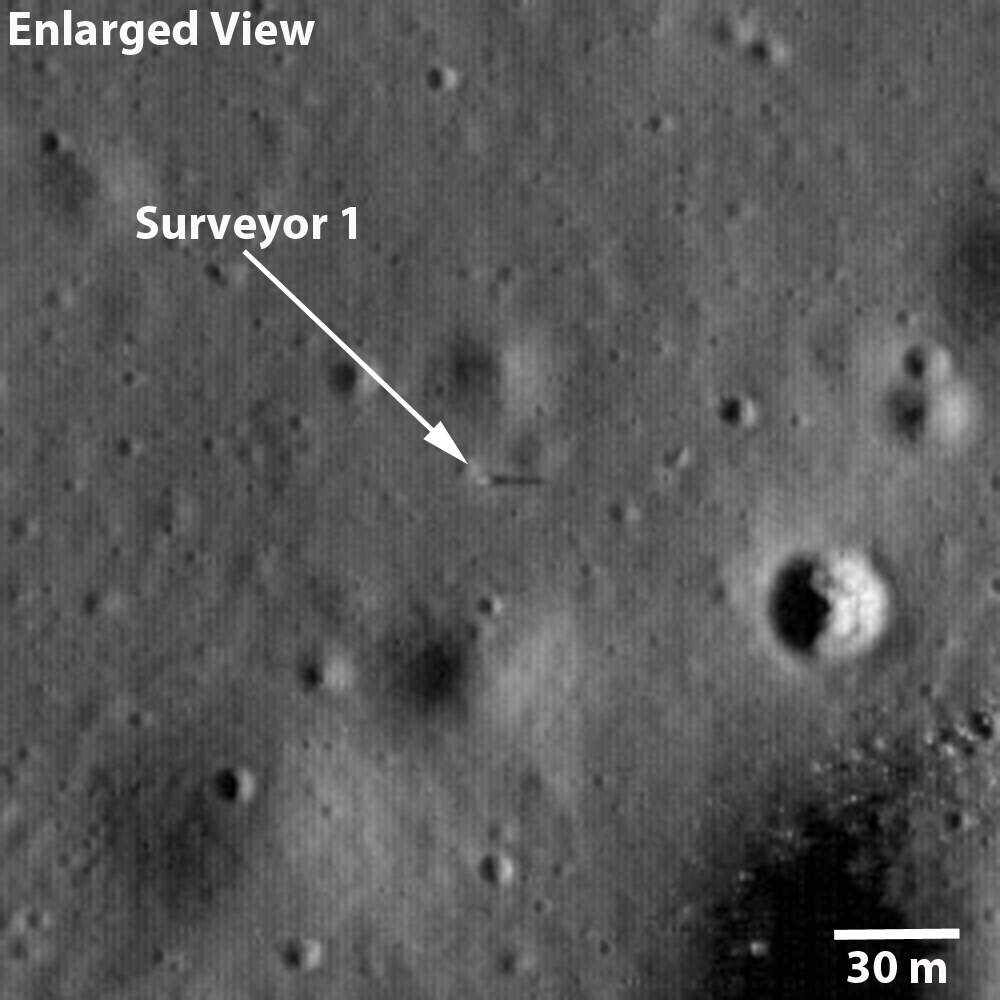
The Russians beat Americans to the Moon in 1966 by only five months. Samuel Lawrence had already written up and released LROC's first views of "Surveyor 1 - America's first soft lunar landing," on September 30, 2009. That observation (M102443995L) swept up the first U.S. lander very early in LRO's Commissioning phase, in orbit 272, when LRO was still flying at twice its Nominal mission altitude, from 102.4 km overhead. That survey of the floor of Flamsteed P was photographed at less than half of the planned LROC NAC resolution; at 1.08 meters per pixel, the Surveyor 1 tripod in profile was barely visible, identifiable mainly in its long shadow at local sunset.The Surveyor design featured a central mast with square solar panels at the top, standing high like a flag. That aided in identifying all five of the successful Surveyor landers, right they sat. 


Unlike its Google Earth icon, seen in Fig. 1, Luna 9 was not standing like an egg, balanced on one hemisphere. After its landing and activation Luna 9 was at tilted, and from slight changes in the background seen in its five photographic panoramas we can tell Luna 9 shifted slightly after deployment.

Fig. 4  Simulated oblique view west by northwest over the area of interest from a point 28 km over the western Oceanus Procellarum. After years of deconstructing the five panoramas captured and returned to Earth by Luna 9, many reliable experts have come to doubt the accuracy of the official landing site (coordinates on the left, at "-1310 m" elevation).  Some believe Luna 9 must have landed somewhere in the plain to the north (on the right, marked "-1640 m").  If the object detailed in Figures 5 and 6 below is Luna 9 then the lander came to rest at a point less than three kilometers and almost due north of the official coordinates ("-1170 m"), and at least 140 meters higher in elevation.  After studying the LROC WAC Digital Terrain Model of the area (Fig. 2) the hills, contiguous with other features surrounding the Plain of Descent, appear to be the highly degraded rim of an ancient, mostly buried crater.  -Image created using ILIADS application, developed by NASA's LMMP project; photography from LROC WAC Global Mosaic with elevations from LOLA altimetry (v.2). [NASA/GSFC/ARC/LMMP/ASU].
The low profile and squat, efficient design of Luna 9 have made it difficult to definitively locate, either somewhere in the expansive plain to the north or near the official position somewhere on a 500 meter high hill, nor on their slopes. All of the area was extensively photographed from LRO, from high altitudes and low, under high Sun and low Sun, with LRO rolled and looking down from directly overhead. If the little vehicle has been captured (which seems certain) what would distinguish its egg shape from thousands of boulders more or less the same size?

It's a safe bet Samuel Lawrence and others on the LROC team encountered this difficulty head-on, with the determination and resourcefulness of a Cold War photo-analyst pouring over U2 photographs of Cuban missile sites. 

In fact, it would be the height of presumption on our part to claim to have done anything more than retraced their steps. It's impossible to believe a candidate object we stumbled on, within their choices of photographic session, hasn't already been considered or scratched off the list. Were it not for something that may turn out to be simply an artifact of digital compression we wouldn't take another look.

Let's just say, "boy, that sure looks like Luna 9!"

What follows are two sets of images, selected from two separate LROC NAC observations, focused on an "object of interest" at sunrise (Figures 5a and 5b), when the Sun was less than 5 degrees over the east horizon, when long shadows allow for depth perception, and then (in Figures 6a - 6d) where, at less than 8° north of the equator, the Sun was high overhead and depth perception gives way to a search for subtle variations in brightness or optical maturity.


Fig. 5a   The full 2.5 kilometer-wide field from LROC NAC M132071202L orbit 4597, June 25, 2010; with resolution greatly reduced from the original 0.48 meter per pixel resolution captured from 40.49 km altitude, incidence angle 85.57°. The yellow rectangle is the area shown at full resolution in Fig. 5b, immediately below. The yellow dot is our "object of interest," so to speak, indicated with an arrow in at full resolution below. The object certainly casts a shadow, as anything with a profile would when caught in naked morning sunshine on the Moon. It is also seemingly brighter than other similarly sized objects in the roughly 238 meter-wide field of view seen below.  [NASA/GSFC/Arizona State University].
Fig. 5b  Full resolution, and very non-definitive rendition of the Object of Interest, again, from LROC NAC M132071202L The object appears to be situated within the west slope of a 10 meter crater, whose interior is very darkened with shadow. Since Luna 9 arrived on the Moon not long after local sunrise, this doesn't help identify the object as Luna 9. The larger, similarly bright object to the southwest is too large to be Luna 9, but its size and location relative to the object of interest makes a case for it being part of the larger lander bus [NASA/GSFC/Arizona State University].
On the 500 meter hills, south of "the plain of descent," under an afternoon Sun:

Fig. 6a  Backing away once again, shifting perspective slightly to the west, with the Sun nearly overhead, this is the field of view within the rectangle back in Fig 3, and slightly west, overlapping the area in Fig. 5a, another 2.5 km-wide area taken this time from LROC NAC M137970706R, orbit 5466, September 1, 2010, from 45.57 km in altitude (incidence angle 29.64°). The area in the white rectangle is the field of view enlarged in Fig. 6b, immediately below [NASA/GSFC/Arizona Sate University].
Fig. 6b  At 40 percent of their original resolution, line 14775 to 15556 by sample 3964 - 4544 from M137970706R. (The dim dark line is an artifact "junction" between line 15000 and 15001). And, like a Russian Doll, the square box above is the roughly 290 meter-wide field of view seen at 100 percent of the original observation's 0.5 meter per pixel resolution seen in Fig. 6c, immediately below [NASA/GSFC/Arizona State University].
Fig. 6c At full resolution, lines 15001 - 15580 by sample 3964 - 4543 from LROC NAC M137970706R. Compare this with Fig. 5b, above and, once again, what is seen under differing lighting conditions on the Moon is clear. When happening upon this candidate object under a high Sun, something catches the eye [NASA/GSFC/Arizona State University].
Fig. 6d  Taking  LROC NAC M137970706R  well beyond its true limit of resolution we stumble upon what might be Luna 9, resting on the west interior slope of a shallow 10 meter crater, perhaps even afterwards sliding slightly between photographic panoramas, February 3, 1966. Under an early afternoon Sun, after being enlarged 400 percent with a super-sampling algorithm, what appear faintly as three of the spacecraft's four instrument-shielding petals (the fourth presumably in its shadow) somehow popped out from the background. No intentional fudging was done to the original brute-force enlargement (See Fig. 7) [NASA/GSFC/Arizona State University].
Fig. 7 A simple enlargement to 400 percent of the half-meter per pixel resolution native to LROC NAC observation M137970706R turned up this object, certainly an oddity if it is not Luna 9. As demonstrated in the hackneyed animated image (Fig. 6d), the object meets the profile, is barely less than 3 kilometers due north of its official landing site, about 140 meters higher in elevation, on a broader slope with presumably less obstructed horizon.

Fig. 8 The view south from Luna 9, February 3, 1966.


Using the popular open-source program Orbital Simulator, "reseferina1" created this interesting simulation of the Luna 9 mission in 1966. Though fun, it too, unfortunately, made the thing look far too easy. The originating YouTube page is HERE.