Showing posts with label Universe Today. Show all posts

Saturday, November 2, 2013

Sunday's hybrid solar eclipse, across Atlantic and Africa

Jeff Aguilar, eclipse, November 2009
The eclipsed sun appeared like a fat, flaming sickle as it set behind a large cargo ship in this portrait obtained by Jett Aguilar from Manila Bay, Philippines, January 26, 2009. Early risers on the American eastern seaboard, on their first full day following an annual return to standard time (UT - 5 hours), will have an opportunity to observe the beginning of a hybrid solar eclipse beginning at sunrise Sunday morning.[Jeff Aguilar/SPACE.com].
On Sunday, November 3 early risers on North America's eastern seaboard will be treated to the beginning of a spectacular sunrise eclipse.

An unusual "hybrid" solar eclipse, combining aspects of both an annual and total eclipse, the Moon's diffuse penumbral shadow first encounters Earth surface at 10:04:34 UT (5:04 am EST) when the Moon will 372,934 km away and closing in distance at a relative speed of less than a kilometer per second. The tip of the Moon's cone-like umbra will reach Earth's surface less than an hour later south of Bermuda.

Though the event will be visible across a much wider area, The Path of Central Eclipse will track east and peak southeast of Liberia two hours later, finally making landfall on the African mainland near the equator, bisecting the continent nearly to Somalia at early evening.

Schematic of Solar Eclipse November 3, 2013
Schematic of the Hybrid Solar Eclipse, Sunday, November 3, 2013, by Fred Espenak of NASA's Goddard Space Flight Center.
"The final (eclipse) of 2013 is the most interesting eclipse of the year," writes Fred Espenak of NASA's Goddard Space Flight Center in Greenbelt, Maryland. "It is one of the rare hybrid, both an annular and total eclipse, where some sections of the path are annular while others are total. The duality comes about when the vertex of the Moon's umbral shadow pierces Earth's surface in predictable areas but falls just shy of the surface elsewhere, leaving a ring, or annulus, of the Sun's disk still visible on that path."

Espenak's authoritative prediction of eclipse details can be read HERE. The last solar eclipse widely visible in the U.S. was an annular eclipse, May 20, 2012. The next partial solar eclipse won't be seen in the United States until October 23, 2014.

And eager preparations are already underway for a spectacular total solar eclipse, visible across all the continental United States, with totality peaking at 2 minutes, 40 seconds on in a pathway of totality 115 km wide in western Kentucky, August 21, 2017.

Important safety precautions for viewing even a brief partial eclipse of the Sun are discussed in an article by Imelda Joson and Edwin Aguirre at Space.com.

Similar important precautions, a diagram showing predicted eclipse percentages at locations in eastern North America and tips for viewing the event online have been written up by David Dickinson at Universe Today.

Saturday, May 11, 2013

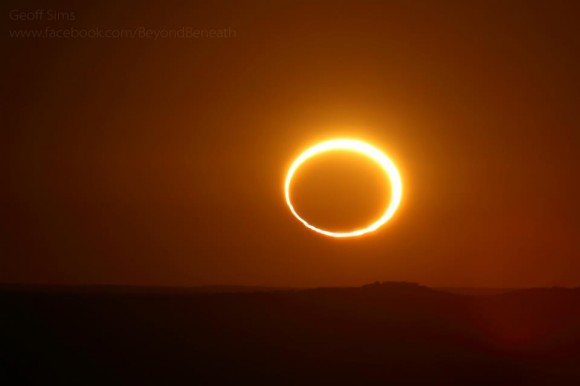
"An Awesome Annular Eclipse!"

A rising annular eclipse as witnessed by Geoff Sims (@Beyond_Beneath) from the Plutonic Gold Mine in Western Australia [Geoff Sims/Universe Today].

Images and Videos from Earth and Space

David Dickinson
Universe Today

A spectacular annular eclipse of the Sun was witnessed across Australia and the southern Pacific region early today. Morning dawned mostly clear across the Australian continent, and those who journeyed out to meet the antumbra of the Moon as the Sun rose across the Great Sandy Desert and the Cape York Peninsula were not disappointed. The rest of us watched worldwide on as Slooh and a scattering of other ad-hoc broadcasts delivered the celestial event to us via the web.

This was a challenging one. Although partial phases of the eclipse was visible across the entirety of Australia, Hawaii, and as far north as the Philippines and as far south as New Zealand, the track of annularity passed over some very remote locales. Stable Internet connections were scarce, and many photos and videos are still trickling in as die-hard eclipse chasers return “from the Bush.”

Read the full article, HERE.

Sunday, February 3, 2013

'There's poop on the Moon'


Jason Major
Universe Today

When the Apollo boys visited the Moon back in the ’60s and ’70s they left more than just some experiments, rovers, and family portraits behind –- they also left, shall we say, a little bit of themselves on the lunar surface. It makes total sense when you think about it, but still… there’s poop on the Moon.

Read the article, HERE.

Thursday, January 31, 2013

Watch a Magical Moonrise


Nancy Atkinson
Universe Today

This is absolutely lovely. Photographer Mark Gee says this incredible real-time video “is as it came off the memory card and there has been no manipulation whatsoever.” It shows the full Moon rising over the Mount Victoria Lookout in Wellington, New Zealand. 

Read more HERE.

Tuesday, January 22, 2013

Conjunction of Jupiter and the Moon

The Moon could be seen literally sliding under the Moon until moonset on the eastern seaboard of the U.S., Tuesday morning, January 22. 'jimnista,' contributor to the Universe Today photostream on flickr added the image above, a combination of two images to compensate for over exposure. It was the closest line of sight conjunction before 2026.

Friday, November 30, 2012

Solar eclipse from 37 kilometers up


Jason Major
Universe Today

"By launching a weather balloon carrying a wide-angle camera into the stratosphere above Queensland, eclipse hunter and amateur astronomer Catalin Beldea and her team were able to obtain their incredible video of the November 14 total eclipse from high enough up that the shadow of the Moon was visible striking Earth’s atmosphere. Totality only lasted a couple of minutes so good timing was essential… but they got the shot. Very impressive!"

Read Jason's article, "In the Shadow of the Moon," at Universe Today, HERE.

The video was organized with and for Romania’s Stiinta&Tehnica.com by editor-in-chief Marc Ulieriu and assembled by Daniel Toma. Music by Shamil Elvenheim.

Thursday, February 9, 2012

Answering the riddle of Giordano Bruno

Relatively "fresh" Giordano Bruno (35.97°N, 102.86°E) and it's bright ejecta rays at local mid-day as seen through the HDTV camera on-board Japan's lunar orbiter SELENE-1 (Kaguya) in 2009. View the still frame as released, HERE [JAXA/NHK/SELENE].
Irene Antonenko
Universe Today

The Moon is covered with craters of various shapes and sizes, and in various states of preservation. Scientists have studied these spectacular features for over five decades, yet there are still many things about craters that we just don’t understand. The study of craters is important because we use them to determine the ages of planetary surfaces. Now, very high resolution imagery from the Lunar Reconnaissance Orbiter Camera (LROC) is allowing us to see lunar craters as never before. Under such scrutiny, one very fresh crater is revealing a host of secrets about the crater-forming process and revealing that it’s not as young as some people may have originally thought.

The crater in question is Giordano Bruno, a 22 km diameter crater located on the far side of the Moon, just beyond the eastern limb. Like all craters on the Moon, this one was named after a famous scientist, in this case, a sixteenth century Italian philosopher who was burned at the stake in 1600 for proposing the existence of “countless Earths.” Because of its position on the far side, Giordano Bruno crater was not seen by humans until it was photographed by the Soviet Luna-3 mission in 1959. But then, this crater was immediately recognized as one of significance, because of its very bright and extensive ray system.

Read the full UT feature story HERE.

Giordano Bruno has offered up to researchers a lifetime of detail about the morphology of lunar craters, not yet "gardened" away by space weathering, in both very narrow and wide angle imagery collected by the Lunar Reconnaissance Orbiter (LRO). This monochrome (604 nm) montage was stitched together from LROC WAC observations collected during four sequential orbital flyovers February 23, 2010 [NASA/GSFC/Arizona State University].
Related Posts:
Moon in UV sheds light on maturation and materials (October 12, 2011)
Fragmented Impact Melt (February 11, 2011)

Monday, September 19, 2011

A mission to find the missing lunar module


Tom Stafford and Gene Cernan in the Apollo 10 lunar module "Snoopy" prepare to dock with John Young, who snapped this picture on May 23, 1969. Away only eight hours Stafford and Cernan put the LM into a transfer orbit and descended to 14.4 km above the lunar surface before dropping the landing stage and firing the critical ascent stage six subsequent missions would depend upon to return them to ferry them back the Command Module and eventually to Earth. It was only the second time humans had visited the Moon's vicinity less than two months before Apollo 11. When later Jettisoned, the LM ascent stage engine was ignited remotely, on a trajectory placing the vehicle in orbit around the Sun, where it is presumed to remain to the present day. "Snoopy" is the only intact LM ascent stage remaining of the ten full Apollo lunar landers eventually launched into space [NASA/JSC].

Adrian West
Universe Today

Where is the Apollo 10 Lunar capsule? It’s somewhere out there — orbiting the Sun — and there’s a new initiative to try and find it!

The Apollo 10 mission launched on May 18, 1968 and was a manned “dry run” for its successor Apollo 11, testing all of the procedures and components of a Moon landing without actually landing on the Moon itself.

After carrying out a successful lunar orbit and docking procedure, the Lunar Module (called “Snoopy”) was jettisoned and sent into an orbit around the Sun.

After 42 years, it’s believed to still be in a heliocentric orbit and a team of UK and international astronomers working with schools are going to try and find it.

Read the full story HERE.

Saturday, July 31, 2010

Water cycle on the Moon remains a mystery


Schematic showing a daily cycle of hydration, loss and rehydration on the lunar surface. [University of Maryland/McREL].

Nancy Atkinson
Universe Today

"Water cycle on the Moon" is a phrase that many people – including lunar scientists – were never expecting to hear. This surprising new finding of ubiquitous water on the surface of the Moon, revealed and confirmed by three different spacecraft last year, has been one of the main topics of recent discussion and study by lunar researchers. But figuring out the cycle of how water appears and disappears over the lunar day remains elusive. As of now, scientists suspect a few different processes that could be delivering water and hydroxyl (OH) to the lunar surface: meteorites or comets hitting the Moon, outgassing from the Moon's interior, or the solar wind interacting with the lunar regolith. But so far, none of the details of any of these processes are adding up.

"When we do the model, we assume the way that the water is lost is through photodissociation, and so that sets the timescale," Hurley told Universe Today. "And using that timescale the amount that is coming in through the solar wind or micrometeorites can't add up to the amount observed if it is in steady state, so something is not jiving."

Dana Hurley from The Johns Hopkins University Applied Physics Laboratory is part of team of scientists attempting to model the lunar water cycle, and she discussed the work at the NASA Lunar Science Institute's third annual Lunar Forum at Ames Research Center, July 20-22, 2010.

(Heads up to Lunar Mark)
Read the full article, HERE.

See Also: The Four Flavors of Lunar Water
Dr. Paul D. Spudis

Wednesday, July 28, 2010

Is the Moon really 'Been there, done that?'


Like Viking settlements in Maritime Canada abandoned centuries before Columbus, forty years after the Apollo era six lunar module descent stages stand lonely near the foot prints where twelve Americans became the first to scratch the lunar surface. Now as then, there are those who question the value of exploring the Moon. The unquestioned scientific value of those earlier excursions was eclipsed by their geopolitical triumph. But, in the early years of the 21st century we have discovered better reasons for returning to the Moon than during the century prior to Apollo. The Moon appears to be an essential key to Deep Space, to our understanding the history of the Solar System, and no understanding of Earth can hope to be complete before a proper exploration of Earth's Moon.

Nancy Atkinson
Universe Today

If there's only one thing we've learned from all the highly successful recent Moon missions – the Lunar Reconnaissance Orbiter, LCROSS, Chandrayaan-1 and Kaguya — it's that the Moon is perplexingly different from our perceptions of the past 40 years. The discovery of water and volatiles across the surface and in the permanently shadowed regions at the poles changes so many of the notions we've had about Earth's constant companion. Basically, just within the past year we've realized the Moon is not a dry, barren, boring place, but a wetter, richer and more interesting destination than we ever imagined. And so, the proposal for NASA to effectively turn away from any human missions to the Moon, as well as Administrator Charlie Bolden's 'been there, done that' comments is quite perplexing – especially for the lunar scientists who have been making these discoveries.

"It's been quite a year for the Moon," said Clive Neal, a lunar geologist from Notre Dame, speaking last week at the NASA Lunar Science Institute's annual Lunar Forum at Ames Research Center. "And things got quite depressing around February 2010."

That's when President Obama proposed a new budget that effectively would end the Constellation program and a return to the Moon.

At the Forum, lunar scientists shared their most recent findings – as well as their attempts to model and comprehend all the data that is not yet understood. But they saved any discussion of NASA's future until the final presentation of the meeting.

"Hopefully this talk will stop you from running out of here ready to hang yourself or slit your wrists," quipped Neal, who led the final session.

The week began, however, with keynote speaker Andrew Chaikin – author of the Apollo 'bible,' "A Man on the Moon," and several other space-related books — saying, "We have to erase that horrendous 'been there done that' notion." Chaikin also shared a famous Peanuts cartoon showing Lucy pulling the football out from under from Charlie Brown. No caption was needed for everyone to understand to what Chaikin was referring.

"With all of these new discoveries, we should have ample reason to believe that humans will follow," said Chaikin. But right now, he added, the man in the Moon looks a little like Rodney Dangerfield. "The Moon wants – and deserves – respect."

Read the article, HERE.

Thursday, July 15, 2010

Senate committee proposed National Space Policy shifts commercial and R&D to Heavy Lift by 2016

Nancy Atkinson

The Senate Commerce, Science and Transportation Committee has unanimously approved legislation that would add a shuttle mission and jump start work on a heavy-lift rocket next year. The NASA Reauthorization Act effectively cancels the Constellation program, but directs NASA to begin work immediately on a new heavy-lift vehicle to be ready by 2016, along with a crew vehicle. The new legislation takes money away, however, from two main focuses on Obama's proposed budget: commercial space development and funding for innovation and breakthrough technologies.

Commercial space ventures would only get $1.6 billion for development in the next three years, as opposed to Obama's plan for $3.3 billion on commercial rocket companies between 2011 and 2013.

Obama had proposed $6 billion over five years for technology development whereas the new Senate bill funds advanced technologies at about $950 million over three years.

Both of these components of the are a big disappointment for those looking towards the future and not necessarily honing in on the next few years.

The plan, mainly spearheaded by Florida Senator Bill Nelson is said to be a compromise between Obama's plan and those in Congress who opposed it.

Read the article, HERE.

Monday, July 5, 2010

Graphite found in Apollo 17 sample

A. Light microscopy image of 72255,89. (B) Higher magnification image of transition from light to dark material in area shown in (A). (C) Raman spectra of three types of graphite analyzed in the sample [A. Steele, et al].

Nancy Atkinson
Universe Today

Long-held secrets continue to be unlocked from the Moon. Researchers taking a new look at a rock brought back by the Apollo 17 mission have discovered graphite in the form of tiny whiskers within the lunar sample. Just like the recent finding of water on the Moon, it was previously thought that any carbon present in the Apollo rocks came from terrestrial contamination from the way the lunar samples were collected, processed or stored. Andrew Steele, who led a team from the Carnegie Institution's Geophysical Laboratory said the graphite could have come from carbonaceous impactors that struck both the Moon and Earth during the Late Heavy Bombardment, approximately 4.1 to 3.8 billion years ago, and if so, could provide a new and important source of information about this period in the solar system's early history.

"We were really surprised at the discovery of graphite and graphite whiskers," Steele said. "We were not expecting to see anything like this."

The tiny graphite whiskers or needles were found in multiple spots within a specific area of lunar sample 722255 from the Mare Serenitatis impact crater in the Taurus-Littrow region, indicating that the minerals are in fact from the Moon and not just contamination.

Read the article, HERE.

Friday, June 25, 2010

Who will win the Google Lunar X-Prize?


Nancy Atkinson
Universe Today

Twenty-one teams are hard at work trying to win the Google Lunar X PRIZE, a $30 million international competition to safely land a robot on the surface of the Moon. The GLXP folks released a video this week as an update on how the teams are progressing. The challenge is not only to land a robot on the Moon, but it also must complete a few tasks – and none of this is easy: travel at least 500 meters over the lunar surface, and send images and data back to Earth.

Although the challenge was announced in 2007 and the teams have been working on their respective rovers, no team is a clear-cut favorite in this competition. In fact, some reports say that no one is likely to actually succeed in the task and win the prize money.

But Will Pomerantz, Senior Director of Space Prizes at GLXP begs to differ and told Universe Today that having so many teams in the hunt for the prize makes the competition — and the excitement — even better.
Read the article, HERE.

Friday, May 28, 2010

JAXA plans for robotic moonbase by 2020

Japanese Space Agency concept drawing of robotic lunar base [JAXA].

Nancy Atkinson
Universe Today

The Japanese space agency, JAXA, has plans to build a base on the Moon by 2020. Not for humans, but for robots, and built by robots, too. A panel authorized by Japan's prime minister has drawn up preliminary plans of how humanoid and rover robots will begin surveying the moon by 2015, and then begin construction of a base near the south pole of the moon. The robots and the base will run on solar power, with total costs about $2.2 billion USD, according to the panel chaired by Waseda University President Katsuhiko Shirai.

Read the article HERE.

Sunday, February 7, 2010

Bolden: No Heavy-Lift until 2020-2030

NASA Administrator Charlie Bolden spoke with reporters Saturday at Kennedy Space Center on the eve of the launch of the STS-130 mission, answering questions that focused mainly on the new 2011 NASA budget and the cancellation of the Constellation program.

Nancy Atkinson of Universe Today has the story HERE.

Thursday, October 8, 2009

LCROSS Impact mere hours away

LCROSS impact area, favorably librated by the Moon's wobbly dance, reveals its underside in this image from the Tortugas 24' telescope of New Mexico State University, part of the professional side of the LCROSS Impact Observation Campaign. [NMSU/MSFC via UniverseToday]

Nancy Atkinson
Universe Today

"The LCROSS spacecraft is going to impact the Moon on Friday, October 9, and here's your chance to watch the action, either just for fun, or to contribute to scientific observations. Whether you want to observe with your own equipment or watch the event on television or a webcast, below you'll find all the information and links you should need to be a part of history. Amateur astronomers need a 10-inch or bigger telescope to make observations."

Guide to Seeing the LCROSS Impact
from UniverseToday.com

Tuesday, August 25, 2009

LCROSS anomaly causes "substantial" fuel loss

Nancy Atkinson
Universe Today

"The operations team for the Lunar Crater Observation and Sensing Satellite (LCROSS) mission has discovered the spacecraft experienced an anomaly, causing it to use up a substantial amount of its fuel. According to spacecraft data, the LCROSS Internal Reference Unit (IRU) experienced a fault. The IRU is a sensor used by the spacecraft's attitude control system (ACS) to determine the orientation and trajectory of the spacecraft. The anomaly caused the spacecraft ACS to switch to the Star Tracker Assembly for spacecraft positional information and caused the spacecraft's thruster to fire excessively, consuming a substantial amount of fuel. Initial estimates, however, indicate that the spacecraft still contains sufficient fuel to complete the full mission."

Read the full report HERE.

Friday, August 7, 2009

Honeysuckle Creek: first to see man on Moon

Ed von Renouard, working at Honeysuckle Creek Tracking Station in Australia was the first person to see images from the Apollo 11 moonwalk

Nancy Atkinson
Universe Today

Tuesday, June 2, 2009

NASA, ISRO collaborating search for lunar ice

Nancy Atkinson
Universe Today

The debate has endured since the early 1960’s: could there be water ice hiding in deep, dark craters near the Moon’s poles, left untouched by sunlight? Several spacecraft orbiting the moon have tried to peer into these craters to find out, but so far no definitive data has been obtained either way. But now NASA and the Indian Space Research Organization (ISRO) are looking to team up two spacecraft to try and answer the question once and for all. “When it happens, it is going to be a unique experiment and will be the first of its kind,” said Dr. Mylswamy Annadurai, project director for the Chandrayaan-I orbiter.

ISRO’s Chandrayaan-I, already in lunar orbit and NASA’s Lunar Reconnaissance Orbiter (LRO), scheduled to launch later this month would be maneuvered to orbit simultaneously over the lunar poles, and the data from the both spacecrafts’ radar instruments would be shared and exchanged. Details of the collaboration are still being worked out, but officials hope to finalize the plans within a month.

The master plan for the experiment was developed Paul Spudis of the Lunar and Planetary Institute of Houston, who also led the team of US scientists in the Chandrayaan-I project.

“Our experiment should answer first the broad questions about the existence of lunar polar ice, its extent and purity,” Spudis wrote in his paper published in Lunar and Planetary Science journal.

Read the Article HERE.

Thursday, April 30, 2009

The NASA Buzz

A welcome Periscope Up into reality, from Nancy Atkinson and Universe Today...

The blogosphere and Twitterverse has been buzzing the past couple of days with NASA what-ifs and possibilities. But that usually happens whenever there are Congressional hearings about our favorite space agency. Here’s the run-down of what is really happening: No extra money has been given to extend the shuttle program as of yet but it is a possibility. NASA is not going to abandon going to the Moon. And no, President Obama hasn’t named a new NASA administrator yet.

Want the details? Aim HERE