Showing posts with label Drew Enns. Show all posts

Wednesday, September 11, 2013

Bright and Dark Ejecta

LROC Featured Image, September 10, 2013 (M139782204LE)
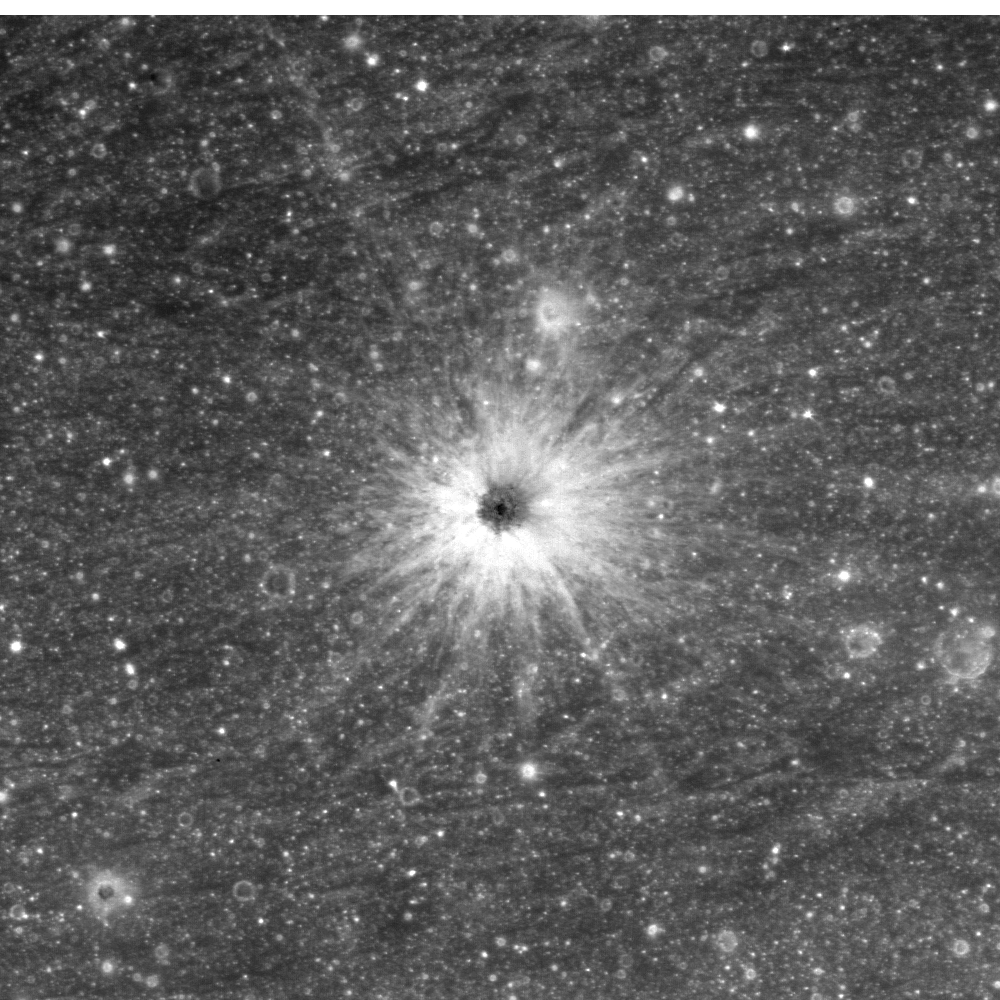
A relatively recent impact event distributed bright, reflective ejecta across the lunar surface in southeast Mare Tranquillitatis. Smaller craters punch through the ejecta to reveal darker substrate, a contrast easier to see under a high Sun, and thus a lower illumination angle of incidence. A 500 meter-wide field of view from LROC Narrow Angle Camera (NAC) observation M139782204LE, spacecraft orbit 5733, September 22, 2010; a 10.11° angle of incidence, resolution 49 cm per pixel from 44.54 km over 4.37°N, 19.29°E [NASA/GSFC/Arizona State University].
Drew Enns
LROC New System

Fresh (young) impacts on the Moon often display magnificent ejecta blankets (so called because they "blanket" the surrounding terrain). Ejecta is unevenly distributed, which gives rise to its interfingered appearance.

Since space weathering tends to lower the albedo of material on an airless planet, the relative brightness of this ejecta blanket speaks to the young age of the parent crater.

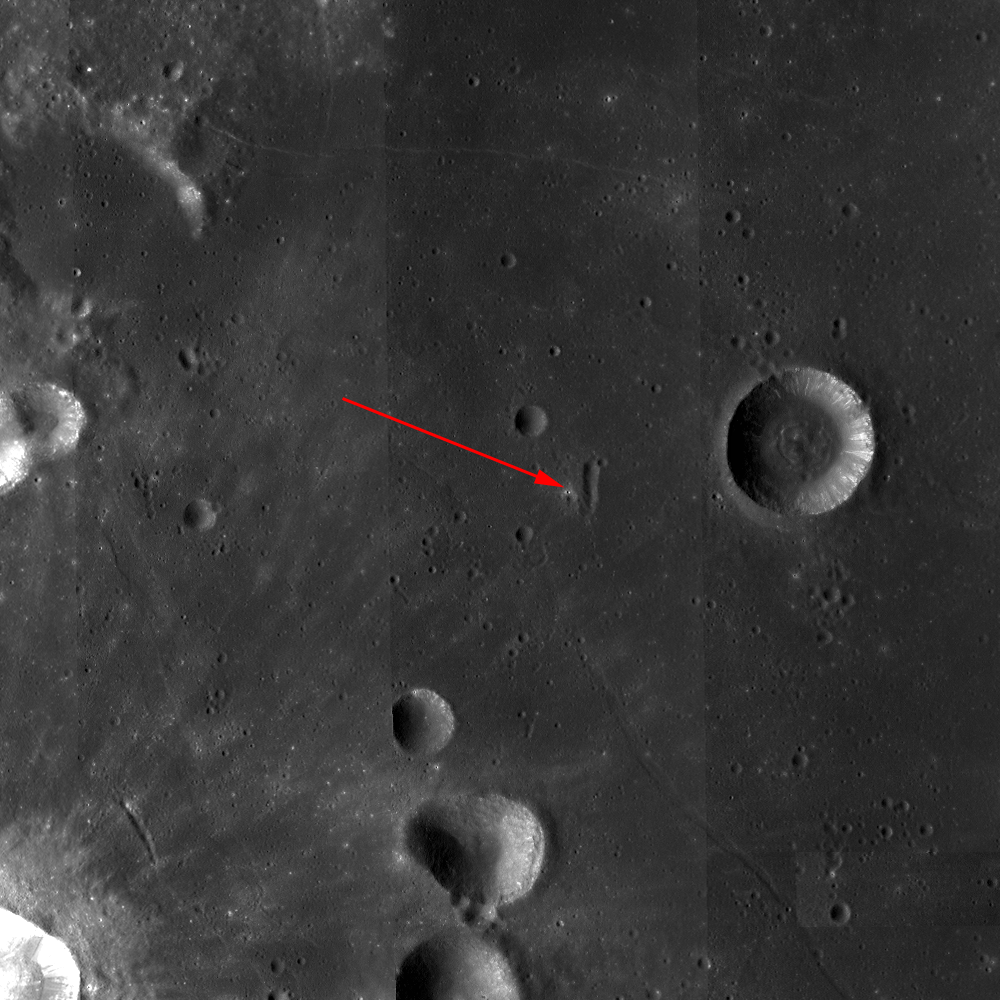
In this case, the parent crater is just to the south of the opening image, and can be seen in the context image.

M162181924L-NSJ-1110-58b92-2252x3572
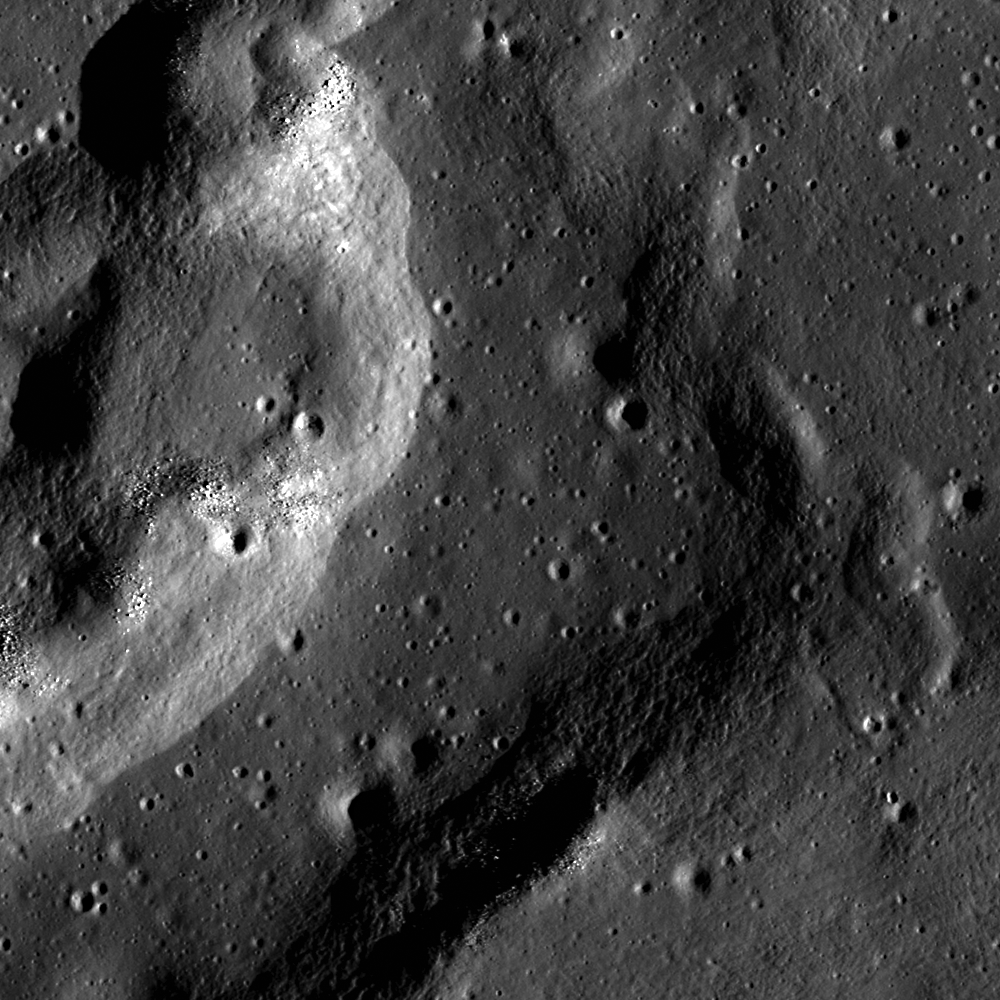
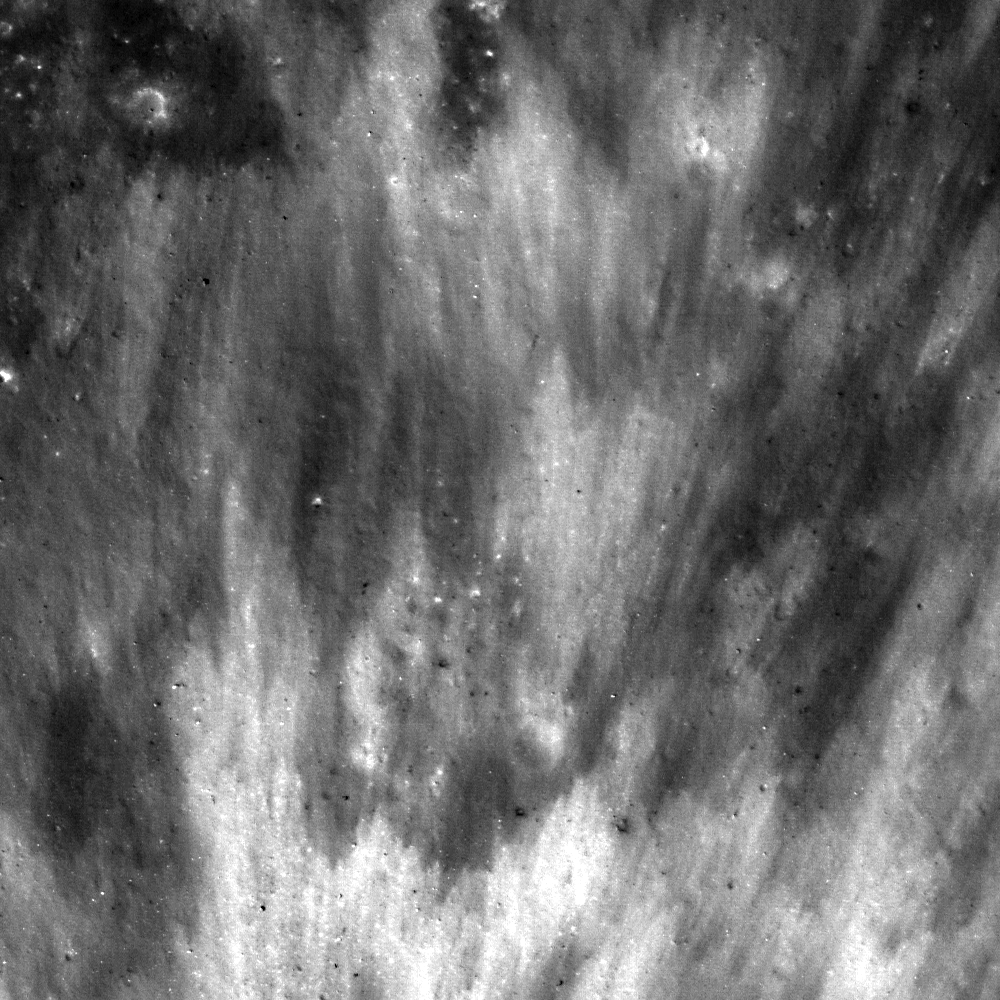
The same small, relatively fresh crater at local sunrise, when shadows under a higher illumination angle of incidence exaggerate variations in topography over albedo. Even so, the brighter surface rays are as distinct as striations channeled into the terrain by the blast. An 1875 meter-wide field of view from LROC NAC frame M162181924L, LRO orbit 9035, June 8, 2011; 73.88° angle of incidence, resolution 0.83 meters per pixel from 39.7 km [NASA/GSFC/Arizona State University].
But what is providing the small circular patches of dark material? Were the patches formed as part of the impact that formed the ejecta blanket, or later? Was the material excavated from below the bright ejecta? Most likely secondary craters (late stage ejecta) from the initial impact, hit and dug up dark mare material (original surface) from below the thin ejecta blanket. Can we test this idea? How dark is dark? In a more precise sense - do the albedos of the small low reflectance spots match that of the surrounding mare?

LROCqm250-sabine-rittter-manners
LROC Wide Angle Camera (WAC) context for the LROC Featured Image released September 10, 2013, showing the field of view located at located at 4.408 N, 19.230 E (marked by the cross). Nearby linear depressions (one smaller, closer depression is visible in the preceding image) may have provided the darker substrate discussed [NASA/GSFC/Arizona State University].
Your eye could be fooled by all the changes in reflectance. The small dark patches have a higher albedo than the mare (0.07 vs 0.06), which would be consistent with mare material mixing with the brighter (0.09 to 0.11) ejecta blanket. This observation is consistent with the secondary crater interpretation (the underlying mare is mixed with a small amount of the bright immature ejecta). If the reflectance of the dark patches was lower than that of the mare, then something else would have to be at work.

Can you think of other explanations while browsing the full LROC NAC frame, HERE?

Related Posts:
Beautiful Ejecta Patterns
DMD Excavations
Symmetric Ejecta

Thursday, June 6, 2013

Imbrium Bench Crater: Regolith all the way down?

A small crater hides a bench of bedrock within its walls. Boulders sit just outside the rim. LROC Narrow Angle Camera (NAC) observation M162447033R, LRO orbit 9074, June 11, 2011; 78° angle of incidence, resolution 0.78 meters per pixel, image field of view 800 meters across from 37.5 km [NASA/GSFC/Arizona State University].
Drew Enns
LROC News System

Today's Featured Image shows a bench crater in the lunar mare. Bench craters are so called because they have a small bench lining the interior of the crater wall. In fact, this bench is interpreted to be the contact between the bottom of the regolith and the basaltic bedrock below.

The regolith is a layer of brecciated material that develops as a result of micrometeorite bombardment, it consists mostly of a fine powder containing numerous angular fragments.

The regolith and the coherent basalt both have different strengths, with the regolith being easier to displace than the underlying basalt during an impact event. The result of a moderate impact (in this case one that produced a 160 meter diameter crater) into this area then gave us a spectacular view of the local stratigraphy.

Another Narrow Angle Camera view of the unnamed crater of interest in Mare Imbrium, from a higher altitude later in the LRO mission. LROC NAC frame M190738110R, orbit 13152, May 4, 2012; 52.37° incidence angle, resolution 1.44 meters from 145.83 km [NASA/GSFC/Arizona State University].
Context LROC Lunaserv view showing the location of the small unnamed crater of interest, east-southeast of McDonald crater in Mare Imbrium. The bench crater is near the center of Mare Imbrium at 30.165° N, 339.493°E. Image width is 100 km [NASA/GSFC/Arizona State University].
Regolith development takes time, and many meteor impacts. Since the impact flux (the number of meteors and comets hitting the Moon) has not been constant in the past, the mare have a thinner regolith than the highlands.

Can you find any more bench craters in the full LROC NAC, HERE?

Related Posts:
New Impact Crater on the Moon!
Regolith on Basalt
Fresh Bench Crater in Oceanus Procellarum

Friday, May 10, 2013

Small Bouldery Crater

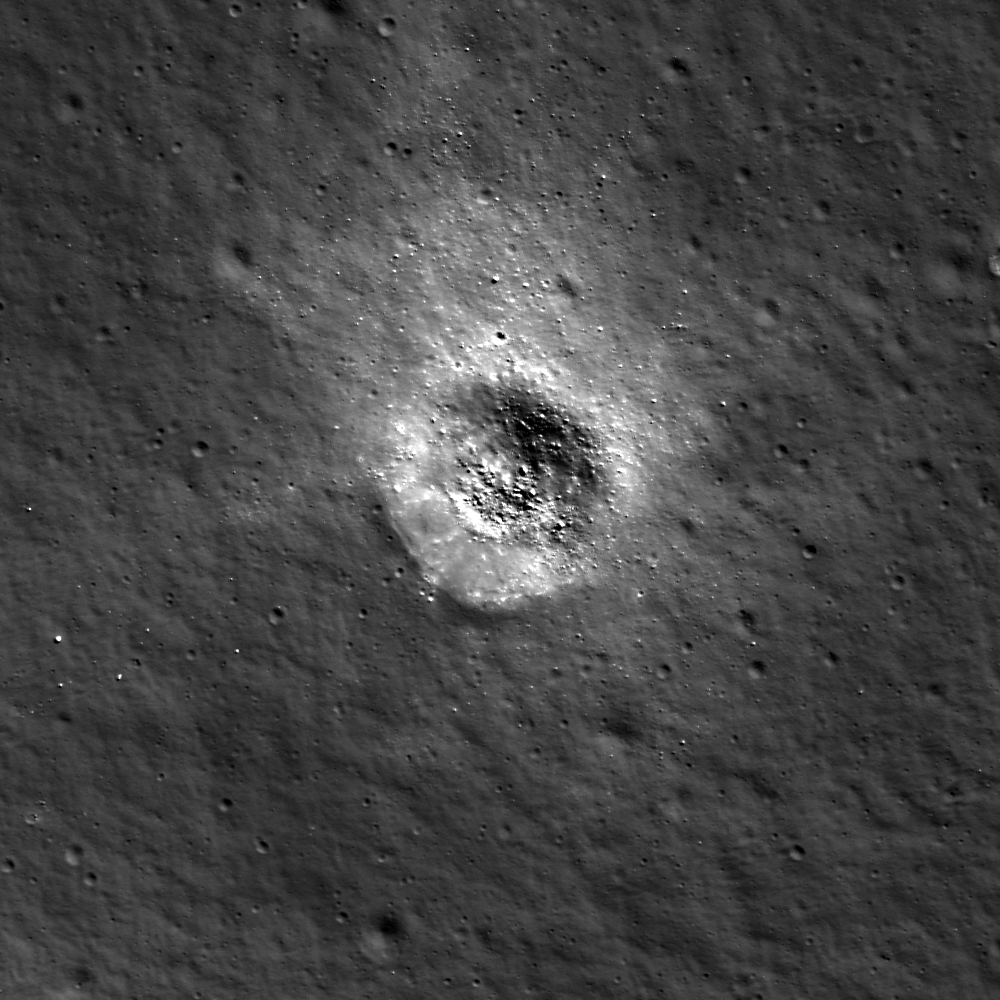
A small crater, sporting a healthy population of boulders and a persistent higher reflectance surrounding ejecta blanket, on the rim of Planck W crater in the farside highland terrain. LROC Narrow Angle Camera (NAC) frame M1120363462L, field of view 500 meters across, resolution 0.5 meters, LRO orbit 17306, April 11, 2013 [NASA/GSFC/Arizona State University].
Drew Enns
LROC News System

The small crater featured today is a bit atypical. The crater's ejecta blanket has a higher reflectance than its surrounding, its interior is peppered with a number of boulders, and it has a poorly developed rim. Bright ejecta normally implies a fresh crater, but with the poorly developed rim it does not appear to be 'fresh'. So it could be either a secondary crater formed from a nearby cratering event, or it could be a fresh crater with an anomalously degraded morphology.

A better idea of the local geology might help with our interpretation.

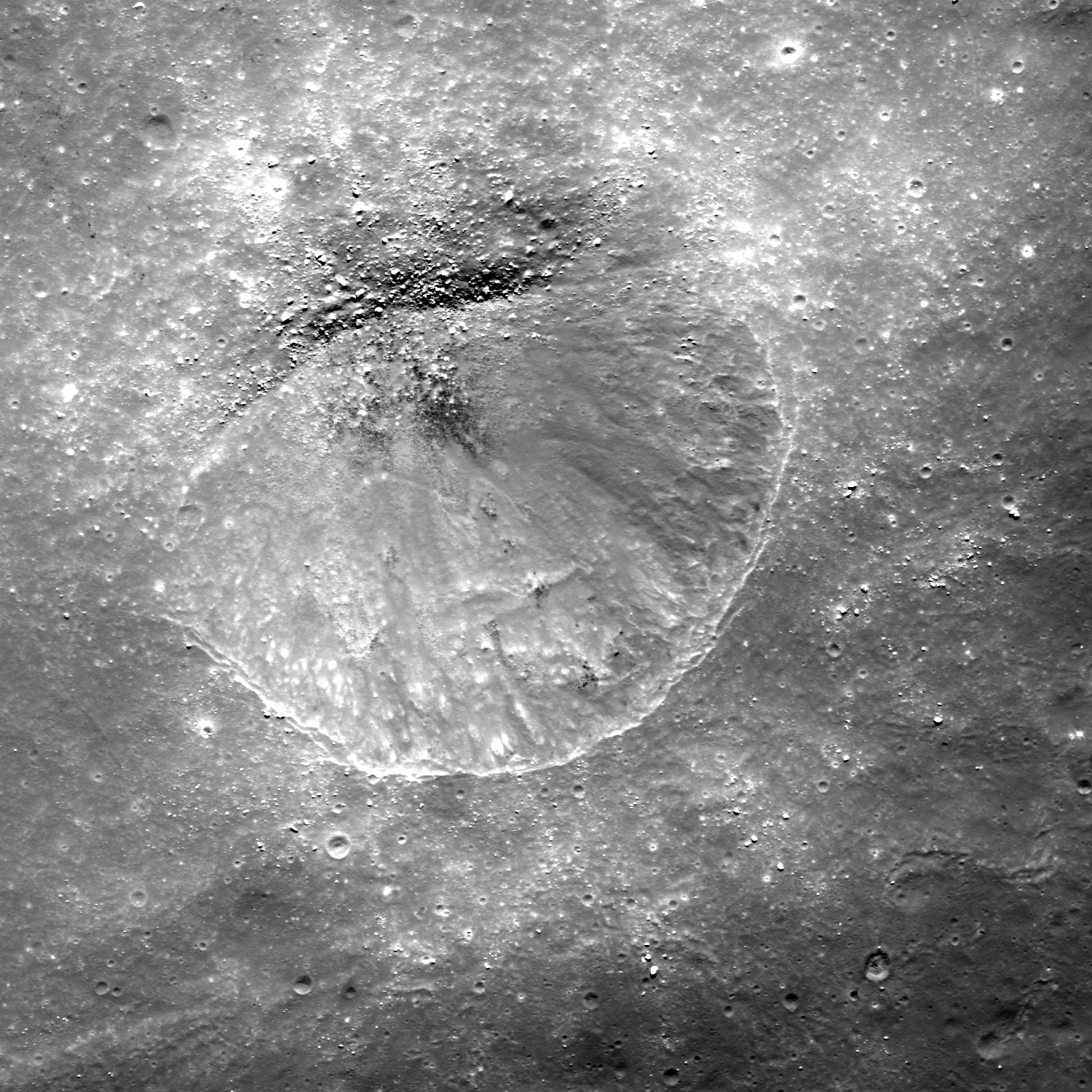
The small crater of interest (upper right) in context with the rim and wall of Planck W (lower left), and a larger and likely younger crater further up the slope (upper left), with a more reflective ejecta blanket. An approximately 2.8 km wide field of view from a mosaic of the right and left frames of LROC NAC observation M172067030, spacecraft orbit 10491, October 1, 2011; angle of incidence 54.39° at 0.64 meters resolution from 61.39 km [NASA/GSFC/Arizona State University].
The small crater apparently sits on the rim of the larger crater Planck W. (the) ejecta blanket (of an adjacent small crater) is highly reflective - (it's) all you can see of the crater in the WAC context image!

Context for the LROC Featured Image, a high-resolution NAC view of the small crater barely visible at upper right in the field of view outlined above (shown in an earlier NAC observation, immediately preceding. The area of interest is on the slope of Planck W (55.44°S, 131.28°E). View cropped from LROC Wide Angle Camera (WAC) observation M110751697C (643 nm), orbit 1455, October 21, 2009; resolution 82.1 meters per pixel, angle of incidence 58.35° - spacecraft altitude 58.6 km [NASA/GSFC/Arizona State University].
In this case it appears that the crater is young since its ejecta blanket is still around. But then why does the crater not look morphologically fresh? It could be a form of physical mass wasting. Diffusion models of the lunar surface indicate that small craters are quickly degraded in terms of their morphology, but the ejecta blanket is not affected. Resulting craters might look very similar to today's Featured Image.

Look for more fresh craters in the full LROC NAC, HERE.

Related Posts:
Symmetric Ejecta
Beautiful Ejecta Patterns
Clusters

Thursday, May 2, 2013

Dating Impacts

Some boulders are exposed in an impact melt sheet. How can these boulders help geologists understand more about the timing of impacts? LROC Narrow Angle Camera (NAC) observation M1120322807L, LRO orbit 17301, April 11, 2013; field of view 1600 meters across [NASA/GSFC/Arizona State University].
Drew Enns
LROC News System

The impact process produces unimaginable amounts of energy! Some of this energy goes into melting rock, resulting is spectacular landforms. But not all of the rocks melt, and some are just heated up! Such is probably the case for the boulders we see in today's Featured Image. But how can these rocks be of use for geologists? On Earth, some enterprising geologists use boulders like these to date impact structures!

Geochronologists are a brand of geologists who study the ages of rocks. One way to get at a rock's absolute age is to measure its gas content. This method is particularly useful for igneous (and impact) settings. Rocks will accumulate gas over time as a result of radioactive decay of different elements, but these gases don't want to be there. If a rock is later warmed up past a specific temperature (which we term the closure temperature) the gases will start to escape. So if an impact event has heated some material above the closure temperature, the gas content of the rock will be 'reset.'

Closer look at the 'double' outcrop, at 0.65 meters per pixel, cropped from LROC NAC frame M154311644R, spacecraft orbit 7875, March 9, 2011; angle of incidence 45.27° - from 62.06 km [NASA/GSFC/Arizona State University].
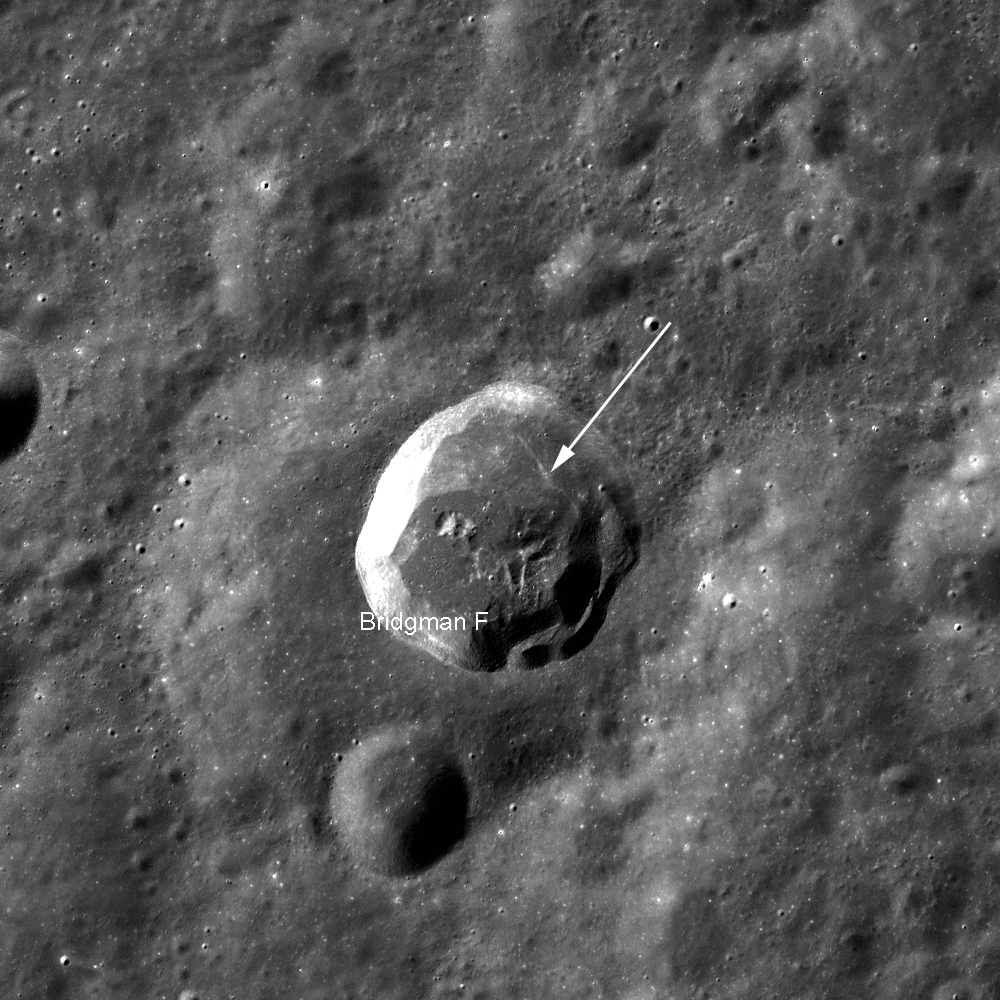
Context image of the LROC Featured Image, May 2, 2013 - for boulders located on a terrace within Bridgman F (44.053° E, 141.825° E). Image width is 100 km [NASA/GSFC/Arizona State University].
Several gas systems are currently in use to obtain absolute dates for rocks, but there are two important ones for impact cratering. One measures the ratio of Argon 40 to Argon 39 (40Ar/39Ar dating). The other uses the Uranium, Thorium, Helium system ((U-Th)/He)). However, both utilize separate materials. 40Ar/39Ar dating benefits from having impact melt to sample. This is one of the methods used in the 1970's that dated Apollo samples and helped scientists understand lunar geologic time. But what if you have no impact melt? On Earth that might be more of a concern since impact melt might not last as long as boulders, and the (U-Th)/He might be the answer.

ASU graduate student Kelsey Young stands next to a boulder in Mistastin crater in Newfoundland. The red box outlines an impact melt zone between two boulders, which we can imagine are contextually very similar to the boulders in our Featured Image [Image credit Kelsey Young].
So Kelsey Young (and her colleagues) at ASU have come up with a new way to date a crater. They date boulders at impact sites using the (U-Th)/He method because the system has a lower closure temperature. This method has a few advantages. One is that boulders are easier to find than melt on Earth's surface. The other is that the system's lower closure temperature means that it is easier to reset the ages of these boulders.

The canonical age for Mistastin crater is 36 +/- 4 Ma, and the (U-Th)/He system came up with 32.7 +/- 1.2 which is within the error of previous estimates. So far this technique shows promise in matching the dates found using 40Ar/39Ar and adds another tool to those of us trying to understand impact cratering!

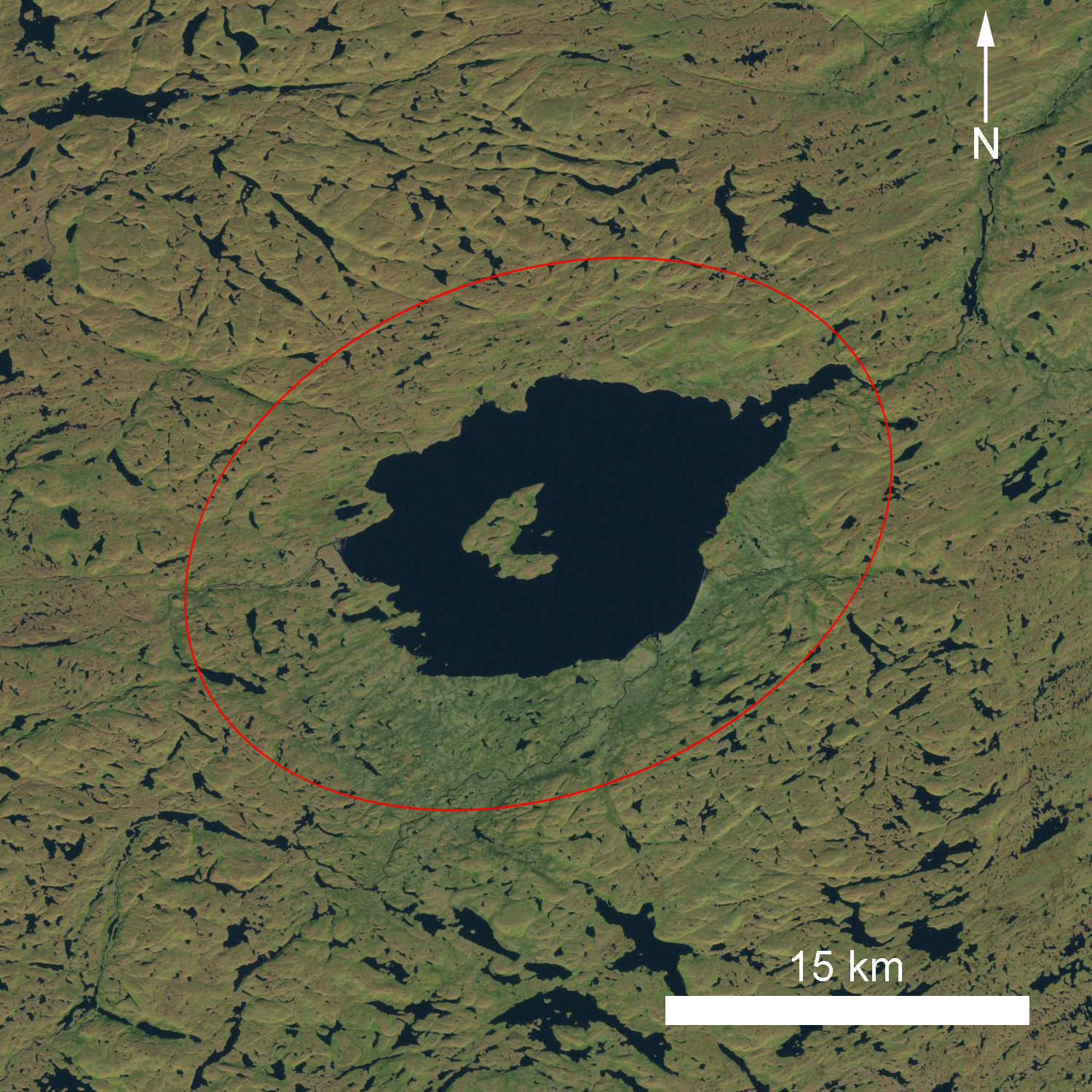
Landsat image of Mistastin crater in Canada (55.83° N, 66.3° W). The impact structure is about 28 km wide, shown here by the red ellipse [NASA/USGS].
Now that we have a better idea of how best to date impact craters, how might you find the absolute age of Bridgeman E crater in today's Featured Image? Of course, you'll have to get there first!

Look for more boulders and melt in the full LROC NAC, HERE.

Related Posts:
River of Rock
Absolute Time
Schiaparelli E

Wednesday, May 1, 2013

Debris on the slopes of Benedict crater

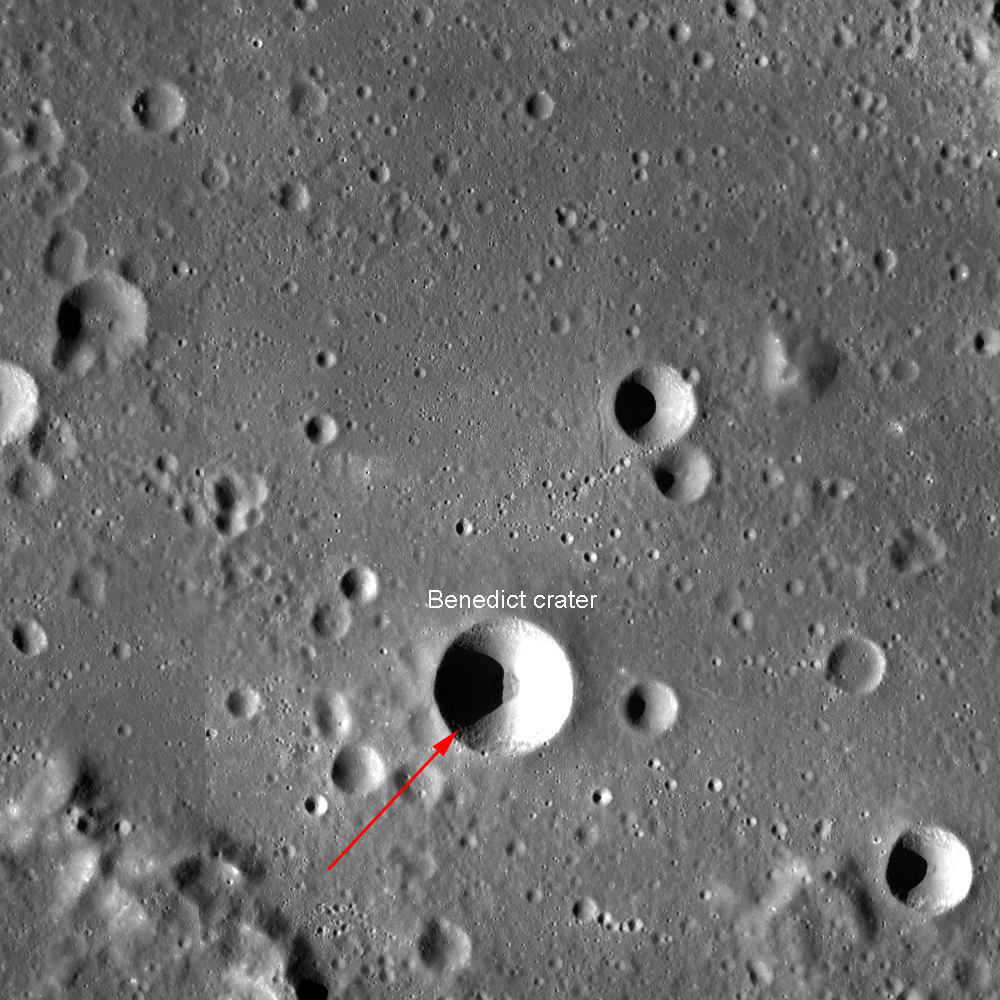
Debris flows on the slope of Benedict crater. Note material collected in small depressions, where boulders stand out as bright dots on the landscape. Recent LROC Narrow Angle Camera (NAC) observation M1120314888R, LRO orbit 17300, April 11, 2013; field of view 1200 meters resolved at 1.2 meters per pixel, downslope toward the upper right [NASA/GSFC/Arizona State University].
Drew Enns
LROC News System

Debris flows occur naturally on most sloped surfaces. This type of 'mass wasting' is actually very common on the Moon. In this case why are small piles of debris accumulating in clumps? This clumping is quite different from other debris flows which are sometimes misidentified as impact melt flows.

Perhaps the debris doesn't have enough energy to make it all the way down, or maybe the surface is not smooth.

Or perhaps the crater wall is not a smooth surface perhaps there are little bumps and depressions. We can see a hint of such undulations from looking at the 'texture' of the surface of the crater wall (and others).

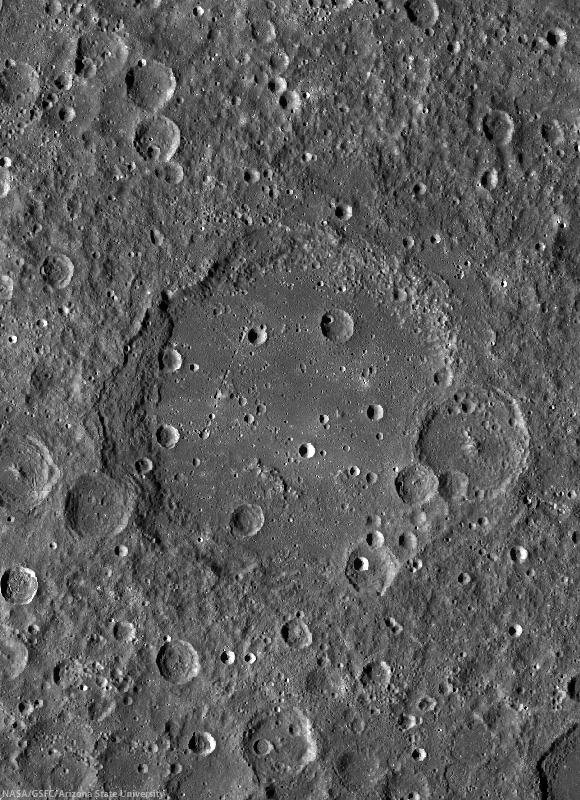
Highly-resampled mosaic of scaled 25000 lines from the center of LROC NAC mosaic M1100280950LR, at a slightly higher resolution and narrower angle of illumination in the original, shows most of Benedict crater with the field of view shown at high resolution in the LROC Featured Image, released May 1, 2013 outlined by the yellow box. Note the asymmetry of the crater floor, an indication of a collapse, or slumping, of the crater's west wall.  Spacecraft orbit 14487, August 22, 2012; scaled from 0.96 meters resolution at 26.77° angle of incidence, from 116.04 km [NASA/GSFC/Arizona State University].
LROC Wide Angle Camera (WAC) context view of 14 km diameter Benedict, well inside the interior of 210 km Mendeleev crater, at 4.345° N, 141.544° E. Field of view 58 km. [NASA/GSFC/Arizona State University].
Smaller scale LROC WAC context image shows Benedict, near center, and its place within 210 km Mendeleev [NASA/GSFC/Arizona State University].
Labeled oblique HDTV view of Mendeleev from the south, captured from Japan's lunar orbiter SELENE-1 (Kaguya) in 2007. View a full-size unlabeled, closer SELENE HDTV still HERE  [JAXA/NHK/SELENE].
We can also see this uneven wall surface in Digital Terrain Models of young craters. The bumpy surface acts to trap debris in shallow depressions, inhibiting growth of the spectacular debris flows seen elsewhere. Mass wasting is a continuous process and in a few tens of millions of years perhaps the interior of Benedict crater will look more like some other craters we have featured.

Look for more debris along the crater wall of Benedict in the full LROC NAC, HERE.

Related Posts:
Dichotomy
Melt or Rubble
Crater Debris
Inside Catena Mendeleev
Mendeleev in full

Sunday, March 31, 2013

Off-center impact on the wall of Guthnick

A small 600 meter crater inside the rim of Guthnick, a Copernican impact integral to the Mendlel-Rydberg basin immediately south of Mare Orientalis. This small impact crater exhibits boulders clustered off center, along with a poorly defined rim. Drew Enns asks, "what could be the cause of these distinctive features?" - Crop from LROC Narrow Angle Camera (NAC) M1117124706L, spacecraft orbit 16850, March 5, 2013; 0.60 meters per pixel resolution, above field of view 3 km [NASA/GSFC/Arizona State University].
Drew Enns
LROC News System

Small impact craters are normally bowl-shaped depressions in a planetary surface. Because of this, boulders and impact melt will also fill in the center of the crater. Yet this is not what we observe in today's Featured Image. Why does this small crater have boulders that are off center? Why is the northern portion of the rim undefined? Is it some sort of dynamical fluke? Probably not. It is more likely that there is some uneven terrain influencing the crater. We can zoom out for a larger view.

Asymmetric craters tend to form when the impact angle is greater than 15° The LROC WAC context mosaic helps a lot! We now see that our small crater formed on the wall of the much larger Guthnick crater.

LROC Wide Angle Camera (WAC) context for the small crater (arrow) on the wall of Guthnick crater at 48.27°S, 266.157°E. Though Guthnick is not the subject of this post, the 36 km crater has been identified as one of two that satisfy requirements for sampling intact basin melt sheets. (Science Concept 2: "The structure and composition of the lunar interior provide fundamental information on the evolution of a differentiated planetary body;" CLSE, 2012, pg 115) - LROC WAC observation M112231731CE (604nm), spacecraft orbit 1673, November 7, 2009; resolution 74.25 meters per pixel from 52.51 km [NASA/GSFC/Arizona State University].
The slope of the Guthnick crater's wall had a big effect on the morphology of this simple crater. During the impact event the steep slope resulted in collapse of the downhill portion of the crater, thus the asymmetric shape and collection of boulders on the downhill side.

Still image taken from HDTV feed from Japan's SELENE-1 (Kaguya) orbiting north over the Moon's west limb. The edge of Mare Orientalis has just appeared on the horizon and long chains of impact craters radiate from is central basin. Guthnick, on the right of the two largest craters at the center probably impacted upon one of the long chains, as much as two billion years after the Orientalis event [JAXA/NHK/SELENE]..
The wide-spread and lasting influence of the Orientale basin-forming-impact event can more easily be seen in this LROC WAC digital elevation model. Perhaps at one time the Mendel-Ryder basin, home of Guthnick (white arrow, lower right) though smaller, had an influence nearly as wide spread, wiped away - on the surface at least - 3.1 billion years ago [NASA/GSFC/Arizona State University/DLR].
Explore more of the Guthnick crater interior in a full resolution reproduction of the original LROC NAC, HERE.

Related Posts:
A Tiny Glancing Blow
Clam Shell
Not Your Average Crater

Figure 2.43 (A Global Lunar Landing Site Study to Provide the Scientific Context for Exploration of the Moon, 2012) Topographic profile of Guthnick. Black arrows indicate the transition from upper crater wall to slumped material, as shown by an inflection in the slope. The map uses a polar projection centered on 48°N, 266°E, and the vertical projection of the elevation profile is about 2:1 [CLSE/NLSI/LPI].

Friday, March 29, 2013

Bright small crater ejecta - with a black eye

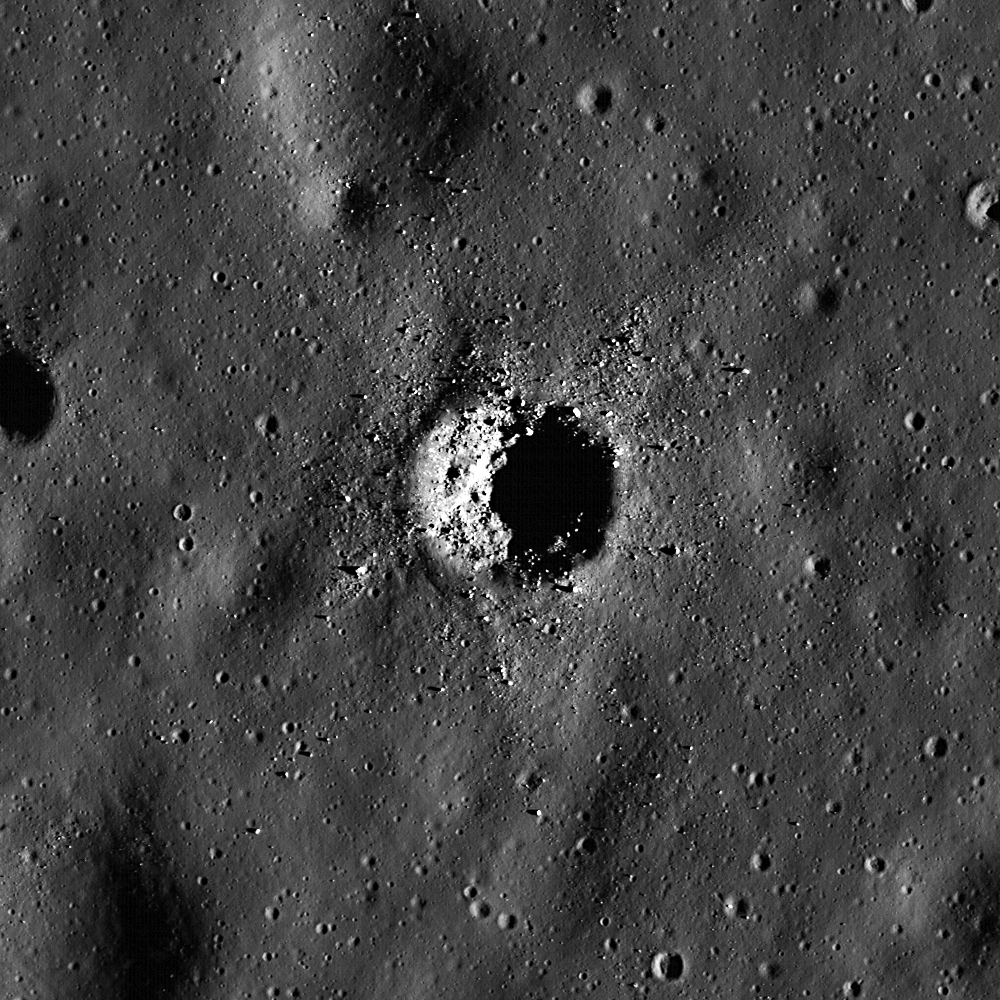
Fifty meter crater with bright ejecta extending several crater radii. The dark deep interior of the crater could be the disk of of an impact melt pond Field of view 1000 meters across from LROC Narrow Angle Camera (NAC) observation M1117189620R, LRO orbit 16860, March 6, 2013; 0.9 meters resolution [NASA/GSFC/Arizona State University].
Drew Enns
LROC News System

Our impressions (and interpretations) of surface features on planetary bodies are affected by the way they interact with sunlight when we image them.

For instance, the shape of a crater is brought out by shadows in large incidence angles (Sun near the horizon) images.

In today’s Featured Image, we are observing a crater with the Sun nearly directly above the surface. This type of image (small incidence angle) helps scientists understand the physical properties of the surface. Why might the ejecta blanket of the crater be highly reflective? Why is the interior have a much lower reflectance? Two different surface properties could be affecting what we see. First, 'fresh' material should be brighter than surrounding material. And second, the composition of materials affects how they reflect light (see albedo).

A similar, somewhat larger crater for comparison - one also considered to be relatively fresh - in Oceanus Procellarum, northeast of the central eye of the Reiner Gamma albedo swirl. The explicit central melt floor, or disk, may resemble the less clearly resolved fresh crater spot-lighted in this post. You can read the feature story about this comparable crater HERE. LROC NAC observation M111972680L [NASA/GSFC/Arizona State University].
LROC Wide Angle Camera (WAC) context of the region around the small crater highlighted in the LROC Featured Image, located near the red cross (3.022°N, 258.698°E). Image field of view roughly 85 km [NASA/GSFC/Arizona State University].
In the case of today's Featured Image, the crater looks very young. We have some stratigraphic evidence for this as the crater is sitting on top of a larger flesh unnamed crater's ejecta deposit (see context image below).

A quickly put-together crop from the Chang'E-2 (CNSA/CLEP) global medium resolution mosaic, highly emphasizing albedo over the relief made visible by long shadows. Even old and deep craters in this 170 km-wide field of view north of Mare Orientalis seem to disappear under the low solar incidence. If the ejecta blanket from the unnamed crater near center were just a little further east and clearly on the Moon's nearside it would rival the similarly bright ejecta from Tycho, Copernicus or Brygius A. The small crater, clearly overwhelmed in this crop, is marked by a small "X" on he theouter slope of Lents (Lenz) C.
Therefore the brightness of the ejecta blanket is likely due to the young nature of the crater! But that doesn't solve the problem of the crater's interior. The interior could have been mantled by a thin veneer of impact melt which then pooled in the center. We know from many examples that impact melt rock reflects less light than its source material.

The small crater (arrow), situated on the ejecta blanket of a fresh crater further east which, in turn, sits on the wide outer reaches of the Mare Orientalis impact basin. View toward the south, [NASA/ILIADS/LMMP].
The impact melt hypothesis is not certain, though a follow up image at a larger incidence angle to help us understand morphology and could certainly help test this hypothesis!

Explore more ejecta in full the NAC frame, HERE.

Related Posts:
Ejecta Starburst
Swept Surface
Symmetric Ejecta
Shades of Grey

Thursday, February 14, 2013

Numerov's Graben

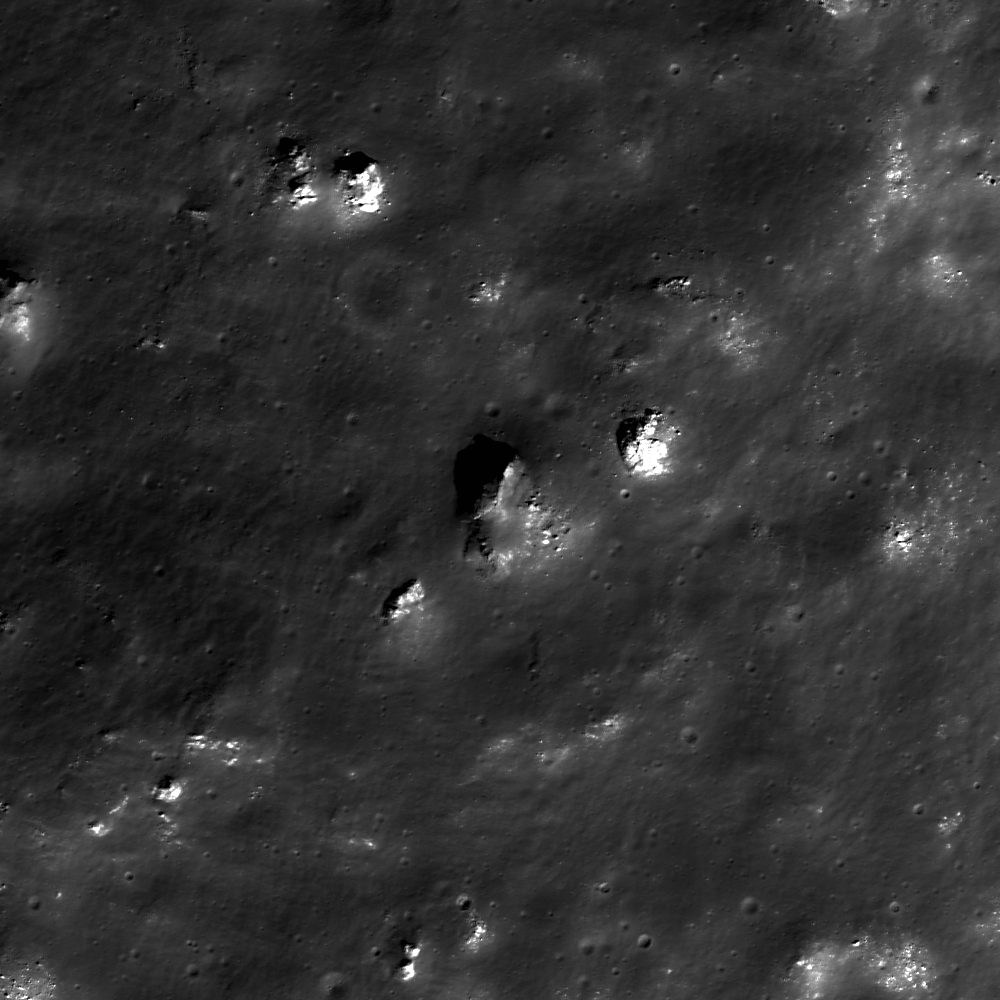
Normal faults in regolith formed remarkably small graben in Nectarian age Numerov crater (70.7°S, 160.7°W). Only a handful of small craters superpose the faults, indicating a young age. LROC NAC M171619370RE, image width is 600 m [NASA/GSFC/Arizona State University].
Drew Enns
LROC News System

Graben on the Moon come in a variety of sizes. Some of the larger rilles in the maria stretch for several tens of kilometers and can be a few kilometers in width. These linear rilles are thought to be the result of extensional stresses near the edges of the maria and are thus graben.

Since the mare basalts are dense, they weigh down the crust in the center of the deposit, pulling rock near the margins inward.

However, the Featured Image today shows much smaller graben that span only hundreds of meters in length and tens of meters in width. To complicate matters, these graben are not in mare basalts, they are inside a crater!

Context image for today's Featured Image. The graben are pointed to by the arrow. A nearby lobate scarp extends from A to A', its low relief enhanced by the low Sun mosaic. Image width is 100 km [NASA/GSFC/Arizona State University].
The LROC Wide Angle Camera (WAC) context image (above) helps us decipher the origin of these graben, as a nearby lobate scarp can be seen at this scale. Lobate scarps form in compressional stress environments as layers of rock or regolith fold and thrust upwards. The thrusting might cause nearby crust or regolith to uplift and bend.

The graben and scarp are only hundreds of meters apart which argues for a compressional interpretation.Thus the interplay between compressional and extensional stresses is reflected in the distribution of tectonic features within Numerov crater. The end result is that we see small graben situated very near to lunar lobate scarps!

Numerov show its great Nectarian age at minimal shadowing in this LROC QuickMap 125 meter resolution orthographic projection assembled from LROC WAC photography and the LROC WAC-based digital terrain model (DTM). By contrast, its larger neighbor shouldered against it's western edge is Antoniadi, an uncharacteristically youthful (Upper Imbrium) impact crater for this part of the lunar surface, deep within South Pole-Aitken basin, and home of the Moon's deepest elevation. The smaller stress affects discussed in the post by Drew Enns are not as apparent at this scale, though other stress affects, scarps in particular, are easier to pick out [NASA/GSFC/ASU/DLR].
Explore more of the lobate scarp and graben in the full LROC NAC, HERE.

Related Posts:
Watch That First Step!
Its the Moon's Fault
Pull Apart - Grabens

LROC WAC mosaic presented using the Virtual Moon Atlas 6 shows Numerov in context with Antoniadi and Minnaert, a triple astrobleme that is easy to spot on maps of the farside and South Pole-Aitken basin [NASA/GSFC/ASU/VMA6].

Wednesday, February 13, 2013

Wrinkle Ridge in Mare Crisium

A complex wrinkle ridge in Mare Crisium at low Sun (angle of incidence 72.8° from the east). Boulders occupy the tops of mounds on the west ridge, and the central depression is more heavily cratered than the ridge. LROC Narrow Angle Camera (NAC) M146573730RE, LRO orbit 6734, December 9, 2010; field of view 700 meters at 89 cm resolution from 43.27 km [NASA/GSFC/Arizona State University].
Drew Enns
LROC News System

Wrinkle ridges are complex structural features that tend to develop in contracting regions of the Moon. Unlike lobate scarps (also contractional structural features), wrinkle ridges are thought to result from a mix of folding and faulting.

A buried thrust fault cuts through the mare, but not completely. Instead of breaking the surface, the fault pushes material upwards and causes the mare to fold over the fault.

This folding leads to a wide variety of wrinkle ridge morphologies. Despite this variation, all wrinkle ridges are made up of a larger ridge with a smaller superposed ridge.

A reproduction from the full 2.3 km-wide field of view, including the area at full resolution in the LROC Featured Image released February 13, 2013. LROC NAC M146573730R [NASA/GSFC/Arizona State University].
LROC Wide Angle Camera context image for the LROC Featured Image, highlighting the anatomy of the wrinkle ridge at 16.09°N, 61.68°E. Several other wrinkle ridges are nearby, each with a distinctive form. There are hints also of ghost craters and the kind of volcanic vent structures characteristic of the Marius Hills [NASA/GSFC/Arizona State University].
So when did all of these wrinkle ridges form?

The law of superposition argues that they must be younger than the mare basalt they deform. The basalts in Mare Crisium range in age from 2.5 to 3.3 billion years old!

These dates come from measuring the radioactive isotopic systems of samples returned by the Soviet Luna 24 mission. If these dates are correct and representative of the surface, the wrinkle ridges here formed after the basalts were deposited. Did the ridges start forming after 2.5 billion years? Probably not. Several mare flows also 'pond' behind wrinkle ridges, so the wrinkles must predate at least some mare material and potentially formed over the same time period. One billion years is a long time to go without tectonic deformation after all. One thing is probable, the wrinkle ridges continued developing after mare volcanism shut off in the area.

Explore more of the wrinkle ridge in the full LROC NAC, HERE.

Related Posts:
Bulging Wrinkle
Tectonics in Mare Frigoris
Relative Age Relationships

Tuesday, February 12, 2013

A Lunar Dichotomy

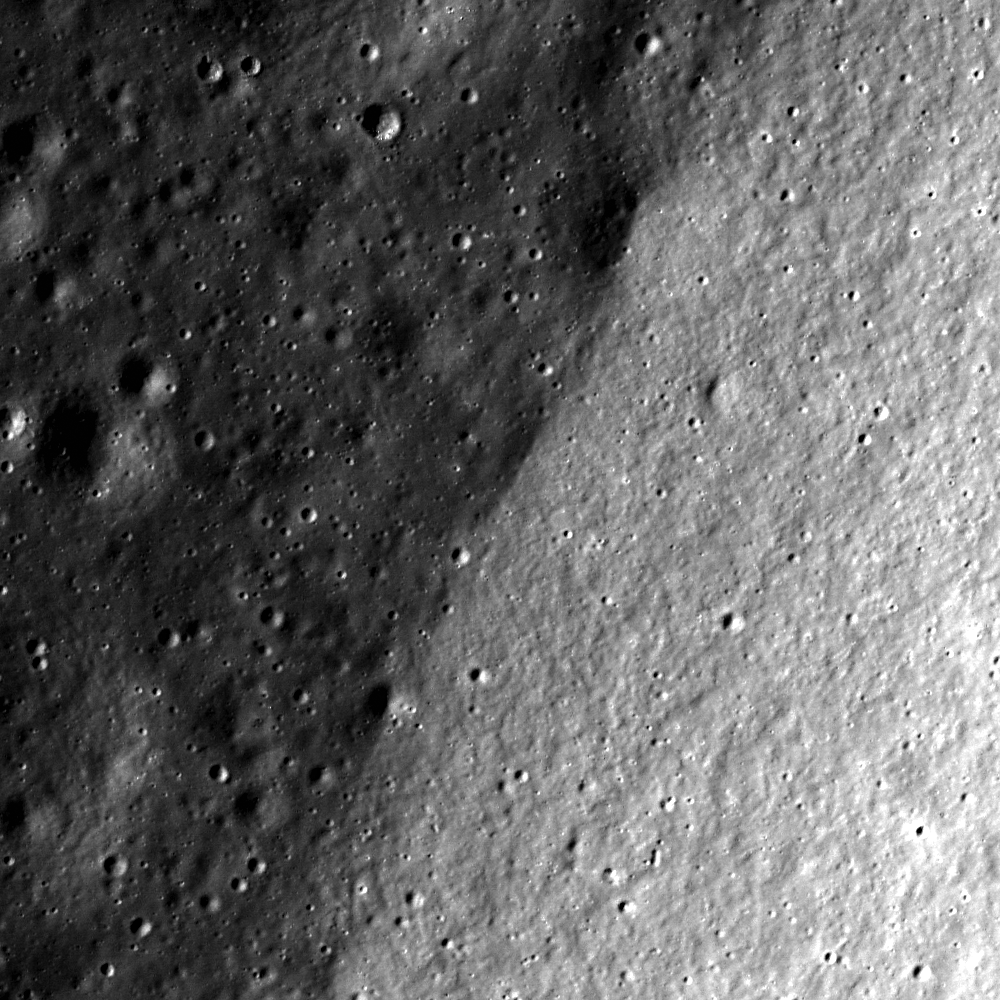
This LROC Narrow Angle Camera (NAC) frame exposes two seemingly different lithologies; one dark with several craters, and one light with few. What are we observing? LROC NAC observation M1113062041RE, spacecraft orbit 16278, January 17, 2013; 70 cm resolution of a field of view 700 meters across [NASA/GSFC/Arizona State University].
Drew Enns
LROC News System

Today's Featured Image shows a very interesting dichotomy on the Moon. One half of the image displays a dark cratered surface, while the other half is lighter in tone with less craters and a different texture. What could cause the difference in brightness, cratering, and texture? What sort of geologic contact are we observing?

Perhaps the bright material is younger, and as a result has fewer craters. Young lunar craters and their ejecta have a higher reflectance than older ones, and their ejecta blankets are only lightly cratered. The darker material could be older lunar terrain that the ejecta has overlain, and we are looking at the contact between these two surface types.
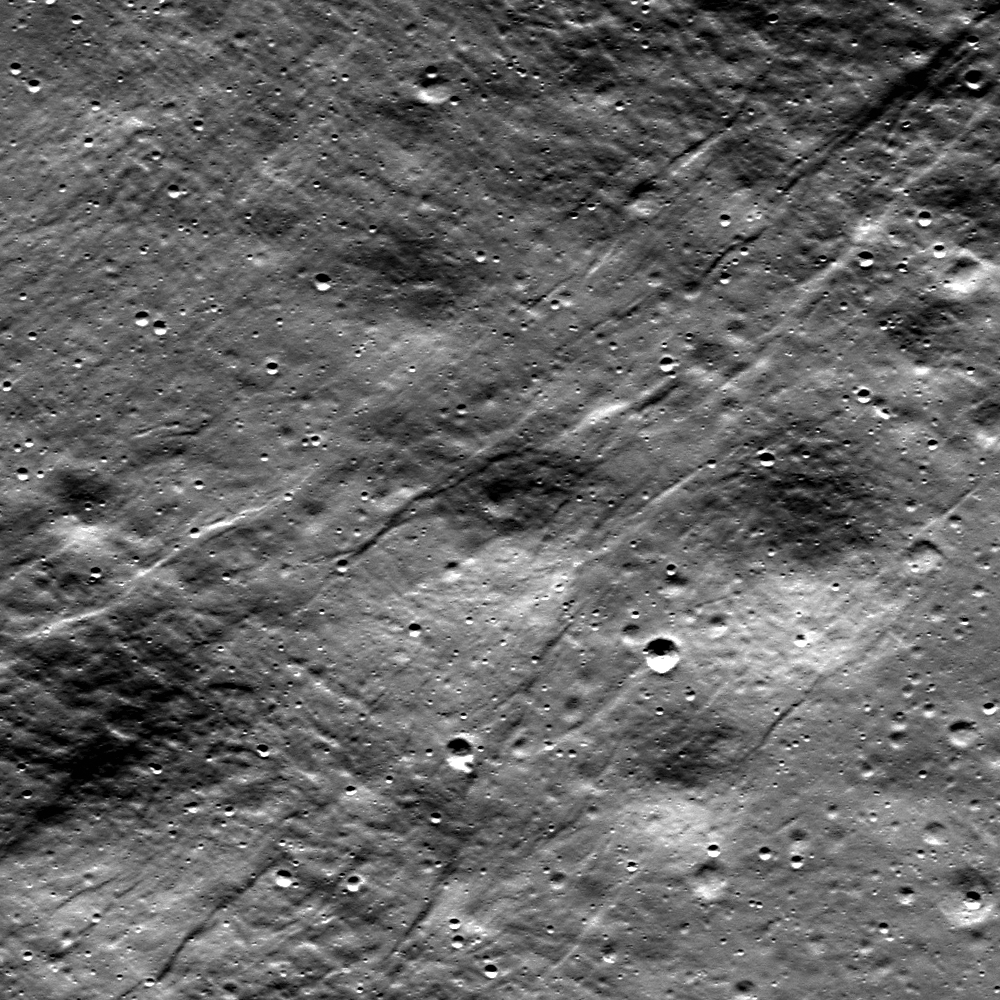
We could also be observing the interior of a crater. The texture of the brighter material is consistent with textures we see on sloped surfaces such as a crater wall. The difference in crater density can be explained as a result of the sloped wall of the crater. The darker half might then be the impact melt at the bottom of the crater floor.

Another hypothesis might be that we are observing the geologic contact between mare basalts and the lunar highlands. The mare are darker than the highlands but should have fewer craters. But that is not what we observe, unless the lighter material is on a slope (such as in our crater interior hypothesis). Which one of these hypotheses is correct? Let's look at a contextual view from the LROC WAC for help.

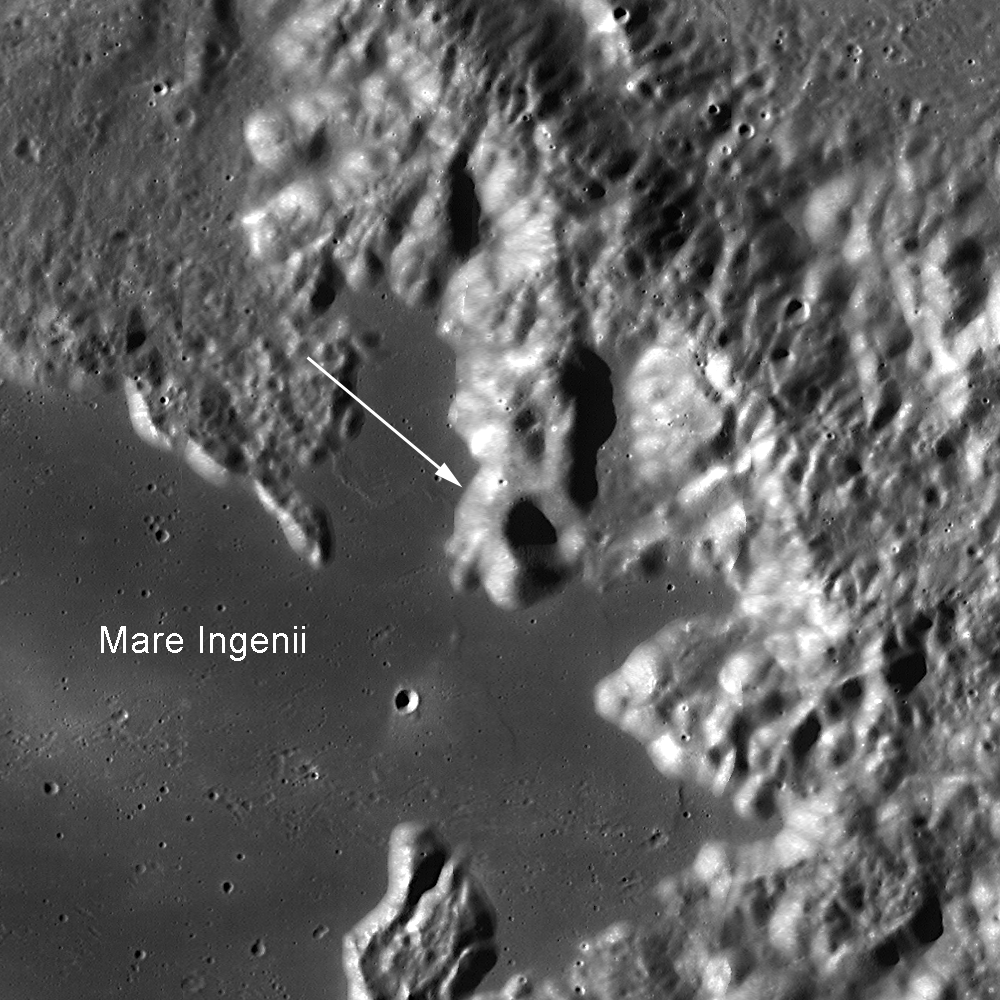
Context LROC Wide Angle Camera (WAC) 100 km-wide field of view designating the location shown at high resolution in the LROC Featured Image, released February 12, 2013. Northeast Mare Ingenii, just beyond the nearly buried rim of Thompson crater on the lunar far side. The contact coordinates are 31.069°S, 168.657°E. This Image width is 100 km [NASA/GSFC/Arizona State University].
The WAC mosaic provides the means to test our hypotheses instantly! The Featured Image is observing the geologic contact between mare basalts in Mare Ingenii and the surrounding highland material. This contact is important for the Moon since the mare and highlands are the two major rock lithologies present on the lunar surface. In fact, we can see this contact while standing outside at night and looking up at the Moon with the naked eye! While Mare Ingenii is on the farside of the Moon, the nearside maria are easy to distinguish against the lighter backdrop of the lunar highlands.

Apollo 15, beginning its 14th orbit, 1971, reemerging into day high to the northwest, delivered this beautiful oblique context photograph of the area of interest, Thompson crater and the surrounding quadrant of northeast Mare Ingenii (the contact is near center in this full resolution inset from AS15-87-11724) in the stark relief of the lengthening shadows of late afternoon [NASA/JSC].
The full frame of the Apollo 15 frame of Mare Ingenii taken from a point nearly antipodal to the expedition's landing site at Hadley Rille. Catch the high-resolution reproduction at the Apollo Lunar Surface Journal HERE [NASA/JSC/ALSJ].
Explore more of the Mare Ingenii and the nearby highlands massifs in the full LROC NAC, HERE

Related Posts:
Approach to Taurus Littrow Valley
Follow the highlands-mare boundary in Tsiolkovskiy!
Mare Moscoviense Constellation Site

Nearly forty years later, Japan's unmanned lunar orbiter SELENE-1 (Kaguya) captured Mare Ingenii in breathtaking HDTV, including the ancient impact basin's distinctive albedo swirl fields (left) precipitated over anomalous local magnetic fields. It's what most planetary scientists think of when the Sea of Ingenuity is under discussion. The area highlighted in the LROC Featured Image is near the Ingenii basin's northwestern extremes but also just beyond the huge Thompson ghost crater (center. See inset below) [JAXA/NHK/SELENE].
Inset from the oblique HDTV still of Mare Ingenii, the location near the field of view captured in the LROC Featured Image designated with an arrow. The swirls of Mare Ingenii draw the eye in the full-size 16:9 still, though far beyond the Ingenii basin rim, hugging the horizon, is most of the oblong, equally intriguing interior of the Van de Graaff basin. All of these scenes, and beyond, are a part of the widespread South Pole-Aitken basin [JAXA/NHK/SELENE].