Showing posts with label NASA Marshall. Show all posts

Thursday, January 22, 2015

Marshall plans eleven cubesats on 2018 SLS debut

The MSA with cubesats tucked away [NASA/MSFC].
Josh Barrett
SpaceAlabama.com

Exploration Flight Test-1, which launched on December 5, 2014 tested the Orion spacecraft.  The capsule that would take people to Mars went to space for the first time, and it was one of NASA's biggest accomplishments in 2014.  In 2018, the next flight of Orion will be on the Space Launch System (SLS), and it will again be an unmanned test flight.  But this time around, there's going to be some extra things sent to space.

The Marshall Space Flight Center is working on getting the most out of the SLS's tremendous lift capability.  NASA had the novel idea of tucking away eleven different scientific missions on Exploration Mission-1, which would provide otherwise costly access to deep space.

"What we're really excited about is the fact that we're able to take this test flight and actually get science out of it, and we're expanding the capability," said Joseph Pelfry, a deputy project manager at Marshall, who was instrumental in this idea.  "SLS is designed for a lot more payload capability, but we're trying to take advantage of every bit of capability the vehicle has."

Three of the eleven missions have already been selected.  The science payloads must fit in to six-unit cubesats, which are efficient and versatile.  They will be hidden in the multi-vehicle stage adapter (MSA), which is the ring that connects Orion's service module to the top stage of SLS.  Once Orion and the service module disconnect and continue on to orbit the moon, compartments in the MSA will launch the science missions at certain times depending on particular mission.

"Flying these secondary payloads is something we're going to do for missions to come and really provide the science community an opportunity that they haven't had before," Pelfrey said.  "That's what the SLS enables beyond the journey to Mars."

Two missions are being designed at Marshall.  The Near-Earth Asteroid (NEA) Scout and Lunar Flashlight are already approved.  Both will make use of solar sail technology - which uses energy from photons emitted by the sun to create a highly efficient, propulsionless way to explore the solar system. 

Read the full post at SpaceAlabama.com, HERE.

Thursday, March 22, 2012

Von Braun: Legend of a Space Titan

Von Braun and the power of vision
Paul D. Spudis
The Once and Future Moon
Smithsonian Air & Space
 
Friday March 23rd is the 100th anniversary of the birth of Wernher von Braun (1912-1977), the man most responsible for creating and implementing a vision of humans in space. Von Braun is legendary in space circles – both admired and criticized by observers within and outside of the program.  As a young space enthusiast and physicist, he worked on solving the practical problems of liquid rocket engines.  Working for the German Wehrmacht, he led the team that designed and built the world’s first ballistic missile weapon, the A-4 (or V-2, as we know it).  In the post-war years, he wrote and spoke about humanity’s imminent future in the new frontier of space.  As head of the Saturn development team and Director of the NASA Marshall Space Flight Center, he designed and supervised the building of the Saturn family of launch vehicles – the rockets that sent men to the Moon.

Von Braun’s contributions are numerous, but in this post, I want to focus specifically on his most lasting legacy, what I call the “von Braun Architecture” – the sequence of steps that von Braun believed would send humanity into space – to live and settle, not just to visit.  To von Braun, space was indeed the “new frontier,” whereby exploration consisted of initial surveys followed by a permanent presence.  In his view, great powers aspire to and accomplish great deeds and the opening and settlement of a new frontier would be the greatest task any nation could undertake.

Wernher von Braun set out his architecture in a series of articles for Collier's magazine, a popular news feature forum in the early 1950’s.  It was a very well received among the young and confident generation that came of age in the shadow of the nuclear bomb  (when science and technology became simultaneously a blessing and a curse to mankind).  Because the series was so popular, it was expanded into three books (Across the Space Frontier, Conquest of the Moon and The Exploration of Mars).  Walt Disney used them to create a three-part episode in his 1955-57 television series Disneyland. The programs described and dramatized each of the major steps of the von Braun architecture: space taxi (shuttle), space station, Moon tug and Mars mission.

To document how his end-to-end system design would work, Von Braun presented detailed engineering drawings and supporting calculations. It was definitely not a mere outline of broad, vague terms listing obvious incremental steps needed to settle space.   Much of his systems analysis is still valid, although today some ideas would be updated to reflect new technologies.  For example, in his architecture, electrical power in space is generated by a solar thermal/mercury vapor turbine system, as photovoltaic arrays had not yet made their appearance in the early 1950’s.  Some of his more advanced concepts have seen partial implementation, such as a reusable space launch system.  Other innovations have yet to be accomplished, such as artificial gravity for the LEO Space Station and cislunar space tugs.

Technical details of von Braun’s half-century old architecture are of lesser importance than his influence on policy.  In broad terms, we’ve been following an implementation of the von Braun space architecture since the Space Age began more than 50 years ago.  The most notable exception and departure from his plan is the Apollo program, which bypassed the shuttle/station stage and headed straight for the Moon – a Sixties geopolitical imperative to beat the Soviets to the Moon.  Because of that looming deadline, a new architecture (one that could launch the entire lunar mission in one fell swoop) had to be developed that would bypass the complex and time-consuming development of a reusable launch vehicle and orbiting space station.  Von Braun tackled this problem with his usual enthusiasm, imagining first an 11 million pound super-rocket (the Nova) and then, a “smaller” 6.7 million pound behemoth (Saturn V) to take America to the Moon.  It was this decadal imperative of Apollo that drove von Braun to develop the heavy lift Saturn V, not some Teutonic tendency toward super-sizing his creations.

After Apollo completed our national goal, NASA fell back on the von Braun Architecture (as the agency always does once it completes a significant milestone):  Shuttle was to provide cheap, routine access to LEO, Space Station was to serve as an orbiting space base and platform to journey beyond and the “moon tug” was to be the Orbital Transfer Vehicle (OTV), designed to transport people and robots to and from high Earth orbits in cislunar space, including geosynchronous orbit (where communications and weather satellites reside), the Earth-Moon L-points and  lunar orbit (it requires the same energy to reach all three from LEO).  Each new NASA program was part of the master plan for space that von Braun laid out sixty years ago.

The von Braun Architecture has staying power because it remains a logical, incremental and cumulative plan that will systematically extend human reach beyond low Earth orbit.  Von Braun wanted space to become a “new ocean” and intended to build the navy to sail it.  He is often remembered for the Saturn V and an alleged penchant for brute-force (i.e., giant rockets), yet the techniques and pieces of the von Braun Architecture (solutions to logistical problems in space), are still being actively studied, advocated and pursued today, including reusable launch vehicles, in-space assembly and fueling, planetary resource utilization and long-duration (read: permanent) residence in space by humans.

Some believe that von Braun was a “technocrat,” primarily interested in megarockets and space power politics; that perception is an unfortunate and incomplete picture of his contributions.  He was as much a space dreamer as Arthur C. Clarke and Gerry O’Neill.  Von Braun believed humanity had a promising, unbounded future in space.  Not content to simply focus on developing a widget here or planting a flag there, he envisioned a path that would enable all activities.  He created an architectural framework that made constant, incremental progress without losing focus on long-range, strategic goals.  For humanity to live and work permanently in space, he understood that we would have to learn how to make what we need from what we found there.  He was not interested in new and ever more distant “stunt” missions; he was interested in and dedicated to, the long-term settlement of space, an objective vital to the future of the human race.

Happy birthday, Wernher von Braun.  We salute your accomplishments, appreciate the trail that you blazed, and miss your guiding wisdom and vision.

Note: Special thanks to my friend Bill Mellberg, historian and humorist (who does a great von Braun impression), for giving me a “heads-up” on the forthcoming von Braun centenary.  Listen to his recent appearance on The Space Show, where he discusses the history of commercial aviation and its parallels (and lack thereof) to modern commercial space.

Originally published March 22, 2012 at his Smithsonian Air & Space blogThe Once and Future Moon, Dr. Spudis is a senior staff scientist at the Lunar and Planetary Institute. The opinions expressed are those of the author and are better informed than average.

Friday, November 4, 2011

Mighty Eagle lander 100 foot flight at Redstone

Kim Newton
Marshall Space Flight Center

NASA will conduct a 100-foot robotic lander altitude test flight Friday, Nov. 4, to mature the technology needed to develop a new generation of small, smart, versatile robotic landers capable of achieving scientific and exploration goals on the surface of the moon, asteroids or other airless bodies.

The test will begin between 10:30 - 11 a.m. CDT and will air live on NASA Television's Education Channel and the agency's Website. The outdoor test will occur at the U.S. Army's Redstone Test Center on Redstone Arsenal in Huntsville, Ala., and is weather dependant.

The lander prototype will perform an autonomous hover test, flying up to 100 feet and then translate, or move sideways, to perform a controlled, safe landing 30 feet away from the launch pad. The lander, dubbed Mighty Eagle, is fueled by 90 percent pure hydrogen peroxide and receives its commands from an onboard computer that activates its onboard thrusters to carry it to a controlled landing using a pre-programmed flight profile. This series of tests demonstrate the test article’s capability to perform an autonomous descent and landing and are being used to checkout landing control algorithms for the next generation of lander missions.

Journalists can attend the test or participate in a media telecon 45 minutes after the altitude test flight. Telecon participants will include Greg Chavers, lead systems engineer for the Robotic Lander Development Project at NASA's Marshall Space Flight Center in Huntsville., and Julie Bassler, project manager for the Robotic Lander Development Project at Marshall. The project is managed by NASA's Science Mission Directorate in Washington.

To attend these events, reporters should contact Kim Newton, Marshall Public and Employee Communications Office at 256-544-0034 no later than 4 p.m. CDT Thursday, Nov. 3. Media representatives must report to the Redstone Visitor Center at Gate 9, Interstate 565 interchange at Rideout Road/Research Park Boulevard. Vehicles will be subjected to a security search at the gate. Journalists will need two photo identifications and proof of car insurance.

For NASA TV streaming video, downlink and scheduling information, visit: http://www.nasa.gov/ntv

The test also will be webcast live via Ustream at: http://www.ustream.tv/channel/nasa-msfc

Tuesday, September 20, 2011

LROC: Dark wisps along the rim of Copernicus


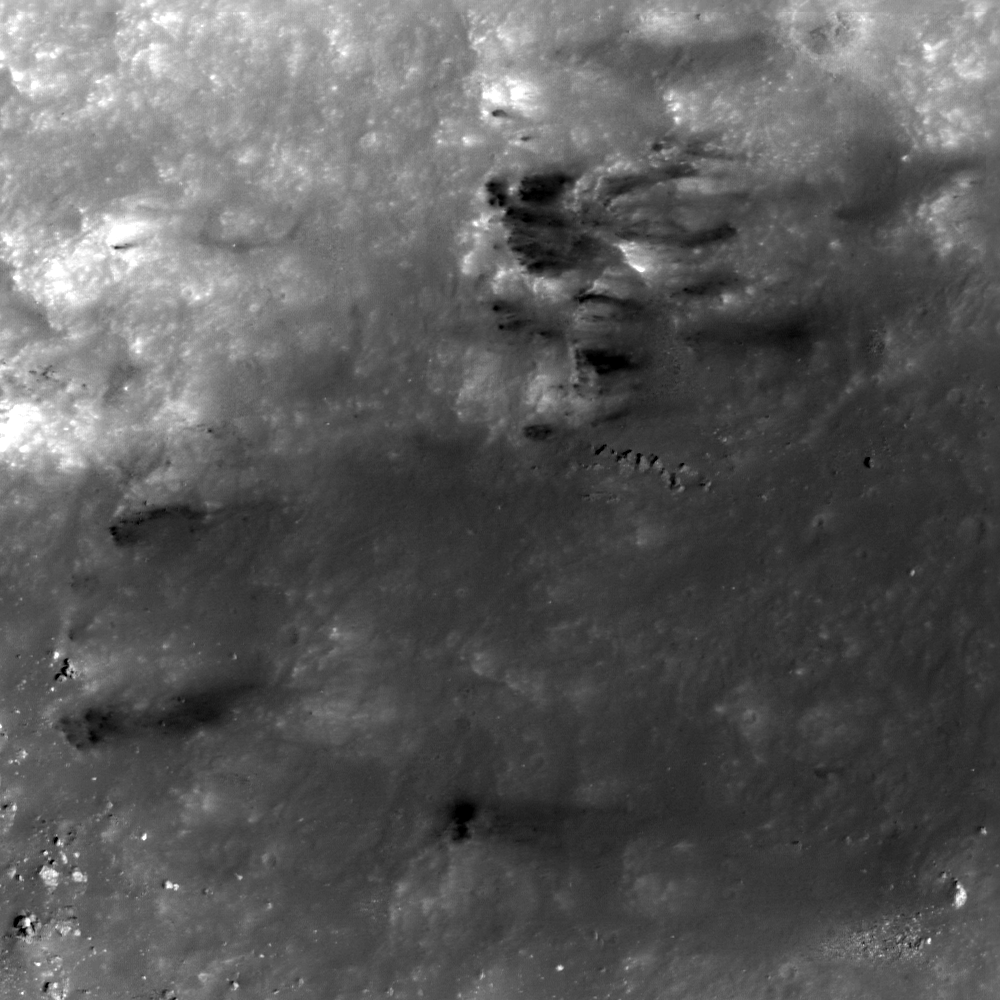
Dark streaks ornament a slope along the Copernicus crater rim (9.3°N, 21.5°W). Down-slope is to the right. LROC Narrow Angle Camera (NAC) observation M11735067L, LRO orbit 1600, November 1, 2009; incidence angle 32°, Sun is from the east, north is up, field of view is roughly 400 meters across. View the full size LROC Featured Image HERE [NASA/GSFC/Arizona State University].

James Ashley
LROC News System

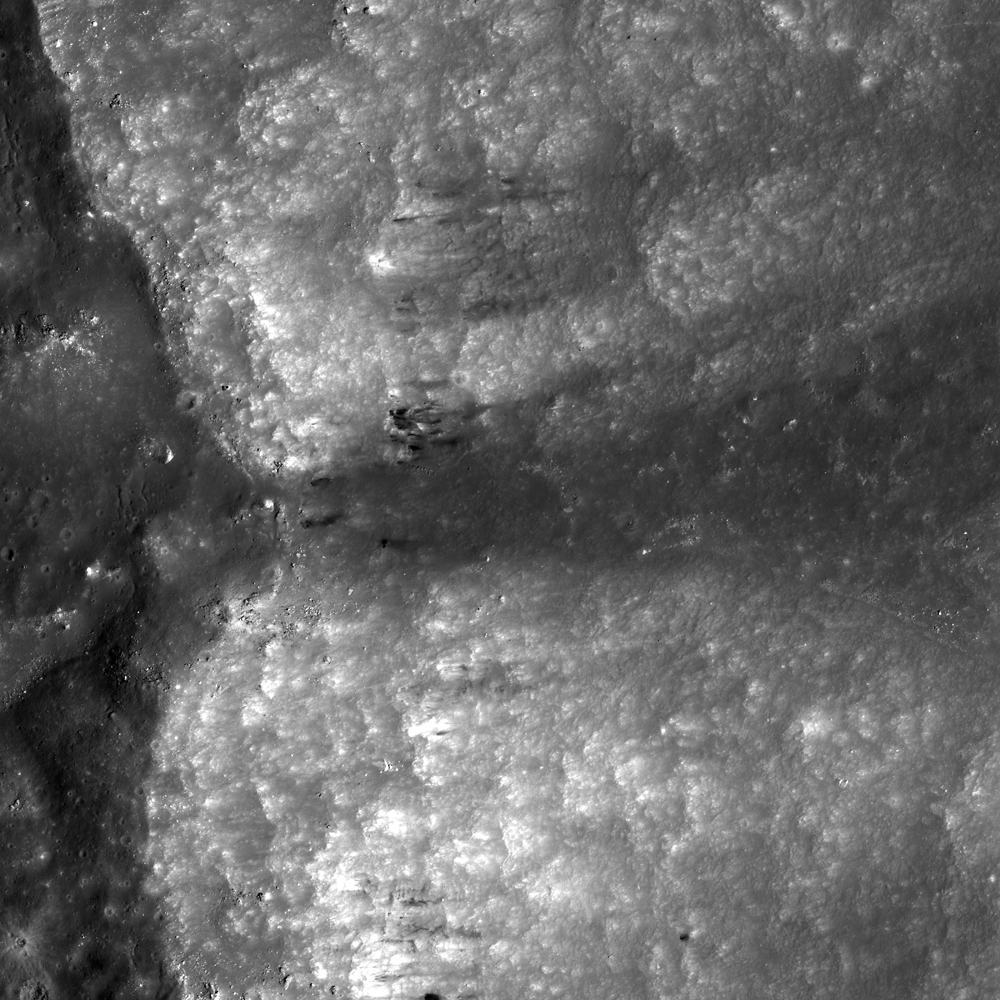
What are these low-reflectance (dark), wispy streaks? The differences in color among lunar deposits is often understood in terms of composition and/or intensity of space weathering (which can discolor soils over time). When they become mixed (often from cratering events), they can produce areas of high color contrast. Most of them seem to have the lowest reflectance at the points highest in elevation on the crater wall (to the left), and become more reflective down-slope (to the right). The features in this image seem to cluster near a promontory that has its own streak of material, emanating as a fan-shaped curtain (see context image below).


From a wider view of LROC NAC M11735067L, showing the association of a promontory's location with the occurrence of the dark deposits (See next image). Field of view roughly 2.2 km across (downsampled from 50 cm/pixel to approximately 2.3 meters/pixel. View the full size LROC context image HERE [NASA/GSFC/Arizona State University].


An artificial perspective of the massive slumped inner slope of the east rim of Copernicus made possible by NASA's ILIADS program. The topography represents laser altimetry collected by LOLA overlaid with morning Terrain Camera imagery from Japan's lunar orbiter Kaguya. (The LROC Featured Image is a close up from overhead of the slot in the crater rim, left of upper center.) View a HDTV orbital still showing Copernicus HERE [NASA/GSFC/MSFC/JAXA/SELENE].

There are several possible explanations for how the smaller, low-reflectance features formed. For example, these dark patches may represent mare basalts that were buried and re-exposed by the formation of Copernicus and subsequent mass wasting. Another possibility is that the low-reflectance materials are dikes or sills (intrusive igneous bodies) that pre-date the Copernicus impact and are now weathering out. Still a third possibility is that mare basalt debris were ejected by a nearby impact and deposited here, perhaps encouraging the erosion of the promontory in the process - or landing near the promontory by coincidence. In this later scenario, each block of ejecta might then have fragmented upon impact and migrated down-slope as individual debris aprons. There are several nearby, relatively recent craters outside of the Copernicus rim that could be responsible for this type of deposition. Are there any additional clues that could be looked for to further solve this mystery?


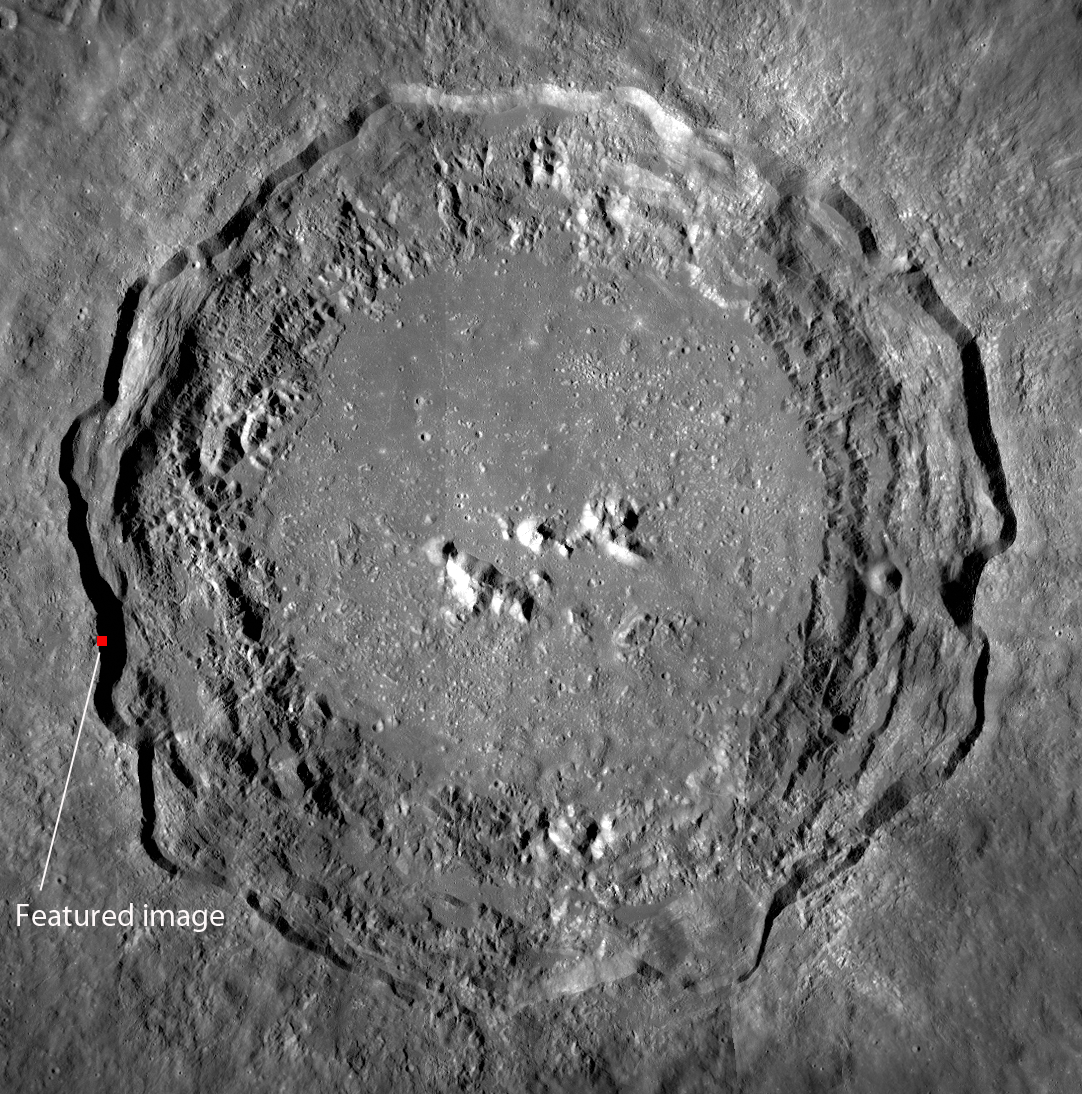
A 54.6 meter per pixel LROC Wide Angle Camera (WAC) perspective centered on the area of interest, on the west-southwestern rim of Copernicus. LROC WAC M131793087C (604 nm), LRO orbit 4556, June 21, 2010; little more than a day after local sunrise, incidence angle 82.2° [NASA/GSFC/Arizona State University].


Above, the LROC WAC context image showing the expanse of Copernicus provides a sense for how steep the outermost walls of the 95 km-wide crater are, and the location of area highlighted in the Featured Image released September 20, 2011. View the full size LROC WAC context image HERE [NASA/GSFC/Arizona State University].

Review the full NAC image HERE to look for more examples.

Related posts:
Dark streaks in Diophantus crater
Dichotomy

Friday, September 16, 2011

It's the Moon's fault


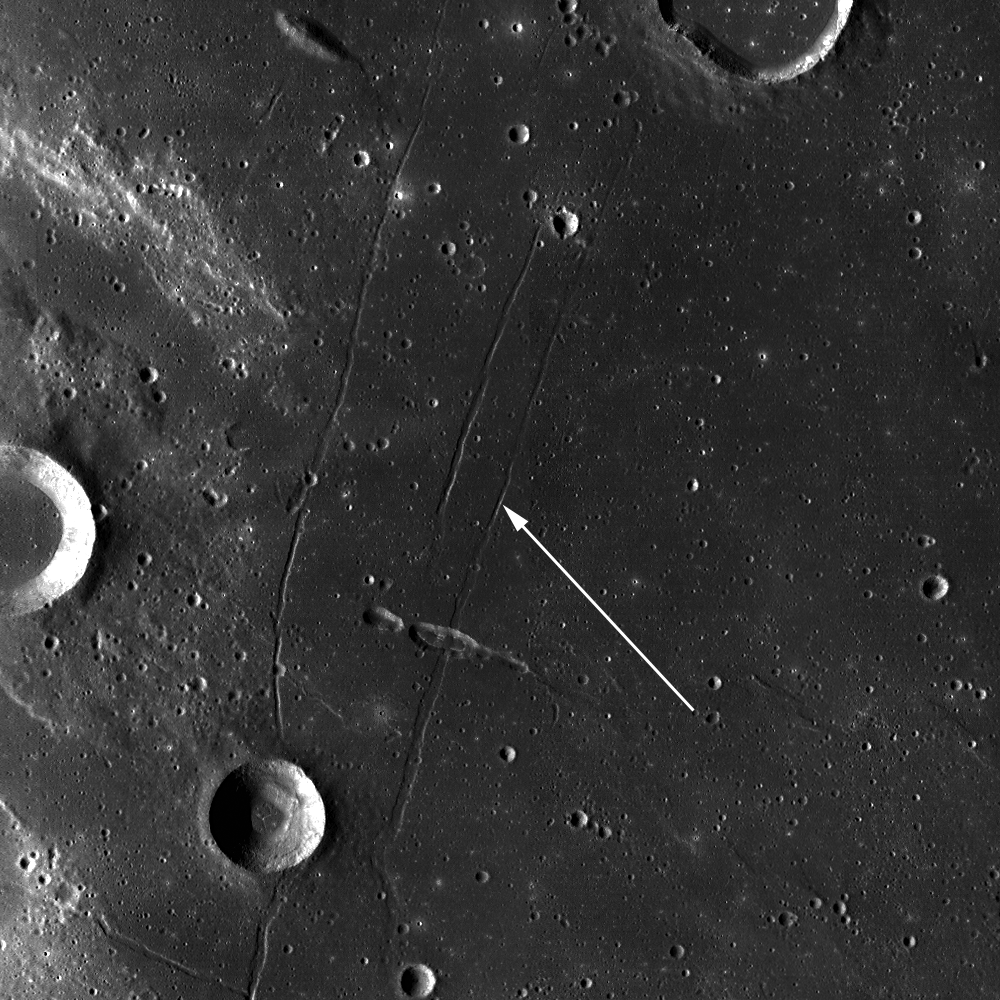
Linear rille in Mare Tranquillitatis, the result of extensional stresses. What caused the offset in the rille on the east wall? LROC Narrow Angle Camera (NAC) observation M146858595LE, LRO orbit 6776, December 13, 2010, field of view 700 meters. See the full size LROC Featured Image HERE [NASA/GSFC/Arizona State University].

Drew Enns
LROC News System

Linear rilles are so named because of their nearly-straight morphology and surface expression. Unlike sinuous rilles, which are volcanic, linear rilles are tectonic in nature. Similar features on Earth are termed graben, and are created when two normal faults border a block of rock which has been depressed, producing a valley.

Since normal faults are understood to be the products of extensional stresses (see yesterday's Featured Image post), we can assume this region of the Moon was "pulled apart" - creating these normal faults, dropping the middle blocks, and producing the linear rilles. So a linear rille is the lunar analog of a graben on Earth!


Full two kilometer width segment of LROC NAC frame M146858595LE, showing the approximate location of the LROC Featured Image, September 15, 2011 [NASA/GSFC/Arizona State University].


LROC Wide Angle Camera (WAC) context images of the Rimae Sosigenes extensional linear rille system in the northeast Mare Tranquillitatis, between the Arago domes (out of view, to the south and east) and the craters Sosigenes and its smaller namesake Sosigenes A. one rille is cross-cut with a close-grouped and prominent secondary crater chain, well-known to well-equipped telescopic observers when the morning terminator passes over five days following a New Moon. WAC monochrome (566 nm) mosaic from orbits 4515-4517, June 18, 2010. See the original LROC WAC context image HERE [NASA/GSFC/Arizona State University].

In today's featured image, two normal faults appear to be offset.

What are we seeing here?


Is Mare Tranquillitatis really an impact basin? Looks can be deceiving, when comparing two familiar and neighboring basins, each flooded multiple times with volcanic flows. Dark and optically-mature regolith covers both Mare Serenitatis (top center) and Tranquillitatis (below - the area of interest is indicated with the yellow area), though the differences in color of each are obvious even in black and white photographs. But In this false-color LOLA elevation map, the nature of Mare Tranquillitatis is less obvious, until one examines more closely and sees how the weight of material infilling the Tranquillitatis plain may have led to finer features like wrinkle ridges and extensional rilles [NASA/GSFC/LOLA/MSFC/LMMP].

It is probably an en echelon step between the two normal faults making up the east wall of the rille. When two faults are near to each other, they can interact and create an en echelon step that helps to even out the displacement and forces that created the faults. En echelon steps are common, and are seen in other tectonic features on the Moon.

Can you find any more faults in the full NAC frame?

Related Posts:
Rima Bürg
Rima Ariadaeus - A Linear Rille

Sunday, September 11, 2011

The thinking behind the GRAIL twins


A useful view of our heterogeneous Moon. A practical illustration of the thinking behind the GRAIL project. From several thousand kilometers above the southern hemisphere and just below the equator of the lunar Farside it’s easier to see our Moon is “lumpy;” perhaps like the asteroids, it's own mass isn't high enough to crush it into a unified solid. From the standpoint of gravity the Moon retains the the memory of the smaller solid and semi-solid bodies from both before and after it's original formation. So nothing stays in close orbit around the Moon for very long without getting a frequent boost, and such boosts need fuel and fuel eventually runs out. This false color map of the lunar surface shows, in low resolution, differences from average elevation, or datum. Mare Orientale is on the right, and just beyond, so a crescent of the Nearside’s is visible. The expanse of the Farside here is defined, by the ancient South Pole Aitken basin, with the Moon's thinnest crusts, below center left, and by the Moon’s highest elevations and thickest crusts in the Farside highlands spread above the SPA rim (yellow box shows field of view in the next illustration [NASA/GSFC/MSFC/LOLA/LMMP/LP].

The Lunar Reconnaissance Orbiter (LRO) has orbited the Moon over 10,000 times since June 2009, mostly in a low and circular polar orbit. It requires a monthly boost to keep its record-breaking mission going. A common demonstration of the Moon's mass concentration (MASCON) problem is a thought experiment. A future astronaut stands on the rim of the Nearside impact basin Mare Imbrium holding a weight suspended a meter below a gloved hand sees that it doesn't hang straight down. Instead it hangs angling slightly toward the center of the basin hundreds of kilometers away. Anything in orbit is alternately tugged or gains slack changing its speed, causing it to eventually crash. This inconvenience, when carefully recorded and studied, is also a good way of mapping the Moon's interior in 3D.

The elevation map above shows how radically different the Moon’s Farside is from the familiar Nearside. In a photographs the extent of the 4 billion year-old SPA basin and the higher ground and its rim don’t stand out nearly as well. The map is plotted from millions of laser points measured from LRO's orbit to and from the lunar surface by the LOLA instrument, shown here using the ILIADS program available from NASA Marshall Space Flight Center. The yellow rectangle shows the field of view shown in an August 2011 release of LOLA science from the Goddard Space Flight Center.


NASA/GSFC, August 15, 2011 - Twenty-five years have passed since seven brave astronauts lost their lives in the Challenger accident. As the Shuttle program comes to an end, we are reminded of those who lost their lives in the pursuit of human exploration. Shortly after the accident, the Challenger astronauts were memorialized by having lunar craters named after them. These seven craters, located on the far side of the Moon in the Apollo Basin, expose deep portions of the lunar crust.

This LOLA image reveals that the depths of McNair and Jarvis craters, in particular, reach nearly 7 km below the lunar datum (the Moon's equivalent of 'sea level'). The depth of McNair and Jarvis is due to their placement within the large Apollo Basin (an existing topographic low) as well as the Apollo Basins location in the even larger South Pole-Aitken Basin. When combined with data from other LRO instruments such as LROC and Diviner, and instruments aboard other spacecraft such as the Moon Mineralogy Mapper (M3) aboard Chandrayaan-1, the complex nature of the Challenger craters is revealed. Data from the M3 instrument reveal that Jarvis crater's composition may represents a deep portion of the lunar crust.

References

Steigerwald, B. (2010) "Biggest, Deepest Crater Exposes Hidden, Ancient Moon," June 2, 2011.
Robinson, M. (2011) "Challenger Astronauts Memorialized on the Moon," January 28, 2011, LROC
Petro, N., et al. (2010) "Lower Crustal Materials Exposed in the Apollo Basin Revealed Using Moon Mineralogy Mapper (M3) Data," 41st Lunar and Planetary Science Conference, #1802, March 2010.

LOLA original map: small | large 


Japan’s lunar orbiter Kaguya (SELENE-1, 2007-2009) vastly added to our knowledge about the “hidden Moon” originally gathered through the Apollo era and afterward, stitched together by 2005. Along with the first HDTV from lunar orbit, Kaguya was a platform for a variety of instruments, including laser altimetry, like LRO. The Kaguya LALT system itself built up an elevation map that is only very recently being surpassed by LOLA during the past two years.

Using their links with Kaguya, with its sub-satellite R-SAT, and in a manner very much like the mission plan for GRAIL-A and B, JAXA investigators delicately measured Doppler shift and subtle light-speed changes between each orbiting spacecraft and with the ground to built-up a detailed map of the Moon’s "gravimetric anomalies."

Together with the unprecedented detail of the Moon’s crustal thicknesses, seen in maps like the one below, Kaguya presented scientists with new and very much more detailed faces of the Moon. Kaguya investigators also helped refine the elusive center of the Moon, from within 20 to 2 kilometers, much more.


The relative thickness of the lunar crust as teased out by Japan's Kaguya orbiter and its sub-satellite R-SAT. The Moon's MASCONS and 'negative gravity anomalies' don't necessarily manifest themselves in surface features, like the one associated with Mare Imbrium.[JAXA].

GRAIL-A and B will join LRO and the recommissioned ARTEMIS twins for a grand total five American unmanned lunar missions, all orbiting the Moon at the same time by the end of the year. The skies above the Moon will become nearly as crowded as those of Mars.

The GRAIL twins will pick up the task of mapping our lumpy Moon’s mass, ARTEMIS the intricacies of the Moon’s plasma wake and its interaction with Solar wind as the Moon orbits through Earth’s magneto-tail with LRO continuing to map the lunar surface from more lasting, slightly higher polar orbit.

All this latter-day renewed interest in the Moon began as preparation for an eventual return, inspired by the loss of Columbia in 2003. That original timeline for renewed, extended human activity on the Moon may seem much further away once again, for the moment, but these unmanned “precursor missions” set into motion through the vagaries of reaction to tragedy or short-term public policy shifts are well along in the pipeline, on time and under budget.


LROC Wide Angle Camera (WAC) monochrome (604nm) mosaic of northeastern Apollo basin, from observations in LRO orbits 2068 and 2069, December 8, 2009; field of view roughly 120 km, resolution 78 meters per pixel, incidence 70° The depth of the interior floor of Jarvis and McNair, the larger and smaller of the two co-joined craters, respectively, and the largest feature seen above, are roughly 7,000 meters below lunar mean elevation. [NASA/GSFC/Arizona State University].

Saturday, January 29, 2011

New Robotic Lander Prototype skates tests


The Robotic Lander Prototype produced at Marshall Space Flight Center, on modified skateboards and a customized track system (a low-cost solution to control movement during final testing of the prototype’s sensors, on-board computer and thrusters [NASA/TBE].

Kim Newton
Marshall Space Flight Center

NASA engineers successfully integrated and completed system testing on a new robotic lander recently at Teledyne Brown Engineering’s facility in Huntsville in support of the Robotic Lunar Lander Project at NASA's Marshall Space Flight Center in Huntsville, Alabama.

The lander prototype was placed on modified skateboards and a customized track system as a low-cost solution to control movement during final testing of the prototype’s sensors, onboard computer, and thrusters. The functional test focused on ensuring that all system components work seamlessly to sense, communicate, and command the lander's movements.

The prototype will be transported to the United States Army Redstone Arsenal Test Center in Huntsville this week to begin strap-down testing, which will lead to free-flying tests later this year.

The lander prototype will aid NASA’s development of a new generation of small, smart, versatile landers for airless bodies such as the moon and asteroids. The lander's design is based on cutting-edge technology, which allows precision landing in high-risk, but high-priority areas, enabling NASA to achieve scientific and exploration goals in previously unexplored locations.

Development of the lander prototype is a cooperative endeavor led by the Robotic Lunar Lander Development Project at the Marshall Center, Johns Hopkins Applied Physics Laboratory of Laurel, Maryland and the Von Braun Center for Science and Innovation, which includes the Science Applications International Corporation, Dynetics Corporation, Teledyne Brown Engineering, Inc. and Millennium Engineering and Integration Company, all of Huntsville.

For more information on the Robotic Lunar Lander Development Project, please visit http://www.nasa.gov/roboticlander.

Tuesday, August 17, 2010

NASA update: ILN Anchor Nodes and Robotic Lunar Lander Project

Updated August 18, 2010 1648 UT
Global Lunar Conference, Beijing
May 31- June 3, 2010

Exploration configuration. Refinements continue on designs for NASA's multipurpose lunar lander bus, while a timetable for deploying an unknown number of Anchor Nodes for the International Lunar Network (ILN) and the fate of a recommended Lunar Polar Volatiles exploration mission to the lunar surface remain on hold, awaiting hints of what will appear in the next Planetary Science Decadal Survey (2013-2022), expected in January 2011 [NASA/MSFC].

Brian J. Morse, Cheryl L. B. Reed
& Karen W. Kirby
Johns Hopkins, Applied Physics Lab

Barbara A. Cohen, Julie A. Bassler, Danny W. Harris
& D. Gregory Chavers
NASA Marshall Space Flight Center

ABSTRACT: In early 2008, NASA established the Lunar Quest Program, a new lunar science research program within NASA’s Science Mission Directorate. The program included the establishment of the anchor nodes of the International Lunar Network (ILN), a network of lunar science stations envisioned to be emplaced by multiple nations. This paper describes the current status of the ILN Anchor Nodes mission development and the lander risk-reduction design, and test activities implemented jointly by NASA’s Marshall Space Flight Center and The Johns Hopkins University Applied Physics Laboratory. The lunar lander concepts developed by this team are applicable to multiple science missions, and this paper will describe a mission combining the functionality of an ILN node with an investigation of lunar polar volatiles.

INTRODUCTION:

NASA Robotic Lunar Lander development. One of the defining features of the U.S. Vision for Space Exploration, established by the former administration and studied by NASA for the past 4 years, is the goal of a human return to the Moon to live and work for extended periods. Whether that plan will be executed, however, has grown increasingly uncertain. Turbulent economic times, along with the need for the new administration to set its own priorities, have resulted in a complete review of U.S. space policy and NASA’s programs.

Many months remain before the process will be complete and new plans can be developed. But even in the face of this uncertainty, it is clear that the Moon is of significant scientific importance to NASA and many other nations and is a prime target for low-cost robotic missions that can be undertaken by most of the world’s space programs. Thus, it can be expected that lunar robotic missions will remain a high priority while the U.S. human exploration program is restructured; when humans begin to venture beyond low-Earth orbit to the Moon, near-Earth objects, and eventually Mars, the generic technological capabilities developed through lunar robotic missions will serve as important steps toward future achievements. The Moon contains a wealth of scientific information about planetary formation and the origins of Earth.

NASA has a rich portfolio of lunar flight projects, including two payloads on India’s Chandrayaan-1; the Lunar Reconnaissance Orbiter (LRO); the Lunar CRater Observation and Sensing Satellite (LCROSS); the Gravity Recovery and Interior Laboratory (GRAIL); the Acceleration, Reconnection, Turbulence and Electrodynamics of Moon’s Interaction with the Sun (ARTEMIS) mission; and the Lunar Atmosphere and Dust Environment Explorer (LADEE) mission.

Other nations, including China, Japan, and India, also have emergent lunar portfolios. During this exciting time for lunar science, many significant scientific discoveries are just being realized from these flights, including the likely orbital confirmation of trapped water-ice on the lunar surface.

In addition, the U.S. National Research Council (NRC) is in the early stages of its new Decadal Survey for Planetary Science, which establishes priorities to be incorporated into the roadmap for NASA’s Planetary Division of the Science Mission Directorate (SMD).

The final report will not be ready until January 2011, but the results of many current planetary studies will be publicized along the way, previewing expected planetary (and lunar) priorities for the next 10 years. Internationally, multiple space-faring nations are concurrently planning robotic missions to the Moon. To maximize the scientific return of these efforts, nine national space agencies signed a statement of intent to establish a set of robotic lunar landers in a geophysical network on the surface of the Moon.

This collaborative initiative is known as the International Lunar Network (ILN). ILN nodes will fly a core set of instruments, plus additional passive, active, in situ resource utilization (ISRU), or engineering experiments, as desired by each space agency. Participants’ contributions can be landers, orbiters, instrumentation, or other significant infrastructure contributions, including communications capabilities, which in total will comprise the ILN.

From Lunar Pioneer Album 2 --
Anchor node of the International Lunar Network (ILN), hosted by the multi-use lander, now well along in development. The new generation configuration is shown here in an unlikely spot, if ILN ultimately turns out to be a sparse seismographic network (i.e., south central Mare Imbrium, in sight of Mons La Hire) [NASA/MSFC/JHU-APL].

The envisioned U.S. contribution to the ILN was the Anchor Nodes mission to be implemented jointly by NASA’s Marshall Space Flight Center (MSFC) and The Johns Hopkins University Applied Physics Laboratory (JHU/APL).

The ILN Anchor Nodes mission would develop a broad lander capability and establish surface and embedded elements to better characterize the structure and composition of the lunar interior. The United States originally envisioned launching the first two nodes to the mid-latitude regions in the 2015–2016 time frame, with an option to launch two more nodes shortly thereafter.

Alternatively, NASA could launch all four nodes in the 2017–2018 time frame. However, the specific science to be conducted, and the payload suite to carry out these measurements, could change, given the recently published lunar water-ice discoveries and the forthcoming results of the Decadal Survey. Discussions continue with NASA’s international partners to provide additional nodes within this time frame to constitute the first lunar scientific network.

Regardless of the specific science objectives, the goals of the Anchor Nodes mission will remain technically and programmatically challenging. These goals include the placement of multiple nodes on the near side of the Moon, continuous operations through many years of lunar eclipse, low-mass and low-power subsystems and instruments, and a minimum 6-year lifetime. Future nodes are planned for the far side of the Moon, for which lunar–Earth communication and navigation solutions are under consideration by countries supporting the ILN.

From Lunar Pioneer Album 1 --
In September 2009, Marshall Space Flight Center in Huntsville, Alabama announced the beginning of tests of a new robotic lunar lander test bed to aid development of a new generation of multi-use landers for robotic space exploration. The Phase One Cold Gas Test Article is equipped with thrusters to guide the lander, one set to control the vehicle's attitude, altitude and landing and additional thrust to offset the effect Earth’s gravity to simulate a lunar environment. By June 2010, the CGTA has been put through its paces 150 times [NASA/MSFC].

After the completion of an extended pre-Phase A study, the implementation of an ILN Anchor Nodes mission was placed on hold pending the resolution of the above-mentioned uncertainties. The MSFC–JHU/APL team was renamed the Robotic Lunar Lander Development Project (RLLDP) with the scope to complete an array of lander technology risk-reduction tasks and to perform studies on other missions that address some of the key science and exploration priorities.

One such mission combined the functionality of a single ILN node with instruments to prospect for volatiles in a fixed location within a permanently shadowed lunar polar crater. The latest data from lunar orbiting observatories have further fueled interest in attaining “ground truth” for the presence of volatiles, including water-ice, in permanently shadowed craters.

The single-site approach is limited in its ability to fully satisfy key science goals associated either with the ILN mission or with a desire to fully characterize the volatile distribution, but it represents a much more affordable single mission that, combined with other missions, could more fully address these goals. The results of this study and the status of the risk-reduction tasks spanning technologies in propulsion; guidance, navigation, and control; power; avionics; thermal; and structures and mechanisms are documented in this paper.

SCIENCE. The Moon provides an important window into the early history of the Earth, containing information about planetary composition, magmatic evolution, surface bombardment, and exposure to the space environment.

Despite more than 4 decades of intensive study, many aspects of the Moon remain to be determined. One of the key motivations for studying the Moon is to better understand the origin of the planets of the inner solar system in general and that of Earth in particular.

The NRC report, New Frontiers in the Solar System: An Integrated Exploration Strategy (the Planetary Science Decadal Survey), is the principal roadmap for solar system exploration, providing a community-based weighting of science priorities across the solar system, including the Earth’s Moon. In this document, the Inner Planets Panel asserted that the inner solar system affords the opportunity to address broad objectives for understanding the history, current state, and potential future of habitable planets. Landed missions were recommended by the panel for all of the terrestrial planets—Mars, Venus, Mercury, and the Moon—in order to address multiple key aspects of inner solar system science.

The next Planetary Science Decadal Survey for the period 2013–2023 is currently under way. This report will not be ready until January 2011, but the results of many current planetary studies will be publicized along the way, previewing expected planetary (and lunar) priorities for the next 10 years.

In support of this activity, the lunar science community articulated and prioritized its science objectives in a set of 35 white papers, painting a coherent and compelling picture of the importance of lunar science to understanding differentiation of planets, the bombardment history of the inner solar system, and processes unique to airless bodies. Two candidate lunar lander missions—a geophysical network and an in situ polar volatile explorer—were studied and presented to the Decadal Survey by this team in order to address multiple key aspects of lunar and planetary science.

Lander technology developed for any of these missions will have significant feedforward to other missions to the Moon and indeed, to other airless bodies such as Mercury, asteroids, and Europa, to which many of the same science objectives are applicable.

Read the Report and Presentations (pdf), HERE.

From Lunar Pioneer Album 3 --
Warm Gas Test Article, currently slated for testing at Marshall Space Flight Center, takes the multi-use lander design testing beyond the maneuver, attitude control and landing thrust demonstrated using the Cold Gas Test Article began in 2009. Testing can now begin for critical maneuvers like Terminal Descent [NASA/MSFC].

Related:
Robot Landers for Science & Exploration
Chavers & Cohen, et.al. [JHU-APL/MSFC]
7th International Planetary Probe Workshop (IPPW-7)
Barcelona, June 12-18, 2010

Monday, August 16, 2010

The impact history of the Moon

From 41st Lunar & Planetary Science Conference (2010) -

The history of the Moon is the history of Earth, and the testimony of the Moon is saturation bombardment. The history of the inner solar system is recorded there also, safe far from the dynamic lithosphere and atmospheric erosion ever-present here on Earth. Even before the preliminary glance (above) at laser altimetry from LOLA, on-board LRO, was presented, 300 impact basins were already identified on the Moon. Most are not as apparent as the familiar "basin-forming impacts" visible to the naked eye, clustered on the Moon's near side (on the left side of the projection of the Moon's eastern hemisphere above). Was a gradual fall-off in both the size and frequency of impacts on the Moon, preserved over 4.5 billion years, steady or were there peaks and valleys in that long process? If so, what caused those events, and how often? Are they cyclical? The Moon holds the answers, a convenient recording of Earth's past. Almost certainly, our companion Moon will tell us something about Earth's future, also [NASA/GSFC].

Barbara A. Cohen
NASA Marshall Space Flight Center (MSFC)

The bombardment history of the Earth-Moon system has been debated since the first recognition that the circular features on the Moon may be impact craters. Because the lunar impact record is the only planetary impact record to be calibrated with absolute ages, it underpins our understanding of geologic ages on every other terrestrial planet.

One of the more remarkable results to come out of lunar sample analyses is the hypothesis that a large number of impact events occurred on the Moon during a narrow window in time approximately 3.8 to 4.1 billion years ago (the lunar “cataclysm”).

Subsequent work on the lunar and martian meteorite suites; remote sensing of the Moon, Mars, asteroids, and icy satellites; improved dynamical modeling; and investigation of terrestrial zircons extend the cataclysm hypothesis to the Earth, other terrestrial planets, and possibly the entire solar system. Renewed US and international interest in exploring the Moon offers new potential to constrain the Earth-Moon bombardment history.

This paper will review the lunar bombardment record, timing and mechanisms for cataclysmic bombardment, and questions that may be answered in a new age of exploration.

View the presentation (pdf), HERE.

Saturday, March 6, 2010

Marshall hosts the 2010 Great Moonbuggy Race


A team from Ohio State University competes at NASA's 16th annual Great Moonbuggy Race. This year's race is shaping up to be one of the best ever! Approximately 75 high school and college teams from around the world are competing in Huntsville, Ala., on April 9-10. It's an off-world racing event like no other! Check back at the NASA Moonbuggy site for the latest news and photos. NASA hosts the 2009 competition photo gallery here. [NASA/MSFC].

The 17th Annual Great Moonbuggy Race will be held April 9-10, 2010 in Huntsville, Alabama, at the U.S. Space & Rocket Center. Student teams are required to design vehicles around a gauntlet of engineering challenges similar to problems faced by the original Apollo moon rover team.

Each Moonbuggy is human powered and carries two students, one female and one male, over a half-mile simulated lunar terrain, including "craters," rocks, "lava" ridges, inclines and "lunar" regolith.

Vehicles are expected to be of "proof-of-concept" engineering test models rather than final production models. Each student team of six members is responsible for building their own buggy, and drivers chosen from each team must also be among the vehicle's builders.

As a part of the competition, and prior to course testing, the disassembled Moonbuggy entries must be carried to the starting line with components contained within a volume of 4' x 4' x 4' - constraints similar to those faced by the original Lunar Roving Vehicle. At the starting line, the entries will be assembled and readied for course testing and evaluated for safety. Assembly occurs one time prior to the first course run.

The top three winning teams in one high school and one college division will be those consuming the shortest total time assembling their vehicles and traversing the course. Each team is permitted two runs of the course, and the shortest course time will be added to the assembly time for the final event total.

Some 1,088 high school, college and university students from 20 states and Puerto Rico, Canada, Germany, Bangladesh, Serbia, India and Romania are enrolled to participate in the race this year.

Students start preparing for the race during the fall semester. They must design, build and test a sturdy, collapsible, lightweight vehicle that addresses engineering problems like those overcome by the original Apollo-era lunar rover development team at Marshall Space Flight Center in Huntsville for the Apollo science "J" missions, beginning with Apollo 15 in 1971.

Top prizes are awarded to the three teams in both the high school and college/university divisions that post the fastest race times, which include assembly and penalty times. A variety of other prizes are given by race corporate sponsors. These include “rookie of the year” and the “featherweight” award, presented to the team with the lightest, fastest buggy.

“NASA is committed to inspiring young people in science, technology, engineering and math, and the Great Moonbuggy Race is an excellent way for us to reach out to young people and get them excited and involved in technical opportunities available to them,” said Mike Selby, an avionics technical assistant in the Marshall Space Flight Center’s Engineering Directorate.

While completing his engineering degree at the University of Alabama in Huntsville, Selby was a member of the school’s moonbuggy teams, helping them to a second-place finish in 1995 and first place in 1996. Since 2001, he has served each year as a volunteer scorekeeper.

The race is hosted by the U.S. Space and Rocket Center and is sponsored by Lockheed Martin Corporation, The Boeing Company, Northrop Grumman Corporation, and Jacobs Engineering ESTS Group.

Monday, January 25, 2010

Geohazards on the Moon and the importance of the International Lunar Network (ILN)

From Lunar Pioneer
International Lunar Network (ILN) "node" notionally superimposed within the actual topography of the southern Mare Imbrium basin, just south of Mons La Hire, whose eastern flanks are lit with dawn. Fanciful though it might be as seen within the lunar equivalent of "street view" in Google Earth, this is unlikely ever to be a landing site for the ILN. The architecture for the lander, however, represents what the ILN team expects from the international effort to finish the job left unfinished after the Apollo Lunar Surface Experiment instruments were defunded and shut down in 1977. [LP/NASA/MSFC/ILN]

Barbara A. Cohen
and the MSFC/APL ILN Team
NASA Marshall Space Flight Center


Seven of the 28 shallow seismic events recorded by the Apollo passive seismic experiment (PSE) network released energy equivalent to earthquakes with magnitudes of 5 or greater. On Earth, such quakes can cause extensive damage to structures near the epicenter. Unexpected structural damage to a lunar habitat could have devastating results and thus, lunar seismicity may present a significant geohazard to long-term human habitation.

Seismic Hazard? Lunar seismicity is 3-5 orders of magnitude lower than Earth. However, the propagation of quake energy is strikingly different on the Moon than on the Earth. The Moon is largely anhydrous and its crust is extensively fractured; the resulting high lunar Q values mean that moonquake attenuation is low. The maximum signal from a shallow moonquake can last up to 10 minutes with a slow tailing off that can continue for hours in total duration, and moonquakes tend to produce seismic waves of higher frequency than earthquakes. Ground motion is the most important factor in causing structural damage, and on the Moon, the observed ground motion of the PSE instruments during moonquakes were typically less than 1 nanometer and artificial seismic signals dampened out within ~ 10 km. However, the Apollo PSEs never recorded a strong shallow moonquake directly below the seismic network.

One mechanism for generation of shallow moonquakes may be lithospheric stress at terrain boundaries such as basaltic mare or large impact basins. If this mechanism is valid, siting a lunar base on the edge of the largest, deepest lunar basin (SPA) could put it at increased seismic risk. We do not yet have enough data on strong, shallow moonquakes to understand their cause, depth, or lateral distribution. Predicting where shallow moonquakes may occur is important for the next phase of lunar exploration.

To evaluate a potential lunar seismic risk, two approaches are needed. First, further research to understand and effectively model lunar ground motion and acceleration by applying advanced terrestrial models and numerical techniques to the lunar environment is crucial. Second, a long-lived, global lunar seismic network needs to be established to globally characterize lunar seismicity and establish the origin, frequency, and propagation of strong moonquakes.

The ILN Mission: NASA’s Science Mission Directorate’s (SMD) International Lunar Network Anchor Nodes Mission continues its concept development. The mission will establish two-four nodes ofthe International Lunar Network (ILN), a network of lunar geophysical stations envisioned to be emplaced by the many nations collaborating on this joint endeavor. The US stations of the ILN, called the Anchor Nodes, are being planned by NASA Marshall Space Flight Center (MSFC) and the Johns Hopkins University Applied Physics Laboratory (APL), with contributions from JPL, ARC, GRC, DOD, and industry.

The Anchor Nodes project has progressed through pre-Phase A design activities and is currently conducting an extended risk reduction program. Risk reduction activities include propulsion thruster testing; thermal control testing and demonstration; low power avionics development; composite coupon testing and evaluation; landing leg stability and vibration; and demonstration of landing algorithms in the MSFC Lunar Lander Robotic Exploration Testbed, which was established in support of risk reduction testing to demonstrate ILN capabilities. An MSFC test vehicle using an Anchor Nodes-like design and a compressed air propulsion system is in use for demonstration of control software. A second version of the MSFC vehicle is planned that will utilize an alternate propulsion system for longer duration flight and descent testing. The upgraded test vehicle will also integrate flight-like components for risk reduction testing, such as landing sensors (cameras, altimeters), instruments, and structural features (landing legs, deployment mechanisms).

International Participation: Representatives from space agencies in Canada, France, Germany, India, Italy, Japan, the Republic of Korea, the United Kingdom, and the United States agreed on a statement of intent for near and long-term evolution and implementation of the ILN. Working groups are addressing potential landing sites, interoperable spectrum and communications standards, and a set of scientifically equivalent core instrumentation to carry out specific measurements.

Summary: The concept of an International Lunar Network provides an organizing theme for US and International landed science missions in the next decade by involving each landed station as a node in a geophysical network. Creation of such a network will dramatically enhance our knowledge regarding the internal structure and composition of the moon, as well as yield important knowledge for the safe and efficient construction and maintenance of a permanent lunar outpost.

Saturday, December 5, 2009

NASA challenges rocketeers to aim a mile high

Huntsville -- NASA has invited more than 350 student rocketeers from middle schools, high schools, colleges and universities -- 37 teams nationwide -- to take part in the 2009-2010 NASA Student Launch Projects.

Their challenge is to build powerful rockets of their own design, complete with a working science payload, and launch them to an altitude of 1 mile.

Read the news release HERE.

Thursday, October 29, 2009

Interview with Ed Ethridge

Interview with Ed Ethridge, at MSFC, from a recent NASA Science Express highlighting steadily advancing research with in-situ resource utilization (ISRU).

Sandeep Ravindran
Popular Science

Last month, scientists confirmed the widespread presence of small amounts of water on the moon. This landmark finding was followed by NASA's crashing its LCROSS probe into a crater in the lunar south pole, generating data which is currently being analyzed to determine the extent of water present around the impact site. Water extracted from the lunar soil could be used to sustain life and to generate rocket propellant. PopSci.com spoke to Ed Ethridge of NASA's Marshall Space Flight Center, who has been studying how microwaves could be used to extract water from lunar soil.

Why use microwaves?

The thermal conductivity of the moon's soil is very low, which was something that the Apollo astronauts found. So we can't heat the soil just by shining the sun's rays on it, they would just get reflected. The advantage of microwaves is that they penetrate and heat the soil from the inside.

Read the Interview HERE.

Thursday, October 22, 2009

Shelby calls Augustine panel 'worthless'

Robert Block
The Write Stuff
Orlando Sentinel

Senator Richard Shelby launched a preemptive strike on President Barack Obama's blue ribbon space panel the day before it was due to release its final report, calling the committee’s findings “worthless.”

Shelby, a staunch defender of NASA’s Marshal Space Flight Center In Huntsville, Ala., said in a Senate floor speech that the committee failed to consider safety when it ranked various rocket options for the White House to consider.

“Without an honest and thorough examination of the safety and reliability aspects of the various designs and options for manned space flight, the findings of this report are worthless,” said Shelby.

The speech sets the stage of what is expected to be a fierce fight between some members of Congress and the White House over the future of human space exploration.

Read the Post, HERE.

Tuesday, October 6, 2009

'Trash can-sized' nuclear reactors to power lunar habitat

Marshall's one of a kind test facility enabled engineers to simulate the nuclear power process of heat transfer from a reactor to a power converter. Boise Pearson (Left), Team Lead for Fission Surface Power Test Facility and Mike Houts Project Manager for nuclear systems at Marshall review test results on the Stirling engine. Kurt Polzin, research scientist is shown in background. [E. Given -NASA-Marshall]

Janet Anderson
NASA Marshall SFC

Huntsville - NASA has made a series of critical strides toward the development of new nuclear reactors the size of a trash can that could power a human outpost on the moon or Mars.

Three recent tests at different NASA centers and a national lab have successfully demonstrated key technologies required for compact fission-based nuclear power plants for human settlements on other worlds.

NASA's Marshall Space Flight Center in Huntsville offers a one-of-a-kind test facility which, without using nuclear materials, enables engineers to simulate the nuclear power process of heat transfer from a reactor to a power converter.

"The recent tests bear out that Fission surface power system could be an important source of energy for exploration on the moon and Mars," said Mike Houts, project manager for nuclear systems at Marshall. "This power system could provide an abundant source of reliable, cost-effective energy and may be used anywhere on the lunar surface."

For this particular test series, the Marshall reactor simulator was linked to a Stirling engine, developed by NASA’s Glenn Research Center in Cleveland. The Stirling engine, named for 19th-century industrialist and inventor Robert Stirling, converts heat into electricity.

The Marshall reactor simulator included a specialized pump, provided by the U.S. Department of Energy, and a coolant loop filled with a mixture of sodium and potassium. The coolant loop provided heat to the Stirling engine at conditions very similar to an actual fission-based surface power system. The joint testing helped resolve potential integration issues and provided information and experience needed to reduce technology risks associated with this system concept.

The testing of the Stirling engine with the Marshall reactor simulator may well be a key factor in demonstrating the readiness of fission surface power technology, and could provide NASA with an efficient and robust system to produce power in the harsh environment on the moon and Mars.

NASA's current plan for human space exploration is to return astronauts to the moon by 2020 on expeditions that could lead to a permanent outpost for exploring the lunar surface and testing technologies that could aid a manned mission to Mars.

The space agency has been studying the feasibility of using nuclear fission power generators to support future moon bases. Engineers performed tests in recent weeks as part of a joint effort by NASA and the Department of Energy.

Nuclear fission power plants work by splitting the nuclei of atoms in a sustainable, controllable reaction that releases heat, which can then be funneled through a power converter to transfer that energy into usable electricity.

"A small fission-based nuclear reactor coupled with a Stirling engine could provide up to 40 kilowatts of usable energy, enough to support a moon base or Mars outpost," said Houts. That's about the same amount of power needed to supply eight houses on Earth, NASA officials have said. The test series was conducted as part of the fission-based surface power project, within NASA's Exploration Technology Development Program, which is tasked with developing advanced technologies that will enable NASA to conduct future human exploration missions, while reducing mission risk and cost.

The next step for NASA's fission power project is to combine its radiator, engine and alternator successes into a single non-nuclear power plant demonstration. That test is slated to begin in 2012, NASA officials said.

For more information about NASA’s Exploration program, visit:

http://www.nasa.gov/centers/marshall/news/news/releases/2009/09-009.html
http://www.nasa.gov/centers/glenn/news/pressrel/2008/08-042addm.html
http://www.nasa.gov/centers/glenn/news/pressrel/2009/09-036_fission.html

Friday, October 2, 2009

Regolith simulant explored in Montana

USGS project geologist Doug Stoeser looks through a huge pile of waste rock from the Stillwater Mine in Nye Wednesday afternoon. Stoeser is working in conjunction with NASA to find the perfect combination of minerals from mine waste to closely simulate a lunar surface to prepare for future moon explorations.

Clair Johnson
Billings Gazette

"Stephen Wilson, a USGS research chemist from Denver, said the agency knew where to find the material NASA sought. "Oh, go to the Stillwater,'' he said. "The Stillwater is one of the unique places that can do it. What is waste rock for the Stillwater mine is exactly what we want.''

"USGS began collecting the rock samples for testing in 2007 and so far has made five trips to the mine site. Wilson said it took two trips to find an outcrop -"a big block of really great rock''- that appears to have a higher grade of minerals. Another source of the regolith material is in the waste rock dug from the mine to get to the platinum-bearing ore.

"So far, USGS has collected 20 tons of Stillwater rocks and has processed 4 tons into regolith in Denver, Wilson said. The project is in the early phase, during which USGS is sampling and testing the rock for quality and consistency and to learn "what will and what won't work,'' he said.

"While artificial regolith has been made before, the new material is "unprecedented'' in its complexity and similarity to the regolith found at moon's southern pole, USGS said."

Read the feature story HERE.

Wednesday, September 23, 2009

New robotic lunar lander test bed

Marshall Space Flight Center is testing a new robotic lunar lander test bed that will aid in the development of a new generation of multi-use landers for robotic space exploration. The test article is equipped with thrusters that guide the lander, one set of which controls the vehicle's attitude that directs the altitude and landing. On the test lander, an additional thruster offsets the effect of Earth’s gravity so that the other thrusters can operate as they would in a lunar environment. MSFC is partnered with John Hopkins University Applied Physics Laboratory and the Von Braun Center for Science and Innovation for this project. Image Credit: NASA

Monday, September 7, 2009

The Grand Lunar Cataclysm and How LRO Can Help Test It

Lunar Reconnaissance Orbiter Science Targeting Meeting
Tempe, Arizona
June 2009

Dr. Barbara A. Cohen
NASA Marshall Space Flight Center

One of the important outstanding goals of lunar science is understanding the bombardment history of the Moon and calibrating the impact flux curve for extrapolation to the Earth and other terrestrial planets. The "terminal lunar cataclysm," a brief but intense period of bombardment about 3.9 billion years ago, is of particular scientific interest.

Radiometric dating of lunar impact-melt rocks forms the backbone of the lunar cataclysm hypothesis. A histogram of precise age determinations of impact-melt rocks shows the characteristics of the classic formulation of the lunar cataclysm hypothesis: a sharp peak at 3.9 billion years, a steep decline after 3.9 billion years and perhaps only 20-200 million year long, and few rocks of impact origin prior to 4 billion years.

Download the .pdf presentation HERE.

Sunday, September 6, 2009

The Lunar Quest Program and the International Lunar Network (ILN)


Dr. Barbara A. Cohen
NASA Marshall Space Flight Center
Lunar Science Workshop 2009, Beijing

The Lunar and Planetary Science group at Marshall provides core capabilities to support the Agency's lunar exploration goals. ILN Anchor Nodes are currently in development by MSFC and APL under the Lunar Quest Program at MSFC.

The Science objectives of the network are to understand the interior structure and composition of the moon. Pre-phase A engineering assessments are complete, showing a design that can achieve the science requirements, either on their own (if 4 launched) or in concert with international partners.

Risk reduction activities are ongoing. The Lunar Quest Program is a Science-based program with the following goals: a) Fly small/medium science missions to accomplish key science goals; b) Build a strong lunar science community; c) Provide opportunities to demonstrate new technologies; and d) Where possible, help ESMD and SOMG goals and enhance presence of science in the implementation of the Vision for Space Exploration.

The Lunar Quest Program will be guided by recommendations from community reports.

Download the Presentation HERE.