Showing posts with label ILN. Show all posts

Tuesday, December 3, 2013

Red Moon, Blue Moon

Node of the International Lunar Network
The International Lunar Network (ILN) would feature a series of landers built by NASA and other nations to perform seismic surveys of the lunar interior [NASA].
Dwayne Day
The Space Review

Yesterday China launched Chang’e-3 on its way to the Moon, with landing scheduled for December 14. If it succeeds, it will be the first spacecraft to make a soft landing on the Moon in nearly four decades. Although the lander and rover have a modest scientific instrument suite, they are headed for a previously unexplored region of the Moon and will therefore return new and undoubtedly interesting data.

Chang’e-3 will not be alone. NASA currently has two spacecraft—Lunar Reconnaissance Orbiter (LRO) and LADEE—circling the Moon. But although NASA also has several other possible lunar lander missions that it could start building within the next decade, it is unlikely that a NASA spacecraft will join the Chinese on the lunar surface for many years to come.
Read the full article, HERE.

Monday, August 19, 2013

Good things delivered in small packages

Mighty Eagle Aces Exam (NASA, International Space Station, 09/05/12)
Overcast skies didn't deter the "Mighty Eagle," flying high over the historic F-1 test stand and completing a milestone round of flight test objectives, September 5, 2012. One of two NASA robotic prototype landers, the vehicle was flown to an altitude of 30.48 meters and descended gently to a controlled landing during a successful free flight Marshall Space Flight Center in Huntsville, Alabama. Nicknamed the "Mighty Eagle" after one of the characters in the popular "Angry Birds" game, the vehicle is a three-legged prototype,  that resembles an actual flight lander design. It is 1.219 meters high, 2.438 in diameter and, when fueled, weighs 317.5 kg. It's a, so-called, “green” vehicle, 90 percent fueled by pure hydrogen peroxide, guided by an onboard computer [NASA/MSFC].
Paul D. Spudis
The Once and Future Moon
Smithsonian Air & Space


Wanted: lander spacecraft to deliver payloads to the Moon.  Must be cheap and reliable.

NASA recently issued an “RFI” – a Request for Information – a method used by the agency to solicit concepts from various companies and gauge their ability to fulfill a future anticipated need.  In this case, the need is for a small robotic lander, one capable of delivering two classes of payloads to the lunar surface: small (from 30 to 100 kg) and medium (from 250 to 450 kg).

Probably focused near-term with the RESOLVE (Regolith and Environment Science and Oxygen and Lunar Volatiles Extraction) payload, the intent of this RFI is to survey existing capabilities for the commercial delivery of a variety of payloads to the Moon.  RESOLVE is a NASA experiment designed to test and demonstrate some techniques of in situ resource utilization (ISRU) on the Moon, specifically the generation of oxygen and the extraction of volatile elements (such as hydrogen) from lunar soil.  The RESOLVE package consists of several highly integrated experiments designed to collect soil on the Moon, heat this feedstock to various temperatures and measure the amount and type of volatile elements released, and practice some techniques of processing the soil into useful products (such as water or oxygen).

Though we’ve been talking about using off-planet resources for years, this is the first time the agency would fly an experiment designed to evaluate the processes and difficulties involved.  Some of us contend that until it is proven possible (by demonstrating it in space), space-based resource utilization (ISRU) will remain classified as “too risky” to incorporate into an architecture.  Engineers don’t doubt the chemistry or physics behind ISRU, but to evaluate risk and return, they want demonstrations using real hardware versus theoretical concepts and paper studies.

Although it will not answer all ISRU questions, RESOVLE can provide useful data and would be an important milestone.  Our ignorance is particularly vast in regard to the nature of the polar volatile deposits.  Some near-polar sites are under consideration for RESOLVE, but because the lander must be able to communicate with Earth, sites near the poles must be in radio view of Earth.  This eliminates the most promising polar volatile sites (permanently dark, out of radio sight) from consideration, at least for the first mission.  However, we know that water ice occurs in some areas in view of Earth, so careful targeting will permit us to get ground truth for a critical area near the one of poles.

There are a wide variety of possible payloads (scientific and resource utilization) for lunar missions using small landers.  A key priority for the lunar science community has been the deployment of a global network of geophysical instruments.  Such a package would include a seismometer (to monitor and measure moonquakes), a heat flow probe (to take the Moon’s temperature) and other instruments, such as a magnetometer and a laser reflector.  The five-station surface network laid out during the Apollo missions was operational for more than 7 years and gave us a first-order understanding of the nature of the deep lunar interior.  A new global network – widely spaced and operating longer with more stations – would vastly improve on that knowledge.

The success of a network mission necessitates a long-lived power source to operate instruments during the very cold, 14-day lunar night (the Apollo network used nuclear power supplies), along with an inexpensive way to deploy the network stations.  New technologies have developed small, reliable radioisotope generators that operate for many years.  A small lander could deliver geophysical stations across the entire globe; each station is low mass, so the smaller (and presumably cheaper) the lander, the more likely that this mission will be realized.  A global seismic network would decipher the crust and mantle structure of the Moon and could monitor its surface for large impacts.  A precise measurement of lunar heat flow (measuring the abundance of radioactive elements in the Moon) will give us more information about the bulk composition of the Moon and advance our understanding of lunar origin.  Laser ranging will also be useful in addressing some critical geophysical and astrophysical problems.


Project Morpheus vehicle "Morpheus Bravo," executes a successful tether test August 7, 2013 at Johnson Space Center. The combined Morpheus/JPL team met all their objectives including engine ignition, ascent, a 3 meter lateral translation over simulated Mars regolith simulant from JPL to help with plume study, 40 seconds of hover at apex and a slant descent to "landing" using free flight guidance. The entire flight duration was around 80 seconds. All though the Mars surface simulant was not typical for Morpheus test fires, it "sure made for a spectacular show"

Single-point landers, making simple measurements, can investigate the surface composition and geology at select landing sites.  If the landing sites and investigations are carefully chosen, they could significantly advance science by answering key questions.  For example, a critical issue in the cratering history of the Moon is knowledge of the absolute age of some of the youngest craters on the Moon.  The formation of the crater Copernicus marks a key time horizon in lunar history (the Copernican Period).  We know its relative age very well but are uncertain about its absolute age.  A small lander can be sent directly to the crater floor, where the impact melt is exposed and accessible, to analyze crater melt rocks for chemical composition and to learn the nature of the impact target (as well as determining the age of the rock by measuring the radiogenic potassium and argon in the rock). Although the potassium-argon technique is not the most precise method of radiometric dating, it can distinguish among the different proposed absolute ages, which vary over a billion years.  By determining this age more precisely, we will better understand the impact flux in the Earth-Moon system, knowledge that will help us better interpret the surface ages of units on other terrestrial planets.

Small landers could deliver a variety of long-lived assets for future surface operations and resource utilization experiments.  Techniques for making oxygen from lunar soil have been proposed but no comparative demonstration has been done on the Moon.  A small laboratory could be send to the Moon to conduct simultaneous experiments on oxygen manufacture.  The advantage of this experiment would be the use of identical feedstock under identical thermal and time constraints to compare their relative efficacy and identify any problems.  This experiment would fit on a small lander (~ 50 kg capacity) and by using solar power, within the span of a single lunar day (2 weeks) could quickly complete its evaluation.

The larger version of the RFI lander opens up other possibilities.  With a payload capacity on the order of 500 kg, this lander could deliver an advanced, automated surface rover (powered by an RTG – nuclear battery) able to undertake extensive and protracted exploration of the polar cold traps.  Equipped with instruments utilizing well established technology, this rover would characterize the physical, chemical and isotopic make up of the polar volatiles – a task critical for mapping the extent and purity of deposits of water ice on the Moon, and evaluating their mining and extraction potential.

The Canadian Space Agency test platform Artemis, Jr. fitted with NASA's RESOLVE instrument package, Day 3 of field testing on Mauna Kea, Hawai'i, July 2012 [CSA].
At this scale, it’s possible to deliver an ascent vehicle to the Moon to retrieve and return samples to Earth.  Scientists have a long list of desired targets for sample return and the potential for low cost, commercial landers to deliver payloads simply and inexpensively to the Moon could revolutionize our understanding of the Moon’s (and Earth’s) history and processes.  From remote sensing data, we know that many fascinating areas on the Moon display rocks either unrepresented or unrecognized in the existing collections from the American Apollo, Soviet Luna, and lunar meteorite samples.  Samples from the oldest impact feature on the Moon – the floor of the South Pole-Aitken basin – are especially desired.  Although a simple “grab” sample won’t answer all of our questions, rocks from this site could address major questions about the bombardment history of the Moon and the early Earth.

Small lander spacecraft will open up new horizons for science and exploration.  Critical to their success is making them simple, robust and inexpensive.  That’s been a tall order for NASA.  Whether the commercial sector can provide this capability more effectively remains to be seen.

Related Posts:
CHONDROBOT-2: Simple, Efficient Semi-Autonomous Lunar Excavator (January 4, 2013)
Technical Readiness (November 17, 2012)
Marshall's new-generation lunar lander flies again (September 11, 2012)
Update: ISRU mission simulations on Hawai'i (July 30, 2012)
'A RESOLVE to mine the Moon' (July 15, 2012)
KSC shows off RESOLVE, ISRU and lunar analog study platform (June 13, 2012)
Mighty Eagle lander's 100 foot flight at Redstone (November 4, 2011)
New Robotic Lander Prototype skates tests (January 29, 2011)
NASA update: ILN Anchor Nodes and Robotic Lunar Lander Project (August 17, 2010)
Field testing of In-Situ Resource Utilization (July 1, 2010)
The Lunar Quest Program and the International Lunar Network (September 6, 2009)
Spotlight on Carnegie-Mellon's SCARAB (April 10, 2009)

Originally published August 17, 2013 at his Smithsonian Air & Space blog The Once and Future Moon, Dr. Spudis is a senior staff scientist at the Lunar and Planetary Institute. The opinions expressed are those of the author but are better informed than average

Monday, April 30, 2012

WIPS: Barbara Cohen, Renaissance Woman

Kat Gardner-Vandy
Women in Planetary Science

Dr. Barbara Cohen is a planetary scientist as NASA's Marshall Space Flight Center (MSFC) in Huntsville, AL. Barb has a B.S. in Geology from the State University of New York at Stony Brook and a Ph.D. in Planetary Sciences from the University of Arizona’s Lunar and Planetary Laboratory (LPL). 

She is an expert in the geochronology and geochemistry of meteorites and serves as the project scientist for the US nodes of the International Lunar Network.  

Barb has been to Antarctica twice as part of the Antarctic Search for Meteorites (ANSMET) program, driven the Mars Exploration Rovers around Mars, and even has an asteroid named after her (6816 Barbcohen). Barb is currently in the process of building a new flight instrument and a new noble-gas laboratory at MSFC.

As a current grad student at LPL, I was eager to interview Barb for the 51 Women in Planetary Science series.

Read the interview HERE.

Monday, November 14, 2011

Scientific Preparations for Lunar Exploration Workshop

Notional (2010) node of the International Lunar Network (ILN) NASA/MSFC
ESA Conference Bureau

We are pleased to announce, on behalf of the organisers, that the Scientific Preparations for Lunar Exploration Workshop will take place on 6 and 7 February 2012 at ESA/ESTEC, Noordwijk, The Netherlands.

Objective: The objective of the workshop is to explore the scientific challenges associated with enabling future exploration of the Moon and the ways in which these challenges can be addressed through:

       - Terrestrial research activities
       - Experiments in Low Earth Orbit and in reduced/micro gravity
       - Investigations on in situ precursor missions

Call for papers
Authors are kindly invited to submit their abstract by using the online abstract submission form, posted on the workshop website http://www.congrex.nl/lunarexplorationws/

More relevant information can be found on the above mentioned website.

We are looking forward to welcoming you at ESA/ESTEC.

Friday, February 4, 2011

Journey to the Center of the Moon


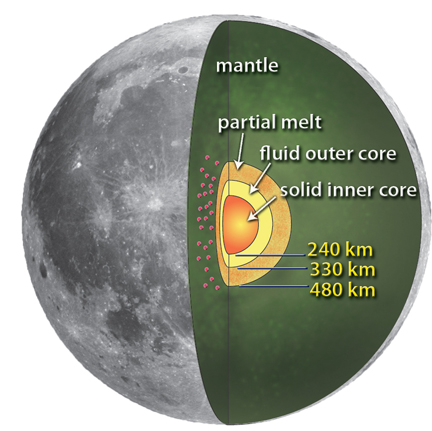
New interpretation of the lunar interior (from Weber et al., 2011, Science 331, 309-312)

Paul D. Spudis
The Once & Future Moon
Smithsonian Air & Space

A recently published science paper presented results of a re-analysis of seismic (moonquake) data sent to the Earth from a network emplaced by the Apollo astronauts 40 years ago. The scientists processing the old data found that the Moon may have more than a simple core – it may have a layered, partly liquid metallic core.

Why is this important? Scientists have known for many years that the Earth has a layered interior structure. The outermost layer, called the crust, is the only part of the Earth directly accessible to us for study. The crust varies in thickness, ranging from a few kilometers in the ocean basins to over 20 km in continental areas. The next zone down is called the mantle. The mantle is very thick – almost 3000 km. It is made up of a dense, iron- and magnesium-rich rock type called peridotite. Partial melting in the mantle is the source of basaltic magma that erupts to make up the floors of ocean basins worldwide. The innermost part of the Earth is the core, comprised mostly of metallic iron and nickel, and over 3000 km in radius. The outer layer of the core is liquid, but the enormous pressure that contains the inner core keeps it solid.

The Earth’s core is electrically conducting as the rotation of the Earth induces currents within it. It is thought that these electrical currents are responsible for the dynamo that generates the magnetic field of the Earth. Because most of the Earth’s iron is contained in the core, we know that in bulk composition, the Earth is made from chondrites, the same stony material found as primitive meteorites in space. Thus, understanding the core is relevant to the origin of its magnetic field and the internal structure and bulk composition of the Earth.

For these reasons, we are interested in the possibility of a core within the Moon. Even before we went to the Moon, we understood that an internal structure similar to Earth was not likely. A property called moment of inertia told us in broad terms that, unlike the layered structure of Earth, the Moon was more or less homogeneous inside. The moment of inertia indicated that any core inside the Moon must be smaller than a couple of hundred kilometers at most (the Moon’s radius is 1740 km).


The Apollo 12 Apollo Lunar Surface Experiment Package (ALSEP) after its deployment in Oceanus Procellarum, November 19, 1969. Among the instruments set up by Conrad & Bean was the Passive Seismic Experiment (PSE). The Apollo ALSEP assets were kept powered by radioisotope thermoelectric generators and data continued to be collected until the project was defunded in 1977, leaving only three laser range reflector arrays as the only remaining Apollo assets contributing new science until the arrival in orbit of LRO in July 2009 [AS12-67-6817-Conrad/Apollo 12].

Seismometers, deployed on the Moon as part of a surface network during the Apollo missions, operated for over seven years collecting data on tremors within the Moon. Because certain rocks have known physical properties (e.g., density), we use the velocity of seismic waves in an indirect way to infer the presence of these rock types and physical structure. From our initial analyses of these data, we determined that the Moon had a fairly thick crust (from 50-80 km, more than twice the thickness of Earth’s crust) and a very thick mantle, almost the remainder of the lunar radius.

The question of the existence of a lunar core remained uncertain. One moonquake resulting from a fairly large impact on the far side of the Moon a couple of years after the Apollo missions had ended produced a signal that suggested the presence of a small core (less than 400 km radius). Moreover, because seismic waves come in two varieties – P-waves, or compression (or sound) waves and S-waves (shear waves, which cannot propagate through liquids) – the partial suppression of S-waves through the center of the Moon during this event suggested that the lunar core might be partly liquid.


The Apollo 14 S-IVB booster (S-IVB-509) was 17.8 meters tall, 6.6 meters wide and weighed about 14,000 kg. It was launched January 31, 1971, and after extraction of the Lunar Module Antares, the S-IVB was directed to dump its remaining fuel directed toward an impact the Moon February 4, 1971. (From "Apollo 14 S-IVB Impact Crater," Mark Robinson, October 8, 2009) "The Apollo impact velocity was 2.54 km/sec at an angle of 69° from the horizontal along a heading of 103° (west to east). The S-IVB had a mass of 14,016 kg at the time of impact and impact energy was 5.54 x 10\10 Joules (equivalent to just over 10 tons of TNT). The signal from the impact was recorded on the Apollo 12 seismometer (PSE) and rebounded throughout the Moon for 3 hours." [NASA/ARC/NLSI].

But this result was so uncertain that few lunar scientists actually believed it. They proceeded to try and constrain the dimensions and composition of a lunar core through other means. A core may be important in the generation of an early global magnetic field that some of the lunar samples seems to indicate (the current Moon has no global field). By carefully measuring the ways in which the magnetic field of the Sun and Earth is modified when the Moon passes through it (as it does during its orbit around the Earth), it was thought that it might be possible to “sense” the presence of a lunar core by measuring these deviations. Results indicated that the core of the Moon had to be small (less than 400 km in radius) and probably made of iron sulfide (FeS).

After seven years of operation, the Apollo seismic net was turned off to save money. Up until it was turned off, we had received a large amount of data but processing it was extremely difficult. The Apollo instruments, although sensitive, were very noisy and not well coupled to bedrock as are seismometers on Earth. Fortunately, faster and more capable computers, along with new techniques to process and analyze noisy data, were developed. And a new generation of scientists came forward to re-examine the old seismic data to see if anything could be discerned from it.

The new results are surprisingly detailed. Not only do these researchers think they have detected a core inside the Moon, but a core with three separate layers – an inner solid core and outer core, very similar in structure to that of the Earth, but with the added wrinkle of a partly molten outermost layer. The entire core is almost 500 km in radius, slightly larger than the diameter inferred from deep magnetic sounding.


LROC Observation M111762553R, LRO orbit 1604, November 2, 2009, from 43.5 km, resolution 49cm/p, solar incidence 31.3° Apollo 14 S-IVB impact at 8.179°S, 333.969°E (from from "LROC Coordinates of Robotic Spacecraft," Samuel Lawrence, April 5, 2010) [NASA/GSFC/Arizona State University].

The presence of currently molten core inside the Moon is rather startling; even the earlier idea about a partly molten zone was viewed askance by most lunar students. But this new idea has revived concepts about a magnetic core dynamo inside the Moon, generating a global field early in lunar history. Such a dynamo might explain a lot about the remnant magnetic fields measured in some of the returned lunar rocks. But there is no obvious reason why such a field would suddenly stop being generated.

Even though the old Apollo network data may still be mined for information, to fully understand lunar structure and history we must emplace a long-lived, global network of new instruments to fully characterize the interior of the Moon. Although studies are underway to determine how this might be accomplished, deployment of such a network is difficult to achieve by robotic spacecraft alone and long life on the Moon may require a nuclear power supply. Each and every time we start believing that we understand our Moon, a new discovery raises even more questions.

Saturday, January 29, 2011

New Robotic Lander Prototype skates tests


The Robotic Lander Prototype produced at Marshall Space Flight Center, on modified skateboards and a customized track system (a low-cost solution to control movement during final testing of the prototype’s sensors, on-board computer and thrusters [NASA/TBE].

Kim Newton
Marshall Space Flight Center

NASA engineers successfully integrated and completed system testing on a new robotic lander recently at Teledyne Brown Engineering’s facility in Huntsville in support of the Robotic Lunar Lander Project at NASA's Marshall Space Flight Center in Huntsville, Alabama.

The lander prototype was placed on modified skateboards and a customized track system as a low-cost solution to control movement during final testing of the prototype’s sensors, onboard computer, and thrusters. The functional test focused on ensuring that all system components work seamlessly to sense, communicate, and command the lander's movements.

The prototype will be transported to the United States Army Redstone Arsenal Test Center in Huntsville this week to begin strap-down testing, which will lead to free-flying tests later this year.

The lander prototype will aid NASA’s development of a new generation of small, smart, versatile landers for airless bodies such as the moon and asteroids. The lander's design is based on cutting-edge technology, which allows precision landing in high-risk, but high-priority areas, enabling NASA to achieve scientific and exploration goals in previously unexplored locations.

Development of the lander prototype is a cooperative endeavor led by the Robotic Lunar Lander Development Project at the Marshall Center, Johns Hopkins Applied Physics Laboratory of Laurel, Maryland and the Von Braun Center for Science and Innovation, which includes the Science Applications International Corporation, Dynetics Corporation, Teledyne Brown Engineering, Inc. and Millennium Engineering and Integration Company, all of Huntsville.

For more information on the Robotic Lunar Lander Development Project, please visit http://www.nasa.gov/roboticlander.

Tuesday, August 17, 2010

NASA update: ILN Anchor Nodes and Robotic Lunar Lander Project

Updated August 18, 2010 1648 UT
Global Lunar Conference, Beijing
May 31- June 3, 2010

Exploration configuration. Refinements continue on designs for NASA's multipurpose lunar lander bus, while a timetable for deploying an unknown number of Anchor Nodes for the International Lunar Network (ILN) and the fate of a recommended Lunar Polar Volatiles exploration mission to the lunar surface remain on hold, awaiting hints of what will appear in the next Planetary Science Decadal Survey (2013-2022), expected in January 2011 [NASA/MSFC].

Brian J. Morse, Cheryl L. B. Reed
& Karen W. Kirby
Johns Hopkins, Applied Physics Lab

Barbara A. Cohen, Julie A. Bassler, Danny W. Harris
& D. Gregory Chavers
NASA Marshall Space Flight Center

ABSTRACT: In early 2008, NASA established the Lunar Quest Program, a new lunar science research program within NASA’s Science Mission Directorate. The program included the establishment of the anchor nodes of the International Lunar Network (ILN), a network of lunar science stations envisioned to be emplaced by multiple nations. This paper describes the current status of the ILN Anchor Nodes mission development and the lander risk-reduction design, and test activities implemented jointly by NASA’s Marshall Space Flight Center and The Johns Hopkins University Applied Physics Laboratory. The lunar lander concepts developed by this team are applicable to multiple science missions, and this paper will describe a mission combining the functionality of an ILN node with an investigation of lunar polar volatiles.

INTRODUCTION:

NASA Robotic Lunar Lander development. One of the defining features of the U.S. Vision for Space Exploration, established by the former administration and studied by NASA for the past 4 years, is the goal of a human return to the Moon to live and work for extended periods. Whether that plan will be executed, however, has grown increasingly uncertain. Turbulent economic times, along with the need for the new administration to set its own priorities, have resulted in a complete review of U.S. space policy and NASA’s programs.

Many months remain before the process will be complete and new plans can be developed. But even in the face of this uncertainty, it is clear that the Moon is of significant scientific importance to NASA and many other nations and is a prime target for low-cost robotic missions that can be undertaken by most of the world’s space programs. Thus, it can be expected that lunar robotic missions will remain a high priority while the U.S. human exploration program is restructured; when humans begin to venture beyond low-Earth orbit to the Moon, near-Earth objects, and eventually Mars, the generic technological capabilities developed through lunar robotic missions will serve as important steps toward future achievements. The Moon contains a wealth of scientific information about planetary formation and the origins of Earth.

NASA has a rich portfolio of lunar flight projects, including two payloads on India’s Chandrayaan-1; the Lunar Reconnaissance Orbiter (LRO); the Lunar CRater Observation and Sensing Satellite (LCROSS); the Gravity Recovery and Interior Laboratory (GRAIL); the Acceleration, Reconnection, Turbulence and Electrodynamics of Moon’s Interaction with the Sun (ARTEMIS) mission; and the Lunar Atmosphere and Dust Environment Explorer (LADEE) mission.

Other nations, including China, Japan, and India, also have emergent lunar portfolios. During this exciting time for lunar science, many significant scientific discoveries are just being realized from these flights, including the likely orbital confirmation of trapped water-ice on the lunar surface.

In addition, the U.S. National Research Council (NRC) is in the early stages of its new Decadal Survey for Planetary Science, which establishes priorities to be incorporated into the roadmap for NASA’s Planetary Division of the Science Mission Directorate (SMD).

The final report will not be ready until January 2011, but the results of many current planetary studies will be publicized along the way, previewing expected planetary (and lunar) priorities for the next 10 years. Internationally, multiple space-faring nations are concurrently planning robotic missions to the Moon. To maximize the scientific return of these efforts, nine national space agencies signed a statement of intent to establish a set of robotic lunar landers in a geophysical network on the surface of the Moon.

This collaborative initiative is known as the International Lunar Network (ILN). ILN nodes will fly a core set of instruments, plus additional passive, active, in situ resource utilization (ISRU), or engineering experiments, as desired by each space agency. Participants’ contributions can be landers, orbiters, instrumentation, or other significant infrastructure contributions, including communications capabilities, which in total will comprise the ILN.

From Lunar Pioneer Album 2 --
Anchor node of the International Lunar Network (ILN), hosted by the multi-use lander, now well along in development. The new generation configuration is shown here in an unlikely spot, if ILN ultimately turns out to be a sparse seismographic network (i.e., south central Mare Imbrium, in sight of Mons La Hire) [NASA/MSFC/JHU-APL].

The envisioned U.S. contribution to the ILN was the Anchor Nodes mission to be implemented jointly by NASA’s Marshall Space Flight Center (MSFC) and The Johns Hopkins University Applied Physics Laboratory (JHU/APL).

The ILN Anchor Nodes mission would develop a broad lander capability and establish surface and embedded elements to better characterize the structure and composition of the lunar interior. The United States originally envisioned launching the first two nodes to the mid-latitude regions in the 2015–2016 time frame, with an option to launch two more nodes shortly thereafter.

Alternatively, NASA could launch all four nodes in the 2017–2018 time frame. However, the specific science to be conducted, and the payload suite to carry out these measurements, could change, given the recently published lunar water-ice discoveries and the forthcoming results of the Decadal Survey. Discussions continue with NASA’s international partners to provide additional nodes within this time frame to constitute the first lunar scientific network.

Regardless of the specific science objectives, the goals of the Anchor Nodes mission will remain technically and programmatically challenging. These goals include the placement of multiple nodes on the near side of the Moon, continuous operations through many years of lunar eclipse, low-mass and low-power subsystems and instruments, and a minimum 6-year lifetime. Future nodes are planned for the far side of the Moon, for which lunar–Earth communication and navigation solutions are under consideration by countries supporting the ILN.

From Lunar Pioneer Album 1 --
In September 2009, Marshall Space Flight Center in Huntsville, Alabama announced the beginning of tests of a new robotic lunar lander test bed to aid development of a new generation of multi-use landers for robotic space exploration. The Phase One Cold Gas Test Article is equipped with thrusters to guide the lander, one set to control the vehicle's attitude, altitude and landing and additional thrust to offset the effect Earth’s gravity to simulate a lunar environment. By June 2010, the CGTA has been put through its paces 150 times [NASA/MSFC].

After the completion of an extended pre-Phase A study, the implementation of an ILN Anchor Nodes mission was placed on hold pending the resolution of the above-mentioned uncertainties. The MSFC–JHU/APL team was renamed the Robotic Lunar Lander Development Project (RLLDP) with the scope to complete an array of lander technology risk-reduction tasks and to perform studies on other missions that address some of the key science and exploration priorities.

One such mission combined the functionality of a single ILN node with instruments to prospect for volatiles in a fixed location within a permanently shadowed lunar polar crater. The latest data from lunar orbiting observatories have further fueled interest in attaining “ground truth” for the presence of volatiles, including water-ice, in permanently shadowed craters.

The single-site approach is limited in its ability to fully satisfy key science goals associated either with the ILN mission or with a desire to fully characterize the volatile distribution, but it represents a much more affordable single mission that, combined with other missions, could more fully address these goals. The results of this study and the status of the risk-reduction tasks spanning technologies in propulsion; guidance, navigation, and control; power; avionics; thermal; and structures and mechanisms are documented in this paper.

SCIENCE. The Moon provides an important window into the early history of the Earth, containing information about planetary composition, magmatic evolution, surface bombardment, and exposure to the space environment.

Despite more than 4 decades of intensive study, many aspects of the Moon remain to be determined. One of the key motivations for studying the Moon is to better understand the origin of the planets of the inner solar system in general and that of Earth in particular.

The NRC report, New Frontiers in the Solar System: An Integrated Exploration Strategy (the Planetary Science Decadal Survey), is the principal roadmap for solar system exploration, providing a community-based weighting of science priorities across the solar system, including the Earth’s Moon. In this document, the Inner Planets Panel asserted that the inner solar system affords the opportunity to address broad objectives for understanding the history, current state, and potential future of habitable planets. Landed missions were recommended by the panel for all of the terrestrial planets—Mars, Venus, Mercury, and the Moon—in order to address multiple key aspects of inner solar system science.

The next Planetary Science Decadal Survey for the period 2013–2023 is currently under way. This report will not be ready until January 2011, but the results of many current planetary studies will be publicized along the way, previewing expected planetary (and lunar) priorities for the next 10 years.

In support of this activity, the lunar science community articulated and prioritized its science objectives in a set of 35 white papers, painting a coherent and compelling picture of the importance of lunar science to understanding differentiation of planets, the bombardment history of the inner solar system, and processes unique to airless bodies. Two candidate lunar lander missions—a geophysical network and an in situ polar volatile explorer—were studied and presented to the Decadal Survey by this team in order to address multiple key aspects of lunar and planetary science.

Lander technology developed for any of these missions will have significant feedforward to other missions to the Moon and indeed, to other airless bodies such as Mercury, asteroids, and Europa, to which many of the same science objectives are applicable.

Read the Report and Presentations (pdf), HERE.

From Lunar Pioneer Album 3 --
Warm Gas Test Article, currently slated for testing at Marshall Space Flight Center, takes the multi-use lander design testing beyond the maneuver, attitude control and landing thrust demonstrated using the Cold Gas Test Article began in 2009. Testing can now begin for critical maneuvers like Terminal Descent [NASA/MSFC].

Related:
Robot Landers for Science & Exploration
Chavers & Cohen, et.al. [JHU-APL/MSFC]
7th International Planetary Probe Workshop (IPPW-7)
Barcelona, June 12-18, 2010

Friday, August 13, 2010

Proposed GLXP rule changes inspire concern

Updated September 15, 2010 1825 UT

Google Lunar X-Prize (GLXP) team SELENOKHOD in Russia demonstrates a test-bed prototype of the lunar rover the group hopes will win a minimum $20 million purse. However, Russian resources now committed to a planned 2013 joint Russian & Indian lunar mission has put a strain on their timetable [Selenokhod].

Peter J. Brown
Asia Times Online

Government space agencies are taking a closer look at the Google Lunar X Prize (GLXP) contest, an international competition to safely land a rover on the moon. Several GLXP teams include space researchers and engineers in Asia on their rosters, and NASA is rolling out a program that might provide US GLXP teams with a $30 million market for their mission data. Other countries may not sit still for long in light of this development.

That is the good news. The not so good news is that as the result of a proposed GLXP rule change, the $20 million GLXP grand prize could be reduced by $5 million if a government-backed lunar mission successfully lands and deploys a rover in advance of any of the 21 GLXP teams accomplishing the same feat. All GLXP teams must be 90% privately funded.

According to the original set of GLXP rules, the grand prize would be awarded to the team that first landed a rover on the Moon and subsequently able to travel at least 500 meters while simultaneously transmitting data and a live TV signal back to Earth. The deadline has been December 31, 2012. If that objective was not achieved, however, a GLXP team could still win a reduced grand prize of $15 million if it fulfilled all requirements by December 2014.

Now, under the proposed so-called GLXP "Master Team Agreement" (MTA), revised rules, including the $5 million cut described above, are taking shape. All remaining prizes, including a $5 million second prize and several bonus prizes, would be unaffected.

Under proposed changes to contest rules, the 2012 deadline is pushed ahead three years to December 31, 2015. However, even that deadline might be extended by the California-based X Prize Foundation (XPF).

Several countries, including the European Space Agency (ESA), are planning to conduct lunar landings over the coming decade. The joint Indian Space Research Organization (ISRO)-Russian Federal Space Agency (Roskosmos) Chandrayaan-2 orbiter and rover / Luna-Resource lunar lander scheduled for 2013, appears first in line.

"Almost every space agency is talking about missions to the lunar surface these days. Putting fixed calendar dates on them is very difficult, though," said William Pomerantz, senior director of space prizes at the XPF.

"We are excited about and are following developments on other fronts, including China's Chang'e 3, Japan's SELENE-2, The Indo-Russian Luna-Resource /Chandrayaan-2, ESA's MoonNEXT, a variety of potential NASA robotic missions and possibly the UK's MoonLite, along with eventual nodes of the proposed International Lunar Network (ILN)."

"At this point, it's difficult to say with certainty which will be which," said Pomerantz

Read the full article, HERE.

Wednesday, August 4, 2010

Luna-Resource & Chandrayaan-2 in 2013

Updated September 15, 2010 1826 UT

Rough notional view of Russia's Luna-Resource lunar lander deploying India's Chandrayaan-2 rover, India's second lunar mission now anticipated in 2013. The Russian lander will carry an IGN-10K neutron generator designed to confirm the presence of water, apparently in vapor form, directly detected by India's Moon Impactor Probe (MIP) near the Moon's south pole in November 2008. [LPRG].

Joel Raupe
Lunar Pioneer

August 3 – The Hindustan Times reports the unmanned Russian lunar lander Luna-Resource, after ferrying and supporting the lunar rover segment of India's Chandrayaan-2 mission, will be an entire stationary mission in its own right, equipped with a neutron generator designed to confirm a presence of water at the Moon’s high latitudes, most likely within the still unsampled 4 billion-year-old South Pole-Aitken (SPA) impact basin.

India’s flag-carrying Moon Impact Probe (MIP), deployed from Chandrayaan-1 in November 2008, appears to have directly detected water in vapor form imoments before its intentional impact near Shackleton crater and the Moon’s south pole.

Chandrayaan-1 was launched by the Indian Space Research Organisation (ISRO) October 22, 2008 and inserted into a polar orbit around the Moon the following November 12.

India's first lunar orbiter completed 3,400 revolutions during 312 days, until all contact was abruptly lost, May 19, 2009. The Moon Impact Probe (MIP) separated from the larger vehicle and soon afterward impacted near Shackleton crater at the Moon's South Pole, not long after Chandrayaan was successfully inserted into lunar orbit.

In 2013, the Indo-Russian Chandrayaan-2 / Luna-Resource (ISRO/Roscosmos) 1,000 kg lunar payload is slated for launch from Sriharikota on the sub-continent’s eastern coast. The six-wheeled ISRO rover, accompanying the Russian lander, is expected to weigh 58 kg.

The Indian rover is designed to operate for a year, traveling 150 kilometers at speeds of 300 meters per (Earth) day, primarily powered by solar energy and juggling the incidence of almost continuous sunlight in and around permanently shadowed regions (PSR's) near the lunar South Pole.

In 2012, the Russian lunar orbiter mission Luna-Glob is being developed to carry four Japan-built impactor-seismographer probes.

The Hindustan Times quotes Yevgeny Bogolyubov, deputy chief designer at All-Russian Scientific Research Institute of Automation (VNIIA), confirming Roscosmos plans "to send to the Moon (Luna Resource) bearing a neutron generator developed by our institute to study the lunar surface.” A similar neutron generator would, he said, eventually be used to study the surface of Mars.

The Press Trust of India reports a "short listing" of instruments to be carried on the Chandrayaan-2 orbiter and rover vehicles launched together with Luna-Resource were to be selected in Bangalore on August 3.

According to ISRO Telemetry Tracking and Command Network (ISTRAC) director S.K. Shivakumar, individual Chandrayaan-2 scientific instruments would weigh between 30 and 35 kg.

Tuesday, March 23, 2010

Apollo 13 Saturn IVB impact crater


Bang! On April 14, 1970 the Apollo 13 Saturn IVB (Saturn V Third Stage) impacted the Moon north of Mare Cognitum (-2.55°S, 332.12°E). The impact crater, roughly 30 meters in diameter, is clearly visible in LROC NAC image M109420042LE. Study of the rare impacts that can be definitively dated helps in determining rates of space weathering on every scale. The Apollo 13 SIVB impact shows a relatively wide ranging ray system, part of which may have resulted from hot plasma pressure waves. [NASA/GSFC/Arizona State University].

The Apollo 14 S-IVB (S-IVB-509) was 17.8 m tall, 6.6 m in diameter and weighing ~14,000 kg. Launched carrying Apollo 14 on January 31, 1971, after extraction of Lunar Module its remaining fuel was dumped and it was directed to impact the Moon on February 4. [NASA].

Saturn V Third Stage impacts recorded by the Apollo seismic network

Juergen Oberst
LROC News System

In April, the Apollo 13 Saturn V blasted off towards the Moon. The Saturn rocket consisted of a 3-stage launching system. While the first and second stage of the launch vehicle dropped back to Earth after launch, the third stage (S-IVB) was used to propel the docked Apollo Command Module and Lunar Module from Earth orbit into a lunar trajectory. The spent rocket booster then separated from the Command Module and later impacted the Moon. From the tracking of the radio signals of the rocket, the impact locations on the Moon and the impact times were fairly well known.

Seismogram of the Apollo 13 S-IVB impact recorded at the Apollo 12 seismic station in digital units (DU). The three traces designate the signal of the 3 orthogonal components of the ground motion at long wavelengths. The arrows mark the arrival times of the p (primary) and the slower s (secondary) seismic waves (image modified from: Ewing, M., et al., (1971), Seismology of the Moon and implications on internal structure, origin and evolution, in: De Jaeger (Eds.): Highlights of Astronomy, IAU, pp.155-172).

The impacts by the S-IVB stages represented unique calibration signals for the Apollo seismic station network, which operated on the lunar surface from 1969 - 1977. Since the rocket impacts occurred at known times and places, the seismic wave velocities, in particular those within the upper lunar crust could be measured directly.

At the time of the Apollo 13 mission, only the seismometer at Apollo 12 was available, which had been deployed 5 months earlier. The S-IVB impact occurred at a distance of 135 km from that seismic station.

AS12-46-5817 Until defunded in 1977, the Apollo 12 seismometer monitored levels of ground motion to detect arriving seismic waves. The instrument is protected by metal foil against the varying temperatures on the lunar surface that produce large thermal stresses. The Solar Wind Spectrometer is to the right of the Apollo Lunar Surface Experiment (ALSEP) Central Station, the Passive Seismic Experiment is to the left and the Lunar Surface Magnetometer is in the background, beyond and just to the left of the Central Station (NASA/Conrad/Apollo 12).

Analysis by the LROC team now have identified the craters associated with most of the rocket impacts in their predicted areas. Taking advantage of the precise LRO orbit and LROC pointing knowledge, it is now possible to determine the impact coordinates of rockets and their distances from the seismic stations more accurately to within a few hundred meters, over time as the orbit calculations are improved these estimates will in turn become more accurate. The precise impact coordinates may warrant a reanalysis of the seismic calibration data for improved models of seismic wave propagation within the Moon and the Lunar interior structure. The seismograph network recorded more than 13,000 seismic events and delivered some of the most important scientific results of the Apollo missions.

Find the Apollo 13 S-IVB impact crater in the full NAC image. Review an earlier LROC image posting of the Apollo 14 S-IVB impact crater.

Monday, January 25, 2010

Geohazards on the Moon and the importance of the International Lunar Network (ILN)

From Lunar Pioneer
International Lunar Network (ILN) "node" notionally superimposed within the actual topography of the southern Mare Imbrium basin, just south of Mons La Hire, whose eastern flanks are lit with dawn. Fanciful though it might be as seen within the lunar equivalent of "street view" in Google Earth, this is unlikely ever to be a landing site for the ILN. The architecture for the lander, however, represents what the ILN team expects from the international effort to finish the job left unfinished after the Apollo Lunar Surface Experiment instruments were defunded and shut down in 1977. [LP/NASA/MSFC/ILN]

Barbara A. Cohen
and the MSFC/APL ILN Team
NASA Marshall Space Flight Center


Seven of the 28 shallow seismic events recorded by the Apollo passive seismic experiment (PSE) network released energy equivalent to earthquakes with magnitudes of 5 or greater. On Earth, such quakes can cause extensive damage to structures near the epicenter. Unexpected structural damage to a lunar habitat could have devastating results and thus, lunar seismicity may present a significant geohazard to long-term human habitation.

Seismic Hazard? Lunar seismicity is 3-5 orders of magnitude lower than Earth. However, the propagation of quake energy is strikingly different on the Moon than on the Earth. The Moon is largely anhydrous and its crust is extensively fractured; the resulting high lunar Q values mean that moonquake attenuation is low. The maximum signal from a shallow moonquake can last up to 10 minutes with a slow tailing off that can continue for hours in total duration, and moonquakes tend to produce seismic waves of higher frequency than earthquakes. Ground motion is the most important factor in causing structural damage, and on the Moon, the observed ground motion of the PSE instruments during moonquakes were typically less than 1 nanometer and artificial seismic signals dampened out within ~ 10 km. However, the Apollo PSEs never recorded a strong shallow moonquake directly below the seismic network.

One mechanism for generation of shallow moonquakes may be lithospheric stress at terrain boundaries such as basaltic mare or large impact basins. If this mechanism is valid, siting a lunar base on the edge of the largest, deepest lunar basin (SPA) could put it at increased seismic risk. We do not yet have enough data on strong, shallow moonquakes to understand their cause, depth, or lateral distribution. Predicting where shallow moonquakes may occur is important for the next phase of lunar exploration.

To evaluate a potential lunar seismic risk, two approaches are needed. First, further research to understand and effectively model lunar ground motion and acceleration by applying advanced terrestrial models and numerical techniques to the lunar environment is crucial. Second, a long-lived, global lunar seismic network needs to be established to globally characterize lunar seismicity and establish the origin, frequency, and propagation of strong moonquakes.

The ILN Mission: NASA’s Science Mission Directorate’s (SMD) International Lunar Network Anchor Nodes Mission continues its concept development. The mission will establish two-four nodes ofthe International Lunar Network (ILN), a network of lunar geophysical stations envisioned to be emplaced by the many nations collaborating on this joint endeavor. The US stations of the ILN, called the Anchor Nodes, are being planned by NASA Marshall Space Flight Center (MSFC) and the Johns Hopkins University Applied Physics Laboratory (APL), with contributions from JPL, ARC, GRC, DOD, and industry.

The Anchor Nodes project has progressed through pre-Phase A design activities and is currently conducting an extended risk reduction program. Risk reduction activities include propulsion thruster testing; thermal control testing and demonstration; low power avionics development; composite coupon testing and evaluation; landing leg stability and vibration; and demonstration of landing algorithms in the MSFC Lunar Lander Robotic Exploration Testbed, which was established in support of risk reduction testing to demonstrate ILN capabilities. An MSFC test vehicle using an Anchor Nodes-like design and a compressed air propulsion system is in use for demonstration of control software. A second version of the MSFC vehicle is planned that will utilize an alternate propulsion system for longer duration flight and descent testing. The upgraded test vehicle will also integrate flight-like components for risk reduction testing, such as landing sensors (cameras, altimeters), instruments, and structural features (landing legs, deployment mechanisms).

International Participation: Representatives from space agencies in Canada, France, Germany, India, Italy, Japan, the Republic of Korea, the United Kingdom, and the United States agreed on a statement of intent for near and long-term evolution and implementation of the ILN. Working groups are addressing potential landing sites, interoperable spectrum and communications standards, and a set of scientifically equivalent core instrumentation to carry out specific measurements.

Summary: The concept of an International Lunar Network provides an organizing theme for US and International landed science missions in the next decade by involving each landed station as a node in a geophysical network. Creation of such a network will dramatically enhance our knowledge regarding the internal structure and composition of the moon, as well as yield important knowledge for the safe and efficient construction and maintenance of a permanent lunar outpost.

Tuesday, November 17, 2009

Novel methods of heat flow deployment for the International Lunar Network (ILN)


Artist rendering of a future node of the International Lunar Network, integrated into the NASA's Next Generation Robotic Lander, seen here arbitrarily situated several kilometers south of Mons La Hire, rising like Ayers Rock in Australia over the vast plains of Mare Imbrium. Current plans call for the NGRL platform to be adopted for a wide variety of other lunar programs also. [ILN/NSFC/Lunar Pioneer].

Kris Zacny, et.al. Honeybee Robotics Spacecraft Mechanism Corp., NASA JPL, Texas Tech & N. Arizona Universities and NASA Goddard

Introduction:

The heat-flow probe directly addresses the goal of the Lunar Geophysical Network, which is to understand the interior structure and composition of the Moon. The International Lunar Network (ILN) is a near-term mission that requires a heat-flow probe. ILN is a set of four small landers, scheduled for launch in the 2016-2018 time frame, that will deploy up to four instruments. The ILN payload is limited to ~25kg and its power will most likely be provided by a ASRGs.

To place 1kg on the surface of the Moon costs ~$50k to$100k. Thus, any scientific instruments must be efficient with respect to limited spacecraft resources such as mass, power, and volume without compromising on quality scientific measurements.

A key challenge for a heat-flow probe will be getting to a 3m depth at which the endogenic thermal gradient can be measured, i.e. below the depth of penetration of the annual thermal wave, within ILN Payload limitations. The Apollo 17 two heat flow probes reached 2.4m. A heat flow probe must create a minimal disturbance to the thermal environment.

Heat-Flow Probe Concepts:

We have been developing two highly innovative low mass and low power heat-flow probe systems (robotic, but can be also astronaut deployable). Each system consists of two parts: 1) a method of reaching 3m depth in lunar regolith, and 2) a method of deploying thermal sensors.

Percussive System: The first system uses a percussive (hammer-like) approach to drive a small diameter (20mm) cone penetrometer to >3 meter depth (Figure 1). Ring-like thermal sensors on the penetrometer rod (heaters and temperature sensors) are deployed into the regolith every 30 cm as the penetrometer goes down to 3 m. The penetration rate of the percussive penetrometer can be correlated to regolith density; this added measurement will help with thermal conductivity correlation.

The system leaves only small sensors in the borehole. The deployment rod is removed once depth is reached, maximizing measurement sensitivity by eliminating thermal path to lander except for the electrical tether.

Pneumatic-Proboscis System: The second system uses a pneumatic (gas) approach to lower the temperature and thermal conductivity sensors attached to a lenticular (bi-convex) tape to > 3 meters (Figure 2).The second system uses a pneumatic (gas) approach to lower the heat flow probe, a lenticular (bi-convex) tape, to > 3 meters (Figure 2). The system is a revolutionary innovation for ILN as it has extremely low mass, volume, and simple deployment. This system is dubbed the “Proboscis” because of its similarity to a butterfly proboscis. Helium gas, used for pressurizing liquid propellant, and is typically vented once on the surface, can be scavenged from the lander propulsion system, making the thermal probe system lighter.

Should spacecraft helium not be available, a simple gas delivery system may be added specifically for the heat flow probe. Honeybee demonstrated that 1 gram of N2 at 5 psia can lift 6000g of JSC-1a in lunar conditions (vacuum, 1/6g) Thus, a only a small amount of gas would be required to penetrate to 3 m.


The 2009 Annual Conference of the
Lunar Exploration Analysis Group (LEAG)
is underway in Houston

Conference Program

Wednesday, October 14, 2009

Lee calls on S. Korea to join ILN

The Chosun IIbo (South Korean) President Lee Myung-bak wants Korea to join an international lunar exploration program. In a speech at the opening of the 60th International Astronautical Congress in Daejeon on Monday, Lee said, "Many countries are cooperating to carry out large-scale space projects such as the lunar exploration program."

He said gaining an understanding of outer space through international cooperation and sharing achievements in space research "are necessary to improve quality of life for all mankind."

Lee was referring to the International Lunar Network project which brings together eight countries under NASA supervision and aims to explore the environment and resources of the Moon by sending six to eight robotic spacecraft to various locations on the lunar surface and building mobile or fixed science stations.

The ILN was chosen on the agenda for the Korea-U.S. summit last year, and Korea signed a letter of intent to join. The government has set a goal to launch a lunar orbit satellite by 2020 and a lunar probe by 2025. Before it attains this goal, it is looking for help in obtaining space technology by participating in the ILN.

Lee also said, "Korea is strong in information technology, nanotechnology and biotechnology. The country can make contributions significantly, though belatedly, to the development of the world's space industry, if it uses those technologies to enhance space technology."

The congress is attended by about 3,000 space experts from some 70 countries and will run until Oct. 16.

Sunday, September 6, 2009

The Lunar Quest Program and the International Lunar Network (ILN)


Dr. Barbara A. Cohen
NASA Marshall Space Flight Center
Lunar Science Workshop 2009, Beijing

The Lunar and Planetary Science group at Marshall provides core capabilities to support the Agency's lunar exploration goals. ILN Anchor Nodes are currently in development by MSFC and APL under the Lunar Quest Program at MSFC.

The Science objectives of the network are to understand the interior structure and composition of the moon. Pre-phase A engineering assessments are complete, showing a design that can achieve the science requirements, either on their own (if 4 launched) or in concert with international partners.

Risk reduction activities are ongoing. The Lunar Quest Program is a Science-based program with the following goals: a) Fly small/medium science missions to accomplish key science goals; b) Build a strong lunar science community; c) Provide opportunities to demonstrate new technologies; and d) Where possible, help ESMD and SOMG goals and enhance presence of science in the implementation of the Vision for Space Exploration.

The Lunar Quest Program will be guided by recommendations from community reports.

Download the Presentation HERE.

Monday, March 2, 2009

ESA input sought on multi-purpose lunar lander

An autonomous lunar lander, which is capable of delivering payload to the lunar surface in support of a human presence on the Moon, as well as payloads directly supporting European exploration objectives. - ESA

The European Space Agency is seeking input from industry, engineering and science interests on the design of what may be the backbone of the middle range of NASA's lunar precursor robotics mission, the International Lunar Network.

Last July, NASA and ESA completed a comparative architecture study on the next generation of unmanned lunar landers. This latest requests builds on such "comparative architecture analysis studies recently conducted in cooperation with NASA," according the the ESA's announcement.

"They helped to define the multiple and varied building blocks needed to return humans to the Moon, and to support a sustained presence there."

At Ministerial Level, "funding was approved for ESA to work towards launching a lunar lander in the 2017–20 timeframe within the European Transportation and Human Exploration Preparatory Activities program and the Global Exploration Strategy (GES)."
This mission builds on lunar exploration comparative architecture analysis studies recently conducted in cooperation with NASA. They helped to define the multiple and varied building blocks needed to return humans to the Moon, and to support a sustained presence there.

Key elements identified in these studies include:
  • fixed and mobile habitation units with integrated life support systems, to give human explorers a safe living environment
  • robotic systems that can act autonomously to prepare for human exploration, and can later work alongside crews during surface operations
  • power generation and storage systems of varying scales to support the energy needs of surface activities, and potentially a human lunar base
  • in situ resource utilization systems that can produce consumables needed by a human crew, such as oxygen and water, from material available on the Moon’s surface
  • delivery of cargo and logistics to the lunar surface to support human excursions, mobile surface missions and possibly base operations
The latter was identified by both ESA and NASA as a possible European contribution to a future international programme of lunar exploration and would take the form of a lunar Cargo Lander.

This Cargo Lander would deliver items such as food, water, oxygen, fuel and equipment to the Moon, in order to enable astronauts to stay for extended periods. It could also be useful during the construction of a permanent human lunar base.
In addition, ESA is also studying a precursor Lunar Lander mission, for which different mission options are under consideration, to develop and demonstrate the required capabilities. The primary goal is the advancement of European human exploration capabilities for contribution to the international lunar exploration effort. The mission also provides an opportunity to characterize the lunar environment and the landing site, as well as a platform for scientific research.

Request for Information

In order to ensure a robust mission definition and to draw on the wealth of relevant experience available, ESA invites the science, technology and industrial community (including non-space industries) to provide inputs to the project through a Request for Information (RFI).
In particular, ESA is interested in learning about technologies, instruments, techniques and experiments that could be accommodated on the Lunar Lander and are in keeping with the mission objectives:
  1. To advance European technological capabilities for future human exploration of the Moon.
  2. To characterise the lunar environment and potential in situ resources to identify their implications for future human exploration.
  3. To progress in the definition of tools, interfaces and operational techniques for surface exploration.
  4. To increase our understanding of the formation, history and evolution of the Moon.
These inputs will be used in the early design phases of the mission, in advance of a formal Announcement of Opportunity.

The RFI began on the Monday 2 March 2009 and remains open for six weeks until 10:00 CEST (08:00 UT) on Tuesday 14 April. Further information on the RFI, including a concept submission template and the review and selection process, can be found in the links on the right side of the page. Responses to the RFI should be sent to: explorationcall@esa.int.


For more information contact:

James Carpenter
Tel: +31 71 565 3540
Email: James.Carpenter@esa.int
ESA FIRST LUNAR LANDER
REQUEST FOR INFORMATION (pdf)

Friday, August 29, 2008

Lidar For Lunar Landers Tested

By Graham Warwick/Aerospace Daily & Defense Report

An experimental laser sensor has been flight-tested at NASA's Dryden Flight Research Center in California as part of the Autonomous Landing and Hazard Avoidance Technology (ALHAT) program aimed at future robotic lunar missions.

The light detection and ranging (lidar) sensor is designed to recognize the landing site during final descent, detect hazards such as craters or boulders and direct the lander to a safer touchdown spot. For the tests at Dryden, a helicopter flew repeated tracks over two target areas on the dry lakebed, at altitudes increasing from 300 feet to 6,200 feet, while the nose-mounted gimbaled lidar focused on plywood circles simulating surface hazards. Data was collected for post-flight processing.

ALHAT is a five-year program to develop a system providing 100-meter landing accuracy in all lighting conditions. Precision landings will enable the assembly of a lunar outpost from modular payloads landed in close proximity.

Friday, August 15, 2008

Unreasonable fear of RTG's

Prototype Modular Common Spacecraft Bus undergoes tests at Ames

The specter of "nuclear powered" lunar landers is being raised, though Radioactive Thermal Generators (RTG's) have been a vital part of NASA's successes, from the Moon to the farthest flung Voyagers still transmitting data from Interstellar Space thirty years after their launch.

Each Apollo lunar landing carried RTG's, Plutonium decay powered generators to power years worth of experiments on the Moon, left behind at all six landing sites. NASA is committed to launching the Lunar Atmosphere Dust and Exosphere Explorer, in 2011, and afterward at least eight landers as part of the International Lunar Network. NASA is considering RTG's to power these important surface experiments through the two-week lunar night.

But, it's looking for high and low for alternatives, even RTG's powered by something a little less "hot" than Plutonium.

Rob Coppinger, over at FlightGlobal Hyperbola has a great outline of the particulars.

At Saturn, the Cassini explorer has just completed its primary mission. It's hard to remember the terror raised by the fashionably anti-nuke crowd, a decade ago, when Cassini was first launched. A small band of protestors threatened to toss themselves under a bus, to stop the launch, originally planned as a payload on-board the Space Shuttle. The crowd was quite a bit smaller in December 1997 than those that showed up to protest Galileo's launch to Jupiter.

Solar power just won't cut the mustard much past Mars, outside the inner solar system. Cassini's long, flawless tour and mission at Saturn just wouldn't have been possible without RTG power, and neither would fantastic data and photographs, like the ones taken this week as it flew sixteen miles through the Ice Fountains of Enceladus.

New Horizons, speeding toward its way toward it's encounter with the remarkable Four-Body System Kuiper Belt Object formally known as "the Planet Pluto," in 2015, would already be a cold chunk of solid waste, out past Saturn now.

It's laudatory to know NASA's looking at alternatives for powering the essential ILN. Before extended human activity on the Moon can begin, we will have learned more about the Moon in the next few years than during the last three decades. The Russians still deny splattering a RTG Mars probe in the Andes, rather than the South Pacific, many years ago. The Rock collector who comes up on that wreckage may not live to tell about it.

In order to find and test safer atomic technologies, eventually 3He or Thorium plants in situ on the Moon, we're going to have to make some trade offs. Either that, or we can all stay home and grow corn.