Showing posts with label Crater Saturation. Show all posts

Wednesday, October 31, 2012

Ghosts of Fecunditatis

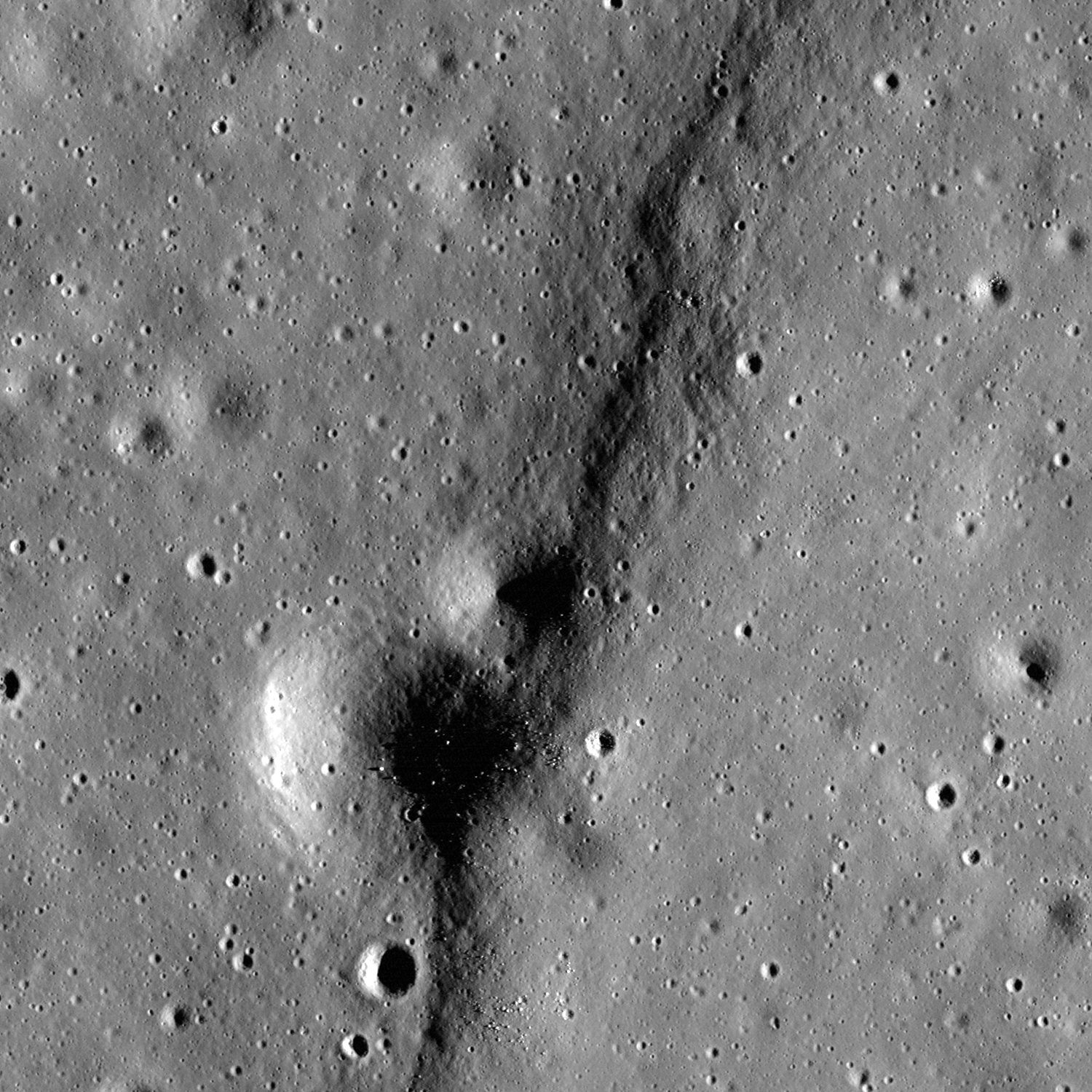
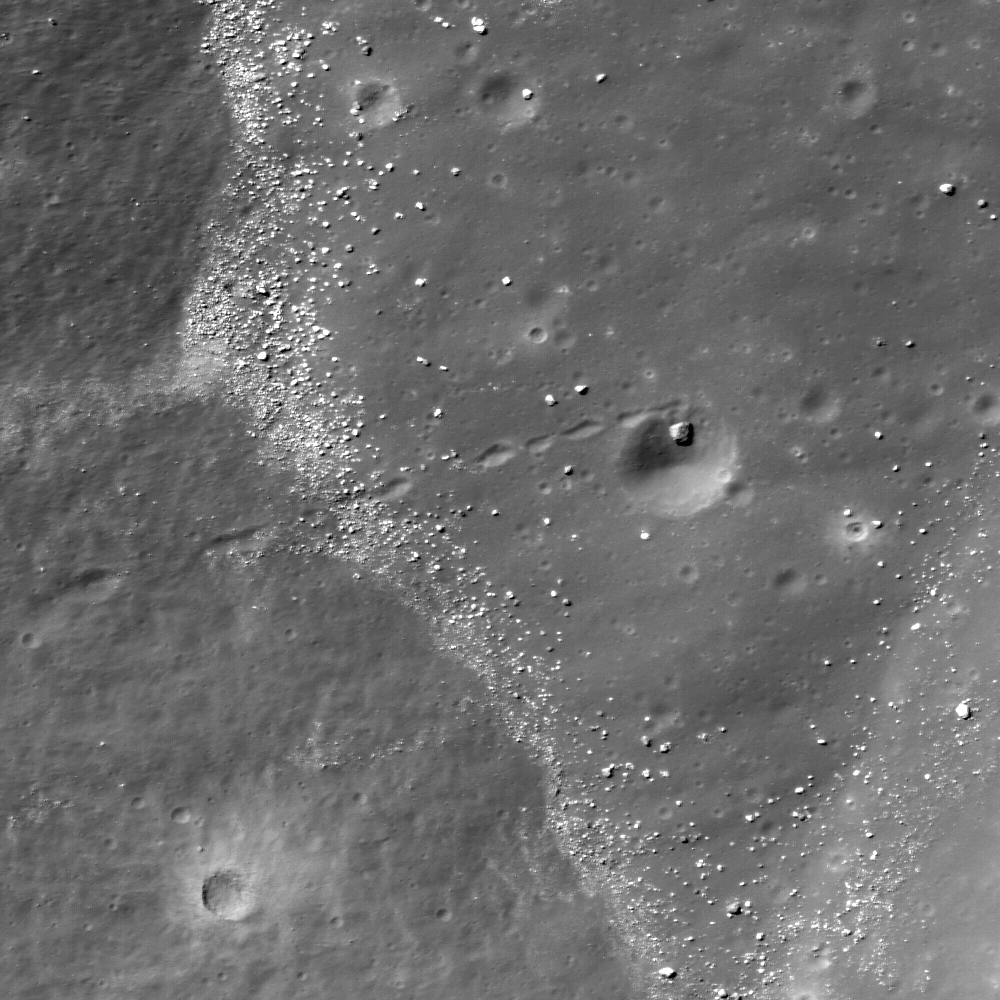
A gentle but distinctive topographic high designates the location of an ancient crater rim, nearly covered by basin flooding by volcanism, inside the boundaries of Mare Fecunditatis. LROC Narrow Angle Camera (NAC) frame M146662326L, illumination is from the east, angle of incidence 72.34° ; an approximately 1 kilometers-wide wide field of view at 0.98 meters resolution (in the original) from 47 kilometers altitude [NASA/GSFC/Arizona State University].
James Ashley
LROC News System

Today's Featured Image focuses on ancient craters that predate mare basin flooding, and which are often recognized by subdued, sometimes discontinuous circular patterns best seen near local lunar sunrise and sunset (high solar incidence as measured from the surface normal). These circles mark the locations of once majestic excavations in the lunar crust. However the emplacement of volcanic deposits filling, surrounding, and overtopping the rims have buried these ancient craters in many instances. The presence of the near-surface rims produce local stresses in the deposits, which in turn deform the mare layers. The result is a wrinkle ridge-like topography with a circular pattern. They are thus often referred to as "ghost" craters, and can be found haunting many large, basin-filling mare deposits.

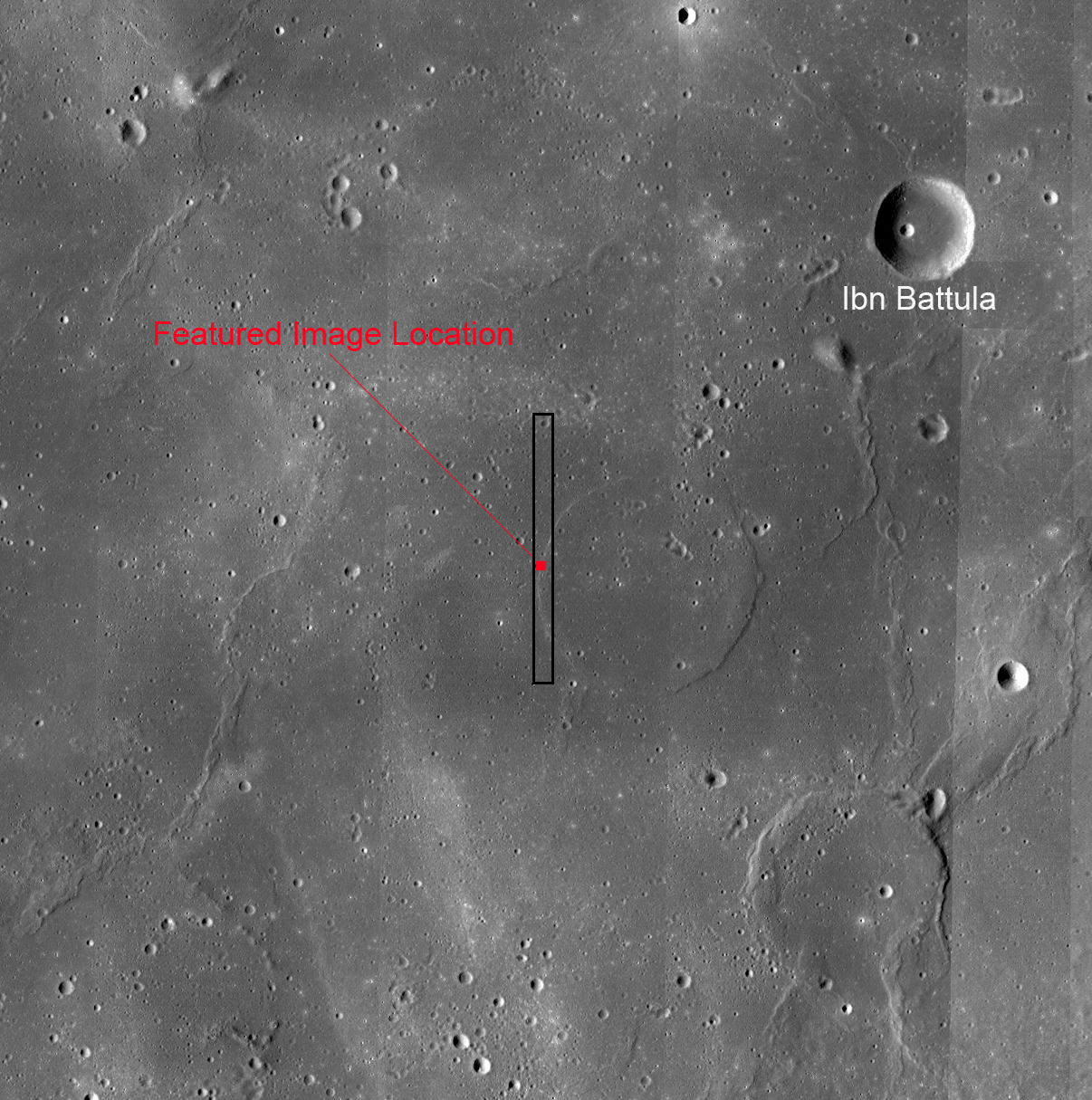
LROC Wide Angle Camera (WAC) mosaic centered on the Featured Image field of view. Note a second and more prominent ghost crater (Goclenius U) in the southeast corner of this approximately 120 km-wide frame [NASA/GSFC/Arizona State University.

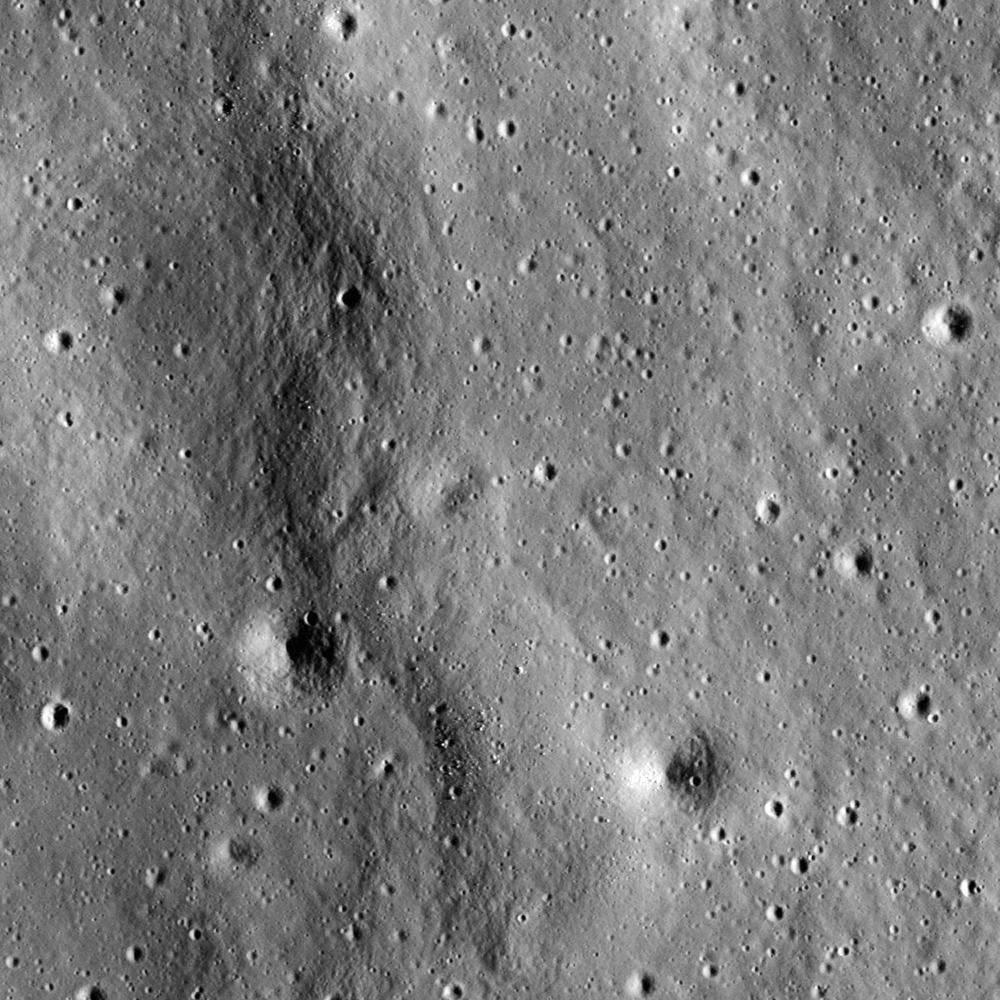
At least two large ghost craters can be found here in the Mare Fecunditatis basin just south and southwest of the crater Ibn Battula. Some portions are simply unrecognizable as former crater rims without the large scale mosaic for context (see example below).

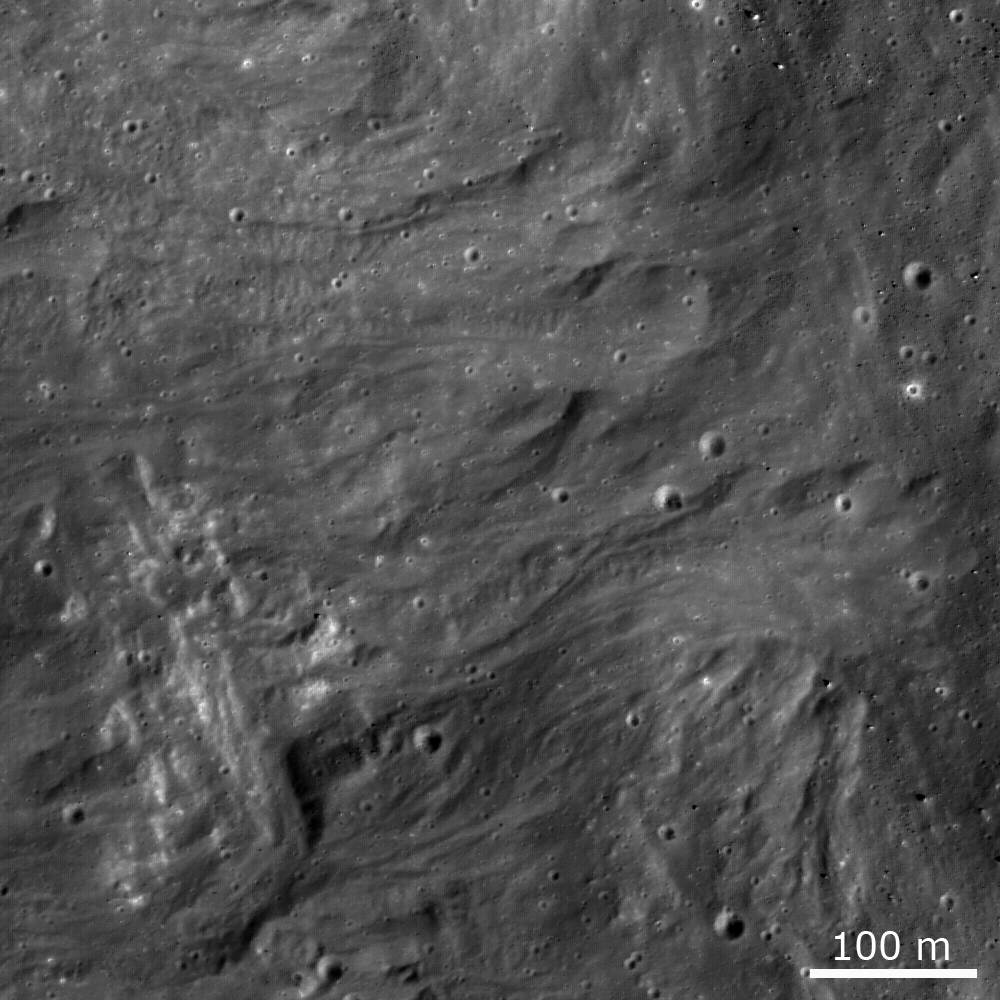
Another portion of the crater rim gives a muted appearance like that of a snow-covered park bench. Field of view width is ~700 meters.

Examine the full NAC frame (HERE) to see a greater length of ghost crater rim. Another example of a ghost crater is presented in the Ghost Crater in Southern Mare Crisium, a Tier 2 Constellation program Region of Interest. Contrast the appearance of a ghost crater to that of a flooded crater (e.g., as in Balcony Over Plato).

Tuesday, March 20, 2012

LROC: Absolute Time

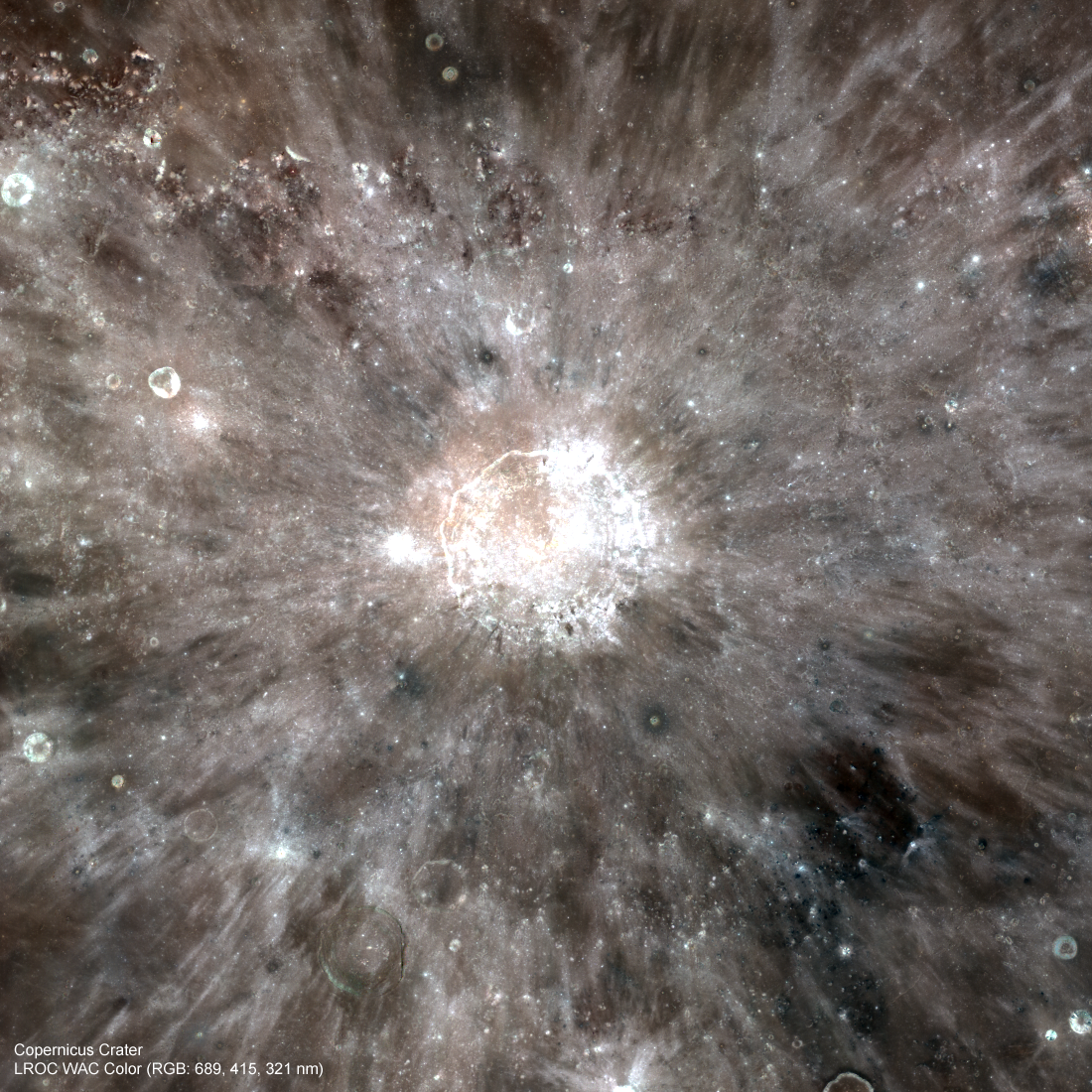
LROC Wide Angle Camera (WAC) visible to ultraviolet portrait of Copernicus crater, field of view 458 km. View the full size LROC Featured Image HERE [NASA/GSFC/Arizona State University].
Mark Robinson
Principal Investigator
Lunar Reconnaissance Orbiter Camera (LROC)
Arizona State University

Understanding how scientists determine the relative age of geologic units on the Moon is straightforward, most of the time. One simply follows the law of superposition; what is on top is younger, what is below is older. In some cases superposition relations are not clear, so scientists then compare crater densities. That is the number of impact craters on a common size of ground. Since impacts occur randomly both in time and on the Moon's surface, any piece of ground has an equal chance of being hit. Over time the number craters in a given area increases. Simply stated, the older an area the more craters you will find.

How do scientists determine the absolute age of a geologic unit? Somehow the crater counts (# of craters per area) have to be "connected" to absolute age dates. The rocks brought back by the Apollo astronauts provide that connection. For example, radiometric age dates of Apollo 11 and 17 basalts are 3.6 to 3.8 billion years (by) old, while those collected at the Apollo 12 are "only" 3.2 by old. Crater counts were taken of these three areas allowing absolute ages to be estimated for other places on the Moon that have crater densities between those of Apollo 12 and Apollo 11. What about absolute age dates for the other Apollo sites and the three Soviet Luna robotic samples? Can the range of time be extended beyond the range 3.2 by and 3.8 by? Unfortunately none of the young large mare basalts were sampled by any of these other missions. Look at the absolute age plot (below).

Newly modified (red points) lunar absolute age plot, from Hiesinger et al (2012). The blowup shows how the point for Copernicus now fits the curve after improved crater counts from new images. The y-axis is the count of the cumulative number of craters larger than 1 km in diameter per a surface area of 1 square km. The x-axis is the age of the surface in billions of years.
There is a very large gap in time (x-axis on the plot) for units less than 3.2 by old! Both the Copernicus and Tycho age dates are inferred. That is, scientists hypothesized that the Apollo 12 astronauts sampled part of a ray of Copernicus and Apollo 17 astronauts collected pieces of Tycho ejecta (from a distance of >1000 km from the crater itself). For thirty years the Copernicus date did not quite fit the chronology curve defined by all of the other samples. Perhaps the absolute age curve was in error, or perhaps Copernicus ray material was not actually sampled at the Apollo 12 landing site? Or perhaps the crater density value for Copernicus was not as accurate as it could be? New crater counts acquired from LROC WAC and NAC images and Kaguya images reveal a different crater density for Copernicus!

HDTV still of Copernicus from Japan's lunar orbiter SELENE-1 (Kaguya), released in 2009. View enlarged HERE [JAXA/NHK/SELENE].
Mystery solved, well perhaps. Scientists still have to live with the sparsity of absolute age points that define the chronology curve, for now. To really nail down the connection between crater density counts and absolute ages we need samples of middle aged and young mare (3 by to 1.5 by years). And samples are needed for very young impact materials (<100 million years), such as the craters Tycho, Aristarchus, and Giordano Bruno. Such samples will not only help scientists better define absolute ages all around the Moon, but also for Mercury, Mars and asteroids.

Explore one of the LROC NAC images used to improve the crater density statistics at Copernicus. The full story on improvements to the absolute lunar chronology can be found in:

"How old are young lunar craters?" Hiesinger, H., C. H. van der Bogert, J. H. Pasckert, L. Funcke, L. Giacomini, L. R. Ostrach, and M. S. Robinson; Journal of Geophysical Research, 117, E00H10, doi:10.1029/2011JE003935


Related LROC Featured Image Posts:
Copernicus Crater and the Lunar Timescale
Eratosthenes Crater and the Lunar Timescale

Sunday, September 19, 2010

LOLA data improves the crater count

Updated September 20, 2010 0051 UT

Another Gap. Following up on a global crater count and mean elevation study of LRO laser altimetry (LOLA), spotlighted by NASA, Sept. 16, another conspicuous, surprisingly oblong gap in the distribution of >20 km craters appears in and around Mare Orientale [NASA/GSFC/LOLA/Brown/SVS].

A study of 5,185 lunar craters of similar size, their global distribution and how their interior elevations deviate from the Moon's global average appears to confirm work by Wilhelms, El Baz and others, published a half-century ago.

Amazingly, those earlier investigators, who improved existing maps of the near side and mapped what was still being learned about the wildly different far side, did not have the benefit of laser altimetry streaming down from the LOLA instrument on board the Lunar Reconnaissance Orbiter (LRO).

More amazing, the Moon's mean elevation, its average radius of 1737.5 kilometers, was far from accurately understood. The LAT package on board JAXA's Kaguya (SELENE-1) isolated the Moon's elusive center further, from within 2 km to within about 200 meters.

In comparison, the Brown University study authored James W. Head is rather like modern lunar instrumentation rated against Apollo guidance computers.

Originally, grid by grid, with slide rule geometry and calculus, plugging time and illumination angles into formula, crater counts of extraordinary accuracy were weaved together by patient investigators. Their published conclusions continue to be confirmed in the mining of laser data from LRO. But questions raised by them stubbornly remain unanswered by 21st century remote sensing. The Ground Truth is still irreplaceable


James W. Head of Brown University has performed a global census 5,185 lunar craters >20 km. in diameter. The study, published in Science, includes a global color-coded tally of the crater's interior elevations, showing deviation from the Moon's global mean "sea level" of 1737.5 km. Not surprisingly, a thinner population of such craters are found in and around familiar near side basins, reconfirming conclusions from long ago that the huge plains represent younger surfaces. (Of craters included in the Brown University census, green = mean global elevation; bluer = below, yellower = above.) [NASA/GSFC/LOLA/Brown/SVS]

So what are these data telling us, confirming theories and restating questions asked by the Light and Shadow slide rule guys of the Apollo era?

Broadly speaking, the Moon holds a reliable record of the history of the Solar System, a record largely lost to water, dynamic weather and plate tectonics on Earth. The Moon's obvious proximity shows this history is also the history of Earth, particularly the history of conditions in that part of the Solar System simultaneously occupied by both bodies.

And the Moon's surface tells a story writ large in bombardment, beginning a very long time ago with the large impactors, like the 4 billion year-old event that formed the 2,100 km-wide South Pole-Aitken basin or the 1290 km-wide Imbrium event that probably happened less than a few hundred million years later. All through the course of the past 4,500 million years, smaller but also respectable kinds of interlopers that punched out the craters in the Head census have continued to "encounter" the Moon with decreasing frequency.

If our dating of features on the Moon's surface is close to being correct, the fall-off in this more common kind of bombardment must have been fairly rapid. Otherwise, the 3.9 billion year-old near side basins, "only" a half-billion years or so after the Moon's magma ocean solidified, would be more punctuated with craters.

The evidence, particularly after studies of the Moon's far side literally entered the picture in 1959, hints that between the formation of SPA and the more familiar near side basins, a gradual decline in these "mid-sized" impacts may have reversed for a 150 to 200 million years before resuming its decline. This is the strongest evidence we have for what's become known as the Grand Bombardment, possibly a juggling of material perturbed as the outer planets, for some unknown reason, waltzed for several million years until stabilizing into their present orbits.


The presentation of the LOLA data study, prepared by the Science Visualization Studio (SVS) at NASA Goddard, was atypical in not including the classic near and far side panels; the two hemispheres shown side by side, centered on the 0° and 180° meridians. The SVS illustrations do include the separate panel above, centered on 90° and 900 frames from their animation. And the animation presents the 5,185 color-coded craters in a way that fancifully builds up gong from east to west as Moon rotates once around. This method does not allow for a view centered over any areas of interest other than the two equatorial slides. If you want to see the census results over Mare Orientale, for example, as at the head of this post, the area of interest falls behind before becoming fully populated [NASA/GSFC/LOLA/Brown/SVS].

Nevertheless, as the the Moon rotates, another second gap appears in the crater count, this time arguably in the the lunar highlands but hardly typical in composition, an oblong gap 2000 kilometers north to south and 1200 km wide centered on Mare Orientale.

Orientale was a late comer, slightly smaller and perhaps more energetic than the great basin-forming impacts of a billion years earlier. If dating methods are reliable, then the fall-off in >20 km-wide impact events had fallen to a trickle by the time of Orientale's formation, 3.1 billion years ago. Some studies hint the Orientale event was energetic enough to have caused an upwelling of molten material in the near side basins, the many ponds of mare material within South Pole-Aitken and elsewhere.

Additional Reading:
The Moon through LRO's eyes
Kelly Beatty
Sky & Telescope

Saturday, September 4, 2010

Boulder saturation


Second look at the LROC Featured Image, from LROC Operations Center, Arizona State University, May 20, 2010 - close up of a 'house-sized' bolder and the end of its bouncing trail, angling back into a worn crater - coming to a halt millennia ago. The 200 meter wide field of view from the interior a large crater situated in still larger 42 kilometer-wide Henry Frères (23.39°S, 301.06°E). ("Hole in one, in a hole in one," Lillian Ostrach, from LROC NAC M122597190L - LRO orbit 3200, March 7, 2010; alt. 46.24 km; res. = 0.50 meters) [NASA/GSFC/Arizona State University].

The history of the Moon is a history of bombardment. From the global to the micro-scale the history of the Solar System has been etched in detail with little erosion other than subsequent bombardment. Other than the splash, relatively brief flow and inundation of melted material, most of the resulting debris has been broken rock, in sizes ranging almost as wide in scope as those of the Moon's craters.

Fortunately, most of this debris has been shattered and shattered again, gardened into pieces small enough to become packed down by micrometeorites, and the Moon turned out to be perfectly safe to walk on. Like the craters, Moon rock is another language time used to write the history of our home star and its system of orbiting bodies, especially Earth, all preserved from the dynamic, relentless erosion supplied by Earth's lithosphere and watery atmosphere.

Everywhere on the Moon where sufficient grades meet up with "flat lands," boulders and their bouncing trails can be found. This has been established and confirmed, as many expected, since the Apollo era. Now, LRO is providing us with our first comprehensive large scale view of these processes.

In March, one boulder along with its meandering trail downward into the interior of 42 kilometer-wide Henry Frères (23.39°S, 301.06°E) caught the trained eye of the planetary geologists at Arizona State University, who operate the wide and narrow angle cameras on-board the Lunar Reconnaissance Orbiter.

The size of the thumbnail image from LROC observation M122597190L did the scene justice, but not when reduced down within the limitations of this blog template (400 x 800). Even though we downloaded the 253 megabyte original, it's taken since May to sort though the fire hose of data being returned by LRO, allowing a second look. We offer it above rotated 90 degrees and in such a way allowing closer examination.

How long ago this boulder was shaken loose from the rim to begin and end it's bouncing journey back into the host crater's interior is not easy to determine. The effects of optical maturity hint at more than 900 million years ago, but that's not narrowing it down very much.

The shape of the boulder is recorded in the pattern it carved, alternately bouncing and then rolling its way to the point where it was briefly caught by the much older crater near the bottom of the slope, where it obviously hesitated and then rolled backward to a stop.

The imagination can almost see the event as it happened, in less than a wink of an eye in comparison to its age. And our experience can also easily imagine just how long such a feature would last, even in the lightest perennial rainfall, here on Earth.

Monday, August 16, 2010

The impact history of the Moon

From 41st Lunar & Planetary Science Conference (2010) -

The history of the Moon is the history of Earth, and the testimony of the Moon is saturation bombardment. The history of the inner solar system is recorded there also, safe far from the dynamic lithosphere and atmospheric erosion ever-present here on Earth. Even before the preliminary glance (above) at laser altimetry from LOLA, on-board LRO, was presented, 300 impact basins were already identified on the Moon. Most are not as apparent as the familiar "basin-forming impacts" visible to the naked eye, clustered on the Moon's near side (on the left side of the projection of the Moon's eastern hemisphere above). Was a gradual fall-off in both the size and frequency of impacts on the Moon, preserved over 4.5 billion years, steady or were there peaks and valleys in that long process? If so, what caused those events, and how often? Are they cyclical? The Moon holds the answers, a convenient recording of Earth's past. Almost certainly, our companion Moon will tell us something about Earth's future, also [NASA/GSFC].

Barbara A. Cohen
NASA Marshall Space Flight Center (MSFC)

The bombardment history of the Earth-Moon system has been debated since the first recognition that the circular features on the Moon may be impact craters. Because the lunar impact record is the only planetary impact record to be calibrated with absolute ages, it underpins our understanding of geologic ages on every other terrestrial planet.

One of the more remarkable results to come out of lunar sample analyses is the hypothesis that a large number of impact events occurred on the Moon during a narrow window in time approximately 3.8 to 4.1 billion years ago (the lunar “cataclysm”).

Subsequent work on the lunar and martian meteorite suites; remote sensing of the Moon, Mars, asteroids, and icy satellites; improved dynamical modeling; and investigation of terrestrial zircons extend the cataclysm hypothesis to the Earth, other terrestrial planets, and possibly the entire solar system. Renewed US and international interest in exploring the Moon offers new potential to constrain the Earth-Moon bombardment history.

This paper will review the lunar bombardment record, timing and mechanisms for cataclysmic bombardment, and questions that may be answered in a new age of exploration.

View the presentation (pdf), HERE.

Friday, May 14, 2010

LOLA: Einstein & Einstein A

A Study in Crater Morphology. Einstein (16.6°N, 271.5°E) and nestled within Einstein A. Laser Altimetry from the Lunar Orbiter Laser Altimeter (LOLA) instrument on-board the Lunar Reconnaissance Orbiter [NASA/GSFC].

LOLA-GSFC Image of the Week - May 14, 2010: Located on the far western limb of the Moon, Einstein and Einstein A (16.6°N, 271.5°E ) are only visible to Earth-bound observers during the rare favorable libration.

Einstein A is younger than Einstein, as indicated by the fact that it lies squarely in the middle of the Einstein's floor. Viewed an topographic data, these two craters reveal much about the relative age and shape of an impact crater.

To understand further, let's first take a look at Einstein. Einstein is a fairly large crater that spans 198 kilometers across. A crater's size alone however cannot reveal much about age. Einstein's relative age can be determined by examining the frequency and distribution of impact craters overprinted on its rim and floor. Younger craters have fewer such impact counts, so they retain more original morphology.

As you may have already guessed, Einstein cluster craters are named after physicist, philosopher and scientist Albert Einstein (1879-1955).

+ Go to LOLA "Image of the Week" Collection.

Wednesday, December 16, 2009

Young Giordano Bruno


Frozen impact melt flows on the ejecta blanket of the young impact crater Giordano Bruno (22 km diameter). The image is about 600 m across and the flows are about 50-100 m wide (NASA/GSFC/Arizona State University).

Mark Robinson
LROC News System

In many cases LROC has seen frozen flows of impact melt inside and on the flanks of Copernican aged craters. Giordano Bruno is one of the youngest large craters (22 km diameter) on the Moon. How old is "youngest"? Written accounts of twelfth century eyewitness reports of a bright flash on the Moon may record the event that formed Giordano Bruno crater. That idea was proposed after the first high resolution pictures of the crater were analyzed from the Apollo era of lunar exploration. Scientists could see that the crater was very young and was in the area of the Moon corresponding to the bright flash, so it seemed possible that the flash and crater were related. More recently a team of scientists analyzing high resolution images acquired by the Japanese lunar orbiter Kaguya estimated that the crater formed more than one million years ago. Very young by lunar standards, but certainly not consistent with the eyewitness reports. The Kaguya team (see below) determined the age by counting the number of craters that formed on the Giordano Bruno subsequent to its formation. Were some of the small impacts discovered on the crater actually formed as late stage ejecta rained down on the crater? If so the age may be younger than the current estimate.

The very high resolution images being returned by LROC are revealing impact crater features in exquisite detail. The deposits shown above are actually small distributary flows that emanated from a larger mass of impact melt that was thrown out onto the northwest rim by the impact. Although formed by a different process, impact melts flow in much the same way as lava flows, forming lobes and exhibiting channels and levees. Like lava flows, they cease to move when their source is depleted or the melt cools and freezes into solid rock. Impact melt is formed by the heat and pressure of the impact process. This particular area is at 36.34°N, 102.45°E. The scene is about 600 m across; image resolution is 0.6 m/pixel.

Hopefully, soon the true age of Giordano Bruno can be determined by radiometric age dating of impact melt rocks returned by future astronauts. In the meantime scroll around in the full image and see if you can determine how the small impact craters formed on this fascinating young crater.


(BELOW: Giordano Bruno from Kaguya in 2007 and 2008.
)


Tuesday, October 20, 2009

Small crater in the Southern Highlands


Fresh crater on the southwest rim of Metius B 440 meters across. [NASA/GSFC/Arizona State University].

Samuel Lawrence
LROC News System

Impacts at all scales dominate the lunar surface. This is a relatively small (440 m diameter) and unnamed crater on the southwestern rim of Metius B, a 14 km diameter crater that is itself on the floor of 88 km Metius in the southeast near side Highlands.

Some post-impact modifications to this crater are readily apparent. Although the crater itself is circular, you can see that the materials inside the crater slumped towards the downslope side of the crater following the impact. There are also numerous boulder trails emanating from around this very fresh crater, created when the rocks strewn outwards by this impact event landed on the slope and began rolling towards the bottom of Metius B.

Even though the Moon may not seem like a terribly dynamic environment, in actuality impacts still occur on a fairly regular basis. One of the critical goals of the LROC scientific investigation is to provide the necessary information to quantify the recent impact rate, providing a key data point for designers of future lunar habitats.

Browse the whole NAC image, HERE.

Saturday, August 8, 2009

All our eggs in one basket

Among the six abyssal lunar south pole craters picked as finalists for the impact of LCROSS, October 9, is Shoemaker, only just recently named in honor of Eugene Shoemaker, the legendary lunar and planetary scientist who, among other things, led the United States' Surveyor robotic lander program on behalf of NASA JPL.

With the equally legendary planetary scientist and writer David Levy and wife Carolyn, Gene Shoemaker co-discovered Comet Shoemaker-Levy 9 on March 24, 1993.

They resolved the shattered comets fragments and quickly traced back them back to what must have been a close encounter with Jupiter in July 1992.

Originally a larger, single comet, Shoemaker-Levy 9 had passed within Jupiter's Roche Limit, where the tremendous gravity-well of Jupiter acted unequally on the primordal icy body, wrenching it apart. Within days it became clear at least nine "calves" of that original comet were destined to slam into Jupiter's southern hemisphere, in mid July 1994.

When the time arrived, Carolyn and Gene Shoemaker, with Dr. Levy and, by way of webcam, Arthur C. Clarke, live from Sri Lanka, on the opposite side of the globe, waited in a NASA-TV studio, live, as virtually all of humankind's telescopes, including Hubble, turned to watch, and no one was disappointed.

Between July 16 and July 22, 1994 the cometary fragments bombarded Jupiter at nearly the same southern latitude and the vaporizing impacts were visible though their points of impact were just beyond view, on the pre-dawn side of the Jovian disk.

One by one, expanding halos, each the size of Earth, rotated into view as the planet turned, winding around into the sunlight as newer impacts continued with a brilliance that lit eclipsed faces of Jupiter's shadowed moons beyond.

That all this "legend" coincided in serendipity, legendary men, women and their instruments, demonstrated a stark fact beyond much in the way of doubt.

Such a display probably did not just happen, like a tree falling in the forest, because, there were ears to hear, or because, for the first time in human history, a passive audience just happened to be looking that way. Such happenings, as Earth's Moon testifies loudly to any who might listen, have to be very common.

There may have been a peak in the shuffling of that single percent of this star system's mass that is not presently part of the Sun, even a Grand Bombardment, 3.9 billion years ago, that very slowly reduced in frequency and in the size of impactors, but the bombardment is still underway.

If there was lingering doubt, fifteen years later, in July 2009, the aftermath of a "Shoemaker-Levy" class cometary impact, a resulting scar-like halo like those seen in 1994, showed up once again, but this time without any advance notice.

As the Daily Galaxy picked up on the story, the Lunar Pioneers are reminded of two compelling reasons to learn the lessons of the Moon, the secrets of the history of the Solar System, writ both large and small on its surface.

We ought not put all Mankind's eggs in one basket.

And while we're reading that "fine print" of the Moon's story, which is also the story of Earth, we had better allow our relatively large natural satellite to teach us hard lessons of survival in the most hostile of environments, the same part of the Universe where the Earth is. After news of this latest impact on Jupiter hit, many were asking that silly question again, "can it happen here?"

No doubt of it. The answer remains the same as it was in 1994. It's not "if," but "when?"

(Another) Pacific Ocean-Sized impact on Jupiter highlight's Hawking's Asteroid Theory

"In further evidence that space itself is an action movie (or at least that God watches Michael Bay movies), an explosion the size of the Pacific ocean has scarred Jupiter. Yes, the entire ocean. The explosion occurred on July 19 when an asteroid slammed into the planet, and although Jupiter has no solid ground the gas can still get thick enough for things like "impacts" and "KABOOM" to happen. - Daily Galaxy, July 24"

Read the feature story HERE.

Tuesday, August 4, 2009

A Dangerous Season for Asteroids?

Familiar Tycho, visible to the standard naked eye, is a relative newcomer to the Moon, despite impressive rays that stretch in all directions. From samples, first predicted and then collected by Harrison Schmitt near the landing site of Apollo 17, (2240 kilometers northeast) the Tycho impact event probably occurred 109 million years ago. Its dramatic rays are, therefore, less darkened by the space-weathering forces of optical maturity (OMAT). Literally hundreds of craters just like it are all over the Moon, like most of the ancient features seen in this telescopic view of the southern Highlands, their rays have reddened or worn away, making them at least 900 million years old. When the Tycho-progenitor struck the Moon, dinosaurs roamed Earth. (Eric Soucy, LPOD)

Firefighters sometimes insist the world of humans is divided along an unpredictable line, one that becomes clear only when a home is fully engaged in fire. Some children, they say, upon being awakened by smoke or noise, defy all odds and do all they can to escape, even if they are not ultimately successful. Others simply pull the covers back over their heads and go back to sleep, permanently. These firefighters insist also there is usually no reliable way of predicting ahead of time which child will follow which path, until the danger is undeniable.

As confirmed by direct observations recently sponsored by NASA, Ito and Malhotra (2009) assume a slight majority of impacts on the Moon take place upon it's leading edge, on the hemisphere perpendicular to its direction in orbit. (The same process making meteors more common after midnight on Earth, until the direction of our orbital path around the Sun gradually comes to be more or less directly overhead, at sunrise.)

Dramatic as Tycho was, the crater record seems to indicate such impacts occurred more frequently in the past, and fell off in probability over time as the Solar System stabilized.

Is the present quiet, however, an illusion? The Moon has the answer, though we might not want to think about, or hear, the plain truth of that message.

One of the most compelling reasons to study the Moon closely is it's well-preserved record of the history of the inner and outer Solar System, conveniently located as it is near the Earth, like a rain gauge or temperature probe in our backyard; events recorded there represent conditions in our vicinity.

We have barely scratched the surface.

But what the Moon does have to say is clear enough to read with the naked eye. The history of the Moon, and, therefore, at least the past 4.5 billion years, is the history of Earth, and the testimony is to a history of bombardment.

As such, there is still much disagreement about a few things, or perhaps it would be better to say that through a careful reading of the data we have what appears to show bombardment gradually tapering off in both size and frequency.

It now appears the Moon formed 4,500 million years ago from materials much in common with those found on Earth, ones common to our location and distance from the same Star.

The very first basin-forming impact, some believe, may have been centered only a couple of hundred kilometers north by northwest of the landing site of Apollo 11, and it may have been large enough to create an impact basin larger than 50 percent of the Moon's surface area.

If this Gargantua impact really happened, it's traces can be found in the shape of the Moon itself, higher and more consistent with the materials we think the entire Moon was made of before the massive strike - on the Far Side.

It might also explain the incomplete shape and age of Oceanus Procellarum, for example, but there is no agreement on the date, it may have happened, and it if it happened at all this event was then followed only a hundred million years or so later by a slightly smaller impact on the southern Far Side, forming the largest confirmed basin on the Moon, stretching from the equator on the Far Side all the way south past the South Pole with a massive, mountainous rim that invades five degrees of southern latitude onto the Near Side. This South Pole-Aitken Basin is ringed by the highest landmarks on the Moon, and it also has within it the Moon's lowest points.

Data points to an impact-event around 4 billion years ago.

After this came Nectaris and Imbrium, the latter forming the most clearly discerned "eye" of the snaggle-toothed "Man on the Moon" pattern seen by the naked eye here on Earth., around 3.9 to 3.8 billion years ago.

Data also seems to indicate the period when most of the Moon's known basins formed may have coincided with a, so-called, Grand Bombardment, a period of chaotic struggle where some of the Outer Solar System gas giants, like Uranus and Neptune, and perhaps Saturn, may have swapped positions, causing quite a stir and raining asteroid-sized objects into the Inner Solar System with furious, deadly, mass extinction-causing events.

Taking "Seven-League Boots" through billions of years of companionship with our Moon, the theory holds that, aside from occasional jostling by passing stars and such, the Solar System gradually settled down to the relative quiet we seem to be experiencing at present. If something was destined to hit something else, it si said, it would most likely have happened by now.

But few, very few, of those who study such things are prepared to make such a bold statement with confidence.

Objects the size of large islands regularly pass by the Earth, often closer than the Moon, and we know the Solar System is both dynamic and stable. It is, therefore, not a matter of whether the bombardment tapered off and the danger is past. It is a simple matter of probability. Sooner or later, Earth will be struck again, just as Jupiter was, as predicted a year earlier in 1994, and was again, this time unpredicted, late last month. Headlines ask "can what happened at Jupiter happen here?" The answer is an emphatic, "of course."

Just knowing where the so-called Near-Earth Objects are is part of the job of understanding the risk. The other part is understanding the probability, and the Moon probably holds that answer; wind, plate tectonics, and especially water have done an excellent job of nearly destroying the same record here on Earth. So, it's especially nice to have the airless Moon so close at hand, probably throughout the past many billions of years.

There is no agreement whether there was any actual increase in bombardment, with the offending objects gradually coming more smaller and less frequent. Fortunately, our understanding of crater-forming events at the Moon has improved vastly in the past 50 years, due in no small part to direct observation from orbit and especially from sampling the surface.

Now comes Takashi Ito and Renu Malhotra, who, like many others, have studied what little we have collected of the Moon's story (which is so much more than we could have guessed at in 1959), and they have come to their own conclusion.

Their conclusion is the "gradually fall-off" in bombardment has not been "symmetric."

A closer look at the fall-off shows, they report, frequent swings, which they now report about in "Asymmetric Impacts of near-Earth asteroids on the Moon." (arXiv:0907.3010)

"Recent lunar crater studies have revealed an asymmetric distribution of rayed craters on the lunar surface," they write as introduction. "The asymmetry is related to the synchronous rotation of the Moon: there is a higher density of rayed craters on the leading hemisphere compared with the trailing hemisphere. Rayed craters represent generally the youngest impacts. The purpose of this paper is to test the hypotheses that (i) the population of Near-Earth asteroids (NEAs) is the source of the impactors that have made the rayed craters, and (ii) that impacts by this projectile population account quantitatively for the observed asymmetry. We carried out numerical simulations of the orbital evolution of a large number of test particles representing NEAs in order to determine directly their impact flux on the Moon."

"The simulations were done in two stages. In the first stage we obtained encounter statistics of NEAs on the Earth's activity sphere. In the second stage we calculated the direct impact flux of the encountering particles on the surface of the Moon; the latter calculations were confined within the activity sphere of the Earth. To represent NEAs' initial conditions, we considered two populations: one is the currently known NEAs, and the other is a synthetic population created by debiasing the orbital distribution of the known NEAs. We find that the near-Earth asteroids do have an asymmetry in their impact flux on the Moon: apex-to-antapex ratio of 1.3-1.4. However, the observed rayed crater distribution's asymmetry is significantly more pronounced: apex-to-antapex ratio of ~1.67."

"Our simulations suggest the existence of an undetected population of slower (low impact velocity) projectiles," the conclude, "such as a population of objects co-orbiting with Earth."

We already know of the existence of a space handful of such co-orbiting objects, (and in remarkably unstable orbits, considering how long Earth, together with our Moon, have been situated where we are).

We are also feverishly looking, high and low, for more, because the implications are staggering for a species with such a short-sighted perspective, based heavily on the time-lines of the lifetimes of both ourselves and even our civilizations (even our species).

All of these are a drop of water, or rather spaces between drops of water in a hurricaine, and those short-lived spaces impress upon us a desired emotional stability, to our cycles of life, though all such stability may, after all, be wholly imaginary.

Read Ito and Malhotra (2009) HERE.