Showing posts with label Pioneers. Show all posts

Thursday, January 29, 2015

B. Ray Hawke, lunar geologist

Dr. B. Ray Hawke on the rim of Kilauea Caldera, Hawai'i Volcanoes National Park, 1984 [Paul Spudis].
Paul D. Spudis
Daily Planet
Smithsonian Air & Space


I was saddened this weekend by the not totally unexpected news that lunar scientist and good friend B. Ray Hawke of the University of Hawaii has passed away.  Colleague and collaborator, I knew B. Ray as long as almost anyone in the business.  We were graduate students together, early co-workers and good friends.

Bernard Ray Hawke hailed from Upton, Kentucky, about 60 miles north of my birthplace, Bowling Green, Kentucky. We first met in 1976 as graduate students at Brown University. A returning Vietnam veteran who’d served as an Airborne Ranger, B. Ray was a kindred spirit who helped me deal with the cultural shock as an Arizona State University student who’d exchanged the grand vistas of my adopted Arizona for the claustrophobic confines of Ivy League New England.  We became good friends, spending hours at his preferred office – the local coffee shop (the IHOP, which advertised a “bottomless” coffee pot, a descriptor that B. Ray took literally).

During our graduate years, we took to using ironically the honorific “Doctor” when speaking to each other (we were all pre-doctoral candidates), not only between ourselves but also when in the presence of others, a private joke that we continued throughout the years.  This led to some amusing situations later, as our students expressed confusion when I would refer to B. Ray – a colleague but also a long-time personal friend – with the formal title of “Dr. Hawke” and he would address me as “Dr. Spudis.”

B. Ray’s scientific work focused very specifically on the Moon.  As a Masters student at the University of Kentucky, he analyzed lunar regolith chemistry and used something called a “mixing model” to determine its geological affinities.  In this technique, the composition of a soil is determined and that composition is modeled as a mixture of known components.  Although seemingly an academic exercise, this approach could be a very powerful technique to decipher the geological history of the Apollo landing sites.  Later, B. Ray and I would apply this same technique to chemical data returned by the orbiting Apollo spacecraft, giving us our first look at regional and global compositions.  Combined with information about the geological setting of regions covered from orbit (such as the basin ejecta), such study would help us reconstruct the composition and makeup of the crust of the Moon.

B. Ray’s early work dealt with integrating lunar sample information with images and geological mapping, my own field of specialization.  He and I spent many hours discussing some of the problems of this effort, and also the issue of overcoming considerable community skepticism about the approach.  We worked to convince our colleagues that the future of lunar science lay in the melding of the broad disciplines of sample science and remote sensing – taking results from the study of samples, using it to inform the interpretation of remote sensing data, and then concocting a geological model that explains and encompasses all known facts.  Although this approach is now a recognized way to conduct lunar science, careful reading of the early literature will show that most early post-Apollo work was highly sequestered by discipline, with little cross-fertilization of results and insights.

Because B. Ray and I found ourselves working on many of the same scientific problems after graduate school, we formed a partnership that lasted 40 years.  One of our earliest efforts was an attempt to use impact basins as large-scale probes of the lunar crust.  An early paper (1984) on the Orientale basin was the first to discover that massive blocks of pure anorthosite, an indigenous rock composed almost completely of plagioclase feldspar, make up the inner ring of that basin.  In addition, we measured the composition of material thrown out from Orientale using chemical maps based on data from the orbiting Apollo spacecraft.  These results indicated that the Orientale basin excavated only the upper portions of the lunar crust; new data from subsequent missions have confirmed these early results.

The study of telescopic spectra, involving very precise measurements of color at high resolution of very small spots on the Moon, became B. Ray’s specialty.  These spectra would be taken of many carefully selected geological targets, a great improvement over the previous approach of targeting mostly by geographic region.  He spent many hours at Hawaii’s Mauna Kea Observatory, diligently working to make certain that data for the correct spot on the Moon was being acquired.  His spectra were collected to address many scientific problems, including basin rings, dark halo craters, lunar “red spots” (spectrally anomalous regions), impact melt deposits and the ejecta of large craters and basins.  B. Ray brought to these studies his extensive background in image analysis and interpretation.  He had made geological maps of portions of the Moon, which for the first time could be interpreted in terms of mineral and chemical content.  These studies are critical to our understanding of the complex and protracted geological evolution of the lunar crust.

During his 35 year association with the University of Hawaii, B. Ray mentored and befriended many students and visiting scientists. I made an extended stay at UH early in 1980, and worked closely with B. Ray on using spectral interpretation to map the Apollo 16 landing site. B. Ray’s work habits were unorthodox to say the least, almost 180 degrees out of phase with normal working hours (I had to adjust to starting work at 9:00 pm and working until after breakfast). But for all that, I never saw anyone work so long and so hard when there was a problem to be solved. B. Ray was a great collaborator who very carefully reviewed each word in a paper, assuring that many errors and mistakes were corrected long before submittal. I could always count on a detailed and insightful review from him, even for papers for which he was not an author.

As he passes into the annals of history, the world of lunar science is a bit poorer without B. Ray Hawke. He was a productive scientist, a hard worker, a tireless advocate for lunar activities and a good and faithful friend. His legacy leaves us with a new way of looking at the Moon – an integrated approach involving studies of samples, remote sensing data, and images. His contributions to lunar science include work on impact melts, Apollo 14 site geology, dark halo craters and the extent of ancient volcanism, lunar non-mare volcanism (KREEP and red spots), and geochemical anomalies of the lunar crust – an extensive and impressive amount of work.

Thank you and rest easy, Dr. Hawke.

Published a short time ago at Smithsonian Air & Space, Daily Planet - Dr. Spudis is a senior staff scientist at the Lunar and Planetary Institute. The opinions expressed are those of the author but are better informed than average.

Tuesday, February 26, 2013

Pioneer - David S. McKay, 76

Accolades continue to pour in following the loss
of renowned planetary scientist David S. McKay.
For the following, a hat tip to Clive Neal of
Notre Dame University.
Leonard David
SPACE.com

David S. McKay, a pioneering NASA scientist in moon and Mars research, astrobiology and space resource utilization, has died, leaving a legacy of work that will continue to shape the future of space exploration. He was 76.

McKay, who served as chief scientist for astrobiology at NASA's Johnson Space Center in Houston,died peacefully in his sleep on Feb. 20 after battling serious health issues for several years.

As a graduate student, McKay was in the audience at Rice University in September 1962 when President John F. Kennedy gave his legendary "We choose to go to the moon" speech that put America solidly on a lunar trajectory.

McKay joined NASA in June of 1965 and was a key lunar scientist of the Apollo era, participating extensively in astronaut training leading up to 1969's historic Apollo 11 mission with field trips to Hawaii, Alaska, Iceland, Mexico and many sites in the western U.S. He also was instrumental in the geology training of Apollo 11 moonwalkers Neil Armstrong and Buzz Aldrin.

The media spotlight shone more brightly on McKay after the Apollo era, primarily because of his work on the "Allan Hills" Mars meteorite, also known as ALH84001.

McKay was lead author of a 1996 paper in the journal Science that suggested ALH84001 may contain evidence of past life on Mars. The claim still spurs controversy, but it also sparked a shift in perspectives that is alive and well within NASA today.

"Whether one accepts their arguments or not, it has led, directly or indirectly, to investigations seeking and finding signs of life in the most extreme environments. History will judge the value of that rather serendipitous outcome, but it seems clear that its significance is, and will remain, great," said David Draper, manager of the Astromaterials Research Office at Johnson Space Center.

Read the full article, HERE.

Monday, January 14, 2013

Brainerd Holmes (1921-2013)

D. Brainerd Holmes: TIME, August 10, 1962
[Boris Artzybasheff].
Ben Evans
AmericaSpace

In spite of a relatively short career within NASA’s senior leadership, D. Brainerd Holmes – who died on Friday, aged 91, from complications of pneumonia – established himself as a shining star in the Apollo era, to such an extent that he found himself on the cover of Time magazine in August 1962 as the agency’s ‘Space Planner’. This brilliant electrical engineer saw military service in World War II and later forged an engineering and industrial career with Western Electric, Bell Laboratories, RCA and Raytheon and, as NASA’s Director of the Office of Manned Space Flight from September 1961 until August 1963, was instrumental in tackling the practicalities of President John F. Kennedy’s thorny goal of putting a man on the Moon. Several years later, when Neil Armstrong and Buzz Aldrin accomplished that goal, Holmes told the New York Times that “we should remember such endeavors as these and know that when given a challenge Americans today can be as hard, as aggressive and as brave as the men who founded this land”.

Dyer Brainerd Holmes was born on 24 May 1921 in Brooklyn, N.Y., but grew up in East Orange, N.J. After graduating from Cornell University with a degree in electrical engineering, he entered the Navy and served throughout the final years of World War II. Returning to civilian life, Holmes worked at Bell Telephone Labs from 1945-53 and at RCA from 1953-61, where he rose to become general manager of the Major Defense Systems Division. Within this role, he oversaw the development of the Talos anti-aircraft missile and electronic systems for the Atlas missile. During this period, he also project managed a federally-sponsored effort to design and implement the Air Force’s Ballistic Missile Early Warning System (BMEWS), with radar installations in Alaska, Greenland and the United Kingdom, whose intent was to detect Soviet missile launches.

Read the obituary at AmericaSpace, HERE.

Tuesday, September 18, 2012

Aldrin speaks to large crowd in Rockford, Illinois

Buzz Aldrin in Rockford, Illinois, September 17, 2012 [WREX-TV 13].
Matt Groves
WREX 13

An American icon finds his way to the Rockford area to show support for the Winnebago County Salvation Army.

The star struck audience listened to every word as a man who has walked amongst the stars, Buzz Aldrin, gave a detailed account of his lunar landing and life after the spotlight.

"It was 66 year from the Wright brothers to Neil and I landing on the moon," remembered Aldrin.

As Buzz Aldrin recalls his experience before, during and after his moonwalk, some listeners wonder what it was like living during such a monumental moment in American and World history.

Others reach back in their memories pulling out their own special piece of what happened during the first moon landing.

"Everybody seemed happy, everybody seemed to be very excited.  Something that had never been done before was being done.  Didn't realize until years later, the magnitude of that feat," said Rudy Valdez.

Rudy Valdez has met Aldrin before.  He works with many astronauts through United Technologies, formerly Hamilton Sunstrand.

He says Aldrin brings more than just a story to the table.

Read the article and view the video, HERE.

Tuesday, May 1, 2012

Renowned research pilot Lee H. Person, Jr.

Lee Person evaluates a Synthetic Visibility System in 1989 - in essence, two helmet-mounted eyepieces connected to video cameras that swivel in response to head movements. Person was inducted into the Virginia Aeronautical Historical Society's Virginia Aviation Hall of Fame at the Virginia Aviation Museum last November [NASA].
Austin Bogus

Lee H. Person Jr., a well-known research pilot at NASA Langley, has died. He was 79 years old. A resident of Yorktown, Person was inducted into the Virginia Aviation Hall of Fame in 2011 in recognition of his contributions to aviation safety and aeronautics research.

Person assisted with NASA's moon landing research during the 1960s, flying lunar landing simulators and helped train for space missions.

He worked with the Apollo astronaut team before it went on its historic journey, during training at the Lunar Landing Research Facility at NASA Langley. The facility helped prepare astronauts for the final 150 feet of landing on the moon. Person was among the first pilots to test the model lander, making the practice flight some 182 times.

"We were working on it to get it to fly right," Person told the Daily Press in a 1994 interview.

"The astronauts would come into town and say something like, 'It rides pretty good, but why don't we try something like this?' They had to be comfortable with it. They were going to fly it onto the moon."

NASA said Person also helped advance the "glass cockpit" design for aircraft. He logged approximately 10,000 flight hours with 100 types of aircraft and rotorcraft.

He also experimented with some advanced gadgetry that never made it into mainstream use. Person got to try out Bell Aircraft Corp's jet pack, dubbed the Bell Rocket belt, a James Bond-style device designed to propel individuals off the ground. That incident landed Person in the hospital.

"He had a great sense of humor," said Dick Yenni, 77, who is also a former research pilot at NASA Langley. "He was a good down-to-earth test pilot and a good engineer to boot."

Person was born in Baton Rouge, La., in 1932. He served in the U.S. Marine Corps a fighter pilot until being discharged in 1958. He joined NASA Langley Research Center in 1962.

Lee Person on his career: YouTube

Sunday, April 29, 2012

Of lunar rovers and rockets

Wernher von Braun and Jewell Moody, left, started working together in Huntsville in the early 1950s. In 1972 Moody received the NASA Exceptional Service Medal, which is the second highest award in the NASA Incentive Awards Program. It is granted for significant achievement or service characterized by unusual initiative or creative ability that clearly demonstrates substantial improvement in engineering, administrative, space flight, or space-related endeavors which contribute to NASA programs.

Press-Register Correspondent/al.com

FAIRHOPE, Alabama -- Jewell Moody, 83, is a builder of things. Not many people can put on their resumè that they built a lunar rover or that they were truly a rocket scientist.

Moody can.

Moody worked with Wernher von Braun and his crew of German scientists starting in 1952. Recently a celebration was held in Huntsville, celebrating what would have been von Braun’s 100th birthday, had he lived — he died in 1977.

Moody remembers von Braun as a very “religious and kind man,” one who took the time to personally send a letter to Moody when his 14-year-old daughter was involved in a life-threatening school bus accident.

Von Braun came to the United States after a devastating war with Nazi Germany. Considering evidence that Germany would not achieve victory in World War II, von Braun began thinking about the postwar era. He participated in the surrender of 500 top German rocket scientists and the rocket information to the Allies.

Before the Allies actually captured the German V-2 rocket complex, von Braun’s team was secured and sent to the United States. In 1950, his team was relocated from Whites Sands Proving Ground, N.M., to Redstone Arsenal near Huntsville.

Moody was about to enter the picture and become a vital part of a historical phase for America.

Moody said von Braun insisted that people pronounce his name as von Brown. “He wanted it to sound more American, I guess,” Moody said.

Read about this Pioneer, HERE.

Thursday, April 12, 2012

Cernan in Tulsa, "We need dreamers."

Capt. Gene Cernan, "Dreamers are doers."
Rick Couri

Gene Cernan is the last man to put a foot on the moon. That happened in December 1972 nearly 40 years ago when the Apollo 17 mission came to and end. Cernan told us he still has a hard time believing it was that long ago and that we haven't been back. Cernan is in Tulsa today signing autographs at the Tulsa Air and Space Museum where I had a chance to catch up and ask him a few things about the space program. Cernan said he will always be proud of what the space program accomplished “technology, digital products, national pride, diplomatic presence” Cernan listed as some of the things he think were the most valuable.

As you can imagine, Cernan thinks the USA should be back in the space race and he hopes the kids of today lead the charge. “We need dreamers, dreamers are doers” he said as he watched the children visiting TASM Tuesday. “As a kid I wondered to myself if I could do that” Cernan remembered. “Then my Dad told me to go for my dreams, it’s amazing how often our fathers are right” he said with a smile.

I asked Cernan to think back to that moment when he was about to take the last step on the moon, what was going through his mind? “I looked back at the earth hanging there in the black, three dimensional with all the blues and the whites of the clouds and the snow.” I could see the memories in Cernan’s eyes when he said “I didn’t want that moment to end, I wanted to freeze time” he recalled.

Cernan was in Tulsa signing copies of his new book, “Last Man on the Moon.”

Link to Corsi's radio interview with Cernan, HERE.

Thursday, March 22, 2012

Von Braun: Legend of a Space Titan

Von Braun and the power of vision
Paul D. Spudis
The Once and Future Moon
Smithsonian Air & Space
 
Friday March 23rd is the 100th anniversary of the birth of Wernher von Braun (1912-1977), the man most responsible for creating and implementing a vision of humans in space. Von Braun is legendary in space circles – both admired and criticized by observers within and outside of the program.  As a young space enthusiast and physicist, he worked on solving the practical problems of liquid rocket engines.  Working for the German Wehrmacht, he led the team that designed and built the world’s first ballistic missile weapon, the A-4 (or V-2, as we know it).  In the post-war years, he wrote and spoke about humanity’s imminent future in the new frontier of space.  As head of the Saturn development team and Director of the NASA Marshall Space Flight Center, he designed and supervised the building of the Saturn family of launch vehicles – the rockets that sent men to the Moon.

Von Braun’s contributions are numerous, but in this post, I want to focus specifically on his most lasting legacy, what I call the “von Braun Architecture” – the sequence of steps that von Braun believed would send humanity into space – to live and settle, not just to visit.  To von Braun, space was indeed the “new frontier,” whereby exploration consisted of initial surveys followed by a permanent presence.  In his view, great powers aspire to and accomplish great deeds and the opening and settlement of a new frontier would be the greatest task any nation could undertake.

Wernher von Braun set out his architecture in a series of articles for Collier's magazine, a popular news feature forum in the early 1950’s.  It was a very well received among the young and confident generation that came of age in the shadow of the nuclear bomb  (when science and technology became simultaneously a blessing and a curse to mankind).  Because the series was so popular, it was expanded into three books (Across the Space Frontier, Conquest of the Moon and The Exploration of Mars).  Walt Disney used them to create a three-part episode in his 1955-57 television series Disneyland. The programs described and dramatized each of the major steps of the von Braun architecture: space taxi (shuttle), space station, Moon tug and Mars mission.

To document how his end-to-end system design would work, Von Braun presented detailed engineering drawings and supporting calculations. It was definitely not a mere outline of broad, vague terms listing obvious incremental steps needed to settle space.   Much of his systems analysis is still valid, although today some ideas would be updated to reflect new technologies.  For example, in his architecture, electrical power in space is generated by a solar thermal/mercury vapor turbine system, as photovoltaic arrays had not yet made their appearance in the early 1950’s.  Some of his more advanced concepts have seen partial implementation, such as a reusable space launch system.  Other innovations have yet to be accomplished, such as artificial gravity for the LEO Space Station and cislunar space tugs.

Technical details of von Braun’s half-century old architecture are of lesser importance than his influence on policy.  In broad terms, we’ve been following an implementation of the von Braun space architecture since the Space Age began more than 50 years ago.  The most notable exception and departure from his plan is the Apollo program, which bypassed the shuttle/station stage and headed straight for the Moon – a Sixties geopolitical imperative to beat the Soviets to the Moon.  Because of that looming deadline, a new architecture (one that could launch the entire lunar mission in one fell swoop) had to be developed that would bypass the complex and time-consuming development of a reusable launch vehicle and orbiting space station.  Von Braun tackled this problem with his usual enthusiasm, imagining first an 11 million pound super-rocket (the Nova) and then, a “smaller” 6.7 million pound behemoth (Saturn V) to take America to the Moon.  It was this decadal imperative of Apollo that drove von Braun to develop the heavy lift Saturn V, not some Teutonic tendency toward super-sizing his creations.

After Apollo completed our national goal, NASA fell back on the von Braun Architecture (as the agency always does once it completes a significant milestone):  Shuttle was to provide cheap, routine access to LEO, Space Station was to serve as an orbiting space base and platform to journey beyond and the “moon tug” was to be the Orbital Transfer Vehicle (OTV), designed to transport people and robots to and from high Earth orbits in cislunar space, including geosynchronous orbit (where communications and weather satellites reside), the Earth-Moon L-points and  lunar orbit (it requires the same energy to reach all three from LEO).  Each new NASA program was part of the master plan for space that von Braun laid out sixty years ago.

The von Braun Architecture has staying power because it remains a logical, incremental and cumulative plan that will systematically extend human reach beyond low Earth orbit.  Von Braun wanted space to become a “new ocean” and intended to build the navy to sail it.  He is often remembered for the Saturn V and an alleged penchant for brute-force (i.e., giant rockets), yet the techniques and pieces of the von Braun Architecture (solutions to logistical problems in space), are still being actively studied, advocated and pursued today, including reusable launch vehicles, in-space assembly and fueling, planetary resource utilization and long-duration (read: permanent) residence in space by humans.

Some believe that von Braun was a “technocrat,” primarily interested in megarockets and space power politics; that perception is an unfortunate and incomplete picture of his contributions.  He was as much a space dreamer as Arthur C. Clarke and Gerry O’Neill.  Von Braun believed humanity had a promising, unbounded future in space.  Not content to simply focus on developing a widget here or planting a flag there, he envisioned a path that would enable all activities.  He created an architectural framework that made constant, incremental progress without losing focus on long-range, strategic goals.  For humanity to live and work permanently in space, he understood that we would have to learn how to make what we need from what we found there.  He was not interested in new and ever more distant “stunt” missions; he was interested in and dedicated to, the long-term settlement of space, an objective vital to the future of the human race.

Happy birthday, Wernher von Braun.  We salute your accomplishments, appreciate the trail that you blazed, and miss your guiding wisdom and vision.

Note: Special thanks to my friend Bill Mellberg, historian and humorist (who does a great von Braun impression), for giving me a “heads-up” on the forthcoming von Braun centenary.  Listen to his recent appearance on The Space Show, where he discusses the history of commercial aviation and its parallels (and lack thereof) to modern commercial space.

Originally published March 22, 2012 at his Smithsonian Air & Space blogThe Once and Future Moon, Dr. Spudis is a senior staff scientist at the Lunar and Planetary Institute. The opinions expressed are those of the author and are better informed than average.

Saturday, October 29, 2011

A Gentleman and Scholar

Dr. Ronald Greeley
(1939 - 2011)

A Tribute By
Paul D. Spudis
The Once & Future Moon
Smithsonian Air & Space

Yet another lunar and planetary scientist has departed this world.  My former teacher, dissertation advisor and mentor Professor Ronald Greeley passed away this week at the age of 72.  The news of his death came as a true bolt from the blue – Ron was in apparent good shape, good humor and active in his scientific research.  And so sadly, I say an untimely goodbye to another friend and colleague.

Ron became involved in planetary geology while fulfilling his military service requirement at NASA Ames Research Center.  Ames needed a geologist, and though trained as a paleontologist, Ron was assigned the task of examining images of the Moon to study volcanic landforms.  He quickly became interested in lava tubes (large horizontal conduits that transport lava from the eruptive vent outward as flows).  After an eruption, lava tubes sometimes drain out, leaving behind an empty cave.  Lava tubes can be many kilometers in length and tens of meters in cross section.

Sinuous channels wind their way across the relatively flat smooth surface of the lunar maria.  Some workers noted the similarity of these features to terrestrial lava tubes and postulated that sinuous rilles were remnants of lava tubes and channels on the Moon.  Ron examined this idea in detail by mapping and studying lava tubes on terrestrial volcanoes and by analyzing the images returned by orbiting lunar spacecraft.  He wrote a key paper on Hadley Rille (a large sinuous rille at the base of the Apennine Mountains) the outer ring of Imbrium basin and the largest impact feature on the lunar near side.  This area had been chosen as the landing site for the future Apollo 15 mission and understanding the origin of sinuous rilles was one of the mission objectives.  Ron detailed the evidence that Hadley Rille is a collapsed lava tube.  He noted the rille originated in an elongate, volcanic depression, had slightly raised edges and trended generally down slope to the north.  Parts of the rille were still roofed, raising the possibility that caves could exist on the Moon.  Years later, I had the honor to be a co-author with Ron and Gordon Swann (Principal Investigator of the Apollo 15 Field Geology Experiment) on another paper about Hadley Rille, modifying and extending the model Ron had developed in 1971.

While taking an undergraduate course at ASU in meteoritics, I wrote a term paper on the geology of Hadley Rille.  I was just getting into lunar science and as a big fan of the Apollo 15 mission, I had read Greeley’s paper with interest.   In a strange coincidence, Ron came to ASU that semester to give a talk on planetary geology and I arranged to meet with him after his seminar.   We ended up talking for a couple of hours and he offered me a job for the summer at NASA-Ames.

For a starry-eyed space cadet, this offer was almost too good to be true.  I worked the summer of 1976 on a Mars mapping project for an advanced mission study.  That was the summer of the Viking landings on Mars, and I spent part of my time in Pasadena as a JPL intern.  Ron was a team member of the Orbiter imaging team and arranged for me to work with him and John Guest on certifying the landing site for Viking 2.  It was a memorable and exciting introduction to planetary exploration and I will always be in Ron’s debt for having given me that opportunity.

After studying for my Master’s degree at Brown, I returned to work with Ron at Ames.  When he moved to ASU, I applied there to get my Ph.D.  Ron agreed to take me on and I became one of his first doctoral students.  Ron was a great mentor and a role model for a modern working scientist.  Even as his academic group grew to where he needed to assign work and follow up later with discussion, I was always welcomed into his office to discuss science or other concerns.  Besides showing his students how to do science, Ron also taught us how to survive scientifically.  Science is a social activity.  Navigating the treacherous political shoals of science is a learned and acquired skill and Ron generously passed those valuable lessons on to his students.

One of Ron’s best qualities as an academic mentor was assuming the role of what most graduate students desperately need, yet few ever get – a merciless and persistent editor.  I never learned how to write until I worked for Ron.  Hopefully I would turn in drafts of papers only to have them handed back to me in (almost literally) shreds.  (This was before the days of word processing – we typed our papers and then literally cut-and-pasted the text into some kind of readable form.)  Being told that your prose “stinks” is an infuriating rite of passage if you hope to become an acceptable writer.  Working with Ron all those years convinced me of an uncomfortable truth – there is only one way to learn how to write and that is to write often and be edited heavily.  Many do the first part, but few are fortunate enough to have a good editor for the second.  Of course, I didn’t see it that way at the time; getting a copy of your work covered in red ink is annoying as hell.  But an edit from Ron always improved the text, regardless of what it did to my blood pressure.  Again, I am in his debt.

Ron never let scientific grass grow under his feet.  He developed an interest in the geological effects of wind and was the first to determine the wind speeds needed to start sandstorms on Mars.  He made geological maps of every planet and was involved as an investigator on most of the robotic planetary missions of the last 30 years.  He served the scientific community through numerous committee memberships and chairmanships.  If Ron was asked to study an issue and write a report on it, you could be sure that his report would encompass the best thinking on a subject – lucidly and concisely presented.  He was a superb speaker and presenter of scientific results, always fluent, interesting and engaging.  Beyond science, Ron’s students learned how to write and speak, two critical skills for a working scientist.

In addition to being a good scientist, Ron was a fine man.  He cared deeply for his family and spent as much time with them as he could, taking his lovely and gracious wife Cindy and children Randy and Vanessa with him on many of his national and international travels.  He was a role model for his students both personally and professionally.  If one wants to be remembered as living a productive and valuable life, emulate Ron Greeley.

Originally published October 28, 2011 at his Smithsonian Air & Space blog The Once and Future Moon, Dr. Spudis is a Senior Staff Scientist at the Lunar and Planetary Institute in Houston. The opinions expressed are those of the author and are better informed than average.

Friday, September 23, 2011

Michael J. Drake

Christopher Francis
KOLD 13 Tuscon

University of Arizona professor Michael J. Drake, who helped guide the growth and prestige of the university's Lunar and Planetary Laboratory, has died at the age of 65.

Drake passed away at the University of Arizona Medical Center-University campus, according to a campus statement.  Drake was a Regents' Professor and director of the LPL as well as head of the department of planetary sciences.

Drake joined the UA planetary sciences faculty in 1973.  He had headed LPL and the planetary sciences department since 1994.  When he arrived, the lab was much smaller, occupying only a part of what is now the Kuiper Space Sciences Building.

View the regional television coverage HERE.

From the University of Arizona at Tuscon:

Michael J. Drake, Regents' Professor, director of the University of Arizona Lunar and Planetary Laboratory and head of the department of planetary sciences, died Wednesday at The University of Arizona Medical Center-University Campus in Tucson, Ariz. He was 65.

Drake, who joined the UA planetary sciences faculty in 1973 and headed LPL and the planetary sciences department since 1994, was the principal investigator of the most ambitious UA project to date, OSIRIS-REx, an $800 million mission designed to retrieve a sample of an asteroid and return it to Earth. OSIRIS-REx is due to launch in 2016. It is the largest grant or contract the UA has ever received.

Drake played a key role in a succession of ever more high-profile space projects that garnered international attention for LPL and the University.

Those include the Cassini mission to explore Saturn, the Gamma-Ray Spectrometer onboard NASA's Mars Odyssey Orbiter, the HiRISE camera onboard NASA's Mars Reconnaissance Orbiter and the Phoenix Mars Lander.

Drake also was a Fellow of the American Geophysical Union, the Geochemical Society and the Meteoritical Society, and he was president of the latter two. He was awarded the Leonard Medal, the highest prize of the Meteoritical Society, in 2004, in part for his work connecting the HED meteorites to the asteroid 4 Vesta.

A native of Bristol, England, Drake graduated with a degree in geology from Victoria University in Manchester, and then he left for a doctoral program in geology from the University of Oregon, graduating in 1972. After a postdoctoral program at the Smithsonian Astrophysical Observatory, Drake moved to, and immediately fell in love with, Arizona.

As a young assistant professor, Drake joined a much smaller LPL in 1973. The lab occupied only a part of what is now the Kuiper Space Sciences Building, and most of his colleagues came from astronomy. Planetary sciences did not have the cachet then that it does now.

"It was, from my point of view, a strange environment," Drake wrote earlier on LPL's website. "It's like the Tower of Babel; you talk in your own language and your own jargon, and communicating across fields is surprisingly difficult. It took a few years before I think most of us began to understand what motivated the other ones, what we were really saying. I think it helped us to speak in clearer, plain English and minimize the jargon, because we came from such  different backgrounds."

Regents' Professor Peter Strittmatter, who recently retired as director of the UA's Steward Observatory and head of the UA astronomy department, said Drake used those communication skills to expand LPL and form close relationships with NASA.

"Mike thought and spoke clearly so you always knew where he stood on an issue," Strittmatter said. "He was a superb director of LPL, a great leader and a great personal friend. He will be sorely missed by all of us at the University of Arizona and especially those involved in the space sciences."

Peter Smith, the principal investigator for the Phoenix Mars Lander mission, said he began working with Drake when Smith was building the camera for the 1997 Mars Pathfinder. He called Drake's handling of the complexities of proposal development "masterful."

"We would meet monthly to review progress and plan strategy," Smith said. "Mike always encouraged excellence and made sure that the University was providing full support to our programs. Over the years, as my career progressed through various missions to Mars, he was there when troubles surfaced and a political push was needed," said Smith, who is also part of the OSIRIS-REx mission.

"He watched our flight projects from the sidelines; his enthusiasm made it clear that he wished for a more direct involvement. After winning the project of his dreams, Mike will continue to inspire and lead through the legacy of his accomplishments."

Edgar J. McCullough, retired professor and head of the UA geosciences department and dean of the College of Science, said he and Drake became friends in the early 1970s when they would go on week-long backpacking excursions around the West.

"When he was in planetary sciences and I was head of the geosciences department, we set up a microprobe laboratory with funding from both departments. It was the first big piece of diagnostic equipment here at a time when geoscience was becoming more of an analytical science," McCullough said. "He was the kind of faculty member you wanted because he was also strong on teaching, especially undergraduates."

McCullough said Drake helped develop promotion and tenure policies for the college and was instrumental in establishing a joint position between the colleges of science and education to create science education programs. Drake also led a major undergraduate teaching effort in planetary sciences, even though the department was created as a graduate program.

Joaquin Ruiz, executive dean of the Colleges of Letters, Arts and Science, said: "Mike was a distinguished scholar, an accomplished administrator and a good friend. His students loved him for his energy, smarts and care. He was able to run the department of planetary sciences incredibly smoothly at the same time as he was writing significant papers about the early evolution of the Earth and solar system and still have time to successfully compete for OSIRIS-REx."

Timothy Swindle, the assistant director at LPL, summed it up, saying, "Not only was he a world-class scientist, but he was a tireless advocate for the Lunar and Planetary Laboratory and all the people who have worked here. Personally, he was a friend and mentor for me, and for many others, and we will miss him deeply."

via Daniel Stolte
University Communications
University of Arizona

and Timothy D. Swindle
Professor, Planetary Sciences and Geosciences
University of Arizona

Saturday, July 30, 2011

Visions Don’t Pass Away – A Tribute to John Marburger


Former Presidential Science Advisor John H. Marburger (1941-2011).

Paul D. Spudis

The Once & Future Moon
Smithsonian Air & Space


Recently deceased John H. Marburger, former Science Advisor to President George W. Bush and Director of the White House Office of Science and Technology Policy, had a long and distinguished career as a scientist, an administrator and public servant. I knew him through his advocacy and involvement in the development of the Vision for Space Exploration. His passing is a loss for America.

The development of the VSE was a direct outgrowth of the devastating loss of the Shuttle Columbia and its crew of seven on February 1, 2003. When questions arose over the need for a human space program, members of the Bush administration undertook a year-long internal study on the purpose and direction of America’s civil space effort. Why do we send people into space? What are our ultimate goals? Many options were on the table during this period of soul-searching.

Post-Columbia, it was very apparent to those who knew and understood the numbers that regardless of direction, significant increases in NASA’s funding were not likely. Any new mission would have to fit an essentially no-growth agency budget (with two wars raging and the explosive growth of entitlement spending, the federal budget could not be stretched enough to cover a doubling of the agency budget – which even if possible, was less in real dollars than Apollo had 40 years earlier). Thus the question became: Given that additional new money would be extremely limited, how can we safely move beyond low Earth orbit? The answer was to maximize our access to space by learning how to use what is available in space to create new capability.

A chemical-propulsion human mission to Mars might have a total mass in Earth orbit of some 500 tons; more than 80% of that mass is fuel for the journey. There are two ways to lower the costs of such a mission: 1) significantly lower the costs of launch from Earth; 2) identify and make fuel from mining sites in space. We’ve struggled off and on with the former but have never attempted the latter. Moreover, learning how to use the resources of space is an essential skill to master for long term, sustainable human presence in space.

The speech Marburger gave at that symposium stands today as one of the clearest and most “visionary” articulations of a future in space ever given.

The Vision for Space Exploration (VSE) was unveiled at NASA headquarters by President Bush. The January 2004 mission announcement was groundbreaking in that the President identified the use of lunar resources to help create and advance a sustainable human presence, specifically, the production of fuel from lunar materials for beyond LEO missions. It was the first time such a concept had been mentioned in any policy declaration. Subsequently, that part of Bush’s speech was proclaimed by many commenting on, or working for the space community, as meaning “building the Mars ship on the Moon.” That characterization confused the clear message that had been sent – one of using what is in space (resources) to create new space faring capabilities (product) starting on the Moon.

Jack Marburger was deeply involved in the year-long space policy study and it was clear that his insight and vision were more acute than many others working in the White House and at NASA. I remember meeting with him in his office at OSTP in mid-2004, some months after the VSE had been announced. At that time, he was aware of the concept of using space resources and was still formulating the implications and possibilities of such an activity. We discussed the idea of water as the “currency” of spaceflight, being useful for life-support consumables, energy storage and rocket fuel. I described for him our then-current knowledge (which at the time was extremely meager but promising) of the presence of ice at the poles of the Moon and the likelihood that appreciable quantities of water might be harvested there.

In the spring of 2006, Jack gave a keynote address at the 44th Goddard Space Symposium. In his speech he pointedly asked, “Why do we have a space program?” Rather than repeating the usual clichés about exploring the unknown or inspiring the next generation, Jack articulated a clear policy direction by saying, “questions about the Vision boil down to whether we want to incorporate the Solar System in our economic sphere, or not.” He specifically noted that such a motivation is vastly different from the one that propelled America to the Moon in the 1960s, saying, “The Moon has unique significance for all space applications for a reason that to my amazement is hardly ever discussed in popular accounts of space policy.” The Moon is the nearest, most accessible useful object beyond low Earth orbit and that is why it is the first step of the VSE. We go to the Moon not to repeat Apollo but to create new capability. Jack understood this clearly.

The speech Marburger gave at that symposium stands today as one of the clearest and most “visionary” articulations of a future in space ever given. It was nothing less than the declaration of a new paradigm for spaceflight, one in which we go and do in space whatever jobs we can imagine or need. This capability is created by learning to use what we find in space, reducing the need to launch (at such prohibitive cost) everything from the bottom of the deepest gravity well in the inner Solar System. As long as we are held hostage to this old template, we will always be mass- and power-limited in space and thus limited in capability.

Jack Marburger understood the importance of and need for human exploration. He sought innovative ways to create a sustainable and affordable space program. Those of us who believe in this vision note his passing with sadness, but also with renewed determination to pursue this viable path. We honor his memory and salute his contributions.

Originally published July 30, 2011 at The Once & Future Moon, (Smithsonian Air & Space). Dr. Spudis is a Senior Staff Scientist at the Lunar and Planetary Institute in Houston. The opinions expressed are better informed than average.

Thursday, July 21, 2011

UA's Lunar and Planetary Lab loses a star

Tom Gehrels, a late professor at the Lunar and Planetary Lab, worked at the UA for 50 years. During his time, he helped expand the reputations of the LPL and Steward Observatory.

Amer Taleb
Arizona Daily Wildcat

With the death of Tom Gehrels on July 11, the UA's Lunar and Planetary Lab lost a pioneer in planetary astronomy.

Raised on a farm in the Netherlands, his aspirations were focused on a career path above and beyond the fields, said his son, Neil Gehrels. During World War II, Tom Gehrels joined the Dutch Resistance against the Nazis. He eventually escaped from the country and fought again alongside the British. As a paratrooper, he dropped behind enemy lines several times. Neil Gehrels said it was during the war years that his father became interested in science and astronomy.

Initially, Gehrels' astronomy career landed him at universities across the country. It was at his final stop at the UA where he would have his biggest impact and revolutionize the way people understand and view outer space.

He arrived at the UA in 1961 as an associate professor. During nearly half a century of work with the Lunar and Planetary Lab, he made many notable contributions to the field of planetary sciences, including the study of the polarization of asteroids to infer properties of asteroids' surfaces. As the founder and lead scientist of the Spacewatch Project on Tucson's Kitt Peak, he was one of the first to study the hazards of near-Earth asteroids. He developed the UA's Space Science Series of conferences and books and wrote more than 10 other books on his own.

Read the story HERE.

Friday, June 24, 2011

Midwinter


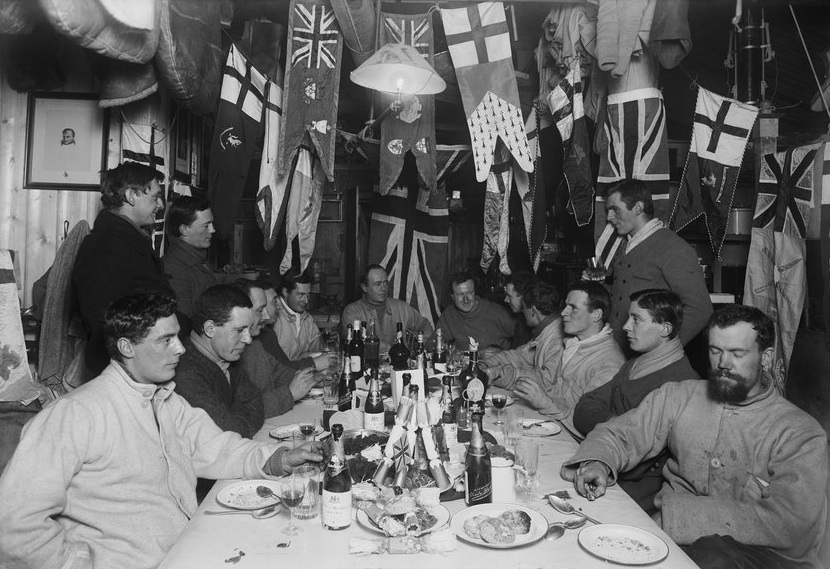
Robert Falcon Scott and the crew of the Terra Nova enjoy a celebratory dinner, Midwinter's Day, Antarctica, June 22, 1911.

Paul D. Spudis
The Once & Future Moon
Smithsonian Air & Space


“Now is the winter of our discontent” – Richard III, Act 1, scene 1

There is a good piece in today’s Telegraph UK by David Robson of a fateful one-hundredth anniversary – the Midwinter Dinner — June 22, 1911 held in Robert Falcon Scott’s Ross Island hut. A year earlier, Scott and the crew of the Terra Nova had set off for the Antarctic and the south pole. It was a carefully planned and perilously financed expedition, a classic journey of the “golden age” of polar exploration. At the time, Scott had no idea that Roald Amundsen, the famous Norwegian polar explorer, had turned his north pole-bound Fram due south and unknown to Scott and his men, was at that moment camped on the opposite side of the Ross Sea, carefully planning a summer dash to the south pole.

Of what relevance is this story to space and the Moon? To me, it encompasses and restates several themes I have developed on this blog about the nature of exploration and sustainable presence in a hostile environment. The theme of the Telegraph article is that Scott’s expedition was all about science. His team included geographers, geologists, biologists and meteorologists. They collected specimens, documented phenomena, made observations, and conducted experiments. Scott’s expedition was organized like a carefully planned military campaign. Although conducted under the command structure of the Royal Navy, it was a civilian expedition, funded by subscription. No tax money was used and financing was always a major headache for Scott.

A theme running through Robson’s article has been a recurring motif in polar literature for many years – that while Scott and his team were honorable scientists, conducting true “exploration,” Amundsen and his men were publicity-seeking interlopers, cads and bounders who treacherously misled the noble and long-suffering Scott about their true intentions, and who then had the cheek to actually race ahead to beat Scott to the south pole. This theme has long been a part of British polar exploration literature – the sting of Amundsen’s victory in the race to the south pole still hurts. A book and television series on the polar race published over 20 years ago attempted to deconstruct this myth and was roundly blasted in the British press at the time.

But the Telegraph piece contains a fundamental contradiction. It takes great pains to show Scott’s expedition as a scientific, scholar’s investigation, as opposed to the “PR stunt” of Amundsen’s polar dash. If this is true, then of what importance was priority in attainment of the south pole anyway? The pole is merely one more data point on a string of measurement stations. Scott’s purpose was science, not stunts. He led a carefully planned and documented expedition to unravel the secrets of the Antarctic. By arriving at the pole after Amundsen, what could it matter? He still had his fossils, rock samples and observations, did he not?

Obviously there was much more at stake than admitted, both then and now. The great age of polar exploration was not about science, any more than Apollo to the Moon was about our first visit to another world. Large public spectacles like polar exploration were both theater and geopolitical struggles. In the decades leading to the Scott and Amundsen efforts, many had tried (and failed) to take the north pole. An entire subculture of polar explorers had developed, each group knowing of the other groups’ efforts in the desperate competition to be the first to stand on top of the world. Establishing priority became an obsession with many and proof was difficult to obtain (the Frederick Cook-Robert Peary controversy over who was the first at the north pole continues to this day).

Both Scott and Amundsen lived in this milieu. But they were also Edwardian gentlemen and sporting conduct was natural and expected behavior. Amundsen’s “sin” was that he discarded the fig leaf of “science” and exposed to public view the raw power politics involved in exploration. In the words of the President of the Royal Geographic Society Leonard Darwin (son of Charles), Amundsen had not “played the game.”

The idea that exploration is for scientific purposes stems largely from this golden age of polar exploration. In part, the conflation developed because of the need for Britain to attribute a noble and uplifting rationale to Scott’s polar trip. His tragic death on the way back from the south pole was made especially bitter by the loss of priority – when Scott arrived at the pole, he found that Amundsen had beaten him there. One way to make this unpleasant pill more palatable was to assign noble motives to Scott and base ones to Amundsen. Hence, a mythos developed, sanctifying Scott as a martyr for science and depicting Amundsen as a crass interloper. An unnoticed side-effect of this storyline was the simultaneous sanctification of science as the rationale for exploration. This attitude is typified by a comment from an astronomer in the early days of implementation of the Vision for Space Exploration in 2004 that “exploration without science is tourism.” Scott’s hagiographer could not have put it better.

But this concept, developed one hundred years ago to salve the outrage and hurt feelings of a disappointed nation, does not serve us well as we contemplate the exploration of our Solar System. Exploration traditionally has a much broader meaning. Columbus, Balboa and Magellan did not undertake their expeditions for science. They sought wealth and power; they envisioned new lands for settlement and the spread of their own culture. In short, the view of “exploration” prior to being redefined during the golden age of polar exploration had little to do with science and much to do with wealth creation, power projection and settlement.

Science is great and knowledge always has both practical and intangible value, but it is a small part of the motivation for exploration. The Antarctic is a continent for science but only by mutual agreement of the international community. The riches of Antarctica remained locked up as scientists hunt its surface for fallen asteroids and evidence for global warming. Some think this is a template for space exploration; others find such an idea anathema. Science stagnates when exploration stalls. If we were exploring the Moon, scientists would find a bounty of extraterrestrial samples and have an unparalleled opportunity to study the record of Earth’s climate locked in eons of undisturbed solar wind in the lunar regolith. Once humanity and technology are able to utilize the Moon’s resources to break the tyranny of the rocket equation, the vast riches of our Solar System will open to explorers, entrepreneurs, settlers, and scientists alike.

We explore for many reasons. There are many valid and important national interests of which science is but one. Scott understood this; hence, his disappointment at his own failure to reach the pole first. As we prepare to leave the Earth on a more permanent basis, it is well to look back at this curious and (I would say) singular interval in history – a time (so we are told) when science became the rationale for exploration. It wasn’t true then and isn’t true now.

Related side-note: Videos of my Space Pioneer Award talk at the recent 2011 International Space Development Conference in Hunstville AL have been posted in two parts, HERE and HERE. This talk touches on several of the themes I mention above. The slides from my talk are available for download HERE.

Originally published June 21, 2011 at The Once & Future Moon, (Smithsonian Air & Space). Dr. Spudis is a Senior Staff Scientist at the Lunar and Planetary Institute in Houston. The opinions expressed are more informed than average.

Tuesday, April 12, 2011

Only fifty years of manned spaceflight


A mere 18,262 days ago, under a waning Crescent Moon, one extraordinarily brave and courageous cosmonaut is accelerated into a single orbit around Earth, and after a harrowing first for all mankind, Yuri Gagarin returns to a different world [Dudespace].

Monday, May 3, 2010

Guenter Wendt, 85

"Pad leader -- or "pad führer" as the astronauts came to affectionately call him due to his strong German accent and unwavering rules -- Wendt oversaw the spacecraft on the launch pads and all who had access to them to ensure the safety of everyone involved."

Read the story at story, HERE.

Wednesday, February 24, 2010

A Lunar Visionary

Paul Spudis
The Once and Future Moon
Smithsonian Air & Space


Klaus Heiss & President Ronald Reagan

"Despite the positive spin from many in the space community, a return to the Moon is as far away now as it was six years ago, before the Vision. In fact, it’s actually farther away as much of the tooling for Shuttle parts that could enable the quick and relatively inexpensive fabrication of a moderately heavy-lift launch vehicle for the VSE are being mothballed or destroyed."

"Klaus’s work on the activities of lunar settlement will stand as a lasting contribution to the literature of space travel. We have too few clear thinkers in this business and we were indeed fortunate to have his informed and authoritative voice to help guide our journey out into the Solar System. We need others who can clearly see the importance of a sustained lunar return to step forward and pick up where Klaus left off.

"A growing catalog of the resources of the Moon continues to spill out. Much of this knowledge was gained through the vision and efforts of Klaus Heiss. I am grateful for his contributions and his friendship. Klaus will be with us in spirit as news of the Moon and its resources is presented at the annual Lunar and Planetary Science Conference next week in Houston."

Read the Article, HERE.

Tuesday, January 26, 2010

Stanley Lebar's camera brought Tranquility Base into homes

From left, Stanley Lebar and Richard Nafzger, two engineers and former NASA employees, who were involved in the taping of the Apollo 11 moon landing, at Goddard Space Flight Center in Greenbelt (Associated Press)

Matt Schudel
Washington Post

On July 20, 1969, when Neil Armstrong opened the hatch of the Apollo 11 lunar module and stepped onto the surface of the moon, a small camera captured the moment and sent pictures back to Earth, 239,000 miles away. At least 500 million people witnessed the long-unattainable milestone on television, as gray, halting images showed Armstrong and fellow astronaut Edwin "Buzz" Aldrin walking on the moon and planting the American flag.

Armstrong memorably described the accomplishment as "one small step for man, one giant leap for mankind."

No one who heard those words was happier than Stanley Lebar. An engineer at a Westinghouse plant outside Baltimore, Mr. Lebar (pronounced luh-BAR) spent five years managing a NASA project to build the camera that went to the moon.

He and his team of 75 engineers used the emerging technology of microelectronics to make a mobile, compact camera that weighed only 7 pounds. Most TV cameras at the time weighed 700 pounds. The new camera had to survive the rigors of liftoff and space travel, it had to work in low light and it had to function in temperatures as high as 300 degrees Fahrenheit and as low as minus-250. Most important, it had to transmit clear black-and-white images that could be shown on television.

After solving these puzzles, Mr. Lebar faced another obstacle: He had to overcome the skepticism of some NASA officials, who considered his camera excess baggage and of no scientific value.

Read the full Obituary HERE.

Monday, November 23, 2009

Konstantin Feoktistov

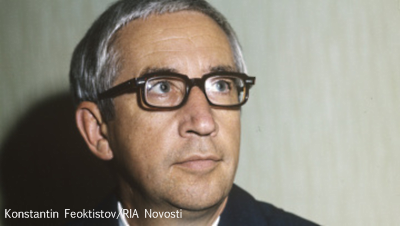
Well-known spaceship designer and one of the Soviet Union's first cosmonauts, Konstantin Feoktistov, has died at 83 in Moscow, the Russian space agency Roscosmos said Sunday.

"We report with regret that Konstantin Feoktistov, a famous Soviet cosmonaut, died in Moscow on Saturday. Information on the funeral service, place and time of the burial will be available later," a Roscosmos spokesman said.

Feoktistov was one of those who designed Soyuz and Progress spaceships, and the Salyut and Mir space stations until 1990. From 1990 he worked as a professor at a Moscow technical university.

Feoktistov, who was the only non-Communist cosmonaut in the Soviet Union, made a spaceflight on board the Voskhod spaceship in 1964. He was awarded the title of the Hero of the Soviet Union for that first group spaceflight in history.

A crater on the Moon is named after Feoktistov.

Friday, November 20, 2009

Maine Engineer wins NASA Space Challenge

1st place winner of the 2009 NASA Astronaut Glove Challenge, Peter Homer, and daughter; Alan Hayes of Volantz, Inc.; Andrew Petro of NASA; 2nd place winner Ted Southern, and team member Amy Miller. Credit: NASA

Clara Moskowitz
Space.com

An aerospace engineer from Maine, the reigning champion of NASA's Astronaut Glove Challenge, held onto his title Thursday to win first prize in a competition to build a better space glove than those worn by astronauts today.

The winner, Peter Homer of Southwest Harbor, Maine, took home $250,000, top prize at the competition held at the Astronaut Hall of Fame in Titusville, Fla., close to NASA's Kennedy Space Center. It was the second win for Homer, who took home first place, and $200,000, in the first-ever Astronaut Glove Challenge in 2007.

Second prize this year went to artist Ted Southern, another former competitor from Brooklyn, New York. Southern was awarded $100,000.

"It was a close decision. Both met all requirements," said Andy Petro, manager of NASA's Centennial Challenges program, which oversees the competition.

The full story HERE.

Sunday, November 8, 2009

Thomas J. O'Malley

Patrick Peterson
Florida Today

Cocoa Beach — Legendary space industry engineer Thomas J. O’Malley, 94, died Friday evening shortly after a phone call from Mercury astronaut and former U.S. Sen. John Glenn, who O’Malley launched into space by pushing a button.

O’Malley displayed the button in the den of his Cocoa Beach home.

Daughter Kathleen O’Malley said the conversation between Glenn and her dad on Friday was brief, but she related hearing O’Malley say “Hello, John Glenn” to the space pioneer.

O’Malley was called to the human spaceflight program in 1961, while working for the Convair division of General Dynamics, where he was a test engineer for the Atlas intercontinental ballistic missile, according to family historian Cornelia Dean, O’Malley’s niece. The Atlas had experienced a series of launch pad explosions.

He was “Convair’s toughest test conductor,” Mercury astronauts Alan Shepard and Deke Slayton wrote in “Moon Shot” in 1994.

Read the story, HERE.