Showing posts with label Vision. Show all posts

Sunday, January 25, 2015

Palazzo to push lunar surface expeditions

U.S. Rep. Steven Palazzo's district includes NASA's John C. Stennis Space Center [Rollcall].
Deborah Barfield Berry and Ledyard King
Hattiesburg American

Rep. Steven Palazzo (R-MS) plans to use his chairmanship of a House panel on space this year to again promote a return-to-the-moon mission and lobby against President Obama's plan to use an asteroid as a stepping-stone to remote sensing Mars from martian orbit.

Palazzo also chaired the House Science, Space and Technology Subcommittee on Space in the last Congress, but this year he sees a possible boost for his priorities in the GOP's takeover of the Senate.

"With the expanded majorities, we're going to continue to put an emphasis on America remaining the leader in space," Palazzo said in a recent interview. "America's leadership in space is no longer just a matter of national pride, it's become a matter of national security."

US Senator Ted Cruz (R-TX), new chairman of the Commerce Subcommittee on Science, Space and Competitiveness, outlined plans to "focus NASA on its core mission, exploring Space and more of it," on January 14 [AP].
One pressing issue this year, he said, will be helping NASA craft a "road map."

"Right now, they say, 'We're going to Mars,'" Palazzo said of NASA officials. "Well, that's great, but they haven't said how we're going to get there. So no one knows what to build, how to build it, when to build it or how to pay for it."

He said the moon, which the U.S. last visited in 1972, is a more logical route to the Red Planet than an asteroid.

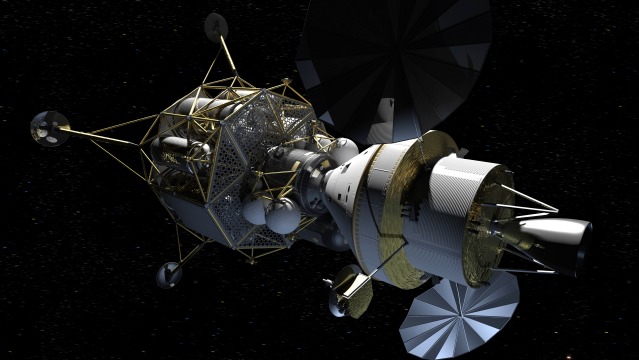
Orion and Altair: architecture envisioned within NASA in 2007, before Congress, acting on the recommendation the Obama administration, eliminated research and development for surface expeditions on the Moon and on Mars. Along with operations in Cislunar space or retrieving an asteroid NASA's leadership today proposes robotic exploration of the martian surface and of Phobos controlled from Mars orbit [NASA/Frassinito & Associates].
"I think most people agree, just because we've done it doesn't mean we can't do it again," Palazzo said.

Palazzo's district is home to Stennis Space Center, a rocket testing site that Palazzo said employs more than 4,000 workers.

But with limited funding for NASA, it will be harder for Palazzo and other supporters of a lunar mission to win support, said Stephen Rozman, a political scientist at Tougaloo College in Mississippi.

"They're going to have to show a real reason for rebuilding or taking the program to the next level right now," he said.

Read the entire article HERE.

Saturday, January 24, 2015

Al Worden: 'NASA took a giant step backwards'

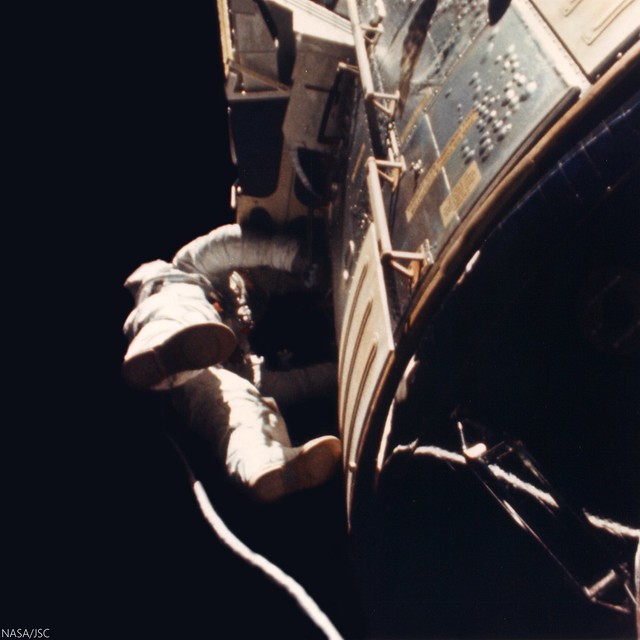
Brief walk in Deep Space: Apollo 15 command module pilot Al Worden leaves the confines of Endeavour for the first time in ten days, to retrieve film and data from the SIMS bay of the service module. The 39 minute spacewalk, August 5, 1971, took place as spacecraft, crew and cargo (including 77 kg of lunar samples) were steadily accelerating toward high-speed reentry and splashdown 30 hours later [NASA/JSC].
Apollo 15 command module pilot
Al Worden, with one of the controversial
souvenir flags flown with 1971 mission.
Cornelia Borrmann
Deutsche Welle

DW: What comes to mind when you see the moon at night?

Alfred M. Worden: Well, it's been more than 43 years since I was there. And I think if you go anywhere, 43 years later those memories are pretty dim in your mind, and it's pretty hard to recapture that. But I will tell you - if the moon is right, and particularly if I have some young people with me, I use it as a training tool to get them excited about astronomy. So I do use the moon, but don't just look at the moon and philosophize about what I did.

You witnessed magic moments of manned space flight - the Apollo era. How was it?

Every single person who worked on the program had one goal in mind: Get the guys on the moon and bring them back safely. There was no bureaucracy. If we had a problem, we sat around a table, we discussed it, and we decided then what to do. We listened to everybody. And then we gave an opinion. And we got through a lot of technical issues very quickly and came to the right conclusions, because everybody came together at the work level.

Nobody was trying to improve their position or ensure that their position did not go away. We did not have any managers that were jockeying for position to go higher. Everybody tried to do what was right to go to moon.

Read the full Berlin interview, HERE.

Monday, January 19, 2015

Destination: Moon


New ESA video, an excellent, if not quite comprehensive, overview of a possible future history of lunar exploration, the Agency's present vision of an ambitious future.

Friday, February 7, 2014

Awakening the Sleeping Satellite

Waning Crescent (ISS Koichi Wakata)
Waning crescent Moon from ISS, tweeted by ISS expedition 38 crew member Koichi Wakata [NASA/JAXA].
Leonidas Papadopoulos
Americaspace.com

"Perhaps the biggest obstacle towards charting a course back to the Moon, is the ‘been there, done that’ mentality that is very popular among many within the space community, in and out of NASA. This view, also shared by the space agency’s current leadership, has caused much controversy among space advocates ever since it was expressed by President Obama during a speech at the Kennedy Space Center in 2010. Elon Musk, CEO of the highly successful Space Exploration Technologies Corporation or SpaceX, echoed NASA’s current stance on the matter, during a recent interview: “The next step is to maybe send people beyond low Earth orbit to a loop around the Moon, possibly land on the Moon — although I’m not super interested in the Moon personally, because obviously we’ve done that and we know we can — but maybe just to prove the capability.”

"Maybe the best answer to this viewpoint has been given by the late Neil Armstrong, during a testimony on the House Committee on Science and Technology in 2010. “Some question why

"America should return to the Moon”, Armstrong said during his testimony. “After all,” they say, “we have already been there.” I find that mystifying. It ‘s as if 16th Century monarchs proclaimed that “We need not go to the New World, we have already been there.” Or if President Thomas Jefferson announced in 1808 that Americans “need not go west of the Mississippi, because Lewis and Clark have already been there.”"

Read the editorial at Americaspace.com, HERE.

Sunday, September 9, 2012

Free Enterprise and 'New Space'

Enterprise in space: Free markets or government subsidies?
Paul Spudis
The Once & Future Moon
Smithsonian Air & Space

Free Enterprise:  Business governed by the laws of supply and demand, not restrained by government interference, regulation or subsidy – also called free market.

Rick Tumlinson of the Space Frontier Foundation published a “free-enterprise” critique of the Republican platform in regard to the American civil space program. Indeed, the text of the space plank is vague (no doubt intentionally, so as to give the candidate maximum flexibility to structure the space program to align with his vision and goals for the country).  But what I found most interesting was the underlying premise and assumptions in Tumlinson’s article, a worldview that I find striking.

In brief, Tumlinson approves of the current administration’s direction for our civil space program.  The U.S. has stepped back from pushing toward the Moon, Mars and beyond and redirected NASA on a quest for “game-changing” technologies (to make spaceflight easier and less costly), while simultaneously transitioning launch to low Earth orbit (LEO) operations to private “commercial space” companies selected by our government to compete for research and development funding and contracts.  Many see this as gutting NASA and the U.S. national space program.  To be clear, the term “commercial space” in this context does not refer to the long-established commercial aerospace industry (e.g., Lockheed-Martin, Boeing) but to a collection of startup companies dubbed “New Space” (typically, companies founded by internet billionaires who have spoken much and often about lofty space plans, but have actually flown in space very little).

Tumlinson criticizes the Republican space plank because it does not explicitly declare that a new administration would continue the current policy.  In his view, the very idea of a federal government space program, including a NASA-developed and operated launch and flight system, is a throwback to 1960’s Cold War thinking.  Instead, he envisions space as a field for new, flexible and innovative companies, untainted by stodgy engineering traditions or bloated bureaucracy.  Many space advocates on the web hold this viewpoint – “If only government would get out of the way and give New Space a chance, there will be a renaissance in space travel!”  But travel to where?  And why?

The idea that LEO flight operations should be transitioned to the commercial sector is not new.  It was a recommendation of the 2004 Aldridge Commission report on implementing the Vision for Space Exploration (VSE).  NASA itself started the Commercial Orbital Transportation Services program (COTS) in 2006, designed to nurture a nascent spaceflight industry by offering subsidies to companies to develop and fly vehicles that could provision and exchange crew aboard the International Space Station.  That effort was envisioned as an adjunct to – not a replacement of – federal government spaceflight capability.

The termination of the VSE and the announcement of the “new direction” in space received high cover from the 2009 Augustine committee report, which concluded that the current “program of record” (e.g., Constellation) was unaffordable.  The Augustine Committee received presentations with options to reconfigure Constellation whereby America could have returned to the Moon (to learn how to use resources found in space) under the existing budgetary cap, but they elected to start from first principles.  Hence, we have something called Flexible Path, which doesn’t set a destination or a mission but calls on us “to develop technology” to go anywhere (unspecified) sometime in the future (also unspecified).  With target dates of 2025 for a “possible” human mission to a near-Earth asteroid and a trip to Mars “sometime in the 2030’s,” timelines and milestones for the Flexible Path offer no clarity or purpose.  Try getting a loan or finding investors using a “flexible” business plan.

Tumlinson argues that both political parties should embrace this new direction because New Space will create greater capability for lower cost sooner.  He also makes much about the philosophical inclinations of the Republican Party (the “conservative” major party in American politics) – Why don’t the Republicans support free enterprise in space?  Why are they putting obstacles in the way of all these new trailblazing entrepreneurs?  As to those obstacles, it is unclear exactly what they are.  True enough, there are regulatory and liability issues with private launch services, but not of such magnitude that they cannot be handled through the traditional means of indemnification (e.g., launch insurance).

The COTS program record of the past decade largely has not been a contract let for services, but a government grant for the technical development of launch vehicles and spacecraft.   Close reading reveals the real issue:  Tumlinson wants more of NASA’s shrinking budget to finance New Space companies. He is concerned that a new administration might cut off this flow of funding.  However, what will cut off the flow of funding is having no market, no direction, and no architectural commitment – regardless of who occupies the White House.

The belief of many New Space advocates is that once they are established to supply and crew the ISS, abundant and robust private commercial markets will emerge for their transportation services.  Although many possible services are envisioned, space tourism is the activity most often mentioned.  Whether such a market emerges is problematic.  Although Richard Branson’s Virgin Galactic has a back-listed manifest of dozens of people desiring a suborbital thrill ride (at a cost of a few hundred thousand dollars), those journeys are infinitely more affordable than a possible orbital trek (which will cost several tens of millions of dollars, at least initially).  Nevertheless, there will no doubt be takers for a ticket.  But what will happen to a commercial space tourism market after the first fatal accident?  New Space advocates often tout their indifference to danger, but such bravado is neither a common nor wise attitude in today’s lawsuit-happy society (not to mention, the inevitable loss of confidence from a limited customer base).  My opinion is that after the first major accident with loss of life, a nascent space tourism industry will become immersed in an avalanche of litigation and will probably fully or partly collapse under the ensuing financial burden.  We are no longer the barnstorming America of the 1920’s and spaceflight is much more difficult than aviation.

Despite labeling themselves “free marketers,” New Space (in its current configuration) looks no different than any other contractor furiously lobbying for government sponsorship through continuation of its subsidies.  True free-market capitalists do not seek government funding to develop a product.  Rather, they devise an answer to an unmet need, identify a market, seek investors and invest their own capital, provide a product or service and only remain viable by making a profit through the sale of their goods and services.

Tumlinson bemoans the attitude of some politicians, ascribing venal and petty motives as to why they do not fully embrace the administration’s new direction, e.g., the oft-thrown label “space pork” to describe support for NASA’s Space Launch System.  In regard to New Space companies, Tumlinson asserts that, “[We] have to both give them a chance and get out of the way.”  But in fact, he does not want government to “get out of the way” – at least not while they’re still shoveling millions into New Space company coffers – nor when they need (and they will) a ruling on, or protection of, their property rights in space.  Any entity that accepts government money is making a “deal with the devil,” whereby it is understood that such money comes with oversight requirements (as well it should, consisting of taxpayer dollars).

"Questions about the vision boil down to whether we want to incorporate the Solar System in our economic sphere, or not.” – Presidential Science Advisor John Marburger, 2006

Successful commercialization of space has occurred in the past (e.g., COMSAT) and will occur in the future.  But the creation of a select, subsidized, quasi-governmental industry is not by any stretch of the imagination what we commonly understand free market capitalism to mean.  It is more akin to oligarchical corporatism, a common feature of the post-Soviet, Russian economy.  True private sector space will be created and welcomed, but not through this mechanism, whose most worrisome accomplishment to date has been to effectively distract Americans from noticing the dismantling of their civil space program and preeminence in space.

Originally published at his Smithsonian Air & Space blog The Once and Future Moon, Dr. Spudis is a senior staff scientist at the Lunar and Planetary Institute. The opinions expressed are those of the author and are better informed than average.

Friday, August 24, 2012

A Cheap Date

The MoonRise mission concept, in its most recent iteration, in cooperation with the Canadian Space Agency. The mission should fulfill a need to obtain a baseline sample of the 4 billion year-old South Pole-Aitken basin, only a small part of which spills over onto the Moon's nearside in line of sight with flight directors on Earth [NASA/NLSI].
Paul D. Spudis
The Once and Future Moon
Smithsonian Air & Space
  
Returning samples to Earth for analysis is one of planetary sciences’ holiest of grails. Although many different, complex measurements on returned samples are possible, one of the most important ones – from the standpoint of geologic study – is to determine the age of a rock.  Ages are determined by obtaining precision measurements of the amounts of different isotopes of certain elements (some of which are radioactive and decay at known rates).  By comparing the ratio of these radioactive elements to their daughter products, the amount of time that has elapsed since the rock formed can be calculated and thus, the age of that rock can be inferred.  If we know from which regional unit the rock comes, we can infer the ages of major events in planetary history.  This is one of the principal reasons why planetary scientists crave samples from other worlds.

We’ve determined the ages of most of the more than 380 kg of rock and soil samples returned from the Moon during Apollo.  Using that information and the geological mapping of the Moon from photographs, we were able to deduce the time sequence of major lunar and Earth-Moon system events.  Broad-scale, regional relations determined by remote mapping allowed us to identify the relative timing and significance of major units, while the returned rock samples allowed us to assign absolute ages to those same units.  The method proved so effective in reconstructing lunar history, that sample return became an idée fixe of the planetary science community, who strongly desired applying this approach to another planet.  Because questions surrounding its potential as a reservoir of life and because its nature permits the landing, retrieval and return (barely) of samples, Mars, with its complex, well mapped surface geology, was the object of most immediate interest.

When the planetary community wrote its recent “decadal survey” (a report outlining the highest priority robotic missions to undertake in the coming ten years), sample return came in as the highest priority for Mars (so high, that in effect, the decadal study told NASA to do a Mars sample return or do nothing).  Once Mars sample return was studied in detail, cost became an issue.  NASA robotic missions are classified according to the cost category they fall under.  The most expensive missions are “Flagship” missions, whose costs exceed $2 billion (the current MSL “Curiosity rover Flagship mission cost about $2.6 billion).  A Mars sample return would require not one but three separate Flagship-class missions: one to rove and collect the samples, another to launch the samples into orbit around Mars, and finally a mission to collect those samples from Mars orbit and return them to the Earth.  Using a variety of scenarios, the effort would cost over $10 billion, with a possible price tag exceeding $20 billion.  This staggering cost quickly shelved Mars sample return while planetary scientists scrambled for something to fill in a possible multi-decadal gap with no mission.

The question became, “Can a different and cheaper approach begin to address some of the key issues for which sample return is thought to be essential?”  Although many kinds of measurements can be done on returned samples, radiometric dating is one of the most critical and one thought to be possible only in laboratories on the Earth.  By using the absolute age of a single unit to bracket the timing of a host of different units mapped from remote sensing data, a single rock from a surface outcrop of a clearly defined unit of regional significance might enable us to calibrate the geologic time scale of Mars.
So the question before us is, “Is it possible to measure the absolute age of a rock remotely?”
Several groups around the country have been investigating the possibility of creating a small, portable laboratory for radiometric dating.  These instruments could be miniaturized and flown aboard a future robotic rover.  Rocks could be selected for analysis as the vehicle roams across the planet.  If such a rover were sent to areas of known geological context (e.g., a large, regional lava flow), rocks dated by the rover would define an absolute age for the flow.  A large lava flow would have numerous impact craters on it (the more densely a surface is cratered, the older it is).  For Mars, we now have to estimate (i.e., guess) how old its units are by comparing crater densities with those for lava flows on the Moon (from which the Apollo astronauts returned samples).  Although this approach is better than nothing, Mars has had its own cratering history and direct comparison to lunar history may not be valid.  A few solid absolute ages for lavas of widely varying age on Mars could “tie down” the cratering curve, such that we would not only date the flows we visit, but we could with precision, confidently estimate the ages of many other geological units not visited.

Indicative of a healthy and engaged science community, not all are convinced that ages obtained from an automated lab would be as useful as the high precision results that would be obtained from state-of-the-art terrestrial laboratories.  But a collection of imprecise ages from a variety of different units on Mars is better than no dates from any unit at all.  Given the astronomical costs and high technical risk of robotic sample return from Mars, the idea that we might be able to measure ages remotely looks increasingly attractive and practical.  This technique could also be applied to other planetary objects.  A properly equipped rover could make numerous measurements of the ages of craters and lava flows over a wide area on the Moon, where such information could be tied into the existing high-quality (but incomplete) lunar time scale.  Remote age dating would also be useful on planets from which launch of a sample return vehicle is nearly impossible, such as Venus (with a dense atmosphere and a very high surface gravity).

As sample return missions escalate in cost and difficulty, we should investigate how much can be learned about a planet’s history short of sample return.  A properly equipped robotic rover could blaze a new “Lewis and Clark Trail,” traversing large distances and making precision measurements along the way – returning information of inestimable value for a relatively low price.

Originally published at his Smithsonian Air & Space blog The Once and Future Moon, Dr. Spudis is a senior staff scientist at the Lunar and Planetary Institute. The opinions expressed are those of the author and are better informed than average.

Related Posts:
How the Mars community shot itself in the foot (March 10, 2012)
LROC: The Soviet lunar sampling missions (March 16, 2012)
The Last Sampler: Failure, then Success (March 17, 2012)
LROC: Retracing the steps of Apollo 15 / Constellation ROI (April 17, 2010)
The Rosetta Stone of the Solar System (November 19, 2009)
The Keepers of the Moon (July 8, 2008)

Tuesday, July 31, 2012

Newt Space

Paul D. Spudis
The Once and Future Moon
Smithsonian Air & Space
  
During a recent talk to a gathering of students, former House Speaker Newt Gingrich spoke of his longstanding interest in space by mentioning the dust-up over comments he made about a Moon colony during the GOP primary.  He expanded this episode into a teaching moment about the nature of innovation and progress in space.  Gingrich is vigorous in his enthusiasm for space exploration but is not a devotee of the current agency and its programs.  In his considered opinion, we need to re-think our approach to space exploration and use more innovative, non-bureaucratic approaches to develop space systems and capabilities.

A historian by training, Gingrich often uses historical analogies to illustrate his point.  On this occasion, he spoke of the experiences of the Wright Brothers and Samuel P. Langley in the development of the first airplane.  As Gingrich relates it, after several failed attempts the Wright brothers finally achieved flight on December 17, 1903, spending in total about $500.  In contrast, Langley (the recipient of a $50,000 government grant) failed in his attempt to fly when his “aerodrome” crashed into the waters of the Potomac River (the actual amounts spent were “less than $1000” and $70,000 respectively, according to James Tobin’s excellent book on the subject).  That powered aircraft might have military use was not a new idea and the then-recent war with Spain led to a re-examination of our defense posture, with the military eager to fund Langley’s aeronautical experiments.

Gingrich contrasts the “faster, cheaper, better” (and successful) approach of the Wrights to the supposedly bureaucratic, measured failure of Langley and suggests that this incident parallels the current differences between the approach of “New Space” (an umbrella term referring to the variety of current efforts by the private sector to develop spaceflight capability) and our federal civil space program.  In other words, it’s not the lack of resources or technology that’s holding us back – it’s our business model.  He suggests that many of the central tenants of “New Space” (including the offering of prizes as technical incentives and “lean” management models) will accomplish more in space than we’ve received through government programs and for much less expenditure.

First flight of Langley's aerodrome - one second after launch and one second before impact
The historical story is interesting but did Gingrich draw the correct conclusion?  Should the success of the Wright brothers be attributed to how they approached the problem or to how much it cost?  In contrast to Gingrich’s suggestion, Samuel Langley did not represent an enormous, bloated and hidebound bureaucracy.   At the turn of the century, the Smithsonian Institution was not the behemoth it is today.  Langley had been hired as an assistant secretary for international affairs at the Smithsonian.  Secretary Spencer Baird died eight months after Langley reported for work, leaving open that position, which Langley accepted.  He wanted to continue his aeronautical experiments and used the facilities of the Smithsonian (including its shops and technicians) to build and test his flying machines.

Langley built a high-powered internal combustion engine for his aircraft, producing greater horsepower per unit weight than any other effort of the time, including the one used by the Wright brothers.  The failure of Langley’s aerodrome largely resulted from its design; the dihedral cross-section of its wings led to instability in any type of wind.  Wilbur Wright described this problem in a June 1903 talk – an understanding that came from the brothers’ experiments with wing shapes on kites at Kitty Hawk.  The Wright flyer used wing-warping to create control surfaces, which made it possible for a pilot to steer the airplane in variable wind conditions.  The Langley aerodrome was naturally unstable; with its wing shape, any gust or cross-wind rendered the aircraft uncontrollable.  In other words, the success of the Wright brothers was due to a superior technical approach, not to their management model.

For anyone who has dealt with bureaucracy, freedom from the ponderous administrative overhead of a government agency is always an enticing vision.  But in many ways, it is orthogonal to the real issue – what are you trying to accomplish and by what means or mechanism?  The Wrights and Langley both knew what they were trying to do, but only one of them had the correct technical approach.  Their technical choices determined the outcome of their efforts, not the total amount of money spent nor the managerial structure of their respective projects.  If so, can we draw any conclusions from this and apply it to the current model of our national civil space program?  The idea that government cannot do anything right is understandably attractive and in vogue, but not completely borne out by the evidence.

As a counter-example to Gingrich’s history of early aviation, consider a technical development project closer to us in time and memory.  A nuclear ship that has to refuel only every few years has an enormous advantage over one that needs near-constant refueling.  The United States possesses a nuclear navy (both aircraft carriers and submarines) largely because of the vision and persistence of one man, Admiral Hyman Rickover.  A true visionary, Rickover believed that nuclear reactors could be made small enough to fit into a ship and safe enough to entrust the lives of thousands of men to such vessels.  For years he fought the navy and the Defense Department to sell the advantages of nuclear sea power to the Congress and President.  Today we have such a fleet largely because of his vision and determined efforts.  And nobody ever took a poll to see if a nuclear navy would “excite and engage” the public.

Newt Gingrich is a true believer of humanity’s future in space.  I admire his dedication and courage in speaking the truth as he sees it.  However, in this case, I believe he has drawn the wrong lesson from history.  Compelling national interests sometimes require the marshaling of our combined will and resources.  We need a dedicated federal space program with a clear strategic direction and the know-how to pull off difficult technical tasks.  No cult of management or prize money will have us walking again on the Moon or using its resources.

For our country to remain vibrant and strong, it is vital that Americans be called upon to engage in the mental and physical challenges of a national space program, coupled to the realities and challenges inherent in an expanding cislunar territory and new markets.  Our pioneering space legacy needs to be embraced and celebrated through a renewed commitment from our government.  If Americans forfeit this direction and opportunity because their government cannot see the danger in the current path, we will have grievously failed in our promise as a nation and our obligation and duty to future generations..

Originally published at his Smithsonian Air & Space blog The Once and Future Moon, Dr. Spudis is a senior staff scientist at the Lunar and Planetary Institute. The opinions expressed are those of the author and are better informed than average

TASC: NASA 'essential for national security'

Support for NASA and Space Exploration in the U.S., as essential public policy and vital to national security, is not expressed as often or as acutely in the 21st century as it was when the civilian space agency was founded in 1958. Instead, considering the agency in the context of the Cold War, as part of an arms race with the former Soviet Union, is often dismissed as ancient history. The agency's role in serving an essential national security interest is usually, at best, remembered only as secondary to its contributions to the quality of life of Americans.

But in the background, in congressional cloakrooms and committee hearings, NASA's role in service to American national security is paramount, even over and above pork barrel politics, and more now as budgetary constraint becomes less abstract with each increase in the national debt ceiling.

The public voice in support of NASA being vital to American national security is rarely heard above the noise of debates over NASA's future exploration roadmap and over the self-continuity concerns of a vested bureaucracy.

Former U.S. Senator and Apollo veteran Harrison Schmitt and  others, have, on occasion, reminded us that NASA's most basic constitutional reason-for-being is still the role it plays as a vital arm of America's national security.

Now a study has been released by The Analytic Sciences Corporation (TASC) expressing this national security raison d'etre in the context of the 21st century. As a think-tank arm associated with the aerospace industry the think tank behind the study may not be a totally dispassionate one, but it at least puts forward the effort as justifying NASA's expense not as either a museum curator or an enabler purely of the dreams of academia or futurists, but as a federal arm serving an over-arching "compelling state interest."

"For the United States," the study's introduction reads, "maintaining a leadership role in space is an essential component of national security, providing the U.S. and our allies “unprecedented advantages in national decision-making, military operations, and homeland security.”* NASA is essential for national security, not only because of its role in developing new space capabilities and technologies, but also because it is explicitly excluded from military activity by the National Aeronautics and Space Act of 1958. Simply stated, NASA is uniquely positioned to facilitate international collaboration on peaceful uses of space in ways the military cannot.

"This paper explores the important roles of international cooperation, cost-reducing technology development and game-changing innovation, as well as NASA’s role supporting a strong commercial space industry. NASA can improve its national space security posture even during times of budget austerity."

The paper can be read online, HERE, or downloaded as an Adobe Reader (pdf) file, HERE.

* National Security Space Strategy, January 2011, DOD and ODNI

Monday, July 30, 2012

China as emerging space power, U.S. opportunity

China's new Long March heavy-lift first stage engine passes 200-second test (HT: Jack Kennedy, Spaceports). The test took place in an valley 50 kilometres from Xi'an, capital of Shaan'xi province, in northwest China.The new engines will be used with the Long March-5 rocket beginning in 2014.

Frank Klotz
The Atlantic

"The U.S. could have much to gain by cooperating with China's growing space program."

Liu Yang, China's first female in Space,
waves during a departure ceremony at
Jiuquan Satellite Launch Center [Reuters].
Commentators often refer to China as an "emerging space power." This characterization understates China's current space capabilities. China has in many respects already reached the top tier of spacefaring nations--with profound implications not only for America's own interests in space, but also for the much-touted "pivot" to the Asia-Pacific region.

While initially starting well behind the two original space powers, China has slowly but steadily added accomplishments to its space portfolio. In 2011, it conducted nineteen space launches--twelve less than Russia that year but one more than the United States. It has manufactured satellites for domestic use and marketed satellites for export, with customers in Southeast Asia, Africa and South America. Chinese spacecraft already have orbited the moon, and Beijing has signaled its intention to land an unmanned probe and possibly even astronauts on the lunar surface.

In late June, China's space endeavors captured headlines across the world when three Chinese astronauts manually docked their Shenzhou-9 spacecraft with the orbiting Tiangong-1 module. In doing so, China became only the third nation besides the United States and Russia to accomplish this complex maneuver. It also demonstrated a capability it will need to one day assemble and operate a permanently manned space station.

Two optional configurations for China's Long-March V heavy-lift, now
in development
HT: Craig Covault, AmericaSpace [CNSA].
Western experts note that a fundamental purpose of the Chinese space program is to bolster the image of China--and the ruling Chinese Communist Party--both at home and abroad. It also aims to spur the development of Chinese science and technology.

Chinese activities in space also have an undeniable military purpose. By their very nature, certain space-related capabilities--launch, earth observation, long-distance communications, precision navigation--can serve both civil and military objectives. In China's case, the overlap is substantial. The People's Liberation Army (PLA) in fact directs major elements of the nation's space program, including manned spaceflight.

As Dean Cheng of the Heritage Foundation has noted, Chinese military writings emphasize the roles space systems can play in supporting air, land and sea operations. These include finding and attacking American forces operating in the Asia-Pacific region. With this end clearly in mind, the PLA is expanding its current constellations of reconnaissance, navigation, meteorological and communications satellites.

Likewise, Chinese strategists understand the growing extent to which the United States and its allies depend upon space-related capabilities in conducting their own military operations. Accordingly, China appears intent on developing capabilities to disrupt an adversary's ability to use space systems, either by attacking satellites directly or by interfering with the ground stations and the communications nodes essential to satellite operations.

For example, in 2007, China conducted a test of a direct-ascent antisatellite interceptor that literally blasted an aging Chinese weather satellite into thousands of metal shards. In the process, it created a cloud of debris that will pose a serious hazard to satellites flying in low-earth orbit for many years to come.

Read the full article, HERE.

Frank Klotz is a senior fellow at the Council on Foreign Relations in Washington, DC, as well as the former commander of Air Force Global Strike Command and the former vice commander of Air Force Space Command. The opinions expressed are his own.

Schematic of Earth-orbit/Lunar-orbit rendezvous plan for China's eventual lunar landing mission is similar to that of the Soviet Union in the 1960's and (in part) the U.S. Constellation scenario prior to the recent cancellation of the Antares lander. Click to enlarge. HT: Craig Covault, AmericaSpace [CNSA].

Monday, July 2, 2012

Failure to Launch, Failure to Lead

President George H. W. Bush (1989-1993), flanked by First Lade Barbara Bush and Dr. Neil Armstrong on his right with Vice President (and head of the National Space Council Dan Quayle) with Apollo 11 command module pilot Michael Collins on his left, celebrates the 20th anniversary of the first manned landing on the Moon, July 20, 1989. The president announced the Space Exploration Initiative (SEI), the first major presidential initiative beyond Earth orbit, and successor to the Space Shuttle, since 1961.
Paul D. Spudis
The Once and Future Moon
Smithsonian Air & Space


In the aftermath of a major Space Shuttle accident, an incumbent President decides that our civil space program needs a bold new strategic direction.  In a major public speech, he outlines a path to return to the Moon and go to Mars.  The space agency responds with full-color sales brochures, committee meetings, community workshops, and a thousand charts outlining the steps they will take to carry out the new direction.  A couple of years pass, a new President takes office, and then – promptly cancels the initiative of the previous administration.

Sound familiar?  This has happened in our space history – twice.

President Bush, with Vice President Quayle, join the crew of Apollo 11
by the unused Lunar Module, now an exhibit at the National Air and
Space Museum, July 20, 1989.
In 1989, after much agency soul-searching following the loss of seven crew members aboard the Space Shuttle Challenger, President George H. W. Bush took to the steps of the National Air and Space Museum and announced what was soon dubbed the “Space Exploration Initiative," (SEI) a long-range program to send people beyond low Earth orbit, first to the Moon and then to Mars.  NASA responded to this challenge by outlining an architecture imaginatively named the “90-Day Study.”  It called for the development of new launch vehicles, new modules, transfer spacecraft and numerous robotic elements, including lunar and martian orbiters and landers (most of them extensions of existing hardware and designs).  Financial analysts somehow arrived at an aggregate cost of $600 billion (which also included assembly of ISS) and everyone gasped.

After numerous politicians and bureaucrats scoffed disapproval, a special ad hoc group was convened to re-examine the objectives and devise a less expensive approach for implementing SEI.  Their report was delivered and immediately put on the shelf.  In the ensuing three years, a new NASA Administrator was named, Congress refused to increase the NASA budget, and President Clinton cancelled SEI.

In 2003, the Space Shuttle Columbia disintegrated during re-entry, killing its crew of seven.  The agency investigated and concluded that foam shed during launch destroyed the integrity of the vehicle’s thermal protection system, causing the loss of the Shuttle.  In January of the following year, President George W. Bush announced a new strategic direction for space – the “Vision for Space Exploration," (VSE) a long-range program to send people beyond low Earth orbit – first to the Moon and then to Mars.  NASA responded to this challenge by outlining an architecture to implement the new direction that called for the development of new launch vehicles, new modules, transfer spacecraft, and numerous robotic elements (including orbiters and landers for both the Moon and Mars – most of them extensions of existing hardware and designs).

President George W. Bush (2001-2009), following the release of the official investigation into the causes of the Columbia accident, announces the Vision for Space Exploration (VSE) at NASA Headquarters in Washington in 2004.
Once again a committee was convened to examine the agency’s implementation of the new direction.  Another report was written and put on a shelf.  During numerous meetings and workshops spread over several years, an architecture emerged – accompanied by many charts (all electronic this time – technology marches on!). President Obama terminated the VSE in April, 2010 during a speech at the John F. Kennedy Space Center (“We choose NOT to go to the Moon!” – the historical resonances astound!).

What, if anything, is to be learned from these two sequences of events?  According to Mark Albrecht, Executive Secretary of the National Space Council in the Bush-41 White House, it means that the space agency is fundamentally broken – comprised of various constituencies that protect turf and resist implementing any new direction that may challenge or threaten their existence.  However, there is another possible reading of the situation.  The space agency was in a very different predicament during SEI than it was during the VSE.  In 1990, NASA had a clear but unfulfilled mission – Space Station Freedom, for which not a single element had yet been launched.  NASA’s anxiety at the time was uncertainty in being able to execute both Station and SEI simultaneously.  The oft-quoted 30-year, $600 billion cost of SEI, repeated by the media to denigrate the effort, included construction and operation of Station, which was to serve as both an orbital platform for missions beyond LEO and as a source of hardware (e.g., habitation modules) that could be adapted to trans-LEO missions.  Even so, most of the costing assumptions in the 90-Day Study were inflated beyond reason, presumably following in the footsteps of former NASA Administrator James Webb, who after reportedly being told that Apollo would cost about $20 billion, asked for more than $35 billion as a cushion.

In contrast, the VSE came along just as NASA was in the middle of ISS construction, with the program’s end clearly in sight.  There was no future plan for human spaceflight beyond Shuttle/ISS and the agency sorely needed some high-level direction.  The idea of Shuttle replacement came from the Columbia Accident Investigations Board report, which contended that the Shuttle system was inherently dangerous and that we ought to develop a new space transportation system as soon as possible.  In contrast to uninformed reporting and Internet mythology, President Bush did not “retire” the Shuttle – he ordered that it first be brought back to flight status (so that ISS construction could be completed) and then transitioned and replaced with new human spacecraft capable of journeys beyond LEO (which became the now-cancelled Project Constellation).  In contrast to SEI, the VSE came to NASA with price limits already in place – after a small incremental increase in the early years, it was to cost no more than we were then spending on human spaceflight (about $8 billion per year) with funding available from the gradual decline in spending on the Shuttle/Station program.  Finally, unlike SEI, which never had much Congressional support, NASA was given two Authorization bills (in 2005 and 2008) that strongly endorsed the VSE (many VSE goals, though ignored, remain in the current 2010 Authorization).

President Barack Obama (2009- ) joins Buzz Aldrin, Michael
Collins and Dr. Neil Armstrong at the White House to mark the
40th Anniversary of Apollo 11, July 20, 2009 [White House].
Although neither SEI nor the VSE succeeded in their principal objectives of sending people beyond low Earth orbit, they did manage to greatly advance our understanding of just what is at stake.  In the case of the former, a variety of people from the defense and civil space sectors worked together on SEI, creating networks that advanced an outbound agenda.  One accomplishment was the Clementine mission, a joint effort by the Department of Defense’s Strategic Defense Initiative Organization and NASA.  Flying in 1994, Clementine successfully mapped the entire Moon in eleven spectral bands, mapping its mineral composition in detail.  Clementine made the first global topographic map of that body and most significantly, found evidence for the presence of water ice in the dark areas near the south pole of the Moon.  The success of Clementine led to the Lunar Prospector mission, a robotic orbiter flown under NASA’s Discovery program, that both confirmed the excess hydrogen at the poles of the Moon and globally mapped the Moon’s chemical composition.

The intriguing results from Clementine and Lunar Prospector resulted in an international fleet of six spacecraft being sent to the Moon in the past decade, adding to our knowledge of the processes, history and potential utility of that body.  From this exploration, we now know that the Moon contains millions of tons of harvestable water.  We possess detailed maps of lunar physical and compositional properties.  In short, we now know that the Moon is habitable and is both an appropriate near-term destination for people and a unique enabling asset for future spaceflight within and beyond the Earth-Moon system.

Now, just as we find the Moon to be an attractive destination, we shrink away from the challenge, watching as others blaze trails we once traveled.  We willingly accept the pablum to not fret over new space powers who do not cancel their programs.  We are told they have not yet done all that we have and that we still carry the mantle of the world’s leading space power.  This is not logical. Similar thoughts once prevailed in Portugal, during an earlier age of exploration.  One doesn’t assume or retain the mantle of leadership by fiat or declaration – it must be earned and exercised.  Perhaps the real issue is not whether NASA is up to the task but rather, whether we as Americans are blind to the truth, unable to recognize that by having our nation withdraw from this arena, that we are retreating from our position, thereby ceding our prosperity, leadership and greatness to other nations who do have the will and the vision to press forward.

Originally published at his Smithsonian Air & Space blog The Once and Future Moon, Dr. Spudis is a senior staff scientist at the Lunar and Planetary Institute. The opinions expressed are those of the author and are better informed than average.

Thursday, June 28, 2012

Moon and Mars our goals - A.P.J. Abdul Kalam

The VYOM Sounding Rocket, designed by students at the
Indian Institute of Space Science and Technology (IIST),
is prepared for its launch into the "cloud-laden skies
above the Arabian Sea, May 18, 2012 [IIST].
Thiruvananthapuram - IIST (The Hindu, June 28) Former President and space scientist Dr. A.P.J. Abdul Kalam has proposed that India take up a manned space mission to the moon and Mars.

Addressing the first convocation ceremony of the Indian Institute of Space Science and Technology (IIST) here on Thursday, he suggested that the country take up the development of hypersonic reusable vehicles for cost-effective space transportation and solar satellites to harness energy for power and drinking water.

He also proposed the development of solar sails for interplanetary missions and an integrated disaster management system using space technology.

Mr. Kalam, who is the Chancellor of the IIST, said India could come up with navigational satellites and a mechanism for refuelling, repair, and maintenance of satellites in geostationary orbit.

Vision Plan - He told the gathering of students, parents, faculty of the IIST, and scientists from ISRO that the new programmes, if taken up under the ISRO vision 2030 plan, could open up new opportunities and challenges for the scientific community and the youth of India.

Mr. Kalam said fully reusable space transportation systems with high payload efficiencies were essential for space missions in future. Such systems, he added, depended on critical technologies such as in-flight air collection and oxygen liquefaction, ram/ scramjet engines, ascent turbojet/turbofan ramjet engines, and advanced lightweight high temperature materials.

Global Demand - Highlighting the need to bring down the iron curtain between technological groups, Mr.Kalam said the global demand was shifting towards the development of ecologically sustainable systems integrating science, technology, and environment.

“The real challenge for the scientific community is to use technology to enrich the life of 750 million rural people.”

He said research in basic sciences was crucial if India was to remain competitive at the global level and develop cost-effective technologies for the common man.

Earlier, Mr. Kalam conferred the B.Tech. degree on 125 students of the first batch of the IIST who graduated in Aerospace Engineering, Avionics, and Physical Sciences.

He also released a book A Brief History of Rocketry in ISRO authored by P.V. Manoranjan Rao and P.Radhakrishnan. Former chairman of the Atomic Energy Commission Srikumar Banerjee was the chief guest at the convocation ceremony.

ISRO chairman K.Radhakrishnan, who is also the chairman of the board of management, IIST, Director of the institute K.S. Dasgupta, and former director B.N.Suresh addressed the gathering.

Thursday, June 14, 2012

Chesley Bonestell and the Landscape of the Moon

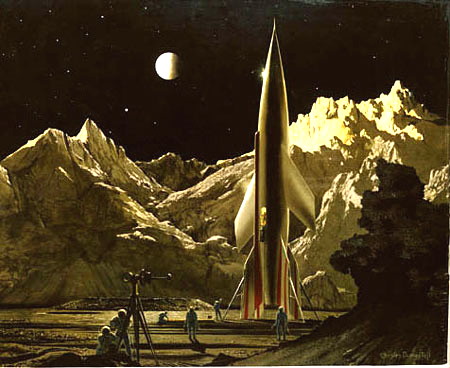
Chesley Bonestall's Conquest of Space (1949).
Paul D. Spudis
The Once and Future Moon
Smithsonian Air & Space

The influence of the arts on our popular culture is well known. The television generation grew up with Forbidden Planet and Star Trek, shaping our sensibilities and expectations about space travel.  The genre of “space art” enlightened and expanded our minds and ignited our imaginations.  The sixties and seventies brought us  “space” artists with their startlingly realistic vistas of unvisited worlds and ancient times.  Authors, writing for all ages and levels of interest, found eager audiences.  From the beginning, the space age left an indelible mark on many.

The spiritual father of these efforts was an artist from the earlier half of the century.  Renowned for what was called “astronomical art,” Chesley Bonestell (1888-1986) painted some of the most famous and classic works of space art.  His sequence showing the ringed giant planet Saturn from its various moons inspired hundreds of students to take up math and science.  Bonestell loved painting the planets because he was convinced that we would soon be visiting them.  His artwork was used to illustrate what media described and popularized about the forthcoming age of planetary exploration.

Bonestell made great efforts to get the technical details of his paintings correct.  He read the scientific literature so that his planetary landscapes reflected the most current knowledge of how his imagined scenes might really appear.  One of his classic pieces of work was for the influential film Destination Moon, produced in 1950 and based on stories by the classic science-fiction writer Robert Heinlein.  Bonestell did matte paintings for the Earth departure and lunar approach scenes.  His masterpiece in that effort was a fourteen-foot long, full panoramic view of the surface used during the lunar stay scenes in the movie.

Bonestell reminded his audience that our home planet is nearby — the backyard of near-Earth space.  Earth hangs relatively low in the sky over the horizon of the crater Harpalus in Mare Frigoris (latitude 52°N); rough jagged peaks, starkly lit by unfiltered blazing sunlight, are set sharply against a black sky holding a sea of silent, non-twinkling stars.  The demands of film intruded onto his artistic vision through the addition of giant cracks on the surface, a modification to which Bonestell objected.  The producer, George Pal, needed the surface cracks so that he could starkly illustrate perspective, as nearby human-scale cracks would rapidly fade into smaller ones in the distance.  Bonestell wanted to show just a dusty surface, a far-field contrast that would have been difficult to portray on the screen.

It is in regard to his portrayal of the mountains of the Moon that Bonestell has received, if not criticism, at least light censure (not without some slightly smug condescension) from some scientists.  He painted a lunar landscape ringed with rough, jagged peaks, towering about the plains, similar to the barren landscape of Death Valley in his native California.  In part, this was the conventional portrayal of lunar mountains; drawings made by engineer/astronomer James Nasmyth in the 19th Century likewise show jagged mountains on the Moon.  Telescopic views leave this impression, based largely on the dramatic appearance of sharp cast shadows on the lunar surface, visible at low sun elevations as shadows of the ringed mountains of the mare basins extend hundreds of kilometers across the flat plains of the dark maria.

The remarkable smoothness of the lunar mountains was evident when Apollo 15 went to the Moon in 1971.  To the disappointment of many, Bonestell’s vision of rugged, craggy peaks (blindingly illuminated by early morning sunlight in the black sky) gave way to an undramatic,  smooth, undulating terrain, so bland that it was difficult to gain any perspective on distance.  The sense of letdown among space buffs was widespread and illustrated most dramatically in a 1990 painting by David Hardy entitled The Way It Should Have Been, which paid tribute to Bonestell’s now-obsolete vision of lunar vistas by showing an Apollo Lunar Module snugly parked amidst the craggy peaks of Bonestell’s old Moon.

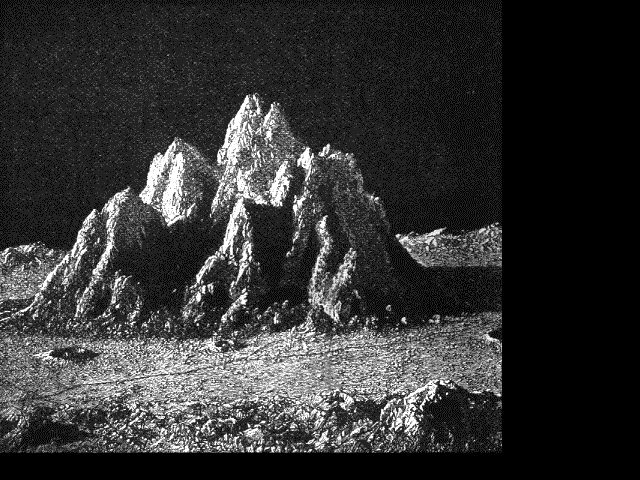
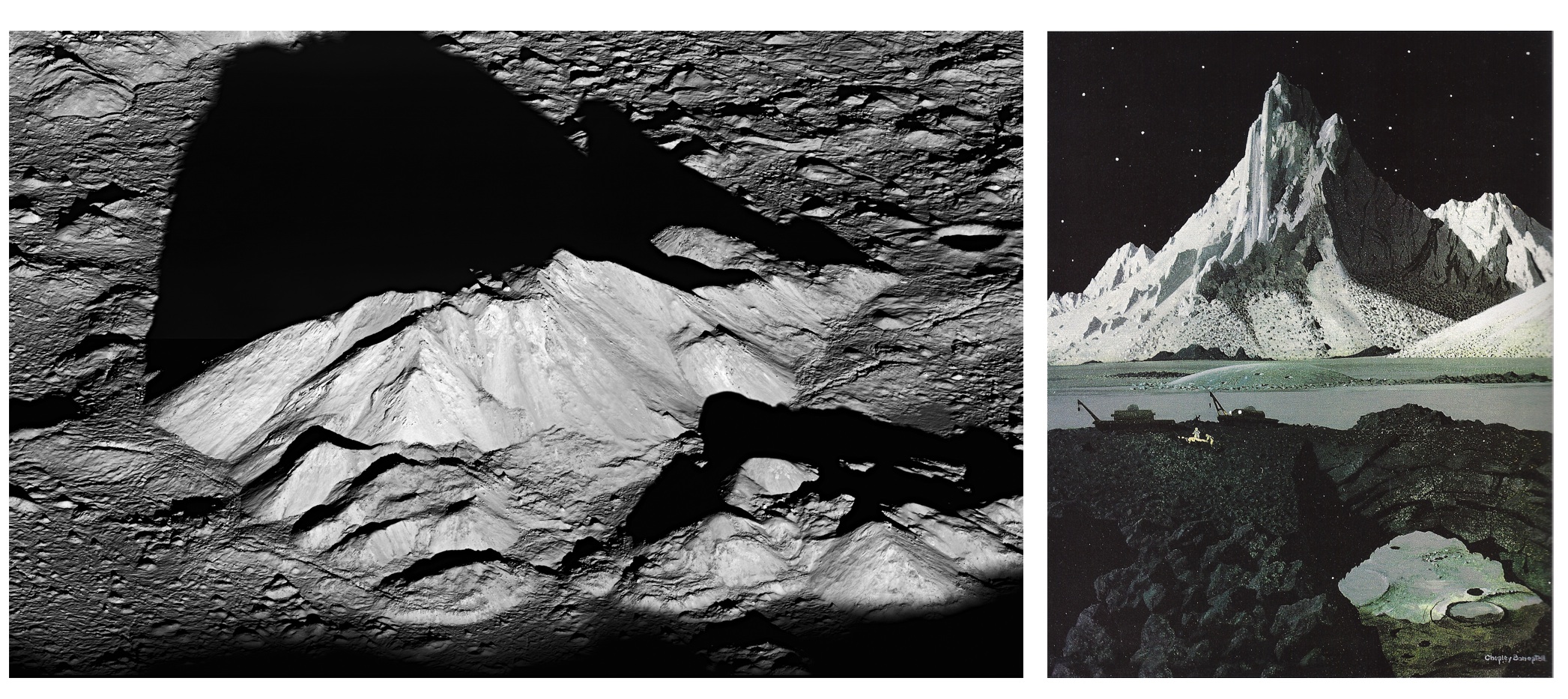
LROC 2011 view of the central peak of the crater Tycho (below) and Bonestall painting for the book, "Rocket to the Moon."
More of the Moon’s physical appearance has been unveiled.  The recent fleet of spacecraft that orbited the Moon has shown us dramatic vistas never before seen.  The spectacular high-definition television of Japan’s Kaguya spacecraft (by the way, when will NHK release a Blu-ray video disk of all that magnificent footage?) displays awesome landscapes that slowly drift beneath the orbiting vehicle, and NASA’s Lunar Reconnaissance Orbiter Camera system has provided some unique and remarkable views.  Some of the most dramatic are oblique-looking perspective views of famous lunar landmarks.  An oblique panorama of the floor of Tycho, the prominent rayed crater on the lunar near side, shows its magnificent, rugged central peak rising out of the inky darkness of the early lunar morning.  That description sounds familiar, doesn’t it?  In fact, when I first saw the new Tycho oblique, I seemed to recall a specific Bonestell painting that was very similar to it.  It was one that Bonestell did for an early 1960’s book, Rocket to the Moon.  The distant peak in Bonestell’s painting eerily foreshadows the dramatic LROC image by 50 years.

Chesley Bonestell’s Moon lives!  Fresh, uneroded features there are as sharp and dramatic as he portrayed them half a century ago.  As lunar features slowly erode under constant sandblasting by micrometeorites and downslope movement of debris, they become smooth and rounded.  The Apennine mountains at the Apollo 15 landing site are smooth because they formed almost 4 billion years ago, in the early dawn of lunar evolution.  In contrast, the central peaks of Tycho were thrust up a mere 100 million years ago, a blink of the eye in lunar geologic terms.  In a couple of billion years, it too will round off and mellow, a gentle undulation on the floor of a nearly obliterated crater.

“The Way It Should Have Been?”  Nah – the way it really is.  On the Moon, as on Earth, spectacular landscapes feed the human spirit and kindle our desire to travel to new places.

Originally published at his Smithsonian Air & Space blog The Once and Future Moon, Dr. Spudis is a senior staff scientist at the Lunar and Planetary Institute. The opinions expressed are those of the author and are better informed than average.

Wednesday, June 6, 2012

Human space exploration: asteroids vs. the Moon?

Sunflower solar panel-powered architecture, featuring the LER, Athlete and Chariot vehicles, that were well along in development before Congress and the Obama administration shelved the Constellation program [NASA/John Frassanito & Associates].
Jeff Foust

Two years ago, the Obama Administration changed the direction of the nation’s human spaceflight programs in a number of ways, including the destinations of those efforts. Gone was the goal of the previous administration of a human return to the Moon by 2020, a date that was looking increasingly unrealistic in the eyes of many, including the Augustine Committee that reviewed NASA’s plans in 2009. In its place was something resembling the “flexible path” approach in that committee’s final report, with the Moon replaced as an initial beyond-Earth destination by a near Earth asteroid. President Obama established a 2025 goal for a human mission to an asteroid in a speech at the Kennedy Space Center in April 2010, also setting a goal of a human mission to Mars in the mid-2030s.

From a technical standpoint, a human mission to a near Earth asteroid could be done solely by the United States given both existing capabilities and those under development, like the Orion spacecraft and Space Launch System heavy-lift rocket. Yet, from a financial standpoint, particular in an era of constrained and even declining budgets, it’s likely the US will seek international partners for an asteroid mission, and almost certainly for later missions to Mars. But do the potential partners of the US also want to participate in human asteroid missions?

The recent Global Space Exploration Conference, or GLEX, held in Washington, DC last month by the American Institute of Aeronautics and Astronautics (AIAA) and the International Astronautical Federation (IAF), offered some mixed messages about international interest in human asteroid missions. Some space agency executives instead spoke openly about going back to the Moon, comments that have some support among former NASA officials who believe that human lunar exploration will have greater support internationally.

Perhaps the boldest endorsement of the Moon, and not near Earth asteroids, as the next destination for human exploration came from Vladimir Popovkin, general director of the Russian space agency Roscosmos. Speaking at a plenary session at GLEX on May 22 that featured the leaders or other top officials of six space agencies, Popovkin suggested the Moon, and not the asteroids, was the preferred destination of the Russian space program.

“We arrived at the conclusion that the Moon is supposed to be the next target” for human exploration, Popovkin said through an interpreter. “We’re not trying to convince you that we shouldn’t be doing anything in the area of Mars exploration, asteroid exploration, just that, in our professional opinion, today we have much better chances to come up with very productive and tangible results when concentrating on the Moon.”

Read the in-depth article, HERE.

"Everyone's gone to the Moon..."

A lunar base creates new capabilities [Pat Rawlings/SAIC].
Paul D. Spudis
The Once and Future Moon
Smithsonian Air & Space

Where does the Moon fit into plans for future human space exploration?  From reading the space media, you might get the idea that the very notion is dead and buried, killed by President Obama’s casual dismissal of the idea in a speech over two years ago at NASA’s Kennedy Space Center, followed this year by Mitt Romney’s dismissive remarks on the Moon during the Republican primaries.

Nevertheless, many in the international community (and in the United States) are keeping the lunar flame alive for a variety of reasons, not the least among them being that it is understood that politicians aren’t rocket scientists – nor should we expect them to be.

The Global Exploration Conference (GLEX) held last month in Washington DC was remarkable for the fact that most of our international space partners are proceeding with plans for lunar return as though its abandonment had never occurred.  The Russians were particularly eager to express their desire to establish capability on the Moon at the meeting, while in recent months strong interest in permanent lunar return has been expressed by the Europeans, Canada, India, Japan and of course, China.  Moreover, unlike many within our own national space agency, the world sees the Moon not simply as a box to be checked-off on the way to Mars but as the enabling asset for space exploration.  As Vladimir Popovkin, head of the Russian Federal Space Agency Roscosmos put it, “It’s a new Moon,” pointing out that the recently confirmed discovery of water at the poles of the Moon enables sustainable, permanent habitation of that body and the creation of new capabilities for voyages to the planets.

Our international space partners believe that spaceflight beyond LEO should entail incremental steps that will gradually extend reach and capability.  Once such a paradigm is adopted, expensive designer missions to plant a flag or do a “touch-and-go” at an asteroid are seen as having limited value and making no economic sense.  On the other hand, the gradual expansion beyond LEO using nearby assets builds a permanent, lasting space faring capability.  The Moon fits into such a scheme by virtue of both its proximity and usefulness.  In the absence of some technical miracle, such as the discovery of new physics that fundamentally change the nature of spaceflight, we are wedded to rocket technology for the foreseeable future.  The rocket equation dictates that it will remain difficult and expensive to reach space and operate there.  Given such problems, some now recognize and conclude that the Moon offers provisioning capability and for this reason and many others, is a desirable destination and near-term goal.

Our pioneering (and current) model of space access requires launching everything from Earth’s surface, taking months to complete a mission, yet gathering minimal information (due to limited time in the vicinity of its designated target) and leaving no lasting or reusable infrastructure in space.  This template guarantees that human spaceflights will be infrequent, expensive and subject to abrupt cancellation due to political whims.   If one views the civil space program primarily as an annoying expenditure whose ambitions must be constrained by making a previously small portion of the program (such as “commercial” launch services) the raison d’être of the entire effort and deferring any real goals to an indefinite and nebulous future, our current path might seem completely reasonable.  However, it appears that the international community believes that space is a real theater of human endeavor and their goal is to make it part of their domain and utility – until recently, also a goal of the American space program.  Perhaps it still is.

Despite common perception, the Moon has not been officially abandoned as a goal for the United States space program.  The current NASA Authorization Act of 2010 lays out the goals and approaches to be followed by the agency in executing its mission.  The Findings by the Congress (section 301) outlines the rationale and goals of the space agency’s human exploration efforts.  As I have written previously, in the seven points dealing with future agency activities, cislunar space is mentioned in four and the lunar surface is called out twice as destinations.  Development of the ability to use the in situ resources of space to create infrastructure is specifically cited in Sec. 301a (4).  The entire section 301 is worth a careful reading.  It calls for a program that uses a gradual, incremental approach to the extension of human reach in space beyond LEO, specifically specifying both commercial and international participation.  There is nothing in the current law that is at odds with the plans and desires of the international community as expressed at the recent GLEX meeting.  The only place one reads about the Moon being abandoned as a national goal for America is in the press and such cases, it is always in the context of a single off-hand remark in one Presidential speech.

From the perspective of two years later, that off-hand remark sounds increasingly ill thought-out and hollow.  Given its context in the speech, the statement seems to derive from the idea that lunar return must perforce be a repeat of the Apollo experience of 30 years ago.  NASA itself has fed this idea, depicting the return to the Moon as the equivalent of a Gemini program within the Apollo-to-Mars fixation of many in the agency.  In their 2006 preliminary plans for lunar return, NASA started out properly by describing the development of an outpost at one of the poles of the Moon and emphasizing human presence and development, but over the next few years architectural studies increasingly drifted away from an outpost and towards the sortie concept, in which we would stage (entirely from Earth) and execute one-off missions to sites of scientific interest all over the Moon for visits of limited duration.  Such an exploration approach dissipates assets and thus increases costs and reduces surface capability and infrastructure.  It was this exploratory approach to lunar return that the Augustine committee evaluated and declared to be “unaffordable,” not the concept of building a centralized outpost that could support ISRU and space development (an approach that the committee did not even consider).

President Obama signed the NASA Authorization bill of 2010 – a bill crafted when his party controlled Congress – and the findings presented in that bill are now law.  So even though the agency and most of the media seem to be blissfully unaware of it, NASA has been charged by Congress to develop space systems capable of conducting missions to and throughout cislunar space, including to the lunar surface.  Our international partners agree with this intended direction, convinced that the Moon is the appropriate next destination for humans in space.

NASA’s reluctance to go in this direction, even while other nations are making plans, forfeits the opportunity for our international leadership in space.  Our space program has to demonstrate the feasibility of using lunar resources to secure us a place as participants and entrepreneurs in the vast economic future of space.

Originally published at his Smithsonian Air & Space blog The Once and Future Moon, Dr. Spudis is a senior staff scientist at the Lunar and Planetary Institute. The opinions expressed are those of the author and are better informed than average.