Showing posts with label Dark Streaks. Show all posts

Thursday, June 14, 2012

LROC: Hyginus and Pyroclastics

A 145 meter crater on the north rim of Hyginus Crater uncovered dark, most likely pyroclastic material. A 504 meter-wide field of view under a relatively high sun (angle of incidence = )from LROC Narrow Angle Camera (NAC) observation M155193272R, LRO orbit 8005, March 19, 2011; resolution 0.48 meters from 40.33 kilometers. View the larger, original LROC Featured Image HERE [NASA/GSFC/Arizona State University].
Sarah Braden
LROC News Center

A crater on the northern rim of Hyginus crater (exact location: 7.896°N, 6.229°E, diameter of 145 meters) excavated low reflectance material.

Deposits of pyroclastics are located around Hyginus Crater, so the low reflectance material is most likely from a layer of pyroclastics buried beneath the lunar surface. 

The same eruption that emplaced the pyroclastics also likely created an empty cavity beneath the surface, which then collapsed, forming Hyginus Crater!

A 1.38 kilometer-wide field of view from the LROC NAC frame stepped back to 2 meter resolution shows the subject of the Featured Image emplaced on the north rim 600 meters over the caldera interior. Dark material excavated by the impact appears to have streamed over the rim and down the wall [NASA/GSFC/Arizona State University].
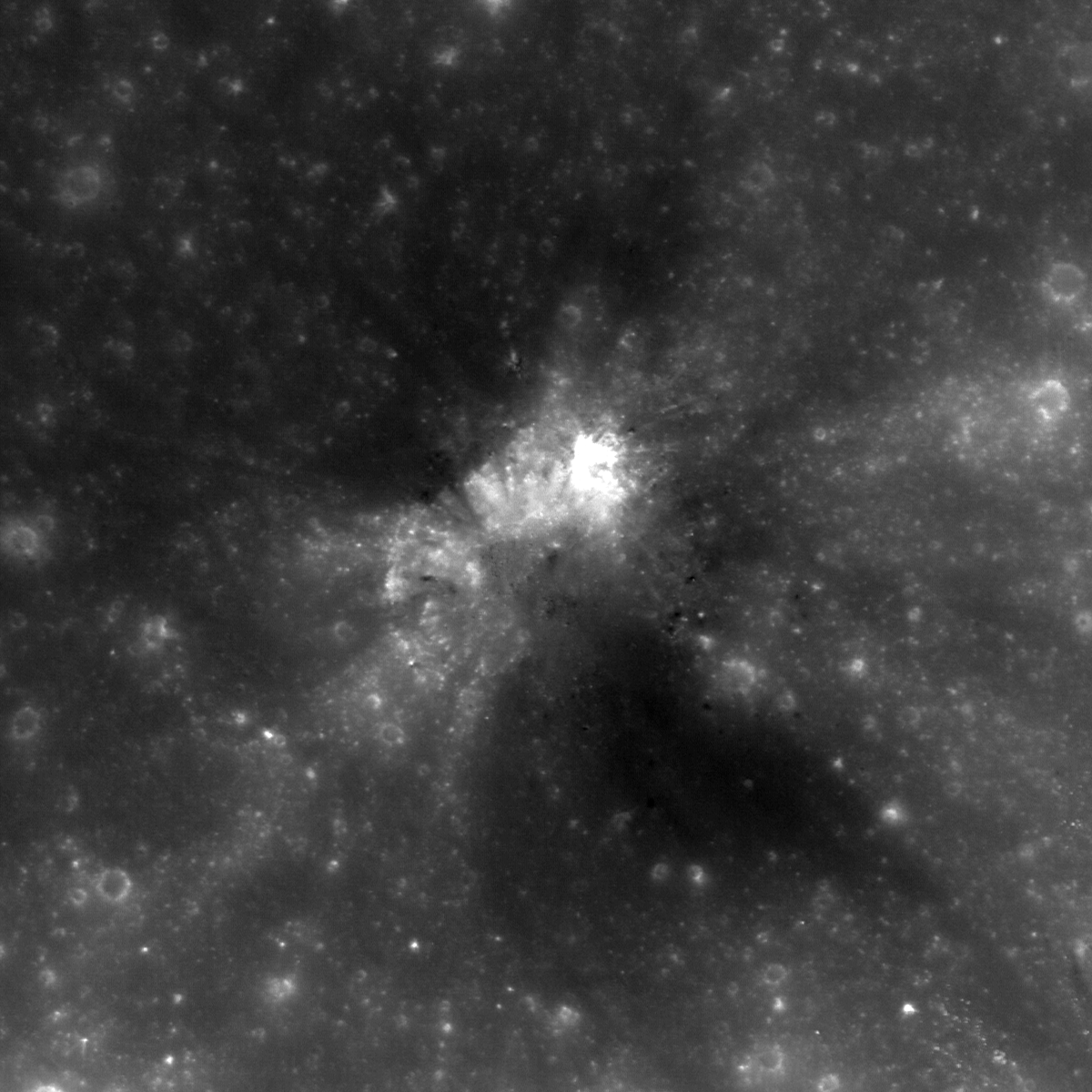
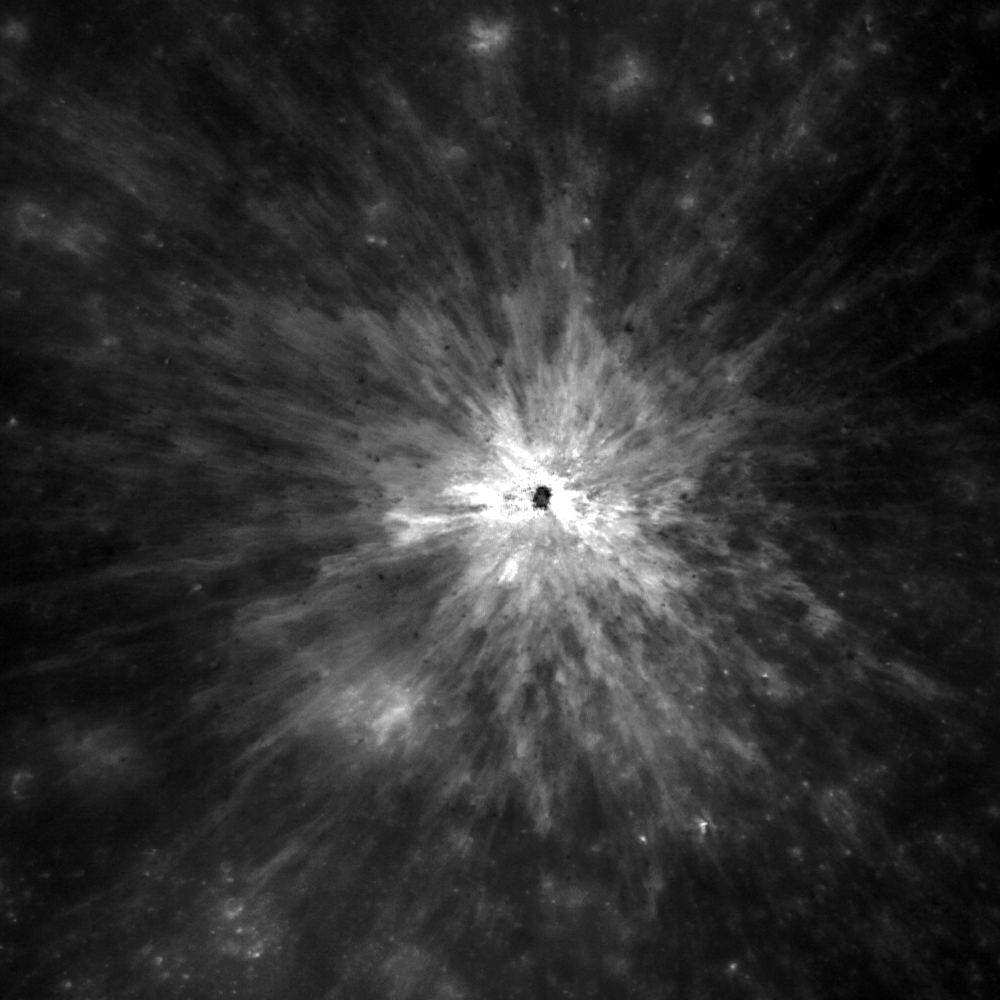
A small, fresh crater on the southern exterior of Hyginus has high reflectance, optically immature ejecta rays instead of dark rays caused by uncovering pyroclastic material.  LROC NAC M155193272R. View a larger version of this 420 meter-wide field of view HERE [NASA/GSFC/Arizona State University].
Another crater in the image above (located at 7.608°N, 6.221°E) found on the southern rim of Hyginus is a perfect contrast to the crater in the Featured Image. The rim of the crater is hard to see in this image, but the diameter is ~20 m. This crater is smaller, so it excavated material from a shallower depth compared to the Featured Image crater, and therefore did not sample the buried pyroclastic deposit. The rays from the crater on the southern rim are high reflectance, which is typical of immaturity rays made of fresh material, in comparison to rays made from material compositionally different from the surrounding area.

In this LROC Wide Angle Camera (WAC) context image the yellow arrow marks the location of the crater in the Featured Image and the white marks the location of the fresh rayed crater. LROC WAC observation M177596018C, LRO orbit 11308, December 3, 2011; angle of incidence 70.31° at 52.82 meters resolution from 38.98 kilometers  [NASA/GSFC/Arizona State University].
Explosive eruptions of basaltic magma form lunar pyroclastic deposits, which are associated with the eruption of the mare deposits on the near side of the Moon. In remote sensing data pyroclastic deposits appear smooth and low in reflectance. Pyroclastic deposits are valuable since measurements of pyroclastic beads returned from the Apollo missions show that the material is enriched in volatile elements such as sulfur, lead, fluorine, and zinc (compared to other more common lunar materials such as mare basalt and highland anorthosite). On the Earth all of these materials are relatively common. However, if you were living on the Moon, pyroclastic deposits are the best place to find these materials! Pyroclastics are also typically high in iron oxides and some contain titanium oxides.

Explore more of the Hyginus caldera inside and out with the full LROC NAC image, HERE.

Related Images:

Friday, November 18, 2011

Slopes, Streaks and Flows

A granular debris flow on the wall of Stevinus A (downhill to the bottom and to the right, in the original full-size LROC Featured Image). A 7 meter boulder impedes the progress of the flow, which bifurcates and reconnects about 10 meters further downhill. LROC Narrow Angle Camera (NAC) observation M154893929R, LRO orbit 7960, March 16, 2011. Detail from LROC Featured Image Dry debris or liquid flow? by Lillian Ostrach, June 3, 2011 [NASA/GSFC/Arizona State University].
Paul D. Spudis
The Once & Future Moon
Smithsonian Air & Space

Although the Moon’s gravity is low, only about 0.165 of the Earth, rock and soil move down slope over time.  In geology, such processes are called mass wasting and is one of the principal sources of erosion on the Moon (the other being meteorite bombardment).  Mass wasting includes both gradual, infinitesimally slow soil creep on slopes and rapid, catastrophic mass movements, called landslides.  Long trains of rock debris can form scree slopes, loose fragments lying precariously at the critical angle beyond which they move, the angle of repose.  Because impact craters make steep walls and the larger ones bring up peaks in their centers, most mass wasting on the Moon is found in and around impact craters of all sizes.

Dark and light streaks on crater walls on the Moon. (click HERE to enlarge) [NASA/GSFC/Arizona State University].
As the number of high resolution images taken from the LRO mission continues to proliferate, several interesting and under-appreciated lunar surface phenomena are becoming more apparent.  Among the fresh craters of the Moon, we find light and dark steaks on the walls of the ubiquitous craters of the Moon.  Although it is not surprising that material might move or flow down steep slopes on the Moon, the appearance of these flows can be startlingly similar to those seen on other planets, particularly Mars, where such streaks have been cited as evidence for the presence of subsurface water.

The new narrow angle LRO camera can see objects on the surface smaller than one meter (typically, 50 cm per pixel resolution).  These new views have shown us a wide diversity of new features within impact craters and have given us a new appreciation for mass wasting.  Larger crater walls are slumped, with stair step-like wall terraces, concentrically arranged around the crater between rim and floor.  In detail, these terraces show ponds of dark material that seem to collect in low areas.  Most of this material looks like it was once molten but now congealed; it is probably solidified impact melt.  Flows of melt may cascade down and over the walls of fresh craters.

However, many “flows” of both dark and light material on the Moon seem to consist of loose fragments of rock debris lying on steep slopes.  These debris flows show a variety of morphologies, including simple flow shapes, cascades, ponding, and fan-like termini.  Sometimes the dark and light flows intermingle within a single crater while others show only one type.  These debris flows can usually be traced back to outcrops of bedrock in the upper portions of the crater wall.  As the bedrock erodes (usually by meteorite erosion and disaggregation due to the intense fracturing induced by the original impact that formed the crater), it sheds small fragments that train down slope, forming flow-like landforms.

Because crater walls are uneven, undulating surfaces, the rates of down slope movement can vary widely over small distances.  This sometimes results in multiple, overlapping flows of debris.  Factors that control the albedo (reflectivity) of the debris flows are not well understood.  It could be related to composition (for example, dark, iron-rich mare basalt vs. white, anorthositic highland rocks).  Another factor might be particle size; small pebble-sized rock flows could be bright as new, fresh surfaces are constantly exposed.  Flows that contain mixed soil might be darker than normal, as this soil could cover the fragments and reduce its average reflectivity.  But while all these factors may be of significance to one degree or another, the brightness of a streak is not particularly indicative of origin.

Dark streaks on crater walls, Mars. (click HERE to enlarge)

On Mars, many dark streaks are evident on crater walls and, as on the Moon, come in a wide variety of forms and occurrences.  Martian dark streaks have been variously interpreted as being caused by compositional and particle size differences, but the most popular idea is that the dark streaks are wet soil, i.e., they represent areas where liquid water is seeping out from the planet’s subsurface and moistening the surface.  One observation supporting this idea is an apparent correlation of some of the dark streaks with surface temperature, with warmer slopes showing more.  As liquid water is not stable on the martian surface, salt-rich brines (which would have much lower melting points than pure water) have been invoked as the possible liquid phase.

The dark streaks on the crater walls of the Moon call water-related interpretations of similar features on Mars into question.  The nature of down slope movement on Mars is likely to be controlled by even more diverse factors than the lunar case.  For example, large landslides partly cover the floor of the Valles Marineris, the large canyon system on Mars.  These landslides can extend tens of kilometers across the valley floor and the mass flow might have been lubricated by trapped atmospheric gas; this “cushioning” effect occurs within some landslides on the Earth.  Such a process would not occur on the Moon.  The diversity of geological processes on Mars suggests that explanations for dark wall streaks could encompass many more possibilities than simple wetting of the surface.

Although the existence of dark lunar streaks does not negate water-related interpretations of similar features on Mars, they do call attention to the need to keep alternative hypotheses in mind.  For many years (and with some success), planetary geologists have extrapolated landforms and processes (thought to be understood) on Earth, to similar appearing features on the planets.  In the case of the dark streaks, terrestrial water seepages in the desert can be darker than surrounding desiccated terrain.  A wide variety of evidence indicates that water is present in the subsurface on Mars but sometimes other effects such as rock composition or particle size are responsible for the streaks and alternatives to seepage should always be kept in mind.

Originally published November 17, 2011 at his Smithsonian Air & Space blog The Once and Future Moon, Dr. Spudis is a senior staff scientist at the Lunar and Planetary Institute. The opinions expressed are those of the author and are better informed than average.

Tuesday, September 20, 2011

LROC: Dark wisps along the rim of Copernicus


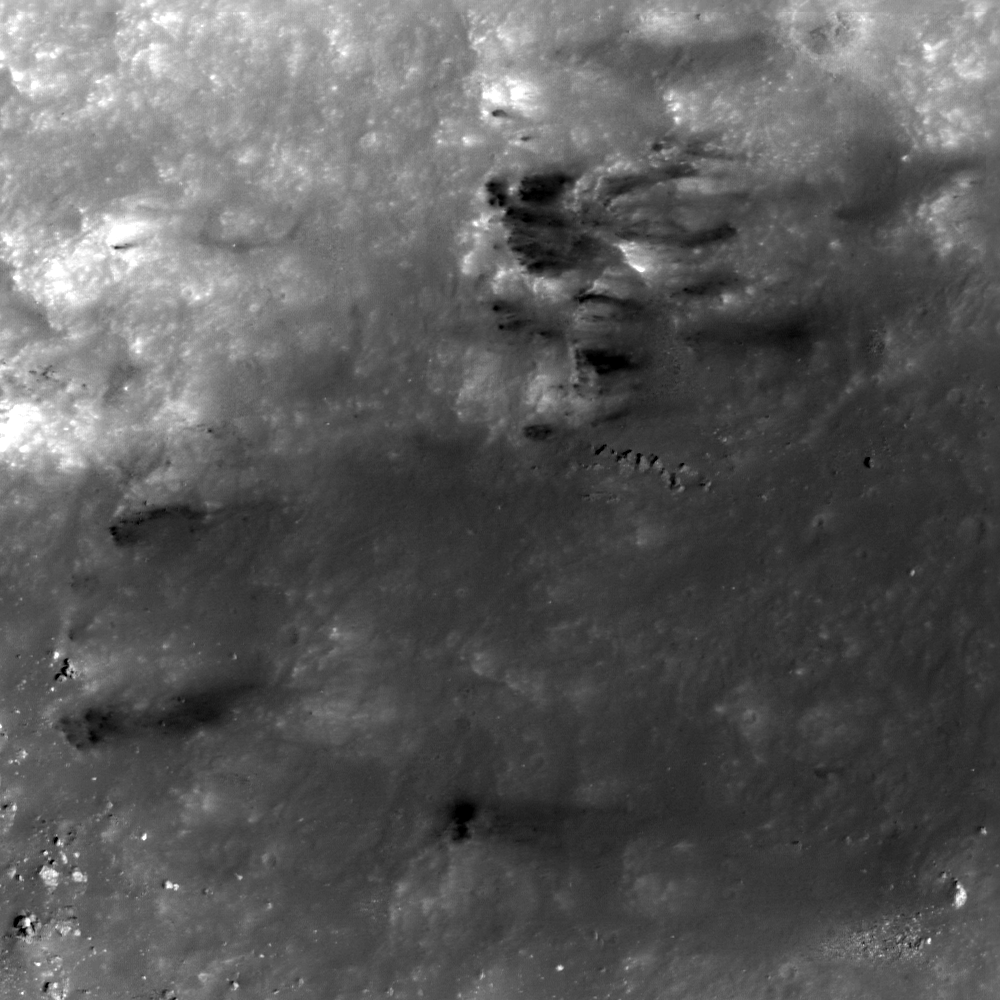
Dark streaks ornament a slope along the Copernicus crater rim (9.3°N, 21.5°W). Down-slope is to the right. LROC Narrow Angle Camera (NAC) observation M11735067L, LRO orbit 1600, November 1, 2009; incidence angle 32°, Sun is from the east, north is up, field of view is roughly 400 meters across. View the full size LROC Featured Image HERE [NASA/GSFC/Arizona State University].

James Ashley
LROC News System

What are these low-reflectance (dark), wispy streaks? The differences in color among lunar deposits is often understood in terms of composition and/or intensity of space weathering (which can discolor soils over time). When they become mixed (often from cratering events), they can produce areas of high color contrast. Most of them seem to have the lowest reflectance at the points highest in elevation on the crater wall (to the left), and become more reflective down-slope (to the right). The features in this image seem to cluster near a promontory that has its own streak of material, emanating as a fan-shaped curtain (see context image below).


From a wider view of LROC NAC M11735067L, showing the association of a promontory's location with the occurrence of the dark deposits (See next image). Field of view roughly 2.2 km across (downsampled from 50 cm/pixel to approximately 2.3 meters/pixel. View the full size LROC context image HERE [NASA/GSFC/Arizona State University].


An artificial perspective of the massive slumped inner slope of the east rim of Copernicus made possible by NASA's ILIADS program. The topography represents laser altimetry collected by LOLA overlaid with morning Terrain Camera imagery from Japan's lunar orbiter Kaguya. (The LROC Featured Image is a close up from overhead of the slot in the crater rim, left of upper center.) View a HDTV orbital still showing Copernicus HERE [NASA/GSFC/MSFC/JAXA/SELENE].

There are several possible explanations for how the smaller, low-reflectance features formed. For example, these dark patches may represent mare basalts that were buried and re-exposed by the formation of Copernicus and subsequent mass wasting. Another possibility is that the low-reflectance materials are dikes or sills (intrusive igneous bodies) that pre-date the Copernicus impact and are now weathering out. Still a third possibility is that mare basalt debris were ejected by a nearby impact and deposited here, perhaps encouraging the erosion of the promontory in the process - or landing near the promontory by coincidence. In this later scenario, each block of ejecta might then have fragmented upon impact and migrated down-slope as individual debris aprons. There are several nearby, relatively recent craters outside of the Copernicus rim that could be responsible for this type of deposition. Are there any additional clues that could be looked for to further solve this mystery?


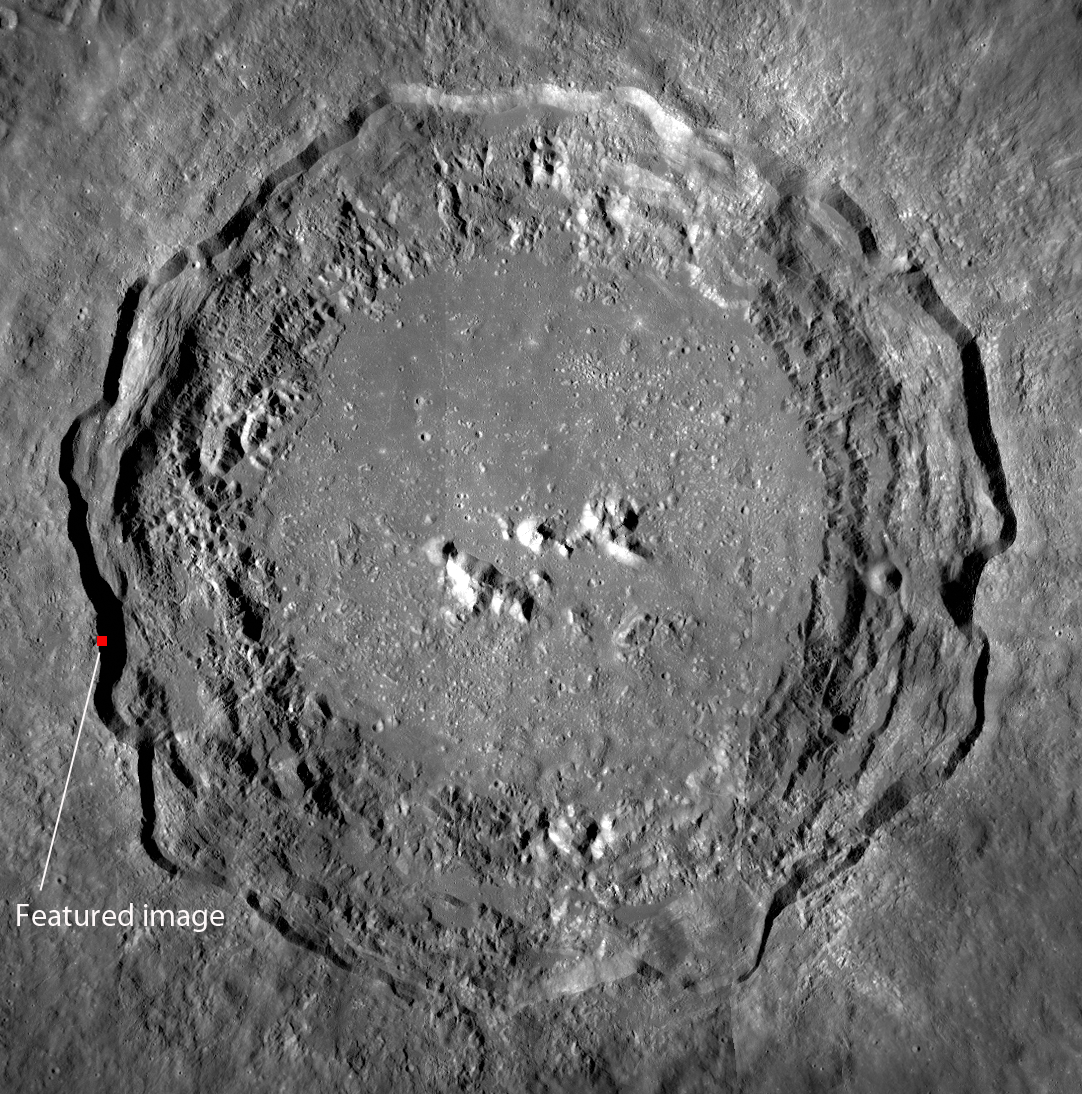
A 54.6 meter per pixel LROC Wide Angle Camera (WAC) perspective centered on the area of interest, on the west-southwestern rim of Copernicus. LROC WAC M131793087C (604 nm), LRO orbit 4556, June 21, 2010; little more than a day after local sunrise, incidence angle 82.2° [NASA/GSFC/Arizona State University].


Above, the LROC WAC context image showing the expanse of Copernicus provides a sense for how steep the outermost walls of the 95 km-wide crater are, and the location of area highlighted in the Featured Image released September 20, 2011. View the full size LROC WAC context image HERE [NASA/GSFC/Arizona State University].

Review the full NAC image HERE to look for more examples.

Related posts:
Dark streaks in Diophantus crater
Dichotomy