Showing posts with label Bombardment. Show all posts

Tuesday, December 11, 2012

The surface of the Moon: What lies beneath?

The Moon's anisotropic composition is well represented in this Mercator projection of lunar gravity, mapped at unprecedented resolution by the twin GRAIL lunar orbiters and centered on the Moon's farside [NASA/JPL/MIT].
Paul D. Spudis
Smithsonian Air & Space

The NASA mission GRAIL (Gravity Recovery And Interior Laboratory) has been orbiting the Moon since last spring.  The mission consists of two identical small spacecraft (dubbed Ebb and Flow) that very carefully keep track of their relative position from each other.  By tracking both of these spacecraft with high precision from Earth, we can monitor any small variations (caused by variations in the Moon’s gravity field) away from their predicted orbital paths.  If the satellite is flying over an area on the Moon with less material than normal (for example, over a deep crater, a hole in the Moon’s crust), it will be less attracted to the Moon because of this mass deficiency and will therefore fly away from the Moon.  If, on the other hand, it flies over an area of excess mass, such as a thick stack of dense lava flows, the excess mass pulls the satellite slightly toward it, increasing its speed and pulling it downwards.  As Ebb and Flow orbit the Moon, they conduct a delicate “dance.”  These movements are caused by variations in the Moon’s gravity (largely a reflection of variations in the density of its crustal rocks).  When combined with the high-resolution, precision topography of the Moon (currently being gathered by the Lunar Reconnaissance Orbiter), we are able to reconstruct the structure and thickness of the lunar crust from orbit.

GRAIL has unveiled a new global gravity data set, very high in resolution and precision and greater than ten times better than our previous version of the global gravity from the Japanese mission SELENE (Kaguya).  One interesting result shows unusual structure – long, quasi-linear gravity features appear in a variety of locations associated with lunar impact basins.  Basins are very large craters that formed during asteroid collisions prior to 3.8 billion years ago.  Some of these linear features extend on great circles across the lunar globe for distances of more than 500 km. These results suggest that solidified intrusions of once-molten rock may form a dense, criss-crossing network within the upper crust.

In order to understand the significance of these gravity features, it is necessary to understand some elementary facts about planetary geology.  Planets generate heat and this heat must be dissipated.  Typically, the heat generated from both the original energy release during formation (accretion) and from the decay of radioactive elements (e.g., uranium) melts the interiors of planets, forming bodies of liquid rock called magma.  This magma is usually less dense than the rocks from which it forms and thus, rises upwards towards the surface.  Sometimes, the molten rock cannot ascend any higher from the deep locations where it comes from and freezes in place – geologists call this type of frozen rock body an intrusion, because it intrudes into pre-existing rock as a liquid and then solidifies by crystallizing.  When magma actually reaches the surface of a planet, it can erupt onto its surface as lava; this activity is called extrusive because the molten rock extrudes onto the surface and then solidifies as lava flows.

Clearly, all erupting lava must have at one time been an intrusive magma body, at least during the time it was ascending upwards toward the surface.  Although many magma bodies reach the surface and create lava flows (such as the dark, smooth maria of the lunar lowlands), sometimes this magma cannot reach the surface and freezes in place within the crust as a linear or tabular body.  Such features (called dikes) are an essential part of the underground, igneous plumbing of volcanoes on all of the terrestrial planets.  We knew that they must have formed on the Moon because we saw the evidence of vents and structures in the maria that are the surface expression of such features.

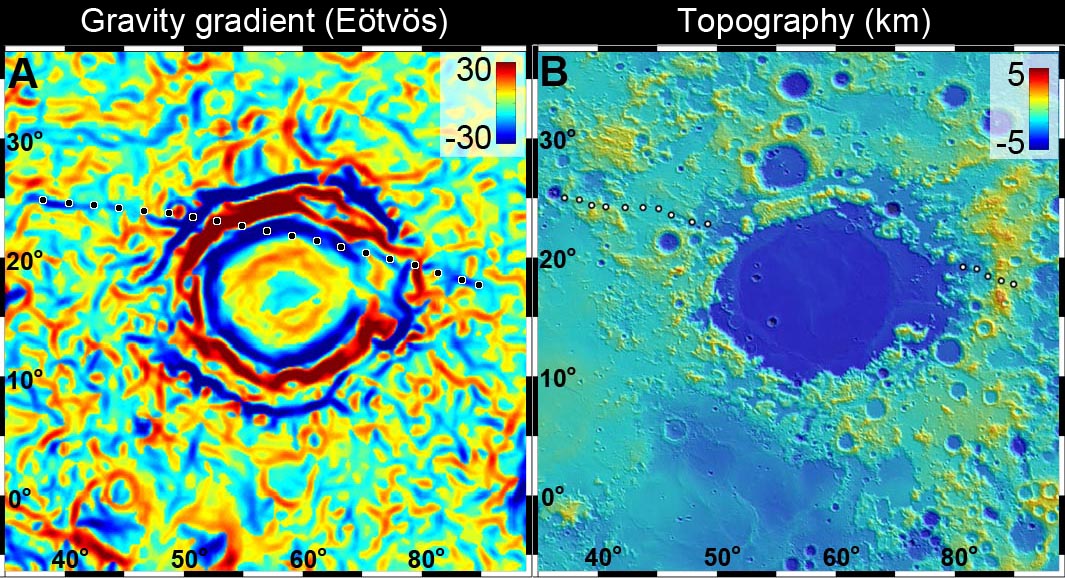
For the first time, the new GRAIL data show us direct evidence for these buried igneous dikes within the lunar crust.  One particularly prominent dike occurs near the Crisium basin, on the eastern near side of the Moon.  This dike extends over 1000 km in a quasi-radial direction northwest of the Crisium rim, disappearing beneath the mare lavas of that basin.  The fact that it is not clearly aligned with the basin structure suggests that it may predate it; we estimate that Crisium basin is older than 3.9 billion years.

Newly released GRAIL lunar gravity gradient map centered on Mare Crisium. An otherwise essentially invisible 300 km-long density of mass was detected buried under 3.9 billion year old Crisium (dotted line) [NASA/JPL/MIT].
Small scale topography of the Crisium basin, assembled from laser data points collected by the LOLA instrument aboard the Lunar Reconnaissance Orbiter [NASA/GSFC].
Mare Crisium and vicinity in a monochrome 1240 km-wide field of view from the LROC Wide Angle Camera 100 meter resolution global mosaic [NASA/GSFC/Arizona State University].
This long linear feature may have been formed when molten magma from the deep interior of the Moon oozed its way toward the surface, before “freezing” at some intermediate level.  Its presence, evident now only by a faint gravity signature (those denser areas “tugging” on the GRAIL satellites “Ebb” and “Flow”), is a tell-tale remnant of its existence deep inside the Moon’s crust.

The highly-detailed GRAIL lunar gravity gradient orthographic map, centered near 60° E meridian (and Mare Crisium, above center). The third of the hemisphere at right is on the Moon's farside. To view the spectacular new animations at their highest-available resolution by visiting the Science Visualization Studio (SVS) at NASA Goddard Space Flight Center, HERE [NASA/JPL/MIT/GSFC/SVS].
Many other linear and circular features are evident in the gravity gradient map produced by GRAIL.  Most of these seem to be associated with the large basins of the lunar highlands, the largest impact craters on the Moon. These features both excavate large amounts of crustal material during formation, and serve as topographic lows and structural traps for the accumulation of subsequent erupted lavas.  The gradient structures show a complex network of density patterns in the shallow subsurface of the Moon; this area is a morass of crushed rock, fractures, large faults and collapse features.  The entire outer portion of the lunar crust has been shattered and broken by an impact barrage of almost unimaginable violence.  The crust has since been partly annealed together by heat, re-fractured by additional impacts, intruded by large bodies of molten rock, resurfaced by the eruption of lavas from the deep interior, and finally has had its outermost surface pulverized into a fine powder by the micrometeorite bombardment.

The Moon may look like a silent, dead world but its past (which is Earth’s past) is testament to an early history of extreme violence and chaos.  The results from the GRAIL mission are helping us understand this complex story.

Originally published at his Smithsonian Air & Space blog The Once and Future Moon, Dr. Spudis is a senior staff scientist at the Lunar and Planetary Institute. The opinions expressed are those of the author and are better informed than average.

Saturday, December 8, 2012

GRAIL twins coax out the Moon's deeper history of the solar system's early, pulverizing bombardment

GRAIL primary mission global gravity map, centered on 0°N, 355°E, from animation released Dec. 5, 2012. Science Visualization Studio (SVS), GSFC [NASA/JPL/MIT].
Jennifer Chu
MIT

Beneath its heavily pockmarked surface, the moon’s interior bears remnants of the very early solar system. Unlike Earth, where plate tectonics has essentially erased any trace of the planet’s earliest composition, the moon’s interior has remained relatively undisturbed over billions of years, preserving a record in its rocks of processes that occurred in the solar system’s earliest days.

Now scientists at MIT, NASA, the Jet Propulsion Laboratory and elsewhere have found evidence that, beneath its surface, the moon’s crust is almost completely pulverized. The finding suggests that, in its first billion years, the moon — and probably other planets like Earth — may have endured much more fracturing from massive impacts than previously thought.

The startling observations come from data collected by NASA’s Gravity Recovery and Interior Laboratory (GRAIL) mission. Since March, the mission’s twin spacecraft, named Ebb and Flow, have been orbiting the moon and measuring its gravitational field.

From GRAIL’s measurements, planetary scientists have now stitched together a high-resolution map of the moon’s gravity — a force created by surface structures such as mountains and craters, as well as deeper structures below the surface. The resulting map reveals an interior gravitational field consistent with an incredibly fractured lunar crust.

“It was known that planets were battered by impacts, but nobody had envisioned that the [moon’s] crust was so beaten up,” says MIT’s Maria Zuber, who leads the GRAIL mission and is the E.A. Griswold Professor of Geophysics in the Department of Earth, Atmospheric and Planetary Sciences. “This is a really big surprise, and is going to cause a lot of people to think about what this means for planetary evolution.” 

Zuber and her colleagues detail their findings from GRAIL in three papers published this week in Science.

GRAIL’s lunar gravity map has also revealed numerous structures on the moon’s surface that were unresolved by previous gravity maps of any planet, including volcanic landforms, impact basin rings, and many simple, bowl-shaped craters. From GRAIL’s measurements, scientists have determined that the moon’s crust, ranging in thickness from 34 to 43 kilometers, is much thinner than planetary geologists had previously suspected. The crust beneath some major basins is nearly nonexistent, indicating that early impacts may have excavated the lunar mantle, providing a window into the interior.

Lifting a veil: In addition to mapping the Moon's anisotropic gravity with unprecedented granularity, the GRAIL primary mission uncovered deeper, essentially vertical dyke structures hundreds of kilometers long, the existence of which had been erased at the surface [NASA/JPL/MIT].

To generate the gravity map, GRAIL’s two probes measure the changing distance between themselves as they orbit in tight formation around the moon. As one of the probes flies over a large mass, such as a mountain or dense, underground rock, the stronger local gravity will pull that probe ahead, widening the space between the two spacecraft. Scientists can translate this changing distance into a gravitational map, representing the gravity produced by both the surface structures and the interior.

To find the gravitational field for the moon’s interior alone, Zuber’s team used topographic measurements from another of their instruments, a laser altimeter aboard the Lunar Reconnaissance Orbiter, a separate spacecraft in orbit around the moon. The scientists calculated the gravitational field expected to be produced by the moon’s topography — its surface structures alone — then subtracted that field from the field measured by GRAIL.

“It’s essentially like removing a veil to reveal the gravity due to the inside of the planet,” Zuber says. “And when we saw those maps, we were just speechless.”

The GRAIL primary science mission also succeeded in definitively mapping the thickness of the Moon's outer crust, shown in another global animation centered over the thickest zones on the lunar farside. The South Pole-Aitken basin, oldest and largest identified impact at 4.1 billion years, hosts some of the thinnest outer crust. The mission has increased the likelihood that fragments of the Moon's deeper zones will eventually be found on the surface, excavated by complex craters located on or near the basin's rim [NASA/JPL/MIT].
Compared to the surface, the map of the interior looked extraordinarily smooth. In fact, the team found that most of the moon’s local gravity is due to surface features, such as crater rims and mountains. Except for the large impact basins, the moon’s upper crust, largely lacks dense rock structures, and is instead likely made of porous, pulverized material.

The interior map did reveal long, linear structures of denser material, which Zuber and her team believe to be buried lunar dikes — formed from magma that seeped into large fractures in the crust, and then solidified into dense walls of rock. These dikes represent evidence for expansion of the moon in its earliest history. But overall, 98 percent of the lunar crust is fragmented — a clear remnant of very early, very massive impacts.

“This is interesting for the moon,” Zuber says. “But what it also means is that every other planet was being bombarded like this.” The resulting fractures, she says, affect the way a planetary body loses heat and also provide a pathway for the transport of interior fluids.

David Kring, a senior staff scientist at the Lunar and Planetary Institute in Houston, says knowing the extent of pulverization in the moon’s crust is an essential detail needed to determine the moon’s bulk composition. Such information would go a long way toward identifying the processes the formed the moon and other planets.

“The staggering quality of the data reported by Professor Zuber and her colleagues is amazing,” says Kring, who was not involved in the research. “The data are exciting because they foretell far more insights than are captured in these initial three papers.”
NASA has scheduled a news conference to discuss the planned deorbiting and impact of the GRAIL spacecraft, December 13.


In addition to GRAIL’s discoveries, Zuber says another major accomplishment has been the performance of the spacecraft themselves. To achieve the mission’s science goals, the two probes, which can travel more than 200 kilometers apart, needed to be able to measure changes in the distance between them to within a few tenths of a micron per second. But GRAIL actually outperformed its measurement requirements by about a factor of five, resolving changes in spacecraft distance to several hundredths of a micron per second — one twenty-thousandth the velocity that a snail travels. 

“On this mission, with two spacecraft, everything had to go perfectly twice,” Zuber says, adding proudly: “Imagine you’re a parent raising a twins, and your children sit down at the piano and play a duet perfectly. That’s how it feels.”

Sunday, September 30, 2012

Hit-and-Run Science

From 'A new hit and run Giant Impact scenario,' July 28, 2012;  Figure 1a: Five snapshots from the 30° impact angle and 1.30vesc impact velocity case (cC06) showing cuts through the impact plane. Colour coded is the type and origin of the material. Dark and light blue indicate target and impactor iron; Red and orange show corresponding silicate material. The far right shows the situation at the time of impact. At 0.52h, it can be seen how the impactor ploughs deep through the targets mantle and pushes considerable amount of target material into orbit. A spiral arm of material forms and gravitationally collapses into fragments. The outer portions of the arm mainly consist of impactor silicates and escapes due to having retained a velocity well above escape velocity. The silicate fragments further inward are stronger decelerated and enter eccentric orbits around the target. The impactor's iron core also looses much of its angular momentum to the outer parts of the spiral arm and re-impacts the proto-Earth. -  Figure 1b: The origin of the disk material highlighted, half a collisional timescale ( (Rimp + Rtar) / vimp ) after impact. In the grazing reference case (cA08), the majority of the proto-lunar disk originates from a spill-over of the impactor. In the head-on cases (cC01, fB06, iA10), much more material comes from the target mantle, being pushed out into orbit by the impactor core. Colours are identical to figure 1. Turquoise on the right shows water ice for the icy impactor case iA10. Reufer, et al. (2012) Icarus 221, 296
Paul Spudis
The Once & Future Moon
Smithsonian Air & Space

The origin of the Moon is a long-standing problem in planetary science.  Reconstructing complex events in the distant past is difficult and requires both knowledge and imagination.  The facts to be explained are relatively straightforward.  The Moon’s overall density (about 3.3 grams per cubic centimeter) and bulk chemical composition are about the same as that of the mantle of the Earth, suggesting a possible relationship between the two.  The idea that Earth and Moon are compositionally related is supported by the ratio of isotopes of oxygen in the lunar samples, which indicate that Earth and Moon are made from matter derived from the same region of the solar nebula (material that is compositionally distinct from that making up the various meteorite groups).  Finally, the Earth and Moon collectively have a very high angular momentum, mostly as a consequence of the high spin rate of Earth and the relatively large mass of our Moon compared to its primary planet.

Prior to the Apollo missions, three different models (capture, fission, binary accretion) vied for acceptance among the lunar science community.  The capture model proposed that the Moon formed elsewhere in the Solar System before a close, chance encounter resulted in the Earth capturing the Moon into orbit.  The fission model proposed that a large mass of molten material spun off a rapidly spinning early Earth, was thrown into orbit and over time, coalesced into the Moon.  The binary accretion model suggested that Earth and Moon assembled themselves independently as two distinct and separate bodies from the beginning.  None of these models seemed able to account for all the “constraints” mentioned above, but no one had any better ideas.

About 30 years ago, the problem of lunar origin was widely considered “solved” with the general acceptance of the Giant Impact model.  In this concept, four and a half billion years ago, the proto-Earth shared its orbit around the Sun with an object about the size of the planet Mars (dubbed Theia, in Greek mythology, the titan who gave birth to Selene, goddess of the Moon).  A chance encounter between these two planetoids resulted in their merging as the Earth-Moon system.  It was thought that a grazing (low angle) impact would serve to both spin up the Terra-Luna system, resulting in its relatively high angular momentum, and hurl vaporized mantle material from Theia into orbit around the Earth.  The disk of orbiting debris quickly coalesced into the Moon and this rapid accumulation resulted in the release of large amounts of heat, which proceeded to melt at least the outer few hundred kilometers of the Moon, creating an “ocean” of molten rock, or magma.

The Giant Impact model seemed to nicely account for most of the properties of the Moon.  But like many big ideas in science, the closer and longer we look at it, the more issues seem to arise.  It was long assumed that the Moon was made of material derived mostly from mantle of the impacting planet (Theia); in this view, the Giant Impact was really just a variant of the capture model.  As such, it did not explain either the chemical similarity of the Moon to the mantle of the Earth, nor their identical oxygen isotope compositions.  This objection was usually brushed away with the admonition that complications might be expected from planet-scale impacts.

A new set of computer models has looked at the consequences of a slightly more head-on planetary collision.  In contrast to the traditional oblique (few degrees) off-center Big Whack, researchers modeled the effects of an impact at about 30° incidence and relatively high velocity (about 1.3 times escape velocity, or roughly 14 km/sec).  They find that in this case, most of the material from which the Moon forms comes not from the impactor Theia, but from the mantle of the Earth.  This result might better explain the compositional attributes of the Earth-Moon system.  In fact, several models were run (slightly varying these conditions) and while none perfectly fit the chemical and dynamical constraints, this one matched them most closely.

While this modeling was underway, another group was analyzing the composition of isotopes of titanium in samples from the Earth, the Moon and meteorites.  The work has established that the chemical fingerprints that relate Earth and Moon are not merely close – they are virtually identical (to the best precision of the measurements).  The authors of this study claim that this result creates problems for the Giant Impact model, as that idea had called for most of the Moon to be derived from the mantle of the impacting planet Theia.  However, with the results of the new computer models of giant impacts discussed above demonstrating that the parameters of the collision can be adjusted to match the constraints on lunar origin, perhaps this is not such a problem for the Giant Impact model after all.

These developments should probably give lunar scientists pause.  After all, the Giant Impact model became popular because the earlier, traditional three models (capture, fission, binary accretion) were all inadequate and their boundaries and defining parameters had to be adjusted to permit their (barely acceptable) viability.  In other words, the models were stretched to fit any inconvenient facts or problem observations.  Now it appears that the same thing is happening to the new, “explains-it-all” Giant Impact model.  A scientific idea that can be stretched to fit any observable fact is not very useful as an explanatory principle – it is simply a glorified “Just So” story.  The late Karl Popper argued that often in science, an idea cannot be shown to be true, but it can always be shown to be wrong – that is, “falsified.”  If a hypothesis cannot be falsified, Popper argued, then it was not scientific. We need a mechanism in science to enable us to dismiss useless or irrelevant concepts and falsification is one way to do that.

So where does such philosophy leave the origin of the Moon?  Perhaps more knowledge and imagination is needed before we can pronounce lunar genesis a “solved problem.”

Originally published at his Smithsonian Air & Space blog The Once and Future Moon, Dr. Spudis is a senior staff scientist at the Lunar and Planetary Institute. The opinions expressed are those of the author and are better informed than average.

Related Posts:
A Sawtooth-like timeline for the first billion years of lunar bombardment (August 28, 2012)
A new 'hit and run' Giant Impact scenario (July 28, 2012)
"Our view of the Moon has turned upside down" (April 26, 2012)
Ti paternity test fingers Earth as Moon's parent (March 28, 2012)
NLSI team sheds light on 'late heavy bombardment' (February 28, 2012)
Spudis: Cataclysmic Conundrum (February 14, 2012)
'Significant change' in bombardment timing (January 6, 2012)
LOLA reveals distinct populations in bombardment record,
Diviner finds "no pristine lunar mantle" even within SPA
(September 16, 2010)
'The Grand Lunar Cataclysm and how LRO can help test it' (September 7, 2009)

Tuesday, August 28, 2012

A Sawtooth-like Timeline for the First Billion Years of Lunar Bombardment

A revised timeline of lunar bombardment, featuring greater granularity and matching new assumptions. (Figure 3, Morbidelli, Marchi, Bottke & Kring, 2012) [ arXiv:1208.4624v1 ].
Morbidelli, Marchi, Bottke & Kring
OCA, Nice
Center for Lunar Origin & Evolution, SwRI, Boulder
Center for Lunar Science & Exploration, USRA -
Lunar and Planetary Institute, Houston
TX, USA

We revisit the early evolution of the Moon's bombardment.

Our work combines modeling (based on plausible projectile sources and their dynamical decay rates) with constraints from the lunar crater record, radiometric ages of the youngest lunar basins and the abundance of highly siderophile elements in the lunar crust and mantle. 

The new profile for lunar bombardment
matches a population of 150 basins since
lunar formation
[Frey (2009)].
We deduce that the evolution of the impact flux did not decline exponentially over the first billion years of lunar history, and no prominent and narrow impact spike 3.9 billion years ago, unlike that typically envisioned in the lunar cataclysm scenario. Instead, we show the timeline of the lunar bombardment has a sawtooth-like profile with an uptick in the impact  flux near 4.1 billion years ago. The impact flux at the beginning of this weaker cataclysm was 5-10 times higher than during the immediately preceding period.

The Nectaris basin should have been one of the first basins formed at the sawtooth. We predict the bombardment rate since 4.1 billion years ago declined slowly and adhered relatively close to classic crater chronology models (
Neukum and Ivanov (1994)). Overall we expect the sawtooth event accounted for about 1/4 the total bombardment suffered by the Moon since its formation. Consequently, considering that 12-14 basins formed during the sawtooth event, we expect the net number of basins formed on the Moon was 45-50.

From our expected bombardment timeline, we derived a new and improved lunar chronology suitable for use on Pre-Nectarian surface units. According to this chronology, a significant portion of the oldest lunar cratered terrains have an age of 4.38 - 4.42 billion years. Moreover, the largest lunar basin, South Pole-Aitken, is older than 4.3 billion years and was therefore not produced during the lunar cataclysm.

Tuesday, February 28, 2012

NLSI team sheds light on 'late heavy bombardment'

Tentative 'hard' evidence of 'late heavy bombardment' and lunar cataclysm surmised by NLSI team may have resulted from a shift in the positions of the outer planets "late" in the early history of our star system's formation, throwing smaller rocky airless bodies into new trajectories and raining into the inner solar system. Post-Lunar Cataclysm diagram of the Solar System [LPI/Marchi/Bottke/Kring/Morbidelli].
A team of NLSI researchers have discovered that debris that caused a "lunar cataclysm" on the Moon 4 billion years ago struck it at much higher speeds than those that made the most ancient craters. The scientists found evidence supporting this scenario by examining the history of crater formation on the Moon.

During Earth's earliest days, our planet and others in the inner solar system, including the Moon, experienced repeated impacts from debris that formed the building blocks of the planets. Over time, as material was swept up and incorporated into the inner planets, the rate of impacts decreased. Then, roughly 4 billion years ago, a second wave of impacts appears to have taken place, with lunar projectiles hitting at much higher speeds. This increase could reflect the origin of the debris, where main belt asteroids were dislodged and sent into the inner solar system by shifts in the orbits of the giant planets.

The team is composed of Simone Marchi, an NLSI postdoctoral fellow, William Bottke, the NLSI Team Lead at Southwest Research Institute, Columbia, Md., David Kring, the NLSI Team Lead at USRA's Lunar and Planetary Institute in Houston, and Alessandro Morbidelli from the Observatoire de la Cote d’Azur, France. Their research paper, “On the Onset of the Lunar Cataclysm as Recorded in its Ancient Crater Populations,” was recently published in the journal Earth and Planetary Science Letters.

Nectaris basin, surrounding impacts of the same age and
size may have formed from progenitors traveling at a
higher velocity than elsewhere [NASA/LMMP].
The scientists analyzed digital maps of the lunar surface to learn about its history. Their analysis shows that craters formed near the 860 km diameter Nectaris impact basin were created by projectiles hitting twice as fast as those found on more ancient terrains. This was represented by a subtle shift in crater sizes, with the crater themselves thirty to forty percent larger on average than those found in comparable populations with older craters. The scientists believe this can be best explained by an increase in the velocities of the projectiles that produced the younger craters.

The increase in velocities may indicate a change in the solar system when the craters were created. The analysis supports the "lunar cataclysm" hypothesis that the brief pulse of impacting objects 4 billion years ago was due to gravitational disturbances caused by the reorganization of the giant planets as their orbits changed. Nectaris, a crater close to the Apollo 16 landing site, appears to have recorded the spike in asteroid impacts during the "lunar cataclysm."

Determining the magnitude and duration of any impact cataclysm and testing that hypothesis is a top science priority for future exploration of the Moon, according to Scientific Context for the Exploration of the Moon  (2007) by the National Research Council's Space Studies Board.

When Apollo astronauts gathered rock samples from the Moon, many samples had ages dating back 3.9 to 4 billion years ago, suggesting an enhanced pulse of bombardment. If a bombardment of asteroids hit the Moon as theorized, there could be indicators left on the lunar surface that would help validate the theory. Detailed mapping by the United States Geological Survey has previously identified small regions of the lunar surface that might contain clues about the bombardment. The team re-studied those ancient surfaces and measured the sizes of the impact craters using new data obtained from the Lunar Orbiter Laser Altimeter, an instrument on NASA’s Lunar Reconnaissance Orbiter (LRO) currently orbiting around the Moon.

“This is an exciting time for lunar research with LRO and other spacecraft providing so much new data,” said lead author Simone Marchi. “Collaborating with scientists of different disciplines allowed us to link these observational data to dynamical models to put new constraints on solar system history.”

The inferred increase in velocity seems to have occurred after the Moon’s largest impact basin was produced, the 2,500-kilometer-diameter South Pole-Aitken Basin, but before the formation of the largest lava-filled impact basins on the lunar nearside, visible from backyards around the world.

“It is fascinating that the surface of our own Moon records evidence of orbital changes in Jupiter and Saturn that took place so long ago,” said NLSI Director Yvonne Pendleton.

The onset of the lunar cataclysm as recorded in its ancient crater populations
Earth and Planetary Science Letters, Volumes 325–326, 1 April 2012, Pages 27-38
Simone Marchi, William F. Bottke, David A. Kring, Alessandro Morbidelli

View Abstract 

Scientists Detect Dramatic Shift in the Energy of Impacting
Asteroids that Pummeled the Ancient Earth and Moon

Dr. Simone Marchi, NLSI Postdoctoral Fellow (USRA, February 27, 2012)

Tuesday, February 14, 2012

Spudis: Cataclysmic Conundrum

Impact melt samples from the Moon tend to have the same age, around 3.9 billion years old. What does this mean?
Paul D. Spudis
The Once and Future Moon
Smithsonian Air & Space


One of the hottest topics in planetary science is the nature of the Moon’s early impact history.  So it was not unexpected that the Early Impact Bombardment of the Solar System Workshop, recently held at the Lunar and Planetary Institute in Houston, generated some interesting discussion.  More than 30 years ago, when researchers at Caltech and elsewhere noted that many lunar highland impact generated rocks had very similar ages, they advanced the idea that the early Moon underwent an extremely large increase (peak) in the rate of asteroid and comet bombardment 3.9 billion years ago (600 million years after the Moon had formed).  They called this late bombardment the lunar “cataclysm.” Work on lunar samples continued after this proposal, and while that apparent peak in impact ages around 3.9 billion years was considered remarkable, many investigators resisted the idea of a cataclysm.  Part of their resistance was because such a late barrage of impacts is difficult to explain dynamically.

All the planets form by the accretion (addition by impact) of smaller particles.  Much work with meteorites (samples from the early Solar System, including lunar and other planetary materials) has shown that Earth and Moon had mostly finished assembling (i.e., grown to their present mass) by 4.5 billion years ago.  This means that the debris clouds orbiting the Sun had been largely swept clean by that time.  How could the Moon then experience another intense bombardment 600 million years later, at 3.9 billion years?  Many complex ideas were examined, including the break up of other, previously existing planets or the incursion of a large number of objects from the shadowy Oort cloud of comets orbiting the Sun in the deep cold and darkness far beyond the orbit of Pluto.

What if there was no cataclysm?  Perhaps the plethora of ages at 3.9 billion years is more apparent than real (a possibility that has been studied in detail).  Part of the problem is that most of our lunar samples come from the “Apollo zone,” a small polygon centered on the lunar near side.   Most of whose landing sites seem to be somehow related to the enormous Imbrium basin, one of the youngest of the many large, multi-ring impact craters that cover the entire Moon.  Perhaps the reason this age turns up so often is that it is really just reflecting one age – that of the Imbrium basin.  Indeed, our best estimate for the age of that feature is 3.85 billion years, very close to the age of the supposed “cataclysm.”  Moreover, some argue that because early cratering rates were so high, they would have destroyed the very evidence we seek – the older impact rocks would have been ground up into an unrecognizable powder, the so-called “stonewall effect.”

Lest you think that this is merely some esoteric debate among lunar scientists and only of interest to them, comparable to arguments between medieval theologians about the number of angels on the head of a pin, you should know that much of our current alleged understanding of the early history of the Earth and other planets comes from our interpretation of the well preserved geological record of the Moon.  Mass accretion followed by global melting and then an impact bombardment is the received wisdom for the early story of all the planets.  We did not make up this narrative; it was dictated by the lunar record.  If we have the story of the Moon wrong, perhaps we are wrong about all the other planets as well.  This era of time is important to Earth history in a special way – it is the time when we suspect that life may have arisen.  The bombardment rate is a crucial variable in that story, as too high a rate will produce too many sterilizing impacts, thereby stopping life in its yet-to-be-made-because-there-are-not-yet-feet tracks.

So which model for early lunar history is correct and how might we decide that?  One possibility is to study samples derived far from the Apollo sites, ones that may not have been as heavily influenced by the dynamics of the Imbrium basin.  We have additional samples of the Moon in the form of meteorites (blasted off the Moon by impact); over 100 are presently known.  Assuming that they come from random places on the Moon (and there is no reason to assume otherwise), many of them could come from areas of the Moon not affected by Imbrium, such as the lunar far side. There is ongoing study of these objects but at first glance, although they contain impact melts from post-heavy bombardment times, they do not appear to have impact melts much older than what is found in the Apollo collections.  This relation suggests that the absence of impact melts older than 3.9 billion years is a global phenomena and not a sampling bias reflecting the effects of the single Imbrium impact event. Such a relation could be produced via a cataclysm or the stonewall effect.

So this result leaves the question of the early bombardment unresolved.  The discussion at the workshop tried to imagine new ways to solve this problem.  Most agreed that the best way to document or refute the cataclysm was to absolutely date some older basin whose relative age is well known and see if it is close in time to Imbrium or not.  We can absolutely date rocks through isotopic methods, but getting the right rocks is the challenge.  Humans can intelligently select samples, but no humans are going to the Moon in the near future.  Robotic spacecraft can collect rocks and soil, so perhaps a robotic sample return mission could provide the samples to resolve this problem.  But where would we send such a robot?

For the last decade, attention has been focused on the extremely large (2500 k diameter) South Pole-Aitken basin, the oldest visible impact feature on the Moon, centered on the southern far side.  The problem is that this feature is so old, much has occurred since its formation and although “grab samples” could be obtained by a robot probe, what might these rocks represent – basin impact melt or some other, post-basin deposit?  Moreover, even if we could somehow convince ourselves that SPA melt had been obtained, the only way these samples resolve the issue is if they are the same age as Imbrium, in which case there was a cataclysm of epic proportions.  If the age of SPA is much older, it could have formed early, leaving the Moon with little subsequent activity, and then a cataclysm at 3.9 billion years ago.  An old age would provide no information on that possibility.

The slightly oblong 4 billion year old South Pole-Aitken impact basin, some of which spills over the South Pole onto the nearside, as represented in preliminary LRO LOLA laser altimetry-based topography from April 2009 [NASA/GSFC/LOLA].
At the workshop, the man who first discovered the multi-ring nature of lunar impact basins over 50 years ago, Bill Hartmann, suggested a different approach.  Bill advanced the notion that we should not sample the oldest basin, but one in the middle of the sequence – the Nectaris basin.  First, because it is much younger than SPA and we are more likely to find a basin melt sheet.  Second, it is on the near side of the Moon, which simplifies the mission requirements and allows direct communication with Earth.  Finally and most importantly, determining the age of Nectaris resolves the cataclysm because it is old enough to be distinct from Imbrium, yet young enough to let us resolve the intermediate cratering history of the Moon.  If Nectaris is 3.9 billion years old, there was a cataclysm.  If it is significantly older (say 4.1 billion years old) there was not one.  It’s not often we get the possibility of such a clear-cut answer in science.

Originally published February 13, 2012 at his Smithsonian Air & Space blog The Once and Future Moon, Dr. Spudis is a senior staff scientist at the Lunar and Planetary Institute. The opinions expressed are those of the author and are better informed than average.

Sunday, September 19, 2010

LOLA data improves the crater count

Updated September 20, 2010 0051 UT

Another Gap. Following up on a global crater count and mean elevation study of LRO laser altimetry (LOLA), spotlighted by NASA, Sept. 16, another conspicuous, surprisingly oblong gap in the distribution of >20 km craters appears in and around Mare Orientale [NASA/GSFC/LOLA/Brown/SVS].

A study of 5,185 lunar craters of similar size, their global distribution and how their interior elevations deviate from the Moon's global average appears to confirm work by Wilhelms, El Baz and others, published a half-century ago.

Amazingly, those earlier investigators, who improved existing maps of the near side and mapped what was still being learned about the wildly different far side, did not have the benefit of laser altimetry streaming down from the LOLA instrument on board the Lunar Reconnaissance Orbiter (LRO).

More amazing, the Moon's mean elevation, its average radius of 1737.5 kilometers, was far from accurately understood. The LAT package on board JAXA's Kaguya (SELENE-1) isolated the Moon's elusive center further, from within 2 km to within about 200 meters.

In comparison, the Brown University study authored James W. Head is rather like modern lunar instrumentation rated against Apollo guidance computers.

Originally, grid by grid, with slide rule geometry and calculus, plugging time and illumination angles into formula, crater counts of extraordinary accuracy were weaved together by patient investigators. Their published conclusions continue to be confirmed in the mining of laser data from LRO. But questions raised by them stubbornly remain unanswered by 21st century remote sensing. The Ground Truth is still irreplaceable


James W. Head of Brown University has performed a global census 5,185 lunar craters >20 km. in diameter. The study, published in Science, includes a global color-coded tally of the crater's interior elevations, showing deviation from the Moon's global mean "sea level" of 1737.5 km. Not surprisingly, a thinner population of such craters are found in and around familiar near side basins, reconfirming conclusions from long ago that the huge plains represent younger surfaces. (Of craters included in the Brown University census, green = mean global elevation; bluer = below, yellower = above.) [NASA/GSFC/LOLA/Brown/SVS]

So what are these data telling us, confirming theories and restating questions asked by the Light and Shadow slide rule guys of the Apollo era?

Broadly speaking, the Moon holds a reliable record of the history of the Solar System, a record largely lost to water, dynamic weather and plate tectonics on Earth. The Moon's obvious proximity shows this history is also the history of Earth, particularly the history of conditions in that part of the Solar System simultaneously occupied by both bodies.

And the Moon's surface tells a story writ large in bombardment, beginning a very long time ago with the large impactors, like the 4 billion year-old event that formed the 2,100 km-wide South Pole-Aitken basin or the 1290 km-wide Imbrium event that probably happened less than a few hundred million years later. All through the course of the past 4,500 million years, smaller but also respectable kinds of interlopers that punched out the craters in the Head census have continued to "encounter" the Moon with decreasing frequency.

If our dating of features on the Moon's surface is close to being correct, the fall-off in this more common kind of bombardment must have been fairly rapid. Otherwise, the 3.9 billion year-old near side basins, "only" a half-billion years or so after the Moon's magma ocean solidified, would be more punctuated with craters.

The evidence, particularly after studies of the Moon's far side literally entered the picture in 1959, hints that between the formation of SPA and the more familiar near side basins, a gradual decline in these "mid-sized" impacts may have reversed for a 150 to 200 million years before resuming its decline. This is the strongest evidence we have for what's become known as the Grand Bombardment, possibly a juggling of material perturbed as the outer planets, for some unknown reason, waltzed for several million years until stabilizing into their present orbits.


The presentation of the LOLA data study, prepared by the Science Visualization Studio (SVS) at NASA Goddard, was atypical in not including the classic near and far side panels; the two hemispheres shown side by side, centered on the 0° and 180° meridians. The SVS illustrations do include the separate panel above, centered on 90° and 900 frames from their animation. And the animation presents the 5,185 color-coded craters in a way that fancifully builds up gong from east to west as Moon rotates once around. This method does not allow for a view centered over any areas of interest other than the two equatorial slides. If you want to see the census results over Mare Orientale, for example, as at the head of this post, the area of interest falls behind before becoming fully populated [NASA/GSFC/LOLA/Brown/SVS].

Nevertheless, as the the Moon rotates, another second gap appears in the crater count, this time arguably in the the lunar highlands but hardly typical in composition, an oblong gap 2000 kilometers north to south and 1200 km wide centered on Mare Orientale.

Orientale was a late comer, slightly smaller and perhaps more energetic than the great basin-forming impacts of a billion years earlier. If dating methods are reliable, then the fall-off in >20 km-wide impact events had fallen to a trickle by the time of Orientale's formation, 3.1 billion years ago. Some studies hint the Orientale event was energetic enough to have caused an upwelling of molten material in the near side basins, the many ponds of mare material within South Pole-Aitken and elsewhere.

Additional Reading:
The Moon through LRO's eyes
Kelly Beatty
Sky & Telescope

Thursday, September 16, 2010

LRO's LOLA reveals distinct populations in bombardment record and Diviner finds "no pristine lunar mantle," even within SPA


Reduced laser altimetry data from the LOLA instrument on-board the Lunar Reconnaissance Orbiter is presented in this topographic map of Mare Orientale, straddling the western limb and marking the border between the Moon's near and far side hemispheres. New studies using these data show the relatively late, dramatic Orientale "basin-forming impact" may have marked a more definitive change in the history of Earth-Moon bombardment than previously understood [NASA/GSFC/LOLA/Brown University].

LRO project management announced Thursday an investigation using data from the Lunar Reconnaissance Orbiter (LRO) laser altimeter (LOLA) have created the first-ever comprehensive catalog of large craters on the moon. One immediate result is the discovery of distinct periods and populations in the Moon's bombardment record.

Data from the LRO Diviner instrument used in two studies has uncovered a richer complexity to in the anorthosite-rich lunar highlands and, more surprisingly, no evidence of materials composed of the pristine lunar mantle Diviner was partly designed to detect.

The history of the Moon is also the history of Earth.

In a new study, Dr. James Head of Brown University describes results obtained from a detailed global topographic map of the moon created LOLA data.

"Our new LRO LOLA dataset shows the older highland impactor population can be clearly distinguished from a younger population in giant impact basins, inundated with solidified lava flows," Head writes. "The highlands have a greater density of large craters compared to smaller ones, implying that the earlier population of impactors had a proportionally greater number of large fragments than the population that characterizes the more recent lunar history."

The Moon, Mars, and Mercury all bear scars of ancient bombardment, impact craters hundreds or even thousands of kilometers across. Earth must have been subjected to this same assault as well.

Large impacts that occurred long after the advent of life on Earth appear to have resulted in Great Extinctions. The partially buried crater at Chicxulub, in the Yucatan, is from a 65 million years old impact widely believed to have led or contributed to the end of Age of Dinosaurs (and many other lifeforms, as well).

Scientists trying to reconstruct the bombardment history on Earth face difficulties because impact craters are relatively swiftly eroded by wind and water, or destroyed by plate tectonics. A rich record, however, is well-preserved on the Moon. The only source of significant erosion comes from other impacts, small and steady or large and less frequent.

"The moon is a Rosetta Stone for understanding the bombardment history of Earth," said Head. "Like Egypt's Rosetta Stone, the lunar record can be used to translate the hieroglyphics of a poorly preserved impact record on Earth."

Head and his team used the LOLA instrument on-board LRO to build a map highlighting lunar craters with unprecedented clarity.

LOLA sends laser pulses to the lunar surface, measures the interval needed for these pulses to reflect back to the spacecraft and then, with a very precise knowledge of the LRO's orbit, convert these data into increasingly more detailed topographic maps of the Moon, said Head.

Objects hitting the moon can be categorized into distinct populations. Each population has its own characteristics. Head also used LOLA maps to determine the times when these populations changed.

"Using the crater counts from within the basalt-inundated impact basins, the familiar "seas" of the Moon's near side, for example, and examining populations superposed upon older craters, we can date these transitions. The LRO LOLA impact crater database shows a transition occurred about the time of the Orientale impact basin forming event, about 3.8 billion years ago.

"The implication is this change in populations occurred around the same time as the large impact basins stopped forming, and this raises questions of whether or not these factors are related. The answers has implications for the earliest history of the inner solar system, including Earth," said Head.


Map showing locations (in purple) of anorthositic crust exhibiting compositional anomalies. The iron and magnesium-rich maria appear red while calcium-rich highlands appear blue green. The five anomalous silicic features are labeled. Full size figure 11, HERE. (Read the Diviner news release HERE) [Science].


In two other studies, researchers describe how data from the Diviner Lunar Radiometer Experiment instrument (Diviner) on LRO are showing that the geologic processes that forged the lunar surface were complex, also. Data revealed previously unseen compositional differences in the crustal highlands, and these have confirmed a presence of an anomalously silica-rich material in five distinct regions.

Every mineral, and therefore every rock, absorbs and emits energy with a unique spectral signature that can be measured to reveal its identity and formation mechanisms. For the first time LRO's Diviner instrument is providing scientists with global, high-resolution infrared maps of the moon, enabling the definitive identification of silicate minerals in the Moon's crust.

"Diviner is literally viewing the moon in a whole new light," said Benjamin Greenhagen of NASA’s Jet Propulsion Laboratory, and lead author of one of the Diviner papers.

Lunar geology can be roughly broken down into two categories – the anorthositic highlands, rich in calcium and aluminum, and basaltic maria, abundant in iron and magnesium. Both of these crustal rock types are deemed by geologists as 'primitive,' i.e., the direct result of crystallization from lunar mantle material, a partially molten layer beneath the crust.

Diviner observations have confirmed most lunar terrains have spectral signatures consistent with compositions that fall into these two broad categories, but also reveal the lunar highlands are far less homogeneous than previously believed.

In a wide range of terrains, Diviner reveals a presence of fine lunar surface material with compositions more sodium rich than typical anorthosite crust. The widespread nature of these "fines" hint there may have been variations in the chemistry and cooling rate of the "magma ocean" which is now thought to have formed the earliest lunar crust, or these could be the result of a secondary processing of the earliest lunar crust.

Most impressively, in several locations around the moon Diviner detects a presence of highly silicic minerals, like quartz, potassium-rich and sodium-rich feldspar - minerals only associated with highly evolved lithologies, rocks that have undergone extensive molten processing.

Detection of silicic minerals at certain locations is significant because these occur in areas previously shown to exhibit unusually high abundances of the element thorium, yet another proxy for highly evolved lithologies.

"The silicic features we've found on the moon are fundamentally different from the more typical basaltic mare and anorthositic highlands," said Timothy Glotch, assistant professor of geosciences at Stony Brook University in New York, and lead author of a second Diviner Science paper. "The fact that we see this composition in multiple geologic settings suggests that there may have been multiple processes producing these rocks."

Read "New types of rock found on Moon by researchers at Stony Brook," HERE.

No evidence for pristine lunar mantle material


Using data from the Diviner Lunar Radiometer, an instrument uniquely capable of identifying common lunar silicate minerals, scientists at Stony Brook University in New York and NASA’s Jet Propulsion Laboratory have found previously unseen compositional differences in the crustal highlands of the Moon, and have confirmed the presence of anomalously silica-rich material in five distinct regions. Diviner data superimposed on a Lunar Orbiter IV mosaic of Aristarchus crater. Red and orange colors indicate silicic compositions [NASA/GSFC/UCLA/Stony Brook].

One thing not apparent in the data is evidence for pristine lunar mantle material, which previous studies have suggested may be exposed at some places on the lunar surface. Such material, rich in iron and magnesium, would be readily detected by Diviner.

Even in the South Pole Aitken basin (SPA), the largest, oldest, and deepest impact crater yet to be identified on the moon, deep enough to have penetrated through the crust and into the mantle, presented no evidence of pristine mantle material.

It's reported likely if the impact that formed SPA or Apollo basins did excavate any mantle material, it has since mixed with crustal material from later impacts, inside and outside the 2100 km-wide SPA impact.

"The new Diviner data will help in selecting the appropriate landing sites for potential future robotic missions to return samples from SPA. We want to use these samples to date the SPA-forming impact and potentially study the lunar mantle, so it's important to use Diviner data to identify areas with minimal mixing," says Greenhagen.

Monday, August 16, 2010

The impact history of the Moon

From 41st Lunar & Planetary Science Conference (2010) -

The history of the Moon is the history of Earth, and the testimony of the Moon is saturation bombardment. The history of the inner solar system is recorded there also, safe far from the dynamic lithosphere and atmospheric erosion ever-present here on Earth. Even before the preliminary glance (above) at laser altimetry from LOLA, on-board LRO, was presented, 300 impact basins were already identified on the Moon. Most are not as apparent as the familiar "basin-forming impacts" visible to the naked eye, clustered on the Moon's near side (on the left side of the projection of the Moon's eastern hemisphere above). Was a gradual fall-off in both the size and frequency of impacts on the Moon, preserved over 4.5 billion years, steady or were there peaks and valleys in that long process? If so, what caused those events, and how often? Are they cyclical? The Moon holds the answers, a convenient recording of Earth's past. Almost certainly, our companion Moon will tell us something about Earth's future, also [NASA/GSFC].

Barbara A. Cohen
NASA Marshall Space Flight Center (MSFC)

The bombardment history of the Earth-Moon system has been debated since the first recognition that the circular features on the Moon may be impact craters. Because the lunar impact record is the only planetary impact record to be calibrated with absolute ages, it underpins our understanding of geologic ages on every other terrestrial planet.

One of the more remarkable results to come out of lunar sample analyses is the hypothesis that a large number of impact events occurred on the Moon during a narrow window in time approximately 3.8 to 4.1 billion years ago (the lunar “cataclysm”).

Subsequent work on the lunar and martian meteorite suites; remote sensing of the Moon, Mars, asteroids, and icy satellites; improved dynamical modeling; and investigation of terrestrial zircons extend the cataclysm hypothesis to the Earth, other terrestrial planets, and possibly the entire solar system. Renewed US and international interest in exploring the Moon offers new potential to constrain the Earth-Moon bombardment history.

This paper will review the lunar bombardment record, timing and mechanisms for cataclysmic bombardment, and questions that may be answered in a new age of exploration.

View the presentation (pdf), HERE.

Wednesday, July 14, 2010

The Moon's largest (known) impact basin


The Four billion year old South Pole-Aitken (SPA) basin, the oldest and largest yet identified on the Moon, was readily visible just as soon as the Soviets obtained humanity's first, hazy telephoto view of the Far Side, barely more than fifty years ago. Above its tortured interior, stretching from near the equator, overlapping the South Pole, to the Near Side is equally unmistakable in a preliminary rendition of LRO (LOLA) laser altimetry. (Reproduced from "Ten Cool Things Seen in the First Year of LRO," NASA, June 23, 2010) [NASA/GSFC/Arizona State University].


A narrow view through the LRO Narrow Angle Camera (LROC NAC) northeast of Ballingauzen, showing the largely unexplored surface of one of the vast number of basalt plains encircled by SPA's outer wall of mountains. "A crater within a crater within a basin, the interior of the South Pole-Aitken basin is one of the most compelling destinations on the Moon. (LROC NAC image M103196768LE, LRO orbit 377, alt. 46.69km, July 27, 2009; Resolution 0.51cm - field of view is 520 meters [NASA/GSFC/Arizona State University].

Brett Denevi

LROC News System

South Pole-Aitken (SPA) basin is the largest and oldest recognized impact basin on the Moon. It's diameter is roughly 2,500 km or 1,550 miles. The Moon's circumference is just under 11,000 km, meaning the basin stretches across nearly a quarter of the Moon. In the LROC WAC mosaic below, which is centered on the middle of the basin, you can see SPA as an area of relatively low reflectance extending from the crater Aitken in the north and all the way down to the South Pole. Topographic data from LOLA can also help to give a sense of the enormous effect the SPA impact had on the Moon - the basin is more than 8 km (5 miles) deep.


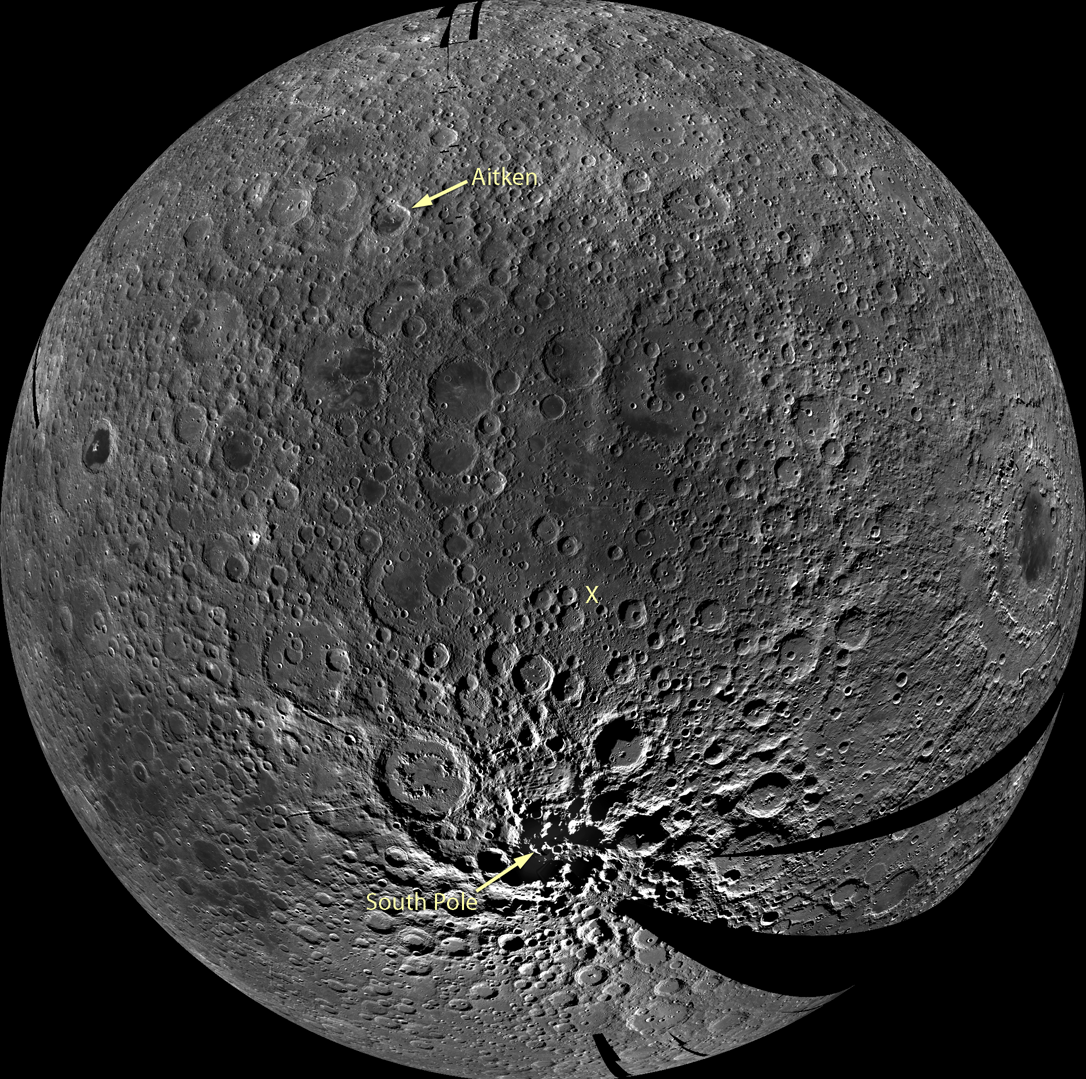
A preliminary monochrome mosaic of the Moon from the LROC Wide Angle Camera (WAC), centered in the middle of the South Pole-Aitken basin. Arrow points to the South Pole and an X marks the Constellation region of interest within the basin and the location of the NAC detail above [NASA/GSFC/Arizona State University].

Stratigraphic relationships show that SPA is the oldest impact basin on the Moon, but scientists are intensely interested in just how old it is. Lunar samples suggest that most of the major basins on the Moon formed around 3.9 billion years ago in a period called the late heavy bombardment. By this time most of the large debris within the solar system should have already accreted to form the planets, so such a large number of big impacts occurring at nearly the same time may have been due to unusual gravitational dynamics in the early Solar System. Was the impact that caused the SPA basin also a part of some cataclysmic event that occurred 3.9 billion years ago? If so, that impact is strong evidence for an extreme event that would have affected all of the terrestrial planets, including Earth at a time when life was just beginning. If the basin is much older, that may suggest that instead of a spike in the impact rate at 3.9 billion years, the number of impacts simply trailed off from a peak earlier on.

How can we find out just how old the SPA impact basin is?

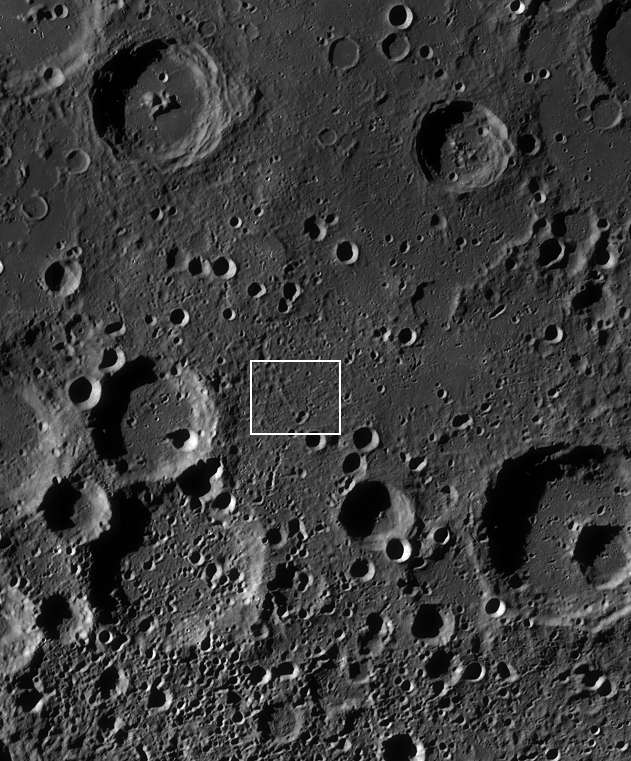
The best way would be to sample materials from the interior of the basin and use radiometric age-dating techniques to determine when they were last molten, as heat from the impact would have melted a large volume of material, resetting radiometric clocks. But the basin is so old that its surface has been cratered many times over, meaning that some of the rocks would have had their radiometric ages reset by these subsequent impacts. So it may be difficult to find rocks with ages that truly reflect the SPA event without careful consideration of the local geology. The Constellation region of interest, highlighted in the NAC detail above and outlined in the WAC mosaic below, was selected because it is in a deep portion of the basin, where a large volume of melt would be expected. Some of this melt would remain as a significant component of the soil, and an analysis of a carefully selected suite of samples from this region would reveal the age of the oldest lunar impact basin.


WAC monochrome mosaic of the interior of SPA, zoomed in to show the 40x40 km Constellation region of interest (white box) and surroundings [NASA/GSFC/Arizona State University].

One final note - imagine the view of the Moon from the Earth when the SPA impact occurred. What would it have looked like? How much ejecta would have landed on the Earth? How long would it take for ejecta to reach the Earth? Surely this impact profoundly affected the young Earth.

Where would the best sample site be? Browse the full-resolution NAC image and WAC mosaic and decide for yourself!

Thursday, October 1, 2009

NLSI Fall 2009 Director’s Virtual Seminar Series

Delia L. Santiago
Digital Science Strategist
NLSI

NASA Lunar Science Institute is beginning a virtual seminar series, open to all interested in lunar science. The first of its Fall 2009 Director's Virtual Seminar Series is scheduled for Tuesday, Oct. 20 at 9 am PDT (1500 UT).

The inaugural speaker for this seminar series will be Dr. Hal Levison, a member of the NLSI team from the Southwest Research Institute. Dr. Levison will be speaking on different models of how the early solar system might have evolved. He will in particular discuss the Nice model of solar system evolution, with an emphasis on how our Moon provides evidence.

Dr. Hal Levison is a planetary scientist with the Southwest Research Institute in Boulder, CO. His work focuses on the long-term behavior of the solar system bodies and involves the development of large-scale numerical experiments. He is best known for his work on the early dynamical evolution of the outer Solar System and is an author of the most comprehensive model to date. Dr. Levison is also the co-author of SWIFT , which is a freely available software package for integrating orbits of solar system bodies.

Access NLSI, HERE, for details.

Monday, September 7, 2009

The Grand Lunar Cataclysm and How LRO Can Help Test It

Lunar Reconnaissance Orbiter Science Targeting Meeting
Tempe, Arizona
June 2009

Dr. Barbara A. Cohen
NASA Marshall Space Flight Center

One of the important outstanding goals of lunar science is understanding the bombardment history of the Moon and calibrating the impact flux curve for extrapolation to the Earth and other terrestrial planets. The "terminal lunar cataclysm," a brief but intense period of bombardment about 3.9 billion years ago, is of particular scientific interest.

Radiometric dating of lunar impact-melt rocks forms the backbone of the lunar cataclysm hypothesis. A histogram of precise age determinations of impact-melt rocks shows the characteristics of the classic formulation of the lunar cataclysm hypothesis: a sharp peak at 3.9 billion years, a steep decline after 3.9 billion years and perhaps only 20-200 million year long, and few rocks of impact origin prior to 4 billion years.

Download the .pdf presentation HERE.