Showing posts with label Lunar Exosphere. Show all posts

Wednesday, February 5, 2014

LADEE economy adds 28 days to mission

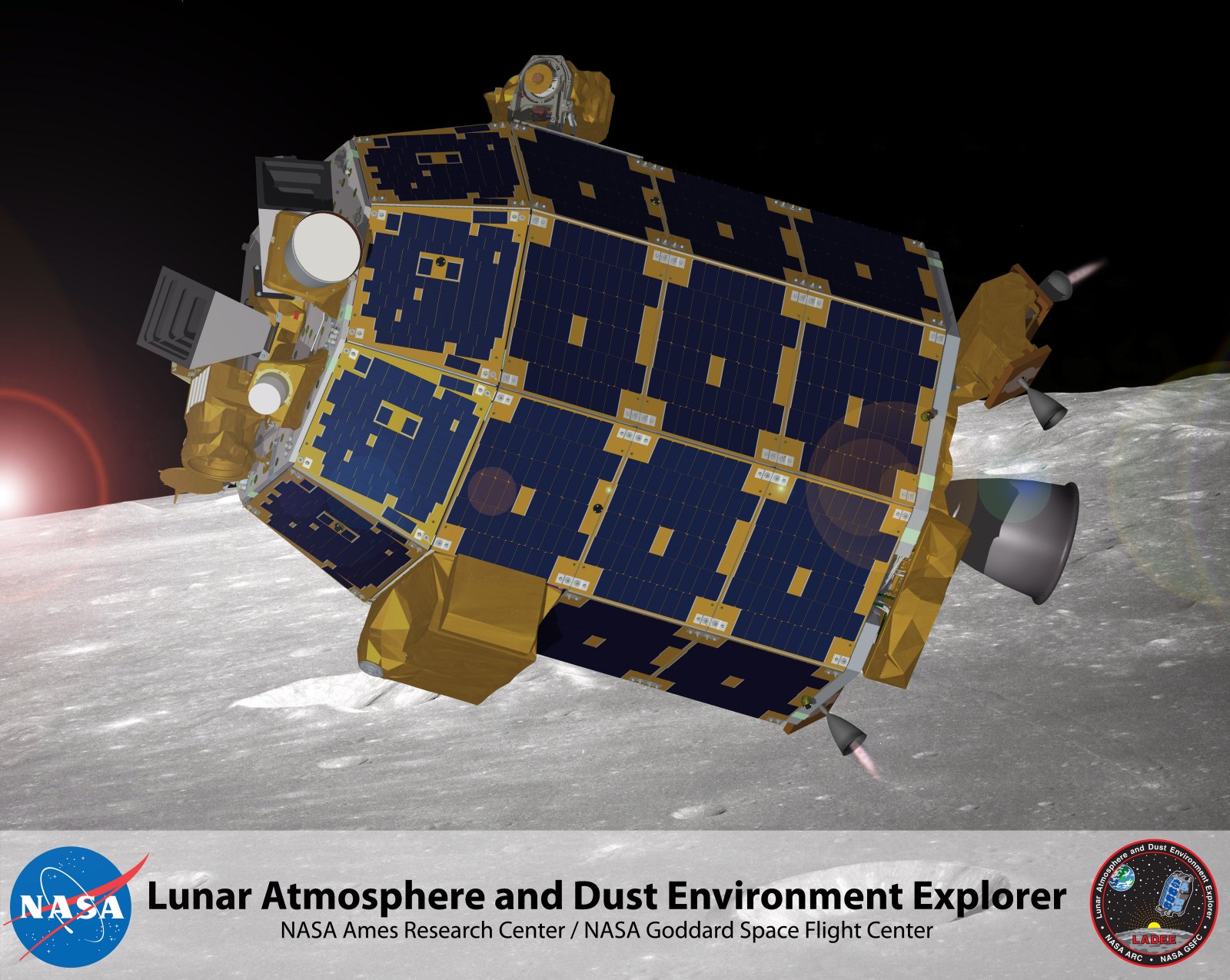
NASA's LADEE, last of the unmanned Constellation precursor missions, in retrograde orbit "baselines" the dusty fallout of the Moon's tenuous exosphere ahead of lunar sunrise [NASA/ARC/JAXA/Dana Berry].
Rachel Hoover
NASA Ames Research Center

NASA's Lunar Atmosphere and Dust Environment Explorer (LADEE) has been approved for a 28-day mission extension. The spacecraft is now expected to impact the lunar surface on or around April 21, 2014, depending on the final trajectory.

The extension provides an opportunity for the satellite to gather an additional full lunar cycle worth of very low-altitude data to help scientists unravel the mysteries of the moon’s atmosphere.

"The launch vehicle performance and orbit capture burns using LADEE's onboard engines were extremely accurate, so the spacecraft had significant propellant remaining to enable extra science," said Butler Hine, LADEE project manager at NASA’s Ames Research Center in Moffett Field, California, where the mission was designed, built, tested, and its day-to-day operations are managed. "This extension represents a tremendous increase in the amount of science data returned from the mission."

The small, car-sized robotic probe launched Sept. 6, 2013, from NASA's Wallops Flight Facility on Wallops Island, Virginia, and has been orbiting the moon since October 6.

On November 10, LADEE began gathering science data and on November 20, the spacecraft entered its science orbit around the moon's equator at an altitude between 12 to 60 kilometers; a unique position that allows the spacecraft to frequently pass from lunar day to lunar night, approximately every two hours. This vantage provides data about the full scope of changes and processes occurring within the moon's tenuous atmosphere.

"The science team has already established a baseline of data for the tenuous lunar atmosphere, or exosphere, and dust impacts," said Rick Elphic LADEE project scientist at Ames. "One cool thing about this extension is that we plan to fly LADEE at only a few kilometers above the lunar surface. This will be much lower than we’ve been before."

Using a set of three instruments, scientists are able to measure the chemical composition of the atmosphere, collect and analyze samples of lunar dust particles in the atmosphere and hope to address a long-standing question: Was lunar dust, electrically charged by sunlight, responsible for the pre-sunrise glow above the lunar horizon detected during several Apollo missions?
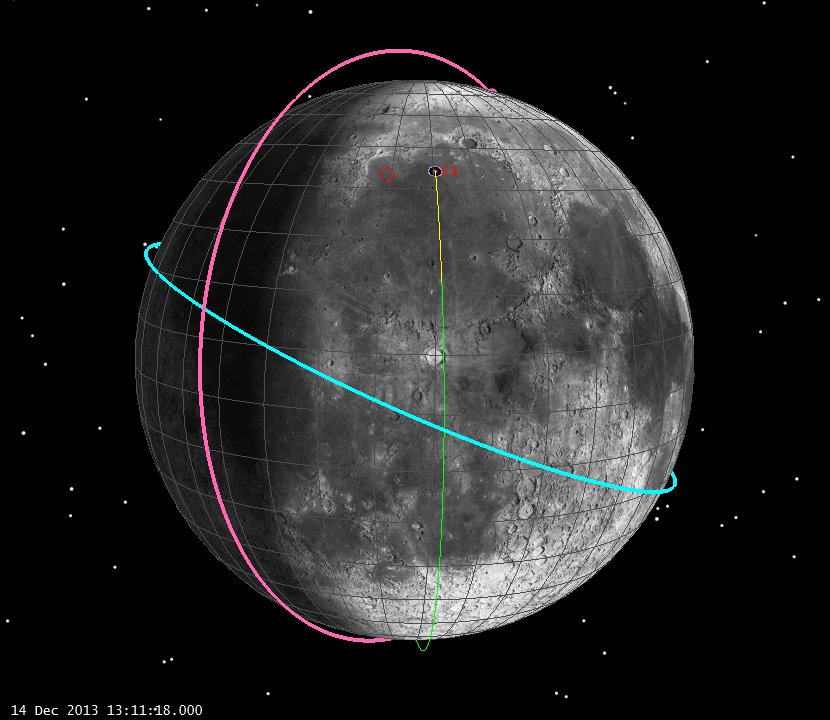
Relative orbital positions of LRO (red), LADEE (blue) and Chang'e-3 only minutes prior to the latter's landing in Mare Imbrium, December 14 ["Post-Landing look at Chang'e trajectory," The Astrogator's League (astrogatorsleague.com)].
Specifically, the Neutral Mass Spectrometer (NSM) operates while pointing in different directions to look for atoms and molecules in the lunar atmosphere from a variety of sources, and has measured helium, neon, and argon-40; three noble gases. The Ultraviolet-Visible Spectrometer (UVS) has peered over the lunar horizon to look for the glow of atoms, molecules and dust in the lunar atmosphere and has made measurements of atmospheric sodium and potassium at lunar sunset, sunrise and noon. The Lunar Dust Experiment (LDEX) recorded dust impacts as soon as its cover opened and has measured the dust tossed up by a fairly steady "rain" of meteoroids on the lunar surface. LDEX occasionally sees an increase in dust impacts due to meteoroid showers, such as the Geminids, and "dust bursts" that may be due to LADEE flying through plumes kicked up from nearby meteoroid impacts.

Detailed information about the structure and composition of the thin lunar atmosphere and whether dust is being lofted into the lunar sky will help researchers understand other bodies in the solar system, such as large asteroids, Mercury and the moons of outer planets.

LADEE was built using an Ames-developed Modular Common Spacecraft Bus architecture, a general purpose spacecraft design that allows NASA to develop, assemble and test multiple modules at the same time. The LADEE bus structure is made of a lightweight carbon composite with an unfueled mass of 547.2 pounds.

NASA's Science Mission Directorate in Washington funds the LADEE mission. Ames manages the overall mission and serves as a base for mission operations and real-time control of the probe. NASA's Goddard Space Flight Center in Greenbelt, Maryland, catalogues and distributes data to a science team located across the country and manages the science instruments. NASA's Marshall Space Flight Center in Huntsville, Alabama manages LADEE within the Lunar Quest Program Office.

Related Recent Posts:
LROC captures LADEE from 9,000 meters (January 30, 2014)
Red Moon, Blue Moon Dwayne Day, The Space Review (December 3, 2013)
LADEE begins collecting data (November 22, 2013)
LADEE transitioning out of commissioning phase (November 6, 2013)
Apollo 12 ALSEP first to measure dust accumulation (November 21, 2013)
Chang'e-3 & LADEE: The Role of Serendipity (October 31, 2013)
LADEE LLCD sets new data record (October 25, 2013)
Measuring almost nothing, looking for the almost invisible (October 16, 2013)
LADEE legacies (September 7, 2013)
Friday, November 22, 2013

LADEE begins collecting data

NASA Ames / Dana Berry
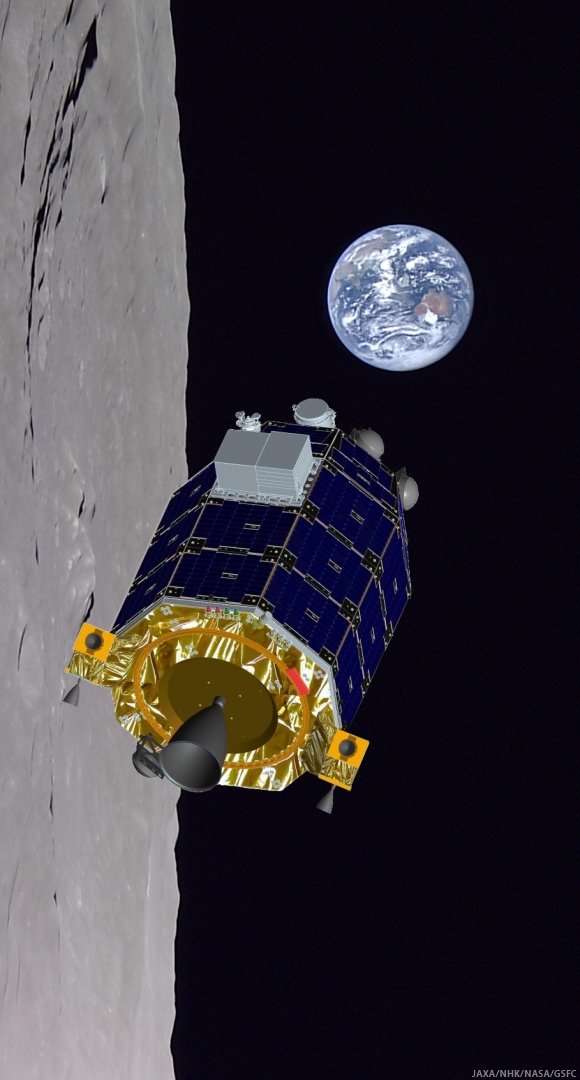
NASA's Lunar Atmosphere and Dust Environment Explorer (LADEE) spacecraft, in orbit above the Moon, as dust scatters light during lunar sunset [NASA/ARC/JAXA/Dana Berry].
Rachel Hoover
NASA Ames Research Center

NASA's Lunar Atmosphere and Dust Environment Explorer (LADEE) is ready to begin collecting science data about the Moon.

On November 20, the spacecraft successfully entered its planned orbit around the Moon's equator -- a unique position allowing the small probe to make frequent passes from lunar day to lunar night. This will provide a full view of the changes and processes occurring within the moon's tenuous atmosphere.

LADEE now orbits the moon about every two hours at an altitude of 12 to 60 km above the Moon's surface. For about 100 days, the spacecraft will gather detailed information about the structure and composition of the thin lunar atmosphere and determine whether dust is being lofted into the lunar sky.

Scientists will be able to study the conditions in the atmosphere during lunar sunrise and sunset, where previous crewed and robotic missions detected a glow of rays and streamers reaching high into the lunar sky.

“This is what we’ve been waiting for – we are already seeing the shape of things to come,” said Rick Elphic, LADEE project scientist at NASA's Ames Research Center in Moffett Field, California

On November 20, flight controllers in the LADEE Mission Operations Center at Ames confirmed LADEE performed a crucial burn of its orbit control system to lower the spacecraft into its optimal position to enable science collection. Mission managers will continuously monitor the spacecraft's altitude and make adjustments as necessary.

"Due to the lumpiness of the moon's gravitational field, LADEE's orbit requires significant maintenance activity with maneuvers taking place as often as every three to five days, or as infrequently as once every two weeks," said Butler Hine, LADEE project manager at Ames. "LADEE will perform regular orbital maintenance maneuvers to keep the spacecraft’s altitude within a safe range above the surface that maximizes the science return."

In addition to science instruments, the spacecraft carried the Lunar Laser Communications Demonstration, NASA's first high-data-rate laser communication system. It is designed to enable satellite communication at rates similar to those of high-speed fiber optic networks on Earth. The system was tested successfully during the commissioning phase of the mission, while LADEE was still at a higher altitude.

LADEE was launched September 6 on a US Air Force Minotaur V, an excess ballistic missile converted into a space launch vehicle and operated by Orbital Sciences Corporation of Dulles, Virginia. LADEE is the first spacecraft designed, developed, built, integrated and tested at Ames, and it is the first probe launched beyond Earth orbit from NASA's Wallops Flight Facility on the Virginia's Eastern Shore.

NASA's Science Mission Directorate in Washington funds the LADEE mission. Ames manages the overall mission and serves as a base for mission operations and real-time control of the probe. NASA's Goddard Space Flight Center in Greenbelt, Maryland, manages the science instruments and technology demonstration payload, the science operations center and overall mission support. NASA's Marshall Space Flight Center in Huntsville, Alabama, manages LADEE within the Lunar Quest Program Office.

Thursday, November 21, 2013

Apollo 12 ALSEP first to measure dust accumulation

Apollo 12 ALSEP Central Station
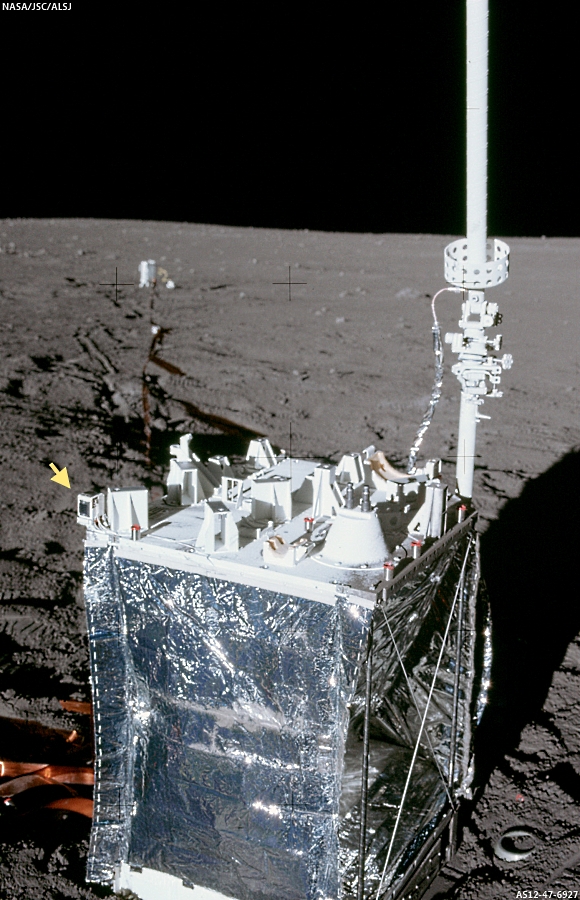
Apollo 12 ALSEP, Central Station, with DTREM (Lunar Dust Collector) marked with arrow. Alan J. Bean, EVA-1;  Oceanus Procellarum, November 19, 1969 (AS12-47-6927) [NASA/JSC/ALSJ].
A dataset thought to have been lost, from an ingenious experiment deployed on the Moon by Apollo astronauts more than four decades ago, has been rediscovered and analyzed. As a result, the Lunar Dust Collector deployed as integral to the Apollo 12 ALSEP system, has become the first instrument to record a measurable rate of dust accumulation on the lunar surface. 

The news is timely, of course, coming the beginning of the Lunar Atmosphere and Dust Environment Explorer (LADEE) science mission, and arriving on November 19, the 44th anniversary of the Apollo 12 expedition.

Keith Cowing
Moonviews.com (LOIRP)

The Lunar Dust Detector, attached to the corner of (the ALSEP Central Station, pictured above), left by the Apollo 12 astronauts, made the first measurement of lunar dust accumulation. As the matchbox-sized device's three solar panels became covered by dust, the voltage they produced dropped.

When Neil Armstrong took humanity's first otherworldly steps in 1969, he didn't know what a nuisance the lunar soil beneath his feet would prove to be. The scratchy dust clung to everything it touched, causing scientific instruments to overheat and, for Apollo 17 astronaut Harrison Schmitt, a sort of lunar dust hay fever. The annoying particles even prompted a scientific experiment to figure out how fast they collect, but NASA's data got lost.

AS17-145-22157
Retrieving a surface sample behind boulders on a crater rim at Apollo 17 Science Station 5, Taurus Littrow valley; December 12, 1972 - Lunar module pilot and geologist Harrison Schmitt already carries a substantial sampling of abrasive, fine lunar dust on his moon suit. Schmitt endorsed development of 'dust mitigation' technology as a high priority for program planners prior to establishing 'extended human activity' on the Moon (Eugene Cernan - AS17-145-22157) [NASA/JSC/ALSJ].
Or, so NASA thought. Now, more than 40 years later, scientists have used the rediscovered data to make the first determination of how fast lunar dust accumulates. It builds up unbelievably slowly by the standards of any Earth-bound housekeeper, their calculations show -- just fast enough to form a layer about a millimeter (0.04 inch) thick every 1,000 years. Yet, that rate is 10 times previous estimates. It's also more than speedy enough to pose a serious problem for the solar cells that serve as critical power sources for space exploration missions.

Thursday, October 31, 2013

Chang'e 3 & LADEE: The Role of Serendipity

The Chang’E 3 spacecraft sets down on the Moon, and exhaust gas from its descent rockets change the lunar exosphere [NASA/CNSA].
Paul D. Spudis
The Once and Future Moon
Smithsonian Air & Space

The Lunar Atmosphere and Dust Environment Explorer (LADEE) spacecraft is currently circling the Moon.  With the spacecraft safely settled into its observation orbit, the mission science team is busy testing and calibrating its instruments.  This U.S. mission was designed to characterize the lunar “atmosphere” – the extremely tenuous zone of gases that vary in time in the space above the Moon.  Technically called an exosphere, this region contains extremely low concentrations of a variety of elements and compounds, of varied origins and a largely unknown life cycle.  LADEE is designed to monitor and characterize these species, with the goal of identifying the process and sources of the gases and how they vary with time.

Initially a precursor to human lunar return, LADEE was selected for development early in 2008, as we wanted to understand the lunar exosphere before the lunar environment was contaminated by humans.  The LADEE spacecraft is designed to observe the Moon in its natural, pristine state.  However, the very act of going to the Moon inadvertently (though briefly) modifies the lunar atmosphere.  When a spacecraft arrives at the Moon, it uses its on-board rocket engines to brake into lunar orbit or to descend to the surface.  These rockets spew large quantities of exhaust gas into space and as the vehicles get captured into the Moon’s gravity field, so too does this exhaust product.

From estimates drawn on the Apollo landings, the rocket exhaust expended from each Lunar Module temporarily doubled the total mass of the natural lunar atmosphere.  This artificial addition of gases eventually dissipates, driven off by solar interactions and other complex effects.  In time, the Moon resumes its normal state of near-vacuum.  The creation of a temporary artificial atmosphere created by rocket effluent and its subsequent dissipation is imperfectly understood, except to the extent that we know that it happens.  The one-month “commissioning phase” that the LADEE mission is currently experiencing was largely designed to ensure that the exhaust from the orbital braking burn of the spacecraft (and subsequent low-rate out-gassing from the spacecraft) is largely complete.  We want to measure the Moon’s environment, not the products of the craft that brought us there.

But the U.S. will not be the only one conducting a mission at the Moon for the next few months.  The long-planned Chinese robotic mission Chang’E 3 is scheduled for launch to the Moon in early December.  Their lander mission will place a fairly large (1200 kg) spacecraft on Sinus Iridum in the northwestern quadrant of the near side, deliver a small roving vehicle and examine and measure the properties of the lunar surface over the course of several months.  But before it begins its surface mission, the Chang’E 3 spacecraft will burn roughly 2600 kg of rocket fuel in the vicinity of the Moon’s exosphere.  I have not seen any documentation on the fuel this spacecraft will use, but it is highly likely that it will be the chemicals unsymmetrical dimethylhydrazine (UDMH; H2NN(CH3)2) and nitrogen tetroxide (N2O4).  These propellants are widely used in spacecraft because they are liquid at room temperature and can be easily stored in tanks for long periods of time (a requirement for long-duration spaceflight to destinations beyond low Earth orbit).

When UDMH and nitrogen tetroxide are burned in a rocket engine, they produce a variety of exhaust gases; the dominant combustion products are water (H2O), nitrogen (N2), carbon monoxide (CO), carbon dioxide (CO2), and a few trace species, including hydrogen (H2) and hydroxyl (OH).  Expelled by a rocket nozzle, these gases rapidly expand in all directions in the vacuum of space.  Because most of the burn occurs after the spacecraft has been “captured” by the gravity of the Moon, this rocket exhaust is also captured by the Moon.  Thus, exhaust from an orbital or a landing vehicle becomes (temporarily) part of the lunar atmosphere.

If you’re thinking that this “rude” addition of alien gases will mess up the very delicate phenomena that LADEE was designed to map and measure, you’re correct – it does.  You might even expect the scientists of the LADEE team would be very upset at this disruption of their carefully planned measurement strategy.  But you would be wrong.  This problem is actually an opportunity.

If successful, Chang'e 3 will perform the first soft-landing on the
Moon since Luna 24 in1976 and deploy the first lunar rover
 since Lunokhod 2 in 1973 [NASA/CNSA].
The coincidence of Chang’E 3 arriving at the Moon after LADEE has begun observations has developed into a serendipitous occurrence for lunar science.  Because we don’t understand very well how exospheric gases are added to and removed from the Moon, what has landed in our laps is an unplanned (but controlled) experiment.  A known quantity of gases – of known composition – will be added to the lunar atmosphere at a precisely known time, in a precisely known place.  One could have not designed a better experiment to measure how this addition of material is distributed, how its distribution evolves over time, and how these expelled gases dissipate into cislunar space.  Even better, LADEE will have almost a full month to monitor and characterize the lunar atmosphere before Chang’E arrives, thus allowing us to first observe the “natural” Moon and then the “contaminated” Moon and how the lunar atmosphere recovers from its defilement.

None of this was prearranged – the Chinese schedule their missions on the basis of their own time-table and programmatic needs (just as NASA’s lunar goals have changed over the last 5 years).  But because of a fortuitous alignment of schedules, we have a unique opportunity to observe in real time how the Moon works.  Hopefully, the Chinese will provide us with detailed mass numbers of their spacecraft and exactly what variety of fuel it carries, but even if they don’t, physics dictates a certain mass and volume of the exhaust gas and its composition will be measured by LADEE (allowing us to know the type of fuel used).  China’s December lander mission to the Moon will provide our U.S. mission with a welcome bit of  “traffic exhaust,” giving scientists the opportunity to learn more from LADEE than we’d originally envisioned.

Serendipity indeed.

Originally published October 30, 2013 at his Smithsonian Air & Space blog The Once and Future Moon, Dr. Spudis is a senior staff scientist at the Lunar and Planetary Institute. The opinions expressed are those of the author but are better informed than average. 

Wednesday, October 16, 2013

Measuring almost nothing, looking for the almost invisible

hdtv_010_4_l-580x1080
NASA's LADEE spacecraft entered it's 250 km Commissioning phase orbit October 12 [NASA/JAXA].
Paul D. Spudis
The Once and Future Moon
Smithsonian Air & Space

Launched last month from the Wallops Island site, LADEE (for Lunar Atmosphere and Dust Environment Explorer) will spend the next few months orbiting the Moon.  This small spacecraft will attempt to characterize and measure the lunar “atmosphere,” while also looking for dust that might be electrostatically levitated above the surface or thrown into ballistic flight by impacts.

Wait a minute.  Did I say “atmosphere?”  Isn’t the Moon renowned for its lack of an atmosphere?  Indeed it is.  In fact, the 10-12 torr surface pressure of the Moon is a better vacuum than we can achieve with even the most advanced equipment in Earth laboratories.  (For comparison, sea level pressure on the Earth is about 760 torr, making the lunar surface pressure over one hundred trillion times less dense.)  A better term for the tenuous gas near the Moon is “exosphere,” meaning free flying gas molecules that may or may not be gravitationally bound to the Moon.  In such an “atmosphere,” there may be only a few thousand molecules in a cubic centimeter of space. This is very tenuous indeed.
  
After the Commissioning phase of its mission is complete, the spacecraft's current 250 km circular orbit will be reduced further down to within 50 km to begin its 100 day Science Mission [NASA/GSFC].
LADEE is designed to investigate from where these atoms and molecules come.  Presently, we think the lunar exosphere consists mostly of helium, sodium and perhaps argon atoms, each coming from a completely different source.  Helium likely comes from the Sun, as the solar wind continually “breathes” onto the surface of the Moon.  Some atoms stick to surface dust grains but many simply bounce off, randomly moving in the space above the lunar surface.  Easy to detect, lunar sodium has been observed from Earth-based telescopes.  It most likely comes from rocks vaporized by the continual rain of micrometeorites.  At least some fraction of this vaporous sodium must hang around the surface, unable to escape the Moon.  Argon might have a solar wind origin, but at least some of it comes from the natural decay of radioactive potassium in the lunar interior (potassium-40 (40K) decays to argon-40 (40Ar) with a half-life of a bit more than one billion years).  Gases like argon, venting from the interior of the Moon, were observed by subsatellites left in lunar orbit by the departing Apollo spacecraft over 40 years ago (these small spacecraft have long since crashed into the Moon).

Although helium, sodium and argon are the principal expected components of the lunar exosphere, the LADEE team will search for other species.  An interesting possibility is water (H2O) or its related species, hydroxyl (OH).  One of the most surprising results of recent lunar exploration was the discovery of adsorbed (surface) water and hydroxyl on the dust grains of the lunar surface (observed by the Moon Mineralogy Mapper (M3) aboard the Indian Chandrayaan-1 lunar orbiter in 2009).  Occurring in the form of a monolayer of molecules on dust grains in the cooler portions of the Moon, a clear water signal is best seen above latitudes of 65° and increasing in strength (i.e., increasing water abundance) toward each pole.

The surprise from M3 was not only the presence of water but observing that its abundance increases with decreasing surface temperatures.  This means that water being made or deposited on the surface is in motion, with a net movement toward the poles.  Chandrayaan-1 also carried an impact probe with a mass spectrometer.  During the probe’s half-hour descent to the South Pole, it passed through a cloud of water in space, just above the lunar surface.  The water cloud at this high latitude had a density a hundred times higher than at the equator, providing additional evidence that exospheric water is in motion, moving from lower, hotter latitudes towards higher, cooler ones.

LADEE cannot directly measure this water in a neutral state, but if some process ionizes it (e.g., if a water molecule breaks apart into a proton and a hydroxyl by UV radiation from the Sun), it will be visible to the ultraviolet spectrometer aboard the spacecraft.  If the process of water migration on the lunar surface is correct, we should be able to observe exospheric water and by measuring its density with time, track the water migration to higher latitudes.

Lunar Horizon Glow (LHC) observed for several hours following local sunset from Surveyor 7 and its landing site just north of Tycho crater. [NASA].
LADEE will also tackle another controversial issue – the amounts and mechanisms of dust movement on and around the Moon.  During the unmanned Surveyor lander missions over 40 years ago, a strange illumination or glow was observed by television for several hours after local sunset, just above the horizon.  This phenomenon was termed “horizon glow” by surprised Surveyor investigators.  At a loss to explain it, the team postulated that some mechanism was lofting dust up above the surface and this dust was scattering sunlight.  Exactly how the dust was lofted was uncertain; some thought it must be fragments in ballistic flight from distant impacts, while others thought that it might be levitated by electrostatic force, thus “hovering” above the surface.

Schematic of documented species of Lunar Horizon Glow, including mid-lunar night imagery captured by Surveyor 7 (Horanyi, et.al., The Lunar Dust Environment: Expectations for the LADEE Lunar Dust Experiment (LDEX), 43rd Lunar and Planetary Science Conference (2012), #2635.
A few years later, just before his orbiting spacecraft emerged into the daylight side of the Moon, Apollo 17 Commander Gene Cernan observed and sketched an illuminated limb and “streamers” that could be seen extending into space above where the lunar horizon would be.  At the time, this phenomenon was thought to be the same as that seen in the Surveyor pictures, although they have totally different scales (the Surveyor horizon glow must occur within a few meters of the surface, while Cernan’s horizon glow extended many kilometers above the Moon). Dust (probably of lunar provenance) is certainly involved in whatever causes this horizon glow.

Apollo 17 commander Gene Cernan's sketches and description of horizon glow and streamers observed in lunar orbit, December 1972 [NASA].
As the Moon slowly rotates once every 708 hours, the line between the sunlit and dark hemispheres (the terminator) slowly moves across the lunar surface.  The day and night hemispheres have different fluxes of electrons from the solar wind and thus, the presence of the terminator can induce an electrical charge in surface materials.  It is postulated that this charge might levitate smaller dust particles such that they would hover above the surface.  LADEE will attempt to detect and map this dust, both by searching for scattered sunlight with its ultraviolet spectrometer and via the direct detection of dust particles in flight with an instrument on the top of the orbiting spacecraft.

The issue of levitated dust is thought to be relevant to the future habitation of the Moon.  If dust is lofted above the surface by the passage of the terminator, the particles could degrade clean surfaces and create a hazard for inhabitants of the Moon.  Such a process could have major effects near the poles of the Moon, areas that are in the near-constant presence of a day-night terminator.  Although it is unlikely that levitated dust on the Moon is an environmental hazard, we currently are working in near total absence of hard data.  Thus, it makes sense to at least try to make some direct measurements of the dust environment around the Moon to assess the importance of this proposed surface process.

LADEE arrived in lunar orbit last Sunday. We wish it well on its mission to give us fresh (and welcome) data on a poorly understood aspect of lunar processes and history.

Related Posts:
LADEE, in 250 km orbit, begins commissioning phase (October 15, 2013)
LADEE Away! (September 7, 2013)
LADEE legacies (September 7, 2013)
LADEE Prelaunch Mission Briefing (September 6, 2013)
ESA prepares for LADEE (July 31, 2013)
LADEE arrives at Wallops Island (June 5, 2013)
LADEE ready to baseline dusty lunar exosphere (June 5, 2013)
First laser comm system ready for launch on LADEE (March 16, 2013)
LADEE project manager update (February 6, 2013)
The Mona Lisa test for LADEE communications (January 21, 2013)
Toxicity of lunar dust (July 2, 2012)
Expectations for the LADEE LDEX (March 23, 2012)
The Dust Management Project (August 9, 2010)
LADEE architecture and mission design (July 6, 2010)
DesertRatS testing electrodynamic dust shield (July 5, 2010)
Dust transport and its importance in the origin of lunar swirls (February 21, 2010)
Dust accumulation on Apollo laser reflectors may indicate a surprisingly fast and
   more dynamic lunar exosphere
(February 16, 2010)
NASA applies low cost lessons to LADEE (January 18, 2010)
Nanotech advances in lunar dust mitigation (August 19, 2009)
Moon dust hazard influenced by Sun's elevation (April 17, 2009)
LADEE launch by Orbital from Wallops Island (April 14, 2009)
Understanding the activation and solution properties of lunar dust
for future lunar habitation
(March 2, 2009)
Respiratory toxicity of lunar highland dust (January 19, 2009)
Toxicological effects of moon dust (June 25, 2008)
Moon dust and duct tape (April 22, 2008)

Originally published October 4, 2013 at his Smithsonian Air & Space blog The Once and Future Moon, Dr. Spudis is a senior staff scientist at the Lunar and Planetary Institute. The opinions expressed are those of the author but are better informed than average.  

Tuesday, October 15, 2013

LADEE, in 250 km orbit, begins commissioning phase

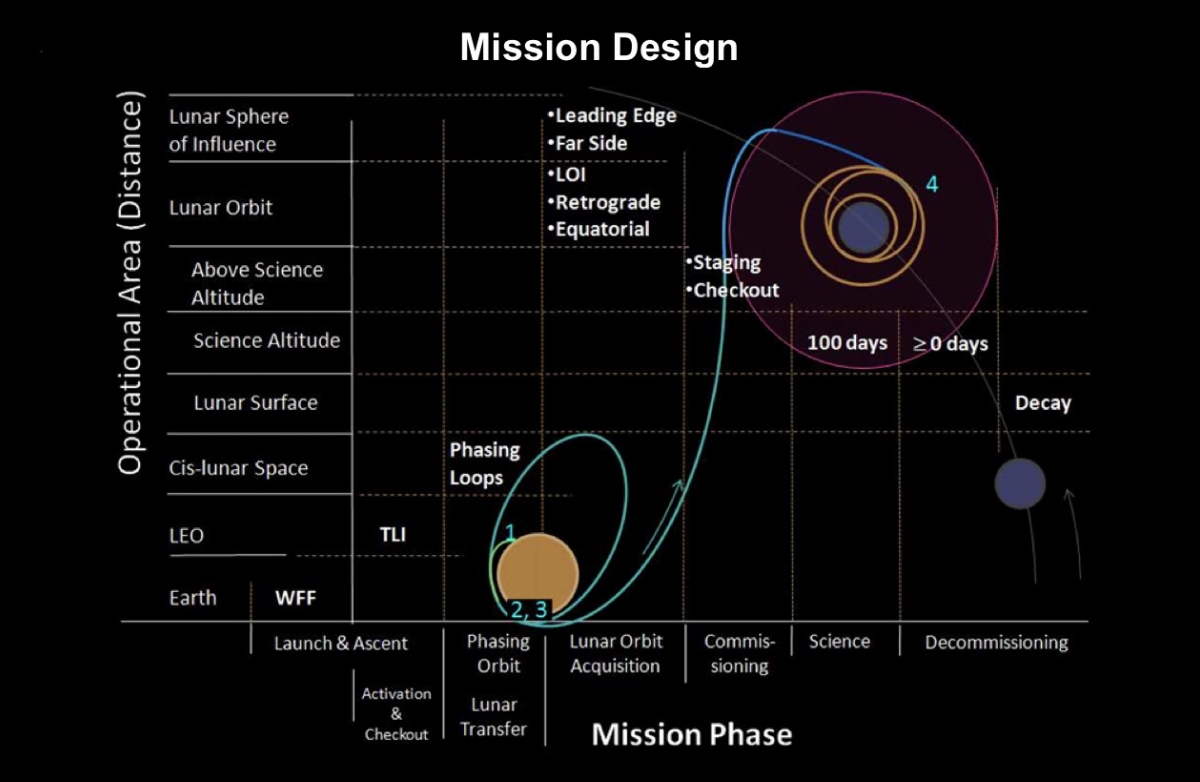
LADEE, last of the Constellation precursor missions, officially entered a highly eccentric orbit around the Moon on October 6, after a month gradually increasing its orbital apogee around Earth to meet up with the Moon's gravimetric Sphere of Influence. Following critical maneuvers October 9 and 12, LADEE is now inserted into a low circular lunar orbit below 250 km to begin the Commissioning phase of its mission, still shy of a much lower Nominal mission orbital altitude below 50 km. [NASA/ARC].
Related Posts:
LADEE Away! (September 7, 2013)
LADEE legacies (September 7, 2013)
LADEE Prelaunch Mission Briefing (September 6, 2013)
ESA prepares for LADEE (July 31, 2013)
LADEE arrives at Wallops Island (June 5, 2013)
LADEE ready to baseline dusty lunar exosphere (June 5, 2013)
First laser comm system ready for launch on LADEE (March 16, 2013)
LADEE project manager update (February 6, 2013)
The Mona Lisa test for LADEE communications (January 21, 2013)
Toxicity of lunar dust (July 2, 2012)
Expectations for the LADEE LDEX (March 23, 2012)
The Dust Management Project (August 9, 2010)
LADEE architecture and mission design (July 6, 2010)
DesertRatS testing electrodynamic dust shield (July 5, 2010)
Dust transport and its importance in the origin of lunar swirls (February 21, 2010)
Dust accumulation on Apollo laser reflectors may indicate a surprisingly fast and
   more dynamic lunar exosphere
(February 16, 2010)
NASA applies low cost lessons to LADEE (January 18, 2010)
Nanotech advances in lunar dust mitigation (August 19, 2009)
Moon dust hazard influenced by Sun's elevation (April 17, 2009)
LADEE launch by Orbital from Wallops Island (April 14, 2009)
Understanding the activation and solution properties of lunar dust
for future lunar habitation
(March 2, 2009)
Respiratory toxicity of lunar highland dust (January 19, 2009)
Toxicological effects of moon dust (June 25, 2008)
Moon dust and duct tape (April 22, 2008)

Wednesday, June 5, 2013

LADEE ready to baseline the dusty lunar exosphere and test high-speed data link

Idealized view of LADEE, last of the Constellation 'precursors,' in lunar orbit [NASA/ARC].
Steve Nerlich
AmericaSpace.com

The Lunar Atmosphere and Dust Environment Explorer (LADEE) is due for launch in September 2013 from the Mid-Atlantic Regional Spaceport. LADEE will study the composition and structure of the tenuous lunar atmosphere, including dust that may be lofted up from the surface. It will also undertake a demonstration of a laser-mediated communications system.

In a thick atmosphere like Earth’s, particles are constantly colliding with each other and hence moving in random and frequently-changing directions. The Moon is thought to have a surface boundary exosphere, which is a thin, collision-free atmosphere in which particles follow largely uninterrupted paths.

A key goal of the LADEE mission is to understand the dynamics of a surface boundary exosphere and how it changes over time, as external conditions vary. A surface boundary exosphere is probably the most common atmosphere found around celestial bodies in the Solar System, including Mercury, the majority of the large asteroids, the moons around our major planets, and the majority of large Kuiper Belt Objects. So, getting a better understanding of the Moon’s surface boundary exosphere is a good start to understanding those environments as well.

Indeed, there is a certain imperative to undertake this research now. The increasing interest in the Moon by a number of nations will lead to a steadily increasing frequency of lunar exploration missions that could change the natural composition of the lunar atmosphere, both through the stirring up of surface dust and by the addition of rocket exhaust components.

Read the article at AmericaSpace.com, HERE.

Related Posts:

Thursday, September 20, 2012

LRX: Radio astronomy from ESA Lunar Lander

LRX, a single tripole radio antenna to engage in baseline radio astronomy from the ESA Lunar Lander after 2017. Figure 6 from Radio astronomy with the Lunar Lander: opening up the last unexplored frequency regime, Wolf, et al (2012).
Wolt, Aminaei, Zarka, Schrader, Boonstra and Falcke
arXiv: 1209.3033 Sept. 17, 2012

The active broadband (1 kHz - 100 MHz) tripole antenna (LRX) on the European Lunar Lander, located at the Lunar South Pole, will allow for sensitive measurements of the lunar exosphere and ionosphere, and their interaction with the Earths magnetosphere, solar wind and coronal mass-ejections (CMEs). In addition, the LRX will allow studies of radio communication on the moon, essential for future exploration.

In addition, the lunar South pole provides an excellent opportunity for radio astronomy. Placing a single radio antenna in an behind a mountain near the Moon's south or north pole would provide "perfect shielding" from man-made radio interference (RFI), and, with an absence of ionospheric distortion with high-temperature and antenna gain stability, allow the detection of 21 cm wavelength emission from the primordial hydrogen that formed after the Big Bang into the era when the first stars formed.

MACS1149-JD, a galaxy of the Cosmic
Dark Ages, formed only 500 million
years
after the Big Bang [HST].
Detection of the 21 cm line from the Moon would allow, for the first time, clues on the distribution and evolution of mass in the early universe, between the Epoch of Recombination and Epoch of Reionization. Next to providing a cosmological breakthrough, a single lunar radio antenna would allow for studies of the effect of solar flares CMEs on the solar wind at distances close to earth (space weather) and open up the study of low frequency radio events (flares and pulses) from Jupiter and Saturn and the other planets, known to emit bright radio emission below 30 MHz (The Shortwave and Medium Wave bands, highly-attenuated by the ionosphere on Earth).

Finally, a single radio antenna on the ESA Lunar Lander would pave the way for a large lunar radio interferometry; demonstrating the long-anticipated possibilities of radio astronomy from the lunar surface while opening up "the last unexplored radio regime." Baseline studies of data collected by a simple experiment affected by its important location will also allow a determination of the limitations of lunar radio science by measuring the local radio background.

Read the full study, HERE.

Friday, July 27, 2012

Scientific Preparations for Lunar Exploration with the European Lunar Lander

Working schematic of the ESA Lunar Lander [Astrium].
James Carpenter, et al
ESA

Abstract - Recent Lunar missions and new scientific results in multiple disciplines have shown that working and operating in the complex lunar environment and exploiting the Moon as a platform for scientific research and further exploration poses major challenges. Underlying these challenges are fundamental scientific unknowns regarding the Moon’s surface, its environment, the effects of this environment and the availability of potential resources. The European Lunar Lander is a mission proposed by the European Space Agency to prepare for future exploration. The mission provides an opportunity to address some of these key unknowns and provide information of importance for future exploration activities.

Approach and Landing Profile The baseline design of the ESA Lunar Lander mission is unchanged since development began in 2010. In addition to real world testing and evaluation of robotic navigation, terminal descent and hazard avoidance, the array of on-board experiments and instruments eventually carried to the lunar surface in 2018 have continually been updated to match the growing knowledge base accumulated by an international fleet of spacecraft. The Carpenter study details the surface mission as projected in July 2012 [Astrium].
Areas of particular interest for investigation on the Lunar Lander include the integrated plasma, dust, charge and radiation environment and its effects, the properties of lunar dust and its physical effects on systems and physiological effects on humans, the availability, distribution and potential application of in situ resources for future exploration. A model payload has then been derived, taking these objectives to account and considering potential payloads proposed through a request for information, and the mission’s boundary conditions. While exploration preparation has driven the definition there is a significant synergy with investigations associated with fundamental scientific questions.

This paper discusses the scientific objectives for the ESA Lunar Lander Mission, which emphasize human exploration preparatory science and introduces the model scientific payload considered as part of the on-going mission studies, in advance of a formal instrument selection.

Download arXiv study 1207.4965.pdf

Tuesday, July 17, 2012

LRO LAMP sharpens Apollo surface helium data

LACE (Lunar Surface Composition Experiment), a.k.a. "Lunar Mass Spectrometer," deployed as part of the Apollo 17 ALSEP (Apollo Lunar Surface Experiment Package) December 11, 1972 and afterward remotely operated and monitored until shutdown in 1977. The experiment housing has been photographed from lunar orbit by the LROC Narrow Angle Camera [Schmitt/AS17-134-20499].
Portions from ScienceDaily July 16, 2012 - The Lunar Atmospheric Composition Experiment (LACE), a spectrometer designed to measure and characterize the thin lunar atmosphere was deployed at Taurus Littrow by Gene Cernan and Harrison Schmitt of Apollo 17. Forty years later, researchers using the Lyman Alpha Mapping Project (LAMP) far ultraviolet spectrograph, on-board LRO have added to those initial measurements to provide the first remotely-sensed measurement of the Moon's gaseous environment at the surface from lunar orbit, specifically the atmospheric concentration of helium.

Aiming LAMP sensors toward the lunar limb, and comparing their readings with measurements of the interstellar background, the authors of work published in Geophysical Research Letters have estimated the helium concentration of the near-surface lunar environment. 

They calculate a density of 7,000 atoms per cubic centimeter at 120° K (-244° F) The earlier LACE observations ranged between 10,000 -- 20,000 and 50,000 atoms per cubic centimeter, depending on the time of day, increasing through the lunar night and decreasing during daylight. The nighttime decrease occurs because the atmosphere cools and contracts, yielding an increased density.

The authors suggest the next steps should involve looking for spatial or temporal variations in lunar atmospheric helium. Such observations could help to determine whether the helium detected is produced locally, by radioactive decay, or if it is formed from trapped and neutralized solar wind.
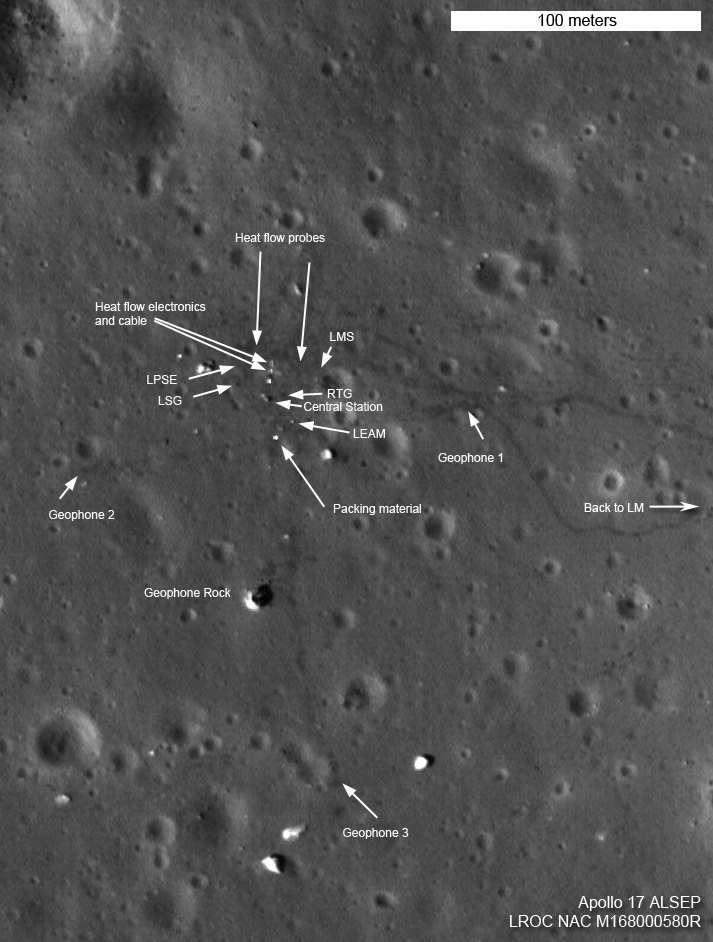
Apollo 17 ALSEP area (north is up). The LACE instrument is labeled "LMS," for Lunar Mass Spectrometer. Detail from a wider field of view HERE. (See Skimming the Moon, September 8, 2011) [NASA/GSFC/Arizona State University].
Journal Reference: Stern, Retherford, Tsang, Feldman, Pryor &. Gladstone. Lunar atmospheric helium detections by the LAMP UV spectrograph on the Lunar Reconnaissance Orbiter. Geophysical Research Letters, 2012; 39 (12)

Wednesday, June 13, 2012

First atmospheric helium detections by LRO LAMP UV spectrograph

Depicted here are atmospheric emission spectra (black) obtained by LAMP on two dates in late 2011, in units of Rayleighs per angstrom. Each panel’s black line is the spectrum obtained by LAMP when its spectrograph slit was placed 83 deg from the nadir, just above the lunar limb. The red line in each panel is the background spectrum obtained close in time by observing the same patch of sky when it is at the zenith, where any contribution from the lunar atmosphere is minimized. The blue line in each panel is the difference spectrum obtained by subtracting the background from the limb spectrum, revealing native lunar atmospheric emission from He I at 584 Å. 1-sigma error bars are depicted on each curve every 4th spectral point, for reference.
Stern, et al
SWrI*

The LAMP far ultraviolet spectrograph aboard the NASA Lunar Reconnaissance Orbiter (LRO) has been used to search for helium, the lightest noble gas in the tenuous lunar atmosphere. We report here the first detection of lunar atmospheric He by remote sensing, and point to future observations that can address questions about its source, and to a search for native lunar atmospheric argon.

*Southwest Research Institute, Johns Hopkins University, Central Arizona College

Saturday, June 2, 2012

Electric Moon Jolts the Solar Wind

ARTEMIS P1 is seen in relation with the orbit of its twin P2 and the GRAIL twins Ebb and Flow below them in low lunar orbit. Together with with the Lunar Reconnaissance Orbiter NASA presently has five vehicles in lunar orbit. The schematic animation can be explored in startling depth using NASA's online Eyes on the Solar System application [NASA/Science].
With the Moon as the most prominent object in the night sky and a major source of an invisible pull that creates ocean tides, many ancient cultures thought it could also affect our health or state of mind -- the word “lunacy” has its origin in this belief. Now, a powerful combination of spacecraft and computer simulations is revealing that the Moon does indeed have a far-reaching, invisible influence -- not on us, but on the Sun, or more specifically, the solar wind.

The solar wind is a thin stream of electrically conducting gas called plasma that’s constantly blown off the surface of the Sun in all directions at around a million miles per hour. When a particularly fast, dense or turbulent solar wind strikes Earth’s magnetic field, it can generate magnetic and radiation storms that are capable of disrupting satellites, power grids, and communication systems. The magnetic “bubble” surrounding Earth also pushes back on the solar wind, creating a bow shock tens of thousands of miles across over the day side of Earth where the solar wind slams into the magnetic field and abruptly slows from supersonic to subsonic speed.

Unlike Earth, the Moon is not surrounded by a global magnetic field. “It was thought that the solar wind crashes into the lunar surface without any warning or ‘push back’ on the solar wind,” says Dr. Andrew Poppe of the University of California, Berkeley. Recently, however, an international fleet of lunar-orbiting spacecraft has detected signs of the Moon’s presence “upstream” in the solar wind. “We’ve seen electron beams and ion fountains over the Moon’s day side,” says Dr. Jasper Halekas, also of the University of California, Berkeley.

These phenomena have been seen as far as 10,000 kilometers above the Moon and generate a kind of turbulence in the solar wind ahead of the Moon, causing subtle changes in the solar wind’s direction and density. The electron beams were first seen by NASA’s Lunar Prospector (1998-1999), while the Japanese Kaguya (2007-2009) mission, the Chinese Chang’e-1 mission, and the Indian Chandrayaan-1 mission all saw ion plumes at low altitudes. 

NASA’s ARTEMIS mission has now also seen both the electron beams and the ion plumes, plus newly identified electromagnetic and electrostatic waves in the plasma ahead of the Moon, at much greater distances from the Moon. “With ARTEMIS, we can see the plasma ring and wiggle a bit, surprisingly far away from the Moon,” says Halekas. ARTEMIS stands for “Acceleration, Reconnection, Turbulence and Electrodynamics of the Moon’s Interaction with the Sun”.

“An upstream turbulent region called the ‘foreshock’ has long been known to exist ahead of the Earth’s bow shock, but the discovery of a similar turbulent layer at the Moon is a surprise,” said Dr. William Farrell of NASA’s Goddard Space Flight Center in Greenbelt, Maryland. Farrell is lead of the NASA Lunar Science Institute’s Dynamic Response of the Environment At the Moon (DREAM) lunar science center, which contributed to the research.

Computer simulations help explain these observations by showing that a complex electric field near the lunar surface is generated by sunlight and the flow of the solar wind. The simulation reveals this electric field can generate electron beams by accelerating electrons blasted from surface material by solar ultraviolet light. Also, related simulations show that when ions in the solar wind collide with ancient, “fossil” magnetic fields in certain areas on the lunar surface, they are reflected back into space in a diffuse, fountain-shaped pattern. These ions are mostly the positively charged ions (protons) of hydrogen atoms, the most common element in the solar wind.

“It’s remarkable that electric and magnetic fields within just a few meters (yards) of the lunar surface can cause the turbulence we see thousands of kilometers away,” says Poppe. When exposed to solar winds, other moons and asteroids in the solar system should have this turbulent layer over their day sides as well, according to the team.

“Discovering more about this layer will enhance our understanding of the Moon and potentially other bodies because it allows information about conditions very near the surface to propagate to great distances, so a spacecraft will gain the ability to virtually explore close to these objects when it’s actually far away,” said Halekas.

Friday, April 20, 2012

Zuber shares lunar morphology insights at Harvard

Daniel J. Kramer and Fatima Mirza
The Harvard Crimson

Geophysicist Maria T. Zuber applied her knowledge of Earth science to one of the world’s most universally studied astronomical bodies—the moon—at this year’s annual Neekeyfar Lecture on Math and Science, hosted Tuesday, April 17, 2012 by the (Harvard University) Undergraduate Council’s Student Advisory Board on Science.

“Basically every human who has lived on the rocky earth has observed the moon,” she said. “So it’s not surprising that when humans first stepped on the moon it was viewed as one of the greatest achievements, if not the greatest achievement, ever accomplished by humanity, at least from a technological standpoint.”

Zuber, E.A. Griswold Professor of Geophysics at MIT, focused on her work on planetary phenomena in the moon’s interior and lunar surface modeling at the talk, titled “Journey to the Center of the Moon.”

Zuber, who is also the department head of Earth, Atmospheric, and Planetary Sciences, is the first female department head in the history of MIT and also the first woman to be selected by NASA to head a major planetary spacecraft mission.

Zuber related her experiences with lunar geophysics to the NASA Gravity Recovery And Interior Laboratory (GRAIL) mission, which launched for the moon in September 2011.

In particular, Zuber explained the details of how to go from research projects in the lab to an applied astronomical endeavor.

Zuber explained to the audience, which ranged from curious undergraduates to astrophysics concentrators and professors, that the moon’s surface consists of two types of rock. One type, anorthosite, or white rock, represents the areas of the moon’s surface that were once covered by the lunar magma ocean.

The other type is basalt, or black rock, whose formation is indicative of lava flows from volcanic melting in the moon’s distant past. Zuber mentioned that the discovery of the once-present magma ocean is considered one of the greatest fruits of the Apollo Mission.

Early in the Earth’s history, Zuber said, it was hit by a Mars-sized object that struck at a sharp angle, tearing off a piece of the Earth’s mantle and sending it into the atmosphere.

Over time, the piece of the mantle folded into a disk and then condensed into the modern-day moon.

The moon also has a rich history of “impact events” or being hit by giant rocks, as indicated by the numerous craters scattered across its surface.

The biggest crater, or impact basin, is on the side of the moon not visible from Earth. This impact basin is two-thirds the width of the United States and is 8 km deep.

MIT geophysicist Dr. Maria T. Zuber, principal investigator for the GRAIL mission, shares the stage with Apollo 11 lunar module pilot Buzz Aldrin, Steve Squyres, and James T. Belllingham at the MIT+150 Symposia Earth, Air, Ocean and Space: The Future of Exploration, April 26, 2011 [Flickr].
One still-unanswered question Zuber discussed was why the near side of the moon is topologically different from the far side. One theory is that the differences are caused by internal lunar activity.

“If you’ve sent 109 space crafts that have essentially mapped the surface and brought back samples, and you haven’t found the answer, then you’re probably not looking in the right place,” she said.

This internal activity could include phase changes in matter, causing fluctuations in energy flow and distribution, as well as “moon quakes” that occur more often when the moon is closest to Earth.

In her research, Zuber works to study the moon’s gravitational field by increasing the resolution of imaging on the moon.

“The results are really transformative when you can improve measurements by three orders of magnitude or better,” said Zuber.

However, she feels her most profound contribution to society stems from her ability to engage the minds of the future. As part of her GRAIL mission, she incorporated cameras on her spacecraft specifically devoted to educating students around the country. The students use online software to monitor the location of the spacecraft in orbit and look at images.

“I want to teach kids physics is not only interesting but also fun,” said Zuber.

According to Deana Ste. Marie, Executive Assistant to the Dean of Science and an advisor to SABS, said that this year, students were able to spend time with Zuber in breakout sessions throughout the day, which proved to be “engaging and rewarding.”

Attendee and one of the event’s organizers, Alexander L. Jaffe ’15, who is also a member of SABS, enjoyed hearing about brand new topics from such a renowned expert.

“The subjects covered were some that I had no experience with before,” he said. “To hear about them, especially from a first hand research project, was fascinating.”

Tuesday, December 6, 2011

CME's could 'sandblast' the Moon

Dust off: Images from computer simulations of the lunar calcium exosphere during a Coronal Mass Ejection (CME-left) and slow solar wind (SW-right) condition. Red and yellow indicate a relatively high abundance of calcium ions and blue, purple, and black indicate a low abundance. A CME produces a much denser exosphere than the slow solar wind. View movie of simulation HERE [NASA/Johns Hopkins-APL].
Bill Steigerwald
NASA GSFC


Solar storms and associated Coronal Mass Ejections (CMEs) can significantly erode the lunar surface according to a new set of computer simulations by NASA scientists. In addition to removing a surprisingly large amount of material from the lunar surface, this could be a major method of atmospheric loss for planets like Mars that are unprotected by a global magnetic field.

The research is being led by Rosemary Killen at NASA's Goddard Space Flight Center, Greenbelt, Md., as part of the Dynamic Response of the Environment At the Moon (DREAM) team within the NASA Lunar Science Institute.

CMEs are basically an intense gust of the normal solar wind, a diffuse stream of electrically conductive gas called plasma that's blown outward from the surface of the Sun into space. A strong CME may contain around a billion tons of plasma moving at up to a million miles per hour in a cloud many times the size of Earth.

The moon has just the barest wisp of an atmosphere, technically called an exosphere because it is so tenuous, which leaves it vulnerable to CME effects. The plasma from CMEs impacts the lunar surface, and atoms from the surface are ejected in a process called "sputtering."

"We found that when this massive cloud of plasma strikes the moon, it acts like a sandblaster and easily removes volatile material from the surface," said William Farrell, DREAM team lead at NASA Goddard. "The model predicts 100 to 200 tons of lunar material – the equivalent of 10 dump truck loads – could be stripped off the lunar surface during the typical 2-day passage of a CME."

This is the first time researchers have attempted to predict the effects of a CME on the moon. "Connecting various models together to mimic conditions during solar storms is a major goal of the DREAM project," says Farrell.

Read the NASA/GSFC News Release, HERE.

Dream Team - NASA/GSFC/NLSI

Thursday, October 21, 2010

Surprising gas from LAMP

From Lunar Pioneer Album 3 -
Southwest Research Institute's LRO/LAMP website, redirected from LRO's main site at Goddard Space Flight Center, remains virtually unchanged since before the launch of LRO, and it's public website (if you can find it) refers to operations in the future. The "Soon" in the "Coming Soon!" above is characteristic of a genuine "ghost site."

EDITOR'S NOTE & OPINION: Out of deep respect for the outstanding, cutting-edge work accomplished by the Southwest Research Institute (SwRI), and because of their contribution to the success of the on-going mission of the Lunar Reconnaissance Orbiter, we're pleased to post the following news release, related to the journal Science publishing research related to the impact of the LCROSS mission, one year ago.

However, of all the experiments and teams contributing to the LRO mission, launched at a huge cost to the American taxpayer, we would be remiss in not expressing our deep displeasure with an apparent complete lack of public outreach by those operating the Lyman-Alpha Mapping Project (LAMP). Of all the LRO instruments, only one other has been more disrespectful of the wider community of proponents of lunar exploration. Only the CRaTER project, whose long publicized website at Boston University has simply disappeared, has done a worse job of keeping the public informed as to their progress.

The Southwest Research Institute's outreach has, since long before LRO/LCROSS was launched on June 18, 2009, kept tantalizing messages posted online advertising features "coming soon," for example, that never arrive, and the team's public information stewardship receives a a failing grade equal at least to that deserved by Boston University and the CRaTER experiment team.

Of all the LRO experiment public outreach efforts, that of the Lunar Reconnaissance Orbiter Camera (LROC) has alone been outstanding, and they deserve to be highly commended.

The Lunar Orbiter Laser Altimeter (LOLA) public information guardians tried, for a time, to make a solid effort and unfortunately also dropped the ball. An LOLA "Image of the Week" feature has now not been undated since the middle of July, in a ridiculous state of affairs, a mocking feature posted on the NASA and GSFC primary LRO public websites.

Diviner and the Mini-RF teams have at least made the effort of keeping citizen-scientists updated, without promising more than they could deliver, and when delivering data products, delivering solid reports. The Russian Institute of Science LEND mission has made results available at least with publicly available monographs and reports.

We take great exception with the presumption expressed by the constant silence out of the Southwest Research Institute and to their apparent contempt for the those interested in the results of their part in the landmark mission of the LRO.
- Joel Raupe
Raleigh, North Carolina

-------
"LRO's LAMP ultraviolet spectrograph observes
LCROSS blast, detects surprising gases in impact plume
"

San Antonio — Oct. 21, 2010 — NASA's Lunar Reconnaissance Orbiter (LRO) and its sophisticated suite of instruments have determined that hydrogen, mercury and other volatile substances are present in permanently shaded soils on the Moon, according to a paper published today in Science.

The Lunar Crater Remote Observation and Sensing Satellite (LCROSS), which launched with LRO, was intentionally crashed onto the Moon's surface Oct. 9, 2009, while LRO instruments watched. About 90 seconds after LCROSS hit the Moon, LRO flew past the debris plume raised by the impact, while the Lyman Alpha Mapping Project (LAMP) and other instruments collected data. Using these data, LAMP team members eventually confirmed the presence of the gases molecular hydrogen, carbon monoxide and atomic mercury, along with smaller amounts of calcium and magnesium, also in gas form.

"We had hints from Apollo soils and models that the volatiles we see in the impact plume have been long collecting near the Moon's polar regions," says Dr. Randy Gladstone, LAMP acting principal investigator, of Southwest Research Institute in San Antonio. "Now we have confirmation."

The point of impact was the Cabeus crater near the lunar south pole. The tiny tilt of the Moon's rotation axis allows the floors of craters near the poles to be permanently shaded from direct sunshine. Without sunlight, temperatures in these areas can be as low as 35 to 100 Kelvin (degrees above absolute zero) – so cold that almost all volatiles that find their way there become trapped. Ongoing micrometeorite impacts cover them with dirt, further isolating them from exposure and possible escape.

LRO's findings are valuable to the future consideration of robotic and manned Moon base locations. Just as the poles have nearby crater floors with permanently shaded regions because of the Moon's orientation to the Sun, they also have nearby mountains and crater rims that are in nearly perpetual sunlight, which would enable the placement and operation of solar-powered systems and equipment. The discovery of water-ice and other resources in the region could also reduce the need to transport resources from Earth for use by astronauts.

"The detection of mercury in the soil was the biggest surprise, especially that it's in about the same abundance as the water detected by LCROSS," says Kurt Retherford, LAMP team member, also of SwRI. "Its toxicity could present a challenge for human exploration."

Developed by Southwest Research Institute, LAMP uses a novel method to peer into the darkness of the Moon's permanently shadowed regions. The ultraviolet spectrograph observes the nightside lunar surface using light from nearby space (and stars), which bathes all bodies in space in a soft glow. This Lyman-alpha glow is invisible to human eyes, but visible to LAMP as it reflects off the Moon. Analyses of the emissions, in collaboration with other LRO instruments, help determine lunar surface properties.

Following the LCROSS impact observations, LAMP continues its investigation of the ultraviolet reflectance properties and composition of the lunar surface and the composition of the lunar atmosphere. Since the conclusion of a one-year reconnaissance mission under NASA's Exploration Systems Mission Directorate, the Science Mission Directorate has assumed oversight of more in-depth investigations for the science instruments. During the science investigation, LAMP will shift into more detailed evaluations of the Moon's atmosphere and its variability.

The paper, "LRO-LAMP Observations of the LCROSS Impact Plume," by G.R. Gladstone, D.M. Hurley, K.D. Retherford, P.D. Feldman, W.R. Pryor, J.-Y. Chaufray, M. Versteeg, T.K. Greathouse, A.J. Steffl, H. Throop, J.W. Parker, D.E. Kaufmann, A.F. Egan, M.W. Davis, D.C. Slater, J. Mukherjee, P.F. Miles, A.R. Hendrix, A. Colaprete, and S.A. Stern, was published in the Oct. 22 issue of Science.