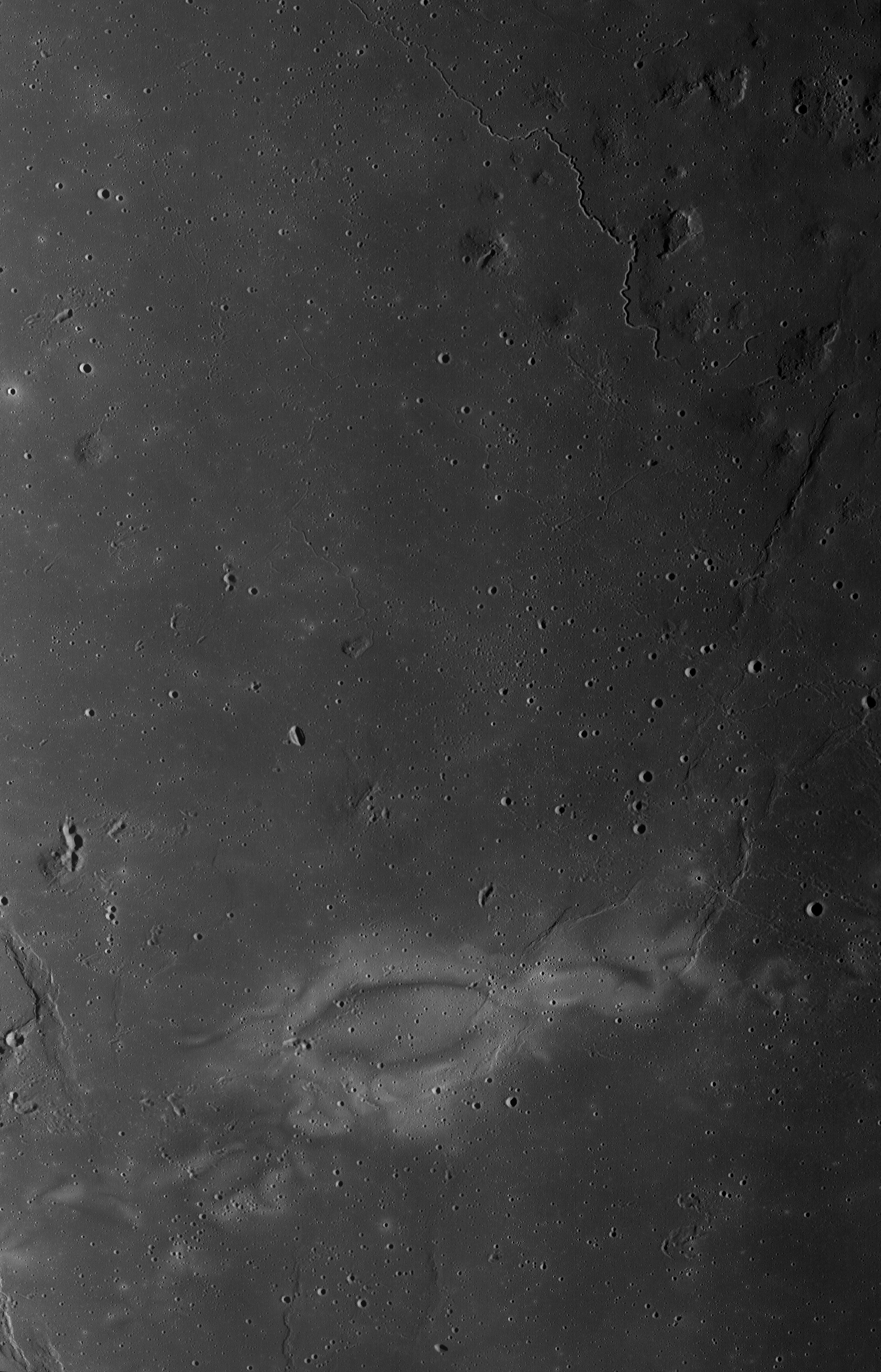
Showing posts with label Apollo 17. Show all posts

Tuesday, January 17, 2017

Eugene A. "Gene" Cernan, USN Ret. (1934-2017)

Among the very last photographs ever taken on the Moon, immediately following a third and final EVA at Taurus Littrow, December 1972, Harrison Schmitt captured a gritty, dusty Apollo 17 cmdr Gene Cernan, just after their retreat to the relative safety of their lander. Findings from the Apollo landings demonstrates the challenge presented by the course fineness of lunar dust to human and spacecraft health. Astronauts report the lunar surface material smelled a bit like ozone and gunpowder.  Cernan, 82, passed away January 16, 2017 [NASA/JSC].

Friday, February 13, 2015

Apollo 17 samples further refine bombardment timeline

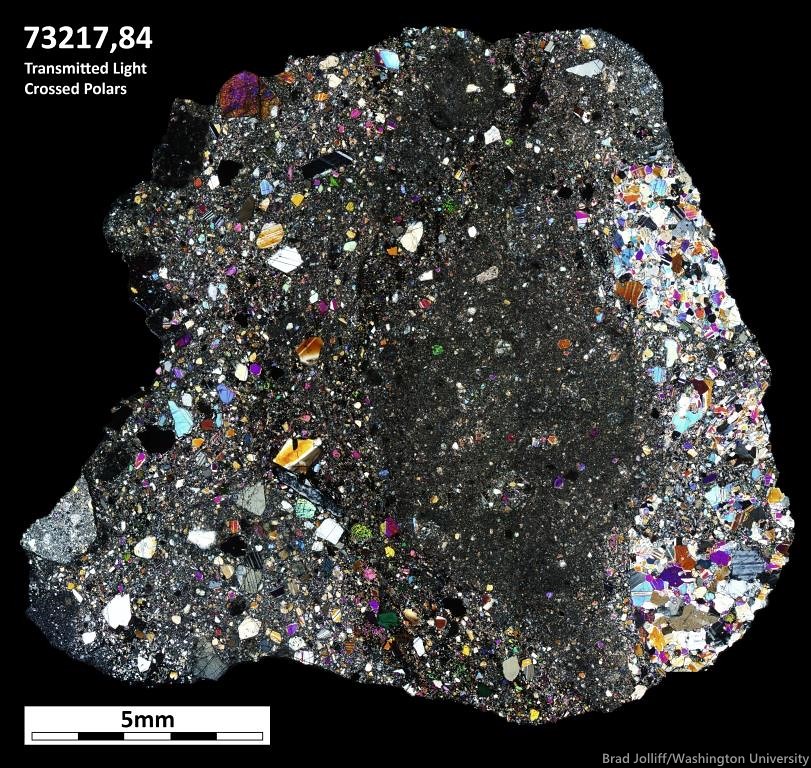
Photomicrograph of a petrographic thin section of a piece of a coherent, crystalline impact melt breccia collected from landslide material at the base of the South Massif, Apollo 17 (sample 73217, 84). In their article published in the Feb. 12 issue of Science Advances, ASU researchers used a laser microprobe technique to investigate age relationships of three of the distinct generations of impact melt shown in this image.
Nikki Cassis
School of Earth and Space Exploration
Arizona State University

It’s been more than 40 years since astronauts returned the last Apollo samples from the moon, and since then those samples have undergone some of the most extensive and comprehensive analysis of any geological collection.

A team led by Arizona State University researchers has now refined the timeline of meteorite impacts on the moon through a pioneering application of laser microprobe technology to Apollo 17 samples.

Impact cratering is the most ubiquitous geologic process affecting the solid surfaces of planetary bodies in the solar system. The moon’s scarred surface serves as a record of meteorite bombardment that spans much of solar system history.

Developing an absolute chronology of lunar impact events is of particular interest because the moon is an important proxy for understanding the early bombardment history of Earth, which has been largely erased by plate tectonics and erosion, and because we can use the lunar impact record to infer the ages of other cratered surfaces in the inner solar system.

Researchers in ASU’s Group 18 Laboratories, headed by professor Kip Hodges, used an ultraviolet laser microprobe, attached to a high-sensitivity mass spectrometer, to analyze argon isotopes in samples returned by Apollo 17. While the technique has been applied to a large number of problems in Earth’s geochronology, this is the first time it has been applied to samples from the Apollo archive.

The samples analyzed by the ASU team are known as lunar impact melt breccias – mash-ups of glass, rock and crystal fragments that were created by impact events on the moon’s surface.

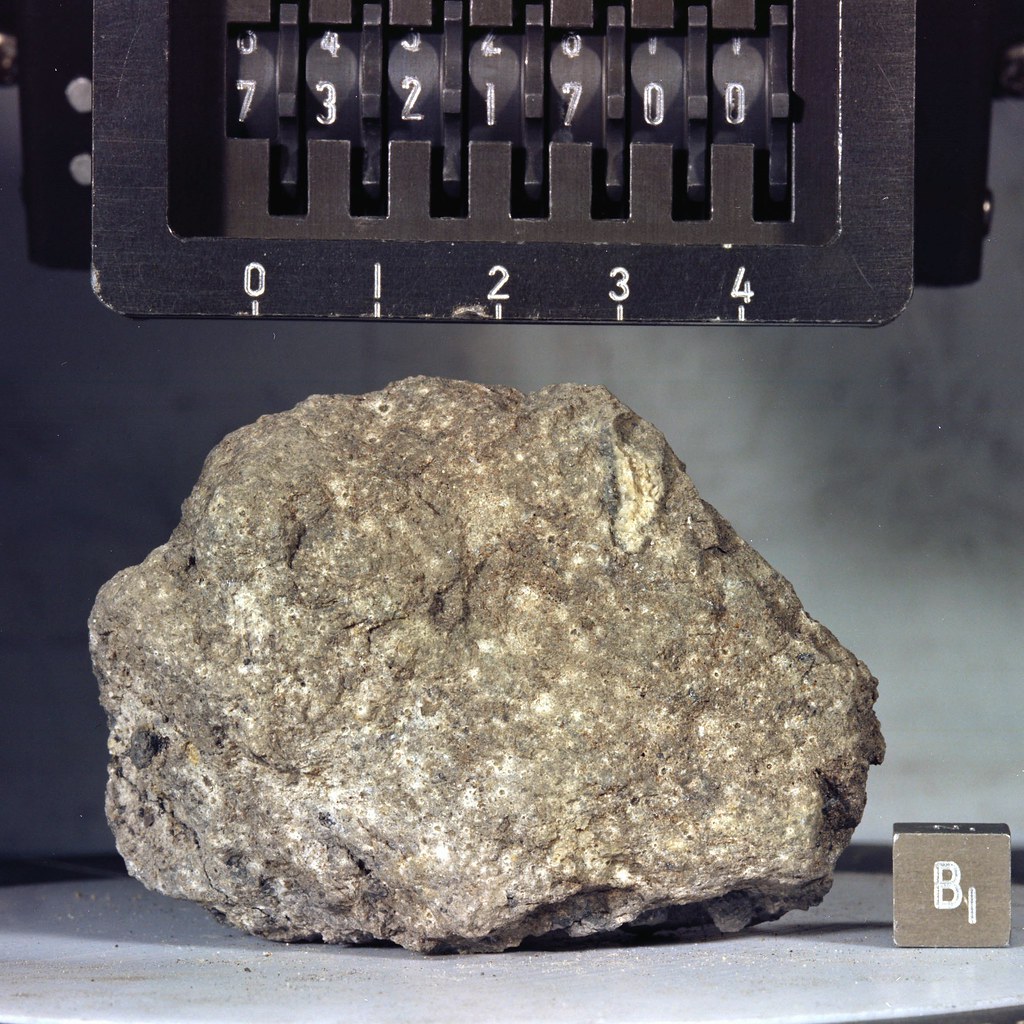
Apollo 17 sample 73217, before processing a 138.8 gm "tough impact melt" breccia rake sample from Science Station 3. The sample was half-buried near Lara crater and close to the Lee-Lincoln lobate scarp contact, and also well inside the Tycho debris chevron called Tortilla Flat. The rock contained a prominent white anorthosite clast, partially analyzed before the remainder was set aside for "posterity." Full processing has waited patiently for the 21st century. S73-16784 [NASA/JSC].
When a meteor strikes another planetary body, the impact produces very large amounts of energy – some of which goes into shock, heating and melting the target rocks. These extreme conditions can "restart the clock" for material melted during impact. As a result, the absolute ages of lunar craters are primarily determined through isotope geochronology of components of the target rocks that were shocked and heated to the point of melting, and which have since solidified.

However, lunar rocks may have experienced multiple impact events over the course of billions of years of bombardment, potentially complicating attempts to date samples and relate the results to the ages of particular impact structures.

Conventional wisdom holds that the largest impact basins on the moon were responsible for generating the vast majority of impact melts, and therefore nearly all of the samples dated must be related to the formation of those basins.

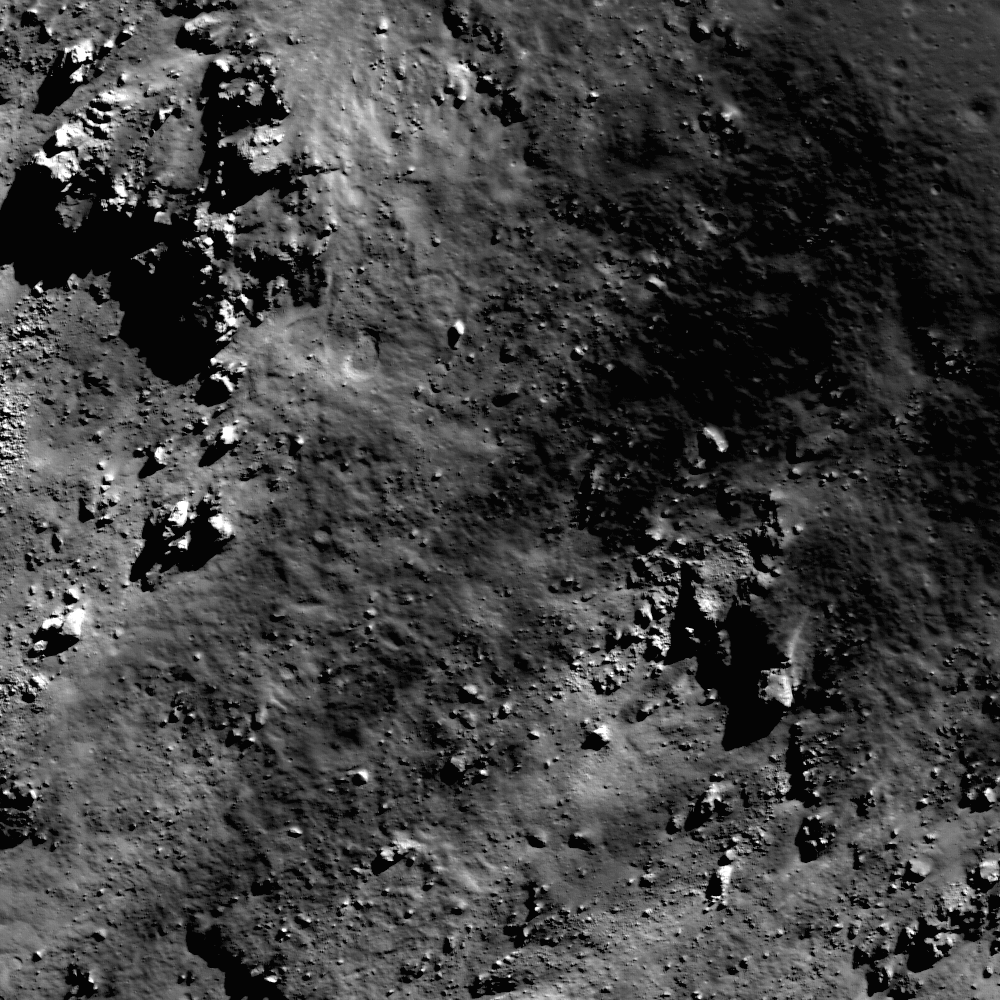
Annotated reproduction of an LROC oblique NAC mosaic showing the landing site (arrow) of the Cernan-Schmitt expedition in December 1972, a roughly 18 km-wide field of view used to illustrate "Approach to Taurus Littrow Valley," December 12, 2012 [NASA/GSFC/Arizona State University].
While it is true that enormous quantities of impact melt are generated by basin-scale impact events, recent images taken by the Lunar Reconnaissance Orbiter Camera confirm that even small craters with diameters on the order of 100 meters can generate impact melts. The team’s findings have important implications for this particular observation. The results are published in the inaugural issue of the American Association for the Advancement of Science’s newest journal, Science Advances, on Feb. 12.

“One of the samples we analyzed, 77115, records evidence for only one impact event, which may or may not be related to a basin-forming impact event. In contrast, we found that the other sample, 73217, preserves evidence for at least three impact events occurring over several hundred million years, not all of which can be related to basin-scale impacts,” says Cameron Mercer, lead author of the paper and a graduate student in ASU’s School of Earth and Space Exploration.

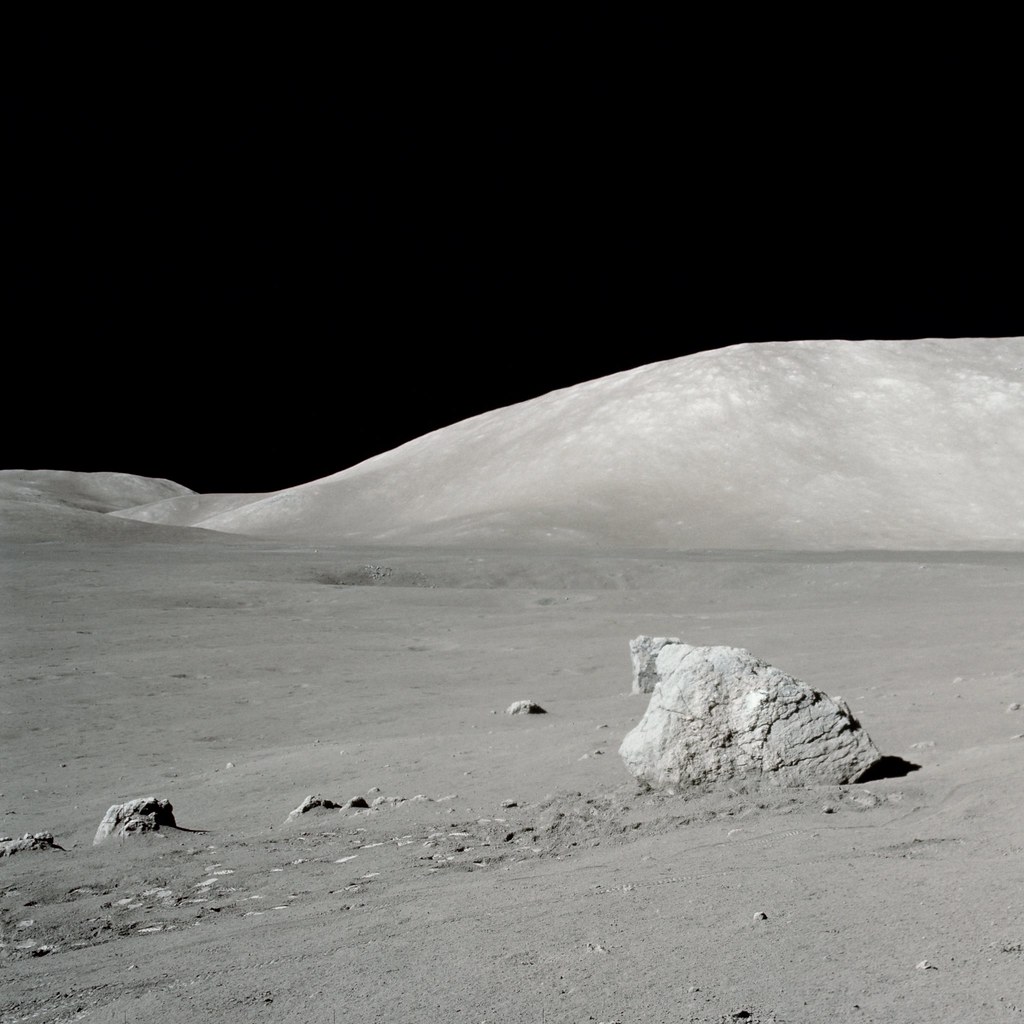
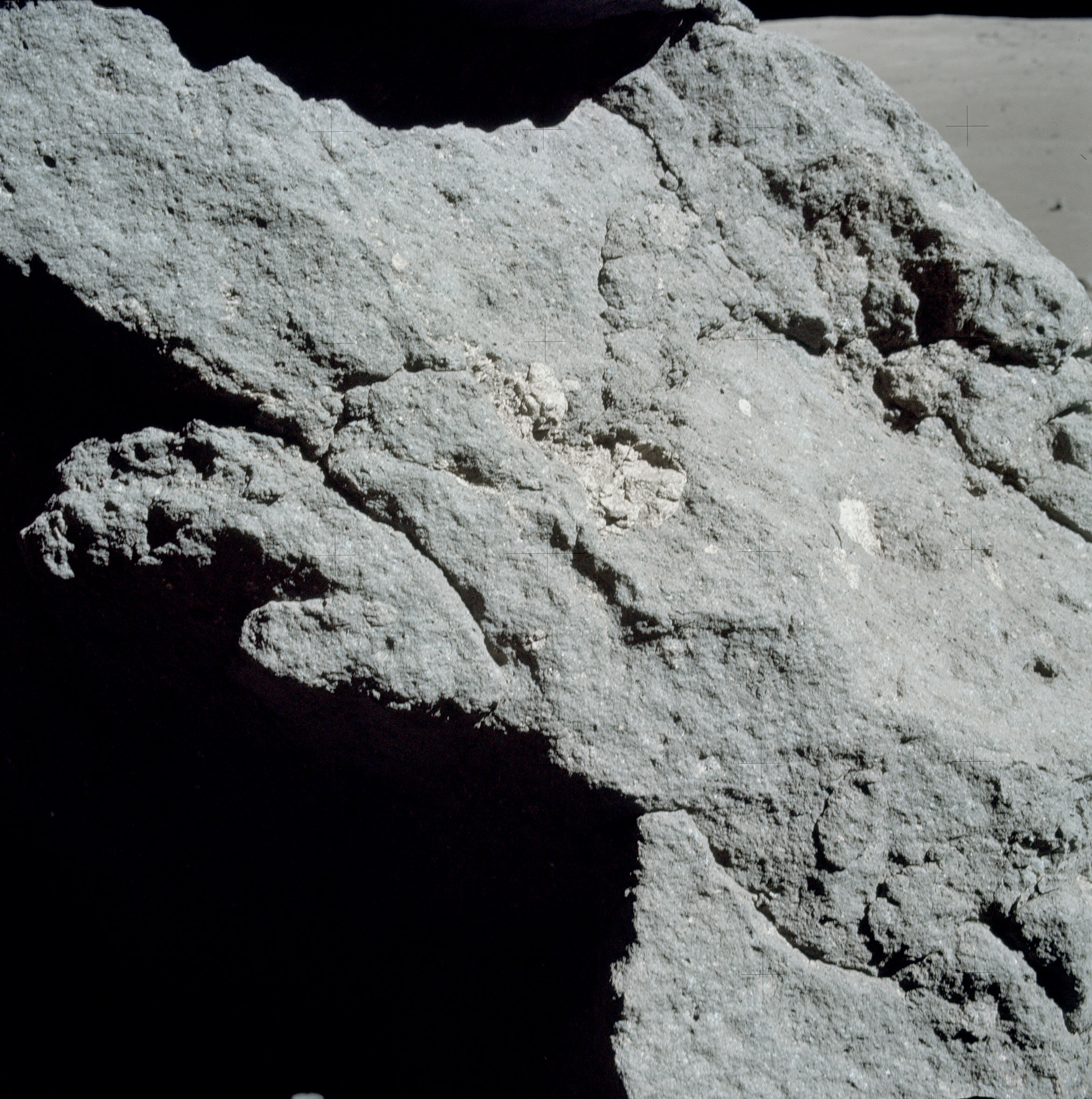
Apollo 17 sample 77115 was taken from the side visible above of the Science Station 7 boulder at lower left in this processed mosaic. From this vantage on the lower slopes of North Massif Gene Cernan and Harrison Schmitt had perhaps their best view across Taurus Littrow valley over to South Massif. The lunar module is easily visible at higher resolutions [NASA/JSC].
Sample 77115, collected by astronauts Gene Cernan and Harrison Schmitt at Station 7 during their third and final moonwalk, records a single melt-forming event about 3.83 billion years ago. Sample 73217, retrieved at Station 3 during the astronauts’ second moonwalk, preserves evidence for at least three distinct impact melt-forming events occurring between 3.81 billion years ago and 3.27 billion years ago. The findings suggest that a single small sample can preserve multiple generations of melt products created by impact events over the course of billions of years.

“Our results emphasize the need for care in how we analyze samples in the context of impact dating, particularly for those samples that appear to have complex, polygenetic origins. This applies to both the samples that we currently have in our lunar and meteoritic collections, as well as samples that we recover during future human and robotic space exploration missions in the inner solar system,” says Mercer.

Tuesday, April 15, 2014

Sometimes you just need to 'vent'

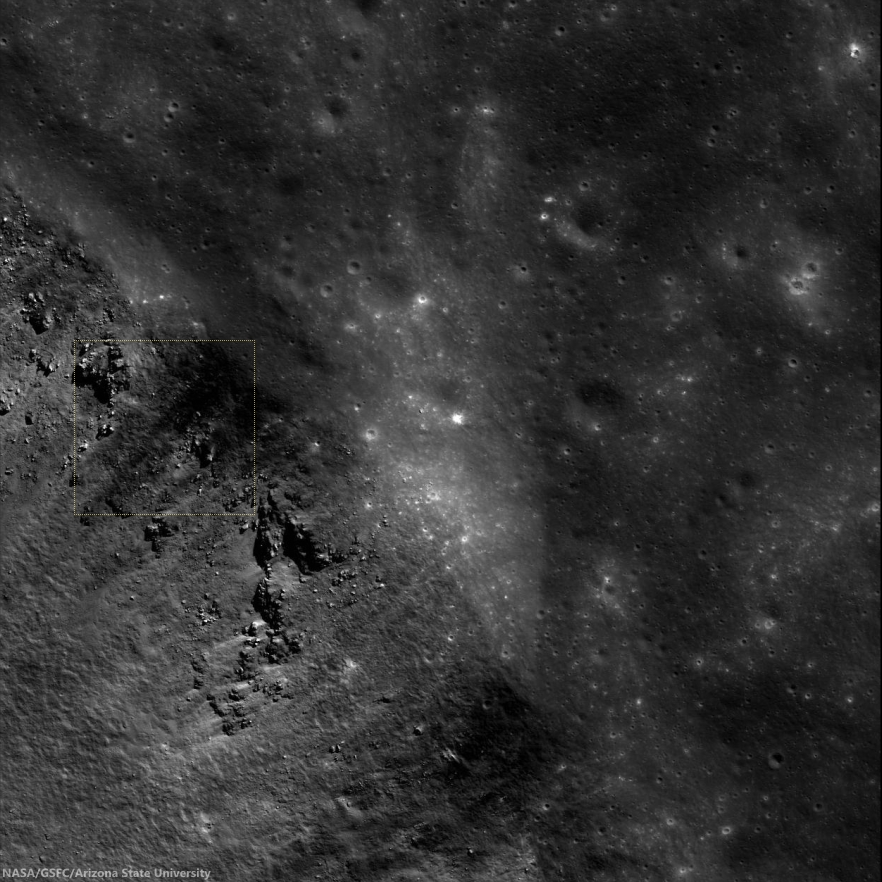
Low reflectance material cascaded down the wall of what is likely a volcanic vent in the southwestern portion of the Orientale basin. Image field of view approximately 750 meters, from LROC NAC observation M1150135366,  LROC orbit 21493, March 22, 2014; incidence 37.45° resolution 77 cm from 75.55 km over 30.12°S, 262.19° [NASA/GSFC/Arizona State University].
H. Meyer
LROC News System

Pyroclastic deposits on the Moon are often identified by a mantled appearance and low reflectance. These deposits are the result of an explosive eruption (or many) that involved a volatile component, likely carbon monoxide. The resulting fine-grained debris, including glass beads like those sampled by Apollo 17, gives the surface a dark, mantled appearance (See WAC image below).

So, where did the low reflectance material come from? The low reflectance material here flowed down the wall of a kidney-shaped (reniform) depression located at the center of the annulus.

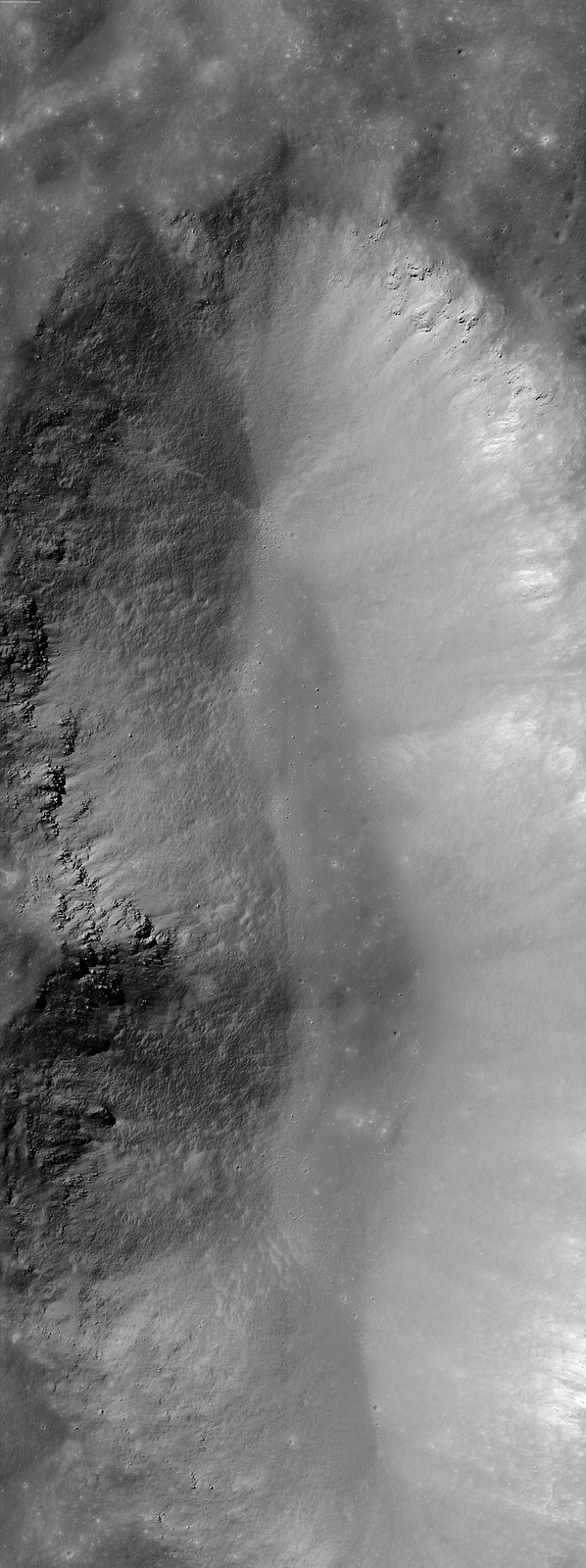
Expanded 3.8 km-wide context for LROC Featured Image released April 15, 2014 - outlined box - northwestern rim of pyroclastic vent, southern frontier Mare Orientale impact basin. Mosaic of left and right frames of LROC NAC observation M1150135366  [NASA/GSFC/Arizona State University].
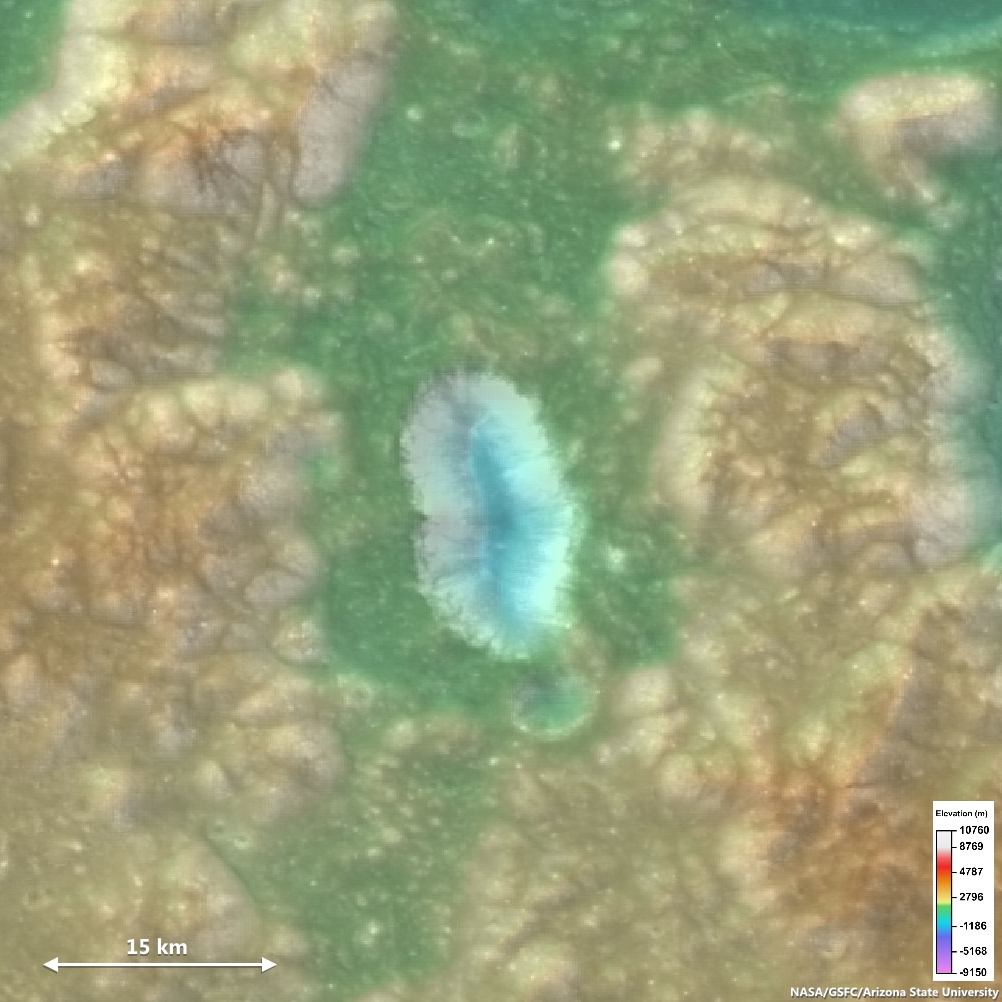
The lack of a discernible crater rim and irregular shape make this depression a suspect (See WAC image below). The walls of the depression are steep-sloped, yet the floor is fairly flat, which is best observed in a color-shaded digital terrain model (DTM). Such reniform depressions are observed in other locations across the Moon, such as Sulpicius Gallus, interpreted to be a pyroclastic source vent.

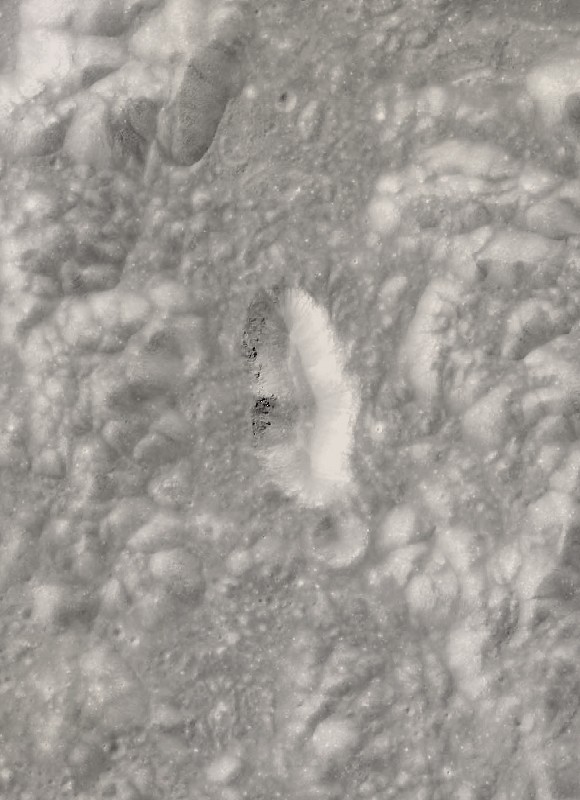
A higher angle of incidence, in this 2.8 x 7.5 km-wide field of view, washes out much of the finer grain albedo, though a look at the larger 40 percent -3760 x 9920- reproduction does reveal much of the detail of the rim, walls, boulder trails and debris-filled floor of the two-kilometer deep "smoke ring vent."  The area of interest on the upper right, also in the LROC Featured Image can be compared. LROC NAC mosaic of the left and right frames of observation M1099502843, LRO orbit 14378, August 13, 2012; illumination incidence angle 45° at 76 cm per pixel resolution, from 72.13 km over 30.11°S, 261.81°E [NASA/GSFC/Arizona State University].
If the kidney-shaped depression is the source of the low reflectance material, it is likely that material was ejected from the source vent at high velocity, creating an umbrella-shaped plume and depositing the dark, fine-grained material in a ring around the vent.

The larger than lunar average - 12.5 x 19.75 km pyroclastic "smoke ring vent," on the southwestern frontier of the Mare Orientale impact basin, is also hub to a regionally distinct 190 km-in diameter ring of darker material that, while not apparent in topographic studies, stands out in all native reflectance photography. Medium resolution Chang'e-2 Global albedo Mosaic [CNSA/CLEP].
Pyroclastic deposits are currently of interest to lunar scientists as a possible resource for future missions to the Moon. Such deposits are rich in hydrogen and helium-3, two potential resources for energy production, and iron and titanium, which have engineering applications.

Elevation study, LROC WAC-derived GLD100 topography in color-coded overlay onto LROC global normalized reflectance data. The high mountains of the concentric Orientale impact basin ring, where the vent is nested, offers a high vantage. Elevations range over 4000 meters in 10 km [NASA/GSFC/Arizona State University].
LROC WAC normalized reflectance 643 nm, of the low-reflectance pyroclastic annulus on the southwest Orientale impact basin. The annulus is approximately 180 km in diameter [NASA/GSFC/Arizona State University].
The necessary capabilities for utilizing resources such as these in-situ, or on site, are currently under development. In-situ resource utilization (ISRU) is critical to the future of exploration of areas that would otherwise be beyond our reach, both physically and financially.

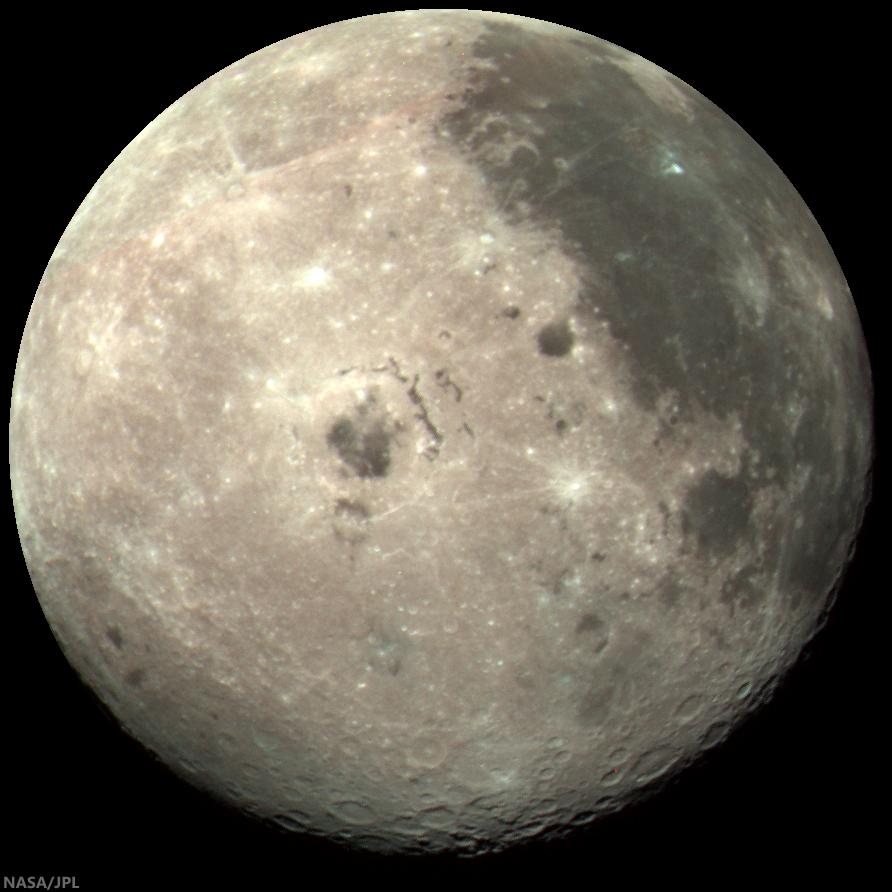
Another opportunity to display this stacked three-color image of the Moon's western hemisphere, which features Mare Orientale so prominently and demonstrates that the pyroclastic annulus south-southwest of its central plain, is large and prominent enough to be photographed from more than half a million kilometers away. In this case, captured by the Jovian probe Galileo at 1735 UT, December 9, 1990 [NASA/JPL].
Do some investigating of your own with the full NAC, HERE.

Related Posts:
Pyroclastics and an unnamed Procellarum vent
Source vent for Rima Prinz I
Craters on the Schrödinger pyroclastic cone
Morphology and distribution of volcanic vents in the Orientale basin from Chandrayaan-1
Unassuming volcanic vent north of Aristarchus Plateau
New pyroclastic structures identified using LROC data
A dark cascade at Sulpicius Gallus
Hyginus and pyroclastics
Layer of pyroclastics in Sinus Aestuum
Lavoisier Pyroclastics
Pyroclastic Excavation
Pyroclastic Trails
Pyroclastic Vent at Orientale DTM

Saturday, February 8, 2014

Special Session, LPSC 2014 (March 17)

 45th Lunar and Planetary Science Conference
New Perspectives of the Moon -
Enabling Future Lunar Missions
The Woodlands, Texas
Monday Morning, March 17, 2014

Prasun Mahanti and Charles Shearer, Chairs

Recent and ongoing missions coupled with new data analyses have dramatically changed our view of the Moon over the last decade. Findings from these missions provide both a fundamental scientific framework to base future missions and essential observations to reduce risk to these missions. Presenters will provide new scientific synthesis of data produced from recent and current lunar missions and data analyses and examine innovative scientific mission strategies enabled by these new insights to address important lunar science and exploration questions.

At Noon on Monday, astronaut-geologist Harrison H. Schmitt will update this special session on "a number of new insights into the geology of Taurus Littrow and surrounding regions."
8:30 a.m. Zuber, Smith, Goossens, Asmar and Konopliv, et al. - A High-Resolution View of the Orientale Basin and Surroundings from the Gravity Recovery and Interior Laboratory (GRAIL), #2061

During the final weeks (the “endgame”) of the Gravity Recovery and Interior Laboratory (GRAIL) mission the orbital altitude of the dual spacecraft was lowered to an average of 11 km above the surface of the Moon. The endgame mapping strategy was designed to provide the highest-resolution coverage over the Orientale basin in order to provide a gravity map of a multi-ring impact basin at unprecedented resolution. (High-resolution data over other areas of the planet were acquired as well.)  We summarize methodology and present results of local analysis to produce a gravitational model with 3-5-km spatial resolution, appropriate for investigating the structure and evolution of Orientale and its surroundings.

8:45 a.m. Warren and Dauphas - Revised Estimation of the Bulk Composition of the Moon in Light of GRAIL Results, and Why Heat Flow Should be a Top Priority for Future Lunar Missions, #2298

The elemental composition of the Moon shows aspects of similarity but also some important differences relative to Earth. The differences are key constraints for modeling the origin of the Moon and planetary origins in general. Most obviously, and regardless of the important FeO issue that is a major focus of this work, the Moon’s total iron content is lower by a factor of 3-4 compared to Earth’s total iron of ~34 wt%.

9:00 a.m. Jolliff and Petro - Recent Mission Observations Provide Scientific Context and Enabling Support for Future Exploration of the Moon’s South Pole-Aitken Basin, #2357

We take an integrated look at results from recent missions, current knowledge gaps, and implications for future in situ or sample-return exploration.

LPSC 2014, #1398, Figure 1. Central South Pole-Aitken basin, LROC WAC base mosaic overlain by GLD100 WAC-derived DTM (scale in meters) showing current NAC geometric stereo image coverage.
The Moon’s South Pole-Aitken (SPA) Basin is a scientifically rich destination for future exploration by landed and sample-return missions.  The current Planetary Science Decadal Survey recognized this scientific potential in terms of the SPA basin’s importance for recording the chronology of major events in the early Solar System as well as for understanding lunar history, structure, and giant impact processes. Current and recent orbital mission results including LRO, GRAIL, Chandrayaan-1, and Kaguya are paving the way for an improved understanding of SPA basin geology and history, and indeed, posing new questions for future exploration.

9:15 a.m. Hurwitz and Kring - Destinations for Sampling Impact Melt Produced by the South Pole — Aitken Basin Impact Event, #1398

LPSC 2014 #1398, Figure 1: FeO (red-yellow tones) and Th (green-blue tones) anomalies from LP data in SPA, shown with images from the LRO Wide Angle Camera (WAC). Features of interest are labeled. SPA melt may also be found in material ejected from the basin, but the anomalies identified above indicate the highest concentration of this melted material.
The intensity of impact activity during the earliest history of the Solar System is poorly constrained due to the lack of samples collected from ancient planetary terrains. The South Pole – Aitken (SPA) basin is the oldest basin identified on the Moon based on stratigraphic superposition and, thus, represents a key target for characterizing this earliest impact record. To determine the absolute age of SPA, rocks that formed as a result of the impact, such as impact melt, must be identified, collected, and analyzed. In this paper, we use high-resolution images obtained by the Lunar Reconnaissance Orbiter Narrow Angle Camera (LROC NAC) to explore locations that potentially contain SPA impact melt. These observations are integrated with spectral analyses of surface compositions and models of melt sheet differentiation to identify destinations where SPA impact melt samples can be collected.

9:30 a.m. Lawrence, Stopar, Speyerer, Robinson and Jolliff - Characterizing Locations for Future Lunar Exploration Using Recent Mission Results, #2785

LPSC 2014, #2785 Figure 1. Example path planning algorithm output for Ina on a LROC Narrow Angle Camera image.
We present results from a project to characterize accessibility and science potential of high-priority locations for future lunar precursor missions.

9:45 a.m. Mahanti, Robinson and Stelling - How Deep and Steep are Small Lunar Craters? — New Insights from LROC NAC DEMs, #1584

Recent lunar missions (e.g. Lunar Reconnaissance Orbiter (LRO), Kaguya), carrying high resolution cameras (e.g. Lunar Reconnaissance Orbiter Camera (LROC) Narrow Angle Camera (NAC), Selene Terrain Camera) have acquired images that will lead to a deeper understanding of impact crater formation and degradation. Historical studies of lunar crater morphology exists for craters in the 10 km diameter range, but is somewhat lacking for craters in the 1 km D range, and rare for craters D below 200 m.

10:00 a.m. Robinson, Boyd, Denevi, Lawrence and Moser, et al. - New Crater on the Moon and a Field of Secondaries, #2164

LPSC 2014 #2164 Figure 1. LROC Narrow Angle Camera (NAC) before and after images of the same small patch of Mare Imbrium reveal the Marshall 17 March Impact Event, the first time an impact on the Moon observed on Earth in real time has been definitively identified from lunar orbit. The newly-formed crater is 18 meters in diameter. From "New Imbrium crater from impact observed on Earth" (December 17, 2013) [NASA/GSFC/Arizona State University].
Amateur and professional observatories monitor the Moon for flashes, interpreted to represent impact events. The NASA Lunar Impact Monitoring Program includes a dedicated telescope facility at Marshall Space Flight Center. The Marshall group recorded over 300 flashes (meteoroid impacts); their brightest recorded flash occurred on 17 March 2013 (20.599±0.172°N, 336.078±0.304°E). Subsequently, a series of Lunar Reconnaissance Orbiter Camera (LROC) Narrow Angle Camera (NAC) images were acquired over the period of June through November 2013 to investigate the nature of this flash.

LPSC 2014 #2164 Figure 2. Temporal ratio (before M183689789L / after M1129645568L) orange outline delimits proximal high reflectance ejecta, red line is the boundary of low reflectance ejecta, blue outline shows boundary of high reflectance outer continuous ejecta, scale bar is 1000 meters.
10:15 a.m. Lucey, Neumann, Paige, Riner and Mazarico, et al. - Evidence for Water Ice and Temperature Dependent Space Weathering at the Lunar Poles from LOLA and Diviner, #2325

LOLA measurements of zero phase reflectance of the Moon have revealed that polar regions in permanent shadow are significantly brighter at 1064 nm than equivalent surfaces that experience some illumination during the year Zuber et al. Several hypotheses for this brightening have been outlined, including water frost and a polar effect on space weathering.  Inclusion of Diviner temperature measurements to LOLA reflectance observations adds a physical chemical dimension to aid interpretation because of the exponential temperature dependence of surface frost lifetime against sublimation. In this abstract we present the results of LOLA measurements of surface reflectance in the polar regions, and assess the validity of the various hypotheses to explain the observations with special attention to temperature.

LPSC 2014 #2325, Figure 2. The distribution of normal albedos for areas in permanent shadow (PSR) and areas sometimes illuminated (Non-PSR) in the north pole (70-90°N). The two populations are significantly offset, though considerable overlap persists.
10:30 a.m. Retherford, Greathouse, Gladstone, Hendrix and Mandt, et al. - New Perspectives on the Lunar Far-UV Albedo: Implications of LRO Lyman Alpha Mapping Project (LAMP) Results for Future Exploration, #2372

LAMP FUV albedo maps are used to investigate the intriguing albedo differences that occur within PSRs. LAMP measurements indicate ~1-2% surface water frost abundances in a few PSRs based on spectral color comparisons, and we find that many PSRs may have porosities of ~0.7 based on relatively low albedos at Lyman-α [1]. The FUV albedo maps reveal lower albedo regions within craters. The lower albedo regions are roughly correlated with the coldest PSR regions, and Hayne et al., this meeting, will pre-sent correlative analyses with Diviner maps. Mandt et al., this meeting, will present updated analyses of the PSR water frost abundances including a search for changes on monthly timescales.

New dayside FUV albedo maps will also be pre-sented. Comparisons between the nightside and day-side photometry techniques help validate the use of Lyman-α and starlight as illumination sources. Analy-sis of dayside spectra for selected regions complement the dayside maps, and are used to investigate space weathering and hydrated surface signatures [5]. Hen-drix et al., this meeting, report that the Compton-Belkovich region presents a relatively red spectral slope in the LAMP dataset, and discuss the potential for surface hydration in this region. A lab study of the FUV reflectance properties of Apollo samples, lunar simulants, and water ice is underway to further charac-terize the UV reflectance techniques. The far-UV spec-tral inversion property of the lunar albedo discovered by the Apollo 17 UVS is confirmed with the LAMP dataset, and Seifert et al., this meeting, investigate fur-ther the contrast of UV-bright mare versus UV-dark highlands region features as a function of wavelength.

LPSC 2014 #1943 Figure 1. Overlay of Diviner annual maximum temperature (colors: 40-350 K) and Ly-α albedo from LAMP (grayscale) for the south polar region of the Moon. The outer edge of the Diviner map lies at 82.5°S.
10:45 a.m. Hayne, Retherford, Sefton-Nash and Paige - Temperature and Ultraviolet Albedo Correlations in the Lunar Polar Regions: Implications for Water Frost, #1943

LPSC 2014 #1942 Figure 3. Surface material with high UV water band depth from LAMP and Diviner Tmax < 130° K is indicated by shades of red in this south polar map. The background grayscale image is Diviner Tmax, a subset of Fig. 1.
11:00 a.m. Zhao, Huang, Xiao, Qiao and Xiao, et al. - Geology of CE-3 Landing Site and Path Planning for Yutu Rover, #1864

Nearly 40 years after the completion of Apollo program and Luna missions, the third Chi-nese lunar mission, Chang’e 3 (CE-3), was launched on December 2 2013, and it safely landed on the surface of the Moon on December 14 2013. The rover “Yutu” separated from the lander successfully about 8 hours later. The landing site of CE-3 is 340.49 °E, 44.12 °N, located in the northern part of Mare Imbrium and about 140 km east to Sinus Iridum. The landing area has a variety of geologic features, such as impact craters, wrinkle ridges and basaltic lava flows with different ages, making it an arresting place to study.

11:15 a.m. Garry W. B. - The Mare Imbrium Flow Field: Regional Geologic Context of the Chang’e 3 Landing Site, #2169

LPSC 2014 #2169 Figure 3. Topographic profiles of two different Phase III lava flows. Low-sun angle images show channels that are a few meters deep in the majority of the Phase III flows indicating preferred paths in many of these lobes.
The Mare Imbrium lava flows are unique to the lunar surface in that they have well-defined flow margins, levees, and channels that are traceable from the source region to the flow front. These flows were initially mapped with Apollo data [4,5], but the data sets did not provide complete coverage of the flow field at a consistent resolution. The overall goal of this study is to reevaluate the flow field with current data sets, create an updated morphologic map of the Mare Imbrium lava flows, and provide a qualitative and quantitative description of the emplacement of the flow field.

11:30 a.m. Hiesinger, Ivanov, Pasckert, Bauch and van der Bogert - Geology of the Lunar Glob Landing Sites in Boguslawsky Crater, #2370

LPSC 2014 #2370 Figure 2. New geologic map of Boguslawsky crater (72.9°S, 43.257°E). Landing ellipses shown in white.
On Nov. 17, 2011, the Space Council of the Russian Academy of Sciences, formally announced that the Luna-Glob and Luna-Resurs missions will be split into separate landing and orbiting missions. Although the main objective of the Luna-Glob lander is to test landing techniques, it will also carry a small scientific payload. The floor of crater Boguslawsky (~95 km in diameter, centered at 72.9°S, 43.26°E) was selected as primary landing site for the Luna-Glob mission. Two landing ellipses, 30x15 km each, were chosen on the  floor of the crater: Ellipse West is at 72.9°S, 41.3°E, Ellipse East is at 73.3S, 43.9E.

11:45 a.m. BREAK

12:00 p.m. Schmitt H. H. - Apollo 17: New Insights from the Synthesis and Integration of Field Notes, Photo-Documentation, and Analytical Data, #2732

A number of new insights into the geology of the valley of Taurus-Littrow and surrounding regions of the Moon have resulted from recent synthesis and integration of transmitted field notes, field recollections, and photodocumentation with over forty years of data from sample analysis and geophysical measurements.

Jack Schmitt's trench and the orange regolith he uncovered at Shorty crater. The minutes spent at this location left a deep mark on planetary science, visible from the Lunar Reconnaissance Orbiter and discussed by LROC principal investigator Mark Robinson in "Just another crater?" December 13, 2011; Apollo 17 Lunar Surface Journal. AS17-137-20900 [NASA].
For further information about the 45th Lunar and Planetary Science Conference visit:
http://www.hou.usra.edu/meetings/lpsc2014/

Sunday, December 15, 2013

Apollo 17, Station 6

Station 6, Apollo 17
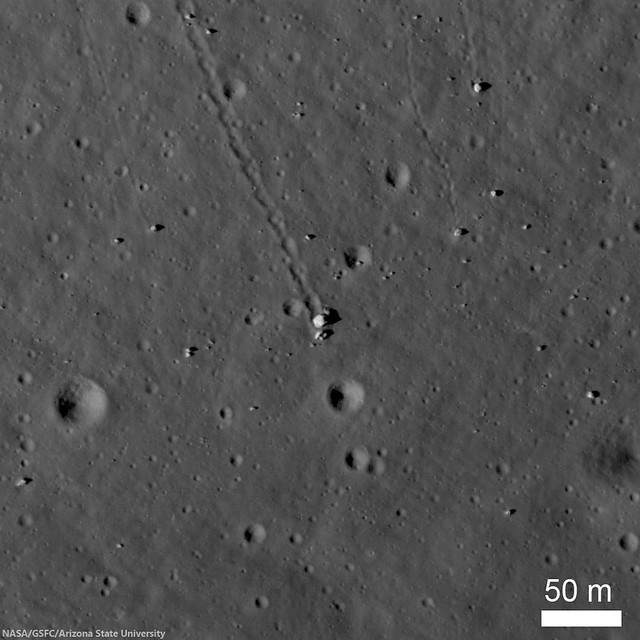
Station 6 allowed Apollo 17 astronauts Eugene Cernan and Jack Schmitt to explore a collection of boulders and regolith that represent rocks from the mighty North Massif. Five large boulder fragments lie at the base of a long boulder trail, all from a single boulder that rolled down the hill and broke apart. LROC Narrow Angle Camera (NAC) observation M134991988R, spacecraft orbit 5027, July 28, 2010; angle of incidence 64.66° at 0.5 meters resolution from 43.83 km over 19.19°N, 30.8°E [NASA/GSFC/Arizona State University].
Jeffrey Plescia
LROC News System

The North Massif lies along the northern side of the Taurus-Littrow Valley, the landing site of Apollo 17. Station 6 was visited during the third and final surface EVA of the expedition and of the Apollo program, December 13, 1972, and was intended as a location to collect ancient highland material from the North Massif as well as a dark mantle that locally covers the region.

The sampling station is about 100 meters above the general valley floor elevation of 2560 meters below global mean average. The North Massif rises some 1400 meters above Station 6 and likely formed in a few seconds as the result of the massive impact that created the Serenitatis Basin.

One of the key science goals at Station 6 was to collect impact melt caused by that event. When rock is melted its radiometric clock is reset to time zero, so a sample of impact melt can be age-dated to determine when the basin formed.

Station 6, Apollo 17
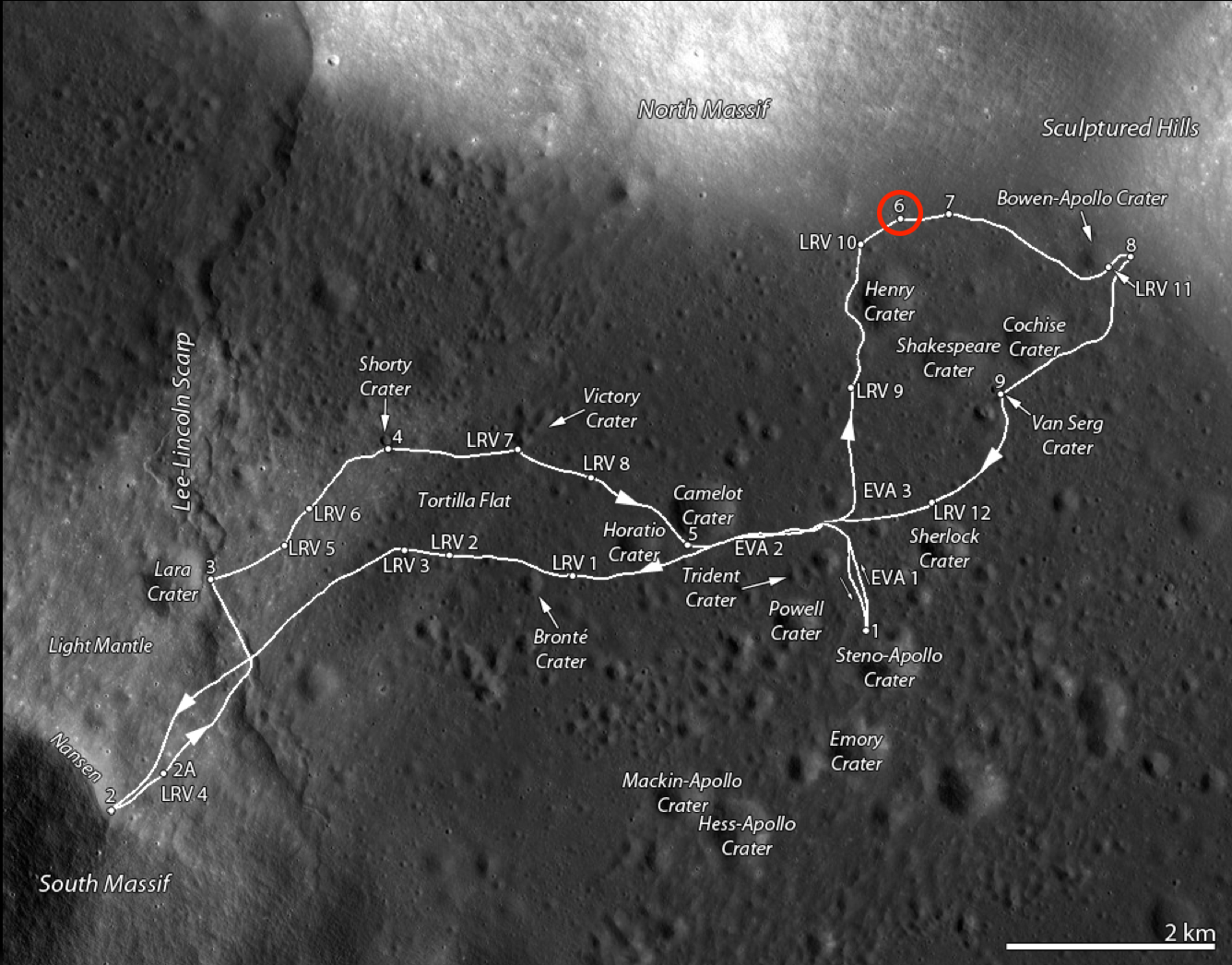
Traverse map of the Apollo 17 site. Station 6 is along the base of the North Massif on the north side of the valley and is circled in red [NASA/GSFC/Arizona State University].
At Station 6, five large blocks are clustered together on a surface that slopes toward the valley floor at about 16°. They lie at the end of a 980 m long boulder trail that formed as a single large boulder rolled down the hill. The trail is about 10-12 m wide with a scalloped edge and periodic small transverse ridges. This irregular pattern is the result of the irregular shape of the boulder. The original boulder was probably about 18 x 10 x 6 m. The largest fragment (Block #2) is about 10 m across.

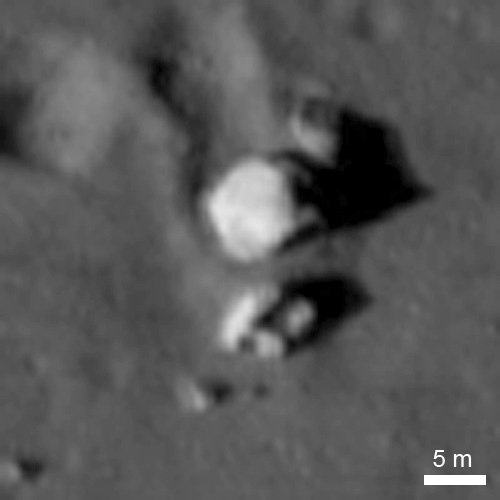
It appears that the rolling ceased when the boulder broke apart and came to the rest in its present location. As the boulder rolled down the hill slope, it pushed up material along the edge of the track forming a berm. A small berm is also visible in front of the largest fragment. An expanded view of the boulders from an LROC image is shown below. Subtle brightness differences are apparent in the largest boulder in the center, and correspond to different rock types (the boulder is a breccia).

Station 6, Apollo 17
The five major blocks at Station 6, and an additional one farther down slope, are clearly visible in LROC NAC M134991788RE, as is the boulder trail above the blocks. Afternoon illumination, sun from the west [NASA/GSFC/Arizona State University].
Pictures taken during the Apollo 17 EVA at Station 6 illustrate the relative size of the boulders; below Jack Schmitt is seen after after sampling the boulders.

Station 6, Apollo 17
Jack Schmitt picking up the gnomon after collecting samples. This view is to the southwest, and the Apollo 17 lunar module stands sentinel in the upper right deep background (AS17-140-21496) [Eugene Cernan/NASA/JSC].
Jack Schmitt put the Apollo 17 lunar module "Challenger" in some perspective, capturing this monochrome shot, through a 500 mm lens, and from over 3 km) from Station 6. From another panorama of EVA images, AS17-139-21203-5 [Harrison Schmitt/NASA/JSC].
A number of samples were collected at Station 6. The illustration below shows the boulder group and a map made during the mission. The map indicates the location of the rock and soil samples as well as the location of the panoramic images.

Station 6, Apollo 17
LROC image of the boulder complex (top); map of the boulder segments and the sample locations (below). North and South Panoramas designate locations where the hand-held panoramic image sequences were captured. The numbers refer to specific Apollo samples [NASA/GSFC/Arizona State University].
Samples from the station include a single drive tube, ten rock samples (3 from the surface, four from block 1, one each from blocks 2, 4, and 5), several sediment samples (3 from between major blocks, one down slope from the blocks, one from the boulder track, and another from on top of block 1), and one rake sample from the ejecta blanket of a small crater to the northwest of the blocks.

Station 6, Apollo 17
Light-colored inclusions in the matrix of one of the boulders (Block 1) (AS17-140-21442) [NASA/JSC].
The boulders consist of clast-bearing impact melts. Despite the color differences, foliation and frequency of vesicles, the boulders consist of a chemically uniform matrix with clasts ranging in size up to about 1 meter in diameter. The clasts consists of rocks across the anorthosite-norite-troctolite suite or their impact-modified derivatives. Simonds (1975) suggested that the matrix is a clast-bearing rock formed by the mechanical mixture of cold, generally little-shocked clasts and superheated impact melt that rapidly quenched to form very-fine subophitic to ophitic crystalline groundmass. These samples have ages of around 3.98 Ga and are interpreted to represent the age of basin-forming event that produced the material, probably the Serenitatis Basin (as discussed in Ryder et al., 1997). However, more recent work suggests that the rocks collected at Station 6 may actually be ejecta from the Imbrium Basin forming event.

Explore the Taurus-Littrow Valley yourself, HERE.

Previous LROC Featured Images RE: Apollo 17:
Oblique view of Taurus Littrow, from the West (December 19, 2012)
Approach To Taurus Littrow Valley (December 11, 2012)
Taurus Littrow Oblique (September 29, 2012)
Question Answered! (July 17, 2012)
Just Another Crater? (December 13, 2011)
Skimming the Moon (September 6, 2011)
Exploring the Apollo 17 Site (October 28, 2009)

China's Jade Rabbit, it's time in the Sun

Yutu on Imbrium
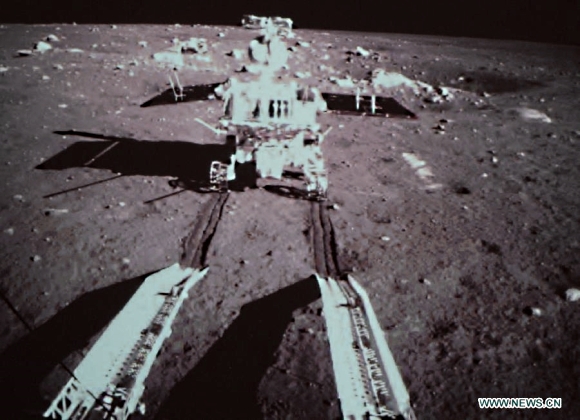
China's "Yutu," the "Jade Rabbit," rolls out onto Mare Imbrium, Sunday, December 14, 2013. Still from master video display in Beijing [CN].
Mike Killian
AmericaSpace.com

Today, exactly 41 years after the last human footprint was made on the moon by Gene Cernan, China became the third nation to touch the lunar surface – joining an exclusive club and earning a round of applause from around the world.

The last lunar landing was performed by the Soviet Union on the Luna 24 sample return mission in 1976, and the United States remains the only country to have ever landed humans on the lunar surface (last human mission to the Moon was NASA’s Apollo 17 in December 1972). 

The mission, named Chang’e 3 after the Chinese goddess of the Moon in ancient myth, is China’s third unmanned lunar mission, but it’s also the first landing – the next step in China’s ambitious Lunar Exploration Program.  Chang’e 1 launched in 2007, and Chang’e 2 launched in 2010. Both missions orbited the Moon and carried out various studies, while also mapping the surface in its entirety, and both missions paved the way for Change’3 to land on the surface.

Chang'e-3 landing site
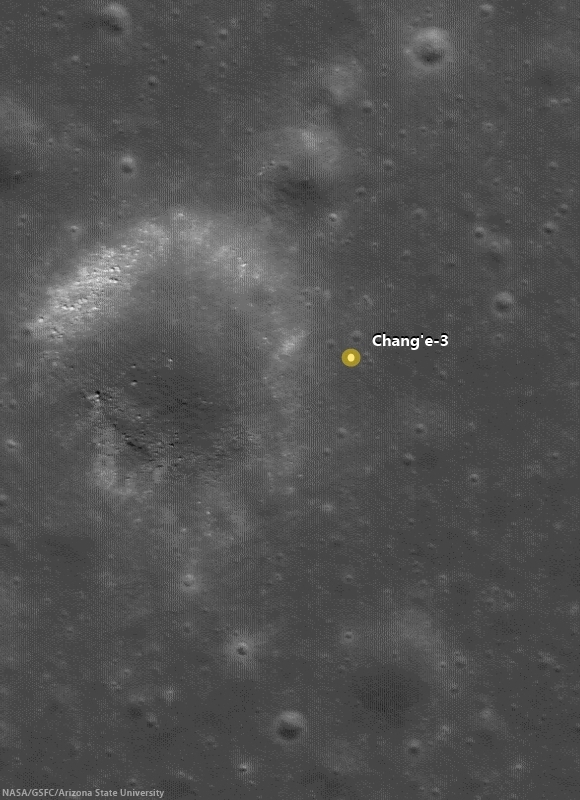
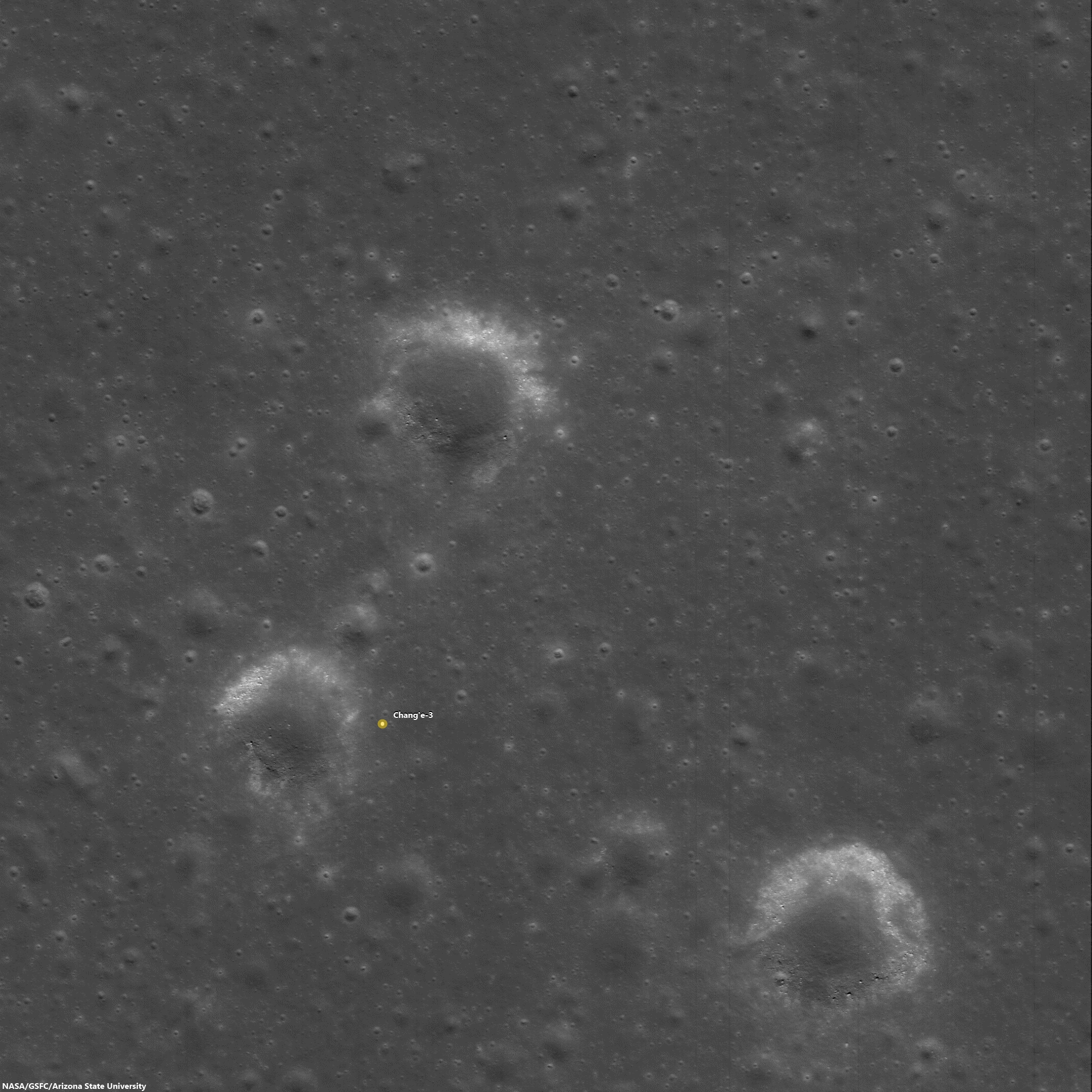
Another LROC NAC observation of the landing site of China's Chang'e-3 lunar lander and Yutu rover, this opportunity around half a meter per pixel superior in resolution than one noted earlier. The vehicles have separated following the successful landing, December 14, 2013 - the 41st anniversary of the last moonwalk of the Apollo program in 1972. 638 meter-wide field of view from LROC Narrow Angle Camera (NAC) observation M1116664800R, orbit 16786, February 28, 2013; angle of incidence 44.83, resolution 1.1 meter per pixel from 145.32 km over 44.61°N, 340.3°E [NASA/GSFC/Arizona State University].
The mission began two weeks ago today with a picture-perfect liftoff from the country’s Xichang Satellite Launch Center in southwest China.  Chang’e 3 soared skyward into the black of night atop a powerful Long March-3B rocket, and minutes later the Chang’e 3 lunar lander and its six-wheeled rover, named Yutu, or “Jade Rabbit,” separated from the rocket’s third stage while coasting into a beautiful sunrise 300 kilometers over the Pacific Ocean.  From there it was a five-day trip to reach lunar orbit, and a week later for Chang’e 3 to begin its descent.

Read the full article, HERE.

Chang'e-3 Landing Site
A 2318 meter-wide, full-resolution field of view from the same LROC NAC observation, M1116664800R [NASA/GSFC/Arizona State University].

Wednesday, October 16, 2013

Measuring almost nothing, looking for the almost invisible

hdtv_010_4_l-580x1080
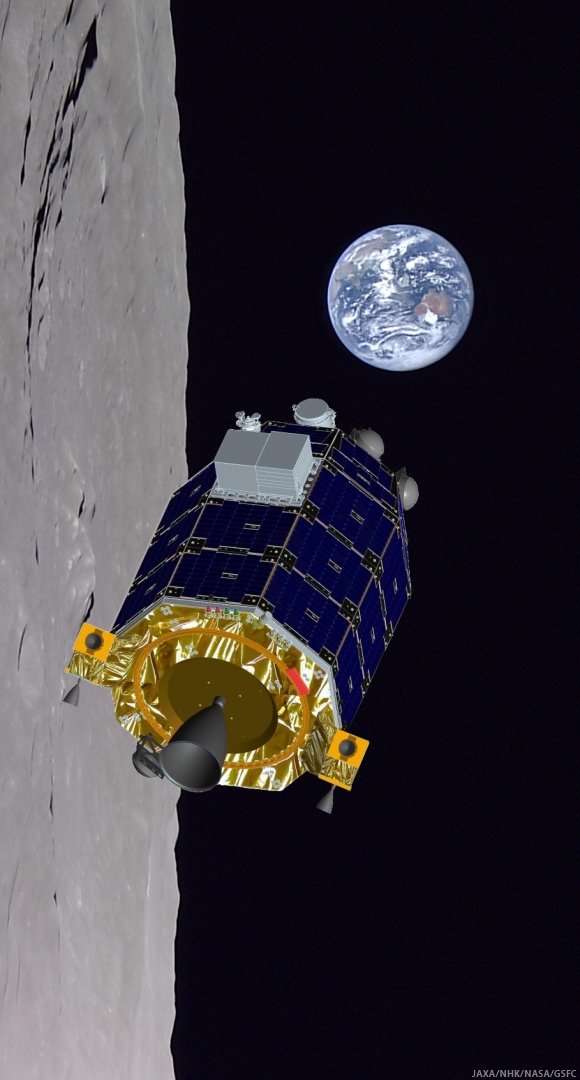
NASA's LADEE spacecraft entered it's 250 km Commissioning phase orbit October 12 [NASA/JAXA].
Paul D. Spudis
The Once and Future Moon
Smithsonian Air & Space

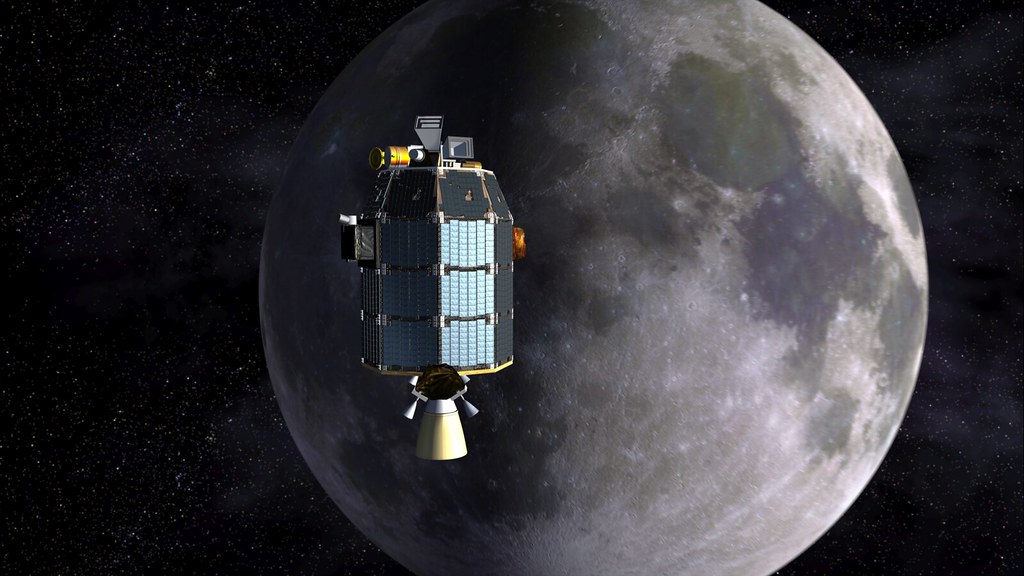
Launched last month from the Wallops Island site, LADEE (for Lunar Atmosphere and Dust Environment Explorer) will spend the next few months orbiting the Moon.  This small spacecraft will attempt to characterize and measure the lunar “atmosphere,” while also looking for dust that might be electrostatically levitated above the surface or thrown into ballistic flight by impacts.

Wait a minute.  Did I say “atmosphere?”  Isn’t the Moon renowned for its lack of an atmosphere?  Indeed it is.  In fact, the 10-12 torr surface pressure of the Moon is a better vacuum than we can achieve with even the most advanced equipment in Earth laboratories.  (For comparison, sea level pressure on the Earth is about 760 torr, making the lunar surface pressure over one hundred trillion times less dense.)  A better term for the tenuous gas near the Moon is “exosphere,” meaning free flying gas molecules that may or may not be gravitationally bound to the Moon.  In such an “atmosphere,” there may be only a few thousand molecules in a cubic centimeter of space. This is very tenuous indeed.
  
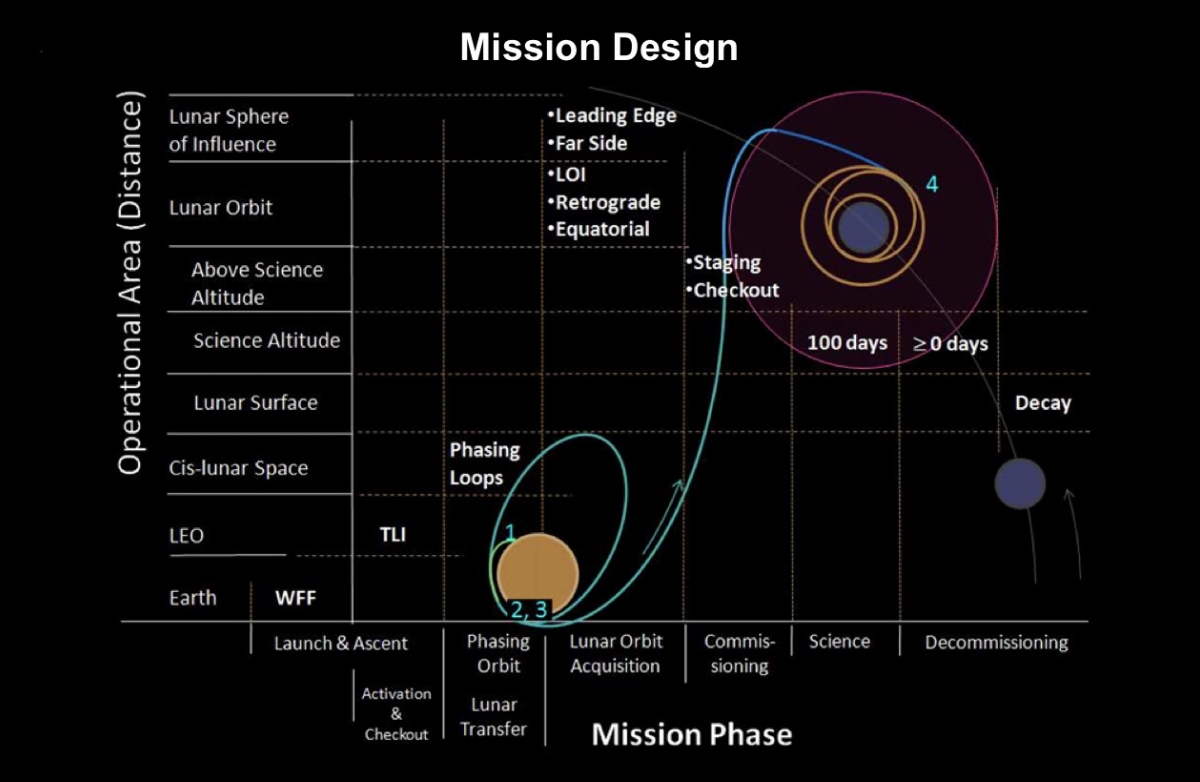
After the Commissioning phase of its mission is complete, the spacecraft's current 250 km circular orbit will be reduced further down to within 50 km to begin its 100 day Science Mission [NASA/GSFC].
LADEE is designed to investigate from where these atoms and molecules come.  Presently, we think the lunar exosphere consists mostly of helium, sodium and perhaps argon atoms, each coming from a completely different source.  Helium likely comes from the Sun, as the solar wind continually “breathes” onto the surface of the Moon.  Some atoms stick to surface dust grains but many simply bounce off, randomly moving in the space above the lunar surface.  Easy to detect, lunar sodium has been observed from Earth-based telescopes.  It most likely comes from rocks vaporized by the continual rain of micrometeorites.  At least some fraction of this vaporous sodium must hang around the surface, unable to escape the Moon.  Argon might have a solar wind origin, but at least some of it comes from the natural decay of radioactive potassium in the lunar interior (potassium-40 (40K) decays to argon-40 (40Ar) with a half-life of a bit more than one billion years).  Gases like argon, venting from the interior of the Moon, were observed by subsatellites left in lunar orbit by the departing Apollo spacecraft over 40 years ago (these small spacecraft have long since crashed into the Moon).

Although helium, sodium and argon are the principal expected components of the lunar exosphere, the LADEE team will search for other species.  An interesting possibility is water (H2O) or its related species, hydroxyl (OH).  One of the most surprising results of recent lunar exploration was the discovery of adsorbed (surface) water and hydroxyl on the dust grains of the lunar surface (observed by the Moon Mineralogy Mapper (M3) aboard the Indian Chandrayaan-1 lunar orbiter in 2009).  Occurring in the form of a monolayer of molecules on dust grains in the cooler portions of the Moon, a clear water signal is best seen above latitudes of 65° and increasing in strength (i.e., increasing water abundance) toward each pole.

The surprise from M3 was not only the presence of water but observing that its abundance increases with decreasing surface temperatures.  This means that water being made or deposited on the surface is in motion, with a net movement toward the poles.  Chandrayaan-1 also carried an impact probe with a mass spectrometer.  During the probe’s half-hour descent to the South Pole, it passed through a cloud of water in space, just above the lunar surface.  The water cloud at this high latitude had a density a hundred times higher than at the equator, providing additional evidence that exospheric water is in motion, moving from lower, hotter latitudes towards higher, cooler ones.

LADEE cannot directly measure this water in a neutral state, but if some process ionizes it (e.g., if a water molecule breaks apart into a proton and a hydroxyl by UV radiation from the Sun), it will be visible to the ultraviolet spectrometer aboard the spacecraft.  If the process of water migration on the lunar surface is correct, we should be able to observe exospheric water and by measuring its density with time, track the water migration to higher latitudes.

Lunar Horizon Glow (LHC) observed for several hours following local sunset from Surveyor 7 and its landing site just north of Tycho crater. [NASA].
LADEE will also tackle another controversial issue – the amounts and mechanisms of dust movement on and around the Moon.  During the unmanned Surveyor lander missions over 40 years ago, a strange illumination or glow was observed by television for several hours after local sunset, just above the horizon.  This phenomenon was termed “horizon glow” by surprised Surveyor investigators.  At a loss to explain it, the team postulated that some mechanism was lofting dust up above the surface and this dust was scattering sunlight.  Exactly how the dust was lofted was uncertain; some thought it must be fragments in ballistic flight from distant impacts, while others thought that it might be levitated by electrostatic force, thus “hovering” above the surface.

Schematic of documented species of Lunar Horizon Glow, including mid-lunar night imagery captured by Surveyor 7 (Horanyi, et.al., The Lunar Dust Environment: Expectations for the LADEE Lunar Dust Experiment (LDEX), 43rd Lunar and Planetary Science Conference (2012), #2635.
A few years later, just before his orbiting spacecraft emerged into the daylight side of the Moon, Apollo 17 Commander Gene Cernan observed and sketched an illuminated limb and “streamers” that could be seen extending into space above where the lunar horizon would be.  At the time, this phenomenon was thought to be the same as that seen in the Surveyor pictures, although they have totally different scales (the Surveyor horizon glow must occur within a few meters of the surface, while Cernan’s horizon glow extended many kilometers above the Moon). Dust (probably of lunar provenance) is certainly involved in whatever causes this horizon glow.

Apollo 17 commander Gene Cernan's sketches and description of horizon glow and streamers observed in lunar orbit, December 1972 [NASA].
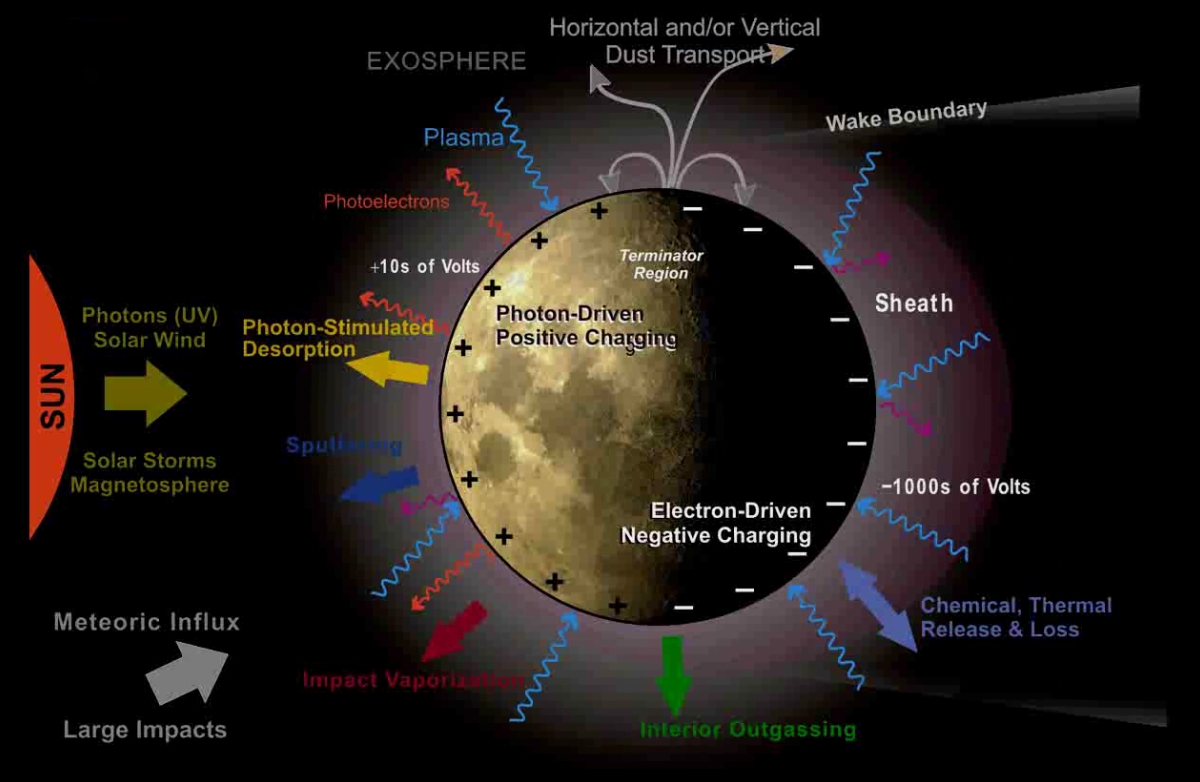
As the Moon slowly rotates once every 708 hours, the line between the sunlit and dark hemispheres (the terminator) slowly moves across the lunar surface.  The day and night hemispheres have different fluxes of electrons from the solar wind and thus, the presence of the terminator can induce an electrical charge in surface materials.  It is postulated that this charge might levitate smaller dust particles such that they would hover above the surface.  LADEE will attempt to detect and map this dust, both by searching for scattered sunlight with its ultraviolet spectrometer and via the direct detection of dust particles in flight with an instrument on the top of the orbiting spacecraft.

The issue of levitated dust is thought to be relevant to the future habitation of the Moon.  If dust is lofted above the surface by the passage of the terminator, the particles could degrade clean surfaces and create a hazard for inhabitants of the Moon.  Such a process could have major effects near the poles of the Moon, areas that are in the near-constant presence of a day-night terminator.  Although it is unlikely that levitated dust on the Moon is an environmental hazard, we currently are working in near total absence of hard data.  Thus, it makes sense to at least try to make some direct measurements of the dust environment around the Moon to assess the importance of this proposed surface process.

LADEE arrived in lunar orbit last Sunday. We wish it well on its mission to give us fresh (and welcome) data on a poorly understood aspect of lunar processes and history.

Related Posts:
LADEE, in 250 km orbit, begins commissioning phase (October 15, 2013)
LADEE Away! (September 7, 2013)
LADEE legacies (September 7, 2013)
LADEE Prelaunch Mission Briefing (September 6, 2013)
ESA prepares for LADEE (July 31, 2013)
LADEE arrives at Wallops Island (June 5, 2013)
LADEE ready to baseline dusty lunar exosphere (June 5, 2013)
First laser comm system ready for launch on LADEE (March 16, 2013)
LADEE project manager update (February 6, 2013)
The Mona Lisa test for LADEE communications (January 21, 2013)
Toxicity of lunar dust (July 2, 2012)
Expectations for the LADEE LDEX (March 23, 2012)
The Dust Management Project (August 9, 2010)
LADEE architecture and mission design (July 6, 2010)
DesertRatS testing electrodynamic dust shield (July 5, 2010)
Dust transport and its importance in the origin of lunar swirls (February 21, 2010)
Dust accumulation on Apollo laser reflectors may indicate a surprisingly fast and
   more dynamic lunar exosphere
(February 16, 2010)
NASA applies low cost lessons to LADEE (January 18, 2010)
Nanotech advances in lunar dust mitigation (August 19, 2009)
Moon dust hazard influenced by Sun's elevation (April 17, 2009)
LADEE launch by Orbital from Wallops Island (April 14, 2009)
Understanding the activation and solution properties of lunar dust
for future lunar habitation
(March 2, 2009)
Respiratory toxicity of lunar highland dust (January 19, 2009)
Toxicological effects of moon dust (June 25, 2008)
Moon dust and duct tape (April 22, 2008)

Originally published October 4, 2013 at his Smithsonian Air & Space blog The Once and Future Moon, Dr. Spudis is a senior staff scientist at the Lunar and Planetary Institute. The opinions expressed are those of the author but are better informed than average.  

Saturday, September 7, 2013

LADEE legacies

LADEE approaches lunar orbit insertion
In planning since 2008, LADEE's reason-for-being emerged from mapping science goals believed essential before any permanent manned presence on the Moon's surface could begin. Fortunately, like LRO, LCROSS and GRAIL, planning and development were well underway and within budget when Congress eventually scrubbed the Constellation brand and manned Altair lander [NASA].
Like "The Blind Men and the Elephant" the most important moving part of many riding along with LADEE to the Moon very much depends on your personal perspective.

What might seem a low-priority mission, accompanied by an appropriate degree of "hype," and has modest fundamental goals under the banner of experimental modular designs and revolutionary high speed communications, - only a 100 day science mission, LADEE has been in development for more than five years. The advanced vehicle also carries with it hopes of some that go back nine times that period, covering a lot of political ground and many changes, even over the relatively short time since its framing and approval.

Gene Cernan's Dusty Spacesuit
Gene Cernan (by Harrison Schmitt) at the close-out of the third and final EVA of Apollo 17, and the last manned visit to the Moon in December 1972. The commander's spacesuit is blackened by exceeding fine lunar dust, more than just a problem of appearances, a real hazard that might have caused hatch and spacesuit seals to fail on a longer surface mission. Constellation planners understood they needed to get a handle on mitigating the hazard posed by omnipresent dust while also gaining an better understanding of the dynamics of a primal airless Moon and its surface before humans return to stay [NASA/JSC].
Few watching the LADEE/Minotaur V launch, critical for Orbital Sciences Corporation, from Wallops Island, are likely to be reminded that the mission owes its existence to the catastrophic loss of Space Shuttle Challenger ten years ago. But it is possible to appreciate the things NASA logically wants emphasized without forgetting LADEE is the beginning of the end of the defunct Constellation program that so many wanted dead and buried in 2009.

LADEE is the last of the unmanned precursor missions once believed essential before "extended human activity" on the Moon could begin. The absolutely remarkable Lunar Reconnaissance Orbiter (LRO) will likely still be orbiting the Moon for a few years after LADEE's mission-terminating guided impact a few months from now, but none of these 21st century American unmanned lunar missions are likely to have have occurred before today without the initial political will put in motion after the report of the Challenger Accident Investigation Board (CAIB).

LRO, LCROSS, GRAIL and now LADEE each owe their reason for being to the loss of a second Space Shuttle and crew in 2003.

LADEE Slides (LEAG 2011 Lunar Exosphere Model (After Halekas))
Very simple schematic of the lunar exosphere. The Moon's surface turned out to be a very dynamic place, after all, with water and exotic metals and volatiles trapped in permanent shadow and also hiding in plain sight [Halekas/LEAG/NASA].
If you've seen the movie footage of Neil Armstrong immediately after setting that first boot on the Moon, backing away from the ladder tethered to the spacecraft then you may have guessed there once was real fear that he might just suddenly disappear in a bog of dust.

Such concern had mostly been dispelled by July 1969, though, after none of the successful unmanned Surveyor landers had encountered anything other than a hard-packed lunar surface. And yet the Moon was correctly presumed to be a very dusty place, constantly "gardened" by micrometeorites (and some not so micro) together with energetic cosmic and solar radiation. Without direct samples, however, no one correctly guessed just how "fine" the dusty powder on the lunar surface could be.

By the time Gene Cernan climbed back into the Apollo 17 lunar module in late 1972 at the end of the program another hazard from this dust had become apparent instead. Rather than sinking into feathery banks of fluffy snowbanks astronauts had to deal instead with a film of electrostatic-charged, clinging and microscopic glassy razor blades. It smelled like gun powder and got into everything, and seemed impossible to clean.

The dark dust of the Moon's immediate surface threatened hatch seals, it scared and tore into spacesuits and, following EVA close-outs became lodged in every conceivable place on an astronaut's body, including up their noses, in their lungs and also lingering in their softest places.

Clearly, "dust mitigation," by then long acknowledged as a real mission and health hazard, came forward as a priority science goal when before new lunar surface expeditions could be carried out. It is accepted as a similar threat to manned travel to Mars, and to the asteroids.

All models of what has become known as a "dynamic" rather than "static" lunar surface include production and trapping of volatile compounds once thought essentially non-existent on the Moon. The speed of this production, it's true dynamics, badly need to be studied before we can return to the Moon with impunity.

Every time an unmanned spacecraft (or a manned lunar module) has landed or taken off from the Moon it's certain some of the dust propelled away by exhaust reaches escape velocity. A larger part of this spiny cloud is put into orbit or on a ballistic path carrying these particles all over the lunar surface. LADEE is designed to establish some natural baseline for this dust before humans start stirring things up. The impact of spacecraft is comparable to the occasional larger natural impact, but hot gas exhaust and its effects is something new.

Painted On Procellarum
The delicate bright dust lanes of the Reiner Gamma "swirl albedo" phenomena, stretching at least 550 km southwest from the dormant volcanic Marius domes to the western frontier of Oceanus Procellarum. Seen here in an LROC WAC mosaic from 2010 under early morning shadows. Detailed laser altimetry confirms little to no topographic component, though it does closely correlate with a well-mapped anomalous crustal magnetic field that must be older than exposure to the Sun and space weathering would allow the surface here to remain so bright. Migration of dust, alternately charged and discharged, dislodged by micro-bombardment is alternately attracted and repelled, here, by the local magnetic field lines, keeping the new dust constantly renewed and gathered no more than a meter or so deep [NASA/GSFC/Arizona State University].
Whether or not this was really a guesstimate or hard science, by the time Congress seriously committed to return to the Moon to stay investigators had acknowledged that a kind of primal state existed there that was worth scientific study for its own sake, before human engaged in any "extended activity." And herein is the compelling interest for funding the LADEE mission. It's one way of discovering the state of the lunar exosphere, its dynamics in and out of Earth's extended magnetic field, under a traveling solar incidence, and through a good sampling of lunar days and nights before things inevitably get busy.

The hyperfast laser-based communications and modular spacecraft design for LADEE will be much talked about in reports about this mission, over the next few days and months. That's "all good," as they say, but it might be worth it to also remember the mission's origins going back before Surveyor or Apollo and also offer at least some thanks to the crew of Columbia. We owe the recent renewed short burst in lunar exploration and our added knowledge of the Moon directly to the loss of that spacecraft and crew.

Lunar Horizon Glow from Clementine (1994)
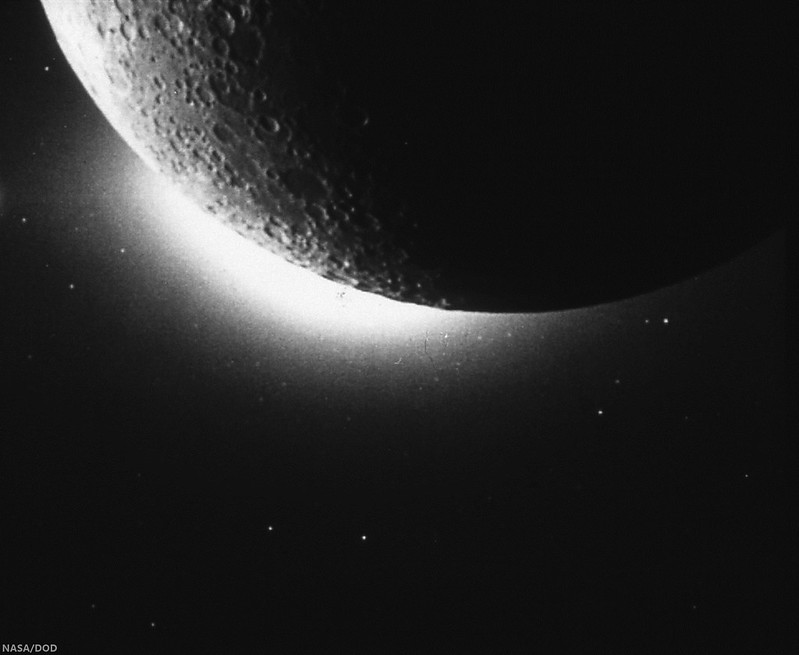
Another lunar mission (and one of only two American missions to the Moon between 1972 and 2009) was also justified as a test platform for new technologies. Now "lost and gone forever," Clementine (1994) spent a year in lunar orbit operated by both NASA and the U.S. Department of Defense. Here Clementine's star-tracking camera finally definitively photographed the "horizon glow" caught previously in the lunar night from the surface by Surveyor 7 and described by Apollo astronauts in lunar orbit twenty years before. This is the phenomena, believed to be back-lit lunar dust, that LADEE is designed to directly sample [NASA/DOD].
And whenever humans eventually return to the Moon for their inevitable extended stay, they will owe much of their preparation to that spacecraft and crew.

Related Posts:
LADEE Prelaunch Mission Briefing (September 6, 2013)
ESA prepares for LADEE (July 31, 2013)
LADEE arrives at Wallops Island (June 5, 2013)
LADEE ready to baseline dusty lunar exosphere (June 5, 2013)
First laser comm system ready for launch on LADEE (March 16, 2013)
LADEE project manager update (February 6, 2013)
The Mona Lisa test for LADEE communications (January 21, 2013)
Toxicity of lunar dust (July 2, 2012)
Expectations for the LADEE LDEX (March 23, 2012)
The Dust Management Project (August 9, 2010)
LADEE architecture and mission design (July 6, 2010)
DesertRatS testing electrodynamic dust shield (July 5, 2010)
Dust transport and its importance in the origin of lunar swirls (February 21, 2010)
Dust accumulation on Apollo laser reflectors may indicate a surprisingly fast and
more dynamic lunar exosphere
(February 16, 2010)
NASA applies low cost lessons to LADEE (January 18, 2010)
Nanotech advances in lunar dust mitigation (August 19, 2009)
Moon dust hazard influenced by Sun's elevation (April 17, 2009)
LADEE launch by Orbital from Wallops Island (April 14, 2009)
Understanding the activation and solution properties of lunar dust
for future lunar habitation
(March 2, 2009)
Respiratory toxicity of lunar highland dust (January 19, 2009)
Toxicological effects of moon dust (June 25, 2008)
Moon dust and duct tape (April 22, 2008)