
 |
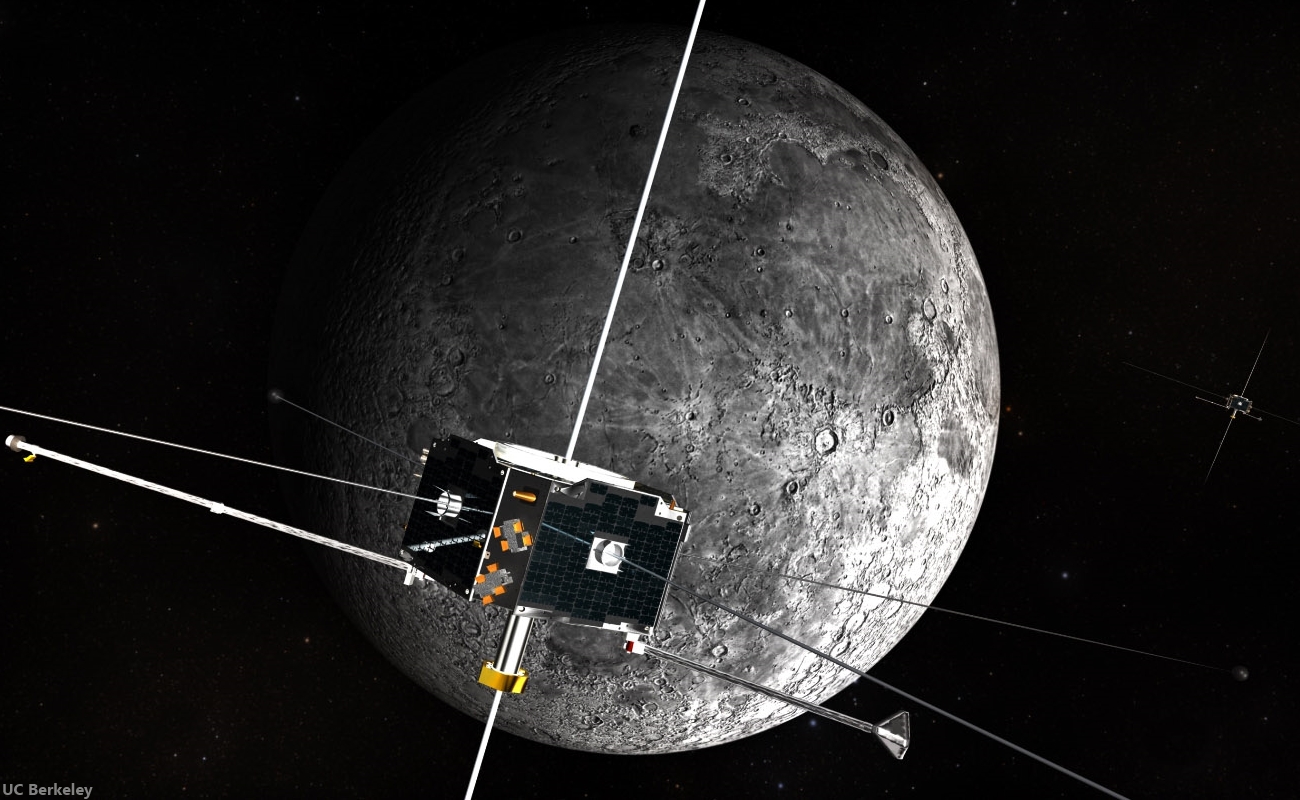
| Following three years in lunar orbit ARTEMIS P1 and P2 are in excellent condition. Originally in Earth orbit, both spacecraft have been in lunar orbit since the summer of 2011 and in space since February 2007 [UC Berkeley]. |
Jasper Halekas
Acting Deputy Principal Investigator ARTEMIS
Space Physics Research Group
Space Sciences Lab
University of California at Berkeley
For those of you who aren't familiar with ARTEMIS, (the Acceleration, Reconnection, Turbulence, and Electrodynamics of the Moon's Interaction with the Sun mission) is an on-going "mission of opportunity," utilizing two of the original five-spacecraft heliophysics constellation THEMIS mission, "re-tasked" to study the interaction of the Moon and it's space plasma environment.
Acting Deputy Principal Investigator ARTEMIS
Space Physics Research Group
Space Sciences Lab
University of California at Berkeley
For those of you who aren't familiar with ARTEMIS, (the Acceleration, Reconnection, Turbulence, and Electrodynamics of the Moon's Interaction with the Sun mission) is an on-going "mission of opportunity," utilizing two of the original five-spacecraft heliophysics constellation THEMIS mission, "re-tasked" to study the interaction of the Moon and it's space plasma environment.
The two ARTEMIS spacecraft have now been in elliptical equatorial orbits around the Moon since 2011 and continue to operate flawlessly. Both probes are in very stable orbits, and the health of the spacecrafts and all instruments remains very good.
Current ARTEMIS lunar investigations are focusing on measuring pickup ions from the exosphere, the electrostatic charging of the surface, the plasma wake, and the interaction of the solar wind with remanent crustal magnetic anomalies. ARTEMIS also uses lunar orbit as a platform to observe the solar wind and (around full Moon) the distant terrestrial magnetotail.
More details on recent studies can be found HERE.
With the LADEE mission about to enter its nominal science orbit, and LRO placing new emphasis on its own measurements of the lunar exosphere, ARTEMIS plays a key role by providing complementary measurements of the solar and terrestrial plasma that acts as both a source and sink for the lunar exosphere, affecting dust released from the lunar surface. Together, these three missions team together to measure the inputs, dynamics, and outputs of the coupled system formed by the Moon's surface, its dusty exosphere and the space environment.
All ARTEMIS data is publicly available on a few-day time scale, and we welcome participation from the community. More information on the mission, instrumentation, data (including summary plots), software, etc. is available from http://artemis.ssl.berkeley.edu, or by contacting the team directly.
 |
| A sample of the elaborate year-long transfer of the two "re-tasked" THEMIS probes from Earth orbit to lunar orbit. ARTEMIS P1 was the first spacecraft navigated to, and performing station-keeping operations around, the Earth-Moon L1 and L2 Lagrangian points [UC Berkeley]. |
More details on recent studies can be found HERE.
With the LADEE mission about to enter its nominal science orbit, and LRO placing new emphasis on its own measurements of the lunar exosphere, ARTEMIS plays a key role by providing complementary measurements of the solar and terrestrial plasma that acts as both a source and sink for the lunar exosphere, affecting dust released from the lunar surface. Together, these three missions team together to measure the inputs, dynamics, and outputs of the coupled system formed by the Moon's surface, its dusty exosphere and the space environment.
All ARTEMIS data is publicly available on a few-day time scale, and we welcome participation from the community. More information on the mission, instrumentation, data (including summary plots), software, etc. is available from http://artemis.ssl.berkeley.edu, or by contacting the team directly.
Related Posts:
Several NASA spacecraft track energy through space (September 26, 2013)
Electric Moon jolts the solar wind (June 2, 2012)
Can we re-purpose space assets? (March 19, 2012)
NASA still studies advantage of lunar resources (February 15, 2012)
Then there were five... in lunar orbit (January 5, 2012)
Twin ARTEMIS probes to study Moon in 3D (July 15, 2011)
ARTEMIS P1 successfully enters lunar orbit (July 1, 2011)
"Dead spacecraft walking" (October 28, 2010)
YouTube demonstration of the re-routing of the two retired THEMIS orbiters to their new bonus mission in lunar orbit.


