Showing posts with label UC Berkeley. Show all posts

Thursday, November 14, 2013

An update on the ARTEMIS twins

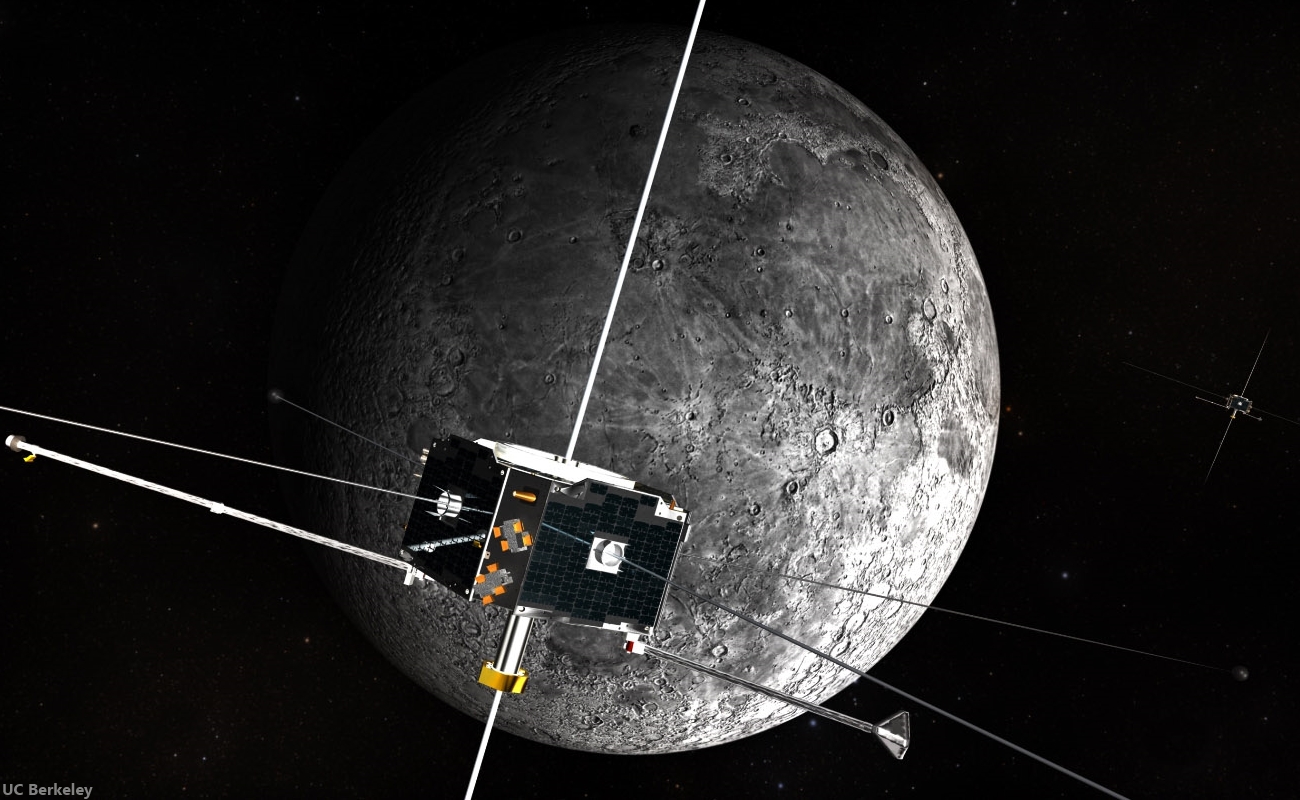
ARTEMIS P1 and P2
Following three years in lunar orbit ARTEMIS P1 and P2 are in excellent condition. Originally in Earth orbit, both spacecraft have been in lunar orbit since the summer of 2011 and in space since February 2007  [UC Berkeley].
Jasper Halekas
Acting Deputy Principal Investigator ARTEMIS
Space Physics Research Group

Space Sciences Lab
University of California at Berkeley

For those of you who aren't familiar with ARTEMIS, (the Acceleration, Reconnection, Turbulence, and Electrodynamics of the Moon's Interaction with the Sun mission) is an on-going "mission of opportunity," utilizing two of the original five-spacecraft heliophysics constellation THEMIS mission, "re-tasked" to study the interaction of the Moon and it's space plasma environment. 

The two ARTEMIS spacecraft have now been in elliptical equatorial orbits around the Moon since 2011 and continue to operate flawlessly. Both probes are in very stable orbits, and the health of the spacecrafts and all instruments remains very good.

ARTEMIS twins
A sample of the elaborate year-long transfer of the two "re-tasked" THEMIS probes from Earth orbit to lunar orbit. ARTEMIS P1 was the first spacecraft navigated to, and performing station-keeping operations around, the Earth-Moon L1 and L2 Lagrangian points [UC Berkeley].
Current ARTEMIS lunar investigations are focusing on measuring pickup ions from the exosphere, the electrostatic charging of the surface, the plasma wake, and the interaction of the solar wind with remanent crustal magnetic anomalies. ARTEMIS also uses lunar orbit as a platform to observe the solar wind and (around full Moon) the distant terrestrial magnetotail.

More details on recent studies can be found HERE.

With the LADEE mission about to enter its nominal science orbit, and LRO placing new emphasis on its own measurements of the lunar exosphere, ARTEMIS plays a key role by providing complementary measurements of the solar and terrestrial plasma that acts as both a source and sink for the lunar exosphere, affecting dust released from the lunar surface. Together, these three missions team together to measure the inputs, dynamics, and outputs of the coupled system formed by the Moon's surface, its dusty exosphere and the space environment.

All ARTEMIS data is publicly available on a few-day time scale, and we welcome participation from the community. More information on the mission, instrumentation, data (including summary plots), software, etc. is available from http://artemis.ssl.berkeley.edu, or by contacting the team directly.

Related Posts:
"Dead spacecraft walking" (October 28, 2010)

YouTube demonstration of the re-routing of the two retired THEMIS orbiters to their new bonus mission in lunar orbit.

Saturday, June 2, 2012

Electric Moon Jolts the Solar Wind

ARTEMIS P1 is seen in relation with the orbit of its twin P2 and the GRAIL twins Ebb and Flow below them in low lunar orbit. Together with with the Lunar Reconnaissance Orbiter NASA presently has five vehicles in lunar orbit. The schematic animation can be explored in startling depth using NASA's online Eyes on the Solar System application [NASA/Science].
With the Moon as the most prominent object in the night sky and a major source of an invisible pull that creates ocean tides, many ancient cultures thought it could also affect our health or state of mind -- the word “lunacy” has its origin in this belief. Now, a powerful combination of spacecraft and computer simulations is revealing that the Moon does indeed have a far-reaching, invisible influence -- not on us, but on the Sun, or more specifically, the solar wind.

The solar wind is a thin stream of electrically conducting gas called plasma that’s constantly blown off the surface of the Sun in all directions at around a million miles per hour. When a particularly fast, dense or turbulent solar wind strikes Earth’s magnetic field, it can generate magnetic and radiation storms that are capable of disrupting satellites, power grids, and communication systems. The magnetic “bubble” surrounding Earth also pushes back on the solar wind, creating a bow shock tens of thousands of miles across over the day side of Earth where the solar wind slams into the magnetic field and abruptly slows from supersonic to subsonic speed.

Unlike Earth, the Moon is not surrounded by a global magnetic field. “It was thought that the solar wind crashes into the lunar surface without any warning or ‘push back’ on the solar wind,” says Dr. Andrew Poppe of the University of California, Berkeley. Recently, however, an international fleet of lunar-orbiting spacecraft has detected signs of the Moon’s presence “upstream” in the solar wind. “We’ve seen electron beams and ion fountains over the Moon’s day side,” says Dr. Jasper Halekas, also of the University of California, Berkeley.

These phenomena have been seen as far as 10,000 kilometers above the Moon and generate a kind of turbulence in the solar wind ahead of the Moon, causing subtle changes in the solar wind’s direction and density. The electron beams were first seen by NASA’s Lunar Prospector (1998-1999), while the Japanese Kaguya (2007-2009) mission, the Chinese Chang’e-1 mission, and the Indian Chandrayaan-1 mission all saw ion plumes at low altitudes. 

NASA’s ARTEMIS mission has now also seen both the electron beams and the ion plumes, plus newly identified electromagnetic and electrostatic waves in the plasma ahead of the Moon, at much greater distances from the Moon. “With ARTEMIS, we can see the plasma ring and wiggle a bit, surprisingly far away from the Moon,” says Halekas. ARTEMIS stands for “Acceleration, Reconnection, Turbulence and Electrodynamics of the Moon’s Interaction with the Sun”.

“An upstream turbulent region called the ‘foreshock’ has long been known to exist ahead of the Earth’s bow shock, but the discovery of a similar turbulent layer at the Moon is a surprise,” said Dr. William Farrell of NASA’s Goddard Space Flight Center in Greenbelt, Maryland. Farrell is lead of the NASA Lunar Science Institute’s Dynamic Response of the Environment At the Moon (DREAM) lunar science center, which contributed to the research.

Computer simulations help explain these observations by showing that a complex electric field near the lunar surface is generated by sunlight and the flow of the solar wind. The simulation reveals this electric field can generate electron beams by accelerating electrons blasted from surface material by solar ultraviolet light. Also, related simulations show that when ions in the solar wind collide with ancient, “fossil” magnetic fields in certain areas on the lunar surface, they are reflected back into space in a diffuse, fountain-shaped pattern. These ions are mostly the positively charged ions (protons) of hydrogen atoms, the most common element in the solar wind.

“It’s remarkable that electric and magnetic fields within just a few meters (yards) of the lunar surface can cause the turbulence we see thousands of kilometers away,” says Poppe. When exposed to solar winds, other moons and asteroids in the solar system should have this turbulent layer over their day sides as well, according to the team.

“Discovering more about this layer will enhance our understanding of the Moon and potentially other bodies because it allows information about conditions very near the surface to propagate to great distances, so a spacecraft will gain the ability to virtually explore close to these objects when it’s actually far away,” said Halekas.

Friday, July 15, 2011

Twin ARTEMIS probes to study Moon in 3D


ARTEMIS P1 and P2 were the outermost two THEMIS probes before maneuvers began July 20, 2009, to swap an Earth orbit for a lunar orbit [UC Berkeley].

Robert Sanders

US Berkeley

On Sunday, July 17, the moon will acquire its second new companion in less than a month. That’s when the second of two probes built by the University of California, Berkeley, and part of NASA’s five-satellite THEMIS mission will drop into a permanent lunar orbit after a meandering, two-year journey from its original orbit around Earth.

The first of the two probes settled into a stable orbit around the moon’s equator on June 27. If all goes well, the second probe will assume a similar lunar orbit, though in the opposite direction, sometime Sunday afternoon. The two spacecraft that comprise the ARTEMIS mission will immediately begin the first observations ever conducted by a pair of satellites of the lunar surface, its magnetic field and the surrounding magnetic environment.

“With two spacecraft orbiting in opposite directions, we can acquire a full 3-D view of the structure of the magnetic fields near the moon and on the lunar surface,” said Vassilis Angelopoulos, principal investigator for the THEMIS and ARTEMIS missions and a professor of space physics at UCLA. “ARTEMIS will be doing totally new science, as well as reusing existing spacecraft to save a lot of taxpayer money.”

“These are the most fully equipped spacecraft that have ever gone to the moon,” added David Sibeck, THEMIS and ARTEMIS project scientist at the Goddard Space Flight Center (GSFC) in Maryland. “For the first time we’re getting a unique, two-point perspective of the moon from two spacecraft, and that will be a major component of our overall lunar research program.”

The transition into a lunar orbit will be handled by engineers at UC Berkeley’s Space Sciences Laboratory (SSL), which serves as mission control both for THEMIS (Time History of Events and Macroscale Interactions during Substorms) and ARTEMIS (Acceleration, Reconnection, Turbulence, and Electrodynamics of the Moon’s Interaction with the Sun).

“We are on our way,” said Manfred Bester, SSL director of operations. “We’re committed.”

What makes the auroras dance?

The five THEMIS satellites (or probes) were launched by NASA on Feb. 17, 2007 to explore how the sun’s magnetic field and million-mile-per-hour solar wind interact with Earth’s magnetic field on Earth’s leeward side, opposite the sun. Within a year and a half, they had answered the mission’s primary question: Where and how do substorms in the Earth’s magnetosphere – which make the auroras at the north and south poles dance – originate?

The answer: the storms originate deep in the planet’s shadow, about a third of the way to the moon, where magnetic field lines snap, reconnect and unleash a storm of energy that funnels to the poles and makes the atmosphere glow in reds and greens. Large storms can wreak havoc on satellites, power grids and communications systems.

Mission accomplished, the THEMIS team was eager to divert two of the probes to the moon to extend their magnetic field studies farther into space. One key reason was that the two probes most distant from Earth would soon die because, with too much time spent in Earth’s shadow, their solar-powered batteries would discharge.


Side view of the ARTEMIS P1 probe's orbit in 2010 as it cruised around the two Earth-moon Lagrange points. In 2011 it maneuvered into a permanent orbit around the moon [NASA].

“That was an engineering challenge; this is the first mission where we’ve piloted into a lunar orbit spacecraft not designed to go there,” said Daniel Cosgrove, the UC Berkeley engineer who controls the spacecrafts’ trajectories. The probes’ small thrusters, for example, only push down and sideways. The probes are also spinning, which makes maneuvering even more difficult.

Also, last year probe P1 lost a spherical sensor from the end of one of four long wires that protrude from the spacecraft to measure electrical fields in space. The probable cause was a micrometeorite that cut a 10-foot section off of the 82-foot wire and caused it to retract into its original spherical housing, sending the “little black sphere flying through the solar system,” Bester said.

“All five spacecraft have been built by a very talented team with enormous attention to detail,” he said, predicting that the ARTEMIS probes could survive for another 10 years, longer than the three remaining THEMIS probes, which repeatedly fly in and out of Earth’s dangerous Van Allen radiation belt.

Lunar orbit

Once the second probe, P2, is in orbit, the two ARTEMIS satellites will graze the lunar surface once per orbit – approaching within a few tens of kilometers – in a belt ranging 20 degrees above and below the equator while recording electric and magnetic fields and ion concentrations.

“When the moon traverses the solar wind, the magnetic field embedded in the rocks near the surface interacts with the solar wind magnetic field, while the surface itself absorbs the solar wind particles, creating a cavity behind the moon,” Angelopoulos said. “We can study these complex interactions to learn much about the moon as well as the solar wind itself from a unique two-point vantage that reveals for the first time 3-D structures and dynamics.”

Sibeck noted that NASA’s twin STEREO spacecraft, launched in 2006, already provide a 3-D perspective on the sun’s large-scale magnetic fields. “THEMIS and ARTEMIS study the microscale processes, which we now know run the system,” he said.

One goal of the ARTEMIS mission is to look for plasmoids, which are hot blobs of ionized gas or plasma.

“THEMIS found evidence that magnetic reconnection propels hot blobs of plasma both towards and away from the Earth, and we want to find out how big they are and how much energy they carry,” Angelopoulos said. “Plasmoids could be tens of thousands of kilometers across.”

“THEMIS found the cause and now ARTEMIS will study the consequences, which are likely massive and global,” Sibeck said.

The spacecraft also will study the surface composition of the moon by recording the solar wind particles reflected or scattered from the surface and the ions sputtered out of the surface by the wind.

“These measurements can tell us about the properties of the surface, from which we can infer the formation and evolution of the surface over billions of years,” Angelopoulos said.

The two ARTEMIS probes will join NASA’s Lunar Reconnaissance Orbiter, which has been orbiting the moon since 2009 taking high-resolution photographs and looking for signs of water ice. In September, NASA is scheduled to launch two GRAIL (Gravity Recovery and Interior Laboratory) spacecraft to map the moon’s gravitational field, and in 2013, the agency plans to launch LADEE (Lunar Atmosphere and Dust Environment Explorer) to characterize the lunar atmosphere and dust environment.

“ARTEMIS will provide context for the LADEE mission,” Sibeck said.

Three other non-functioning satellites remain in orbit around the moon: two subsatellites of Japan’s lunar orbiter, Kaguya, which was guided to a crash on the surface in 2009; and India’s Chandrayaan-1, which lost communication with Earth that same year. China’s second lunar orbiter, Chang’e 2, left the moon for interplanetary space on June 8.

For more information:

First ARTEMIS Spacecraft Successfully Enters Lunar Orbit
(NASA press release, June 28, 2011)
Out of THEMIS, ARTEMIS: Earth’s loss is moon’s gain
(UC Berkeley press release, Oct. 27, 2010)
THEMIS mission identifies power behind northern lights
(UC Berkeley press release, July 24, 2008)
Successful launch of UC Berkeley’s THEMIS satellites
(UC Berkeley press release, Jan. 17, 2007)

Friday, July 1, 2011

ARTEMIS P1 successfully enters lunar orbit


The predicted path for ARTEMIS P1 as it enters lunar orbit [NASA/Goddard/D. Folta]. Play/Download Animations HERE.

Karen C. Fox

NASA/Goddard

On June 22, ARTEMIS P1 began firing its thrusters to move out of its kidney-shaped "libration" orbit on one side of the moon, where it has been since January. Three successive maneuvers were used to kick the spacecraft out of its orbit and send it on a trajectory toward the moon.

It continued on that path until June 27 at 10:04 a.m. EDT when the spacecraft was about 2,400 miles from the moon. At that point, flight engineers at UC Berkeley issued the first commands to move it into orbit around the moon. Two more maneuvers helped fine-tune the position, and as of 12:30 p.m. EDT, ARTEMIS P1 is now in lunar orbit.

"ARTEMIS is the first mission ever to orbit the moon's Lagrangian points."

This is the culmination of a complex, two-year journey that relied predominantly on gravity boosts and used minimal fuel. The path from its orbit around Earth to the moon was developed and orchestrated by engineers at the NASA's Goddard Space Flight Center in Greenbelt, Md., NASA's Jet Propulsion Lab in Pasadena, Calif., and University of California at Berkeley.

The engineers will watch the ARTEMIS P1 orbit closely over the next few days in case additional adjustments are required. Engineers are set to move the second spacecraft, ARTEMIS P2, into position on July 17.

ARTEMIS is the first mission ever to orbit the moon's Lagrangian points – points on either side of the moon where the moon and Earth's gravity balance perfectly. It is also the first to attempt to move from the Lagrangian to lunar orbit.

The ARTEMIS mission uses two of the five in-orbit spacecraft from another NASA Heliophysics constellation of satellites called THEMIS that were launched in 2007 and successfully completed their mission in 2010. The ARTEMIS mission allowed NASA to repurpose two in-orbit spacecraft to extend their useful science mission.

Follow the full story, HERE.

Tuesday, October 20, 2009

Update on new lunar phase of THEMIS mission

Michael Barkoviak
UC Berkeley Daily Tech

"The NASA THEMIS satellite mission, which launched in 2007 ... using five identical satellites" in Earth orbit "researchers are able to successfully measure the local magnetic field and properties of the particles trapped in the magnetic field."

"Two of the five THEMIS probes are now on their way to the moon, for a new life studying the lunar environment"... "Although the two-year 'prime mission phase' of THEMIS is now over, three of the THEMIS probes, closest to the Earth, will continue to operate (for many years) collecting scientific data about the solar wind interaction, space weather, geomagnetic storms, etc."

"Although there are concerns of fuel levels, researchers will have the probes utilize complex orbits that will involve flying them by the moon using Lagrange points to help reduce fuel consumption."

Instead of launching a new mission, researchers decided to send the probes to the moon. Dubbed 'ARTEMIS,' the two space probes ... will conduct several flybys of the lunar surface later this year, then will go into orbit.

Read the original article, HERE.

Sunday, April 26, 2009

ARTEMIS to Lagrange points to lunar orbit

THEMIS P1 (TH-B) in red and P2 (TH-C) orbit between this summer's orbit raise maneuvers and October 2010 when they will capture the Lagrange points between Earth and Moon. After six months in these orbits, P1 and P2 will be inserted into Lunar orbits where they will make measurements of the Lunar warke, the magnetotail, and solar wind through September 2012. See Larger Image HERE.

THEMIS will continue with five probes, saving two by sending them on a long and important detour through Earth-Moon Lagrange points to equatorial lunar orbit.

Sometime in May final approval should be given to save two of the five co-orbiting satellites in the successful THEMIS constellation by diverting these to Earth-Moon Lagrange points and eventually into lunar orbit for a 17 month stay.

Needed study of the lunar exosphere and of the Moon's wake within the solar wind and within the magnetotail of Earth will be added to THEMIS exceptional primary mission in a challenging and complex set of orbital manuvers.

ARTEMIS will become a distinct component of THEMIS and its ongoing continuing study of the solar wind and its complex interactions with Earth's magnetosphere, as an expected sharp increase in solar activity as Solar Cycle 24 gets underway, while also gathering a unique and needed dataset in vicinity of the Moon prior to extended human activity.

THEMIS (Time History of Events and Macroscale Interactions during Substorms) should be expanded to include ARTEMIS (Acceleration, Reconnection Turbulence and Electrodynamics of Moon's Interaction with the Sun).

In planning for THEMIS at the University of California at Berkeley, principal investigator V. Angelopoulos and his team knew they would have a problem soon after their primary mission was accomplished. If the P1 and P2 satellites in the five probe constellation were not adjusted in their orbits. It was announced March 20 that the THEMIS primary mission had been completed. Each of the five probes remain in excellent health.

Nevertheless, because of their initial orbital configurations, P1 and P2 are eventually headed into extended periods in Earth's shadow, and outside their solar battery's recharging design range. That initial orbital configuration was obviously necessary because the five probes set in motion a vast opportunity to gather data and make new discoveries, documented in at least 30 papers.

The new "ARTEMIS component" of THEMIS will begin an ascent toward the Moon beginning late 2009, and the basic five vehicle mission will be able to continue. As the ARTEMIS component is manuvered through the Earth-Moon Lagrange points, and eventually into lunar orbit, study can begin strongly complementing the Lunar Reconnaissance Orbiter and LADEE missions.

The complex orbital manuver will take nearly two years, but will enabling THEMIS to continue it's baseline mission without the loss of two of the five probes. (See diagram, page 29 of the Proposal submitted by the THEMIS team last summer, HERE.)


Road Cleared for ARTEMIS (THEMIS News & Events, February 27, 2009)

On Feb 24, 2009 ARTEMIS passed its mini-Confirmation review at (Goddard Space Flight Center). Therefore, the road has been cleared for the upcoming mission implementation. There will be a delta (pico) review in early May to ensure progress with contingency planning is adequate, but we don't anticipate any problems. Congratulations to the implementation teams at UCB, JPL and GSFC for their outstanding progress to-date!

The essence of the comments of the review board was that the ARTEMIS team has done an outstanding job, especially considering the little (8 months) time that has passed since the Senior Review go-ahead. Of course, it was recognized that there is still a lot of work ahead, but the team yesterday presented a reasonable, viable plan, which conveys confidence they can deliver. Even though this is a challenging project, given the resources and time available, this condition was deemed acceptable considering that the THEMIS probes are already operating well and this is an extended-phase mission. The reviewers have come up with less than a handful of requests for action, which I am certain will strengthen the project, as it moves towards the Orbit Raise Maneuvers in the upcoming summer. Tentatively the ORMs start July 9th.
Please find the extended THEMIS proposal HERE.
Please find the Senior Review report HERE.