Showing posts with label ARTEMIS. Show all posts

Thursday, November 14, 2013

An update on the ARTEMIS twins

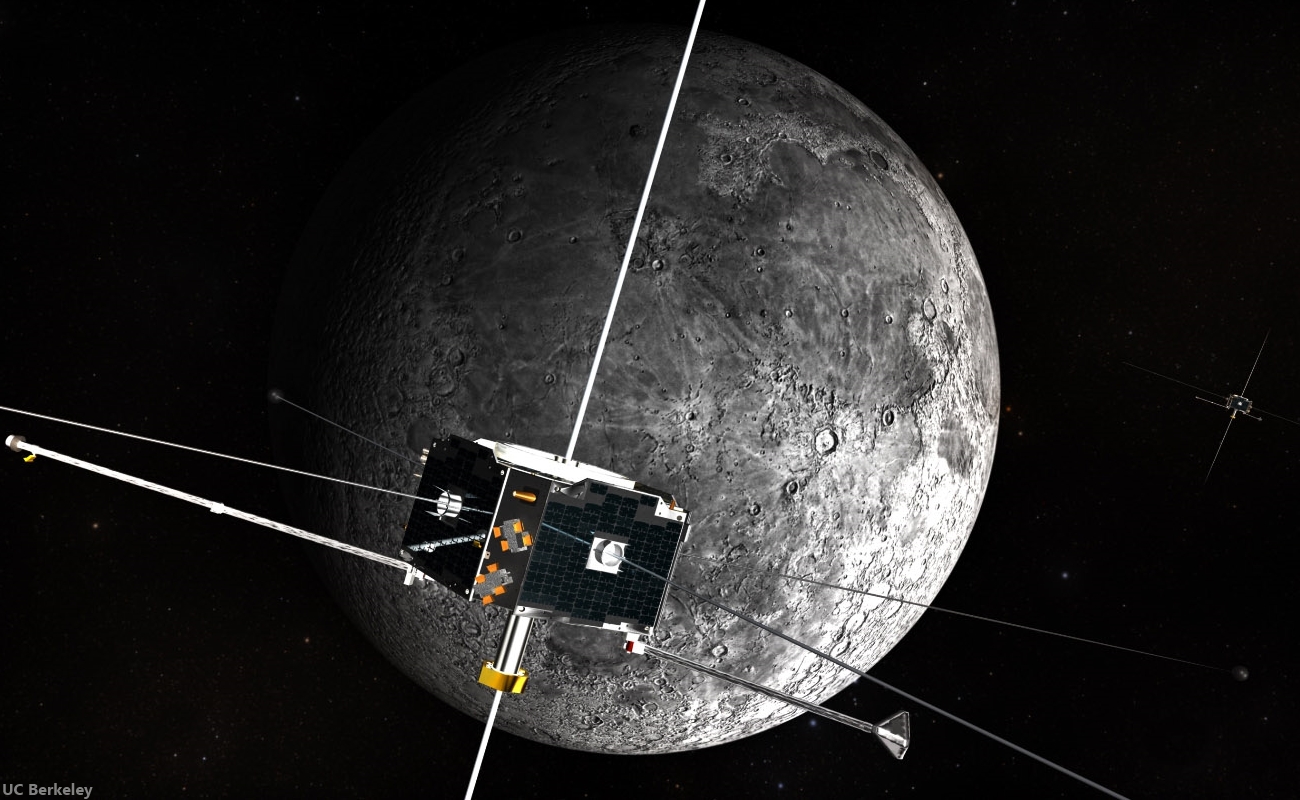
ARTEMIS P1 and P2
Following three years in lunar orbit ARTEMIS P1 and P2 are in excellent condition. Originally in Earth orbit, both spacecraft have been in lunar orbit since the summer of 2011 and in space since February 2007  [UC Berkeley].
Jasper Halekas
Acting Deputy Principal Investigator ARTEMIS
Space Physics Research Group

Space Sciences Lab
University of California at Berkeley

For those of you who aren't familiar with ARTEMIS, (the Acceleration, Reconnection, Turbulence, and Electrodynamics of the Moon's Interaction with the Sun mission) is an on-going "mission of opportunity," utilizing two of the original five-spacecraft heliophysics constellation THEMIS mission, "re-tasked" to study the interaction of the Moon and it's space plasma environment. 

The two ARTEMIS spacecraft have now been in elliptical equatorial orbits around the Moon since 2011 and continue to operate flawlessly. Both probes are in very stable orbits, and the health of the spacecrafts and all instruments remains very good.

ARTEMIS twins
A sample of the elaborate year-long transfer of the two "re-tasked" THEMIS probes from Earth orbit to lunar orbit. ARTEMIS P1 was the first spacecraft navigated to, and performing station-keeping operations around, the Earth-Moon L1 and L2 Lagrangian points [UC Berkeley].
Current ARTEMIS lunar investigations are focusing on measuring pickup ions from the exosphere, the electrostatic charging of the surface, the plasma wake, and the interaction of the solar wind with remanent crustal magnetic anomalies. ARTEMIS also uses lunar orbit as a platform to observe the solar wind and (around full Moon) the distant terrestrial magnetotail.

More details on recent studies can be found HERE.

With the LADEE mission about to enter its nominal science orbit, and LRO placing new emphasis on its own measurements of the lunar exosphere, ARTEMIS plays a key role by providing complementary measurements of the solar and terrestrial plasma that acts as both a source and sink for the lunar exosphere, affecting dust released from the lunar surface. Together, these three missions team together to measure the inputs, dynamics, and outputs of the coupled system formed by the Moon's surface, its dusty exosphere and the space environment.

All ARTEMIS data is publicly available on a few-day time scale, and we welcome participation from the community. More information on the mission, instrumentation, data (including summary plots), software, etc. is available from http://artemis.ssl.berkeley.edu, or by contacting the team directly.

Related Posts:
"Dead spacecraft walking" (October 28, 2010)

YouTube demonstration of the re-routing of the two retired THEMIS orbiters to their new bonus mission in lunar orbit.

Saturday, June 2, 2012

Electric Moon Jolts the Solar Wind

ARTEMIS P1 is seen in relation with the orbit of its twin P2 and the GRAIL twins Ebb and Flow below them in low lunar orbit. Together with with the Lunar Reconnaissance Orbiter NASA presently has five vehicles in lunar orbit. The schematic animation can be explored in startling depth using NASA's online Eyes on the Solar System application [NASA/Science].
With the Moon as the most prominent object in the night sky and a major source of an invisible pull that creates ocean tides, many ancient cultures thought it could also affect our health or state of mind -- the word “lunacy” has its origin in this belief. Now, a powerful combination of spacecraft and computer simulations is revealing that the Moon does indeed have a far-reaching, invisible influence -- not on us, but on the Sun, or more specifically, the solar wind.

The solar wind is a thin stream of electrically conducting gas called plasma that’s constantly blown off the surface of the Sun in all directions at around a million miles per hour. When a particularly fast, dense or turbulent solar wind strikes Earth’s magnetic field, it can generate magnetic and radiation storms that are capable of disrupting satellites, power grids, and communication systems. The magnetic “bubble” surrounding Earth also pushes back on the solar wind, creating a bow shock tens of thousands of miles across over the day side of Earth where the solar wind slams into the magnetic field and abruptly slows from supersonic to subsonic speed.

Unlike Earth, the Moon is not surrounded by a global magnetic field. “It was thought that the solar wind crashes into the lunar surface without any warning or ‘push back’ on the solar wind,” says Dr. Andrew Poppe of the University of California, Berkeley. Recently, however, an international fleet of lunar-orbiting spacecraft has detected signs of the Moon’s presence “upstream” in the solar wind. “We’ve seen electron beams and ion fountains over the Moon’s day side,” says Dr. Jasper Halekas, also of the University of California, Berkeley.

These phenomena have been seen as far as 10,000 kilometers above the Moon and generate a kind of turbulence in the solar wind ahead of the Moon, causing subtle changes in the solar wind’s direction and density. The electron beams were first seen by NASA’s Lunar Prospector (1998-1999), while the Japanese Kaguya (2007-2009) mission, the Chinese Chang’e-1 mission, and the Indian Chandrayaan-1 mission all saw ion plumes at low altitudes. 

NASA’s ARTEMIS mission has now also seen both the electron beams and the ion plumes, plus newly identified electromagnetic and electrostatic waves in the plasma ahead of the Moon, at much greater distances from the Moon. “With ARTEMIS, we can see the plasma ring and wiggle a bit, surprisingly far away from the Moon,” says Halekas. ARTEMIS stands for “Acceleration, Reconnection, Turbulence and Electrodynamics of the Moon’s Interaction with the Sun”.

“An upstream turbulent region called the ‘foreshock’ has long been known to exist ahead of the Earth’s bow shock, but the discovery of a similar turbulent layer at the Moon is a surprise,” said Dr. William Farrell of NASA’s Goddard Space Flight Center in Greenbelt, Maryland. Farrell is lead of the NASA Lunar Science Institute’s Dynamic Response of the Environment At the Moon (DREAM) lunar science center, which contributed to the research.

Computer simulations help explain these observations by showing that a complex electric field near the lunar surface is generated by sunlight and the flow of the solar wind. The simulation reveals this electric field can generate electron beams by accelerating electrons blasted from surface material by solar ultraviolet light. Also, related simulations show that when ions in the solar wind collide with ancient, “fossil” magnetic fields in certain areas on the lunar surface, they are reflected back into space in a diffuse, fountain-shaped pattern. These ions are mostly the positively charged ions (protons) of hydrogen atoms, the most common element in the solar wind.

“It’s remarkable that electric and magnetic fields within just a few meters (yards) of the lunar surface can cause the turbulence we see thousands of kilometers away,” says Poppe. When exposed to solar winds, other moons and asteroids in the solar system should have this turbulent layer over their day sides as well, according to the team.

“Discovering more about this layer will enhance our understanding of the Moon and potentially other bodies because it allows information about conditions very near the surface to propagate to great distances, so a spacecraft will gain the ability to virtually explore close to these objects when it’s actually far away,” said Halekas.

Monday, March 19, 2012

Can we re-purpose space assets?

Express-AM4: Total loss or a new purpose?
Paul D. Spudis
The Once and Future Moon
Smithsonian Air & Space
 
The Russians launched a communications satellite, the Astrium Express-AM4, in August 2011.  After a failure in its Proton launch vehicle (resulting in loss of contact and control), it was presumed lost.  However, it survived and is trapped in a high-inclination orbit – a 20,000 by 650 km elliptical orbit (inclined 52° from the equator).  Forcing it to operational geosynchronous (GEO) orbit would take most of its fuel, leaving the satellite with a very limited useful lifetime.  The satellite was insured and payment has been collected on the mishap of the launch but the Russians have yet to decide on what to do with this wayward satellite circling Earth in the “wrong” orbit.  Recently they indicated that there is enough fuel to conduct a controlled re-entry and descent, guiding the satellite to a safe, watery grave somewhere in one of the Earth’s oceans.

Must this be the fate of a newly orbiting space asset?  True, it is in the wrong orbit for its original use as a commercial communications satellite, originally headed for 36,000 km above Earth to GEO, but what if instead it were repurposed?  A company called Polar Broadband has an interesting idea about turning this mishap around and using it for a good purpose.  Though not for its original users, they see a way to use this communication satellite for an assignment it is now suited to do.*  Polar Broadband envisions moving this satellite into an elongate orbit with a 24-hour period and apogee (high point) over its southern extreme (52° S) because a satellite in such an orbit can do service as a communications resource for Antarctica.

Antarctica!?  It’s a remote barren landscape!  True it is remote, but the population of this lonely continent swells greatly during southern summer when hundreds of scientists descend down under to conduct a wide variety of scientific studies.  Although there are a few central bases (like McMurdo), communications with teams in the field can be spotty and unreliable.  If this satellite could be positioned into a new orbit, it would appear in the sky for about 16 hours each day, allowing predictable, reliable communications from a variety of locations in Antarctica, including the difficult to access Amundsen-Scott South Polar Station.

An attempt to repurpose this satellite hardware appears to be a win-win for everybody.  The National Science Foundation gets a new satellite asset for safe and productive communications with and operations in the Antarctic, Polar Broadband gets to sell this service to the NSF, and by giving a green light to this endeavor, the Russians will have benefited the international scientific community.  There are no guarantees but the possibility for these rewards make the attempt worthwhile.

Two of the original 5-vehicle swarm having completed the THEMIS mission were re-purposed to become ARTEMIS, exploring the solar-terrestrial and lunar electro-magnetic plasma environment, arriving in lunar orbit after a long, low energy transfer maneuver by way of LaGrange points in 2011. Now these robust spacecraft are part of an American team totaling five unmanned probes now in orbit around the Moon [NASA].
This experiment also holds relevance for future lunar exploration.  What is being proposed for Express-AM4 is to create a reliable satellite  system so that a distant base can communicate with its mission control for science and operations.  Building and operating a working outpost at one of the lunar poles will require high bandwidth communication to remotely control robotic assets and return volumes of scientific and engineering data to Earth.  Acquiring and gaining operational experience with polar communications is a good analog to doing so around the Moon, where we will require similar communications relays with long dwell times over the poles for access to polar spacecraft and robotic vehicles.

The Russians have said that the satellite has suffered extensive radiation damage as a result of its continued passage through the Van Allen radiation belts.  But in its new guise, the satellite would receive far less radiation exposure than it would by going to GEO.  Put to new use, this “lost” satellite could provide vital communications to and between scientific expeditions and assets in Antarctica and provide us with experience relevant to future operations on the Moon.  A wayward communications satellite has presented us with an unexpected and rich opportunity.

Originally published March 19, 2012 at his Smithsonian Air & Space blogThe Once and Future Moon, Dr. Spudis is a senior staff scientist at the Lunar and Planetary Institute. The opinions expressed are those of the author and are better informed than average.

*Update: Controllers deorbited Astrium Express AM4 on Sunday, March 25, despite the last-minute bid to salvage the spacecraft.

Wednesday, February 15, 2012

NASA still studies advantage of lunar resources

Complex low-energy transfer orbit utilized to move outermost two of five original THEMIS mission spacecraft into lunar orbit, where they became the second and third of five spacecraft the U.S. currently has in orbit around the Moon. In turn, ARTEMIS L1 and L2 became the first spacecraft to orbit Lagrange Points 1 and 2 (L1 and L2). Among many pathways to deep space under study a semi-permanent manned station in orbit around L2 while simultaneously utilizing lunar materials to manufacture and fuel spacecraft and life support, offers what may prove to be a less expensive avenue into deep space.  [NASA/ARTEMIS].
Brian Palmer
Special to The Washington Post
via
Bangor Daily News

Remember gazing up at the moon and wondering what it’s made of? Some pretty smart people are doing the same thing today. And it’s not childlike curiosity that’s motivating them: It’s money.

Interest in materials known as rare earth elements surged when China temporarily blocked exports in 2010. Manufacturers started looking everywhere for new supplies of gadolinium and terbium and other elements used in televisions, hybrid car batteries and many other products.

The search took them to such places as California, the Pacific ocean floor and the moon. The moon’s stock is up even among politicians, as Newt Gingrich and Mitt Romney recently sparred over whether it makes sense to invest in lunar mining.

Read the full article HERE.


A Youtube video describes the complex orbits the two ARTEMIS spacecraft utilized to attain lunar orbit in 2011.

Sunday, September 11, 2011

The thinking behind the GRAIL twins


A useful view of our heterogeneous Moon. A practical illustration of the thinking behind the GRAIL project. From several thousand kilometers above the southern hemisphere and just below the equator of the lunar Farside it’s easier to see our Moon is “lumpy;” perhaps like the asteroids, it's own mass isn't high enough to crush it into a unified solid. From the standpoint of gravity the Moon retains the the memory of the smaller solid and semi-solid bodies from both before and after it's original formation. So nothing stays in close orbit around the Moon for very long without getting a frequent boost, and such boosts need fuel and fuel eventually runs out. This false color map of the lunar surface shows, in low resolution, differences from average elevation, or datum. Mare Orientale is on the right, and just beyond, so a crescent of the Nearside’s is visible. The expanse of the Farside here is defined, by the ancient South Pole Aitken basin, with the Moon's thinnest crusts, below center left, and by the Moon’s highest elevations and thickest crusts in the Farside highlands spread above the SPA rim (yellow box shows field of view in the next illustration [NASA/GSFC/MSFC/LOLA/LMMP/LP].

The Lunar Reconnaissance Orbiter (LRO) has orbited the Moon over 10,000 times since June 2009, mostly in a low and circular polar orbit. It requires a monthly boost to keep its record-breaking mission going. A common demonstration of the Moon's mass concentration (MASCON) problem is a thought experiment. A future astronaut stands on the rim of the Nearside impact basin Mare Imbrium holding a weight suspended a meter below a gloved hand sees that it doesn't hang straight down. Instead it hangs angling slightly toward the center of the basin hundreds of kilometers away. Anything in orbit is alternately tugged or gains slack changing its speed, causing it to eventually crash. This inconvenience, when carefully recorded and studied, is also a good way of mapping the Moon's interior in 3D.

The elevation map above shows how radically different the Moon’s Farside is from the familiar Nearside. In a photographs the extent of the 4 billion year-old SPA basin and the higher ground and its rim don’t stand out nearly as well. The map is plotted from millions of laser points measured from LRO's orbit to and from the lunar surface by the LOLA instrument, shown here using the ILIADS program available from NASA Marshall Space Flight Center. The yellow rectangle shows the field of view shown in an August 2011 release of LOLA science from the Goddard Space Flight Center.


NASA/GSFC, August 15, 2011 - Twenty-five years have passed since seven brave astronauts lost their lives in the Challenger accident. As the Shuttle program comes to an end, we are reminded of those who lost their lives in the pursuit of human exploration. Shortly after the accident, the Challenger astronauts were memorialized by having lunar craters named after them. These seven craters, located on the far side of the Moon in the Apollo Basin, expose deep portions of the lunar crust.

This LOLA image reveals that the depths of McNair and Jarvis craters, in particular, reach nearly 7 km below the lunar datum (the Moon's equivalent of 'sea level'). The depth of McNair and Jarvis is due to their placement within the large Apollo Basin (an existing topographic low) as well as the Apollo Basins location in the even larger South Pole-Aitken Basin. When combined with data from other LRO instruments such as LROC and Diviner, and instruments aboard other spacecraft such as the Moon Mineralogy Mapper (M3) aboard Chandrayaan-1, the complex nature of the Challenger craters is revealed. Data from the M3 instrument reveal that Jarvis crater's composition may represents a deep portion of the lunar crust.

References

Steigerwald, B. (2010) "Biggest, Deepest Crater Exposes Hidden, Ancient Moon," June 2, 2011.
Robinson, M. (2011) "Challenger Astronauts Memorialized on the Moon," January 28, 2011, LROC
Petro, N., et al. (2010) "Lower Crustal Materials Exposed in the Apollo Basin Revealed Using Moon Mineralogy Mapper (M3) Data," 41st Lunar and Planetary Science Conference, #1802, March 2010.

LOLA original map: small | large 


Japan’s lunar orbiter Kaguya (SELENE-1, 2007-2009) vastly added to our knowledge about the “hidden Moon” originally gathered through the Apollo era and afterward, stitched together by 2005. Along with the first HDTV from lunar orbit, Kaguya was a platform for a variety of instruments, including laser altimetry, like LRO. The Kaguya LALT system itself built up an elevation map that is only very recently being surpassed by LOLA during the past two years.

Using their links with Kaguya, with its sub-satellite R-SAT, and in a manner very much like the mission plan for GRAIL-A and B, JAXA investigators delicately measured Doppler shift and subtle light-speed changes between each orbiting spacecraft and with the ground to built-up a detailed map of the Moon’s "gravimetric anomalies."

Together with the unprecedented detail of the Moon’s crustal thicknesses, seen in maps like the one below, Kaguya presented scientists with new and very much more detailed faces of the Moon. Kaguya investigators also helped refine the elusive center of the Moon, from within 20 to 2 kilometers, much more.


The relative thickness of the lunar crust as teased out by Japan's Kaguya orbiter and its sub-satellite R-SAT. The Moon's MASCONS and 'negative gravity anomalies' don't necessarily manifest themselves in surface features, like the one associated with Mare Imbrium.[JAXA].

GRAIL-A and B will join LRO and the recommissioned ARTEMIS twins for a grand total five American unmanned lunar missions, all orbiting the Moon at the same time by the end of the year. The skies above the Moon will become nearly as crowded as those of Mars.

The GRAIL twins will pick up the task of mapping our lumpy Moon’s mass, ARTEMIS the intricacies of the Moon’s plasma wake and its interaction with Solar wind as the Moon orbits through Earth’s magneto-tail with LRO continuing to map the lunar surface from more lasting, slightly higher polar orbit.

All this latter-day renewed interest in the Moon began as preparation for an eventual return, inspired by the loss of Columbia in 2003. That original timeline for renewed, extended human activity on the Moon may seem much further away once again, for the moment, but these unmanned “precursor missions” set into motion through the vagaries of reaction to tragedy or short-term public policy shifts are well along in the pipeline, on time and under budget.


LROC Wide Angle Camera (WAC) monochrome (604nm) mosaic of northeastern Apollo basin, from observations in LRO orbits 2068 and 2069, December 8, 2009; field of view roughly 120 km, resolution 78 meters per pixel, incidence 70° The depth of the interior floor of Jarvis and McNair, the larger and smaller of the two co-joined craters, respectively, and the largest feature seen above, are roughly 7,000 meters below lunar mean elevation. [NASA/GSFC/Arizona State University].

Friday, July 15, 2011

Twin ARTEMIS probes to study Moon in 3D


ARTEMIS P1 and P2 were the outermost two THEMIS probes before maneuvers began July 20, 2009, to swap an Earth orbit for a lunar orbit [UC Berkeley].

Robert Sanders

US Berkeley

On Sunday, July 17, the moon will acquire its second new companion in less than a month. That’s when the second of two probes built by the University of California, Berkeley, and part of NASA’s five-satellite THEMIS mission will drop into a permanent lunar orbit after a meandering, two-year journey from its original orbit around Earth.

The first of the two probes settled into a stable orbit around the moon’s equator on June 27. If all goes well, the second probe will assume a similar lunar orbit, though in the opposite direction, sometime Sunday afternoon. The two spacecraft that comprise the ARTEMIS mission will immediately begin the first observations ever conducted by a pair of satellites of the lunar surface, its magnetic field and the surrounding magnetic environment.

“With two spacecraft orbiting in opposite directions, we can acquire a full 3-D view of the structure of the magnetic fields near the moon and on the lunar surface,” said Vassilis Angelopoulos, principal investigator for the THEMIS and ARTEMIS missions and a professor of space physics at UCLA. “ARTEMIS will be doing totally new science, as well as reusing existing spacecraft to save a lot of taxpayer money.”

“These are the most fully equipped spacecraft that have ever gone to the moon,” added David Sibeck, THEMIS and ARTEMIS project scientist at the Goddard Space Flight Center (GSFC) in Maryland. “For the first time we’re getting a unique, two-point perspective of the moon from two spacecraft, and that will be a major component of our overall lunar research program.”

The transition into a lunar orbit will be handled by engineers at UC Berkeley’s Space Sciences Laboratory (SSL), which serves as mission control both for THEMIS (Time History of Events and Macroscale Interactions during Substorms) and ARTEMIS (Acceleration, Reconnection, Turbulence, and Electrodynamics of the Moon’s Interaction with the Sun).

“We are on our way,” said Manfred Bester, SSL director of operations. “We’re committed.”

What makes the auroras dance?

The five THEMIS satellites (or probes) were launched by NASA on Feb. 17, 2007 to explore how the sun’s magnetic field and million-mile-per-hour solar wind interact with Earth’s magnetic field on Earth’s leeward side, opposite the sun. Within a year and a half, they had answered the mission’s primary question: Where and how do substorms in the Earth’s magnetosphere – which make the auroras at the north and south poles dance – originate?

The answer: the storms originate deep in the planet’s shadow, about a third of the way to the moon, where magnetic field lines snap, reconnect and unleash a storm of energy that funnels to the poles and makes the atmosphere glow in reds and greens. Large storms can wreak havoc on satellites, power grids and communications systems.

Mission accomplished, the THEMIS team was eager to divert two of the probes to the moon to extend their magnetic field studies farther into space. One key reason was that the two probes most distant from Earth would soon die because, with too much time spent in Earth’s shadow, their solar-powered batteries would discharge.


Side view of the ARTEMIS P1 probe's orbit in 2010 as it cruised around the two Earth-moon Lagrange points. In 2011 it maneuvered into a permanent orbit around the moon [NASA].

“That was an engineering challenge; this is the first mission where we’ve piloted into a lunar orbit spacecraft not designed to go there,” said Daniel Cosgrove, the UC Berkeley engineer who controls the spacecrafts’ trajectories. The probes’ small thrusters, for example, only push down and sideways. The probes are also spinning, which makes maneuvering even more difficult.

Also, last year probe P1 lost a spherical sensor from the end of one of four long wires that protrude from the spacecraft to measure electrical fields in space. The probable cause was a micrometeorite that cut a 10-foot section off of the 82-foot wire and caused it to retract into its original spherical housing, sending the “little black sphere flying through the solar system,” Bester said.

“All five spacecraft have been built by a very talented team with enormous attention to detail,” he said, predicting that the ARTEMIS probes could survive for another 10 years, longer than the three remaining THEMIS probes, which repeatedly fly in and out of Earth’s dangerous Van Allen radiation belt.

Lunar orbit

Once the second probe, P2, is in orbit, the two ARTEMIS satellites will graze the lunar surface once per orbit – approaching within a few tens of kilometers – in a belt ranging 20 degrees above and below the equator while recording electric and magnetic fields and ion concentrations.

“When the moon traverses the solar wind, the magnetic field embedded in the rocks near the surface interacts with the solar wind magnetic field, while the surface itself absorbs the solar wind particles, creating a cavity behind the moon,” Angelopoulos said. “We can study these complex interactions to learn much about the moon as well as the solar wind itself from a unique two-point vantage that reveals for the first time 3-D structures and dynamics.”

Sibeck noted that NASA’s twin STEREO spacecraft, launched in 2006, already provide a 3-D perspective on the sun’s large-scale magnetic fields. “THEMIS and ARTEMIS study the microscale processes, which we now know run the system,” he said.

One goal of the ARTEMIS mission is to look for plasmoids, which are hot blobs of ionized gas or plasma.

“THEMIS found evidence that magnetic reconnection propels hot blobs of plasma both towards and away from the Earth, and we want to find out how big they are and how much energy they carry,” Angelopoulos said. “Plasmoids could be tens of thousands of kilometers across.”

“THEMIS found the cause and now ARTEMIS will study the consequences, which are likely massive and global,” Sibeck said.

The spacecraft also will study the surface composition of the moon by recording the solar wind particles reflected or scattered from the surface and the ions sputtered out of the surface by the wind.

“These measurements can tell us about the properties of the surface, from which we can infer the formation and evolution of the surface over billions of years,” Angelopoulos said.

The two ARTEMIS probes will join NASA’s Lunar Reconnaissance Orbiter, which has been orbiting the moon since 2009 taking high-resolution photographs and looking for signs of water ice. In September, NASA is scheduled to launch two GRAIL (Gravity Recovery and Interior Laboratory) spacecraft to map the moon’s gravitational field, and in 2013, the agency plans to launch LADEE (Lunar Atmosphere and Dust Environment Explorer) to characterize the lunar atmosphere and dust environment.

“ARTEMIS will provide context for the LADEE mission,” Sibeck said.

Three other non-functioning satellites remain in orbit around the moon: two subsatellites of Japan’s lunar orbiter, Kaguya, which was guided to a crash on the surface in 2009; and India’s Chandrayaan-1, which lost communication with Earth that same year. China’s second lunar orbiter, Chang’e 2, left the moon for interplanetary space on June 8.

For more information:

First ARTEMIS Spacecraft Successfully Enters Lunar Orbit
(NASA press release, June 28, 2011)
Out of THEMIS, ARTEMIS: Earth’s loss is moon’s gain
(UC Berkeley press release, Oct. 27, 2010)
THEMIS mission identifies power behind northern lights
(UC Berkeley press release, July 24, 2008)
Successful launch of UC Berkeley’s THEMIS satellites
(UC Berkeley press release, Jan. 17, 2007)

Friday, July 1, 2011

ARTEMIS P1 successfully enters lunar orbit


The predicted path for ARTEMIS P1 as it enters lunar orbit [NASA/Goddard/D. Folta]. Play/Download Animations HERE.

Karen C. Fox

NASA/Goddard

On June 22, ARTEMIS P1 began firing its thrusters to move out of its kidney-shaped "libration" orbit on one side of the moon, where it has been since January. Three successive maneuvers were used to kick the spacecraft out of its orbit and send it on a trajectory toward the moon.

It continued on that path until June 27 at 10:04 a.m. EDT when the spacecraft was about 2,400 miles from the moon. At that point, flight engineers at UC Berkeley issued the first commands to move it into orbit around the moon. Two more maneuvers helped fine-tune the position, and as of 12:30 p.m. EDT, ARTEMIS P1 is now in lunar orbit.

"ARTEMIS is the first mission ever to orbit the moon's Lagrangian points."

This is the culmination of a complex, two-year journey that relied predominantly on gravity boosts and used minimal fuel. The path from its orbit around Earth to the moon was developed and orchestrated by engineers at the NASA's Goddard Space Flight Center in Greenbelt, Md., NASA's Jet Propulsion Lab in Pasadena, Calif., and University of California at Berkeley.

The engineers will watch the ARTEMIS P1 orbit closely over the next few days in case additional adjustments are required. Engineers are set to move the second spacecraft, ARTEMIS P2, into position on July 17.

ARTEMIS is the first mission ever to orbit the moon's Lagrangian points – points on either side of the moon where the moon and Earth's gravity balance perfectly. It is also the first to attempt to move from the Lagrangian to lunar orbit.

The ARTEMIS mission uses two of the five in-orbit spacecraft from another NASA Heliophysics constellation of satellites called THEMIS that were launched in 2007 and successfully completed their mission in 2010. The ARTEMIS mission allowed NASA to repurpose two in-orbit spacecraft to extend their useful science mission.

Follow the full story, HERE.

Thursday, October 28, 2010

"Dead spacecraft walking"


Artist's concept of ARTEMIS A and B (formally THEMIS-P1 and P2), after a circuitous, low-energy orbital transfer resembling a year-long round of pin-ball - back and forth many times between Lagrange points, finally in lunar orbit on a new and important mission. (A full-sized view is available HERE.) Flight Dynamics data from ARTEMIS P2 recently indicated one electric field instrument end-effector may have been struck by a meteoroid [NASA/UCLA].

Tony Phillips
Science@NASA

In 2007 NASA launched a fleet of five spacecraft into Earth's magnetosphere to study the physics of geomagnetic storms. Collectively, they were called THEMIS, short for "Time History of Events and Macroscale Interactions during Substorms." P1 and P2 were the outermost members of the quintet.

Working together, the probes quickly discovered a cornucopia of previously unknown phenomena such as colliding auroras, magnetic spacequakes, and plasma bullets shooting up and down Earth’s magnetic tail. This has allowed researchers to solve several longstanding mysteries of the Northern Lights.

The mission was going splendidly, except for one thing: Occasionally, P1 and P2 would pass through the shadow of Earth. The solar powered spacecraft were designed to go without sunlight for as much as three hours at a time, so a small amount of shadowing was no problem. But as the mission wore on, their orbits evolved and by 2009 the pair was spending as much as 8 hours a day in the dark.

"The two spacecraft were running out of power and freezing to death," says Angelopoulos. "We had to do something to save them."

The team brainstormed a solution. Because the mission had gone so well, the spacecraft still had an ample supply of fuel--enough to go to the Moon. "We could do some great science from lunar orbit," he says. NASA approved the trip and in late 2009, P1 and P2 headed away from the shadows of Earth.

With a new destination, the mission needed a new name. The team selected ARTEMIS, the Greek goddess of the Moon. It also stands for "Acceleration, Reconnection, Turbulence and Electrodynamics of the Moon’s Interaction with the Sun."

The first big events of the ARTEMIS mission are underway now. On August 25, 2010, ARTEMIS-P1 reached the L2 Lagrange point on the far side of the Moon. Following close behind, ARTEMIS-P2 entered the opposite L1 Lagrange point on Oct. 22nd. Lagrange points are places where the gravity of Earth and Moon balance, creating a sort of gravitational parking spot for spacecraft.


The ARTEMIS spacecraft are currently located at the L1 and L2 Earth-Moon Lagrange points. ARTEMIS-P1 is the first spacecraft to navigate to and perform stationkeeping operations around the Earth-Moon L1 and L2 Lagrangian points. A full-size view is available HERE, and a YouTube demonstration of the route taken to the new mission can be seen HERE [NASA/GSFC/UCLA].

"We're exploring the Earth-Moon Lagrange points for the first time," says Manfred Bester, Mission Operations Manager from the University of California at Berkeley, where the mission is operated. "No other spacecraft have orbited there."

Because they lie just outside Earth's magnetosphere, Lagrange points are excellent places to study the solar wind. Sensors onboard the ARTEMIS probes will have in situ access to solar wind streams and storm clouds as they approach our planet—a possible boon to space weather forecasters. Moreover, working from opposite Lagrange points, the two spacecraft will be able to measure solar wind turbulence on scales never sampled by previous missions.

"ARTEMIS is going to give us a fundamental new understanding of the solar wind," predicts David Sibeck, ARTEMIS project scientist at the Goddard Space Flight Center. "And that's just for starters."

ARTEMIS will also explore the Moon's plasma wake—a turbulent cavity carved out of the solar wind by the Moon itself, akin to the wake just behind a speedboat. Sibeck says "this is a giant natural laboratory filled with a whole zoo of plasma waves waiting to be discovered and studied."

Another target of the ARTEMIS mission is Earth's magnetotail. Like a wind sock at a breezy airport, Earth's magnetic field is elongated by the action of the solar wind, forming a tail that stretches to the orbit of the Moon and beyond. Once a month around the time of the full Moon, the ARTEMIS probes will follow the Moon through the magnetotail for in situ observations.
"Orbiting the Moon is notoriously tricky, however, because of irregularities in the lunar gravitational field."
"We are particularly hoping to catch some magnetic reconnection events," says Sibeck. "These are explosions in Earth's magnetotail that mimic solar flares--albeit on a much smaller scale." ARTEMIS might even see giant 'plasmoids' accelerated by the explosions hitting the Moon during magnetic storms.

These far-out explorations may have down-to-Earth applications. Plasma waves and reconnection events pop up on Earth, e.g., in experimental fusion chambers. Fundamental discoveries by ARTEMIS could help advance research in the area of clean renewable energy.

After six months at the Lagrange points, ARTEMIS will move in closer to the Moon—at first only 100 km from the surface and eventually even less than that. From point-blank range, the spacecraft will look to see what the solar wind does to a rocky world when there's no magnetic field to protect it.

"Earth is protected from solar wind by the planetary magnetic field," explains Angelopolous. "The Moon, on the other hand, is utterly exposed. It has no global magnetism."

Studying how the solar wind electrifies, alters and erodes the Moon's surface could reveal valuable information for future explorers and give planetary scientists a hint of what's happening on other unmagnetized worlds around the solar system.

Orbiting the Moon is notoriously tricky, however, because of irregularities in the lunar gravitational field. Enormous concentrations of mass (mascons) hiding just below the surface tug on spacecraft in unexpected ways, causing them over time to veer out of orbit. ARTEMIS will mitigate this problem using highly elongated orbits ranging from tens of km to 18,000 km.

"We'll only be near the lunar surface for a brief time each orbit (accumulating a sizable dataset over the years)," explains Angelopoulos. "Most of the time we'll linger 18,000 km away where we can continue our studies of the solar wind at a safe distance."

The Dead Spacecraft Walking may have a long life ahead, after all.

Related Posts:
NASA update: ILN Anchor Nodes
and Robotic Lunar Lander Project

August 17, 2010

THEMIS becomes ARTEMIS
Aviation Week
July 30, 2010


Robotic Lunar Landers
for Science and Exploration

41st Lunar and Planetary Science Conference, #2616
March 4, 2010


ARTEMIS, A Two Spacecraft, Planetary
and Heliospheric Lunar Mission
41st Lunar and Planetary Science Conference, #1425
March 4, 2010


Update on the new lunar phase
of THEMIS mission

UC Berkeley Daily Tech
October 30, 2009


ARTEMIS to Lagrange points
to lunar orbit

April 26, 2009

Tuesday, October 20, 2009

Update on new lunar phase of THEMIS mission

Michael Barkoviak
UC Berkeley Daily Tech

"The NASA THEMIS satellite mission, which launched in 2007 ... using five identical satellites" in Earth orbit "researchers are able to successfully measure the local magnetic field and properties of the particles trapped in the magnetic field."

"Two of the five THEMIS probes are now on their way to the moon, for a new life studying the lunar environment"... "Although the two-year 'prime mission phase' of THEMIS is now over, three of the THEMIS probes, closest to the Earth, will continue to operate (for many years) collecting scientific data about the solar wind interaction, space weather, geomagnetic storms, etc."

"Although there are concerns of fuel levels, researchers will have the probes utilize complex orbits that will involve flying them by the moon using Lagrange points to help reduce fuel consumption."

Instead of launching a new mission, researchers decided to send the probes to the moon. Dubbed 'ARTEMIS,' the two space probes ... will conduct several flybys of the lunar surface later this year, then will go into orbit.

Read the original article, HERE.

Sunday, April 26, 2009

ARTEMIS to Lagrange points to lunar orbit

THEMIS P1 (TH-B) in red and P2 (TH-C) orbit between this summer's orbit raise maneuvers and October 2010 when they will capture the Lagrange points between Earth and Moon. After six months in these orbits, P1 and P2 will be inserted into Lunar orbits where they will make measurements of the Lunar warke, the magnetotail, and solar wind through September 2012. See Larger Image HERE.

THEMIS will continue with five probes, saving two by sending them on a long and important detour through Earth-Moon Lagrange points to equatorial lunar orbit.

Sometime in May final approval should be given to save two of the five co-orbiting satellites in the successful THEMIS constellation by diverting these to Earth-Moon Lagrange points and eventually into lunar orbit for a 17 month stay.

Needed study of the lunar exosphere and of the Moon's wake within the solar wind and within the magnetotail of Earth will be added to THEMIS exceptional primary mission in a challenging and complex set of orbital manuvers.

ARTEMIS will become a distinct component of THEMIS and its ongoing continuing study of the solar wind and its complex interactions with Earth's magnetosphere, as an expected sharp increase in solar activity as Solar Cycle 24 gets underway, while also gathering a unique and needed dataset in vicinity of the Moon prior to extended human activity.

THEMIS (Time History of Events and Macroscale Interactions during Substorms) should be expanded to include ARTEMIS (Acceleration, Reconnection Turbulence and Electrodynamics of Moon's Interaction with the Sun).

In planning for THEMIS at the University of California at Berkeley, principal investigator V. Angelopoulos and his team knew they would have a problem soon after their primary mission was accomplished. If the P1 and P2 satellites in the five probe constellation were not adjusted in their orbits. It was announced March 20 that the THEMIS primary mission had been completed. Each of the five probes remain in excellent health.

Nevertheless, because of their initial orbital configurations, P1 and P2 are eventually headed into extended periods in Earth's shadow, and outside their solar battery's recharging design range. That initial orbital configuration was obviously necessary because the five probes set in motion a vast opportunity to gather data and make new discoveries, documented in at least 30 papers.

The new "ARTEMIS component" of THEMIS will begin an ascent toward the Moon beginning late 2009, and the basic five vehicle mission will be able to continue. As the ARTEMIS component is manuvered through the Earth-Moon Lagrange points, and eventually into lunar orbit, study can begin strongly complementing the Lunar Reconnaissance Orbiter and LADEE missions.

The complex orbital manuver will take nearly two years, but will enabling THEMIS to continue it's baseline mission without the loss of two of the five probes. (See diagram, page 29 of the Proposal submitted by the THEMIS team last summer, HERE.)


Road Cleared for ARTEMIS (THEMIS News & Events, February 27, 2009)

On Feb 24, 2009 ARTEMIS passed its mini-Confirmation review at (Goddard Space Flight Center). Therefore, the road has been cleared for the upcoming mission implementation. There will be a delta (pico) review in early May to ensure progress with contingency planning is adequate, but we don't anticipate any problems. Congratulations to the implementation teams at UCB, JPL and GSFC for their outstanding progress to-date!

The essence of the comments of the review board was that the ARTEMIS team has done an outstanding job, especially considering the little (8 months) time that has passed since the Senior Review go-ahead. Of course, it was recognized that there is still a lot of work ahead, but the team yesterday presented a reasonable, viable plan, which conveys confidence they can deliver. Even though this is a challenging project, given the resources and time available, this condition was deemed acceptable considering that the THEMIS probes are already operating well and this is an extended-phase mission. The reviewers have come up with less than a handful of requests for action, which I am certain will strengthen the project, as it moves towards the Orbit Raise Maneuvers in the upcoming summer. Tentatively the ORMs start July 9th.
Please find the extended THEMIS proposal HERE.
Please find the Senior Review report HERE.