
 |
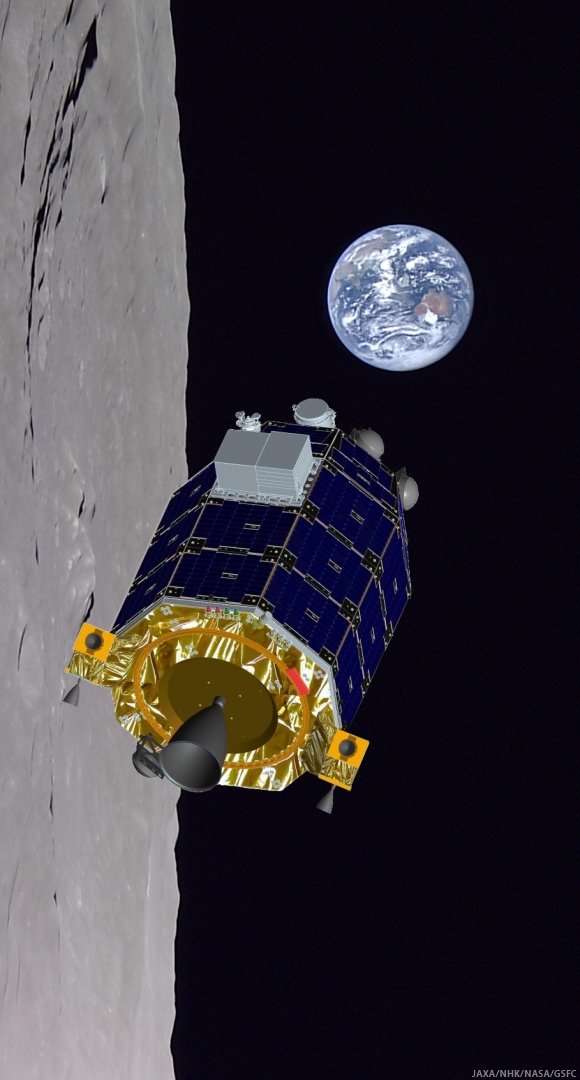
| NASA's LADEE spacecraft entered it's 250 km Commissioning phase orbit October 12 [NASA/JAXA]. |
Paul D. Spudis
The Once and Future Moon
Smithsonian Air & Space
Smithsonian Air & Space
Wait a minute. Did I say “atmosphere?” Isn’t the Moon renowned for its lack of an atmosphere? Indeed it is. In fact, the 10-12 torr surface pressure of the Moon is a better vacuum than we can achieve with even the most advanced equipment in Earth laboratories. (For comparison, sea level pressure on the Earth is about 760 torr, making the lunar surface pressure over one hundred trillion times less dense.) A better term for the tenuous gas near the Moon is “exosphere,” meaning free flying gas molecules that may or may not be gravitationally bound to the Moon. In such an “atmosphere,” there may be only a few thousand molecules in a cubic centimeter of space. This is very tenuous indeed.
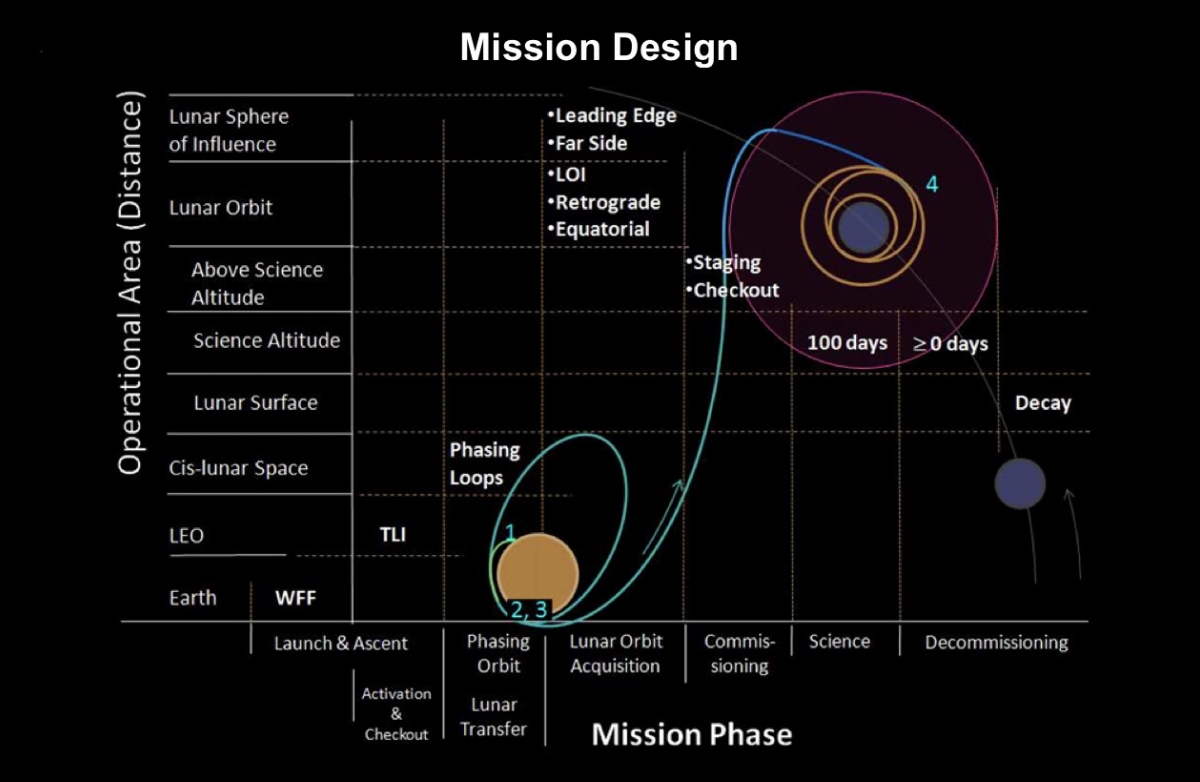 |
| After the Commissioning phase of its mission is complete, the spacecraft's current 250 km circular orbit will be reduced further down to within 50 km to begin its 100 day Science Mission [NASA/GSFC]. |
LADEE is designed to investigate from where these atoms and molecules come. Presently, we think the lunar exosphere consists mostly of helium, sodium and perhaps argon atoms, each coming from a completely different source. Helium likely comes from the Sun, as the solar wind continually “breathes” onto the surface of the Moon. Some atoms stick to surface dust grains but many simply bounce off, randomly moving in the space above the lunar surface. Easy to detect, lunar sodium has been observed from Earth-based telescopes. It most likely comes from rocks vaporized by the continual rain of micrometeorites. At least some fraction of this vaporous sodium must hang around the surface, unable to escape the Moon. Argon might have a solar wind origin, but at least some of it comes from the natural decay of radioactive potassium in the lunar interior (potassium-40 (40K) decays to argon-40 (40Ar) with a half-life of a bit more than one billion years). Gases like argon, venting from the interior of the Moon, were observed by subsatellites left in lunar orbit by the departing Apollo spacecraft over 40 years ago (these small spacecraft have long since crashed into the Moon).
Although helium, sodium and argon are the principal expected components of the lunar exosphere, the LADEE team will search for other species. An interesting possibility is water (H2O) or its related species, hydroxyl (OH). One of the most surprising results of recent lunar exploration was the discovery of adsorbed (surface) water and hydroxyl on the dust grains of the lunar surface (observed by the Moon Mineralogy Mapper (M3) aboard the Indian Chandrayaan-1 lunar orbiter in 2009). Occurring in the form of a monolayer of molecules on dust grains in the cooler portions of the Moon, a clear water signal is best seen above latitudes of 65° and increasing in strength (i.e., increasing water abundance) toward each pole.
The surprise from M3 was not only the presence of water but observing that its abundance increases with decreasing surface temperatures. This means that water being made or deposited on the surface is in motion, with a net movement toward the poles. Chandrayaan-1 also carried an impact probe with a mass spectrometer. During the probe’s half-hour descent to the South Pole, it passed through a cloud of water in space, just above the lunar surface. The water cloud at this high latitude had a density a hundred times higher than at the equator, providing additional evidence that exospheric water is in motion, moving from lower, hotter latitudes towards higher, cooler ones.
LADEE cannot directly measure this water in a neutral state, but if some process ionizes it (e.g., if a water molecule breaks apart into a proton and a hydroxyl by UV radiation from the Sun), it will be visible to the ultraviolet spectrometer aboard the spacecraft. If the process of water migration on the lunar surface is correct, we should be able to observe exospheric water and by measuring its density with time, track the water migration to higher latitudes.
LADEE will also tackle another controversial issue – the amounts and mechanisms of dust movement on and around the Moon. During the unmanned Surveyor lander missions over 40 years ago, a strange illumination or glow was observed by television for several hours after local sunset, just above the horizon. This phenomenon was termed “horizon glow” by surprised Surveyor investigators. At a loss to explain it, the team postulated that some mechanism was lofting dust up above the surface and this dust was scattering sunlight. Exactly how the dust was lofted was uncertain; some thought it must be fragments in ballistic flight from distant impacts, while others thought that it might be levitated by electrostatic force, thus “hovering” above the surface.
A few years later, just before his orbiting spacecraft emerged into the daylight side of the Moon, Apollo 17 Commander Gene Cernan observed and sketched an illuminated limb and “streamers” that could be seen extending into space above where the lunar horizon would be. At the time, this phenomenon was thought to be the same as that seen in the Surveyor pictures, although they have totally different scales (the Surveyor horizon glow must occur within a few meters of the surface, while Cernan’s horizon glow extended many kilometers above the Moon). Dust (probably of lunar provenance) is certainly involved in whatever causes this horizon glow.
As the Moon slowly rotates once every 708 hours, the line between the sunlit and dark hemispheres (the terminator) slowly moves across the lunar surface. The day and night hemispheres have different fluxes of electrons from the solar wind and thus, the presence of the terminator can induce an electrical charge in surface materials. It is postulated that this charge might levitate smaller dust particles such that they would hover above the surface. LADEE will attempt to detect and map this dust, both by searching for scattered sunlight with its ultraviolet spectrometer and via the direct detection of dust particles in flight with an instrument on the top of the orbiting spacecraft.
The issue of levitated dust is thought to be relevant to the future habitation of the Moon. If dust is lofted above the surface by the passage of the terminator, the particles could degrade clean surfaces and create a hazard for inhabitants of the Moon. Such a process could have major effects near the poles of the Moon, areas that are in the near-constant presence of a day-night terminator. Although it is unlikely that levitated dust on the Moon is an environmental hazard, we currently are working in near total absence of hard data. Thus, it makes sense to at least try to make some direct measurements of the dust environment around the Moon to assess the importance of this proposed surface process.
LADEE arrived in lunar orbit last Sunday. We wish it well on its mission to give us fresh (and welcome) data on a poorly understood aspect of lunar processes and history.
Related Posts:
Although helium, sodium and argon are the principal expected components of the lunar exosphere, the LADEE team will search for other species. An interesting possibility is water (H2O) or its related species, hydroxyl (OH). One of the most surprising results of recent lunar exploration was the discovery of adsorbed (surface) water and hydroxyl on the dust grains of the lunar surface (observed by the Moon Mineralogy Mapper (M3) aboard the Indian Chandrayaan-1 lunar orbiter in 2009). Occurring in the form of a monolayer of molecules on dust grains in the cooler portions of the Moon, a clear water signal is best seen above latitudes of 65° and increasing in strength (i.e., increasing water abundance) toward each pole.
The surprise from M3 was not only the presence of water but observing that its abundance increases with decreasing surface temperatures. This means that water being made or deposited on the surface is in motion, with a net movement toward the poles. Chandrayaan-1 also carried an impact probe with a mass spectrometer. During the probe’s half-hour descent to the South Pole, it passed through a cloud of water in space, just above the lunar surface. The water cloud at this high latitude had a density a hundred times higher than at the equator, providing additional evidence that exospheric water is in motion, moving from lower, hotter latitudes towards higher, cooler ones.
LADEE cannot directly measure this water in a neutral state, but if some process ionizes it (e.g., if a water molecule breaks apart into a proton and a hydroxyl by UV radiation from the Sun), it will be visible to the ultraviolet spectrometer aboard the spacecraft. If the process of water migration on the lunar surface is correct, we should be able to observe exospheric water and by measuring its density with time, track the water migration to higher latitudes.
 |
| Lunar Horizon Glow (LHC) observed for several hours following local sunset from Surveyor 7 and its landing site just north of Tycho crater. [NASA]. |
 |
| Schematic of documented species of Lunar Horizon Glow, including mid-lunar night imagery captured by Surveyor 7 (Horanyi, et.al., The Lunar Dust Environment: Expectations for the LADEE Lunar Dust Experiment (LDEX), 43rd Lunar and Planetary Science Conference (2012), #2635. |
 |
| Apollo 17 commander Gene Cernan's sketches and description of horizon glow and streamers observed in lunar orbit, December 1972 [NASA]. |
The issue of levitated dust is thought to be relevant to the future habitation of the Moon. If dust is lofted above the surface by the passage of the terminator, the particles could degrade clean surfaces and create a hazard for inhabitants of the Moon. Such a process could have major effects near the poles of the Moon, areas that are in the near-constant presence of a day-night terminator. Although it is unlikely that levitated dust on the Moon is an environmental hazard, we currently are working in near total absence of hard data. Thus, it makes sense to at least try to make some direct measurements of the dust environment around the Moon to assess the importance of this proposed surface process.
LADEE arrived in lunar orbit last Sunday. We wish it well on its mission to give us fresh (and welcome) data on a poorly understood aspect of lunar processes and history.
Related Posts:
LADEE, in 250 km orbit, begins commissioning phase (October 15, 2013)
LADEE Away! (September 7, 2013)
LADEE legacies (September 7, 2013)
LADEE Prelaunch Mission Briefing (September 6, 2013)
ESA prepares for LADEE (July 31, 2013)
LADEE arrives at Wallops Island (June 5, 2013)
LADEE ready to baseline dusty lunar exosphere (June 5, 2013)
First laser comm system ready for launch on LADEE (March 16, 2013)
LADEE project manager update (February 6, 2013)
The Mona Lisa test for LADEE communications (January 21, 2013)
Toxicity of lunar dust (July 2, 2012)
Expectations for the LADEE LDEX (March 23, 2012)
The Dust Management Project (August 9, 2010)
LADEE architecture and mission design (July 6, 2010)
DesertRatS testing electrodynamic dust shield (July 5, 2010)
Dust transport and its importance in the origin of lunar swirls (February 21, 2010)
Dust accumulation on Apollo laser reflectors may indicate a surprisingly fast and
more dynamic lunar exosphere (February 16, 2010)
NASA applies low cost lessons to LADEE (January 18, 2010)
Nanotech advances in lunar dust mitigation (August 19, 2009)
Moon dust hazard influenced by Sun's elevation (April 17, 2009)
LADEE launch by Orbital from Wallops Island (April 14, 2009)
Understanding the activation and solution properties of lunar dust
for future lunar habitation (March 2, 2009)
Respiratory toxicity of lunar highland dust (January 19, 2009)
Toxicological effects of moon dust (June 25, 2008)
Moon dust and duct tape (April 22, 2008)
LADEE Away! (September 7, 2013)
LADEE legacies (September 7, 2013)
LADEE Prelaunch Mission Briefing (September 6, 2013)
ESA prepares for LADEE (July 31, 2013)
LADEE arrives at Wallops Island (June 5, 2013)
LADEE ready to baseline dusty lunar exosphere (June 5, 2013)
First laser comm system ready for launch on LADEE (March 16, 2013)
LADEE project manager update (February 6, 2013)
The Mona Lisa test for LADEE communications (January 21, 2013)
Toxicity of lunar dust (July 2, 2012)
Expectations for the LADEE LDEX (March 23, 2012)
The Dust Management Project (August 9, 2010)
LADEE architecture and mission design (July 6, 2010)
DesertRatS testing electrodynamic dust shield (July 5, 2010)
Dust transport and its importance in the origin of lunar swirls (February 21, 2010)
Dust accumulation on Apollo laser reflectors may indicate a surprisingly fast and
more dynamic lunar exosphere (February 16, 2010)
NASA applies low cost lessons to LADEE (January 18, 2010)
Nanotech advances in lunar dust mitigation (August 19, 2009)
Moon dust hazard influenced by Sun's elevation (April 17, 2009)
LADEE launch by Orbital from Wallops Island (April 14, 2009)
Understanding the activation and solution properties of lunar dust
for future lunar habitation (March 2, 2009)
Respiratory toxicity of lunar highland dust (January 19, 2009)
Toxicological effects of moon dust (June 25, 2008)
Moon dust and duct tape (April 22, 2008)
Originally published October 4, 2013 at his Smithsonian Air & Space blog The Once and Future Moon, Dr. Spudis is a senior staff scientist at the Lunar and Planetary Institute. The opinions expressed are those of the author but are better informed than average.


