Showing posts with label Apollo 12. Show all posts

Thursday, May 15, 2014

Earth rising

The vastness of space, and the inviting terra firma of Earth and Moon. LROC Featured Image, May 7, 2014. LROC WAC M1145896768C, LRO orbit 20898, February 1, 2014 [NASA/GSFC/Arizona State University].
Paul D. Spudis
The Once and Future Moon
Smithsonian Air & Space

The LRO Camera Team recently released a newly obtained, beautiful image of the Earth above the north pole of the Moon.  In the history of lunar exploration, Earthrise photos have always been widely displayed and admired. Capturing the iconic image of a magnificent blue and white Earth hanging over the barren, gray surface of the Moon is one of the most memorable moments of man’s first flight to the Moon by Apollo 8 in December 1968.

This picture graced the covers of newspapers and magazines everywhere; it inspired a million words of prose and created the modern environmental movement as we know it. Few single images have had such pervasive and lasting power.
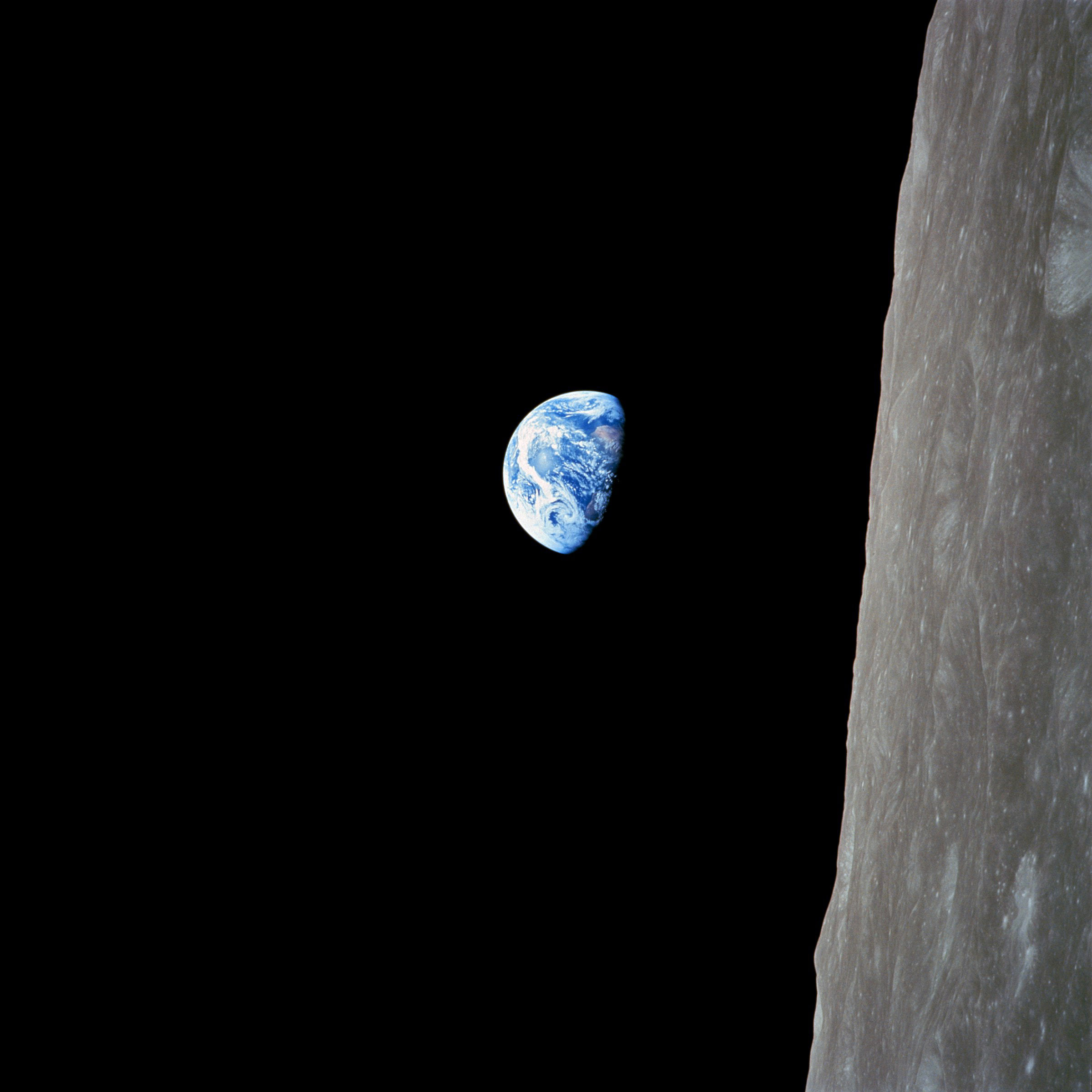
Apollo 8's overview effect: Iconic Earthrise image, AS08-14-2383, Bill Anders' serendipitous photograph of Earth as the first manned flight to the Moon swung around from the farside, December 24, 1968 [NASA/JSC].
The Apollo 11 crew landed on the lunar surface a few months after that Earthrise photo was circulated. During this and subsequent missions (all on the central near side of the Moon), it was reported by the media that Earth always appears stationary in the same part of the sky as seen from the Moon’s surface.

In November 1969, the Apollo 12 crew put up a large inverted umbrella antenna to improve communication data rates from the lunar surface; it had to be set-up and aligned, but once pointed at Earth, it remained pointed at it forever.

Simulated time-lapse view of Earth from the vicinity of the Moon's north pole, where the significance of the Moon's libration creates changes in a notional viewers perspective. Earth appears to swing through a Lissajous figure in the sky. Three lunar days are squeezed into 1:45 using Celesta.

Because the Moon orbits the Earth and is in synchronous rotation with its orbital period, we always see the same side.  Hence, there is a near side (the hemisphere we see from Earth) and a far side (the side we cannot see from Earth; it is often mistakenly called the “dark side”).

A consequence of this synchronous rotation is that from the Moon, the Earth appears stationary in the sky, just as the hub of a bicycle wheel remains stationary from the viewpoint of one of its spokes. Thus, while the Sun rises and sets according to the slow rotation rate of the Moon (one complete rotation every 708 hours, half day and half night), the Earth is always in the same spot in the sky. Of course, because it is illuminated by the Sun, it changes its phase on the same timescale as does the Moon as seen from Earth, although reversed (a full Moon on Earth is a new Earth from the Moon and vice versa.)  From the far side of the Moon, one does not see the Earth at all.

Are spectacular views of Earthrise only visible from spacecraft in orbit about the Moon? Not quite.

Two points about the Moon’s orbit make the story a bit more complicated. First, the Moon’s orbit around the Earth is not circular but elliptical, its distance ranging from 363,000 km up to 405,000 km from the Earth. Second, the plane of the Moon’s orbit is inclined about 5 degrees to the ecliptic (the plane of the Earth-Moon system’s orbit around the Sun). These two facts mean that the Moon librates, or “wobbles” both left and right (an effect of its elliptical orbit) and up and down (an effect of the inclination of its orbital plane). These librations are not overwhelmingly significant, but result in some interesting effects around the limb of the Moon – the great circle made up by the 90 degrees east and west longitude lines, including both poles.
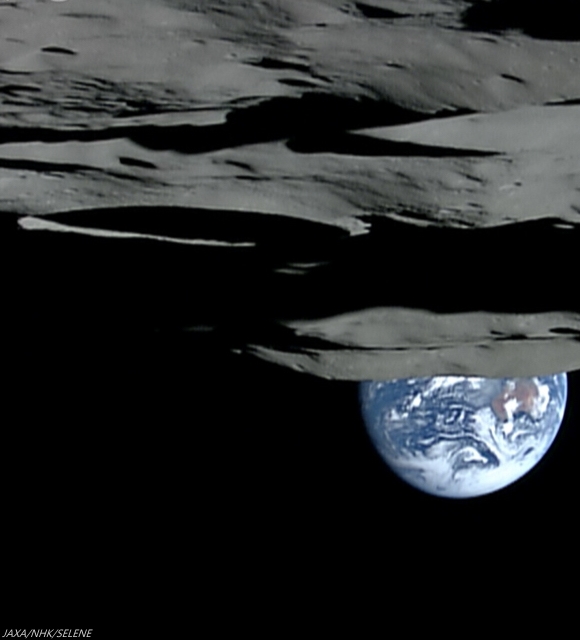
Earthset, from 1080p video captured from Japan's lunar orbiter SELENE-1 (Kaguya) October 31, 2007, as spacecraft and camera, in polar orbit, began its track north from the south pole (on the rim of Shackleton crater, center left) over the Moon's farside, leaving Earth to set behind Malapert massif, a nearside fragment of the rim of immense South Pole-Aitken impact basin [JAXA/NHK/SELENE].
The Earth as seen from the Moon is about 2 degrees in angular width (about 4 times the apparent diameter of the Moon and Sun as seen from Earth). Earth’s disk is roughly equivalent to the size of a quarter held out at arm’s length; the Moon’s apparent disk is pea-sized. Because of the Moon’s longitudinal libration, the “limb” areas near the 90 degree meridians are sometimes visible to Earth and other times not. Thus, the Earth will sometimes appear in the sky and sometimes be hidden below the Moon’s horizon – in other words, an observer along this line of longitude will see an Earthrise and an Earthset.

The longitudinal libration is about 8 degrees, so the observer on the lunar limb would see the Earth slowly rise above the horizon and clear it by its apparent diameter, then slowly sink below the horizon by the same amount. That Earthrise will be slow indeed – it will take a couple of days for the full disk of the Earth to rise above the horizon. This cycle would repeat on a monthly timescale, as the Moon completes one revolution around the Earth.

Similarly, one would also see the Earth rise and set at the poles of the Moon, although to a different magnitude. The polar view is almost completely dominated by the latitudinal libration, caused by the inclination of the Moon’s orbital plane. This variation is about 6.5 degrees (it includes the Moon’s spin axis obliquity of 1.5 degrees) and would vary on a similar monthly timescale. These variations will become important if future lunar inhabitants live at the poles, as I think likely. As the Earth will sometimes be out of direct view, it is likely that we will depend on relay satellites for continuous communication. Polar inhabitants will also see a “different” Sun from what they’re accustomed to on Earth – at the lunar poles, the sun rotates around the horizon, rather than rising and setting.
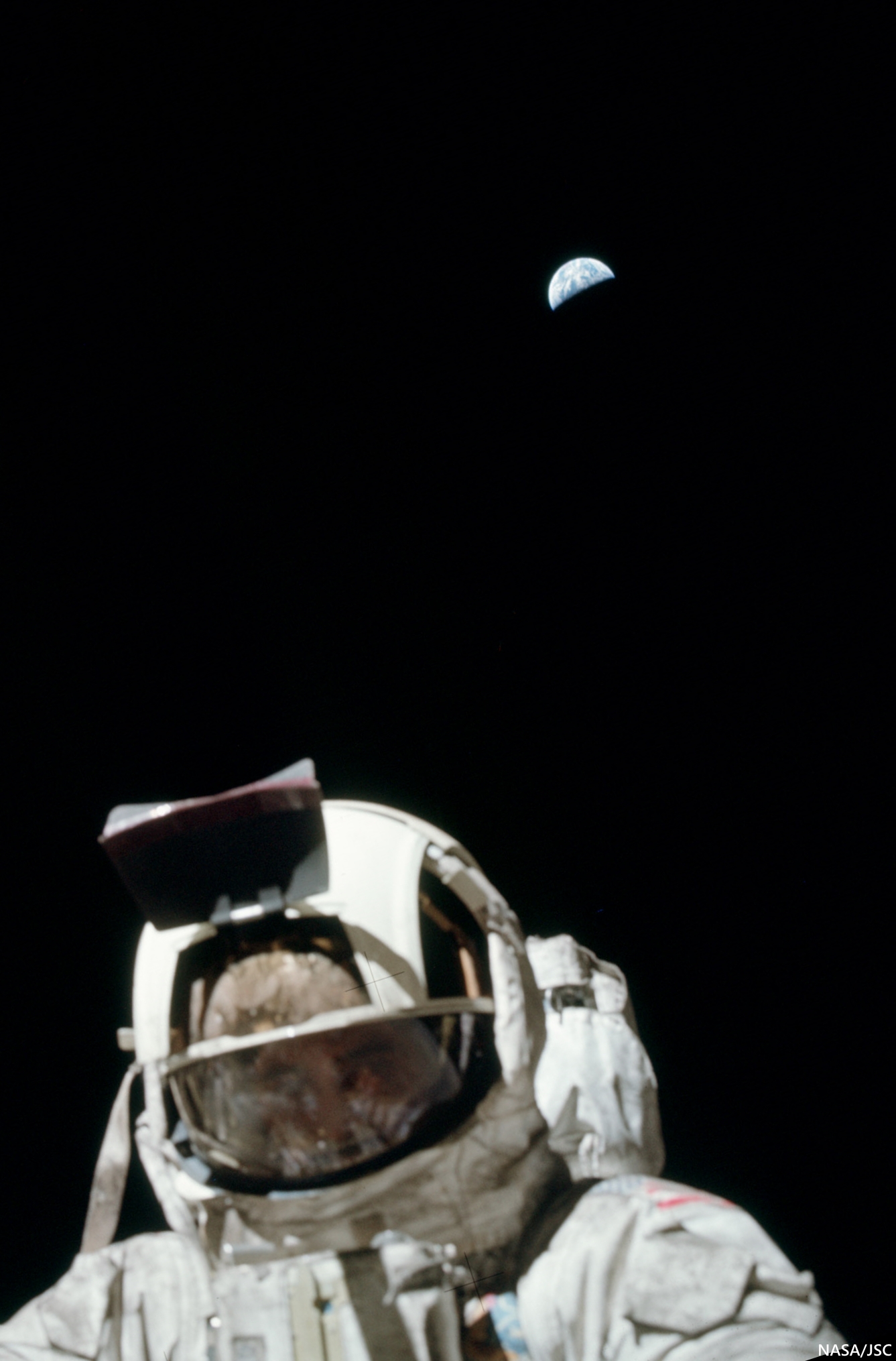
Cernan and Earth. At Taurus Littrow, Earth maintains its position. Ground controllers did occasionally admonished Apollo 17 Cmdr. Gene Cernan's partner Jack Schmidt for lifting his solar visor to get a better look at a rock, from time to time, during the last walks on the Moon. But at this point, however, as he traded poses with Schmidt using Earth as a backdrop, Cernan did briefly lift his visor halfway, allowing posterity an atypical view of an actual human face on the Moon in December 1972 (AS17-134-20471) [NASA/JSC].
Thus, there are places on the Moon from which we can stand and contemplate the sheer beauty and magnificence of a slowly rising Earth. Given the sea change in global perspective provided by the famous Earthrise picture taken by the Apollo 8 crew almost fifty years ago, what societal impacts will occur when a human being stands on the lunar surface and watches the Earth slowly rise above the horizon? I suspect that a similar shift in planetary perspective will occur. If history is any guide, such a shift will have profound psychological and political implications  – both positive and negative – in our reach for the stars.

Dr. Paul D. Spudis is a senior staff scientist at the Lunar and Planetary Institute in Houston. This column was originally published by Smithsonian Air & Space online, and his website can be found at www.spudislunarresources.com. The opinions he expressed here are his own, but these are better informed than most.

Thursday, November 21, 2013

Apollo 12 ALSEP first to measure dust accumulation

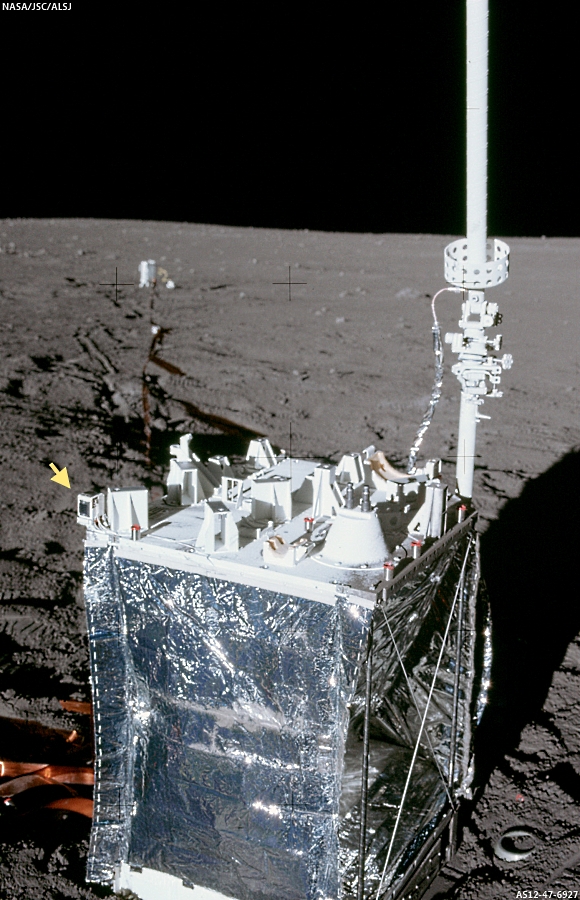
Apollo 12 ALSEP Central Station
Apollo 12 ALSEP, Central Station, with DTREM (Lunar Dust Collector) marked with arrow. Alan J. Bean, EVA-1;  Oceanus Procellarum, November 19, 1969 (AS12-47-6927) [NASA/JSC/ALSJ].
A dataset thought to have been lost, from an ingenious experiment deployed on the Moon by Apollo astronauts more than four decades ago, has been rediscovered and analyzed. As a result, the Lunar Dust Collector deployed as integral to the Apollo 12 ALSEP system, has become the first instrument to record a measurable rate of dust accumulation on the lunar surface. 

The news is timely, of course, coming the beginning of the Lunar Atmosphere and Dust Environment Explorer (LADEE) science mission, and arriving on November 19, the 44th anniversary of the Apollo 12 expedition.

Keith Cowing
Moonviews.com (LOIRP)

The Lunar Dust Detector, attached to the corner of (the ALSEP Central Station, pictured above), left by the Apollo 12 astronauts, made the first measurement of lunar dust accumulation. As the matchbox-sized device's three solar panels became covered by dust, the voltage they produced dropped.

When Neil Armstrong took humanity's first otherworldly steps in 1969, he didn't know what a nuisance the lunar soil beneath his feet would prove to be. The scratchy dust clung to everything it touched, causing scientific instruments to overheat and, for Apollo 17 astronaut Harrison Schmitt, a sort of lunar dust hay fever. The annoying particles even prompted a scientific experiment to figure out how fast they collect, but NASA's data got lost.
AS17-145-22157
Retrieving a surface sample behind boulders on a crater rim at Apollo 17 Science Station 5, Taurus Littrow valley; December 12, 1972 - Lunar module pilot and geologist Harrison Schmitt already carries a substantial sampling of abrasive, fine lunar dust on his moon suit. Schmitt endorsed development of 'dust mitigation' technology as a high priority for program planners prior to establishing 'extended human activity' on the Moon (Eugene Cernan - AS17-145-22157) [NASA/JSC/ALSJ].
Or, so NASA thought. Now, more than 40 years later, scientists have used the rediscovered data to make the first determination of how fast lunar dust accumulates. It builds up unbelievably slowly by the standards of any Earth-bound housekeeper, their calculations show -- just fast enough to form a layer about a millimeter (0.04 inch) thick every 1,000 years. Yet, that rate is 10 times previous estimates. It's also more than speedy enough to pose a serious problem for the solar cells that serve as critical power sources for space exploration missions.

Tuesday, July 9, 2013

Surveyor Crater: Before and After

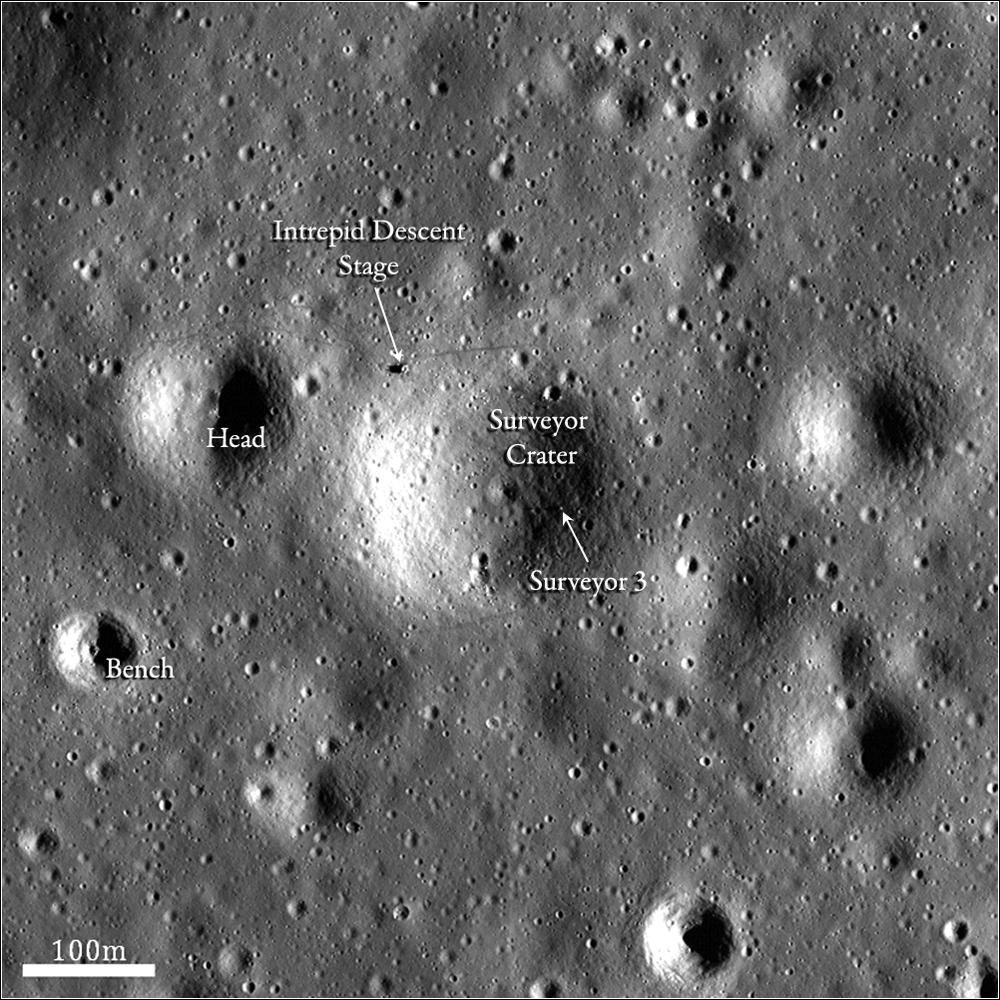
Another look at Surveyor Crater, the Apollo 12 and Surveyor 3 landing site, under early morning illumination not much above the horizon from what Conrad & Bean encountered after the second manned landing on the Moon in November 1969. (View the labeled LROC Featured Image release HERE,, and read a description for comparisons made between a high-resolution Lunar Orbiter photograph of the same area. Field of view above is 270 meters at this, the full 47 centimeter per pixel resolution; cropped from LROC Narrow Angle Camera (NAC) mosaic M177785917RL, orbit 11336, December 6, 2011; 73.1° angle of incidence from 38.15 kilometers [NASA/GSFC/Arizona State University].
Ryan Clegg
LROC News System

The Lunar Orbiter program, much like LRO, was designed primarily to obtain images to allow scientists and engineers to characterize the lunar surface in the context of finding safe and engaging landing sites for future missions.

A total of 5 Lunar Orbiters (LO) were sent to the Moon, and they collectively photographed most of the lunar surface at 60 to 600 meters resolution, with resolutions as high as 1 meter per pixel for some of the LO-5 photographs.

In 1967, NASA launched Lunar Orbiter 3 with the primary objective of finding safe landing sites for the Surveyor and Apollo missions. Both a Surveyor and an Apollo mission soon visited one area that the Lunar Orbiter photographed. Surveyor 3 landed on April 20, 1967 in Oceanus Procellarum at approximately 3.02°S, 23.42°W.

The spacecraft landed in a small, 200 m crater that was later named Surveyor Crater.

LOIRP3154H2-A12-paths-58b-1400x1931
Recovered from the original telemetry tapes by the Lunar Orbiter Image Restoration Project (LOIRP). LO3-154 H2 was recently released, including an inset marking the Surveyor 3 and Apollo 12 expeditions [LOIRP/Moonviews.com].
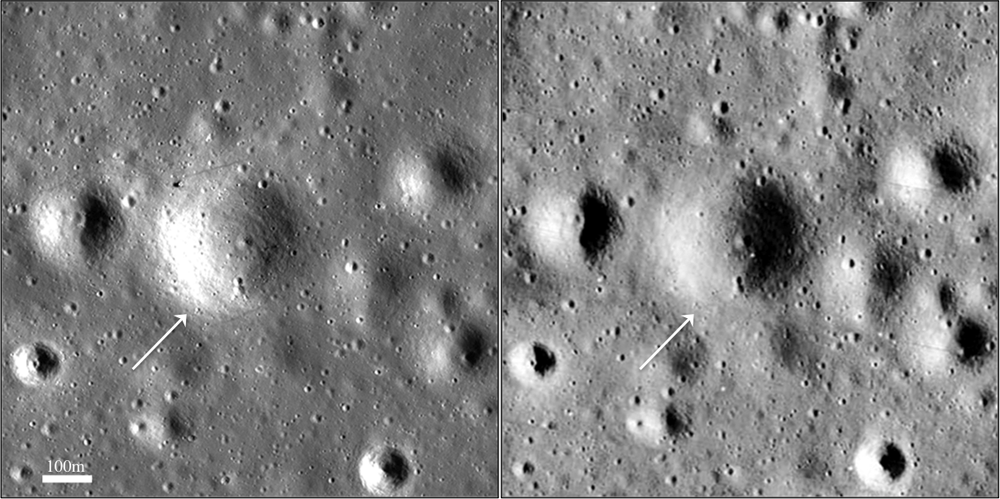
LROC image M1108432631R (left, incidence angle = 68.8 degrees) and Lunar Orbiter 3 image LO3-154-H2 (right, incidence angle = 67.2 degrees) of Surveyor Crater, the eventual landing site of both Surveyor 3 and Apollo 12. Both images were taken at similar illumination geometries and the NAC image has been stretched to match the saturation seen in the LO-3 image [NASA/GSFC/USGS/LPI].
The LROC NAC mosaic (bottom) and an similarly arranged field of view from Lunar Orbiter image 3154-H2 (top, incidence angle = 67.2°) of Surveyor Crater, eventual landing site of Surveyor 3 and Apollo 12 soon after.
Two and a half years later, on 19 November 1969, Apollo 12 demonstrated the Lunar Module's capability to make a pinpoint landing by setting down on the edge of Surveyor Crater, about 155 m from the deactivated Surveyor 3 spacecraft. Almost 45 years later, LROC imaged the same area of Oceanus Procellarum that LO-3 photographed. The LROC image, however, reveals some new features - the Apollo 12 Lunar Module (LM), Surveyor 3 spacecraft, and astronaut tracks are all visible. Perhaps most evident is that Surveyor Crater and the area around the LM are noticeably brighter than in the LO image.

AS12-48-7133HR
Apollo 12 cmdr. Pete Conrad poses by the Surveyor 3 unmanned spacecraft two and a half years after the small vehicle soft landed just inside the east rim of a 200 meter crater in Oceanus Procellarum, a deliberate test and demonstration of rapid advancements in precise landing navigation necessary for future landings. Conrad holds up the sampling arm and grasps the video camera assembly, both retrieved and providing valuable study of the effects of the dusty landing plume originating from Intrepid lunar module. Alan Bean snapped this picture. [NASA/ALSJ].
This increase in reflectivity resulted from effects of the rocket exhaust interacting with the regolith during the descent of the Apollo 12 Lunar Module. Directly beneath and adjacent to the LM the surface appears darker because the exhaust gas disrupted and roughed up the surface. However, a few meters away from the lander and extending outward for several hundred meters, the surface was altered in such a way as to make it more reflective, possibly a result of smoothing.

During the Apollo 12 descent, Pete Conrad flew the spacecraft around the edge of Surveyor Crater in order to get to the safe landing spot he wanted. The crater then likely acted as a mechanism to contain the rocket exhaust, causing the entire crater to experience disturbance and appear more reflective.

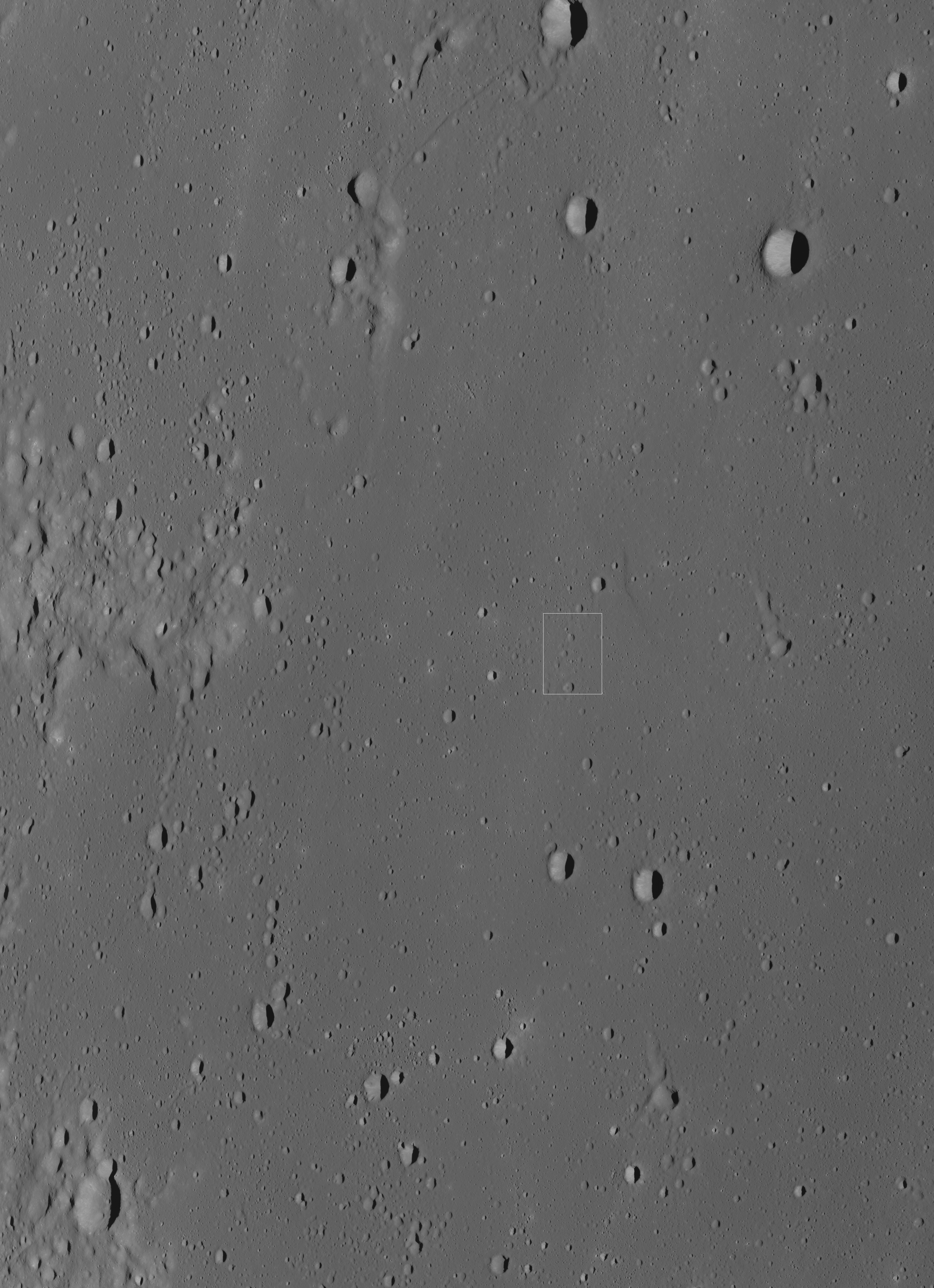
A pixel, and part of another (marked by the arrow) just barely shows the Apollo 12 lunar module descent stage profile, on the "shoulder" of "The Snowman" crater group, from 106.48 kilometers above a point on the lunar surface well to the east. The original resolution above 3.5 meters per pixel, May 31, 2012. LROC NAC frame M193067752R. (The long shadow of the mast of Surveyor 3 may just be visible as a small bump on the shadow line across the interior of Surveyor crater [NASA/GSFC/Arizona State University].
The full-width of LROC NAC frame from M193067752R, where a rectangle marks the field of view at 40% full resolution in the image immediately above, camera and spacecraft were slewed 60° off nadir, providing an unusual oblique observation. (Both this image abd the one referenced immediately above it originally used to illustrate the post "Apollo 12 at 43 Years," Nov. 20, 2012) [NASA/GSFC/Arizona State University].
LROC WAC context mosaic, with the location of Surveyor crater marked. Note proximity with the ejecta rays far-flung south-southwest from Copernicus, beyond the frame at upper right). Cropped from the LROC QuickMap application, set at 125 meters resolution [NASA/GSFC/Arizona State University].
Be sure to explore the entire NAC frame (M177785917L and M177785917R mosaic), HERE.

Previous Posts:
Apollo 12 at 43 Years (November 20, 2012)
Pinpoint Landing on the Moon (Apollo 12) (March 12, 2012)
New Views of Apollo 12 (September 8, 2011)
First Low Altitude Apollo 12 NAC Image (August 11, 2011)
Triumph (and disappointment) of Apollo 12 (November 19, 2009)
Apollo 12 Second Look:Midday on the Ocean of Storms (November 4, 2009)
First Look: Apollo 12 and Surveyor 3 (September 3, 2008)

Thursday, July 19, 2012

New tool for exploring LROC NAC Images

23 high-resolution views of the Apollo 12 (and Surveyor III) landing site, in a clickable catalog, together with a solar-illumination slide-scale for viewing the images at all available illumination angles of incidence. Featured Sites, a "New tool" LROC invites users to "Explore the Apollo landing sites using LROC images [NASA/ASU/Arizona State University].
Mark Robinson
Principal Investigator
Lunar Reconnaissance Orbiter Camera (LROC)
Arizona State University
 
The LROC team just released a new webpage to help lunar explorers interact with spectacular LROC images of engaging features on the Moon. The new webpage is designed, with what we hope is an intuitive and easy-to-use interface, to help you find specific features amongst the hundreds of thousands of NAC images now in the archive! First out in our new webpage are some of the most historic places in our Solar System: the Apollo Landing sites where human beings took their first steps into the larger Universe, starting with Apollo 11, 43 years ago tomorrow. Explore these amazing locations on the beta version of the new LROC Featured Sites webpage. Over the next several weeks wrinkles will be ironed out of the new page, and then we will add more content. So keep checking back.

8 of 22 high-resolution LROC NAC observations of the Apollo landing site (July 20, 1969) already available in the new Featured Sites catalog [NASA/GSFC/Arizona State University].
Screen capture of LROC NAC Landing Site Flip Book, Apollo 12 example [NASA/GSFC/Arizona State University].
Have fun dragging the Sun and seeing how the surface changes!

Wednesday, March 7, 2012

LROC: Pinpoint Landing on the Moon (Apollo 12)


Descent and landing of Apollo 12 in Oceanus Procellarum, November 1969.

The Apollo 12 landing site (3.0119°S, 336.585°E) in Oceanus Procellarum, imaged during the second LRO low-altitude campaign, orbit 10,987, November 11, 2011. Field of view width = 225 meters, LROC Narrow Angle Camera (NAC) observation M175428601R  View the full size LROC Featured Image HERE [NASA/GSFC/Arizona State University].

Samuel Lawrence
LROC News System

The LRO mission continues to collect observations that are enabling ground-breaking new scientific discoveries about the Moon. As geologists, whenever we look at remotely sensed data collected from another planet, in a sense we are staring back in time. But this is the “deep time” of geology, where we are trying to understand natural processes that (at least on the Moon, anyway) could have happened billions of years ago. But the LRO mission is unique because we can also see human history. Not just any history, either, but one of humanity's greatest accomplishments, our first steps on another world. Twelve astronauts explored the lunar surface, directly seeing things with their own eyes, making observations, and collecting samples with their own hands. These samples and observations revolutionized our understanding of our solar system.

This “snapshot in time” effect is especially evident at the Apollo 12 landing site in Oceanus Procellarum, now known as Statio Cognitum. Here, you can see the remnants of not one, but two missions to the Moon. Astronauts Pete Conrad and Alan Bean demonstrated that a precision lunar landing with the Apollo system was possible, enabling all of the targeted landings that followed. Bean and Conrad collected rock samples and made field observations, which resulted in key discoveries about lunar geology. They also collected and returned components from the nearby US Surveyor 3 spacecraft, which landed at this site almost two and half years previously, providing important information to engineers about the how materials survive in the lunar environment.

Annotated low altitude LROC NAC image of the Apollo 12 landing site (view the glorious 2438 x 2109 image HERE). The informal names of craters visited by the astronauts, the positions of the ALSEP, Intrepid descent stage, and Surveyor 3 spacecraft are highlighted. LROC NAC M175428601R [NASA/GSFC/Arizona State University].
In the image above, you can see the remnants of the scientific experiments the astronauts set up on the surface, the first long-term Apollo Lunar Surface Experiments Package (ALSEP).  Powered by a Radioisotope Thermoelectric Generator (RTG), the ALSEP included a seismometer to record "moonquakes" and several experiments designed to make measurements of the lunar environment, including a Solar Wind Spectrometer, a Cold Cathode Ion Gauge, and a Suprathermal Ion Detector (see if you can find each piece of hardware). The Apollo 12 ALSEP returned data and measurements to Earth for over seven years following the mission and was turned off in September 1977. From the lower altitude you can pick out the shadow of the still standing flag, the High Gain Antenna (HGA), and the discarded Portable Life Support System (PLSS) backpacks.

Apollo 12 photograph of the ALSEP central station, with Intrepid and S-band High Gain Antenna (HGA) in the background. The ribbon cables in this image are clearly visible in the first low-altitude LROC image of the Apollo 12 landing site, below [NASA high-resolution photograph AS12-47-6928].
After deploying the ALSEP, the astronauts moved to the northwest, eventually stopping to take a series of photographs of the crater dubbed “Middle Crescent”. The boulders the astronauts observed on the surface are visible in the LROC image above.

Apollo 12 photograph of the interior of Middle Crescent crater, taken during the first Apollo 12 EVA [NASA high-resolution photograph AS12-46-6838].
During the second EVA, the astronauts performed a geologic traverse on foot covering almost 1.5 km. In today’s image, you can clearly follow the path they took edging around Head crater, proceeding to Bench and Sharp craters with a brief stop at Halo crater, visiting the Surveyor spacecraft, and then returning to the Lunar Module.

Apollo 12 photograph of the interior of Sharp crater taken by astronaut Pete Conrad, whose shadow you can see in the lower right [NASA high-resolution photograph AS12-49-7271].
One of the most common questions prior to the launch of LRO was: will you be able to see the American flags that were left on the Moon by the astronauts? The flags themselves are too small to be seen by the NACs, even with the small pixel scales enabled by the low-altitude orbit.  However you can see the shadow being cast by the flag. This is especially evident in this movie [15 MB Quicktime file] of LROC images of a complete lunar day, shown sequentially from dawn to dusk. Watch the rotation of the shadows carefully, and you can see the shadow cast by the flag! Question answered, yes you can find the flag - but what does it look like? Have the stars and stripes faded? That question will remain for a future landed spacecraft.

LRO was placed in low periapse orbits during two months last year: 8 August 2011 to 6 September 2011 and 31 October to 27 November 2011. In each month, LROC was able to obtain low altitude images of the Apollo 12 site. For comparison, the first low-altitude image is shown below. When this image was acquired, the Sun was 54° above the horizon (early-afternoon) and in today's Featured Image the Sun was 45° above the horizon (mid-morning). Incredibly, you can even see the ribbon cables connecting the ALSEP instruments to the central station in this first low-altitude Apollo 12 image (below). The cables appear as bright, straight lines leading from the SIDE and LSM, and are visible because, despite being narrower than the 25-cm pixel scale, they are highly reflective.

First NAC low altitude image of Apollo 12 site, larger area version linked below [NASA/GSFC/Arizona State University].
Forty-two years ago, using technologies that many people today would probably (and erroneously) find hopelessly antiquated, the crew of Apollo 12 executed a flawless precision landing  on another world. Imagine how much more today’s astronauts will accomplish when we return to the Moon with 21st century technology!

Explore the Ocean of Storms in our newest NAC observation, and be sure to check out this YouTube video showing the Apollo 12 landing site:


Other LROC Images of the Apollo 12 Landing Site:
First Look: Apollo 12 and Surveyor 3
Apollo 12 Second Look: Midday on the Ocean of Storms
First Low Altitude Apollo 12 NAC Image

Wednesday, October 27, 2010

Surveyor 7: Our fragile lunar LDEF

From Lunar Pioneer Album 2 -
Surveyor 7 (center) - last of the unmanned series, and landed furthest from the equator, north of Tycho (40.980°S, 348.491°E), January 1968. LROC Narrow Angle Camera observation M119936760LE, LRO orbit 2808, February 4, 2010, from 46.32 km. The distinctive square solar panel and mast casts a long shadow. Resolution 53 cm per pixel, spacecraft and camera skew toward target was nearly 20 degrees [NASA/GSFC/Arizona State University].

Can you located the "seemingly" big rock and craggy crater in the television mosaic returned by Surveyor 7 in the 2010 picture above? Can you see the shadow cast by the square solar panel standing on a mast above the Surveyor tripod landing platform?


Thanks to Sam Lawrence of Mark Robinson's LROC team at Arizona State University for maintaining an excellent, definitive list of human artifacts they have managed to locate on the lunar surface, using the Narrow Angle Camera (NAC) on-board LRO. By the time the scene above was imaged, on February 4, 2010 (zipping overhead at around 1.6 km per second, from an altitude of only 46.32 km), Surveyor 7 had been sitting on the Moon here, north of the Tycho for 42 years, 25 days, 14 hours, 25 minutes and 57 seconds. That means Surveyor 7 has been patiently sitting here through 568 blistering hot lunar days and super-cold nights, exposed to virtual vacuum and continuously bombarded by cosmic rays, solar wind and micrometeorites.

Because we have a documented record of the spacecraft's condition, up until losing contact with it 65 hours after its arrival here, and especially prior to its launch, chance are good Surveyor 7 (like other human artifacts on the Moon, located in a variety of places that may experience slightly different conditions, holds a pretty valuable record as a Long Duration Exposure Facility, something worth preserving for very close examination. Though this same situation - on a much shorter time scale - went into the decision to land Apollo 12 at the earlier landing site of Surveyor 3, this was secondary to testing Apollo's ability to land at a pre-determined target, and not just somewhere close. This test was a phenomenal success, vital to later missions that would land in tight spots, after negotiating their way over mountain ranges. When Conrad & Bean retrieved the television camera and robotic arm from Surveyor 3, they were examined with microscopic precision, over the course of nine months.

The report (large .pdf) proved to be a cautionary tale for future missions with the purpose of preserving these priceless baseline records of decades of exposure, some likely to be very delicate. Whether there was any accumulation of dust from the dynamic lunar exosphere on Surveyor 3 was impossible to discover, though that might also have been lost in handling anyway. Though, again, the value of Surveyor 3 as a LDEF was secondary to the Apollo 12 mission, it was eventually found that what minor pitting and paint blistering found on these parts were probably a result of the high velocity dust and debris kicked up by the descent and landing of Apollo 12. Even if Conrad & Bean had landed even closer to their intended target, a little shorter of the shallow crater where Surveyor 3 had been for thirty months, a similar contamination was inevitable.

Because of what has been since been surmised about the likely dynamism of the lunar exosphere, the migration of charged dust, and also because of a far more lengthy record of all the other conditions experienced by Surveyor 7 and the other artifacts - particularly those soft-landed - it's now considered important that future missions arrive from what once would have been considered a very great distance. Approaching these valuable "LDEF's" slowly, low to the ground is mandatory. It's also accepted that the infamous dust and debris fans kicked up by the arrival of manned and unmanned landings accelerated many particles to orbital, even escape velocity. Even arrivals at a modest distance, just over the horizon, is now considered certain to complicate a record waiting to teach us about the conditions on the Moon over an appreciable period.

As an aside, on March 21, 2010, I speculated the following image might also be of Surveyor 7. But, after a close examination it's clear I was mistaken. And after taking a look at the entire frame from which Sam Lawrence's definitive identification above was cropped, there are natural objects in the vicinity that, under the right illumination, might look a lot like the still-strange (to me) looking "thing" found in M111668133LE.

Sunday, July 18, 2010

Al Bean inducted into National Aviation Hall of Fame in Dayton, Ohio


Apollo 12 lunar module pilot Alan Bean, active as a renowned artist and speaker, 40 years after he became only the fourth human to walk on the Moon (November 1969).

DAYTON, Ohio — The pilot of the lunar module for the second moon landing is among four people newly inducted into the National Aviation Hall of Fame in Ohio.

Capt. Alan Bean, of Apollo 12's November 1969 moon mission, discussed the landing Saturday at an induction ceremony in Dayton. The 78-year-old from Houston recalled looking out the window of the 6,000 mph spacecraft as it circled the moon 45 miles below.

Also enshrined were: Clay Lacy, a business aviation entrepreneur and cinematographer; the late Warren Grimes, called the "father of aircraft lighting" and an inventor of navigation instruments; and, the late Noel Wien, Arctic flight expert and Wien Alaska Airlines founder.

They joined 203 previous inductees in the hall founded in 1962 in the hometown of the Wright brothers.

Tuesday, March 23, 2010

Apollo 13 Saturn IVB impact crater


Bang! On April 14, 1970 the Apollo 13 Saturn IVB (Saturn V Third Stage) impacted the Moon north of Mare Cognitum (-2.55°S, 332.12°E). The impact crater, roughly 30 meters in diameter, is clearly visible in LROC NAC image M109420042LE. Study of the rare impacts that can be definitively dated helps in determining rates of space weathering on every scale. The Apollo 13 SIVB impact shows a relatively wide ranging ray system, part of which may have resulted from hot plasma pressure waves. [NASA/GSFC/Arizona State University].

The Apollo 14 S-IVB (S-IVB-509) was 17.8 m tall, 6.6 m in diameter and weighing ~14,000 kg. Launched carrying Apollo 14 on January 31, 1971, after extraction of Lunar Module its remaining fuel was dumped and it was directed to impact the Moon on February 4. [NASA].

Saturn V Third Stage impacts recorded by the Apollo seismic network

Juergen Oberst
LROC News System

In April, the Apollo 13 Saturn V blasted off towards the Moon. The Saturn rocket consisted of a 3-stage launching system. While the first and second stage of the launch vehicle dropped back to Earth after launch, the third stage (S-IVB) was used to propel the docked Apollo Command Module and Lunar Module from Earth orbit into a lunar trajectory. The spent rocket booster then separated from the Command Module and later impacted the Moon. From the tracking of the radio signals of the rocket, the impact locations on the Moon and the impact times were fairly well known.

Seismogram of the Apollo 13 S-IVB impact recorded at the Apollo 12 seismic station in digital units (DU). The three traces designate the signal of the 3 orthogonal components of the ground motion at long wavelengths. The arrows mark the arrival times of the p (primary) and the slower s (secondary) seismic waves (image modified from: Ewing, M., et al., (1971), Seismology of the Moon and implications on internal structure, origin and evolution, in: De Jaeger (Eds.): Highlights of Astronomy, IAU, pp.155-172).

The impacts by the S-IVB stages represented unique calibration signals for the Apollo seismic station network, which operated on the lunar surface from 1969 - 1977. Since the rocket impacts occurred at known times and places, the seismic wave velocities, in particular those within the upper lunar crust could be measured directly.

At the time of the Apollo 13 mission, only the seismometer at Apollo 12 was available, which had been deployed 5 months earlier. The S-IVB impact occurred at a distance of 135 km from that seismic station.

AS12-46-5817 Until defunded in 1977, the Apollo 12 seismometer monitored levels of ground motion to detect arriving seismic waves. The instrument is protected by metal foil against the varying temperatures on the lunar surface that produce large thermal stresses. The Solar Wind Spectrometer is to the right of the Apollo Lunar Surface Experiment (ALSEP) Central Station, the Passive Seismic Experiment is to the left and the Lunar Surface Magnetometer is in the background, beyond and just to the left of the Central Station (NASA/Conrad/Apollo 12).

Analysis by the LROC team now have identified the craters associated with most of the rocket impacts in their predicted areas. Taking advantage of the precise LRO orbit and LROC pointing knowledge, it is now possible to determine the impact coordinates of rockets and their distances from the seismic stations more accurately to within a few hundred meters, over time as the orbit calculations are improved these estimates will in turn become more accurate. The precise impact coordinates may warrant a reanalysis of the seismic calibration data for improved models of seismic wave propagation within the Moon and the Lunar interior structure. The seismograph network recorded more than 13,000 seismic events and delivered some of the most important scientific results of the Apollo missions.

Find the Apollo 13 S-IVB impact crater in the full NAC image. Review an earlier LROC image posting of the Apollo 14 S-IVB impact crater.

Tuesday, March 9, 2010

Al Bean shares Apollo 12 with community college students in Iowa

"Is anybody out there?" by Alan Bean. Apollo 12 Lunar Module Pilot Alan Bean became the fourth of twelve humans to set foot on the Moon, November 19, 1969, the first pinpoint, targeted landing on another world. After Pete Conrad and Bean returned to Earth with Command Module Pilot Dick Gordon, Bean retired from NASA and the U.S. Navy and became a professional artist. He's made an enjoyable attempt to capture the experience in his art ever since [Alan Bean Gallery (2000) 30 3/4 x 41 inches, Textured Acryllic with Moon Dust on Aircraft Plywood].

KCCI.com - Des Moines - A man who walked on the moon just four months after Neil Armstrong and Buzz Aldrin took their historic steps appeared in Des Moines on Friday to share his experience.

Alan Bean was part of the Apollo 12 mission to land on and explore the Ocean of Storms in late 1969.

"It was more than my childhood dream," Bean said. "I feel that I'm the luckiest person you've ever met."

Read the story HERE.

Midday on the Ocean of Storms - High-Sun Lunar Reconnaissance Orbiter Camera (LROC) Narrow-Angle Camera (NAC) frame showing Oceanus Procellarum, including the Apollo 12 landing site explored by Pete Conrad and Al Bean in 1969. Can you spot the descent stage of the lunar module Intrepid and the Surveyor III spacecraft in the ASU Zoomify frame [NASA/GSFC/Arizona State University].

Tuesday, February 16, 2010

Dust accumulation on Apollo laser reflectors may indicate a surprisingly fast and more dynamic lunar exosphere


February 5, 1971 at Fra Mauro (3.65° S, 342.53° E). The Apollo 14 Laser Ranging Retroreflector experiment, photographed by Cmdr. Alan Shepard. The Apollo LLR's, at Tranquility Base, Fra Mauro and a third with four times the surface area at Hadley Delta, have long been the last Apollo experiments still underway. Designed to return reflected laser light in precisely the direction from which it arrives, vastly improved lasers and detector sensitivities on Earth in the years since have allowed scientists to gauge the Earth-Moon distance with micro-precision, and tantalizing close to limits determining the "locality" of physical laws on cosmological scales [NASA/ASJ].

Joel Raupe
Lunar Pioneer

The Apollo 12 lunar landing of November 1969, in walking distance from Surveyor 3, demonstrated accumulated levels of understanding of the Moon, lunar navigation and vehicle capability that was truly stunning. Some hold the engineering accomplishment to be as great a Cold War victory as the first landing clearly was four months earlier. Like so many other unexpected discoveries in space exploration, however, new lessons and wisdom took on a greater importance with the passing of time.

Though Conrad and Bean succeeded also in collecting the camera and shovel arm from the unmanned Surveyor 3, learning what those artifacts could tell us about the Moon as a "long duration exposure facility" was not a NASA priority. The Final Reports in 1970 (NASA-CR-121796) indicated after careful examination of Surveyor 3's components that what slight "weathering" there was to be found on camera was wholly a result of the blast of Apollo 12 descent engine. But, first actually locating and then landing the lunar module precisely where Surveyor 3 was situated (there were no orbital photographs of the spacecraft in situ) was pretty astonishment by itself. No one was cautious of any evidence of an active fallout of electrostatic dust on the Moon in 1969.

Though there had been hints of a gossamer-thin migratory dust phenomena happening on the Moon, Apollo 8 crew sightings from orbit and night time Surveyor images, the concerns of the time were solar and cosmic radiation, and micrometeor bombardment. Evidence at the Apollo astronaut's feet and on their spacesuits (and in their eyes and noses) of the voluminous accumulations of dust everywhere on the Moon was (not incorrectly) thought to be the end result of extremely slow processes.

The evidence for the presence of a dusty lunar exosphere has mostly been discovered to explain gathering evidence, not all of it gathered on location. Twenty years ago great (but very thin) trailing clouds of silicon and potassium ions, among the more easily spectographically-detected dusty elements. These were composed into photographs showing the Moon orbiting Earth in a cloud of it's own bombardment.

The forty years since Apollo, occasionally punctuated with influential, if rare (until 2007), lunar probes like Lunar Prospector, gave lunar and planetary scientists a lot of time and new evidence to ponder. Perhaps the length of time itself allowed many theories to be shaken out and ultimately proven amazingly accurate.

Departing tests of instruments now used by Cassini at Enceladus to detect water were aimed at first light at the Moon, precisely because its bone-dryness was believed to present a sold baseline of zero water. The unexpected detection of water there, coincident with daily cycles of sunlight, has now become part of the context of evidence old and new that verified the astounding conclusion that some areas of the lunar surface may be wetter than Mars (relatively speaking).

In May 2012 NASA Lunar Atmosphere and Dust Environment Explorer (LADEE) should have the capability needed to improve our understanding of processes related to the charging of lunar dust particles and the implantation and presence of water on the Moon, the interaction of solar particles and energetic photons (including neutral hydrogen) that polarize the smallest grains on the Moon's immediate surface. Gardened over, roughly every 2 million years predominately by micrometeorite bombardment, submicron sized flecks are repelled by opposing charges into ballistic trajectories as high as the orbit forty years ago of Apollo's command and service modules.

Though posing little or no danger to orbiting spacecraft, the range of hazards that lunar dust poses to sustained surface operations, whether manned of unmanned, are manifold. The susceptibility of the smallest of these shards to electrical charging, their stubborn clinging to seals and skin, for example, is both the source of their danger and perhaps their mitigation.

The forensics done on the Surveyor 3 parts offered us lessons. In the near future, if anything is to be learned about fallout of lunar dust from an examination of human artifacts a degree of care must be taken beyond the mission goals of Apollo 12. If you want to approach and examine Apollo 11's descent stage, for example, the arrival of Apollo 12 near Surveyor 3 showed any similar arrival near near Tranquility Base should be from well over the horizon, and more. Calculations show at least some of the famous dust raised at the arrival and departure of Apollo's lunar modules must have attained great altitude, even escape velocity.

Very little would be needed to disturb a forty year record of dusty "precipitation."

It is thought that the migratory dust circling the Moon continuously, with its wave crest directly behind the longitude of sunrise, is related to the forces that lead to implantation of volatile molecules like hydroxyl and water. The path of the oppositely charged and neutralized dust fallout, it's cycle of return to the surface, may rain in one direction during the equivalent of a lunar winter and predominate in the opposite deviation from westerly during a lunar summer.

Dust fallout cycles may then be the source of the criss-crossed "elephant skin" patterns seen on lunar high places and elsewhere.

Tied as the phenomena is to solar-induced charging, the pattern of the Moon's dusty cycles of levitation and fallout are attenuated during the Moon's monthly transit through Earth's magnetotail. Something similar may be true, on a smaller scale, affecting levitation and subsequent fallout of lunar dust in and around especially strong crustal magnetism. This might perhaps then be a solution to the mystery posed by a presence of brighter surface albedo (low optical maturity) characteristic of lunar swirls within these"magnetic anomalies" whose origins otherwise speak of greater age than high albedo would indicate.

And now, very recently, evidence comes to "light" that fallout from the very thin, neverending lunar dust storm is accumulating with a greater speed than anyone may have imagined.

When a powerful laser is aimed at the Moon from Apache Point in New Mexico, the thin beam consisting of many hundreds of billions of photons spreads out to at least two kilometers in width during the second and a half needed for it to center on Apollo's retroreflectors, 400,000 kilometers away. The small sampling of that beam reflected back is literally counted in single photons by the time it returns back to New Mexico.

After accounting for things like today's more accurate photon detectors, more powerful and accurate lasers, more suitable laser wavelengths and a more powerful telescopes than originally used for this purpose at MacDonald Observatory in Texas, the photon count should be measurably improving, just as it has been. Still, something doesn't quite add up, and one investigator thinks he knows why.
"Tom Murphy from the University of California, San Diego, who leads one of the teams at the Apache Point Observatory in Sunspot, New Mexico, thinks the mirrors have become coated in moon dust. "The lunar reflectors are not as good as they used to be by a factor of 10," he says."
An article in New Scientist February 15 takes up the story now, illustrating better also why measuring the distance from Earth to the Moon, and the retroreflectors left behind on the Moon have lately taken on a new importance to cosmologists.

Recommended Article in New Scientist, HERE.

Sunday, February 14, 2010

Ancient Lunar Valentine


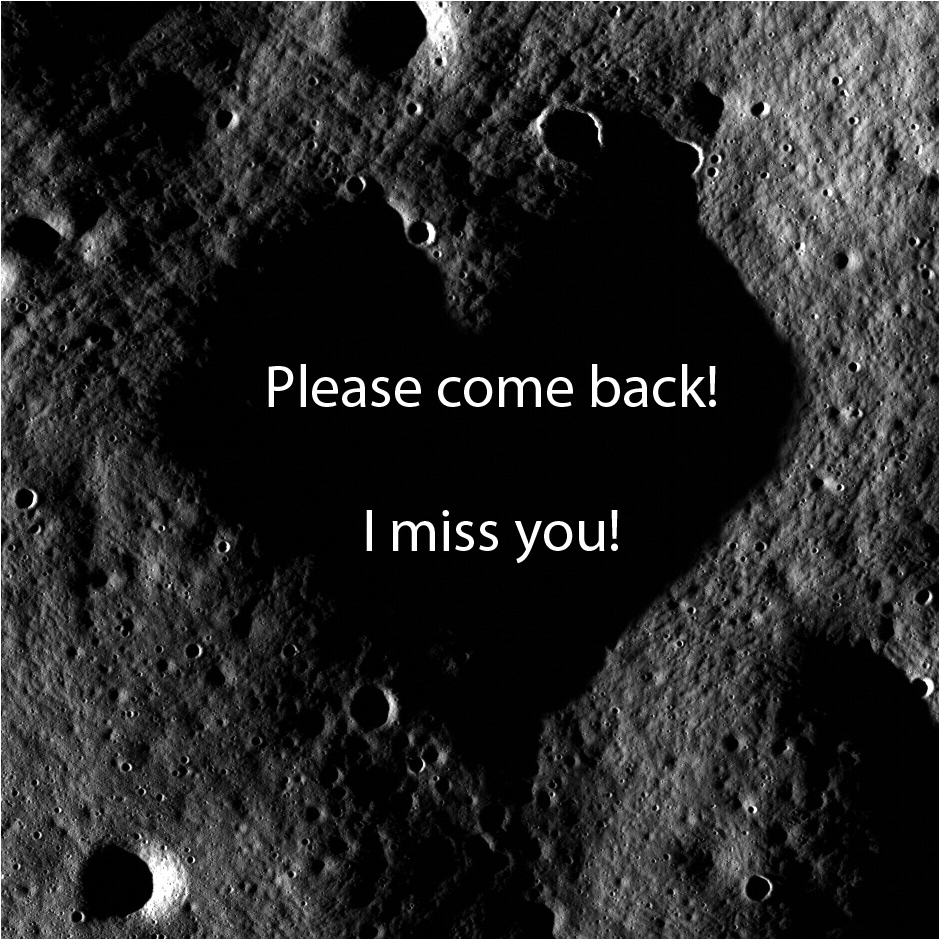
November 19, 1969, and EVA 1 of Apollo 12. Conrad & Bean are on their way to a planned survey of Middle Crescent Crater as Al Bean stops to examine this heart-shaped secondary crater. Pete Conrad, facing away, examines nearby features of the flat expanse of far-eastern Oceanus Procellarum [AS12-47-6938HR-NASA/ASJ].


Not to be outdone by serendipity from the now-supposedly by-gone Apollo era, Mark Robinson, principal investigator for the Lunar Reconnaissance Orbiter Camera (LROC) team at Arizona State University posted the above high-resolution LRO Narrow-Angle Camera image very late on Valentines Day (American Mountain Standard Time)

Thursday, November 19, 2009

Triumph (and disappointment) of Apollo 12


The genuine triumph, November 19, 1969
. The Apollo 12 lunar module Intrepid on target, Alan Bean takes the iconic photograph of Pete Conrad standing next to Surveyor 3 as he displays those parts they came to retrieve: the unmanned lander's television camera and shovel arm. Surveyor 3 had waited 944 days, alternately broiled and flash-frozen into it's thirty-fifth lunar sunrise. This precision landing, aided by remarkable navigation and supplementary Doppler radar, was an unparalleled achievement. Meanwhile, back on Earth, all anyone could see of the action (below) was burned on the ruined camera's retina [Alan Bean NASA/Apollo].


An entertainment disappointment. The first live color television broadcast from the Moon didn't last very long, a little over twenty minutes, covering Conrad & Bean's light-hearted descent down the ladder through their first steps and brief arrival ceremony. Almost from the moment the live color television camera was retrieved from its stowed vantage, Al Bean inadvertently exposed the it to the brilliant sunrise, and it was toast. People on the ground stared at the image (above) for at least forty-five disbelieving minutes before the big networks and NASA accepted the fact that the scene wasn't going to change.


Joel Raupe
Lunar Pioneer

Not enough is being written about the 40th anniversary of Apollo 12, and that surprises me a little. I know it shouldn't. After all, there are at least a hundred million Americans alive today for whom last July's Fortieth Anniversary of Apollo 11 must have seemed similar to what I experienced during that same anniversary in 1967 of Charles Lindbergh's solo flight across the Atlantic.

It's a good thing we have those tapes reproducing the improperly synched and smeared black and while television images of Neil Armstrong's first steps. It's sweeter still that Mark Robinson and his LROC team, who so skillfully operate the Narrow Angle Camera on the Lunar Reconnaissance Orbiter (LRO) released detailed photographic surveys of the Apollo landing sites, showing those first steps still so well-preserved on lunar surface.

Otherwise someone might come up with some "conspiracy theory," insisting the whole thing was taped on a sound stage, perhaps at Area 51 or something.

If that had been the case I would have to compare such theories with the opinions expressed by my Grandfather, a half-Plains Indian, cowboy and shell-shocked veteran of World War I, who would never quite grasp the concept of Earth orbit, let alone traveling to the Moon.

I'm going to have to ask you to imagine experiencing this thing through the eyes of a ten-year-old, a certifiable space fanatic who was forced to sit in the backseat to impatiently listen to my Grandfather and his brothers as they rationalized this news of Americans on the Moon, somehow both impossible and a national triumph.

My Grandfather theorized from behind the wheel of his dusty Ford, windows rolled down as he tooled around the Central Texas countryside that, while it was clearly impossible for humans to actually be walking on the Moon, it was "still a good thing, what they're doing."

"What they done," he concluded, "was land over there in Japan, in them bum craters, which was a good thing, since no one had been there since they dropped them bums."

My father, a decade younger than I am today, had to insist I keep my silence, and I did, reluctantly, occasionally dodging my grandfather's chewing tobacco, little wet payloads launched suborbitally out the driver's side window.

He meant, of course, that "the government, up in Washington" had, instead, landed military personnel in spacesuits at the sites of the first nuclear "bum" explosions: Alamogordo, Hiroshima, Nagasaki and Bikini Atoll.

"Son," he would say, rolling his eyes each time that this interesting, if chatty, ten-year-old grandson of his tried hard to explain basic Newtonian Mechanics, a genial grin on his face, chiding me through the rear-view mirror, "what keeps it up there?"

And I've patiently ignored, without any contempt prior to investigation, any and all of the best conspiracy theories about the Apollo Moon landings ever since.

Allow me also to forego sharing too much detail of Apollo 12 that you can find on your own, today, using any respectable search engine. In the Apollo Era, fanatic followers of NASA had to wait usually about six months to see a selection of the best photographs from each of those missions, as presented in National Geographic. Not until the middle of the 1990's was I aware that higher resolutions of the still photography from those missions was remotely possible.

Apollo 12 was a historic demonstration of what still remains close to the cutting edge in orbital mechanics and engineering. The mission was designed originally as a stop-gap and back-up should Apollo 11 fail, and became instead the first true precision landing on the Moon.

A glance at the contemporary pictures of the landing site, the landing site of Surveyor 3, shows a puzzling plain featuring the chaotic layers of crater saturation in the vast equatorial Oceanus Procellarum, and it still has me shaking my head in admiration for the sheer talent that made this landing happen forty years ago.

It will take us years to catch up with where we dared reach. (Compare this situation with the state of aviation forty years after "Lucky" Lindy's flew the Atlantic.)

Yes, I'm still awed, wondering how mission planners knew so precisely which crater Surveyor 3 was sitting, the very crater, where it would just be beginning it's 35th lunar sunrise, 944 Earth-days after its robotic landing (and then a re-landing) in April 1967.

Conrad and Bean, frankly, were ecstatic when the lunar module Intrepid tipped forward through Terminal Descent and they instantly spied the "Snowman" cluster of craters where Surveyor 3 waited patiently.

Cheerful Commander Charles "Pete" Conrad, Jr., USN (1930 - 1999) became the third person to walk on the Moon, November 19, 1969, just four months after Armstrong & Aldrin the previous July.

Apollo 11 was a hard act to follow, but if anyone was best suited to provide some needed entertainment value, where Armstrong had provided needed steely precision, it was Pete Conrad.

Short, energetic, it's difficult to find any picture of the man without his trademark, gap-tooth smile. He and Al Bean were a friendly team, a notable contrast with the cautious crew Apollo 11.

Again, put yourself in my ten-year-old shoes, that November.

I had followed (and still follow) each and every mission, manned or unmanned. And on that "School Night," I strained to listen to the live communications, through the now-classic ridiculous jabbering of television network commentators and readers, even waiting through commercials.

It was my junk, since Telstar, at least.

Still, I didn't miss much that night, though the more easily distracted were already drifting away from the much larger Cloud of Witness the previous July.

So I was sat glued to the television, with my collection of glued-together models, of a Saturn V, an Apollo CSM-LM combo, a separate Lunar Module and my Rand McNally Moon map. And I listened to the faceless voices, so far away, to Conrad & Bean excitedly relaying their Comm through another daring descent.

At some point, I looked around the living room and realized I was the only one awake in the house. But my Mother (who quietly shared my enthusiasm for space travel, who had turned me on to Star Trek) fought sleep and finally did slip into the room, perhaps as worried for me missing sleep than for Pete Conrad and Al Bean.

Their landing passed, and I fell asleep, knowing it would be many hours before they would disembark.

I was waiting for the television, and, for the first time, a color camera.

My Mother nudged me back awake, admonishing me to back away from the new color television around daybreak. As I rubbed my eyes, Conrad was suddenly visible in our living room coming down the ladder, upside down at first, soon rectified by Houston.

It looked a lot like Apollo 11, only this time, the scene was definitely "in color."

Color television was still "new," or "newly cheaper," finally reaching a fifty percent household saturation, essentially the same technology first publically demonstrated at the 1939 New York Worlds Fair.

The rest of the household began to gather, and my stunned father, already dressed and primed for work, changed his mind and decided to go in late, instead. He wasn't as above "all that" as he thought.

Today, you can watch it all on the Internet, if you carefully dodge the conspiracy uploads, and witness every moment of what we saw Live From The Moon during the following twenty minutes or so. The highlights of that brief, very promising but tragically brief broadcast is discussed on Wikipedia:

"When Conrad, who was somewhat shorter than Neil Armstrong, stepped onto the lunar surface, his first words were "Whoopie! Man, that may have been a small one for Neil, but that's a long one for me."[4] This was not an off-the-cuff remark: Conrad had made a $500 bet with reporter Oriana Fallaci he would say these words, after she had queried whether NASA had instructed Neil Armstrong what to say as he stepped onto the Moon. Conrad later said he was never able to collect the money.[5][6]

"To improve the quality of television pictures from the Moon, a color camera was carried on Apollo 12 (unlike the monochrome camera that was used on Apollo 11). Unfortunately, when Bean carried the camera to the place near the lunar module where it was to be set up, he inadvertently pointed it directly into the Sun, destroying the vidicon tube. Television coverage of this mission was thus terminated almost immediately."

That single broadcast would be the first and only color television coverage of a Moon landing until Apollo 14, in 1971. The hiatus, of course, was due to the Apollo 13 abort the following April.

Even then, much of the Apollo 14 excursions would happen out from the view of an improved but still imperfect live television camera. When time finally arrived for what became the final three science, or "J" missions, supplied with redundant, remote controlled cameras, mounted on lunar electric rovers, a lot of the magic was gone for the lowest common denominators in the market of mass appeal, among whom were many who would tolerate no more interruptions of their Soaps. Viet Nam was winding down, and the introspective, odd-ball Seventies were well underway.

I'm not insisting that a moment's inattention, the unintentional destruction of Apollo 12's color TV camera so early during an exceptional mission, caused the larger "Gap," the gap in lunar exploration, from Apollo 17 to Lunar Prospector, but it is certain full appreciation of the role entertainment plays in the funding of space exploration is still not fully appreciated.