 |
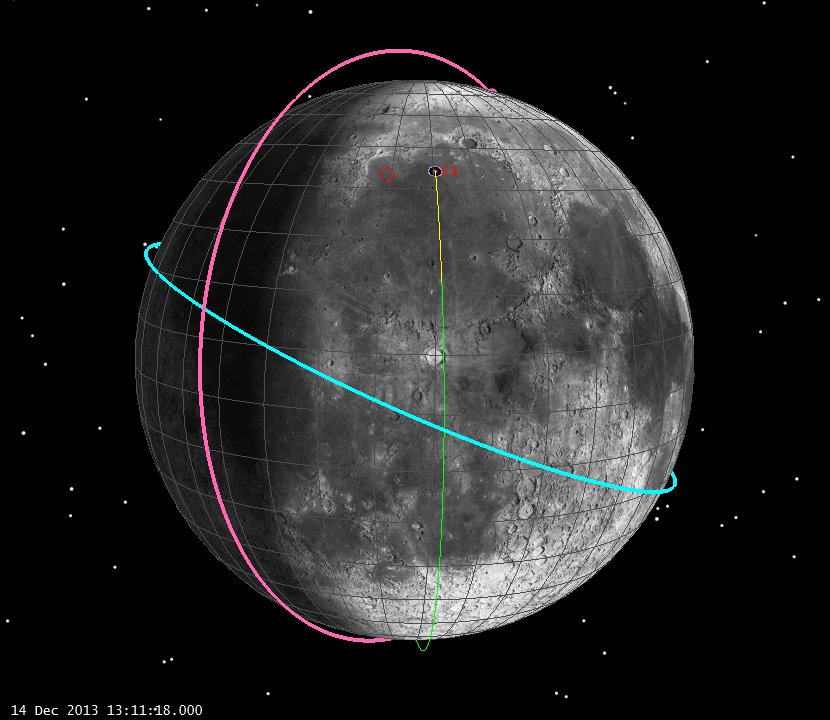
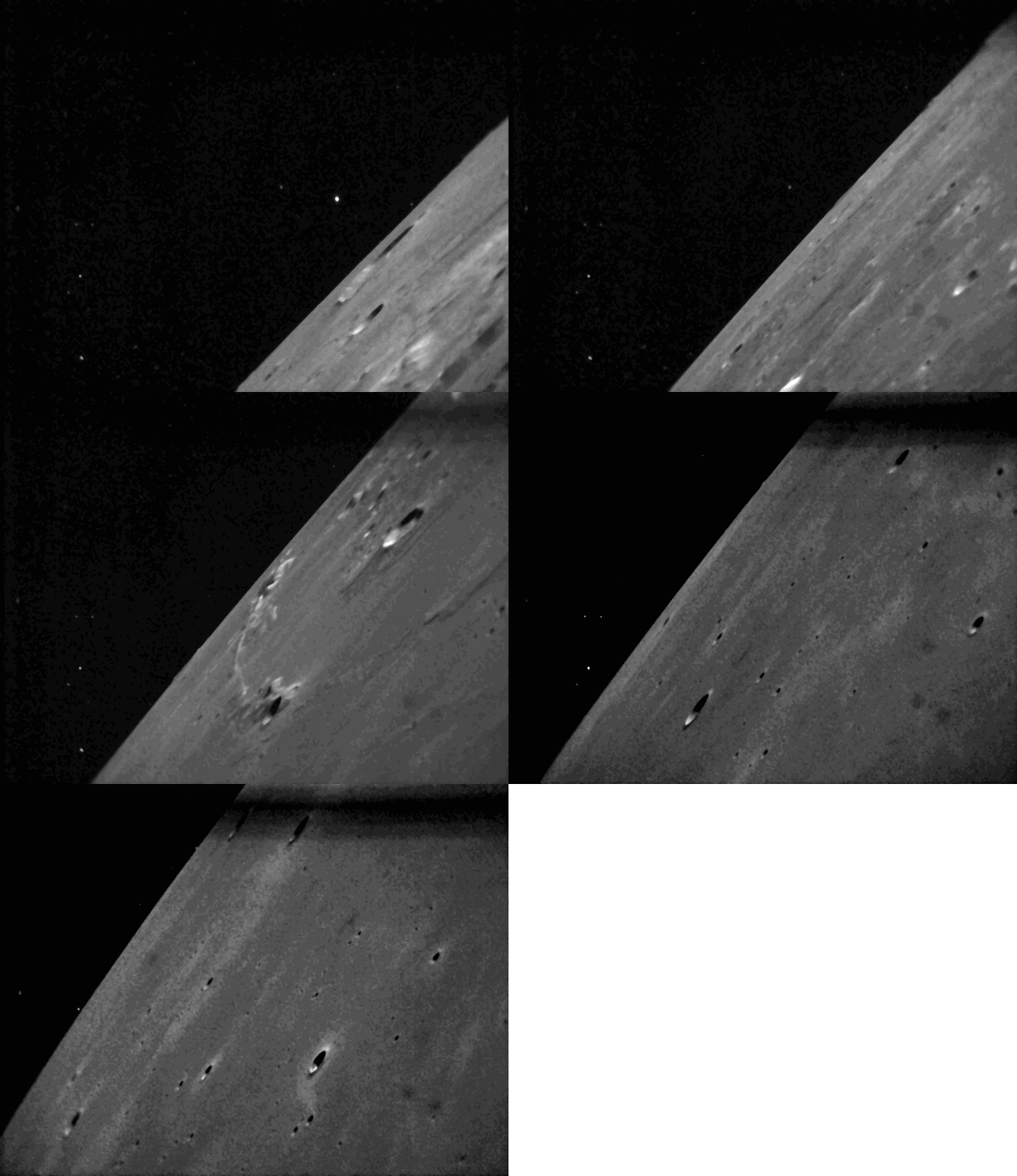
| Series of LADEE star tracker images show the starfield against which the spacecraft baselines the data it collects eclipsed by the Moon below, as the short-lived mission's orbit skirts the northern edge of the Aristarchus plateau [NASA/ARC]. |
Rachel Hoover
NASA Ames Research Center
Earlier this month, NASA's Lunar Atmosphere and Dust Environment Explorer (LADEE) observatory successfully downlinked images of the moon and stars taken by onboard camera systems, known as star trackers. This is the first time the LADEE team commanded the spacecraft to send these pictures back to Earth.
The main job of a star tracker is to snap images of the surrounding star field so that the spacecraft can internally calculate its orientation in space. It completes this task many times per minute. The accuracy of each of LADEE's instruments' measurements depends on the star tracker calculating the precise orientation of the spacecraft.
"Star tracker cameras are actually not very good at taking ordinary images," said Butler Hine LADEE project manager at NASA's Ames Research Center in Moffett Field, California "But they can sometimes provide exciting glimpses of the lunar terrain."
Given the critical nature of its assignment, a star tracker doesn't use ordinary cameras. Star trackers' lenses have a wide-angle field of view in order to capture the night sky in a single frame.
The images shown here were acquired on February 8, 2014, around 2345 UT, while LADEE was carrying out atmospheric measurements. The series of five images were taken at one-minute intervals, and caught features in the northwestern hemisphere of the moon. LADEE was traveling approximately 100 km per minute along its retrograde semi-equatorial orbit. All images were taken during lunar night, but with Earthshine illuminating the surface.
The initial image captured the smooth-floored crater Krieger (22.86 km, 29.02°N, 314.39°E) on the horizon, with 7 km Toscanelli in the foreground.
The second image shows Wollaston P, about 4 km across near the horizon, and the southeastern flank of the lunar mountain Mons Herodotus.
The third image caught a minor lunar mountain range Montes Agricola, the northwest frontier of the Aristarchus Plateau, as well as the flat-floored crater Raman, about 10 km in diameter.
Image four in the series captures 6 km Golgi and 5 km Zinner.
The final image views craters Lichtenberg A (6.9 km, 28.9°N, 299.89°E) and Schiaparelli E (4.9 km, 27.12°N, 297.93°E) in the smooth mare basalt plains of western Oceanus Procellarum.
The star trackers will operate while LADEE continues to measure the chemical composition of the atmosphere, collect and analyze samples of lunar dust particles in the atmosphere and hope to address a long-standing question: Was lunar dust, electrically charged by sunlight, responsible for the pre-sunrise glow above the lunar horizon observed during several Apollo missions? And who knows? The star trackers may help answer that question.
NASA Ames Research Center
Earlier this month, NASA's Lunar Atmosphere and Dust Environment Explorer (LADEE) observatory successfully downlinked images of the moon and stars taken by onboard camera systems, known as star trackers. This is the first time the LADEE team commanded the spacecraft to send these pictures back to Earth.
The main job of a star tracker is to snap images of the surrounding star field so that the spacecraft can internally calculate its orientation in space. It completes this task many times per minute. The accuracy of each of LADEE's instruments' measurements depends on the star tracker calculating the precise orientation of the spacecraft.
"Star tracker cameras are actually not very good at taking ordinary images," said Butler Hine LADEE project manager at NASA's Ames Research Center in Moffett Field, California "But they can sometimes provide exciting glimpses of the lunar terrain."
Given the critical nature of its assignment, a star tracker doesn't use ordinary cameras. Star trackers' lenses have a wide-angle field of view in order to capture the night sky in a single frame.
The images shown here were acquired on February 8, 2014, around 2345 UT, while LADEE was carrying out atmospheric measurements. The series of five images were taken at one-minute intervals, and caught features in the northwestern hemisphere of the moon. LADEE was traveling approximately 100 km per minute along its retrograde semi-equatorial orbit. All images were taken during lunar night, but with Earthshine illuminating the surface.
The initial image captured the smooth-floored crater Krieger (22.86 km, 29.02°N, 314.39°E) on the horizon, with 7 km Toscanelli in the foreground.
The second image shows Wollaston P, about 4 km across near the horizon, and the southeastern flank of the lunar mountain Mons Herodotus.
The third image caught a minor lunar mountain range Montes Agricola, the northwest frontier of the Aristarchus Plateau, as well as the flat-floored crater Raman, about 10 km in diameter.
Image four in the series captures 6 km Golgi and 5 km Zinner.
The final image views craters Lichtenberg A (6.9 km, 28.9°N, 299.89°E) and Schiaparelli E (4.9 km, 27.12°N, 297.93°E) in the smooth mare basalt plains of western Oceanus Procellarum.
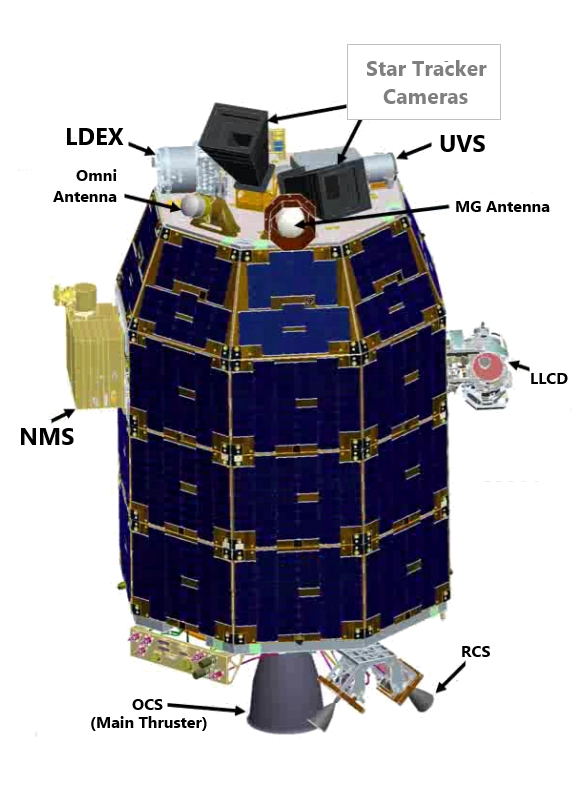 |
| Location of LADEE Star Tracker Cameras in relation to its primary components [NASA/LEAG]. |