Showing posts with label Exosphere. Show all posts

Thursday, November 21, 2013

Apollo 12 ALSEP first to measure dust accumulation

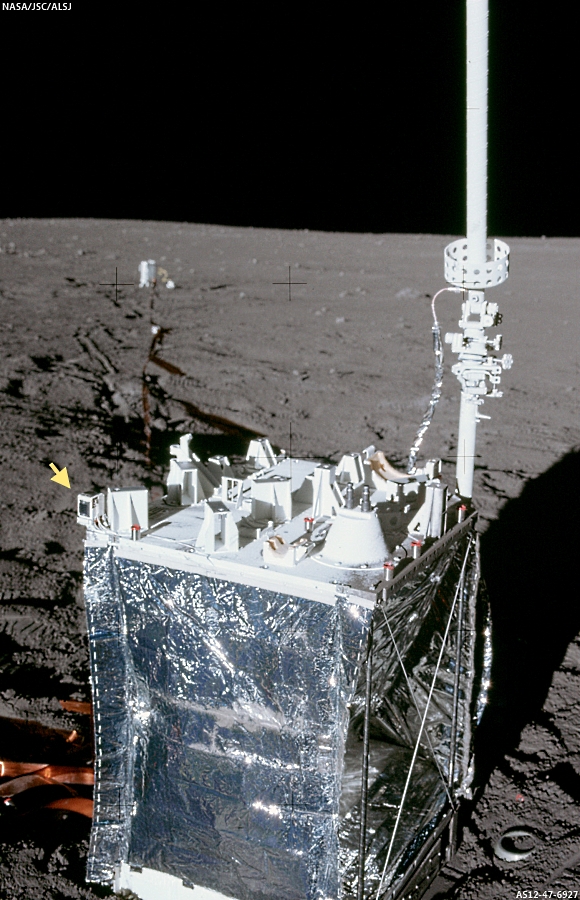
Apollo 12 ALSEP Central Station
Apollo 12 ALSEP, Central Station, with DTREM (Lunar Dust Collector) marked with arrow. Alan J. Bean, EVA-1;  Oceanus Procellarum, November 19, 1969 (AS12-47-6927) [NASA/JSC/ALSJ].
A dataset thought to have been lost, from an ingenious experiment deployed on the Moon by Apollo astronauts more than four decades ago, has been rediscovered and analyzed. As a result, the Lunar Dust Collector deployed as integral to the Apollo 12 ALSEP system, has become the first instrument to record a measurable rate of dust accumulation on the lunar surface. 

The news is timely, of course, coming the beginning of the Lunar Atmosphere and Dust Environment Explorer (LADEE) science mission, and arriving on November 19, the 44th anniversary of the Apollo 12 expedition.

Keith Cowing
Moonviews.com (LOIRP)

The Lunar Dust Detector, attached to the corner of (the ALSEP Central Station, pictured above), left by the Apollo 12 astronauts, made the first measurement of lunar dust accumulation. As the matchbox-sized device's three solar panels became covered by dust, the voltage they produced dropped.

When Neil Armstrong took humanity's first otherworldly steps in 1969, he didn't know what a nuisance the lunar soil beneath his feet would prove to be. The scratchy dust clung to everything it touched, causing scientific instruments to overheat and, for Apollo 17 astronaut Harrison Schmitt, a sort of lunar dust hay fever. The annoying particles even prompted a scientific experiment to figure out how fast they collect, but NASA's data got lost.

AS17-145-22157
Retrieving a surface sample behind boulders on a crater rim at Apollo 17 Science Station 5, Taurus Littrow valley; December 12, 1972 - Lunar module pilot and geologist Harrison Schmitt already carries a substantial sampling of abrasive, fine lunar dust on his moon suit. Schmitt endorsed development of 'dust mitigation' technology as a high priority for program planners prior to establishing 'extended human activity' on the Moon (Eugene Cernan - AS17-145-22157) [NASA/JSC/ALSJ].
Or, so NASA thought. Now, more than 40 years later, scientists have used the rediscovered data to make the first determination of how fast lunar dust accumulates. It builds up unbelievably slowly by the standards of any Earth-bound housekeeper, their calculations show -- just fast enough to form a layer about a millimeter (0.04 inch) thick every 1,000 years. Yet, that rate is 10 times previous estimates. It's also more than speedy enough to pose a serious problem for the solar cells that serve as critical power sources for space exploration missions.

Friday, March 23, 2012

Expectations for the LADEE LDEX

The 'Dust, Atmosphere, and Plasma: Moon and Small Bodies' (DAP-2012) meeting will take place in Boulder, June 6-8, 2012. Please visit our webpages http://ldap2012.colorado.edu/  to register and submit an abstract by 3/30/2012, if you plan to attend.

We are looking forward to see you in Boulder!

- Alan Stern and Mihaly Horanyi
A lasting lesson from Apollo. The lunar exosphere gets into everything, fine as talcum, abrasive as broken glass, and a significant cumulative threat to seals and any and all working parts generally, whether biological and mechanical. Beyond its demonstrated mission threat the Moon's dusty environment is a delicate, "pristine" and important  part of a 4.5 billion year history of space weather near Earth. Apollo 17 lunar module pilot and geologist Harrison H. "Jack" Schmitt moves forward with the patina of 22 hours activity on the lunar surface clinging to his suit. AS17-145-22157 [NASA/JSC/ALSJ].
The Moon's sodium tail,
Potter and Morgan (1998).
The Lunar Dust Environment:
Expectations for the LADEE
Lunar Dust Experiment (LDEX)

Mihaly Horanyi, Sternovsky & Shul
with Colette, Grün, Kempf, Srama & Mocker
43rd Lunar and Planetary Science Conference, #2635

Introduction: The lunar dust environment is expected to be dominated by submicron-sized dust particles released from the Moon due to the continual bombardment by micrometeoroids, and due to plasma-induced near-surface intense electric fields. The Lunar Dust EXperiment (LDEX) is designed to map the spatial and temporal variability of the dust size and density distributions in the lunar environment on-board the upcoming Lunar Atmosphere and Dust Environment Explorer (LADEE) mission

LDEX is an impact detector, capable of measuring the mass of submicron sized dust grains. LDEX will also measure the collective signal of dust grains below the detection threshold for single dust impacts; hence it can search for the putative population of grains with r ~ 0.1 μm lofted over the terminator regions by plasma effects.

LDEX has been developed at the Laboratory for Atmospheric and Space Physics and Colorado Center for Lunar Dust and Atmospheric Studies (LASP/CCLDAS, University of Colorado at Boulder) and has a high degree of heritage based on similar instruments on the HEOS 2, Ulysses, Galileo, and Cassini missions. The LDEX flight model will be tested and calibrated at both the (Max-Planck-Institute for Nuclear Physics, Heidelberg, Germany) and Boulder dust accelerator facilities.

At the Lunar and Planetary Science Conference, March 21, 2012, Dr. Horányi summarized expected capabilities of LDEX and made predictions for its measurements in lunar orbit, based on current theoretical models. The authors also discussed a proposed LDEXPLUS instrument being developed for a possible LADEE follow-up mission to add the instrument's design capability for in-situ chemical analysis of impacting dust particles, perhaps to verify "the existence of water ice on the lunar surface and map the density of valuable resources of commercial interest".

Figure 1. LDEX EM and FM units and the schematic drawings of the instrument.
The LDEX instrument: The two expected sources of dust in the lunar environment are ejecta production due to continual bombardment by interplanetary meteoroids and lofting due to plasma effects. LDEX is an impact ionization dust detector with a sensor area of ~0.01 m\2. LDEX is a low risk, compact instrument and uses no flight software (Figure 1). In addition to individual dust impacts of grains with radii r > 0.3 μm, LDEX can identify a large population of smaller grains (0.1 < r < 0.3 μm) by measuring their collective signal.The expected impact rates, and the signature of lofted small grains expected over the terminators are shown in Figure 2.

Figure 2. Expected impact rates on a 30x100 km orbit with its pericenter over the morning terminator.

Initial test and calibration of the LDEX FM model were done at the CCLDAS dust accelerator facility. Full calibrations are planned in early 2012 at both the Heidelberg and the Boulder facilities. Figure 3 shows the preliminary test results, indicating that LDEX will meet or exceed its measurement requirements.

Figure 3. Initial test results for the LDEX FM instrument showing the detected particle mass versus their velocity. At the expected impact speed of 1.6 km/s,

LDEX will detect particles with radii r > 0.4 μm. The ratio of detected and undetected particles matches the expected value due to the duty cycle of the electronics and the transparency of the screens that provide shielding and exclude the solar wind electrons from entering LDEX.

The LDEX-PLUS instrument extends the LDEX capabilities to also measure the chemical composition of the impacting particles with a mass resolution of M/ΔM > 30. Traditional methods to analyze surfaces of airless planetary objects from an orbiter are IR and gamma-ray spectroscopy, and neutron backscatter measurements. A complementary method is to analyze dust particles as samples of planetary objects from which they were released. The source region of each analyzed grain can be determined with accuracy at the surface that is approximately the altitude of the orbit.

This ‘dust spectrometer’ approach provides key chemical constraints for varying provinces on the lunar surfaces. LDEX-PLUS is of particular interest to verify from orbit the presence of water ice in the permanently shadowed lunar craters. LDEX-PLUS combines the impact detection capabilities of LDEX with a linear time-of-flight system, similar to the Cassini Cosmic Dust Analyzer (CDA) instrument. Figure 4 shows an example time-of-flight mass spectrum of an ice-bearing dust grain.

Figure 4. Spectrum of a water ice particle obtained at ~ 4 km/s impact speed by the Cassini CDA instrument in Saturn's E ring. The dominant peaks are mass lines of water cluster ions (H2O)nH+, generated upon impact of an ice-bearing particle.
Schematic of documented species of horizon glow, such as the famous mid-lunar night imagery captured by Surveyor 7 in 1968.

Conclusions. LDEX, on-board LADEE, is scheduled to launch in May 2013 and will be capable of mapping the density distributions of both the large ejecta particles and the collective signal of small lofted grains. LDEX-PLUS, on-board a follow-up lunar mission, can collect a large number of samples from a greater part of the entire surface for analysis.

The instrument is especially sensitive to the metallic compounds of minerals and any species which easily form ions (e.g. water). The accuracy of the trajectory back-tracing to the surface is comparable to the altitude of the satellite. This in-situ method allows compositional surface mapping of the Moon. Since the dust spectrometer is particularly sensitive to refractory compounds which are difficult to access by other methods it is also complementary to remote sensing spectroscopy and an ion or neutral mass spectrometer. A ram pointing dust spectrometer and a nadir pointing remote sensing instrument collect data from approximately the same spot on the surface of the Moon, hence the combination of these measurements greatly enhances our ability to map the chemical composition of the surface and identify water-bearing regions.

An LDEX-PLUS type instrument can also address many of the science goals of a Europa Jupiter System Mission (EJSM) regarding the surface chemistry of icy satellites. See original Conference abstract, HERE, for citations.
Lunar Horizon Glow (LHC) as televised (vidicon photography) in local night, early 1968 [NASA].

Tuesday, December 6, 2011

CME's could 'sandblast' the Moon

Dust off: Images from computer simulations of the lunar calcium exosphere during a Coronal Mass Ejection (CME-left) and slow solar wind (SW-right) condition. Red and yellow indicate a relatively high abundance of calcium ions and blue, purple, and black indicate a low abundance. A CME produces a much denser exosphere than the slow solar wind. View movie of simulation HERE [NASA/Johns Hopkins-APL].
Bill Steigerwald
NASA GSFC


Solar storms and associated Coronal Mass Ejections (CMEs) can significantly erode the lunar surface according to a new set of computer simulations by NASA scientists. In addition to removing a surprisingly large amount of material from the lunar surface, this could be a major method of atmospheric loss for planets like Mars that are unprotected by a global magnetic field.

The research is being led by Rosemary Killen at NASA's Goddard Space Flight Center, Greenbelt, Md., as part of the Dynamic Response of the Environment At the Moon (DREAM) team within the NASA Lunar Science Institute.

CMEs are basically an intense gust of the normal solar wind, a diffuse stream of electrically conductive gas called plasma that's blown outward from the surface of the Sun into space. A strong CME may contain around a billion tons of plasma moving at up to a million miles per hour in a cloud many times the size of Earth.

The moon has just the barest wisp of an atmosphere, technically called an exosphere because it is so tenuous, which leaves it vulnerable to CME effects. The plasma from CMEs impacts the lunar surface, and atoms from the surface are ejected in a process called "sputtering."

"We found that when this massive cloud of plasma strikes the moon, it acts like a sandblaster and easily removes volatile material from the surface," said William Farrell, DREAM team lead at NASA Goddard. "The model predicts 100 to 200 tons of lunar material – the equivalent of 10 dump truck loads – could be stripped off the lunar surface during the typical 2-day passage of a CME."

This is the first time researchers have attempted to predict the effects of a CME on the moon. "Connecting various models together to mimic conditions during solar storms is a major goal of the DREAM project," says Farrell.

Read the NASA/GSFC News Release, HERE.

Dream Team - NASA/GSFC/NLSI

Sunday, February 1, 2009

NLSI picks Goddard to study the Dynamic Moon

NASA's Lunar Science Institute (NLSI) has selected a proposal submitter by NASA Goddard to investigate the influence of the Sun on the Moon. The wide-ranging effects of Solar Wind and its surface interaction with the dusty lunar surface was identified as essential research, by the National Academies of Science's Space Studies Board in 2007, before extended human activity on the Moon can begin.

The award, one of seven announced by NASA, devotes $5 million over four years beginning in April. Researchers will build advanced simulations to explore the interaction between the Sun and Moon, emphasizing surface interactions during solar particle events (SPEs) such as intense flares and Coronal Mass Ejections. The study will also investigate spellation along with both primary and secondary high energy Galactic Cosmic Ray impacts and those of micrometeorites.

"Many people think of the moon as dead, but if you look with a different pair of glasses – at the atomic level – it is very active," said Dr. William Farrell of NASA Goddard, Principal Investigator for the proposal, called the Dynamic Response of the Environment at the Moon (DREAM).

"One of our roles will be to provide modeling support to scientists examining data from NASA's lunar science missions, such as the Lunar Reconnaissance Orbiter (LRO). There are always surprises in science, and our computer models can help them understand unexpected results or choose among competing theories," said Farrell.

"The sun is constantly throwing energy and matter into space – radiation and a million-mile-per-hour stream of electrically charged particles called the solar wind. If you put an object in the path of this stuff, such as the moon, that object will get hit and react. This reaction to inflowing solar matter includes surface erosion of gas and dust. There are also other subtle reactions, like the electrostatic charging of the lunar surface and any object on the surface that can be a concern for human explorers. All these effects are enhanced during a solar storm when the sun temporarily spews out a greater amount of energy and matter," said Farrell.

DREAM researchers will study many ways the sun influences the moon, but some interactions will be of special interest to human explorers: solar storms, the electric charging of lunar dust, and the erosion of potential resources at the poles.

Read the Goddard Press Release HERE.