Showing posts with label CLEP. Show all posts

Thursday, January 15, 2015

Chang'e-5 T1 service module tightens its lunar orbit

The Chang'e-5 T1 service module (with profile of the Xiaofei "Little Flyer" reentry test vehicle that hitched a ride to the Moon in late October, in profile) has been inserted successfully in a 200 x 200 km polar lunar orbit. (Xiaofei returned to Earth November 1, eight days after launch onboard a Long March 3C booster).
Perhaps they just should have called it Chang'e-4.  But Beijing instead waited nearly until the October 24 launch of the Long March 3C rocket carrying Chang'e-5 T1 to the Moon before putting an official name to the engineering test. 

Part of this mission is still underway, though many who are interested outside China's official circles believed the awkwardly named composite mission came to an end when the Xiaofei ("Little Flyer") sample return and high-speed reentry test article arrived back on Earth, November 1.

Xiaofei is recovered after its eight day
journey around the Moon
[Xinhua].
The China National Space Administration (CNSA) reports the service module of China's "unmanned test lunar orbiter entered a 127-minute orbit on Tuesday, after three orbital transfers since Sunday."

Using backup equipment from the Chang'e-3 together with test articles ahead of the Chang'e-5 sample return mission scheduled for 2017, the CNSA announced it had skipped over the "Chang'e-4" designation, originally a name for a back-up mission if Chang'e-3 had failed, and named the present intermediate test "Chang'e-5 T1." 

Based on released schematics and photographs of both Chang'e-3 and Chang'e-5 T1 vehicles while each was being prepared for launch, the "T1" service module now in lunar orbit does not resemble the earlier orbital science platforms Chang'e-1 or 2. It more likely resembles the now-familiar profile of the Chang'e-3 lander, without the legs.

"To decelerate the craft enough for entering its target orbit," CNSA reported, "the service module conducted three braking maneuvers on Sunday, Monday and Tuesday.

"After the circular orbit stabilizes," the T1 service module will continue in polar orbit, at an altitude of 200 km, "for tests to validate key technologies for the next lunar probe mission, Chang'e-5."

"The spacecraft has enough power remaining and is in sound condition," according to CNSA. 

"Technicians on Earth have exercised timely and stable control, with the tasks of tracing the service module and system tests progressing well."

Chang'e-5 T1 was launched on October 24, 2014, and "the service module was separated from the orbiter's Xiaofei return capsule, with the capsule returning to Earth after circling behind the moon during an eight-day mission.

"The service module reached the Earth-Moon second Lagrange Point (L2) in late November and left L2 point January 4, after completing all preset scientific tasks," CNSA reports.

"The orbiter is a test run for the final chapter of China's three step lunar program -- orbiting, landing and returning," CNSA announced. "The obtained data and validated re-entry technology will be used for the development of Chang'e-5, which is slated for launch around 2017.

Related Posts:
It's not bragging if you do it (December 9, 2013)
China's Long March to the Moon (January 14, 2012)

Thursday, October 30, 2014

High speed re-entry of test platform expected Nov. 1


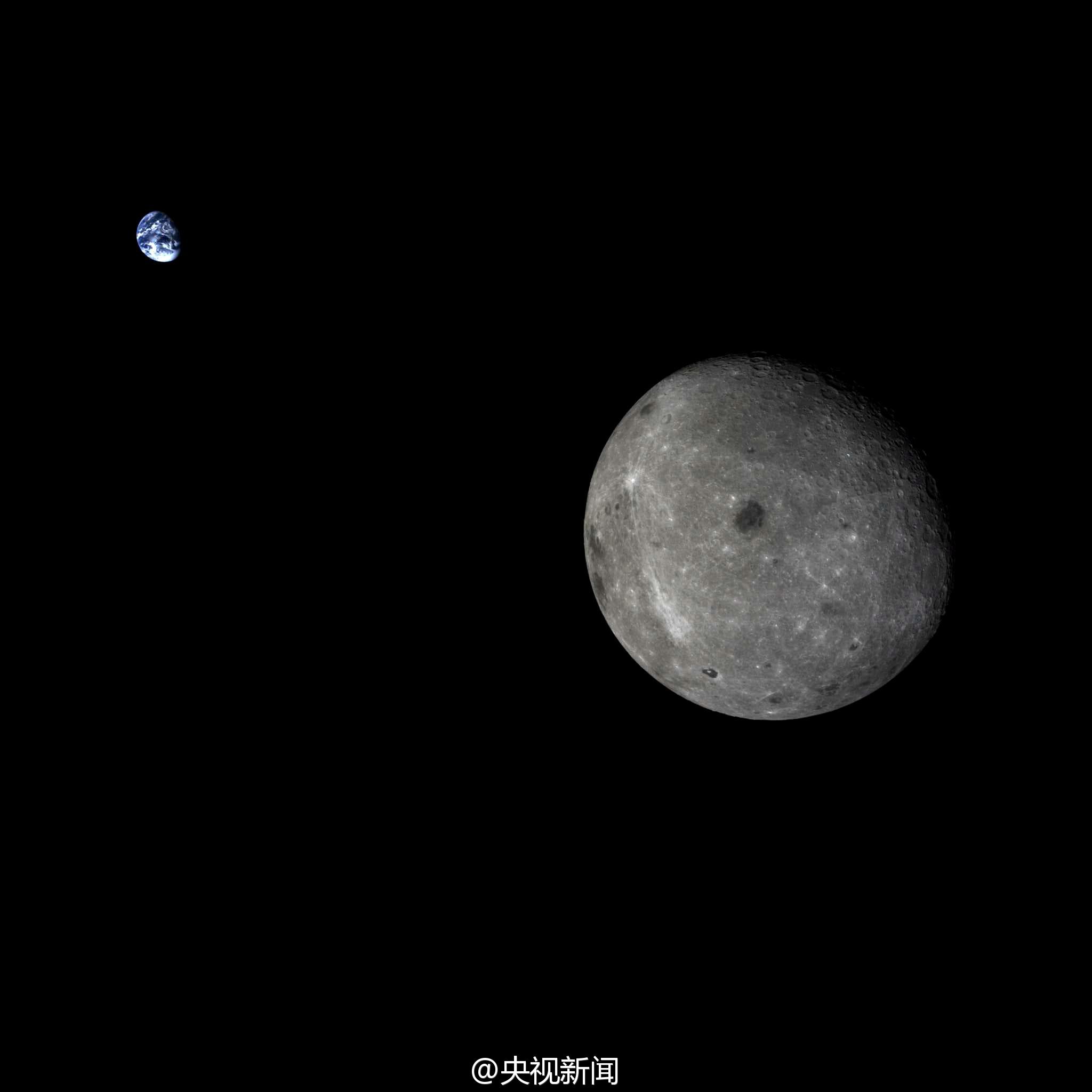
The lunar north pole and about 60 percent of the Moon's farside is visible in this view captured from 3300 km over the Moon's farside, Oct. 28, from the solar array camera in flight aboard a Chang'e 5 flight dynamic test platform. From Earth, a low Crescent Moon was visible in the evening sky. The phase angles of this image are comparable with those of the Soviet Union's Luna 3 vehicle and its first photographs of the farside captured October 7, 1959. Now well along on the return trip, a challenging re-entry at above 11 km/second, a first for China and the primary reason for the test mission, will occur Nov. 1, according to the State Administration of Science, Technology and Industry for National Defense (SASTIND). Dynamic control and high-speed re-entry technologies are necessary for the success of the scheduled 2017 robotic sample return mission Chang'e 5 [Xinhua].

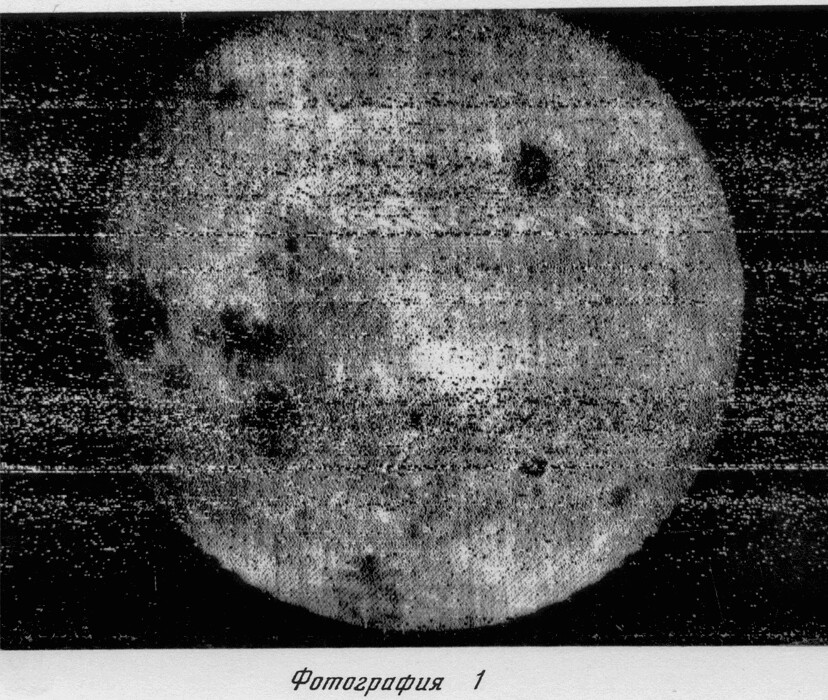
Comparisons have been made with the incidence angles of this, mankind's first look at the Moon's farside, from the Soviet Union's unmanned Luna 3, October 7, 1959 and the view above of Moon and Earth together from the Chang'e-5 flight dynamics test platform, October 28, 2014. More of the Moon's nearside and less farside was seen in the 1959 facsimile radioed back to Earth, but both views feature prominently Mare Moscoviense and mare-filled Tsiolkovskiy crater and highlight the now-well known differences between the two hemispheres, tidally locked into their permanent relationships with earthbound viewers [MAS/NASA].

Thursday, October 23, 2014

China launches lunar sample return test mission

Long March 3C lofts a lunar free-return trajectory and re-entry test module toward cislunar space early Friday morning, October 24, local time. The booster lifted off from Xichang Satellite Launch Center, in China's Sichuan Province, beginning a nine-day mission to 'live fire' test technologies China considers vital to the eventual success of Chang'e-5, a robotic lunar sample return mission now planned for 2017 [Xinhua/Jiang Hongjing].
Test module launch  preparations [CNSA/CLEP].
XICHANG, Sichuan, Oct. 24 (Xinhua) -- China launched an unmanned spacecraft early Friday to test technologies to be used in the Chang'e-5, a future probe that will conduct the country's first moon mission with a return to Earth.

The lunar orbiter was launched atop an advanced Long March-3C rocket from the Xichang Satellite Launch Center in southwest China's Sichuan Province.

The test spacecraft separated from its carrier rocket and entered the expected the orbit shortly after the liftoff, according to the State Administration of Science, Technology and Industry for National Defense.

The whole mission will take about eight days. Developed by China Aerospace Science and Technology Corporation, the spacecraft will fly around the moon for half a circle and return to Earth.

On its return, the test spacecraft will approach the terrestrial atmosphere at a velocity of nearly 11.2 kilometers per second and rebound to slow down before re-entering the atmosphere. It will land in north China's Inner Mongolia Autonomous Region.

The mission is to obtain experimental data and validate re-entry technologies such as guidance, navigation and control, heat shield and trajectory design for a future touch-down on the moon by Chang'e-5, which is expected to be sent to the moon, collect samples and return to Earth in 2017.

It is the first time China has conducted a test involving a half-orbiter around the moon at a height of 380,000 kilometers before having the spacecraft return to Earth.

The test orbiter is a precursor to the last phase of a three-step moon probe project, a lunar sample return mission.

China carried out Chang'e-1 and Chang'e-2 missions in 2007 and 2010, respectively, capping the orbital phase.

The ongoing second phase saw Chang'e-3 with the country's first moon rover Yutu onboard succeed in soft landing on the moon in December 2013. Chang'e-4 is the backup probe of Chang'e-3 and will help pave the way for future probes.

Related Posts:
Geologic characteristics: Chang'E-3 exploration region (January 31, 2014)
ESA on Yutu, as controllers wait for sunrise, February 9 (January 31, 2014)
Problem with solar-powered Yutu rover before nightfall (January 25, 2014)
Chang'e begins long-term science mission (January 18, 2014)
Preliminary Science Results from Chang'e-3 (January 16, 2014)
Chang'e-3 and Yutu survive first lunar night (January 14, 2014)
Chang'e-3 APXS delivers its first surface analysis (January 1, 2014)
Chang'e-3 lander and Yutu rover from LRO (December 31, 2013)
6 of 8 Chang'e-3 science instruments now active (December 18, 2013)
LRO: Finding Chang'e-3 (December 15, 2013)
China's Jade Rabbit, it's time in the Sun (December 15, 2013)
Chang'e-3 Landing Site in Mare Imbrium (December 15, 2013)
Jade Rabbit successfully deployed to the lunar surface (December 14, 2013)
It's not bragging if you do it (December 9, 2013)
"Lunar Aspirations" - Beijing Review (December 9, 2013)
Chang'e-3 safely inserted into lunar orbit (December 6, 2013)
CCTV: Chang'e-3, launch past TLO to Earthview (December 2, 2013)
Chang'e-3 launched from Xichang (December 1, 2013)
Chang'e-3 launch window opens 1 December 1730 UT (November 29, 2013)
Helping China to the MoonESA (November 29, 2013)
Chang'e-3 and LADEE: The Role of Serendipity (October 31, 2013)
Outstanding animation celebrates China's Chang'e-3 (October 29, 2013)
LROC updates image tally of human artifacts on the Moon (September 25, 2013)
Chang'e-3: China's rover mission (May 4, 2013)
China's grand plan for lunar exploration (October 11, 2012)
ILOA to study deep space from Chang'e-3 (September 11, 2012)
China's Long March to the Moon (January 14, 2012)
China plans lunar research base (May 11, 2011)
PRC continues methodical program (March 8, 2011)
Chang'e-2 arrives in mission orbit (October 9, 2010)
Dispatch from Chang'e-2: Sinus Iridum (October 4, 2010)
Chang'e-2 takes direct approach (October 1, 2010)
Chang'e-2 sets stage for future lunar missions (September 3, 2010)
Chang'e-1 research reported published (July 22, 2010)

China to launch sample return re-entry test vehicle

Long March 3C at Xichang [CNSA/CLEP].
Mo Hong'e
Xinhua

China will launch a new lunar mission this week to test technology likely to be used in Chang'e-5, a future lunar probe with the ability to return to Earth.

The experimental spacecraft launched this week is expected to utilize a free-return trajectory to fly high over the Moon's farside and adjust its course for return directly to Earth, according to a source with the State Administration of Science, Technology and Industry for National Defense.

The test module is reportedly in nominal condition and is scheduled to launch sometime prior to local dawn, between Friday and Sunday, from the Xichang Satellite Launch Center.

China's Long March-3C booster will carry the mission through trans-lunar injection.

The mission will involve the spacecraft cislunar navigation, re-entering Earth's atmosphere at above 11 km per second and landing safely on Earth, the source said.

Testing the spacecraft to return land safely at a pre-determined location is considered to be a key capability needed for Chang'e-5, the 2017 mission  designed to land, retrieve lunar samples, launch from the Moon and return the samples to Earth.

Saturday, January 25, 2014

Problem with solar-powered Yutu rover before nightfall

CCTV Yutu rover on the Moon
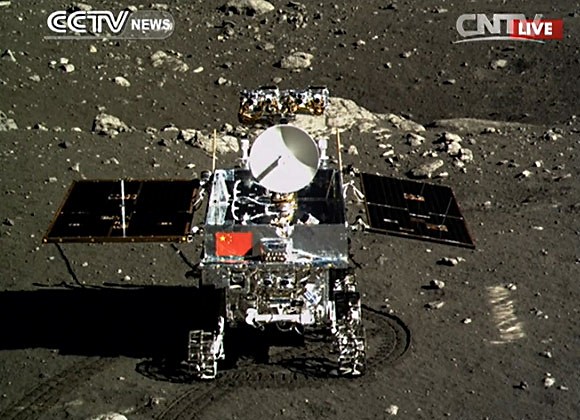
China's Yutu, "Jade Rabbit," lunar rover, the first such vehicle operated on the Moon since 1976 [CCTV].
Official sources in Beijing report China's lunar rover Yutu “experienced a mechanical abnormality" and "scientists are organizing repairs."

The problem occurred “due to the complicated lunar surface environment," just before local sunset at the Chang’e-3 landing site on Saturday, January 25, Xinhua reported, citing a report from SASTIND, China’s State Administration of Science Technology and Industry for National Defense.

No further details were available from official sources early Sunday, Beijing time (UT +8 hours).

Unofficial sources, however, say the rover's solar panels may have failed to retract when ground controllers were preparing Yutu for hibernation ahead of local sunset on Saturday, and the start of a second 330 hour-long lunar night since successful deployment from the Chang’e-3 lander, December 14.

Whether the anomaly permanently disables the rover may be undetermined. Both the Chang’e-3 lander and Yutu depend on solar power, so communicated efforts to resolve the issue may have had to be suspended before nightfall to conserve a base of power to sustain the small robot through the long night ahead.

Retracted solar panels also may be critical to protecting the rover’s components over the two weeks of cold and darkness before the next local sunrise on February 9. The Mare Imbrium landing site’s latitude, with its higher angles of incidence sunlight than available at the equator, might require the lander and rover both experience a shorter period of peak charging, a shorter time when the Sun is higher in the sky, than strictly the time between dawn and dusk.

Meanwhile, with no problems of its own reported, the stationary Chang'e-3 lander, Xinhua reported, successfully began its own second 14 day-long period of required dormancy period on Friday.

After their first hibernation periods ended two weeks ago the optical telescope carried out observations using an extreme ultraviolet (UV) camera, observing Earth’s plasma-sphere, which is among other successful operations reported among “Preliminary Science Results” released by the Chinese Academy of Sciences a week ago.

UHF communications between the lander and Yutu were also successfully tested.

The Chang'e-3 mission makes China only the third nation to soft-land a spacecraft on the Moon, the first since Luna 24 in 1976, and whatever the outcome of its present challenges, Yutu is only the third remote- operated rover deployed on the Moon since Lunokhod 2 in 1973, which also used solar power but was kept warm through four lunar nights using heat generated by a radioisotope decay heater.

Some Related Posts:
Chang'e begins long-term science mission (January 18, 2014)
Preliminary Science Results from Chang'e-3 (January 16, 2014)
Chang'e-3 and Yutu survive first lunar night (January 14, 2014)
Chang'e-3 APXS delivers its first surface analysis (January 1, 2014)
Chang'e-3 lander and Yutu rover from LRO (December 31, 2013)

Wednesday, January 1, 2014

Chang'e-3 APXS delivers its first surface analysis

Chang'e-3 Active X-ray Spectrometer (APXS)
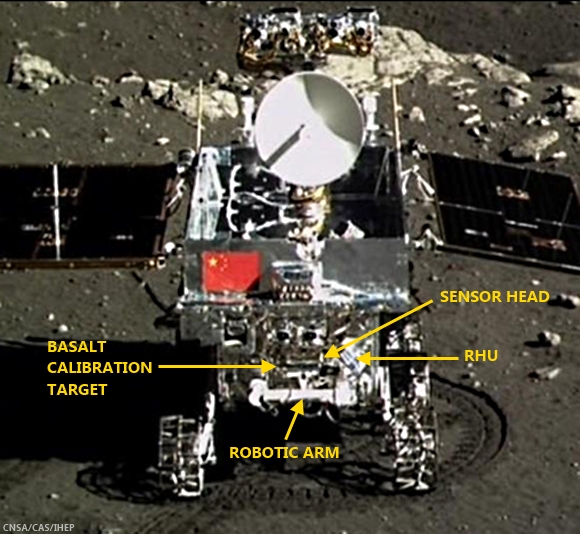
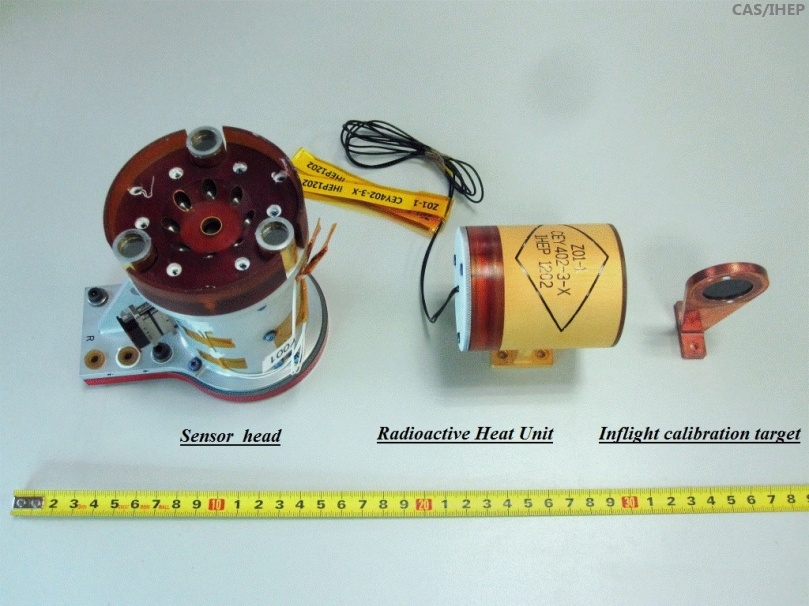
Active Particle-induced X-ray Spectrometer (APXS) components on the Chang'e-3 "Yutu" lunar rover [Xinhua/CNSA/CLEP/IHEP/CAS].
The Active Particle-induced X-ray Spectrometer (APXS), on the Yutu rover delivered to the lunar surface by the Chang’e-3 lunar lander, on December 25 sent back its first X-ray fluorescence spectrum of the lunar regolith around the landing site in northwest Mare Imbrium.

The announcement was made by the Institute of High Energy Physics (IHEP) of the Chinese Academy of Sciences (CAS), December 30.

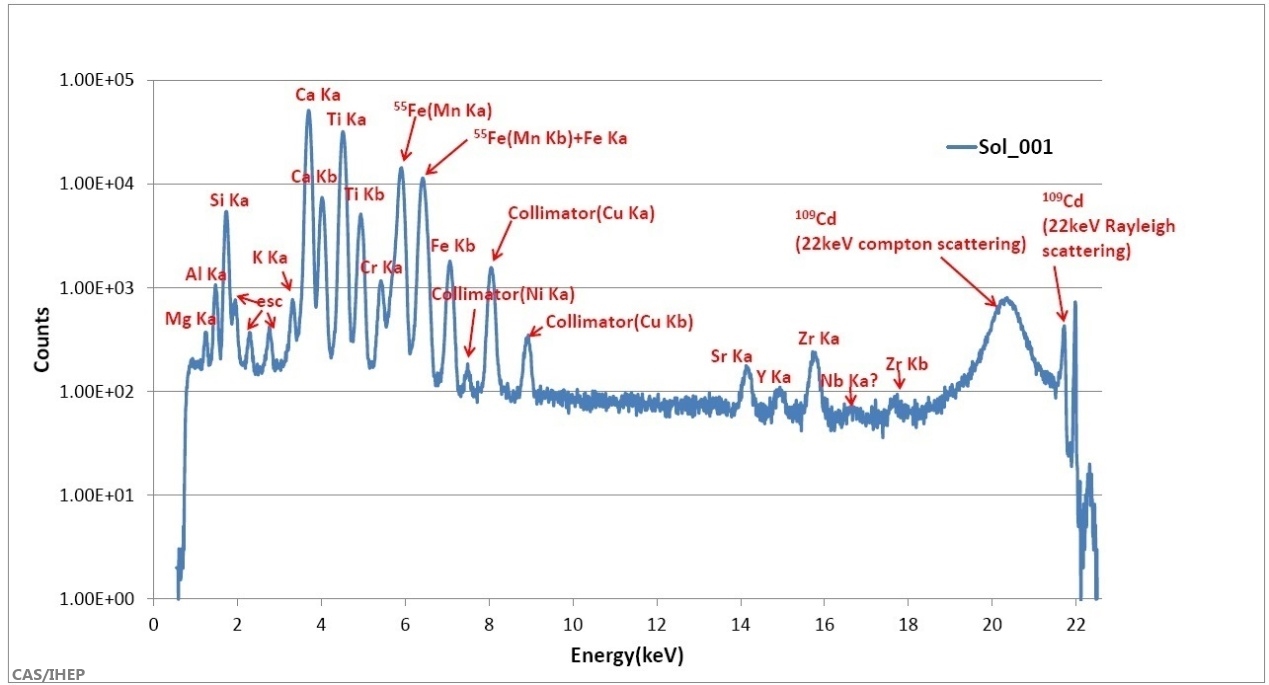
Initial analysis indicates a marked presence of eight major rock-forming elements: magnesium, aluminum, silicon, potassium, calcium, titanium, chromium and iron (Mg, Al, Si, K, Ca, Ti, Cr and Fe) and at least three minor elements, strontium, yttrium and zirconium (Sr, Y and Zr) identified in this spectrum. 

Chang'e-1 (Yutu) APXS - Sol 1
First X-ray florescent spectrum of the lunar surface at the Chang'e-3 Mare Imbrium landing site (click to enlarge) [IHEP/CAS].
The energy resolution of APXS is estimated at roughly 135 at 5.9keV (thousand electron volts), demonstrating the small instrument is among the best X-ray spectrometers yet deployed in direct planetary exploration.

APXS was initially powered up on December 23, and in-flight calibration, establishing a baseline by analyzing a common basalt rock sample of known composition mounted on the rover, was completed over five minutes, preparing a stable performance on the lunar surface. After two terrestrial days APXS was successfully deployed to within two to three centimeters over the regolith of Mare Imbrium on the robotic arm of Yutu and began its designed operation. 

Complimenting its X-ray spectrometry, the APXS instrument measured returned X-ray count rate at various distances.

Yutu APXS components
APXS components (sensor head, radioactive heat unit (RHU) and inflight baseline calibration target [IHEP/CAS].
China's Institute of High Energy Physics (IHEP) developed APXS in collaboration with the China Academy of Science Purple Mountain Observatory (PMO). Before the on-going Chang'e-3 mission two X-ray Spectrometers developed by IHEP, flown on Chang’e-1 (2007) and Chang’e-2 (2010).

Tuesday, December 31, 2013

Chang'e-3 lander and Yutu rover from LRO

LROC view of Chang'e 3
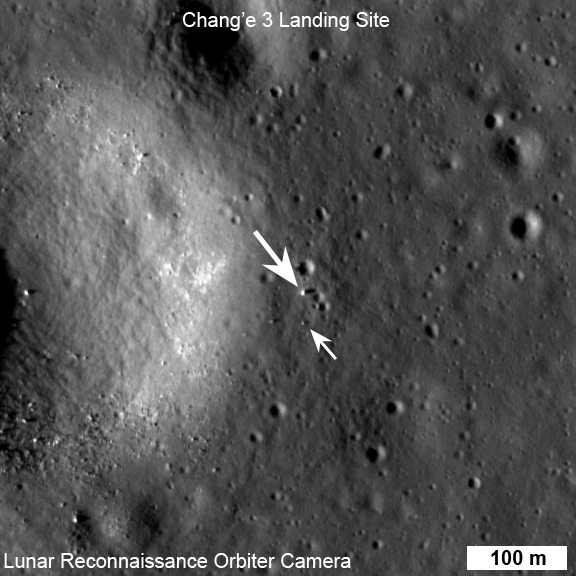
LROC Narrow Angle Camera (NAC) view of the Chang'e 3 lander and Yutu (Jade Rabbit) rover just before local sunset on their first lunar day of exploring Mare Imbrium. LROC NAC M1142582775R, image field of view 576 meters [NASA/GSFC/Arizona State University].
Mark Robinson
Principal Investigator
Lunar Reconnaissance Orbiter Camera
Arizona State University

Chang'e 3 landed on Mare Imbrium (Sea of Rains) just east of a 450 m diameter impact crater on 14 December 2013. Soon after landing, a small rover named Yutu (Jade Rabbit) was deployed and took its first tentative drive onto the airless regolith. At the time of the landing LRO's orbit was far from the landing site so images of the landing were not possible. Ten days later on 24 December, LRO approached the landing site, and LROC was able to acquire a series of six LROC Narrow Angle Camera (NAC) image pairs during the next 36 hours (19 orbits).

YuTu Rover (58762-717x940)
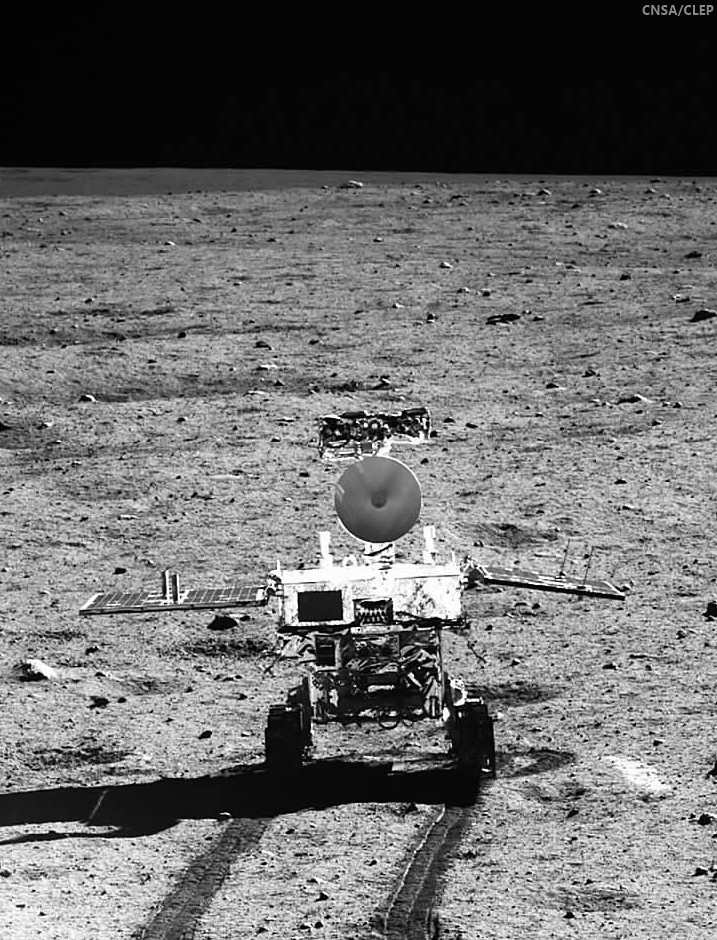
Yutu in a monochrome still captured from the Chang'e-3 lander, already slumbering in preparation for the bristling cold 14 day lunar night [CNSA/CLEP].
The highest resolution image was possible when LRO was nearly overhead on 25 December 03:52:49 UT. At this time LRO was at an altitude of ~150 km above the site, and the pixel size was 150 cm.

LROC NAC before and after images of the Chang'e 3 landing site [NASA/GSFC/Arizona State University].
The rover is only about 150 cm wide, yet it shows up in the NAC images for two reasons: the solar panels are very effective at reflecting light so the rover shows up as two bright pixels, and the Sun is setting thus the rover casts a distinct shadow (as does the lander). Since the rover is close to the size of a pixel, how can we be sure we are seeing the rover and not a comparably sized boulder? Fortuitously, the NAC acquired a "before" image (M1127248516R) of the landing site, with nearly identical lighting, on 30 June 2013. By comparing the before and after landing site images, the LROC team confirmed the position of the lander and rover, and derived accurate map coordinates for the lander (44.1214°N, 340.4884°E, -2640 meters elevation).

Panorama to LROC Narrow Angle CameraNAC
Chang'e 3 lander panorama [Images from CNSA; compiled by Di Lorenzo and Kremer] showing Yutu shortly after it drove down the ramp to the surface. Yellow lines connect craters seen in the panorama and the LROC image (taken at a later date after the rover had moved), red lines indicate approximate field of view of the panorama.
The lander set down about 60 meters east of the rim of a 450 meter diameter impact crater (40 meters deep) on a thick deposit of volcanic materials. A large scale wrinkle ridge (~100 km long, 10 km wide) cuts across the area and was formed as tectonic stress caused the volcanic layers to buckle and break along faults. Wrinkle ridges are common on the Moon, Mercury and Mars.

change3_wac_morph_and_noslew_1000
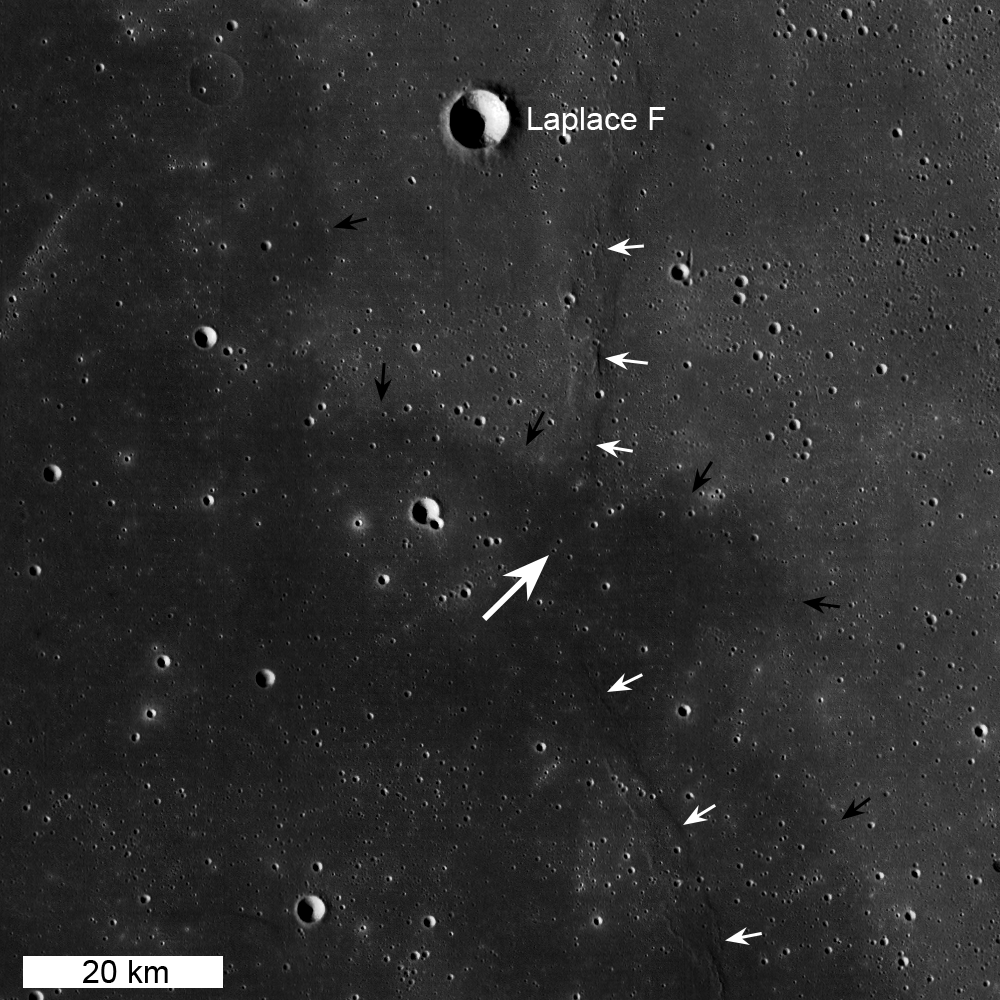
LROC WAC context mosaic for the Chang'e 3 landing site (large white arrow); small white arrows indicate wrinkle ridge and small black arrows delimit boundary between "red" mare (northeast) and "blue" mare (southwest), image is 100 km wide [NASA/GSFC/Arizona State University].
M177x3C_604nm-anot-58x128-1337x2950
Another LROC Wide Angle Camera mosaic, captured at high incidence, show the extent of the wrinkle ridge in northwest Mare Imbrium. Area swept up during three sequential orbital passes in 2011. See the full-size mosaic HERE [NASA/GSFC/Arizona State University]/
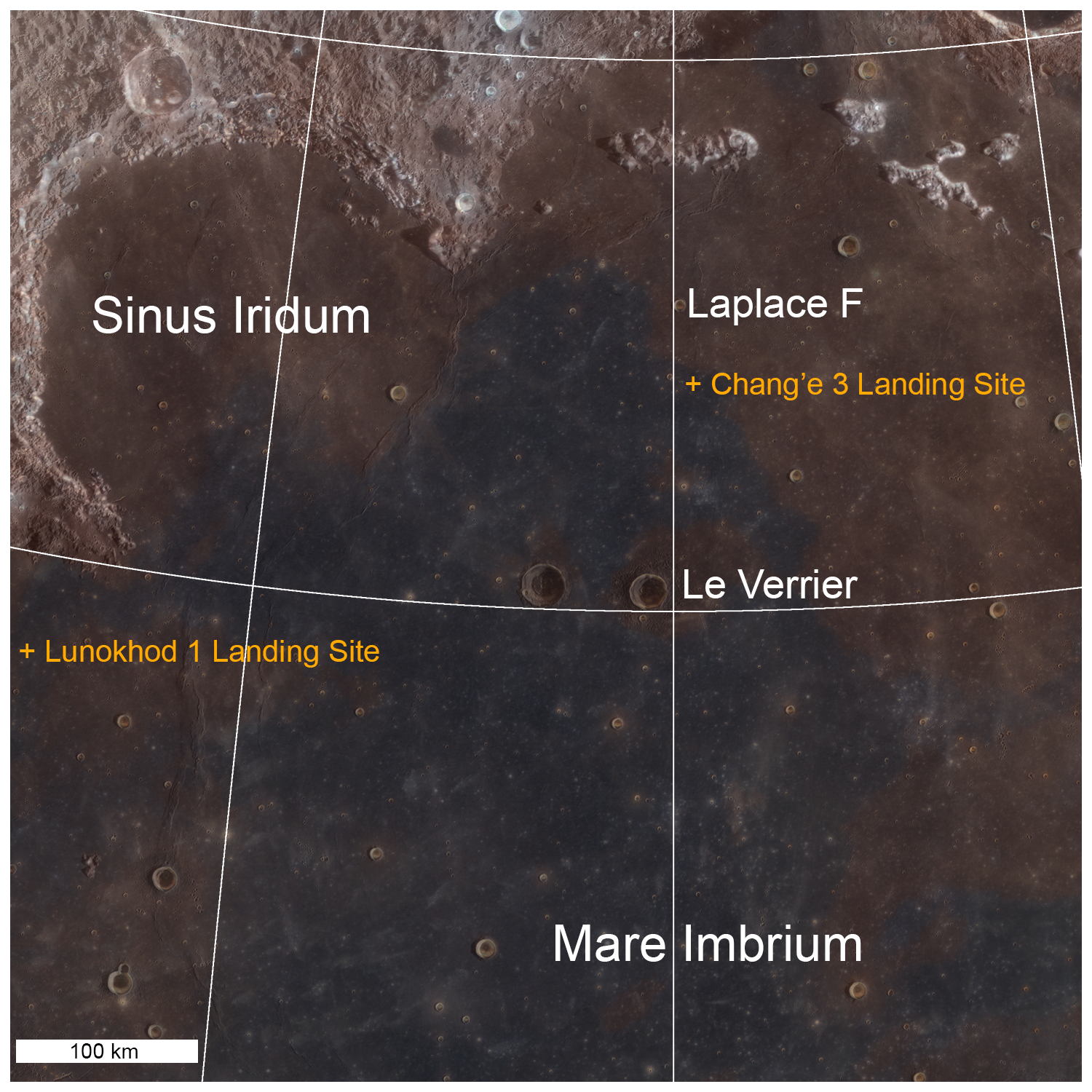
Lunar mare basalts are divided into two main spectral (color) types: "red" and "blue" (blue is perhaps a misnomer, think "less red"). Basalts on the Moon (same on Earth) are composed mainly of two minerals, pyroxene and plagioclase, though olivine and ilmenite can sometimes occur in significant amounts. The presence of ilmenite (FeTiO3) results in lower reflectance and a "less-red" color - thus the blue basalts. The landing site is on a blue mare (higher titanium) thought to be about 3.0 billion years old. The boundary (black arrows in above WAC mosaic) with an older (3.5 billion years) red mare is only 10 km to the north.

WAC Color Chang'e 3
LROC WAC color (689 nm, 415 nm, 321 nm) overlain on WAC sunset black and white image. Note the proximity of the landing site to a contact between red and blue maria [NASA/GSFC/Arizona State University].
A large area LROC WAC topography map of the Imbrium basin and surrounds is available HERE.

Related LROC Featured Images:
Safe on the Surface of the Moon!
A Great Place to Rove!
LROC Coordinates of Robotic Spacecraft - 2013 Update

Chang'e 3: NAC before and after images
LROC NAC observations before and after, animated above [NASA/GSFC/Arizona State University].

Wednesday, December 18, 2013

Chang'e-5 lunar sample mission on for 2017

Chang'e-5 ascent stage
A preliminary notional view of the Chang'e-5 ascent stage on departure from the lunar surface. Officials of China's Lunar Exploration Program (CLEP) have confirmed the sample return mission is scheduled for 2017.
Global Times (Beijing) -China has announced the next step in its lunar exploration program will be carried out by a new moon probe, Chang'e-5, expected to launch in 2017.

This follows the successful soft-landing of the Chang'e-3 probe on the lunar surface Saturday evening.

"The research and development of Chang'e-5 is proceeding smoothly at present and we expect it to be finished and ready to launch in 2017," announced Wu Zhijian, spokesman for the State Administration of Science, Technology and Industry for National Defense at a press conference Monday.

The third and final stage of the unmanned missions to sample the lunar surface is expected to be completed by 2020, using the Chang'e-5 and 6 lunar probes, which will be able to return samples to Earth, said Wu.

This is also the last phase of the China Lunar Exploration Program as a part of the National Guideline for Medium and Long-term Plan for Science and Technology Development (2006-20) issued by the State Council in 2006.

China has completed the first two phases of the program, said Wu.

The first phase was achieved when the Chang'e-1 lunar orbiter launched in 2007, while the second phase was marked as complete when the Chang'e-3 lunar probe and its moon rover separated and took photos of each other on the extraterrestrial body on Sunday.

By Monday morning, five of the eight exploratory devices on Chang'e-3 had been put into operation to survey the lunar surface topography and geology, said Zou Yongliao, an engineer from the Chinese Academy of Sciences

M177x3C_604nm-anot-580x800
LROC Wide Angle Camera (WAC) monochrome (604 nm) mosaic of a 35.7 km-wide parcel of the Laplace F - Le Verrier region in north central Mare Imbrium, marking the December 14, 2013 landing site of China's Chang'e-3. From a 200 km-long field of view swept up in three sequential orbits, December 5, 2011; a sunrise angle of incidence of 76° at 61.5 meters resolution, from 44.7 km [NASA/GSFC/Arizona State University].
"The program's third phase will be more difficult because many breakthroughs must be made in key technologies such as lift-off from the moon's surface, sampling encapsulation, rendezvous and docking in lunar orbit, and high-speed Earth re-entry, which are all new to China," said Wu.

The Chang'e-4 probe, which served as a backup for Chang'e-3, will now be used to test the new techniques for the mission's third phase.

Scale model Yutu
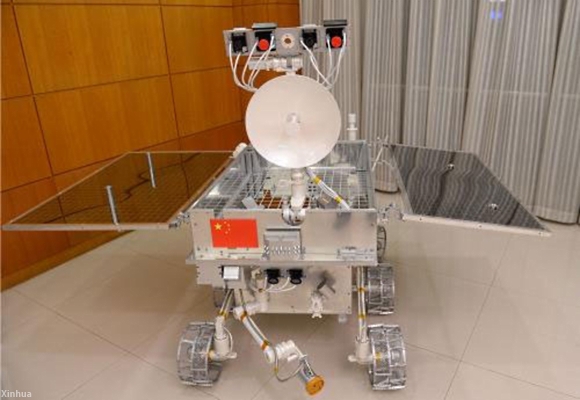
Scale model of the six-wheeled robotic moon rover 'Yutu' (Jade Rabbit), without the, by-now familiar, gold foil thermal blankets. Picture taken at the Beijing Aerospace Command and Control Center [Xinhua].
In response to questions of international cooperation concerning lunar exploration, Wu noted that China is always positive in maintaining good cooperation with other regions and organizations. Data collected through the Chang'e-1 and Chang'e-2 probes is accessible to scientists from across the world, according to Wu.

Wu pointed out that China's exploration will follow the consistent aim of the peaceful use of outer space, which will promote new breakthroughs in high-technology development.

"Despite our current progress, China still lags behind space giants like the US and Russia in many aspects. We need to work harder and move faster," Wu said.

6 of 8 Chang'e-3 science instruments now active

Students learn about the ongoing Chang'e-3 mission at a primary school in Ganyu, Jiangsu province, on Tuesday. Designers are pleased with the mission's success so far, as experiments have gone more smoothly than expected [Si Wei/China Daily].
Emily Lakdawalla of The Planetary Society has performed a herculean labor, today, pulling together many threads to deliver what might be the best possible description of a "lengthy press briefing by several members of the Chang'e 3 science team," Wednesday.

"I found it to be quite informative," Emily wrote, "not just about the mission but also about attitudes about Chinese space exploration and foreign cooperation. It was useful background for my participation in an hour-long panel discussion on China Radio International's "Today" program."

A link to her detailed summary follows the official China Daily description, below:

Wang Fan
China Daily

Six out of the eight pieces of scientific equipment deployed to the moon with the Chang'e-3 lunar mission have been activated by scientists and are functioning properly, according to scientists working on the mission.

Speaking at a news conference on Tuesday, scientists said that the equipment aboard the Yutu lunar rover and the Chang'e-3 lander had so far been functioning as hoped, despite the unexpectedly rigorous conditions of the lunar environment.

"Except for the alpha particle X-ray spectrometer and the visible and near-infrared imaging spectrometer, the instruments have all been activated and are undergoing tests and adjustments," said Su Yan, deputy designer of the Chang'e-3 ground applications system.

Zhang He, deputy designer of the probe, said though the temperature disparity is greater than scientists had anticipated, all the equipment on the moon is in "perfect" condition, and optical and ultraviolet-imaging experiments are under way.

Scientists with the ground applications system are expecting to receive a colossal quantity of original data from the rover and lander, which have independent channels to send signals, Su said. The earlier Chang'e-1 and Chang'e-2 craft only had one channel each, he said.

The mission's success so far has been a relief to Wu Weiren, chief designer of China's lunar probe program. He said the whole process, including the launch, the soft landing, the separation of the rover and lander and the ongoing experiments, have gone "much smoother" than he had expected.

Read the full article at China Daily, HERE.

Big HT: to Emily Lakdawalla at The Planetary Society, for her well-translated transcription of Wednesday's press conference posted HERE.

Monday, December 9, 2013

It's not bragging if you do it

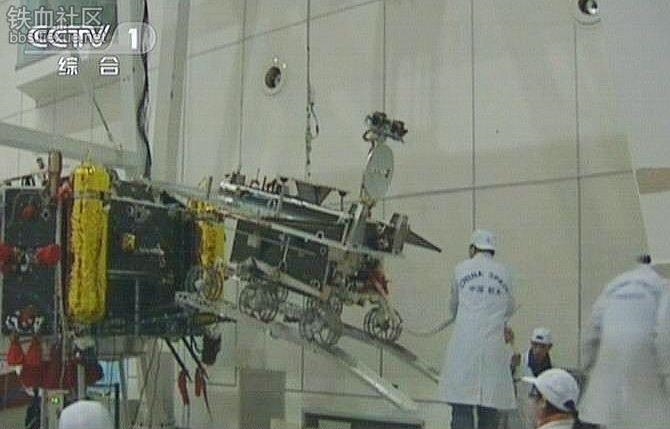
Chang'e-3 Lander dispatched to the Moon
Climbing high over the central Pacific, a forward camera on the Long March 3B third stage captured the deployment of Chang'e-3 on its 112 hour "Journey to the Moon." Launched after midnight in China, the modified Long March 3B completes its part of the mission minutes later over the International Dateline; confronting sunrise of the previous day. Chang'e-3 and Yutu, its "Jade Rabbit" lunar rover, speed on to intercept a New Moon, into the glare of the Sun [CCTV].
Dwayne Day
The Space Review

Later this week, if all goes according to plan, China will land a robotic spacecraft and rover on the Moon, something that nobody has done in nearly four decades. If the Chinese do what they did for the launch, they will broadcast much of the event live on television and over the Internet. Last week’s launch coverage on government-controlled English language CCTV was remarkable for its openness. Indeed, the coverage was indistinguishable from Western news coverage of a major space event. There was no propagandizing or nationalistic chest-thumping, just a straightforward reporting with lots of information about the mission and what was happening. The event, and its coverage, highlighted the fact that China has an attractive, technically sophisticated scientific space program that could serve international relations purposes. It was a demonstration of what American political scientist Joseph Nye has referred to as “soft power,” the ability to compel or attract nations to do what you want. China’s space program gives them this ability to attract partners. The problem is that some of China’s other activities undercut their attractiveness as a potential partner.

Last Sunday’s CCTV coverage of the Chang’e-3 launch was quite sophisticated. The network had correspondents at the launch site and at the control center. They had a commentator in the studio asking rudimentary questions of an expert during the launch sequence. The questions and the expert’s answers were intended for a general, non-space-savvy audience. They also had animations of the lander and rover, and segments focusing on the development of the spacecraft, including interviews with engineers who had built individual parts. For instance, one young engineer had worked on small electric motors for the spacecraft. He acknowledged that there was nothing very sophisticated or exciting about the motors, but that they were vital to mission success.

Read the full article, HERE.

"Lunar Aspirations" - Beijing Review

Yutu Rover model at Market Show
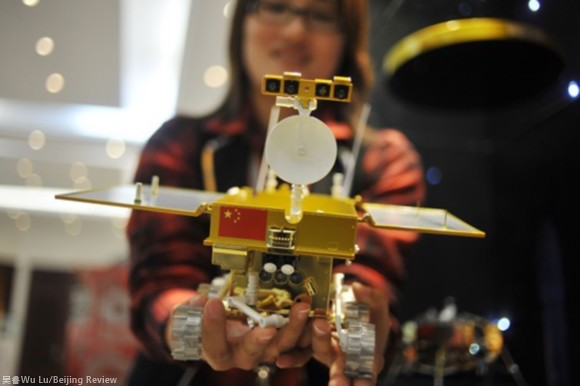
Saleswoman in Dongguan, Guangdong Province, displays a model of China's lunar rover, Yutu, on December 4, 2013 [Wu Lu/Beijing Review].
Yuan Yuan
Beijing Review.com.cn

After 10 years of space exploration efforts, China has finally launched its first mission to land a spacecraft on the surface of an extraterrestrial body.

On December 2, China's third lunar probe, Chang'e-3, was launched into space on an enhanced Long March 3B rocket at the Xichang Satellite Launch Center in southwestern Sichuan Province. Chang'e-3 is expected to soft land on the moon in mid-December, making it the first mission to do so since the former Soviet Union's Luna 24 mission in 1976.

Chang'e-3 comprises a lander and a six-wheeled lunar rover equipped with four cameras and two mechanical legs that allow it to dig up soil samples. The rover, named Yutu, meaning Jade Rabbit, will survey the moon's geological structure and surface substances during its three-month lifespan, while looking for natural resources. According to Chinese folklore, the goddess Chang'e lives on the moon with only a white rabbit for companion.

"If successful, the Chang'e-3 mission will give China the ability to explore the surface of an extraterrestrial body," said Sun Huixian, deputy engineer in chief of the second phase of China's lunar program.

Landing
Milestone mission: Chang'e-3 is expected to be soft-landed on the Moon late this week.


"This will be a breakthrough for China in conducting observation and survey of the moon's surface," said Wu Weiren, chief designer of China's lunar program. "More than 80 percent of technologies and products used during the mission are newly developed."

After entering lunar orbit, Chang'e-3 will go through six stages of deceleration to descend from 15 km above to the lunar surface, Xinhua News Agency reported on November 29.

The soft landing processes used by U.S. and Soviet unmanned spacecraft in the 1970s were unable to hover or avoid obstacles. Chang'e-3 can accurately survey its landing site and identify the safest spots on which to land, according to Sun.

In order to land quickly, the probe is equipped with high-precision, fast-response sensors that analyze its motion and surroundings. The variable thrust engine designed and made domestically by Chinese scientists and used for Chang'e-3 can generate up to 7,500 newtons of thrust.

During the Chang'-3 mission, a telescope will be set up on the moon, for the first time in human history, to observe the inner region of the Earth's magnetosphere—the area where the planet's magnetic field is still strong enough to affect charged particles in space. The lunar rover will also survey the moon surface using radar.

Chang'e-3 is part of the second phase of China's lunar program, which includes orbiting, landing and returning to Earth.

In phase three, China's unmanned probe will return to Earth with lunar soil and rock samples. The timetable for this phase has not been specified, but earlier reports suggested that it could be concluded as early as 2020.

In June 2011, the Chinese Academy of Sciences released a development roadmap for the country's scientific sector. It estimated that China will be able to accomplish a manned mission to the moon and set up a lunar base around 2030, with the base to be able to launch manned spacecraft from approximately 2050.

Read the full article at the Beijing Review, HERE.

Sunday, December 8, 2013

Rumor: China postpones outyear lunar landings

change3-14
Chang'e-3, now in lunar orbit, is scheduled to land on the Moon later this week [CCTV].
(Note Source is ChinaTimes, Taipei, Monday, December 9) A source from the Shanghai Academy of Spaceflight Technology (SAST) said China has made major adjustments to its lunar exploration program (CLEP), postponing its plan to carry Chinese astronauts to the surface of the moon.

The current exploration plan is that Chang'e 3 will arrive on the moon, as scheduled, and since investment has been made in Chang'e 4, that mission will take place in 2015 as scheduled.

Research and development for Chang'e 5 mission, however, has been halted, leading to the postponement of China's manned lunar missions. According to the China National Space Administration (CNSA) plan, the Lunar Exploration Program consists of three phases — orbital, soft landing and automated sample return — which China hopes can be carried out successfully by 2020.

In 2010, after Chang'e 2 was launched, China's top expert for moon exploration and researcher at the Chinese Academy of Science, Ouyang Ziyuan, said the southern point of the moon is expected to be an ideal landing spot for a lander carrying astronauts. He noted that China's manned mission to the moon is unlikely to be realized by 2020.

In fact, he previously stated in 2006 that the country would be capable of taking humans to the moon between 2021 and 2025. However, on Jan. 9, 2013, Ouyang changed his mind, saying unmanned lunar missions will accumulate the necessary experience and skill for China's construction of a moon base and future manned missions, but the country has no timetable for a manned lunar landing.

In 2007, Luan Enjie, chief commander of China's Lunar Orbiter Project and former head of China National Space Administration, said China would not take humans to the moon in the next 20 years. Chinese astronauts are not projected to land on the moon until after 2030.

Now is the time for neXt Generation lunar space science

Chang'e 3 is a lunar exploration mission operated by China National Space Administration, incorporating a robotic lander and a rover. Part of the second phase of the Chinese Lunar Exploration Program (CLEP), it will be China's first lunar rover, and the first spacecraft in 37 years to make a soft landing on the Moon.

Jack Kennedy
Spaceports

The first Moon landing in nearly three generations is set to occur Saturday, December 14, 2013 (in Beijing). The Chang'e-3 now orbits 110 km (63-miles) above the lunar surface.

HELLO Generation X, the Millennial Generation and #generation (or Generation Z). This is the time to engage in some neXt Generation lunar space science!

Read the full post at Spaceports, HERE.

Monday, December 2, 2013

CCTV: Chang'e-3, launch past TLO to Earth-view


Full Launch and TLO Sequence to Roll to View Earth

Friday, November 29, 2013

Chang'e-3 launch window opens 1 December 1730 UT

chang-e-3-yutu-2013-670x324
CCTV video still, released August 2013, shows final tests and loading of China's Chang'e-3, the third mission of China's Lunar Exploration Program [CCTV/CNSA].
Joel Raupe 
Lunar Pioneer
 
The China National Space Administration (CNSA) Lunar Exploration Program (CLEP) is gearing up for a nighttime launch of it's third unmanned lunar mission, Chang'e-3, Sunday, December 1 (UT), the first of a series of launch windows beginning 1730 UT, December 1; early Monday morning, December 2, at 1:30 am in Beijing.

Chang'e-3 will be launched aboard a modified Long March 3B booster from Xichang Satellite Launch Center, Suchuan Provence. The long-stated goal of the mission is to perform China's first soft-landing beyond Earth and the first such landing on the Moon in the 21st century, the first since the Soviet mission Luna 24 landed and retrieved a sample from Mare Crisium in 1976.

Presuming a successful launch, early Monday local time, Chang'e-3 will land on the Moon as early as Saturday, December 14, or about 30 hours after local sunrise at the targeted landing zone in Sinus Iridum. A landing early into the two-week-long lunar day will allow the mission to take full advantage of its designed use of solar power.

Sunrise at the intended landing zone, in the vicinity of Laplace A crater (43.74°N, 26.935°W), will begin in the early hours of December 12 (UT).

The mission is also designed to deploy the first remote-operated lunar rover on the lunar surface since the Soviet Luna 21 lander deployed Lunokhod-2 and explored Le Monnier crater in 1973. 

Following a national naming contest with 650,000 online participants, China state news sources report the Chang'e-3 lunar rover has been named Yutu, (Jade Rabbit), after the traditional ethereal attendant to the lunar goddess Chang'e.

Tasks for Yutu include "surveying the moon's geological structure and surface substances while looking for natural resources," said Ouyang Ziyuan, a chief scientist of CLEP, in an interview with Xinhua ("China's lunar probe to land on Moon next month," Mo Hong'e, November 26, ecns.cn).

A detailed summary of the planned landing zone for the Chang'e-3 mission, near Laplace A crater in east Sinus Iridum, was posted HERE, a discussion written by Lunar Reconnaissance Orbiter Camera (LROC) principal investigator Dr. Mark Robinson of Arizona State University, released November 22.

In cooperation with the International Lunar Observatory Association (ILOA) in Hawaii, an ultra-violet telescope will be operated from the Chang'e-3 lander, a first since a small UV instrument was operated on the Moon by the Apollo 16 expedition in 1972.

China's Lunar Exploration Program, initiated in 2004, consists of five planned missions. Chang'e-1 became that nation's first lunar orbiter November 5, 2007 and was deorbited to a reportedly planned impact in Mare Fecunditatis, March 1, 2009.

The highly-successful Chang'e-2 orbiter was launched from Xichang, October 1, 2009 and was inserted into lunar orbit five days later. Chang'e-2 captured orbital photography later assembled into a global, low-angle illumination mosaic of the Moon, said to be the first of its kind. 

While performing orbital maneuvers critical to the planned Chang'e-3 landing in Sinus Iridum, Chang'e-2 captured high-resolution low-perilune photography of Laplace A crater and its vicinity.

Chang'e-2 was afterward maneuvered beyond Cislunar space, leaving lunar orbit  June 9, 2011. Ground controllers moved the spacecraft to an extended stay in and around Lagrangian Point 2 (L2), one of five stable points in the Earth-Moon-Sun system where the influences of the gravity of the three bodies balance each other out. 

L2 space is beyond the Moon, more or less directly over the farside, and it presumably where communications with surface missions beyond line-of-sight of Earth could be at least partially maintained.

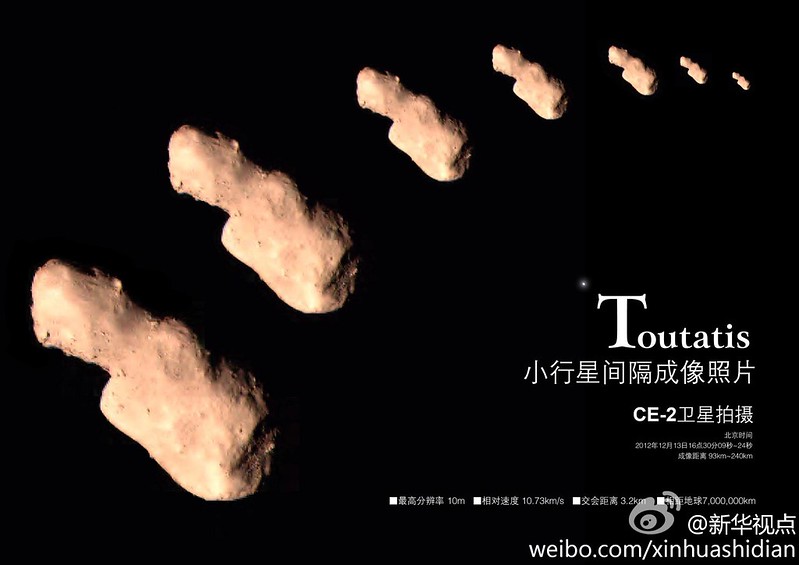
4179 Toutatis Chang'e-2 flyby
Chang'e-2 passed to within 3.2 km of the potentially hazardous asteroid 4179 Toutatis in December 2012, traveling at a relative speed of 11.72 kilometers per second [CNSA/Xinhua].
Still underway, having departed L2 for interplanetary space, Chang'e-2 recently returned photographs of its recent very close encounter with potentially hazardous asteroid 4179 Toutatis, December 13, 2012.

After Chang'e-3, China plans at least two additional unmanned lunar missions designed to retrieve samples, Chang'e 4 in 2015 and Chang'e 5 in 2018.

Related Posts:
'Government Penalty' removed from Google Lunar XPRIZE terms (November 7, 2013)
Chang'e-3 and LADEE: The Role of Serendipity (October 31, 2013)
Outstanding animation celebrates China's Chang'e-3 (October 29, 2013)
LROC updates image tally of human artifacts on the Moon (September 25, 2013)
Chang'e-3 officially enters launch phase (August 31, 2013)
Chang'e-3 undergoing thermal vacuum testing (May 9, 2013)
Chang'e-3: China's rover mission (May 4, 2013)
Chang'e-3 lander and rover expected in 2013 (January 10, 2013)
China's grand plan for lunar exploration (October 11, 2012)
ILOA to study deep space from Chang'e-3 (September 11, 2012)
Will China deploys first lunar rover since 1976? (April 29, 2012)
China's Long March to the Moon (January 14, 2012)
China plans lunar research base (May 11, 2011)
PRC continues methodical program (March 8, 2011)
Chang'e-2 arrives in mission orbit (October 9, 2010)
Dispatch from Chang'e-2: Sinus Iridum (October 4, 2010)
Chang'e-2 takes direct approach (October 1, 2010)
Chang'e-2 sets stage for future lunar missions (September 3, 2010)
Chang'e-1 research reported published (July 22, 2010)

Friday, November 22, 2013

A Great Place to Rove: Sinus Iridum and Chang'e 3

China will launch it's third unmanned lunar probe very early in December. Plans for Chang'e 3 include the first soft landing on the Moon since 1976 and the first rover since 1973. The China National Space Agency (CNSA) has long reported the target for this historic mission is Sinus Iridum, "the Bay of Rainbows," on the northwestern frontier of Mare Imbrium.

Meanwhile, following five years of planning, the NASA orbiter
LADEE has begun a 100 day examination of the Moon's tenuous exosphere, its formal science mission, in low equatorial orbit. It's all but certain both missions will be underway at the same time, leading some to jump to conclusions in reporting the two missions will interfere with one another. But, as Dr. Paul Spudis of the Lunar and Planetary Institute reports, nothing could be further from truth. Read his assessment, HERE.

-
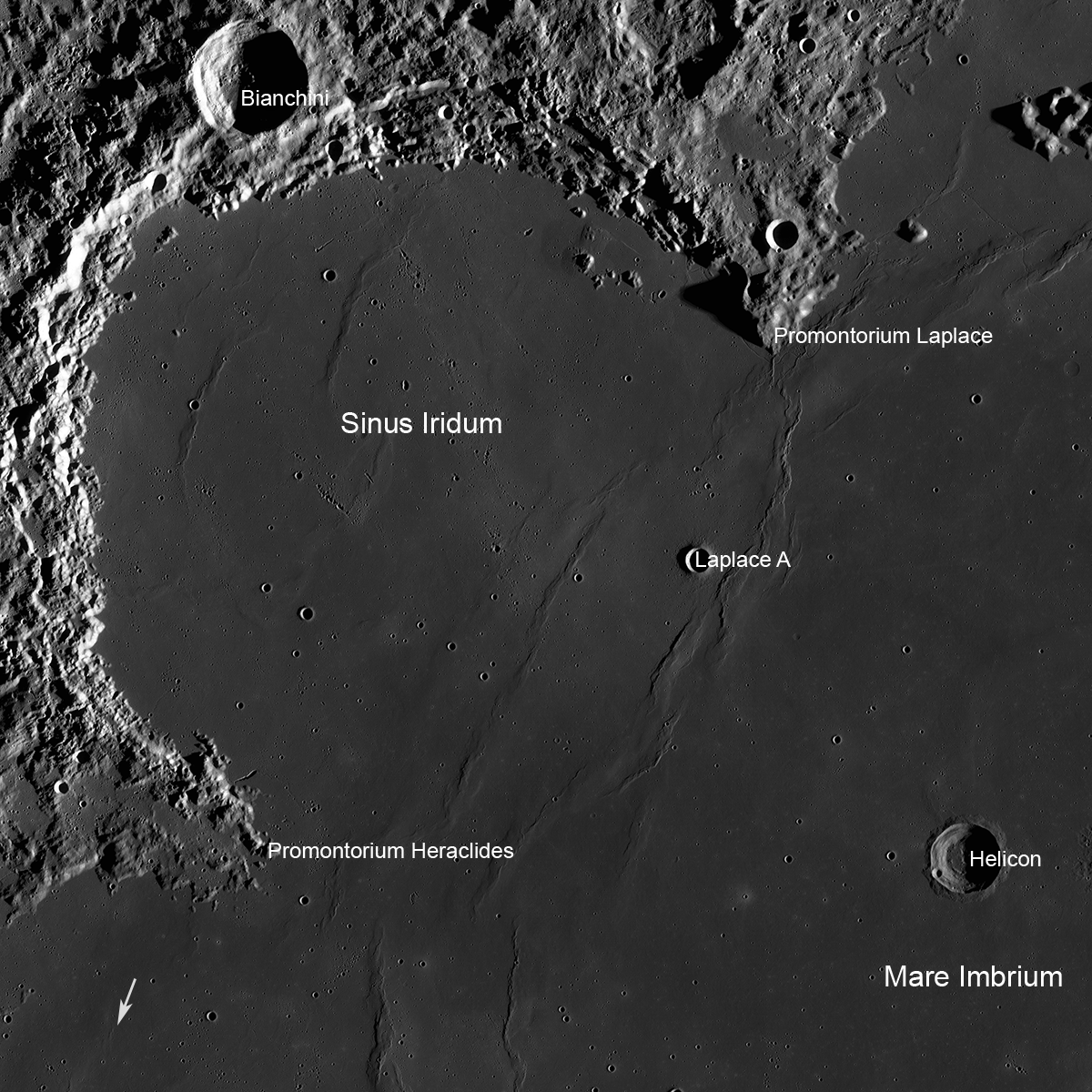
Sinus Iridum
Sinus Iridum - it is likely China will land a rover near Laplace A before the end of 2013. (Arrow shows location of the Soviet Lunokhod 1), LROC Wide Angle Camera mosaic field of view 360 km [NASA/GSFC/Arizona State University].
Mark Robinson
Principal Investigator
Lunar Reconnaissance Orbiter Camera (LROC)
Arizona State University

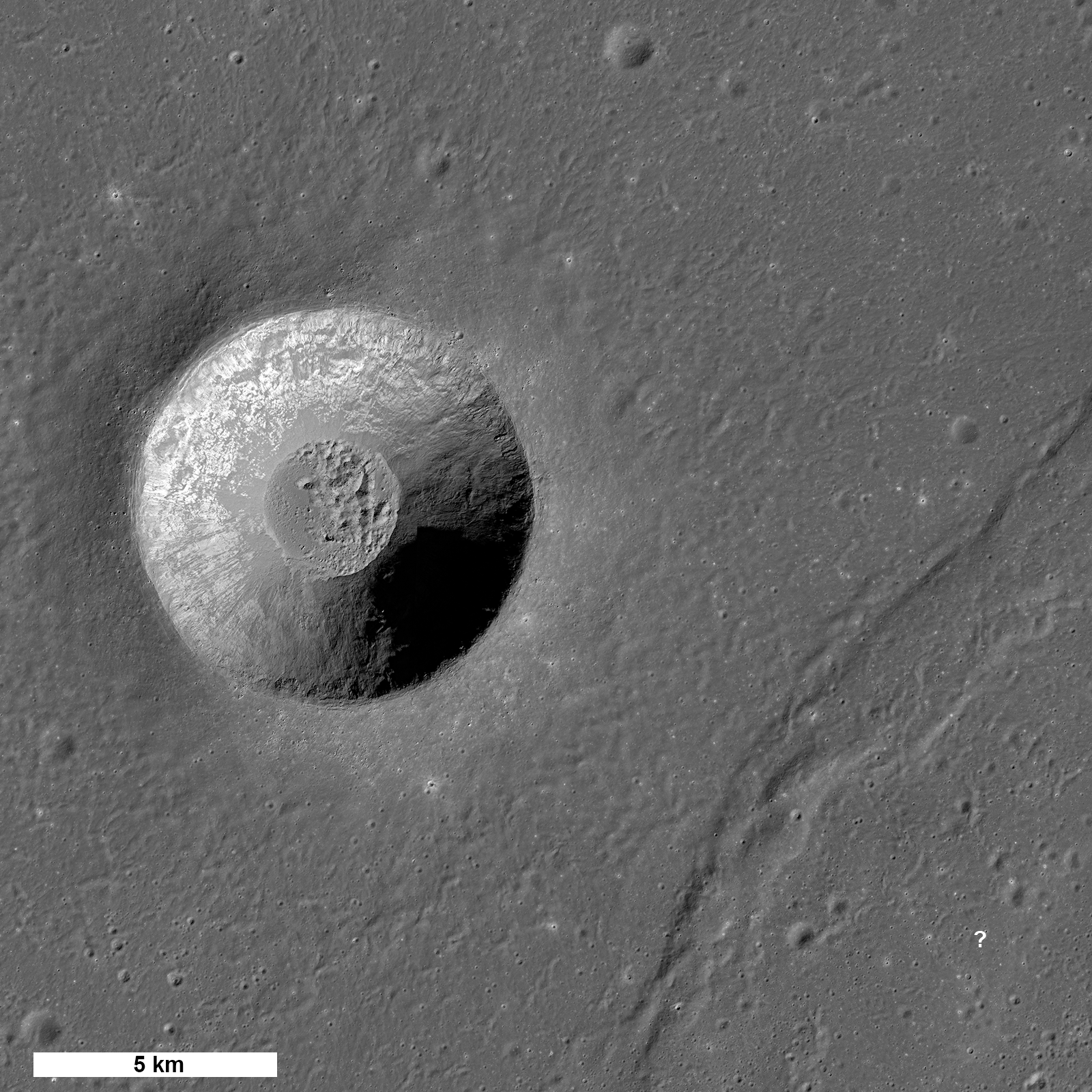
In the near future China will attempt a robotic landing on the Moon, and will deploy a rover. The launch date and landing dates have not been officially announced. The exact landing spot is also not yet publicly designated, but it seems likely the landing will take place in Sinus Iridum, possibly near the fresh crater Laplace A (8 km diameter).

Why this particular spot on the Moon? Likely there are critical engineering constraints in terms of landing site selection as well as important science goals. And there is the dramatic grandeur of the lunar landscape!

Imagine the first rover-eye view from the crater rim - a sheer drop of 1600 meters at your wheels, and an 8 km view across to the far wall! From LROC NAC images we know rock is exposed in the upper walls and dramatic landslides streamed material down to the crater floor. Speaking of the crater floor - it hosts a now frozen lake of impact melt 2500 meters (1.5 miles) in diameter. Imagine the moments after the crater formed, the floor was a cauldron of molten rock with debris sliding down into the melt, and the crater itself was deforming as the floor uplifted after the initial pressure of the impact was relieved.

Laplace A and wrinkle ridge
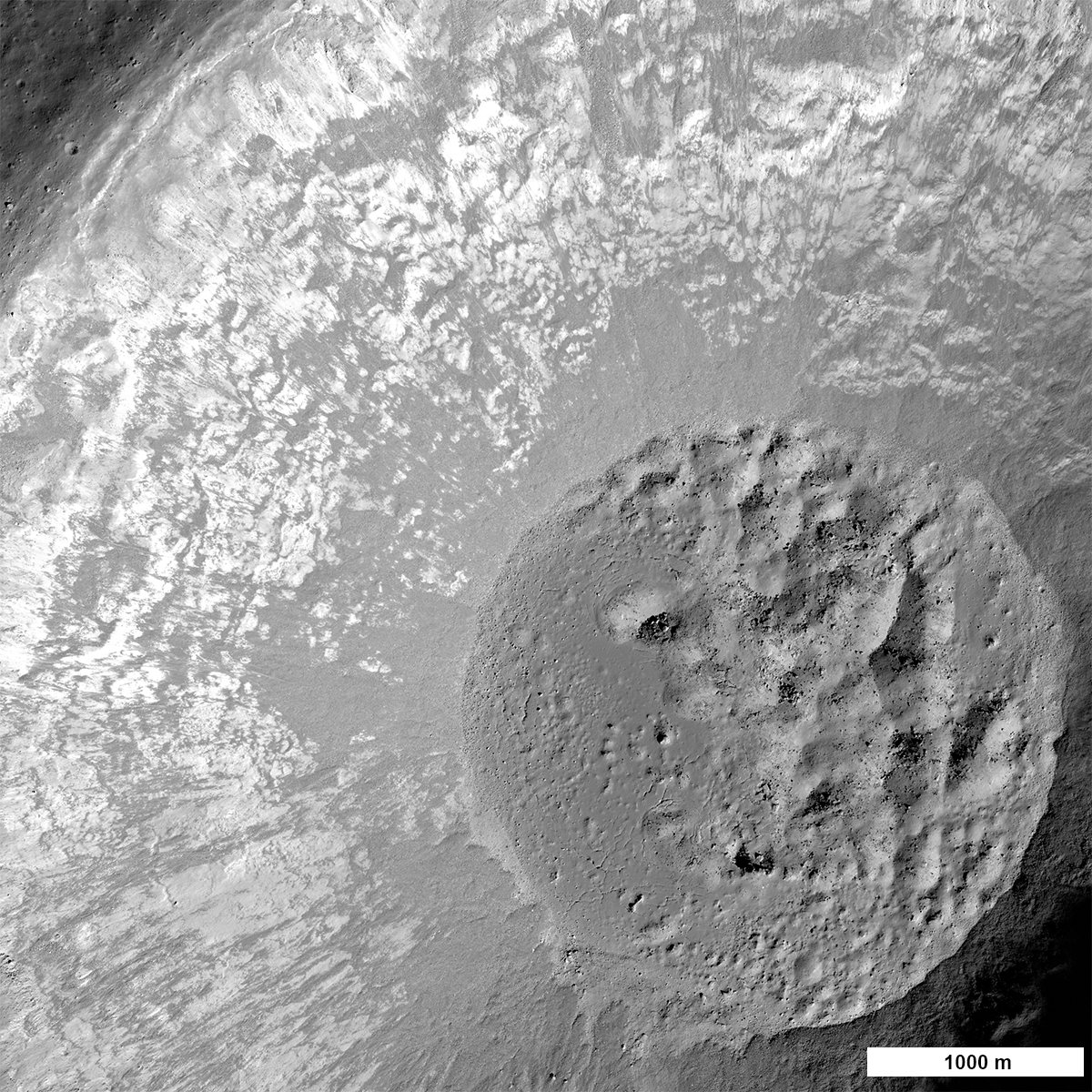
Laplace A crater and nearby wrinkle ridge (diagonally across at lower right). The question mark shows a potential landing site from which the rover could traverse northwest across the ridge to the edge of the crater [NASA/GSFC/Arizona State University].
Laplace A is a fascinating scientific target for a rover. It is a great example of a very young crater formed in mare basalt. A rover traversing the crater's ejecta blanket is in essence similar to driving down into the crater (in a geologic sense). We know from studies of terrestrial impact craters (such as Meteor crater) that material ejected from deep in a crater ends up near the rim, and rocks from the pre-impact surface are thrown far from the crater (a crater radius or more). So as a rover drives closer and closer to the rim it can characterize rocks from deeper and deeper below the surface.

Some of the many outstanding questions regarding the nature of the mare basalts include: how thick are individual flows, does the composition of the erupted magma change with time and location, and are pyroclastic (explosive) eruptions intermingled with effusive eruptions? These questions can be directly addressed with the Chang'e 3 rover! No humans or robots have ever visited a fresh crater anywhere near this size on the Moon (or Mars for that matter) so the return from this mission has great potential for advancing our knowledge of the Moon.

Laplace A
LROC NAC view of the interior of Laplace A crater [NASA/GSFC/Arizona State University].
But wait, there's more!

Another key question can be addressed: what is the 3D nature of large contractional ridges on the Moon? The rover is thought to have a ground penetrating radar (GPR) and it just so happens that a large wrinkle ridge (a contractional landform) lies about 10 km east of Laplace A. Although the exact mission plan is not publicly available, one potential scenario is that the lander sets down just east of the wrinkle ridge and deploys the rover. After initial testing of the lander and rover, and geologic characterization of the landing site, the rover could set off to the west towards the crater. As the rover drives up and over the wrinkle ridge the GPR would continuously probe the subsurface, slowly building up a 3D profile down to 100 meters or more (?) beneath the surface. Wrinkle ridges are complex landforms created when mare basalts are compressed, causing them to buckle and break along faults. However, wrinkle ridges have not been fully explored, and the  geometry and number of faults associated with each wrinkle ridge is not known. A subsurface profile of a wrinkle ridge could tell us the number of faults, where the faults are located, and how steeply the faults dip: is it 15°, 30° or 45°?

Chang-E-2-Laplace-A-900
Laplace A as plotted using photography and digital terrain model gathered from the CNSA orbiter Chang'e 2 [CNSA/CLEP].
From LROC images we have mapped the location of all the mare wrinkle ridges, and measured their surface topography, but all we have for the subsurface are models! Soon we may have actual measurements providing a good first step towards interpreting these poorly understood features. Wrinkle ridges are also found on Mercury and Mars, so better understanding a lunar example will help scientists unravel the tectonic story across the inner Solar System. Since only a handful of human and robotic missions have ever landed on the Moon, the results from the Chang'e 3 mission will provide important new scientific insights into our Moon.

Chang-e-2-CCD-LaPlace-full
Full resolution segment of the west wall and rim of Laplace A by Chang'e 2 [CNSA/CLEP].
Once Chang'e 3 has landed, LROC should be able to spot the lander and the rover; LRO will be above Laplace A on 25 December, 22 January, and 18 February.  The LROC team looks forward to posting images of the two vehicles!

Coincidentally, Lunokhod 1 landed only 250 km to the southwest of Laplace A over forty years ago (17 November 1970). This intrepid Soviet rover explored for almost a year and traveled a total distance of 10.5 km. Both the lander vehicle (Luna 17) and the rover can be seen on the surface today.

Perhaps the Chang'e 3 lander and rover will look something like this. Lunokhod 1 rover in its final parking place (38.315°N, 324.992°E) on the surface of Mare Imbrium, 250 km southwest of Laplace A. The Soviet rover, and its French-built laser range reflector array, were lost for four decades until relocated by LRO. The addition of the LLR to astrophysicists on Earth critically improved the accuracy of measurements of the distance to the Moon, bringing the uncertainty to within 3 millimeters. LROC NAC observation M175502049RE, spacecraft orbit 10998, resolution 33 cm per pixel. Original LROC Featured Image, HERE [NASA/GSFC/Arizona State University].
Explore the LROC Featured Mosaic of the Laplace region of interest, HERE.

Related Posts:
Lunar Laser Ranging: The Millimeter Range (November 19, 2013)
'Government landing penalty' removed from Google Lunar Xprize terms (November 7, 2013)
Chang'e 3 and LADEE: The Role of Serendipity, Paul Spudis (October 31, 2013)

Thursday, October 31, 2013

Chang'e 3 & LADEE: The Role of Serendipity

The Chang’E 3 spacecraft sets down on the Moon, and exhaust gas from its descent rockets change the lunar exosphere [NASA/CNSA].
Paul D. Spudis
The Once and Future Moon
Smithsonian Air & Space

The Lunar Atmosphere and Dust Environment Explorer (LADEE) spacecraft is currently circling the Moon.  With the spacecraft safely settled into its observation orbit, the mission science team is busy testing and calibrating its instruments.  This U.S. mission was designed to characterize the lunar “atmosphere” – the extremely tenuous zone of gases that vary in time in the space above the Moon.  Technically called an exosphere, this region contains extremely low concentrations of a variety of elements and compounds, of varied origins and a largely unknown life cycle.  LADEE is designed to monitor and characterize these species, with the goal of identifying the process and sources of the gases and how they vary with time.

Initially a precursor to human lunar return, LADEE was selected for development early in 2008, as we wanted to understand the lunar exosphere before the lunar environment was contaminated by humans.  The LADEE spacecraft is designed to observe the Moon in its natural, pristine state.  However, the very act of going to the Moon inadvertently (though briefly) modifies the lunar atmosphere.  When a spacecraft arrives at the Moon, it uses its on-board rocket engines to brake into lunar orbit or to descend to the surface.  These rockets spew large quantities of exhaust gas into space and as the vehicles get captured into the Moon’s gravity field, so too does this exhaust product.

From estimates drawn on the Apollo landings, the rocket exhaust expended from each Lunar Module temporarily doubled the total mass of the natural lunar atmosphere.  This artificial addition of gases eventually dissipates, driven off by solar interactions and other complex effects.  In time, the Moon resumes its normal state of near-vacuum.  The creation of a temporary artificial atmosphere created by rocket effluent and its subsequent dissipation is imperfectly understood, except to the extent that we know that it happens.  The one-month “commissioning phase” that the LADEE mission is currently experiencing was largely designed to ensure that the exhaust from the orbital braking burn of the spacecraft (and subsequent low-rate out-gassing from the spacecraft) is largely complete.  We want to measure the Moon’s environment, not the products of the craft that brought us there.

But the U.S. will not be the only one conducting a mission at the Moon for the next few months.  The long-planned Chinese robotic mission Chang’E 3 is scheduled for launch to the Moon in early December.  Their lander mission will place a fairly large (1200 kg) spacecraft on Sinus Iridum in the northwestern quadrant of the near side, deliver a small roving vehicle and examine and measure the properties of the lunar surface over the course of several months.  But before it begins its surface mission, the Chang’E 3 spacecraft will burn roughly 2600 kg of rocket fuel in the vicinity of the Moon’s exosphere.  I have not seen any documentation on the fuel this spacecraft will use, but it is highly likely that it will be the chemicals unsymmetrical dimethylhydrazine (UDMH; H2NN(CH3)2) and nitrogen tetroxide (N2O4).  These propellants are widely used in spacecraft because they are liquid at room temperature and can be easily stored in tanks for long periods of time (a requirement for long-duration spaceflight to destinations beyond low Earth orbit).

When UDMH and nitrogen tetroxide are burned in a rocket engine, they produce a variety of exhaust gases; the dominant combustion products are water (H2O), nitrogen (N2), carbon monoxide (CO), carbon dioxide (CO2), and a few trace species, including hydrogen (H2) and hydroxyl (OH).  Expelled by a rocket nozzle, these gases rapidly expand in all directions in the vacuum of space.  Because most of the burn occurs after the spacecraft has been “captured” by the gravity of the Moon, this rocket exhaust is also captured by the Moon.  Thus, exhaust from an orbital or a landing vehicle becomes (temporarily) part of the lunar atmosphere.

If you’re thinking that this “rude” addition of alien gases will mess up the very delicate phenomena that LADEE was designed to map and measure, you’re correct – it does.  You might even expect the scientists of the LADEE team would be very upset at this disruption of their carefully planned measurement strategy.  But you would be wrong.  This problem is actually an opportunity.

If successful, Chang'e 3 will perform the first soft-landing on the
Moon since Luna 24 in1976 and deploy the first lunar rover
 since Lunokhod 2 in 1973 [NASA/CNSA].
The coincidence of Chang’E 3 arriving at the Moon after LADEE has begun observations has developed into a serendipitous occurrence for lunar science.  Because we don’t understand very well how exospheric gases are added to and removed from the Moon, what has landed in our laps is an unplanned (but controlled) experiment.  A known quantity of gases – of known composition – will be added to the lunar atmosphere at a precisely known time, in a precisely known place.  One could have not designed a better experiment to measure how this addition of material is distributed, how its distribution evolves over time, and how these expelled gases dissipate into cislunar space.  Even better, LADEE will have almost a full month to monitor and characterize the lunar atmosphere before Chang’E arrives, thus allowing us to first observe the “natural” Moon and then the “contaminated” Moon and how the lunar atmosphere recovers from its defilement.

None of this was prearranged – the Chinese schedule their missions on the basis of their own time-table and programmatic needs (just as NASA’s lunar goals have changed over the last 5 years).  But because of a fortuitous alignment of schedules, we have a unique opportunity to observe in real time how the Moon works.  Hopefully, the Chinese will provide us with detailed mass numbers of their spacecraft and exactly what variety of fuel it carries, but even if they don’t, physics dictates a certain mass and volume of the exhaust gas and its composition will be measured by LADEE (allowing us to know the type of fuel used).  China’s December lander mission to the Moon will provide our U.S. mission with a welcome bit of  “traffic exhaust,” giving scientists the opportunity to learn more from LADEE than we’d originally envisioned.

Serendipity indeed.

Originally published October 30, 2013 at his Smithsonian Air & Space blog The Once and Future Moon, Dr. Spudis is a senior staff scientist at the Lunar and Planetary Institute. The opinions expressed are those of the author but are better informed than average