Showing posts with label SWRI. Show all posts

Thursday, February 12, 2015

Postdoctoral Researcher positions, SwRI

Far-UV albedos show some agreement with epithermal neutron suppression regions [NASA/GSFC/SwRI].
Erin Rogers, PHR
Sr. Specialist
Employment Operations
Southwest Research Institute

The UV imaging spectrograph group at Southwest Research Institute (SwRI) is seeking postdoctoral planetary scientists to join our team's investigations of a variety of science questions using far-UV observations. 

Topics of study include:
  1. Characterization of volatiles within permanently shaded regions (PSRs) at the lunar poles with the Lyman Alpha Mapping Project (LAMP) imaging spectrograph on the Lunar Reconnaissance Orbiter (LRO); 
  2. Imaging Jupiter's powerful auroral emissions with the Juno UV Spectrograph (UVS)
  3. Studying the atmosphere of Pluto with the New Horizons Alice instrument
  4. Analysis of Hubble campaign observations in search of water vapor plumes on Europa
  5. Instrument development work related to the Jupiter Icy Moons Explorer (JUICE) UVS investigation and other future UV/optical projects in Astrophysics, Planetary Science, Heliophysics, and Earth Sciences.
  • Candidates are encouraged to develop their own additional research projects.

Candidates must have experience with imaging and/or spectroscopy from space-based or ground-based observatories; strong programming skills with Interactive Data Language (IDL) is preferred. A background in scientific analysis and publications related to one or more of the topics listed above is highly desirable. Specific tasks include: analyzing UV spectral imaging datasets; assist with planning future observations; publishing results in peer-reviewed journals and presentations at professional meetings; development of concepts and new technologies for UV/VIS/IR instrumentation and assist ing with flight instrument integration, test and calibration tasks, and leading and/or assisting proposal writing for new business.

All candidates must use the swri.jobs website to prepare and submit applications.  They may reference job number 15-01143 or utilize the following job link:

Wednesday, December 11, 2013

Earth and Moon from Juno fly-by

"Earth and Moon as seen from passing spacecraft"
D C Agle
Jet Propulsion Laboratory

Steve Cole
NASA Headquarters 

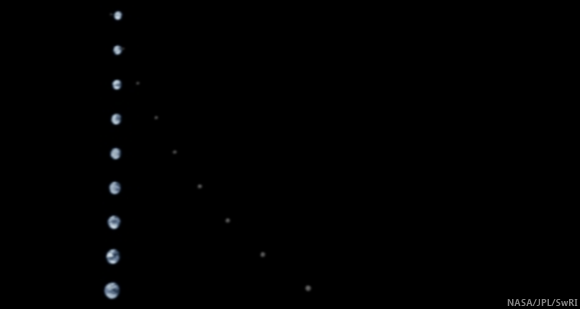
When NASA’s Juno spacecraft flew past Earth on October 9, 2013, it received a boost in speed of more than 7.3 kilometers per second, which set it on course for a July 4, 2016 rendezvous with Jupiter. One of Juno's sensors, a faint star tracking camera, also had a unique view of the Earth-Moon system. The result was an intriguing, if low-resolution, glimpse of what it would be like to approach our worlds from a distance.

“In the movie, you ride aboard Juno as it approaches Earth and then soars off into the blackness of space," said Scott Bolton, Juno principal investigator at the Southwest Research Institute (SwRI) in San Antonio. "No previous view of our world has ever captured the heavenly waltz of Earth and Moon."

The Juno Earth flyby movie is available on YouTube HERE. The original score is by Vangelis.

Earth-Moon from Juno October 9, 2013
Ancient cosmic pirouette of Earth and Moon from the Jovian-bound spacecraft Juno as it flew by Earth, October 9, 2013 [NASA/JPL-Caltech].
The cameras that took the images for the movie are located near the pointed tip of one of the spacecraft's three solar-array arms. They are part of Juno's Magnetic Field Investigation (MAG) and are normally used to determine the orientation of the magnetic sensors. These cameras look away from the sunlit side of the solar array, so as the spacecraft approached, the system's four cameras pointed toward Earth. Earth and Moon came into view when Juno was about 966,000 kilometers away -- about thrice the Earth-Moon separation.

During the flyby, timing was everything. Juno was traveling about twice as fast as a typical satellite, and the spacecraft itself was spinning at 2 RPM.

To assemble a movie that wouldn't make viewers dizzy, the star tracker had to capture a frame each time the camera was facing Earth at precisely the right instant. The frames were then sent to Earth, where they were processed into video.

"Everything we humans are and everything we do is represented in that view," said the star tracker's designer, John Jørgensen of the Danish Technical University, near Copenhagen.

Amateur Radio signal from Juno Fly-By
The Waves instrument aboard NASA's Juno spacecraft recorded amateur radio signals from ham radio operators from around the world [NASA/JPL-Caltech/University of Iowa].

Also during the flyby, Juno's Waves instrument, which is tasked with measuring radio and plasma waves in Jupiter's magnetosphere, recorded amateur radio signals. This was part of a public outreach effort involving ham radio operators from around the world. They were invited to say "HI" to Juno by coordinating radio transmissions that carried the same Morse-coded message. Operators from every continent, including Antarctica, participated.

"With the Earth flyby completed, Juno is now on course for arrival at Jupiter on July 4, 2016," said Rick Nybakken, Juno project manager at NASA's Jet Propulsion Laboratory in California

Moon from Juno fly-by
Moon from Juno star-tracking camera, October 9, 2013 [NASA/JPL/SwRI/MSSS/Ken Kremer/Marco Di Lorenzo].
The Juno spacecraft was launched from Kennedy Space Center in Florida on August 5, 2011. Juno’s launch vehicle was capable of giving the spacecraft only enough energy to reach the asteroid belt, at which point the Sun’s gravity pulled it back toward the inner solar system. Mission planners designed the swing by Earth as a gravity assist to increase the spacecraft’s speed relative to the Sun, so it could reach Jupiter. (The spacecraft’s speed relative to Earth before and after the flyby was unchanged.)

EFB12_7s_Juno-Earth-mosaic_Ken-Kremer-1000x1414
Earth - over the coast of Namibia, from mosaic of images captured from the Juno spacecraft's on-board Junocam, near the Jupiter-bound probe's close encounter with Earth and Moon, October 9, 2013 [NASA/JPL/SwRI/MSSS/Ken Kremer/Marco Di Lorenzo].
After Juno arrives and enters into orbit around Jupiter the spacecraft will circle the planet 33 times, from pole to pole, and use its collection of science instruments to probe beneath the gas giant's obscuring cloud cover. Scientists will learn about Jupiter's origins, internal structure, atmosphere and magnetosphere.

Juno's name comes from Greek and Roman mythology. At times personified in Earth's Moon, Juno was the goddess of the civil state.

More information about Juno is online, HERE

Tuesday, November 19, 2013

More from CRaTER on radiation health hazards

CRaTER, in a fifth year in lunar orbit aboard LRO is providing a solid data set on the real health hazards, and possible mitigation, of high-energy radiation in deep space. Using proven technologies cosmic, not solar, radiation, is a significant block to long-term human spaceflight beyond the Moon [NASA/GSFC/UNH/SwRI].
David Sims
University of New Hampshire
Institute for the Sutdy of Earth, Oceans and Space


Scientists from the University of New Hampshire and colleagues have published comprehensive findings on space-based radiation as measured by a UNH-led detector aboard NASA's Lunar Reconnaissance Orbiter (LRO). The data provide critical information on the radiation hazards that will be faced by astronauts on extended missions to deep space such as those to Mars.

The papers in a special issue of the journal Space Weather document and quantify measurements made since 2009 by the Cosmic Ray Telescope for the Effects of Radiation (CRaTER) radiation detector.

"These data are a fundamental reference for the radiation hazards in near Earth 'geospace' out to Mars and other regions of our sun's vast heliosphere," says CRaTER principal investigator Nathan Schwadron of the UNH Institute for the Study of Earth, Oceans, and Space (EOS).

The space environment poses significant risks to both humans and satellites due to harmful radiation from galactic cosmic rays and solar energetic particles that can easily penetrate typical shielding and damage electronics. When this radiation impacts biological cells, it can cause an increased risk of cancer.

Standard spacecraft shielding, integrated into hull design,
is strong protection from most solar radiation, but defeats
this purpose with high-energy cosmic rays it simply
splits into deadly showers of secondary particles
[NAS].
Before CRaTER's long-term radiation measurements were derived using a material called "tissue-equivalent plastic" - a stand-in for human muscle capable of gauging radiation dosage - those hazards were not sufficiently well characterized to determine if long missions outside low-Earth orbit can be accomplished with acceptable risk.

CRaTER's seminal measurements now provide quantified, radiation hazard data from lunar orbit and can be used to calculate radiation dosage from deep space down to airline altitudes.

The data will be crucial in developing techniques for shielding against space-based radiation dosage. The measurements have also played a vital role in UNH space scientists' efforts to develop both the first Web-based tool for predicting and forecasting the radiation environment in near-Earth, lunar, and Martian space environments and a space radiation detector that possesses unprecedented performance capabilities.

The near real-time prediction/forecasting tool known as PREDICCS integrates for the first time numerical models of space radiation and a host of real-time measurements being made by satellites currently in space. It provides updates of the radiation environment on an hourly basis and archives the data weekly, monthly, and yearly - an historical record that provides a clear picture of when a safe radiation dose limit is reached for skin or blood-forming organs, for example.

CRaTER offers an opportunity to test the capability of PREDICCS to accurately describe the lunar radiation environment. The Space Weather special issue provides comparisons between dose rates produced by PREDICCS with those measured by CRaTER during three major solar energetic particle events that occurred in 2012.

The detector developed at UNH, known as DoSEN, short for Dose Spectra from Energetic Particles and Neutrons, measures and calculates the absorbed dose in matter and tissue resulting from the exposure to indirect and direct ionizing radiation, which can change cells at the atomic level and lead to irreparable damage. Schwadron is lead scientist for both the PREDICCS and the DoSEN project.

"DoSEN is an innovative concept that will lead to a new generation of radiation detectors, or dosimeters, to aid in understanding the hazards posed by the radiation environment of space," says Schwadron. "The ability to accurately understand these hazards will be critical to protect astronauts sent beyond low-Earth orbit on extended space missions."

DoSEN combines two advanced, complementary radiation detection concepts that present fundamental advantages over traditional dosimetry. The dosimeter measures both the energy and the charge distribution of energetic particles that affect human and robotic health in a way not presently possible with current technology. Protons, heavy ions, and neutrons all contribute significantly to the radiation hazard.

"Understanding how different particles such as neutrons and heavy ions pose hazards will be extremely important in completely characterizing the types of environments we will operate in," Schwadron says. "For example, on the Moon, there are additional hazards from neutrons that are created by high-energy radiation interacting in the lunar soil and radiating outward from the surface."

That 'backsplash" of protons, which was discovered by CRaTER and is known as the Moon's radiation "albedo," is caused by the partial reflection of galactic cosmic rays off the moon's surface. This creates a surprising one-two punch of deadly radiation and can also be used to peer below the lunar surface like a geological probe.

Says Harlan Spence, CRaTER deputy lead scientist and director of EOS, "Until now, people have not had the 'eyes' necessary to see this particular population of particles. With CRaTER, we just happen to have the right focus to make these discoveries."

UNH team members on the CRaTER instrument and co-authors on the Space Weather papers include Schwadron, Spence, Sonya Smith, Mike Golightly, Jody Wilson and Colin Joyce, Jason Legere, and Cary Zeitlin of the Southwest Research Institute Earth, Oceans, and Space Department at UNH. Coauthors from the UNH Space Science Center on the DoSEN project include James Ryan, Peter Bloser, and Chris Bancroft.
CRaTER-schematic
Figure 1. Wilson, et al, "First Albedo Proton Map of the Moon," Diagram of CRaTER instrument showing cross-sectional cutaway view of the stack of six detectors (D1–D6) and pieces of tissue equivalent plastic (TEP). Example particle trajectories are shown for a high-energy galactic cosmic ray from the zenith passing completely through the instrument (red line) and for an albedo proton (blue line) coming up from the lunar surface and passing through four detectors before being stopped in one of the blocks of TEP. (Adapted from Spence et al. [2010].)

Additional Background from NASA Goddard Space Flight Center:

Paul Gabrielsen
 
Radiation in deep space comes from cosmic rays, from the solar wind and from solar energetic particles emanated during a solar storm. Particles from these sources rocket through space. Many can pass right through matter, such as our bodies. So-called ionizing radiation knocks electrons off of atoms within our bodies, creating highly reactive ions. Within Earth's protective atmosphere and magnetic field, we receive low doses of background radiation every day. The radiation hazards astronauts face are serious, yet manageable thanks to research endeavors such as the CRaTER instrument.

CRaTER measures realistic human radiation doses at the moon using a unique material called tissue-equivalent plastic (TEP). Two pieces of this plastic, roughly 2 inches and 1 inch thick, respectively, are separated by silicon radiation detectors. The TEP-detector combo measures how much radiation may actually reach human organs, which may be less than the amount that reaches the spacecraft.

"Tissue-equivalent plastic gives us an idea of the self-shielding of the body," said Larry Townsend, of the University of Tennessee, Knoxville. "The radiation spectrum at the organs is not going to be the same as the radiation spectrum that's outside the spacecraft."

Townsend notes that CRaTER's observations have come at a time when solar activity, and hence the solar wind, has been unusually quiet. The solar wind disperses some galactic cosmic rays, but in the current solar lull, more of these rays are able to bombard the Earth and moon. CRaTER, which launched aboard LRO with six other instruments in 2009, has been able to monitor the lunar environment as solar activity has declined. Further mission extensions would allow additional detailed measurements as solar activity waxes and wanes.

"They're lower-level exposures," Townsend said, of galactic cosmic rays, "but they're damaging in the sense that the particles are highly charged and heavy, and they create a lot of damage when they're going through the body."

But lab tests suggested that materials rich in hydrogen, such as some plastics, may shield against these heavy particles, said Cary Zeitlin of the Southwest Research Institute, San Antonio, Texas. "The tissue-equivalent plastic in CRaTER has fairly high hydrogen content," he said, "so it lets us test this hypothesis using data from deep space. And it turns out that plastic really is a good shield against these particles, significantly better than aluminum."

LRO's unofficial motto states that "exploration enables science, and science enables exploration." The LRO spacecraft launched as an exploration mission, a forerunner for humanity's return to the moon. But after completing its primary mission in 2010, LRO has become a powerful instrument for lunar and planetary science. CRaTER is an active participant in this scientific study, discovering a previously unmeasured source of hazardous radiation emanating from the moon itself.

This radiation comes from the partial reflection, also called an albedo, of galactic cosmic rays off the moon's surface. Galactic cosmic ray protons penetrate as much as a meter (about 3.2 feet) into the lunar surface, bombarding the material within and creating a spray of secondary radiation and a mix of high-energy particles that flies back out into space. This galactic cosmic ray albedo, which may interact differently with various chemical structures, could provide another method to remotely map the minerals present at the moon's surface.

CRaTER directly measured the proton component of the moon's radiation albedo for the first time, said Harlan Spence, deputy principal investigator at the University of New Hampshire. The TEP radiation detector measures various components of radiation separately, which enables CRaTER to, in Spence's words, "unfold" the energy spectrum of the radiation albedo. This result, he said, illustrates the value of combining exploration and science in spaceflight. "If we had been on a different science-oriented mission, we probably would've developed a different instrument," Spence said. "In fact, we probably never would have flown TEP."

Looking toward future missions, Schwadron and his colleagues are developing a next-generation radiation dose detector, drawing on CRaTER's design. The detector, called Dose Spectra from Energetic particles and Neutrons (DoSEN) builds on CRaTER's ability to break radiation down into its components and assess the doses resulting from each part of the radiation spectrum. Human exploration will benefit, Schwadron said, from this "very specific information about the spectrum of radiation we need to shield against."

Spence, who served as the instrument's principal investigator through the primary mission said he's proud of his team's foresight to equip CRaTER with the capability to accomplish its mission and continue to pursue great science.

"We had hopes and aspirations," he said, "but we didn't think we would be able to reap as much from those data as we are. Exploration now is enabling science."

Related Posts:
Cosmic Ray threat to manned spaceflight tested on MSL (May 31, 2013)
The radiation environment and its effects on human spaceflight: A Lunar Mission (January 5, 2013)
Cosmic ray flux effects lunar ice (March 19, 2012)
"A Perfect Storm of Cosmic Rays" (September 29, 2009)
Cosmic rays and manned space travel (September 16, 2009)
Cosmic ray flux highest ever recorded (September 3, 2009)
Returning to the Moon (August 9, 2009)
Skeptical: LUNAR-TEX radiation blanket (May 11, 2009)
NASA cataract detection down to Earth (January 18, 2009)
NASA and Congress sacrifice radiation shielding flexibility
removing dry landing hardware
(May 17, 2008)

Managing Space Radiation Risk in the New Era of Space Exploration (2008)
Committee on the Evaluation of Radiation Shielding for Space Exploration
National Research Council

Wednesday, June 12, 2013

CRaTER on LRO shows lighter materials may better mitigate cosmic ray health risks

As CRaTER, flying with LRO, closes out a fourth year in lunar orbit, long duration exposure to cosmic rays while traveling within and beyond Earth's magnetic field shows materials lighter than traditional aluminum and titanium alloyed hulls may reduce the probability of Radiation Exposure Induced Death (REID) [NASA/GSFC/UHN/SwRI].
University of New Hampshire - Durham –- Space scientists from the University of New Hampshire (UNH) and the Southwest Research Institute (SwRI) report that data gathered by NASA’s Lunar Reconnaissance Orbiter (LRO) show lighter materials like plastics provide effective shielding against the radiation hazards faced by astronauts during extended space travel. The finding could help reduce health risks to humans on future missions into deep space.

Aluminum has always been the primary material in spacecraft construction, but it provides relatively little protection against high-energy cosmic rays and can add so much mass to spacecraft that they become cost-prohibitive to launch.

The scientists have published their findings online in the American Geophysical Union journal Space Weather. Titled “Measurements of Galactic Cosmic Ray Shielding with the CRaTER Instrument,” the work is based on observations made by the Cosmic Ray Telescope for the Effects of Radiation (CRaTER) on board the LRO spacecraft. Lead author of the paper is Cary Zeitlin (zeitlin@boulder.swri.edu) of the SwRI Earth, Oceans, and Space Department at UNH. Co-author Nathan Schwadron of the UNH Institute for the Study of Earth, Oceans, and Space is the principal investigator for CRaTER.

“This is the first study using observations from space to confirm what has been thought for some time—that plastics and other lightweight materials are pound-for-pound more effective for shielding against cosmic radiation than aluminum," Zeitlin said. "Shielding can’t entirely solve the radiation exposure problem in deep space, but there are clear differences in effectiveness of different materials.”

The plastic-aluminum comparison was made in earlier ground-based tests using beams of heavy particles to simulate cosmic rays. “The shielding effectiveness of the plastic in space is very much in line with what we discovered from the beam experiments, so we’ve gained a lot of confidence in the conclusions we drew from that work,” says Zeitlin. “Anything with high hydrogen content, including water, would work well.”

The space-based results were a product of CRaTER’s ability to accurately gauge the radiation dose of cosmic rays after passing through a material known as “tissue-equivalent plastic,” which simulates human muscle tissue. 

Prior to CRaTER and recent measurements by the Radiation Assessment Detector (RAD) on the Mars rover Curiosity, the effects of thick shielding on cosmic rays had only been simulated in computer models and in particle accelerators, with little observational data from deep space.

The CRaTER observations have validated the models and the ground-based measurements, meaning that lightweight shielding materials could safely be used for long missions, provided their structural properties can be made adequate to withstand the rigors of spaceflight.

Since LRO’s launch in June 2009, the CRaTER instrument has been measuring energetic charged particles— often very heavy and spectacularly energetic particles traveling at nearly the speed of light and cause detrimental health effects—from galactic cosmic rays and solar particle events (SPE's). 

Fortunately, Earth’s thick atmosphere and strong magnetic field provide adequate shielding against these dangerous high-energy particles.

To view the Space Weather article (behind academic pay wall), visit http://onlinelibrary.wiley.com/doi/10.1002/swe.20043/abstract

For more on the CRaTER instrument, visit http://crater.sr.unh.edu/ and for the LRO mission visit http://lunar.gsfc.nasa.gov/mission.html.

Related Posts:

Friday, May 31, 2013

Cosmic ray threat to manned spaceflight tested on MSL

The MSL cruise phase as unmanned proxy for Orion, testing the deep space radiation environment [NASA].
Employing present, proven technology manned space travel to Mars exceeds NASA’s own limits on astronaut radiation exposure. That limit is calculated in terms of risk of “Radiation Exposure Induced Death,” or “REID,” over an individual astronaut’s life expectancy.

Ironically, as astronauts age their risk of eventually dying from causes unrelated to radiation exposure steadily increase. It’s the kind of risk coldly calculated by insurance providers. Though dying of undiagnosed heart disease is fed into the calculus, such other threats to the older astronaut's long-term survival overshadow their cumulative risk of REID.

None of this is news. This fly in the ointment in need of being overcome before humans can safely experience long-duration spaceflight beyond Earth’s magnetic field was starkly spelled out in the influential “ (2007),” a report put together by the National Academy of Science before the Constellation program was cancelled. The hard numbers have been gathered from the opening of the Space Age, from Explorer 1 through Apollo, from the Voyagers through the International Space Station.

Now these projections have been verified again by an instrument that traveled to Mars with Curiosity.

The lead investigators for these sensors announced their results during a NASA audio press conference Thursday. Dr. Cary Zeitlin, a principal scientist in the Southwest Research Institute’s (SwRI) Space Science and Engineering Division discussed detailed measurements of energetic and highly-ionizing particle radiation gathered during the 253 day, 560 million km journey to deliver the Mars Science Laboratory (MSL) “Curiosity” rover to the floor of Gail crater on Mars.

The Radiation Assessment Detector (RAD) made detailed measurements of the energetic particle radiation environment inside the spacecraft, providing important insights for future human missions to Mars.

NASA/JPL/SwRI
"In terms of accumulated dose, it's like getting a whole-body CT scan once every five or six days," said Dr. Cary Zeitlin, a principal scientist in SwRI's Space Science and Engineering Division and lead author of Measurements of Energetic Particle Radiation in Transit to Mars on the Mars Science Laboratory, scheduled for publication in the journal Science on May 31.

"Understanding the radiation environment inside a spacecraft carrying humans to Mars or other deep space destinations is critical for planning future crewed missions," Zeitlin said. "Based on RAD measurements, unless propulsion systems advance rapidly, a large share of mission radiation exposure will be during outbound and return travel, when the spacecraft and its inhabitants will be exposed to the radiation environment in interplanetary space, shielded only by the spacecraft itself."

Titanium alloy in the hull of a manned spacecraft is a good shield
against most solar particle events, but counter-productive against
the heaviest cosmic rays. These heavy nucleons split and shower
damage into human tissue.
Two forms of radiation pose potential health risks to astronauts in deep space: a chronic low dose of galactic cosmic rays (GCRs) and the possibility of short-term exposures to the solar energetic particles (SEPs) associated with solar flares and coronal mass ejections. Radiation dose is measured in units of Sievert (Sv) or milliSievert (1/1000 Sv). Long-term population studies have shown that exposure to radiation increases a person's lifetime cancer risk; exposure to a dose of 1 Sv is associated with a 5 percent increase in fatal cancer risk.

GCRs tend to be highly energetic, highly penetrating particles that are not stopped by the modest shielding provided by a typical spacecraft. These high-energy particles include a small percentage of so-called heavy ions, which are atomic nuclei without their usual complement of electrons. Heavy ions are known to cause more biological damage than other types of particles.

The solar particles of concern for astronaut safety are typically protons with kinetic energies up to a few hundred MeV (one MeV is a million electron volts). Solar events typically produce very large fluxes of these particles, as well as helium and heavier ions, but rarely produce higher-energy fluxes similar to GCRs. The comparatively low energy of typical SEPs means that spacecraft shielding is much more effective against SEPs than GCRs.

"A vehicle carrying humans into deep space would likely have a 'storm shelter' to protect against solar particles. But the GCRs are harder to stop and, even an aluminum hull a foot thick wouldn't change the dose very much," said Zeitlin.

"The RAD data show an average GCR dose equivalent rate of 1.8 milliSieverts per day in cruise. The total during just the transit phases of a Mars mission would be approximately .66 Sv for a round trip with current propulsion systems," said Zeitlin. Time spent on the surface of Mars might add considerably to the total dose equivalent, depending on shielding conditions and the duration of the stay. Exposure values that ensure crews will not exceed the various space agencies standards are less than 1 Sv.

"Scientists need to validate theories and models with actual measurements, which RAD is now providing. These measurements will be used to better understand how radiation travels through deep space and how it is affected and changed by the spacecraft structure itself," says Donald M. Hassler, a program director at Southwest Research Institute and principal investigator of the RAD investigation. "The spacecraft protects somewhat against lower energy particles, but others can propagate through the structure unchanged or break down into secondary particles."

Only about 5 percent of the radiation dose was associated with solar particles, both because it was a relatively quiet period in the solar cycle and due to shielding provided by the spacecraft. Crew exposures during a human mission back and forth to Mars would depend on the habitat shielding and the unpredictable nature of large SEP events. Even so, the results are representative of a trip to Mars under conditions of low to moderate solar activity.

"This issue will have to be addressed, one way or another, before humans can go into deep space for months or years at a time," said Zeitlin.

SwRI, together with Christian Albrechts University in Kiel, Germany, built RAD with funding from the NASA Human Exploration and Operations Mission Directorate and Germany's national aerospace research center, DLR.


Scientific Context for the Exploration of the Moon (2007)
Space Studies Board
National Research Council

Monday, March 18, 2013

Golden Spike and LPI schedule 2013 conference

Notional view of NASA's recently-abandoned Altair lunar lander, on a pad in the Moon's high northern latitudes formed from sintered regolith. Golden Spike Company announced in January Altair's designer Northrup Grumman to initiate design work on a manned lunar lander to return to the Moon by 2020.
The Golden Spike Company of Boulder, Colorado has announced an international workshop next October "to explore the kinds of landing sites, experiments, and geological traverses their astronauts should undertake on the Moon starting in 2020."

The two-day seminar will be held at the Lunar and Planetary Science Institute (LPI) in Houston, October 3-4, 2013.  

The program committee includes Alan Stern, Golden Spike CEO and President, Steve Mackwell of the Lunar and Planetary Institute, Clive Neal of Notre Dame, William McKinnon of Washington University, Amand Mahesh of Open University, Dr. Daniel Durda of the Southwest Research Institute (SwRI) and James Carpenter of the European Space Agency.

“We’re excited to announce this workshop, which will seek input from lunar researchers from across the world regarding scientific priorities for Golden Spike expeditions, Stern said. "We also expect this workshop to multiply interest in our missions from science and space agencies across the globe.”

“It is great to be part of the beginning of a new age of space exploration where commercial entities step up as key enablers of manned exploration of the solar system, and it is so appropriate this first meeting will be held at the Lunar and Planetary Science Institute, with its roots in the Apollo era,” Mackwell added.

The workshop will consist of plenary and a poster sessions organized around topical themes, invited presentations, and discussion panels. Stern and Golden Spike’s board chair Gerry Griffin, former director of the Johnson Space Center in Houston, will offer a public presentation about Golden Spike, Thursday evening, October 3.

More information about this workshop, including an opportunity to provide an expression of interest in attending and potentially speaking, can be found HERE.

Related Posts:
Golden Spike taps Northrup Grumman to design manned lunar lander
(Ben Evans, AmericaSpace, January 13, 2013)
Turning science fiction to science fact (Jeff Foust, The Space Review, December 11, 2012)

Thursday, October 25, 2012

Making the Moon: Two New Models

Simulation of a Moon-forming impact [Harvard University].
"A common origin for the Moon and Earth is required by their identical isotopic composition. However, simulations of the current giant impact hypothesis for Moon formation find that most lunar material originated from the impactor, which should have had a different isotopic signature. Previous Moon-formation studies assumed that the angular momentum after the impact was similar to the present day; however, Earth-mass planets are expected to have higher spin rates at the end of accretion. Here, we show that typical last giant impacts onto a fast-spinning proto-Earth can produce a Moon-forming disk derived primarily from Earth's mantle. Furthermore, we find that a faster-spinning early Earth-Moon system can lose angular momentum and reach the present state through an orbital resonance between the Sun and Moon."

- Matija Ćuk & Sarah T. Stewart-Mukhopadhyay, "Making the Moon from a Fast-Spinning Earth: A Giant Impact Followed by Resonant Spinning," Science DOI: 10.1126/science.1225542 (Online October 17, 2012)

Scientists have long believed the Moon formed as a result of a collision between the early Earth and a smaller planet, but computer models of the giant impact have always predicted the wrong composition for the Moon. Now researchers at Harvard University and the SETI Institute are proposing a new spin on the giant impact model to match the observed composition of the Moon. Understanding how the Moon formed is important for astrobiologists who are studying how the Earth became habitable for life as we know it.

The previous giant impact models have held that the small planet, Theia, hit the Earth, sending a cloud of debris from Theia into orbit that formed the Moon. But the chemistry of the Moon matches the Earth. Now Sarah T. Stewart-Mukhopadhyay, a professor in Harvard's Department of Earth and Planetary Sciences, and her SETI colleague Matija Ćuk propose a new giant impact model that resulted in pieces of the Earth breaking off and forming the Moon.

The researchers present a dynamic model of their theory, motivated by the results of chemical analyzes of isotopes from the Earth and Moon, in a paper published online today in Science. The results were also presented at the 44th meeting of the AAS Division for Planetary Sciences in Reno, NV.

Additionally, Stewart and Ćuk propose that prior to the collision and creation of the Moon, the Earth was spinning much faster than it does now, and had a day that was only two to three hours long.

Many scientists believe that Earth itself emerged from a series of giant impacts. These impacts made the early Earth spin near its stability limit of about 2 hours per revolution. The last giant impact, they believe, formed a Moon that is a twin of the Earth. Stewart and Ćuk posit that when the giant impact occurred between Theia and the fast-spinning Earth, the high speed of the Earth's spin caused the ejection of material from Earth into orbit. The ejected material formed a Moon with chemical composition similar to Earth. After the impact, the rapidly rotating Earth was slowed down by the gravitational interaction between the Sun and the Moon.

Previous giant impact models could match the size of the Moon and the present angular momentum of the Earth and Moon but did not explain the similar chemistry of the Earth and Moon. But the new theory, with the discovery of a mechanism to slow the spin of the Earth after the impact, explains how a giant impact with a fast-spinning Earth could result in a Moon with a similar chemical composition

Almost a "double planet," the Earth-Moon system imaged by the ESA Mars Express in Mars orbit [ESA].
As part of their dynamic model, Ćuk and Stewart found that a resonance between Earth's orbit around the Sun and the Moon's orbit around Earth can pass angular momentum to the Sun. Furthermore, Ćuk and Stewart showed that if the Earth was fast-spinning before the impact then a giant impact would eject enough Earth material into orbit to make the Moon.

Today, tides between the Earth and Moon both slow Earth's rotation and push the Moon's orbit further away. But the total angular momentum of the system is conserved. The finding is significant because without a fast-spinning Earth preceding impact, "a giant impact could not make the Moon originate from the Earth's mantle with today's angular momentum," says Stewart.

The origin of the Moon had been called into question by isotope analyzes of material from both Earth and the Moon. The isotope signatures of celestial bodies differ greatly and often are used to 'fingerprint' different planets and meteorite groups. The data show that the Earth and Moon are 'isotopic twins,' a contradiction to the Moon origin story from the original giant impact model. If the original model were correct, then the Moon should have had a different isotopic fingerprint than the Earth.

Nineteenth century scientists speculated about a fast-spinning early Earth. George H. Darwin, son of Charles Darwin, studied the relation between tides and the Moon. In 1879, he suggested that the Moon formed by fission from the Earth, but he did not know how early Earth might have being spinning so quickly. A similar dynamic model for a great impact resulting in the formation of the Moon from Earth material is described in a second paper in the same issue of Science. This alternative dynamic model is presented by Dr. Robin Canup of the Southwest Research Institute (SwRI).

Related:
Forming the Moon with an Earth-Like Composition via a Giant Impact (Canup, SwRI; Science)
Water from the Sun (October 17, 2012)
Hit-and-Run Science (September 30, 2012)
A Sawtooth-like timeline for the first billion years of lunar bombardment (August 28, 2012)
A new 'hit and run' Giant Impact scenario (July 28, 2012)
"Our view of the Moon has turned upside down" (April 26, 2012)
Ti paternity test fingers Earth as Moon's parent (March 28, 2012)
NLSI team sheds light on 'late heavy bombardment' (February 28, 2012)
Spudis: Cataclysmic Conundrum (February 14, 2012)
'Significant change' in bombardment timing (January 6, 2012)
LOLA reveals distinct populations in bombardment record,
Diviner finds "no pristine lunar mantle" even within SPA
(September 16, 2010)
'The Grand Lunar Cataclysm and how LRO can help test it' (September 7, 2009)

The Astrobiology Institute, Harvard Crimson, SETI Institute and Southwest Research Institute contributed to this digest.

Wednesday, June 13, 2012

First atmospheric helium detections by LRO LAMP UV spectrograph

Depicted here are atmospheric emission spectra (black) obtained by LAMP on two dates in late 2011, in units of Rayleighs per angstrom. Each panel’s black line is the spectrum obtained by LAMP when its spectrograph slit was placed 83 deg from the nadir, just above the lunar limb. The red line in each panel is the background spectrum obtained close in time by observing the same patch of sky when it is at the zenith, where any contribution from the lunar atmosphere is minimized. The blue line in each panel is the difference spectrum obtained by subtracting the background from the limb spectrum, revealing native lunar atmospheric emission from He I at 584 Å. 1-sigma error bars are depicted on each curve every 4th spectral point, for reference.
Stern, et al
SWrI*

The LAMP far ultraviolet spectrograph aboard the NASA Lunar Reconnaissance Orbiter (LRO) has been used to search for helium, the lightest noble gas in the tenuous lunar atmosphere. We report here the first detection of lunar atmospheric He by remote sensing, and point to future observations that can address questions about its source, and to a search for native lunar atmospheric argon.

*Southwest Research Institute, Johns Hopkins University, Central Arizona College

Wednesday, February 29, 2012

Postdoctoral Position at SwRI (LRO-LAMP)

Gladstone, et al, (2012)
The Lyman Alpha Mapping Project (LAMP) on the Lunar Reconnaissance Orbiter (LRO) mission is seeking a postdoctoral planetary scientist to join our team's investigations of a variety of lunar science questions using far-UV observations of the lunar surface. 

Topics of study include characterization of permanently shaded regions at the lunar poles, mapping of surface water frost and hydrates, and identifying regional space weathering effects. The far-UV map and spectra analyses to be performed include comparisons with other LRO and lunar datasets for detailed surveys of regions of interest.  Applicants having experience with imaging and/or spectroscopy from space-based observations, and a background in scientific analysis and publication of lunar geology and/or volatiles topics are encouraged to apply. This is a one year limited term position in San Antonio, TX, with extension dependent on availability of funding.

Visit http://www.swri.edu/HR/JobListing.asp and enter Job Code 15-01040 to apply now.  For additional inquiries contact Dr. Kurt Retherford at kretherford@swri.edu.

See also: Postdoctoral Position at UCLA (LRO-DIVINER)

Tuesday, February 28, 2012

NLSI team sheds light on 'late heavy bombardment'

Tentative 'hard' evidence of 'late heavy bombardment' and lunar cataclysm surmised by NLSI team may have resulted from a shift in the positions of the outer planets "late" in the early history of our star system's formation, throwing smaller rocky airless bodies into new trajectories and raining into the inner solar system. Post-Lunar Cataclysm diagram of the Solar System [LPI/Marchi/Bottke/Kring/Morbidelli].
A team of NLSI researchers have discovered that debris that caused a "lunar cataclysm" on the Moon 4 billion years ago struck it at much higher speeds than those that made the most ancient craters. The scientists found evidence supporting this scenario by examining the history of crater formation on the Moon.

During Earth's earliest days, our planet and others in the inner solar system, including the Moon, experienced repeated impacts from debris that formed the building blocks of the planets. Over time, as material was swept up and incorporated into the inner planets, the rate of impacts decreased. Then, roughly 4 billion years ago, a second wave of impacts appears to have taken place, with lunar projectiles hitting at much higher speeds. This increase could reflect the origin of the debris, where main belt asteroids were dislodged and sent into the inner solar system by shifts in the orbits of the giant planets.

The team is composed of Simone Marchi, an NLSI postdoctoral fellow, William Bottke, the NLSI Team Lead at Southwest Research Institute, Columbia, Md., David Kring, the NLSI Team Lead at USRA's Lunar and Planetary Institute in Houston, and Alessandro Morbidelli from the Observatoire de la Cote d’Azur, France. Their research paper, “On the Onset of the Lunar Cataclysm as Recorded in its Ancient Crater Populations,” was recently published in the journal Earth and Planetary Science Letters.

Nectaris basin, surrounding impacts of the same age and
size may have formed from progenitors traveling at a
higher velocity than elsewhere [NASA/LMMP].
The scientists analyzed digital maps of the lunar surface to learn about its history. Their analysis shows that craters formed near the 860 km diameter Nectaris impact basin were created by projectiles hitting twice as fast as those found on more ancient terrains. This was represented by a subtle shift in crater sizes, with the crater themselves thirty to forty percent larger on average than those found in comparable populations with older craters. The scientists believe this can be best explained by an increase in the velocities of the projectiles that produced the younger craters.

The increase in velocities may indicate a change in the solar system when the craters were created. The analysis supports the "lunar cataclysm" hypothesis that the brief pulse of impacting objects 4 billion years ago was due to gravitational disturbances caused by the reorganization of the giant planets as their orbits changed. Nectaris, a crater close to the Apollo 16 landing site, appears to have recorded the spike in asteroid impacts during the "lunar cataclysm."

Determining the magnitude and duration of any impact cataclysm and testing that hypothesis is a top science priority for future exploration of the Moon, according to Scientific Context for the Exploration of the Moon  (2007) by the National Research Council's Space Studies Board.

When Apollo astronauts gathered rock samples from the Moon, many samples had ages dating back 3.9 to 4 billion years ago, suggesting an enhanced pulse of bombardment. If a bombardment of asteroids hit the Moon as theorized, there could be indicators left on the lunar surface that would help validate the theory. Detailed mapping by the United States Geological Survey has previously identified small regions of the lunar surface that might contain clues about the bombardment. The team re-studied those ancient surfaces and measured the sizes of the impact craters using new data obtained from the Lunar Orbiter Laser Altimeter, an instrument on NASA’s Lunar Reconnaissance Orbiter (LRO) currently orbiting around the Moon.

“This is an exciting time for lunar research with LRO and other spacecraft providing so much new data,” said lead author Simone Marchi. “Collaborating with scientists of different disciplines allowed us to link these observational data to dynamical models to put new constraints on solar system history.”

The inferred increase in velocity seems to have occurred after the Moon’s largest impact basin was produced, the 2,500-kilometer-diameter South Pole-Aitken Basin, but before the formation of the largest lava-filled impact basins on the lunar nearside, visible from backyards around the world.

“It is fascinating that the surface of our own Moon records evidence of orbital changes in Jupiter and Saturn that took place so long ago,” said NLSI Director Yvonne Pendleton.

The onset of the lunar cataclysm as recorded in its ancient crater populations
Earth and Planetary Science Letters, Volumes 325–326, 1 April 2012, Pages 27-38
Simone Marchi, William F. Bottke, David A. Kring, Alessandro Morbidelli

View Abstract 

Scientists Detect Dramatic Shift in the Energy of Impacting
Asteroids that Pummeled the Ancient Earth and Moon

Dr. Simone Marchi, NLSI Postdoctoral Fellow (USRA, February 27, 2012)

Saturday, January 14, 2012

Shadowed fluffy lunar frost detected in starlight

LRO (in this case the LOLA imaging team) is slowly but certainly stripping away the shadows from the permanently shadowed regions of the Moon. The differences between the water-supporting natures of the rocks deep in the shadowed southern craters Haworth and Shoemaker has been better explained by data collected by LRO's LAMP instrument. From Earth, seen here from a Kaguya HDTV still shot from nearly the same angle in 2008, the shadowed region between the nearside rim of South Pole Aitken basin and 10 km-wide Shackleton (which supports the Moon's south pole on it's rim) can only be measured through "the notch" between Malapert massif on the left and the lofty "Leibnitz beta" massif on the right [NASA/JAXA/LMMP/ILIADS]
San Antonio  New maps produced by the Lyman Alpha Mapping Project (LAMP) aboard NASA's Lunar Reconnaissance Orbiter (LRO) reveal features at the Moon's north and south poles in regions that lie in perpetual darkness. Developed by the Southwest Research Institute (SwRI), the LAMP instrument is sensitive on dim "starlight," specifically the band of electro-magnetic frequencies emitted when hydrogen (which usually travels in pairs) is reduced to a single atom, usually when encountering other forms of radiation.

This Ly-α (Lyman-alpha) spectral line is peculiar to neutral hydrogen, the most basic and abundant element in the universe, is produced by light with a wavelength of 121.4 nm, a frequency below the narrow band of optical frequencies visible to the naked eye. By gathering data revealed by this all-pervasive indirect starlight LAMP can peer into so-called "permanently shadowed regions" (PSRs).

In repeated passes over the lunar poles using this method researchers have able to determine the presence of very fine structure, such as the likely porosity of lunar surface rock or the most likely textures of water frost in super-cold volatile traps, in permanent shadow from the Sun, and only in those places on the Moon not overwhelmed by direct or immediately indirect sunlight.


The LAMP maps show that many PSRs are darker at far-ultraviolet wavelengths and redder than nearby surface areas that receive sunlight. The darker regions are consistent with large surface porosities — indicating "fluffy" soils — while the reddening is consistent with the presence of water frost on the surface.

"Our results suggest there could be as much as 1 to 2 percent water frost in some permanently shadowed soils," says author Dr. Randy Gladstone, an Institute scientist in the SwRI Space Science and Engineering Division. "This is unexpected because naturally occurring interplanetary Lyman-alpha was thought to destroy any water frost before it could accumulate."

The LAMP team estimates that the loss of water frost is about 16 times slower than previously believed. In addition, the accumulation of water frost is also likely to be highly dependent on local conditions, such as temperature, thermal cycling and even geologically recent "impact gardening" in which micrometeoroid impacts redistribute the location and depth of volatile compounds.

Lyman-alpha albedo maps for greater south polar region from the first year of LAMP night-side observations. Initial studies were focused on those areas above 80°N. The white square is the area highlighted in a recent paper comparing what's been discovered about the big differences between the interiors of permanently shadowed neighbors Haworth and Shoemaker craters. "Calibrated photon events" accumulated month by month and divided by model-based illumination baselines show "generally, we find good agreement between UV-dark regions and the coldest shaded craters revealed by the LRO Diviner instrument." Identifying the cause of this albedo darkening required spectral analysis but the likeliest explanation included either the presence of "UV-absorbing volatiles at the surface" and/or "a change in surface properties (e.g., roughness or porosities) at these interesting locations." [Retherford et al., Lunar and Planetary Sciences Conference, (2011)].
Finding water frost at these new locations adds to a rapidly improving understanding of the Moon's water and related species, as discovered by three other space missions through near-infrared emissions observations and found buried within the Cabeus crater by the LCROSS impactor roughly two years ago. During LRO's nominal exploration mission, LAMP added to the LCROSS results by measuring hydrogen, mercury and other volatile gases ejected along with the water from the permanently shaded soils of the Moon's Cabeus crater.

"An even more unexpected finding is that LAMP's technique for measuring the lunar Lyman-alpha albedo indicates higher surface porosities within PSRs, and supports the long-postulated presence of tenuous 'fairy-castle' like arrangements of surface grains in the PSR soils," says co-author Dr. Kurt Retherford, a senior research scientist also in SwRI's Space Science and Engineering Division.

Comparisons with future LAMP maps created using data gathered from the Moon's day side will prove helpful for revealing more about the presence of water frost, as well as the surface porosities of the darker surface features observed. The LAMP team is also eager to apply the Lyman-alpha technique elsewhere on the Moon and on other solar system objects such as Mercury.

No longer terra incognitia, the permanently shadowed interiors and area surrounding the southern polar craters Haworth and Shoemaker have had their elevation unveiled in precise detail, seen here in laser altimetry collected over two years and several thousand polar orbits [NASA/GSFC/LOLA].
LRO's findings are expected to be valuable to the future consideration of a permanent Moon base. The permanently shadowed regions of the Moon are revealing themselves to be some of the most exotic places in the solar system, well worthy of future exploration, says Retherford. Any discovery of water frost and other resources in the area also could reduce the need to transport resources from Earth to a base at the pole.

The paper, "Far-Ultraviolet Reflectance Properties of the Moon's Permanently Shadowed Regions," by G.R. Gladstone, K.D. Retherford, A.F. Egan, D.E. Kaufmann, P.F. Miles, et al., was published in the Jan. 7 issue of the Journal of Geophysical Research. LAMP's principal investigator is Dr. Alan Stern, associate vice president of the SwRI Space Science and Engineering Division.

Thursday, October 21, 2010

LRO analysis of LCROSS data proves essential

Updated October 25, 2010, 1837 UT

Investigators and teams operating advanced instruments flying on-board Lunar Reconnaissance Orbiter mapped the impact of the LCROSS impactor and its aftermath, October 9, 2009. Their full reports were discussed October 21, 2010, coincident with being published in the journal Science. LRO approaches the impact, seen as a true false-color map of the measured dissipation of heat 21 seconds after the impact in the permanently shadowed region of the Cabeus crater group [NASA/GSFC/UCLA/SVS].

Bill Steigerwald
Goddard Space Flight Center

Last year on October 9, NASA's LCROSS (Lunar Crater Remote Observation and Sensing Satellite) intentionally crashed its companion Centaur upper stage into the Cabeus crater near the lunar south pole. The idea was to kick up debris from the bottom of the crater so its composition could be analyzed. The Centaur hit at over 5,600 miles per hour, sending up a plume of material over 12 miles high.

"Seeing mostly pure water ice grains in the plume means water ice was somehow delivered or chemical processes are causing ice to accumulate in large quantities," said Anthony Colaprete, LCROSS project scientist and principal investigator at NASA's Ames Research Center, Moffett Field, CA. "Furthermore, the diversity and abundance of certain materials called volatiles in the plume, suggest a variety of sources, like comets and asteroids, and an active water cycle within the lunar shadows."

LCROSS was a companion mission to NASA's Lunar Reconnaissance Orbiter (LRO) mission, launched in tandem with the advanced lunar orbiter, June 18, 2009.

The two missions were designed to work together, and support from LRO was critical to the success of LCROSS. During impact, LRO, which is normally looking at the lunar surface, was tilted toward the horizon so it could observe the plume. Shortly after the Centaur hit the Moon, LRO flew past debris and gas from the impact while its instruments collected data.

"LRO assisted LCROSS in two primary ways -- selecting the impact site and confirming the LCROSS observations," said Gordon Chin of Goddard Space Flight Center, LRO associate project scientist.


The LCROSS Shepherding and Sensing module immediately follows the empty Centaur impactor, returning data to Earth on the latter's impact and the formation of a 30 meter crater seconds before its own impact nearby. LRO approached and passed the relatively "water-rich" 72 square km permanently shadowed target and orbited nearly overhead the following orbit, measuring the signature of both impacts. Both vehicles had been launched together the previous June. (LRO, still in orbit, has now orbited the Moon more than 6000 times) Scene taken from new animation released by NASA, October 21, 2010 [NASA/GSFC/ARC].

"Since observatories on Earth were also planning to view the impact, there were a lot of constraints on the location -- the impact plume had to rise out of the crater and into sunlight, and it had to be visible from Earth," said Chin.

Prior to the impact, LRO's instruments worked together to map and provide details on the polar regions, according to Chin. For example, LRO's Lunar Orbiter Laser Altimeter (LOLA) instrument built up three-dimensional (topographic) maps of the surface. This data was plugged into computer simulations to see how shadows change as the Moon moves in its orbit, so that regions in permanent shadow could be identified. The Lunar Reconnaissance Orbiter Camera (LROC) helped by making images of the actual regions of light and shade, which were used to verify the simulation's accuracy. Finally, LOLA measured the depths of polar craters to find areas where the impact could still be seen from Earth.

Since hydrogen is a component of water, maps of lunar hydrogen deposits are useful for finding areas that might hold water. Preliminary hydrogen maps were provided by the spacecraft's Lunar Exploration Neutron Detector (LEND) instrument. Regions that had relatively high amounts of hydrogen were identified as the most promising for the impact.

"Over a year ago, we formally suggested Cabeus to the LCROSS principal investigator," said LEND principal investigator, Igor Mitrofanov of the Institute for Space Research, Moscow. "According to our current data, the regolith within the Cabeus impact crater may have the highest content of water anywhere on the Moon, perhaps up 4.0 percent weight."

"Originally, the LCROSS team was going with a site further north than the Cabeus crater, because it was better for Earth visibility," said Chin. "However, LEND revealed that the area did not have a high hydrogen concentration, but Cabeus did. Also, Diviner showed that Cabeus was one of the coldest sites, and LOLA indicated it was in permanent shadow. So, we were able to inform the decision to aim for Cabeus further south -- while it was a little less visible from Earth, Cabeus was ultimately better for what we were trying to find."

Temperature maps from LRO's Diviner instrument were also crucial to identify where the coldest places were.

David Paige, principal Investigator of the Diviner instrument from the University of California, Los Angeles, used temperature measurements of the lunar south pole obtained by Diviner to model the stability of water ice both at and near the surface.

"The temperatures inside these permanently shadowed craters are even colder than we had expected. Our model results indicate that in these extreme cold conditions, surface deposits of water ice would almost certainly be stable," said Paige, "but perhaps more significantly, these areas are surrounded by much larger permafrost regions where ice could be stable just beneath the surface."

"We conclude that large areas of the lunar south pole are cold enough to trap not only water ice, but other volatile compounds (substances with low boiling points) such as sulfur dioxide, carbon dioxide, formaldehyde, ammonia, methanol, mercury and sodium," Paige added.

UCLA graduate student and Diviner team member, Paul Hayne, was monitoring the data in real-time as it was sent back from Diviner.


Diviner brightness temperature swath acquired about 90 seconds after the LCROSS impact, the location of which is indicated by the white arrow. Based on the Diviner measurements, the impact site was heated to more than 380°C (1,300°F) Click HERE for larger view [UCLA/NASA/JPL/GSFC].

"During the fly-by 90 seconds after impact, all seven of Diviner's infrared channels measured an enhanced thermal signal from the crater. The more sensitive of its two solar channels also measured the thermal signal, along with reflected sunlight from the impact plume. Two hours later, the three longest wavelength channels picked up the signal, and after four hours only one channel detected anything above the background temperature."

Scientists were able to learn two things from these measurements: first, they were able to constrain the mass of material that was ejected outwards into space from the impact crater; second, they were able to infer the initial temperature and make estimates about the effects of ice in the soil on the observed cooling behavior.

Another LRO instrument, the Lyman-Alpha Mapping Project (LAMP), used data on the gas cloud to confirm the presence of the molecular hydrogen, carbon monoxide and atomic mercury, along with smaller amounts of calcium and magnesium, all in gaseous form.

"We had hints from Apollo soils and models that the volatiles we see in the impact plume have been long collecting near the Moon’s polar regions," said Randy Gladstone, LAMP acting principal investigator, of Southwest Research Institute (SwRI) in San Antonio, Texas. "Now we have confirmation."


The Lyman Alpha Mapping Project (LAMP) ultraviolet spectrograph onboard LRO observed the LCROSS plume as far-ultraviolet emissions from the fluorescence of sunlight by molecular hydrogen and carbon monoxide, plus resonantly scattered sunlight from atomic mercury, with contributions from calcium and magnesium. The observed light curve is well simulated by the expansion of a vapor cloud at a temperature of ~1000 kelvin, containing ~570 kilograms (kg) of carbon monoxide, ~140 kg of molecular hydrogen, ~160 kg of calcium, ~120 kg of mercury, and ~40 kg of magnesium [NASA/LRO/SwRI].

"The detection of mercury in the soil was the biggest surprise, especially that it’s in about the same abundance as the water detected by LCROSS," said Kurt Retherford, LAMP team member, also of SwRI.

"The observations by the suite of LRO and LCROSS instruments demonstrate the moon has a complex environment that experiences intriguing chemical processes," said Richard Vondrak, LRO project scientist at NASA Goddard. "This knowledge can open doors to new areas of research and exploration."

Related Links> NASA press release | Media briefing materials


View the full-size video, HERE.