Wednesday, August 11, 2010

Volcanos in the Lake of Death

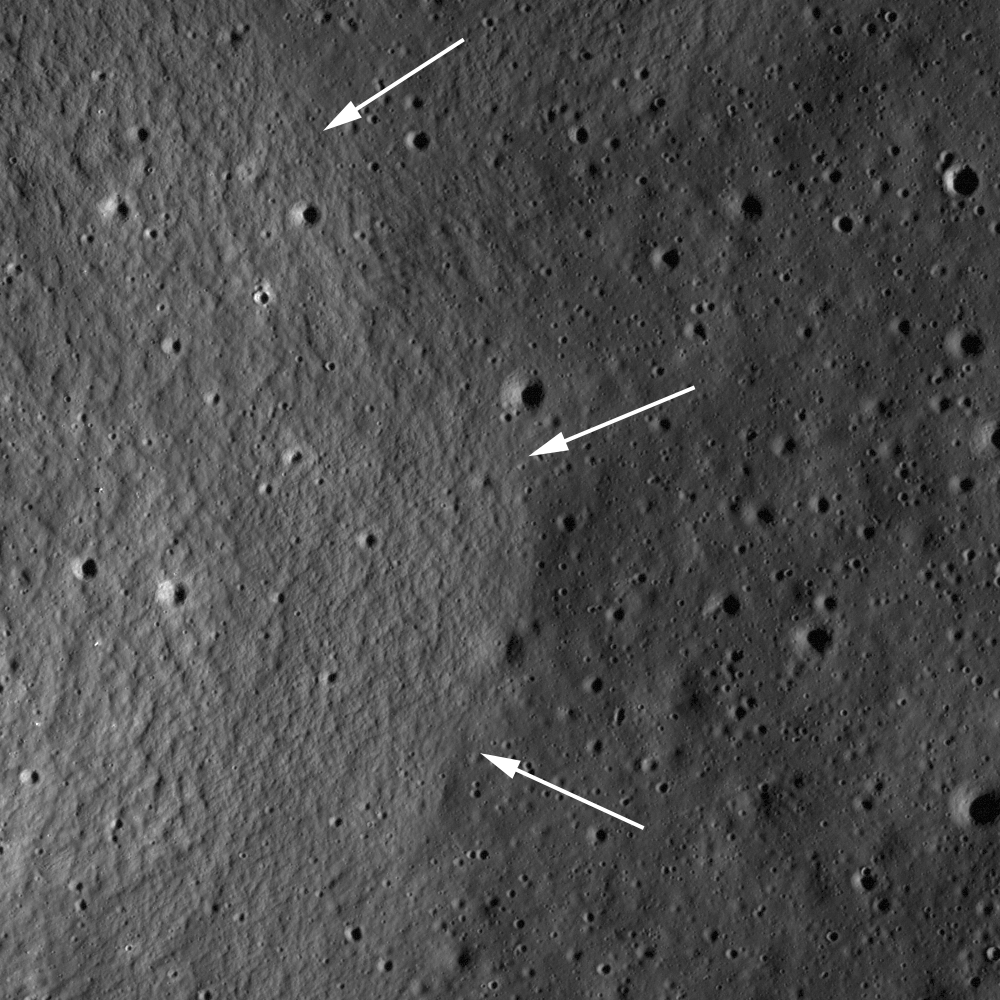
Most of the craters on the Moon formed through impact processes. However, some craters, like the one visible in this portion of the LROC Featured Image "Volcanoes in the Lake of Death," August 11, 2010, may be a volcano summit pit crater. A 923 meter-wide field f view from LROC NAC observation M131488521R, LRO orbit 4511, June 18, 2010; resolution 93 cm per pixel, incidence angle 82.28° from 44.79 km over 44.11°N, 23.94°E [NASA/GSFC/Arizona State University].
Lillian Ostrach
LROC News System

When most people think about volcanism on the Moon, they usually consider the vast mare basalts located primarily on the lunar near side.

However, there are many different volcanic features on the Moon! Sinuous rilles, mare domes, non-mare domes, and pyroclastic deposits are several volcanic features that the LROC NAC studies at 0.50 m/pixel. The opening image in today's Featured Image is an exciting view of what may be the pit crater at the summit of a small volcano. These features which may be similar to terrestrial cinder or scoria cones.

In contrast to lunar volcanoes, such as mare domes, this pair of volcanoes is much smaller - they are only ~1.5 km across the widest portion of their bases (very small by lunar standards!).
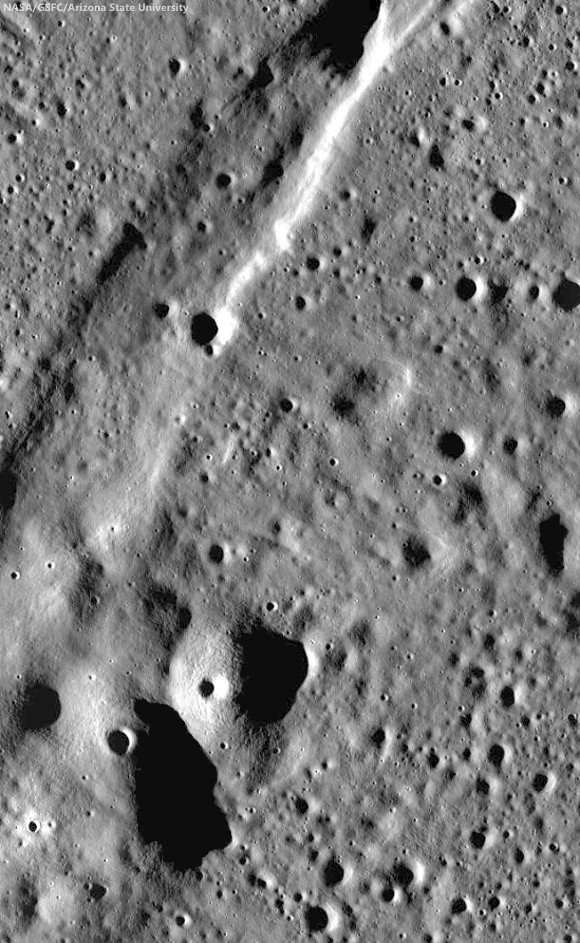
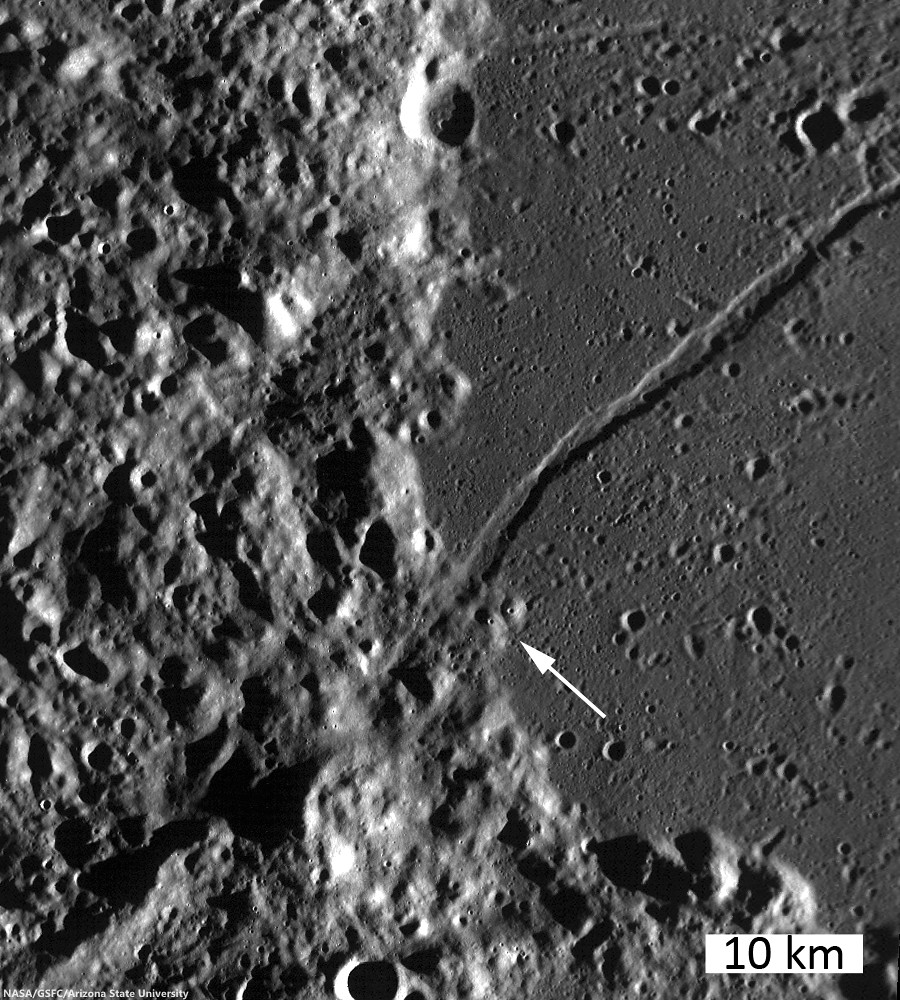
From "Lunar Morphology in the Lake of Death," Dec. 17, 2009: Close up on southwestern Lacus Mortis and a 700 meter wide section of 104 km-long graben Rimae Bürg near where it translates from the mare-filled "lake" into the highlands beyond its shore. LRO orbit 211, July 12, 2009; alt. 162.49 km, native res = 1.6 m [NASA/GSFC/Arizona State University].
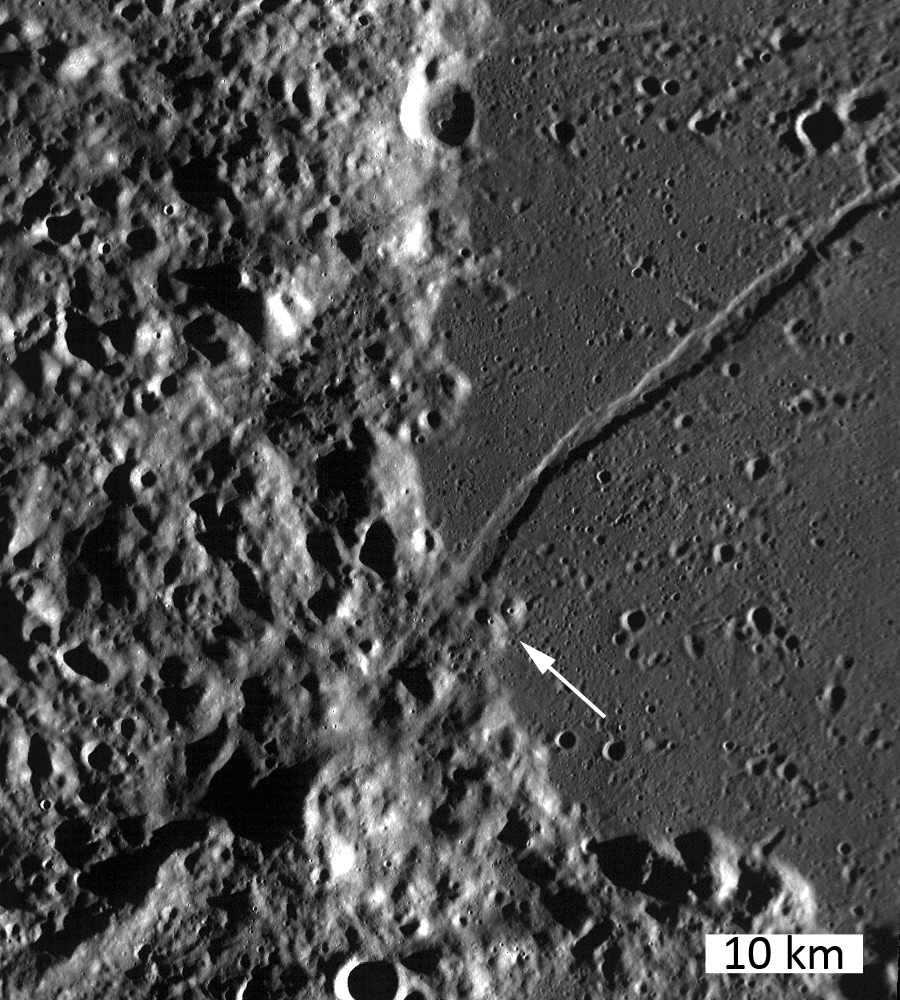
Investigators during the Apollo years suggested that volcanic features like domes could be present in this region; with the tremendous capability of the LROC instruments, we can now take a closer look and begin to ascertain if this is indeed the case. Located at the highlands-mare boundary, these two features appear to be volcanic in origin and also isolated from other volcanic features (besides the mare) - other regions with prominent volcanoes exhibit several domes within close proximity to one another. So, why are there only two features here, which we interpret to be volcanic in origin? We can't really answer that question with just a single LROC NAC image pair and an LROC WAC monochrome context image of the immediate area. Instead, we need an LROC WAC mosaic that provides a regional view of Lacus Mortis so that any other volcanic or dome-like features can be observed.

Portion of LROC WAC mosaic, centered on the highlands-Lacus Mortis mare contact; arrow points to two probable volcanic features, each of which are roughly 1.5 km across at their widest. Northward of these features is a linear rille that can be traced into the highlands where it appears to transform into a ridge [NASA/GSFC/Arizona State University].
Additionally, when the LROC team discovers new features we can target a stereo observation and make detailed topographic maps to help scientists better understand a features origin. Once a detailed study of the presence, locations, sizes, and forms of any other similar volcanic features are identified in Lacus Mortis, we can begin to assess these geologic features and hypothesize to their origins. For example, in the immediate vicinity shown in the LROC WAC monochrome context image, there is a linear rille (or graben) cutting through the mare, transitioning into a ridge in the highlands. Maybe this tectonic feature has something to do with the volcanic feature?

The Lunar Reconnaissance Orbiter is gradually adding granularity to long-familiar lunar features, like Lacus Mortis. Above, a sampling of LROC NAC observations in southwest Lacus Mortis show how differing illumination angles and altitudes compliment each other to build up what may soon be a first, truly complete view of the lunar surface.

From the LROC WAC frame we cannot distinguish relative ages between the volcanic features and rille, so determining the relationship between these features (if any) remains a mystery (at this time). Clearly, the geology of this immediate area is complex and is a worthwhile candidate for future lunar exploration!

Explore the landscape of Lacus Mortis for yourself, HERE.

Some Relate Posts:
Not your average complex crater, July 28, 2010
Lunar Morphology in the Lake of Death, December 17, 2009
Blogger's Best for the Best, December 6, 2009
Terraced Wall of Bürg, July 31, 2009

Tuesday, August 10, 2010

Desert RATS pack for Arizona


Mike Miller demonstrates one of the backpacks his team designed and built for the Desert Research and Technology Studies (Desert Rats) project's upcoming field test in Arizona. Miller led the team that developed the backpacks. The backpacks are equipped with GPS antennas, communications components and cameras. They are meant to show researchers what an astronaut might need to explore an alien world and give designers a look at the hardships the equipment could encounter [NASA/Frank Michaux].

Steven Siceloff
NASA Kennedy Space Center

"A team of astronauts, scientists and engineers from several NASA centers head to Arizona's desert each year to simulate the unique environment of space explorers. The effort is meant to test equipment and people to find out the best way to explore another world.

"Kennedy's engineers develop the communications, navigation and data transmission networks needed, a task that includes a semitrailer set up as a mission operations center, a command vehicle, a specialized RV, a pair of Humvees plus enough communications gear to set up a wireless network for a small crew of explorers to talk back to "Earth" like they will from other planets.

"Equipment from other centers, such as a pair of large rovers, has to work on the same communications network. The rovers, for example, relay the signals from the backpacks to the mission operations center.

"Although the area they test in is not a perfect stand-in for the moon or Mars in terms of having breathable air and normal gravity, the site does a pretty good job of isolating the participants, said Mike Miller, communications research engineer at Kennedy.

"We have to take everything to the site, just like we will to other planet surfaces," Miller said."

Read the full story, HERE.

Monday, August 9, 2010

Chandrayaan-2 rover prototype


Prototype of the ISRO Chandrayaan-II lunar rover, under development at IIT-Kanpur. The Mechanical Engineering Department there has been given the task of constructing the rover's imaging and control systems [IIT-Kanpur].

Pradeep Mohandas
Parallel Spirals

Perhaps for the first time, and hopefully not the last time, the Indian Space Research Organisation (ISRO) is involving under-graduate and post-graduate students in the development of a major space mission. (I am planning to do a story on this for the Moon Miners Manifesto India Quarterly this October and will add more details, when possible.

India's Minister of State for Science & Technology and Earth Sciences, Prithviraj Chavan, confirmed in India's Parliament ISRO engineers are developing and building Chandrayaan-II, together with Russia. India's second lunar mission will consist of an Indian orbiter and a Russian lander ferrying an Indian lunar rover, all equipped with scientific instruments.

The only constant in this chatter of news stream is that Chandrayaan-II will fly in the first quarter of 2013.

Read the article, HERE.

Moon Summit: Stellafane


Left to Right: Chuck Wood (green), Richard Evans (blue-checked shirt), Ron Doel (blue), Pete Schultz (tie), Tom Dobbins (white) and Bill Sheehan (black), Bert Willard - not pictured [Ken Spencer/LPOD].

Chuck Wood
Lunar Picture of the Day (LPOD)

With the famous Hartness Turret Telescope in the background, this scene is immediately identifiable to (Amateur Telescope Makers) as being near the Stellafane telescope gathering at Springfield, Vermont.

John Briggs and Dan Lorraine organized a one day Moon Morphology workshop the day before Stellafane officially started and drew a fantastic set of speakers (above) and a very inquisitive and knowledgeable audience.

The balance of interest and experience of the speakers fed a continuing discussion of lunar science and history. I gave an introduction about learning to read the history of the Moon from evidence visible in the eyepiece and in images, and then a second talk about how LTVT, LRO topo data and other recent technologies brought great opportunities to amateurs.

Read the article, HERE.

The earthbound face extinction - Hawking


The human race must look to outer space within the next century or it will become extinct, Professor Stephen Hawking has warned [Daily Telegraph].

Richard Alleyne
Science Correspondent
Daily Telegraph


The renowned astrophysicist said he fears mankind is in great danger and its future "must be in space" if it is to survive.

In an interview he said threats to the existence of the human race such as war, resource depletion and overpopulation meant it was at its greater risk ever.

Although a long advocate of colonising space in order to continue man's reign, this is his direst warning to date.

"It will be difficult enough to avoid disaster in the next hundred years, let alone the next thousand or million," he told the website Big Think.

"Our only chance of long-term survival is not to remain inward looking on planet Earth but to spread out into space.

Read the article, HERE.

The impact that shattered Santa Fe

Leslie Mullen
Astrobiology Magazine

Roberta Talache picks a shatter cone out of a rubble pile from the Santa Fe impact structure [Leslie Mullen].

On a winding road near Santa Fe, New Mexico, exposed mountain walls form an intricate mosaic of brown, yellow, pink and gray rocks that stretch up toward the deep blue sky. To the untrained eye, these rocks are just a random jumble of different shapes and colors. To a geologist, however, such rock outcrops can tell a compelling story about the distant past.

One particular outcrop on this Santa Fe mountain pass whispers a thrilling tale of ancient cataclysmic violence.

Evidence suggests that a large meteorite smashed into this area long ago. The force of the impact shattered the ground and tossed broken and pulverized rocks far and wide.

Read the Astrobiology
Feature Article, HERE.

Griffin’s critique of NASA’s new direction

Former NASA administrator Mike Griffin was less critical than in months past, speaking to a conference of the International Mars Society in Dayton, Ohio, Friday. The House committee plan for NASA FY2011 , he said, was better than the Senate's, and plans preliminarily approved in both chambers were superior to plans promoted by the White House [File photo: CSM, April 2009].

Jeff Foust
The Space Review

Former NASA administrators are not generally known for being outspoken about space policy after their tenures running the agency...Mike Griffin, however, is not content to remain quiet during this period of upheaval in space policy. The administrator who oversaw the formation and initial development of the Constellation architecture—most notably the Ares 1 rocket and Orion capsule—is clearly not happy to see the White House and even Congress willing to dismantle part or all it in favor of a new approach to human space exploration.

Griffin started his speech by first reviewing the administration’s proposed plan for NASA, and his take on it—which, not unexpectedly, wasn’t particularly positive. One area of concern he expressed was the plan by the White House to defer a decision on a heavy-lift vehicle (HLV) to no later than 2015. “I would ask you to note the timing,” Griffin said: a 2015 decision would come near the end of President Obama’s second and final term (assuming he wins reelection in 2012), and thus the funding decisions would be put in the lap of his successor. “By the time there was any budget year that would actually have to support the development of a real heavy-lift rocket, the president who is promising to do it will be gone,” he said.

Read the full report, HERE.

The Dust Management Project


Apollo 16 Beta Cloth Sample (69003). Surface contact sampling method. "It appears the uppermost surface is enriched in fine grains compared to the bulk soil," wrote Dr. Sarah Noble. The earliest direct lunar observations showed evidence of active micrometeor "gardening" and/or dynamic electromagnetic charging, levitation and ballistic migration [NASA/JSC/MSFC].

Mark Hyatt (NASA/Glenn) & Sharon Strake (NASA/GSFC)
AIAA, 40th International
Conference on Environmental Systems
Barcelona, 11-15 July 2010

A return to the Moon to extend human presence, pursue scientific activities, use the Moon to prepare for future human missions to Mars, and expand Earth’s economic sphere, will require investment in developing new technologies and capabilities to achieve affordable and sustainable human exploration. From the operational experience gained and lessons learned during the Apollo missions, conducting long-term operations in the lunar environment will be a particular challenge, given the difficulties presented by the unique physical properties and other characteristics of lunar regolith, including dust.

The Apollo missions and other lunar explorations have identified significant lunar dust-related problems that will challenge future mission success. Comprised of regolith particles ranging in size from tens of nanometers to microns, lunar dust is a manifestation of the complex interaction of the lunar surface with multiple mechanical, electrical, and gravitational effects. The environmental and anthropogenic factors effecting the perturbation, transport, and deposition of lunar dust must be studied in order to mitigate it’s potentially harmful effects on exploration systems and human explorers.

The Dust Management Project (DMP) is tasked with the evaluation of lunar dust effects, assessment of the resulting risks, and development of mitigation and management strategies and technologies related to Exploration Systems architectures.


Lotus Coating. Just one dust mitigation strategy examined by the Dust Management Project. An uncoated radiator sample and a Lotus coated radiator sample after contamination with JSC-1 Lunar simulant.

By pursuing an integrated approach of characterization, technology development, and application focus, the DMP has made significant progress in the first three years of implementation.

The project provides coordination and integration of dust related activities in (the NASA Exploration System Mission Directorate) ESMD, with a focus on the dust related challenges associated with long duration lunar missions.

The project has established a comprehensive body of data and experience and defined and filled key gaps in knowledge and capabilities. The project has developed specific technologies useful in the mitigation and control of dust and its effects on systems. New simulants are now becoming available to assess mitigation technologies and approaches as well as perform test and verification of components and systems.

Critical information and technology deliverables will be provided directly to Exploration flight (Lunar Precursor Robotic and Constellation) programs. Lunar dust should be viewed as integrated environmental phenomena, the study of which must employ a coordinated, multidisciplinary approach. The Dust Management Project will certainly include elements exploiting theoretical studies, earth-bound experiments, key measurements conducted by early robotic missions, and development of “best design” rules and specific engineering solutions for systems and their components affected by lunar dust.

Read the paper (pdf), HERE.

Sunday, August 8, 2010

LRO Mini-RF spends month mapping lunar poles


The Mini-RF radar instrument on-board the Lunar Reconnaissance Orbiter has just completed its first month of systematic polar mapping. These mosaics cover from 70° to the pole for both the north (top) and south (bottom) polar regions. The left-hand images show radar brightness whilst the right-hand color images also show the circular polarization ratio. These data will be analyzed to search for ice deposits in the floors of the permanently shadowed craters, as well as to learn more about the impact cratering process on the Moon.


In this close-up of the full-size mosaic released by NASA August 7, most of the resolution is drained of the very granularity investigators are looking for, and have found at these highest northern latitudes, indications of changes in the polarity of radar signals returned to the spacecraft consistent with, among very few other things, hydrogen in a bound state with oxygen, as frozen water. Lost in this hazy reproduction also is a small crater singled last month showing a exceptionally strong indication. (See Potentially ice-rich' crater in Rozhdestvenskiy, Friday, July 2, 2010).

Familiar relief is obscured in Mini-RF (and in representations of data returned by the somewhat less sensitive but proven valuable Mini-SAR instrument flown on India's Chandrayaan-1), but the information obtained is like nothing else. Mapping and narrowing the possible composition of the lunar surface must be an exceptionally interesting study in images not yet available to the public [NASA/GSFC].


This nighttime temperature map, shown for reference, assembled from LRO Diviner data closely matches the field of view further up. (Left center, along the western interior of Hermite is an area unseen until LRO, within a permanently shadowed region now known to host the coldest temperatures yet detected in the entire solar system, during long lunar night only 25 degrees K.) [NASA/GSFC]

Nobody knows...how dry I am

Paul D. Spudis
The Once & Future Moon
Smithsonian Air & Space

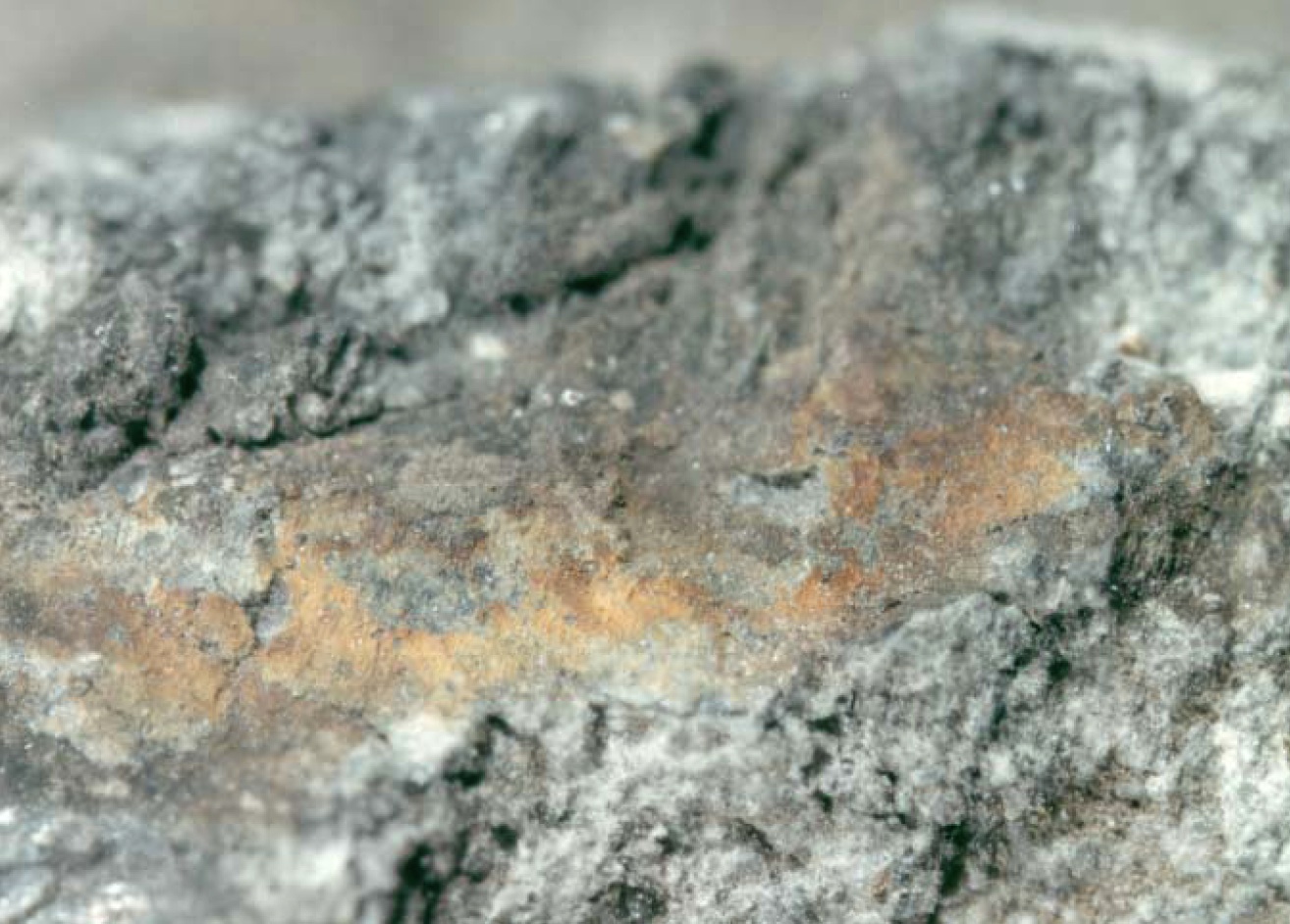
Apollo 16 sample 60095, "Rusty Rock" -- rough handling on the way to Earth or indigenous, contamination or oxidation from "Moon water?"

The never-ending saga of water on the Moon continues apace. In the latest revelation, it is now claimed that the Moon is indeed “dry” after all and never had much water (this new finding is only in regard to endogenous lunar water contained inside the Moon, not to water that has been or is being added to the lunar surface from impacting debris). Details of the controversy illuminate not only how science is done, but also how science is reported to the public by the popular press.

The current study by scientists at the University of New Mexico did not measure lunar water directly, but rather a chemical proxy for it, the element chlorine. Chlorine is “hydrophylic” (water-loving) and in theory, its abundance and variations should track with those of water inside the Moon. The new study finds that while the ratio of isotopes of chlorine largely are invariant in Earth rocks, they vary widely on the Moon. The interpretation of this observation is that the Moon does not possess an “offsetting” mechanism that regulates terrestrial chlorine isotope ratios, and the biggest offsetting factor in such systems is the hydrogen present in water in the Earth’s interior. The conclusion of this study is that as this factor is absent from the studied lunar samples, the Moon has no large amount of water nor did it ever have any.

Back in 1972, a “rusty rock” – sample number 66095 – was brought back to Earth by the Apollo 16 astronauts. Lunar scientists have long debated the origin and meaning of the molecule hydroxyl (OH) in the mineral akaganite (an oxidized iron compound) that was identified on its surface. Does this famous “oddball” rock sample indicate the movement of and interaction with water and the lunar surface, or did the akaganite form inside the warm, humid Apollo 16 command module during its transport to Earth.

Results from the University of New Mexico study are not inconsistent with what we’ve known about the Moon for some time. Almost all of the Apollo samples are bone-dry (showing no hydrous mineral phases) and chemically reduced, indicating formation in a non-oxidizing environment. Such conditions are possible in the absence of water. Conventional wisdom that the Moon has no significant water derives from these and similar observations.

When esoteric or complex arguments are made about the meaning of some discovery, it is sometimes very difficult for the popular press to fully follow the lines of reasoning.

When Prohibition is repealed and we return to the Moon, many of our questions can be answered and there will be no need to dream up non-existent controversies with hyperbolic and misleading headlines.

A 2008 analyses of lunar samples promised to change our perception of water and the Moon. Studies of beads of volcanic glass from the deep interior and grains of the mineral apatite in several types of lunar rock surprised us by the presence of water (H2O) or its related ion hydroxyl trapped in both the glass and mineral grains. The amounts of water detected were still quite small (a few tens of parts per million), but significantly greater than previously reported. Much was made of these new discoveries, including the suggestion that models of lunar origin would have to be reconsidered and perhaps revised.

Do the newly released study results negate previous work? Hardly. What’s true for one part of the Moon may or may not be true for another. Scientists must separate their observations from the subsequent inferences drawn from those observations. Unless some error is made, the previous measurements of water in a sample are objective facts. What the presence of that water means is something else. The interpretation of facts draws on our understanding of how nature works and the completeness of our reconstruction of the history of the Moon; both are incomplete at best and just plain wrong at worst. Moreover, there is a tendency for scientists to want their results to be significant. Thus, they will sometimes draw broad, sweeping planet-wide conclusions that may not be justified by the actual observation. I know this happens because I have done it myself. There is no intent to falsify or mislead – only a desire to claim a fullness of understanding that may not yet be warranted.

When esoteric or complex arguments are made about the meaning of some discovery, it is sometimes very difficult for the popular press to fully follow the lines of reasoning. They also have a desire to make stories interesting to their readers, so they tend to focus on controversy, often portraying different interpretation of facts as “fights’ between rival scientific groups. These tendencies often result in hilarious headlines, e.g., “Moon not so watery after all” or my personal favorite, “Moon water dreams evaporate.” Funny – I don’t recall ever “dreaming” about water in the Moon and I very much doubt that many of my colleagues do either. But differing opinions means conflict and conflict means human interest, and so a fight it must be.

Nature is complicated and that can make for some missteps in our long struggle to characterize it and reconstruct its history. The simple fact is, the Moon is more complex and interesting than we had thought. Scientifically, this is a good thing. We want hard problems to tackle and solve. And the process of solving problems sometimes does create feuds between scientists; history is replete with them. However, in this latest instance, a feud doesn’t exist – only a desire to fully understand the Moon and its history. When Prohibition is repealed and we return to the Moon, many of our questions can be answered and there will be no need to dream up non-existent controversies with hyperbolic and misleading headlines.

Saturday, August 7, 2010

NASA offers purchase of data from private, unmanned lunar landings

Carnegie Mellon University's spin-off Astrobotics has already devoted $3,000,000 toward winning the Google Lunar X-Prize (GLXP) by December 2012 [Astrobotics].

Astrobotic Technology, the Carnegie Mellon University company devoted to lunar robotic exploration, wasted no time announcing its acceptance of NASA's offer to buy up to $10 million in data from a commercial unmanned mission to the Moon. NASA announced August 5 its Innovative Lunar Demonstrations Data (ILDD) program, with a total budget of $30 million.

Astrobotic's primary goal is to revisit the July 1969 landing site of Apollo 11 (0.67°N, 23.47°E) no later than December 2012 to win all three lunar landing cash incentives; a total $24 million in the the primary Google Lunar X Prize (GLXP) contest, the $2 million bonus prize offered by Florida if the mission is launched there, and now up to $10 million offered by NASA to buy data from the mission.

The company is one of more than twenty organizations presently qualified to compete Google-sponsored lunar lander competition managed by the X-Prize Foundation. The goals includes successfully landing a privately-funded lunar rover on the Moon and traveling at least 500 meters while returning data and televised images. A bonus prize is offered for landing near a human artifact in a manner that can be verified.

The winning plan as outlined by Astrobotic includes, "connecting the Internet to the Moon and returning 3D High-Definition to convey the experience to the world. "

Carnegie Mellon and the company have already spent over $3 million creating prototype robots together with mission designs since 2007, when the Google Lunar X Prize was first offered.

The new NASA program to purchase data from successful commercial landings will accelerate the company's work on the spacecraft, the company announced.

"Sensing devices and software needed for an automated lunar landing are evolving from our research and development on autonomous cars," said Dr. William "Red" Whittaker, Astrobotic founder, and director of CMU's Field Robotics Center. "Much of the technology for winning the DARPA (the Defense Advanced Research Projects Agency) Urban Challenge car race also applies directly to our lunar landing project."

Astrobotic and CMU are testing a prototype robotic vehicle sufficiently robust to operate in the extreme heat of two week lunar day and to survive the deeply cold, equally long lunar night.

Friday, August 6, 2010

An EVA not taken


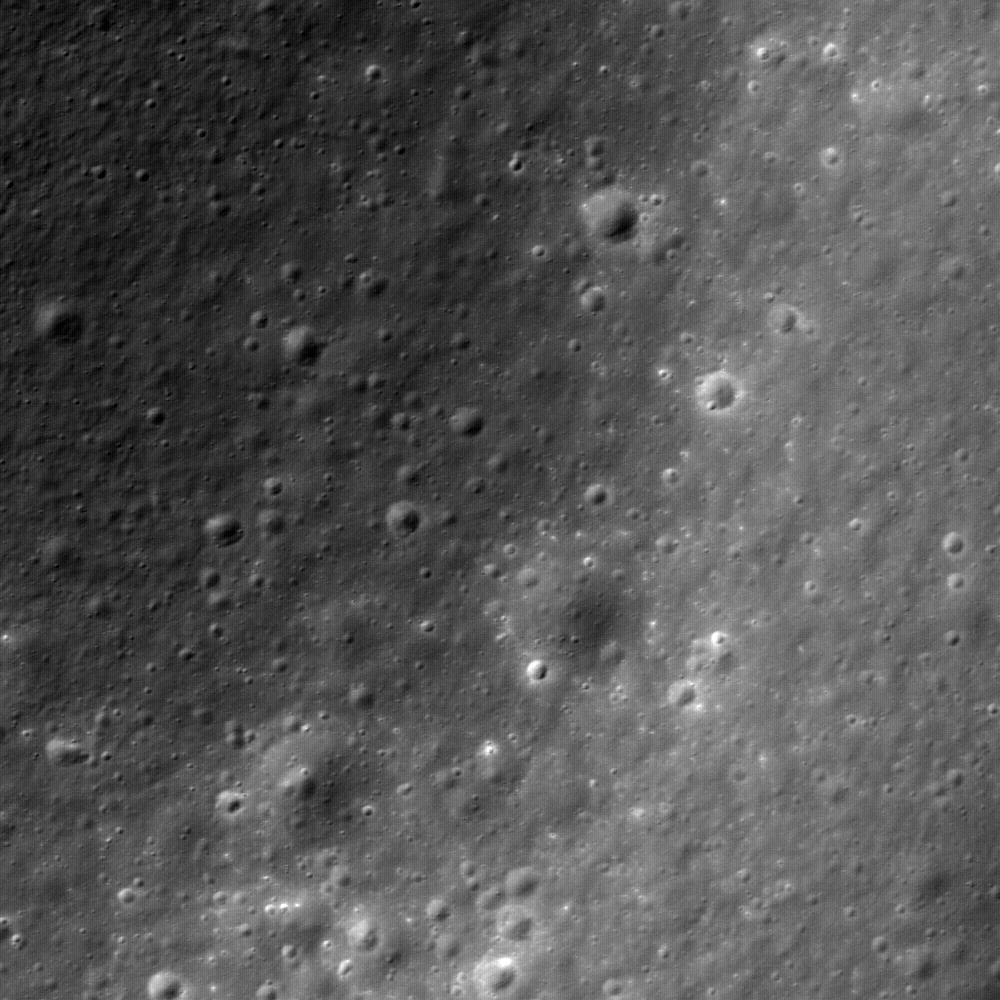
Mare surface in Sinus Aestuum near a lunar exploration site proposed in the late 1950s. (LRO orbit 4196, May 24, 2010, resolution = 47cm/pixel. Image width is 470 meters) [NASA/GSFC/Arizona State University].

Samuel Lawrence
LROC News System

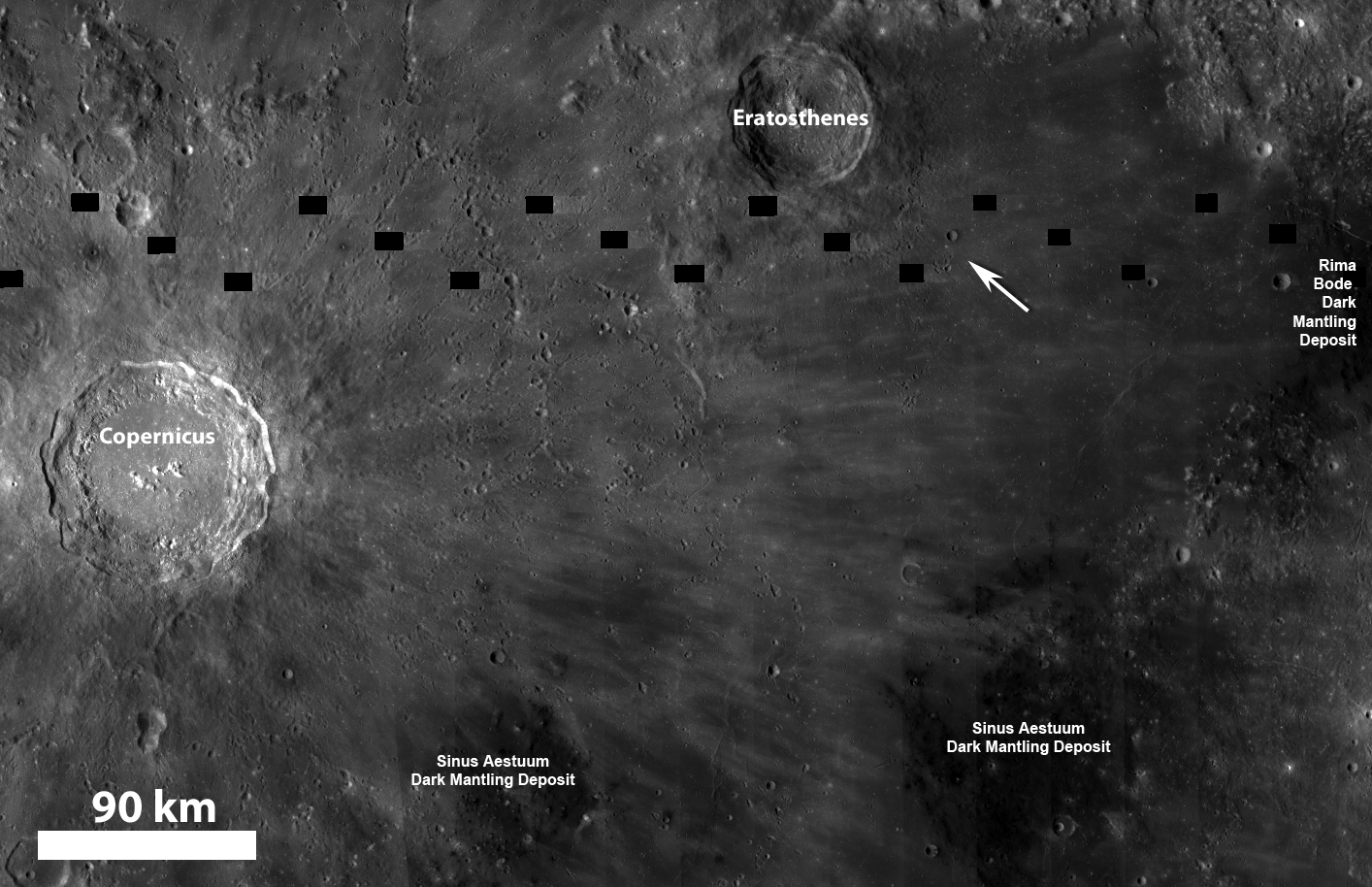
Thinking about locations on the Moon where humans should be exploring is nothing new. In the late 1950s, at the dawn of the Space Age (when Project Mercury was still getting off the ground), the United States Army proposed to establish a large lunar base to use for a variety of science, engineering, and military tasks. Despite the paucity of data about the lunar surface at that point in history, the Army team that proposed Project Horizon suggested several notional sites for this lunar outpost based on what was known at the time. One of these sites was located near this region in Sinus Aestuum, located southeast of Eratosthenes crater just beyond the southern rim of the of the great Imbrium basin.


LROC Wide Angle Camera monochrome mosaic of the Sinus Aestuum region. Approximate location of today's Featured Image is shown by the small white arrow. (See full size image HERE.) Black rectangles are regions between individual WAC images to be filled-in at a later date [NASA/GSFC/Arizona State University].

We know more about the Moon now than we did when this location was proposed over five decades ago. Knowing what we do now, it turns out that this would have been a fantastic location for an early lunar outpost. As you can see in today's Featured Image, this mare surface is relatively smooth, the near-equatorial location would have made for a dynamically favorable landing target, and the nearside location would enable continuous real-time communications with Earth. The location would have permitted sampling (and age-dating) the rays of Copernicus and direct exploration of Eratosthenes crater, the foundations for the lunar stratigraphic time scale.

This location is centrally located between several targets now known to have high scientific and exploration interest, including the aforementioned Eratosthenes crater, Copernicus crater, the rich ores of the Rima Bode regional dark mantling deposit, the Sinus Aestuum regional dark mantling deposit, and the southern rim of the Imbrium Basin, although an extended surface traverse would have been required to access those locations from this site. Future robotic and human lunar sortie missions will provide important new scientific insights into the lunar surface, but long-duration human lunar outposts will provide even more valuable benefits, including the flexibility to make exploration forays that last longer (or even repeat visits) to key scientific locations, as well as providing more infrastructure to leverage existing lunar resources.

Examine the full NAC view of the region!

Canadian Moon buggy backed by stimulus cash

Steven Chase
Globe and Mail
"Canadian Space Agency officials say U.S. goals of reaching Mars will require an American-led activity on the moon to prepare for a longer trip. Plus, they say, there are many other nations with their own plans that may want Canadian technology."

Read the article, HERE.

The global image of the Moon obtained by Chang’E-1: Data processing and lunar cartography


The digital elevation model (DEM) from the Chang'E-1 laser altimeter, used for geometric correction of the CCD photography [CNSA/CAS/CLEP].

LI ChunLai, et al.
Science China, Earth Sciences
August 2010 (Vol.53 No.8)


The global lunar image of the first phase of Chinese Lunar Exploration Program (CLEP) is the first image to cover all over the surface of the Moon. It will serve as a critical foundation for succeeding exploration and scientific research.

In this paper, the acquisition, characteristics, and data quality of Chang’E-1 Charged Coupled Device (CCD) image data are described in detail.

Also described are the methodology and procedure of data processing. According to rule of planetary cartography, the image data has been processed, geometrically corrected, and then (made into a mosaic) and merged to a scale of 1:2,500,000. The results of data processing and charting show the image data of Chang’E-1 CCD and its geometric precision meet the demands of charting a map in the scale of 1:2,500,000.

The relative geometric positioning precision of the global image is better than 240 meters, and the absolute geometric positioning precision is slightly better than that of the ULCN2005 and Clementine lunar basemap (v. 2.0). The plane positioning precision is approximately 100–1500 meters. The global image is proven to be the best global image of the Moon so far in terms of space coverage, image quality and positioning precision.

Download the RESEARCH PAPER (PDF), HERE.
Google Scholar, August 6, 2010

Thursday, August 5, 2010

Happy 80th Birthday, Dr. Armstrong

Dr. Neil Armstong, first human to set foot on another world, who celebrates his 80th birthday, August 5, 2010. The Apollo 11 Cmdr. stepped off the Apollo 11 lunar module "Eagle" foot pad and into legend 41 years ago, July 20, 1969.

Neil Armstrong, Eighty This Week. An Appreciation

Andrew Sumereau

American Thinker

For over half of his life now, Neil Armstrong has gracefully enjoyed and endured the appellation "First Man on the Moon." And, although his popularity is currently way below the likes of Lady Gaga (whoever that is), it can be reasonably argued that over the next millennia, when the history of the Twentieth Century is written, his name will stand out over all others. When the Obamas, Stalins, and Churchills have gone the way of just so many Caesars and Pharaohs of old, when the great movements and wars are forgotten, Neil Armstrong's name will live on, not for who he was, but for what he did. And, as with so many of the great, his attributes will probably be appreciated far more after he is gone.

A son of an Ohio state government worker, Armstrong enjoyed a comfortable small-town Depression upbringing distinguished only by an unusual passion for flight. He took to flying at a young age, earning his pilot's license at sixteen, he joined the Navy, and flew Panther jets from aircraft carriers by the time he was twenty. A member of the famous "Screaming Eagles" all-jet Fighter Squadron 51, he flew hazardous combat missions over North Korea and China. Armstrong was one of the few to make over 100 carrier landings, his squadron's exploits were later dramatized from the work by James Michener in the feature starring William Holden, "The Bridges at Toko-Ri (1954).

Returning to Purdue University after Korea to finish his degree in aeronautical engineering in 1955, civilian Armstrong was recruited to pilot and test the newly developed experimental rockets and jets at Edwards in California. Contemporary of the celebrated and colorful Chuck Yeager, test pilot Armstrong set records for speed and altitude with a quiet workman-like demeanor that was to characterize his entire professional life. Brushing the edge of space at 63.25 km altitude, in the X-15 experimental hypersonic spacecraft, Armstrong tested the limits of aerodynamics over the western desert just as Sputnik was rocking the scientific (and political) world.

Assigned to the now largely forgotten Dyna-Soar project, which developed airplane-like space vehicles and competed with early NASA rocketry like that used in Project Mercury, Armstrong remained active and busy as "pilot-engineer" while the space race heated up. To the surprise of many of his friends and co-workers, he applied for the second group of openings for NASA's growing astronaut corps in 1962, after Kennedy's call for a moon landing "before the decade was out." Selected as the very first civilian astronaut, he trained with the extraordinary group of nine men who joined the legendary "Right Stuff" Original Seven astronauts; men of the highest caliber, (names every schoolchild should know, but alas, does not,) -intelligent, educated, fearless, and destined for challenges of the highest order, triumphs, disasters and death: Lovell, White, Borman, Conrad, Young, See, Stafford, and McDivitt.

Named commander of Gemini VIII, Armstrong gained repute for his coolness under pressure when his malfunctioning capsule began turning end-over-end at a sickeningly and dangerously fast rate after the first successful docking of spacecraft in orbit. Aborting the mission after bringing the spacecraft to safety, a depressed Armstrong dismissed any hint that his actions were heroic, regretting the missed opportunities, focused as he was on the mission and the consequences to Project Gemini and its follow-up, Project Apollo.

Of the moon mission, and the drama over landing at Tranquility Base, as Buzz Aldrin coolly counted down the fuel readings while Armstrong piloted the Lunar Module over boulders and craters, more is known. The entire world watched as history unfolded that July night in 1969; the dramatic landing, the other-worldly television show, the snowy black and white picture revealing two Americans bouncing along the lunar surface and speaking to Nixon via telephone. The nation, the world, was thrilled and inspired, and then, as always, moved on to the ephemeral and mundane, and, ultimately, forgot.

After the ticker-tape parades and banquets and public honors across the globe, Armstrong moved on to what many consider the most exemplary part of his life. For the unique contribution of the first man on the moon may not lie in his courage or his resourcefulness or his patriotism, but rather in his bearing and dignity over forty plus years of exposure and fame.

In 1971, after retiring from NASA, Armstrong began teaching Aerospace Engineering at the University of Cincinnati. He avoided offers from many businesses to act as spokesman until Chrysler, in financial difficulties and backed by a loan from the federal government, successfully approached him to advertise its renewed commitment to automotive engineering excellence. Subsequently, he quietly served on the boards of several companies, and was asked to serve on the Rogers Commission investigating the Challenger Shuttle disaster in 1986. Much of his time has been spent avoiding the spotlight and preserving his name, image and reputation.

In his private life he has known great happiness and great struggle. Losing his two-year old daughter to a rare brain cancer in 1961, and divorcing his wife after 38 years of marriage, the trials of his profession have left scars. "Most of my adult life," he said, "has been spent saying goodbye to friends and colleagues." He suffered a heart attack in 1991 and recovered to find a new bride in 1994. "Retired" in 2002, Armstrong celebrates his 80th birthday today.

Perhaps the modern world, and especially modern America, enjoys creating celebrities and heroes out of nothing almost as much as tearing them down. A man like Neil Armstrong, a hero of deeds and courage and character, stands out as a rarity to say the least. How lucky we are that the person chosen by fate to be the first to walk on the moon was such a man.

Concentric Gruithuisen K


Inner rim of Gruithuisen K (35.4° N, 317.3° E) from a subset of LROC NAC observation M111877130L. Image width = 510 meters, north is up and sunlight is from the lower right (Full image, HERE.) [NASA/GSFC/Arizona State University].

Sarah Braden
LROC News System

Impact craters affect the entire surface of the Moon, from micron-sized pits to multi-ringed impact basins. Lunar craters also have a wide array of morphologies. Generally, the size and the morphology of a crater depends on the size and velocity of the impacting bolide. Lunar scientists have used crater size and form to group lunar craters into three basic categories: simple craters, complex craters, and multi-ringed basins.


Kaguya wide view shows the proximity of Gruithuisen K to the interesting "Braided Rill" formation approximately 50 km southwest in Oceanus Procellarum. Field of view is around 70 km. Charles Wood, curator of the Lunar Picture of the Day (LPOD), featured a superior level of detail and recommended discussion about this still-perplexing formation, December 22, 2009. Kaguya (SELENE-1) Terrain Camera (TC-056-1) [JAXA/SELENE].

Simple craters are circular, bowl-shaped, and usually less than 10-15 km in diameter. Complex craters are usually larger than 10-20 km in diameter and have a well-defined central peak. Complex craters also often have a rim with one or more terraces. The central peak is brought up from great depths beneath the crater as the ground elastically rebounds after the shock and pressure of the bolide impact. Multi-ringed basins are remnants of the largest impacts on the lunar surface and usually have more than one rim (such as the 1100 km diameter Imbrium Basin).

See Chapter 3 of Geologic History of the Moon by Don Wilhelms for more information about lunar impact craters.


LROC Wide Angle Camera context view for today's Featured Image centered on Gruithuisen K, adjacent to a mare-highlands boundary. (Subset of WAC frame M117773324 [NASA/GSFC/Arizona State University].

Some craters possess characteristics outside of these basic categories. Elliptical, polygonal, and concentric craters are further classifications for craters on the Moon. Elliptical, or oval-shaped, craters form when the impactor hits the surface at an oblique angle, usually around 10° or less. Polygonal craters can form for a number of reasons, and usually the morphology results from pre-existing structural weaknesses in the material at the impact site, such as what is observed with the terrestrial Meteor Crater.

Today's Featured Image is of Gruithuisen K, an example of a class of impact structure referred to as a concentric crater. Gruithuisen K has an inner and outer rim, as well as hummocky material between the inner and outer walls. One possible explanation for concentric craters like Gruithuisen K is that geologic layers with different strength properties in the target zone produce the “rings” of concentric craters. Since the weathering processes (like wind and rain) that eventually obscure impact structures here on Earth don't occur on the Moon, the Moon's surface preserves billions of years of impact history and a variety of impact structure morphologies. Human and robotic exploration of lunar impact structures will therefore provide incredibly valuable new insights into this fundamental Solar System process along with the history of the Earth-Moon system.

Browse the full-resolution NAC frame.


Full 2.6 km width center field of view of LROC Narrow Angle Camera (NAC) observation M111877130LE, showing the interior anatomy of Gruithuisen K, north-south, from inner rim to inner rim. The full observation was swept up during LRO orbit 1621, November 3, 2009, from an altitude of 49.39 km. Full image resolution = 0.51 [NASA/GSFC/Arizona State University].

Wednesday, August 4, 2010

Luna-Resource & Chandrayaan-2 in 2013

Updated September 15, 2010 1826 UT

Rough notional view of Russia's Luna-Resource lunar lander deploying India's Chandrayaan-2 rover, India's second lunar mission now anticipated in 2013. The Russian lander will carry an IGN-10K neutron generator designed to confirm the presence of water, apparently in vapor form, directly detected by India's Moon Impactor Probe (MIP) near the Moon's south pole in November 2008. [LPRG].

Joel Raupe
Lunar Pioneer

August 3 – The Hindustan Times reports the unmanned Russian lunar lander Luna-Resource, after ferrying and supporting the lunar rover segment of India's Chandrayaan-2 mission, will be an entire stationary mission in its own right, equipped with a neutron generator designed to confirm a presence of water at the Moon’s high latitudes, most likely within the still unsampled 4 billion-year-old South Pole-Aitken (SPA) impact basin.

India’s flag-carrying Moon Impact Probe (MIP), deployed from Chandrayaan-1 in November 2008, appears to have directly detected water in vapor form imoments before its intentional impact near Shackleton crater and the Moon’s south pole.

Chandrayaan-1 was launched by the Indian Space Research Organisation (ISRO) October 22, 2008 and inserted into a polar orbit around the Moon the following November 12.

India's first lunar orbiter completed 3,400 revolutions during 312 days, until all contact was abruptly lost, May 19, 2009. The Moon Impact Probe (MIP) separated from the larger vehicle and soon afterward impacted near Shackleton crater at the Moon's South Pole, not long after Chandrayaan was successfully inserted into lunar orbit.

In 2013, the Indo-Russian Chandrayaan-2 / Luna-Resource (ISRO/Roscosmos) 1,000 kg lunar payload is slated for launch from Sriharikota on the sub-continent’s eastern coast. The six-wheeled ISRO rover, accompanying the Russian lander, is expected to weigh 58 kg.

The Indian rover is designed to operate for a year, traveling 150 kilometers at speeds of 300 meters per (Earth) day, primarily powered by solar energy and juggling the incidence of almost continuous sunlight in and around permanently shadowed regions (PSR's) near the lunar South Pole.

In 2012, the Russian lunar orbiter mission Luna-Glob is being developed to carry four Japan-built impactor-seismographer probes.

The Hindustan Times quotes Yevgeny Bogolyubov, deputy chief designer at All-Russian Scientific Research Institute of Automation (VNIIA), confirming Roscosmos plans "to send to the Moon (Luna Resource) bearing a neutron generator developed by our institute to study the lunar surface.” A similar neutron generator would, he said, eventually be used to study the surface of Mars.

The Press Trust of India reports a "short listing" of instruments to be carried on the Chandrayaan-2 orbiter and rover vehicles launched together with Luna-Resource were to be selected in Bangalore on August 3.

According to ISRO Telemetry Tracking and Command Network (ISTRAC) director S.K. Shivakumar, individual Chandrayaan-2 scientific instruments would weigh between 30 and 35 kg.

Remnants of the Imbrium impact event


Mare basalts embayed ejecta structures formed by the massive Imbrium impact in this sub-scene of LROC Narrow Angle Camera (NAC) observation M131501983RE (2.2 km higher above, 902 meters in the LROC Featured Image field of view [full image HERE], immediately above). Arrows denote the contact between younger mare basalts and older Imbrium ejecta, image [NASA/GSFC/Arizona State University].

Lillian Ostrach
LROC News System

Mare basalts fill most of the large impact basins on the Moon, and in many cases the pre-existing topography was buried by the huge outpourings of lava. However, sometimes pre-existing topography is not completely buried by the mare basalts. When lava flows around a topographic high and does not bury it completely, the resulting landform is called a kipuka, and may be used to tell scientists about the region before the lavas flowed across the landscape. In the case of today's Featured Image, this kipuka in southwestern Lacus Somniorum is probably ejecta from the impact that formed the Imbrium basin. When looking at a regional view, this knob and others form relatively linear chains which can be traced back to the Imbrium basin.


Preliminary Lunar Reconnaissance Orbiter (LRO) laser altimetry (LOLA) data showing Imbrium as seen from Earth, the most predominant, clearly identifiable feature on the near side seen with the naked eye from Earth. Imbrium is central to most of the Moon's mare phenomena and it's highest diversity of compounds. [NASA/GSFC].

Since the mare basalts are embaying this feature, the basalts postdate the formation of the Imbrium basin. Using remotely-sensed data to establish this kind of geologic relationship on the lunar surface helps to clarify the geologic history of the Moon, an important consideration for planning future lunar exploration.

LROC Wide Angle Camera view of southwestern Lacus Somniorum; arrow points to location of today's Featured Image. Subset of LROC WAC monochrome M117339055M [NASA/GSFC/Arizona State University].

Explore the landscape of Lacus Somniorum
for yourself, HERE.

Tuesday, August 3, 2010

ISRO releases lunar polar mosaics


From newly released Chandrayaan-1 Terrain Mapping Camera (TMC) mosaic of lunar south pole [ISRO].

Pradeep Mohandas
Parallel Spirals

ISRO has posted updates to Chandrayaan-1 website involving the lunar poles. This is interesting time to post these updates. ISRO had announced that payloads flying on Chandrayaan-2 were to be finalized at a meeting to be held on August 3, 2010. Chandrayaan-2 is expected to land two rovers on the Lunar South Pole.

Read the summary, HERE.

Newly released Chandrayaan-1 Lunar Laser Range Instrument (LLRI) mosaic of the Moon's north polar region. India's first lunar probe arrived in lunar orbit November 12, 2008 and successfully returned data for 312 days [ISRO].

The Apollo Model & FY 2011


Four days shy of six months out of office, former President Lyndon Johnson (right) watches the launch of Apollo 11, together with Lady Bird Johnson and Apollo 10 Cmdr. Thomas P. Stafford, Jr., July 16, 1969. Whatever else might be said of LBJ, no single politician can be more credited for the creation of NASA as a civilian space agency or for shepherding the national resources necessary to achieving the Apollo lunar landings, as Senate majority leader, Vice President and President. Like Johnson, NASA is a "creature of Congress" [NASA].

“Today outer space is free. It is unscarred by conflict. It must remain this way… Men who have worked together to reach the stars are not likely to descend together into the depths of war and desolation.” Senate majority leader Lyndon B. Johnson (D-TX), 1958

Taylor Dinerman

Hudson New York

Perhaps the primary goal of the Obama administration's 2011 budget NASA proposal was to kill, once and for all, the Apollo Moon mission model that has determined the way the US space agency operates for nearly the last 60 years.

The so-called compromise proposal that unanimously passed the Senate Commerce Committee on July 15th gutted most of the Obama proposal. The House version does even more damage to the administration's proposal. While the Bush era Constellation program would seem to be dead, at least in name, its substance has survived for at least another year. There is a lesson here, not only for those who would reform NASA, but also for those who want to reform any reasonably sized government agency.

The first lesson is: Do not ignore Congress. NASA as it exists is the product of decades of Congressional action. Reformers may believe that they know what the agency needs, but without Congressional support, they have no hope of making a difference...

Read the article, HERE.

Interview with new NLSI head Yvonne Pendleton

"The moon has gone from questionably interesting to absolutely fascinating. It’s providing a laboratory, our nearest laboratory off-planet where we can go and actually explore and test."

Last month Dr. Yvonne Pendleton became director of NASA’s Lunar Science Institute at Ames Research Center in California.

"Because of the missions that have happened recently, especially LRO, the Lunar Reconnaissance Orbiter , and LCROSS, the mission that impacted the moon and kicked up material that we are now analyzing, we’re understanding far more about the water and volatile materials on the moon. In many respects, the moon represents our history, our past, and also our future."

90 Second Interview:


Full 8 minute Audio & Text Summary @ Earthsky


Monday, August 2, 2010

Cold Storage


A permanently-double-shaded crater near a lunar pole. Within the double-shaded crater, a suspended thermal shield reflecting 50 K gray body radiation back towards the lunar surface is shown. Extremely low heat conduction between the object and the lunar surface could additionally be produced using superconducting magnetic levitation to support the thermal shield and the principal object. The thermal shield would be shaped to block surface heat radiation from all directions [NASA/SSC].

NASA Tech Brief - Stennis Space Center - In the polar regions of the Moon, some areas within craters are permanently shadowed from solar illumination and can drop to temperatures of 100 K or lower. These sites may serve as cold traps, capturing ice and other volatile compounds, possibly for eons. Interestingly, ice stored in these locations could potentially alter how lunar exploration is conducted. Within craters inside craters (double-shaded craters) that are shaded from thermal re-radiation and from solar illuminated regions, even colder regions should exist and, in many cases, temperatures in these regions never exceed 50 K.

Working in these harsh environments with existing conventional systems, exploration or mining activities could be quite daunting and challenging. However, if the unique characteristics of these environments were exploited, the power, weight, and total mass that is required to be carried from the Earth to the Moon for lunar exploration and research would be substantially reduced.

In theory, by minimizing the heat transfer between an object and the lunar surface, temperatures near absolute zero can be produced. In a single or double-shaded crater, if the object was isolated from the variety of thermal sources and was allowed to radiatively cool to space, the achievable temperature would be limited by the 3 K cosmic background and the anomalous solar wind that can strike the object being cooled. Our analysis shows that under many circumstances, with some simple thermal radiation shielding, it is possible to establish environments with temperatures of several degrees Kelvin.

Read the full article, HERE.

Sunday, August 1, 2010

A Walk at Dusk


Caspar David Friedrich (1774-1840), c. 1830; Oil on canvas
Getty Museum

You decide the Desert RATS' next destination


SEV - Surface Exploration Vehicle (Surface Concept) at Desert RATS Field Test on the Black Point Lava Flow in Arizona. Unveiled in 2007, the latest model began tests in 2009. During the Apollo program, exploration was confined to the distance astronauts could expect to walk back wearing spacesuits if their rovers broke down: about 10 km. The presence of two or more service SEVs on the lunar or Martian surface would extend that potential range to more than 200 km in any direction, greatly increasing the scientific opportunities during missions. Even in the midst of challenging terrain, emergency shelter and support can be less than an hour away. [NASA/ARC/IRG].

NASA is inviting the public to choose the area in northern Arizona where explorers will conduct part of the annual Desert Research and Technology Studies (Desert RATS).

"Desert RATS is an annual test where NASA takes equipment and crews into the field to simulate future planetary exploration missions," said Joe Kosmo, Desert RATS manager at NASA's Johnson Space Center in Houston. "We want the public to be a part of this."

From July 27 until August 8 anyone can vote on where to send the Desert RATS team. To cast your vote, visit HERE.

(http://ti.arc.nasa.gov/desertrats/vote).

The website features interactive panoramic images of lava, rocks and desert for the public to choose as the most interesting destination to explore.

The location that receives the most votes will be announced August 16. Astronauts will visit that site to perform field geology and collect rock samples.

The Intelligent Robotics Group (IRG) at NASA/Ames Research Center (Moffett Field, CA) took the panoramic images of terrain and geologic features at Black Point Lava Flow in Arizona.

"It is essential to involve the public in NASA's exploration program to engage and inspire the next generation of scientists and engineers," said IRG Director Terry Fong. "We want people of all ages to be able to actively participate, contribute and collaborate in meaningful ways to NASA's activities."

The Desert Rats 2010 mission also involves field testing two space exploration vehicles, which could allow astronauts to spend two or more weeks living, working, and traveling across different planets. Astronauts will use two such vehicles to explore a lava flow and test data collection methods, communications protocols, mission operations, and advanced technology. Desert RATS is sponsored by NASA's Exploration Systems Mission Directorate in Washington.


A Glimpse of the Future - Micro-Gravity airless-body exploration will require a play on the SEV without wheels. The Surface Exploration Vehicle (Space Concept) features aspects also undergoing tests [NASA/ARC].

GRAIL tandem on target for 2011


The GRAIL (Gravity Recovery and Interior Laboratory) spacecraft concept, designed to further improve maps of the Moon's anisotropic gravity well and the composition of its interior, taking advantage of a stable lunar lithosphere to read the history of the inner Solar System [NASA/JPL/GSFC/MIT].

Engineers at Lockheed-Martin Space Systems in Denver, CO have conducted a fuel tank check of one of NASA's GRAIL mission spacecraft (Gravity Recovery and Interior Laboratory) scheduled for launch in 2011.

"Confirming the size and fit of manufactured components is one of the steps required prior to welding the spacecraft's fuel tanks into the propulsion system's feed lines," according to a news release from the Jet Propulsion Laboratory in Pasadena, CA.

"The GRAIL mission will fly twin spacecraft (spacecraft "A" and "B") in tandem orbits around the moon for several months to measure its gravity field in unprecedented detail. The mission will also answer longstanding questions about Earth's moon, and provide scientists a better understanding of how Earth and other rocky planets in the solar system formed."

The GRAIL spacecraft concept builds on a legacy of similar tandem satellite concepts, including most recently the twin sub-satellites flown with Japan's SELENE-1. Tiny changes in Ka band transmission time between the two spacecraft, which will arrive in lunar orbit 50 hours apart, and also between each of the spacecraft and ground stations on Earth, will allow investigators to detail the uneven composition of the Moon's interior.

The rationale for the mission, and other details, are detailed by the mission's host, the renowned Massachusetts Institute for Technology (MIT).

"The Moon is the most accessible and best studied of rocky, or "terrestrial", bodies beyond Earth. Unlike Earth, however, the Moon's surface geology preserves the record of nearly the entirety of 4.5 billion years of solar system history. Orbital observations combined with samples of surface rocks returned to Earth, show that no other body preserves the record of geological history so clearly as the Moon.

"The structure and composition of the lunar interior (and by inference the nature and timing of internal melting and heat loss) hold the key to reconstructing this history. Longstanding questions such the origin of the maria, the reason for the nearside-farside asymmetry in crustal thickness, and the explanation for the puzzling magnetization of crustal rocks, all require a greatly improved understanding of the Moon’s interior. Deciphering the structure of the interior will bring understanding of the evolution of the Moon itself, and also extend knowledge of the origin and thermal evolution of the Moon to other bodies in the inner solar system. For example, while the Moon was once thought to be unique in developing a "magma ocean" shortly after accretion, and now such a phenomenon has now been credibly proposed for Mars as well.

"This need to understand the internal structure in order to reconstruct planetary evolution motivates the GRAIL primary science objectives, which are to determine the structure of the lunar interior from crust to core and to further the understanding of the thermal evolution of the Moon. The GRAIL mission will accomplish these goals by performing global, regional and local high-resolution (30x30 km), high-accuracy gravity field measurements with twin, low-altitude (50 km) polar-orbiting spacecraft using a Ka-band ranging instrument."

The GRAIL Science Team will conduct six lunar science investigations:

* Map the structure of the crust & lithosphere.
* Understand the Moon’s asymmetric thermal evolution.
* Determine the subsurface structure of impact basins and the origin of mascons.
* Ascertain the temporal evolution of crustal brecciation and magmatism.
* Constrain deep interior structure from tides.
* Place limits on the size of the possible inner core."

GRAIL operations and preliminary data processing will be handled by NASA's Jet Propulsion Laboratory and noted lunar and planetary scientist Maria Zuber is principal investigator for the GRAIL mission.

Former astronaut Sally Ride will also head up a K-12 educational outreach project utilizing live television transmissions from five on-board "Moonkams."

Together with LRO and LADEE, GRAIL was originally funded as a necessary robotic precursor mission ahead of "extended human activity on the Moon," as mapped by the National Academies of Sciences Space Studies Board in 2007.


Engineers conduct checks on one of two NASA GRAIL spacecraft. The image was taken June 29, 2010 during the propulsion subsystem assembly and integration effort in the Space Support Building clean room at Lockheed Martin Space Systems in Denver.

One POV

From LP Album 4
Editor's NOTE: Lunar Pioneer is not a political fellowship. The ancient and original membership for whom this website has been created (i.e., the widely placed, thirty-three year-old "Society of friends exploring Earth's Moon") individually represent a wide variety of political views. Recently certain members prevailed upon the wider group Conscience to allow the sharing of an occasional opinion or general observation, representing a particular Point of View (POV), through the Lunar Network blog provided said "opinions" were not already widely available here or elsewhere. These POV's are to be presented rarely and for informational purposes only, not to propagate an ideology or opinion, rather simply to share the fact that such opinions exist. Therefore, what follows is the opinion of the writer only. It does not necessarily represent the opinion of the Lunar Pioneer Group nor of any of its members, or of the Editor. - JCR.

"Planetary exploration, that last great endeavor of what Oswald Spengler called Faustian Culture – the spiritual movement that built the great cathedrals of Christian Europe and that invented science and technology – is dead.


"On its tomb we see rise the social-welfare “nanny state,” multiculturalism, affirmative action, Gaia-worship, the entertainment industry, and an education establishment nationalized, feminized, and purged of intellectual rigor so as to make room for insipid self-esteem and the cultivation of homey errands that (how to put it?) teenage girls can do.

"Contemporary society, like the teenage girl, takes interest in itself primarily, in a preening and thoroughly petty way. The postmodern social order dresses women up as soldiers, it puts them in dangerous aircraft as pilots, and it even sends some of them on Shuttle missions, but it lacks the outward urge of the true pioneering spirit. The de-spirited dhimmi-polity meanwhile cozies up to Stone Age barbarians but refuses to rebuild its own fallen towers ten years after they fell..."

The Brussels Journal, July 10, 2010
Via KA-CHING!/Motel Zero