Showing posts with label Lunar Habitat. Show all posts

Friday, November 15, 2013

"The Best of Times, the Worst of Times..."

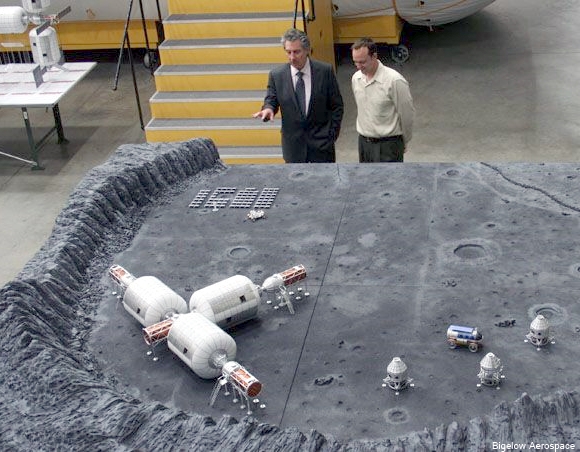
Robert Bigelow explains his commercial lunar habitat, being readied to undergo a test deployment in the Nevada desert, last May. More recently he's proposed using of the NASA COTS model to explore cislunar space and establish 'extended human activity' on the Moon [Bigelow Aerospace].
Doug Messier
Parabolic Arc

All the promise, perils and contradictions of America’s human spaceflight effort were on display earlier this week in Washington, D.C.

Things were looking good for a day or so, but then the proverbial other shoe dropped to remind everyone of the deep trouble that lies ahead as NASA attempts to restore its human spaceflight capability and send astronauts beyond low Earth orbit.

As NASA struggles to execute a series of ambitious programs on increasingly tight budgets, the main beneficiary appears to be the bumbling, crisis prone Russian space agency Roscosmos, which has reaped a financial windfall as a result of America’s equally bumbling human spaceflight policy. And matters could get worse before they get better (for NASA, at least).

The events of the week played out as follows:

Read the full post, HERE.

Also:
Bigelow urges use of COTS model for cislunar transportation
Jeff Foust, New Space Journal, November 15, 2013 

Wednesday, April 10, 2013

General Bolden on the Moon

EDITORIAL : The Space Community experienced a minor brush fire late last week, set accidentally perhaps, by NASA administrator Charles Bolden and his reaction to the National Research Council's congressional-commissioned review of NASA’s "strategic vision."

It’s a sad fact of American politics that the release of the NRC report might have passed largely unnoticed had Bolden been as cryptic about the Moon’s place in NASA’s future as the rest of the administration has been from is beginning.

Instead he confirmed for us one line of reasoning into the administration’s actual rationale for erasing the Moon from National Space Policy, three years ago.

“I don’t know how to say it any more plainly,” Bolden said. “NASA does not have a human lunar mission in its portfolio, and we are not planning for one.”

He warned the next administration not to change course “again” back to the Moon. That would mean, he said, the U.S. would “never again see Americans on the Moon, on Mars, near an asteroid, or anywhere. We cannot continue to change the course of human exploration.”

“NASA will not take the lead on a human lunar mission,” Bolden said. “NASA is not going to the Moon with a human as a primary project probably in my lifetime,” because “we can only do so many things, and NASA’s focus will remain on human missions to asteroids and Mars.”

“All that was 'a given,' three years ago,” Apollo 17 commander Gene Cernan said afterward on Tuesday, perhaps forgetting along with General Bolden, that "going to the Moon as a primary project" has not been a goal of the American government since 1969, and this was never "a primary project" of the Vision for Space Exploration in 2004 or of those who recognize the Moon's strategic and scientific value and who still support restoring the Moon back into scientific context today.

On the surface there did seem little that was new in Bolden’s protests. All the superficial reasons for dropping the Moon as an intermediate objective on the way to Mars spread abroad by the administration and its supporters still make little sense. No one who seriously supported a return to the Moon as an essential objective on the way to Mars ever hoped simply to recreate Apollo. 

And if it’s asteroids you want, the Moon has been an asteroid magnet for about 4.575 billion years.

Aside from the glaring hole left by having had the Moon erased from National Space Policy, three years after the cancellation of Constellation, America's deep space efforts are really little different from what they were at the end of the Bush administration, with little actual progress having been made not already set in motion before President Obama's Inauguration.. 

Aside from the missing Altair lander, and the R&D required to build it, together with a simple recognition of the Moon’s clear strategic value in overcoming tremendous technological challenges facing any manned mission to Mars, very little has actually changed.

The end goal of landing astronauts on Mars, someday, some way, in budgetary “out years,” is still the same, as was retiring the Space Shuttle and planned development and use of commercial transportation to ISS. These were integral to the Vision for Space Exploration introduced in 2004. Though some seem determined to credit the administration with having dreamed up subsidized commercial space, and certainly for popularizing the idea, that too was integral to the VSE and as far as presidents go the initiative dates back to Ronald Reagan.

From a political perspective, with unwitting help from General Bolden, we no longer have to simply make educated guessed as to why the Moon was edited out of NASA’s strategy. As it turns out, it was not the “been there, done that” argument offered by the President, after all..

Bolden has finally confirmed for us one line of investigation into the mysterious missing Moon by simply telling us that the Obama administration just does not want the American governmentto take the leadon any manned return to the Moon.

Thus, it was a political decision, dressed up and oversold with some of the tired arguments originally heard forty years ago.

That's not a crime, of course. Thankfully Bolden has also communicated that the administration is not opposed to "leading from behind" on a manned mission to the Moon, perhaps lead by a different nation, nor does he rule out robotic exploration, though the nation has so far committed only to finishing or fulfilling the precursor robotic lunar missions that were either already underway or already long in the pipeline.

We are genuinely grateful the administration appears unwilling to stand in the way of any commercial manned or unmanned landings in the Moon.

But why this passionate and now very specfic opposition to America leading while exploring and using the Moon as a stepping stone to Mars and as a Rosetta Stone for the rest of the Solar System?

In light of all the other alterations made to the President's 'asteroid initiative' over the past three years, was the administration's unyielding position the original and still primary reason the whole Constellation program was cancelled?

The Moon, and those of us still urging policy makers to take another look at its advantages over manned asteroids exploration, are apparently occasionally being heard in the White House. In the past three years the administration has occasionally floated tantalizing trial balloons, future efforts involving the Moon, but specifically without any  human landing.

One thing is different in the past three years. The small flotilla of remote sensing spacecraft, from Japan, China and India, as well as the U.S. sent to the Moon, and inspired by the lead America had taken with in 2004, after a long national drought five American spacecraft in lunar orbit simultaneously for most of this past year, and planetary scientists have learned more about the Moon since 2004 than in the two decades previous.

This new look at the Moon has by now strongly confirmed the Moon's strategic importance and its usefulness to science, and as a logical support for future manned missions to Mars.
"Just after it has been relegated to a “been there, done that” status, the Moon again shows us we have a lot to learn about its history, physical state and the potential value of its resources. We must take the initiative to learn more as the Moon is crucial in developing and advancing a sustainable space faring infrastructure." -   Paul D. Spudis

Why then, like Arthur C. Clarke’s Europa, are American astronauts to “attempt no landing there?” If we are taking the lead going to Mars, our role in a return to the Moon along that path would seem to be irrelevant.

This much is clear. Leaving the Moon out as an intermediate goal, as a place where America already has a momentary and essential lead, is a stubbornly held position dear to the administration.From Bolden’s statements late last week one might think someone had suggested NASA’s strategy for building a path to Mars should be renamed back to “Constellation.”

Though only occasionally experienced, if America’s history and the nation's storied history of manned space exploration has succeeded in teaching us anything it has taught history has a very tight turning radius.

Thursday, January 31, 2013

ESA: Building a Lunar Base with 3D Printing

For ESA's 3D-printed lunar base concept, Foster+Partners devised a weight-bearing ‘catenary’ dome design with a cellular structured wall to shield against micrometeoroids and space radiation, incorporating a pressurised inflatable to shelter astronauts [ESA/Foster+Partners].
Setting up a lunar base could be made much simpler by using a 3D printer to build it from local materials. Industrial partners including renowned architects Foster + Partners have joined with ESA to test the feasibility of 3D printing using lunar soil.

“Terrestrial 3D printing technology has produced entire structures,” said Laurent Pambaguian, heading the project for ESA.

“Our industrial team investigated if it could similarly be employed to build a lunar habitat.”

Foster + Partners devised a weight-bearing ‘catenary’ dome design with a cellular structured wall to shield against micrometeoroids and space radiation, incorporating a pressurised inflatable to shelter astronauts.

The UK’s Monolite supplied the D-Shape printer for ESA's 3D-printed lunar base study, with a mobile printing array of nozzles on a 6 meter frame to spray a binding solution onto a sand-like building material. 3D ‘printouts’ are built up layer by layer – the company more typically uses its printer to create sculptures and is working on artificial coral reefs to help preserve beaches from energetic sea waves. First the simulated lunar material with magnesium oxide – turning it into ‘paper’ to print with. Then for structural ‘ink’ a binding salt is applied which converts material to a stone-like solid [ESA/Monolite].
A hollow closed-cell structure – reminiscent of bird bones – provides a good combination of strength and weight.

The base’s design was guided in turn by the properties of 3D-printed lunar soil, with a 1.5 tonne building block produced as a demonstration.

“3D printing offers a potential means of facilitating lunar settlement with reduced logistics from Earth,” added Scott Hovland of ESA’s human spaceflight team.

Sculpture produced by Monolite using 3D printing [ESA/Monolite].
“The new possibilities this work opens up can then be considered by international space agencies as part of the current development of a common exploration strategy.”

“As a practice, we are used to designing for extreme climates on Earth and exploiting the environmental benefits of using local, sustainable materials,” remarked Xavier De Kestelier of Foster + Partners Specialist Modelling Group. “Our lunar habitation follows a similar logic.”

The UK’s Monolite supplied the D-Shape printer, with a mobile printing array of nozzles on a 6 m frame to spray a binding solution onto a sand-like building material.

This 1.5 metric tonne building block was produced as a demonstration of 3D printing techniques using lunar soil. The design is based on a hollow closed-cell structure – reminiscent of bird bones – to give a good combination of strength and weight [ESA].
3D ‘printouts’ are built up layer by layer – the company more typically uses its printer to create sculptures and is working on artificial coral reefs to help preserve beaches from energetic sea waves.

“First, we needed to mix the simulated lunar material with magnesium oxide. This turns it into ‘paper’ we can print with,” explained Monolite founder Enrico Dini.

“Then for our structural ‘ink’ we apply a binding salt which converts material to a stone-like solid.

“Our current printer builds at a rate of around 2 m per hour, while our next-generation design should attain 3.5 m per hour, completing an entire building in a week.”

Italian space research firm Alta SpA worked with Pisa-based engineering university Scuola Superiore Sant’Anna on adapting 3D printing techniques to a Moon mission and ensuring process quality control. The effect of working in a vacuum was also assessed.

“The process is based on applying liquids but, of course, unprotected liquids boil away in vacuum,” said Giovanni Cesaretti of Alta.

“So we inserted the 3D printer nozzle beneath the regolith layer. We found small 2 mm-scale droplets stay trapped by capillary forces in the soil, meaning the printing process can indeed work in vacuum.”

Simulated lunar regolith is produced for scientific testing by specialist companies, typically sold by the kilogram. But the team required many tonnes for their work.

“As another useful outcome, we discovered a European source of simulated lunar regolith,” added Enrico.

“Basaltic rock from one volcano in central Italy turns out to bear a 99.8% resemblance to lunar soil.”

“This project took place through ESA’s General Studies Programme, used to look into new topics,” Laurent commented.

“We have confirmed the basic concept, and assembled a capable team for follow-on work.”

Factors such as controlling lunar dust – hazardous to breathe in – and thermal factors will require further study.

3D printing works best at room temperature but over much of the Moon temperatures vary enormously across days and nights lasting two weeks each. For potential settlement, the lunar poles offer the most moderate temperature range.

Setting up a future lunar base could be made much simpler by using a 3D printer to build it from local materials. Industrial partners including renowned architects Foster+Partners have joined with ESA to test the feasibility of 3D printing using lunar soil.

The base is first unfolded from a tubular module that can be easily transported by space rocket. An inflatable dome then extends from one end of this cylinder to provide a support structure for construction. Layers of regolith are then built up over the dome by a robot-operated 3D printer (right) to create a protective shell [ESA/Foster+Partners].

Tuesday, June 12, 2012

University of Arizona off-world garden ready for tour

Tyler Jensen, left, and Thomas Hillebrand are putting together the teaching module of the University of Arizona's Lunar Greenhouse, which is headed to San Diego and Chicago to raise awareness about the greenhouse and hydroponic gardening. A prototype greenhouse is at the right [Mamta Popat/Arizona Daily Star].
Mark Armao
The Arizona Daily Star

A greenhouse designed for extraterrestrial use is taking a more terrestrial trip this summer.

Someday, the University of Arizona's Lunar Greenhouse will provide a life-support system for astronauts on prospective missions to the moon, Mars and beyond. But before it gets to the moon, the Lunar Greenhouse is hitting the road.

Designed by a team at the University of Arizona Controlled Environment Agriculture Center, the greenhouse is being exhibited at the San Diego County Fair, followed by a stopover at the Museum of Science and Industry in Chicago.

"This is for rocket technology, but it's not rocket science," said Lane Patterson, lab manager and researcher for the project.

The goal is to show vegetables can not only be grown in space, but can also supply astronauts with oxygen and clean water, he said.

A prototype has been operating at UA's Campus Agriculture Center since 2010. Inside, vegetables climb the walls of the 18-foot-long cylinder with aluminum ribs covered by a durable plastic skin. Picture a really big slinky with plants inside.

The structure collapses into a 4-foot-long disk for spaceflight. Upon landing, the greenhouse would expand like an accordion and begin to operate.

The greenhouse grows plants hydroponically, which means without soil. Seeds take root in a nutrient-rich solution contained in a flexible plastic tube.

"We're working mostly with vegetables that NASA has interest in; that's leafy green vegetables -lettuces and spinaches and small green herbs like basil," said Gene Giacomelli, director of the program and a plant sciences and engineering professor. The team also is interested in vining plants like tomatoes and root crops like sweet potatoes.

Food isn't the only benefit.

"Each one of them (plants) can provide the water and the oxygen for one astronaut every day," Giacomelli said.

It works like this: The plants absorb carbon dioxide, which astronauts breathe out. And then release oxygen, which astronauts breathe in. In addition to revitalizing the air, the Lunar Greenhouse would recycle water. Eventually, the system would provide clean water by cycling distilled urine through the plants, and collecting the water vapor the plants give off. The intent is to conserve resources and reduce waste.

The lack of atmosphere on the moon presents other challenges, as well. The Lunar Greenhouse would have to be buried under a layer of lunar soil to protect it from micrometeorites and solar radiation. This means artificial lighting is a crucial factor for the project. Proposed lighting options include using energy-efficient LEDs, and piping sunlight into the greenhouse via fiber optic cables, Giacomelli said.

Webcams and sensors in the greenhouse would allow operators on Earth to monitor and manipulate the conditions inside the Lunar Greenhouse.

Giacomelli said the technology has plenty of applications on Earth.

"If a greenhouse is just being installed in Northern Africa, for example, where they've never had a greenhouse before. We do not have to be there to help them grow," he said. "We can stay in Tucson and give them advice from the web camera from the data on the computer and help them grow the crop."

The project is funded through NASA's Ralph Steckler Space Grant Colonization Research and Technology Development Opportunity.

The team has positioned a webcam in the lab that anyone can view online. Team members have addressed entire classrooms though the webcam - from local third-graders to Australian graduate students. "Rather than taking the classroom to the lab, we're taking the lab to the classroom," said Patterson.

What's heading to San Diego and Chicago is a teaching module similar to the Lunar Greenhouse to raise awareness about the project and how to garden hydroponically, Giacomelli said.

As for the Lunar Greenhouse and its prospective trip to space, no specific benchmarks have been set. Funding for the Lunar Greenhouse comes from a special foundation, so recent budget cuts at NASA have not directly affected the project.

Patterson is confident in the system's capabilities, and where the outreach program is headed.

"It's about keeping you alive," he said. "Period."

Details of the scheduled exhibits, HERE.
View the UA's Lunar Greenhouse Online

Monday, May 21, 2012

Lunarcrete, transforming hazard into habitat

Fine as talcum, abrasive as jagged glass, clinging and ubiquitous, lunar dust mitigation is on everybody's list of the biggest challenges facing extended human (and robotic) activity on the surface of the Moon. One essential strategy involves sintering, or otherwise transforming, regolith into native pavement. In a NASA simulation above the shelved Altair manned lander concept is shown landed and parked near the lunar South Pole where a permanent landing pad has been constructed [NASA].
Keith Veronese
io9.com

So, you are on the moon and need to build a new structure. As one of the first lucky colonists there, what are you going to use? Lunarcrete of course.

Lunarcrete is a mixture similar to concrete that could be created using the loose layer of dust and rock covering the surface of the moon. Creating structures from lunarcrete will be one of the keys to cutting colonization costs and increasing self sufficiency of colonies. Terrestrial experiments show that creating a concrete-like substance from lunar rock is possible, but is it practical?

Continue reading the full article HERE

Thursday, April 12, 2012

Staking a claim on the Moon


Jeff Foust
The Space Review

A long-running cause célèbre of some elements of the space advocacy movement has been the issue of private property rights, or the lack thereof, beyond Earth. Despite the existence of many private ventures that are happy to sell you plots of land on the Moon or other worlds, there are no recognized claims of property on those celestial bodies. The Moon Treaty of 1979, for example, explicitly prohibits any entity, government or commercial, from claiming any territory on the Moon.

While that treaty has been ratified or acceded to by only a handful of countries, the older Outer Space Treaty (OST), widely accepted by all major spacefaring countries, prohibits countries from making any claims of national sovereignty over the Moon or other celestial bodies. Without any nation claiming territory on the Moon, the conventional wisdom goes, there is no national government that can register or recognize claims made by individuals or companies to property there. Changing that situation would require amending the OST, a process that would likely be drawn-out, messy, and unpredictable.

Or does it? A white paper released last week argues that private property claims to territory in outer space could be consistent with the OST, provided the US passed legislation to recognize those claims. Such legislation could enable private entities inside and outside the US to claim property of the Moon, thus enabling greater private development in space. Others, though, while acknowledging the need for private property rights on the Moon, say the loophole that this proposal exploits doesn’t actually exist.


A loophole in the OST? Read the article HERE.

Moonscraper - 2040

This project ends with the arrival of the first human settlers on the Moon; it is merely a case study for process informed by complex phenomena and its potential implications in Architecture [eVolvo / Luis Quinones]..
Honorable Mention :  2011 Skyscraper Competition

In challenging the typology of a skyscraper this proposal considers an alternative set of criteria to reexamine habitation, construction, and organizational logic. In examining our global trajectory resulting in issues of overpopulation and depletion of natural resources, this project proposes a developmental shift away from the Earth. The chosen site for this project is on the Shackleton Crater Rim on the South Pole of the Moon.

The Moon was chosen as a testing ground for its ability to depart from the traditional constraints we find on Earth. There are limitations, such as low gravity, non-existent weather, and an abundance of unexploited natural resources such as large traces of frozen water and hydroxyl gases. These are particularly useful if combined, with the use of Regenerative Fuel Cells, where the process of electrolysis is proposed as means of sustaining energy and life by extracting the hydrogen and oxygen molecules from the water. In order to maximize solar gain due to the low oblique angle of the Sun, the skyscraper is the optimal building typology. However, this verticality is not solely expressed above the lunar surface. Instead a nested verticality of embedded towers deep below the surface provides protection from radiation, meteor impacts, and temperature differentials.

The embedded areas of the towers are networked together through a multitude of robots working together to produce a self-organizing system. The operation is a simple technique of mound building like termites and ants colonies. This behavior is characterized by programming local interactions, which give rise to emergent structures. In the development of these behavioral and bottom-up techniques a complex network of relationships will emerge. Ideally, this settlement would grow into the size of a contemporary human city, with developed infrastructure and habitation systems.

This research deals primarily with non-linear systems, termite structures, robotics, and algorithmic design. This project ends with the arrival of the first human settlers on the Moon; it is merely a case study for process informed by complex phenomena and its potential implications in Architecture.

Full Poster Views HERE.

eVolo / Architecture Magazine is an architecture and design journal focused on technological advances, sustainability, and innovative design for the 21st Century. Our objective is to promote and discuss the most avant-garde ideas generated in schools and professional studios around the world. It is a medium to explore the reality and future of design with up-to-date news, events, and projects.

Friday, February 24, 2012

Space Quarterly preview: Future Lunar Bases

Why, Where and How, By Dennis Wingo

Paired concept of nomadic extended human sortie Constellation-attendant architecture as envisioned by NASA in 2009 [NASA/Frassinito & Associates].
Marc Boucher at SpaceRef has posted a "free preview from the March issue of Space Quarterly magazine," an article "only available in the U.S. edition."

Lunar bases and their location is a subject that has been discussed and argued about for decades, without any real consensus, because each interest group is driven to a different area. Some think little of the Moon and see it as nothing more than a distraction on the way to Mars. The thesis of this article is that not only is the Moon vitally important for developing a sustainable infrastructure to support the eventual settlement of Mars, it is vitally important for the overall future of mankind and for the economic development of the solar system. It is far beyond time for our community to make this intellectual commitment and then develop our thoughts and plans from there. In order for mankind to prosper on the Earth in the long term, the resources of our solar system, beginning at the Moon, are crucial, and it is time to quit apologizing for this stance. To provide structure three general regions of interest will be discussed, based upon utility, cost, and long-term viability.

Read the extensive preview HERE.

Tuesday, November 8, 2011

TSR: Fear of a Chinese Moon

Robert Bigelow, speaking at the ISPCS conference in New Mexico this month, claimed that China is on a path towards taking control of the Moon within 15 years [ISPCS].

Jeff Foust

Robert Bigelow is best known in space circles as the founder of Bigelow Aerospace, the company he created over a decade ago to develop commercial space habitats using expandable (or inflatable) technology licensed from NASA. The Las Vegas-based company has successfully launched two prototype modules, Genesis 1 and 2, to demonstrate the technology and has plans for larger modules and commercial space stations for companies and so-called “sovereign clients”, nations without their own indigenous space programs.

Bigelow’s plans originally generated considerable skepticism in the broader space community. However, as the company won success with its Genesis missions and found interest in its plans from potential customers and even NASA—which sees the demand generated by Bigelow’s commercial habitats as a key part of the broader business case for the agency’s commercial crew plans—Bigelow has gained considerable credibility. Now, he’s using the platform he has as one of the nation’s leading space entrepreneurs to broadcast a warning about an unusual, even quixotic, threat to America’s space ambitions: that China will, in effect, seize the Moon.

Speaking at the International Symposium for Personal and Commercial Spaceflight (ISPCS) in Las Cruces, New Mexico, earlier this month, Bigelow spent very little time talking about his own company and its ambitions.


Why would China do such a thing? Bigelow is convinced that China’s quest for prestige—to demonstrate that it is the most powerful country in the world—will inevitably drive the country to lay claim to the Moon. “China already has a grand national vision,” he said. “Their vision is that China wants to be indisputably number one in the world, measured any way you want to measure.”

That means, he said, not just simply repeating the past achievements of the US in space but moving beyond them. “Why not take the all-important syllogistic next step: ownership, ownership, ownership?” he suggested. Doing so, he said, would generate “global psychological impact” and considerable prestige for the Chinese people. “I think nothing else the Chinese could possibly do in the next 15 years would cause as great a benefit for China,” he said.

He argued that China, with its growing wealth and its historical “ability to maintain focus”, would be in a position to land humans on the Moon and start making claims between 2022 and 2026. “China has an ability to focus and galvanize its programs because of the centralization of the government” that can allow them to stay on that schedule, he told reporters after his ISPCS talk.

One obvious obstacle is the Outer Space Treaty, of which China is a party, which prohibits countries from making territorial claims to the Moon or other celestial bodies. Bigelow suggested, though, that China could work to amend the treaty through the support of countries in Africa and Latin America where China is making major investments. Alternatively, he said, China could simply decide to withdraw from the treaty. Public opinion, he said, won’t be factor. “There isn’t going to be World War Three over this,” he said. “There isn’t going to be a single shot fired.”

Read the full article at The Space Review, HERE.

Monday, November 7, 2011

The replicators have arrived

"Slide show" comparing an illumination model of the lunar north pole region, made using a three-dimensional printer and LRO laser altimetry by Howard Fink of New York University, with standard representations of LOLA data and one LROC WAC mosaic [Howard Fink/NYU/NASA/GSFC/ASU].
Paul D. Spudis
The Once & Future Moon
Smithsonian Air & Space

Of all the wonders depicted in science fiction books and movies, one of the most intriguing is the machine that makes anything that you need or desire.  Merely enter a detailed plan, or push the button for items programmed into the machine – dials twirl, the machine hums and out pops what you requested.  Technology gives us Aladdin’s Lamp.  A handy device that will find many uses.

We’re not quite there yet but crude versions of such imagined machines already exist.  These machines are called “rapid prototype” generators or three-dimensional printers.  They take digitized information about the dimensions and shape of an object and use that data to control a fabricator that re-creates the object using a variety of different materials.  Typically, these machines use easy to mold plastics and epoxy resins but in principle, any material could be used to create virtually any object.

3-D printers contribute to the advancement our understanding of lunar morphology, as LRO fills long-neglected gaps in lunar morphology. Malapert Massif (85.9°S, 0.42°E). From an 80 meter resolution image of the South Pole region of the Moon built from a 20 meter original supplied by the LRO/LOLA science team [Howard Fink/NYU].
For comparison nearly the same area modeled by laser altimetry (LOLA) above, Malapert from the LROC Wide Angle Camera (WAC) RDR 100 meter Global Mosaic [NASA/GSFC/Arizona State University].

What’s the relevance of this technology to spaceflight and to the Moon?  One of the key objects of lunar return is to learn how to use the material and energy resources of the Moon to create new capabilities.  To date, we have focused our attention on simple raw materials like bulk regolith (soil) and the water found at the poles.  It makes sense to initially limit our resource utilization ambitions to simple materials that are both useful and relatively massive, which currently have those killer transportation costs when delivered from Earth.  Bulk regolith has many different uses, such as shielding (e.g., rocket exhaust blast berms) as well as raw material for simple surface structures.

However, once we are on the Moon and have met the basic necessities of life, we can begin to experiment with making and using more complex products.  In effect, the inhabitants of the Moon will begin to create more complicated parts and items from what they find around them, just outside their door.  The techniques of three-dimensional printing will allow us to discover what makes life off-planet easier and more productive.  We will experiment by using the local materials to maintain and repair equipment, build new structures, and finally begin off-planet manufacturing.

To illustrate the obliquity of the view angle and the problem posed in gathering information about the tantalizing but permanently shadowed regions of the Moon, Shackleton crater, with the Moon's South Pole on its rim (upper left) together with Malapert Massif on the horizon, seen with Earth as a back drop. HDTV still from Japan's Kaguya orbiter released November 2007 [JAXA/NHK/SELENE].
During the early stages of lunar habitation, material and equipment will be brought from Earth.  With continued use, particularly in the harsh lunar surface environment, breakdowns will occur.  Although initially we will use spare parts from Earth, for simple uncomplicated structures that are needed quickly, a three-dimensional printer can make substitute parts using local resource materials found near the outpost.  Most existing 3-D printers on Earth use plastics and related materials (which are complex carbon-based compounds, mostly derived from petroleum) but some processing has used concrete, which can be made on the Moon from sieved regolith and water.  In addition, we also know that regolith can be fused into ceramic using microwaves, so rapid prototyping activities on the Moon may eventually find that partially melting particulate matter into glass is another way to create useful objects.

The lunar surface is a good source of material and energy useful in creating a wide variety of objects.  I mentioned simple ceramics and aggregates, but additionally, a variety of metals (including iron, aluminum and titanium) are available on the Moon.  Silicon for making electronic components and solar cells is abundant on the Moon.  Designs for robotic rovers that literally fuse the in-place upper surface of the lunar regolith into electricity-producing solar cells have already been imagined and prototyped.  We can outsource solar energy jobs to the Moon!

These technical developments lead to mind-boggling possibilities.  Back in the 1940s, the mathematician John von Neumann imagined what he called “self-replicating automata,” small machines that could process information to reproduce themselves at exponential rates.  Interestingly, von Neumann himself thought of the idea of using such automata in space, where both energy and materials are (quite literally) unlimited.  A machine that contains the information and the ability to reproduce itself may ultimately be the tool humanity needs to “conquer” space.  Hordes of reproducing robots could prepare a planet for colonization as well as providing safe havens and habitats.

We can experiment on the Moon with self-replicating machines because it contains the necessary material and energy resources.  Of course, in the near-term, we will simply use this new technology to create spare parts and perhaps simple objects that we find serve our immediate and utilitarian needs.  But things like this have a habit of evolving far beyond their initial envisioned use, and often in directions that we do not expect; we are not smart enough to imagine what we don’t know.  The technology of three-dimensional printing will make the habitation of the Moon – our nearest neighbor in space – easier and more productive.  Even now, creative former NASA workers have found a way to make this technology pay off.  In the future, perhaps their talents could be applied to making the Moon a second home to humanity.

Originally published October 24, 2011 at his Smithsonian Air & Space blog The Once and Future Moon, Dr. Spudis is a Senior Staff Scientist at the Lunar and Planetary Institute in Houston. The opinions expressed are those of the author and are better informed than average.

Friday, February 18, 2011

LROC: Sinuous Chain of Depressions


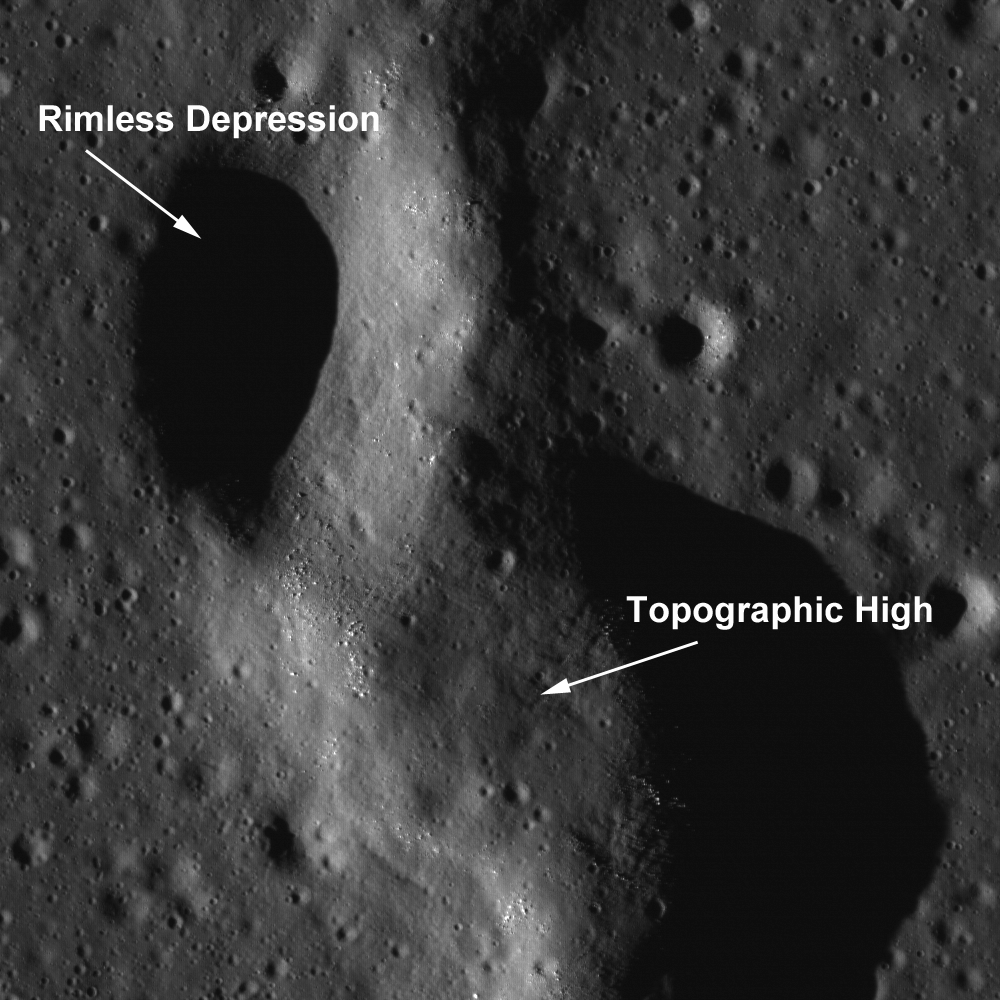
A single depression from a larger sinuous chain of pits located at 34.6°N, 316.5°E, from LROC Narrow Angle Camera (NAC) frame M102443238R. This chain may host uncollapsed lava tubes between the depressions suitable for human habitation. Field of view 1.5 km, solar incidence from the west at 78° Full-sized Featured Image HERE [NASA/GSFC/Arizona State University].

Sarah Braden
LROC News System

This unnamed sinuous chain of pits was suggested to be a collapsed lava tube (see Wilhelms' Geologic History of the Moon). New high resolution NAC images (e.g. M102443238R) provide a new look at the area. This particular feature transitions from a discontinuous sinuous rille into an equally discontinuous wrinkle ridge.


Future Spaceport? Near 35.34°N, 317.57°E, the "Rimae Gruithuisen" chain-rille complex might conceal overlapping 'sublunarian' lava channels, in a part of Oceanus Procellarum replete with the iron and titanium oxide proxies that might mark some of the Moon's deepest reserves of Helium-3, among other promising resources. One day, perhaps a city may spread along the 50 km length of the Gruithuisen chain rille, its residents at least as sheltered from solar storms and cosmic rays as anyone living at sea level on Earth. LROC NAC M102443238L&R, field of view ~5.8 km [NASA/GSFC/Arizona State University].

Some scientists have suggested that wrinkle ridge faults interact with lava tubes, with the wrinkle ridge exploiting a zone of mechanical weakness (the lava tube) in the preexisting basalt deposit. In this NAC image, the topographic depressions are non-circular, with collapse rims. Many of the pits have boulders on the interior walls. If these depressions were created by impacts, each pit would have a raised rim and an ejecta blanket.


Pulling back from the Featured Image above for context, a roughly 5.8 km by 10 km segment lifted from the heart of a mosaic of both the left and right frames of NAC observation M102443238L & R, swept up early in the Commission Phase of the LROC mission (from an altitude of 155.57 km, LRO orbit 272, July 17, 2009 [NASA/GSFC/Arizona State University]. Full resolution desktop wallpaper.

Lava tube caves could be used during future human exploration for long-term habitation. Scientists first suggested drained lunar lava tubes as possible human habitats in 1962, and since then the possible lava tube caves have remained at the forefront of both geological debate and the future of a sustained human presence on the Moon. The lunar caves would be an ideal location for a lunar base because they a) require little construction and enable a habitat to be placed inside with a minimal amount of building, b) provide a natural environmental control (insulation and temperature stability), and c) provide protection from natural hazards (i.e., cosmic rays, meteorites, micrometeorite impacts, impact crater ejecta). On Earth, our atmosphere protects us from cancer-causing radiation, but the Moon has no atmosphere and therefore astronauts must find an alternate means of shelter, especially during times of high radiation, like solar flares and coronal mass ejections.


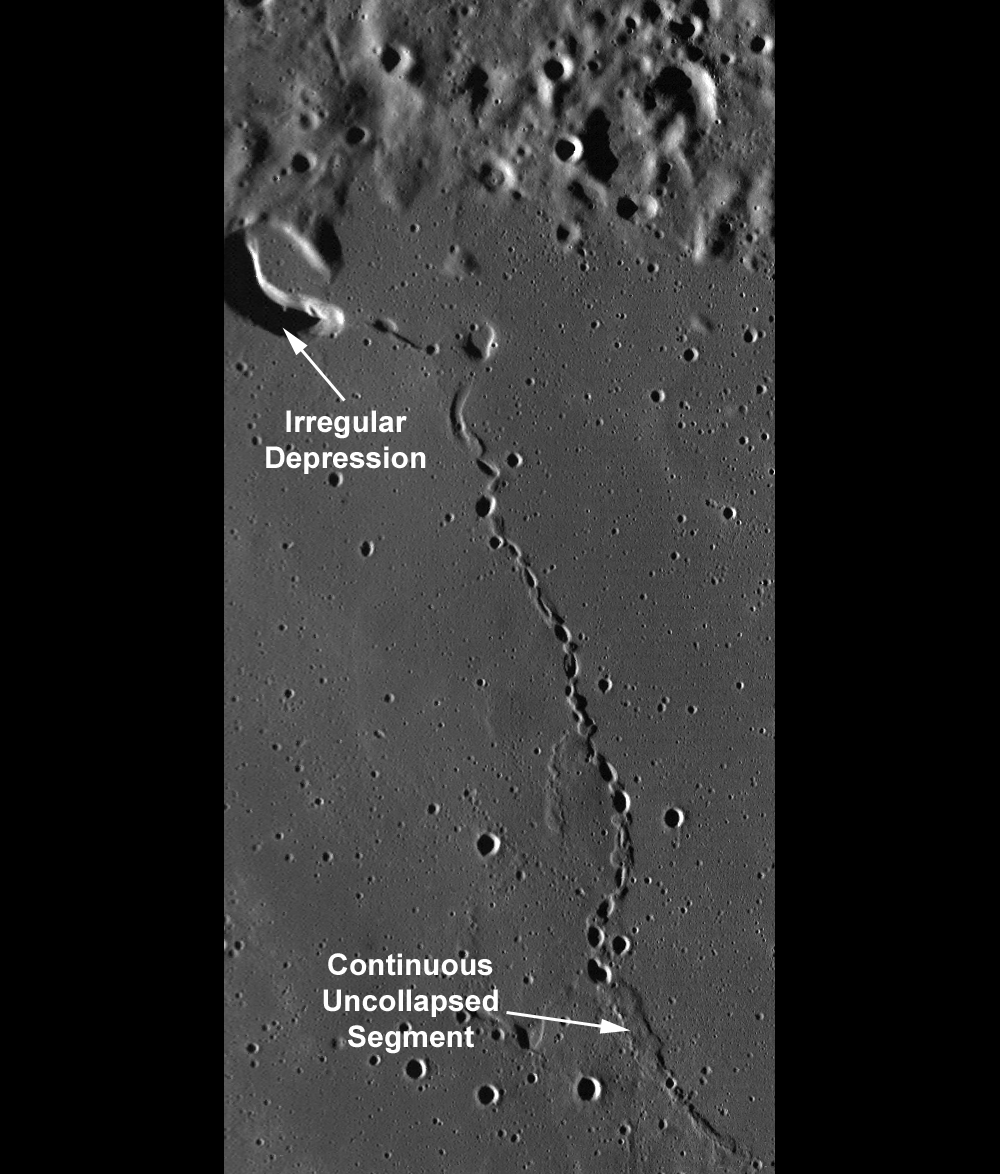
This section of LROC Wide Angle Camera (WAC) monochrome (689nm) mosaic (M117773324-M117780116ME, LRO orbit 2490-2491, January 10, 2010) shows the area where the feature transitions from a chain of collapse pits to a continuous uncollapsed segment. The large, bow-shaped depression at the northwest terminus of the chain may be a possible source region for the flow of lava across this region. The chain is ~50 km long (M117773324ME res. 58.9 m/pixel) View the Full-Sized Featured Image HERE [NASA/GSFC/Arizona State University].

Geologists suspect that lunar lava tubes form similarly to terrestrial lava tubes. However, lunar lava tubes are likely much larger, due to the lower gravity and the lack of an atmosphere. Studies of lava tubes on Earth show that most are hollow. If lunar lava tubes form in a similar way, then they too are most likely hollow. A lava tube may form when an active basaltic lava flow develops a continuous crust. For instance, an open lava channel may form a crust of hardened rock that extends from the sides and, over time, meets in the middle, forming a roof. Even if a lava tube develops a roof, it still has lava running through it. There is a possibility that the cooling lava would solidify inside the tube and block it. However, on Earth most lava tubes do not "plug up." As the rate of lava flowing from the source diminishes over time, the level of liquid in the tube drops, leaving an empty space between the top of the flow and the roof of the tube.

Browse the thrilling full-resolution NAC.

Related Featured Images:
Natural Bridge on the Moon
Concentric Gruithuisen K
Depths of Mare Ingenii
Marius Hills Pit Lava Tube Skylight?


The featured chain rille imaged by the Terrain Camera aboard Japan's SELENE-1 ("Kaguya") in 2008, draped in its context within the Gruithuisen region of the lunar digital elevation model available to users of the Google Earth application [>v.5]. The rille is located in Oceanus Procellarum west of its contact with Mare Imbrium. Sinus Iridum is beyond the horizon at upper right and just below, the point marks the site of the Gruithuisen dome Region of Interest. The concentric crater, above center, is Gruithuisen K [JAXA/SELENE/NASA/GSFC/USGS/Google].

Friday, September 10, 2010

ISRU: Microbe mining the Moon & Mars

From From Album LP1 -
Light weight passenger - Cyanobacterium Anabaena cylindrica used commercially as a nitrogen fixer and as a natural fertilizer in rice paddies. Scientists also found it could help mine oxygen, nutrients and minerals on the Moon. Field of view approximately 100 μm [Protist Information Server].

Charles Choi
Scientific American

Microbes currently are used in mining to help recover metals such as gold, copper and uranium. Now researchers suggest bacteria could be enlisted for "bio-mining" in space, to extract oxygen, nutrients and minerals from extraterrestrial bodies such as the moon and Mars for use by future colonists there.

Researchers experimented with a variety of cyanobacteria, often known as blue-green algae, on analogues of lunar and Martian regolith (loose surface rock). These photosynthetic bacteria have adapted to live in some of the most extreme environments on Earth, from the cold, hyper-arid Antarctic McMurdo Dry Valleys to the hot, dry Atacama Desert in Chile, suggesting they might be capable of surviving the rigors of outer space.

"We will not be able to colonize either the moon or Mars without development of cyanobacterial biotechnologies," says astrobiologist Igor Brown, who did not take part in this study. Previously, at NASA, Brown and his colleagues successfully grew cyanobacteria from hot springs in Yellowstone National Park on iron-rich rocks designed to simulate lunar material.

"There are processes one could use to dissolve lunar regolith with special chemicals, but the costs of delivering such compounds to the moon is enormous," Brown says. "That is why we propose using just vials of microbes instead. "Scientists could also genetically engineer new microbes that are even better at bio-mining, he adds.

Read the full article, HERE.

Monday, August 2, 2010

Cold Storage


A permanently-double-shaded crater near a lunar pole. Within the double-shaded crater, a suspended thermal shield reflecting 50 K gray body radiation back towards the lunar surface is shown. Extremely low heat conduction between the object and the lunar surface could additionally be produced using superconducting magnetic levitation to support the thermal shield and the principal object. The thermal shield would be shaped to block surface heat radiation from all directions [NASA/SSC].

NASA Tech Brief - Stennis Space Center - In the polar regions of the Moon, some areas within craters are permanently shadowed from solar illumination and can drop to temperatures of 100 K or lower. These sites may serve as cold traps, capturing ice and other volatile compounds, possibly for eons. Interestingly, ice stored in these locations could potentially alter how lunar exploration is conducted. Within craters inside craters (double-shaded craters) that are shaded from thermal re-radiation and from solar illuminated regions, even colder regions should exist and, in many cases, temperatures in these regions never exceed 50 K.

Working in these harsh environments with existing conventional systems, exploration or mining activities could be quite daunting and challenging. However, if the unique characteristics of these environments were exploited, the power, weight, and total mass that is required to be carried from the Earth to the Moon for lunar exploration and research would be substantially reduced.

In theory, by minimizing the heat transfer between an object and the lunar surface, temperatures near absolute zero can be produced. In a single or double-shaded crater, if the object was isolated from the variety of thermal sources and was allowed to radiatively cool to space, the achievable temperature would be limited by the 3 K cosmic background and the anomalous solar wind that can strike the object being cooled. Our analysis shows that under many circumstances, with some simple thermal radiation shielding, it is possible to establish environments with temperatures of several degrees Kelvin.

Read the full article, HERE.

Tuesday, July 6, 2010

Second Generation ATHLETE lunar vehicle


The second generation ATHLETE lunar vehicle with mock habitat as payload [NASA/JPL].

Matt Heverly, Jaret Matthews,
Matt Frost & Chris McQuin
NASA/JPL/California Institute of Technology

Proceedings of the 40th Aerospace Mechanisms Symposium, (pg. 317-326)

NASA/Kennedy Space Center, May 2010

The Tri-ATHLETE vehicle is the second generation of a wheel-on-limb vehicle being developed to support the return of humans to the lunar surface. This paper describes the design, assembly, and test of the Tri-ATHLETE robotic system with a specific emphasis on the limb joint actuators. The design and implementation of the structural components is discussed, and a novel and low cost approach to approximating flight-like cabling is also presented. The paper concludes with a discussion of the “second system effect” and other lessons learned as well as results from a three week long field trial of the vehicle in the Arizona desert.

In order to establish a continual human presence on the Moon we must develop assisting infrastructure that can carry cargo as well as provide mobility to the astronauts for exploration and the development of a central, but not necessarily fixed, lunar base. The Tri-ATHLETE vehicle system is a new form of two cooperative robotic vehicles that can act individually or physically connect together through a structural pallet to transport and manipulate cargo.

The basis of the ATHLETE (All Terrain Hex Limed Extra Terrestrial Explorer) robot is the wheel-on-limb vehicle concept. This hybrid mobility platform enables the vehicle to traverse at high speeds across benign terrain, as well as enabling walking, by locking the wheels and using them as feet, on extreme terrain. This vehicle architecture also allows for manipulation since the vehicle is stable on three or more wheels. Non-adjacent limbs can be lifted and used to interact with the environment.

A tool mechanism at the end of the limb, attached to the wheel hub, allows for interchangeable tools, such as a gripper or an auger, to be used for manipulation. This unique vehicle design allows for significant weight savings over a traditional planetary roving vehicle that must have large wheels to allow for low ground pressure as well as high torque wheel actuators since the vehicle cannot walk in extremely soft or steep terrain.


Tri-ATHLETE lunar vehicle Michelin Lunar Wheel impacting a 10-cm rock [NASA/JPL].

The ATHLETE project started in March of 2005. The first generation vehicle was completed in October of that same year. This 1000-kg, 2-m tall vehicle was developed rapidly with the intent of providing a hardware platform to aid in the development of the robotic system’s software. This software development vehicle ended up performing five field tests in natural terrain throughout the United States.

These field tests enabled the team to test the vehicle’s capabilities such as traversability over soft terrain, walking, repelling, and manipulation in unstructured environments.

From this first prototype several new capabilities were discovered and several vehicle deficiencies were revealed.

Review the presentation (PDF), HERE.

Monday, July 5, 2010

DesertRaTS testing Electrodynamic Dust Shield


Figure 1. shows an example of a lunar architecture that is being evaluated at DesertRaTS.

Calle & Immer, et.al.
Electrostatics and Surface Physics Laboratory
ASRC Aerospace
Florida Institute of Technology
Oklahoma Baptist University


NASA is developing a Habitat Demonstration Unit (HDU) to investigate the feasibility of lunar surface technologies and lunar ground operations. The HDU will define and validate lunar scenario architecture through field analog testing. It will contain a four-port vertical habitat module with docking demonstration capabilities. The Electrodynamic Dust Shield (EDS) is being incorporated into the HDU to demonstrate dust removal from a view-port and from a door prior to docking procedures. In this paper, we will describe our efforts to scale up the EDS to protect a viewport 20 cm in diameter. We will also describe the devel-opment of several 20 cm × 25 cm EDS patches to demonstrate dust removal from one of the HDU doors.

NASA has designed and built a Pressurized Excursion Module (PEM) for a Lunar Habi-tat Demonstration Unit (HDU), a full scale lunar habitat prototype, to perform analog testing of the lunar environment in desert locations. The Desert Research and Technolo-gy Study (RaTS), a series of analog tests that NASA has held at several different desert locations for several years, allows the Agency to run through potential “day in the life” scenarios at a lunar outpost with prototype equipment. These analog tests provide engi-neers and scientists with insights into the utilization of the different systems so that the exploration architecture and the operation concepts can be refined. The HDU will be operated during a 14- to 21-day mission at the 2010 DesertRaTS event planned for Black Point Lava Flow in Arizona.

The PEM has four doors with docking demonstration capabilities. Each door contains a 21-cm diameter viewport. During docking activities with the Lunar Electric Rover (LER), which contains a similar door, the two doors open inward. Any dust accumulating on the surface of these doors must be removed prior to docking.

The Electrodynamic Dust Shield (EDS) technology that NASA has been developing as an active dust removal system during the past several years is being used to demonstrate dust removal from the PEM door. A transparent EDS system has also been installed on one of the viewports to maintain it dust-free during the DesertRaTS activities.


Figure 6. Photographs of the 20-cm diameter transparent EDS for the PEM viewport during laboratory tests. JSC-1A stimulant dust was deposited in a relatively uniform fashion, as shown at the top. The photograph below it shows the EDS after activation. Dust has been removed to the region outside the electrode grid. These tests were performed with the EDS sitting horizontally in a glove box.

In this paper, we describe the development of the different EDS systems installed on the PEM and the demonstration tests planned for DesertRaTS. We also describe scale up plans for future HDU demonstrations.

Review the research (PDF), HERE
Proceedings ESA Annual Meeting on Electrostatics 2010

Wednesday, March 3, 2010

Habitat Demonstration Unit: An Overview

Figure 1 from "The Habitat Demonstration Unit Project Overview," Illustration of the latest Constellation Lunar Scenario 12.1 "Excursion Configuration." The Pressurized Excursion Module (PEM) depicted at the center will be represented by the "HDU" and tested this summer as part of the 2010 Desert Research and Technologies Simulations ("Desert Rats") test objectives [NASA].

A technique being utilized in NASA's lunar architecture analysis is analog testing of the lunar environment in desert locales. Running through potential "day in the life" scenarios at a lunar outpost with prototype equipment allows designers insight into the utilization of the proposed systems and refines architecture and operations concepts. A series of Desert Research and Technology Studies (Desert-RATS) have been held in locations such as Moses Lake, Washington and Black Point Lava Flow, Arizona, where the most recent test in September 2009 was performed with a Lunar Electric Rover, and a fourteen day excursion was practiced. The 2010 session of Desert-RaTS is planned for Black Point Lava Flow where two LERs will operate together and add a full scale lunar habitat prototype, the Habitat Demonstration Unit to the two LERs to allow for a 14-28 day mission.

(Earth and Space Conference 2010, Honolulu, March 15-17)

Read the full Overview (Adobe .pdf) HERE.

Tuesday, February 9, 2010

Tubular structures on lunar surface, ideal landing sites

R. Ramachandran
The Hindu

Remnant tubular structures or tunnel-like formations from lunar volcanic flows in the past, which extend a couple of kilometres on the moon’s surface, could serve as ideal landing as well as human settlement sites for future lunar missions, including Chandrayaan-II, according to some new findings from India’s Chandrayaan-1.

These findings were reported on Monday at the Sixth Chandrayaan-1 Scientific Meeting being held at the Physical Research Laboratory (PRL) here.

Data from the Terrain Mapping Camera (TMC), one of the Indian instruments on-board the spacecraft, has revealed one such volcanic tube in the Oceanus Procellarum area of the moon (central longitude 58.317 deg. W and latitude 14.111 deg. N). The remnants of volcanic tubes on the moon whose roofs have capsized and a trench or valley is created is called a rille system, which is a groove or long narrow depression on the lunar surface. The volcanic tube identified by the TMC comprises two cobra hood-shaped rilles, the longer one measuring 3.65 km in NE-SW direction and the smaller one measuring 0.73 km. The interesting feature is that these rilles seem connected by an intermediate stretch of a two km-long and 360-metre-wide uncollapsed portion (see picture), which seems to be the roof of the lava tube that did not collapse for some reason, said A. S. Arya of the Indian Space Research Organisation’s Space Applications Centre (SAC), Ahmedabad, who described the findings at the meeting.

More significantly, the uncollapsed part is very close to the surface, only 160 metre below. Its hollow interiors could be safe spots for lunar habitation, or even parking lunar landers for protection from the harsh impacts of interplanetary material, meteorite showers, solar wind and radiation. “For future missions aimed at creating permanent base stations and human settlements on the moon, there is a need to identify such locales that have survived the onslaught of the past impacts and would provide safe shelters to human beings on the moon,” Dr. Arya said. For instance, the Japanese mission Kaguya discovered a vertical hollow structure, but that is not suitable for habitation, Dr. Arya said. In a horizontal tubular structure, however, any lunar vehicle can just move along the rille into the tunnel structure for safe parking.

But the TMC findings could even become the starting point for identifying suitable locations for immediate missions such as Chandrayaan-II, which plans to land two lunar rovers, said M. Annadurai, Project Director, Chandrayaan-1 and Chandrayaan-II. Chandrayaan-II has set itself the ambitious goals of sustaining the two rovers in the harsh lunar environment for as long as six months. All previous missions have landed in the sunlit area and have not been able to survive beyond a few weeks. “We need to see how Chandrayaan-1 data can be used from an engineering point of view in terms of site terrain information and soil interactions to know where to land our rovers from this perspective,” Dr. Annadurai said.

Like Chandrayaan-1, its follow-up mission, which is likely to be flown during 2012-13, will also focus mostly on the higher lunar latitudes, Dr. Annadurai said. “From an engineering point of view, we need to look at the rovers spending longer night hours. For optimal power utilisation, they will function in the hibernation mode when there is no sunlight for generating power,” he said. “So a suitable site could be the edge of some crater or a site near such volcanic tubes where they can retreat for hibernation. But a cross comparison of data from different Chandrayaan-1 experiments can tell us much more than just the TMC data. And such a trend has been evident at this meeting.”

With Russia already part of the project, Chandrayaan-II is also likely to have international collaboration, especially with all the principal investigators of the various experiments keen on carrying the work forward by collaborating among themselves in the future.

Sunday, January 3, 2010

Ben Bova: Far-ranging civilization springs from moon’s water

Ben Bova
NaplesNews.com

Hundreds of years from now, when historians write about the year 2009, what will they consider to be the most significant event of the year just passed?

I don’t think it will be politics or social change or war, pestilence or artistic styles. The most important event of 2009 is the confirmation that there is abundant water on the moon.

You don’t believe that? Let me draw you a brief history of the next few hundred years.

Read the post HERE.

Thursday, November 26, 2009

Thanksgiving on the Moon: A Lunar Feast

Paul D. Spudis
The Once and Future Moon
Smithsonian Air & Space

We often hear the Moon described as a lifeless desert, a barren rock in space where nothing can survive. Although the Moon is certainly different from the Earth, it is hardly barren. From the 1970’s through the 1990’s (largely before we knew about the presence of water and other volatiles in the lunar polar regions) the late, lunar scientist Dr. Larry Haskin set forth some basic facts about the chemical composition of the Moon. Larry was a chemist by training and his view was that the Moon has all that we need – just not in the form in which we need it.

Larry wrote a very interesting paper for the 1988 Second Symposium on Lunar Bases. Over the years, I heard him give several different versions of this talk. Initially, he called it “Wine and Cheese from the Lunar Desert” but after deciding that he didn’t want to drive away or offend any teetotalers in his audience, he changed it, first to “Cola and Cheese” and then “Water and Cheese from the Lunar Desert.” Although the liquid varied, the cheese stayed.

Read the Post HERE.

Wednesday, October 28, 2009

Paul Spudis: Caves on the Moon

The science team of the Japanese Kaguya mission have just published a paper claiming to have found an opening to a cave on the Moon. Such a discovery is a potentially important development for future lunar habitation. Lava tubes are large caves created during the volcanic eruption of a very fluid, highly effusive lava. They are common on Earth, especially in iron-rich basaltic lavas, such as those that make up most of the Hawaiian islands.

The idea that caves occur on the Moon has been around for a long time. We have long known that the lunar maria (the dark, smooth, relatively uncratered plains of the Moon) are made up of old basaltic lava flows. Looking at orbital photographs, we find many narrow, winding channels (or rilles) in the maria. These channels cannot be the product of water erosion, as flowing liquid water cannot exist in the vacuum of the lunar surface. So workers looked for another explanation. They found it in lava channels and tubes.


The cobra head of Rima Birt, a far smaller version of the more familiar feature on Aristarchus Plateau, in southeastern Mare Nubium. Rupes Recta, "the straight wall," and the crater Birt can be seen in the background of this image constructed from data collected by the Terrain Camera on-board Japan's Kaguya lunar orbiter. [JAXA/SELENE/LP]

On Earth, volcanic terrains often show small channels within young lava flows. Lava tubes form when hot lava erupts, pouring out onto the surface. The lava immediately begins to cool, with the outermost edges cooling first. As the lava cools and hardens from the outside edges inward, the flow of still-molten lava becomes constricted to a central, narrow, interior conduit. When the eruption stops, the still-liquid lava drains out, leaving behind an empty cave-like tube-shaped segment. In some instances, the roof of the drained tube collapses, exposing the tube interior as a channel or, if less extensive, creating a “skylight” or a hole that allows access to the cave interior. Lava caves are quite common on volcanoes made up of runny (low viscosity) lava, such as the shield volcanoes of Hawaii.

Caves found on the Moon would be very useful. Because they form in dense basaltic lava, the space inside a tube is protected from both the hard radiation of the lunar surface and the constant micrometeorite bombardment the Moon experiences. Moreover, the temperature of the subsurface of the Moon is very stable; below the zone which experiences the extreme temperatures of night and day, lunar temperatures are fairly constant at about -20° C. On Earth, lava caves can be quite roomy, with diameters tens of meters across and hundreds of meters long. On the Moon, these dimensions may be much larger – the low gravity of the Moon results in much bigger lunar lava tubes and channels than their terrestrial counterparts, being hundreds of meters across and many kilometers long. Thus, they offer many potential advantages to future lunar inhabitants.

Before we pack our bags for the Marius Hills, we should take note of some other properties of lava tubes. Many lava tubes partly or completely collapse immediately after their formation. If the roofed segments are weakened by flowing lava, earthquakes, or are very thin, they cannot support their own weight and after the lava drains out, the roof falls into the void. This is seen on both the Earth and Moon. Hadley Rille, visited by the Apollo 15 astronauts in 1971, is a lava channel, parts of which were roofed over as a tube. The crew landed near a channel portion, but a roofed segment is only about 12 km from the site. High resolution images of that segment show no entrance to an underground cave there or elsewhere along the rille (channel). That doesn’t mean that there is no cave portion of Hadley Rille, but it does suggest there is no entrance to a cave there.

Other candidates on the Moon look more promising. Numerous lava tube “skylights” have been noted in association with many lava channels on the Moon. These skylights are typically unconnected to each other or any nearby feature and are found as individual tube segments that appear to start and stop along the trend of a rille. It is impossible to identify lava cave entrances because most of the images we have for these features are low resolution and have near-vertical viewing geometry.

The new Kaguya pictures show a circular, rimless pit on the floor of the projected segment of a rille. Collapse pits are not uncommon on the Moon and many of them are not associated with lava channels or tubes. So while the new Kaguya images are intriguing, they are not definitive evidence for a cave.

There are other issues in regard to the use of lunar lava tubes. Many (if not most) terrestrial lava tubes are not void; they are either filled with late-stage lava, which plugs up the cave, or by collapse debris, which buries it. Finding a new void lava tube is celebrated by the caving community simply because void tubes are rare. But even if a void tube formed on the Moon, it may not remain that way for all time. Lunar volcanism was active over 3 billion years ago. Since then the Moon has been constantly bombarded by debris, initiating landslides, infilling craters, and generating seismic waves. Such a bombardment could well act as a leveler to collapse and fill in void lava caves that might have existed on the Moon.

But the biggest problem with lunar caves is even more fundamental – they aren’t where we want them. Sustained human presence on the Moon is enabled by the presence of the material and energy resources needed to support human life and operations around the Moon. After over a decade of study and exploration, we now know that these locations are near the poles of the Moon. Unfortunately, both poles are in the highlands and finding a lava tube in such non-volcanic terrain is highly unlikely, regardless of the imaginative ramblings of certain science-fiction authors. If a lunar cave were present there, we would certainly consider using it. But it makes no more sense to locate a lunar base near the caves, than it does to build a water-park in the Sahara desert.

The formation of lunar lava tubes and caves is an interesting scientific topic, but their utilitarian value is uncertain, at least until we have established a permanent presence on the Moon. Ultimately, we may be able to use them to live on the Moon, but first, we need to follow the Willie Sutton principle and go where the money is.