|
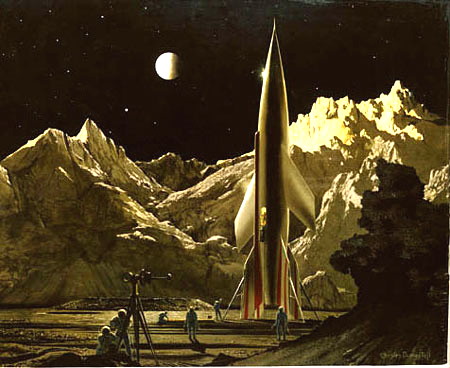
| Chesley Bonestall's Conquest of Space (1949). |
Paul D. Spudis
The Once and Future Moon
Smithsonian Air & Space
The Once and Future Moon
Smithsonian Air & Space
The influence of the arts on our popular culture is well known. The television generation grew up with Forbidden Planet and Star Trek, shaping our sensibilities and expectations about space travel. The genre of “space art” enlightened and expanded our minds and ignited our imaginations. The sixties and seventies brought us “space” artists with their startlingly realistic vistas of unvisited worlds and ancient times. Authors, writing for all ages and levels of interest, found eager audiences. From the beginning, the space age left an indelible mark on many.
The spiritual father of these efforts was an artist from the earlier half of the century. Renowned for what was called “astronomical art,” Chesley Bonestell (1888-1986) painted some of the most famous and classic works of space art. His sequence showing the ringed giant planet Saturn from its various moons inspired hundreds of students to take up math and science. Bonestell loved painting the planets because he was convinced that we would soon be visiting them. His artwork was used to illustrate what media described and popularized about the forthcoming age of planetary exploration.
Bonestell made great efforts to get the technical details of his paintings correct. He read the scientific literature so that his planetary landscapes reflected the most current knowledge of how his imagined scenes might really appear. One of his classic pieces of work was for the influential film Destination Moon, produced in 1950 and based on stories by the classic science-fiction writer Robert Heinlein. Bonestell did matte paintings for the Earth departure and lunar approach scenes. His masterpiece in that effort was a fourteen-foot long, full panoramic view of the surface used during the lunar stay scenes in the movie.
Bonestell reminded his audience that our home planet is nearby — the backyard of near-Earth space. Earth hangs relatively low in the sky over the horizon of the crater Harpalus in Mare Frigoris (latitude 52°N); rough jagged peaks, starkly lit by unfiltered blazing sunlight, are set sharply against a black sky holding a sea of silent, non-twinkling stars. The demands of film intruded onto his artistic vision through the addition of giant cracks on the surface, a modification to which Bonestell objected. The producer, George Pal, needed the surface cracks so that he could starkly illustrate perspective, as nearby human-scale cracks would rapidly fade into smaller ones in the distance. Bonestell wanted to show just a dusty surface, a far-field contrast that would have been difficult to portray on the screen.
It is in regard to his portrayal of the mountains of the Moon that Bonestell has received, if not criticism, at least light censure (not without some slightly smug condescension) from some scientists. He painted a lunar landscape ringed with rough, jagged peaks, towering about the plains, similar to the barren landscape of Death Valley in his native California. In part, this was the conventional portrayal of lunar mountains; drawings made by engineer/astronomer James Nasmyth in the 19th Century likewise show jagged mountains on the Moon. Telescopic views leave this impression, based largely on the dramatic appearance of sharp cast shadows on the lunar surface, visible at low sun elevations as shadows of the ringed mountains of the mare basins extend hundreds of kilometers across the flat plains of the dark maria.
The remarkable smoothness of the lunar mountains was evident when Apollo 15 went to the Moon in 1971. To the disappointment of many, Bonestell’s vision of rugged, craggy peaks (blindingly illuminated by early morning sunlight in the black sky) gave way to an undramatic, smooth, undulating terrain, so bland that it was difficult to gain any perspective on distance. The sense of letdown among space buffs was widespread and illustrated most dramatically in a 1990 painting by David Hardy entitled The Way It Should Have Been, which paid tribute to Bonestell’s now-obsolete vision of lunar vistas by showing an Apollo Lunar Module snugly parked amidst the craggy peaks of Bonestell’s old Moon.
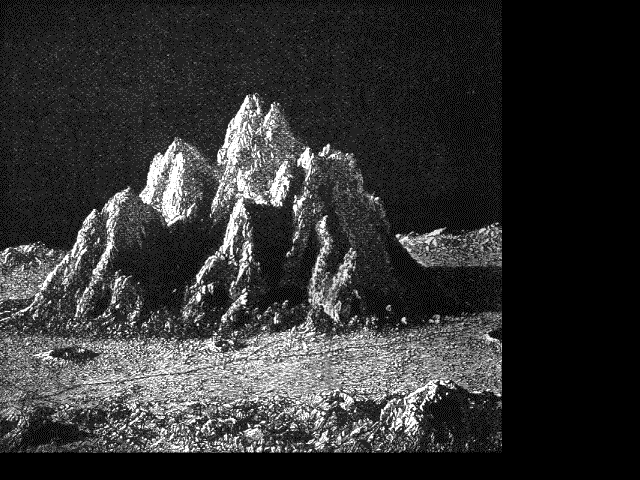
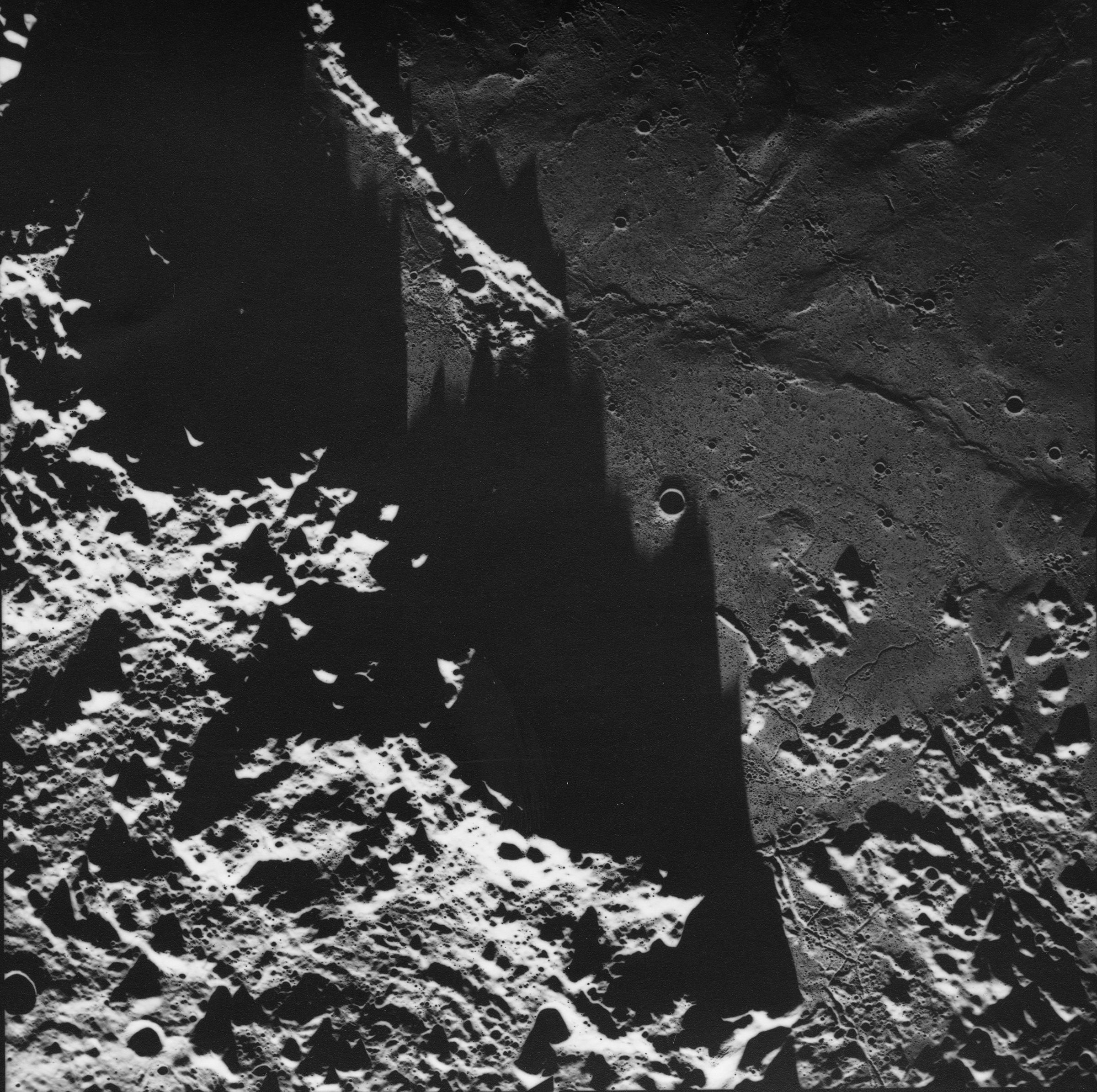
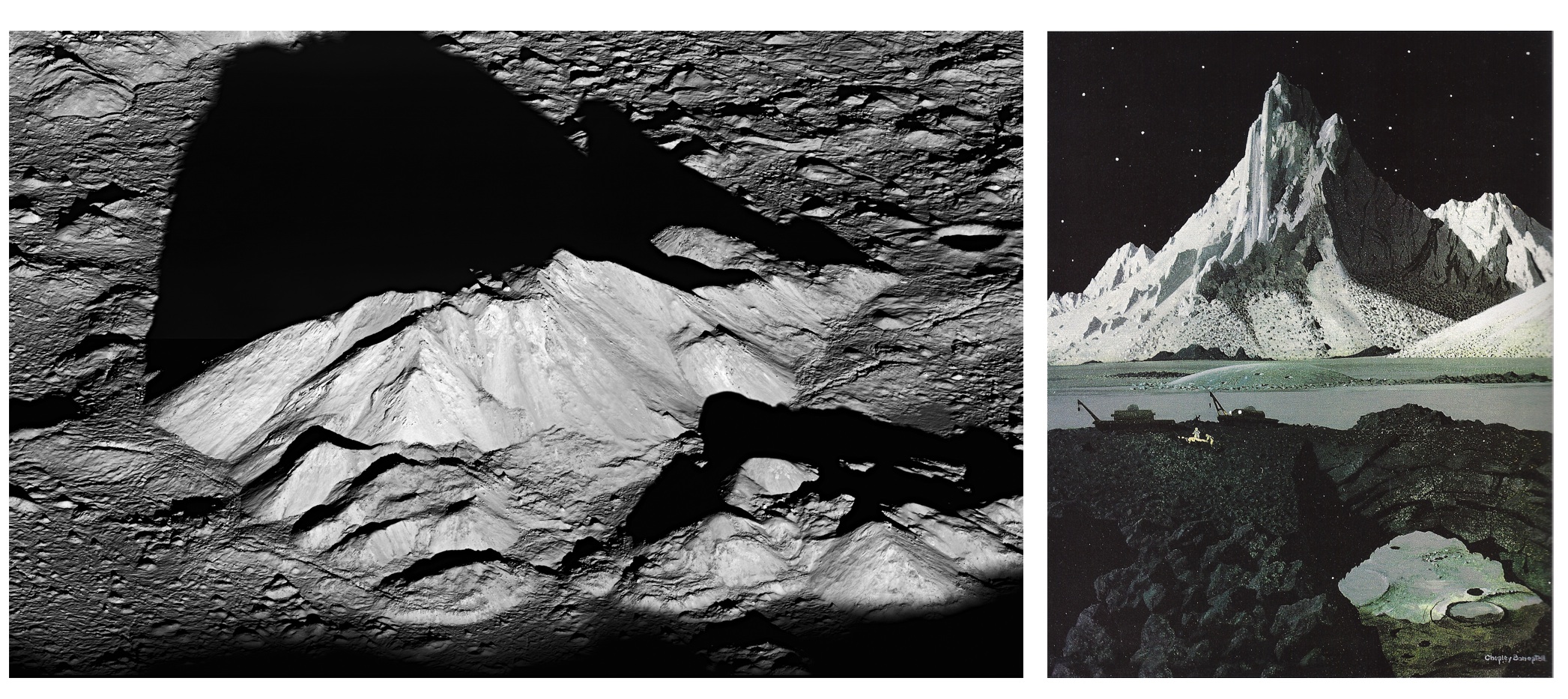
More of the Moon’s physical appearance has been unveiled. The recent fleet of spacecraft that orbited the Moon has shown us dramatic vistas never before seen. The spectacular high-definition television of Japan’s Kaguya spacecraft (by the way, when will NHK release a Blu-ray video disk of all that magnificent footage?) displays awesome landscapes that slowly drift beneath the orbiting vehicle, and NASA’s Lunar Reconnaissance Orbiter Camera system has provided some unique and remarkable views. Some of the most dramatic are oblique-looking perspective views of famous lunar landmarks. An oblique panorama of the floor of Tycho, the prominent rayed crater on the lunar near side, shows its magnificent, rugged central peak rising out of the inky darkness of the early lunar morning. That description sounds familiar, doesn’t it? In fact, when I first saw the new Tycho oblique, I seemed to recall a specific Bonestell painting that was very similar to it. It was one that Bonestell did for an early 1960’s book, Rocket to the Moon. The distant peak in Bonestell’s painting eerily foreshadows the dramatic LROC image by 50 years.
Chesley Bonestell’s Moon lives! Fresh, uneroded features there are as sharp and dramatic as he portrayed them half a century ago. As lunar features slowly erode under constant sandblasting by micrometeorites and downslope movement of debris, they become smooth and rounded. The Apennine mountains at the Apollo 15 landing site are smooth because they formed almost 4 billion years ago, in the early dawn of lunar evolution. In contrast, the central peaks of Tycho were thrust up a mere 100 million years ago, a blink of the eye in lunar geologic terms. In a couple of billion years, it too will round off and mellow, a gentle undulation on the floor of a nearly obliterated crater.
“The Way It Should Have Been?” Nah – the way it really is. On the Moon, as on Earth, spectacular landscapes feed the human spirit and kindle our desire to travel to new places.
The spiritual father of these efforts was an artist from the earlier half of the century. Renowned for what was called “astronomical art,” Chesley Bonestell (1888-1986) painted some of the most famous and classic works of space art. His sequence showing the ringed giant planet Saturn from its various moons inspired hundreds of students to take up math and science. Bonestell loved painting the planets because he was convinced that we would soon be visiting them. His artwork was used to illustrate what media described and popularized about the forthcoming age of planetary exploration.
Bonestell made great efforts to get the technical details of his paintings correct. He read the scientific literature so that his planetary landscapes reflected the most current knowledge of how his imagined scenes might really appear. One of his classic pieces of work was for the influential film Destination Moon, produced in 1950 and based on stories by the classic science-fiction writer Robert Heinlein. Bonestell did matte paintings for the Earth departure and lunar approach scenes. His masterpiece in that effort was a fourteen-foot long, full panoramic view of the surface used during the lunar stay scenes in the movie.
Bonestell reminded his audience that our home planet is nearby — the backyard of near-Earth space. Earth hangs relatively low in the sky over the horizon of the crater Harpalus in Mare Frigoris (latitude 52°N); rough jagged peaks, starkly lit by unfiltered blazing sunlight, are set sharply against a black sky holding a sea of silent, non-twinkling stars. The demands of film intruded onto his artistic vision through the addition of giant cracks on the surface, a modification to which Bonestell objected. The producer, George Pal, needed the surface cracks so that he could starkly illustrate perspective, as nearby human-scale cracks would rapidly fade into smaller ones in the distance. Bonestell wanted to show just a dusty surface, a far-field contrast that would have been difficult to portray on the screen.
It is in regard to his portrayal of the mountains of the Moon that Bonestell has received, if not criticism, at least light censure (not without some slightly smug condescension) from some scientists. He painted a lunar landscape ringed with rough, jagged peaks, towering about the plains, similar to the barren landscape of Death Valley in his native California. In part, this was the conventional portrayal of lunar mountains; drawings made by engineer/astronomer James Nasmyth in the 19th Century likewise show jagged mountains on the Moon. Telescopic views leave this impression, based largely on the dramatic appearance of sharp cast shadows on the lunar surface, visible at low sun elevations as shadows of the ringed mountains of the mare basins extend hundreds of kilometers across the flat plains of the dark maria.
The remarkable smoothness of the lunar mountains was evident when Apollo 15 went to the Moon in 1971. To the disappointment of many, Bonestell’s vision of rugged, craggy peaks (blindingly illuminated by early morning sunlight in the black sky) gave way to an undramatic, smooth, undulating terrain, so bland that it was difficult to gain any perspective on distance. The sense of letdown among space buffs was widespread and illustrated most dramatically in a 1990 painting by David Hardy entitled The Way It Should Have Been, which paid tribute to Bonestell’s now-obsolete vision of lunar vistas by showing an Apollo Lunar Module snugly parked amidst the craggy peaks of Bonestell’s old Moon.
 |
| LROC 2011 view of the central peak of the crater Tycho (below) and Bonestall painting for the book, "Rocket to the Moon." |
Chesley Bonestell’s Moon lives! Fresh, uneroded features there are as sharp and dramatic as he portrayed them half a century ago. As lunar features slowly erode under constant sandblasting by micrometeorites and downslope movement of debris, they become smooth and rounded. The Apennine mountains at the Apollo 15 landing site are smooth because they formed almost 4 billion years ago, in the early dawn of lunar evolution. In contrast, the central peaks of Tycho were thrust up a mere 100 million years ago, a blink of the eye in lunar geologic terms. In a couple of billion years, it too will round off and mellow, a gentle undulation on the floor of a nearly obliterated crater.
“The Way It Should Have Been?” Nah – the way it really is. On the Moon, as on Earth, spectacular landscapes feed the human spirit and kindle our desire to travel to new places.
Originally published at his Smithsonian Air & Space blog The Once and Future Moon, Dr. Spudis is a senior staff scientist at the Lunar and Planetary Institute. The opinions expressed are those of the author and are better informed than average.