Showing posts with label Lunar Rover. Show all posts

Friday, November 29, 2013

Chang'e-3 launch window opens 1 December 1730 UT

chang-e-3-yutu-2013-670x324
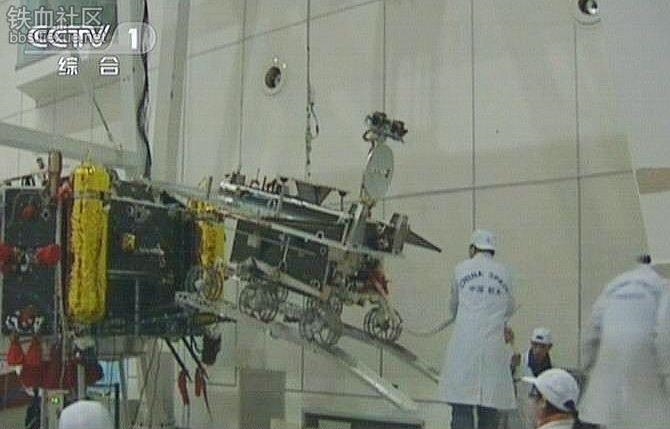
CCTV video still, released August 2013, shows final tests and loading of China's Chang'e-3, the third mission of China's Lunar Exploration Program [CCTV/CNSA].
Joel Raupe 
Lunar Pioneer
 
The China National Space Administration (CNSA) Lunar Exploration Program (CLEP) is gearing up for a nighttime launch of it's third unmanned lunar mission, Chang'e-3, Sunday, December 1 (UT), the first of a series of launch windows beginning 1730 UT, December 1; early Monday morning, December 2, at 1:30 am in Beijing.

Chang'e-3 will be launched aboard a modified Long March 3B booster from Xichang Satellite Launch Center, Suchuan Provence. The long-stated goal of the mission is to perform China's first soft-landing beyond Earth and the first such landing on the Moon in the 21st century, the first since the Soviet mission Luna 24 landed and retrieved a sample from Mare Crisium in 1976.

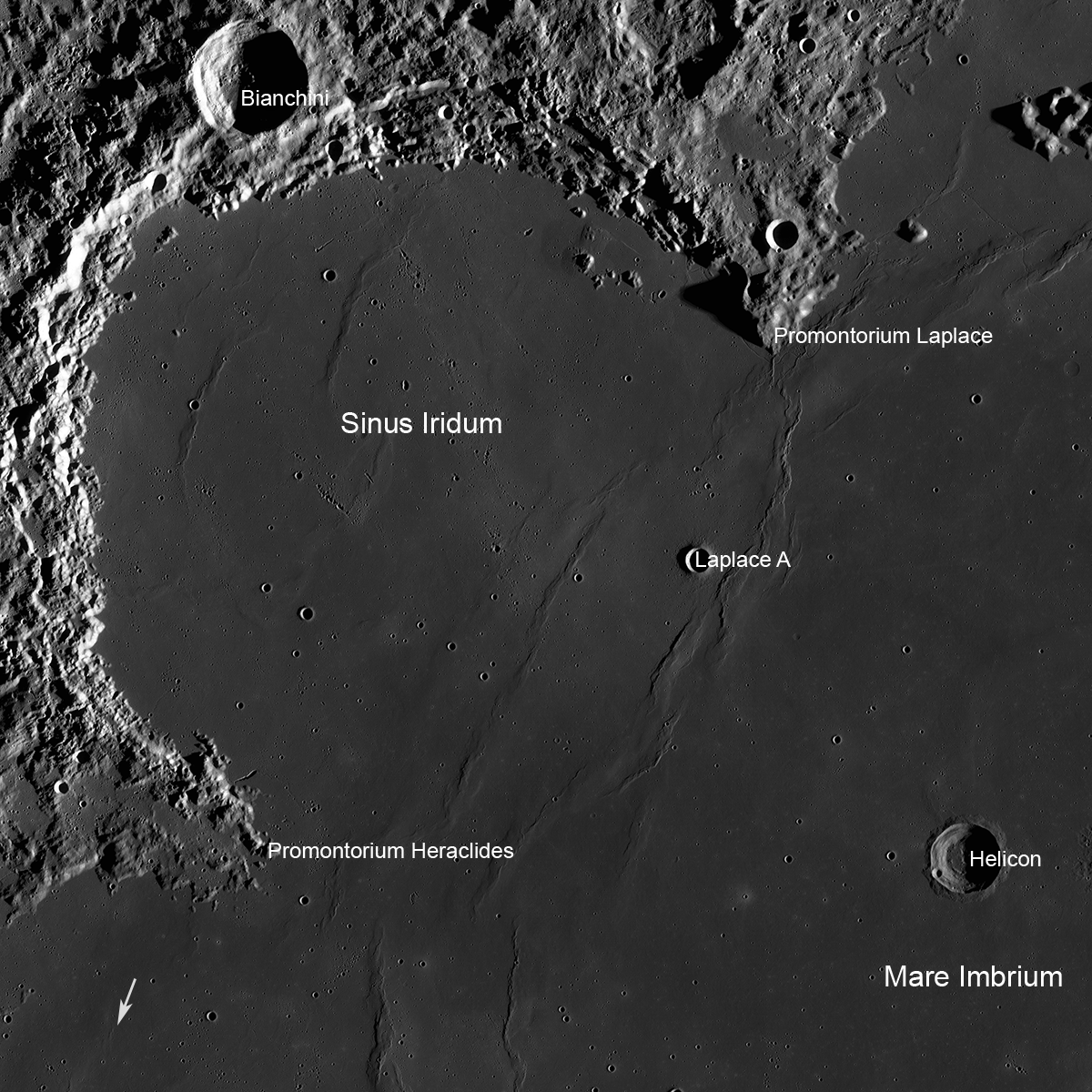
Presuming a successful launch, early Monday local time, Chang'e-3 will land on the Moon as early as Saturday, December 14, or about 30 hours after local sunrise at the targeted landing zone in Sinus Iridum. A landing early into the two-week-long lunar day will allow the mission to take full advantage of its designed use of solar power.

Sunrise at the intended landing zone, in the vicinity of Laplace A crater (43.74°N, 26.935°W), will begin in the early hours of December 12 (UT).

The mission is also designed to deploy the first remote-operated lunar rover on the lunar surface since the Soviet Luna 21 lander deployed Lunokhod-2 and explored Le Monnier crater in 1973. 

Following a national naming contest with 650,000 online participants, China state news sources report the Chang'e-3 lunar rover has been named Yutu, (Jade Rabbit), after the traditional ethereal attendant to the lunar goddess Chang'e.

Tasks for Yutu include "surveying the moon's geological structure and surface substances while looking for natural resources," said Ouyang Ziyuan, a chief scientist of CLEP, in an interview with Xinhua ("China's lunar probe to land on Moon next month," Mo Hong'e, November 26, ecns.cn).

A detailed summary of the planned landing zone for the Chang'e-3 mission, near Laplace A crater in east Sinus Iridum, was posted HERE, a discussion written by Lunar Reconnaissance Orbiter Camera (LROC) principal investigator Dr. Mark Robinson of Arizona State University, released November 22.

In cooperation with the International Lunar Observatory Association (ILOA) in Hawaii, an ultra-violet telescope will be operated from the Chang'e-3 lander, a first since a small UV instrument was operated on the Moon by the Apollo 16 expedition in 1972.

China's Lunar Exploration Program, initiated in 2004, consists of five planned missions. Chang'e-1 became that nation's first lunar orbiter November 5, 2007 and was deorbited to a reportedly planned impact in Mare Fecunditatis, March 1, 2009.

The highly-successful Chang'e-2 orbiter was launched from Xichang, October 1, 2009 and was inserted into lunar orbit five days later. Chang'e-2 captured orbital photography later assembled into a global, low-angle illumination mosaic of the Moon, said to be the first of its kind. 

While performing orbital maneuvers critical to the planned Chang'e-3 landing in Sinus Iridum, Chang'e-2 captured high-resolution low-perilune photography of Laplace A crater and its vicinity.

Chang'e-2 was afterward maneuvered beyond Cislunar space, leaving lunar orbit  June 9, 2011. Ground controllers moved the spacecraft to an extended stay in and around Lagrangian Point 2 (L2), one of five stable points in the Earth-Moon-Sun system where the influences of the gravity of the three bodies balance each other out. 

L2 space is beyond the Moon, more or less directly over the farside, and it presumably where communications with surface missions beyond line-of-sight of Earth could be at least partially maintained.
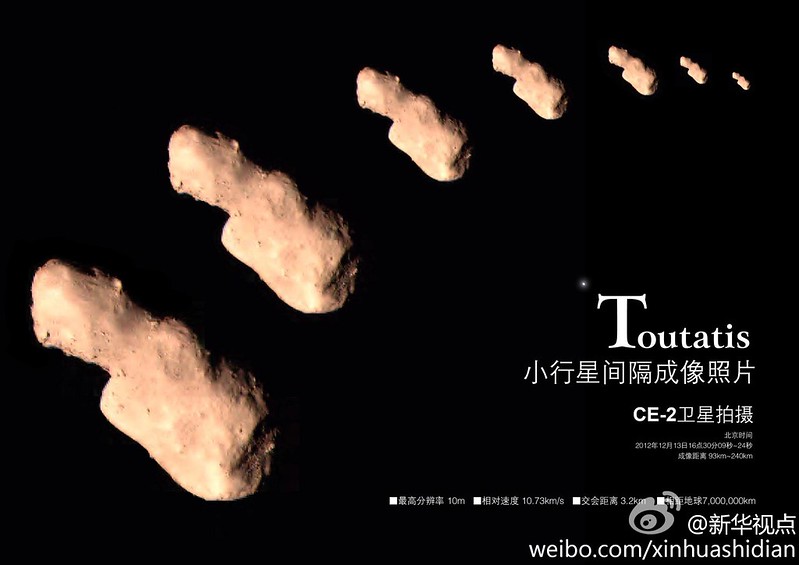
4179 Toutatis Chang'e-2 flyby
Chang'e-2 passed to within 3.2 km of the potentially hazardous asteroid 4179 Toutatis in December 2012, traveling at a relative speed of 11.72 kilometers per second [CNSA/Xinhua].
Still underway, having departed L2 for interplanetary space, Chang'e-2 recently returned photographs of its recent very close encounter with potentially hazardous asteroid 4179 Toutatis, December 13, 2012.

After Chang'e-3, China plans at least two additional unmanned lunar missions designed to retrieve samples, Chang'e 4 in 2015 and Chang'e 5 in 2018.

Related Posts:
'Government Penalty' removed from Google Lunar XPRIZE terms (November 7, 2013)
Chang'e-3 and LADEE: The Role of Serendipity (October 31, 2013)
Outstanding animation celebrates China's Chang'e-3 (October 29, 2013)
LROC updates image tally of human artifacts on the Moon (September 25, 2013)
Chang'e-3 officially enters launch phase (August 31, 2013)
Chang'e-3 undergoing thermal vacuum testing (May 9, 2013)
Chang'e-3: China's rover mission (May 4, 2013)
Chang'e-3 lander and rover expected in 2013 (January 10, 2013)
China's grand plan for lunar exploration (October 11, 2012)
ILOA to study deep space from Chang'e-3 (September 11, 2012)
Will China deploys first lunar rover since 1976? (April 29, 2012)
China's Long March to the Moon (January 14, 2012)
China plans lunar research base (May 11, 2011)
PRC continues methodical program (March 8, 2011)
Chang'e-2 arrives in mission orbit (October 9, 2010)
Dispatch from Chang'e-2: Sinus Iridum (October 4, 2010)
Chang'e-2 takes direct approach (October 1, 2010)
Chang'e-2 sets stage for future lunar missions (September 3, 2010)
Chang'e-1 research reported published (July 22, 2010)

Friday, November 22, 2013

A Great Place to Rove: Sinus Iridum and Chang'e 3

China will launch it's third unmanned lunar probe very early in December. Plans for Chang'e 3 include the first soft landing on the Moon since 1976 and the first rover since 1973. The China National Space Agency (CNSA) has long reported the target for this historic mission is Sinus Iridum, "the Bay of Rainbows," on the northwestern frontier of Mare Imbrium.

Meanwhile, following five years of planning, the NASA orbiter
LADEE has begun a 100 day examination of the Moon's tenuous exosphere, its formal science mission, in low equatorial orbit. It's all but certain both missions will be underway at the same time, leading some to jump to conclusions in reporting the two missions will interfere with one another. But, as Dr. Paul Spudis of the Lunar and Planetary Institute reports, nothing could be further from truth. Read his assessment, HERE.

-
Sinus Iridum
Sinus Iridum - it is likely China will land a rover near Laplace A before the end of 2013. (Arrow shows location of the Soviet Lunokhod 1), LROC Wide Angle Camera mosaic field of view 360 km [NASA/GSFC/Arizona State University].
Mark Robinson
Principal Investigator
Lunar Reconnaissance Orbiter Camera (LROC)
Arizona State University

In the near future China will attempt a robotic landing on the Moon, and will deploy a rover. The launch date and landing dates have not been officially announced. The exact landing spot is also not yet publicly designated, but it seems likely the landing will take place in Sinus Iridum, possibly near the fresh crater Laplace A (8 km diameter).

Why this particular spot on the Moon? Likely there are critical engineering constraints in terms of landing site selection as well as important science goals. And there is the dramatic grandeur of the lunar landscape!

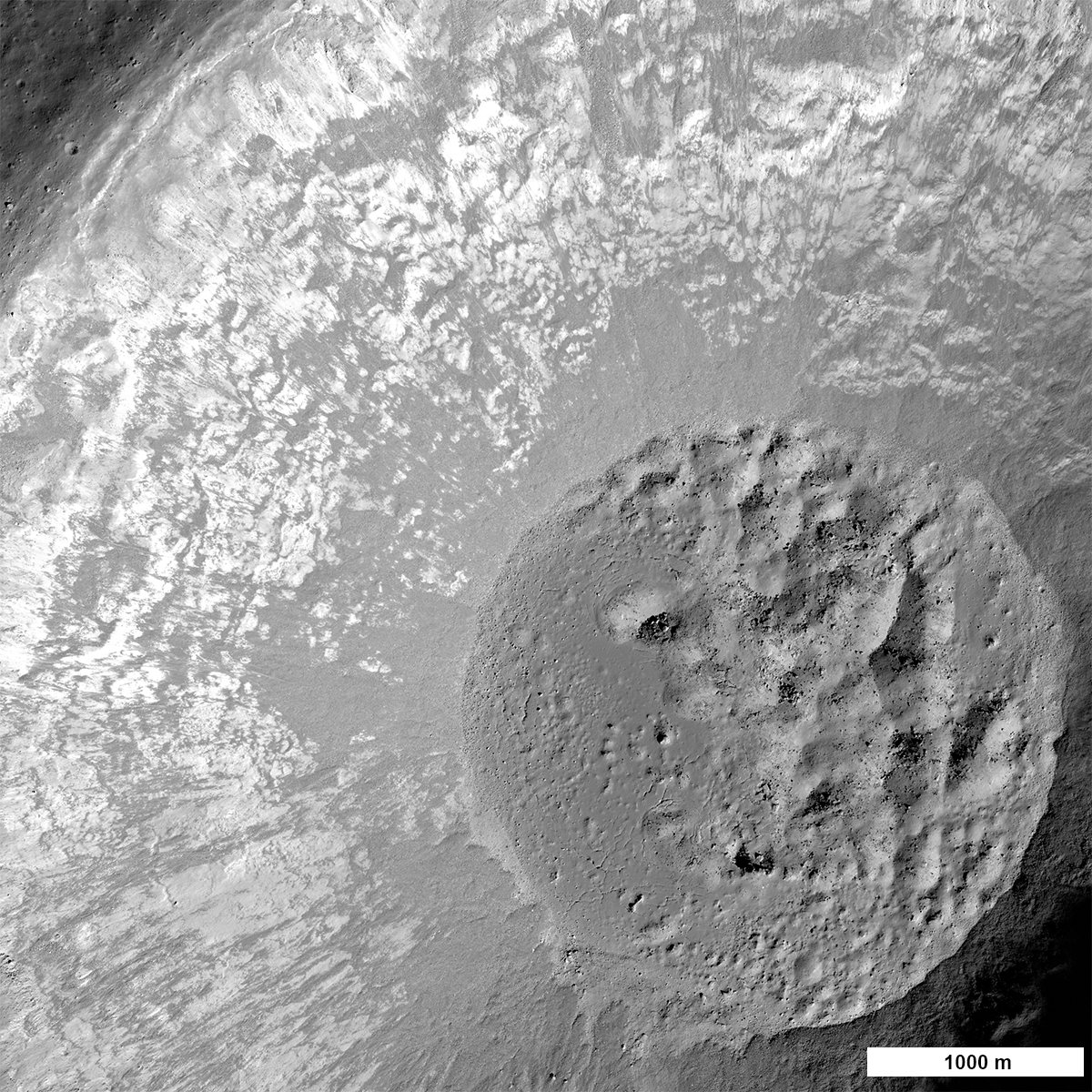
Imagine the first rover-eye view from the crater rim - a sheer drop of 1600 meters at your wheels, and an 8 km view across to the far wall! From LROC NAC images we know rock is exposed in the upper walls and dramatic landslides streamed material down to the crater floor. Speaking of the crater floor - it hosts a now frozen lake of impact melt 2500 meters (1.5 miles) in diameter. Imagine the moments after the crater formed, the floor was a cauldron of molten rock with debris sliding down into the melt, and the crater itself was deforming as the floor uplifted after the initial pressure of the impact was relieved.

Laplace A and wrinkle ridge
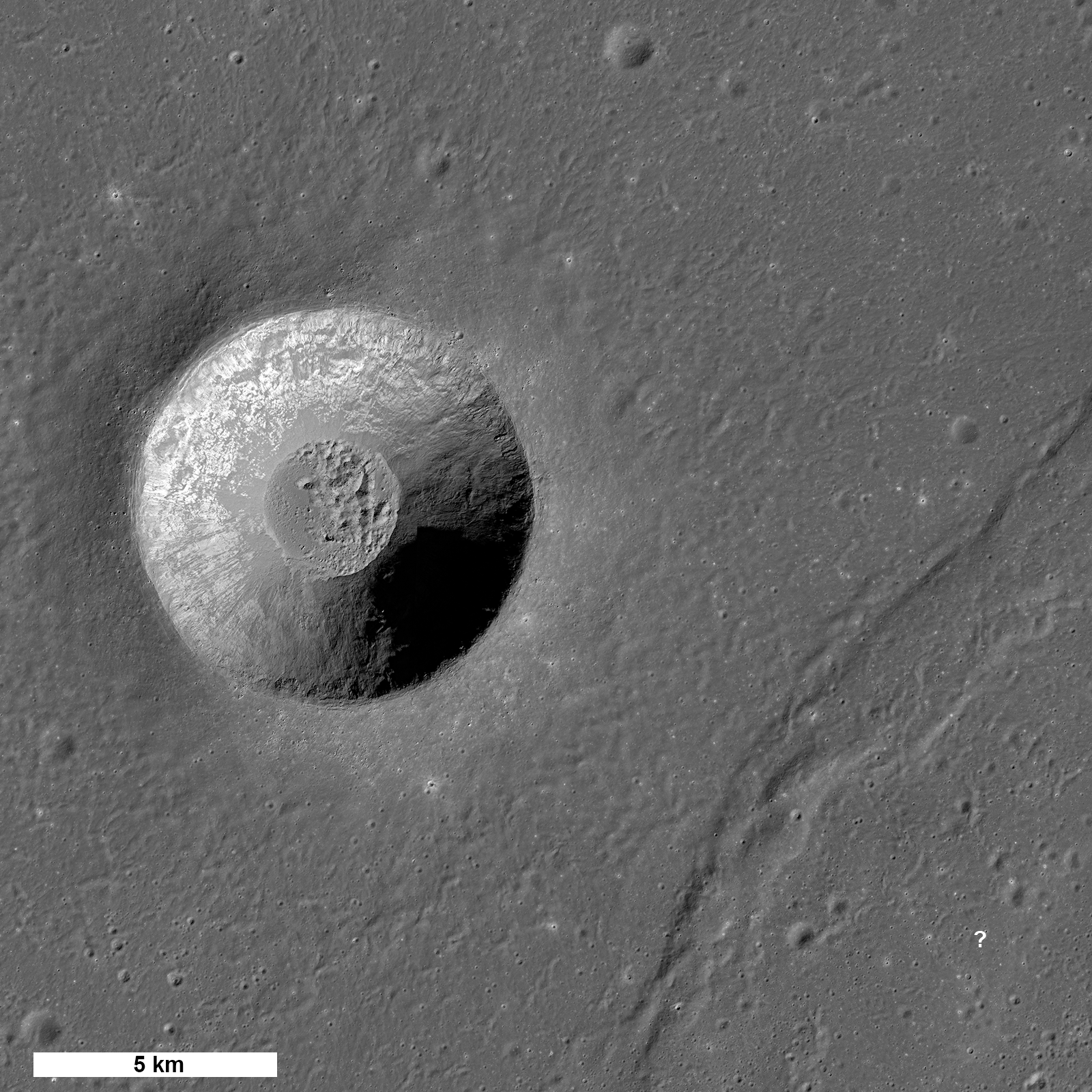
Laplace A crater and nearby wrinkle ridge (diagonally across at lower right). The question mark shows a potential landing site from which the rover could traverse northwest across the ridge to the edge of the crater [NASA/GSFC/Arizona State University].
Laplace A is a fascinating scientific target for a rover. It is a great example of a very young crater formed in mare basalt. A rover traversing the crater's ejecta blanket is in essence similar to driving down into the crater (in a geologic sense). We know from studies of terrestrial impact craters (such as Meteor crater) that material ejected from deep in a crater ends up near the rim, and rocks from the pre-impact surface are thrown far from the crater (a crater radius or more). So as a rover drives closer and closer to the rim it can characterize rocks from deeper and deeper below the surface.

Some of the many outstanding questions regarding the nature of the mare basalts include: how thick are individual flows, does the composition of the erupted magma change with time and location, and are pyroclastic (explosive) eruptions intermingled with effusive eruptions? These questions can be directly addressed with the Chang'e 3 rover! No humans or robots have ever visited a fresh crater anywhere near this size on the Moon (or Mars for that matter) so the return from this mission has great potential for advancing our knowledge of the Moon.

Laplace A
LROC NAC view of the interior of Laplace A crater [NASA/GSFC/Arizona State University].
But wait, there's more!

Another key question can be addressed: what is the 3D nature of large contractional ridges on the Moon? The rover is thought to have a ground penetrating radar (GPR) and it just so happens that a large wrinkle ridge (a contractional landform) lies about 10 km east of Laplace A. Although the exact mission plan is not publicly available, one potential scenario is that the lander sets down just east of the wrinkle ridge and deploys the rover. After initial testing of the lander and rover, and geologic characterization of the landing site, the rover could set off to the west towards the crater. As the rover drives up and over the wrinkle ridge the GPR would continuously probe the subsurface, slowly building up a 3D profile down to 100 meters or more (?) beneath the surface. Wrinkle ridges are complex landforms created when mare basalts are compressed, causing them to buckle and break along faults. However, wrinkle ridges have not been fully explored, and the  geometry and number of faults associated with each wrinkle ridge is not known. A subsurface profile of a wrinkle ridge could tell us the number of faults, where the faults are located, and how steeply the faults dip: is it 15°, 30° or 45°?

Chang-E-2-Laplace-A-900
Laplace A as plotted using photography and digital terrain model gathered from the CNSA orbiter Chang'e 2 [CNSA/CLEP].
From LROC images we have mapped the location of all the mare wrinkle ridges, and measured their surface topography, but all we have for the subsurface are models! Soon we may have actual measurements providing a good first step towards interpreting these poorly understood features. Wrinkle ridges are also found on Mercury and Mars, so better understanding a lunar example will help scientists unravel the tectonic story across the inner Solar System. Since only a handful of human and robotic missions have ever landed on the Moon, the results from the Chang'e 3 mission will provide important new scientific insights into our Moon.

Chang-e-2-CCD-LaPlace-full
Full resolution segment of the west wall and rim of Laplace A by Chang'e 2 [CNSA/CLEP].
Once Chang'e 3 has landed, LROC should be able to spot the lander and the rover; LRO will be above Laplace A on 25 December, 22 January, and 18 February.  The LROC team looks forward to posting images of the two vehicles!

Coincidentally, Lunokhod 1 landed only 250 km to the southwest of Laplace A over forty years ago (17 November 1970). This intrepid Soviet rover explored for almost a year and traveled a total distance of 10.5 km. Both the lander vehicle (Luna 17) and the rover can be seen on the surface today.

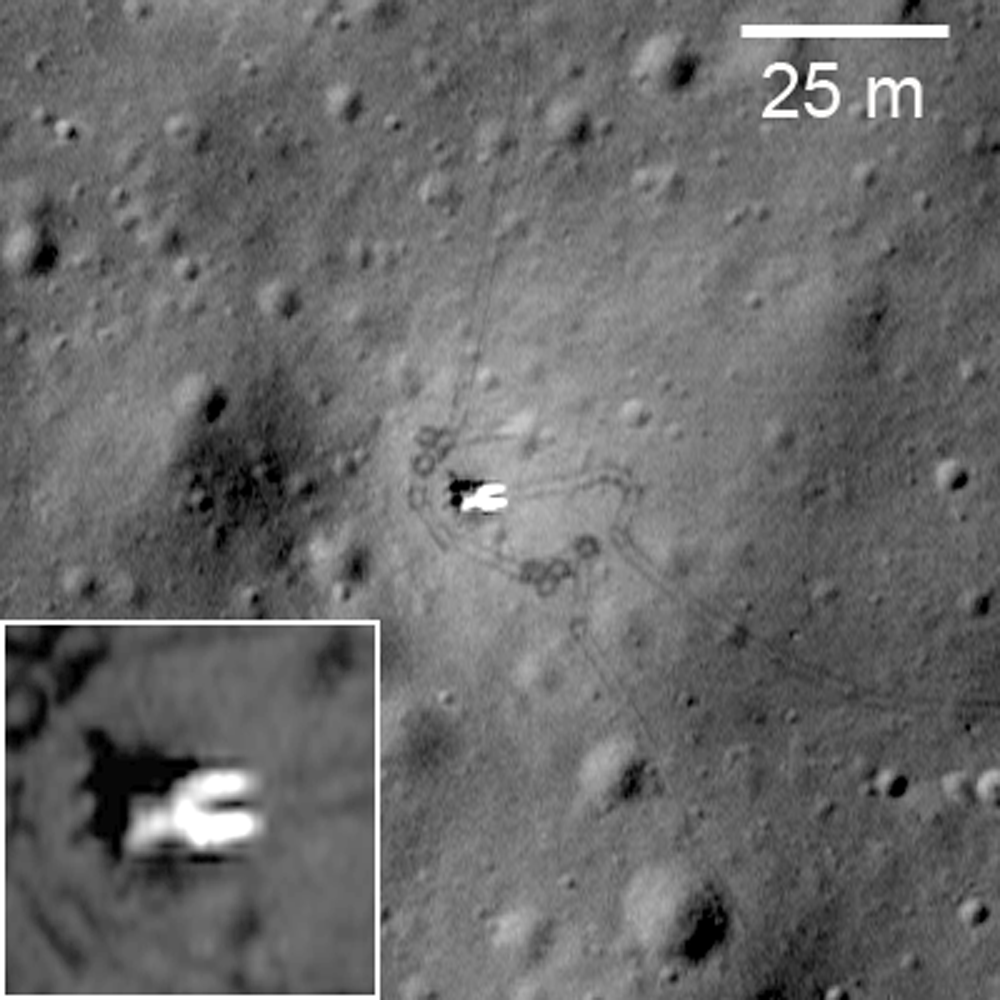
Perhaps the Chang'e 3 lander and rover will look something like this. Lunokhod 1 rover in its final parking place (38.315°N, 324.992°E) on the surface of Mare Imbrium, 250 km southwest of Laplace A. The Soviet rover, and its French-built laser range reflector array, were lost for four decades until relocated by LRO. The addition of the LLR to astrophysicists on Earth critically improved the accuracy of measurements of the distance to the Moon, bringing the uncertainty to within 3 millimeters. LROC NAC observation M175502049RE, spacecraft orbit 10998, resolution 33 cm per pixel. Original LROC Featured Image, HERE [NASA/GSFC/Arizona State University].
Explore the LROC Featured Mosaic of the Laplace region of interest, HERE.

Related Posts:
Lunar Laser Ranging: The Millimeter Range (November 19, 2013)
'Government landing penalty' removed from Google Lunar Xprize terms (November 7, 2013)
Chang'e 3 and LADEE: The Role of Serendipity, Paul Spudis (October 31, 2013)

Tuesday, November 19, 2013

Has NASA 'RESOLVE'd' on Canadian lunar rover?

The Canadian Space Agency test platform "Artemis, Jr.," fitted with NASA's RESOLVE surface materials probe package "RESOLVE," on Day 3 of field testing on Hawai'i, July 2012 [CSA].
Tom Spears
Ottawa Citizen

Neptec Design Group of Ottawa is the front-runner to build the next moon rover — a traveling robot that will hunt for water on an unmanned NASA mission in 2017. NASA has asked the Canadian Space Agency specifically for Neptec’s rover, called Artemis Jr., said Mike Kearns, president of space exploration with the Ottawa aerospace engineering firm.

It has chosen a Canadian drill and Canadian avionics, too.

“One of the missions on that path is called RESOLVE, renamed by some people now as the Lunar Prospector Mission,” Kearns said.“NASA, for funding reasons, has asked CSA to provide the rover and the drill. And they actually asked for our Neptec rover ... and for the drill that is made by a company called Deltion.” (Deltion Innovations of Sudbury took over the design that originated with NORCAT. Its drill developed out of Canadian mining technology.)

What sealed NASA’s interest was a test drive of the rover prototype on the side of a Hawaiian volcano, in 2012. Chosen to simulate the harsh landscape of the moon and Mars, it provided a place for Artemis Jr. to drive, pivot and steer past obstacles using its vision system and navigation software. It passed nine days of tests.It’s called “Jr.” because this is a scaled-down version of a Neptec rover designed to carry astronauts, called Artemis.

Searching for water in space is vital. Not only can astronauts drink it, but it can be broken down into oxygen and hydrogen, both used in rocket propellant. Artemis Jr. could also search for methane.Neptec hopes the 2017 date will resonate with politicians who want some flag-waving in Canada’s 150th year.

“The question that always comes up is: That’s very nice but what’s the financial benefit? What’s the return to the taxpayers. And the answer is that ... for every dollar that CSA gives us, we end up with $10, mostly in export sales. We sell those products around the world.”

While the Canadian Space Agency can open the bidding to include MDA, the CANADARM builders, Kearns says NASA’s preference gives his company’s Artemis Jr. rover a strong chance. MDA officials weren’t available for comment Monday.

NASA is publicly leaning toward the Neptec team. In a description of the mission it writes: “RESOLVE is not just a NASA effort; the Canadian Space Agency provided Artemis Jr., which is the rover for the payload; the onboard drill and sample transfer system; as well as avionics microprocessors.”

Fanciful rendering of the Artemis, Jr. platform on the floor of Mare Crisium. A better view of the system, in the real world and in more detail is available, HERE.
Artemis Jr. is actually the product of a group of Canadian companies: Ontario Drive and Gear, from New Hamburg, Ont.; ComDev and Neptec from Ottawa; Deltion; and NGC from Sherbrooke.

The four-wheeled rover can pivot on one spot, moving the right wheels forward and the left ones in reverse. It has coarse metal treads for traction, and a solar panel on top.

It’s designed for NASA’s Regolith & Environment Science and Oxygen & Lunar Volatile Extraction (RESOLVE) project, which involves heating the “regolith” (loose minerals on the moon’s surface) to extract gas.

Related Posts:
Good things delivered in small packages, Paul Spudis (August 19, 2013)
Geological sampling and planetary exploration, Paul Spudis (February 19, 2013)
'a RESOLVE to mine the Moon,' Brian Shiro (July 15, 2012)

Saturday, August 31, 2013

Chang'e-3 officially enters launch phase

Chang'e-2 soft lander deploys first lunar rover in nearly 40 years in this simulation shown on China national television [CNSA].
Zhu Ningzhu
From Xinhua   

"Chang'e-3 has officially entered its launch stage, following its research and manufacture period," said a statement released by the administration after Wednesday's meeting on the mission.

The mission will see a Chinese space probe land on a celestial body for the first time.

"The Chang'e-3 mission makes best use of a plethora of innovative technology. It is an extremely difficult mission, that carries great risk," said Ma Xingrui, head of China's space exploration body and chief commander of the lunar program.

LROC WAC Sinus Iridum Mosaic [NASA/GSFC/Arizona State University]
Sinus Iridum, the "Bay of Rainbows" embayment on the northwestern frontier of Mare Imbrium and likely target for the first soft landing on the Moon since 1976, by China's third unmanned lunar probe Chang'e-3 before the end of 2013. LROC Wide Angle Camera (WAC) mosaic [NASA/GSFC/Arizona State University].
The Chang'e-3 mission is the second phase of China's lunar program which includes orbiting, landing and returning to Earth, following the successes of the Chang'e-2 missions, which include plotting a high-resolution, full-coverage lunar map.

Chang'e-3's carrier rocket has successfully gone through its first test while the launch pad, control and ground application systems are ready for the mission.

Chang'e-3 will be launched from the Xichang Satellite Launch Center in southwest China.

From the Register:

The Chang’e-3 probe, first revealed last year, is a 100kg, six-wheeled rover that will spend three months traversing the lunar landscape under human control. The spacecraft will use the Moon’s gravity to slow down, orbit the satellite, and then soft-land using rocket propulsion.

This will be the first time the Chinese have landed a spacecraft on a non-terrestrial surface and the Chang’e-3 will be a crucial test of both Chinese aeronautics and rocketry control systems. The rover will pave the way for a future manned mission to the Moon, and a possible space colony on the surface.

“The Chang’e-3 mission makes best use of a plethora of innovative technology. It is an extremely difficult mission, that carries great risk,” said Ma Xingrui, head of China’s space exploration body and chief commander of the lunar program.

The first Chang’e probe was launched 2007 and completed a 3D map of the Moon’s surface before being intentionally crashed into the planetoid. Chang’e 2, launched in 2010, carried out further mapping 100km off the Moon’s surface before being directed out to fly by the asteroid Toutatis and is now heading out into the Solar System.

Like NASA’s early rovers on Mars, the Chang’e-3 will be primarily solar powered and will carry a ground-facing radar on its belly capable of penetrating up to 30 meters into the lunar regolith, as well as a alpha particle X-ray spectrometer and an infrared spectrometer.

China plans a manned mission to the lunar surface possibly as soon as 2017 – although he authorities aren’t setting themselves a Kennedyesque deadline and say they’ll go when they are ready. Once there, however, the Chinese government has said it plans to build the first manned lunar outpost, an objective NASA has already abandoned.

Related Posts:

Thursday, May 9, 2013

Chang'e-3 undergoing thermal vacuum testing

Chang'E-3 begins thermal and hard vacuum testing at the AIT Hall  facility of the China Aerospace Science and Technology Corporation in Beijing [CNSA/CLEP/CSA].
Emily Lakdawalla
The Planetary Society

A member of the NASASpaceflight.com forum has posted a large set of photos taken during Chang'E 3 thermal vacuum testing. They are all watermarked "China Space News" which is, as near as I can tell, a Chinese magazine -- I am hoping that the gigantic watermarks make it okay for me to post them. 

I'm posting them here in the spirit of asking forgiveness rather than permission, because I haven't been able to figure out a way to ask for permission. (EDIT: Here's where the photos were originally posted online.)

Thermal vacuum testing is one of the last major testing programs that a spacecraft has to endure before it is cleared for launch. It is a test that must be performed on the actual spacecraft that is headed for space -- not on an engineering model -- and it has to be done with the spacecraft essentially completely assembled.

Read the full article, links, and more images, HERE.

Related:
Chang'E-3 lander and rover expected in 2013 (January 10, 2013)
'China's grand plan for lunar exploration' (October 11, 2012)
ILOA to study deep space from Chang'E-3 (September 11, 2012)
Will China deploys first lunar rover since 1976? (April 29, 2012)
China's Long March to the Moon (January 14, 2012)
China plans lunar research base (May 11, 2011)
PRC continues methodical program (March 8, 2011)
Chang'E-2 arrives in mission orbit (October 9, 2010)
Dispatch from Chang'E-2: Sinus Iridum (October 4, 2010)
Chang'E-2 takes direct approach (October 1, 2010)
Chang'E-2 sets stage for future lunar missions (September 3, 2010)
Chang-E-1 research reported published (July 22, 2010)
Saturday, May 4, 2013

Chang'e-3: The Chinese Rover Mission

The Automatic Lunar Surface Exploring Vehicle, China's planned Chang'e-3 lunar rover, "a solar powered vehicle designed and built by the China Academy of Space Technology (CAST). The six-wheeled rover has a designed life of 90 days to explore three square kilometers, a total mass of 120 kg (with a 20kg payload capacity) designed to travel up to 10 kilometers." Illustration from "Will China deploy the first lunar rover since 1976?" - April 30, 2012.
Steve Nerlich
AmericaSpace.com

Currently scheduled for launch in December 2013, from the Xichang Satellite Launch Center in Sichuan province, the Chang’e 3 mission aims to land a Chinese rover on the Moon. If the mission is successful, it will be the first soft landing on the Moon since the Russian Luna 24 mission in 1976. Overseen by the China National Space Administration, the Chang’e program is following a step-wise approach to lunar exploration that could lead to the first taikonaut stepping onto the Moon by 2025.

The previous Chang’e 1 and 2 lunar orbiting missions, launched in 2007 and 2010, represented the first phase of the Chang’e program. Chang’e 3, to be followed by Chang’e 4, represent the second phase of the program, both involving rovers. The third phase, with Chang’e 5, will be sample-return mission and is currently scheduled for 2017. After that, it is anticipated that a new program will commence, which might culminate in a manned landing.

Chang’e is the name of a Chinese goddess who ascended to the Moon after consuming an immortality pill and there befriended a jade rabbit who was already a lunar resident. The elements of this legend were relayed by NASA to the Apollo 11 crew ahead of the first Moon landing in 1969. Michael Collins famously responded “Okay. We’ll keep a close eye out for the bunny girl”.
Read the full article, HERE.

Thursday, January 10, 2013

The Chang'E-3 lander and rover expected in 2013

The Automatic Lunar Surface Exploring Vehicle, China's planned Chang'e-3 lunar rover, "a solar powered vehicle designed and built by the China Academy of Space Technology (CAST). The six-wheeled rover has a designed life of 90 days to explore three square kilometers, a total mass of 120 kg (with a 20kg payload capacity) designed to travel up to 10 kilometers." LP illustration, "Will China deploy the first lunar rover since 1976? - April 30, 2012.
Emily Lakdawalla
The Planetary Society

One of the missions planned for launch this year is China's Chang'E 3. I had never paid any attention to Chang'E 3 until this week, so I had no idea how large or ambitious it is. Chang'E 3 is a 1200-kilogram, RTG-powered lunar soft lander with a 1-year nominal mission lifetime. On top of that, it includes a 100-kilogram rover equipped with cameras and APXS. The rover has a nominal lifetime of 3 months and range of 10 kilometers. Wow. Here's a cool artist's concept that Glen Nagle put together. Enjoy it -- this is the first time it's been published!

China announced late in 2011 that Chang'E 3 would be a lunar soft lander, to launch in 2013. Computer animations played on Chinese TV around that time (go to the 30-second mark) showed a lander deploying a smaller MER-like, solar-powered rover, with six basket-rimmed wheels and two pairs of cameras on a mast. It is expected to land in Sinus Iridum, an area well surveyed by Chang'E 2.

Read the excellent digest and review, HERE.

A Few Related Posts:
China and the Moon (June 19, 2012)

Friday, October 12, 2012

'China's grand plan for lunar exploration'

China's second lunar orbiter, the ultimately successful Chang'e-2, is mated to it's launch vehicle in preparation for launch in October 2010. According to official state-owned news sources, the determined and methodical China Lunar Exploration Program (CLEP) marches on.
Wang Xiaodong
China Daily

A lunar probe scheduled to be sent to the moon in 2017 by China will bring back enough samples from the surface of the moon for research by various institutes, according to Ouyang Ziyuan, chief scientist for China’s lunar exploration project.

“The sample acquired by Chang’e-5 will be distributed to qualified institutes of many different sectors in China for research,” Ouyang, a member of the Chinese Academy of Sciences, said after an event organized by the Chinese Society of Astronautics to celebrate World Space Week.

A UN Generally Assembly resolution adopted in 1999 declared Oct 4-10 each year as World Space Week, to celebrate the contributions of space science and technology to the betterment of the human condition.

“We will gather the strength of the whole nation for achievement of the highest level. And we will do what others haven’t done yet,” Ouyang said, referring to the research into samples to be brought back by Chang’e-5.

China’s lunar probe project consists of unmanned moon exploration, a manned moon landing and building of a moon base. Currently, China is in the first stage.

China launched its Chang’e-1 orbiter in 2007 and Chang’e-2 in 2010, and got a great deal of scientific data and a full high-resolution map of the moon.

China is scheduled to send its third probe, Chang’e –3, to the moon next year. After the sampling of the moon’s surface is done around 2020, China will start a manned lunar mission. But there is no clear timetable for that, Ouyang said.

Related Posts:

Monday, October 8, 2012

Astrobotic unveils Polaris lunar rover design

Astrobotic's Polaris prospects for water at the lunar poles. With 3 vertical solar panels generating 250 watts and two radiator panels to shed excess heat, the Polaris design features stereo cameras and laser sensors to create 3-D video and digital models its surroundings. The robot communicates directly with Earth using a directional S-band antenna. Polaris will carry up to 70 kg in payload, i.e., core drill and science instruments to identify water content. Polaris is capable of autonomously traversal of permanently shadowed areas and will be equipped with variable height suspension for clearance or drilling angles. The suspension will maintains four-wheel ground contact without springs [Astrobotic Technologies, Inc.].
John Thornton
Astronbotic

Astrobotic today announced completion of a prototype lunar prospecting rover, Polaris, to search for water ice at the Moon's poles.  The rover will prospect for water, oxygen, methane, and other volatiles which could be useful for energy, supporting life, and producing rocket fuel.  "This rover is a first step toward using off-Earth resources to further human exploration of our solar system," said John Thornton, President. 

Polaris is specialized for drilling at the Moon's pole which is characterized by low glancing sun angles and operation near shadowed regions that can reach cryogenic temperatures.  The rover is tall enough to deploy a 4ft drill and produce 250W of power with solar panels oriented toward the Sun, which stays just above above the horizon.

Polaris, 1.63 meters wide and 2.4 meters long, can move at 30 cm a second on 60 cm-diameter wheels.  The rover weighs 150 kg, and will accommodate a drill and science instruments of up to 70 kilograms.

Computer vision determines the rover's position on the Moon within 3 meters. "It's game changing for lunar surface exploration and we're the ones to pursue it," said William "Red" Whittaker, CEO.  Without GPS, Polaris will match surface pictures with satellite imagery taken by NASA's Lunar Reconnaissance Orbiter (LRO) to determine its location on the Moon.

The rover features wheels and chassis beams constructed of light, tough composite materials.   The lighter structural materials minimize overall weight while accommodating the heavy drill and massive batteries required for this mission.

Astrobotic has won nine lunar contracts from NASA worth $3.6 million, including one to evaluate how Polaris can accommodate NASA’s ice-prospecting instruments during a 5k traverse near the Moon’s north pole.

Tuesday, September 11, 2012

Canadian Lunar Exploration Light Rover prototype

Stylized View of the Lunar Exploration Light Rover (LELR) Design, Figure 3 from "A Canadian Lunar Exploration Light Rover Prototype," McCoubry & Langley, et al, (Sept. 2012).
McCoubrey & Langley, et al
MacDonald, Dettwiler, and Associates, CANADA
Centre de technologies avancées BRP – Universite de Sherbrooke
University of Toronto Institute for Aerospace Studies

CANADA

In 2010, the Canadian Space Agency (CSA) commenced the Lunar Exploration Light Rover (LELR) project as part of its Exploration Surface Mobility program. The LELR project consists of building rovers, integrating them with tools and instruments, and executing representative mission deployments. The LELR is designed for mobility tasks related to science prospecting, in-situ resource utilization (ISRU), and future upgrades for crew transportation. The vehicle is based on a rugged, custom mobility platform built by Bombardier Recreational Products Centre for Advanced Technology.

Onboard sensors provide feedback and situational awareness for tele-operation, autonomy, and onboard control (future upgrade). Modular onboard software is used to ensure future upgradeability, and offers such features as localization without external aids and visual teach and repeat software developed by the University of Toronto. Future work may involve adding onboard human control, further integration with payloads and deployments in coordination with the international space exploration community.

Figure 2: "Artist’s Concept of the Lunar Exploration Light Rover’s Various Mission Configurations."
In the context of returning systems to the surface of the Moon, there have been several recent developments in the area of Lunar mobility. The Chariot rover is a large-class system designed to carry astronauts and perform regolith moving tasks such as bulldozing. The Eurobot Ground Prototype (EGP) rover is a medium-class system designed to accomplish both science exploration and transport of a single standing astronaut. The Scarab rover is a small-class rover designed to carry resource prospecting instruments and sensors. The goal of the Lunar Exploration Rover (LELR) program is to develop a mobility solution that can accomplish all of these tasks and thereby provide a flexible and versatile platform for development and testing including integration with exploration tools and instruments. This will then allow development and simulation of analogue mission scenarios. The LELR vehicle is a key part of the Canadian Space Agency (CSA) Exploration Surface Mobility program.

The remainder of this paper will discuss the mission scenarios used to define the LELR requirements, the LELR design, and the current program status and upcoming test plan.

View the full paper, HERE.

Some Related Posts

Friday, August 10, 2012

Barcelona Moon Team contracts with Great Wall

Long March 2C/CTS-2 booster [GlobalSecurity.org].

Great Wall Industry Corporation of China will send the Spanish Google Lunar X-PRIZE team's lunar rover to the moon in June 2014, according to the Galactic Suite company which heads the "Barcelona Moon Team" that is competing in the Google Lunar X Prize contest.

The rover will be launched by a Long March 2C/CTS-2 rocket from China's Xichang Satellite Launch Center. The Google Lunar X-PRIZE challenges participants to create a robot that can move over the lunar surface and send live images back to Earth before December 2015.

(WIRED, August 9, 2012)

Tuesday, July 31, 2012

'Man's First Wheels on the Moon,' at 41 years

Loading up the first of the Apollo lunar rovers, lunar module pilot Jim Irwin paused to memorialize the placard commemorating 'Man's first wheels on the Moon, Delivered by Falcon, July 30, 1971. Forty-one years later, the relatively low mileage electric car still sits on the plain north of Hadley Rille. Strictly speaking, the Lunokhod teleoperated rover on the opposite side of Mare Iridium were the first "wheels," on the Moon. In American parlance, however, this first of the three Apollo J mission Lunar Electric Rovers, operated by men behind the 'wheel,' were correctly designated the first "wheels" on the Moon AS15-88-11862 [NASA/JSC/ALSJ].
J. Terry White
President and CEO
White Eagle Aerospace, LLC
American Aerospace blog, Seattle Post Intelligencer

Forty-one years ago today, Apollo 15 landed in the Hadley-Appennine region of the Moon. The fourth manned lunar landing, Apollo 15 was one of the most scientifically successful and geologically diverse of the Apollo Lunar Landing Program.

The Apollo 15 Lunar Module Falcon, with Dave Scott and Jim Irwin onboard, landed at 22:16:29 UTC in the Hadley-Appennine region of the Moon on Friday, 30 July 1971.  High overhead, Al Worden orbited the Moon alone in the Command Module (CM) Endeavor.

Read this mission summary, HERE.
And explore the full mission record, videos and pictures 
at the Apollo 15 Lunar Surface Journal, HERE.

Apollo 15 Related Posts:

Tuesday, July 17, 2012

JAXA announces SELENE-2 now slated for 2017

Japan's SELENE-2 follow-up to the versatile Kaguya (2007-2009) orbiter has remained essentially the same in design since originally proposed. Participation by Japan's experienced astronaut corp in any future manned mission to the Moon carried out by the United States government may now be some distance beyond 2017 [JAXA].
A representative of Japan's space agency JAXA announced Sunday in India that planning is definitely underway to launch the long-anticipated sequel mission to that nation's first lunar orbiter, "Kaguya" (SELENE-1) in 2017. Because budgeting for the mission has been "delayed" twice through Japan's own sovereign debt difficulties news that JAXA has not abandoned the mission design is encouraging.

Tatsuaki Okada, representing JAXA, made reiterated Japan's determination to carry out the SELENE-2 mission at the 39th Scientific Assembly of the Committee on Space Research (Cospar) now underway at Mysore, Karnataka State, in India. According to a report posted by Srinivas Laxman of AsianScientist "nearly 3,000 space scientists from 74 countries are participating in the meeting."

Originally anticipated for a launch in 2012, 2015, and then lost on the budgetary cutting room floor, Okada said Japan's plans for SELENE-2 still included an orbiter, lander and rover. 

“It is for developing and for the demonstration of key technologies for future human exploration," Okada said. "It is a multipurpose mission which is a precursor for human exploration,” he told a Cospar session on lunar sciences. Okada later told Asian Scientist Magazine a future manned lunar mission "will be in collaboration with NASA."

“While the rocket and the lunar lander will be from NASA," Okada said, according to Laxman, "the astronaut will be from Japan. There will be science exploration and moon utilization by the Japanese astronaut.”

Okada also, according to Laxman, "did not rule out SELENE-2 being delayed once again, because of budgetary constraints."

The SELENE-2 design calls an orbiter weighing 700 kg, a lander at 1,000 kg and a small 100 kg rover, though the lander, in line with earlier reports, may have additional capacity for an additional 100 kg payload.

Okada said eleven landing sites were under consideration, including the Fra Mauro region explored by Alan Shepard and Edgar Mitchell of Apollo 14 in 1971. The SELENE-2 lander is not being designed for long-duration stay on the lunar surface, requiring survival through a lunar night. The mission will begin with arrival at local sunrise and come to and end with the loss of solar power at sunset, 14 days later.

Tuesday, July 3, 2012

Craters near Lunokhod-1 officially named

Luna 17, the lander that carried Lunokhod 1 to the surface; debarking ramps for the rover visible extending down to the surface to the right. Many rover tracks are visible around the lander and throughout LROC Narrow Angle Camera (NAC) frame M175502049RE, LRO orbit 10998, November 9, 2011. View the original contextual image with enlarged inset, HERE [NASA/GSFC/Arizona State University].
Olga Zakutnyaya
The Voice of Russia
 

A number of moon craters in the vicinity of Lunokhod–1 lunar rover have been given their own names. They were named in honor of the crew members of the first self-propelled vehicle on the surface of the celestial body.

The experiment carried out more than 40 years ago is to be repeated in the course of “Luna-Resource” expedition which should be launched no earlier than 2015.

The International Astronomical Union has approved 12 new names for small craters on the Moon, and now they have names of the members of the first lunar expedition and scientists who were involved in the project. Despite the fact that these people were not able to walk on the Moon’s surface themselves, they were the ones who led Lunokhod–1 – the first planet rover on the surface of an alien celestial body. All craters are located in the area of the “Sea of Rain” (Mare Imbrium) where the landing vehicle of Luna-17 interplanetary automatic station soft-landed in November 1970. It delivered Lunokhod lunar rover onto the Moon’s surface. All craters are comparatively small, their diameter ranging from 100 to 400 meters.

Thus, the names of Albert, Borya, Gena (in honor of the navigator Gabdulkhai Latypov), Igor, Kolya, Kostya, Leonid, Nikolya, Slava, Valera, Vasya, and Vitya appeared on the Moon.

The Luna-17 spacecraft was built by the design and construction bureau of the machine-engineering plant named after S.A. Lavochkin (now NPO Lavochkin). Lunokhod-1 was equipped with a set of scientific devices to explore the lunar soil. In the course of 10 months that it was working on the Moon, the rover traveled over 10.5 kilometers and sent back to Earth information about the mineral composition and characteristics of the lunar surface.

Lunokhod 1 rover in its final parking place (38.315°N, 324.992°E) on the surface of Mare Imbrium. LROC Narrow Angle Camera (NAC) observation M175502049RE, orbit 10998, November 9, 2011, resolution 33 cm per pixel. View original Featured Image released March 14, 2012 (with enlarged inset) HERE. [NASA/GSFC/Arizona State University].
Lunokhod-1 was controlled remotely via the center for space communications by two crews – five people each who worked in shifts. Each crew consisted of a commander, a driver, a navigator, a flight engineer, and a high gain antenna operator. Thus there were 10 people all together, plus a reserve driver and reserve high gain antenna operator.

Even though by the time Lunokhod-1 was launched American astronauts had already landed on the Moon, the soviet rover was no less a remarkable scientific and technical achievement. Unfortunately, at that time, the meaning of this achievement was overshadowed by the defeat in the race to put a man on the moon. Lunokhod-1, with all its novelty and complexity, was more of a consolation prize. At least that was the general attitude – and analysts might object, of course. Sadly, it was what determined the further development of the lunar program. After the improved version Lunokhod-2 in 1973, there was Lunokhod-3 which never made it to the Moon. As a result, the Lunar Program of the USSR was suspended. Forty years on there has been little progress.

Today it can be said that it was a mistake. Weak consolation might be the fact that space programs in other countries primarily in the United States have also been suspended. However, the comparison might not be accurate – paradoxically as it may sound as though the soviet moon explorations at the end of the “manned moon race” were in a better state (if not financially from the strategic point of view). A continuation of manned expeditions demanded huge resources and clear goals, which probably did not exist at that time. Autonomous expeditions were easier from the point of view of their preparation but brought back much more scientific results. Besides, by that time, complicated initial stages with lots of failures were overcome and so reliability was higher.

Far western 1970 Landing Zone of the Soviet Union's Luna 17, and the final parking spot of the first remote-operated lunar rover, Lunokhod-1. The French-built laser reflector array deployed from the Lunokhod eluded detection for four decades until its precise location was reacquired by the LROC Narrow Angle Camera in 2009. It's relocation added vital precision to measurements of the Earth-Moon distance that may answer important questions in astrophysics. LROC Wide Angle Camera 100 meter Global Mosaic overlaid upon LOLA topography and assembled using the NASA LMMP ILIADS application [NASA/GSFC/LMMP/Arizona State University].
Something similar is happening to NASA’s Mars exploration program. A long and ongoing exploration of the planet with more and more sophisticated and complex tasks resulted in the fact that the US became a true leader in the Mars programs. That was, in fact, the main argument by scholars who objected to cuts in NASA’s planetary space budget in 2013. In their opinion to lose such an important scientific and technical foundation would be a poor strategic move.

The current plans of Russia in the area of space exploration include returning to the Moon with landing vehicles and a mini-rover – a self-propelled machine which is being developed by an Indian organization for the purposes of the Luna-Resource program. It is planned to repeat lunar soil collection considering previous experiences. If in the course of the first expeditions the soil was collected only in the places of landing – now the goal is to combine the operation of the mini-rover and returning spacecraft. The mini-rover is to determine the most interesting spots and collect soil from them and then the spacecraft should return the samples to the Earth.

New Names Approved for Twelve Small Lunar Craters - The Working Group for Planetary System Nomenclature has approved 12 new names for small craters on the Moon: Albert, Borya, Gena, Igor, Kolya, Kostya, Leonid, Nikolya, Slava, Valera, Vasya, and Vitya. For details, see the map of LAC 24 and the Lunokhod-1 traverse map in the Gazetteer of Planetary Nomenclature [USGS].
Yet as of now these are only plans. Information from the Moon is coming daily. NASA LRO and GRAIL spacecraft continue to work in the Moon’s orbit (two spacecraft which measure lunar gravity fields). Several days ago, the NASA LRO mission published recent images of the lava fields formed as a result of asteroid impacts. The images were taken by LROC – Lunar Reconnaissance Orbiter Camera. This camera is also connected to the Lunokhods – in 2010, the first high resolution images were printed and it was possible to see Lunokhod-1 and the landing spacecraft and the wheel tracks. Interesting that in the same year a group of American scientists announced that they had managed to intercept a pulse from a laser retroreflector on Lunokhod-1.

It is probable that these circumstances have raised the interest in the Lunokhod program again. Naturally, recognition of the achievements of the soviet scientists is satisfying on the one hand, but on the other the interest is mostly coming from western institutions and space lovers. Without the LROC images, the “favourite lunar tractor” would be remembered only by those who are truly loyal to space science. That is why one of the tasks of the future lunar program is not only to learn again how to land and control spacecraft on the Moon, but also how to inform people about it in plain language, and on a regular basis.

Related: Lunokhod-1 revisited (March 15, 2012)

Wednesday, June 13, 2012

Bound for Hawai'i - NASA KSC shows off latest rover concept, ISRU and lunar analog study platform

The Regolith and Environment Science and Oxygen and Lunar Volatile Extraction, or RESOLVE, consists of a lunar rover and drill to support a NASA payload that is designed to prospect for water, ice and other lunar resources.  Kennedy Space Center "media photo opportunity," Tuesday, June 12, 2012.
Kennedy Space Center - Central Florida News 13 (Orlando) NASA is undertaking a possible rover mission which will hunt for large quantities of water on the lunar surface. Tuesday at the Kennedy Space Center, a lunar rover and drill were unveiled, designed to prospect for water and ice on the moon.

Much of the proposed mission springboard off a recent moon mapping mission which detected thick pockets of water ice in areas which are never exposed to the sun.

Water is essential to produce oxygen to breathe and cool spacecraft and equipment.

"Seventy-five percent or more of the vehicle is propellant. And if I didn't have to take all of that with me, I can save an awful lot on launch costs. Not having to carry the mass of the water with you everywhere you get is really important. It would reduce the mass and size of our launch vehicles, and thereby drop the cost of the missions," explained NASA project manager William Larson.

The Regolith and Environment Science and Oxygen and Lunar Volatile Extraction, or RESOLVE (pdf), consists of a lunar rover and drill provided by the Canadian Space Agency to support a NASA payload that is designed to prospect for water, ice and other lunar resources. RESOLVE also will demonstrate how future explorers can take advantage of resources at potential landing sites by manufacturing oxygen from soil.