Narrated by Tim Allen, a new premier video from Google Lunar X Prize, "a complete behind-the-scenes feature on the $30 million competition, the largest incentivized prize in history.
"Adapted from an award-winning digital planetarium show, the 24-minute movie chronicles 18 teams from around the world looking to make history by landing a privately funded robotic spacecraft on the Moon. This global competition is designed to spark imagination and inspire a renewed commitment to space exploration, not by governments or countries – but by the citizens of the world."
U.S. Rep. Steven Palazzo's district includes NASA's John C. Stennis Space Center [Rollcall].
Deborah Barfield Berry and Ledyard King
Hattiesburg American
Rep. Steven Palazzo (R-MS) plans to use his chairmanship of a House panel on space this year to again promote a return-to-the-moon mission and lobby against President Obama's plan to use an asteroid as a stepping-stone to remote sensing Mars from martian orbit.
Palazzo also chaired the House Science, Space and Technology Subcommittee on Space in the last Congress, but this year he sees a possible boost for his priorities in the GOP's takeover of the Senate.
"With the expanded majorities, we're going to continue to put an emphasis on America remaining the leader in space," Palazzo said in a recent interview. "America's leadership in space is no longer just a matter of national pride, it's become a matter of national security."
US Senator Ted Cruz (R-TX), new chairman of the Commerce Subcommittee on Science, Space and Competitiveness, outlined plans to "focus NASA on its core mission, exploring Space and more of it," on January 14 [AP].
One pressing issue this year, he said, will be helping NASA craft a "road map."
"Right now, they say, 'We're going to Mars,'" Palazzo said of NASA officials. "Well, that's great, but they haven't said how we're going to get there. So no one knows what to build, how to build it, when to build it or how to pay for it."
He said the moon, which the U.S. last visited in 1972, is a more logical route to the Red Planet than an asteroid.
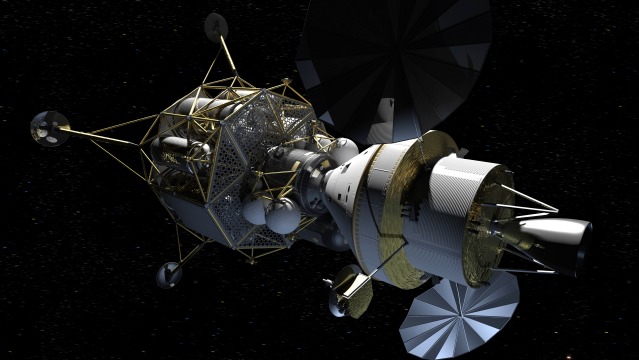
Orion and Altair: architecture envisioned within NASA in 2007, before Congress, acting on the recommendation the Obama administration, eliminated research and development for surface expeditions on the Moon and on Mars. Along with operations in Cislunar space or retrieving an asteroid NASA's leadership today proposes robotic exploration of the martian surface and of Phobos controlled from Mars orbit [NASA/Frassinito & Associates].
"I think most people agree, just because we've done it doesn't mean we can't do it again," Palazzo said.
Palazzo's district is home to Stennis Space Center, a rocket testing site that Palazzo said employs more than 4,000 workers.
But with limited funding for NASA, it will be harder for Palazzo and other supporters of a lunar mission to win support, said Stephen Rozman, a political scientist at Tougaloo College in Mississippi.
"They're going to have to show a real reason for rebuilding or taking the program to the next level right now," he said.
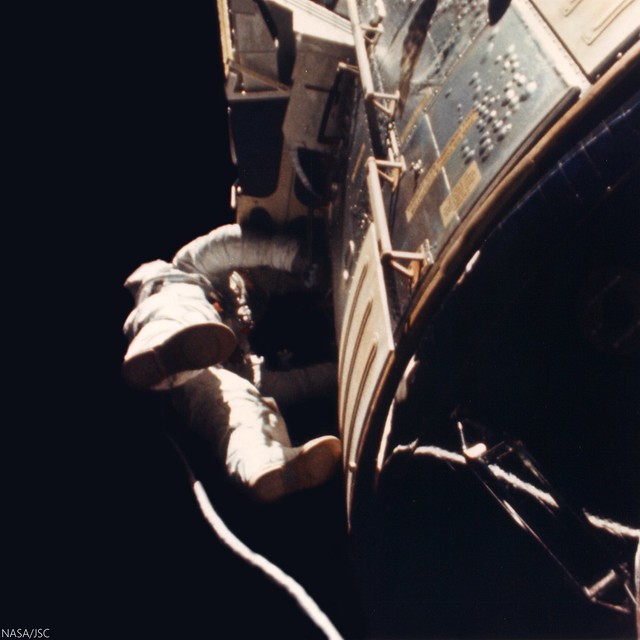
Brief walk in Deep Space: Apollo 15 command module pilot Al Worden leaves the confines of Endeavour for the first time in ten days, to retrieve film and data from the SIMS bay of the service module. The 39 minute spacewalk, August 5, 1971, took place as spacecraft, crew and cargo (including 77 kg of lunar samples) were steadily accelerating toward high-speed reentry and splashdown 30 hours later [NASA/JSC].
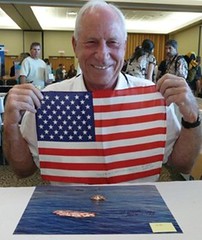
Apollo 15 command module pilot Al Worden, with one of the controversial souvenir flags flown with 1971 mission.
Cornelia Borrmann
Deutsche Welle
DW: What comes to mind when you see the moon at night?
Alfred M. Worden: Well, it's been more than 43 years since I was there. And I think if you go anywhere, 43 years later those memories are pretty dim in your mind, and it's pretty hard to recapture that. But I will tell you - if the moon is right, and particularly if I have some young people with me, I use it as a training tool to get them excited about astronomy. So I do use the moon, but don't just look at the moon and philosophize about what I did.
You witnessed magic moments of manned space flight - the Apollo era. How was it?
Every single person who worked on the program had one goal in mind: Get the guys on the moon and bring them back safely. There was no bureaucracy. If we had a problem, we sat around a table, we discussed it, and we decided then what to do. We listened to everybody. And then we gave an opinion. And we got through a lot of technical issues very quickly and came to the right conclusions, because everybody came together at the work level.
Nobody was trying to improve their position or ensure that their position did not go away. We did not have any managers that were jockeying for position to go higher. Everybody tried to do what was right to go to moon.
New ESA video, an excellent, if not quite comprehensive, overview of a possible future history of lunar exploration, the Agency's present vision of an ambitious future.
The store of our knowledge of the Moon grew exponentially in the wake of America's brief but still lingering commitment to the Vision for Space Exploration (2004-2009), without which the LCROSS, LRO, LADEE and GRAIL missions would not have been funded.
A planned Russian return to the lunar surface may benefit from a post- Fobos-Grunt shakeout.
Aram Ter-Ghazaryan
Special to Russia Beyond the Headlines
As part of the Federal Space Program, Moon exploration operations will be launched in 2016. In 2018 the first spacecraft will be sent to the Moon to deliver comet material back to Earth.
A manned flight is scheduled for 2030-2031. Future plans include the mining of rare earth metals required for the development of high-tech industries.
Scientists from the Russian Academy of Sciences, the Moscow State University Sternberg Astronomical Institute and the Russian Federal Space Agency are participating in this Moon exploration project.
The first spacecraft to be sent to the Moon will be relatively simple. According to Vladislav Shevchenko, the Sternberg Institute’s Head of the Department of Lunar and Planetary Research, this is because the Russian space program has not carried out a Moon landing for over 40 years.
“The last Luna-24 launch was carried out in 1976. The current spacecraft, Luna-25, is a lot lighter than its predecessor, as its main mission is to bring back ice from the lunar south pole,” Shevchenko said. According to him, the south pole was chosen because according to satellite data, it houses the largest reserves of frozen volatile gases found in comets.
Read the full article at Russia Beyond the Headlines, HERE.
The last direct sample of the Moon returned to Earth was retrieved by the Soviet Union's Luna 24 robotic lander on August 18, 1976 (in total darkness). The vehicle landed on the rim of this 64 meter-wide crater on the southeastern plains of Mare Crisium (12.717°N, 62.222°E) and the Lunar Reconnaissance Orbiter (LRO) LROC Narrow Angle Cameras (NAC) imaged the lander's descent stage (lower left) on November 2, 2011, from only 25.57 km overhead. LROC NAC M174868307L, LRO orbit 10904, resolution 43 cm per pixel [NASA/GSFC/Arizona State University].
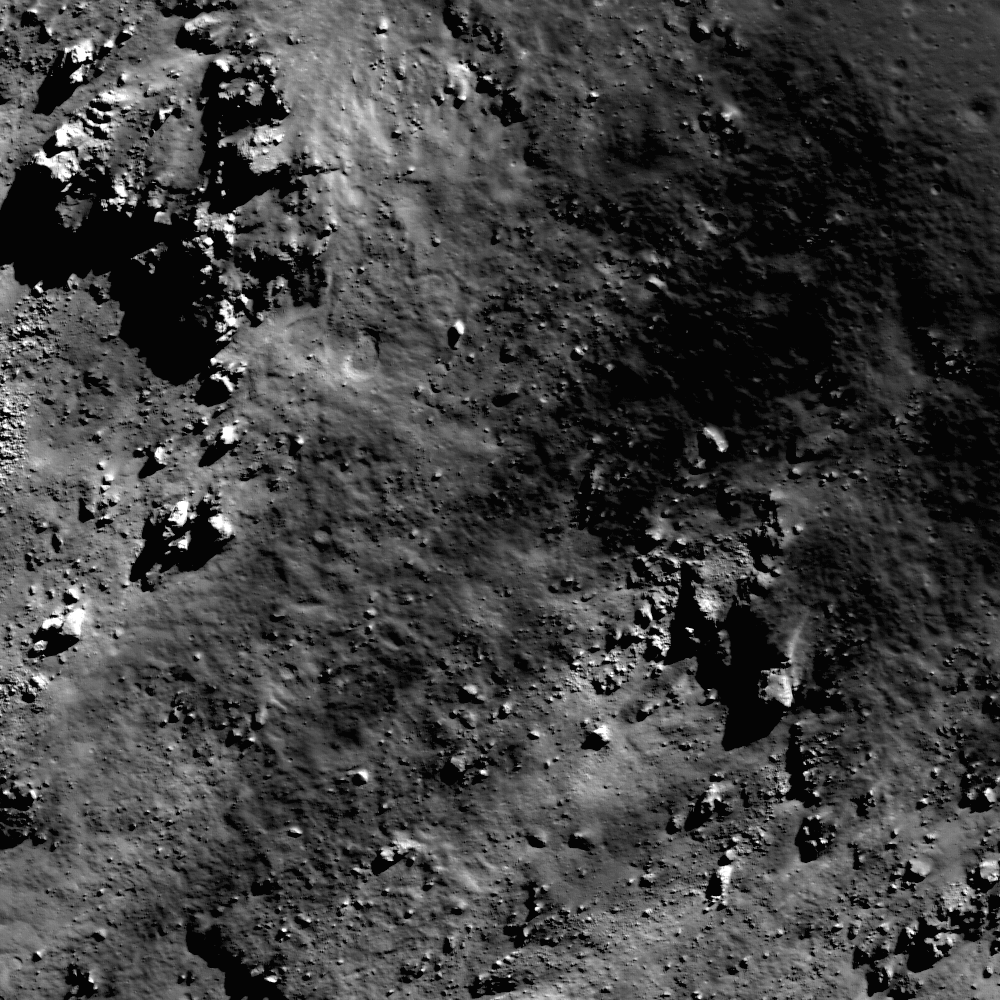
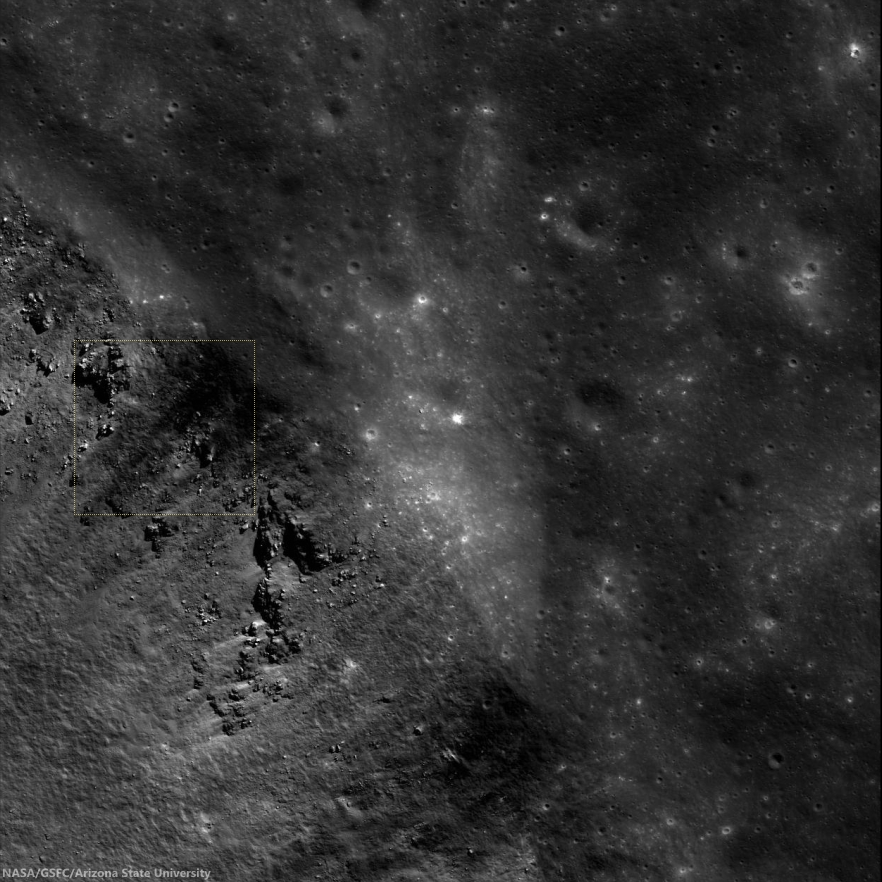
Low reflectance material cascaded down the wall of what is likely a volcanic vent in the southwestern portion of the Orientale basin. Image field of view approximately 750 meters, from LROC NAC observation M1150135366, LROC orbit 21493, March 22, 2014; incidence 37.45° resolution 77 cm from 75.55 km over 30.12°S, 262.19° [NASA/GSFC/Arizona State University].
H. Meyer
LROC News System
Pyroclastic deposits on the Moon are often identified by a mantled appearance and low reflectance. These deposits are the result of an explosive eruption (or many) that involved a volatile component, likely carbon monoxide. The resulting fine-grained debris, including glass beads like those sampled by Apollo 17, gives the surface a dark, mantled appearance (See WAC image below).
So, where did the low reflectance material come from? The low reflectance material here flowed down the wall of a kidney-shaped (reniform) depression located at the center of the annulus.
Expanded 3.8 km-wide context for LROC Featured Image released April 15, 2014 - outlined box - northwestern rim of pyroclastic vent, southern frontier Mare Orientale impact basin. Mosaic of left and right frames of LROC NAC observation M1150135366 [NASA/GSFC/Arizona State University].
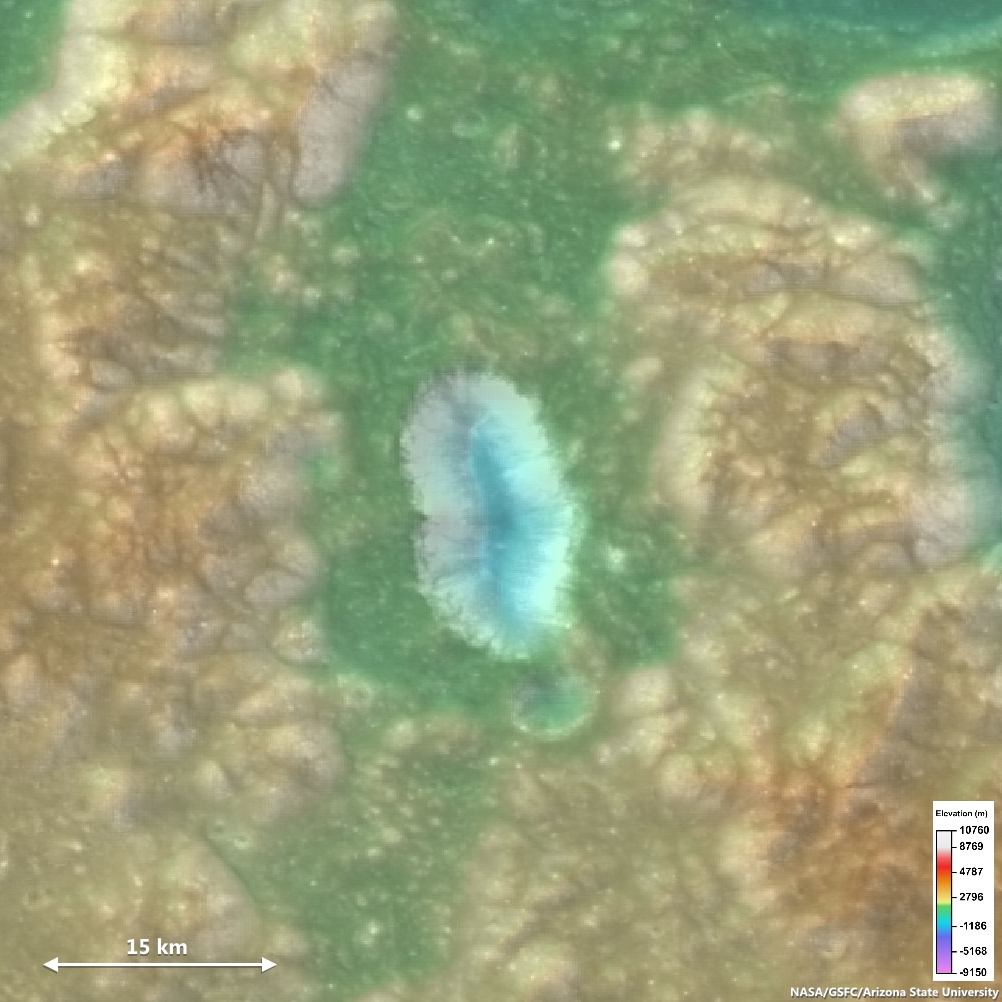
The lack of a discernible crater rim and irregular shape make this depression a suspect (See WAC image below). The walls of the depression are steep-sloped, yet the floor is fairly flat, which is best observed in a color-shaded digital terrain model (DTM). Such reniform depressions are observed in other locations across the Moon, such as Sulpicius Gallus, interpreted to be a pyroclastic source vent.
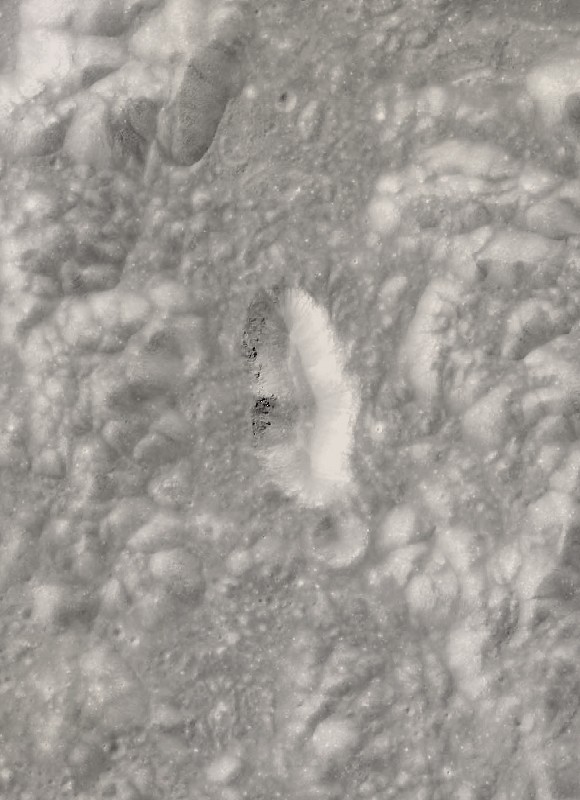
A higher angle of incidence, in this 2.8 x 7.5 km-wide field of view, washes out much of the finer grain albedo, though a look at the larger 40 percent -3760 x 9920- reproduction does reveal much of the detail of the rim, walls, boulder trails and debris-filled floor of the two-kilometer deep "smoke ring vent." The area of interest on the upper right, also in the LROC Featured Image can be compared. LROC NAC mosaic of the left and right frames of observation M1099502843, LRO orbit 14378, August 13, 2012; illumination incidence angle 45° at 76 cm per pixel resolution, from 72.13 km over 30.11°S, 261.81°E [NASA/GSFC/Arizona State University].
If the kidney-shaped depression is the source of the low reflectance material, it is likely that material was ejected from the source vent at high velocity, creating an umbrella-shaped plume and depositing the dark, fine-grained material in a ring around the vent.
The larger than lunar average - 12.5 x 19.75 km pyroclastic "smoke ring vent," on the southwestern frontier of the Mare Orientale impact basin, is also hub to a regionally distinct 190 km-in diameter ring of darker material that, while not apparent in topographic studies, stands out in all native reflectance photography. Medium resolution Chang'e-2 Global albedo Mosaic [CNSA/CLEP].
Pyroclastic deposits are currently of interest to lunar scientists as a possible resource for future missions to the Moon. Such deposits are rich in hydrogen and helium-3, two potential resources for energy production, and iron and titanium, which have engineering applications.
Elevation study, LROC WAC-derived GLD100 topography in color-coded overlay onto LROC global normalized reflectance data. The high mountains of the concentric Orientale impact basin ring, where the vent is nested, offers a high vantage. Elevations range over 4000 meters in 10 km [NASA/GSFC/Arizona State University].
LROC WAC normalized reflectance 643 nm, of the low-reflectance pyroclastic annulus on the southwest Orientale impact basin. The annulus is approximately 180 km in diameter [NASA/GSFC/Arizona State University].
The necessary capabilities for utilizing resources such as these in-situ, or on site, are currently under development. In-situ resource utilization (ISRU) is critical to the future of exploration of areas that would otherwise be beyond our reach, both physically and financially.
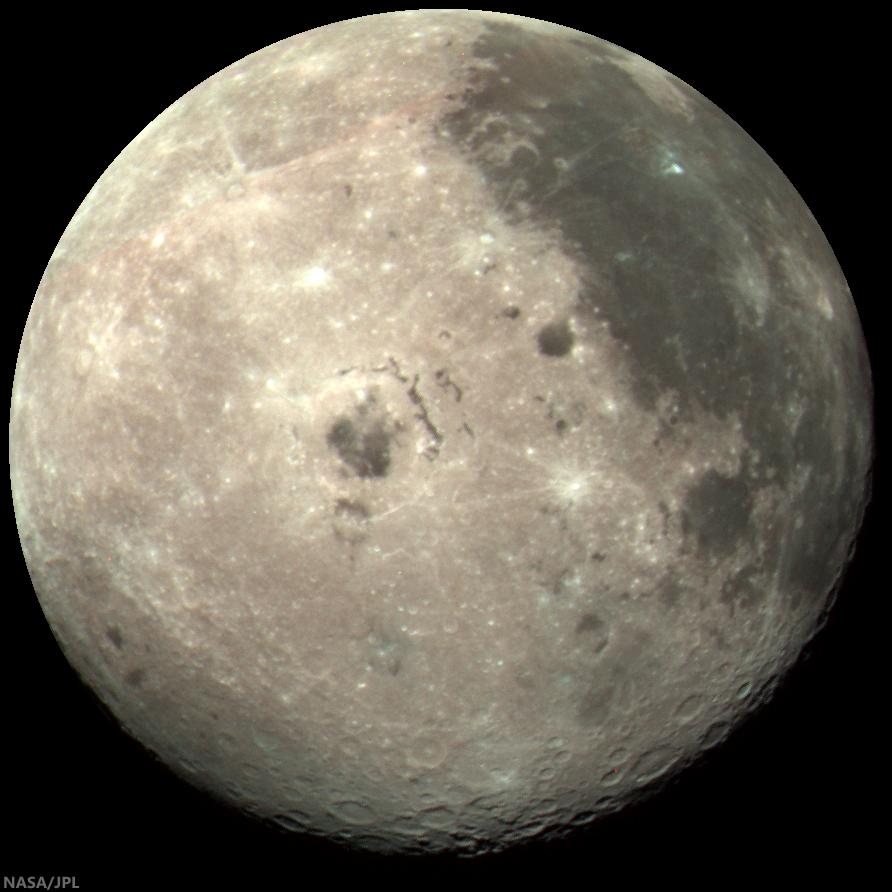
Another opportunity to display this stacked three-color image of the Moon's western hemisphere, which features Mare Orientale so prominently and demonstrates that the pyroclastic annulus south-southwest of its central plain, is large and prominent enough to be photographed from more than half a million kilometers away. In this case, captured by the Jovian probe Galileo at 1735 UT, December 9, 1990 [NASA/JPL].
Do some investigating of your own with the full NAC, HERE.
"Perhaps the biggest obstacle towards charting a course back to the Moon, is the ‘been there, done that’ mentality that is very popular among many within the space community, in and out of NASA. This view, also shared by the space agency’s current leadership, has caused much controversy among space advocates ever since it was expressed by President Obama during a speech at the Kennedy Space Center in 2010. Elon Musk, CEO of the highly successful Space Exploration Technologies Corporation or SpaceX, echoed NASA’s current stance on the matter, during a recent interview: “The next step is to maybe send people beyond low Earth orbit to a loop around the Moon, possibly land on the Moon — although I’m not super interested in the Moon personally, because obviously we’ve done that and we know we can — but maybe just to prove the capability.”
"Maybe the best answer to this viewpoint has been given by the late Neil Armstrong, during a testimony on the House Committee on Science and Technology in 2010. “Some question why "America should return to the Moon”, Armstrong said during his testimony. “After all,” they say, “we have already been there.” I find that mystifying. It ‘s as if 16th Century monarchs proclaimed that “We need not go to the New World, we have already been there.” Or if President Thomas Jefferson announced in 1808 that Americans “need not go west of the Mississippi, because Lewis and Clark have already been there.”"
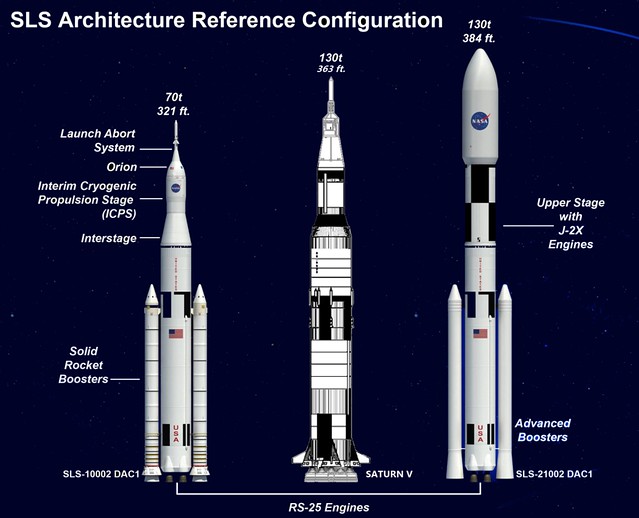
All trussed up, with nowhere to go? NASA's Space Launch System (SLS) heavy-lift launcher compared with the Saturn V used to send Apollo to the Moon, forty years ago.
Anthony Young
The Space Review
For the first time in nearly half a century, the United States will, in a matter of a few years, have the launch capability to send crewed spacecraft to the Moon. The launch vehicle that could make that possible is the Space Launch System (SLS). However, while the Moon was once a goal of exploration under the Vision for Space Exploration and Project Constellation, much further destinations are currently under consideration by NASA.
There have been several incisive articles in The Space Review against the SLS, primarily against the cost of its development and projected operation. Even the former deputy administrator of NASA, Lori Garver, has now publicly come out against the SLS, stating the launch vehicle design embraces decades-old propulsion technology (which it does) and that America can do better.
For better or worse, the heavy lift launch vehicle in America’s future will be the SLS. There is, as yet, no funded mandate—that is, program—to send crews to a near Earth asteroid, and the cost of mounting a crewed mission to Mars would give the Congressional Budget Office fits. Funding for such programs are for future congressional hearings to debate.
Under NASA’s website heading “Human Spaceflight Missions” is the subheading “Future Exploration Plans” with the following items: Asteroid Redirect Initiative, Commercial Space, Orion Crew Vehicle, and Space Launch System. Only the first item is a mission: the remaining three are not. You will not find a definitive mission goal for the SLS, only nebulous statements about taking astronauts deeper into space than ever before.
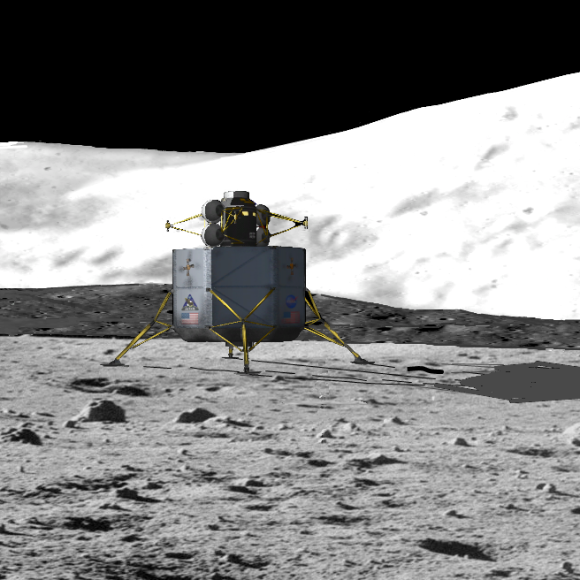
The Constellation Altair lunar lander (as conceived in 2010) After the scrubbing of the Constellation program, the only vehicle still missing from it renamed replacements was a manned landing vehicle, along with plans for "extended human activity on the Moon."
NASA also has an impressive science website. The tabs to go to specific pages regarding the space agency’s primary scientific thrust. They are (bypassing the Big Questions tab) Earth, Heliophysics, Planets, Astrophysics, Missions, Technology, and Science News. Conspicuously absent is a tab for the Moon. It is only under the Heliophysics tab one finds information related to lunar scientific exploration, in the form of a 2007 report titled “Heliophysics Science and the Moon: Potential Solar and Space Physics Science for Lunar Exploration.”
However, prior to this heliophysics-centric publication, the National Research Council (NRC) published “The Scientific Context for Exploration of the Moon”. The interim report was published in 2006 and the final report was released in 2007. It laid out the scientific rationale for the resumption of exploration of the Moon. There have, in fact, been many such strategy documents published over the decades since the end of Apollo by NASA, the NRC, and other organizations supportive of America’s return to the Moon.
It is clear, judging from the above-mentioned websites and documents, the current emphasis for scientific exploration is focused on the Sun, the Earth, and the planets, with seemingly cursory attention to the Moon. However, with the development of the SLS, the Moon may yet come back into favor.
Effective utilization of lunar resources may require an international regime to avoid potential conflicts and maximize the return on investment [NASA].
Vid Beldavs
The Space Review
While much has been learned about the Moon over the decades since the beginning of spaceflight, understanding of its potential resource wealth is incomplete and the technologies to exploit those resources remain to be developed. Now with China, Russia, and the US demonstrating the ability to land and operate on the Moon, and with ESA, India, Japan, and others developing such abilities, it is becoming increasingly clear that capabilities to exploit the resources of the Moon can be developed. Furthermore, the discovery of water in the lunar polar regions, near elevations in permanent sunshine, has led to the development of specific plans for the exploitation of the water resources for fuel for transportation operations in cislunar space, notably by Paul Spudis.
The obvious high value of the Moon’s water resources creates a basis for international competition—a Moon Race—and potential conflict. The necessity of an international regime for the exploitation of the natural resources of the Moon is likely to become an urgent matter for all spacefaring powers. The development of an effective international regime for the exploitation of the Moon’s resources would benefit from a thorough, internationally coordinated study of those resources and from the development of necessary technologies and governance mechanisms for their exploitation including funding for this purpose. What is proposed is an “International Lunar Decade” to study lunar resources and to develop capabilities for exploiting such resources with the following goals:
Remote-operated demonstration of in situ resource utilization (ISRU), believed to be a necessary prelude to mining the Moon and gaining a true foothold in space. Should the artist's notional decals have been those of the Peoples Republic of China? [Pat Rawlings].
Much of the mass we launch for space missions is what I call “dumb mass” – heavy things like water and fuel that, while absolutely necessary, contain low amounts of information. Regardless of launch costs, there is no virtue in launching this type of mass from Earth. Learning to use what we find in space to create new capabilities is a skill that we must master to become “space faring.” The Moon is in an excellent location relative to Earth; it is a well-stocked laboratory where we can learn and hone these skills.
Press coverage since the December 14 soft landing of China’s Chang’E 3 on the Moon has quoted officials of the Chinese space program as stating their interest is in “mining” the Moon. The desired commodity usually bandied about is 3He, the light isotope of helium that (in theory) could be used to fuel a “clean” nuclear fusion reaction and generate electrical power here on Earth. Other possible lunar products mentioned in passing include metals such as titanium and aluminum. But what exactly is meant when we talk about “mining” the Moon? What materials on the lunar surface are useful and thus valuable? Perhaps the term “useful” needs some exposition.
Mining merely means the extraction of some useful product from a planet. In the context of extraterrestrial mining, useful might mean useful in space, not necessarily useful to import back to the Earth. For example, right now, there are abundant terrestrial supplies of aluminum. It makes no economic sense to mine aluminum from the Moon or some other space object for import back to Earth. However, if we’re in the process of establishing a permanent presence on some extraterrestrial object, several tons of aluminum from local sources might be very handy. While no one would suggest exporting simple, low-processing materials such as bulk soil (regolith) and aggregate (concrete and adobe) back to Earth, they have uses and thus enormous value on the Moon and in space for local building and other engineering requirements.
The real value of extraterrestrial mining is accessing material outside of Earth’s gravity well and making products that enable and create new capabilities in space and on other worlds. So far, we have not found any deposits of unknown materials in space that cannot be found on Earth (the “unobtainium” beloved of science fiction writers). But we have found deposits of common materials that, while having no economic value for return to Earth, have enormous value in space. Anything that we can find and use on another world means that much less material that has to be launched from the surface of the Earth. With launch costs of many thousands of dollars per pound, every bit of mass that we can find and use in space is that much less budget-busting dumb mass hauled up from Earth.
I believe that the real game-changer for mining the planets is water. This most common of substances is the most valuable commodity in space because it has so many uses. Water is attractive because it is easily transportable in solid or liquid form, but it is massive and thus, expensive to move around in space. Most of the uses of water in space will probably happen close to the sources from which we extract it, either on the planetary surface or in the space just above and near them.
[Karnik]
Water is required for life in general and in particular, for human life here and in space. We can drink the water, use it to reconstitute dehydrated food, use it for thermal ballast, and protect ourselves from the hard radiation environment of deep space by jacketing spacecraft and habitats with it. Water is a simple molecule (H2O) and can be broken into its constituent elements by the process of passing an electrical current through it; we can thus easily “crack” water into its components (hydrogen and oxygen) and store these gases for later use. The obvious use for this oxygen is to provide breathable air for space habitats. But additionally, because the water cracking process is reversible, we can take these gases and combine them in fuel cells to create electricity. This makes for a fascinating possibility; during the day, we can crack water into hydrogen and oxygen using electrical power derived from solar panels and store these products in tanks. During times when the Sun is not visible (either night on a planet or during eclipse in space), we can re-combine these gases to generate electrical power. Such a device is called a rechargeable fuel cell (RFC) and can provide continuous electrical power for space vehicles and habitats. Thus, water becomes a medium for energy storage, being broken apart during daylight and recombined during the night, allowing for continuous and reliable power in space. The valuable by-product of this process is excess water for life-support and other uses.
The last major use of water is probably the most important in terms of creating new capabilities in space. When water is broken into its constituent gases and then frozen into liquid (cryogenic form), it becomes rocket fuel. Liquid hydrogen and oxygen are the most powerful chemical propellant known. The ability to make rocket fuel in space changes almost everything we know about the economics of spaceflight. Because of its high cost, anything that we can do to lower the required mass launched from Earth saves money and makes spaceflight more capable. In the case of missions beyond low Earth orbit, most of the mass of the Earth departure vehicle is fuel. For a human Mars mission, more than 80% of its total mass is propellant. Most of that propellant will be used in the rocket burn to leave Earth. Thus, by obtaining the required propellant from a space-based source and refueling there, the total lift-off weight (cost) from Earth is much lower.
Although hydrogen-oxygen is the most powerful rocket propellant, its use does have some drawbacks. Hydrogen has a very low boiling point, only about 20° above absolute zero (-253° C). This extremely low temperature is difficult to generate (i.e., power intensive) so making cryogenic hydrogen is a tough proposition. Moreover, hydrogen has an extremely low density, so storage tanks for liquid hydrogen are very large and bulky and must be carefully insulated to minimize the “boil-off” of the fuel. Boil-off is an important problem that must be solved if we are to use space-derived cryogens for propellant; it involves capturing the boiling vapor and condensing it back into liquid form again to prevent its loss to space.
Some argue that since hydrogen is so volatile and difficult to work with, we should focus solely on obtaining oxygen from planetary sources as that gas is 16/18ths (89%) of the mass of water. Producing liquid oxygen (boiling point of -183° C) is much easier than liquid hydrogen and it is more easily handled and stored. However, we would still need some type of fuel to burn with this oxidizer; a variety of other substances could be used for rocket fuel, including methane (CH4), ammonia (NH3), sulfur (S) and even powered aluminum (Al). Interestingly and fortunately for us, all of these substances are found in the deposits of the lunar poles – the most valuable real estate in our Solar System with peaks of near-constant sunlight for power generation.
The real value created by mining the Moon (or any extraterrestrial object) is capability – the ability to move more freely, more often and with more mass in and about cislunar (Earth-Moon) space where most of our national security and economic satellites reside. By creating an off-planet supply depot, we free ourselves from the tyranny of the rocket equation. I don’t know if the Chinese see the “problem” this way or not. But they should. I believe that eventually, they will. And so must we.
The Chinese do not appear to be waiting for “magic beans” to lower launch costs. There are many reasons to believe that those costs have already fallen about as much as they will, barring some major new launch vehicle paradigm. By holding back and betting on some major new launch breakthrough materializing, the United States could be walking away from a sure thing – leaving the innovation and technology field, and with it the economic and national security benefits that will follow, to countries who recognize the strategic value and potential of the Moon and are already making plans to tap into it.
Originally published December 27, 2013 at his Smithsonian Air & Space blogThe Once and Future Moon, Dr. Spudis is a senior staff scientist at the Lunar and Planetary Institute. The opinions expressed are those of the author but are better informed than average.
The 50th anniversary of the tragic death of President John F. Kennedy has prompted examination of his presidential legacies and in particular, the role he played in our race to the Moon. In an op-ed, Rand Simberg opines on how space buffs magnify and distort Kennedy’s space legacy – that in fact, JFK really didn’t care one whit for spaceflight and only challenged the Soviets to a Moon race for near-term, earthly political purposes.
No one conversant with the history of the Apollo program could seriously doubt that the impetus for setting the goal of a lunar landing within a decade was driven primarily by geopolitical considerations, rather than by a romantic notion of colonizing the Solar System. But there’s a bit more to the story. Simberg’s piece fails to recognize that close, hands-on experience with the unfamiliar often changes attitudes and that prejudices evolve over time.
Upon taking office, Kennedy had little interest in the space program but like Eisenhower with Sputnik, intervening events abruptly forced a change in his outlook. In April 1961 Yuri Gagarin orbited the Earth – the first flight of a human in space – engulfing Kennedy in a press feeding frenzy as a triumphant Soviet Union laid claim to one of the most important laurels of the space age. With recriminations still echoing throughout Washington, a second national security disaster emerged – the Bay of Pigs fiasco, a failed invasion of Cuba by American-sponsored anti-Castro exiles. The new administration appeared both inept and indecisive. The Gagarin space flight and the U.S.-backed invasion of Cuba occurred during the build-up of a devastating nuclear arsenal by the Soviet Union, amid bellicose pronouncements from its bombastic leader, Nikita Sergeivich Khrushchev – “We will bury you!”
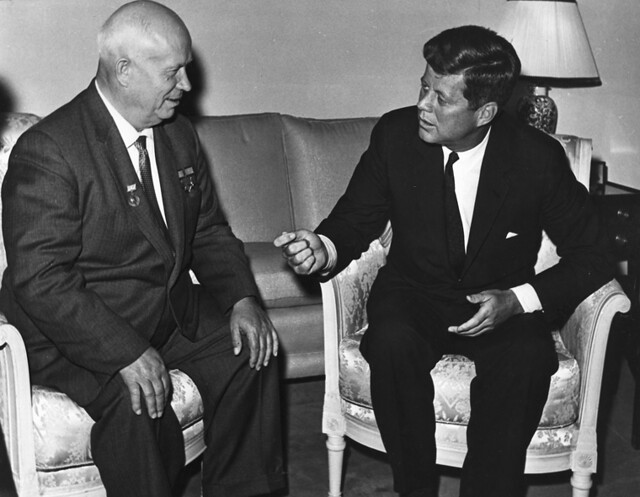
June 3, 1961 - only two months following the Gagarin's pioneering orbital flight, and less than a month after Alan Shepard's 15 minute suborbital ride, President John Kennedy meets with Soviet Chairman Nikita Khrushchev at the U. S. Embassy residence, Vienna, Austria [Deptartment of State/John Fitzgerald Kennedy Library, Boston].
Against this high-temperature political background, Kennedy looked for a significant technical project with which to challenge the Soviets. Kennedy thought that the large-scale desalination of seawater would help win the hearts of emerging “Third World” nations. A key consideration was choosing an effort that the Soviets could not win in the next few years. True enough, space was not his original choice but in order to give the United States enough time to build up and use its industrial and technical might (as well as provide payback on politically realistic timescales), Kennedy needed a challenging long-term national goal.
By assigning his Vice-President Lyndon Baines Johnson to look into possible space projects and report back to him, Kennedy had placed the decision in the hands of someone already committed to an accelerated and vigorous space effort. As Senate Majority Leader, Johnson – a vocal advocate for large-scale space projects – had previously helped shepherd the 1958 Space Act (that created NASA) though the Congress. It was Johnson who asked NASA’s James Webb and Hugh Dryden for options.
In a memo to Johnson, Kennedy specifically asked, “Is there a space program we can undertake and win?” With Johnson’s committee working closely with Wernher von Braun on what was technically possible in the near- and far-terms, it became apparent that the Soviets had a clear advantage in rocket boosters, making any attempt to match Soviet space accomplishments in low Earth orbit within the next few years likely to fail. On the other hand, if the U.S. were to pick a goal which neither country could achieve in the near-term, America’s edge in technology and resources might give them enough of an advantage to win in the long run – making it a real race.
A manned mission to the Moon emerged as the logical goal and was duly reported to the President. Kennedy was willing but hesitant – initial cost estimates for Apollo were on the order of $40 billion (this was in a saner fiscal era, when a billion dollars meant real money). Committing to spend that much, while not unprecedented, would give politicians of any stripe pause. Nonetheless, Kennedy moved forward with the Moon landing challenge, announcing his initiative in a special Joint Session of Congress on May 25, 1961.
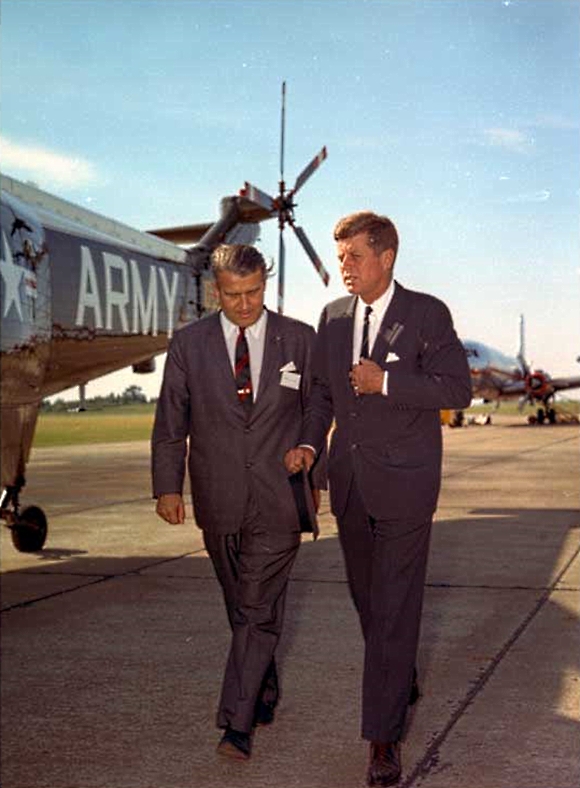
So we now have a picture of a U.S. President, due to political circumstances, forced into and agreeing to a program he was reluctant to undertake. According to Simberg’s piece, this is the meaning of Apollo. What’s missing is that (as they like to say in Washington) Kennedy “evolved” in his beliefs. While initially willing (but cool) to the space program, his continued attention to “the race” over the remainder of his presidency suggests that he became more keenly interested over time. Kennedy, often guided by von Braun who would brief him on technical details, made multiple visits to the new NASA field centers. Kennedy became a “buff” – just like so many of us in the 1960s, drawn up in the excitement of the new space effort. Enthralled by events like a static firing test of Saturn engines at the Marshall Space Flight Center in May of 1963, he began soaking up space knowledge. He was hooked and in it to win it.
Kennedy’s speech at Rice University on September 12, 1962 has become inextricably tied to the American can-do spirit and cited whenever someone wants to capture the inherent romanticism and steely determination of the American effort. Apollo was not some tiresome political task or a pork-shoveling boondoggle to JFK. It was about winning a battle in a very real Cold War. It is in this context that President Kennedy’s September 1963 offer to go to the Moon jointly with the Russians must be understood. Yet, part of a speech given at the United Nations, has been interpreted to show that Kennedy was ambivalent toward space and was attempting to dodge the heavy political and fiscal costs of building the Apollo system. This notion has led some to surmise that had he lived, Kennedy would not have been as ardent a supporter of the space program as we space cadets believe that he was.
John Kennedy's seminal remarks at Rice University, Houston, Texas, September 12, 1962. It was this speech where, many believe, the 35th President succeeded in placing manned spaceflight in historic and definitively American context. "We choose to go to the Moon," he said, "and do the other things, not because they are easy, but because they are hard. Because that goal will serve to organize and measure the best of our energies and skills. Because that challenge is one we are willing to accept, one we are unwilling to postpone, and one we intend to win."
Words were effective weapons during the Cold War. At every opportunity, Kennedy contrasted the open, non-military nature of the American space program with the secretive and presumably bellicose nature of the Soviet one.
This contrast was made explicit in Kennedy’s initial rationale for the lunar effort when he said, “Whatever mankind must undertake, free men must fully share” (emphasis added). By 1963, Kennedy knew Khrushchev’s mind-set as well as any foreign leader. He knew that Khrushchev and the rest of the Soviet Presidium would never accept a proposal for a joint lunar mission – they were suspicious, paranoid triumphalists, as their never-ending blitz of space propaganda illustrated. Moreover, at this stage of the space race, the Soviets were clearly ahead, having racked up a number of headline-grabbing “firsts” including simultaneous multiple crews and spacecraft, four-day long missions, and orbiting the first woman in space, Valentina Tereshkova.
By making an offer for a joint American-Soviet lunar mission, Kennedy appeared reasonable and forthcoming. “See? America has nothing but peaceful intentions for space. If our Soviet colleagues have similar intentions, as they claim, why do they not join us when we ask them to?” Jack Kennedy, a decorated World War II veteran and the consummate Cold Warrior, knew how to play the propaganda card. His offer did not represent a desire to back away from his U.S. commitment to space. It was a calculated move by the United States in the ongoing war of words, threats and confrontations that constituted the Cold War.
It’s tempting to retrospectively apply today’s intellectual template to past events, but by doing so it distorts the historical record. A look at Kennedy’s approach to the Soviet Union shows that his inclination was to confront them when necessary. The Bay of Pigs fiasco early in his presidency followed by the Berlin crisis led Kennedy to believe that Khrushchev and the Soviets must be opposed on the world stage, up to and including space. Initially cool to the very idea of human spaceflight, Kennedy took the concept to new heights of accomplishment by setting – and ultimately achieving – a goal that captured the imaginations of war-weary people around the world.
Originally published November 24, 2013 at his Smithsonian Air & Space blog The Once and Future Moon, Dr. Spudis is a senior staff scientist at the Lunar and Planetary Institute. The opinions expressed are those of the author but are better informed than average.
An interesting report in the Washington Post relates that the current Mars rover Curiosity (MSL) has found no evidence for methane on that planet, a finding that contradicts some earlier reports of the presence of that gas in the martian atmosphere. The report goes on to say that this finding “disappointed” some members of the Curiosity science team. Supposedly after earlier studies detected methane in telescopic spectra, they had “high hopes” for a positive result from the Curiosity rover.
Various reactions to this revelation are interesting, as they suggest something about the current mania for the search for extraterrestrial life, as well as something about the ultimate rationale for our national space program.
Mars Orbiter Mission (MOM), subsequently launched successfully November 5, under preparation for a prelaunch test at the ISRO Satish Dhawan Space Centre, SHAR, at Srihairkota [ISRO].
Whence comes this obsession and why does it drive our space efforts and dominate space news coverage? Science fiction dreams have long been a part of the space effort, with many working in the field receiving their first exposure to space topics via that medium played out in print, film and video. From bug-eyed Martians invading the Earth to slimy, acid-dripping killers stowed away aboard spacecraft, the obsession with extraterrestrial life took firm hold of the human imagination.
This sense of fascination is so strong that space advocates have tried to harness it as a way to justify (if not coerce) increased amounts of spending on the civil space program. After the end of the Apollo program, with its clearly geopolitical goals accomplished, the space program needed a new long-term rationale, one that would ensure its continuation over many years. Carl Sagan, an astronomer fascinated by the possibility of life on other worlds, emerged as the principal spokesman for the idea that searching for ET was the “true and good” rationale for exploring space. The dominant theme of his television series Cosmos was the vastness of the universe with endless possibilities for finding life “out there.” For a public television program, it was a huge hit (but to keep some perspective, in 1980 when the series first aired, it did not crack even the top thirty, which included such fare as Dallas, The Dukes of Hazard, and The Love Boat).
Seeking to justify federal spending on space, the Quest for Life Elsewhere (QFLE, as I shall call it) was enthusiastically adopted by the scientific community. As a slogan it was catchy, but effectively got nowhere in terms of policy influence until 1996, with the discovery of what was claimed to be bacterial microfossils in ALHA 84001 (a meteorite that on the basis of several lines of evidence, we believe comes from Mars). This rock has tiny features that resemble fossil bacteria as seen in Earth rocks. This discovery was considered sensational at the time and even resulted in a nationally televised Rose Garden statement by the President of the United States. More significantly for policy, the Mars scientific community parleyed that discovery into a program series of robotic missions, each one increasingly more ambitious (read: expensive) to be sent to Mars over the coming decade(s). This mission series was established outside the agency’s traditional lines of mission proposal and accountability systems and became (in effect), an “entitlement” for the Mars science community and JPL, who possesses the agency monopoly on missions to Mars.
A series of increasingly sophisticated spacecraft were then sent to Mars over the next few years, each one finding that the planet at one time had liquid water at or near its surface and that the climate of the planet has changed, perhaps many times, over the course of its history. But no evidence of extant or former life has been found. As portrayed in the article, this latest finding is another dashing of the “hopes” of the Mars scientists. Funny – I always thought that the job of the scientist was to describe the universe as it is and how it works, not to “hope” for a confirmation of one’s preferred hypothesis (gained through the eyes of a machine afforded almost human-like adoration).
Which brings us to my point above about the use of QFLE as a rationale for the American civil space program.
Seasonal, or at least periodic, remote detection of Methane in the tenuous martian atmosphere may be evidence of biotic activity [ESA].
The goal of adopting such a rationale is to ensure an enduring, long-term space exploration program. From a practical perspective, the danger of using QFLE as the primary goal for space is that if you do not find life, you’ve essentially failed and have probably written your programmatic obituary. To date, the Mars science community has pled for a verdict of incomplete – we simply have not yet gone to the correct place with the correct tools and techniques to verify what they “hope” to find. If this rationalization works, Mars exploration becomes an endless program – we can always say this, no matter wherever we go on Mars and whatever we find. In fact, the problem with that rationale is that such pleading may backfire. When most people think of alien life, they have images of ET in mind, not pond scum. If the public understood that’s what we are really looking for, I suspect that a lot of the support for this crusade would quickly dissipate (I believe much of it has already).
My objection to using the QFLE as a rationale for space is on a more philosophical level. Even if you finally do find martian microbes, what have you proven? There are virtually no modern scientists who do not (to some degree) subscribe to the materialist paradigm of life’s origins, in which given the right compositions, energy and environment, life will naturally arise and evolve. This is what scientists believe about the Earth and they most certainly believe it about other planets. So if we finally do find Mars microbes, either ancient or existing, all we would have done is to prove something that most scientists believe now anyway. The stridency of many scientists in their obsession to obtain “proof” of extraterrestrial life seems like other agendas are at work here, which I pass over without comment.
In science, new findings come all the time and it is highly likely that this “negative” result will soon be countered by some new and compelling “evidence” to the contrary. I think that a long-range strategic rationale to explore and use the Solar System requires re-thinking. A space program needs to return societal value for its cost. I believe that there is abundant value in making our near-term goal the creation of a flexible and permanent system that opens up space for many different and varied uses. Making the space program a Quest for Life Elsewhere is a prescription for failure and ultimately, termination..
Originally published September 24, 2013 at his Smithsonian Air & Space blog The Once and Future Moon, Dr. Spudis is a senior staff scientist at the Lunar and Planetary Institute. The opinions expressed are those of the author but are better informed than average.
Dark Ages Radio Explorer (DARE), utilizing the radio-quiet of the lunar
farside to explore the earliest period on the cosmic time line, 200
million years between the primordial Big Bang and the emergence of the
earliest luminous sources and the structure of the present universe. "The lunar Farside is potentially the only site in the inner solar system for high precision radio cosmology.” [NLSI].
The Moon is a unique platform from and on which to conduct astrophysical measurements. The Lunar University Network for Astrophysics Research (LUNAR) and the Center for Lunar Origins and Evolution (CLOE) teams within the NASA Lunar Science Institute (NLSI) are illustrating how the Moon can be used as a platform to advance important goals in astrophysics. Of relevance to Astrophysics and aligned with NASA strategic goals, all three of the primary research themes articulated by New Worlds, New Horizons in Astronomy & Astrophysics are being addressed by LUNAR and CLOE, namely Probing Cosmic Dawn, Understanding New Worlds, and Physics of the Universe
Capt. Gene Cernan, USN (Ret.), at the beginning of the third and final EVA of Apollo 17, December 13, 1972 [NASA/Harrison Schmitt].
I. A. Crawford, et al*. Accepted for publication in a forthcoming Special Issue of Planetary and Space Science on "Scientific Preparations for Lunar Exploration"
The lunar geological record has much to tell us about the earliest history of the Solar System, the origin and evolution of the Earth-Moon system, the geological evolution of rocky planets, and the near-Earth cosmic environment throughout Solar System history. In addition, the lunar surface offers outstanding opportunities for research in astronomy, astrobiology, fundamental physics, life sciences and human physiology and medicine. This paper provides an interdisciplinary review of outstanding lunar science objectives in all of these different areas. It is concluded that addressing them satisfactorily will require an end to the 40-year hiatus of lunar surface exploration, and the placing of new scientific instruments on, and the return of additional samples from, the surface of the Moon. Some of these objectives can be achieved robotically (e.g. through targeted sample return, the deployment of geophysical networks, and the placing of antennas on the lunar surface to form radio telescopes). However, in the longer term, most of these scientific objectives would benefit significantly from renewed human operations on the lunar surface. For these reasons it is highly desirable that current plans for renewed robotic surface exploration of the Moon are developed in the context of a future human lunar exploration program, such as that proposed by the recently formulated Global Exploration Roadmap.
Sunflower solar panel-powered architecture, featuring the LER, Athlete and Chariot vehicles, that were well along in development before Congress and the Obama administration shelved the Constellation program [NASA/John Frassanito & Associates].
Two years ago, the Obama Administration changed the direction of the nation’s human spaceflight programs in a number of ways, including the destinations of those efforts. Gone was the goal of the previous administration of a human return to the Moon by 2020, a date that was looking increasingly unrealistic in the eyes of many, including the Augustine Committee that reviewed NASA’s plans in 2009. In its place was something resembling the “flexible path” approach in that committee’s final report, with the Moon replaced as an initial beyond-Earth destination by a near Earth asteroid. President Obama established a 2025 goal for a human mission to an asteroid in a speech at the Kennedy Space Center in April 2010, also setting a goal of a human mission to Mars in the mid-2030s.
From a technical standpoint, a human mission to a near Earth asteroid could be done solely by the United States given both existing capabilities and those under development, like the Orion spacecraft and Space Launch System heavy-lift rocket. Yet, from a financial standpoint, particular in an era of constrained and even declining budgets, it’s likely the US will seek international partners for an asteroid mission, and almost certainly for later missions to Mars. But do the potential partners of the US also want to participate in human asteroid missions?
The recent Global Space Exploration Conference, or GLEX, held in Washington, DC last month by the American Institute of Aeronautics and Astronautics (AIAA) and the International Astronautical Federation (IAF), offered some mixed messages about international interest in human asteroid missions. Some space agency executives instead spoke openly about going back to the Moon, comments that have some support among former NASA officials who believe that human lunar exploration will have greater support internationally.
Perhaps the boldest endorsement of the Moon, and not near Earth asteroids, as the next destination for human exploration came from Vladimir Popovkin, general director of the Russian space agency Roscosmos. Speaking at a plenary session at GLEX on May 22 that featured the leaders or other top officials of six space agencies, Popovkin suggested the Moon, and not the asteroids, was the preferred destination of the Russian space program.
“We arrived at the conclusion that the Moon is supposed to be the next target” for human exploration, Popovkin said through an interpreter. “We’re not trying to convince you that we shouldn’t be doing anything in the area of Mars exploration, asteroid exploration, just that, in our professional opinion, today we have much better chances to come up with very productive and tangible results when concentrating on the Moon.”
A lunar base creates new capabilities [Pat Rawlings/SAIC].
Paul D. Spudis The Once and Future Moon Smithsonian Air & Space
Where does the Moon fit into plans for future human space exploration? From reading the space media, you might get the idea that the very notion is dead and buried, killed by President Obama’s casual dismissal of the idea in a speech over two years ago at NASA’s Kennedy Space Center, followed this year by Mitt Romney’s dismissive remarks on the Moon during the Republican primaries.
Nevertheless, many in the international community (and in the United States) are keeping the lunar flame alive for a variety of reasons, not the least among them being that it is understood that politicians aren’t rocket scientists – nor should we expect them to be.
The Global Exploration Conference (GLEX) held last month in Washington DC was remarkable for the fact that most of our international space partners are proceeding with plans for lunar return as though its abandonment had never occurred. The Russians were particularly eager to express their desire to establish capability on the Moon at the meeting, while in recent months strong interest in permanent lunar return has been expressed by the Europeans, Canada, India, Japan and of course, China. Moreover, unlike many within our own national space agency, the world sees the Moon not simply as a box to be checked-off on the way to Mars but as the enabling asset for space exploration. As Vladimir Popovkin, head of the Russian Federal Space Agency Roscosmos put it, “It’s a new Moon,” pointing out that the recently confirmed discovery of water at the poles of the Moon enables sustainable, permanent habitation of that body and the creation of new capabilities for voyages to the planets.
Our international space partners believe that spaceflight beyond LEO should entail incremental steps that will gradually extend reach and capability. Once such a paradigm is adopted, expensive designer missions to plant a flag or do a “touch-and-go” at an asteroid are seen as having limited value and making no economic sense. On the other hand, the gradual expansion beyond LEO using nearby assets builds a permanent, lasting space faring capability. The Moon fits into such a scheme by virtue of both its proximity and usefulness. In the absence of some technical miracle, such as the discovery of new physics that fundamentally change the nature of spaceflight, we are wedded to rocket technology for the foreseeable future. The rocket equation dictates that it will remain difficult and expensive to reach space and operate there. Given such problems, some now recognize and conclude that the Moon offers provisioning capability and for this reason and many others, is a desirable destination and near-term goal.
Our pioneering (and current) model of space access requires launching everything from Earth’s surface, taking months to complete a mission, yet gathering minimal information (due to limited time in the vicinity of its designated target) and leaving no lasting or reusable infrastructure in space. This template guarantees that human spaceflights will be infrequent, expensive and subject to abrupt cancellation due to political whims. If one views the civil space program primarily as an annoying expenditure whose ambitions must be constrained by making a previously small portion of the program (such as “commercial” launch services) the raison d’être of the entire effort and deferring any real goals to an indefinite and nebulous future, our current path might seem completely reasonable. However, it appears that the international community believes that space is a real theater of human endeavor and their goal is to make it part of their domain and utility – until recently, also a goal of the American space program. Perhaps it still is.
Despite common perception, the Moon has not been officially abandoned as a goal for the United States space program. The current NASA Authorization Act of 2010 lays out the goals and approaches to be followed by the agency in executing its mission. The Findings by the Congress (section 301) outlines the rationale and goals of the space agency’s human exploration efforts. As I have written previously, in the seven points dealing with future agency activities, cislunar space is mentioned in four and the lunar surface is called out twice as destinations. Development of the ability to use the in situ resources of space to create infrastructure is specifically cited in Sec. 301a (4). The entire section 301 is worth a careful reading. It calls for a program that uses a gradual, incremental approach to the extension of human reach in space beyond LEO, specifically specifying both commercial and international participation. There is nothing in the current law that is at odds with the plans and desires of the international community as expressed at the recent GLEX meeting. The only place one reads about the Moon being abandoned as a national goal for America is in the press and such cases, it is always in the context of a single off-hand remark in one Presidential speech.
From the perspective of two years later, that off-hand remark sounds increasingly ill thought-out and hollow. Given its context in the speech, the statement seems to derive from the idea that lunar return must perforce be a repeat of the Apollo experience of 30 years ago. NASA itself has fed this idea, depicting the return to the Moon as the equivalent of a Gemini program within the Apollo-to-Mars fixation of many in the agency. In their 2006 preliminary plans for lunar return, NASA started out properly by describing the development of an outpost at one of the poles of the Moon and emphasizing human presence and development, but over the next few years architectural studies increasingly drifted away from an outpost and towards the sortie concept, in which we would stage (entirely from Earth) and execute one-off missions to sites of scientific interest all over the Moon for visits of limited duration. Such an exploration approach dissipates assets and thus increases costs and reduces surface capability and infrastructure. It was this exploratory approach to lunar return that the Augustine committee evaluated and declared to be “unaffordable,” not the concept of building a centralized outpost that could support ISRU and space development (an approach that the committee did not even consider).
President Obama signed the NASA Authorization bill of 2010 – a bill crafted when his party controlled Congress – and the findings presented in that bill are now law. So even though the agency and most of the media seem to be blissfully unaware of it, NASA has been charged by Congress to develop space systems capable of conducting missions to and throughout cislunar space, including to the lunar surface. Our international partners agree with this intended direction, convinced that the Moon is the appropriate next destination for humans in space.
NASA’s reluctance to go in this direction, even while other nations are making plans, forfeits the opportunity for our international leadership in space. Our space program has to demonstrate the feasibility of using lunar resources to secure us a place as participants and entrepreneurs in the vast economic future of space.
Originally published at his Smithsonian Air & Space blog The Once and Future Moon, Dr. Spudis is a senior staff scientist at the Lunar and Planetary Institute. The opinions expressed are those of the author and are better informed than average.