Showing posts with label LROC NAC. Show all posts

Thursday, November 7, 2013

Ranger 7: Making an Impact on History

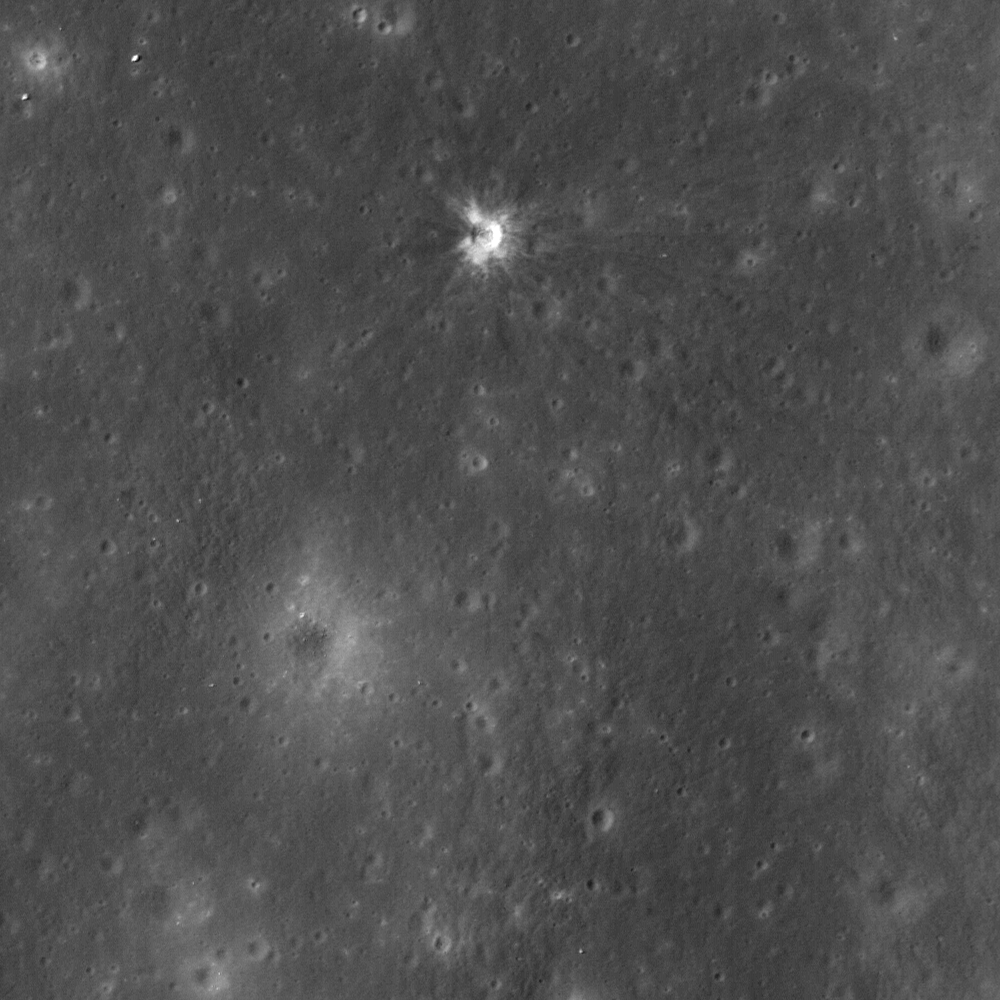
M153014430L-Ranger_7
Impact site of Ranger 7, a 14 meter-wide crater near the center of Mare Cognitum (10.634°S, 20.677°W). 487 meter-wide field of view from LROC Narrow Angle Camera (NAC) observation M153014430L, LRO orbit 7693, February 22, 2011; 33.97° angle of incidence, resolution 49 centimeters per pixel from 42.69 km [NASA/GSFC/Arizona State University].
J. Stopar
LROC News System

On 31 July 1964, Ranger 7 returned the first high resolution images of the Moon specifically collected in preparation for the Apollo lunar landings (1969-1972); the first definitive success of the Ranger program.

Rangers 1 and 2 were test missions in Earth orbit (1961), and Rangers 3 through 6 (1962-1964) were launched on an impact trajectory to the lunar surface. Rangers 3 through 6 were meant to return images of the lunar surface on approach to the Moon and up until the instant of impact, resulting in a suite of images with progressively higher and higher resolution of the lunar surface. However, only Rangers 4 and 6 met their intended target.

Despite this accomplishment, both the Rangers 4 and 6 spacecraft, due to technical problems, failed to collect or return any images leading up to their final destination. Finally, Ranger 7 (1964) was successful! It returned images of an extensively cratered terrain in Mare Cognitum, and this pioneering spacecraft paved the way to our current understanding of the composition and physical properties of the lunar surface. As a result of the images returned by Rangers 7 through 9 (1964-1965), scientists and engineers generally agreed that the lunar surface was safe for the then-upcoming Apollo missions.

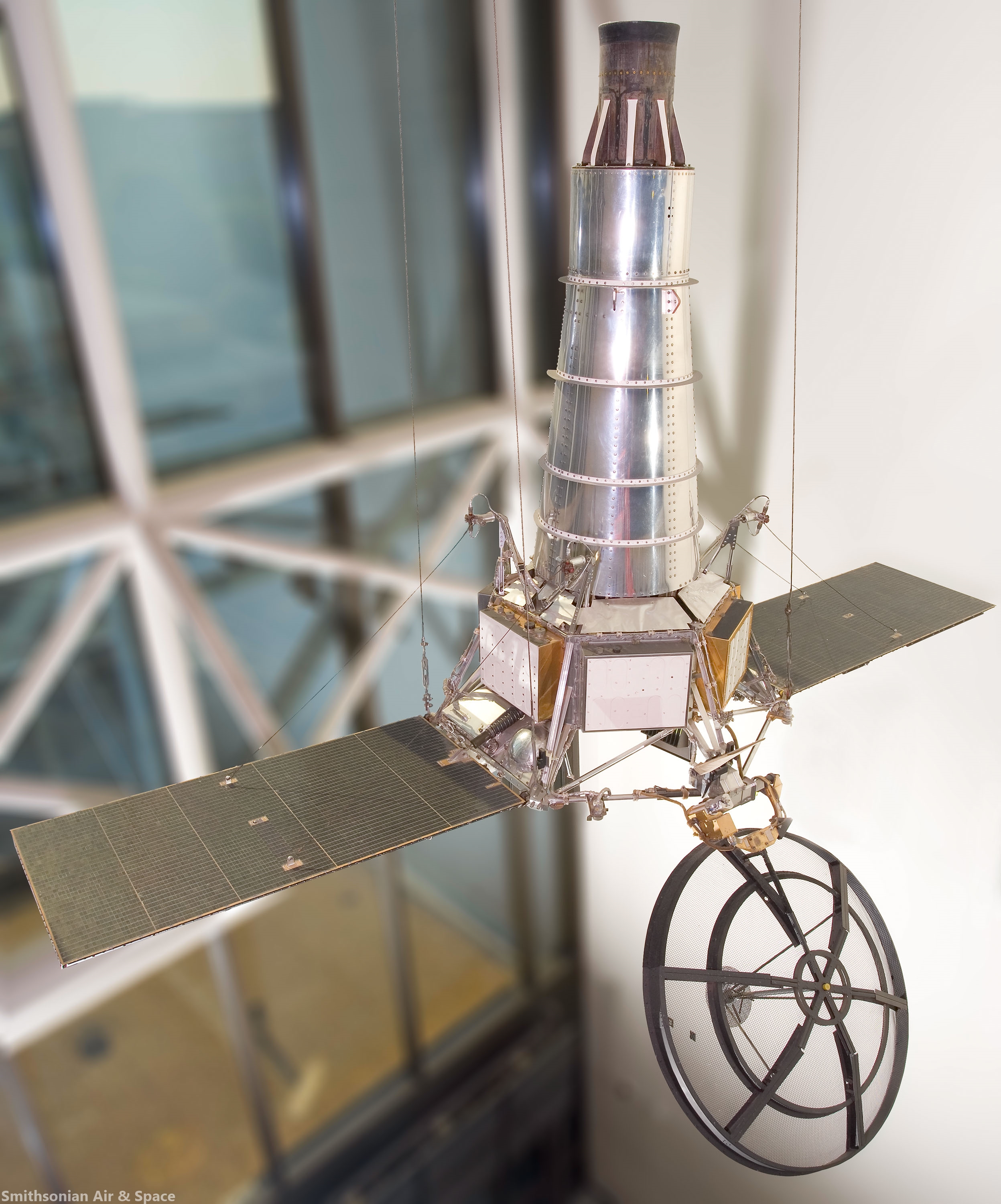
RANGER replica
Replica of Ranger Block III (Rangers 6-9) spacecraft on display at the Smithsonian National Air and Space Museum. The replica spacecraft made of parts from Ranger test vehicles and is about 10 meters tall and 4.5 meters wide  [Smithsonian Air & Space].
Ranger 7 transmitted an image of its impact point in Mare Cognitum seconds before impacting at roughly 2.7 km/s. In 1972, the Apollo 16 orbital panoramic camera captured frame AS16-P-5430 that contained a view of the recently formed Ranger 7 impact crater. The figures below show a portion of this panoramic frame. The full resolution AS16-P-5430 frame can be viewed at the Apollo Image Archive. This panoramic frame allowed observation of Mare Cognitum several years after the Ranger 7 impact, revealing a new crater nearly 14 m in diameter at the exact location of the known Ranger 7 impact! This crater, along with impact craters formed by other early lunar spacecraft such as Ranger 9, are some of the earliest examples of confirmed change detections (the formation of a new feature) on the lunar surface. The details of the Ranger 7 and 9 impact craters were described by Moore in 1972 following analysis of images returned from Apollo 16.

Ranger 7 impact crater as seen in Apollo 16 panoramic camera frame AS16-P-5430 [NASA/JSC/Arizona State University].
Full width (downsampled) Apollo 16 panoramic camera frame AS16-P-5430. Yellow box shows location of Ranger 7 impact crater. North is to the right [NASA/JSC/Arizona State University].
The LROC NAC has now imaged the Ranger 7, 8, and 9 impact craters multiple times at various lighting conditions. These images can be explored in detail on our newly updated Featured Sites page.

Low sun images (below) display the degree to which the mare has been extensively cratered in this part of the Moon. Hartmann (1967) originally interpreted this dense cratering to imply that the mare in this area are more than several billion years old. On the other hand, high sun images (like today's Featured Image at the top of the page) bring out the high reflectance ejecta rays that extend many crater diameters from the impact. The darker rays to the west of the crater are downrange from the known impact direction (roughly 115° east of north). The distribution of rays and their composition provide clues about direction of impact, composition of the subsurface, as well as impactor properties.

Ranger 7 impact crater
The 14 meter-wide impact crater as seen through the high-resolution LRO (LROC) Narrow Angle Camera (NAC) under high-angle (sunset) illumination, the long shadows emphasizing topography over reflectance [NASA/GSFC/Arizona State University].
The Ranger spacecraft all formed small (approximately 15 meters in diameter), roughly circular impact craters. But depending on the impact shape, mass distribution, velocity, and angle of impact, the resulting crater size and morphology vary. For example, the Apollo Saturn V launch stages (S-IVBs) that were intentionally impacted into the lunar surface between 1970 and 1972 were more massive and cylindrical in shape than the Ranger spacecraft (but impacted at a similar velocity), resulting in larger and elongate craters. A new collection of LROC NAC images of the Apollo S-IVB impactors can also be explored on our updated Featured Sites page. A full list of known coordinates of robotic spacecraft, including those that impacted the lunar surface, was also recently updated by the LROC team and can be downloaded and viewed as a map.

Explore the full LROC NAC frame of the Ranger 7 impact site, HERE.

Related Posts:
LROC Coordinates of Robotic Spacecraft 2013 Update (September 25, 2013)
Surveyor Crater, Before and After (July 9, 2013)
Graves of the GRAIL twins (March 19, 2013)
48 years of memories of Alphonsus and Ranger 9 (January 24, 2013)
Ranger 8 impact on digitized LOIRP image (July 31, 2012)
The discarded extension of the Ranger program (April 30, 2012)
"Boy, that sure looks like Luna 9!" (December 3, 2011)
Apollo 13 S-IVB Impact in Apollo seismic recordings (March 22, 2010)
The LCROSS 'Smoking Gun' (November 13, 2009)
LCROSS confirms water on the Moon (November 13, 2009)
When bombing the Moon was a good idea (October 21, 2009)
Apollo 14 S-IVB Impact Crater (October 8, 2009)

Wednesday, June 20, 2012

LROC: "River of Rock"

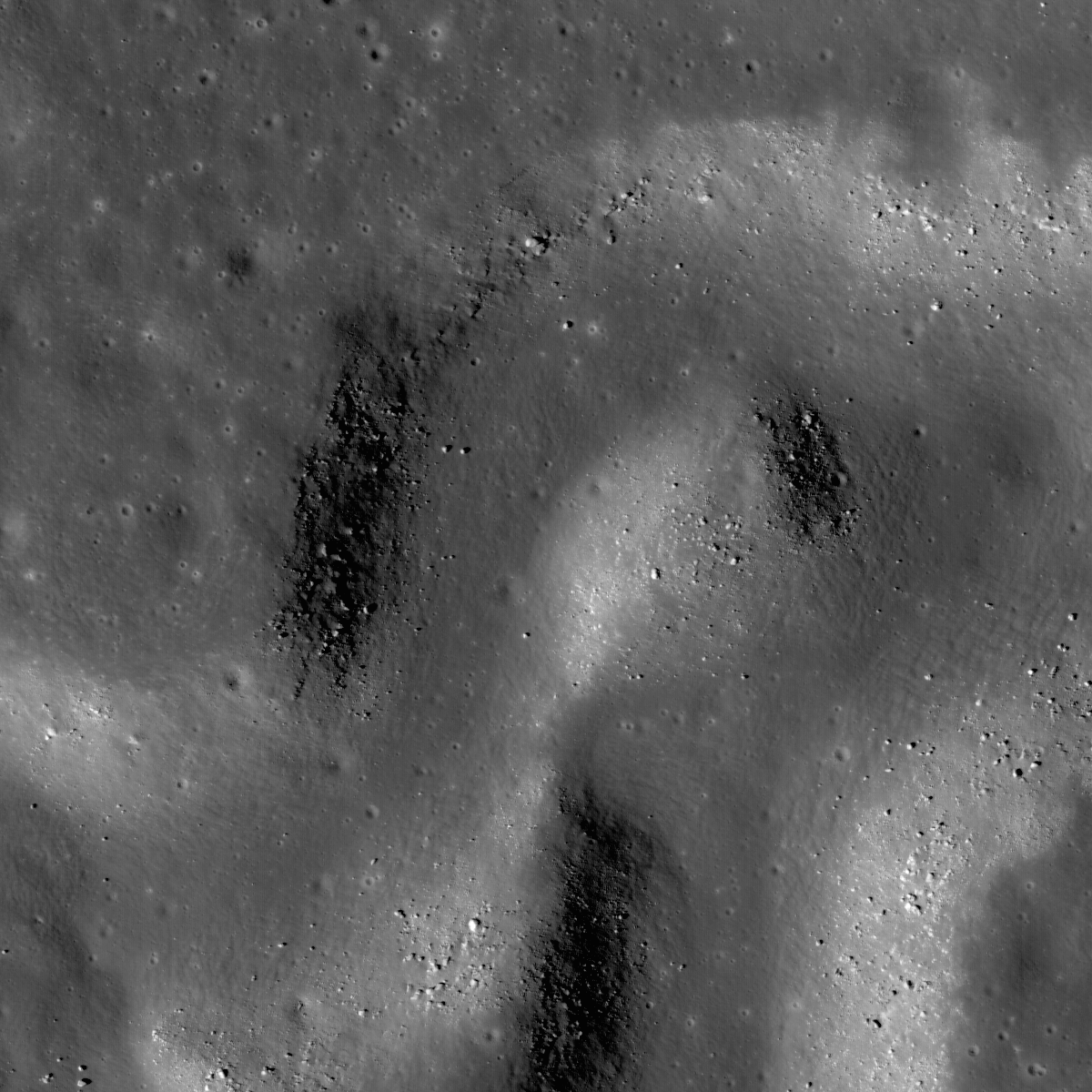
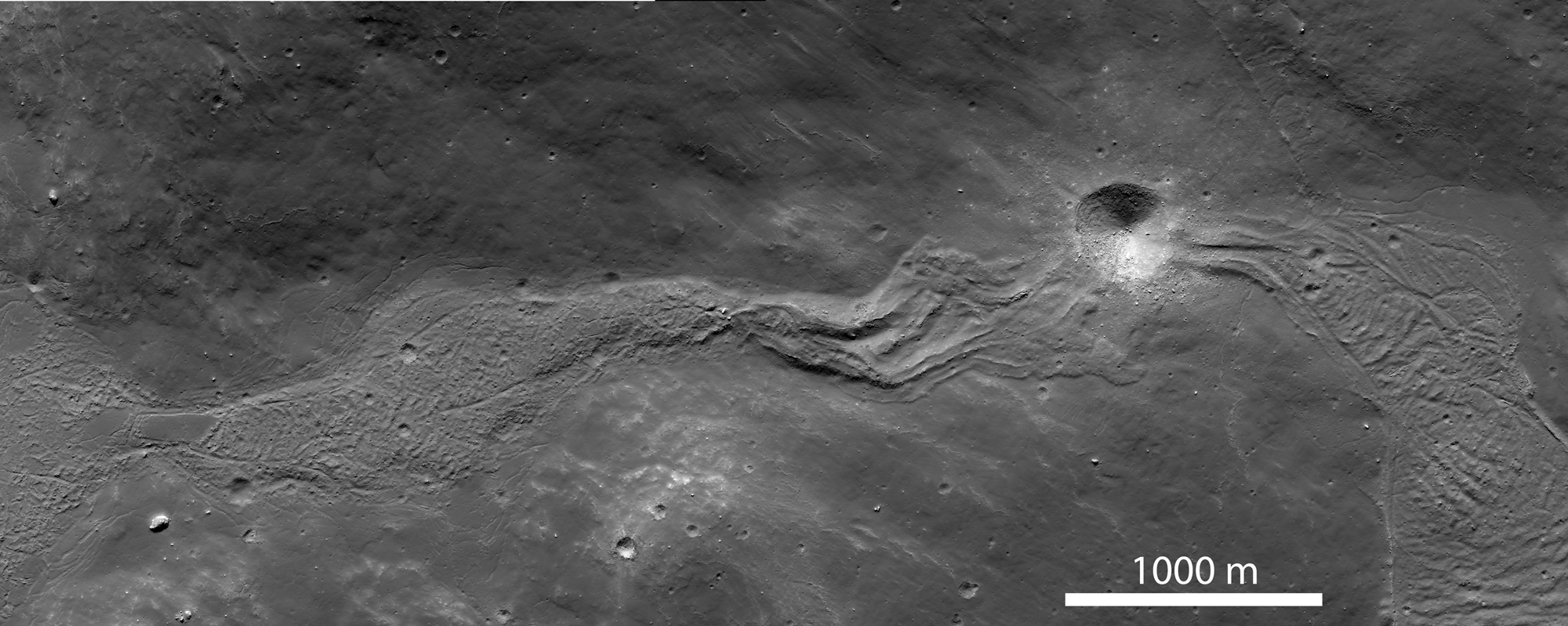
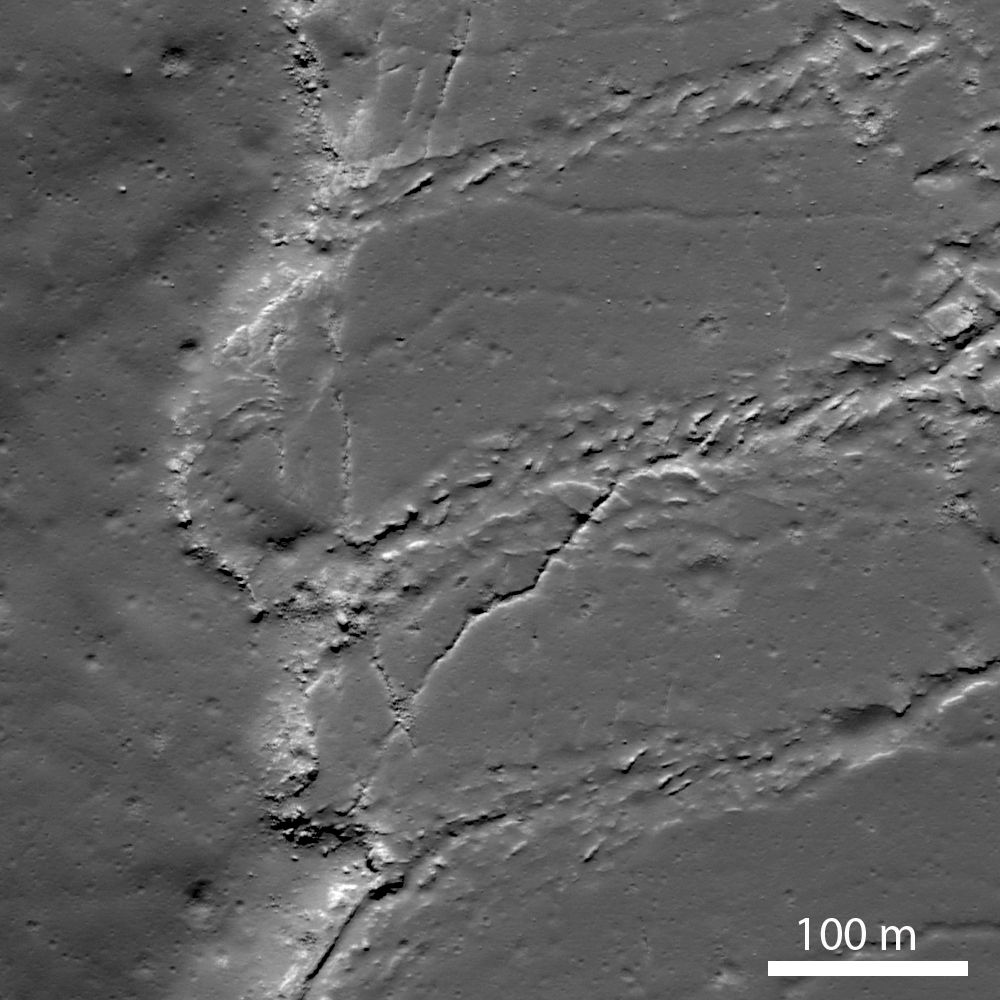
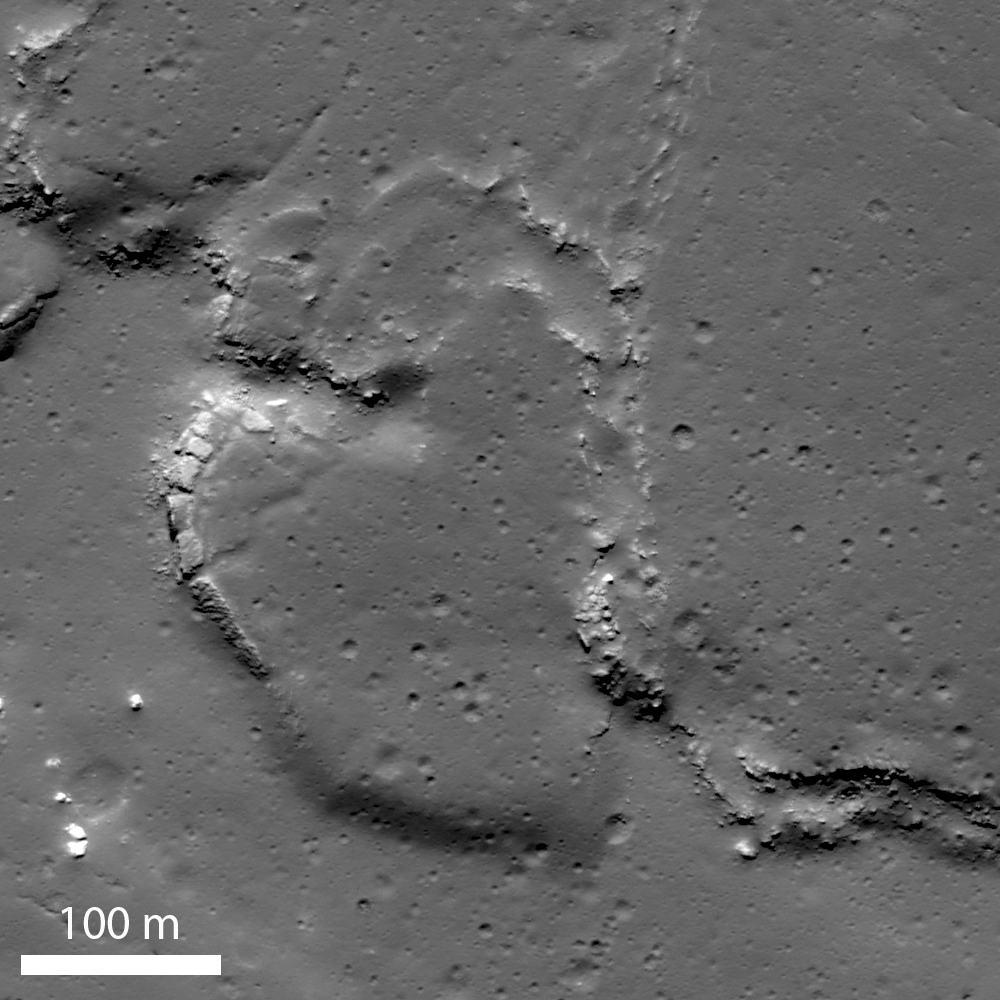
A small section of an enormous, now frozen, river of impact melt that flowed down the southeastern flank of Tycho crater some 108 million years ago. LROC Narrow Angle Camera (NAC) observation M185940195RE, LRO orbit 12480, March 9, 2012; angle of incidence 46.55° at 0.64 meters resolution from 61.72 kilometers. View the full-size 1000 x 1000px LROC Featured Image HERE [NASA/GSFC/Arizona State University].
Jeffrey Plescia
LROC News System

Impact melt is one of most spectacular products of impact cratering events. A comet or asteroid impacts the Moon at 10-60 km/sec, and releases so much energy that it melts a significant amount of the target rock. The larger the projectile, the bigger the crater, and the more melt that is produced. While much of the Tycho impact melt pooled on crater floor, some of it was thrown out of the crater onto the rim. A large mass of impact melt landed on the southeastern rim and flowed down the rim filling low areas and then spilling over and continuing downhill. Between pools, the melt formed narrow flows whose width was controlled by the topography.

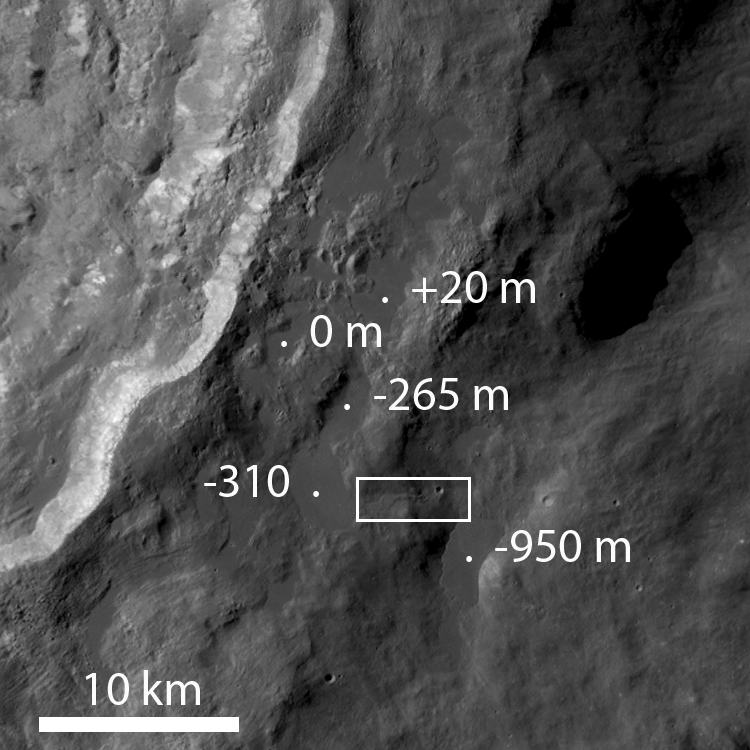
The context image (sub-sampled NAC mosaic) below shows a wider view of the impact melt deposit extending down slope from a high pool (on the left side of the image) at an elevation of about -310 m to a lower pool on the (on the right side of the image) that lies more than 600 m downslope (elevation -950 m). The flow is about 5000 m long; its width ranges from 300 to 700 m and is controlled by the topography of the surrounding hills. The texture of the flow surface and the formation of channels on its eastern end (above and below the crater) is a function of the slope of the underlying surface, and the changes in viscosity of the melt as it cools.

This contextual montage of the corresponding left and right frames of LROC NAC observation M185940195 allows this view of spectacular river of impact melt, now frozen, that briefly flowed down the southeastern flank of Tycho crater. View the spectacular full-size (2000 x 800px) context view HERE [NASA/GSFC/Arizona State University].
Contextual LROC Wide Angle Camera (WAC) image of the various pools and their elevations. Over distances of 10-20 km, the melt flowed down almost a kilometer in elevation. The white box roughly outlines the field of view shown in detail immediately above. LROC WAC observation M177698611C (604nm), orbit 11323, December 5, 2011, illumination from the northeast (upper right) at an 80.34° angle of incidence; 59.83 meters resolution, from 43.7 kilometers. View the original annotated context image HERE [NASA/GSFC/Arizona State University].
The last pool (-950 m elevation) to be filled by this melt flow has well preserved sharp morphologic features that tell scientists much about the history of emplacement. The overall pool is about 4500 meters long by 2100 meters wide.

Context image of the lowest pool of impact melt, showing the locations of higher resolution images below. Cropped with depth distortion from the full size context image accompanying the LROC Featured Image, released June 20, 2012.  From a montage of the corresponding left and right frames from LROC NAC observation M181222542LR, orbit 11820, January 14, 2012; resolution 1.3 meters from 62.98 kilometers, angle of incidence 72.72° [NASA/GSFC/Arizona State University].
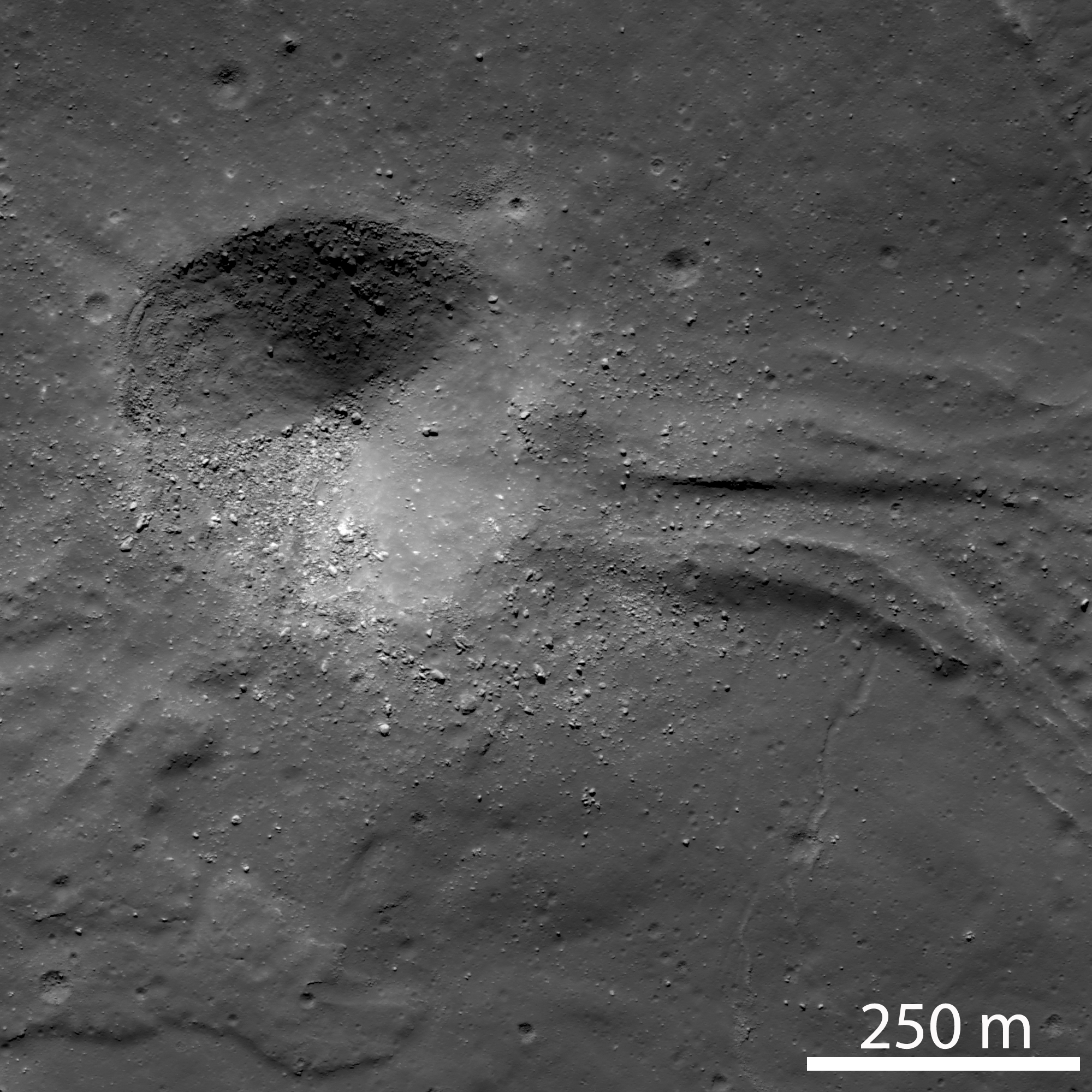
The impact melt flowed (A) eastward down a narrow valley from a higher pool to the west, then draining into and filling a depression at a lower elevation. To the east of the crater, the flow is about 250 m wide and exhibits a well-defined channel with levees about 60 m wide. Farther east the flow broadens into a large pool. Later a 400 m impact crater formed in hardened impact melt ejecting boulders up to 20 meters in diameter. This crater provides a great section through the flow for future geologists roaming about this geologic wonderland!

(A) A 400 meter impact crater obliterated the flow. View the original 2000 x 2000px detail, HERE [NASA/GSFC/Arizona State University].
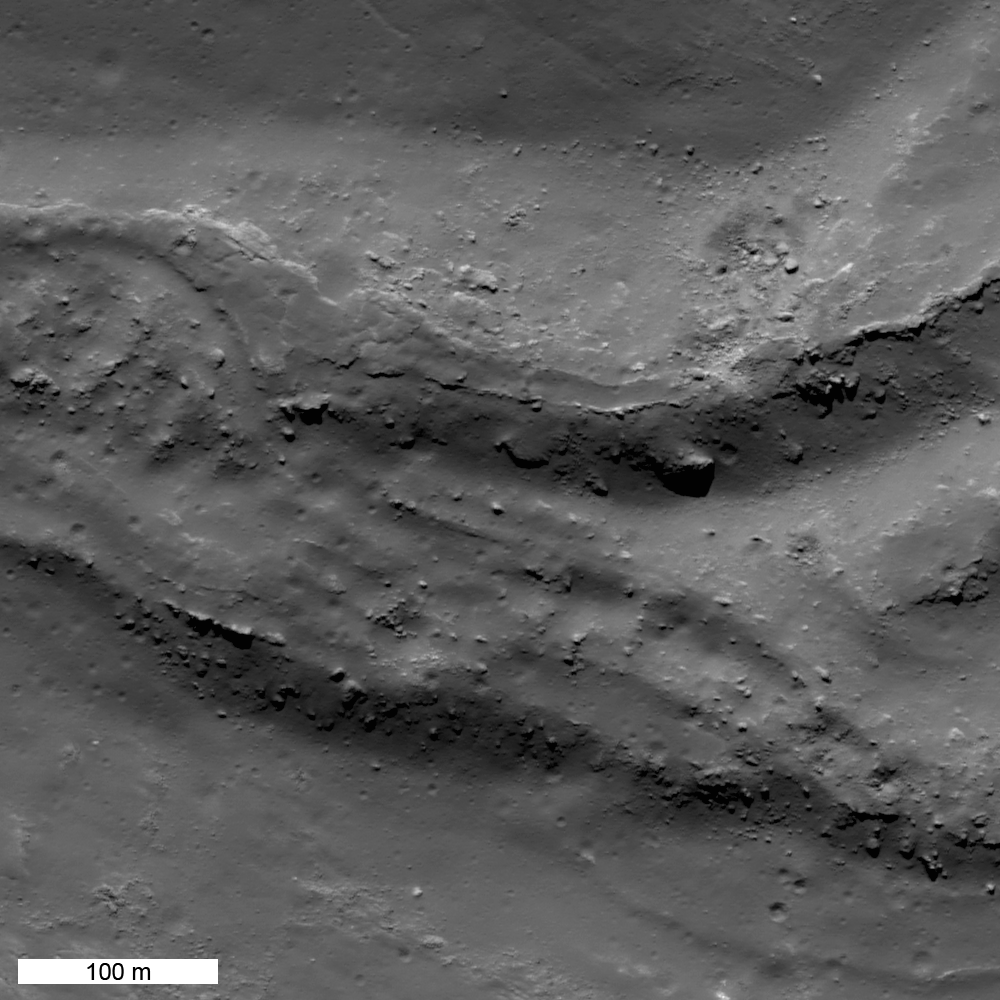
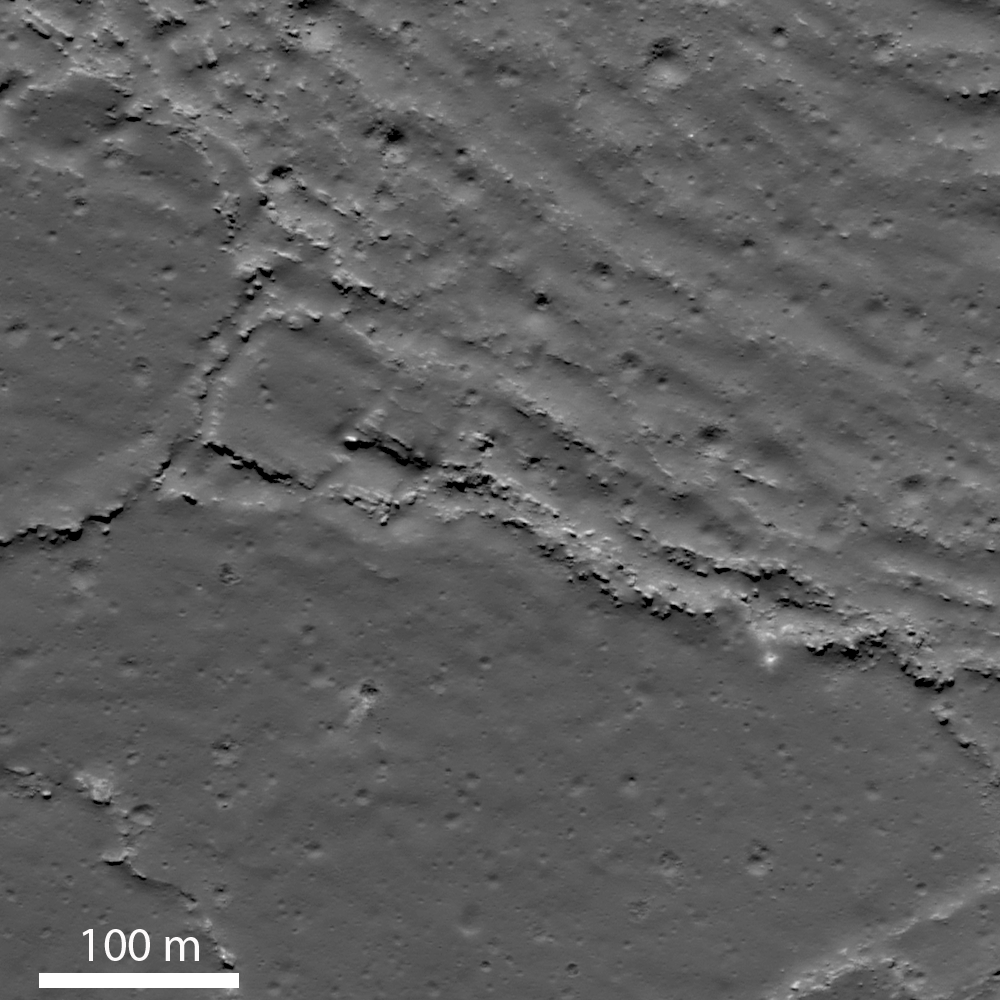
The upper right portion of image (B) shows a wrinkled flow surface with ridges spaced about 30-40 m apart; the lower left portion of the flow has a smooth surface. The two different surfaces suggest that there were different pulses of impact melt entering the pool. An initial pulse formed a relatively smooth surface, then a second pulse of melt entered the pool wrinkling part of the crust. As a crust formed on the cooling melt, continued movement compressed and deformed the surface into the wrinkled texture. Along the ridge crests, the crust has been broken up into slabs.
(B) Wrinkled and platy lava flow surface. View the 1000 x 1000px detail image, HERE [NASA/GSFC/Arizona State University].
The margin of one impact melt pools reveals a fascinating story (right hand side of image [C]). A series of northeast-trending disturbed zones, 25-50 m wide, cut the flow. The zones are likely are shear planes along which differential movement of the flow has occurred. These planes form boundaries between portions of the flow that moved laterally (to the lower left) by different amounts; the shearing movement has broken up the surface crust of the flow into a numerous small blocks. The edge of the flow is marked by a rubble zone.

(C) Shearing along the western margin of the pool. View the 1000 x 1000px detail image, HERE [NASA/GSFC/Arizona State University].
The southern end (D) is defined by a series of small lobes which probably represent breakout of still molten impact melt from the edge of the pool. The edges of the lobes are marked by plates of broken crust which presumably were rafted away from the original edge. The large lobe would have broken out from the end of the pool and flowed and broadened into a lobe about 200 m long and 300 m wide.

(D) Lobate terminus of impact melt pool. View the 1000 x 1000px detail image, HERE [NASA/GSFC/Arizona State University].
Explore the full resolution NAC frame, HERE.

Directly Related:
"Tycho's flash-frozen inferno," November 2, 2011

Related LROC Posts:
View From The Other Side
Tycho Central Peak Spectacular
Chaotic Crater Floor in Tycho
Polygonal Fractures On Tycho Ejecta

Simulated oblique view of the southeastern flank of Tycho, from "Tycho's flash-frozen inferno," a discussion of the stream of impact melt and its cascade down the rim of the 109 million year old relatively recent impact, posted here last November. Jeff Plescia of Arizona State University's Lunar Reconnaissance Orbiter Camera (LROC) science team covers the topic in more recent images and greater detail below [NASA/GSFC/USGS/Arizona State University/Google Earth]

Monday, May 21, 2012

LROC Second Tycho central peak oblique

View from the other side: Summit of Tycho crater central peak seen from west-to-east; the rough material on the floor of the crater in the upper right formed as a massive pool of impact melt solidified. Detail from LROC Narrow Angle Camera (NAC) oblique observation M181286769LR, LRO orbit 11829, January 15, 2012. Explore the full range of this spectacular image HERE [NASA/GSFC/Arizona State University].
Mark Robinson
Principal Investigator
Lunar Reconnaissance Orbiter Camera
Arizona State University

The Lunar Orbiters (1966-1968) photographed Tycho crater in 1966 and 1967 and first revealed the beautiful state of preservation of this ~80 km diameter impact crater. Geologists saw sharp, craggy slopes in the crater walls and central peak, some form of ponded liquid and preserved flows, and a labyrinth of fractures in the rough, flat floor. What liquid flowed and ponded inside and outside the crater? Initially geologists hypothesized that the Tycho impact event triggered an upwelling of lava, and the ponds and flows were frozen volcanic forms.

Later it was determined that the hypothesized volcanic ponds and lakes and flows were indeed related to the formation of the crater, but not as volcanic eruptions of subsurface magma. Rather, they were accumulations of massive amounts of lunar rock that was melted as the Tycho asteroid (or comet) slammed into the Moon and released unimaginable amounts of kinetic energy, in an instant. It was only in 1960 that Gene Shoemaker and colleagues proved that Meteor Crater (aka Barringer crater) near Winslow, Arizona, was formed by an asteroid impact. Thus the idea that many craters on the Moon (and Earth) were formed by impacts was only coming into widespread acceptance at the time of the Lunar Orbiter missions. Today we have a growing catalog of impact melt deposits from many young craters across the face of the Moon.

LROC NAC oblique view of Tycho crater, from the west toward the east, in late afternoon. Tycho crater is ~82 km in diameter and the central peak rises some 2000 meters above the crater floor (LROC NAC M181286769LR - Explore the full range of this spectacular image HERE [NASA/GSFC/Arizona State University].
LROC captured a spectacular oblique view of Tycho's central peak on 10 June 2011 looking east-to-west. In today's Featured Image the view is from the other side, and shows the exterior flanks as well as the crater interior. Many impact melt features are easily seen both inside the crater and on its flanks.

Tycho Central Peak labeled - The small black arrows mark the edge of a darker smooth unit interpreted to be a thin frozen coating of impact melt. The small white arrow indicates a 120 meter boulder discussed in a previously released NAC oblique of Tycho crater [NASA/GSFC/Arizona State University].
Impact melt is sometimes seen as a thin crust on crater walls and peaks. It can be recognized by its lower reflectance, smooth texture that hugs the substrate, and parallel fractures. Much of the central peak was coated in melt (see the figures above and below) and the previous oblique LROC Tycho peak image.

Slosh mark - Small black arrows mark a distinctive shelf - probably formed as puddled impact melt on the crater floor sloshed up the side of the central peak. "F" indicate areas showing parallel fractures in the impact melt crust, LROC NAC M181286769  [NASA/GSFC/Arizona State University].

Above, you can see where smooth impact melt appears to drape over an entire portion of the central peak, and the distinct line where the once-molten impact melt sloshed up the side of the central peak and then drained back to pool on the floor. How did the impact melt coating reach the top of the central peak, which is some 2000 meters (6562 ft) above the crater floor? There are two likely scenarios. First, some amount of impact melt was thrown straight up as the crater was excavated and the central peak was forming. As gravity slowed the flight of the melt it fell back into the crater coating the newly formed peak. A second model involves slumping and collapse of the crater walls. As these large blocks of material slumped into the crater pooled impact in the bottom of the crater was tossed upwards and coated the peak. Less energetic slumps caused waves in the sea of impact melt surrounding the peak, and slosh marks from waves of melt can be seen on the peak and walls of the crater (figure above).

Many of the features are similar to those seen in volcanic flows that pool in low spots of the landscape. How do we know that what we see here isn't volcanic in origin? There are several lines of evidence. First, the locations on top of and coating central the central peaks, on the crater rim, and in ponds on the terraces are consistent with where ejected melt-rock would land, but not with where volcanic eruptions would occur. Second, the composition of the material in this region is that of typical highlands material, inconsistent with all other known lunar volcanic deposits. Finally, the age of the Tycho impact crater is thought to be around 100 million years, which is quite young for a feature on the Moon. By this time, the Moon is thought to have cooled so substantially that it no longer had the internal heat to produce molten volcanic material that could reach the surface. The youngest volcanic deposits on the surface are on the order of a billion years old.

Today's featured image provides a beautiful complementary view of the Moon's ongoing surface evolution via impact cratering. Eventually, Tycho's features will be ground down by subsequent impacts, and new craters with their own spectacular peaks and pools of melt will replace Tycho as one of the most striking features on the Moon. Explore this new spectacular oblique image of Tycho crater and find the impact melt deposits hiding high and low, inside and outside, of the crater.

Be sure to check out the YouTube video:


Download this video (.mov) HERE

Read earlier LROC Featured Images highlighting Tycho crater:
LROC's first oblique of Tycho
Chaotic crater floor in Tycho
Polygonal fractures on Tycho ejecta
Impact melt on Tycho floor
Ejecta on Tycho floor

Revisit other LROC oblique views of the Moon:
Aristarchus crater
Hadley rille
Vertregt J crater
Aitken crater
Bhabha crater

Simulated oblique view (LROC NAC oblique field of view covering the interior of Tycho is boxed by the yellow rectangle) along a line of sight similar to that of the LROC Narrow Angle Camera in orbit 11289, January 15, 2012 [NASA/LMMP/GSFC/Arizona State University].

Monday, February 6, 2012

LROC releases 57 narrow angle elevation models

False color model of the highest vents of the many Marius Hills now believed to be a single shield volcano in central Oceanus Procellarum, a region which may have remained active until 1.1 billion years ago. Nearby (bottom, north) is the tadpole head of the unofficially named "Sinuous Rille A." This area was a prime potential landing site in the Apollo era, more recently in the second tier of 50 Constellation Regions of Interest. The low profile of the Marius Hills, surrounded by relatively flat Procellarum mare, has made appreciating their anatomy difficult except after local sunrise and before local sunset when even low features cast long shadows. LROC Narrow Angle Camera photography taken from overhead and from a slewed angle in orbits before and after such opportunities has made it possible to build very high resolution models when the rare opportunity presents itself [NASA/GSFC/Arizona State University.
On January 15, the LROC team at Arizona State released 57 new high resolution digital terrain models (DTM). According to principal investigator Dr. Mark Robinson, "the new DTMs total about 170 Gbytes of data, and cover a variety of high science value targets."

"Start exploring today," Robinson urged. HERE.
The Marius Hills ROI (color strip closer to the horizon) in the context of LROC Wide Angle and Narrow Angle Camera photography showing a handful of the surrounding hills to the southwest and including the grayscale DTM of the Reiner Gamma albedo swirl over a 600 kilometer stretch of the Procellarum mare, a trail that seems to begin in those hills meandering to the famous central "eye" of Reiner Gamma, also a Tier 2 Constellation program Region of Interest and location of the Moon's most familiar crustal magnetic field. Since its discovery early in the history of nearside telescopic study observers have speculated whether the distinctive bright swirl of anomalously low optical maturity was accompanied by a topographic component. The grayscale DTM sliced through the dense "eye" of the formation appears to show nothing like a different crater count or change in elevation that explains the highly visible swirl, seemingly painted over the wide space of Procellarum mare.
The search for the once-elusive highest elevation on the lunar surface came to an end in the 21st century, first with the arrival of Japan's SELENE-1 (Kaguya) and soon confirmed by two digital elevation models under development using data from LRO laser altimetry (LOLA) and offset orbital photography from the LROC NAC and WAC instruments. Somewhat isolated from hills nearly as high along the northern outer rim of the ancient South Pole Aitken basin, north of the Korolev impact basin, this high promontory adjacent to the eastern wall of Engel'hardt crater on the Moon's farside tops out at 10,786 meters above global mean, almost 2 kilometers higher than Mt. Everest [NASA/GSFC/Arizona State University].
Explore the LROC Narrow Angle Camera Digital Terrain Models HERE.

Friday, December 16, 2011

The closest of lunar close-ups, now available

Go the the LROC QuickMap "and grow wise." Select the NAC footprints overlay from the left side of the QucikMap interface and study their individual patterns. Logically, the larger the footprint the higher the vantage point. If you look very closely, in a few places, more in one hemisphere than the other, there are the most narrow and smallest of NAC footprints. Those are the very closest of close-ups of the lunar surface, captured during a brief low-perigee phase in the LRO mission last August, part of the 8th release of LROC imagery to the Planetary Data System, December 15 [NASA/GSFC/Arizona State University].
It's a storied challenge for the most talented and best equipped amateur telescopes. The much studied nearside 'caldera' "Ina" is seen above prior to local sunset on January 6, 2010; a roughly 46 kilometer-wide LROC Wide Angle Camera (WAC) color (689 nm) field of view stitched from sessions in sequential orbits. (Down slope from the feature, to the east by southeast, younger surface material may be a hint of pyroclastic flow). A window of very low pass orbits LRO took over the lunar surface last August allowed LROC team members to take a few extreme close-ups, among those released December 15. One of these is detailed below [NASA/GSFC/Arizona State University].
Joel Raupe
Lunar Pioneer

LRO data collected June 14 - September 15, 2011 is now available through the Planetary Data System (LRO Node), the 8th such consecutive release. Details on its size and scope should be posted by the Lunar Reconnaissance Orbiter science teams shortly.

Among these data are the latest available images collected in those 90 days by the Lunar Reconnaissance Orbiter Camera (LROC) team at Arizona State University. The LROC QuickMap and other web-based indexes have been updated to include this newest set, though the LROC News System has been unusually quite, so far, announcing their availability.

From February 2010 (LRO orbit 2791) "Ina" (18.65°N, 5.3°E) is seen here in a montage of 10000 lines taken from both the left and the right frames of Narrow Angle Camera (NAC) observation M119815570. Ina is "an extremely young and unusual 3 by 2 km depression that may represent a gas eruption site on the Moon" [NASA/GSFC/Arizona State University]
Scientists are busy people. The image some of us have of Einstein, Bohr and Schrödinger lounging around a smoking salon or discussing the impossible melding of Quantum Mechanics and Special Relativity in a random walk in the park, relates with modern science as well as John Wayne's earliest movies match up with the real Wild West.

And it's an unusual set of images. Last August, for a brief period, LRO was brought closer to the lunar surface, to perilune heights sometimes below 24 kilometers. As discussed at the time the spacecraft afterwards returned to it's mission profile, low-eccentricity polar orbit of around 50 kilometers, but next month, to save fuel for its extended mission, the orbiter will be raised to the longer-term stability of a 100 kilometer polar orbit. As such, we're not likely to see LROC Narrow Angle Camera close-ups of the lunar surface as detailed as some collected in August until End of Mission.

It's a little misleading to post this latest, somewhat oblique raw LROC NAC August close-up of Ina. It's from the left frame of M168170208, and with a somewhat oblique resolution of 40 centimeters per pixel, from 24.19 km in altitude, it does not seem much more detailed than what the eye first sees looking at the same field taken from the left side of M119815570, from nearly twice the altitude. Other than for dramatic affect, the only reason to add the image above to the sequence is to provide some context.
 After spending a few hours looking through a sample of the LROC August close-ups, I'm reminded of something Charles Wood (LPOD) wrote after the first releases of LROC NAC images in 2009. He looked forward to the release and assembly of the mission's Wide Angle Camera imagery, he said. As breathtaking and beautiful as the NAC images were, they seemed almost too difficult to interpret without context. The science of the mission was not readily available to the unassisted human eye. The contact between one's nose and face is easy to see, but an inch away it can all seem like the same skin.

The full 40 centimeter per pixel close-up of the southern "contact" between Ina and "that which is not Ina" from LROC NAC M169170208L, orbit 9917, August 16, 2011. Incidence angle 43.28° The field of view above is around 230 meters across.
There may not be a lot of eye-candy in the LROC August 2011 close-ups, but those who are patient and observant, those who understand at least some of the context of what they are seeing in these images, will undoubtedly make new discoveries.

Tuesday, November 10, 2009

Dr. Jack Schmitt salutes LROC's Mark Robinson and the LRO camera team at Arizona State

Region of Taurus-Littrow valley around the Apollo 17 landing site (Full Release Image) [NASA/GSFC/Arizona State University].

Mark Klesius
The Daily Planet
Smithsonian Air & Space


"We emailed moonwalker Harrison Schmitt, the Apollo 17 lunar module pilot and the only geologist—the only scientist—to have walked on the moon, and asked him if he’d seen the new photos of his old stomping grounds. He had. Anything strike him as different from the way it looked in December 1972?"

Read the full post, HERE.

Dr. Harrison Schmitt minutes after beginning the first EVA of the last manned mission to the lunar surface at Taurus-Littrow, near the eastern edge of Mare Serenitatis, early December 12, 1972 [High Resolution/Apollo 17 Surface Journal].

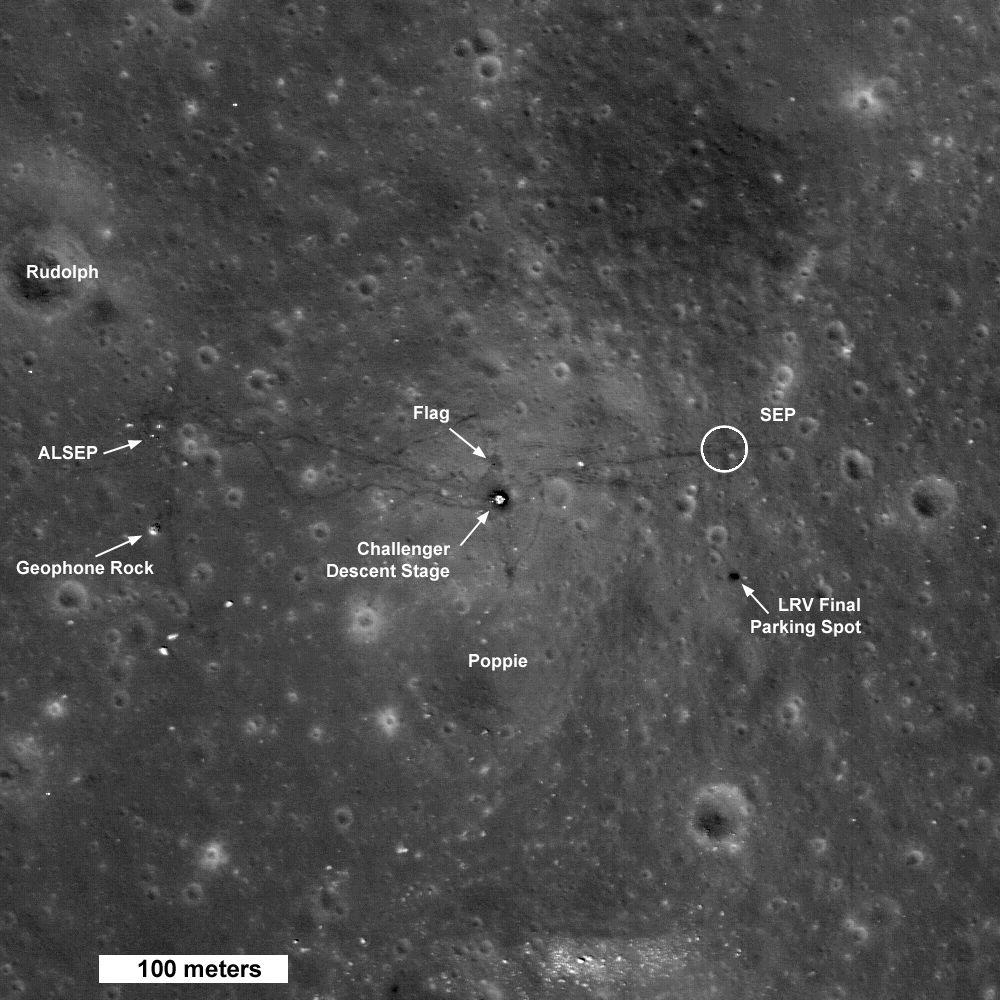
Just seeing this overhead, high sun angle detail of the Apollo 17 landing site in the Valley of Taurus-Littrow strikes my interest!” Schmitt wrote. “The pre-Apollo 17 photography we had for planning was at lower sun angles and at least ten times lower resolution. Having a record of our activities in the vicinity of the Challenger stirs great memories. My appreciation and awe goes to Mark Robinson and his LRO team.”

Friday, September 4, 2009

LRO zooms in on Apollo 12, Surveyor 3

Left out of July's initial looks at the Apollo lunar landing sites, Lunar Reconnaissance Rover (LRO) Narrow Angle Camera's (LROC NAC) easily swept up this outstanding close-up of Apollo 12's perch on the northwestern rim of "Surveyor Crater" in the Sea of Storms last month.

In November 1969, Conrad and Bean accomplished the second manned landing on the Moon and surprised themselves, proving Apollo could land precisely on a pre-selected patch of ground, this one just 150 meters, easily with "walking distance" from Surveyor 3. The American unmanned lander was situated just where mission planners believed it to be, inside the small crater where it's 65 hour mission on the surface had ended two years earlier. [NASA/GSFC/Arizona State University] FULL SCAN - ASU News - LROC News System

Wednesday, August 19, 2009

Moon Zoo is coming...

Ejecta apron of Tsiolkovskiy basin forming impact; a crop taken from the stunning close-up taken by the Narrow Angle Camera on-board the Lunar Reconnaissance Orbiter, (LRO), the LROC, operated under the experienced management of Arizona State University,'s School of Earth & Space Exploration. Among the few mare-filled basins on the Moon's far side, Japan's lunar orbiter Kaguya featured HDTV images of Tsiolkovskiy, where MIT and the U.S. Naval Research Laboratory have proposed deploying a unique radio telescope beyond interference from human activities on Earth. In this picture, the massive spill of melted rock from the Tsiolkovskiy event is pictured as never before, down to approximately 80 centimeters per pixel from a strip only 8,400 meters wide. The wave of heated flow almost completely covered an earlier crater, now just barely visible here as "a ghost crater," upper left of center. Nearby, more recent impacts have fallen on top of the flow. The boulder field, right and below of center, would present an expensive hazard to manned and unmanned landers, just as smaller boulders nearly brought about an abort of the Apollo 11 mission, seconds before landing. The latest generation of lunar exploring robots are downloading enormous volumes of important data, presenting a problem of timely analysis that might be solved by spreading that interesting work among a larger pool of people.

From SciBuff.com Science Blog:

Moon Zoo will be another citizen science project, the latest incarnation of the highly successful Galaxy Zoo. The project will use high resolution images from the Lunar Reconnaissance Orbiter Camera (LROC) on NASA’s LRO spacecraft. Moon Zoo will ask the participants to classify and measure the shape of features on lunar surface with the main focus on:

  • counting the number of and measuring the size of impact craters
  • categorizing locations of interest such as lava channels, crater chains, lava flooded impact craters, volcanic eruptive centers, etc.
  • assessing the degree of boulder hazard by comparing boulder density on two images
  • identifying recent changes on lunar surface by comparing LRO and Apollo photographs
  • determining the location of space mission hardware on the Moon (Apollo landers, Luna rovers, European and Chinese probes)

Besides delivering high quality data which will (hopefully) address many questions of lunar science, Moon Zoo will also be an excellent tool to promote lunar and space exploration and engage the public in learning about processes involved in scientific discoveries. Moon Zoo is expected to be even more popular than Galaxy Zoo, exploiting the media exposure of the 40th anniversary of Apollo 11 and the recent NASA’s LRO/LCROSS mission.

Read the full article/posting HERE.

LRO captures Aristarchus rille


Sinuous rille winding its way across a much larger rille in the heart of the Aristarchus Plateau, image width 1.76 km [NASA/GSFC/Arizona State University]

Vallis Schröteri, the largest rille on the Moon, originates on the Aristarchus Plateau and is ]comprised of three key morphologic features (below): the Cobra Head, the primary rille (155 km long), and the inner rille (204 km long). Rilles are believed to have formed as large volumes of very fluid magma erupted and flowed rapidly from the vent. Scientists are not certain how rilles are formed - that's one of many questions that future human lunar explorers will answer. Experts currently think that molten lava may carve a channel into the lunar surface (erosional model), or levees may form at the margins of the flow confining it (constructional model). Some lunar sinuous rilles may have started as collapsed lava tubes and were later modified to their final form. Lunar sinuous rilles do form by volcanic eruptions, but the details of how they get their "river-like" shape are also a mystery. The LROC NAC frame (above) shows a section of the inner rille about halfway down its length where it is about 600 m wide and the primary rille about 4300 m. LROC will provide high resolution stereo images of many lunar rilles to help scientists discriminate between the competing models of formation. The geologic complexity of Aristarchus Plateau and its rich, easily accessible deposits of potential resources make it an exciting landing site for future human exploration missions.

LROC Image: Uncalibrated data; north is up; Image width is approximately 1.76 km, browse the whole NAC image.

Explore the full Apollo Metric frame of Vallis Schröteri and the Aristarchus Plateau.

Read the LROC News Release HERE.

Friday, July 31, 2009

Terraced Wall of Bürg

Under control of Arizona State University, the Narrow Angle Camera of the Lunar Reconnaissance Orbiter has not been idle this lunation. Above, our 400 px wide inset cannot begin to give proper context to this latest release, showing astounding detail of a favorite telescopic target of the Near Side's northern hemisphere, Bürg Crater, surrounded by the warped Lacus Mortis, not far from Atlas and Hercules. Follow the ray that bisects Mare Serenitatus through south central Bessel (does that ray only seem to originate with Tycho?). It will lead you to a squarish plateau, where Bürg sits almost directly in the middle. The sides of the apparent plateau are sliced by rilles, some of which pose questions only LRO seems well equipped to answer.

The news release and a links to the image HERE.

Sunday, July 19, 2009

Rediscovering Tranquility Base


In the relief of advancing shadows of sunset, in the southwestern Mare Tranquillitatus on July 12, 2009, the Narrow Angle Camera (NAC) of the Lunar Reconnaissance Orbiter (LRO) works as designed. Below Center sits the Descent Stage of the Apollo 11 Lunar Module Eagle, continuing its uninterrupted forty-year-long vigil over the first human footprints on another world.

Just in time for the 40th anniversary of Dr. Neil Armstrong's first manned landing, and his tentative first steps on the Moon, Dr. Mark Robinson, principal investigator for the LRO wide and narrow angle, high-resolution cameras (LROC) and his team at Arizona State University have released the first pictures of Tranquility Base since 1969.

The deck atop Eagle's Descent Stage, used as a launch pad for the Ascent Stage, was last seen only briefly after a tensely anticipated lift-off when the departing vehicle pitched forward before continuing its acceleration back into lunar orbit, for rendezvous with the Command Module Columbia and the return to Earth.

A long sunset shadow from Eagle's lower stage, also well-within a remarkable 50 cm per pixel resolution of LRO's NAC, points directly opposite from the direction it had when it landed on July 20, 1969. A week less than forty years later, the shadow points toward the direction of its arrival with a long-ago sunrise.

This isn't the first time Apollo vehicles on the surface have been imaged from orbit. Apollos 15, 16 & 17, the last and primarily science, or "J," missions, of the program each came equipped with both powerful panoramic, wide-angle and 70 mm cameras that collected what were, until now, the highest resolution images of the lunar surface ever taken. Those last missions photographed their respective landers on the surface, when also near perigee.

Such close up pictures of the earlier landing site of Apollo 11 were not possible. Each of the better equipped last missions, carrying the powerful cameras on-board their Service Modules, were aligned with landing sites far from the equator when passing through the longitude of Tranquility Base.

High resolution photographs of each of the Apollo landing sites were available, of course.

Very recently, the Lunar Orbiter Image Restoration Project (LOIRP) reproduced an outstanding photograph of the landing site of Surveyor 3 and, 18 months later, Apollo 12. Unfortunately, it was first imaged even before Surveyor 3 landed, making the later, very precise landing of Apollo 12, only 150 meters from Surveyor 3, in November 1969 all the more remarkable.

A Lunar Orbiter did photograph Surveyor 1, however, where it must still rest inside the ancient Flamsteed crater, in the wide expanse of Oceanus Procellarum.

The uncalibrated image from the LRO NAC has renewed hope of locating the precise, sometimes even controversial fates of crash site, impact sites and the landing sites of many "lost" artifacts of the First Age of Lunar Exploration. The actual final resting place of the Soviet Union's Luna 9, the first successfully soft-landed vehicle on the Moon, for example, is not precisely known.

Though the U.S.S.R.'s Luna 17 nuclear-powered rover was equppied with a French-built laser-ranging reflector, no one knows exactly why not a single photon has been detected, reflected back, since it was parked in Sinus Iridum in 1971.

The final resting place of Luna 21, on the otherhand, still weakly confirms its location near Le Monnier, with GPS precision, a dim reflection of laser light counted by the photons per hour returned to the Apache Point Obervatory Lunar Laser ranging operation (APOLLO).

Though Japan's just-deorbited Kaguya carried highly capable instruments, including its famous HDTV, it was not designed to detect anything so small as an Apollo lunar module descent stage, though JAXA did release good surveys of the landing sites of Apollo 11, 14, 15 & 17, it produced no close-up images of Apollo 11.

One HDTV image of the southwestern Sea of Tranquility was useful in showing the color and composition of the surrounding area, and it demonstrated why Apollo mission planners picked what appeared to be a very smooth first landing site, even after the near-by televised impact of Ranger 8 or the soft-landing of Surveyor 5 only 22 kilometers to the northwest of what would become Tranquility Base.

In fact, it was not until the guidance computer, on-board Eagle, nearly landed Apollo 11 within an unsurveyed, stadium-sized crater, and Armstrong took control to lander nearly a half-mile "long," that the true nature of the "smooth" landing area was seen for the rough patch of ground that it is. Now we can see it again, for the first time.

Comparing Kaguya with LRO


For comparison, the most detailed image of the Apollo 11 landing site yet released from Japan's Kaguya, a Terrain Camera image from 300 kilometers overhead taken in late 2007.

The image was used to compare a visual scale representation with a false-color image of the same area, taken from data collected by Kaguya's Multi-Band imager. The area shown is the eastern half of that TC image.

The image is a not a fair demonstration of the what was later shown to be a very impressive range for the JAXA's Terrain Camera. At this altitude, at 5 meters per pixel resolution, the Descent Stage of Eagle was invisible. The white smudge to the left of the tip of the arrow added, west and in front of Eagle is still believed by some to be evidence of rougher, more reflective regolith that may have been exposed when an overhay of aeons of dust was scattered great distances by the arrival of Eagle.


It's not a fair comparison.

The Terrain Camera's computer-generated, small-scale image of the Apollo 11 landing area in 2007 was not taken to uncover human artifacts. Immediately below is an LROC image taken six times closer to the surface, using a camera designed to map detail.

The Terrain Camera was designed to provide baseline for Kaguya's other experiments.

Nevertheless the Kaguya TC image from 2007 and the still-uncalibrated LRO image gathered only a few days ago are, together, the most detailed small-scale images of Tranquility Base ever released.

More and more, even amateur telescopic images of the region come very close to the color resolution of Kaguya's HDTV in lunar orbit. But, just as seen in the TC image, the deeply "gardened," boulder-strewn, ancient and very rough patch chosen for man's first landing on the Moon has really only been seen twice. First, by Armstrong & Aldrin, in those moments just prior to the first landing, and now by the Narrow Angle Camera of the Lunar Reconnaissance Orbiter.


Above, a roughly 300 percent blow-up of the Kaguya TC image from 300 kilometers in 2007 shows how deceptively smooth the region was thought to be before the Apollo 11 landing.

That "white smudge" is definitely seen, directly ahead of where Eagle's Descent Stage came to a rest, arriving from the east and descending from orbit from the right, the "swept" area is consistent with what might have been produced by a vehicle briefly pitched back to slow forward momentum. And yet, a glance at the LRO image below seems to show only a naturally depressed area ahead of the landing spot. The LRO NAC image is closer to the "Ground Truth."


At smaller scale than the first image from the LRO NAC at the beginning of this post, this image is good for demonstrating how much our understanding of one of the best studied, best known areas of the Moon has improved almost overnight with the arrival of LRO.

Soon we will see the entire Moon as only those who have actually been there saw it forty years ago, and then only in the immediate vicinity of six small patches of ground on a planet with surface area the size of Africa. With the arrival of LRO, we will, in many ways, be exploring the Moon for the first time.