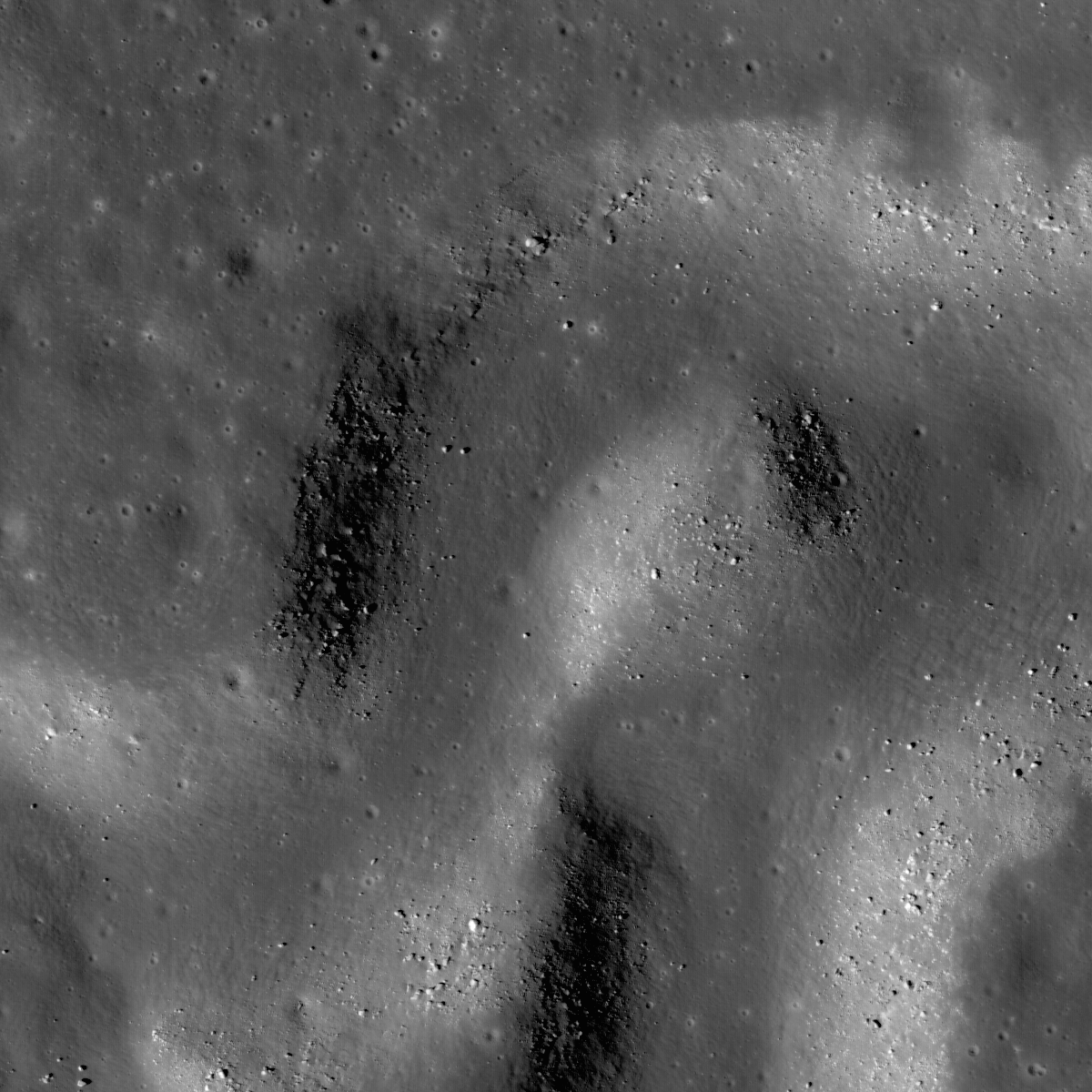
Possible cavern skylight on the Moon, 65 meters in diameter, may be a window onto a subsurface cavern on the Moon. Photographed by the Kaguya Terrain Camera, May 20, 2008, from a larger image of the Marius Hills region of the lunar nearside. [ISAS / JAXA / Junichi Haruyama et al.]
On October 10, Emily Lakdawalla, science and technology coordinator for the Planetary Society, reported on the discovery of "an open pit on the Moon," reported in research for the Japanese Space Agency (JAXA) from evidence gathered during the mission of the Kaguya lunar orbiter, "likely a window onto a sublunar world, a skylight into a subsurface cavern."
"Junichi Haruyama, Kazuyuki Hioki, Motomaro Shirao, Tomokatsu Morota, Harald Hiesinger, Carolyn van der Bogert, Hideaki Miyamoto, Akira Iwasaki, Yasuhiro Yokots, Makiko Ohtake, Tsuneo Matsunaga, Seiichi Hara, Shunsuke Nakanotani, and Carlé Pieters describe the feature in a paper now in press in Geophysical Research Letters, entitled "Possible lunar lava tube skylight observed by SELENE cameras."

The Marius Hills of Oceanus Procellarum, in a scene familiar to telescopic observers around 100 hours after First Quarter at local sunrise, when the shallow shields around volcanic vents are briefly visible in sharp relief of long shadows. Volcanism has shaped the topography of the wider region in distinctive ways. To the north, Aristarchus Plateau seems directly connected to the morphology of these vents, which seem in turn connected to the bright albedo and strong magnetic field of Reiner Gamma, to the southwest. Some or all of those implied interconnections may actually be under the lunar surface [Mario Weiland, Celestron C14-XLT, January 8, 2009].

The Marius formation is high among the fifty future science targets, areas of interest and possible landing sites for direct exploration, just as they were for Apollo. In fact, had Apollo 13 been able to land at Fra Mauro, Marius might well have been the eventual landing site of Apollo 17, rather than Taurus Littrow. In 2008, Japan's Kaguya swept up the region with its High Definition Television camera [HDTV-027-l, JAXA/NHK/SELENE].
Volcanism clearly played a role in the formation of the Moon. The basins of the near side testify to the flow of molten material superheated by kinetic energy released by massive basin-forming impacts.
Perhaps because of a running debate about the origin of the Moon's craters, one that continued well into the Apollo Era, the role of volcanism seems to have been more understated after the dispute seemed to have been resolved around the time of the manned landings. However, a proper and more circumspect fit for volcanism is the scheme of lunar morphology has gradually emerged in the years after, not the least because of direct evidence gathered by the chance observations by a the only geologist ever to do field work on the Moon.
Though long suspected, the discovery reported by Lakwallada would be more direct evidence many sinuous rilles seen on the lunar surface became visible only after flows subsided and ceilings collapsed, probably due to high or persistent but low magnitude moonquakes, or both.
"Lava flow protection of underlying material and structure has been documented on the Moon," wrote Dr. Harrison Schmitt, the only geologist ever to do field work on the lunar surface. He offered his observations during an online discussion of the recent discovery in the Marius Hills.
"For example," Schmitt wrote, "the very old, uncontaminated orange pyroclastics at Shorty Crater, and, by implication, uncontaminated green pyroclastics sampled by Apollo 15."
"One other consideration," Schmitt added, was "a sharp decrease in mechanical strength at depth, which may be the cause of the small, highly exaggerated pit-bottomed impact craters I reported (at) Taurus-Littrow. This might happen on the much larger scale being reported, a lava flow over a deeper regolith unit, provided that the abstract's statement, that "there are (not) conspicuous deposits indicating volcanic eruptions from the hole..." also means it's certain that no ejecta rim or blanket exists around the hole."
Though there are rilles and domes and other apparent results from lava flow, aside from flooded basins, throughout the lunar surface, there are few better place for an initial look for this handiwork than the broad surroundings of the Marius region within Oceanus Procellarum.
Procellarum basin itself, of course, was inundated more than once, as impacts, like mighty Imbrium nearby, ultimately erased more than half its original rim. That basin's extent, its true size and its ancient origins are still disputed.
Later impacts might well have caused eruptions and fountains of molten material along a network of wrinkles, rilles and underground connections that seems to run at least from Mons Rumker in the North, tied in someway to Aristarchus Plateau, and, in turn, even to the Reiner Gamma albedo and magnetic anomaly that begins amidst the Marius Domes.

For the full story and implications to future manned exploration on the Moon, read Lakdawalla's posting on the Planetary Society Blog, HERE.
The Marius formation is high among the fifty future science targets, areas of interest and possible landing sites for direct exploration, just as they were for Apollo. In fact, had Apollo 13 been able to land at Fra Mauro, Marius might well have been the eventual landing site of Apollo 17, rather than Taurus Littrow. In 2008, Japan's Kaguya swept up the region with its High Definition Television camera [HDTV-027-l, JAXA/NHK/SELENE].
Volcanism clearly played a role in the formation of the Moon. The basins of the near side testify to the flow of molten material superheated by kinetic energy released by massive basin-forming impacts.
Perhaps because of a running debate about the origin of the Moon's craters, one that continued well into the Apollo Era, the role of volcanism seems to have been more understated after the dispute seemed to have been resolved around the time of the manned landings. However, a proper and more circumspect fit for volcanism is the scheme of lunar morphology has gradually emerged in the years after, not the least because of direct evidence gathered by the chance observations by a the only geologist ever to do field work on the Moon.
Though long suspected, the discovery reported by Lakwallada would be more direct evidence many sinuous rilles seen on the lunar surface became visible only after flows subsided and ceilings collapsed, probably due to high or persistent but low magnitude moonquakes, or both.
"Lava flow protection of underlying material and structure has been documented on the Moon," wrote Dr. Harrison Schmitt, the only geologist ever to do field work on the lunar surface. He offered his observations during an online discussion of the recent discovery in the Marius Hills.
"For example," Schmitt wrote, "the very old, uncontaminated orange pyroclastics at Shorty Crater, and, by implication, uncontaminated green pyroclastics sampled by Apollo 15."
"One other consideration," Schmitt added, was "a sharp decrease in mechanical strength at depth, which may be the cause of the small, highly exaggerated pit-bottomed impact craters I reported (at) Taurus-Littrow. This might happen on the much larger scale being reported, a lava flow over a deeper regolith unit, provided that the abstract's statement, that "there are (not) conspicuous deposits indicating volcanic eruptions from the hole..." also means it's certain that no ejecta rim or blanket exists around the hole."
Though there are rilles and domes and other apparent results from lava flow, aside from flooded basins, throughout the lunar surface, there are few better place for an initial look for this handiwork than the broad surroundings of the Marius region within Oceanus Procellarum.
Procellarum basin itself, of course, was inundated more than once, as impacts, like mighty Imbrium nearby, ultimately erased more than half its original rim. That basin's extent, its true size and its ancient origins are still disputed.
Later impacts might well have caused eruptions and fountains of molten material along a network of wrinkles, rilles and underground connections that seems to run at least from Mons Rumker in the North, tied in someway to Aristarchus Plateau, and, in turn, even to the Reiner Gamma albedo and magnetic anomaly that begins amidst the Marius Domes.
Lunar Orbiter II-213-M, as recently reconstructed from original taped transmissions by the Lunar Orbiter Image Restoration Project (LOIRP).
For the full story and implications to future manned exploration on the Moon, read Lakdawalla's posting on the Planetary Society Blog, HERE.