Showing posts with label LLRR. Show all posts

Tuesday, November 19, 2013

Lunar Laser Ranging: The Millimeter Challenge

Lunar Laser Range Reflector arrays
The five Lunar Laser Range Reflector (LLR or LLRR) arrays deployed on the lunar surface, one each at the landing sites of Apollo 11, 14 and 15, and also to the Soviet rovers Lunokhod 1 and 2. The sublime accuracy of the decades-long measurements are priceless to astrophysics. Nearside view from "Synthetic View of the Moon," LROC Featured Image released October 15, 2013 [NASA/GSFC/Arizona State University].
T. W. Murphy, Jr.
Center for Astrophysics and Space Sciences
University of California

Lunar laser ranging has provided many of the best tests of gravitation since the first Apollo astronauts landed on the Moon. The march to higher precision continues to this day, now entering the millimeter regime and promising continued improvement in scientific results. This review introduces key aspects of the technique, details the motivations, observables, and results for a variety of science objectives, summarizes the current state of the art, highlights new developments in the field, describes the modeling challenges and looks to the future of the enterprise.

Since 1969, lunar laser ranging (LLR) has provided high-precision measurements of the Earth-Moon distance, contributing to the foundations of our knowledge in gravitation and planetary physics. While being the most evident force of nature, gravity is in fact the weakest of the fundamental forces, and consequently the most poorly tested by modern experiments. Einstein's general relativity, currently our best description of gravity, is fundamentally incompatible with quantum mechanics and is likely to be replaced by a more complete theory in the future. A modified theory would, for example, predict small deviations in the solar system that, if seen, could have profound consequences for understanding the universe as a whole.

Utilizing reflectors placed on the lunar surface by American astronauts and Soviet rovers, LLR measures the round-trip travel time of short pulses of laser light directed to one reflector at a time. By mapping the shape of the lunar orbit, LLR is able to distinguish between competing theories of gravity. Range precision has improved from a few decimeters initially to a few millimeters recently, constituting a relative precision of 10-9 through 10-11. Leveraging the raw measurement across the Earth-Sun distance provides another two orders of magnitude for gauging relativistic effects in the Earth-Moon-Sun system.

The largest of the Apollo lunar laser range reflectors (LLRR) arrays, deployed at Hadley Rille by Scott and Irwin of the Apollo 15 surface expedition in February 1971. The instrument is still a regularly acquired critical part of on-going experimental astrophysics. AS15-85-11468 [NASA/JSC].
As LLR precision has improved over time, the technique has remained at the cutting edge of tests of gravitational phenomenology and probes of the lunar interior, and has informed our knowledge of Earth orientation, precession, and coordinate systems. LLR was last reviewed in this series in 1982; this update describes the key science drivers and findings of LLR, the apparatus and technologies involved, the requisite modeling techniques, and future prospects on all fronts.

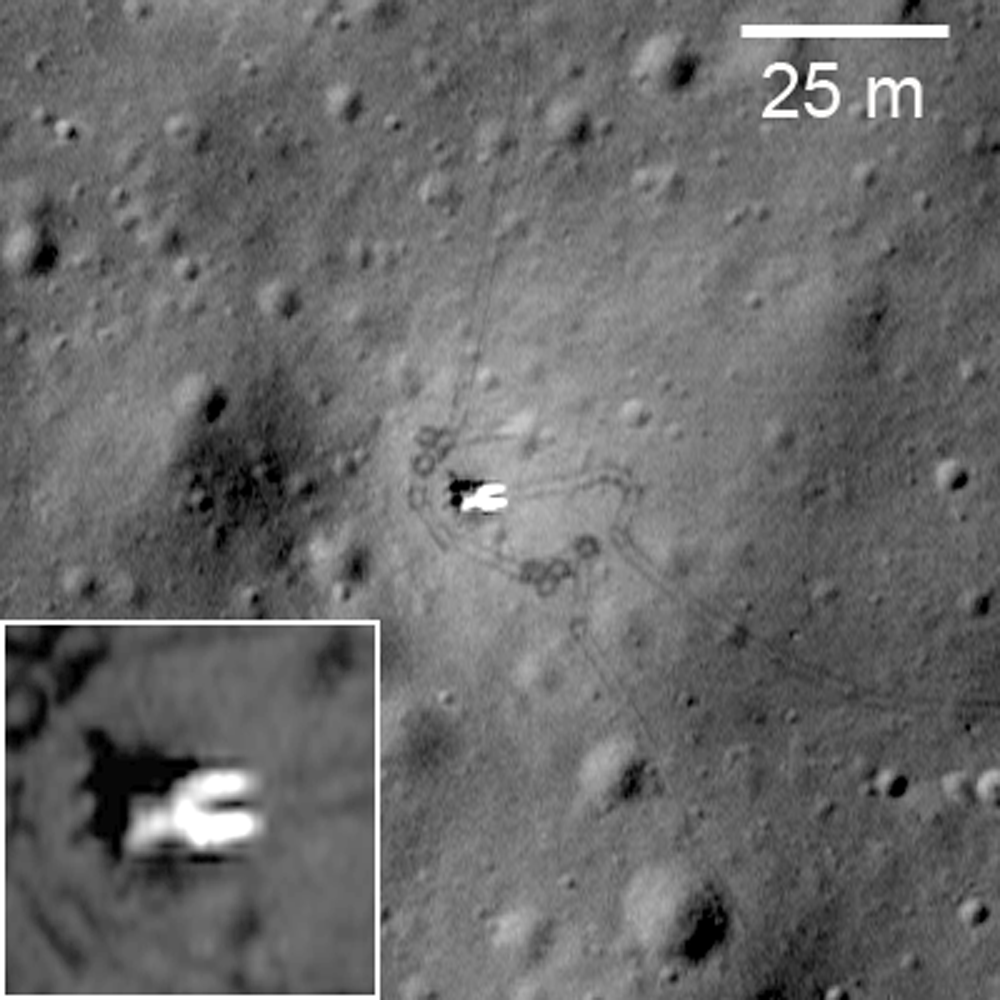
Lunokhod 1 rover in its final parking place (38.315°N, 324.992°E) on the surface of Mare Imbrium. LROC Narrow Angle Camera (NAC) observation M175502049RE, orbit 10998, November 9, 2011, resolution 33 cm per pixel. View original Featured Image released March 14, 2012 (with enlarged inset) HERE [NASA/GSFC/Arizona State University].
LLR is expected to continue on its trajectory of improvement, maintaining a leading role in contributions to science. Other recent reviews by Merkowitz (2010) and by Muller, et al. (2012) complement the present one. The Merkowitz review, like this one, stresses gravitational tests of LLR, but with greater emphasis on associated range signals. Next-generation reflector and transponder technologies are more thoroughly covered. The Muller et al. review (for which this author is a co-author) covers a more complete history of LLR, has statistics on the LLR data set, and provides greater emphasis on geophysics, selenophysics, and coordinate systems.

This review is organized as follows: Section 1 provides an overview of the subject; Section 2 reviews the science delivered by LLR, with an emphasis on gravitation; Section 3 describes current LLR capabilities; Section 4 relates recent surprises from LLR, including the finding of the lost Lunokhod 1 reflector and evidence for dust accumulation on the reflectors; Section 5 treats the modeling challenges associated with millimeter-level LLR accuracy; and Section 6 covers possible future directions for the practice of LLR.

Wednesday, September 25, 2013

LROC updates image tally of human artifacts on the Moon

Luna 17, the spacecraft that carried the Lunokhod-1 rover to the surface of the Moon; debarking ramps for the rover tracks around the lander are visible, extending southeast, to the right. LROC Narrow Angle Camera (NAC) frame M175502049RE, LRO orbit 10998, November 9, 2011; angle of incidence 57.78° at 43 cm per pixel resolution from 30.66 km over 38.23°N, 325.01°E. View the original contextual image with an enlarged inset HERE [NASA/GSFC/Arizona State University].
Samuel Lawrence
LROC News System

Repeat imaging of anthropogenic targets on the Moon remains an LROC priority as the LRO Extended Science Mission continues. These continuing observations of historic hardware and impact craters are not just interesting from a historical standpoint - each image adds to our knowledge of lunar science and engineering, particularly cartography, geology, and photometry.

Making sure that the lunar cartographic network is accurate is a critical component for planning future lunar missions for both human and robotic exploration of the Moon. The historic spacecraft serve as benchmarks (especially the laser retroreflectors). When new images arrive and final ephemeris is in hand we can check if the hardware has moved - well, actually we see the level of uncertainty in computing latitude/longitude coordinates (currently about ±15 meters).

View of the Luna 17 lander from the Lunokhod-1rover (the vehicle descended from its position atop the lander from the opposite side). A wide variety of images, including many other firsts from the Soviet Union's lunar exploration program  of the Cold War era can be viewed HERE.
Currently the United States has no near-term plans to land humans or robotic spacecraft on the Moon, however China is scheduled to launch the Chang'e 3 mission in December. If we are lucky, the LROC team might have a before picture to compare to any after pictures of the Chang'e 3 landing site (the exact planned landing coordinates have not yet been released). Currently all LROC NAC investigations must rely solely on "after" images of landing sites. Obtaining a before and after set of images of the Chang'e 3 will facilitate a much better understanding of the delicate processes involved in regolith redistribution due to lander rocket plumes.

When a spacecraft lands on the Moon in a powered descent, exhaust gases from the descent engine disrupt the surface resulting in visible changes around the landed vehicle. These changes can be better understood with photometric studies using using LROC NAC images taken with different illumination geometries. Close to (or right under) the lander the soil is most disrupted, leading to reduced reflectance. Interestingly a zone of increased reflectance surrounds the lander. This "blast zone" ranges from a few meters for the Surveyor spacecraft, to a few tens of meters for Luna, and a few hundred meters for Apollo.

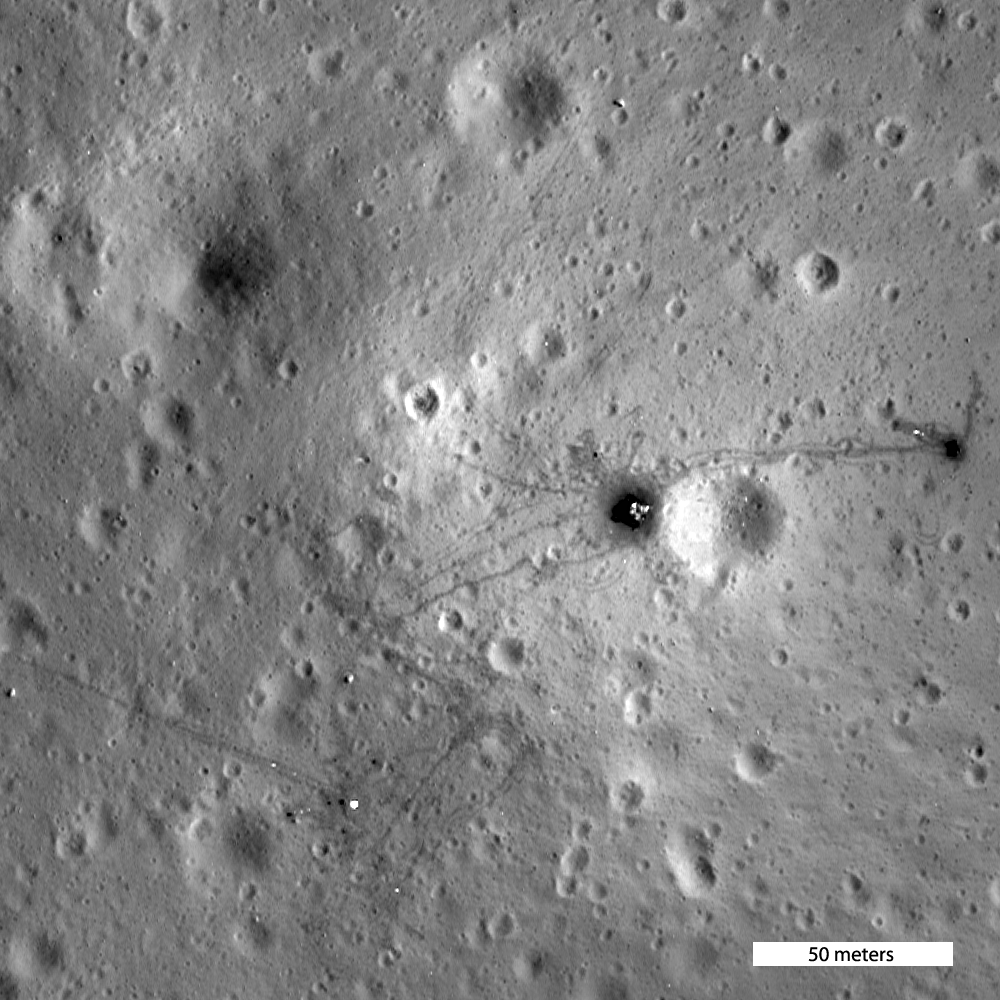
The Apollo 15 landing site through shifting shadows of a simulated lunar day, courtesy of the LROC Featured Sites Index. Very little appears to have changed since the departure of Scott and Irwin nearly 600 lunar days ago [NASA/GSFC/Arizona State University].
Photometric modeling indicates possible causes for the increased reflectance zones from smoothing of the surface by the exhaust flow, the destruction of micro-scale regolith structure, and/or the redistribution of fine particles from the area beneath the lander to its surroundings. Modeling the dynamics of rocket exhaust plumes and studying the exhaust plume effects of previous landed spacecraft on the Moon are defining safe operational practices for future landing sites and outposts.

Exceptionally detailed photograph of the Ranger 9 impact on the floor of Alphonsus crater appears to include an inner disk of darker material around 10 meters across, possibly melt created by the release of kinetic energy, LROC NAC M170579736R, LRO orbit 10272, September 13, 2011; angle of incidence 16.1° at 49.6 cm per pixel resolution from 44.64 km [NASA/GSFC/Arizona State University].
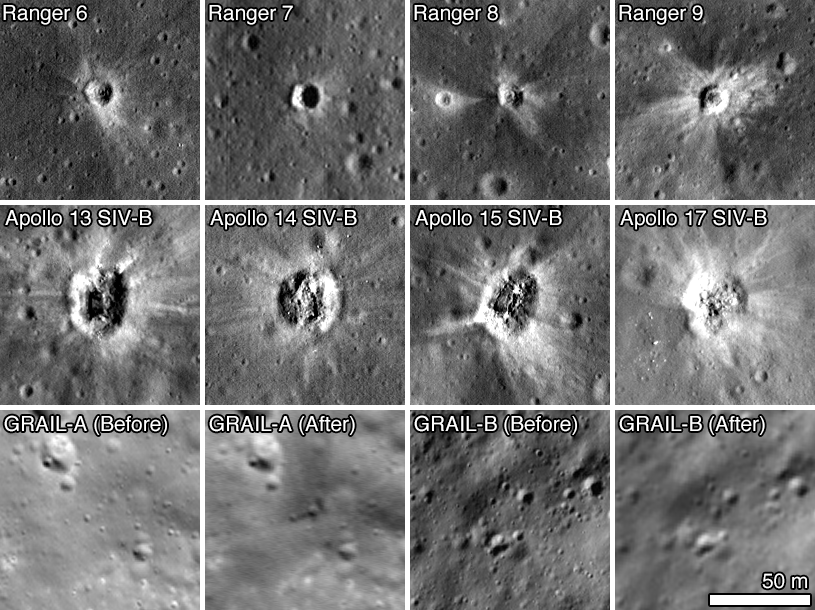
Selection of spacecraft impact sites imaged from LRO using the LROC twin Narrow Angle Camera instrument, all at the same scale [NASA/GSFC/Arizona State University].
Careful retracing of the Lunokhod 2 traverse dramatically improved our understanding of the surface activities of that intrepid rover. In addition, by accurately determining the locations of the Luna 23 and Luna 24 landers, the LROC team determined not only how the Luna 23 spacecraft failed, but also that the Luna 24 sample was collected on the rim of a small impact crater, providing an explanation for the discrepancies that existed for the past three decades between samples and remote sensing of the Mare Crisium surface.

Check out a map of robotic spacecraft sites on the lunar surface, HERE.

(a) listing of coordinates (mean Earth/polar axis (ME) system) of ... Soviet and American robotic space hardware and craters produced through spacecraft impact (thus far) identified by the LROC Team can be download as an Adobe PDF file is available HERE.

ED NOTE: This is at least a partial update to "Coordinates of Robotic Spacecraft," released April 9, 2010.

To generate the list of observed latitudes and longitudes, we compiled a list of line and sample coordinates for the center of each object in each image. Each image was then initialized using the USGS Integrated Software for Imagers and Spectrometers (ISIS) software package, attaching the appropriate spacecraft position and pointing information, along with the GLD100 lunar shape model for elevation. ISIS routines were then used to compute the latitude and longitude of the spacecraft (or impact crater) in that image.

The LRO spacecraft positions on the list were provided by the latest cross-over corrected spacecraft positioning kernels provided by the LRO LOLA Team, with an orbital position uncertainty of 15 meters. Finally, temperature-corrected NAC camera kernels produced by the LROC team contributed to the high precision and accuracy. The coordinates listed in the table are statistical median from all of the images acquired before April 28, 2013 for a particular site.

Related Posts:
Apollo 12 at 43 Years (November 20, 2012)
Taurus Littrow Oblique (September 29, 2012)
Close-up on the lonely trail of Lunokhod-2 (September 17, 2012)
America's last unmanned lunar lander (September 7, 2012)
"Houston, Tranquility Base here" (August 28, 2012)
Scooping the Soviets (August 8, 2012)
Apollo 15 departs Hadley Rille Delta - 41 years ago (August 2, 2012)
Tranquility Base at high-resolution before Apollo 11 (August 2, 2012)
Ranger 8 impact on restored Lunar Orbiter LOIRP photograph (July 31, 2012)
"O! Say can you see, by the dawn's early light" (July 27, 2012)
New tool for exploring LROC images and Apollo landing observations (July 19, 2012)
Craters bear Lunokhod-1 officially named (July 3, 2012)
Astronaut's eye view of the Apollo 16 landing site (June 19, 2012)
Who discovered water on the Moon (June 1, 2012)
Will China deploy the first lunar rover since 1976? (April 30, 2012)
The discarded extension of the Ranger program, David S.F. Portree (April 30, 2012)
Orion, up close (April 24, 2012)
Forty years ago, 'a big ol' Navy salute' (April 21, 2012)
Forty years ago-Apollo 16 (April 21, 2012)
The Last Sampler: Failure, then Success (March 17, 2012)
Lunokhod-1 revisited, too (March 15, 2012)
Lunokhod-2 revisited (March 13, 2012)
Pinpoint Landing on the Moon - Apollo 12 (March 12, 2012)
How Young is Young? - Apollo 16 (March 9, 2012)
LROC's closest look yet at Tranquility Base (March 8, 2012)
Apollo 12 and its pinpoint landing in the Moon (March 7, 2012)
Follow the tracks - Apollo 15 (March 6, 2012)

From the second of two sequential, exceptionally low periapsis orbital passes, allowing the LROC team at Arizona State University to capture breathtaking views of the Apollo 16 landing site in the nearside Southern Highlands, LRO orbit 10950, November 6, 2011; LROC NAC M175179080, field of view 145 meters, released on the 40th anniversary of the lift-off from the Moon of the Young and Duke expedition, April 22, 2012 [NASA/GSFC/Arizona State University]

Just another crater? (December 13, 2011)
"Boy, that sure looks like Luna 9!" (December 3, 2011)
Cernan says China will be first back to the Moon (November 8, 2011)
Hadley Rille and the Mountains of the Moon (November 8, 2011)
The First Race to the Moon, David S.F. Portree (September 27, 2011)
On the run! - Apollo 14 (September 8, 2011)
New Views of Apollo 12 (September 8, 2011)
Apollo 14 at 25 cm per pixel (September 8, 2011)
Skimming the Moon (September 8, 2011)
LRO Briefing: Latest Close-Ups of Apollo Sites (September 6, 2011)
Low altitude views of Apollo released (September 3, 2011)
First Low Altitude Apollo 12 NAC Image (August 11, 2011)
Crash or Coincidence (July 22, 2011)
Surveyor 7 (February 12, 2011)
New View of Apollo 14 (February 4, 2011)

Surveyor 7: Our Fragile Lunar LDEF (October 27, 2010)
LRO analysis of LCROSS data proves essential (October 21, 2010)
LRO transitions from exploration to science (September 16, 2010)
Apollo 16, Footsteps Under High Sun (July 11, 2010)
Too brief an expedition to a lobate scarp (August 24, 2010)
Re-acquisition: Lunokhod-1 (April 27, 2010)
Apollo 16: 38 years on (April 21, 2010)
Retracing the steps of Apollo 15: Constellation ROI (April 17, 2010)
Value-added LROC (April 16, 2010)
A fundamental point on the Moon (April 13, 2010)
The part of Apollo 13 that made it to the Moon (April 12, 2010)
Coordinates of Robotic Spacecraft (April 9, 2010)
Ranger 9 (April 4, 2010)
Absentee ownership of Lunokhod-2 (April 1, 2010)
LOLA's Tycho and the Apollo era (March 28, 2010)
The first successful robotic sampler, Luna 16 (March 26, 2010)
Apollo 13 SIVB impact (March 23, 2010)
Surveyor 5: A Hole-in-One (March 21, 2010)
Surveyor 6 on the plains of Sinus Medii (March 21, 2010)
Luna 21 Lander (March 19, 2010)
Foot fall around Orion in the mid-day glare (March 19, 2010)
Lunokhod-1 and Lunokhod-2 (March 17, 2010)
The Soviet lunar sampling missions (March 16, 2010)
Alan Bean shares Apollo 12 with community college students in Iowa (March 9, 2010)

The largest of three Apollo lunar laser range reflectors (LLRR), deployed at Hadley Rille by Scott and Irwin of Apollo 15 in February 1971. The instrument is still an active, critical component of on-going experimental science, part of the effort to further constrain the measured distance to the Moon (to within 3 mm) in part determine "locality," if any, of the laws cosmological physics. AS15-85-11468 [NASA/JSC].
Triumph (and disappointment) of Apollo 12 (November 19, 2009)
High Noon over Apollo 11 on YouTube (November 14, 2009)
Midday on Oceanus Procellarum: Apollo 12 (November 5, 2009)
Apollo 12 Second Look: Midday on the Ocean of Storms (November 4, 2009)
Apollo 17 from 50 kilometers (October 28, 2009)
When bombing the Moon was a good idea (October 21, 2009)
Apollo 14 SIVB impact (October 8, 2009)
Lonely Sentinel Abides (October 1, 2009)
Surveyor 1: America's first soft lunar landing (September 30, 2009)
Tranquility Base: a better, second look (September 29, 2009)
Shadow on the Moon (September 24, 2009)
LROC zooms in on Apollo 12 and Surveyor 3 (September 4, 2009)
First Look: Apollo 12 and Surveyor 3 (September 3, 2009)
Lasting boot prints from 1971 (August 21, 2009)
Trail of Discovery at Fra Mauro (August 19, 2009)
The continued importance of lunar laser ranging (August 3, 2009)
Rediscovering Tranquility Base (July 19, 2009)
Five Apollo landing sites photographed (July 17, 2009)
Lunar Orbiter III-154-H2 (LOIRP) (June 16, 2009)
LOIRP recovers early image of Ranger 8 impact (June 9, 2009)
Kaguya to impact June 10 (May 21, 2009)
Chang'e-1 controlled impact in Mare Fecunditatis (March 1, 2009)
More astounding detail (Surveyor 1) from LOIRP (February 26, 2009)
Anniversary of Ranger 8 (February 20, 2009)
Surveyor proved the Moon safe for man (January 4, 2009)

Chandrayaan-1 Moon Impact Probe shoots Shackleton (November 15, 2008)
Tranquility Base from Kaguya (SELENE-1) (March 29, 2008)

Monday, November 26, 2012

NLSI Director's Seminar Series, Live Online Nov. 27

Jack Burns
University of Colorado at Boulder

Tuesday, November 27, 2012
1800 UTC - 10AM PST, 1PM EST

The NASA Lunar Science Institute (NLSI) Lunar University Network for Astrophysics Research (LUNAR) is a team of researchers and students at leading universities, NASA centers, and federal research laboratories undertaking investigations aimed at using the Moon as a platform for space science.

LUNAR research includes Lunar Interior Physics & Gravitation using Lunar Laser Ranging (LLR), Low Frequency Cosmology and Astrophysics (LFCA), Planetary Science and the Lunar Ionosphere, Radio Heliophysics and Space Radiation, and Exploration Science. The LUNAR team is exploring technologies that are likely to have a dual purpose, serving both exploration and science.

Larger laser range reflector deployed at Hadley
Rille Delta by Scott and Irwin of Apollo 15 in
February 1971, a still active component of that
missions ALSEP and today an effort to constrain
the measured distance to the Moon to determine
locality, if any, of cosmological physics.
In this talk Dr. Burns will describe how LUNAR researchers are using LLR to provide the most precise constraints on General Relativity and gravitation, how low frequency radio observations of the Sun will assist us in understanding and predicting solar radiation that propagates throughout interplanetary space, and how low radio frequency telescopes in lunar orbit and on the lunar farside will allow us to probe the first stars and galaxies during the early Universe’s Cosmic Dawn.

Dr. Burns will also describe our development of new human/robotic mission concepts, including a mission to the Earth-Moon L2 Lagrange point, where astronauts in the Orion spacecraft will teleoperate rovers for geological exploration and for deployment of a low radio frequency array.

To Join Live Video Conference via browser (Adobe Connect) and to view slides : http://connect.arc.nasa.gov/nlsi_directors_seminar/

To Join via Video Conferencing System, RSVP Ricky Guest only if joining by Polycom or other standards-based Video Teleconferencing System.

Burns is a professor in the Department of Astrophysical and Planetary Sciences and Vice President Emeritus for Academic Affairs and Research for the University of Colorado at Boulder.  He is also Director of the NASA Lunar Science Institute’s Lunar University Network for Astrophysics Research (LUNAR), a NASA-funded center and part of the NASA Lunar Science Institute. Burns received his B.S. degree, magna cum laude, in Astrophysics from the University of Massachusetts, and received his doctorate in Astronomy from Indiana University.

From 2001 - 2005, Burns served as Vice President for Academic Affairs & Research for the University of Colorado System.  Burns was Vice Provost for Research at the University of Missouri – Columbia from 1997 through 2001. He was Associate Dean for the College of Arts and Sciences at New Mexico State University (NMSU) and served as Department Head and Professor in the Department of Astronomy at NMSU from 1989 until 1996.

Dark Ages Radio Explorer (DARE), utilizing the radio-quiet of the lunar farside to explore the earliest period on the cosmic time line, 200 million years between the primordial Big Bang and the emergence of the earliest luminous sources and the structure of the present universe. "The lunar Farside is potentially the only site in the inner solar system for high precision radio cosmology.” Illustration accompanying post "Farside offers radio quiet to probe Cosmic Dark Age," July 2, 2012 [NLSI].
During his tenure at the University of New Mexico from 1980 to 1989, Burns served as the Director of the Institute for Astrophysics, and he was a Presidential Fellow. He was a postdoctoral fellow at the National Radio Astronomy Observatory from 1978 to 1980.

Burns has over 380 publications in refereed journals, books, and in conference proceedings and abstracts (listed in NASA’s Astrophysics Data System). He is an elected Fellow of the American Physical Society and the American Association for the Advancement of Science and received NASA’s Exceptional Public Service Medal in 2010 for his service on the NASA Advisory Council (NAC) and as Chair of the NAC Science Committee.

Related Posts:

Tuesday, April 24, 2012

The Moon as a platform for astrophysics

Darks Ages Radio Explorer (DARE), utilizing the radio-quiet of the lunar farside to explore the earliest period on the cosmic time line, 200 million years between the primordial Big Bang and the emergence of the earliest luminous sources and the structure of the present universe. "The lunar Farside is potentially the only site in the inner solar system for high precision radio cosmology.” [NLSI].
Joel Raupe
and from reports

The Moon has been used as a platform for astrophysics research since laser range reflectors were deployed by three of the six Apollo surface expeditions and also as part of the Soviet two Lunokhod robotic rovers. A lunar laser range reflector (LLRR) has now been orbiting the Moon as part of the Lunar Reconnaissance Orbiter (LRO) mission since June 2009.

A welcome added bonus to the LRO mission came after photographing Lunokhod-1. The 1970 mission's French-built LLRR had been lost almost immediately after the rover was parked for the last time in 1970.

Before LRO, with only four arrays bouncing back mere photons from powerful laser pulses from Earth beginning in 1969, the distance to the Moon was measured with increasing accuracy down to a 3 centimeter margin of error. With the addition of the LRO reflector and after definitively locating Lunokhod-1 astrophysicists sharpened  measurements even further, finally with precision enough to rule out the idea that the astounding newly discovered increasing rate of the universe's expansion might be a “local” phenomenon, or a kind of optical illusion.

The Naval Research Laboratory (NRL), together with the Massachusetts Institute of Technology (MIT), has been building on the age old dream of utilizing the “radio quiet” of the Moon’s Farside to peer into the elusive Cosmic Dark Age, the period between the Big Bang and the “Epoch of Reionization,”  when an intergalactic medium composed mostly of neutral gases was “ionized by the emergence of the first luminous sources.”

Continuing with this description supplied by the MIT Haystack Observatory, “The sources may have been stars, galaxies, quasars, or some combination.  By studying  Reionization we can learn a great deal about the process of structure formation in the Universe, and find the evolutionary links between the remarkably smooth matter distribution at early times revealed by (Cosmic Background Radiation) studies and the highly structured universe of galaxies and clusters of galaxies” astronomers can peer more than 10 billion light years into the past.

Exploring that early “Dark Age” will almost certainly require radio telescopes able to detect sources radiating at frequencies red-shifted to wavelengths typical of the noise created by human civilization.

A solution offered by MIT and the NRL suggested an immense antenna farm deployed robotically on the wide floor of Tsiolkovskiy crater. The Dark Age Lunar Interferometer array was discussed in some detail in 2008, when achieving “extended human activity” on the Moon was national space policy.

The NASA Lunar Science Institute (NLSI) reports two of their collaborating working groups are suggesting putting a radio telescope in orbit around the Moon where it can put a significant part of its time exploring this cosmic Dark Age, the Darks Ages Radio Explorer (DARE). The mission concept is one of two ideas being pursued by the Lunar University Network for Astrophysical Research (LUNAR) “addressing the question of how the Moon can be used as a platform to advance important goals in astrophysics,” according to the NLSI.

The other suggestion by the LUNAR group proposes, “technology development for future lunar surface telescopes, which can help detect and characterize Earth-like planets orbiting nearby starts.

“Both approaches leverage the Moon as a science platform. The lunar Farside is potentially the only site in the inner solar system for high precision radio cosmology.”

DARE will use the highly-redshifted hyperfine 21 cm transition from neutral hydrogen to track the formation of the first luminous objects by their impact on the intergalactic medium during the end of the Dark Ages and during Cosmic Dawn. The science instrument is composed of a low frequency radiometer, a receiver, and a digital spectrometer. The various sub-systems have been constructed and are in the process of system integration. After check-out, the system will be deployed and tested at the Murchison Radio Observatory in Western Australia—one of the most radio quiet locations on the planet.

The Lunar Radio Telescope Array (LRTA) is a concept for a telescope located on the far side of the Moon where it is protected from radio frequency interference (RFI). It would detect magnetically generated radio emissions to provide insights into the interior structure of planets— information likely to be difficult to obtain by other means.

The Apollo 15 laser ranger reflector, 4x the area of
the LLRR arrays deployed by Apollo 11 & 14, is
the most reliable of the 5 units placed on the Moon.
Furthermore, the Lunar Laser Ranging (LLR) component of the LUNAR team has taken a two-fold approach toward testing theories of gravity. Not only are they continuing precise measurements of the Earth-Moon distance via laser ranging, but they are also leading efforts to develop a next-generation retroreflector package that could be emplaced on the Moon by future missions.

While the three retroflector arrays deployed during Apollo era were an incredible success, the reduced return from the arrays over the years has limited advanced investigation into general relativity. At present, there are a number of stations that can access Apollo 15 arrays but not the Apollo 11 and 14 arrays; the new retroreflectors will have signals that can be accessed by a large number of lunar laser ranging ground stations. A next generation retroreflector would improve precision measurements for gravitational physics and for understanding the lunar interior.

As a classical theory, general relativity and quantum mechanics are fundamentally inconsistent; there must be a breakdown at some level of accuracy in general relativity or a problem with quantum mechanics. A much higher ranging accuracy would improve scientific results in testing the theory of general relativity by more than two orders of magnitude. 

This post was derived in part from the NLSI release,
NLSI Teams Conduct Astrophysics Research

Related Posts:
MIT to lead development of new radio telescope
array on lunar farside
(February 19, 2008)
Naval Research Laboratory to design Farside DALI (March 11, 2008)
What better view? (March 26, 2008)
New model of lunar motion from Apollo LLRR (December 27, 2008)
MacDonald LLR defunded by NSF (June 21, 2009)
The continued importance of lunar laser ranging (August 3, 2009)
Laser Ranging and the LRO (August 12, 2009)
Dust accumulation on Apollo laser reflectors may
indicate a surprisingly fast and more dynamic
lunar exosphere
(February 16, 2010)
Long term degradation of optics on the Moon (March 4, 2010)
A Fundamental Point on the Moon (April 13, 2010)
Acquisition Lunokhod-1 (April 27, 2010)

Tuesday, April 27, 2010

Acquisition Луноход 1

From Lunar Pioneer
It might seem easy to spot after cameras on-board the Lunar Reconnaissance Orbiter (LRO) found Lunokhod 1 late last year. Nevertheless, after years of searching, before last November little hope remained that it's French-built laser reflectors would ever assume their important place with four other reflector stations on the Moon. With the help of LRO researchers have now acquired a reflection, tallied in photons, from the old Russian vehicle, a big bonus for theoretical cosmology and planetary science. In the images above and below Lunakhod 1 is set within the context of true surroundings. Above, a high ridge is visible on the north-northwest horizon, beyond the flat vastness of Mare Imbrium. These are the foothills southwest of Promontorium Heraclides. The closest of these are about 42 kilometers away. Click here for a better look.


Can you find Lunokhod 1 in the top image, maybe from clues in the enhanced close-up below it? The Russian lunar rover parked on the western shore of Mare Imbrium hadn't been detected since September 1971. More important than just locating Lunokhod 1, with the essential help of the LROC team at Arizona State, researchers very recently detected it's French-built laser range reflector. LRO (LROC) Narrow-Angle Camera M114185541RE (Orbit 1961, November 30, 2009, alt. 48.4 km. & resolution = 51.3 cm per pixel.) [NASA/GSFC/Arizona State University].

Researchers at the University of California at San Diego have acquired a reflection from the Laser Range Retro-Reflector on Lunokhod 1, the Soviet lunar rover that went missing from September 1971 until being found last November through the narrow-angle cameras on LRO.

The addition of a fifth working laser reflector is a windfall for physicists who believe measuring an even finer Earth-Moon distance could solve important puzzles about the cosmos, things like the locality of physical laws, for example. Putting a point on the Earth-Moon distance finer than three centimeters is thought to be the key.

As early as December 1969 McDonald Observatory gauged the Earth-Moon distance to within 30 centimeters by timing reflection of laser light to and from the Apollo 11 landing site. A pencil-thin laser beam is a kilometer-wide after a 1.5 light-second trip to the Moon. The LRRR deployed at Tranquility Base was designed to reflect light precisely in the direction from which it arrives. After an additional 1.5 seconds the laser light returned to Earth is measured by the photon, enough over many sessions to measure Earth-Moon distance with great precision.

An additional LRRR, identical to the one at Tranquility, was deployed at Fra Mauro by Apollo 14 and another, four-times larger than these, was set up north of the equator near Hadley Rille by Apollo 15. The latter, deployed in 1971, is still the most reliable of the LRRR's set up during the Apollo era.

The Soviet Union landed two RTG-powered lunar rovers, in 1970 and 1973, and both Lunokhod 1 and 2 were equipped with smaller French-built LRRR's. After ten months of successful operation the Soviets lost contact with Lunokhod 1 in 1971. Despite problematic thermal issues and limitations due to its smaller size the LRRR on Lunokhod 2, parked on the eastern side of Mare Serenitatis, has been periodically detected since its mission ended in 1973.

Lunokhod 1 was thought to be parked properly, to the west of it's carrier landing site near the western edge of Mare Imbrium. Instead it appears the rover was properly parked to the north of its last known location, enough for a wide miss. No confirmed detection of its LRRR had been cataloged in over 39 years, until now.


Laser Range Retro-Reflector array at the Moon. Apollo 11 (1969) & Apollo 14 (1971), near the equator and 27 degrees of longitude apart, each one quarter the size of the unit deployed by Apollo 15 (1972). Not detected until 2010 is the french-built triangular array on the Soviet rover Lunokhod 1. The design repeated on the Lunokhod 2 robotic rover has experienced "thermal drawbacks" that hinder daylight detection, conversely sometimes aiding its detection during the lunar night. In addition, NASA/Goddard Space Flight Center is presently keeping close track of LRO using laser ranging from a telescope in Maryland.

In 2005 McDonald Observatory shut down its laser and U.S. work moved to the more powerful and more sensitive system at the Apache Point Observatory in New Mexico. As work has progressed there, high hopes have been held that, at last, Lunokhod 1 might be added to the network. With the help of LRO, which swept up the definite location of the long-lost Soviet rover last November, four decades of patience have been rewarded.

Read Monday's University of California/San Diego news release through the report from NASA's Astrobiology Institute, HERE.

Read NASA's recent report on the LRO surveys of the Lunokhod landing sites, HERE.

Some other Laser Range Retro-Reflector posts:

A Fundamental Point on the Moon (April 13, 2010)

Long-term degradation of optics on the Moon (March 4, 2010)

Laser Ranging and the LRO (August 12, 2009)

Thursday, March 4, 2010

Long-term degradation of optics on the moon


According to the Apollo 15 Surface Journal Comdr. Dave Scott observed that the LRRR looked "super clean" when he and Jim Erwin deployed the mission surface experiments July 31, 1971. He took the cross-Sun view of the LRRR above from the south, showing the orientation gnomon and bubble level. Four times the size of the retro-reflectors deployed by Apollo 11 and Apollo 14, the third and final U.S. LRRR deployed by Apollo 15 is the unit most often detected from Earth. Though lasers and photon detectors have improved many times over in the past four decades, and though First Look at the Apollo landing sites by the Lunar Reconnaissance Orbiter Camera (LROC) last summer showed equipment and astronaut footprints undisturbed, something has been steadily degrading the amount of light these important mirrors are returning back to Earth.

(A Follow-Up on "Dust accumulation on Apollo laser reflectors may indicate a surprizingly fast and more dynamic lunar exosphere," February 16, 2009)

T.W. Murphy, et.al.
University of California-San Diego

Abstract: Forty years ago, Apollo astronauts placed the first of several retroreflector arrays on the lunar surface. Their continued usefulness for laser-ranging might suggest that the lunar environment does not damage optical devices. However, new laser ranging data reveal that the efficiency of the three Apollo reflector arrays is now diminished by a factor of ten at all lunar phases and by an additional factor of ten when the lunar phase is near full moon. These deficits did not exist in the earliest years of lunar ranging, indicating that the lunar environment damages optical equipment on the timescale of decades. Dust or abrasion on the front faces of the corner-cube prisms may be responsible, reducing their reflectivity and degrading their thermal performance when exposed to face-on sunlight at full moon. These mechanisms can be tested using laboratory simulations and must be understood before designing equipment destined for the moon.

Long-term NASA plans (NASA Strategic Plan 2006) for placing scientific equipment on the moon face uncertainty regarding the environmental impact on such devices as hard information about the lunar environmental effect on scientific instruments has not been available. From a quantitative analysis of the performance of the laser reflectors, we find clear evidence for degradation of the retroreflectors, and note that degradation began within one decade of placement on the lunar surface.


Some lunar laser retro-reflector arrays are brighter than others, though all their detections on Earth are measured in photons counts. Pencil-thin laser beams leave Earth and widen by more than a kilometer by their arrival on the Moon. The smallest part of these wavefronts are gathered up and reflected back, making a second traverse of the Earth-Moon distance and through Earth's absorbing and refractive atmosphere. [AS15-95-11468 & AS15-85-11469].

From 1969–1985, the McDonald Observatory 2.7 m Smith Telescope (MST: Bender et al. 1973) dominated lunar laser ranging (LLR), using a 634 nm ruby laser.

Starting around 1985, the McDonald operation moved away from the competitively-scheduled MST to a dedicated 0.76 m telescope designed to perform both satellite and lunar laser ranging, becoming the McDonald Laser Ranging System. In 1984 other LLR operations began at the Observatoire de la Cˆote d’Azur in France and at the Haleakala site in Hawaii, that used 1.5 m and 1.74 m telescopes, respectively. These systems all operate Nd:YAG lasers at 532 nm.

In 2006, the Apache Point Observatory Lunar Laser-ranging Operation (APOLLO) began science operations using the 3.5 m telescope and a 532 nm laser at the Apache Point Observatory in New Mexico.

Primarily geared toward improving tests of gravity, APOLLO is designed to reach a range precision of one millimeter via a substantial increase in the rate of return photons. The large telescope aperture and good image quality at the site, when coupled with a 4x4 single-photon detector array, produces return photon rates from all three Apollo reflectors that are about 70 times higher than the best rates experienced by the previous LLR record-holder (OCA). Consequently, APOLLO is able to obtain ranges through the full moon phase for the first time since MST LLR measurements ceased around 1985.

We find that the performance of the reflectors themselves degrades during the period surrounding full moon. In this paper we describe the full-moon deficit, report its statistical significance, and eliminate the possibility that it results from reduced system sensitivity at full moon. We show that this deficit began in the 1970’s, and examine the significance of successful total-eclipse observations by OCA and MLRS. We see an additional factor-of-ten signal deficit that applies at all lunar phases, but this observation requires a detailed technical evaluation of the link, and is deferred to a later publication.

We briefly discuss possible mechanisms that might account for the observed deficits.

From arXiv 1003.0713v1.pdf, HERE.


Laser Range Retro-Reflector (LRRR) arrays at the Moon. Apollo 11 (1969) & Apollo 14 (1971) are nearer the Moon's equator (and 40 degrees apart) and each is a quarter the size of the unit deployed Scott and Irwin of Apollo 15 (1971). Undetected since it was parked in 1970 are the french-built triangular prisms affixed to the Soviet rover Lunokhod 1 (1970). A similar design on the Lunokhod 2 rover (1973) has thermal drawbacks, alternately both hindering and aiding a rare detection. More recently, Goddard Space Flight Center keeps track of LRO (2009) and the Moon using laser ranging from a telescope in Maryland (See "Laser ranging and LRO," August 12, 2009).

Tuesday, February 16, 2010

Dust accumulation on Apollo laser reflectors may indicate a surprisingly fast and more dynamic lunar exosphere


February 5, 1971 at Fra Mauro (3.65° S, 342.53° E). The Apollo 14 Laser Ranging Retroreflector experiment, photographed by Cmdr. Alan Shepard. The Apollo LLR's, at Tranquility Base, Fra Mauro and a third with four times the surface area at Hadley Delta, have long been the last Apollo experiments still underway. Designed to return reflected laser light in precisely the direction from which it arrives, vastly improved lasers and detector sensitivities on Earth in the years since have allowed scientists to gauge the Earth-Moon distance with micro-precision, and tantalizing close to limits determining the "locality" of physical laws on cosmological scales [NASA/ASJ].

Joel Raupe
Lunar Pioneer

The Apollo 12 lunar landing of November 1969, in walking distance from Surveyor 3, demonstrated accumulated levels of understanding of the Moon, lunar navigation and vehicle capability that was truly stunning. Some hold the engineering accomplishment to be as great a Cold War victory as the first landing clearly was four months earlier. Like so many other unexpected discoveries in space exploration, however, new lessons and wisdom took on a greater importance with the passing of time.

Though Conrad and Bean succeeded also in collecting the camera and shovel arm from the unmanned Surveyor 3, learning what those artifacts could tell us about the Moon as a "long duration exposure facility" was not a NASA priority. The Final Reports in 1970 (NASA-CR-121796) indicated after careful examination of Surveyor 3's components that what slight "weathering" there was to be found on camera was wholly a result of the blast of Apollo 12 descent engine. But, first actually locating and then landing the lunar module precisely where Surveyor 3 was situated (there were no orbital photographs of the spacecraft in situ) was pretty astonishment by itself. No one was cautious of any evidence of an active fallout of electrostatic dust on the Moon in 1969.

Though there had been hints of a gossamer-thin migratory dust phenomena happening on the Moon, Apollo 8 crew sightings from orbit and night time Surveyor images, the concerns of the time were solar and cosmic radiation, and micrometeor bombardment. Evidence at the Apollo astronaut's feet and on their spacesuits (and in their eyes and noses) of the voluminous accumulations of dust everywhere on the Moon was (not incorrectly) thought to be the end result of extremely slow processes.

The evidence for the presence of a dusty lunar exosphere has mostly been discovered to explain gathering evidence, not all of it gathered on location. Twenty years ago great (but very thin) trailing clouds of silicon and potassium ions, among the more easily spectographically-detected dusty elements. These were composed into photographs showing the Moon orbiting Earth in a cloud of it's own bombardment.

The forty years since Apollo, occasionally punctuated with influential, if rare (until 2007), lunar probes like Lunar Prospector, gave lunar and planetary scientists a lot of time and new evidence to ponder. Perhaps the length of time itself allowed many theories to be shaken out and ultimately proven amazingly accurate.

Departing tests of instruments now used by Cassini at Enceladus to detect water were aimed at first light at the Moon, precisely because its bone-dryness was believed to present a sold baseline of zero water. The unexpected detection of water there, coincident with daily cycles of sunlight, has now become part of the context of evidence old and new that verified the astounding conclusion that some areas of the lunar surface may be wetter than Mars (relatively speaking).

In May 2012 NASA Lunar Atmosphere and Dust Environment Explorer (LADEE) should have the capability needed to improve our understanding of processes related to the charging of lunar dust particles and the implantation and presence of water on the Moon, the interaction of solar particles and energetic photons (including neutral hydrogen) that polarize the smallest grains on the Moon's immediate surface. Gardened over, roughly every 2 million years predominately by micrometeorite bombardment, submicron sized flecks are repelled by opposing charges into ballistic trajectories as high as the orbit forty years ago of Apollo's command and service modules.

Though posing little or no danger to orbiting spacecraft, the range of hazards that lunar dust poses to sustained surface operations, whether manned of unmanned, are manifold. The susceptibility of the smallest of these shards to electrical charging, their stubborn clinging to seals and skin, for example, is both the source of their danger and perhaps their mitigation.

The forensics done on the Surveyor 3 parts offered us lessons. In the near future, if anything is to be learned about fallout of lunar dust from an examination of human artifacts a degree of care must be taken beyond the mission goals of Apollo 12. If you want to approach and examine Apollo 11's descent stage, for example, the arrival of Apollo 12 near Surveyor 3 showed any similar arrival near near Tranquility Base should be from well over the horizon, and more. Calculations show at least some of the famous dust raised at the arrival and departure of Apollo's lunar modules must have attained great altitude, even escape velocity.

Very little would be needed to disturb a forty year record of dusty "precipitation."

It is thought that the migratory dust circling the Moon continuously, with its wave crest directly behind the longitude of sunrise, is related to the forces that lead to implantation of volatile molecules like hydroxyl and water. The path of the oppositely charged and neutralized dust fallout, it's cycle of return to the surface, may rain in one direction during the equivalent of a lunar winter and predominate in the opposite deviation from westerly during a lunar summer.

Dust fallout cycles may then be the source of the criss-crossed "elephant skin" patterns seen on lunar high places and elsewhere.

Tied as the phenomena is to solar-induced charging, the pattern of the Moon's dusty cycles of levitation and fallout are attenuated during the Moon's monthly transit through Earth's magnetotail. Something similar may be true, on a smaller scale, affecting levitation and subsequent fallout of lunar dust in and around especially strong crustal magnetism. This might perhaps then be a solution to the mystery posed by a presence of brighter surface albedo (low optical maturity) characteristic of lunar swirls within these"magnetic anomalies" whose origins otherwise speak of greater age than high albedo would indicate.

And now, very recently, evidence comes to "light" that fallout from the very thin, neverending lunar dust storm is accumulating with a greater speed than anyone may have imagined.

When a powerful laser is aimed at the Moon from Apache Point in New Mexico, the thin beam consisting of many hundreds of billions of photons spreads out to at least two kilometers in width during the second and a half needed for it to center on Apollo's retroreflectors, 400,000 kilometers away. The small sampling of that beam reflected back is literally counted in single photons by the time it returns back to New Mexico.

After accounting for things like today's more accurate photon detectors, more powerful and accurate lasers, more suitable laser wavelengths and a more powerful telescopes than originally used for this purpose at MacDonald Observatory in Texas, the photon count should be measurably improving, just as it has been. Still, something doesn't quite add up, and one investigator thinks he knows why.
"Tom Murphy from the University of California, San Diego, who leads one of the teams at the Apache Point Observatory in Sunspot, New Mexico, thinks the mirrors have become coated in moon dust. "The lunar reflectors are not as good as they used to be by a factor of 10," he says."
An article in New Scientist February 15 takes up the story now, illustrating better also why measuring the distance from Earth to the Moon, and the retroreflectors left behind on the Moon have lately taken on a new importance to cosmologists.

Recommended Article in New Scientist, HERE.

Monday, August 3, 2009

The continued importance of lunar laser ranging

Again, as mentioned many times here, news of the laser range experiment at MacDonald Observatory at Fort Davis, Texas shutting its lunar laser ranging experiment down, after nearly forty years of operation, has led some to believe the longest running (and only operational) experiment left on the lunar surface during the Apollo Era has come to an end.

The University of Texas announced the end of the laser ranging program at Fort Davis more than a month ago after the National Science Foundation turned down further funding requests. Not far away, however, as the world most famous laser range experiment was coming to an end, it was just getting started, and with better equipment and a larger telescope at Apache Point, under the supervision of New Mexico State University.

As reported briefly among Physics Today's news picks, Monday afternoon, lunar laser ranging is "Still going after 40 years." The Apache Point "APOLLO" station is well worth a browse, to contemplate the photon by photon count of reflected laser light originating in New Mexico as a pencil-thin beam that spreads to a kilometer in width by the time it reaches the reflectors left by the crews of Apollos 11, 14 and 15, and the French-built reflector on-board the Soviet unmanned expedition Luna 21.

The National Lunar Science Institute has picked up on the importance of resolving the distance to the Moon to within 3 millimeters, which may ultimately be accomplished at Apache Point but was outside the limits of the instruments devoted to LLRR observations at Fort Davis.

It does not reflect badly, so to speak, of the history racked up in this area at MacDonald, however. The distance to the Moon was determined within 30 centimeters at Fort Davis almost immediately after Apollo 11 returned to Earth, in late 1969. Several proposals have surfaced in recent years, though, theorizing on the possible importance of pegging the lunar distance down to a half millimeter. Establishing with this accuracy the distance between the Moon and Earth and the shared barycenter of their mutual center of gravity would add to the context of observations of the Cosmos at greater distances, eliminating from contention or confirming various grand "theories of everything."

According to a preview of his discussion to be held at the NSLI's 2009 forum, led by Dr. Jack O. Burns of the University of Colorado at Boulder, "LUNAR is one of seven teams recently funded by the NLSI, dedicated to the study of Astrophysics from the Moon and headquartered at the University of Colorado."

"In this talk," Burns writes, "I will describe the research and E/PO efforts of our team. LUNAR has defined four key projects: Gravitational Physics and Lunar Structure using Lunar Laser Ranging, Low Frequency Radio Heliophysics, Low Frequency Cosmology, and the Assessment of Other Potential Astrophysics from the Moon."

"The Moon is a unique platform for fundamental astrophysical measurements of gravitation, the Sun, and the Universe. Lunar laser ranging of the Earth-Moon distance provides extremely high precision constraints on General Relativity (GR) and alternative models of gravity. Current alternate theories for gravity, including those that explain dark matter and dark energy, predict deviations from GR at a level that is potentially within the grasp of the next generation of lunar laser retroreflectors. Lacking a permanent ionosphere and, on the lunar farside, shielded from terrestrial radio emissions, a low frequency (<100>

I will describe both the science and the technology of these new astrophysical observatories for the lunar surface along with an ambitious program of Education and Public Outreach that involves new planetarium shows, teacher workshops, undergraduate classes and interdisciplinary graduate seminars.

Sunday, June 21, 2009

MacDonald LLR defunded by NSF

"After 40 years' reflection," the 0.8 meter laser ranging telescope at MacDonald Observatory in west Texas has lost its National Science Foundation (NSF) funding.

The NSF has notified MacDonald $125,000 in annual funding had been cut after an annual review of the scientific merits of its lunar laser ranger and other projects.

The famous facility near Fort Davis is home to a variety of large instruments. The laser ranging telescope was surpassed recently in accuracy by "APOLLO," the Apache Point Observatory Lunar Laser-ranging Operation, a modern project using lunar laser ranging (LLR) with a 3.5 meter telescope at Apache Point, New Mexico.

The laser reflectors arrays, left on the Moon by Apollo 11, 14 and the largest set down by Apollo 15 were each first detected at MacDonald, measuring the distance between Earth and Moon with a thin laser about a kilometer wide when it reaches the lunar surface.

The three reflector arrays absorb a small sample of that light and reflect it back to earth in amounts gathered up and counted in photons per hour.

The Soviet Union also attached smaller reflectors on two rovers, one which has never been detected and another that is perched on Luna 21. Though small, it is regularly detected by laser ranging station on Earth. Together, the four sets of arrays on the Moon continue to provide enough science to inspire designs for future reflectors.

Using MacDonald LLR telescope, the distance to the Moon has been measured within three inches, enough to determine the Moon is presently pulling away from Earth at a rate of a few inches per century. At Apache Point, that horizon has been brought down to within one inch, "sort of," anyway, according to their website.

The three Apollo laser reflector arrays are the only remaining active experiments from the Apollo field expeditions to the lunar surface between 1969 and 1972. The same should also be credited to the Soviet unmanned sampling and survey program.

If the MacDonald 0.6 lunar laser ranging is soon ended, these experiments using the arrays left on the Moon will continue to be monitored.

Close is no longer good enough.

Finer monitoring of the distance between Earth and Moon took on greater significance after it was proposed the measurements, even over even such a relatively small distance, might constrain the range of possible answers to great cosmic questions.

Apache Point, upgraded by 2005, scientists have improved the accuracy (and photon count) of measures of the Earth-Moon distance with an ultimate goal being within centimenters, a threshold some believe will prove or disprove certain theories of the cosmos.

According to those at Apache Point, "Einstein's Equivalence Principle, upon which General Relativity rests, claims all forms of mass-energy experience the same acceleration in response to an external gravitational force." The inertial mass and gravitational mass are equal for all forms of mass and energy.

"This is very difficult to verify for gravitational energy itself," they write, "because laboratory masses have no appreciable gravitational binding energy." They need masses with gravity they can detect.

"One needs bodies as large as Earth to have any measurable self-energy content. Even then, the self-energy contribution to Earth's total mass-energy is less than one part-per-billion." The contribution of Earth to the inertia of the Sun plus Earth is hard to detect.

"If Earth's gravitational self-energy does not precisely obey this Equivalence Principle, the orbits of Earth and the Moon, around the sun, would be slightly displaced from one another, a modification of Kepler's Third Law) which would show up as a signal in our lunar range data."

"Various Cosmic String-theories, Quintessence, and other alternatives to General Relativity almost all predict a violation of the Equivalence Principle at some level. Recent hints there may be some new and mysterious modification to the laws of large-scale gravitational attraction, indicated by supernovae and the unequal distribution of the cosmic background microwave radiation, make it important to probe every available aspect of the basic nature of gravity."

"Lunar Laser Ranging also provides the best test of the stability of Issac Newton's gravitational constant, G, at this time limited to a variation of less than one part in 1012 each year."

"Relativistic geodetic precession is also best probed, currently by the more sensitive LLR installed in 2005, and verified at Apache Point t0 a 0.35% level of precision."

"The list goes on. Lunar Laser Ranging also provides the best test of the motional influence on gravitational attraction (called gravitomagnetism) to a 0.1% level of precision, and also sets the most stringent limits on deviations from the expected 1/r2 law of gravity."