Among the very last photographs ever taken on the Moon, immediately following a third and final EVA at Taurus Littrow, December 1972, Harrison Schmitt captured a gritty, dusty Apollo 17 cmdr Gene Cernan, just after their retreat to the relative safety of their lander. Findings from the Apollo landings demonstrates the challenge presented by the course fineness of lunar dust to human and spacecraft health. Astronauts report the lunar surface material smelled a bit like ozone and gunpowder. Cernan, 82, passed away January 16, 2017 [NASA/JSC].
The 50th anniversary of the tragic death of President John F. Kennedy has prompted examination of his presidential legacies and in particular, the role he played in our race to the Moon. In an op-ed, Rand Simberg opines on how space buffs magnify and distort Kennedy’s space legacy – that in fact, JFK really didn’t care one whit for spaceflight and only challenged the Soviets to a Moon race for near-term, earthly political purposes.
No one conversant with the history of the Apollo program could seriously doubt that the impetus for setting the goal of a lunar landing within a decade was driven primarily by geopolitical considerations, rather than by a romantic notion of colonizing the Solar System. But there’s a bit more to the story. Simberg’s piece fails to recognize that close, hands-on experience with the unfamiliar often changes attitudes and that prejudices evolve over time.
Upon taking office, Kennedy had little interest in the space program but like Eisenhower with Sputnik, intervening events abruptly forced a change in his outlook. In April 1961 Yuri Gagarin orbited the Earth – the first flight of a human in space – engulfing Kennedy in a press feeding frenzy as a triumphant Soviet Union laid claim to one of the most important laurels of the space age. With recriminations still echoing throughout Washington, a second national security disaster emerged – the Bay of Pigs fiasco, a failed invasion of Cuba by American-sponsored anti-Castro exiles. The new administration appeared both inept and indecisive. The Gagarin space flight and the U.S.-backed invasion of Cuba occurred during the build-up of a devastating nuclear arsenal by the Soviet Union, amid bellicose pronouncements from its bombastic leader, Nikita Sergeivich Khrushchev – “We will bury you!”
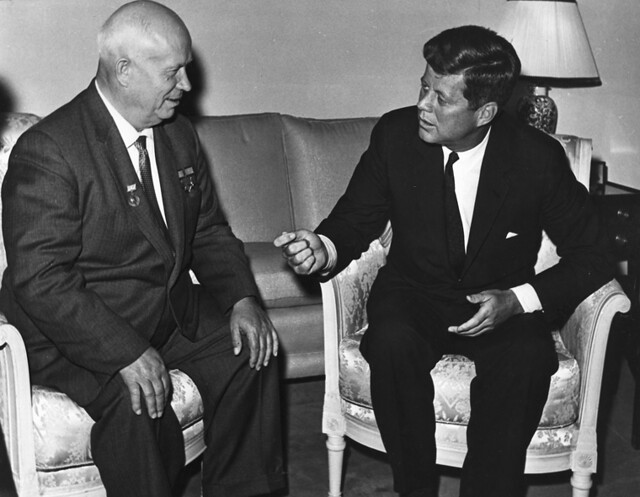
June 3, 1961 - only two months following the Gagarin's pioneering orbital flight, and less than a month after Alan Shepard's 15 minute suborbital ride, President John Kennedy meets with Soviet Chairman Nikita Khrushchev at the U. S. Embassy residence, Vienna, Austria [Deptartment of State/John Fitzgerald Kennedy Library, Boston].
Against this high-temperature political background, Kennedy looked for a significant technical project with which to challenge the Soviets. Kennedy thought that the large-scale desalination of seawater would help win the hearts of emerging “Third World” nations. A key consideration was choosing an effort that the Soviets could not win in the next few years. True enough, space was not his original choice but in order to give the United States enough time to build up and use its industrial and technical might (as well as provide payback on politically realistic timescales), Kennedy needed a challenging long-term national goal.
By assigning his Vice-President Lyndon Baines Johnson to look into possible space projects and report back to him, Kennedy had placed the decision in the hands of someone already committed to an accelerated and vigorous space effort. As Senate Majority Leader, Johnson – a vocal advocate for large-scale space projects – had previously helped shepherd the 1958 Space Act (that created NASA) though the Congress. It was Johnson who asked NASA’s James Webb and Hugh Dryden for options.
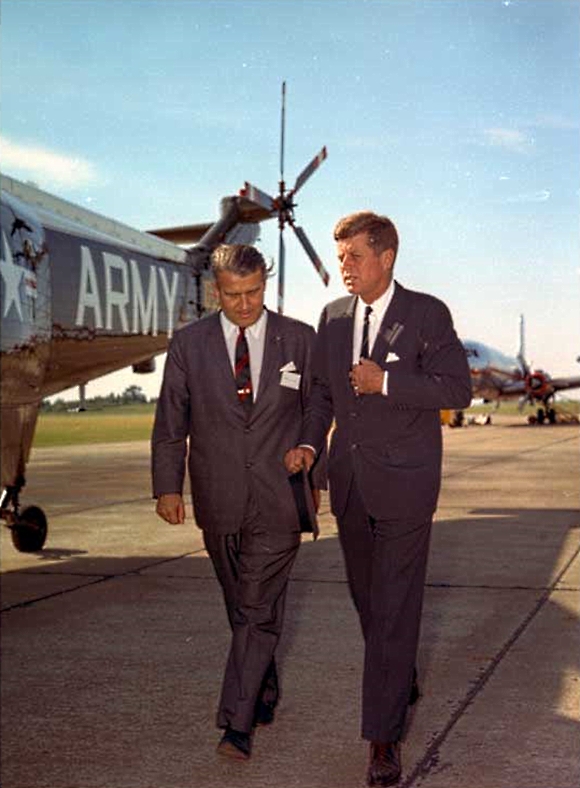
In a memo to Johnson, Kennedy specifically asked, “Is there a space program we can undertake and win?” With Johnson’s committee working closely with Wernher von Braun on what was technically possible in the near- and far-terms, it became apparent that the Soviets had a clear advantage in rocket boosters, making any attempt to match Soviet space accomplishments in low Earth orbit within the next few years likely to fail. On the other hand, if the U.S. were to pick a goal which neither country could achieve in the near-term, America’s edge in technology and resources might give them enough of an advantage to win in the long run – making it a real race.
A manned mission to the Moon emerged as the logical goal and was duly reported to the President. Kennedy was willing but hesitant – initial cost estimates for Apollo were on the order of $40 billion (this was in a saner fiscal era, when a billion dollars meant real money). Committing to spend that much, while not unprecedented, would give politicians of any stripe pause. Nonetheless, Kennedy moved forward with the Moon landing challenge, announcing his initiative in a special Joint Session of Congress on May 25, 1961.
So we now have a picture of a U.S. President, due to political circumstances, forced into and agreeing to a program he was reluctant to undertake. According to Simberg’s piece, this is the meaning of Apollo. What’s missing is that (as they like to say in Washington) Kennedy “evolved” in his beliefs. While initially willing (but cool) to the space program, his continued attention to “the race” over the remainder of his presidency suggests that he became more keenly interested over time. Kennedy, often guided by von Braun who would brief him on technical details, made multiple visits to the new NASA field centers. Kennedy became a “buff” – just like so many of us in the 1960s, drawn up in the excitement of the new space effort. Enthralled by events like a static firing test of Saturn engines at the Marshall Space Flight Center in May of 1963, he began soaking up space knowledge. He was hooked and in it to win it.
Kennedy’s speech at Rice University on September 12, 1962 has become inextricably tied to the American can-do spirit and cited whenever someone wants to capture the inherent romanticism and steely determination of the American effort. Apollo was not some tiresome political task or a pork-shoveling boondoggle to JFK. It was about winning a battle in a very real Cold War. It is in this context that President Kennedy’s September 1963 offer to go to the Moon jointly with the Russians must be understood. Yet, part of a speech given at the United Nations, has been interpreted to show that Kennedy was ambivalent toward space and was attempting to dodge the heavy political and fiscal costs of building the Apollo system. This notion has led some to surmise that had he lived, Kennedy would not have been as ardent a supporter of the space program as we space cadets believe that he was.
John Kennedy's seminal remarks at Rice University, Houston, Texas, September 12, 1962. It was this speech where, many believe, the 35th President succeeded in placing manned spaceflight in historic and definitively American context. "We choose to go to the Moon," he said, "and do the other things, not because they are easy, but because they are hard. Because that goal will serve to organize and measure the best of our energies and skills. Because that challenge is one we are willing to accept, one we are unwilling to postpone, and one we intend to win."
Words were effective weapons during the Cold War. At every opportunity, Kennedy contrasted the open, non-military nature of the American space program with the secretive and presumably bellicose nature of the Soviet one.
This contrast was made explicit in Kennedy’s initial rationale for the lunar effort when he said, “Whatever mankind must undertake, free men must fully share” (emphasis added). By 1963, Kennedy knew Khrushchev’s mind-set as well as any foreign leader. He knew that Khrushchev and the rest of the Soviet Presidium would never accept a proposal for a joint lunar mission – they were suspicious, paranoid triumphalists, as their never-ending blitz of space propaganda illustrated. Moreover, at this stage of the space race, the Soviets were clearly ahead, having racked up a number of headline-grabbing “firsts” including simultaneous multiple crews and spacecraft, four-day long missions, and orbiting the first woman in space, Valentina Tereshkova.
By making an offer for a joint American-Soviet lunar mission, Kennedy appeared reasonable and forthcoming. “See? America has nothing but peaceful intentions for space. If our Soviet colleagues have similar intentions, as they claim, why do they not join us when we ask them to?” Jack Kennedy, a decorated World War II veteran and the consummate Cold Warrior, knew how to play the propaganda card. His offer did not represent a desire to back away from his U.S. commitment to space. It was a calculated move by the United States in the ongoing war of words, threats and confrontations that constituted the Cold War.
It’s tempting to retrospectively apply today’s intellectual template to past events, but by doing so it distorts the historical record. A look at Kennedy’s approach to the Soviet Union shows that his inclination was to confront them when necessary. The Bay of Pigs fiasco early in his presidency followed by the Berlin crisis led Kennedy to believe that Khrushchev and the Soviets must be opposed on the world stage, up to and including space. Initially cool to the very idea of human spaceflight, Kennedy took the concept to new heights of accomplishment by setting – and ultimately achieving – a goal that captured the imaginations of war-weary people around the world.
Originally published November 24, 2013 at his Smithsonian Air & Space blog The Once and Future Moon, Dr. Spudis is a senior staff scientist at the Lunar and Planetary Institute. The opinions expressed are those of the author but are better informed than average.
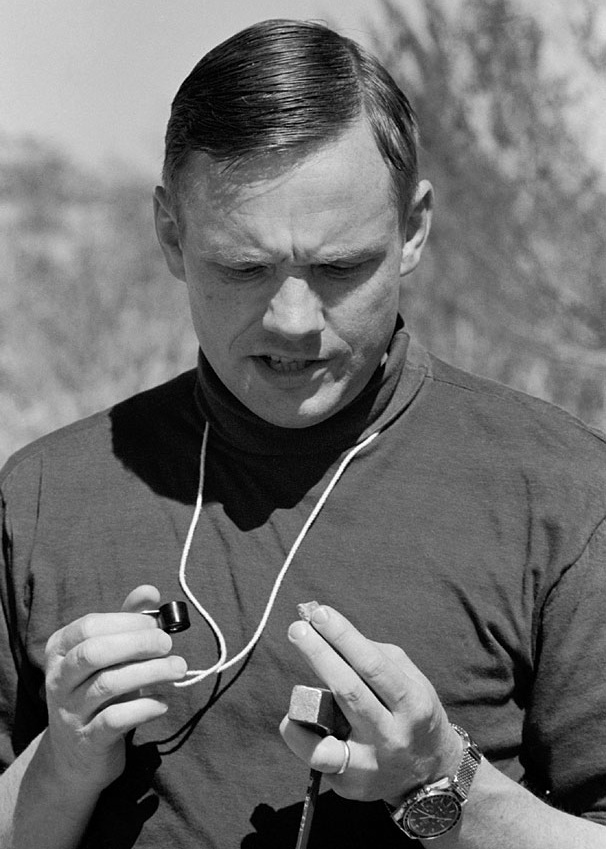
Neil Armstrong examines a sample from the Sierra Madera impact crater, west Texas during geology training for the Apollo program.
Paul Spudis
The Once & Future Moon Smithsonian Air & Space
Because of his flying career and the life that he led, Neil Armstrong’s passing has many recounting his place in the history of spaceflight and remembering a life well lived. He holds a special place in our hearts and a unique place in history – and he always will.
I met Neil Armstrong at a conference, an encounter I won’t forget. A quiet, unassuming man of medium height and build, pleasant and genial, surrounded by a horde of admirers and well-wishers, I could tell he was slightly uncomfortable with (but resigned to) the adulation he received. In his mind, the 1969 flight of Apollo 11 was simply another professional assignment he flew as a test pilot – the landing on the Moon was of more significance than his first step on it. He was an aviator, in every sense of that word. The landing was an accomplishment for humanity – a giant step for mankind.
My glimpses of Neil come not from personal encounters with him, but from others who knew him. During a discussion several years ago with Dave Scott (Apollo astronaut and Commander of the 1971 Apollo 15 mission), I inquired about an obscure incident during the 1966 flight of Gemini 8 (flown by Neil and Dave). That mission conducted the first docking of two spacecraft in space and I wanted to know some details of the emergency experienced by the crew on that flight.
The incident had occurred shortly after the docking, when the Gemini-Agena spacecraft began to roll slightly. The rate of rotation became greater with time and it was evident that something was very wrong. Neil, as commander, was responsible for “flying” the spacecraft but couldn’t get the rolling under control. Thinking that the Agena (their unmanned target vehicle) was responsible, the crew made the decision to undock from it (they were out of contact with Mission Control at the time). As soon as they did, the Gemini spacecraft started to roll and tumble at an ever increasing and alarming rate. Dave recalled with a chuckle that Neil looked over at him, pointed at the attitude control stick and said “See if you can do anything with it!” Dave’s recollection of their exchange gave me a glimpse of a very human moment in a life and death situation. This was serious – if they couldn’t regain control, they would black out from the centrifugal forces in the tumbling vehicle. Neil kept his cool, activated the re-entry thrusters and soon stabilized the bucking Gemini spacecraft. The solution saved their lives but ended the mission, sending them home prematurely but safely.
The story of the first lunar landing is well known. The automatic systems of the Apollo 11 Lunar Module Eagle were targeting the vehicle into a large crater filled with automobile-sized boulders. Landing there would be disastrous, as the LM would likely topple over on touchdown, eliminating the crew’s ability to liftoff from the Moon and return home. Taking manual control, Neil (with Mission Control advising the crew they had thirty seconds of fuel left) guided the LM over the hazardous debris field to a safe touchdown a few hundred meters beyond the original landing site. Tension during the agonizingly long pause in the air-to-ground communications was palpable. Relief could be heard in Capcom Charlie Duke’s voice as Neil calmly announced that the Eagle had landed. Yet again, a critical situation expertly handled by a test pilot just doing his job – the calm and collected decision making necessary when flying finicky machines near the edges of their performance envelopes.
Neil’s scientific work on the Moon during his EVA warrants special mention. Being the first humans to land on another world, it is understandable that the crew had many ceremonial duties to perform. Although they had been carefully instructed to stay close to the LM, without informing Mission Control, Neil walked back a hundred meters or so to Little West crater (overflown earlier) to examine and photograph its interior. Those photos showed the basaltic bedrock of Tranquility Base – documenting that the Eagle had landed amidst ejecta from that crater thereby establishing the provenance of samples collected during the crew’s limited time on the surface. According to Gene Shoemaker and Gordon Swann, both of the U.S. Geological Survey, Neil was one of the best students of geology among the Apollo astronauts. Through his work on the Moon, he showed an ability beyond mere mastery of the facts of geology – he intuitively grasped its objectives, as well as the philosophy of the science. Like every other facet of the mission, Neil understood and took this role seriously. No matter what topic was addressed or which role was taken, he could always be counted on to turn in his best performance.
Armstrong understood the historic role of being the first man on the Moon but he never succumbed to the siren call of fame. He could have cashed in on his status but choose a different path. He was the quintessence of quiet dignity, possessing the “Aw shucks, t’weren’t nothin’” Gary Cooper-ish manner of understated heroism. After retirement, he lived happily in his home state of Ohio, taught aeronautics (his first love) at the University of Cincinnati, and advised on various engineering topics and problems for both government and industry. Throughout NASA’s post-Apollo efforts – without fanfare – he often and freely lent his efforts to the space program. He served his country with honor and dignity.
As a test pilot, Neil routinely showed his ability to make quick, life saving decisions in dangerous situations. As a senior spokesman for space, he clearly voiced his concern over the dismantling and destruction of our national space program. Neil understood that our civil space program is a critical national asset, both as a technology innovator and a source of inspiration for the public. Who would recognize this more clearly than Neil Armstrong? From long experience, he knew what kinds of government programs worked and what kind didn’t. He knew his fellow man. In appearances before Congress in recent years, he outlined specific objections to our current direction in space. A true patriot, Neil did not hesitate to voice his opinions, whether they aligned with current policy or not.
It’s become cliché to say that Neil Armstrong holds a unique place in history. On this occasion, we should pause to consider just how singular his place is. No one – not the first human to Mars nor the first crew to venture beyond the Solar System – will ever achieve the same level of significance as the first human to step onto the surface of another world. The flight of Apollo 11 was truly a once in a lifetime event – and by that, I mean in the lifetime of humanity. That first step was indeed one to “divide history,” as the NASA Public Affairs Office put it at the time.
Goodbye, Neil Armstrong – and thank you. We’ve lost one of our most authoritative and articulate spokesmen for human spaceflight. I mourn him and share his valid concerns for our dysfunctional national space program.
Originally published at his Smithsonian Air & Space blog The Once and Future Moon, Dr. Spudis is a senior staff scientist at the Lunar and Planetary Institute. The opinions expressed are those of the author and are better informed than average.
Artist rendering of the various configurations of NASA's Space Launch System (SLS) together with a quick comparison with the Saturn V (1967-1972) [NASA].
The rocket that will launch humans farther into space than ever before
passed a major NASA review Wednesday. The Space Launch System (SLS)
Program completed a combined System Requirements Review and System
Definition Review, which set requirements of the overall launch vehicle
system. SLS now moves ahead to its preliminary design phase.
The SLS will launch NASA's Orion spacecraft and other payloads, and
provide an entirely new capability for human exploration beyond low
Earth orbit.
These NASA reviews set technical, performance, cost and schedule
requirements to provide on-time development of the heavy-lift rocket. As
part of the process, an independent review board comprised of technical
experts from across NASA evaluated SLS Program documents describing
vehicle specifications, budget and schedule. The board confirmed SLS is
ready to move from concept development to preliminary design.
23 high-resolution views of the Apollo 12 (and Surveyor III) landing site, in a clickable catalog, together with a solar-illumination slide-scale for viewing the images at all available illumination angles of incidence. Featured Sites, a "New tool" LROC invites users to "Explore the Apollo landing sites using LROC images [NASA/ASU/Arizona State University].
Mark Robinson
Principal Investigator
Lunar Reconnaissance Orbiter Camera (LROC)
Arizona State University
The LROC team just released a new webpage to help lunar explorers interact with spectacular LROC images of engaging features on the Moon. The new webpage is designed, with what we hope is an intuitive and easy-to-use interface, to help you find specific features amongst the hundreds of thousands of NAC images now in the archive! First out in our new webpage are some of the most historic places in our Solar System: the Apollo Landing sites where human beings took their first steps into the larger Universe, starting with Apollo 11, 43 years ago tomorrow. Explore these amazing locations on the beta version of the new LROC Featured Sites webpage. Over the next several weeks wrinkles will be ironed out of the new page, and then we will add more content. So keep checking back.
8 of 22 high-resolution LROC NAC observations of the Apollo landing site (July 20, 1969) already available in the new Featured Sites catalog [NASA/GSFC/Arizona State University].
Screen capture of LROC NAC Landing Site Flip Book, Apollo 12 example [NASA/GSFC/Arizona State University].
Have fun dragging the Sun and seeing how the surface changes!
The sole professional scientist to explore the lunar surface, geologist and former U.S. Senator Harrison Schmitt, and Apollo 16 lunar module pilot Charles Duke, together with five other Apollo astronauts, are among the 49 former NASA directors, scientists and astronauts who signed an open letter to NASA Administrator Charles Bolden last week, "admonishing (NASA) for it’s role in advocating a high degree of certainty that man-made CO2 is a major cause of climate change while neglecting empirical evidence that calls the theory into question."
The group, which includes two former directors of Johnson Space Center in Houston, are "dismayed over the failure of NASA, and specifically the Goddard Institute For Space Studies (GISS), to make an objective assessment of all available scientific data on climate change."
They charge that NASA is relying too heavily on "complex climate models that have proven scientifically inadequate in predicting climate only one or two decades in advance."
H. Leighton Steward, chairman of the non-profit Plants Need CO2, noted "many of the former NASA scientists harbored doubts about the significance of the C02-climate change theory and have concerns over NASA’s advocacy on the issue." While making presentations in late 2011 to many of the signatories of the letter, Steward "realized that the NASA scientists should make their concerns known to NASA and the GISS," according to the press release accompanying the letter.
“These American heroes – the astronauts that took to space and the scientists and engineers that put them there – are simply stating their concern over NASA’s extreme advocacy for an unproven theory,” Steward said.
“There’s a concern that if it turns out that CO2 is not a major cause of climate change, NASA will have put the reputation of NASA, NASA’s current and former employees, and even the very reputation of science itself at risk of public ridicule and distrust.”
Select excerpts from the letter:
“The unbridled advocacy of CO2 being the major cause of climate change is unbecoming of NASA’s history of making an objective assessment of all available scientific data prior to making decisions or public statements.”
“We believe the claims by NASA and GISS, that man-made carbon dioxide is having a catastrophic impact on global climate change are not substantiated.”
“We request that NASA refrain from including unproven and unsupported remarks in its future releases and websites on this subject.”
The full text of the letter and signatories, HERE.
Image of artificial moon rock sample, measuring about half
millimeter across, made with an electron microprobe at ambient
temperature after the experiment with X-rays. The fragmenta-
tion of the sample occurred when it was extracted from the
small diamond cylinder in which it had been melted under high
pressure and temperature [ESRF/Nature].
Does the Moon still have even a small, warm liquid core? The answer can only be apparent indirectly, behind its dance movements and the combined angular momentum of it juggled components; the Moon’s anisotropy. If, as investigators now claim, the Moon’s outer surface is still shrinking or, in some cases, stretching, other outward evidence of even a small warm and liquid core can only be discovered indirectly. Why, for example, is any evidence of volcanism on the Moon’s surface at least a billion years old?
A science team in the Netherlands claims to have discovered one answer, the natural buoyancy of molten but poorly mixed constituent materials closer to the Moon’s core. The world’s press is reporting their more subtle investigation, using X-rays, with headlines about future lunar volcanism, which contrasts with their own press release and it's secondary headline:
Deep lunar magma is too heavy to produce active volcanoes
"Scientists have now identified a likely reason for this peaceful surface life: the hot, molten rock in the Moon's deep interior could be so dense that it is simply too heavy to rise to the surface like a bubble in water. For their experiments, the scientists produced microscopic copies of moon rock collected by the Apollo missions and melted them at the extremely high pressures and temperatures found inside the Moon. They then measured their densities with powerful X-rays. The results are published in the Journal Nature Geosciences on 19 February 2012.
"The team was led by Mirjam van Kan Parker and Wim van Westrenen from VU University Amsterdam and comprised of scientists from the Universities of Paris 6/CNRS, Lyon 1/CNRS, Edinburgh, and the European Synchrotron Radiation Facility (ESRF) in Grenoble.
Exploded schematic of the high-pressure cell
assembly for the ESRF synchrotron X-ray
experiment. The artificial moon rock samples
(orange) were placed inside the ring-shaped, natural
diamond sample holder (grey), and surrounded by
a large disk-shaped container (red) [ESRF/Nature].
"The driving force for vertical movement of magma is the density difference between the magma and the surrounding solid material, making the liquid magma move slowly upwards like a bubble. The lighter the liquid magma is, the more violent the upward movement will be.
"To determine the density of lunar magma, Wim van Westrenen and his colleagues synthesised moon rock in their laboratory in Amsterdam, using the composition derived from Apollo samples as their “recipe”. The pressures and temperatures close to the core of the Moon are more than 45,000 bar and about 1500 degrees. It is possible to generate these extreme conditions with small samples, heating them with a high electric current while squashing them in a press. By measuring the attenuation of a powerful synchrotron X-ray beam at the (European Synchrotron Radiation Facility) in Grenoble, traversing the sample both solid and molten, the density at high pressure and high temperature could be measured.
“We had to use the most brilliant X-ray beam in the world for this experiment because the magma sample is so tiny and confined in a massive, highly absorbing container. Without a bright beam of X-rays, you cannot measure these density variations”, says Mohamed Mezouar from the ESRF.
"The measurements at the ESRF were combined with computer simulations to calculate the magma density at any location in the Moon.
"Nearly all the lunar magmas were found to be less dense than their solid surroundings, similar to the situation on Earth. There is one important exception: small droplets of titanium-rich glass first found in Apollo 14 mission samples produce liquid magma as dense as the rocks found in the deepest parts of the lunar mantle today. This magma would not move towards the surface.
"Such titanium-rich magma can only be formed by melting titanium rich solid rocks. Previous experiments have shown that such rocks were formed soon after the formation of the Moon at shallow levels, close to the surface. How did they get deep into the mantle? The scientists conclude that large vertical movements must have occurred early in the history of the Moon, during which titanium-rich rocks descended from near the surface all the way to the core-mantle boundary. “After descending, magma formed from these near-surface rocks, very rich in titanium, and accumulated at the bottom of the mantle – a bit like an upside-down volcano. Today, the Moon is still cooling down, as are the melts in its interior. In the distant future, the cooler and therefore solidifying melt will change in composition, likely making it less dense than its surroundings. This lighter magma could make its way again up to the surface forming an active volcano on the Moon – what a sight that would be! – but for the time being, this is just a hypothesis to stimulate more experiments”, concludes Wim van Westrenen."
Reference: Mirjam van Kan Parker, et al., Neutral buoyancy of titanium-rich melts in the deep lunar interior, Nature Geoscience advanced online publication, 19 February 2012
It might seem easy to spot after cameras on-board the Lunar Reconnaissance Orbiter (LRO) found Lunokhod 1 late last year. Nevertheless, after years of searching, before last November little hope remained that it's French-built laser reflectors would ever assume their important place with four other reflector stations on the Moon. With the help of LRO researchers have now acquired a reflection, tallied in photons, from the old Russian vehicle, a big bonus for theoretical cosmology and planetary science. In the images above and below Lunakhod 1 is set within the context of true surroundings. Above, a high ridge is visible on the north-northwest horizon, beyond the flat vastness of Mare Imbrium. These are the foothills southwest of Promontorium Heraclides. The closest of these are about 42 kilometers away. Click here for a better look.
Can you find Lunokhod 1 in the top image, maybe from clues in the enhanced close-up below it? The Russian lunar rover parked on the western shore of Mare Imbrium hadn't been detected since September 1971. More important than just locating Lunokhod 1, with the essential help of the LROC team at Arizona State, researchers very recently detected it's French-built laser range reflector. LRO (LROC) Narrow-Angle Camera M114185541RE (Orbit 1961, November 30, 2009, alt. 48.4 km. & resolution = 51.3 cm per pixel.) [NASA/GSFC/Arizona State University].
Researchers at the University of California at San Diego have acquired a reflection from the Laser Range Retro-Reflector on Lunokhod 1, the Soviet lunar rover that went missing from September 1971 until being found last November through the narrow-angle cameras on LRO.
The addition of a fifth working laser reflector is a windfall for physicists who believe measuring an even finer Earth-Moon distance could solve important puzzles about the cosmos, things like the locality of physical laws, for example. Putting a point on the Earth-Moon distance finer than three centimeters is thought to be the key.
As early as December 1969 McDonald Observatory gauged the Earth-Moon distance to within 30 centimeters by timing reflection of laser light to and from the Apollo 11 landing site. A pencil-thin laser beam is a kilometer-wide after a 1.5 light-second trip to the Moon. The LRRR deployed at Tranquility Base was designed to reflect light precisely in the direction from which it arrives. After an additional 1.5 seconds the laser light returned to Earth is measured by the photon, enough over many sessions to measure Earth-Moon distance with great precision.
An additional LRRR, identical to the one at Tranquility, was deployed at Fra Mauro by Apollo 14 and another, four-times larger than these, was set up north of the equator near Hadley Rille by Apollo 15. The latter, deployed in 1971, is still the most reliable of the LRRR's set up during the Apollo era.
The Soviet Union landed two RTG-powered lunar rovers, in 1970 and 1973, and both Lunokhod 1 and 2 were equipped with smaller French-built LRRR's. After ten months of successful operation the Soviets lost contact with Lunokhod 1 in 1971. Despite problematic thermal issues and limitations due to its smaller size the LRRR on Lunokhod 2, parked on the eastern side of Mare Serenitatis, has been periodically detected since its mission ended in 1973.
Lunokhod 1 was thought to be parked properly, to the west of it's carrier landing site near the western edge of Mare Imbrium. Instead it appears the rover was properly parked to the north of its last known location, enough for a wide miss. No confirmed detection of its LRRR had been cataloged in over 39 years, until now.
Laser Range Retro-Reflector array at the Moon. Apollo 11 (1969) & Apollo 14 (1971), near the equator and 27 degrees of longitude apart, each one quarter the size of the unit deployed by Apollo 15 (1972). Not detected until 2010 is the french-built triangular array on the Soviet rover Lunokhod 1. The design repeated on the Lunokhod 2 robotic rover has experienced "thermal drawbacks" that hinder daylight detection, conversely sometimes aiding its detection during the lunar night. In addition, NASA/Goddard Space Flight Center is presently keeping close track of LRO using laser ranging from a telescope in Maryland.
In 2005 McDonald Observatory shut down its laser and U.S. work moved to the more powerful and more sensitive system at the Apache Point Observatory in New Mexico. As work has progressed there, high hopes have been held that, at last, Lunokhod 1 might be added to the network. With the help of LRO, which swept up the definite location of the long-lost Soviet rover last November, four decades of patience have been rewarded.
Read Monday's University of California/San Diego news release through the report from NASA's Astrobiology Institute, HERE.
Read NASA's recent report on the LRO surveys of the Lunokhod landing sites, HERE.
February 5, 1971 at Fra Mauro (3.65° S, 342.53° E). The Apollo 14 Laser Ranging Retroreflector experiment, photographed by Cmdr. Alan Shepard. The Apollo LLR's, at Tranquility Base, Fra Mauro and a third with four times the surface area at Hadley Delta, have long been the last Apollo experiments still underway. Designed to return reflected laser light in precisely the direction from which it arrives, vastly improved lasers and detector sensitivities on Earth in the years since have allowed scientists to gauge the Earth-Moon distance with micro-precision, and tantalizing close to limits determining the "locality" of physical laws on cosmological scales [NASA/ASJ].
The Apollo 12 lunar landing of November 1969, in walking distance from Surveyor 3, demonstrated accumulated levels of understanding of the Moon, lunar navigation and vehicle capability that was truly stunning. Some hold the engineering accomplishment to be as great a Cold War victory as the first landing clearly was four months earlier. Like so many other unexpected discoveries in space exploration, however, new lessons and wisdom took on a greater importance with the passing of time.
Though Conrad and Bean succeeded also in collecting the camera and shovel arm from the unmanned Surveyor 3, learning what those artifacts could tell us about the Moon as a "long duration exposure facility" was not a NASA priority. The Final Reports in 1970 (NASA-CR-121796) indicated after careful examination of Surveyor 3's components that what slight "weathering" there was to be found on camera was wholly a result of the blast of Apollo 12 descent engine. But, first actually locating and then landing the lunar module precisely where Surveyor 3 was situated (there were no orbital photographs of the spacecraft in situ) was pretty astonishment by itself. No one was cautious of any evidence of an active fallout of electrostatic dust on the Moon in 1969.
Though there had been hints of a gossamer-thin migratory dust phenomena happening on the Moon, Apollo 8 crew sightings from orbit and night time Surveyor images, the concerns of the time were solar and cosmic radiation, and micrometeor bombardment. Evidence at the Apollo astronaut's feet and on their spacesuits (and in their eyes and noses) of the voluminous accumulations of dust everywhere on the Moon was (not incorrectly) thought to be the end result of extremely slow processes.
The evidence for the presence of a dusty lunar exosphere has mostly been discovered to explain gathering evidence, not all of it gathered on location. Twenty years ago great (but very thin) trailing clouds of silicon and potassium ions, among the more easily spectographically-detected dusty elements. These were composed into photographs showing the Moon orbiting Earth in a cloud of it's own bombardment.
The forty years since Apollo, occasionally punctuated with influential, if rare (until 2007), lunar probes likeLunar Prospector, gave lunar and planetary scientists a lot of time and new evidence to ponder. Perhaps the length of time itself allowed many theories to be shaken out and ultimately proven amazingly accurate.
Departing tests of instruments now used by Cassini at Enceladus to detect water were aimed at first light at the Moon, precisely because its bone-dryness was believed to present a sold baseline of zero water. The unexpected detection of water there, coincident with daily cycles of sunlight, has now become part of the context of evidence old and new that verified the astounding conclusion that some areas of the lunar surface may be wetter than Mars (relatively speaking).
In May 2012 NASA Lunar Atmosphere and Dust Environment Explorer (LADEE) should have the capability needed to improve our understanding of processes related to the charging of lunar dust particles and the implantation and presence of water on the Moon, the interaction of solar particles and energetic photons (including neutral hydrogen) that polarize the smallest grains on the Moon's immediate surface. Gardened over, roughly every 2 million years predominately by micrometeorite bombardment, submicron sized flecks are repelled by opposing charges into ballistic trajectories as high as the orbit forty years ago of Apollo's command and service modules.
Though posing little or no danger to orbiting spacecraft, the range of hazards that lunar dust poses to sustained surface operations, whether manned of unmanned, are manifold. The susceptibility of the smallest of these shards to electrical charging, their stubborn clinging to seals and skin, for example, is both the source of their danger and perhaps their mitigation.
The forensics done on the Surveyor 3 parts offered us lessons. In the near future, if anything is to be learned about fallout of lunar dust from an examination of human artifacts a degree of care must be taken beyond the mission goals of Apollo 12. If you want to approach and examine Apollo 11's descent stage, for example, the arrival of Apollo 12 near Surveyor 3 showed any similar arrival near near Tranquility Base should be from well over the horizon, and more. Calculations show at least some of the famous dust raised at the arrival and departure of Apollo's lunar modules must have attained great altitude, even escape velocity.
Very little would be needed to disturb a forty year record of dusty "precipitation."
It is thought that the migratory dust circling the Moon continuously, with its wave crest directly behind the longitude of sunrise, is related to the forces that lead to implantation of volatile molecules like hydroxyl and water. The path of the oppositely charged and neutralized dust fallout, it's cycle of return to the surface, may rain in one direction during the equivalent of a lunar winter and predominate in the opposite deviation from westerly during a lunar summer.
Dust fallout cycles may then be the source of the criss-crossed "elephant skin" patterns seen on lunar high places and elsewhere.
Tied as the phenomena is to solar-induced charging, the pattern of the Moon's dusty cycles of levitation and fallout are attenuated during the Moon's monthly transit through Earth's magnetotail. Something similar may be true, on a smaller scale, affecting levitation and subsequent fallout of lunar dust in and around especially strong crustal magnetism. This might perhaps then be a solution to the mystery posed by a presence of brighter surface albedo (low optical maturity) characteristic of lunar swirls within these"magnetic anomalies" whose origins otherwise speak of greater age than high albedo would indicate.
And now, very recently, evidence comes to "light" that fallout from the very thin, neverending lunar dust storm is accumulating with a greater speed than anyone may have imagined.
When a powerful laser is aimed at the Moon from Apache Point in New Mexico, the thin beam consisting of many hundreds of billions of photons spreads out to at least two kilometers in width during the second and a half needed for it to center on Apollo's retroreflectors, 400,000 kilometers away. The small sampling of that beam reflected back is literally counted in single photons by the time it returns back to New Mexico.
After accounting for things like today's more accurate photon detectors, more powerful and accurate lasers, more suitable laser wavelengths and a more powerful telescopes than originally used for this purpose at MacDonald Observatory in Texas, the photon count should be measurably improving, just as it has been. Still, something doesn't quite add up, and one investigator thinks he knows why.
"Tom Murphy from the University of California, San Diego, who leads one of the teams at the Apache Point Observatory in Sunspot, New Mexico, thinks the mirrors have become coated in moon dust. "The lunar reflectors are not as good as they used to be by a factor of 10," he says."
An article in New Scientist February 15 takes up the story now, illustrating better also why measuring the distance from Earth to the Moon, and the retroreflectors left behind on the Moon have lately taken on a new importance to cosmologists.
Traverse map of Apollo 14 landing site. [NASA/GSFC/ASU/OSU] (Full Size HERE.) Jordan Lawyer LROC News System
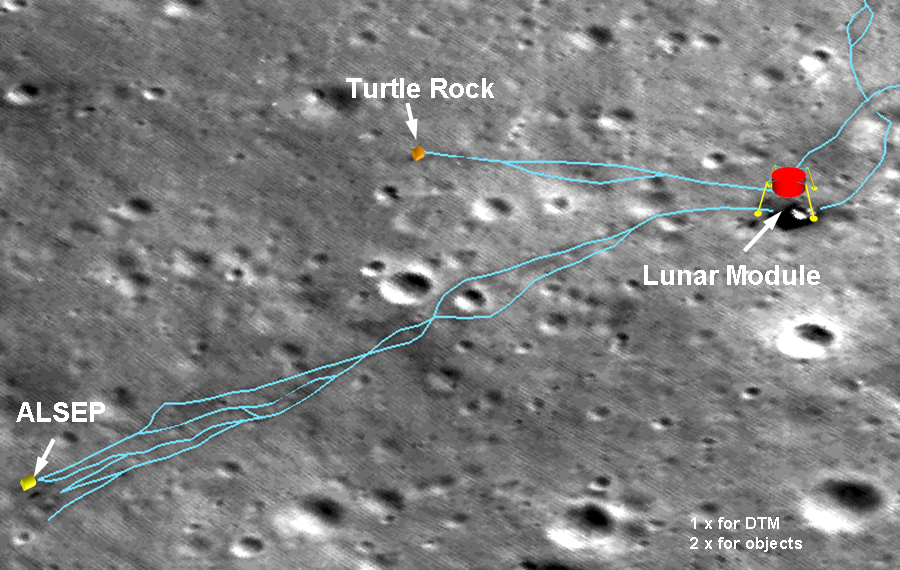
In the zoomed image (HERE), the lunar module can be identified by its deck (red points) and distinctive shadow (green lines). These points are measured in the two stereo images and their corresponding 3D ground coordinates are computed. Note that the shadow analysis uses different times and sun angles of the two images for computation. In addition, the nearby terrain is measured at the selected points on the ground (green points) as a reference. From these measurements, we can compute the height and diameter of the lunar module. As the result, the height of the lunar module (descent stage) is estimated as 3.0 m, compared to the design specification of 3.2 m. On the other hand, the shadow analysis resulted in a height of the lunar module of 3.2 m. Furthermore, using a least squares fitting to a circle the diameter of the lunar module is computed as 4.4 m, compared to the design data of 4.2 m.
Apollo 14 at the beginning of Edgar Mitchell and Alan Shepard's first EVA in February, 1971. Erik van Meijgaarden has combined A14-9254 and 9255 as a 4 o'clock portrait of the Lunar Module, now a feature of the Apollo 14 section of the Apollo Surface Journal.
Having barely survived the aftermath of the tank explosion resulting in the only aborted manned lunar landing, after swinging around the Moon and using their lunar module's descent rocket to accelerate their lifeboat configuration into a proper return trajectory, before encountering Earth's atmosphere at 40,000 kilometers per hour, the crew first undocked from the LM and then jettisoned the Service Module. Only then were they able to see how close their ordeal came to ending at the very start. The explosion had ripped away entire panels on the SM and warped the fragile superstructure. As they re-entered Earth's atmosphere it still remained to be seen whether the Command Module's heat-shield had been damaged. Though the scene above was described by the exhausted crew to anxious Houston, nearly a week passed after the crew of Apollo 13 was safe on the ground before the above picture was available to the world [NASA/Apollo 13].
Jason Rhian
Examiner
It was called NASA’s “successful failure” and it marked one of the most trying points in the space agency’s history. Apollo 13 tested the resolve of NASA’s young engineers and astronauts as never before the heroic efforts of these space pioneers would go down to write NASA’s finest hour. Now, on the fortieth anniversary of the near-loss of the Apollo 13 crew, the Astronaut Scholarship Foundation is celebrating the safe return of the crew at Kennedy Space Center in Florida.
The Apollo 13 saga began with the liftoff of the mighty Saturn V rocket at 13:13 p.m. (EDT) on April 11, 1970. Two days after launch, a command was given to stir the oxygen tanks and what followed was one of the most dramatic moments in manned spaceflight history. An explosion occurred and the crew and mission managers on the ground had to scramble to ensure the safe return of the crew. Through seat-of-the-pants flying and ingenious technical innovations, the crew was brought home safe and sound. To show how great an impact this mission had, to date it is the only Apollo mission to have a big-budget Hollywood movie made about it.
On July 20, 1969, Buzz Aldrin became the second man to set foot on the Moon, following mission commander Neil Armstrong. That historic moment was over 40 years ago. Today, Aldrin is celebrating another milestone, his 80th birthday.
Although the famous Apollo 11 mission was over four decades ago when NASA was in its infancy, Buzz continues to be very vocal in matters of human spaceflight. He is an outspoken critic of spaceflight policy and an expert in communicating all things space to the public.
INTERVIEW: Find out what Buzz had to say to Discovery News correspondent Irene Klotz during the Apollo 11 anniversary in July 2009.
The Lunar Reconnaissance Orbiter's (LROC) Narrow Angle Camera swept up this high-sun image of a fresh crater in the Meskelyne region in south central Mare Tranquillitatis, 326 km east-northeast of Tranquility Base, in its 1196th orbit, Sept. 30, 2009 [M108992058RE - NASA/GSFC/Arizona State University]
NASA's Lunar Reconnaissance Orbiter (LRO) was launched in June 2009 and is currently orbiting the Moon around its poles at a low altitude of just 50 kilometers (31 miles). The primary objective of the LRO is to prepare for future lunar exploration, scouting for safe and compelling landing sites, potential resources (like water ice) and more. The high-quality imagery used in the mapping of the lunar surface is unprecedented, and a few early images have included detailed overviews of the landing sites of several Apollo missions some 40 years after they took place. LRO is now on a one year mission with possible extensions of up to five years. Collected here are several recent LRO images, and a few then-and-now comparisons of Apollo landing sites.
Glancing back at Vallis Lorus as seen from an eastern extreme up on the north side of the "lobe" rising between Rima Sung Mei (the shallow fissure with darker material moving off to the northeast and out of view) and Rima Krishna (to the left, and eclipsed by the lobe) over-looking a uniquely-shaped lunar valley in the western Mare Serenitatis.
Larger than it might appear, the western extreme above center is approximately 5.5 km away, and the deepest point in the valley floor, just barely out of sight below, falls away more than 300 meters below this "virtual" vantage point made possible by GoogleMoon. This close-up is combines Apollo science photography with laser altimeter data from Japan's Kaguya (SELENE-1) mission (2007-2009). [GoogleMoon/ASU/NASA/USGS/JAXA] GoogleMoon, a virtual world within GoogleEarth, provides arm-chair lunar explorers a long-awaited way of experiencing the "ground truth" on our nearest neighbor, the chance to see vistas from the surface as only an astronaut can, though no astronaut yet has. There are limits to the availability of data from the latest international fleet of 21st century probes, however, presenting a slight problem to GoogleMoon users, while hinting at a solution to that problem that GoogleMoon might eventually provide.
Before long, you or an astronaut (or a taikonaut; some kind of Human Being, in any case) will stand and survey Vallis Lorus from it's eastern rim. I took a stroll there today, not just without my helmet but without my spacesuit. And this took far less effort than setting up my telescope and waiting for one of only two viewing opportunities each month - six days after a New Moon or five days after the Moon is Full - all the while wishing for a cloudless sky.
I took the picture (screen capture) above soon after hungrily devouring the latest "featured image" released by the LROC News System at Arizona State University.
Though this doesn't yet rival the unparalleled detail in Mare Serenitatis seen from Lunar Reconnaissance Rover (LRO) last August, it's pretty close to the perspective you or I might see standing on the Moon at this spot, or at least what I might see without my glasses.
The Japanese Space Agency (JAXA) demonstrated the potential when combining Kaguya laser altimeter and Terrain Mapping Camera data in 2008. Photographs taken from the ground by Dave Scott and Jim Irwin (Apollo 15) from edge of Hadley Rille with St. George Crater at the rille bend at the foot of the Montes Apenninus were juxtaposed against a similar perspective within a computer-generated virtual presence at the same location, and they matched perfectly. This offered best evidence to date that Scott & Worden were actually on the Moon in 1971, and showing the same scene captured by the color television camera mounted on their Rover.
The only thing missing was the kind of "edging," the smaller-grained material, small rocks and differentiated boulders, boot prints and dust now coming in from LRO. This is almost the same experience available today, in relatively small and narrow areas of the Moon, if you have GoogleEarth (v.5 and above).
Aside from the landing sites for Apollo 15 and 17, yesterday's featured release from LROC, highlighting Vallis Lorus ("Aratus CA," Oct. 3), is the first from LRO in the Apollo science-mission, high-resolution photography corridor of GoogleMoon, a strip of near side surface roughly 150 km wide stretching over 2700 km from southeast-central Mare Imbrium on the west to the south side of Mare Crisium on the east.
It's a good start but GoogleMoon won't really be fully released, as heralded in celebration of the 40th anniversary of Apollo 11 last July, until this same depth of resolution covers the entire virtual Moon.
While the Apollo science imagery, from Apollo 15, 16 & 17, did not cover the whole Moon it did cover much more than that featured in GoogleMoon at present. Even the lower resolution photography elsewhere in GoogleMoon would be vastly improved with the addition of Kaguya altimetry or, perhaps better still, LOLA laser altimetry from LRO.
The gently sloping terrain everywhere else but what is found within the single Apollo corridor or at the landing sites (probably altimetry from Clementine gathered in 1994, has a "here there be dragons" feel. It's bound to be a disappointment to young, would-be lunar explorers who want to scale Rupes Recta or the heights of the far side.
Finding out why GoogleMoon's developers stopped where they did, or more importantly if there are plans to complete the project in a timely fashion has proven to be elusive, though we are still trying and would welcome suggestions.
In the meantime, the astounding experience of exploring those areas within the high-resolution scenery is actually yielding new discoveries, and it is offering what might be a solution to a thorny problem patiently outlined by Dr. Harrison Schmitt. It's a solution to a problem which might also be at the root of why serious GoogleMoon explorers find themselves confined to restricted areas.
I will outline just what we mean in the next installment.
Washington -- Reporters are invited to attend a briefing about the NASA Lunar Electric Rover concept vehicle that will be driven down Pennsylvania Avenue in Washington as part of the presidential inaugural parade on Jan. 20. The rover is part of a new generation of prototype vehicles that NASA is evaluating for use when astronauts return to the moon in 2020.
The briefing will be held in the NASA Headquarters auditorium at 300 E Street, SW, on Wednesday, Jan. 21, at 1:30 p.m. EST. After the briefing, NASA officials will escort participants to the vehicle and demonstrate some of the rover's capabilities for reporters.
About the size of a pickup truck, the rover can house two astronauts for as long as 14 days with sleeping and sanitary facilities. Among the rover's many unique features is a "crabbing" movement that enables it to drive its six pairs of wheels in any combination of forward and sideways motion to scramble over rough terrain. As an additional benefit, the vehicle is helping NASA develop new technologies that will be applicable to electric vehicles on Earth.
For a high-resolution photo and more information about the NASA lunar rover, visit: HERE.
San Diego Union-Tribune Like most astronauts in the 1960s, the Apollo 8 crew members were Cold War warriors. Their mission was to fly to the moon, scout landing sites and return safely to Earth.
But on Dec. 24, 1968, as Apollo 8 completed its third orbit around the moon, James Lovell Jr., Frank Borman and William Anders saw something that made the mission more than another battle to prevail over the Soviet Union.
They saw the Earth, emerging from the lunar horizon as their spacecraft flew 69 miles above a dead, monochromatic moonscape.
“The Earth was the only thing in the universe that had any color,” said Borman, now 80. “It was a long way away.”
The sight was one of the few uplifting moments in a year pummeled by war, assassinations and civil unrest.
The three men were nearly a quarter million miles from home – the farthest anyone had yet ventured. Their mission would clear the way for Neil Armstrong and Edwin Aldrin to land on the moon seven months later.
Dr. Neil Armstrong (Left - Apollo 11 cmdr.), Dr. Harrison "Jack" Schmitt (Center Right - Apollo 17 LM cmdr.) & Captain Gene Cernan (Right - Apollo 17 cmdr.) tour Constellation Altair Lunar Lander mock-up. Rarely do we notice history until it becomes history. That's Wayne Ottinger between Dr. Armstrong and Dr. Schmitt, who worked with all three in engineering the Apollo Lunar Module. BIG HAT TIP to ROB COPPINGER @ Hyperbola (Flight International)
Hadley Rille Valley and Mount Hadley - smaller scale HDTV still of the Palus Putredinis (the Marsh of Decay) amidst the Lunar Apennines and southwest of Imbrium Basin; and Aristillis and Autolycus Craters by Japan's (JAXA) KAGUYA, February 2008
At five meter resolution, the Lunar Community, still Earthbound, has marveled at the HDTV stills beamed home by Japan's Kaguya(Selene) Lunar Orbiter. Unfortunately, it has also whetted appetites for the half-meter resolution promised by NASA's Lunar Reconnaissance Orbiter. LRO is still slated for launch in October.
Meanwhile JAXA continues to serve up appetizers from multiple instruments, and an orbital view Senator Jack Schmitt (Apollo 17) describes as "the closest thing to being there" he's experienced since December 1972.
After releasing tight shots of Tranquillity Base from 200 kilometers overhead and the high phase angle & high altitude images of Taurus-Littrow, the first and last places humans scratched the surface of Earth's Moon, respectively, JAXA has today released perhaps the best shots yet of an Apollo landing site.
The image above hardly does the release justice, as Junya Terazono explained earlier today:
Hello lunatics,
JAXA announced today that Kaguya successfully captured images of Apollo 15 landing site. And they confirmed some remnant of thrusted gas (helo) near the landing point. This is the world's first of discovery of Apollo evidence since the cessation of the mission.
* JAXA press release (Japanese, as usual) http://www.jaxa.jp/press/2008/05/20080520_kaguya_j.html The image captured on 24 Feb 2008. Also, they released composite 3D images of the landing site using stereo pairs. The images show remarkable coincidence with photographs taken in Apollo 15 mission.
FIGURE ONE: Brief explanations of each image.
FIGURE TWO: The stereoscopic view of the Apollo 15 landing site. You can clearly see the meandering Hadley Rille in the middle of the photograph.
FIGURE THREE: The topographic map of the landing site (LPI). The red arrow shows the viewing direction of Figure 1.
FIGURE FOUR: Magnified view of the image near the landing site. The area surrounded by red lines are considered as the remnant of the halo, the exposed surface after blowing of the thrusted gas.
FIGURE FIVE: The difference of the landing site before and after the landing, from the Apollo 15 Preliminary Science Report. Left one is AS15-87-11719, taken before landing. Right one is AS15-9430, taken from the command module after two circulation of the moon.
FIGURE SIX: The comparison between stereoscopic view composed from Kaguya images (left) and Apollo 15 view (right). As any viewpoint is available from Kaguya TC images, JAXA staff composed the image simulated the view from Apollo 15 landing site. Hills and other topography are remarkably same.
FIGURE SEVEN: A HDTV image of Apollo 15 landing site.
Close-up view of the Hadley rille. The stacked lava flows are clearly seen.