Showing posts with label DALI. Show all posts

Monday, July 2, 2012

Farside offers radio-quiet to probe cosmic Dark Age

Dark Ages Radio Explorer (DARE), utilizing the radio-quiet of the lunar farside to explore the earliest period on the cosmic time line, 200 million years between the primordial Big Bang and the emergence of the earliest luminous sources and the structure of the present universe. "The lunar Farside is potentially the only site in the inner solar system for high precision radio cosmology.” [NLSI].
Anil Ananthaswamy
New Scientist
 

FORTY years after NASA ditched the idea of landing Apollo 17 on the far side of the moon, the forbidden fruit is being sought once again. Not by astronauts this time, but by astronomers seeking a quiet spot from which to observe the universe's "dark ages".

This was an epoch in the development of the cosmos, which lasted for a few hundred million years after the big bang, before stars and galaxies began to form. The only way to observe the dark ages is to look for faint radio signals from neutral hydrogen - single protons orbited by single electrons - which filled the early universe.

Telescopes on Earth, such as the Murchison Widefield Array in Western Australia, are searching for such signals, at frequencies above 100 megahertz. This can probe the universe back to 400 million years after the big bang.

To explore even earlier times, telescopes need to receive radio waves at frequencies below 100 megahertz. Interference from radio sources on Earth such as FM radio and the planet's ionosphere can mess up these signals. "You get to the point where the ionosphere is just a hopeless barrier," says Dayton Jones of NASA's Jet Propulsion Laboratory (JPL) in Pasadena, California. "You have got to go to space, and the most promising location by far is the far side of the moon."
To peer back to the universe's earliest years will need sensitive telescopes in a place where Earth's ionosphere and radio chatter cannot interfere
This is why astronomers were discussing it at an American Astronomical Society meeting in Anchorage, Alaska, this month. Telescopes behind the moon would not have to contend with Earth's ionosphere, and they would also be shielded from our planet's radio chatter. "It is a very pristine environment for low-frequency observation," says Jones.

The first shot at radio astronomy from the moon's far side will probably be a mission called the Dark Ages Radio Explorer, being designed by Jack Burns at the University of Colorado at Boulder, and colleagues.

If selected as a mission by NASA in its review next year, DARE will orbit the moon at an altitude of 200 kilometers. It will collect neutral-hydrogen signals between 40 and 120 megahertz. That corresponds to 80 million to 420 million years after the big bang. Its antenna is designed to pick up signals from the entire sky. The craft will be a little toughie, with parts made from an Astroquartz/Kevlar fibre, which is very thermally stable - particularly handy when moving in and out of sunlight as it orbits the moon.


The DARE team has begun testing the probe's antenna at remote locations on Earth, starting with the National Radio Quiet Zone surrounding the Green Bank telescope in West Virginia. "It may be a radio quiet zone, but it's not quite," says DARE team member Abhirup Datta. "You can still see the FM bands coming in, and of course the ionosphere is a problem."

Not everyone reckons a space-based solution is needed to study the universe's dark ages. "Existing ground-based experiments will yield good progress on this problem at a tiny fraction of the cost of a space mission," says Steven Tingay of Curtin University in Bentley, Western Australia, who headed the construction of the Murchison array.

Burns disagrees. Preliminary tests reveal that the Earth's ionosphere is absorbing signals from space and re-emitting them as noise in frequencies below 80 megahertz. "If we can verify and characterize that, that slams the lid on any attempts to do this kind of experiment from the ground," says Burns.

Once DARE has done its job, his team want to deploy bigger telescopes on the lunar far side to image the first stars and galaxies. These antennas would be made of conducting material imprinted on extremely lightweight films of polyamide, micrometers thick.

In one design, three 100-metre-long arms of such films are attached to a central box of electronics. The arms would be rolled up tight for launch and, once on the moon, a rover sent along with the unit will move it to its required spot and help unfurl the arms. The rover would likely have to be controlled by astronauts orbiting a Lagrange point over the lunar far side.

To test this scenario, Burns's team will work with astronauts based on the International Space Station next year. The astronauts will remotely operate a Mars rover called K-10. It is being outfitted to unwind films of polyamide on a simulated Martian landscape at NASA Ames Research Center in Moffett Field, California.

HDTV still of Tsiolkovskiy, captured by Japan's lunar orbiter SELENE-1 ("Kaguya," 2007-2009). The Naval Research Laboratory, Massachusetts Institute of Technology and  others are refining work on a possible radio telescope array to be deployed in the conspicuous farside crater floor to utilize the radio quiet of the the Moon's farside to probe the cosmic Dark Age [JAXA/NHK/SELENE].
"The ultimate experiment we'd like to do for cosmology on the far side would involve thousands of these antennas," says Burns.

But what if the basic idea proves unfeasible, in terms of cost or in overcoming obstacles in the terrain? At JPL, Jones and his team are working on another solution: rolled-up antennas that inflate like party blowers seconds before they touch the lunar surface. "They are essentially immune to whatever irregularities there are at the surface," says Jones.

Astronomers have their sights set on at least one site for such telescopes: the flat bed of the 180-kilometre-wide Tsiolkovskiy crater, exactly where the Apollo 17 astronauts first wanted to land.

Related Posts:

Tuesday, April 24, 2012

The Moon as a platform for astrophysics

Darks Ages Radio Explorer (DARE), utilizing the radio-quiet of the lunar farside to explore the earliest period on the cosmic time line, 200 million years between the primordial Big Bang and the emergence of the earliest luminous sources and the structure of the present universe. "The lunar Farside is potentially the only site in the inner solar system for high precision radio cosmology.” [NLSI].
Joel Raupe
and from reports

The Moon has been used as a platform for astrophysics research since laser range reflectors were deployed by three of the six Apollo surface expeditions and also as part of the Soviet two Lunokhod robotic rovers. A lunar laser range reflector (LLRR) has now been orbiting the Moon as part of the Lunar Reconnaissance Orbiter (LRO) mission since June 2009.

A welcome added bonus to the LRO mission came after photographing Lunokhod-1. The 1970 mission's French-built LLRR had been lost almost immediately after the rover was parked for the last time in 1970.

Before LRO, with only four arrays bouncing back mere photons from powerful laser pulses from Earth beginning in 1969, the distance to the Moon was measured with increasing accuracy down to a 3 centimeter margin of error. With the addition of the LRO reflector and after definitively locating Lunokhod-1 astrophysicists sharpened  measurements even further, finally with precision enough to rule out the idea that the astounding newly discovered increasing rate of the universe's expansion might be a “local” phenomenon, or a kind of optical illusion.

The Naval Research Laboratory (NRL), together with the Massachusetts Institute of Technology (MIT), has been building on the age old dream of utilizing the “radio quiet” of the Moon’s Farside to peer into the elusive Cosmic Dark Age, the period between the Big Bang and the “Epoch of Reionization,”  when an intergalactic medium composed mostly of neutral gases was “ionized by the emergence of the first luminous sources.”

Continuing with this description supplied by the MIT Haystack Observatory, “The sources may have been stars, galaxies, quasars, or some combination.  By studying  Reionization we can learn a great deal about the process of structure formation in the Universe, and find the evolutionary links between the remarkably smooth matter distribution at early times revealed by (Cosmic Background Radiation) studies and the highly structured universe of galaxies and clusters of galaxies” astronomers can peer more than 10 billion light years into the past.

Exploring that early “Dark Age” will almost certainly require radio telescopes able to detect sources radiating at frequencies red-shifted to wavelengths typical of the noise created by human civilization.

A solution offered by MIT and the NRL suggested an immense antenna farm deployed robotically on the wide floor of Tsiolkovskiy crater. The Dark Age Lunar Interferometer array was discussed in some detail in 2008, when achieving “extended human activity” on the Moon was national space policy.

The NASA Lunar Science Institute (NLSI) reports two of their collaborating working groups are suggesting putting a radio telescope in orbit around the Moon where it can put a significant part of its time exploring this cosmic Dark Age, the Darks Ages Radio Explorer (DARE). The mission concept is one of two ideas being pursued by the Lunar University Network for Astrophysical Research (LUNAR) “addressing the question of how the Moon can be used as a platform to advance important goals in astrophysics,” according to the NLSI.

The other suggestion by the LUNAR group proposes, “technology development for future lunar surface telescopes, which can help detect and characterize Earth-like planets orbiting nearby starts.

“Both approaches leverage the Moon as a science platform. The lunar Farside is potentially the only site in the inner solar system for high precision radio cosmology.”

DARE will use the highly-redshifted hyperfine 21 cm transition from neutral hydrogen to track the formation of the first luminous objects by their impact on the intergalactic medium during the end of the Dark Ages and during Cosmic Dawn. The science instrument is composed of a low frequency radiometer, a receiver, and a digital spectrometer. The various sub-systems have been constructed and are in the process of system integration. After check-out, the system will be deployed and tested at the Murchison Radio Observatory in Western Australia—one of the most radio quiet locations on the planet.

The Lunar Radio Telescope Array (LRTA) is a concept for a telescope located on the far side of the Moon where it is protected from radio frequency interference (RFI). It would detect magnetically generated radio emissions to provide insights into the interior structure of planets— information likely to be difficult to obtain by other means.

The Apollo 15 laser ranger reflector, 4x the area of
the LLRR arrays deployed by Apollo 11 & 14, is
the most reliable of the 5 units placed on the Moon.
Furthermore, the Lunar Laser Ranging (LLR) component of the LUNAR team has taken a two-fold approach toward testing theories of gravity. Not only are they continuing precise measurements of the Earth-Moon distance via laser ranging, but they are also leading efforts to develop a next-generation retroreflector package that could be emplaced on the Moon by future missions.

While the three retroflector arrays deployed during Apollo era were an incredible success, the reduced return from the arrays over the years has limited advanced investigation into general relativity. At present, there are a number of stations that can access Apollo 15 arrays but not the Apollo 11 and 14 arrays; the new retroreflectors will have signals that can be accessed by a large number of lunar laser ranging ground stations. A next generation retroreflector would improve precision measurements for gravitational physics and for understanding the lunar interior.

As a classical theory, general relativity and quantum mechanics are fundamentally inconsistent; there must be a breakdown at some level of accuracy in general relativity or a problem with quantum mechanics. A much higher ranging accuracy would improve scientific results in testing the theory of general relativity by more than two orders of magnitude. 

This post was derived in part from the NLSI release,
NLSI Teams Conduct Astrophysics Research

Related Posts:
MIT to lead development of new radio telescope
array on lunar farside
(February 19, 2008)
Naval Research Laboratory to design Farside DALI (March 11, 2008)
What better view? (March 26, 2008)
New model of lunar motion from Apollo LLRR (December 27, 2008)
MacDonald LLR defunded by NSF (June 21, 2009)
The continued importance of lunar laser ranging (August 3, 2009)
Laser Ranging and the LRO (August 12, 2009)
Dust accumulation on Apollo laser reflectors may
indicate a surprisingly fast and more dynamic
lunar exosphere
(February 16, 2010)
Long term degradation of optics on the Moon (March 4, 2010)
A Fundamental Point on the Moon (April 13, 2010)
Acquisition Lunokhod-1 (April 27, 2010)

Thursday, September 29, 2011

LROC: Highland-Mare Boundary of Tsiolkovskiy


Central segment from HDTV still returned by Japan's lunar orbiter Kaguya (SELENE-1, 2007. This oblique, long-range view across the craggy expansive floor and central peak from the north shows Tsiolkovsky crater's floor. It's prominent on the farside because such dark features are far fewer here than on the Nearside. The slumped inner circumference of Tsiolkovsky's rim glowers several kilometers over its floor, an area where the Naval Research Lab, MIT and NASA hope one day to eventually deploy a radio array shielded from man-made interference. Such a facility could probe the cosmological "Dark Ages," a poorly understood 200 million year-long time between the Big Bang and the formation of earliest stars and galaxies.

LROC used it's Narrow Angle Camera (NAC) to study the contact boundary between rugged highland and Tsiolkovsky's relatively flat and darker floor. (The area shown in a Featured Image released September 28, 2011 is indicated by the yellow arrow) [JAXA/NHK/SELENE].


The mare plain of Tsiolkovsky stood out plainly in the first images of the lunar Farside returned by the Soviet probe Luna 3 in 1959, highlighting from the start the striking differences between the familiar features of the Moon's nearside and an entire hemisphere never before seen by human eyes. The northeastern contact area highlighted below in a more detailed look at this part of the LROC WAC 100 meter resolution Global Mosaic is boxed in yellow [NASA/GSFC/Arizona State University].


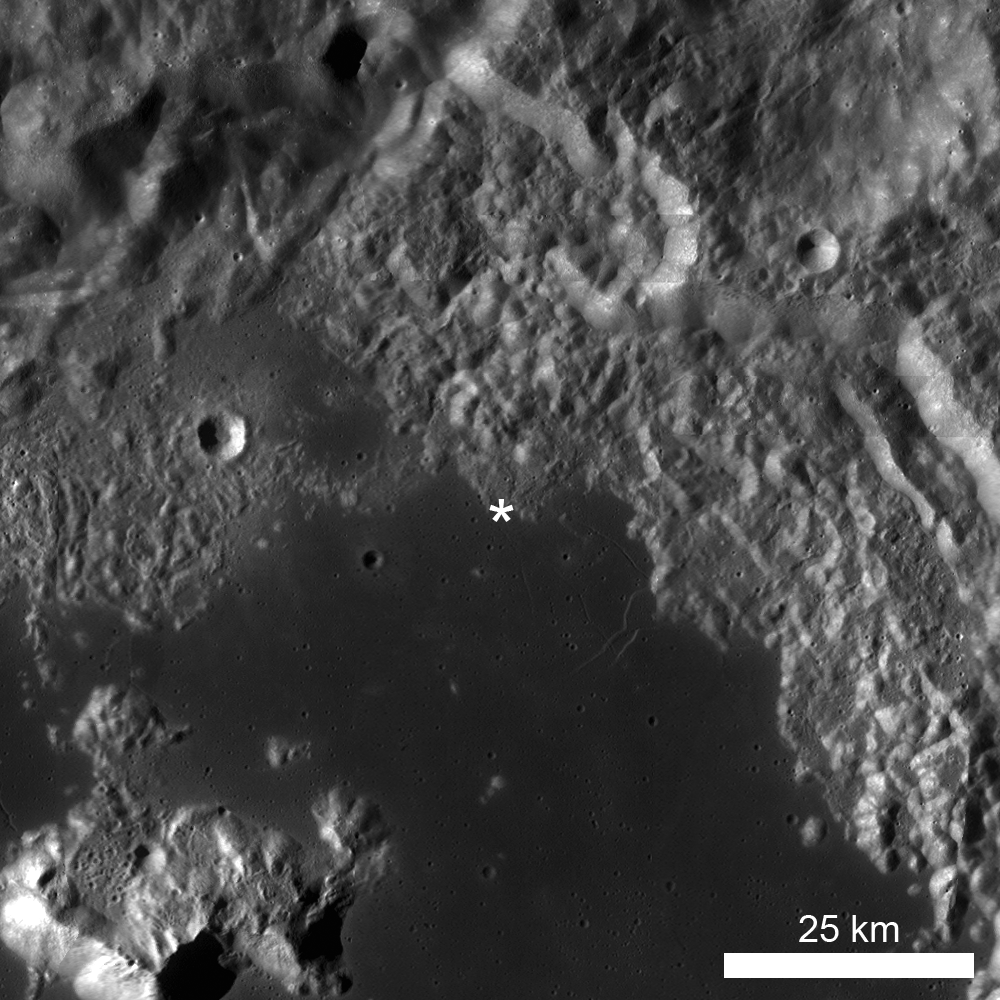
Northeastern portion of Tsiolkovsky crater, highlighting the boundary between mare and the highlands. Asterisk notes location of NAC inset; LROC WAC monochrome mosaic, 100 m/pixel. View the full-size LROC image released September 28, 2011 HERE [NASA/GSFC/Arizona State University].

Lillian Ostrach
LROC News System

Tsiolkovsky crater is a stunning example of a complex crater and is located on the farside (185 km diameter; 20.46°S, 129.06°E). Many geological features are observed within and around this impact crater, including a central peak, terraced walls, extensive ejecta, and a partially mare-filled floor. Tsiolkovskiy is an experiment in mare basalt flooding that is frozen in time and contains one of only a few mare deposits on the lunar farside. When we usually think of mare basalts, we mentally picture the vast nearside basalts, probably because we see them so clearly during a full Moon. These nearside basalts fill (or just nearly fill) the large impact basins that formed early in the Moon's geologic history, but the basalts that flooded Tsiolkovsky (as well as those that formed Mare Moscoviense and Mare Orientale, for example) only partially flooded these farside basins. Thus, we can use these basins to study the geology of the farside mare deposits and the timing and extent of volcanism on the lunar farside.

Because substantial lateral mixing of materials on the Moon is limited, the boundary between the mare and the highlands within Tsiolkovskiy crater is particularly obvious. In the opening image, the high-reflectance highlands material in which Tsiolkovskiy formed is embayed by the lower-reflectance mare basalt. The area of the crater floor flooded by basalt is smooth and has low reflectance while the central peak, crater walls, and portions of the floor remain relatively unchanged except for the accumulation of small impacts (meters to ~5 km diameter) over geologic time.


Full 60 centimeter per pixel resolution close-up of LROC Narrow Angle Camera (NAC) observation M159100547R. LRO orbit 8580, May 3, 2011, showing a small part of the the boundary between mare and highland material in Tsiolkovsky. Instead of an obvious contact boundary between these units the change from highland to mare is gradational at this scale. The degraded crater at center has served as a slope trap for high-reflectance material that originated from the high crater wall, well outside this field of view of only roughly 350 meters. View the 600 meter-wide original LROC image HERE [NASA/GSFC/Arizona State University].

However, the boundary between the highlands and the mare in Tsiolkovsky is not so well defined at 60 cm/pixel in the LROC NAC images. Why is this the case? To answer, we must consider the way material moves on the Moon. Earlier we said that substantial lateral mixing on the Moon is limited, which is true. Impacts excavate material that is moved laterally, thus mixing local materials. With enough impacts, the albedo differences between highlands and mare will blur and eventually disappear. The fact that we see rays extending out long distances from Copernican-aged impacts show that lateral mixing occurs over great distances. So why can we still see the highlands-mare boundary so sharply in the WAC images? Close examination of that same boundary in the NAC images shows the boundary to be not so sharp. At the scale of the NAC, you can see that impact cratering is slowly blurring the boundary. Have you experienced this effect in your travels here on Earth? Perhaps you have planned an adventure using a geologic map or a map based on satellite images or airplane photography only to find that the well-defined boundary you noticed on the map is not so easy to spot on the ground. If you haven't, well, perhaps it is time to plan your next adventure!

Prowl around the mare-highlands boundary in Tsiolkovsky crater in the full LROC NAC image!

Related Posts:

Saturday, May 1, 2010

Tsiolkovskiy - Constellation Region of Interest


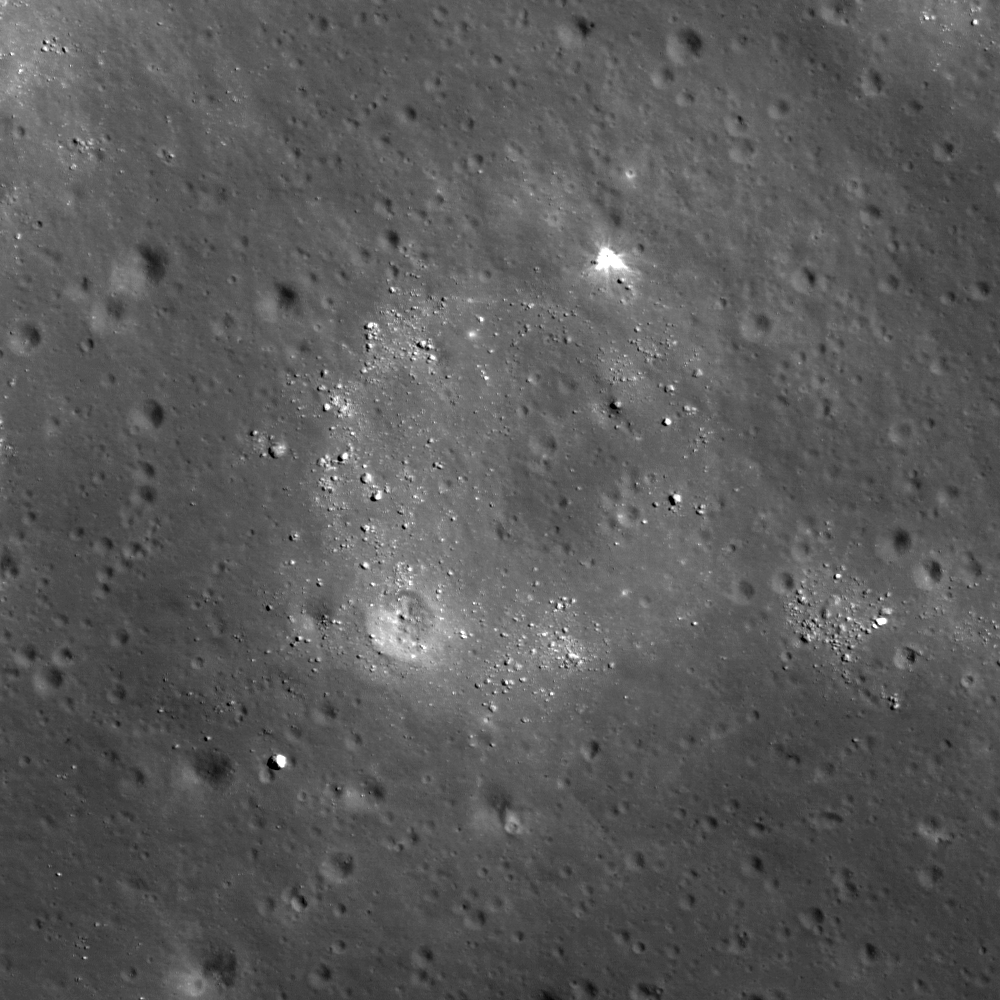
LROC Featured Image, April 30, 2010. Narrow-Angle Camera view of massive boulders on an outlying rampart of the complex central peak of Tsiolkovskiy, and within the Constellation Region of Interest. The full image is of and area roughly 700 meters wide (LROC NAC frame M113107391L) [NASA/GSFC/Arizona State University].

Maria Banks
LROC News System

Tsiolkovskiy Crater is 185 kilometers (115 miles) wide and located on the far side of the Moon. It's named after Russian scientist and visionary space pioneer Konstantin Tsiolkovskiy.

"The earth," Tsiolkovskiy wrote, "is the cradle of the mind. But one cannot live forever in a cradle."

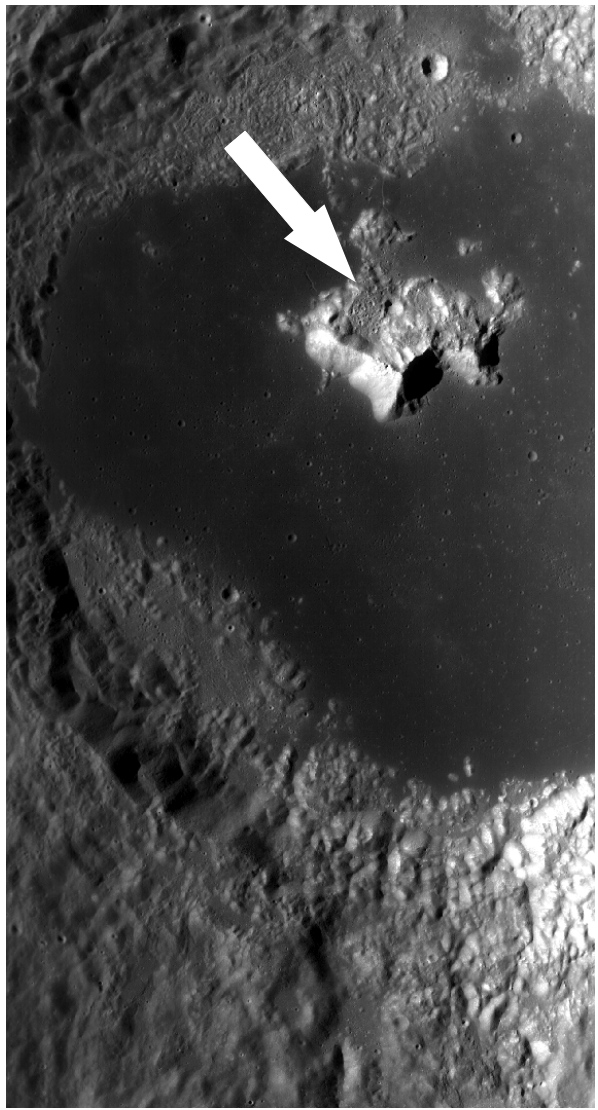
The crater has a complex central peak, a smooth lava-flooded floor, a lunar lobate scarp located on the ejecta blanket near the crater rim and several other interesting geomorphological landforms and features that make Tsiolkovskiy an exciting destination for future human lunar exploration.


LROC Wide Angle Camera context image showing Tsiolkovskiy crater and the surrounding lunar highlands. The approximate position of LROC's Featured Image is shown by the white arrow [NASA/GSFC/Arizona State University].

Tsiolkovskiy's floor is covered with relatively smooth mare basalt that formed from pooling basalt that was erupted after the crater formed. The central peak, a large mountain near the center of the crater, is composed of material from beneath the crater floor that rebounded upward after being compressed during the impact event. Also visible are many boulders or pieces of the uplifted central peak that have broken off and accumulated on the crater floor. The relationship between some of the boulders and the mare basalt flows is complex. In some areas it appears that boulders are surrounded and partially covered by the basalt lava indicating that the lava formed more recently than the boulders. In others, the boulders look like they rest on top of the dark lava flows.

The biggest boulders in this view are up to ~25 m (over 80 feet) in length! This is roughly the length of a college basketball court or two school buses lined up lengthwise. In areas such as this, astronauts are able to easily collect and study rocks from the smooth mare crater floor as well as rocks that originated from beneath the lunar surface! You can also see on the floor of the crater multiple smaller craters that formed over time as small asteroids and comets impacted the Moon. Scientists can use counts and measurements of superposed craters to estimate when Tsiolkovskiy Crater formed - the more craters, the older the surface on which they lie.

For more information on LROC's observation campaign for the Constellation program Regions of Interest read this Lunar and Planetary Science Conference abstract, and visit the LRO Science Targeting Meeting website (look for the baseball card summary sheets for each site: part 1, part 2).

Read more about Tsiolkovskiy at Arizona State University's Apollo Digital Image of the Week.

Explore the Tsiolkovskiy Constellation region of interest for yourself!


HDTV still image of Tsiolkovskiy from Japan's lunar orbiter SELENE-1 (Kaguya, 2007-2009). The Naval Research Laboratory, Massachusetts Institute of Technology and NASA have teamed up to design and deploy a radio telescope array on the floor of the far side crater, hoping to use the radio quiet of the side of the Moon blocked from the interferences of Earth and her billions to probe the cosmological "Dark Ages," a poorly understood time between the primeval fireball of the Big Bang and the formation of earliest galaxies [JAXA/NHK/SELENE].

Friday, April 4, 2008

More on NRL's Lunar Athlete Rover

While I've written before of the U.S. Navy's Athlete, a dexterous, long distance and freight-handling robotic walking lunar rover, under development by the Naval Research Laboratory in cooperation with the Massachusetts Institute of Technology, I thought I'd be reading of something quite different when teased by a passing headline a short time ago.

The Athlete test-bed robots are gangly-looking enough, I thought, than to read New Scientist describe them as "giant, six-legged robots," that can "pick up and move a future Moon base thousands of kilometres across the lunar surface.."

They're certainly big, but hardly the 50 Foot Woman, not able to to lift a single-wide mobile home, let along an entire moon base, except perhaps in pieces and many trips.

And whether they are able to handle "thousands of kilometers" even over the course of any one unit's lifetime remains to be seen.

Athlete has been developed with MIT's farside Dark Age Lunar Interferometer, or DALI, which the Institute hopes can be deployed over a thirty-five mile wide area of the Tsiolkovsky, and in relative radio quiet a decade from now. DALI would listening for faint, highly red-shifted wavelengths from the so-called Dark Age, between 200 million years after the Big Bang and the first eras of star formation hundreds of millions of years later, when the structure of the present state of the known Universe began.

As I posted previously, the Naval Research Laboratory shares a $500,000 grant with MIT to design and test the logistics of deploying the proposed array. Plans call for deploying a nearside radio array to perform some actual science and to test the concepts behind DALI and its construction, already well along in planning.

NRL proposes using Athlete to patiently and persistently, as a robot should, haul components from a landing zone and eventual hub to sites clustered over a 50 kilometer wide area in Tsiolkovsky's southeastern third.

Each collector, 250 meters in size, would then need to be deployed and tuned. I've suggested they might then become integral to the full array itself by offering tuning mobility as the rails for the Very Long Baseline Array in Socorro, New Mexico performs, changing the size of a massive virtual aperture.

AIAA Lunar Architecture (September 2007) - Adobe Reader

Wednesday, March 26, 2008

What better view?

Physics professor Jacqueline Hewitt, director of MIT's Kavli Institute for Astrophysics and Space Science, stands behind a prototype of a radio telescope array. A team she leads has been chosen by NASA to develop plans for such an array on the far side of the moon. Photo / Donna Coveney MIT

THE TECH HERALD
NASA is treating the idea seriously enough to set aside $12 million in its stretched budget to examine the possibility of an array of radio telescopes to be situated on the dark side of the Moon.

Facing away from earth and its excessive broadcast noise, the telescopes would take advantage of the Moon's lack of an atmosphere to listen for ultra-low frequency radio waves from the midst of the universe.

The better listening conditions would improve the chances of picking up radio waves which may help astronomers in their quest to uncover the evolution of the universe.

The proposal, first suggested by a team at the Massachusetts Institute of Technology (MIT), consists of an number of telescopes over an area of 2 square kilometres which would be constructed by robots. Scientists from the Naval Research Laboratory (NRL) will now study how best to take the idea and turn it into a practical working telescope.

Among the concepts to be studied will be the Dark Ages Lunar Interferometer (DALI), the so-called "Dark Ages" interval between the Big Bang and the formation of the stars.

"Probing the Dark Ages presents the opportunity to watch the young universe evolve," says Dr Joseph Lazio, with the Washington DC-based Naval Research Laboratory, which is sharing a US$500,000 NASA grant with MIT for another lunar observatory.


Tuesday, March 18, 2008

Navy shows off the Athletes, Stretches for the Lunar Farside

Construction of the Dark Ages Lunar Interferometer, or DALI, will require a lot a territory, for sufficient baseline to build an antenna to detect even the lowest harmonics of highly redshifted electro-magnetic signals, and there's a need for much "radio-quiet" to pull those signals out from the background noise, for the best signal-to-noise ratio and "gain."

And the Dark Ages Lunar Interferometer will need both to detect the altogether faint signals of, well, whatever one might find in the darkness between the Realm of the Blue Galaxies - the very limit of optical telescopy and still on our side of the cosmic microwave hiss of just three degrees above absolute zero - all that remains of the outer edge of the Big Bang, when "nothing became everything."

The Cosmic Dark Ages have something to tell us, but they exist only in the fossil sky and from a period before the first stars formed. It is truly a dark age, and JPL would like to change this. And one Prime Reason for a return to Earth's Moon is made manifest, because it is a natural platform for the largest telescopes imaginable, and these idea are taking shape sooner rather than later.
The construction of the DALI, a sea of "cellular" detectors spread over a huge are, will be, developers say, robotic. A trick, on the Farside, depending on interminent communication and exceptionally hardy robots, of course.

The Lunar Farside has both "radio-quiet" and territory, in abundance, or NASA's Jet Propulsion Laboratory in Pasadena hopes so, and for the moment anyway.

The U.S. Naval Research Laboratory showed off its Athletes, recently, and not for the Beijing Olympics. These Athletes look ready for uncomplaining work deploying MIT's design for a very, very, very long baseline interferometer in the Sea of Tsiolkovski, named, of course for the Russian school teacher who dreamed and discovered a "method of achieving extreme altitude," in awe, "to lift, by hand, a rock from the moon," and, in the next sentence, "the earth is the cradle of the mind, but one cannot live forever in a cradle."

It's an excellent first look. From DVICE.com (powered by SciFi )

See also "Naval Research Laboratory to design Farside DALI," March 11, 2008

Tuesday, March 11, 2008

Naval Research Laboratory to design Farside DALI


The Dark Age Lunar Interferometer (DALI) apparently planned for multi-robot deployment from Tsiolkovsky

Contact: Donna McKinney
(202) 767-2541
Naval Research Laboratory

A team of scientists and engineers led by the Naval Research Laboratory (NRL) will study how to design a telescope on the Moon for peering into the last unexplored epoch in the Universe’s history. NASA has announced that it will sponsor a series of studies focusing on next-generation space missions for astronomy. These studies will contribute to the Decadal Survey, an effort undertaken every 10 years by astronomers and physicists to help establish priorities for future research directions in astronomy and astrophysics. The upcoming Decadal Survey occurs over the next two years.

Among the missions to be studied is the Dark Ages Lunar Interferometer (DALI), the NRL-led concept for a telescope based on the Moon and studying an era of the young Universe, during the first 100 million years of its existence. Although the night sky is filled with stars, these stars did not form instantaneously after the Big Bang. There was an interval, now called the “Dark Ages,” in which the Universe was unlit by any star. The most abundant element in the Universe, and the raw material from which stars, planets, and people are formed, is hydrogen. Fortunately, the hydrogen atom can produce a signal in the radio-wavelength part of the spectrum, at 21 cm; a wavelength far longer than what the human eye can detect. If these first signals from hydrogen atoms in the Dark Ages can be detected, astronomers can essentially probe how the first stars, the first galaxies, and ultimately the modern Universe evolved.

Because the Universe is expanding, the signals from these distant hydrogen atoms will be stretched (or redshifted) to much longer wavelengths, as large as several meters. While astronomical observations at radio wavelengths have a long history, this portion of the electromagnetic spectrum is now heavily used for various civil and military transmissions, all of which are millions of times brighter than the hydrogen signal that astronomers seek to detect. Additionally, the upper layers of the Earth’s atmosphere are ionized (the ionosphere), which introduce distortions into astronomical signals as they pass through on their way to telescopes on the ground.

With no atmosphere and shielding from the Earth, the far side of the Moon presents a nearly ideal environment for a sensitive Dark Ages telescope. In NRL’s DALI concept, scientists and engineers will investigate novel antenna constructions, methods to deploy the antennas, electronics that can survive in the harsh lunar environment, and related technology in preparation for developing a roadmap for research and development of a lunar telescope over the next decade. The team will also build on their experience in developing the Radio Observatory for Lunar Sortie Science, a NASA-funded study of a pathfinding array that would be located on the near side of the Moon.

The project leader at NRL, Dr. Joseph Lazio, pointed out that DALI will be one of the most powerful telescopes ever built and will bring us closer than we have ever been to understanding where our Universe came from and where it is going. “Probing the Dark Ages presents the opportunity to watch the young Universe evolve,” Dr. Lazio said. “Just as current cosmological studies have both fascinated and surprised us, I anticipate that DALI will lead both to increased understanding of the Universe and unexpected discoveries.”

When asked about the program, NRL Senior Astronomer Dr. Kurt Weiler remarked: “Building telescopes on the Moon is clearly a long-term project, but I am very excited about us getting started on this proposal.”
###
Scientists and engineers from institutions and NASA centers around the country are participating in the Dark Ages Lunar Interferometer study, including NASA/Goddard Space Flight Center, Caltech/Jet Propulsion Laboratory, the University of Colorado, the Smithsonian Astrophysical Observatory, the National Radio Astronomy Observatory, University of California-Los Angeles, University of California-Berkeley, the University of New Mexico, and Virginia Polytechnic Institute and State University (VA Tech).