Showing posts with label University of Colorado at Boulder. Show all posts

Friday, June 26, 2015

LADEE analysis maps lopsided meteoric dust cloud

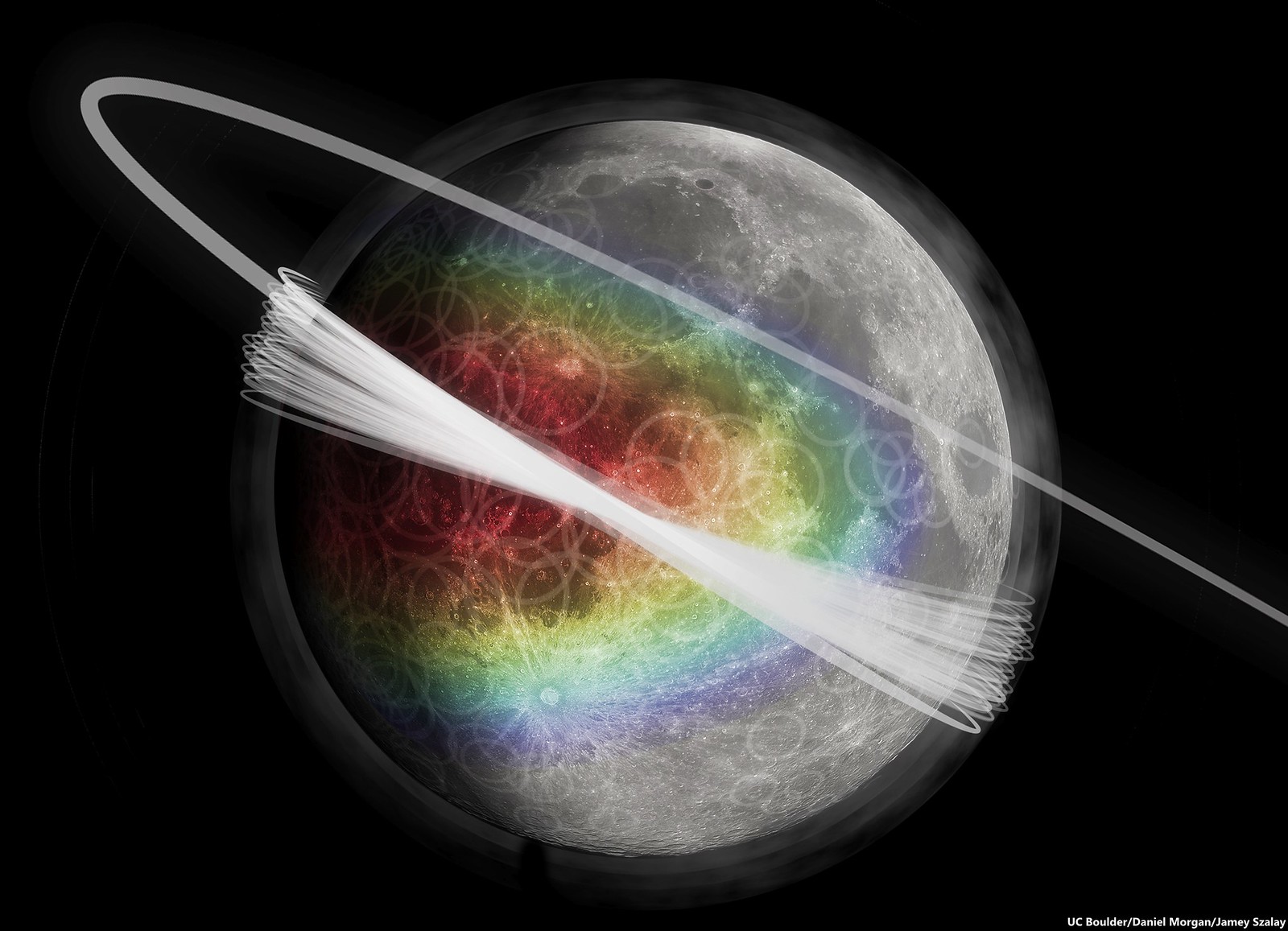
Artist's conception of the lunar dust exosphere surrounding the moon. The color represents the amount of material ejected from the surface, showing a peak in the apex direction. A haze of dust is shown around the moon. Gray faded circles are overlaid on the lunar surface to represent the random nature of the primary impactors. An artist's conception of the LADEE orbital inclination is also shown [UC Boulder/Daniel Morgan/Jamey Szalay].
Darryl Waller
Sharon Lozano
NASA Ames

New science results from NASA’s LADEE mission (Lunar Atmosphere and Dust Environment Explorer) indicate the Moon is regularly engulfed in a permanent, but lopsided and transitory, dust cloud increasing in density during encounters with cometary debris, like those producing the Geminids, according to a new study led by University of Colorado Boulder.

"Knowledge about the dusty environments in space has practical applications," said CU-Boulder physics Professor Mihály Horányi. "Knowing where the dust is and where it is headed in the solar system could help mitigate hazards for future human exploration, including dust particles damaging spacecraft or harming astronauts."

The cloud was discovered using data from a detector on board LADEE called the Lunar Dust Experiment (LDEX) designed and built by CU-Boulder. LDEX charted more than 140,000 impacts during the six-month survey launched in September 2013. NASA’s Ames Research Center in Moffett Field, California was responsible for spacecraft design, development, testing and mission operations.

“The LDEX team has been painstakingly analyzing their data since the LADEE mission ended on April 18, 2014,” said LADEE project scientist at Ames, Rick Elphic. “Their results answer one of the big LADEE science questions: is there a dust component to the tenuous lunar atmosphere?  And if so, why is it there?” 

According to Horányi, the cloud is primarily made up of tiny dust grains kicked up from the moon’s surface by the impact of high-speed, interplanetary dust particles. A single dust particle from a comet striking the moon’s surface lofts thousands of smaller dust specks into the airless environment, and the lunar cloud is maintained by this sometimes predictable process of regolith "gardening."

“Identifying this permanent dust cloud engulfing the moon was a nice gift from this mission,” said Horányi, the principal investigator for the LDEX instrument and lead author of the study. “We can carry these findings over to studies of other airless bodies, like the moons of other planets and the asteroids.”
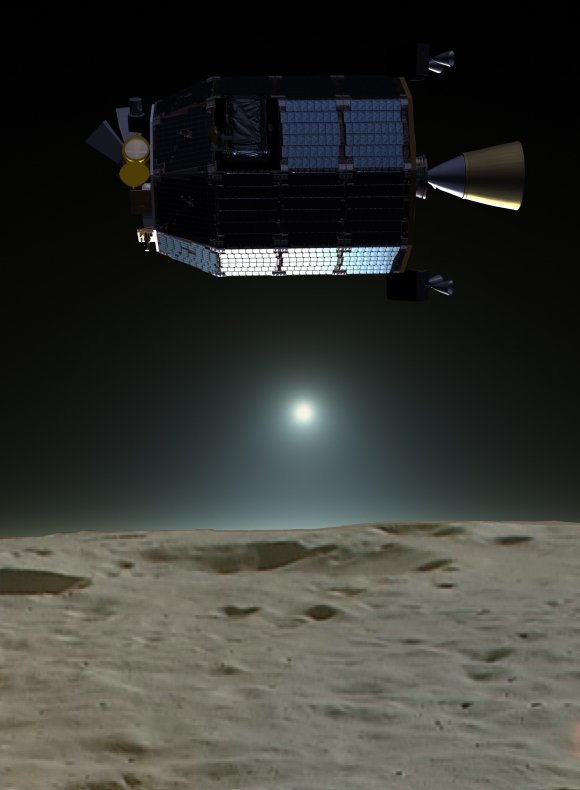
Artist's composite showing LADEE spacecraft in close orbit [NASA/JAXA/LP].
A paper on the subject appears in the June 17 issue of Nature. Co-authors Jamey Szalay, Sascha Kempf, Eberhard Grun and Zoltan Sternovsky from CU-Boulder, Juergen Schmidt from the University Oulu in Finland, and Ralf Srama from the University of Stuttgart in Germany.

The first hints of a cloud of dust around the moon came in the late 1960s when cameras functioning overnight aboard the unmanned moon lander Surveyor 7 captured bright glow hours ahead of lunar sunrise. Not long after astronauts in lunar orbit described a significant glow above the lunar surface when approaching sunrise, phenomenon brighter than the sun by itself should have been able to produce over a body with only a trace, essentially non-existent, atmosphere.

Because these new findings do not square with the Apollo reports of a thicker, higher dust cloud, conditions back then may have been somewhat different. The dust on the moon -- which is dark and sticky and regularly dirtied the suits of moonwalking astronauts -- was created over several billion years as interplanetary dust particles incessantly pounded the rocky lunar surface.

Apollo 17 commander Gene Cernan's sketches and description of horizon glow and streamers observed in lunar orbit in December 1972 [NASA].
Many of the cometary dust particles impacting lunar surface are traveling at thousands of miles per hour in a retrograde, or counterclockwise orbit around the sun, the opposite orbital direction of the solar system’s planets. This causes high-speed, near head-on collisions with the dust particles and the moon’s leading surface as the Earth-moon system travel together around the sun.

Related LADEE Posts:
LADEE impact crater found (October 29, 2014)
First Science from LADEE (45th LPSC, March 18 2014)
LADEE's (star tracker) images of the Moon (February 14, 2014)
LADEE economy adds 28 days to mission (February 5, 2014)
LROC captures LADEE from 9,000 meters (January 30, 2014)
Red Moon, Blue Moon Dwayne DayThe Space Review (December 3, 2013)
LADEE begins collecting data (November 22, 2013)
LADEE transitioning out of commissioning phase (November 6, 2013)
Apollo 12 ALSEP first to measure dust accumulation (November 21, 2013)
Chang'e-3 & LADEE: The Role of Serendipity (October 31, 2013)
LADEE LLCD sets new data record (October 25, 2013)
Measuring almost nothing, looking for the almost invisible (October 16, 2013)
LADEE legacies (September 7, 2013)
LADEE Prelaunch Mission Briefing (September 6, 2013)
ESA prepares for LADEE (July 31, 2013)
LADEE arrives at Wallops Island (June 5, 2013)
LADEE ready to baseline dusty lunar exosphere (June 5, 2013)
First laser comm system ready for launch on LADEE (March 16, 2013)
LADEE project manager update (February 6, 2013)
The Mona Lisa test for LADEE communications (January 21, 2013)
Toxicity of lunar dust (July 2, 2012)
Expectations for the LADEE LDEX (March 23, 2012)
The Dust Management Project (August 9, 2010)
LADEE architecture and mission design (July 6, 2010)
DesertRatS testing electrodynamic dust shield (July 5, 2010)
Dust transport and its importance in the origin of lunar swirls (February 21, 2010)
Dust accumulation on Apollo laser reflectors may indicate a surprisingly fast and
more dynamic lunar exosphere
 (February 16, 2010)
NASA applies low cost lessons to LADEE (January 18, 2010)
Nanotech advances in lunar dust mitigation (August 19, 2009)
Moon dust hazard influenced by Sun's elevation (April 17, 2009)
LADEE launch by Orbital from Wallops Island (April 14, 2009)
Understanding the activation and solution properties of lunar dust
for future lunar habitation
 (March 2, 2009)
Respiratory toxicity of lunar highland dust (January 19, 2009)
Toxicological effects of moon dust (June 25, 2008)
Moon dust and duct tape (April 22, 2008)

Monday, November 26, 2012

NLSI Director's Seminar Series, Live Online Nov. 27

Jack Burns
University of Colorado at Boulder

Tuesday, November 27, 2012
1800 UTC - 10AM PST, 1PM EST

The NASA Lunar Science Institute (NLSI) Lunar University Network for Astrophysics Research (LUNAR) is a team of researchers and students at leading universities, NASA centers, and federal research laboratories undertaking investigations aimed at using the Moon as a platform for space science.

LUNAR research includes Lunar Interior Physics & Gravitation using Lunar Laser Ranging (LLR), Low Frequency Cosmology and Astrophysics (LFCA), Planetary Science and the Lunar Ionosphere, Radio Heliophysics and Space Radiation, and Exploration Science. The LUNAR team is exploring technologies that are likely to have a dual purpose, serving both exploration and science.

Larger laser range reflector deployed at Hadley
Rille Delta by Scott and Irwin of Apollo 15 in
February 1971, a still active component of that
missions ALSEP and today an effort to constrain
the measured distance to the Moon to determine
locality, if any, of cosmological physics.
In this talk Dr. Burns will describe how LUNAR researchers are using LLR to provide the most precise constraints on General Relativity and gravitation, how low frequency radio observations of the Sun will assist us in understanding and predicting solar radiation that propagates throughout interplanetary space, and how low radio frequency telescopes in lunar orbit and on the lunar farside will allow us to probe the first stars and galaxies during the early Universe’s Cosmic Dawn.

Dr. Burns will also describe our development of new human/robotic mission concepts, including a mission to the Earth-Moon L2 Lagrange point, where astronauts in the Orion spacecraft will teleoperate rovers for geological exploration and for deployment of a low radio frequency array.

To Join Live Video Conference via browser (Adobe Connect) and to view slides : http://connect.arc.nasa.gov/nlsi_directors_seminar/

To Join via Video Conferencing System, RSVP Ricky Guest only if joining by Polycom or other standards-based Video Teleconferencing System.

Burns is a professor in the Department of Astrophysical and Planetary Sciences and Vice President Emeritus for Academic Affairs and Research for the University of Colorado at Boulder.  He is also Director of the NASA Lunar Science Institute’s Lunar University Network for Astrophysics Research (LUNAR), a NASA-funded center and part of the NASA Lunar Science Institute. Burns received his B.S. degree, magna cum laude, in Astrophysics from the University of Massachusetts, and received his doctorate in Astronomy from Indiana University.

From 2001 - 2005, Burns served as Vice President for Academic Affairs & Research for the University of Colorado System.  Burns was Vice Provost for Research at the University of Missouri – Columbia from 1997 through 2001. He was Associate Dean for the College of Arts and Sciences at New Mexico State University (NMSU) and served as Department Head and Professor in the Department of Astronomy at NMSU from 1989 until 1996.

Dark Ages Radio Explorer (DARE), utilizing the radio-quiet of the lunar farside to explore the earliest period on the cosmic time line, 200 million years between the primordial Big Bang and the emergence of the earliest luminous sources and the structure of the present universe. "The lunar Farside is potentially the only site in the inner solar system for high precision radio cosmology.” Illustration accompanying post "Farside offers radio quiet to probe Cosmic Dark Age," July 2, 2012 [NLSI].
During his tenure at the University of New Mexico from 1980 to 1989, Burns served as the Director of the Institute for Astrophysics, and he was a Presidential Fellow. He was a postdoctoral fellow at the National Radio Astronomy Observatory from 1978 to 1980.

Burns has over 380 publications in refereed journals, books, and in conference proceedings and abstracts (listed in NASA’s Astrophysics Data System). He is an elected Fellow of the American Physical Society and the American Association for the Advancement of Science and received NASA’s Exceptional Public Service Medal in 2010 for his service on the NASA Advisory Council (NAC) and as Chair of the NAC Science Committee.

Related Posts:

Monday, July 2, 2012

Farside offers radio-quiet to probe cosmic Dark Age

Dark Ages Radio Explorer (DARE), utilizing the radio-quiet of the lunar farside to explore the earliest period on the cosmic time line, 200 million years between the primordial Big Bang and the emergence of the earliest luminous sources and the structure of the present universe. "The lunar Farside is potentially the only site in the inner solar system for high precision radio cosmology.” [NLSI].
Anil Ananthaswamy
New Scientist
 

FORTY years after NASA ditched the idea of landing Apollo 17 on the far side of the moon, the forbidden fruit is being sought once again. Not by astronauts this time, but by astronomers seeking a quiet spot from which to observe the universe's "dark ages".

This was an epoch in the development of the cosmos, which lasted for a few hundred million years after the big bang, before stars and galaxies began to form. The only way to observe the dark ages is to look for faint radio signals from neutral hydrogen - single protons orbited by single electrons - which filled the early universe.

Telescopes on Earth, such as the Murchison Widefield Array in Western Australia, are searching for such signals, at frequencies above 100 megahertz. This can probe the universe back to 400 million years after the big bang.

To explore even earlier times, telescopes need to receive radio waves at frequencies below 100 megahertz. Interference from radio sources on Earth such as FM radio and the planet's ionosphere can mess up these signals. "You get to the point where the ionosphere is just a hopeless barrier," says Dayton Jones of NASA's Jet Propulsion Laboratory (JPL) in Pasadena, California. "You have got to go to space, and the most promising location by far is the far side of the moon."
To peer back to the universe's earliest years will need sensitive telescopes in a place where Earth's ionosphere and radio chatter cannot interfere
This is why astronomers were discussing it at an American Astronomical Society meeting in Anchorage, Alaska, this month. Telescopes behind the moon would not have to contend with Earth's ionosphere, and they would also be shielded from our planet's radio chatter. "It is a very pristine environment for low-frequency observation," says Jones.

The first shot at radio astronomy from the moon's far side will probably be a mission called the Dark Ages Radio Explorer, being designed by Jack Burns at the University of Colorado at Boulder, and colleagues.

If selected as a mission by NASA in its review next year, DARE will orbit the moon at an altitude of 200 kilometers. It will collect neutral-hydrogen signals between 40 and 120 megahertz. That corresponds to 80 million to 420 million years after the big bang. Its antenna is designed to pick up signals from the entire sky. The craft will be a little toughie, with parts made from an Astroquartz/Kevlar fibre, which is very thermally stable - particularly handy when moving in and out of sunlight as it orbits the moon.


The DARE team has begun testing the probe's antenna at remote locations on Earth, starting with the National Radio Quiet Zone surrounding the Green Bank telescope in West Virginia. "It may be a radio quiet zone, but it's not quite," says DARE team member Abhirup Datta. "You can still see the FM bands coming in, and of course the ionosphere is a problem."

Not everyone reckons a space-based solution is needed to study the universe's dark ages. "Existing ground-based experiments will yield good progress on this problem at a tiny fraction of the cost of a space mission," says Steven Tingay of Curtin University in Bentley, Western Australia, who headed the construction of the Murchison array.

Burns disagrees. Preliminary tests reveal that the Earth's ionosphere is absorbing signals from space and re-emitting them as noise in frequencies below 80 megahertz. "If we can verify and characterize that, that slams the lid on any attempts to do this kind of experiment from the ground," says Burns.

Once DARE has done its job, his team want to deploy bigger telescopes on the lunar far side to image the first stars and galaxies. These antennas would be made of conducting material imprinted on extremely lightweight films of polyamide, micrometers thick.

In one design, three 100-metre-long arms of such films are attached to a central box of electronics. The arms would be rolled up tight for launch and, once on the moon, a rover sent along with the unit will move it to its required spot and help unfurl the arms. The rover would likely have to be controlled by astronauts orbiting a Lagrange point over the lunar far side.

To test this scenario, Burns's team will work with astronauts based on the International Space Station next year. The astronauts will remotely operate a Mars rover called K-10. It is being outfitted to unwind films of polyamide on a simulated Martian landscape at NASA Ames Research Center in Moffett Field, California.

HDTV still of Tsiolkovskiy, captured by Japan's lunar orbiter SELENE-1 ("Kaguya," 2007-2009). The Naval Research Laboratory, Massachusetts Institute of Technology and  others are refining work on a possible radio telescope array to be deployed in the conspicuous farside crater floor to utilize the radio quiet of the the Moon's farside to probe the cosmic Dark Age [JAXA/NHK/SELENE].
"The ultimate experiment we'd like to do for cosmology on the far side would involve thousands of these antennas," says Burns.

But what if the basic idea proves unfeasible, in terms of cost or in overcoming obstacles in the terrain? At JPL, Jones and his team are working on another solution: rolled-up antennas that inflate like party blowers seconds before they touch the lunar surface. "They are essentially immune to whatever irregularities there are at the surface," says Jones.

Astronomers have their sights set on at least one site for such telescopes: the flat bed of the 180-kilometre-wide Tsiolkovskiy crater, exactly where the Apollo 17 astronauts first wanted to land.

Related Posts:

Monday, June 11, 2012

ISRU: NASA KSC prototype rover photo op

From the Hawai'i summer season of 2011, NASA and academia will continue the methodical testing and development of semi-autonomous and robust robotic rovers will continue this year [NASA].
An excellent overview of a recent lunar analog study, released (PDF) May 2012
Desert Research and Technology Studies (DRATS) 2009: A 14-Day Evaluation of the
SpaceExploration Vehicle Prototype in a Lunar Analog Environment

Abercromby, Gernhardt and Litaker, JSC

Media are invited to a briefing and photo opportunity Tuesday, June 12, at the Press Site television auditorium at NASA's Kennedy Space Center in Florida to view a prototype of a lunar prospecting mission.

The Regolith and Environment Science and Oxygen and Lunar Volatile Extraction, or RESOLVE, consists of a lunar rover and drill provided by the Canadian Space Agency to support a NASA payload that is designed to prospect for water, ice and other lunar resources. RESOLVE also will demonstrate how future explorers can take advantage of resources at potential landing sites by manufacturing oxygen from soil.

Journalists will have an opportunity to photograph the hardware, as well as interview NASA and Canadian Space Agency officials.

NASA will be conducting field tests in July outside of Hilo, Hawaii, with equipment and concept vehicles that demonstrate how explorers might prospect for resources and make their own oxygen for survival while on other planetary bodies.

Journalists without Kennedy accreditation must apply for credentials by 4 p.m. June 11. International media accreditation for this event is closed. Badges for this specific event can be picked up at Kennedy's Badging Office on State Road 405. Media must apply for credentials online at: https://media.ksc.nasa.gov

For more information about NASA's exploration plans, visit: http://www.nasa.gov/exploration

Friday, May 18, 2012

Dusty "DAP-2012" workshop, UC Boulder, June 6-8

From 2007, a widely-circulated small scale schematic showing the interaction of the Solar Wind and the lunar surface and the Moon's dusty and dynamic exosphere [Jasper Halekas of the University of California at Berkeley].
The "Dust, Atmosphere and Plasma: Moon and Small Bodies" meeting  will take place on June 6-8, 2012, in Boulder Colorado. (Program is now available at http://lasp.colorado.edu/ccldas/ldap_2012. Attendees may register online by June 1.

The DAP-2012 workshop will be a forum to discuss current understanding of the surface environment of the Moon and asteroids, to share new results from past and ongoing missions and to describe expectations for future missions.

DAP-2012 is a follow up on the first workshop Lunar dust, atmosphere, and plasma: The next steps (LDAP-2010). Contributions to LDAP-2010 were published in the special issue of Planetary and Space Sciences, and a similar volume is planned to report the contributions to DAP-2012.

The workshop will be focused on open science questions, status of modeling and laboratory capabilities and the definitions of required measurements and instruments for future investigations from orbit or the surface.

The workshop is hosted by Alan Stern and Mihaly Horányi, and supported by the NASA Lunar Science Institute (NLSI): Colorado Center for Lunar Dust and Atmospheric Studies (CCLDAS), the Laboratory for Atmospheric and Space Physics, and the Center for Integrated Plasma Studies of the University of Colorado.

The workshop is set to take place at the LASP Space Science Building, 3665 Discovery Drive, Boulder, Colorado 80303 To register and obtain further information visit the workshop website, HERE.

Friday, March 23, 2012

Expectations for the LADEE LDEX

The 'Dust, Atmosphere, and Plasma: Moon and Small Bodies' (DAP-2012) meeting will take place in Boulder, June 6-8, 2012. Please visit our webpages http://ldap2012.colorado.edu/  to register and submit an abstract by 3/30/2012, if you plan to attend.

We are looking forward to see you in Boulder!

- Alan Stern and Mihaly Horanyi
A lasting lesson from Apollo. The lunar exosphere gets into everything, fine as talcum, abrasive as broken glass, and a significant cumulative threat to seals and any and all working parts generally, whether biological and mechanical. Beyond its demonstrated mission threat the Moon's dusty environment is a delicate, "pristine" and important  part of a 4.5 billion year history of space weather near Earth. Apollo 17 lunar module pilot and geologist Harrison H. "Jack" Schmitt moves forward with the patina of 22 hours activity on the lunar surface clinging to his suit. AS17-145-22157 [NASA/JSC/ALSJ].
The Moon's sodium tail,
Potter and Morgan (1998).
The Lunar Dust Environment:
Expectations for the LADEE
Lunar Dust Experiment (LDEX)

Mihaly Horanyi, Sternovsky & Shul
with Colette, Grün, Kempf, Srama & Mocker
43rd Lunar and Planetary Science Conference, #2635

Introduction: The lunar dust environment is expected to be dominated by submicron-sized dust particles released from the Moon due to the continual bombardment by micrometeoroids, and due to plasma-induced near-surface intense electric fields. The Lunar Dust EXperiment (LDEX) is designed to map the spatial and temporal variability of the dust size and density distributions in the lunar environment on-board the upcoming Lunar Atmosphere and Dust Environment Explorer (LADEE) mission

LDEX is an impact detector, capable of measuring the mass of submicron sized dust grains. LDEX will also measure the collective signal of dust grains below the detection threshold for single dust impacts; hence it can search for the putative population of grains with r ~ 0.1 μm lofted over the terminator regions by plasma effects.

LDEX has been developed at the Laboratory for Atmospheric and Space Physics and Colorado Center for Lunar Dust and Atmospheric Studies (LASP/CCLDAS, University of Colorado at Boulder) and has a high degree of heritage based on similar instruments on the HEOS 2, Ulysses, Galileo, and Cassini missions. The LDEX flight model will be tested and calibrated at both the (Max-Planck-Institute for Nuclear Physics, Heidelberg, Germany) and Boulder dust accelerator facilities.

At the Lunar and Planetary Science Conference, March 21, 2012, Dr. Horányi summarized expected capabilities of LDEX and made predictions for its measurements in lunar orbit, based on current theoretical models. The authors also discussed a proposed LDEXPLUS instrument being developed for a possible LADEE follow-up mission to add the instrument's design capability for in-situ chemical analysis of impacting dust particles, perhaps to verify "the existence of water ice on the lunar surface and map the density of valuable resources of commercial interest".

Figure 1. LDEX EM and FM units and the schematic drawings of the instrument.
The LDEX instrument: The two expected sources of dust in the lunar environment are ejecta production due to continual bombardment by interplanetary meteoroids and lofting due to plasma effects. LDEX is an impact ionization dust detector with a sensor area of ~0.01 m\2. LDEX is a low risk, compact instrument and uses no flight software (Figure 1). In addition to individual dust impacts of grains with radii r > 0.3 μm, LDEX can identify a large population of smaller grains (0.1 < r < 0.3 μm) by measuring their collective signal.The expected impact rates, and the signature of lofted small grains expected over the terminators are shown in Figure 2.

Figure 2. Expected impact rates on a 30x100 km orbit with its pericenter over the morning terminator.

Initial test and calibration of the LDEX FM model were done at the CCLDAS dust accelerator facility. Full calibrations are planned in early 2012 at both the Heidelberg and the Boulder facilities. Figure 3 shows the preliminary test results, indicating that LDEX will meet or exceed its measurement requirements.

Figure 3. Initial test results for the LDEX FM instrument showing the detected particle mass versus their velocity. At the expected impact speed of 1.6 km/s,

LDEX will detect particles with radii r > 0.4 μm. The ratio of detected and undetected particles matches the expected value due to the duty cycle of the electronics and the transparency of the screens that provide shielding and exclude the solar wind electrons from entering LDEX.

The LDEX-PLUS instrument extends the LDEX capabilities to also measure the chemical composition of the impacting particles with a mass resolution of M/ΔM > 30. Traditional methods to analyze surfaces of airless planetary objects from an orbiter are IR and gamma-ray spectroscopy, and neutron backscatter measurements. A complementary method is to analyze dust particles as samples of planetary objects from which they were released. The source region of each analyzed grain can be determined with accuracy at the surface that is approximately the altitude of the orbit.

This ‘dust spectrometer’ approach provides key chemical constraints for varying provinces on the lunar surfaces. LDEX-PLUS is of particular interest to verify from orbit the presence of water ice in the permanently shadowed lunar craters. LDEX-PLUS combines the impact detection capabilities of LDEX with a linear time-of-flight system, similar to the Cassini Cosmic Dust Analyzer (CDA) instrument. Figure 4 shows an example time-of-flight mass spectrum of an ice-bearing dust grain.

Figure 4. Spectrum of a water ice particle obtained at ~ 4 km/s impact speed by the Cassini CDA instrument in Saturn's E ring. The dominant peaks are mass lines of water cluster ions (H2O)nH+, generated upon impact of an ice-bearing particle.
Schematic of documented species of horizon glow, such as the famous mid-lunar night imagery captured by Surveyor 7 in 1968.

Conclusions. LDEX, on-board LADEE, is scheduled to launch in May 2013 and will be capable of mapping the density distributions of both the large ejecta particles and the collective signal of small lofted grains. LDEX-PLUS, on-board a follow-up lunar mission, can collect a large number of samples from a greater part of the entire surface for analysis.

The instrument is especially sensitive to the metallic compounds of minerals and any species which easily form ions (e.g. water). The accuracy of the trajectory back-tracing to the surface is comparable to the altitude of the satellite. This in-situ method allows compositional surface mapping of the Moon. Since the dust spectrometer is particularly sensitive to refractory compounds which are difficult to access by other methods it is also complementary to remote sensing spectroscopy and an ion or neutral mass spectrometer. A ram pointing dust spectrometer and a nadir pointing remote sensing instrument collect data from approximately the same spot on the surface of the Moon, hence the combination of these measurements greatly enhances our ability to map the chemical composition of the surface and identify water-bearing regions.

An LDEX-PLUS type instrument can also address many of the science goals of a Europa Jupiter System Mission (EJSM) regarding the surface chemistry of icy satellites. See original Conference abstract, HERE, for citations.
Lunar Horizon Glow (LHC) as televised (vidicon photography) in local night, early 1968 [NASA].

Wednesday, February 29, 2012

Postdoctoral Position at SwRI (LRO-LAMP)

Gladstone, et al, (2012)
The Lyman Alpha Mapping Project (LAMP) on the Lunar Reconnaissance Orbiter (LRO) mission is seeking a postdoctoral planetary scientist to join our team's investigations of a variety of lunar science questions using far-UV observations of the lunar surface. 

Topics of study include characterization of permanently shaded regions at the lunar poles, mapping of surface water frost and hydrates, and identifying regional space weathering effects. The far-UV map and spectra analyses to be performed include comparisons with other LRO and lunar datasets for detailed surveys of regions of interest.  Applicants having experience with imaging and/or spectroscopy from space-based observations, and a background in scientific analysis and publication of lunar geology and/or volatiles topics are encouraged to apply. This is a one year limited term position in San Antonio, TX, with extension dependent on availability of funding.

Visit http://www.swri.edu/HR/JobListing.asp and enter Job Code 15-01040 to apply now.  For additional inquiries contact Dr. Kurt Retherford at kretherford@swri.edu.

See also: Postdoctoral Position at UCLA (LRO-DIVINER)