Showing posts with label Helium-3. Show all posts

Tuesday, April 15, 2014

Sometimes you just need to 'vent'

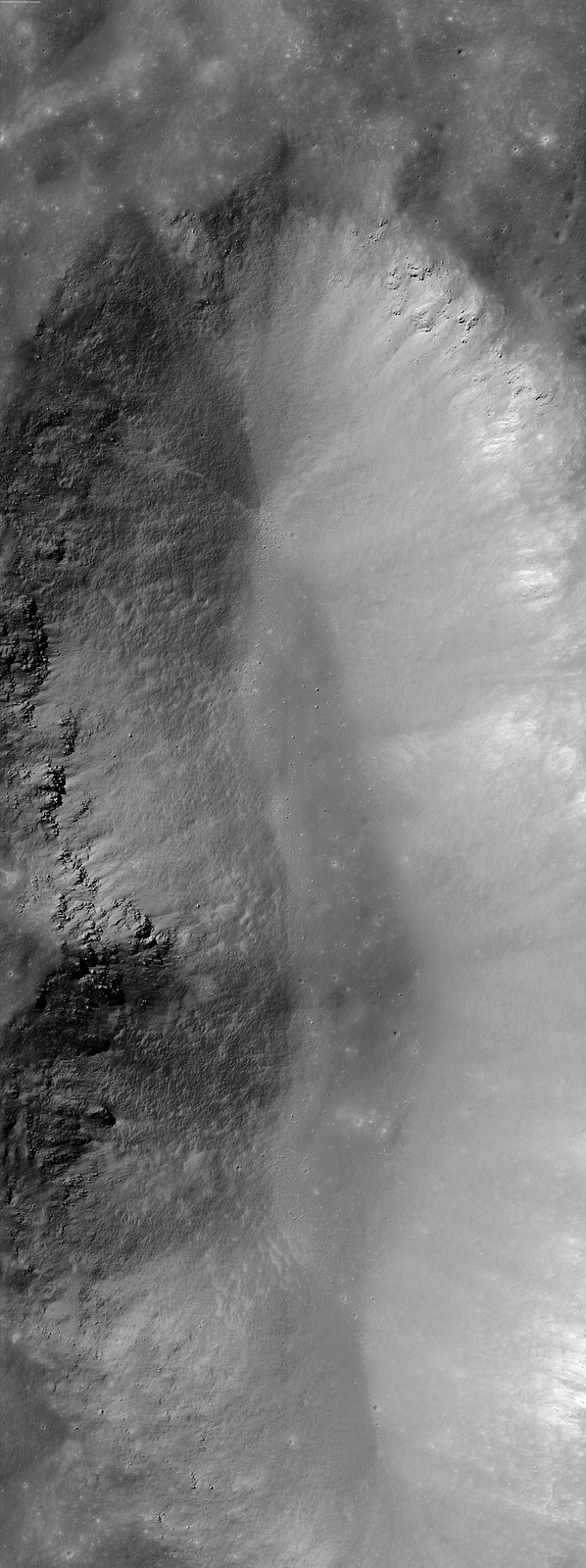
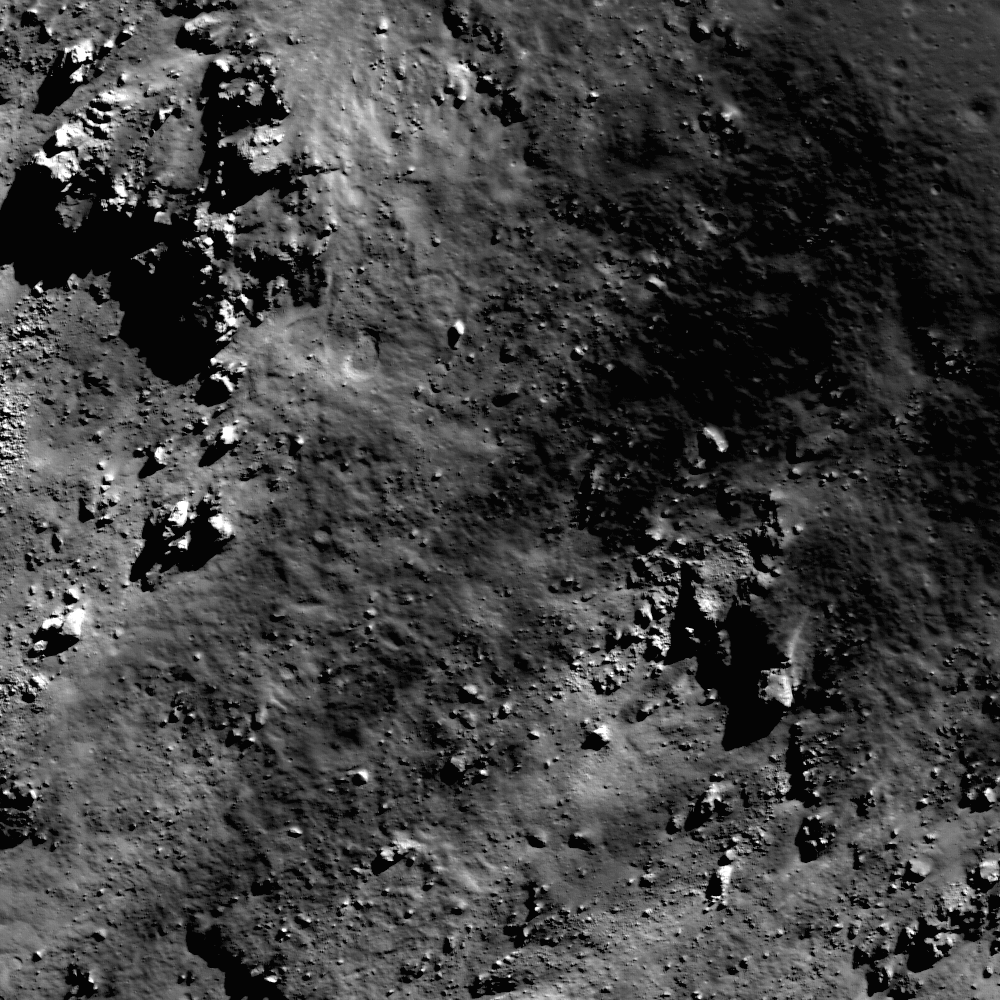
Low reflectance material cascaded down the wall of what is likely a volcanic vent in the southwestern portion of the Orientale basin. Image field of view approximately 750 meters, from LROC NAC observation M1150135366,  LROC orbit 21493, March 22, 2014; incidence 37.45° resolution 77 cm from 75.55 km over 30.12°S, 262.19° [NASA/GSFC/Arizona State University].
H. Meyer
LROC News System

Pyroclastic deposits on the Moon are often identified by a mantled appearance and low reflectance. These deposits are the result of an explosive eruption (or many) that involved a volatile component, likely carbon monoxide. The resulting fine-grained debris, including glass beads like those sampled by Apollo 17, gives the surface a dark, mantled appearance (See WAC image below).

So, where did the low reflectance material come from? The low reflectance material here flowed down the wall of a kidney-shaped (reniform) depression located at the center of the annulus.
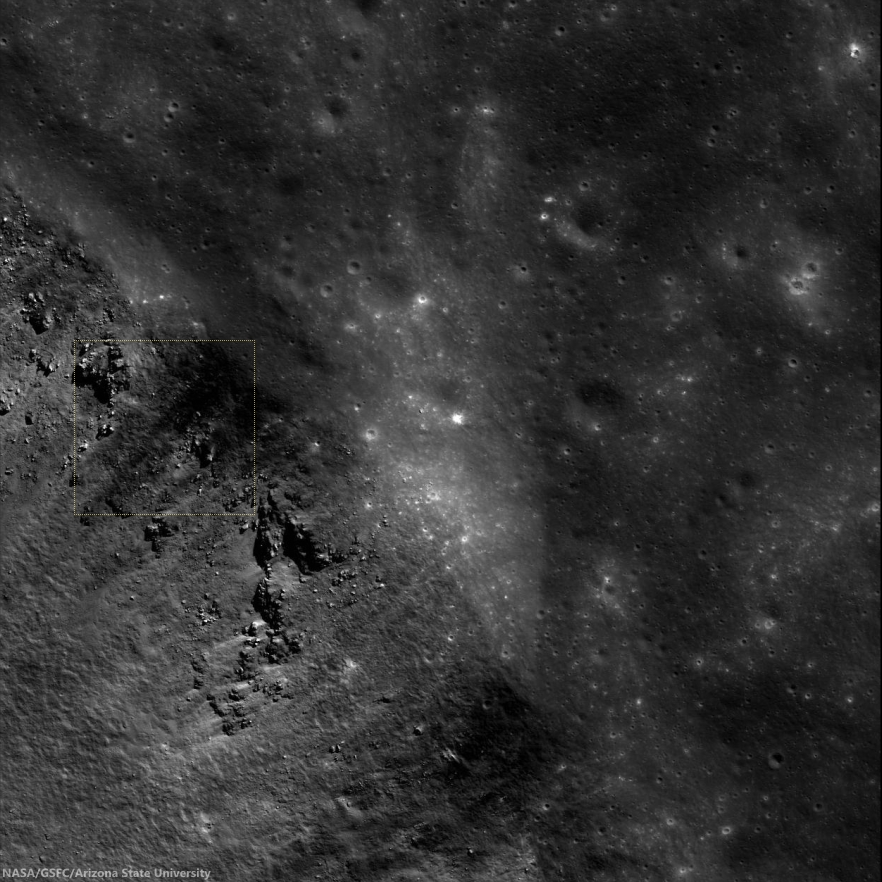
Expanded 3.8 km-wide context for LROC Featured Image released April 15, 2014 - outlined box - northwestern rim of pyroclastic vent, southern frontier Mare Orientale impact basin. Mosaic of left and right frames of LROC NAC observation M1150135366  [NASA/GSFC/Arizona State University].
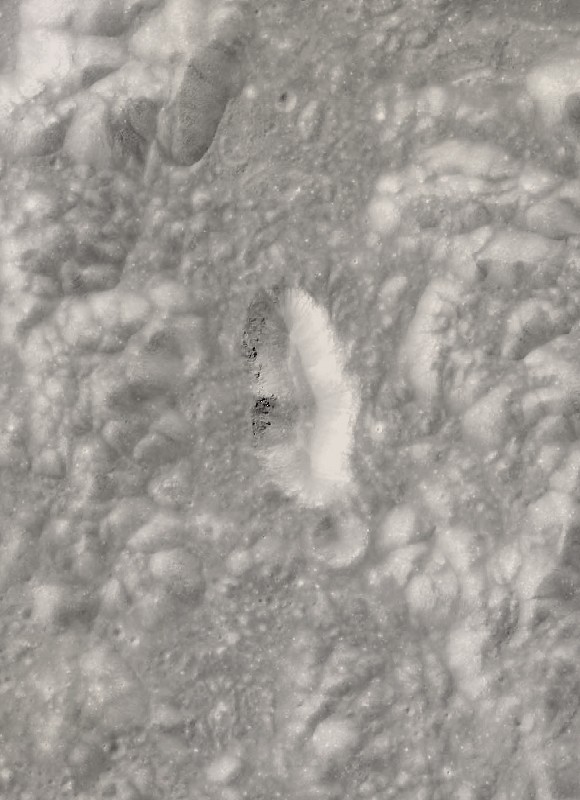
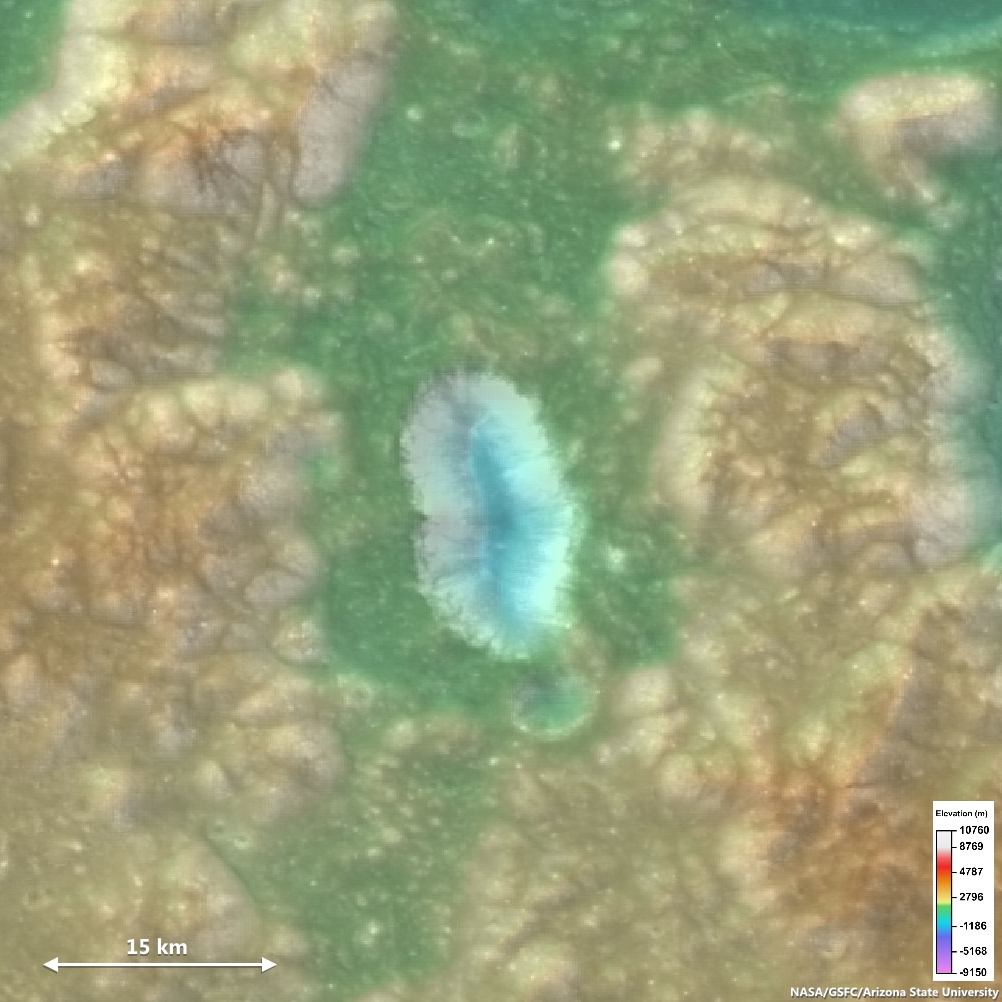
The lack of a discernible crater rim and irregular shape make this depression a suspect (See WAC image below). The walls of the depression are steep-sloped, yet the floor is fairly flat, which is best observed in a color-shaded digital terrain model (DTM). Such reniform depressions are observed in other locations across the Moon, such as Sulpicius Gallus, interpreted to be a pyroclastic source vent.

A higher angle of incidence, in this 2.8 x 7.5 km-wide field of view, washes out much of the finer grain albedo, though a look at the larger 40 percent -3760 x 9920- reproduction does reveal much of the detail of the rim, walls, boulder trails and debris-filled floor of the two-kilometer deep "smoke ring vent."  The area of interest on the upper right, also in the LROC Featured Image can be compared. LROC NAC mosaic of the left and right frames of observation M1099502843, LRO orbit 14378, August 13, 2012; illumination incidence angle 45° at 76 cm per pixel resolution, from 72.13 km over 30.11°S, 261.81°E [NASA/GSFC/Arizona State University].
If the kidney-shaped depression is the source of the low reflectance material, it is likely that material was ejected from the source vent at high velocity, creating an umbrella-shaped plume and depositing the dark, fine-grained material in a ring around the vent.

The larger than lunar average - 12.5 x 19.75 km pyroclastic "smoke ring vent," on the southwestern frontier of the Mare Orientale impact basin, is also hub to a regionally distinct 190 km-in diameter ring of darker material that, while not apparent in topographic studies, stands out in all native reflectance photography. Medium resolution Chang'e-2 Global albedo Mosaic [CNSA/CLEP].
Pyroclastic deposits are currently of interest to lunar scientists as a possible resource for future missions to the Moon. Such deposits are rich in hydrogen and helium-3, two potential resources for energy production, and iron and titanium, which have engineering applications.

Elevation study, LROC WAC-derived GLD100 topography in color-coded overlay onto LROC global normalized reflectance data. The high mountains of the concentric Orientale impact basin ring, where the vent is nested, offers a high vantage. Elevations range over 4000 meters in 10 km [NASA/GSFC/Arizona State University].
LROC WAC normalized reflectance 643 nm, of the low-reflectance pyroclastic annulus on the southwest Orientale impact basin. The annulus is approximately 180 km in diameter [NASA/GSFC/Arizona State University].
The necessary capabilities for utilizing resources such as these in-situ, or on site, are currently under development. In-situ resource utilization (ISRU) is critical to the future of exploration of areas that would otherwise be beyond our reach, both physically and financially.

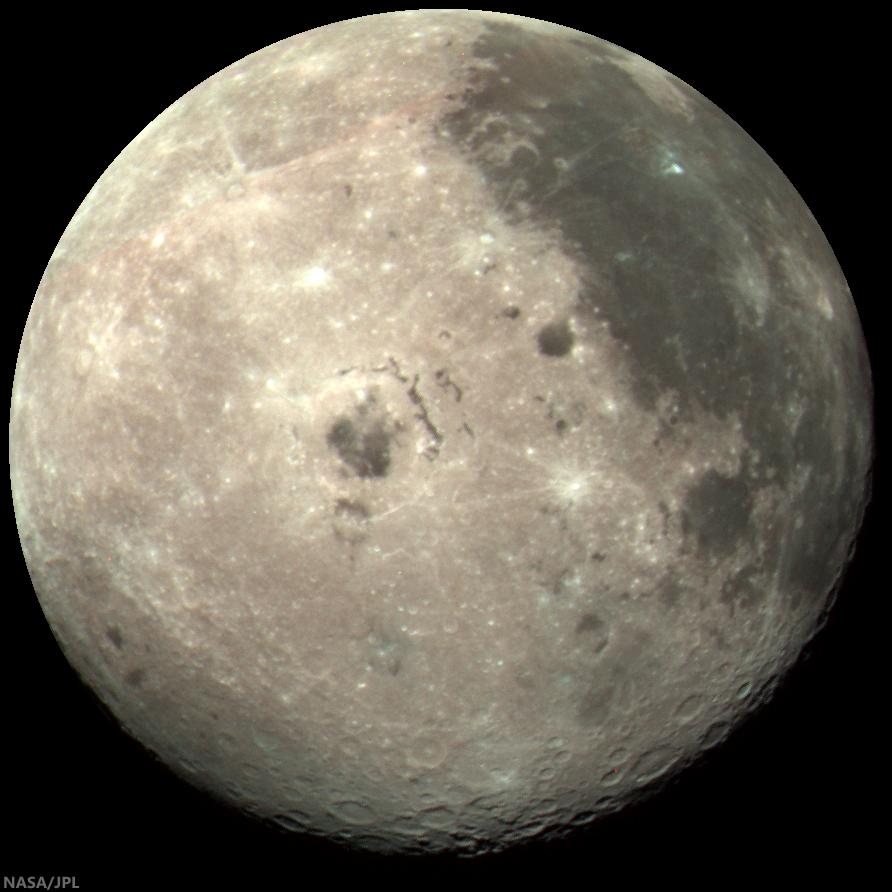
Another opportunity to display this stacked three-color image of the Moon's western hemisphere, which features Mare Orientale so prominently and demonstrates that the pyroclastic annulus south-southwest of its central plain, is large and prominent enough to be photographed from more than half a million kilometers away. In this case, captured by the Jovian probe Galileo at 1735 UT, December 9, 1990 [NASA/JPL].
Do some investigating of your own with the full NAC, HERE.

Related Posts:
Pyroclastics and an unnamed Procellarum vent
Source vent for Rima Prinz I
Craters on the Schrödinger pyroclastic cone
Morphology and distribution of volcanic vents in the Orientale basin from Chandrayaan-1
Unassuming volcanic vent north of Aristarchus Plateau
New pyroclastic structures identified using LROC data
A dark cascade at Sulpicius Gallus
Hyginus and pyroclastics
Layer of pyroclastics in Sinus Aestuum
Lavoisier Pyroclastics
Pyroclastic Excavation
Pyroclastic Trails
Pyroclastic Vent at Orientale DTM

Thursday, June 21, 2012

Foreign Policy: "Is there money on the Moon?"

Five to ten kilometer resolution map of Thorium, related to the lunar surface in parts per million by Japan's lunar orbiter Kaguya. While many have long noted the practical mineral wealth on the Moon, as Joshua E. Keating draws those threads together below, the Moon's most valuable resource is probably still its proximity and its volatiles just outside Earth's gravity well.
Joshua E. Keating
Foreign Policy Blog

In a new article for Foreign Policy, John Hickman ponders what the political ramifications might be if China were to declare sovereignty over a swath of territory on the moon, triggering a lunar land grab. But what about the economics of this extraterrestrial Great Game? Maintaining a permanent manned presence on the moon is an awfully pricey undertaking just to make a political statement. Is there any way to make some money from mining the moon's riches?

Possibly, but it's a long-term investment. The biggest cheese on the moon is probably helium-3, an isotope that's abundant in the moon's regolith, but rare and getting rarer here on Earth. Helium-3 is currently used mostly for scientific research, but some see it as a future source for non-radioactive fusion power. Unfortunately, the United States and Soviet Union exhausted much of the world's supply during Cold War-era nuclear tests. Several private companies, including Silicon Valley's Moon Express, are exploring the development of helium-3 mining on the moon and governments including India and Russia have discussed the possibility. (It's also the basis of the plot for the 2009 movie
Moon.)

It's hard not to be enticed by the numbers. Gerald Kulcinski, director of the Fusion Technology Institute at the University of Wisconsin, estimated when contacted by Foreign Policy that given the potential energy of a ton of helium-3 (the equivalent of about 50 million barrels of crude oil) and the estimated amount of recoverable helium-3 (around 75,000 tons, or 15 percent of the total amount on the moon) we could be looking at around $375 trillion worth of the stuff.

Read the full Foreign Policy blog post
HERE.

"To read more about China's lunar ambitions, click HERE."

Tuesday, May 15, 2012

Lunar boom: we'll soon mine the Moon

"As history has repeatedly shown, where there are valuable minerals to be unearthed, adventurous humans will arrive in droves – even if it means battling extreme conditions and risking life and limb. So what will happen when the next great “gold rush” in our history is quite literally out of this world…" A landscape of the imagination, in this case inspired by Mark Maxwell and JAXA, shows part of a larger study for Astrobotic Technology a generation or two beyond their present production line. In the deep lunar south their notional "Moon Digger" vehicles are clearing, perhaps in some places sintering, a new landscape more familiar to human civilization, extracting billions of years of space sediment along the way [Mark Maxwell/Astrobotic/JAXA]..
Leonhard Bernold
Associate Professor of Engineering
University of New South Wales
theconversation.edu.au

As history has repeatedly shown, where there are valuable minerals to be unearthed, adventurous humans will arrive in droves – even if it means battling extreme conditions and risking life and limb.

So what will happen when the next great “gold rush” in our history is quite literally out of this world? And what kind of technology would be needed for the mining? After many years of trying, I believe a have a workable answer to the second of these questions – but what about the first?

Business analysts may poke fun at the “impossibly” expensive cost of mining nearby celestial bodies such as asteroids, or even the moon, but these pursuits are not beyond the realm of possibility.

Returning to the moon for the purposes of mining will require new technologies and new ways of thinking, and this extends to the conventional business model. We cannot write these pursuits off based on high cost alone, especially given the hidden treasures to be found.

So, will we ever see mining trucks hauling material on the moon or on the asteroids? Quite simply, no.

It is a common mistake made by engineers, including myself, to project terrestrial technology on to the moon. After all, the moon’s environment is vastly different to that of Earth.

Read the complete premier, HERE.

Friday, October 7, 2011

New map of lunar titanium and Iron presented

The above image accompanying many reports of the LROC titanium and iron survey is everywhere being misidentified as showing the boundary area between Mare Serenitatis and Tranquillitatis. It's not clear why Figures 1 - 4 listed along with the official conference news posting were apparently not released at the news conference reported below. The image above may be a part of a larger global mosaic and looks suspiciously like early WAC color test articles released by LROC more than a year ago. Regardless, the area shown in the image above is interesting enough but shows an area mostly south of the equator and southwest of Copernicus on the Moon's nearside.

Map showing concentration of iron and titanium in Nearside maria. Iron and titanium are part of the mineral ilmenite (FeTiO3 ), which has the ability to capture and retain gases, such as hydrogen and helium, from the solar wind. An isotope of helium, helium-3, can be found in ilmenite and is especially valuable for nuclear power production [NASA/USGS/Community College of Baltimore County].
Paris (AFP) — A new map of the Moon has revealed an abundance of titanium ore that is up to 10 times richer than on Earth, a finding that could one day lead to a lunar mining colony, astronomers said on Friday.

The discovery was made thanks to a camera aboard the US Lunar Reconnaissance Orbiter, which swept the surface of the Moon, scrutinizing it in seven different light wavelengths.

Mark Robinson of Arizona State University, who presented the research at a conference in Nantes, western France with Brett Denevi of Johns Hopkins University in Baltimore, sifted through the data for telltale jumps in the ratio of ultra-violet to visible light.


NASA/USGS/Community College of Baltimore County
They established this signature thanks to rock samples brought back to Earth by Apollo 17 astronauts in 1972 and images of the area around the mission's landing site by the Hubble space telescope.

"Looking up at the Moon, its surface appears painted with shades of grey, at least to the human eye," explained Robinson.

"But with the right instruments, the Moon can appear colorful.

"The maria [lunar plains] appear reddish in some places and blue in others.

"Although subtle, these color variations tell us important things about the chemistry and evolution of the lunar surface. They indicate the titanium and iron abundance, as well as the maturity of a lunar soil."

Titanium is as strong as steel but nearly half as light, which makes it a highly desired -- and also very expensive -- metal.

On Earth, titanium is found, at the very most, in around one percent of similar types of ore. But the new map found abundances in the lunar maria that range from about one percent to 10 percent, the conference organizers said in a press release. In the lunar highlands, abundance was around one percent.

The meeting gathers, for the first time, members of the European Planetary Science Congress and the American Astronomical Society's Division for Planetary Sciences.

The find offers a double potential bounty, they said.

"Lunar titanium is mostly found in the mineral ilmenite, a compound containing iron, titanium and oxygen," they said.

"Future miners living and working on the Moon could break down ilmenite to liberate these elements.

"In addition, Apollo data shows that titanium-rich minerals are more efficient at retaining particles from the solar wind, such as helium and hydrogen. These gases would also provide a vital resource for future human inhabitants of lunar colonies."

The exposed upper 3 centimeters surface of the Moon is turned over, or "gardened" at least once every 2 million years. The visible surface has been estimated to reach "optical maturity," or "OMAT," over the course of 900 million years. Direct and remote examination has confirmed that the Moon's deeper topography retains a high-fidelity record of it's stormy 4.74 billion year history, recording the history of the Solar System and Earth while a continuous make over by solar radiation and heavier elements implanted by cosmic ray bombardment. The abundance of Helium-3 and Helium 4 is thought to be related to the abundance of iron and titanium. From: "Global inventory of Helium-3 in lunar regoliths estimated by a multi-channel microwave radiometer on Chang'E-1," WenZhe Fa and Yaqiu Jin (2010), Chinese Science Bulletin, Vol. 55, No. 35 [Maurice Collins].

Wednesday, May 11, 2011

China plans lunar research base


An improved, if unoriginal, global map of Helium-3 distribution on the lunar surface, based on the distribution of ferrous titanium oxides observed by China's Chang'E lunar orbiters, released in 2010 [CNSA/CLEP].

People's Daily Online

Under China's three-phase lunar probe plans for orbiting the moon, landing on the moon and returning back to Earth, China is scheduled to launch the Chang'e-3 and softly land it on the moon, where it will release a moon rover to explore the lunar surface, by 2013.

China will carry out an unmanned lunar landing around 2017 before making manned lunar landings and building research bases on the moon, said Ouyang Ziyuan, chief scientist of China's lunar probe program, in Shanghai on May 9.

Ouyang made the remarks during the opening ceremony of the 2011 IEEE International Conference on Robotics and Automation.

He said that the Chang'e-2 has operated safely for 200 days as of May 1. During the operation of the Chang'e-2 in space, four tiny cameras on the satellite recorded clear photographs, marking China's first-ever aerospace application of CMOS imaging technologies, first space surveillance engineering application, first photograph captured at the moment of igniting the 490N engine and first photograph of the Earth taken by a camera on an orbiting lunar orbiter.

However, is the ultimate mission of the Chang'e-2 to test soft-landing technologies for the Chang'e-3 or to test Earth reentry technologies for follow-up Chang'e series satellites after their lunar landings? Ouyang said that the ultimate mission of the Chang'e-3 Satellite has yet to be determined. Whatever mission is selected, the Chang'e-2 will test key technologies for follow-up tasks of Chang'e series satellites before completing its lunar trip.

For instance, the Chang'e-2 can either make a "pilot" soft-landing in order to test technologies for the Chang'e-3 or return to Earth orbit under ground control and simulate the return of future Chang'e series satellites to earth after 2013.

Ouyang said that the Chang'e-3 will be equipped with a 70-kilogram lander and a 120-kilogram moon rover. The satellite will weigh about 500 kilograms and will have a designed life of three months. As the intelligent robotic technology develops, the rover will be able to determine its own routes, climb slopes, avoid obstacles and pick a good spot to perform science experiments with a collection of sensors. Furthermore, it will even be capable of collecting samples from the moon and sending them back to Earth for further studies.

Ouyang said that China plans to send recoverable rovers and humans to the moon at appropriate times. In addition, China is also considering building a research base on the moon and exploring Mars and other parts of outer space. To achieve its goal, the country is building a new satellite launch center and is making great efforts to develop more advanced rocket engines.

Thursday, December 16, 2010

Chang'e-1 maps Moon's Helium-3 inventory


An interpolation of the total amount of Helium-3 per square meter "fixed" in the lunar regolith (ppb/m2), from "Global inventory of Helium-3 in lunar regoliths estimated by a multi-channel microwave radiometer on the Chang-E 1 lunar satellite," F. WenZhe, et al., Chinese Science Bulletin, December 2010, Vol. LV, No.35. Scarce on Earth, Helium-3 is a strategic ionized element and projected future source of clean energy. Likely a bi-product of solar incidence, as interesting as it's interpolated abundance in nearside mares Tranquillitatis, Fecunditatis and Oceanus Procellarum is it's apparent lack in similar landscapes. While the methods used to indirectly locate and map Helium-3 on the Moon is not new, the study may be of the highest resolution ever publicly released, Point HERE for a full-resolution view [Fudan University/Institut de Physique du Globe de Paris].

Fa WenZhe & Jin YaQiu
Fudan University &
Institut de Physique du Globe de Paris


Helium-3 (3He) implanted by solar wind in the lunar regolith is a valuable resource because of its potential as a fusion fuel. On the basis of the Apollo regolith samples, a linear relationship between 3He abundance and solar wind flux, optical maturity and TiO2 content has been presented. China successfully launched its first lunar exploration satellite Chang-E 1 (CE-1) on October 24, 2007. A multi-channeled microwave radiometer was aboard the satellite with the purpose of measuring microwave thermal emission from the lunar surface layer. From the multi-channel brightness temperature (Tb) observed by CE-1, the global distribution of the regolith thickness was inverted from the multi-channel Tb, and was used to evaluate the total amount of 3He per unit area in the lunar regolith. The global inventory of 3He was estimated as being 6.6×10⁸ kg; 3.7×10⁸ kg for the lunar nearside and 2.9×10⁸ kg for the lunar farside.

Helium-3 (3He) is a clean, safe and non-radioactive fusion fuel. Compared with traditional fusion reaction of using 3H, the reaction involving 3He does not generate any high-energy neutrons and does not produce prolonged radioactivity, and hence is not dangerous to a reactor or the environment.

Terrestrial sources of 3He are extremely rare and the total inventory is only about 2.0×10⁴ kg. Because there is neither a geomagnetic field nor an atmosphere on the Moon, solar wind particles can impinge directly upon the lunar surface and hence be captured by lunar regolith particles. As a consequence, a significant amount of solar wind elements (such as helium) have accumulated in the regolith during the long geological history of the Moon.

Significant work has been done to estimate the 3He implantation and abundance in the lunar regolith during the last few decades, based on the returned regolith samples from the Apollo and Luna missions. However, there has been a need to have a precise lunar regolith thickness distribution map of the whole lunar surface to determine the quantities of 3He present.

China successfully launched its first lunar exploration satellite Chang-E 1 (CE-1) on October 24, 2007. A multichannel microwave radiometer was aboard the satellite and had the purpose of measuring microwave thermal emissions from the lunar surface layer. From the analysis of the primary CE-1 observations, consisting of the brightness temperature (Tb) (from November 2007 to February 2008), Fa and Jin successfully inverted the global distribution of regolith thickness. This newly acquired dataset provided an opportunity to quantitatively estimate the global inventory of the 3He accumulated in the whole regolith.

In this study, by combining the models of normalized solar wind flux over the lunar surface, the global distribution of TiO2 content and the surface optical maturity derived from Clementine UVVIS multi-spectral data, a linear relationship between 3He abundance, TiO2 content and surface optical maturity can be derived for the global distribution of 3He in the lunar near-surface layer (thickness less than 1 μm). Using the newly acquired global distribution of the regolith thickness obtained from CE-1 multi-channel radiometer observations, the total amount of 3He per unit area in lunar regolith can then be obtained.

Read the Study, HERE.

Monday, August 30, 2010

Nobel Prize winner warns of helium scarcity


Probable distribution of helium-3 (3He) on the lunar surface is strongly linked to mare basalt with a high solar incidence and the presence of thorium and titanium oxide. Geologist Harrison Schmitt, Apollo 17 lunar module pilot, with Gerald Kulcinski of the University of Wisconsin at Madison, has long and urgently advocated a fusion-powered Helium-3 Economy by 2050. Though not all the more familiar near side lunar 'seas' show the high likelihood of ready reserves of helium-3, Schmitt notes one area likely to hold future economical reserves of this commodity are within Mare Tranquillitatis and under the landing site of Apollo 11.

Discover Blogs/80beats

The United States currently holds around half of the world’s helium supply and we’re selling it, for cheap.

We’ve known this for a while. We started stockpiling the stuff near Amarillo, Texas in 1925, in part for dirigible use, and stepped up reserves in the 1960s as a Cold War asset. In 1996, Congress passed the Helium Privatization Act mandating that the United States sell the gas at artificially low prices to get rid of the stockpile by 2015. This February, the National Research Council published a report estimating that, given increasing consumption, the world may run out of helium in 40 years. That’s bad news given helium’s current applications in science, technology, and party decorations–and possible future applications in fusion energy.

Now physicist Robert Richardson, who won a 1996 Nobel Prize for work using helium-3 to make superfluids, has come forward to stress the folly of underselling our supply of the natural resource. He suggested in several interviews that the gas’s price should mirror its actual demand and scarcity. He estimates that typical party balloons should cost $100 a pop.

“They couldn’t sell it fast enough and the world price for helium gas is ridiculously cheap,” Professor Richardson told a summer meeting of Nobel laureates…. “Once helium is released into the atmosphere in the form of party balloons or boiling helium it is lost to the Earth forever, lost to the Earth forever,” he emphasised. [The Independent]

Read the full review, HERE.

See also:
"Helium-3 powering the future?"
August 14, 2008

Monday, February 15, 2010

Expert: China close to lunar landing capability

Shenzhou-7 roll-out at Jiuquan in northwest China's Gansu Province, September 20, 2008. [Xinhua]

People's Daily - After years of development, China's space technology is close to moon landing capability, said Fu Yiqing, space expert and consultant to the Shanghai Institute of Space Propulsion (SISP).

Fu, also a senior member of American Institute of Aeronautics and Astronautics (AIAA), said this during an interview with reporters form China News Service.

New generations of Chinese taikonauts are studying moon landing technology. Although there is no big problem in the overall technical aspects of moon landing, some details still need to be researched and implemented, said Fu.

Aerospace engines produced by the SISP are the key parts. The orbit of Chang'e II, planned to be launched this year, will be closer to the moon, making preparation for the moon landing.

Fu said China will launch Tiangong 1 space laboratory making a breakthrough in space rendezvous and docking technology; develop the Long March V, large-scale carrier rocket and prepare for launch of space station; launch Chang'e II and Chang'e III satellites and achieve a soft landing of moon's surface; make use of moon rover to explore the moon and provide data for the for the moon base mission.

Besides China, a number of countries are also accelerating the pace of manned space missions. The U.S. plans to "return to the moon" and Europe, Russia, Japan and India have also raised the concept of the moon landings.

Studies have found helium-3 is more abundant on the Moon than on the Earth. It is a variant of the gas used in lasers and refrigerators as well as in balloons. Moon gas could meet earth's future energy demands for thousands of years.

Fu has served as a director designer of engines of Long March III and Long March IV carrier rockets.

Sunday, December 6, 2009

"Quickest way to Mars is through the Moon"


Lot's of work is ahead before even contemplating any logistical path for utilizing lunar volatiles, and other resources, says Apollo 17 veteran Dr. Harrison Schmitt. The former Senator from New Mexico addressed the Austrian Academy of Sciences in Vienna on December 2. [Image Vancouver, 2007]

Xinhua - Discovery of water on the moon might not significantly speed up the establishment of manned stations there, according to someone who has been there, U.S astronaut Harrison H. Schmitt.

Schmitt landed on the moon in 1972 aboard Apollo 17, the last manned mission to touch down on the lunar surface. Being a geologist, he is among an elite group of 12 Americans who are the only people to have walked on the moon to date.

Addressing the Austrian Academy of Sciences here Wednesday about "the origin and history of Moon", he expressed his interest in the recent discovery by U.S. National Aeronautics and Space Administration (NASA) scientists of evidence of water on the moon.

However, he pointed out that that was not enough to promote the establishment of lunar manned station. In his view, the key issue about water on the moon was not its scarcity but rather how to use it.

Schmitt explained there was a lot of hydrogen on the surface of the moon, with which it would be easy to produce water. But there was still no solution to the problem of how to use the frozen water under the very low temperatures that exist there.

Nevertheless, Schmitt believed humankind would finally establish stations on the moon. After all, "the quickest way to Mars is through the Moon," he said.

He said landing on Mars would be the next goal for manned space missions. In order to achieve this goal, people could establish "training camps for young people" on the moon.

During his speech, Schmitt also expressed suspicions about human activities resulting in global warming. In his view, the natural factors, such as solar activity, had a larger impact than the human use of fossil fuels.

Thursday, November 19, 2009

The Rosetta Stone of the Solar System

The Ocean of Storms, November 19, 1969. Minutes into the first of two EVAs, Apollo 12 lunar module pilot Alan Bean is photographed by Pete Conrad, the fourth and third human beings to walk on another world [NASA].

AFP - The moon, which is once again the focus of an international space race, could hold the key to the birth of our planet some 4.5 billion years ago, and help unlock the oldest secrets of the universe.

Forty years after American Neil Armstrong first walked on the moon, and as the United States aims to return astronauts to Earth's nearest neighbor by 2020, it remains an object of fascination and curiosity.

Friday's announcement that the US space agency has found "a significant amount" of water frozen water deep in the moon's surface will re-ignite mankind's dreams of colonizing Earth's only satellite.

Part of the goal of once again returning to the moon -- some 384,402 kilometers (238,855 miles) from the Earth -- is to learn more about its hidden natural resources.

"The moon still has a great deal of scientific information left to be discovered that relates directly to... our understanding of the history of the Earth and early history of other planets," geologist Harrison Schmitt told AFP earlier this year.

Schmitt landed on the moon in 1972 aboard the Apollo 17, the last manned mission to touch down on the lunar surface. He is among an elite group of 12 Americans who are the only people to have walked on the moon to date.

And as the Earth's natural resources gradually dwindle, some scientists believe the moon could prove a goldmine for future generations.

Among the 382 kilos (842 pounds) of rocks and lunar soil brought back by astronauts from the moon during six Apollo missions is a rock that scientists call "genesis," which dates back to around 4.5 million years ago, about the time when the solar system began.

The moon, which has virtually no atmosphere, is effectively a geological blank slate for scientists because it has not had the contact with water and air that has changed the Earth's surface.

"One reason to go back to the moon is to find out whether there is anything of value to be done there... If the answer is yes, you can do economically valuable things and use local resources," said John Logsdon, a curator at Washington's National Air and Space Museum.

America's new lunar program, dubbed Constellation, was launched in 2004 with the intention of establishing a forward operating station for astronauts as well as to seek evidence of water beneath the moon's ground ice.

President Barack Obama has appointed a commission to review the program's cost and goals. And several other countries, including China and Russia, have announced their ambitions to send missions to the moon, about a four-day trip by space shuttle from Earth.

Schmitt, a former astronaut, noted the moon's soil is rich in helium-3, which comes from the outer layer of the sun and is blown around the solar system by solar winds.

The element is rarely found on Earth, unlike on the moon, where it is heavily accumulated because it is pushed away by the Earth's magnetic poles.

Helium-3 is highly sought for nuclear fusion, and though the technology is still in its infancy, the element "will ultimately be quite valuable on Earth," Schmitt said.

Reserves of helium-3 on the moon are in the order of a million tons, according to some estimates, and just 25 tons could potentially serve to power the European Union and United States for a year.

The moon is also an ideal location for astronauts to prepare and train for long missions into space, including to Mars, according to NASA.

Monday, November 9, 2009

"Moon" debuts on DVD, Blue Ray in January


"You've been up here too long, you've lost your marbles." Solitary helium-3 miner (Sam Rockwell) confronts himself, literally, aided, after a fashion, by the pre-programmed advice of his smiley-faced computer companion (Kevin Spacey) in Duncan Jones' award-winning premier feature, "MOON," available on DVD and Blue Ray early next year.

Neil Miller
FilmSchoolRejects.com

A few weeks back, director Duncan Jones revealed some of the DVD and Blu-ray release details for the import release of his highly acclaimed film Moon via his twitter account (@ManMadeMoon). And ever since, we’ve been waiting for official word from Sony Pictures Home Entertainment. Today, we have that official word in the form of the press release below. The film will hit Blu-ray and DVD here in the states on January 12th, and it will include what appears to be a solid amount of special features. This includes two commentary tracks, two Q&A featurettes and two behind the scenes featurettes. Not bad for a smaller release.

More HERE.

Tuesday, October 20, 2009

A Legal Regime for the Mining of Helium-3 on the Moon: U.S. Policy Options

Richard Bilder
University of Wisconsin Law School

This article addresses questions of U.S. international legal and space policy arising from current proposals of the U.S., Russia, China and India to establish bases on the Moon, in part with the purpose of mining and bringing to Earth Helium-3 (He-3).

He-3 is an isotope of helium that is available in quantity only on the Moon and could, as an ideal fuel for nuclear fusion reactors, furnish humanity a virtually unlimited source of safe, non-polluting energy for centuries to come. It is estimated 40 tons of liquefied He-3 brought from the Moon to Earth (about the amount that could comfortably fit in the cargo bays of two Space Shuttles) would provide sufficient fuel for He-3-based fusion reactors to meet the full electrical needs of the U.S. (or a quarter of the entire world’s electrical needs) for an entire year.

There is as yet, however, no international consensus on whether, or how, any nation or private enterprise can exploit or acquire title to He-3 or other lunar resources. The article calls attention to what may become a “race to the Moon” to obtain He-3 and discusses: (1) the technical and economic prospects for the development of He-3-based energy, (2) the present legal situation concerning the exploitation of lunar resources such as He-3 and (3) policy options for the U.S. regarding the establishment of an international legal regime capable of avoiding conflict in the exploitation of He-3 and other lunar resources and facilitating the broad scale development of He-3-based energy.

Download the full report (Adobe Reader file) HERE.
Mirror Site

Monday, June 29, 2009

Igniting Fusion

Ground zero: A circular access port affords a glimpse into a 10-meter-diameter target chamber where, in the coming months, powerful lasers will be fired with the goal of setting off small thermonuclear explosions.
(See more images.) Credit: Jason Madara

Researchers at a the National Ignition Facility (NIF) in California will soon attempt to start self-sustaining fusion reactions using the world's largest lasers. If it works, it could be a first step on the road to abundant fusion power.

Kevin Bullis
MIT Technology Review
July-August 2009

It's late April and workers are assembling the last parts of the National Ignition Facility (NIF), a sprawling building covering the area of three football fields at Lawrence Livermore National Laboratory in Livermore, CA. Dressed in hard hats, hair nets, lab coats, and latex gloves, they have gathered at the target chamber, a sphere 10 meters in diameter and bristling with 48 burnished-aluminum ducts that together house 192 separate laser beams. Each beam on its own is one of the world's most powerful, says Bruno Van Wonterghem, operations manager at NIF. Together they deliver 50 to 60 times the energy of any other laser.

Read the Article HERE.

Saturday, June 13, 2009

Is helium-3 mining, as seen in "Moon," a realistic possibility?


Southwestern Sea of Tranquillity - Nov. 2007 - Japan's
Kaguya orbiter imaged the flat and exceedingly ancient spot where humans first walked upon the Moon, from 100 kilometers above.

Rare on Earth, Helium-3 is fused deeply in the lowland plains that characterize the Moon's Near Side, and particularly within the Sea of Tranquility near the equator. No one knows how deeply, but it's presence is thought to be within these basins together with certain iron and titanium oxides, as discovered in samples collected here and the Ocean of Storms. Scarce in the lunar highlands, Helium-3 is believed to make up around 20 percent by weight of the loose regolith of the Near Side Seas
.

John Matson in 60 Second Science Blog, Scientific American - What if we found a clean, abundant resource that could provide the lion's share of the world's energy needs? How far would we be willing to go to get it...?

That's the question posed—in both a moral and a logistic sense—by the new sci-fi film MOON, directed by Duncan Jones (the son of musician David Bowie), which opens in New York City and Los Angeles this week...

As it turns out, the film depicts a vision quite close to what some researchers describe as a powerful—if extremely difficult—solution to our energy woes.

Gerald Kulcinski, a nuclear engineer and director of the Fusion Technology Institute at the University of Wisconsin–Madison, has been researching the possibility of mining the moon's helium 3 for decades. He is, along with Apollo 17 astronaut Harrison Schmitt, one of the concept's most prominent advocates. (Schmitt wrote an article for Popular Mechanics in 2004 that describes a harvesting operation much like the one Bell manages at Sarang.)

The lunar surface, Kulcinski says, should indeed be loaded with the isotope, which is in the solar wind, the stream of charged particles from the sun. It is scarce on Earth because the planet's atmosphere and magnetic field largely deflect the brunt of the solar wind, but the moon is far less protected. "The only thing that's close to the sun that has neither an atmosphere nor a magnetic field is the moon," Kulcinski says. And samples from the Apollo program show elevated levels of helium 3 compared to the puny amounts available on Earth. Kulcinski estimates that there are a million metric tons of helium 3 embedded in the outermost layer of the moon's crust.

Read the Posting HERE.

Monday, May 4, 2009

Future may depend on Lunar Colonization

Journalist Andres Castellanos of My Conscience Explodes highlights a lecture April 23 by Eric Vanderhoot, Astronomy and Physics Lab Coordinator at Florida Atlantic University given at the South Florida Science Museum.

Clearly a coordinator after my own heart, Vanderhoot spoke in favor of a position almost precisely the same as that of the Lunar Pioneers, Castellanos reports.

"America’s future in space," according to Vanderhoot, "depends on its willingness to colonize the moon. And it’s not a far-off idea. The moon has energy resources not found on Earth and the technologies needed to harness these resources are mostly known."

Of course, LP strongly agrees, though we frame the point more starkly, e.g., "America's future may depend on its willingness to colonize Earth's Moon." (Never more true, but more difficult to sell when I first made that statement in 1976. And I was not alone, during that dreary first gap in manned spaceflight.)

Castellanos continues, "the head of (FAU's) observatory and physics lab presented all of his ideas regarding living on the moon in a lecture (that) sought to answer the question: Can we live in space?"

The short answer is we already do. But can we move into space aside from highly skilled astronauts?” Vandernoot says."

"He thinks America should strive to revive its frontier spirit, the same one that drove families in wagons toward the old west. This time, however, brave pioneers should settle the moon."

"Vandernoot was quick when his audience asked him about Mars. He warned of spending too much money on a manned mission there. “Absolutely not, we would blow through our budget and never go anywhere again,” Vandernoot responds. “The only way for the public to appreciate any endeavor is for America to get something back for its investment.”

"Vandernoot says resources on the moon can help alleviate Earth’s energy crisis. He also points out that no living ecosystem will be hurt by human presence."

If the reader is understandably skeptical of the Pioneer's more "extreme" position, one can hardly blame you. It has been a stormy season of dire predictions, the last half-century or so, we are so used to being unable to get a word in edgewise, we had kept our position to ourselves, the last quarter century or so. The soil has, however, never been more fully prepared.

It is in the context of those dire warnings, oddly enough, the Lunar Pioneers have often recommended a glance at one of many first class studies on the subject by former Senator Harrison Schmitt (R-NM), in particular those co-written with University of Wisconsin colleague Dr. G.L. Kulcinski.

Fusion Power from Lunar Resources; G.L. Kulcinski and H.H. Schmitt, October 1990 (revised September 1991) [presented at the 41st Congress of the International Astronautical Federation, Dresden, Germany, 6-12 October 1990. (pdf - 25 pages, 625 kB)

The better part of Castellanos excellent full report is HERE.

Thursday, April 16, 2009

Duncan Jones, Director of "Moon"

Popular Mechanics interviews Moon director
Duncan Jones
Erin McCarthy

"Duncan Jones, the movie's director, wanted to make the kind of gritty sci-fi film that he feels is no longer being made. The writer and director walks PM's Digital Hollywood through DIY FX on a budget, answering to astronauts at NASA and the difference between artificial intelligence and anthropomorphized computers. Plus, check out the Moon trailer
HERE."

"I read a book by Robert Zubrin, Entering Space. It was all about how we could financially justify colonizing the solar system; there was a chapter on colonizing the moon and using helium-3 as a source for fusion power. It did seem to be a very logical argument about why you would have a reason to set up a moon base. I think one of the things that is limiting about NASA leading the space race is that everything they do is researched, but it doesn't have any direct relevance to how it affects our lives. But with helium-3, there is a very direct link to how we could use that as a resource here on Earth and why it would be profitable."

Jones, after receiving favorable from private screenings for cinematic legends Terry Gilliam and Neil Gaiman, says he now anxiously awaits a review from Ridley Scott. His next project, though not a squeal, takes up where the world portrayed in Scott's 1982 classic Blade Runner leaves off, in not-to-distant future Berlin.

Read the Popular Mechanics interview HERE.

Wednesday, April 1, 2009

Jack Schmitt to speak at University of Houston


Former U.S. Senator, Dr. Harrison "Jack" Schmitt, lunar module pilot for Apollo 17, last man to step out onto the lunar surface and the only professional scientist to visit to Moon, during an inpromptu interview at Rutgers University.

One of the last astronauts to step foot on the moon will be speaking at the University of Houston Wednesday, April 1. Part of Apollo 17, the last Apollo mission to land men on the moon, Harrison Schmitt is the only trained geologist to have ever walked on the lunar surface. His talk is free and open to the public.
Schmitt, an adjunct professor of engineering at the University of Wisconsin, will speak from 6 to 7 p.m. in the Shamrock Ballroom of the Hilton University of Houston Hotel. His talk is titled "Shoot for the Moon: Future Energy, Lunar Return and Science Education."
During the Apollo 17 flight in December 1972, Schmitt took the photograph of the Earth called "The Blue Marble" that was officially credited to the entire Apollo 17 crew by NASA. As the only geologist in the astronaut corps, he became the first of the scientist-astronauts to receive a crew assignment and played a key role in training Apollo crews to be geologic observers and field workers when in lunar orbit and on the lunar surface. After each of the landing missions, he participated in the examination and evaluation of the returned lunar samples. After the completion of Apollo 17, he played an active role in documenting the Apollo geologic results.
During the UH lecture, Schmitt plans to cover subjects from his book "Return to the Moon: Exploration, Enterprise, and Energy in the Human Settlement of Space." Topics include the role of humans in space, space law and policy, space entrepreneurship and management, and the economics and production of Helium-3 (He-3) for power generation.
A long-term proponent for obtaining He-3 from the lunar surface for nuclear fusion to harness energy, Schmitt will talk about the eventual possibility of mining the moon for vast stores of nonpolluting nuclear fuel from this source. There is only an estimated 15 tons of the He-3 isotope on Earth. The moon, however, has an abundant supply estimated to be between one to five million tons of this precious isotope in its regolith, the layer of loose rock resting on the lunar surface.
Schmitt also will offer his perspective on climate change. He made recent headlines as a scientist who disagrees with the theory of man-made global warming.
This talk is the 16th Milton Dobrin Memorial Distinguished Geophysics Lecture sponsored by the UH Department of Earth and Atmospheric Sciences. The annual event is named for the late Milton Dobrin, a well-respected geophysicist who was a member of the UH geosciences faculty prior to his death in 1980. He made distinguished contributions to exploration geophysics and to the advancement of the profession.

Thursday, March 5, 2009

After the moon, ISRO aims for the sun

Last updated September 15, 2010 1858 UT
The universe is our playground

Harsha Pramod
itexaminer.com

Bengaluru (India)

The silent space surrounding the moon could soon be busy with the movement of active satellites from different countries in its parent planet. The Indian Space Research Organisation’s (ISRO) lunar satellite Chandrayaan-1 is now orbiting in an elliptical orbit over the polar regions of the moon. ISRO launched Chandrayaan-1 (meaning ‘moon craft’) successfully on 22 October 2008, thereby joining the space faring countries in the lunar race. Launched at a cost of about $75 million, Chandrayaan-I will remain in its orbit for about two years. This is especially significant because of the renewed interest in the Earth’s lone satellite after a lull of many decades.

The moon has always been a source of mystery to the human race. It has been associated with mythology and beauty. Being the nearest celestial body, it continues to be a source of great interest to the space scientists. The lunar mission is seen as an important milestone in the space journey.

In the early 1960s the race for the moon was between the US and the USSR. However, the USSR nearly abandoned its lunar mission in the 1970s. Russia is now planning to launch its lunar project ‘Luna-Glob’ in the next few years. The US agency, National Aeronautics and Space Administration’s (NASA’s) Lunar Reconnaissance Orbiter (LRO) and Gravity Recovery and Interior Laboratory (GRAIL) are expected to provide significant information to help plan for an advanced manned lunar mission in the next decade. LRO is scheduled for launch in April this year while GRAIL is planned for 2011.

ISRO is conscious of the fact that although other countries have undertaken space missions, the data is often not shared. So, India launched its own lunar mission. China is also moving ahead in space, with plans to send (three more) robotic explorers to the moon by 2020.

Its first lunar satellite Chang'e-1, named after (the) legendary Chinese moon goddess, impacted the moon this year. In the global scene, India has set an example of international cooperation by carrying foreign payloads on Chandrayaan-1.

Chandrayaan-1 should help ISRO improve technology for future missions (and) could provide information about the availability of Helium-3 on the moon.

Helium-3 is a non-radioactive isotope of helium considered as a comparatively clean fuel for future nuclear fusion reactors.

Riding high on the success of Chandrayaan-I, ISRO plans to launch Chandrayaan-2 in 2012. Chandrayaan-2 will be launched on India’s Geosynchronous Satellite Launch Vehicle (GSLV). The mission has been allocated a budget of $86.6 million (Rs 425 crore). Chandrayaan-2 will comprise a lander and a robotic rover, which will soft land on the moon. The robot will take samples from the lunar surface for analysis and will transmit the data back to the earth. ISRO has already signed a pact with the Russian federal space agency (Roscosmos) for the mission. According to the pact, Roscosmos will be responsible for the Lander/Rover.

While Chandrayaan-1 is yet to unload many of its secrets, ISRO is aggressively pursuing its future projects such as the solar mission, Aditya, a satellite to study solar emissions. With the design in place, the mission will be launched in a couple of years. Aditya is reportedly the first space based solar mission planned to study corona, the sun’s outer layer. There are limitations to studying corona from the earth as it is visible only during solar eclipses. The earth’s atmosphere also scatters sunlight. This makes a space mission to study corona even more significant.

ISRO’s study on a Mars mission is also underway. The orbiter mission to Mars aims to study the Martian atmosphere, weather and solar wind-Mars interactions. According to ISRO, setting up a base in the moon could help future space explorations. A long trip to a celestial body such as the Mars could use the moon as an intermediate base. Mission to Mars is likely to could happen around 2019. Missions to other planets could well become a reality in the long term.

India’s manned mission to space at a cost $2.3 billion (Rs 12,000 crore) could be expected before 2015. While ISRO is not averse to international cooperation, it prefers to be self-reliant. ISRO’s manned mission into space has been approved by the Space Commission and is awaiting the government’s approval.

Asteroid or comet flyby flights could also become future missions. This could study the surface and interior of comet nucleus, composition of dust and gas in the comet, solar radiations and also bring samples of comet dust for study.

NASA is currently in the news for its Kepler mission, which aims to explore outer space for alien life. If all goes well, the mission will be launched in Florida on Friday night, 6 March, local time. The Kepler mission is a $600-million mission in search of habitable planets.

China, the US and Japan are going ahead with major plans for space exploration. Everyone wants a share of the outer space. While ISRO says it is not interested in a space war, it also does not want to be lagging behind in enhancing its competence to explore space. The possibilities awaiting the space explorers could very well challenge human imagination.

Check Out
Chandrayaan-I mission not expensive, says Nair
Chandrayaan 1 launch success
India allocates $86.6 million for Chandrayaan-2
ISRO
PIB
Economic Times

Wednesday, March 4, 2009

"The Moon" gets a premier date

It won't matter to me that the lonely Helium-3 "miner," played by Sam Rockwell, in the Sundance Film Festival sleeper Sci-Fi hit "The Moon" is stationed, for obvious dramatic effect, on the Moon's Far Side. Never mind that our best science indicates that vast amount of available Helium-3 is probably located in Near Side seas Mare Tranquillitatis and Oceanus Procellarum.

It's just great to see Helium-3, which in the case of The Moon is really only the thing that Alfred Hitchcock called a "McGuffin," or "the thing the spies are looking for that doesn't really matter to the story or the audience" finally become a part of the popular culture, or at least "the noise level," for what its worth.

Enough has been written elsewhere about this film and its story, and how it received a distribution deal after its Festival premier. Nevertheless, it would be lax to neglect joining others in announcing The Moon will be generally released June 12, immediately after the peak of the Summer Blockbuster release season, which already features the hyper-hyped and anticipated Star Trek in May.

And the launch of LRO/LCROSS, if all goes well, on May 27.

Sunday, January 18, 2009

MOON: Premiers at Sundance

Featuring the voice of Kevin Spacey and starring Sam Rockwell, a new popularized vision of 3Helium mining on the Moon premiers at the Sundance Independent Movie Festival.

Read the REVIEW HERE.