Showing posts with label Xinhua. Show all posts

Thursday, October 23, 2014

China to launch sample return re-entry test vehicle

Long March 3C at Xichang [CNSA/CLEP].
Mo Hong'e
Xinhua

China will launch a new lunar mission this week to test technology likely to be used in Chang'e-5, a future lunar probe with the ability to return to Earth.

The experimental spacecraft launched this week is expected to utilize a free-return trajectory to fly high over the Moon's farside and adjust its course for return directly to Earth, according to a source with the State Administration of Science, Technology and Industry for National Defense.

The test module is reportedly in nominal condition and is scheduled to launch sometime prior to local dawn, between Friday and Sunday, from the Xichang Satellite Launch Center.

China's Long March-3C booster will carry the mission through trans-lunar injection.

The mission will involve the spacecraft cislunar navigation, re-entering Earth's atmosphere at above 11 km per second and landing safely on Earth, the source said.

Testing the spacecraft to return land safely at a pre-determined location is considered to be a key capability needed for Chang'e-5, the 2017 mission  designed to land, retrieve lunar samples, launch from the Moon and return the samples to Earth.

Saturday, January 25, 2014

Problem with solar-powered Yutu rover before nightfall

CCTV Yutu rover on the Moon
China's Yutu, "Jade Rabbit," lunar rover, the first such vehicle operated on the Moon since 1976 [CCTV].
Official sources in Beijing report China's lunar rover Yutu “experienced a mechanical abnormality" and "scientists are organizing repairs."

The problem occurred “due to the complicated lunar surface environment," just before local sunset at the Chang’e-3 landing site on Saturday, January 25, Xinhua reported, citing a report from SASTIND, China’s State Administration of Science Technology and Industry for National Defense.

No further details were available from official sources early Sunday, Beijing time (UT +8 hours).

Unofficial sources, however, say the rover's solar panels may have failed to retract when ground controllers were preparing Yutu for hibernation ahead of local sunset on Saturday, and the start of a second 330 hour-long lunar night since successful deployment from the Chang’e-3 lander, December 14.

Whether the anomaly permanently disables the rover may be undetermined. Both the Chang’e-3 lander and Yutu depend on solar power, so communicated efforts to resolve the issue may have had to be suspended before nightfall to conserve a base of power to sustain the small robot through the long night ahead.

Retracted solar panels also may be critical to protecting the rover’s components over the two weeks of cold and darkness before the next local sunrise on February 9. The Mare Imbrium landing site’s latitude, with its higher angles of incidence sunlight than available at the equator, might require the lander and rover both experience a shorter period of peak charging, a shorter time when the Sun is higher in the sky, than strictly the time between dawn and dusk.

Meanwhile, with no problems of its own reported, the stationary Chang'e-3 lander, Xinhua reported, successfully began its own second 14 day-long period of required dormancy period on Friday.

After their first hibernation periods ended two weeks ago the optical telescope carried out observations using an extreme ultraviolet (UV) camera, observing Earth’s plasma-sphere, which is among other successful operations reported among “Preliminary Science Results” released by the Chinese Academy of Sciences a week ago.

UHF communications between the lander and Yutu were also successfully tested.

The Chang'e-3 mission makes China only the third nation to soft-land a spacecraft on the Moon, the first since Luna 24 in 1976, and whatever the outcome of its present challenges, Yutu is only the third remote- operated rover deployed on the Moon since Lunokhod 2 in 1973, which also used solar power but was kept warm through four lunar nights using heat generated by a radioisotope decay heater.

Some Related Posts:
Chang'e begins long-term science mission (January 18, 2014)
Preliminary Science Results from Chang'e-3 (January 16, 2014)
Chang'e-3 and Yutu survive first lunar night (January 14, 2014)
Chang'e-3 APXS delivers its first surface analysis (January 1, 2014)
Chang'e-3 lander and Yutu rover from LRO (December 31, 2013)

Saturday, January 18, 2014

Chang'e 3 begins long-term science mission

Chang'e-3 (CH-3 PCam)
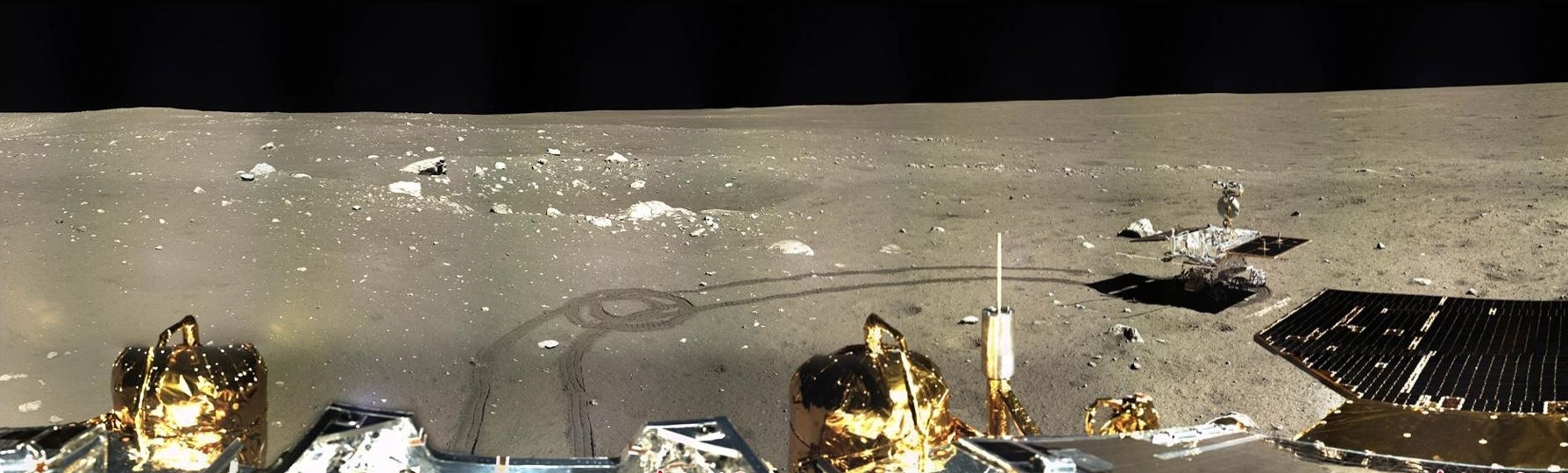
Chang'e-3 lunar lander Panoramic Camera image, from a sequence released January 17. (Click on image for a wider mosaic) [Chinanews.com].
[From China Daily - January 17 (UT)] The Chang'e-3 lunar lander and rover "Yutu" have begun their long-term science mission, and will have their durability tested as it continues a survey of its landing site in northwest Mare Imbrium, sources with the Beijing Aerospace Control Center said Thursday.

The center transferred operations of the probe to a smaller management team Wednesday night, said Cui Yan, who leads the team. "We have made all the hardware and software ready for the long-term control tasks and have developed new management methods," Cui said.

Liu Junqi, one of the chief engineers on Cui's team, said during the yearlong mission the team will coordinate deep-space control stations around the nation and closely monitor the Chang'e-3 lander and Yutu to arrange scientific missions on the lunar surface.

One of major responsibility for the team is to put the lander and rover into sleep mode as the long lunar night descends and re-awaken the vehicles and their science instruments after local sunrise, Liu said. Night on the moon lasts two weeks, and the surface temperatures quickly fall below -180° C, and there is no sunlight to provide power from solar panels.

Part of a 360° panorama from the Chang'e-3 lunar lander, released with Preliminary Science Results from the Chinese Academy of Sciences, January 16 [CNSA/CLEP/CAS].

"The transfer of control marks the successful completion of the probe's first stage of exploration and scientific missions," said a publicity officer at BACC, who refused to be named. He said, under the long-term management mode, the lander and rover don't need a lot of people to take care of them. Cui's team, which has less than 20 people, is able to take over from the current large control group.

"Next, the team will control the probe to perform scientific operations that can last several months. Engineers will test whether the lander and rover can function well over a long period and whether they can live up to their designed life span," the officer added. "During the yearlong period, the team's controllers and engineers will work about 15 consecutive night shifts each month, so this is really a tough job."

Yutu, the "Jade Rabbit" lunar rover, has a designed lifespan of three months, and the lander is expected to work for one year.

After waking up following nearly two weeks of dormancy, Yutu completed its first sampling of lunar soil using its mechanical arm Tuesday, January 14, the Beijing center said. "Accuracy control of the mechanical arm at a distance of 380,000 kilometers has been realized, marking China's breakthrough in controlling a mechanical arm with high precision on the lunar surface," said Wu Fenglei from the center.

Yutu will continue to survey the moon's geological structure and surface substances and look for natural resources, while the lander will explore the landing site until the end of its life span.

Related:
Preliminary Science Results from Chang'e-3 (January 16, 2014)

Friday, December 6, 2013

Chang'e-3 safely inserted into lunar orbit

Chang'e-3 in lunar orbit
Chang'e-3 was slowed into an 100 x 100 km retrograde orbit around the Moon by 0953 UT, Friday, December 6, 2013. Engine cut-off ended a well-planned and executed 361 second firing sequence that brought to conclusion an approximately 112 hour trans-lunar coast. China's third unmanned lunar mission since 2007 was launched directly into trans-lunar trajectory from Xichang Satellite Center at 1730 UT, Sunday December 1 (1:30 am Beijing time, Monday morning, December 2).

Looking forward, orbital maneuvers are planned that will eventually reduce the lowest altitude of the Chang'e-3's orbit to within 16 km over Sinus Iridum at local sunrise, December 14. Chang'e-3 is expected to perform the first soft-landing on the lunar surface in the 21st century; the first of the millennium and first since the Soviet Union's Luna 24 sampling mission of 1976. Chang'e-3 is designed also to deploy the remotely-controlled lunar rover Yutu, the first since the Soviet Lunokhod 2 of 1973, on or after Saturday, December 14 (in China).

Terminal velocity and landing, with engine cut-off 4 meters over the pulverized surface of Sinus Iridum, is expected after local sunrise immediately southeast of Laplace A crater
[Lunar Pioneer].
Xinhua - China's Chang'e-3 probe entered lunar orbit at 0953 UT (5:53 pm in Beijing), Friday, December 6, following approximately 112 hours in Earth-Moon transfer orbit. This report has been confirmed by the Beijing Aerospace Control Center (BACC).

The probe was slowed into lunar orbit by a 361 second precise burn of the vehicle's variable thrust engines, following commands uploaded by ground controllers at BACC, as it flew over the Moon's farside .

The center later verified Chang'e-3 had entered a 100 km-high, nearly circular orbit around the Moon.

Launched at 1730, Sunday (UT) from southwest China's Xichang Satellite Center, Chang'e-3 is set to be soft-landed on the Moon near the contact zone between Mare Imbrium and Sinus Iridum, near Laplace A crater, soon after the sunrise terminator sweeps over the selected landing zone, after December 14..

Friday, November 29, 2013

Chang'e-3 launch window opens 1 December 1730 UT

chang-e-3-yutu-2013-670x324
CCTV video still, released August 2013, shows final tests and loading of China's Chang'e-3, the third mission of China's Lunar Exploration Program [CCTV/CNSA].
Joel Raupe 
Lunar Pioneer
 
The China National Space Administration (CNSA) Lunar Exploration Program (CLEP) is gearing up for a nighttime launch of it's third unmanned lunar mission, Chang'e-3, Sunday, December 1 (UT), the first of a series of launch windows beginning 1730 UT, December 1; early Monday morning, December 2, at 1:30 am in Beijing.

Chang'e-3 will be launched aboard a modified Long March 3B booster from Xichang Satellite Launch Center, Suchuan Provence. The long-stated goal of the mission is to perform China's first soft-landing beyond Earth and the first such landing on the Moon in the 21st century, the first since the Soviet mission Luna 24 landed and retrieved a sample from Mare Crisium in 1976.

Presuming a successful launch, early Monday local time, Chang'e-3 will land on the Moon as early as Saturday, December 14, or about 30 hours after local sunrise at the targeted landing zone in Sinus Iridum. A landing early into the two-week-long lunar day will allow the mission to take full advantage of its designed use of solar power.

Sunrise at the intended landing zone, in the vicinity of Laplace A crater (43.74°N, 26.935°W), will begin in the early hours of December 12 (UT).

The mission is also designed to deploy the first remote-operated lunar rover on the lunar surface since the Soviet Luna 21 lander deployed Lunokhod-2 and explored Le Monnier crater in 1973. 

Following a national naming contest with 650,000 online participants, China state news sources report the Chang'e-3 lunar rover has been named Yutu, (Jade Rabbit), after the traditional ethereal attendant to the lunar goddess Chang'e.

Tasks for Yutu include "surveying the moon's geological structure and surface substances while looking for natural resources," said Ouyang Ziyuan, a chief scientist of CLEP, in an interview with Xinhua ("China's lunar probe to land on Moon next month," Mo Hong'e, November 26, ecns.cn).

A detailed summary of the planned landing zone for the Chang'e-3 mission, near Laplace A crater in east Sinus Iridum, was posted HERE, a discussion written by Lunar Reconnaissance Orbiter Camera (LROC) principal investigator Dr. Mark Robinson of Arizona State University, released November 22.

In cooperation with the International Lunar Observatory Association (ILOA) in Hawaii, an ultra-violet telescope will be operated from the Chang'e-3 lander, a first since a small UV instrument was operated on the Moon by the Apollo 16 expedition in 1972.

China's Lunar Exploration Program, initiated in 2004, consists of five planned missions. Chang'e-1 became that nation's first lunar orbiter November 5, 2007 and was deorbited to a reportedly planned impact in Mare Fecunditatis, March 1, 2009.

The highly-successful Chang'e-2 orbiter was launched from Xichang, October 1, 2009 and was inserted into lunar orbit five days later. Chang'e-2 captured orbital photography later assembled into a global, low-angle illumination mosaic of the Moon, said to be the first of its kind. 

While performing orbital maneuvers critical to the planned Chang'e-3 landing in Sinus Iridum, Chang'e-2 captured high-resolution low-perilune photography of Laplace A crater and its vicinity.

Chang'e-2 was afterward maneuvered beyond Cislunar space, leaving lunar orbit  June 9, 2011. Ground controllers moved the spacecraft to an extended stay in and around Lagrangian Point 2 (L2), one of five stable points in the Earth-Moon-Sun system where the influences of the gravity of the three bodies balance each other out. 

L2 space is beyond the Moon, more or less directly over the farside, and it presumably where communications with surface missions beyond line-of-sight of Earth could be at least partially maintained.

4179 Toutatis Chang'e-2 flyby
Chang'e-2 passed to within 3.2 km of the potentially hazardous asteroid 4179 Toutatis in December 2012, traveling at a relative speed of 11.72 kilometers per second [CNSA/Xinhua].
Still underway, having departed L2 for interplanetary space, Chang'e-2 recently returned photographs of its recent very close encounter with potentially hazardous asteroid 4179 Toutatis, December 13, 2012.

After Chang'e-3, China plans at least two additional unmanned lunar missions designed to retrieve samples, Chang'e 4 in 2015 and Chang'e 5 in 2018.

Related Posts:
'Government Penalty' removed from Google Lunar XPRIZE terms (November 7, 2013)
Chang'e-3 and LADEE: The Role of Serendipity (October 31, 2013)
Outstanding animation celebrates China's Chang'e-3 (October 29, 2013)
LROC updates image tally of human artifacts on the Moon (September 25, 2013)
Chang'e-3 officially enters launch phase (August 31, 2013)
Chang'e-3 undergoing thermal vacuum testing (May 9, 2013)
Chang'e-3: China's rover mission (May 4, 2013)
Chang'e-3 lander and rover expected in 2013 (January 10, 2013)
China's grand plan for lunar exploration (October 11, 2012)
ILOA to study deep space from Chang'e-3 (September 11, 2012)
Will China deploys first lunar rover since 1976? (April 29, 2012)
China's Long March to the Moon (January 14, 2012)
China plans lunar research base (May 11, 2011)
PRC continues methodical program (March 8, 2011)
Chang'e-2 arrives in mission orbit (October 9, 2010)
Dispatch from Chang'e-2: Sinus Iridum (October 4, 2010)
Chang'e-2 takes direct approach (October 1, 2010)
Chang'e-2 sets stage for future lunar missions (September 3, 2010)
Chang'e-1 research reported published (July 22, 2010)

Tuesday, October 29, 2013

Outstanding animation celebrates China's Chang'E 3


Animations, even notional illustrations, of the up-coming CNSA Chang'E 3 lunar lander and its rover have been nearly non-existent. Those of us who have learned fresh pictures are essential for our readers to pay attention to even the most crackling fresh textual news have had to use and re-use often hazy pictures, some from conferences nearly a decade old.

Hopefully, that's beginning to change, perhaps as much a result of labors of love and a broader availability of modeling software beyond any change of priorities on the part of CNSA. That agency's web presence, without the regular help of China's state new agency Xinhua, is plainly useless. Unfortunately Xinhua's reports, though arriving now with increased regularity, are rarely accompanied with any illustration.

But, let's face the sad fact. NASA, JPL, and Goddard's Science Visualization Studio (SVS), as well as very talented subcontractors like John Frassanito & Associates have spoiled us.

Of course, George Lucas' Industrial Light and Magic and Hollywood's regular use of CGI played an even bigger role in advancing our expectations. We have come to expect mission-oriented stills and animations, even real time simulations, as essential to news of the most obscure flights. It meets a demand where the rule of media has long been "no picture, no story."

Chang'e-3
Still from unprecedented, professional class animation celebrating the upcoming Chang'e 3 mission to the lunar surface [Pockn].
Fortunately for us, someone about whom we presently know very little, beyond a Weibo blog we are still translating and a YouTube account profile ("Pockn Liu"), has just published a brief but outstanding animation celebrating Chang'e 3, about to become the third of China's unmanned lunar missions, now being readied for a December launch.

If successful, when Chang'e 3 lands, as planned, in Sinus Iridum, China will accomplish the first soft-landing on the Moon in nearly four decades, since the Soviet Union's Luna 24 in 1976.

Friday, September 3, 2010

Chang'e-2 sets stage for future Moon missions


China's second lunar orbiter Chang'e-2 began as back up for Chang'e-1 (2007-2009). Scheduled for a possible October launch, Chang'e-2 should arrive sooner, orbit the Moon closer and gather better data. If all goes well the vehicle should allow rehearsal opportunities for China's first soft landing on the Moon in 2013, and a better camera on Chang'e-2 may gather 1 meter resolution photographs of preferred landing sites.

China's unmanned space program has only one deep space target: the Moon. The United States may be preparing to abandon manned exploration of the lunar surface but the new era of international lunar exploration, a 'second moon race,' continues. India, Russia and China may each have achieved soft landings there before the U.S. deploys the first, if any, of planned nodes for an International Lunar Network (ILN). After Chandrayaan-2 and Chang'e-3, Chang'e-4 may return the first lunar samples to Earth since the Soviet's Luna 24 in 1976.

From Xinhua -- China's second lunar probe, Chang'e-2, will transition much faster than its predecessor, reaching lunar orbit in a shorter period of time, a top Chinese space scientist told Xinhua Friday.

China launched Chang'e-1 from Sichuan October 24, 2007. The first of China's planned unmanned lunar missions ended a 16-month mission March 1, 2009 when it was intentionally de-orbited into Mare Fecunditatis.

"It is estimated Chang'e-2 can reach lunar orbit within five days, compared to 13 days, 14 hours and 19 minutes for Chang'e-1," Ouyang Ziyuan, chief scientist at the China Lunar Exploration Project, told Xinhua.

"China had not been to Moon before Chang'e-1 so we were very prudent and adjusted its transfer orbit in a very slow manner. It traveled 2.06 million kilometers before lunar orbit insertion," Ouyang said. "It's different now. We are more certain about the launch and can send Chang'e-2 directly to the moon, and we have also planned the transfer orbit to reach the Moon within five days."

Plans call for Chang'e 2 to orbit 100 km closer to the moon with a higher resolution camera, he said.

According to China's three-phase lunar exploration 'road map,' the country will first launch the Chang'e-2 and afterward soft-land Chang'e-3 on the moon in 2013 and, in 2017, Chang'e-4 will return a lunar sample to Earth.

Experts have speculated the Chang'e-2 mission will allow China to begin mastering soft-landing techniques for Chang'e-3 and 4, short of terminal descent. Careful lowering of its orbit to rehearse everything short of terminal descent that otherwise might begin after passing perilune could allow low passes over an intended target and an opportunity to take high-resolution photography.


Public mock-up of the China Lunar Exploration Program (CLEP) Chang'e-4, in development for a soft landing on the Moon in 2013. China's methodical dual-track developmental plans, its manned and unmanned (lunar), space programs seem devoted more to engineering design capability over science [Xinhua].

Sunday, December 6, 2009

"Quickest way to Mars is through the Moon"


Lot's of work is ahead before even contemplating any logistical path for utilizing lunar volatiles, and other resources, says Apollo 17 veteran Dr. Harrison Schmitt. The former Senator from New Mexico addressed the Austrian Academy of Sciences in Vienna on December 2. [Image Vancouver, 2007]

Xinhua - Discovery of water on the moon might not significantly speed up the establishment of manned stations there, according to someone who has been there, U.S astronaut Harrison H. Schmitt.

Schmitt landed on the moon in 1972 aboard Apollo 17, the last manned mission to touch down on the lunar surface. Being a geologist, he is among an elite group of 12 Americans who are the only people to have walked on the moon to date.

Addressing the Austrian Academy of Sciences here Wednesday about "the origin and history of Moon", he expressed his interest in the recent discovery by U.S. National Aeronautics and Space Administration (NASA) scientists of evidence of water on the moon.

However, he pointed out that that was not enough to promote the establishment of lunar manned station. In his view, the key issue about water on the moon was not its scarcity but rather how to use it.

Schmitt explained there was a lot of hydrogen on the surface of the moon, with which it would be easy to produce water. But there was still no solution to the problem of how to use the frozen water under the very low temperatures that exist there.

Nevertheless, Schmitt believed humankind would finally establish stations on the moon. After all, "the quickest way to Mars is through the Moon," he said.

He said landing on Mars would be the next goal for manned space missions. In order to achieve this goal, people could establish "training camps for young people" on the moon.

During his speech, Schmitt also expressed suspicions about human activities resulting in global warming. In his view, the natural factors, such as solar activity, had a larger impact than the human use of fossil fuels.

Wednesday, November 4, 2009

China air force talks space supremacy

The commander of the Chinese Air Force has described dominating the space as an imperative for the country's security.

The commander of the People's Liberation Army Air Force (PLA), Xu Qiliang, said on Monday superiority in space could give a nation control over war zones both on land and at sea, AFP reported.

Speaking to the army newspaper, he said, "As far as the revolution in military affairs is concerned, the competition between military forces is moving towards outer space... this is a historical inevitability and a development that cannot be turned back."

China, however, has joined forces with Russia proposing a treaty which banned the use of weapons in space.

Read the story, HERE.

Monday, September 28, 2009

Xinhua: Chang'E map of Moon completed

(Xinhua) -- Chinese experts Monday announced that the country's space scientists had completed the world's highest-resolution three-dimensional map of the moon.

The map, covering the whole surface of the moon, was made based on image data obtained by a charge-coupled device (CCD) stereo camera carried by the Chang'e-1, China's first lunar probe. The map's spatial resolution -- measured by the distance of two features within an image that can be clearly defined -- is 500 meters.

Liu Xianlin, head of the expert team that made the accreditation, said the map could greatly help study the features, laws and creation of the moon's surface and deepen understanding of lunar geology and its evolution.

"It would also pave the way for setting scientific objectives in future lunar probe projects," said Liu, an academician of the Chinese Academy of Surveying and Mapping.

The Chang'e-1 lunar probe was launched in October 2007.

Wednesday, August 12, 2009

China warns of space arms race; Russia threatens response to U.S. hypersonic advances

China warns of 'Arms Race in Outer Space'
AP - GENEVA — China's Foreign Minister Yang Jiechi called Wednesday for international diplomacy to avert an "arms race in outer space."

Space should be reserved for peaceful purposes, Yang told the 65-nation Conference on Disarmament in Geneva.

"Outer space is now facing the looming danger of weaponization," he said. "Credible and effective multilateral measures must be taken to forestall the weaponization and arms race in outer space."

China and Russia have been vocal advocates of a global treaty against space-based weapons and argue for this to be included in future Conference of Disarmament negotiations.

The United States has dismissed the criticism as designed to block its plans for a missile interceptor system — while leaving untouched Chinese and Russian ground-based missiles that can fire into space.

"Countries should neither develop missile defense systems that undermine global strategic stability nor deploy weapons in outer space," Yang said.

Read the full article HERE.

Russia to upgrade air-space defense:
air force commander

Zelin says response to U.S. hypersonic advances

Xinhua -Russia will improve its air and space defense systems to counter possible threats from other nations, the country's air force commander said Tuesday.

Other countries, particularly the United States, will acquire new weapons such as hypersonic vehicles by 2030, and therefore will be able to deliver coordinated high-precision strikes from air and space against any target on Russian territory, Col. Gen. Alexander Zelin told a news conference.

Russia needs to upgrade its weapons and systems in order to counter such a potential, Zelin said.

In line with the new concept, air-space defense brigades will be created within the Russian Air Force and will be equipped with advanced S-400 and S-500 air defense systems, he said.

"The S-500 system is being developed under an original design ... and will be capable of destroying hypersonic and ballistic targets," Zelin said.

Read the full article HERE.

Saturday, May 23, 2009

China considering manned lunar landing in 2025-2030: expert

(Xinhua) -- A space scientist has said that Chinese scientists are considering the feasibility of a manned lunar landing mission at an appropriate time between 2025 and 2030.

China will be able to fetch samples collected by unmanned lunar probe by 2017, Ye Peijian, chief designer of the lunar probe with China's Chang'e Project, said at a science lecture held Friday in Shanghai.

"Through the development of lunar probes, we have made constant progress of the ability to explore the outer space," Ye was quoted as saying by the China News Service.

China launched its lunar mission in 2007 by successfully sending a unmanned probe Chang'e-1 to the lunar orbit. The spacecraft managed to transmit some pictures of the moon's surface back in January last year.

Chang'e-1 ended its 16-month mission on March 1 this year by impacting the moon, bringing the first phase of the nation's three-stage lunar mission to an end.

The second phase will lead to a landing and launch of a rover vehicle on the moon's surface.

According to Ye, China will launch the second lunar probe Chang'e-2 in 2010 which will conduct research at a 100-kilometer-high moon orbit as the preparation for a soft landing by Chang'e-3.

"By 2013, China will send the landing craft and rover vehicle to the moon," he said.

The chief designer said that Chang'e-3 will use variable thrusters to make a vertical landing on the surface near the moon's equator area.

The lunar rover will leave Chang'e-3 and work on the moon's surface for three months, Ye said, adding scientists have decided to adopt isotope technique generator to provide energy for the rover when it is in lunar nights when temperatures drop to 200 Celsius degrees below zero.

For the third phase of the mission, China will recover a spacecraft carrying samples from the moon by 2017, and according to the current design of a sample collector, two kilograms of lunar samples can be brought back, Ye said.

Tuesday, March 3, 2009

PRC "aggressively" developing space station

Confirming an earlier report from Xinhua, Craig Covault over at Spaceflight Now is reporting that far from maintaining cautious and methodical space exploration, Beijing is preparing to launch a 17,000 lb low orbiting manned "military" space station. Launch is expected, Craig reports, in late 2010, to coincide with the retirement of the Space Shuttle.

Read Craig's story HERE.

Monday, August 18, 2008

Great! Now how about some data...

"China's first lunar probe satellite "normal" after eclipse"

("Normal," as in MIA.)

You'll be glad to know the Chinese, who admit their Olympic Opening ceremonies were a thinly veiled statement about their ambitions for the Moon, are proud their solar powered Chang'e 1 survived another lunar eclipse over this past weekend.

Having seen only one photograph taken by their polar orbiter, and only heard from Xinhua of the successful mapping of the Moon by their fragile People's Spacecraft, I'm beginning to wonder myself whether it really exists. If they are hoarding data, violating the Outer Space Treaty of 1967 (to which they, admittedly, they were not original signatories) then they're making the Japanese look as brave with their raw data as NASA during the Apollo landings.

You can read all about this latest non-development from Xinhua, if you believe that sort of thing.

Wednesday, March 12, 2008

PRC Confident of 'Recoverable' Lunar Rover

XINHUA

BEIJING - China will have a recoverable moon rover, which will carry back lunar soil samples, by 2017 if technical research "progresses smoothly," said the chief designer of Chang'e-1, the country's first moon probe, here Tuesday.

China plans to land a probe on the moon in 2013, said Ye Peijian, chief commander and designer of probe's satellite system, and an academician of the Chinese Academy of Sciences.

The milestone Chang'e-1 blasted off last October, marking the first step in China's ambitious three-stage moon mission.

"A recoverable moon rover is a must, though it is a much tougher task than a moon lander," said Ye, also a member of the 11th National Committee of the Chinese People's Political Consultative Conference (CPPCC), on the sidelines of the annual full session of the top political advisory body.

So far all data the experts have obtained about the moon is collected and processed by remote devices. Having that data examined hands-on by scientists will be an improvement, Ye said.

"A recoverable moon rover is also vital for a manned moon landing," Ye said but added that China so far has no plan to land men on the moon.

Scientists have been working on a recoverable moon rover scheme, he said. "If the government approves it and we start technical preparation now, it will be finished in 2017."

Ye also admitted that technical challenges remain concerning the landing mission.

The soft landing vehicle and moon rover should meet high technical standards as they will have to stay on the moon for three months to a year, he said.

"A night on the moon is equal to 14 days on the earth, during which the solar batteries cannot be recharged. It remains a question how the equipment will be kept warm and working," he said.

The mission also needs a stable and powerful data transmission system as the information will be sent a distance of 380,000 km back to the earth, he said.

The government has approved the scheme to develop a non-recoverable landing moon rover and experts have started working on it, Ye said.

The country will launch another moon orbiter Chang'e-2 around 2009, which is expected to follow an orbit of 100 km above the moon's surface, 100 km lower the Chang'e-1, Ye said.

"We also hope to prolong the service of Change'-1 by three to six months," he said.

Celebrate the Lantern Festival with Chang'e 1

Friday, March 7, 2008

"Green China"

As the Beijing Olympics approach, the PRC announces its intention to build a new launch complex on Hainan Island as motivated by a planet-friendly flourish of fashionable 'sustainability,' in hope of, one day, launching less polluting rockets.

Xinhua
The State Council of China has greenlighted the construction of a new space launch center in the southern island province of Hainan and the project has been kicked off, said a top provincial official on Thursday.

The launch center, the fourth in China, is expected to complete in five years, Wei Liucheng, Secretary of Hainan Provincial Committee of the Communist Party of China (CPC), told Xinhua on the sideline of the annual full session the National People's Congress (NPC), the top legislature.

The center, occupying an area of 17,000 mu (1,133 hectares), will be used to launch geostationary satellites, deep-space exploration satellites and polar orbit satellites.

The new space launch center is constructed for the sustainable development of China's areospace cause and is designed to meet the demand of launching innoxious and pollution-free carrier rockets.

Wei also announced that a theme park is planned to be built near the launch center and may be built synchronously with the space launch center.

The theme park, dubbed as the first-ever one in Asia with the theme of areospace, will exhibit rockets and model rockets and provide opportunities for visitors to experience zero gravity.

Friday, February 29, 2008

China to carry out first spacewalk in 2008

BEIJING- China plans to carry out its first spacewalk in second half of the year, an official of the nation's manned space program said here on Thursday.

Shenzhou VII will be launched from Jiuquan Satellite Launch Center in the northwestern province of Gansu late in the year, and the astronauts will leave their spacecraft for the first time, the official told Xinhua.

The spacecraft will also release a small inspection satellite, which monitors its own performance.

Breakthroughs have been made in significant techniques related to the spacewalk. Research into the development of spacecraft and rockets has been going smoothly, and astronauts have undertaken extensive training, according to the official.

Shenzhou VII will start the second phase of China's three-stage space program, said the official.

In the second stage, China plans further breakthroughs in manned space flight, such as space walks and docking of the capsule and space module. In this phase, China will put into orbit a space laboratory staffed by humans for short periods and establish a fully-equipped space engineering system.

In the third stage, China will build a permanent space station and a space engineering system. Astronauts and scientists will travel between the Earth and the space station to conduct large-scale experiments.

China began its manned space program in 1999. It successfully sent Yang Liwei into orbit on the Shenzhou V spacecraft in 2003.

Two years later, Fei Junlong and Nie Haisheng completed a Chinese record of five-day flight on the Shenzhou VI. All returned safely.

SHANGHAI - China may live broadcast the first ever spacewalk by its astronauts in the upcoming space mission of Shenzhou VII this year, a scientist involved in the program said here on Friday.

Yuan Jie, president of Shanghai Academy of Spaceflight Technology (SAST), made the remarks at the ongoing annual session of Shanghai People's Congress, or legislature of the city.

Full story

Friday, February 22, 2008

China to launch Chang'e-II in 2009

AFP Beijing
China hopes to launch its second moon-orbiting satellite in 2009, state media reported Friday, as the country steps up its space programme.

The news came after scientists regained contact with the country's first lunar satellite Chang'e-1 following a four-hour blackout, Xinhua news agency said.

Ye Peijian, the chief commander of Chang'e-1, did not elaborate on his announcement of the follow-up mission.

Change'e-1 is currently making a three-dimensional survey of the moon, and collecting data on the make-up of its surface, the report added.

The control centre lost contact with the satellite for four hours on Thursday, as it moved into a shadow area caused by Earth blocking out the sun, the report added.

In November, Premier Wen Jiabao hailed the first photo from the probe as evidence of China's rise as a space and technological power, and said it showed the country's dream of flying to the moon was beginning to materialise.

Chang'e-1 is the first stage of a programme that aims to land an unmanned rover on the moon by 2012 and put a man there by about 2020.

Beijing said it planned to launch a record number of spacecraft this year, state media reported Tuesday.