Showing posts with label Chang'e-3. Show all posts

Wednesday, March 5, 2014

New views of Chang'e-3 from LRO

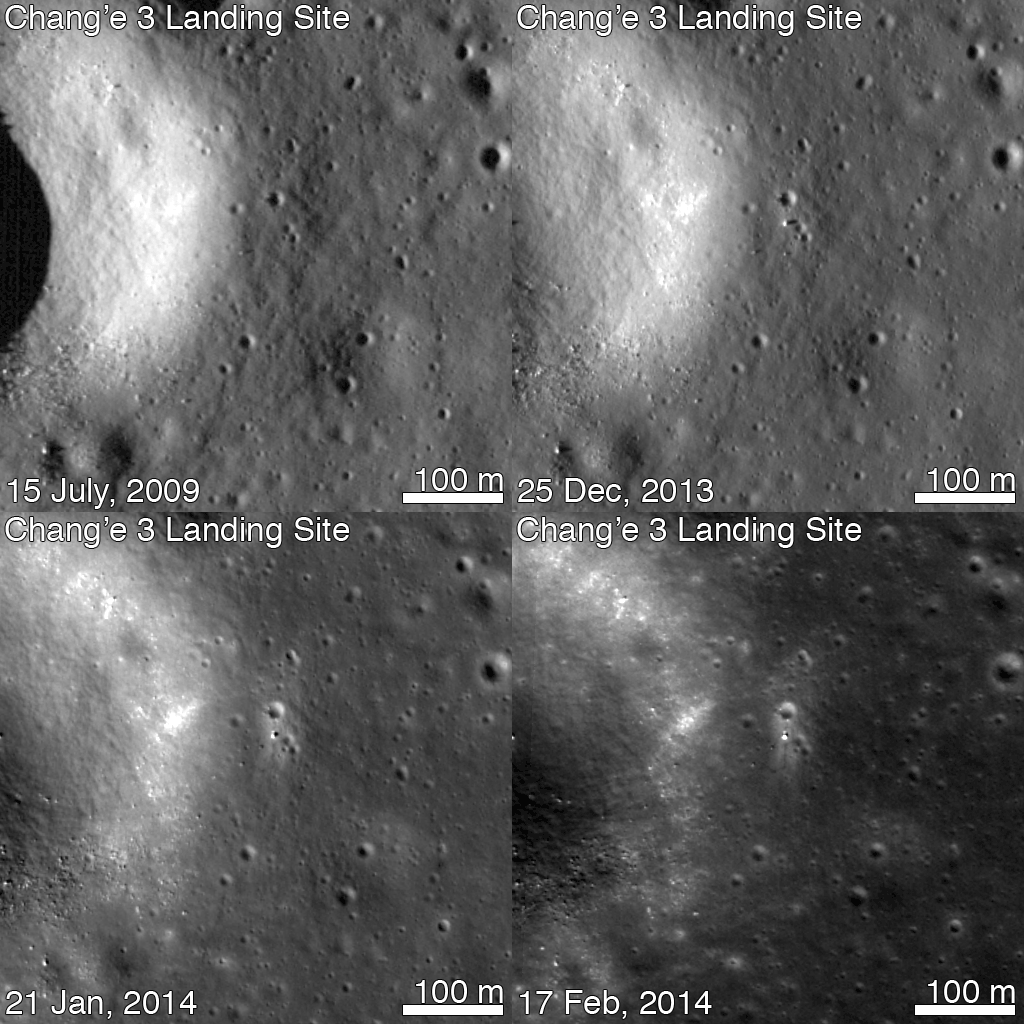
Four views Chang'e 3 landing site
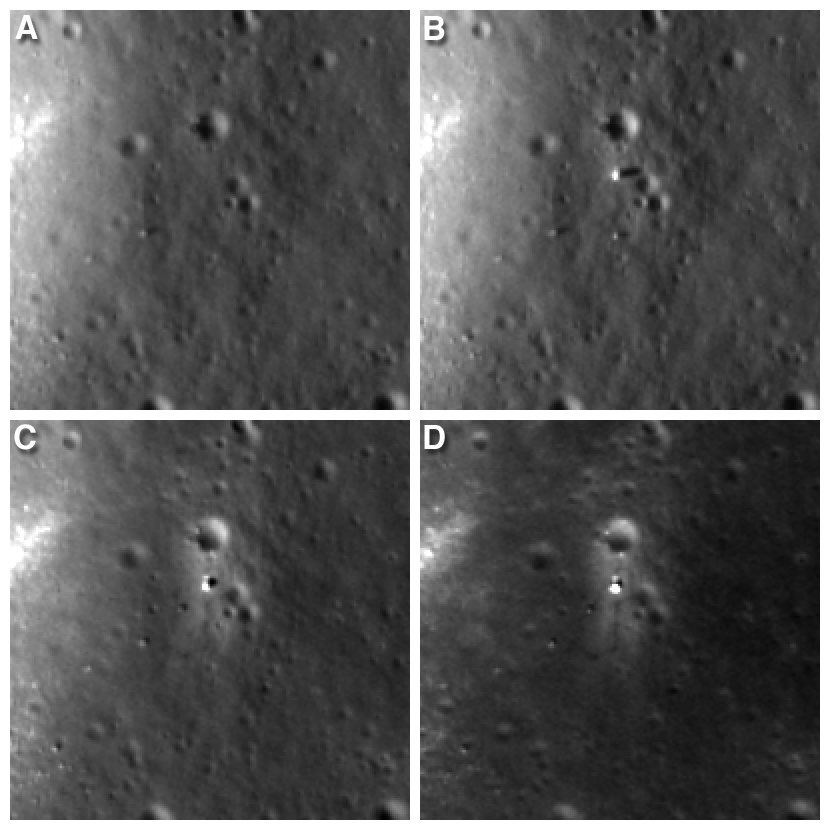
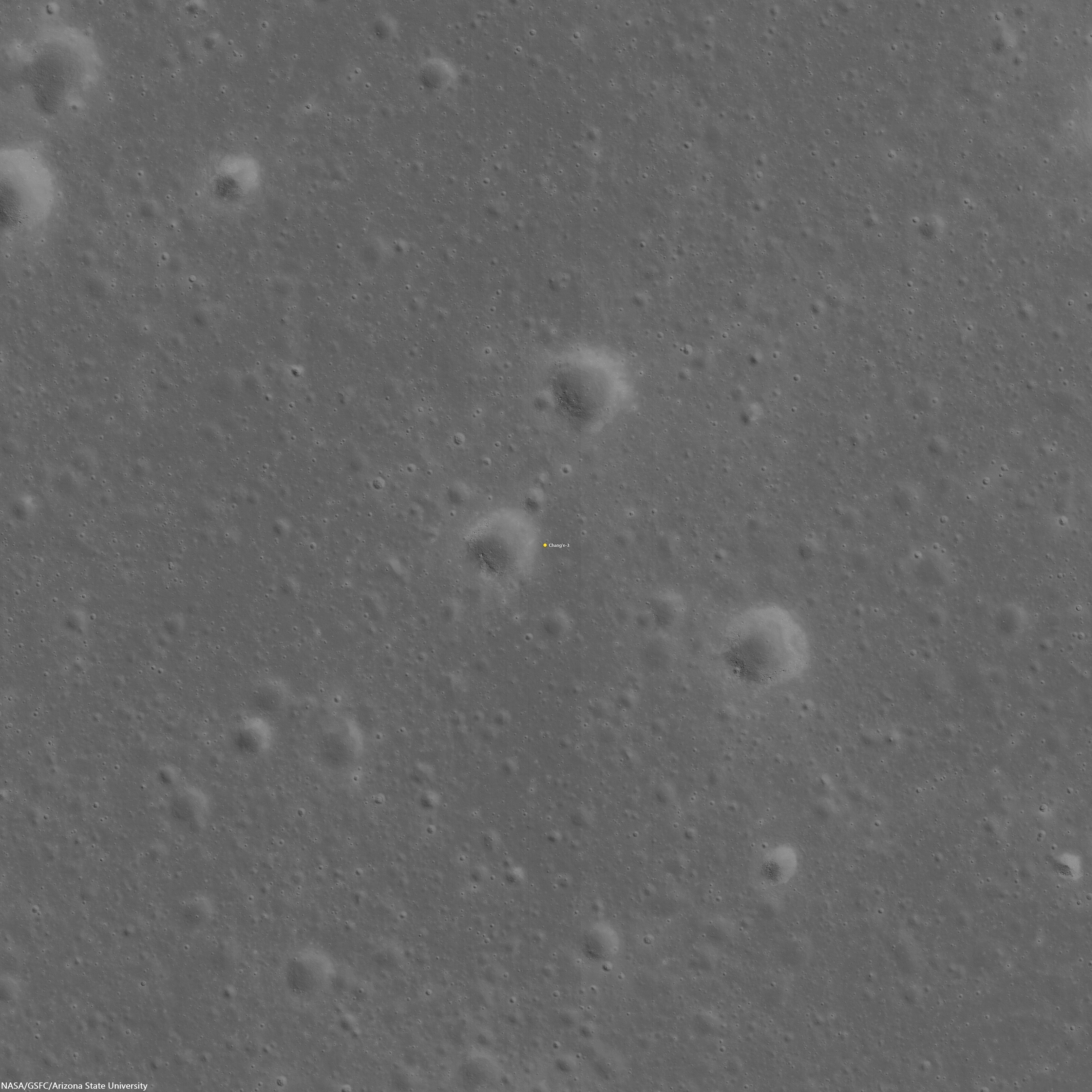
Four recent LROC Narrow Angle Camera (NAC) views of the Chang'e 3 landing site: A) before landing, June 30, 2013; B) after landing, December 25, 2013; C) January 21, 2014; D) February 17, 2014. Each image is enlarged by a factor of two, each field of view is 200 meters across. Follow Yutu's path clockwise around the lander in panel D [NASA/GSFC/Arizona State University].
Mark Robinson
Principal Investigator
Lunar Reconnaissance Orbiter Camera (LROC)
Arizona State University

Chang'e 3 landed on Mare Imbrium (Sea of Rains) on 14 December 2013. LROC has now imaged the lander and rover three times: 25 December 2013 (M1142582775R), 21 January 2014 (M1144936321L), and 17 February 2014 (M1147290066R). From month-to-month the solar incidence angle decreased steadily from 77° to 45° (incidence angle at sunset is 90°); due to the latitude of the site (44.1214°N, 340.4884°E, -2630 meters elevation) the incidence angle cannot get much smaller. Solar incidence angle is a measure of the Sun above the horizon; at noon on the equator the Sun is overhead and the incidence angle is 0°, at dawn or dusk the incidence angle is 90°.

Four views of the Chang'e 3 landing site from before the landing until Feb 2014 [NASA/GSFC/Arizona State University].
As the Sun gets higher above the horizon, topography appears subdued and reflectance differences become more apparent. In the case of the Chang'e 3 site, with the Sun higher in the sky one can now see Yutu's tracks (February image). In the opening image you can see Yutu about 30 meters south of the lander, then it moved to the northwest and parked 17 meters southwest of the lander. In the February image it is apparent that Yutu did not move appreciably from the January location.

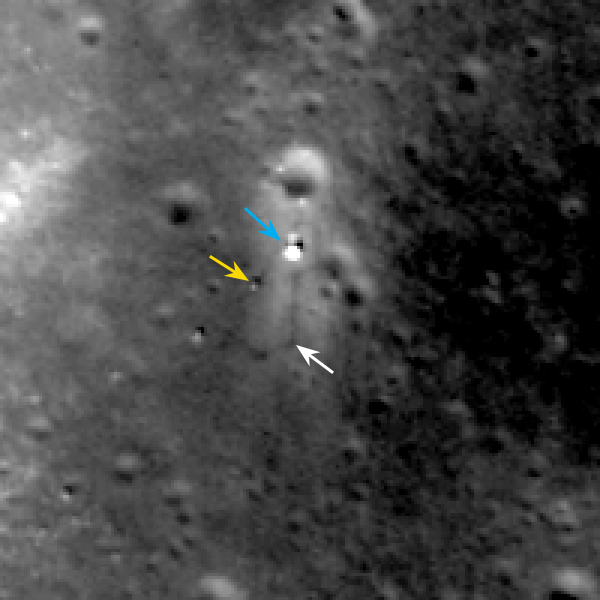
LROC February Chang'e 3 Site Image
LROC February 2014 image of Chang'e 3 site. Blue arrow indicates Chang'e 3 lander, yellow arrow points to Yutu (rover), and white arrow marks the December location of Yutu. Yutu's tracks can be followed clockwise around the lander to its current location. Image enlarged 2x, width 200 meters [NASA/GSFC/Arizona State University].
Owing to the lower solar incidence angle the latest NAC image better shows Yutu's tracks and the lander engine blast zone (high reflectance) that runs north-to-south relative to the lander. Next month the solar incidence angle will again increase and subtle landforms will begin to dominate the landscape.

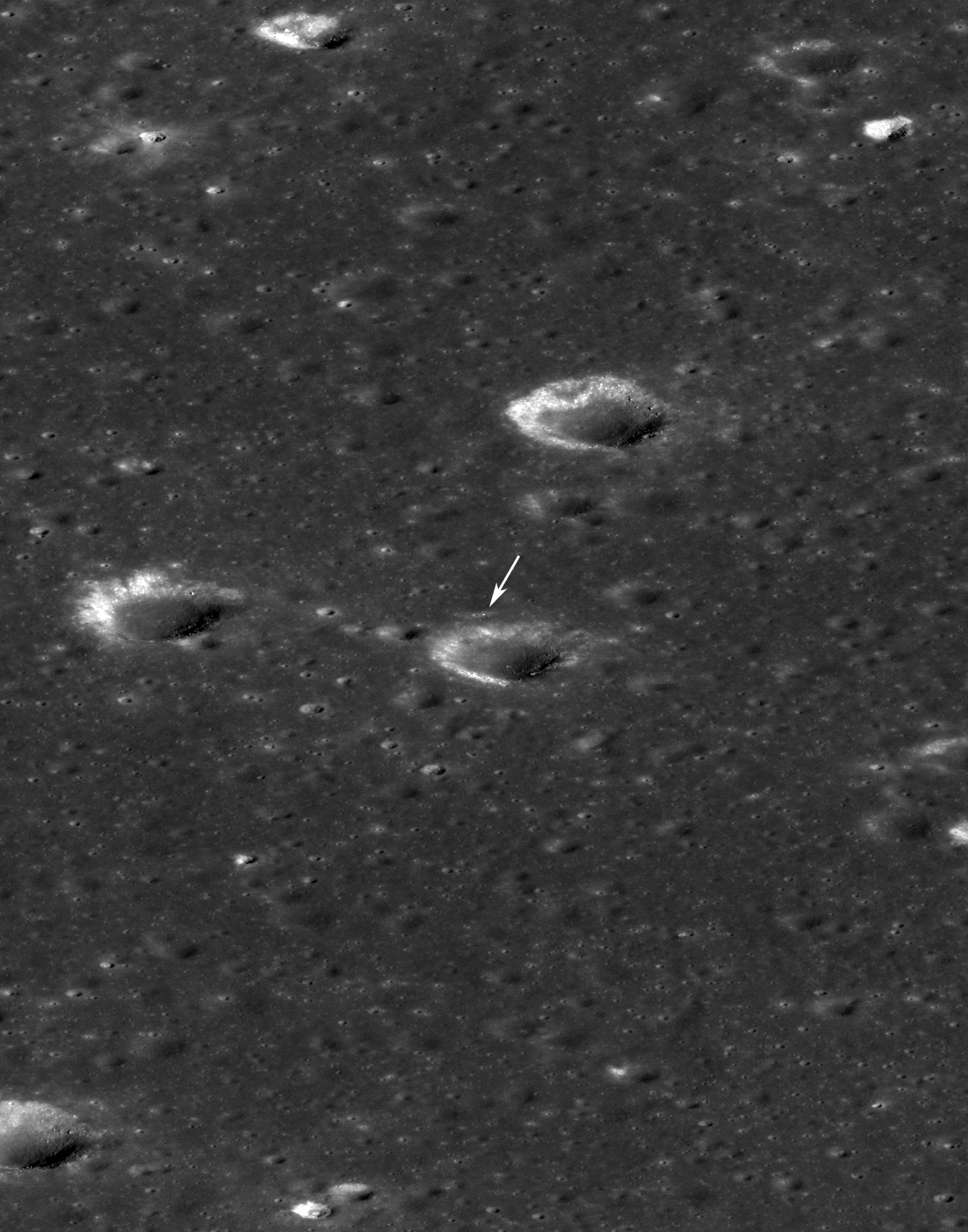
LROC NAC Oblique Chang'e 3
LRO slewed 54° to the East on February 16 to allow LROC to snap a dramatic oblique view of the Chang'e 3 site (arrow).  Crater in front of lander is 450 m diameter, image width 2900 meters at the center M1145007448LR [NASA/GSFC/Arizona State University].

Some Related Posts and LROC Featured Images:
Geologic Characteristics: Chang'e-3 exploration region
ESA on Yutu, as controllers wait for Feb. 9 sunrise
Chang'e 3 Lander and Rover From Above
Safe on the Surface of the Moon
Recent Impact
Coordinates of Robotic Spacecraft

Wednesday, February 26, 2014

You too, Yutu?

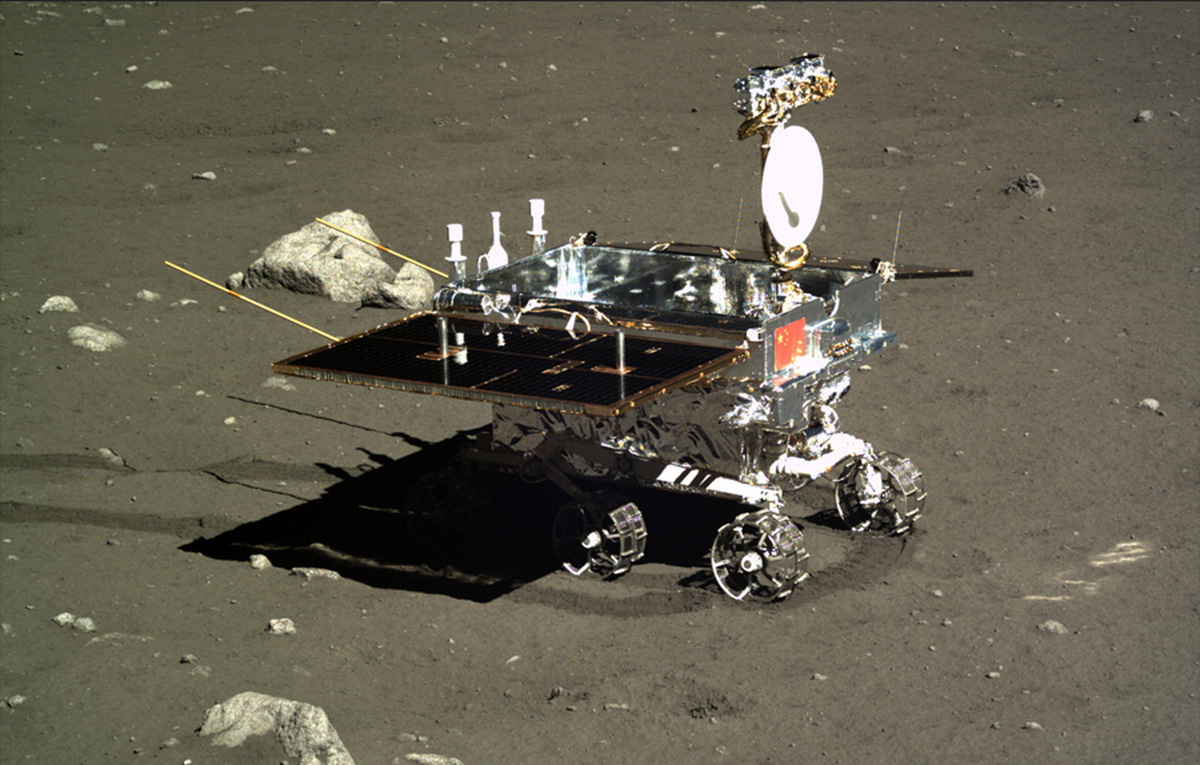
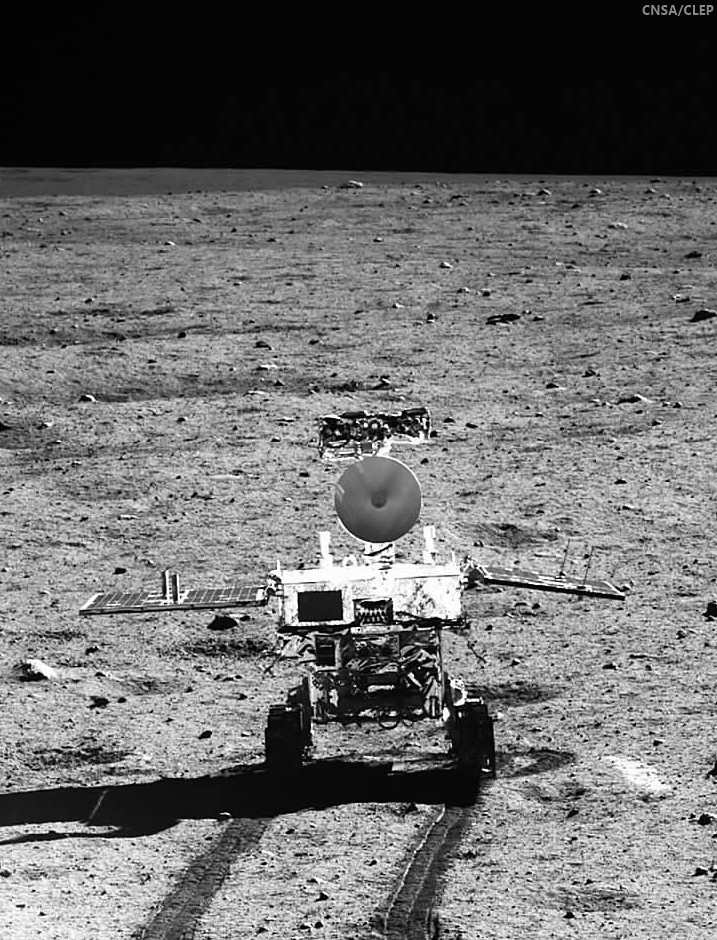
Jade Rabbit, "Yutu," the first lunar rover since Lunokhod-2 explored Le Monnier crater for the first half of 1973, in profile, as seen from the Chang'e-3 Panoramic Camera soon after deployment and its first tantalizingly brief trip across a few square meters of Mare Imbrium. The twin dipole antenna extending behind the vehicle are its ground-penetrating array [CAS/CNSA/CLEP].
Paul Spudis
The Once and Future Moon
Smithsonian Air & Space

Another lunar day has come and gone on the barren plains of Mare Imbrium.  How fares its most famous terrestrial inhabitant, the Chang’E 3 spacecraft and Jade Rabbit, the little Yutu rover?  The fact is, we really don’t know and those that presumably do aren’t talking about it much.

The Yutu rover of the Chang’E 3 mission has experienced some “mechanic control abnormality due to the complicated lunar surface,” is how the Chinese phrased the situation.  Details on the nature of the problem are impossible to come by, but one clear result is that the Yutu cannot move.  It apparently spent the last lunar day (which lasted from about 10 February until last weekend) sitting in one place.  For some scientific investigations, that is not necessarily a problem, but for Yutu’s primary scientific mission, it is fatal.

The goal of placing a rover on the Moon is to explore and examine multiple sites distant from each other.  Additionally, the traverse between stations enables unique experiments, such as profiling the surface – the principal objective of the ground-penetrating radar on China’s rover.  As the vehicle moves across the lunar surface, it emits radio waves of varying frequency into the surface.

Reflections from subsurface layers or boundaries are then received by the rover’s antenna, thereby allowing scientists to infer subsurface structure.  To get a subsurface profile, these measurements must be taken while the rover is moving.  Thus, an immobile rover makes this experiment impossible.

The rover’s other instruments operate during a stationary period.  However, once a chemical measurement has been made or an image taken, there is little value in continually repeating it.

If the Yutu rover is immobile, its scientific mission is effectively over.

News reports have stopped giving us data and information from the Chang’E 3 lander (which has a camera and an ultraviolet telescope) but assuming it is still operating, it may continue making observations.  The lander spacecraft made a panorama of the landing site, so that objective was completed.  Presumably, if the UV telescope is still operating, it can continue observing the sky but these observations are not significant to lunar science.

Three LROC NAC views of the Chang'e-3 landing site in north Mare Imbrium (44.1214°N, 340.4884°E, -2630 m elev.), before landing, after deploying the Yutu rover (south of the lander) and after Yutu was moved just to the southeast of the lander, where it apparently failed (and remains) reportedly following a ground-operations error during preparations ahead a long lunar night [NASA/GSFC/Arizona State University].
Thus, from the perspective of lunar science, it appears that the Chang’E 3’s Moon mission is over.

So, how did Yutu do as a lunar explorer?  For now, we really don’t know.  Aside from a few color images and a chemical spectra that was released to the press, little scientific data has been revealed (a Google translate version of a Chinese web page describing the Chang’E 3 science to date can be read HERE).  The data we have seen mostly show that the instruments were functioning.  We do not know how many measurements were made, what they have told us, or the geological setting of the chemical analyses.

The Chang’E 3 lander set down very near the rim of a crater 450 meters in diameter, a feature whose walls are littered with angular blocks clearly derived from the local bedrock. The fact that the Yutu did not make an immediate beeline over to those blocks for a detailed examination and chemical analysis tells me one of two things: either those planning the rover’s exploration traverse are not geologists or they didn’t get to it before the rover stopped working.

Yutu has led a famous existence in cyberspace, with numerous “tweets” to the world.  A public eager to anthropomorphize machines has responded in kind, including offering several admonitions to the rover to “pay attention to his wake-up calls.”  All this rhetorical cuteness hides the fact that China has been less than forthcoming about this mission, as they are about all of their space missions.  We hear only what they want us to hear.  Successes (of which they have had many) are widely trumpeted with blasts of publicity, while difficulties and failures are buried in silence.  It’s true that a space program run by the military (in the case of China, the People’s Liberation Army) will tend toward such an ethic.  But the WALL·E-like image promoted by China early in the mission is not the image conveyed by their current posture with the world press.

I find the Chinese attitude both interesting and dismaying.  It is similar to one that I experienced with Indian Space Research Organization (ISRO) during the Chandrayaan-1 lunar orbiter mission.  When the Chandrayaan spacecraft was running into difficulties after a few months in lunar orbit, the organizational instinct was to deny any problems and be less than forthcoming with the press about the status of the spacecraft.

Spaceflight is inherently difficult and things break all the time.  It is beyond ridiculous to cover up a problem by pretending that it doesn’t exist.  Similar behavior patterns characterized the early Soviet space program, in which we never heard about mission failures, but successes were given widespread publicity.  It seems that to date, China is adhering to that model.

There has been much in the media about the non-welcoming posture of some towards engagement and possible cooperation with China in space – admonishing Congress and NASA to be open to cooperating with China on future space missions.  There may come a time when this is possible but for now, it seems that reality is far away.

Dr. Paul D. Spudis is a senior staff scientist at the Lunar and Planetary Institute in Houston. This column was originally published by Smithsonian Air & Space, and his website can be found at www.spudislunarresources.com. The opinions he expressed here are his own, and these are better informed than most.

Related Posts:
It's not bragging if you do it (December 9, 2013)
China's Long March to the Moon (January 14, 2012)

Wednesday, February 12, 2014

Jade Rabbit awakes

Yutu lives
Profile of Yutu, the first lunar rover since 1976, from the Chang'e-3 Panoramic Camera, from an image sequence released January 17. Click on image or here for larger view [CNSA/CLEP/CAS].
Never officially confirmed (or denied), reports that China's solar-powered lunar rover Yutu (Jade Rabbit) did not survive a second 14 day-long, bitterly cold lunar night have proven to have been premature. Late Wednesday, Beijing time, as the Sun rose higher over the Mare Imbrium landing site, the rover was almost fully revived.

"Our rabbit is awake," reported Yong-Chun Zheng of the Chinese Academy of Sciences. "Instruments on the rover stood up to the challenge of the very low temperatures during the lunar night."

Followers in social media communities, both on and off the mainland, were expressing condolences over the loss of the wheeled vehicle. As dawn occurred at the landing site, February 9, while no official announcement as to the rover's fate has been released.

The rover's solar panels apparently did not retract before the beginning of its second night on the Moon in late January. The vehicle was believed to be almost certainly lost from that point, as state media reported. The panels were designed to be integral thermal protection for sensitive control circuitry.

The Chang'e-3 lunar lander, on the other hand, had successfully hibernated through its second night and been revived while the rover it had deployed soon after landing on the Moon in December was unsuccessfully buttoned-up for a second night on the lunar surface.

Scientists had feared the worst for the small rover, and awaited official announcement.Congratulatory messages from throughout the world arrived as news spread that engineers had successfully transmitted and received a signal from Yutu.

"The rover can receive commands from the ground," Zheng wrote, "and we have received data from the rover."

The extent of any long-term damage and whether efforts to properly place the rover into hibernation ahead its third lunar night will be successful are still unclear. Zheng reported, however, ground engineers are optimistic that the rover will return useful science.

"Except some sensitive components, most of the functions of the rover have been recovered, Zheng wrote. "Our experiences will contribute to future lunar missions, both with the lander and rover. Lunar and planetary missions are never easy, always sources of joy mingled with surprise, but we anticipate the brave Jade Rabbit will yet gain new discoveries on the Moon."

Yutu is the first remote-operated lunar rover successfully operated on the Moon since the Soviet Union's Lunokhod-2 in 1976.

The planetary science community throughout the world have hailed the Yutu rover's deployment from the Chang'e-3 lander, quick to point to initial science results and operations following even a single lunar night as reasons to call the still-ongoing Chang'e-3 and Yutu missions successful.

Related:

Friday, January 31, 2014

Geologic characteristics: Chang’E-3 exploration region

From extensive data distilled from remote sensing collected by the DIVINER Lunar Radiometer on-board the Lunar Reconnaissance Orbiter (LRO) since July 2009 has allowed David Page and the DIVINER team to produce extensive maps of the thermal behavior "and a range of derived quantities at the Chang'e-3 landing site, described in a separate report released January 5. Distinct areas can be seen in LROC WAC Surveys, with an overlay mapping rock abundance using thermal dissipation temperatures collected at the coldest periods, before local sunrise. DIVINER detected no minimum temperatures in the area below 94°K [NASA/JPL/UCLA/GSFC/ASU].
Zhao, Huang & Qiao, et.al.
Planetary Science Institute
China University of Geosciences, Wuhan

Science China (March 2014)

ABSTRACT: We present topographic, geomorphologic and compositional characteristics of a 1°×1° (~ 660 square kilometer) region centered near the landing site of Chang’E-3 using the highest spatial resolution data available. We analyze the topography and slope using Digital Terrain Model (DTM) generated from Terrain Camera (TC) images. The exploration region is overall relatively flat and the elevation difference is less than 300 meters, and eighty percent of the area slopes are less than 5°. 

Impact craters in the exploration region are classified into four types based on their degradation states. We investigate the wrinkle ridges visible in the exploration region in detail, using TC and Lunar Reconnaissance Orbiter (LRO) Narrow Angle Camera (NAC) images. We calculate iron oxide and titanium dioxide abundances using Multispectral Imager (MI) data and confirm two basaltic units: the northern part, belonging to Imbrium era low-titanium to very-low titanium mare basalts, and the southern part is Eratosthenian era low titanium to high titanium mare basalts. 

Finally, we produce a geological map and propose the geologic evolution of the exploration region. 

M177x3C_604nm-anot-580x800
The north central Mare Imbrium exploration region and landing site of Chang'e-3.  The geology report dates the northern mare to the Imbrium Age and the southern mare, in the lander's immediate vicinity to the Eratosthenian age, two billion years apart. LROC WAC mosaic swept up in three sequential orbits, December 5, 2011; sunrise angle of incidence 76° at 61.5 meters per pixel resolution, from 44.7 km [NASA/GSFC/Arizona State University].
INTRODUCTION: Nearly 40 years after the completion of the Apollo and Luna missions, the third Chinese lunar mission, Chang’E-3 (CE-3), was launched on December 2, 2013 and safely landed on the surface of the Moon on December 14, 2013.

The rover “Yutu” separated from the lander successfully about 8 hours later. The landing site of CE-3 is 44.12°N, 340.49°E, which is located in the northern part of Mare Imbrium. As the first Chinese lunar soft-lander and rover, the landing site was selected primarily considering engineering constraints, including topography, communication and solar illumination.

In addition, local geologic diversity was also taken into consideration, including impact craters, wrinkle ridges, and basaltic materials of different ages. The CE-3 landing site and its nearby terrains have never been visited by any other missions. Therefore, the exploration will shed light on the geologic characteristics, geochemical diversity and evolution of Mare Imbrium.

Geological maps in Apollo era and recent studies reveal regional geologic information for Sinus Iridum and the adjacent terrains. However, the spatial resolution of previous maps is not sufficient for detailed geologic study or for the rover traverse planning considering both scientific and engineering requirements. Luckily, as unprecedented high spatial resolution remote sensing data being acquired by recent lunar missions (e.g., Chang’E 1 & 2, SELENE-1, Chandrayaan-1 and Lunar Reconnaissance Orbiter: LRO), large scale geological mapping and detailed study were possible for prior study of the Chang'e-3 landing site and its exploration region. 

Read or Download the Full Adobe PDF file HERE.

ESA on Yutu, as controllers wait for sunrise, February 9

Yutu
Song of Yutu. China News reported panorama photographs of the Chang'e-3 lander captured by Yutu and corresponding images of the Jade Rabbit rover from the lander, prior to the end of their second 330 hour-long lunar day, January 25, were the final such complimentary photographs of the mission [CAS/CNSA/CLEP].
Professor Bernard H. Foing
Bernard Foing
Executive Director
International Lunar Exploration Working Group (ILEWG).

ESA SMART-1 Project scientist

The Chang'e3 lander and Yutu rover achieved impressive results in their first lunar day on the surface, where temperatures are over 90°C (194°F) at midday. After their first lunar night, which is extreme, with temperatures dropping to -180°C (-292°F), they spectacularly woke up and resumed operations after January 12.

This was already an achievement considering the very difficult thermal conditions and surface environment on the Moon. Already with our SMART-1 (2003) spacecraft orbiting the Moon we had to solve thermal problems, but it is much more difficult for a rover on the surface.

Unofficial information mentions a mechanical problem during the withdrawal of a solar panel on rover Yutu prior to sleep on January 25 for the second night. This could affect the electronic box and a few instruments on the rover mast.
Operations of the Chang'e-3 lander instruments would not be affected.

1. Is it likely that lunar dust caused a mechanical failure, meaning the rover could not hibernate?  It is not established that dust is the culprit at this stage. The high thermal extremes from day to night (from 90° to –180°C, or 194° to -292°F) can also certainly put a huge stress and fatigue on mechanical systems.

2. What can be done to protect future rovers from lunar dust?  Already measures are being taken by rover designers to avoid dust entering sensitive mechanical gear or depositing on optical surfaces. However lunar dust can be electrostatically charged and can stick on sensitive parts.

3. Is Yutu no longer operational, or could it be fixed?  Our Chang’e 3 and Yutu colleagues can be praised for what they have achieved so far. I am sure that they are not going to give up. They are analyzing, in depth, the problem and are working hard to assess safe recovery strategies.

4. How will this failure restrict the remaining mission?  The lander went nominally to sleep (January 25). The Yutu rover sent an emotional farewell message before hibernating. For the Yutu rover we have to hope and wait for the next lunar morning (around February 9) to assess the situation. Best wishes from all of us to the Yutu lunar Jade Rabbit.

We wish the teams and Change3 Yutu good luck and success for further operations. Lunar exploration is difficult, but these technical challenges bring progress for future lunar and planetary missions and even for applications in space and on Earth.

Related Posts:
Problem with solar-powered Yutu rover before nightfall (January 25, 2014)
Chang'e begins long-term science mission (January 18, 2014)
Preliminary Science Results from Chang'e-3 (January 16, 2014)
Chang'e-3 and Yutu survive first lunar night (January 14, 2014)
Chang'e-3 APXS delivers its first surface analysis (January 1, 2014)
Chang'e-3 lander and Yutu rover from LRO (December 31, 2013)
6 of 8 Chang'e-3 science instruments now active (December 18, 2013)
LRO: Finding Chang'e-3 (December 15, 2013)
China's Jade Rabbit, it's time in the Sun (December 15, 2013)
Chang'e-3 Landing Site in Mare Imbrium (December 15, 2013)
Jade Rabbit successfully deployed to the lunar surface (December 14, 2013)
It's not bragging if you do it (December 9, 2013)
"Lunar Aspirations" - Beijing Review (December 9, 2013)
Chang'e-3 safely inserted into lunar orbit (December 6, 2013)
CCTV: Chang'e-3, launch past TLO to Earthview (December 2, 2013)
Chang'e-3 launched from Xichang (December 1, 2013)
Chang'e-3 launch window opens 1 December 1730 UT (November 29, 2013)
Helping China to the Moon, ESA (November 29, 2013)
'Government Penalty' removed from Google Lunar XPRIZE terms (November 7, 2013)
Chang'e-3 and LADEE: The Role of Serendipity (October 31, 2013)
Outstanding animation celebrates China's Chang'e-3 (October 29, 2013)
LROC updates image tally of human artifacts on the Moon (September 25, 2013)
Chang'e-3: China's rover mission (May 4, 2013)
China's grand plan for lunar exploration (October 11, 2012)
ILOA to study deep space from Chang'e-3 (September 11, 2012)
China's Long March to the Moon (January 14, 2012)
China plans lunar research base (May 11, 2011)
PRC continues methodical program (March 8, 2011)
Chang'e-2 arrives in mission orbit (October 9, 2010)
Dispatch from Chang'e-2: Sinus Iridum (October 4, 2010)
Chang'e-2 takes direct approach (October 1, 2010)
Chang'e-2 sets stage for future lunar missions (September 3, 2010)
Chang'e-1 research reported published (July 22, 2010)
Chandrayaan-1 goes silent (August 29, 2009)

Saturday, January 25, 2014

Problem with solar-powered Yutu rover before nightfall

CCTV Yutu rover on the Moon
China's Yutu, "Jade Rabbit," lunar rover, the first such vehicle operated on the Moon since 1976 [CCTV].
Official sources in Beijing report China's lunar rover Yutu “experienced a mechanical abnormality" and "scientists are organizing repairs."

The problem occurred “due to the complicated lunar surface environment," just before local sunset at the Chang’e-3 landing site on Saturday, January 25, Xinhua reported, citing a report from SASTIND, China’s State Administration of Science Technology and Industry for National Defense.

No further details were available from official sources early Sunday, Beijing time (UT +8 hours).

Unofficial sources, however, say the rover's solar panels may have failed to retract when ground controllers were preparing Yutu for hibernation ahead of local sunset on Saturday, and the start of a second 330 hour-long lunar night since successful deployment from the Chang’e-3 lander, December 14.

Whether the anomaly permanently disables the rover may be undetermined. Both the Chang’e-3 lander and Yutu depend on solar power, so communicated efforts to resolve the issue may have had to be suspended before nightfall to conserve a base of power to sustain the small robot through the long night ahead.

Retracted solar panels also may be critical to protecting the rover’s components over the two weeks of cold and darkness before the next local sunrise on February 9. The Mare Imbrium landing site’s latitude, with its higher angles of incidence sunlight than available at the equator, might require the lander and rover both experience a shorter period of peak charging, a shorter time when the Sun is higher in the sky, than strictly the time between dawn and dusk.

Meanwhile, with no problems of its own reported, the stationary Chang'e-3 lander, Xinhua reported, successfully began its own second 14 day-long period of required dormancy period on Friday.

After their first hibernation periods ended two weeks ago the optical telescope carried out observations using an extreme ultraviolet (UV) camera, observing Earth’s plasma-sphere, which is among other successful operations reported among “Preliminary Science Results” released by the Chinese Academy of Sciences a week ago.

UHF communications between the lander and Yutu were also successfully tested.

The Chang'e-3 mission makes China only the third nation to soft-land a spacecraft on the Moon, the first since Luna 24 in 1976, and whatever the outcome of its present challenges, Yutu is only the third remote- operated rover deployed on the Moon since Lunokhod 2 in 1973, which also used solar power but was kept warm through four lunar nights using heat generated by a radioisotope decay heater.

Some Related Posts:
Chang'e begins long-term science mission (January 18, 2014)
Preliminary Science Results from Chang'e-3 (January 16, 2014)
Chang'e-3 and Yutu survive first lunar night (January 14, 2014)
Chang'e-3 APXS delivers its first surface analysis (January 1, 2014)
Chang'e-3 lander and Yutu rover from LRO (December 31, 2013)

Saturday, January 18, 2014

Chang'e 3 begins long-term science mission

Chang'e-3 (CH-3 PCam)
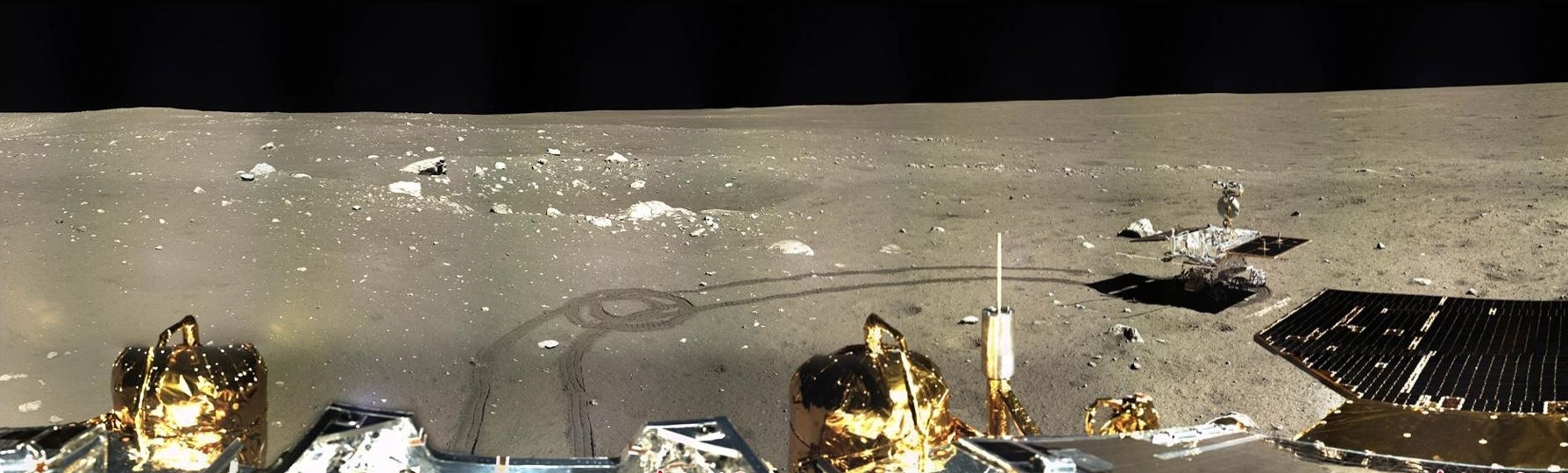
Chang'e-3 lunar lander Panoramic Camera image, from a sequence released January 17. (Click on image for a wider mosaic) [Chinanews.com].
[From China Daily - January 17 (UT)] The Chang'e-3 lunar lander and rover "Yutu" have begun their long-term science mission, and will have their durability tested as it continues a survey of its landing site in northwest Mare Imbrium, sources with the Beijing Aerospace Control Center said Thursday.

The center transferred operations of the probe to a smaller management team Wednesday night, said Cui Yan, who leads the team. "We have made all the hardware and software ready for the long-term control tasks and have developed new management methods," Cui said.

Liu Junqi, one of the chief engineers on Cui's team, said during the yearlong mission the team will coordinate deep-space control stations around the nation and closely monitor the Chang'e-3 lander and Yutu to arrange scientific missions on the lunar surface.

One of major responsibility for the team is to put the lander and rover into sleep mode as the long lunar night descends and re-awaken the vehicles and their science instruments after local sunrise, Liu said. Night on the moon lasts two weeks, and the surface temperatures quickly fall below -180° C, and there is no sunlight to provide power from solar panels.

Part of a 360° panorama from the Chang'e-3 lunar lander, released with Preliminary Science Results from the Chinese Academy of Sciences, January 16 [CNSA/CLEP/CAS].

"The transfer of control marks the successful completion of the probe's first stage of exploration and scientific missions," said a publicity officer at BACC, who refused to be named. He said, under the long-term management mode, the lander and rover don't need a lot of people to take care of them. Cui's team, which has less than 20 people, is able to take over from the current large control group.

"Next, the team will control the probe to perform scientific operations that can last several months. Engineers will test whether the lander and rover can function well over a long period and whether they can live up to their designed life span," the officer added. "During the yearlong period, the team's controllers and engineers will work about 15 consecutive night shifts each month, so this is really a tough job."

Yutu, the "Jade Rabbit" lunar rover, has a designed lifespan of three months, and the lander is expected to work for one year.

After waking up following nearly two weeks of dormancy, Yutu completed its first sampling of lunar soil using its mechanical arm Tuesday, January 14, the Beijing center said. "Accuracy control of the mechanical arm at a distance of 380,000 kilometers has been realized, marking China's breakthrough in controlling a mechanical arm with high precision on the lunar surface," said Wu Fenglei from the center.

Yutu will continue to survey the moon's geological structure and surface substances and look for natural resources, while the lander will explore the landing site until the end of its life span.

Related:
Preliminary Science Results from Chang'e-3 (January 16, 2014)

Wednesday, January 1, 2014

Chang'e-3 APXS delivers its first surface analysis

Chang'e-3 Active X-ray Spectrometer (APXS)
Active Particle-induced X-ray Spectrometer (APXS) components on the Chang'e-3 "Yutu" lunar rover [Xinhua/CNSA/CLEP/IHEP/CAS].
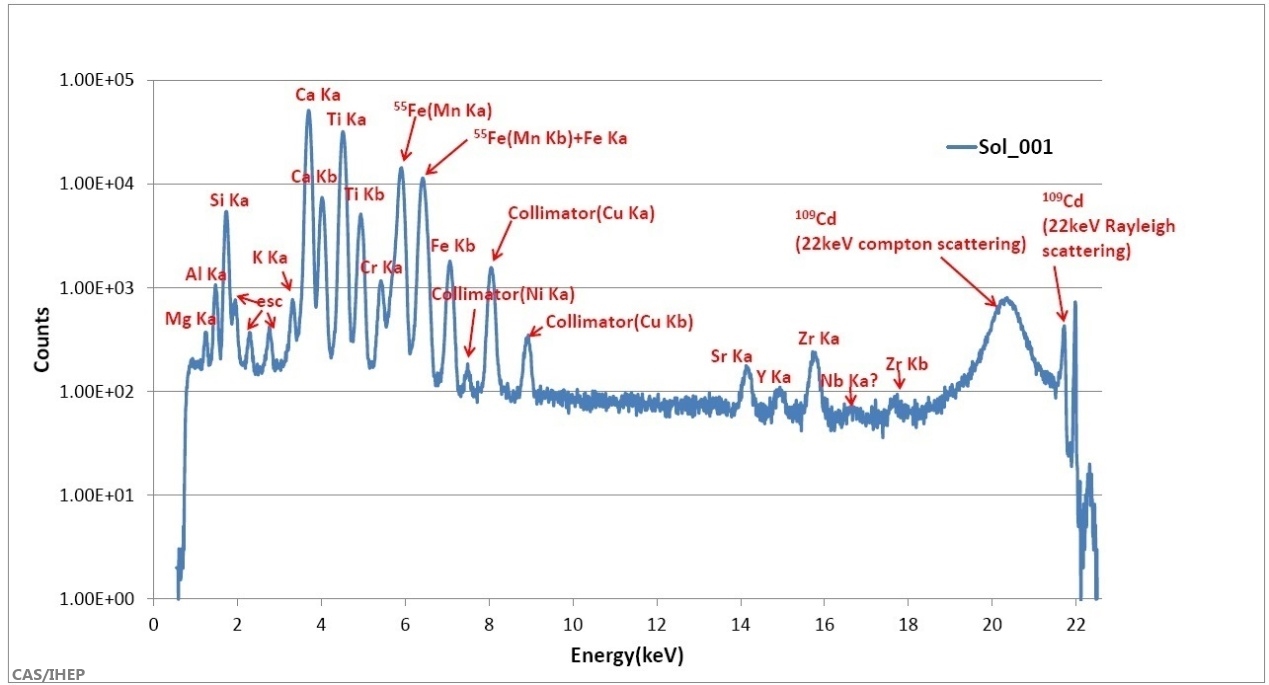
The Active Particle-induced X-ray Spectrometer (APXS), on the Yutu rover delivered to the lunar surface by the Chang’e-3 lunar lander, on December 25 sent back its first X-ray fluorescence spectrum of the lunar regolith around the landing site in northwest Mare Imbrium.

The announcement was made by the Institute of High Energy Physics (IHEP) of the Chinese Academy of Sciences (CAS), December 30.

Initial analysis indicates a marked presence of eight major rock-forming elements: magnesium, aluminum, silicon, potassium, calcium, titanium, chromium and iron (Mg, Al, Si, K, Ca, Ti, Cr and Fe) and at least three minor elements, strontium, yttrium and zirconium (Sr, Y and Zr) identified in this spectrum. 

Chang'e-1 (Yutu) APXS - Sol 1
First X-ray florescent spectrum of the lunar surface at the Chang'e-3 Mare Imbrium landing site (click to enlarge) [IHEP/CAS].
The energy resolution of APXS is estimated at roughly 135 at 5.9keV (thousand electron volts), demonstrating the small instrument is among the best X-ray spectrometers yet deployed in direct planetary exploration.

APXS was initially powered up on December 23, and in-flight calibration, establishing a baseline by analyzing a common basalt rock sample of known composition mounted on the rover, was completed over five minutes, preparing a stable performance on the lunar surface. After two terrestrial days APXS was successfully deployed to within two to three centimeters over the regolith of Mare Imbrium on the robotic arm of Yutu and began its designed operation. 

Complimenting its X-ray spectrometry, the APXS instrument measured returned X-ray count rate at various distances.

Yutu APXS components
APXS components (sensor head, radioactive heat unit (RHU) and inflight baseline calibration target [IHEP/CAS].
China's Institute of High Energy Physics (IHEP) developed APXS in collaboration with the China Academy of Science Purple Mountain Observatory (PMO). Before the on-going Chang'e-3 mission two X-ray Spectrometers developed by IHEP, flown on Chang’e-1 (2007) and Chang’e-2 (2010).

Tuesday, December 31, 2013

Chang'e-3 lander and Yutu rover from LRO

LROC view of Chang'e 3
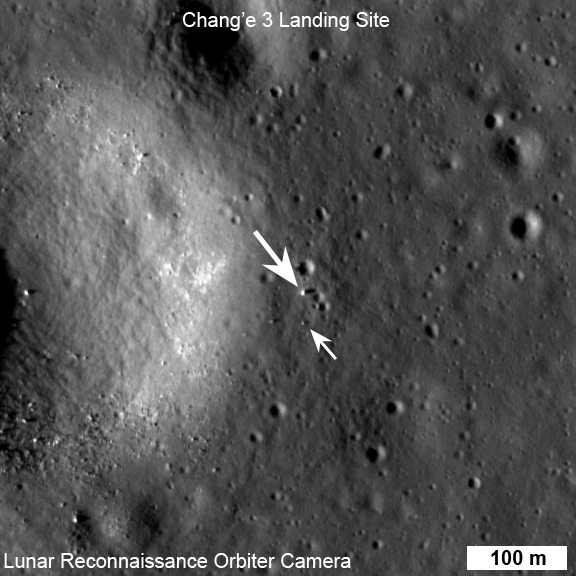
LROC Narrow Angle Camera (NAC) view of the Chang'e 3 lander and Yutu (Jade Rabbit) rover just before local sunset on their first lunar day of exploring Mare Imbrium. LROC NAC M1142582775R, image field of view 576 meters [NASA/GSFC/Arizona State University].
Mark Robinson
Principal Investigator
Lunar Reconnaissance Orbiter Camera
Arizona State University

Chang'e 3 landed on Mare Imbrium (Sea of Rains) just east of a 450 m diameter impact crater on 14 December 2013. Soon after landing, a small rover named Yutu (Jade Rabbit) was deployed and took its first tentative drive onto the airless regolith. At the time of the landing LRO's orbit was far from the landing site so images of the landing were not possible. Ten days later on 24 December, LRO approached the landing site, and LROC was able to acquire a series of six LROC Narrow Angle Camera (NAC) image pairs during the next 36 hours (19 orbits).

YuTu Rover (58762-717x940)
Yutu in a monochrome still captured from the Chang'e-3 lander, already slumbering in preparation for the bristling cold 14 day lunar night [CNSA/CLEP].
The highest resolution image was possible when LRO was nearly overhead on 25 December 03:52:49 UT. At this time LRO was at an altitude of ~150 km above the site, and the pixel size was 150 cm.

LROC NAC before and after images of the Chang'e 3 landing site [NASA/GSFC/Arizona State University].
The rover is only about 150 cm wide, yet it shows up in the NAC images for two reasons: the solar panels are very effective at reflecting light so the rover shows up as two bright pixels, and the Sun is setting thus the rover casts a distinct shadow (as does the lander). Since the rover is close to the size of a pixel, how can we be sure we are seeing the rover and not a comparably sized boulder? Fortuitously, the NAC acquired a "before" image (M1127248516R) of the landing site, with nearly identical lighting, on 30 June 2013. By comparing the before and after landing site images, the LROC team confirmed the position of the lander and rover, and derived accurate map coordinates for the lander (44.1214°N, 340.4884°E, -2640 meters elevation).

Panorama to LROC Narrow Angle CameraNAC
Chang'e 3 lander panorama [Images from CNSA; compiled by Di Lorenzo and Kremer] showing Yutu shortly after it drove down the ramp to the surface. Yellow lines connect craters seen in the panorama and the LROC image (taken at a later date after the rover had moved), red lines indicate approximate field of view of the panorama.
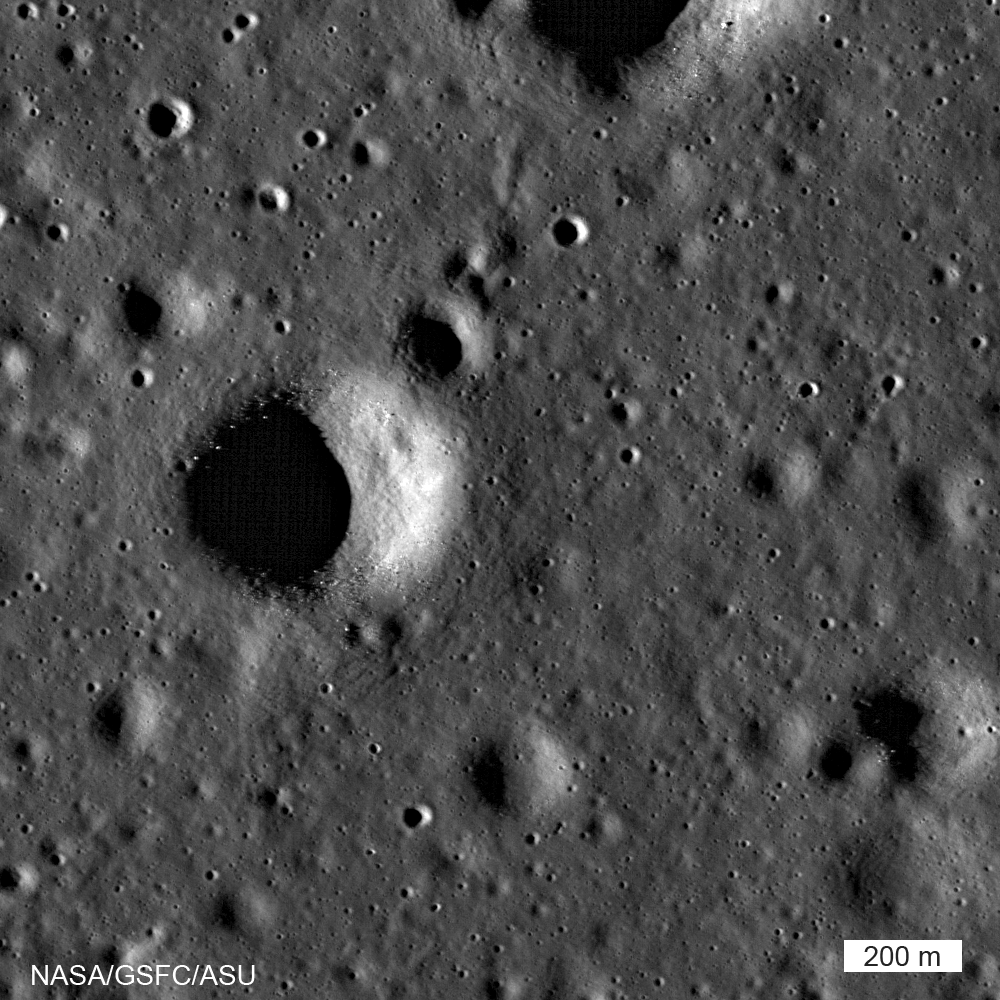
The lander set down about 60 meters east of the rim of a 450 meter diameter impact crater (40 meters deep) on a thick deposit of volcanic materials. A large scale wrinkle ridge (~100 km long, 10 km wide) cuts across the area and was formed as tectonic stress caused the volcanic layers to buckle and break along faults. Wrinkle ridges are common on the Moon, Mercury and Mars.

change3_wac_morph_and_noslew_1000
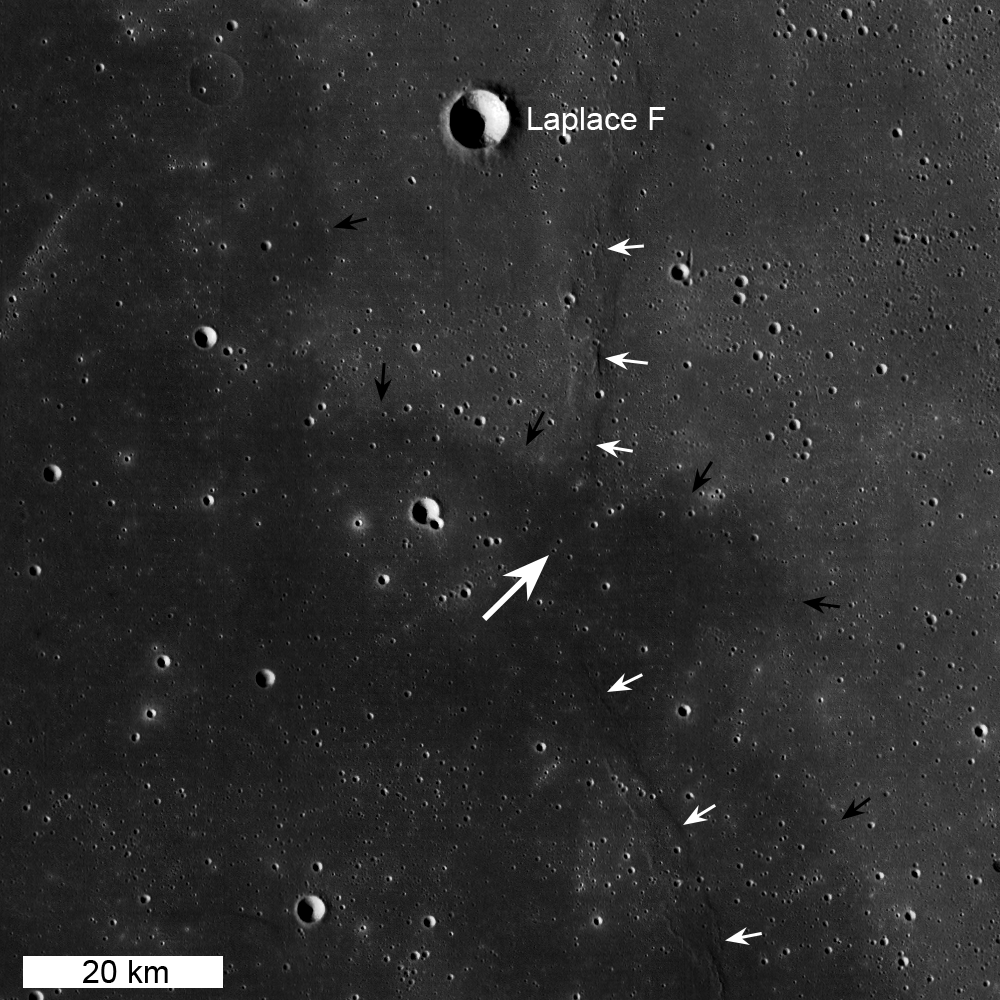
LROC WAC context mosaic for the Chang'e 3 landing site (large white arrow); small white arrows indicate wrinkle ridge and small black arrows delimit boundary between "red" mare (northeast) and "blue" mare (southwest), image is 100 km wide [NASA/GSFC/Arizona State University].
M177x3C_604nm-anot-58x128-1337x2950
Another LROC Wide Angle Camera mosaic, captured at high incidence, show the extent of the wrinkle ridge in northwest Mare Imbrium. Area swept up during three sequential orbital passes in 2011. See the full-size mosaic HERE [NASA/GSFC/Arizona State University]/
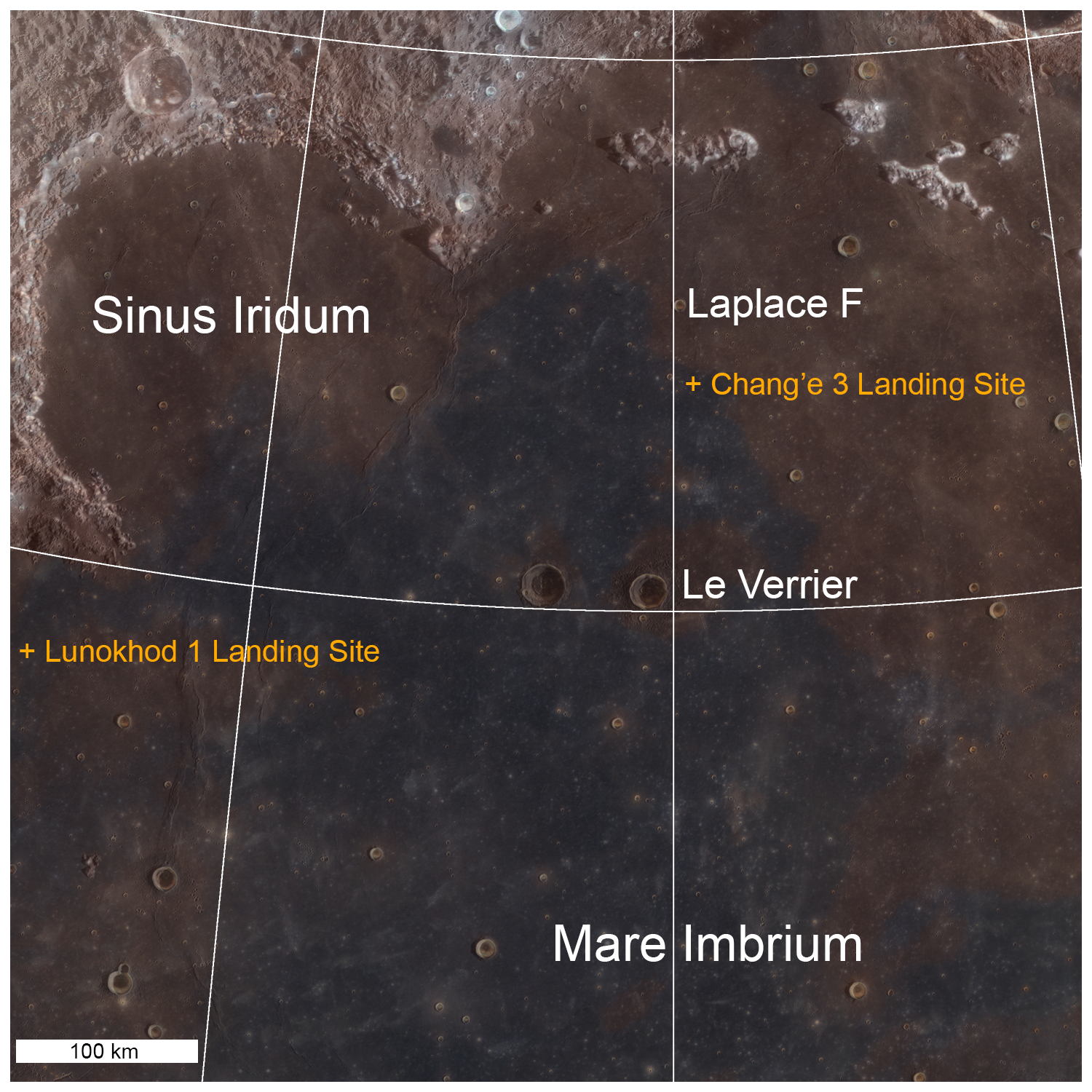
Lunar mare basalts are divided into two main spectral (color) types: "red" and "blue" (blue is perhaps a misnomer, think "less red"). Basalts on the Moon (same on Earth) are composed mainly of two minerals, pyroxene and plagioclase, though olivine and ilmenite can sometimes occur in significant amounts. The presence of ilmenite (FeTiO3) results in lower reflectance and a "less-red" color - thus the blue basalts. The landing site is on a blue mare (higher titanium) thought to be about 3.0 billion years old. The boundary (black arrows in above WAC mosaic) with an older (3.5 billion years) red mare is only 10 km to the north.

WAC Color Chang'e 3
LROC WAC color (689 nm, 415 nm, 321 nm) overlain on WAC sunset black and white image. Note the proximity of the landing site to a contact between red and blue maria [NASA/GSFC/Arizona State University].
A large area LROC WAC topography map of the Imbrium basin and surrounds is available HERE.

Related LROC Featured Images:
Safe on the Surface of the Moon!
A Great Place to Rove!
LROC Coordinates of Robotic Spacecraft - 2013 Update

Chang'e 3: NAC before and after images
LROC NAC observations before and after, animated above [NASA/GSFC/Arizona State University].

Wednesday, December 18, 2013

6 of 8 Chang'e-3 science instruments now active

Students learn about the ongoing Chang'e-3 mission at a primary school in Ganyu, Jiangsu province, on Tuesday. Designers are pleased with the mission's success so far, as experiments have gone more smoothly than expected [Si Wei/China Daily].
Emily Lakdawalla of The Planetary Society has performed a herculean labor, today, pulling together many threads to deliver what might be the best possible description of a "lengthy press briefing by several members of the Chang'e 3 science team," Wednesday.

"I found it to be quite informative," Emily wrote, "not just about the mission but also about attitudes about Chinese space exploration and foreign cooperation. It was useful background for my participation in an hour-long panel discussion on China Radio International's "Today" program."

A link to her detailed summary follows the official China Daily description, below:

Wang Fan
China Daily

Six out of the eight pieces of scientific equipment deployed to the moon with the Chang'e-3 lunar mission have been activated by scientists and are functioning properly, according to scientists working on the mission.

Speaking at a news conference on Tuesday, scientists said that the equipment aboard the Yutu lunar rover and the Chang'e-3 lander had so far been functioning as hoped, despite the unexpectedly rigorous conditions of the lunar environment.

"Except for the alpha particle X-ray spectrometer and the visible and near-infrared imaging spectrometer, the instruments have all been activated and are undergoing tests and adjustments," said Su Yan, deputy designer of the Chang'e-3 ground applications system.

Zhang He, deputy designer of the probe, said though the temperature disparity is greater than scientists had anticipated, all the equipment on the moon is in "perfect" condition, and optical and ultraviolet-imaging experiments are under way.

Scientists with the ground applications system are expecting to receive a colossal quantity of original data from the rover and lander, which have independent channels to send signals, Su said. The earlier Chang'e-1 and Chang'e-2 craft only had one channel each, he said.

The mission's success so far has been a relief to Wu Weiren, chief designer of China's lunar probe program. He said the whole process, including the launch, the soft landing, the separation of the rover and lander and the ongoing experiments, have gone "much smoother" than he had expected.

Read the full article at China Daily, HERE.

Big HT: to Emily Lakdawalla at The Planetary Society, for her well-translated transcription of Wednesday's press conference posted HERE.

Sunday, December 15, 2013

LRO: Finding Chang'e-3

landing_clean_M102285549La1-1000
In more than four years in lunar orbit, the LRO LROC Narrow Angle Camera (NAC) system has released to the Planetary Data System (PDS) ony a few observations that include the Chang'e-3 landing site. From the earliest of these, acquired July 15, 2009, in only orbit 250 comes this sample of LROC NAC observation M102285549, centered on the area seen in descent images acquired by Chang'e-3 while closing in on the surface of Mare Imbrium. The field of view is 1700 meters, resolution 1.66 meters per pixel, late afternoon angle of incidence 80.85° from 168.17 km [NASA/GSFC/Arizona State University].
Mark Robinson
Principal Investigator
Lunar Reconnaissance Orbiter Camera (LROC)
Arizona State University

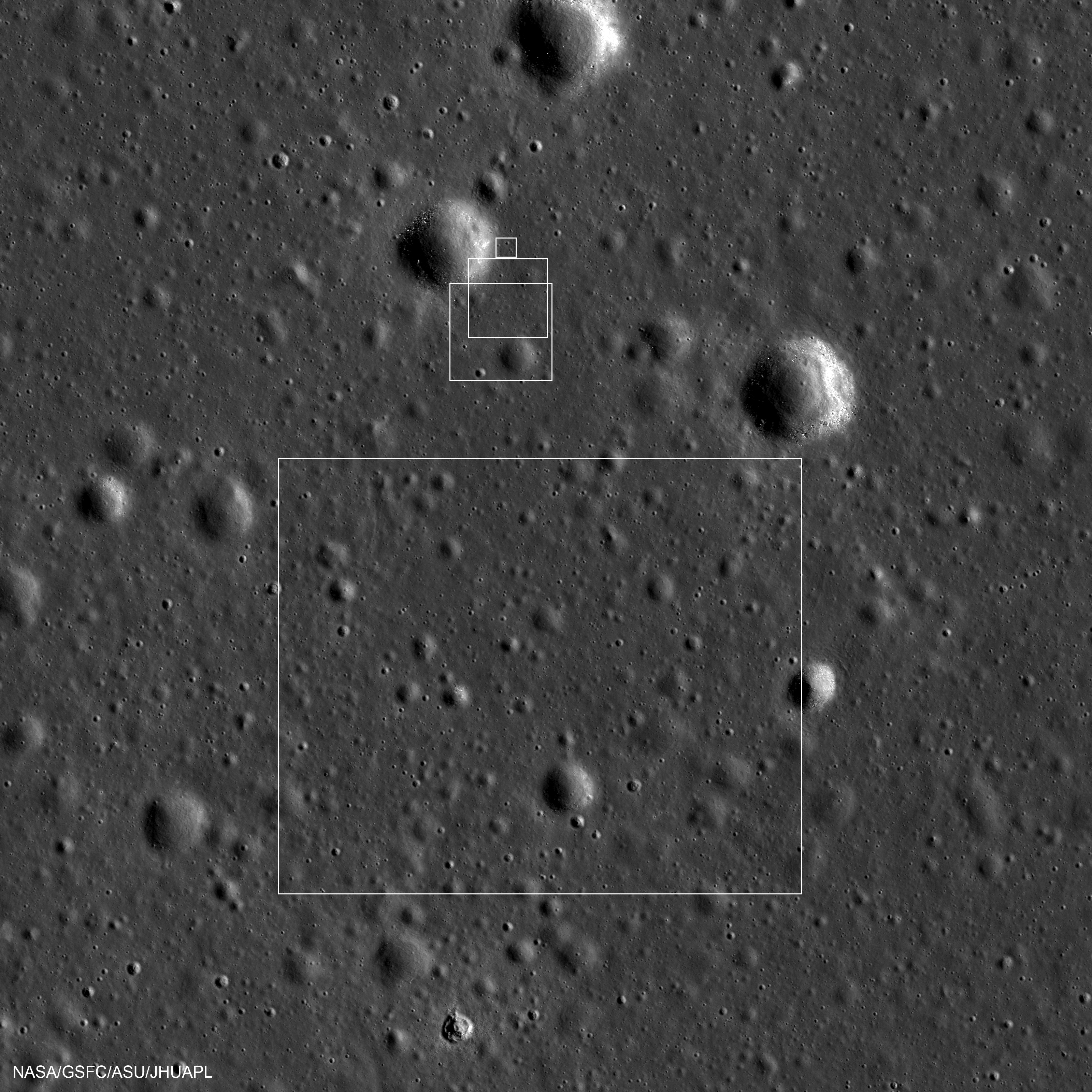
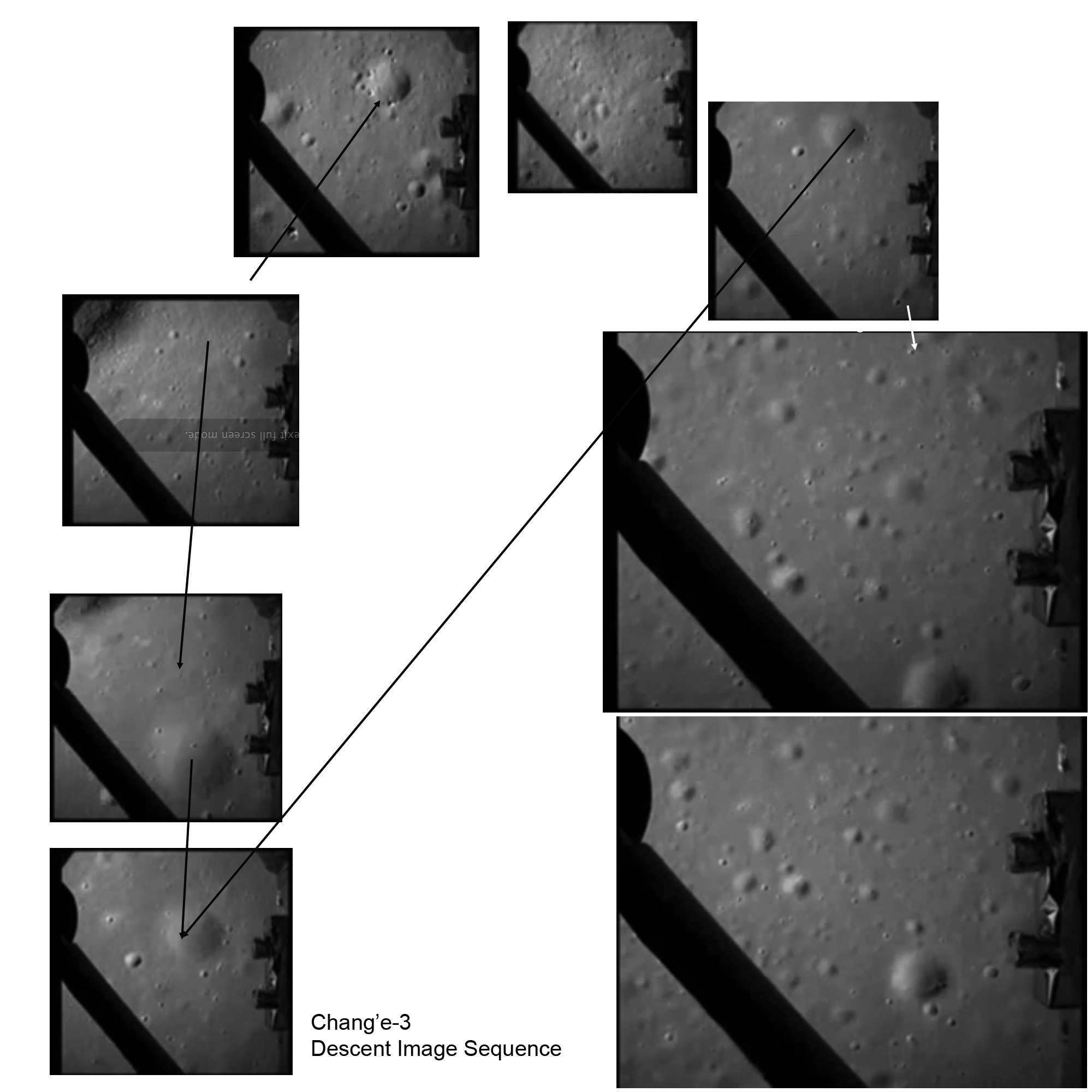
Chang'e-3 successfully landed on the Moon on 14 December 2013. The touchdown occurred on the far eastern edge of the commonly reported landing zone (44.12°N, 340.49°E), in the northwestern portion of Mare Imbrium. By correlating features seen in the nested series of Chang'e-3 descent images it appears the spacecraft landed just to the east of a 450 meter diameter crater.

descent_lroc1-3200
Boxes indicate areas in Chang'e-3 descent images. The spacecraft is probably in, or very near, the smallest box. Field of view 4700 meters wide, from LROC NAC M181302794L orbit 11832, January 15, 2012; angle of incidence 71.7° at 1.57 meters resolution, from 158.79 km [NASA/GSFC/ASU/JHUAPL].
The exact landing site will be known when the Chang'e-3 flight team has time to correlate features seen in surface images with orbital images, and tracking data are refined.

sequence
Chang'e-3 descent images used to locate landing site in LROC NAC images [CNSA/CLEP].
LRO will next be above western Mare Imbrium on 24 and 25 December, and LROC will image the Chang'e-3 landing site.

Meanwhile, why not evisit previous LROC posts of other hardware still on the Moon, and check out the LROC Featured Sites, HERE.

China's Jade Rabbit, it's time in the Sun

Yutu on Imbrium
China's "Yutu," the "Jade Rabbit," rolls out onto Mare Imbrium, Sunday, December 14, 2013. Still from master video display in Beijing [CN].
Mike Killian
AmericaSpace.com

Today, exactly 41 years after the last human footprint was made on the moon by Gene Cernan, China became the third nation to touch the lunar surface – joining an exclusive club and earning a round of applause from around the world.

The last lunar landing was performed by the Soviet Union on the Luna 24 sample return mission in 1976, and the United States remains the only country to have ever landed humans on the lunar surface (last human mission to the Moon was NASA’s Apollo 17 in December 1972). 

The mission, named Chang’e 3 after the Chinese goddess of the Moon in ancient myth, is China’s third unmanned lunar mission, but it’s also the first landing – the next step in China’s ambitious Lunar Exploration Program.  Chang’e 1 launched in 2007, and Chang’e 2 launched in 2010. Both missions orbited the Moon and carried out various studies, while also mapping the surface in its entirety, and both missions paved the way for Change’3 to land on the surface.

Chang'e-3 landing site
Another LROC NAC observation of the landing site of China's Chang'e-3 lunar lander and Yutu rover, this opportunity around half a meter per pixel superior in resolution than one noted earlier. The vehicles have separated following the successful landing, December 14, 2013 - the 41st anniversary of the last moonwalk of the Apollo program in 1972. 638 meter-wide field of view from LROC Narrow Angle Camera (NAC) observation M1116664800R, orbit 16786, February 28, 2013; angle of incidence 44.83, resolution 1.1 meter per pixel from 145.32 km over 44.61°N, 340.3°E [NASA/GSFC/Arizona State University].
The mission began two weeks ago today with a picture-perfect liftoff from the country’s Xichang Satellite Launch Center in southwest China.  Chang’e 3 soared skyward into the black of night atop a powerful Long March-3B rocket, and minutes later the Chang’e 3 lunar lander and its six-wheeled rover, named Yutu, or “Jade Rabbit,” separated from the rocket’s third stage while coasting into a beautiful sunrise 300 kilometers over the Pacific Ocean.  From there it was a five-day trip to reach lunar orbit, and a week later for Chang’e 3 to begin its descent.

Read the full article, HERE.

Chang'e-3 Landing Site
A 2318 meter-wide, full-resolution field of view from the same LROC NAC observation, M1116664800R [NASA/GSFC/Arizona State University].

Chang'e-3 Landing Site in Mare Imbrium

Chang'e-3 Landing Site
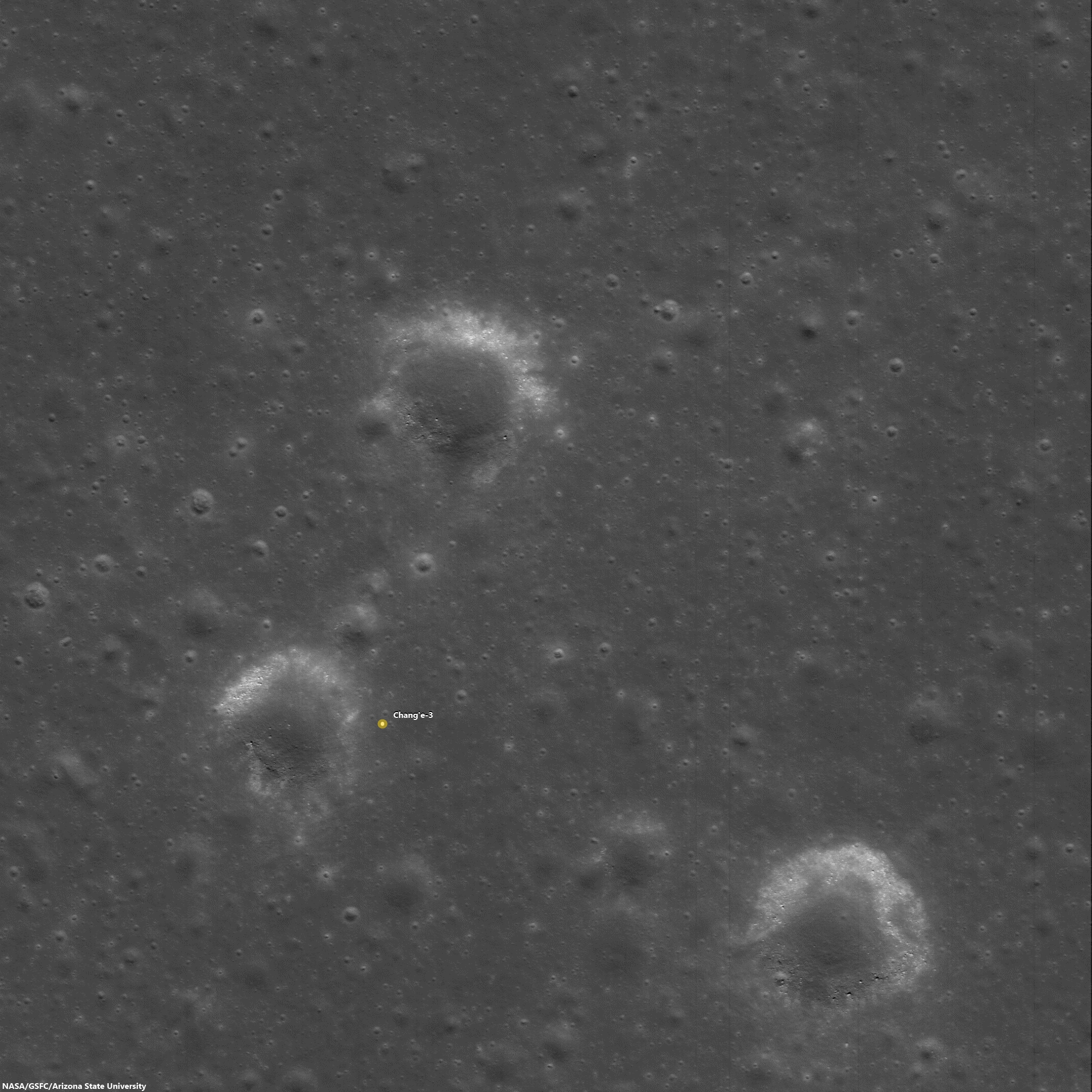
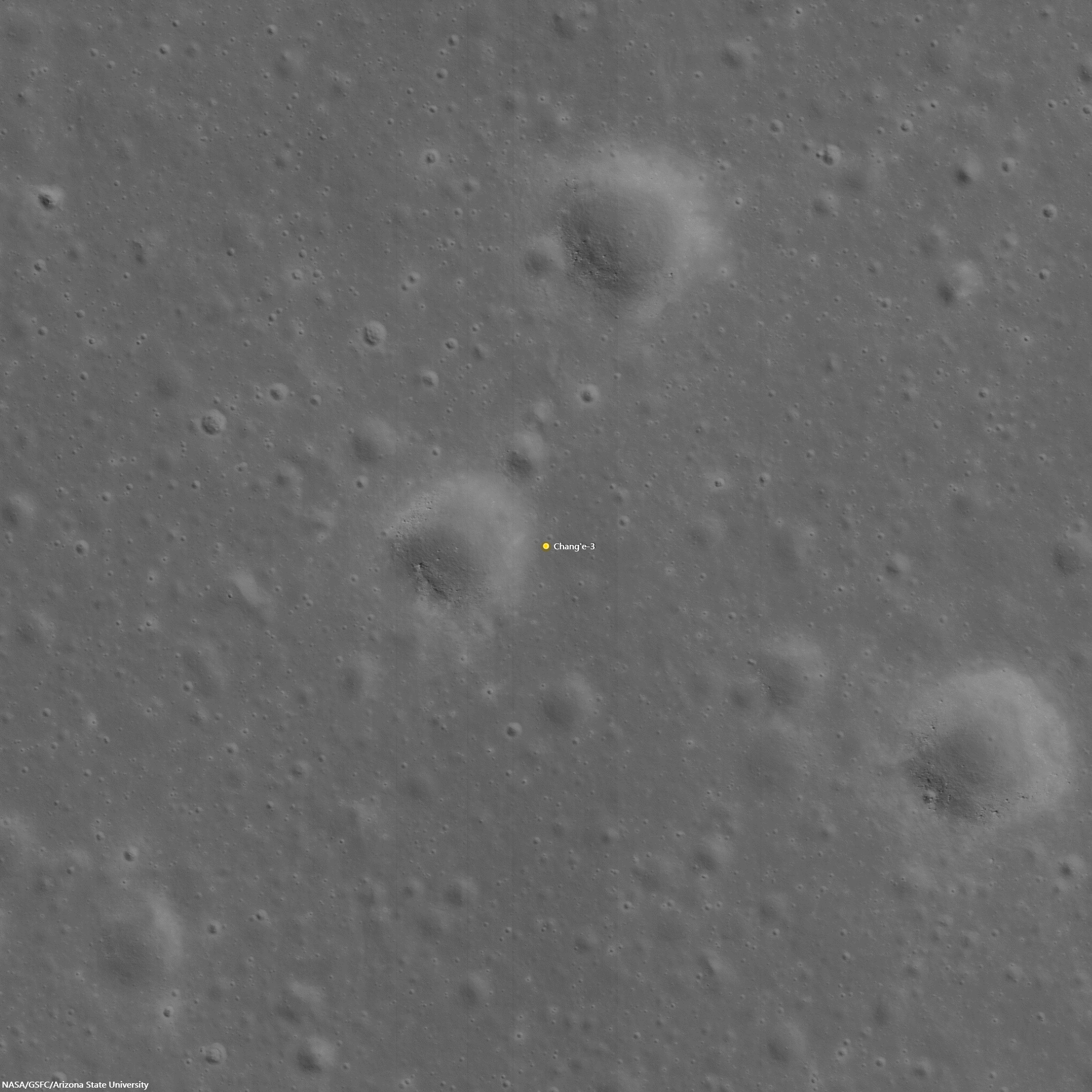
Landing Site of the Chang'e-3 lunar lander located and marked at the center of a full (1.58 meters per pixel) resolution, 916 meter-wide field of view of the surface of Mare Imbrium. The preliminary official landing site was 44.12°N, 19.51°W, though the location marked was matched with sequential still video returned to Earth by Chang'e-3 during its landing sequence. LROC NAC mosaic M183661683RL, orbit 12162, February 12, 2012; angle of incidence 54.12° from 159.26 kilometers [NASA/GSFC/Arizona State University].
Chang'e-3 Landing Site matched with LROC NAC imagery
3.16 km-wide field of view (2000 x 2000 px.), HERE.
Chang'e-3 Landing Site matched with LROC NAC imagery
6.32 km-wide field of view (4000 x 4000 px.), HERE.

See a second LROC NAC observation of the Chang'e-3 landing site, of slightly better resolution, HERE.

Saturday, December 14, 2013

Jade Rabbit successfully deployed to lunar surface


BEIJING, Dec. 15 (Xinhua) -- China's first moon rover, Yutu, or Jade Rabbit, separated from the lander early on Sunday, several hours after the Chang'e-3 probe soft-landed on the lunar surface.

The six-wheeled rover touched the lunar surface at 4:35 a.m., leaving deep trace on the loose lunar soil. The process was recorded by the camera on the lander and the images were sent to the earth.

The transfer mechanism with Yutu aboard unlocked at 4:06 a.m. with one side reaching the moon's surface, allowing the rover to descend to the surface following a ladder mechanism.

After the separation, the rover and lander will take photos of each other and start their own scientific explorations.

Chang'e-3 landed on the moon's Sinus Iridum, or the Bay of Rainbows, at 9:11 p.m. Saturday, making China the third country in the world to carry out such a rover mission after the United States and former Soviet Union.

In ancient Chinese mythology, Yutu was the white pet rabbit of the lunar goddess Chang'e. The name for the rover was selected following an online poll that collected several million votes from people around the world. 

Monday, December 9, 2013

It's not bragging if you do it

Chang'e-3 Lander dispatched to the Moon
Climbing high over the central Pacific, a forward camera on the Long March 3B third stage captured the deployment of Chang'e-3 on its 112 hour "Journey to the Moon." Launched after midnight in China, the modified Long March 3B completes its part of the mission minutes later over the International Dateline; confronting sunrise of the previous day. Chang'e-3 and Yutu, its "Jade Rabbit" lunar rover, speed on to intercept a New Moon, into the glare of the Sun [CCTV].
Dwayne Day
The Space Review

Later this week, if all goes according to plan, China will land a robotic spacecraft and rover on the Moon, something that nobody has done in nearly four decades. If the Chinese do what they did for the launch, they will broadcast much of the event live on television and over the Internet. Last week’s launch coverage on government-controlled English language CCTV was remarkable for its openness. Indeed, the coverage was indistinguishable from Western news coverage of a major space event. There was no propagandizing or nationalistic chest-thumping, just a straightforward reporting with lots of information about the mission and what was happening. The event, and its coverage, highlighted the fact that China has an attractive, technically sophisticated scientific space program that could serve international relations purposes. It was a demonstration of what American political scientist Joseph Nye has referred to as “soft power,” the ability to compel or attract nations to do what you want. China’s space program gives them this ability to attract partners. The problem is that some of China’s other activities undercut their attractiveness as a potential partner.

Last Sunday’s CCTV coverage of the Chang’e-3 launch was quite sophisticated. The network had correspondents at the launch site and at the control center. They had a commentator in the studio asking rudimentary questions of an expert during the launch sequence. The questions and the expert’s answers were intended for a general, non-space-savvy audience. They also had animations of the lander and rover, and segments focusing on the development of the spacecraft, including interviews with engineers who had built individual parts. For instance, one young engineer had worked on small electric motors for the spacecraft. He acknowledged that there was nothing very sophisticated or exciting about the motors, but that they were vital to mission success.

Read the full article, HERE.

"Lunar Aspirations" - Beijing Review

Yutu Rover model at Market Show
Saleswoman in Dongguan, Guangdong Province, displays a model of China's lunar rover, Yutu, on December 4, 2013 [Wu Lu/Beijing Review].
Yuan Yuan
Beijing Review.com.cn

After 10 years of space exploration efforts, China has finally launched its first mission to land a spacecraft on the surface of an extraterrestrial body.

On December 2, China's third lunar probe, Chang'e-3, was launched into space on an enhanced Long March 3B rocket at the Xichang Satellite Launch Center in southwestern Sichuan Province. Chang'e-3 is expected to soft land on the moon in mid-December, making it the first mission to do so since the former Soviet Union's Luna 24 mission in 1976.

Chang'e-3 comprises a lander and a six-wheeled lunar rover equipped with four cameras and two mechanical legs that allow it to dig up soil samples. The rover, named Yutu, meaning Jade Rabbit, will survey the moon's geological structure and surface substances during its three-month lifespan, while looking for natural resources. According to Chinese folklore, the goddess Chang'e lives on the moon with only a white rabbit for companion.

"If successful, the Chang'e-3 mission will give China the ability to explore the surface of an extraterrestrial body," said Sun Huixian, deputy engineer in chief of the second phase of China's lunar program.

Landing
Milestone mission: Chang'e-3 is expected to be soft-landed on the Moon late this week.


"This will be a breakthrough for China in conducting observation and survey of the moon's surface," said Wu Weiren, chief designer of China's lunar program. "More than 80 percent of technologies and products used during the mission are newly developed."

After entering lunar orbit, Chang'e-3 will go through six stages of deceleration to descend from 15 km above to the lunar surface, Xinhua News Agency reported on November 29.

The soft landing processes used by U.S. and Soviet unmanned spacecraft in the 1970s were unable to hover or avoid obstacles. Chang'e-3 can accurately survey its landing site and identify the safest spots on which to land, according to Sun.

In order to land quickly, the probe is equipped with high-precision, fast-response sensors that analyze its motion and surroundings. The variable thrust engine designed and made domestically by Chinese scientists and used for Chang'e-3 can generate up to 7,500 newtons of thrust.

During the Chang'-3 mission, a telescope will be set up on the moon, for the first time in human history, to observe the inner region of the Earth's magnetosphere—the area where the planet's magnetic field is still strong enough to affect charged particles in space. The lunar rover will also survey the moon surface using radar.

Chang'e-3 is part of the second phase of China's lunar program, which includes orbiting, landing and returning to Earth.

In phase three, China's unmanned probe will return to Earth with lunar soil and rock samples. The timetable for this phase has not been specified, but earlier reports suggested that it could be concluded as early as 2020.

In June 2011, the Chinese Academy of Sciences released a development roadmap for the country's scientific sector. It estimated that China will be able to accomplish a manned mission to the moon and set up a lunar base around 2030, with the base to be able to launch manned spacecraft from approximately 2050.

Read the full article at the Beijing Review, HERE.