Showing posts with label Chang'e-2. Show all posts

Thursday, September 4, 2014

Secondary scatter over Haret C and the SPA interior

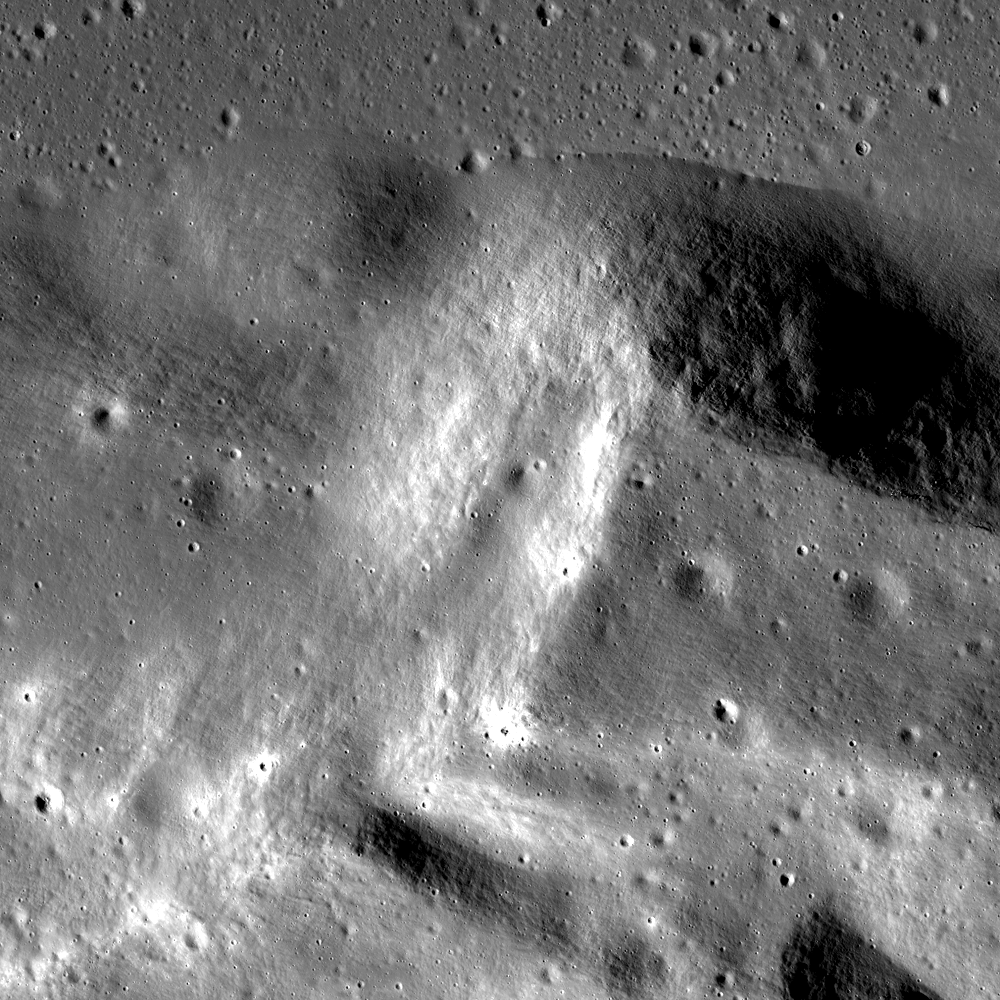
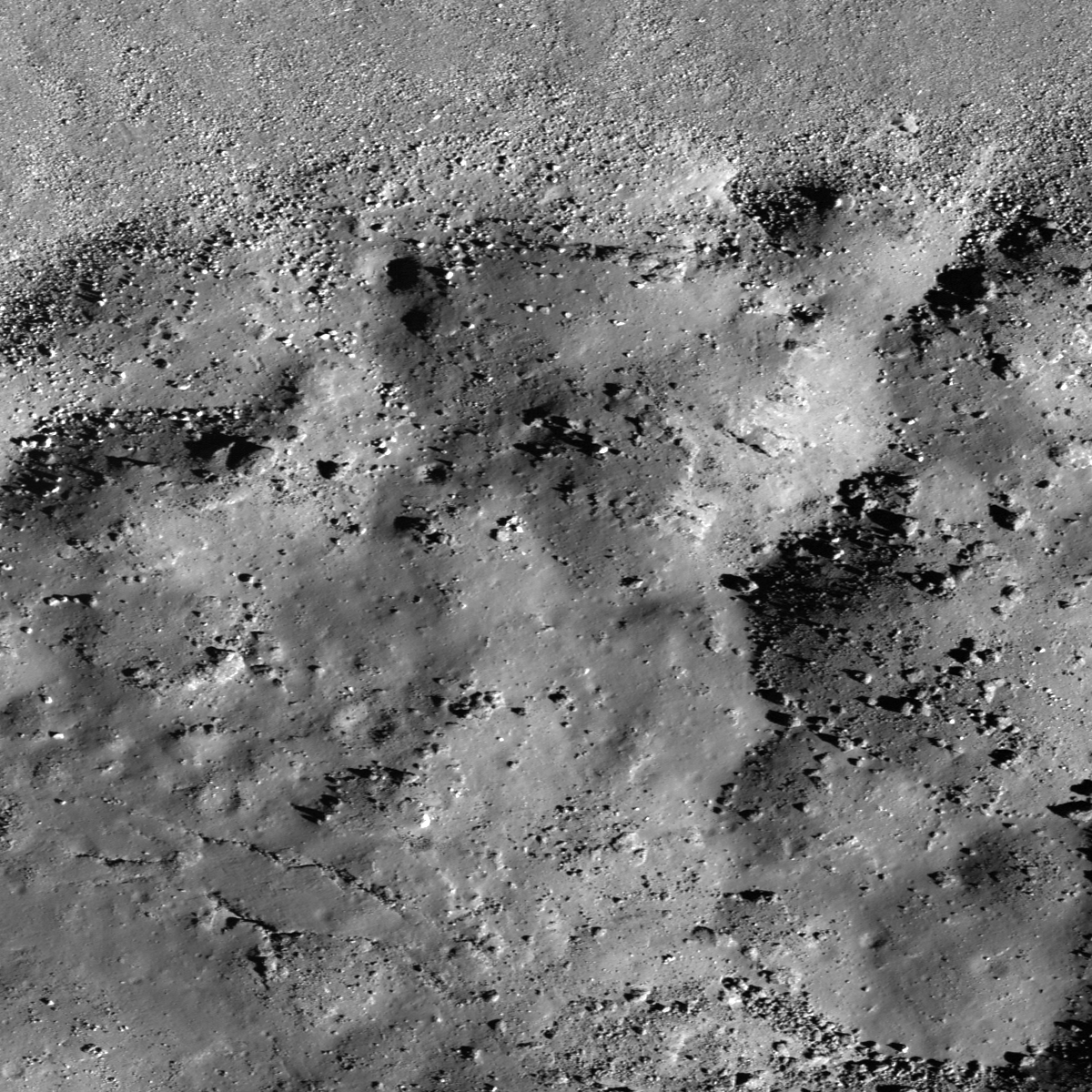
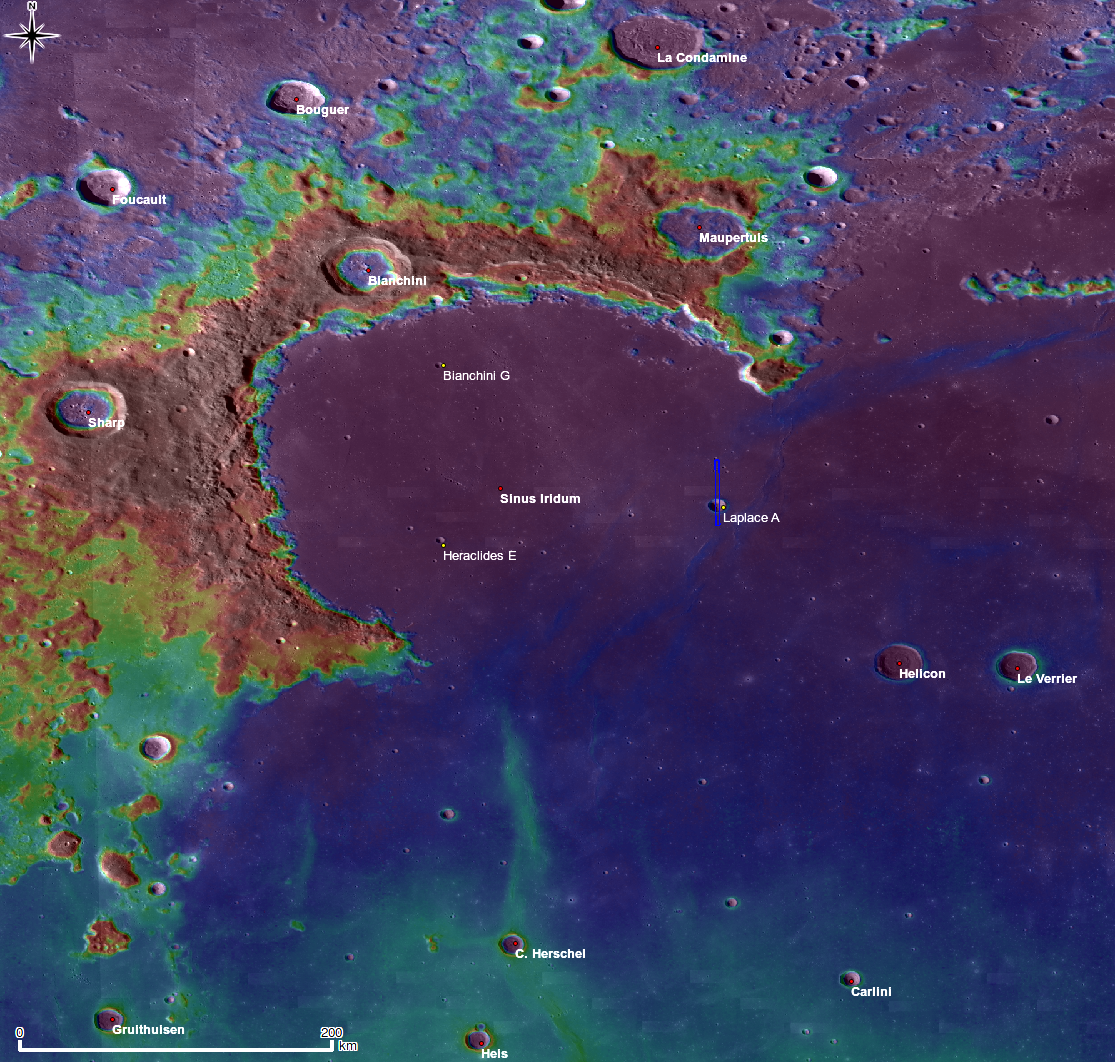
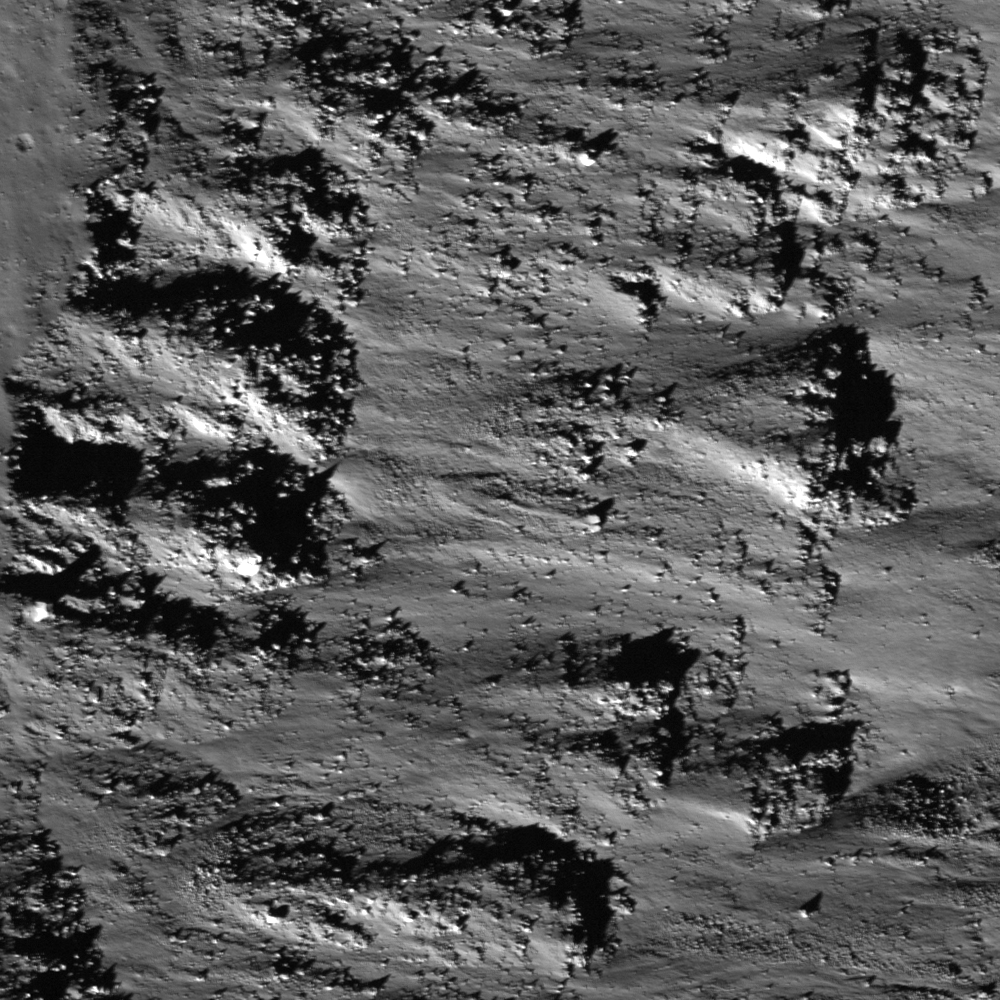
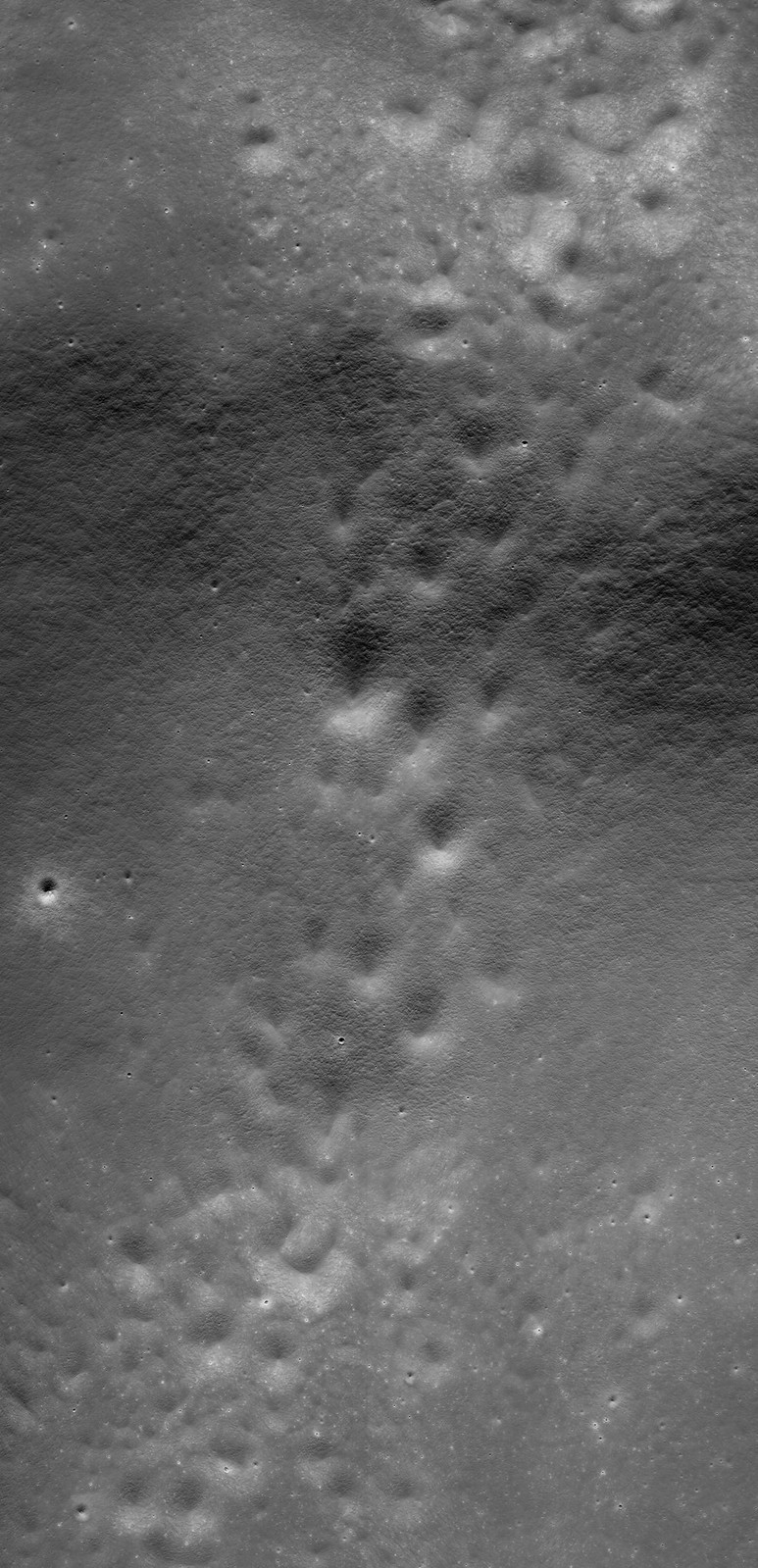
A stream of secondary craters crosses the rim of Haret C (28.47 km; 57.6°S, 186.3°E), stretching from the northeast exterior, southeast into the interior of the crater, deep within the South Pole-Aitken impact basin. 6.52 km-wide field of view from LROC NAC mosaic M1163623161LR, LRO orbit 23388, August 25, 2014; 56.75° incidence, resolution 68 cm from 63.63 km over 57.6°S, 185.26°E [NASA/GSFC/Arizona State University].
H. Meyer
LROC News System

Closely clustered or overlapping craters of similar size and morphology are likely secondary craters.

Secondary craters form when an impactor hits the surface (forming the primary crater) and throws out blocks of material that proceed to form their own craters (secondaries) as they hit the surface.

Sometimes, secondary craters can be difficult to identify if they do not occur in groups. Because craters are used to estimate the age of a surface (a process called crater counting), it is important that scientists are able to identify secondary craters.

Thankfully, in the case of Haret C, the secondary craters stand out from primary craters due to their proximity to each other. Random impacts typically do not form clusters like those draped over Haret C (28.47 km; 57.6°S, 186.3°E) .

A quick look at Haret C made possible by the international burst of lunar exploration briefly inspired by interest in the run-up to the Constellation program. The crater chain is easy enough to see in the medium resolution global albedo mosaic swept up from Chang'e-2. And the basics of the ranges and elevations of the region are displayed using the LROC Quickmap service.
Within high resolution images, smaller craters are used for crater counting. However, secondary craters become more common at smaller diameters introducing a problem for crater counters if the secondaries cannot be distinguished from primary craters. Secondaries counted as primaries result in higher crater counts per unit area, which in turn result in age estimates that are older than the true age of the surface.

Haret C does not dominate, but it is easy to pick out near the center of this HDTV still (larger view HERE) from Japan's lunar orbiter Kaguya (SELENE-1) in 2008. There are two other stills where Haret C and its crater chain are visible in context with central South Pole-Aitken basin and it's larger neighbors Bose (92.5 km; 53.95°S, 190.63°E) and Bhabha (70.52 km; 55.49°S, 194.69°E), HERE and HERE [JAXA/NHK/SELENE].
A key science goal is coming to a better understanding of the morphology or abundance of secondaries relative to primary craters so that more accurate age estimates can be made for smaller, younger terrains: especially important for panning at the scale of the NAC images for future missions to the Moon.

Seven minutes of video from GRAIL-A (Ebb) during orbit 1902 in 2012. Using the student-directed Forward MoonKAM video camera we can close in on the secondary crater chain at Haret C looking north from a perspective beginning at 30 km rising to 41 km over the surface at the end of the sequence. Starting in the polar latitudes of the southern farside the compressed view quickly passes up over the enigmatic interior of South Pole-Aitken basin, over Antoniadi (137.91 km; 69.3°S, 186.94°E, home of the Moon's lowest elevation) north 22° following the meridian that crater shares with Haret C [NASA/JPL/UCSD/SRSC].
Explore the full-width NAC mosaic HERE. Do you see any primary craters in the mix?

Related Posts:

Thursday, March 6, 2014

Squarish Lavoisier A of Oceanus Procellarum

Squarish Lavoisier A
The square corner along the north-most rim of Lavoisier A (28.5 km, 36.972°N, 286.74°E), evidence of pre-impact fracturing. LROC NAC observation M112759713L, spacecraft orbit 18324, July 4, 2014; field of view approximately 7 km, resolution 1.41 meters per pixel. LROC Featured Image, released March 6, 2014 [NASA/GSFC/Arizona State University].
Raquel Nuno
LROC News System

Why are most craters circular (even craters found on Earth)? By hurtling objects together at many miles per second in large laboratories, scientists have shown that only the most oblique impacts (less than 10° from the horizon) produce elliptical craters.

The kinetic energy of an impactor behaves much like the energy from a nuclear bomb. The energy is transferred to the target material by a shock wave, and shock waves produced by an impact, whether oblique or head-on, propagate hemispherically. This shape means that energy is being delivered equally in all directions; resulting in a hemispherical void and thus circular craters. However, conditions in nature do not always mirror the laboratory. In fact some craters are nearly square! A portion of the rim of Lavoisier A crater tells a story of the geology before impact. Lavoisier A is a squareish crater with a diameter of 28.5 km in the northwestern portion of Oceanus Procellarum.

Levoisier A from Chang'e-2
High-reflectance, low-angle illumination incidence view of 28.5 km-wide Lavoisier A from the Chang'e-2 global mosaic, with real color added from the Clementine survey (1994) [Virtual Moon Atlas 5].
Much of Lavoisier A's shape is thought to be due to preexisting joints or faults in the target rock. These discontinuities create zones of weakness, affecting how the shock wave travels through the material. We find square craters on other planetary bodies such as on the asteroid Eros and here on Earth. An example of a square crater that has been thoroughly studied is Meteor Crater in Arizona.

Levoisier A (Astronominsk)
Among the better views of Lavoisier A possible from Earth, situated as it is on the northwest limb of the Moon's nearside, in northwest Oceanus Procellarum, at the direct center of this image from a mosaic by Yuri Goryachko, Mikhail Abgarian and Konstantin Morozov, the Astronominsk team of Minsk, Belarus, sectioned from a full-disk observation photographed September 4, 2012 (below) [Astronominsk].
Levoisier A (Astronominsk)
Lavoisier A is marked with an arrow in the full-disk, 4300 by 4900 mosaic of the waning Moon, September 4, 2012 [Astronominsk].
This crater formed on layers of sedimentary rocks that have orthogonal vertical joints running below where the crater formed. The joints disrupted the shock wave flow in certain directions, preventing the formation of a circular crater. Another indication of weaknesses within the target layers is the appearance of the northeastern portion of the crater rim. It appears as if a layer of rock has been peeled back.

Can you find the evidence of pre-impact fracturing (square boundaries) in the full resolution NAC, HERE?

Related Posts:
Squished Crater
Four of a Kind in Catena Davy

Wednesday, December 18, 2013

6 of 8 Chang'e-3 science instruments now active

Students learn about the ongoing Chang'e-3 mission at a primary school in Ganyu, Jiangsu province, on Tuesday. Designers are pleased with the mission's success so far, as experiments have gone more smoothly than expected [Si Wei/China Daily].
Emily Lakdawalla of The Planetary Society has performed a herculean labor, today, pulling together many threads to deliver what might be the best possible description of a "lengthy press briefing by several members of the Chang'e 3 science team," Wednesday.

"I found it to be quite informative," Emily wrote, "not just about the mission but also about attitudes about Chinese space exploration and foreign cooperation. It was useful background for my participation in an hour-long panel discussion on China Radio International's "Today" program."

A link to her detailed summary follows the official China Daily description, below:

Wang Fan
China Daily

Six out of the eight pieces of scientific equipment deployed to the moon with the Chang'e-3 lunar mission have been activated by scientists and are functioning properly, according to scientists working on the mission.

Speaking at a news conference on Tuesday, scientists said that the equipment aboard the Yutu lunar rover and the Chang'e-3 lander had so far been functioning as hoped, despite the unexpectedly rigorous conditions of the lunar environment.

"Except for the alpha particle X-ray spectrometer and the visible and near-infrared imaging spectrometer, the instruments have all been activated and are undergoing tests and adjustments," said Su Yan, deputy designer of the Chang'e-3 ground applications system.

Zhang He, deputy designer of the probe, said though the temperature disparity is greater than scientists had anticipated, all the equipment on the moon is in "perfect" condition, and optical and ultraviolet-imaging experiments are under way.

Scientists with the ground applications system are expecting to receive a colossal quantity of original data from the rover and lander, which have independent channels to send signals, Su said. The earlier Chang'e-1 and Chang'e-2 craft only had one channel each, he said.

The mission's success so far has been a relief to Wu Weiren, chief designer of China's lunar probe program. He said the whole process, including the launch, the soft landing, the separation of the rover and lander and the ongoing experiments, have gone "much smoother" than he had expected.

Read the full article at China Daily, HERE.

Big HT: to Emily Lakdawalla at The Planetary Society, for her well-translated transcription of Wednesday's press conference posted HERE.

Friday, October 12, 2012

'China's grand plan for lunar exploration'

China's second lunar orbiter, the ultimately successful Chang'e-2, is mated to it's launch vehicle in preparation for launch in October 2010. According to official state-owned news sources, the determined and methodical China Lunar Exploration Program (CLEP) marches on.
Wang Xiaodong
China Daily

A lunar probe scheduled to be sent to the moon in 2017 by China will bring back enough samples from the surface of the moon for research by various institutes, according to Ouyang Ziyuan, chief scientist for China’s lunar exploration project.

“The sample acquired by Chang’e-5 will be distributed to qualified institutes of many different sectors in China for research,” Ouyang, a member of the Chinese Academy of Sciences, said after an event organized by the Chinese Society of Astronautics to celebrate World Space Week.

A UN Generally Assembly resolution adopted in 1999 declared Oct 4-10 each year as World Space Week, to celebrate the contributions of space science and technology to the betterment of the human condition.

“We will gather the strength of the whole nation for achievement of the highest level. And we will do what others haven’t done yet,” Ouyang said, referring to the research into samples to be brought back by Chang’e-5.

China’s lunar probe project consists of unmanned moon exploration, a manned moon landing and building of a moon base. Currently, China is in the first stage.

China launched its Chang’e-1 orbiter in 2007 and Chang’e-2 in 2010, and got a great deal of scientific data and a full high-resolution map of the moon.

China is scheduled to send its third probe, Chang’e –3, to the moon next year. After the sampling of the moon’s surface is done around 2020, China will start a manned lunar mission. But there is no clear timetable for that, Ouyang said.

Related Posts:

Tuesday, June 19, 2012

China and the Moon

Shenzhou 9 lifts off for rendezvous and docking in space
Paul D. Spudis
The Once and Future Moon
Smithsonian Air & Space

With the weekend launch of the latest Shenzhou spacecraft and its successful rendezvous and docking with an orbiting space station, world attention is once again focused on China’s flourishing space program.  Although China’s human spaceflight efforts currently focus on low Earth orbit, in recent years they have sent two robotic orbital spacecraft to the Moon and have announced their intentions for a lunar lander/rover mission.  These efforts lead many in the west to speculate that a presence on the Moon is a likely and realistic goal for China’s space future.  In terms of the possible purpose for such lunar efforts, things are little more vague.  Most assume that China will go to the Moon for reasons similar to the geopolitical motives that impelled America to undertake the Apollo missions.  While some actually welcome China’s aspirations to conquer the Moon, other space observers smirk at their apparent willingness to (as they characterize it) “waste billions of dollars to repeat what America did thirty years ago.”  Others understand why China aims for the Moon.

The United States currently has no strategic space goal.  Many in the U.S. space community argue that the development of commercial launch services through federal subsidies is a goal.  To smooth the path for this approach, calls for consensus have been made by some New Space advocates.  Funding to support the research and development costs of these new commercial services would come by excising chunks of the rapidly dwindling NASA budget.   “Flat or declining” now describes the American civil space program budget and regularly reaching LEO to supply ISS has become our “new” vision.

In contrast, China is conducting an incremental, step-wise effort to gradually but inexorably extend their reach and influence in space, first into low Earth orbit and then into cislunar space and beyond.  Their approach uses a variety of hardware derived from existing systems while adding new capabilities over time.  China appears to be focused and following clear, long-range goals in space.  Because we do not look ahead on timescales of 20-30 years (accustomed instead to a 5-10 year timeframe), we have no long-range strategy to guide what we build or a plan for securing any long-term space goals.

Certainly wide-ranging concerns propel China’s push for human space access, some that can be envisioned now and some that cannot.  But fundamentally, they have accepted the proposition that freedom of space in the 21st century is equivalent to the principle of freedom of the seas that governed 19th and 20th century geopolitics.   In short, such a principle comprises the ability to project power and to protect national interests whenever and wherever China might be confronted within the strategic theater in question, in this case, the domain of cislunar space.

I have written before on the economic, strategic and scientific value of cislunar space, the zone in which virtually all of our space assets and satellites reside.  China intends to preserve her freedom of action by creating a spaceflight capability that can access and use any location of cislunar space, up to and including the lunar surface.  To build a sustainable space program using incremental, cumulative steps, it makes no sense to “leapfrog” over (or to ignore) the intermediate locations from which space faring capability and utility can be demonstrated, established and used.

Much of the published speculation on China’s interest in the Moon focuses on mining the Moon for the nuclear fusion fuel 3He or substances found on the lunar surface, such as titanium or rare earth elements.  In fact, one of the simplest substances found on the Moon has enormous value in space – water.  Water can be used to support human life, as a medium of energy storage, and as rocket propellant.  Water is the currency of spaceflight and one of the most valuable, usable substances we could obtain from any extraterrestrial object.

If I wanted to establish a secure foothold for my country in cislunar space, I would secure the territory near the poles of the Moon.  We know from the results of several recent probes that the lunar poles contain billions of tons of water, much of it chemically unbound as ice, a particularly easy form to harvest, concentrate and use. Material and energy resources, concentrated together in a compact location are assets of immense economic and strategic value.  Wars have been waged over less.

International treaty prohibits claims of extraterrestrial territory by national entities.  But treaties are “gentlemen’s agreements” and sometimes nations do not behave like gentlemen.  There is no mechanism to enforce the 1967 Outer Space Treaty except for a given country’s unwillingness to undergo international opprobrium.  Moreover, a country can withdraw from the treaty at will.  China tends to do what it wants to do, unless the economic or political price is perceived to be too high.  The potential of the Moon and cislunar space may outweigh their sense of geopolitical risk or concern about international ostracism.

What does this mean for the United States?  To listen to many in the space press, nothing.  A quick yawn and then back to propagandizing for more federal dollars to be passed on to new space companies.  But ultimately, it could mean that their libertarian dreams of a profit-making space frontier will never come to pass.  If free market capitalism and democratic political institutions are to have a future in the new frontier of space, entities, investors and consumers who share these values must secure a notable presence.  If the United States has a vigorous civil space program that creates a permanent presence there, such a system may have a chance to take root.  Conversely, our absence is almost a guarantee that our system and values will not be the guiding paradigm on the new frontier.

For many observers, an absent America (or with a mere supporting role) would be acceptable.  They believe America is what’s wrong with the world and that it’s high time that we step aside (in their opinion to one of subservience and irrelevance – certainly not one of power projection or as an economic engine and technology driver).  Parties (and countries) that lead make the rules.  While China has a great industrial base and a large, seemingly market-based economic system, it is actually a system of big government corporatism, where central planners decide which industries shall be allowed to grow and in what direction – capitalism, under total governmental control.

China is a rapidly advancing technically and is one of our largest trading partners, attributes beneficial in relationships between equals.  Historically, once a shift occurs in the status of partners, relationships change.  Because China’s influence in the world is growing, it is vital that we discuss and weigh these facts.  Our national economic and security interests cannot be jeopardized by a misguided rush to hand our space future over to companies who are in the imagining stage of what China just accomplished this weekend.

Originally published at his Smithsonian Air & Space blog The Once and Future Moon, Dr. Spudis is a senior staff scientist at the Lunar and Planetary Institute. The opinions expressed are those of the author and are better informed than average.

Thursday, February 9, 2012

LROC: Outcrops in Laplace A

Debris flows and outcrops exposed in the walls of Laplace A crater, offset from Sinus Iridum. Illumination from southwest over a field of view (FOV) approximately 525 meters across, down-slope to the right. LROC Narrow Angle Camera (NAC) M137725771R, orbit 5430, August 29, 2010; incidence angle 52.91° with a resolution 0.52 meters per pixel from 49.72 kilometers. View the original LROC Featured Image HERE [NASA/GSFC/Arizona State University].
James Ashley
LROC News System

As with many mare deposit exposures when viewed at the Narrow Angle Camera imaging scale of 0.5 m/pixel, the bedrock outcrops in the walls of Laplace A appear as layered ledges. The layers are most noticeable in the north-northeast to south-southwest trending rocks visible in the northeast quadrant of the frame. Additional indications of layering can be found in the full NAC image. 

The prominent V-shaped outlines to some of the outcrops are suggestive of constructional deposition. Granular debris flows cascading down the crater walls following excavation appear to have encountered the obstructing ledges and "dammed up" behind them. Resistance to flow in such situations takes on a tapered shape in the direction of flow as the material becomes compacted. Minor occurrences of impact melt may be contributing to the smooth appearance of the flow deposits between the outcrops.

Featured Image FOV in context of the full 2.5 kilometers wide LROC NAC frame M137735771R [NASA/GSFC/Arizona State University].
The north wall of Laplace A is similarly characterized by the outcrops visible in very high resolution in the LROC NAC frame. The crater and surrounding Sinus Iridum were closely examined as a likely landing site for the Chang'e 3 mission by 2014 by China's lunar orbiter Chang'e 2. Nine kilometer-wide Laplace A (43.64° N, 333.33°E) is a familiar nearside feature because of its place in the largely "featureless" landscape along the frontier of the northwest Mare Imbrium and Sinus Iridum. The crater excavated Imbrium mare over the inundated "missing" southeastern outer ring of the Iridum impact zone. A rewarding 7000 pixel-wide, very detailed version of the image is available from tantaonews.com [CNSA/CLEP].
Nine-kilometer Laplace A is a familiar nearside feature in the mare where Sinus Iridum meets Mare Imbrium. If you have access to a small telescope, it is a challenging target for the eyepiece best viewed two days after First Quarter or a day after Last Quarter. Context information for the LROC NAC Featured Image and the Chang'e 2 study from LROC Wide Angle Camera (WAC) observations gathered during last August's low periapsis period (from an average 33.06 kilometers, at a resolution of 47.6 meters per pixel), orbits 9946 through 9949, August 19, 2011 [NASA/GSFC/Arizona State University].
A 95 km-wide FOV from the WAC monochrome (566 nm) mosaic collected over 4 orbital passes, August 29, 2011 [NASA/GSFC/Arizona State University].
Additional examples of both layering and debris flow in crater wall exposures can be found in the following Featured Image posts: Dawes, Pytheas, and Layering in Messier A.

The apparent isolation of Laplace A (center right) is misleading in this HDTV still of Sinus Iridum, embayed by the vast northwest floor of Mare Imbrium, though there is an authentic paucity of similarly-sized craters in the vicinity, unlike the lunar Highlands. HD video captured by Japan's lunar orbiter SELENE-1 (Kaguya) in 2009. A larger version of this frame can be viewed HERE [JAXA/NHK/SELENE].

Friday, December 30, 2011

China issues new space Five Year Plan

From a 2006 exhibit diorama, China's latest white paper reiterates the PRC will continue efforts aimed toward an eventual manned landing on the Moon [CNSA/CLEP].
Marcia S. Smith
SpacePolicyOnline

China issued a new "white paper" today describing the achievements of its space program over the past 5 years and outlining its plans for the next 5 years.   China issued such white papers in 2000 and 2006, and the 2011 version offers little that is new.

According to the English-language version published on Xinhua's website, China has relatively modest plans for its space program, most of which were previously known.  No ground-breaking plans were revealed.

"In the next five years, China will strengthen its basic capacities of the space industry, accelerate research on leading-edge technology, and continue to implement important space scientific and technological projects, including human spaceflight, lunar exploration, high-resolution Earth observation system, satellite navigation and positioning system, new-generation launch vehicles, and other priority projects in key fields. China will develop a comprehensive plan for construction of space infrastructure, promote its satellites and satellite applications industry, further conduct space science research, and push forward the comprehensive, coordinated and sustainable development of China's space industry."

As China has indicated in the past, it is developing at least three new launch vehicles for various purposes.  A Delta-4 class launch vehicle, Long March 5, is expected to begin operations from a new launch site on Hainan Island in 2014.   Designed to place 25 tons into low Earth orbit or 14 tons into geostationary orbit, it will be the largest of China's space launch vehicles.  China also is developing a new small launch vehicle, Long March 6, and a new mid-sized rocket, Long March 7, both of which are mentioned in the white paper.  No plans for a heavy-lift launch vehicle were announced today, however.   Instead the white paper says only that China will "conduct special demonstrations and pre-research on key technologies for heavy-lift launch vehicles."

Assertions by Chinese "experts" quoted in the Chinese media over the past several years that China was planning to send taikonauts to the Moon in this decade appealed to those who wanted to catalyze another "Moon race," but could not be traced back to official government policy.   Today's document, which presumably represents official policy, says only that China will conduct studies "on the preliminary plan for a human lunar landing." 

Read the full story HERE.

Saturday, June 11, 2011

Chang'e-2 completes lunar mission and departs


Detail from the Digital Elevation Model (DEM) of Sinus Iridum, an area of high interest to the Chinese Lunar Exploration Program surveyed by the PRC's second lunar orbiter Chang'e 2, which has now left the Moon's vicinity and departed for "Outer Space" [CNSA/CLEP].

Deng Shasha
xinhua

Beijing -- China's second moon orbiter Chang'e-2 on Thursday set off from its moon orbit for outer space about 1.5 million km away from the earth, Chinese scientists said Thursday.

The orbiter left its moon orbit at 5:10 p.m. and it will take about 85 days for the orbiter to reach outer space, according to the State Administration of Science,Technology and Industry for National Defence (SASTIND).

The orbiter had finished all its tasks within its designed life span of six months by April 1.

Scientists decided to let it carry out additional exploratory tasks as the orbiter still had fuel in reserve.

Traveling into outer space from the moon's orbit is the most important task among five additional ones, according to the SASTIND.

"It's the first time in the world for a satellite to be set off from the moon in remote outer space," said Zhou Jianliang, deputy chief engineer of the Chang'e-2 measure and control system of the Beijing Aerospace Control Center (BACC).

Moon exploration means about 400,000 km away from the earth, but outer space exploration means 1.5 million km, posing great challenges to the country's technology in measure and control, telecommunications, data transaction and orbit design, scientists said.

Before flying away, the orbiter had finished two additional tasks as of May 23.

One was to take photos of the northern and southern poles of the moon. The other was to descend again to the perilune orbit, about 15 km away from the surface, to catch high-resolution images of the Sinus Iridum, or Bay of Rainbows, the proposed landing ground for future moon missions.

Scientists hope the satellite can continue operations until the end of next year.


Nine kilometer-wide Laplace A (43.64° N, 333.33°E) is a familiar nearside feature because of its place in the largely "featureless" landscape along the frontier of the northwest Mare Imbrium and Sinus Iridum. The crater, also extensively surveyed by NASA's LRO - see links below - has "pre-excavated" Imbrium seabed over the inundated "missing" southeastern outer ring of the Iridum impact. A rewarding 7000 pixel-wide, very detailed version of the image is available from tantaonews.com [CNSA/CLEP].

"We are developing outer space measure and control stations in outer space and they will be capable to carry out tasks by the end of the second half next year," said an SASTIND scientist, who declined to be named.

At that time, the satellite can be used to test the two stations' functions, the scientist said.

Challenges exist as Chang'e-2 was not designed for the additional task and it is now in extended service without extra capacities to deal with abnormal risks, Zhou said.

Meanwhile, long-distance brings many problems like weakening signals and difficulties in measure and control, Zhou said.

The Chang'e probes are named after a legendary Chinese moon goddess who flew to the moon.

Besides the current operations, China's ambitious three-stage moon mission will include a moon landing and launch of a moon rover around 2012 in the second phase. In the third phase, another rover will land on the moon and return to earth with lunar soil and stone samples for scientific research around 2017.

The country has no plan or timetable for a manned moon landing for now.

China launched its first lunar probe, Chang'e-1, in October 2007.

It became the third country after Russia and the United States to send a person into space in 2003. Two more manned space missions followed with the more recent in 2008 involving the country's first human space walk.

Heads Up: Barbara A. Cohen, Marshall Space Flight Center

Related Posts:
Mounds in a Melt Pond
February 24, 2011
Sinus Iridum - Next Destination?
October 16, 2010
Chang'e-2 arrives in mission orbit
October 9, 2010

Wednesday, March 9, 2011

PRC continues methodical program

Chang'E 3 prototype development update:


Preliminary concept models of the CNSA Chang'E-3 lunar rover vehicle, which may be deployed after a landing in Sinus Iridium in 2013 [CNSA/CLEP].

Yan Meng
People's Daily Online

The Chang'e-3 lunar probe has entered the prototype development stage, and it will be launched in 2013 at the Xichang Satellite Launch Center on a mission to achieve a soft landing on the moon's surface, said Ye Peijian, chief scientist of deep space exploration at the China Academy of Space Technology.

He said that the Chang'e-3 lunar probe with "legs" and wheels is a brand-new spacecraft for China, so the technology is difficult to master.

"The biggest difficulty of the Chang'e-3 is how to land on the lunar surface steadily," Ye said.

Ye said it must be a soft landing, not a hard hit. A soft landing cannot use a parachute because there is a vacuum on the moon. The probe will instead use anti-thrust to slow down the speed of the engine.

Ye said that there are five landing sites that have been pre-selected for Chang'e-3 lunar probe. Sinus Iridum is the first choice in the first task because it is a flat region that is well-lit and easily observable.

Ye Peijian said the Chang'e-3 lander will carry seven sets of scientific instruments and several cameras to conduct different scientific exploration missions as well as take photos of the Earth and other celestial bodies.

The lunar rover will also have eight instruments, including a panoramic camera and lunar exploration radar. The lunar rover will use automated navigation, turning, route selection, climbing and obstacle avoidance and then transmit the data back to Earth by itself or through the lander.

According to reports, after the launch of Chang'e-3, the Chang'e-4 lunar probe will also be launched. The Chang'e-3 and Chang'e-4 will together complete the task of landing on the moon in the second phase of China's lunar exploration, which is the implementation of a lunar soft landing and automatic inspections investigation.


China plans world's largest rocket test site:


Chang'E 2 lifts off in October, beginning China's second and more sophisticated lunar survey, part of the PRC's methodical China Lunar Exploration Program (CLEP).

Kit Eaton
Fast Company

The U.S.-Russian space race that led to the Apollo lunar landings is the stuff of legend. But now a new race is emerging, as China gears up with the world's biggest rocket-production factory. And we're not talking about fireworks.

Early rockets were based on old Russian designs, but China's space industry has developed extraordinarily quickly since then. Chinese science and engineering teams launched an astronaut on the Shenzhou V mission in late 2003, then completed a spacewalk in 2008 on the Shenzhou 7 launch (see the video below). Though much of the nation's space efforts are shrouded in mystery, the deputy head of the Academy of Launch Vehicle Technology just revealed that the world's biggest facility for designing, building, and testing rockets is under construction in the Tianjin area of northern China.

Read the article HERE.

Thursday, February 24, 2011

Mounds in a melt pond


Deep interior of Laplace A crater, LROC Narrow Angle Camera (NAC) M129466485R, corrected resolution 0.80 m/pixel, field of view 960 meters; sunlight from southeast, incidence 66° (LRO orbit 4213, May 25, 2010) Full-sized LROC Featured Image HERE [NASA/GSFC/Arizona State University].

Hiroyuki Sato
LROC News System

During an impact event the kinetic energy of the meteorite is dissipated by compression, fragmentation, excavation and launching rock debris -- all resulting in an impact crater. The large amount of energy released also melts some of the target rock, and often times impact melt ponds form in the floor of the crater. Since the impact melt is liquid, it seeks an equi-potential level (surface is perpendicular to the gravity vector), thus it is flat and smooth as it freezes.

Today's Featured Image reveals the bottom of Laplace A crater, specifically the north edge of its impact melt pond. The upper side of this image corresponds to the lower part of crater wall, covered by lots of boulders. The surface of this melt pond consists of dozens of low mounds, possibly due to deformation of the pond surface after partial solidification. Perhaps rebound of the crater floor caused the level of molten material beneath the crust to rise and create small breakouts to the surface. There is also a cone shaped depression near these mounds. It may have formed as magma drained out from below?


Inset from full-sized context map (HERE) shows the rich detail of the vicinity of Laplace A, the largest crater in the "mouth" of Sinus Iridium, south of Promontorium Laplace (upper right). LROC Wide Angle Camera (WAC) 100 meter/pixel monochrome global mosaic, overlayed by WAC color Digital Terrain Model (500 m/p). The blue long box over Laplace A corresponds to the footprint of the right-hand frame of LROC NAC M129466485 from which the LROC Featured Image above was derived [NASA/GSFC/Arizona State University].

Explore lunar landslides by viewing the full NAC frame!

The topographic color was produced as a by-product of stereo analysis of the WAC global dataset. Producing the global Digital Elevation Model (DEM) is a big job being led by LROC team members at the German Aerospace Center (DLR; English version) in Berlin.

Related Featured Images:
Impact melt features in Tycho crater's floor
The Floor of Tycho - Constellation ROI
Central Peak of Rutherfurd
More Impact Melt!


General location of the LROC Featured Image, February 24, 2011, within the wider context of the larger width of LROC NAC frame M129466485R [NASA/GSFC/Arizona State University].


It's unfair, really, to seemingly disparage this amazing view as being among the "middle range" of available resolutions in the current harvest from international lunar robotic missions. A 3D view of Laplace A as viewed at or near perilune during a high-priority survey of Sinus Iridium, (possible landing site for China's first lunar lander) from China's second lunar orbiter Chang'E-2, released last October 28, 2010. A larger version of the image is available HERE [CNSA/CLEP].

From LROC WAC Sample Album
Inset from uncorrected LROC WAC frame M120026575ME showing Laplace A, swept up during LRO orbit 2822 from an altitude of 36.36 km; resolution 50.92 meters/pixel, February 5, 2010. [NASA/GSFC/Arizona State University].

Monday, October 18, 2010

A different look at 'Target Rainbow'


HDTV still from Japan's lunar orbiter Kaguya (SELENE-1) shows the full semi-circle of Sinus Iridum, the "Bay of Rainbows," and the contact between basalt melt that flooded the ancient crater and Imbrium basin. Yet another look at one of the high-priority areas of interest targeted by China's Lunar Exploration Program (CLEP) as a possible landing site in 2013. China's second lunar orbiter Chang'E-2 arrived in lunar orbit October 6, 2010. Click HERE for full 1920x1080 view [JAXA/NHK/SELENE].

Recent Related Posts:
Sinus Iridum - Next Destination?
Mark Robinson, Saturday, October 16, 2010

Chang'E-2 arrives in lunar orbit
Joel Raupe, Saturday, October 9, 2010

Wednesday, October 6, 2010

Chang'E-2 successfully inserted into lunar orbit

Dr. Yong-Chun Zheng of China's Academy of Sciences (NAOC) has reported, after a breaking maneuver performed at 0306 UT October 6, the Chang'E-2 lunar orbiter officially arrived in lunar orbit at 0340 UT.

Flight planners will soon perform a gradual series of breaking maneuvers near perilune to reduce the present preliminary 12 hour 100 × 8000 km orbit to the 100 × 15 km mission orbit.

Chinese Lunar Exploration Program (CLEP) flight directors then plan to begin low pass surveys of Sinus Iridum, on the northwest side of Mare Imbrium, possible landing site for the Chang'E-3 stationary lander and lunar rover in 2013.

Monday, October 4, 2010

Dispatch from Chang'E-2: Sinus Iridum


Clementine (1994) Near-Infrared Multi-Spectral Mosaic (USGS Map-A-Planet] view of Sinus Iridum (44.4°N, 330.0°E), the 414 km-wide "Bay of Rainbows" on the northwestern tier of Mare Imbrium (with the lofty Jura Mountains on its west). Xinhua news agency reports the relatively high-latitude feature is the intended target of a low a planned low-perigee, high-resolution survey by Chang'E-2 as the intended target for a planned landing by Chang'E-3 in 2013.

Dr. Yong-Chun Zheng, associate professor at the National Astronomical Observatories, Chinese Academy of Sciences (NAOC) reports from Beijing, "the high energy particle detector (HPD) on board Chang'E-2 was switched a day after Trans-Lunar Injection, "suggesting the scientific instrument has begun working"

"Data transmitted from Chang'E-2, such as the temperature, voltage and power of the HDP, are all within range, indicating the instrument works well."

Chang'E-2 carries seven scientific instruments. "The HPD is responsible for surveying the space environment in the journey from the earth to the moon and space environment near the moon," Zheng said. HPD is one of two instrument stages of the Chang'E'2 Space Environment Monitor System, designed to measure heavy ions, proton spectra and the composition and spatial distribution of low-energy solar wind.

Second of Three Course Corrections Unnecessary

Beijing Aerospace Command and Control Center completed an initial adjustment of Chang'E-2's course at 12:25, October 2 (Beijing time). Further adjustments are expected, but Xinhua has reported that the second of three planned TLC maneuvers had been deemed "unnecessary."

Chang'E-2 was launched at 18:59:57 pm, October 1 (Beijing time) and was directly inserted into an earth-moon transfer orbit. Direct Earth-Moon transfers generally require an initial critical course correction.

"Chang'E-2 needed to slightly change its orbit at the appropriate time," Zheng reports. "If the orbit correction is not on time, the satellite could depart from its correct orbit to the moon and might not be captured by the moon's gravity," which is overwhelmed first by Earth and then, about half the distance to the Moon, by the Sun. "So, for Chang'E-2," Zheng said, "the orbit correction was very important."

Telemetry indicates the Long March 3C booster successfully sent Chang'E-2 into its target course and, "everything is going well," Zheng said. "We give the mission perfect evaluation marks."

"Chang'E-2 needed to slightly change its orbit at the appropriate time," Zheng said. "If the orbit correction is not on time, the satellite could depart from its correct orbit to the moon and might not be captured by the moon's gravity," which is overwhelmed first by Earth and then, about half the distance to the Moon, by the Sun.

China's state news agency Xinhua reported Monday Chang'E-2 is expected to travel a total of 112 hours before lunar orbit insertion.

Xinhua also disclosed the relatively high-latitude Sinus Iridum, the familiar 411 km "half-moon" embayment "Bay of Rainbows," on the northwestern edge of Mare Imbrium is one intended target of the Chang'E-2 survey. "To acquire more detailed moon data, Chang'E-2 will enter a lower lunar orbit about 100 km above the surface (compared with the 200-km altitude of Chang'E-1) according to the control center.

"The satellite will eventually be maneuvered into an orbit just 15 kilometers above the moon. At that point, Chang'E-2 will take pictures of moon's Bay of Rainbows area, the proposed landing site for Chang'E-3, with a resolution of 1.5 meters. The spatial resolution of Chang'E-1's CCD stereo camera was 120 meters, said Wu Weiren, chief designer of China's lunar orbiter project.

Friday, October 1, 2010

Chang'E-2 takes direct approach

Updated 2 October 2010 - 1708 UT

Chang'E-2, second of China's four planned unmanned missions to the Moon through 2017, begin it's mission successfully Friday, October 1, 2010. [CCTV-4].

The Chinese National Space Agency's Lunar Exploration Program (CLEP) successfully began a second unmanned lunar mission, Friday October 1, 2010, with high confidence in their spacecraft and high hopes for what is billed as a technical mission. A modified Long March 3C booster lifted off on-time, at the opening of its launch window, and soon accelerated Chang'E-2 toward it's planned rendezvous with the Moon 120 hours later.

It's a faster, direct trajectory than was used in 2007 to increase an Earth-orbit apogee for Chang'E-1 probe to encounter the Moon at the height reached in a third eccentric orbit, and reflects China's earned confidence in their Lunar Exploration Program.

"It is estimated Chang'E-2 can reach lunar orbit within five days, compared to 13 days, 14 hours and 19 minutes for Chang'E-1," Ouyang Ziyuan, chief scientist at the China Lunar Exploration Project (CLEP) told Xinhua.

"China had not been to the Moon before Chang'E-1 so we were very prudent and adjusted its transfer orbit in a very slow manner. It traveled 2.06 million kilometers before lunar orbit insertion," Ouyang said. "It's different now. We can send Chang'E-2 directly to the moon, and we have also planned to reach the Moon within five days."

The Chang'E-2 mission profile calls for a lower lunar orbit, and hints at China's intention to eventually maneuver the probe into one or more rehearsal transfer orbits with a 9 km perilune over future landing targets. Equipped with an improved digital camera, mission planners hope to use these low passes to gather images of selected landing targets at higher than an advertised 1 meter resolution.

Chang'E-3, a future stationary lander with robotic rover is under development for 2013 along with Chang'E-4, a lunar sample return mission in 2017.


China's State-run media pulled out all the more obvious stops, Friday evening, devoting well over an hour of full televised coverage of the successful launch of Chang'E-2 from Xichang Satellite Launch Center in Sichuan Province [CCTV-4].


Mainland sources report specifics on the Chang'E-2 payload are "necessarily similar to that of it's predecessor," with a few significant differences:

1. Optical Imaging System: (pdf) A.) Charge Coupled Device (CCD) improved stereo camera (improved) for global lunar surface imagining - resolution improved from 120 meter to 10m. In lower passes (e.g. rehearsal of landing logistics, short of Terminal Descent) resolution can approach 1 meter. More specification of CCD: LPSC 2010 #2570 (pdf). B.) Interferometer spectrometer imager (same as Chang'E-1): Specs: LPSC 2010, #2061 (pdf).

2. Laser Altimeter (improved): Focused on several candidate soft landing Regions of Interest, 5 laser points per second (1 point of chang'e-1) to the lunar surface. More information, HERE.

3. Gamma/X-ray Spectrometers (same as Chang'E-1): LPSC 2010, #1046 (pdf).

4. Microwave Detector (same as Chang'E-1): LPSC 2010, #1125 (pdf).

5. Space Environment Monitor System (Same as Chang'E-1, i.e., "measure the contents of heavy ions, energy spectra of protons and contents and spatial distribution of low-energy ions in solar wind. A.) High-Energy solar particle detector, B.) Low-Energy Ion Detector.)


Public mock-up of the China Lunar Exploration Program (CLEP) Chang'E-3 stationary lander component, now under development, for a planned soft landing on the Moon in 2013. China's methodical dual-track developmental plans, its manned and unmanned (lunar), space programs are devoted more to improving engineering design capability over science [Xinhua].

Prior to launch, Yong-Chun Zheng. of the National Astronomical Observatories at the Chinese Academy of Science in Beijing outlined more specifics of the CLEP program's legacy and future.

The Chang'E-1 orbiter was the first lunar probe of China. The lunar orbiting project is the first step of China's "orbiting, landing, returning" strategy of lunar exploration. Chang'E-1 was successfully launched October 24, 2007 at Xichang Satellite Launch Center and was guided to a sucessful targeted impact March 1, 2009.

The total mission length was 495 days with a total raw data count of approximately 1.37TB, with 4TB of scientific data product produced. By the analysis and application of these data, a series of science results have been achieved, especially "the global image of the Moon." Chang'E-1 completed its four scientific objectives and provides the foundation for the promotion of lunar and planetary sciences in China and for succeeding lunar exploration missions.

Chang’E-2 had been designed and produced as a backup of Chang'E-1. After the success of Chang'E-1, technical modifications for new mission goals for Chang'E-2 were developed as technical test vehicle for the second stage of China’s Lunar Exploration Program (CLEP). Following launch, Friday:

Time from launch to be LOI was shortened from CE-1's 12 to CE-2's 5 days.

The orbit altitude was lowered down from CE-1's 200 km to CE-2's 100 km.

The spatial resolution of CCD stereo camera will be improved from CE-1's 120 m to CE-2's 10 m.

The frequency of laser pulse of laser altimeter will be improved from CE-1's 1 Hz to CE-2's 5 Hz. The mission goals of CE-2 will focus on high resolution imagery of the planned landing site of the CE-3 lunar lander and rover.

Key technology involving soft landing a on the Moon will be tested during the CE-2 mission, and the success of CE-2 will provide an important technical basis for the successful implementation of China's future lunar exploration.

Friday, September 3, 2010

Chang'e-2 sets stage for future Moon missions


China's second lunar orbiter Chang'e-2 began as back up for Chang'e-1 (2007-2009). Scheduled for a possible October launch, Chang'e-2 should arrive sooner, orbit the Moon closer and gather better data. If all goes well the vehicle should allow rehearsal opportunities for China's first soft landing on the Moon in 2013, and a better camera on Chang'e-2 may gather 1 meter resolution photographs of preferred landing sites.

China's unmanned space program has only one deep space target: the Moon. The United States may be preparing to abandon manned exploration of the lunar surface but the new era of international lunar exploration, a 'second moon race,' continues. India, Russia and China may each have achieved soft landings there before the U.S. deploys the first, if any, of planned nodes for an International Lunar Network (ILN). After Chandrayaan-2 and Chang'e-3, Chang'e-4 may return the first lunar samples to Earth since the Soviet's Luna 24 in 1976.

From Xinhua -- China's second lunar probe, Chang'e-2, will transition much faster than its predecessor, reaching lunar orbit in a shorter period of time, a top Chinese space scientist told Xinhua Friday.

China launched Chang'e-1 from Sichuan October 24, 2007. The first of China's planned unmanned lunar missions ended a 16-month mission March 1, 2009 when it was intentionally de-orbited into Mare Fecunditatis.

"It is estimated Chang'e-2 can reach lunar orbit within five days, compared to 13 days, 14 hours and 19 minutes for Chang'e-1," Ouyang Ziyuan, chief scientist at the China Lunar Exploration Project, told Xinhua.

"China had not been to Moon before Chang'e-1 so we were very prudent and adjusted its transfer orbit in a very slow manner. It traveled 2.06 million kilometers before lunar orbit insertion," Ouyang said. "It's different now. We are more certain about the launch and can send Chang'e-2 directly to the moon, and we have also planned the transfer orbit to reach the Moon within five days."

Plans call for Chang'e 2 to orbit 100 km closer to the moon with a higher resolution camera, he said.

According to China's three-phase lunar exploration 'road map,' the country will first launch the Chang'e-2 and afterward soft-land Chang'e-3 on the moon in 2013 and, in 2017, Chang'e-4 will return a lunar sample to Earth.

Experts have speculated the Chang'e-2 mission will allow China to begin mastering soft-landing techniques for Chang'e-3 and 4, short of terminal descent. Careful lowering of its orbit to rehearse everything short of terminal descent that otherwise might begin after passing perilune could allow low passes over an intended target and an opportunity to take high-resolution photography.


Public mock-up of the China Lunar Exploration Program (CLEP) Chang'e-4, in development for a soft landing on the Moon in 2013. China's methodical dual-track developmental plans, its manned and unmanned (lunar), space programs seem devoted more to engineering design capability over science [Xinhua].

Friday, August 13, 2010

Proposed GLXP rule changes inspire concern

Updated September 15, 2010 1825 UT

Google Lunar X-Prize (GLXP) team SELENOKHOD in Russia demonstrates a test-bed prototype of the lunar rover the group hopes will win a minimum $20 million purse. However, Russian resources now committed to a planned 2013 joint Russian & Indian lunar mission has put a strain on their timetable [Selenokhod].

Peter J. Brown
Asia Times Online

Government space agencies are taking a closer look at the Google Lunar X Prize (GLXP) contest, an international competition to safely land a rover on the moon. Several GLXP teams include space researchers and engineers in Asia on their rosters, and NASA is rolling out a program that might provide US GLXP teams with a $30 million market for their mission data. Other countries may not sit still for long in light of this development.

That is the good news. The not so good news is that as the result of a proposed GLXP rule change, the $20 million GLXP grand prize could be reduced by $5 million if a government-backed lunar mission successfully lands and deploys a rover in advance of any of the 21 GLXP teams accomplishing the same feat. All GLXP teams must be 90% privately funded.

According to the original set of GLXP rules, the grand prize would be awarded to the team that first landed a rover on the Moon and subsequently able to travel at least 500 meters while simultaneously transmitting data and a live TV signal back to Earth. The deadline has been December 31, 2012. If that objective was not achieved, however, a GLXP team could still win a reduced grand prize of $15 million if it fulfilled all requirements by December 2014.

Now, under the proposed so-called GLXP "Master Team Agreement" (MTA), revised rules, including the $5 million cut described above, are taking shape. All remaining prizes, including a $5 million second prize and several bonus prizes, would be unaffected.

Under proposed changes to contest rules, the 2012 deadline is pushed ahead three years to December 31, 2015. However, even that deadline might be extended by the California-based X Prize Foundation (XPF).

Several countries, including the European Space Agency (ESA), are planning to conduct lunar landings over the coming decade. The joint Indian Space Research Organization (ISRO)-Russian Federal Space Agency (Roskosmos) Chandrayaan-2 orbiter and rover / Luna-Resource lunar lander scheduled for 2013, appears first in line.

"Almost every space agency is talking about missions to the lunar surface these days. Putting fixed calendar dates on them is very difficult, though," said William Pomerantz, senior director of space prizes at the XPF.

"We are excited about and are following developments on other fronts, including China's Chang'e 3, Japan's SELENE-2, The Indo-Russian Luna-Resource /Chandrayaan-2, ESA's MoonNEXT, a variety of potential NASA robotic missions and possibly the UK's MoonLite, along with eventual nodes of the proposed International Lunar Network (ILN)."

"At this point, it's difficult to say with certainty which will be which," said Pomerantz

Read the full article, HERE.