Showing posts with label Hydroyxls. Show all posts

Tuesday, April 15, 2014

Sometimes you just need to 'vent'

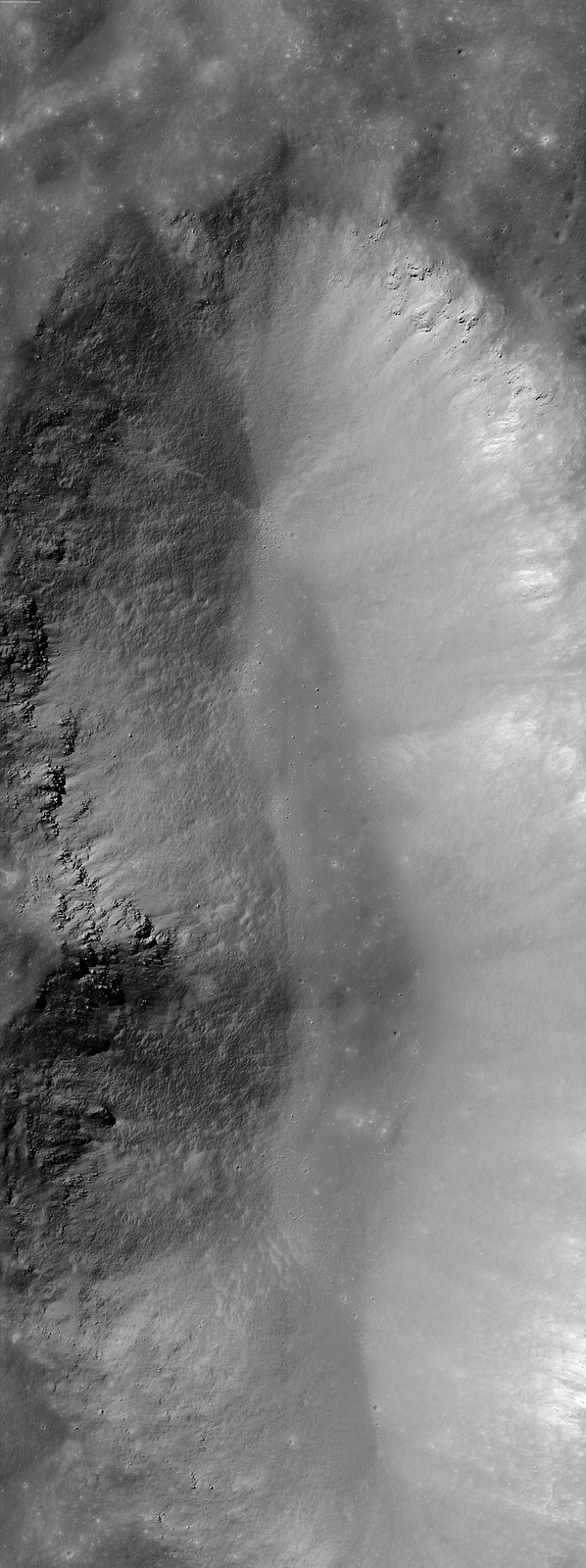
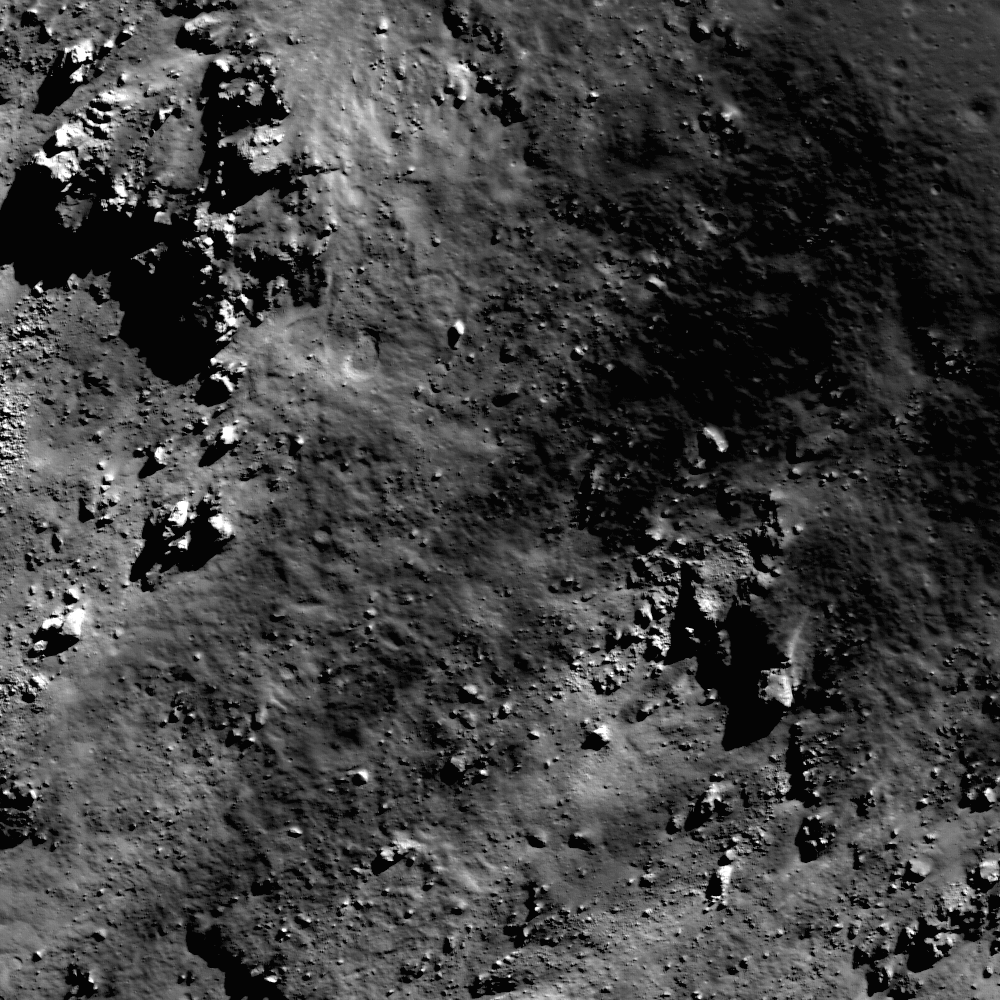
Low reflectance material cascaded down the wall of what is likely a volcanic vent in the southwestern portion of the Orientale basin. Image field of view approximately 750 meters, from LROC NAC observation M1150135366,  LROC orbit 21493, March 22, 2014; incidence 37.45° resolution 77 cm from 75.55 km over 30.12°S, 262.19° [NASA/GSFC/Arizona State University].
H. Meyer
LROC News System

Pyroclastic deposits on the Moon are often identified by a mantled appearance and low reflectance. These deposits are the result of an explosive eruption (or many) that involved a volatile component, likely carbon monoxide. The resulting fine-grained debris, including glass beads like those sampled by Apollo 17, gives the surface a dark, mantled appearance (See WAC image below).

So, where did the low reflectance material come from? The low reflectance material here flowed down the wall of a kidney-shaped (reniform) depression located at the center of the annulus.
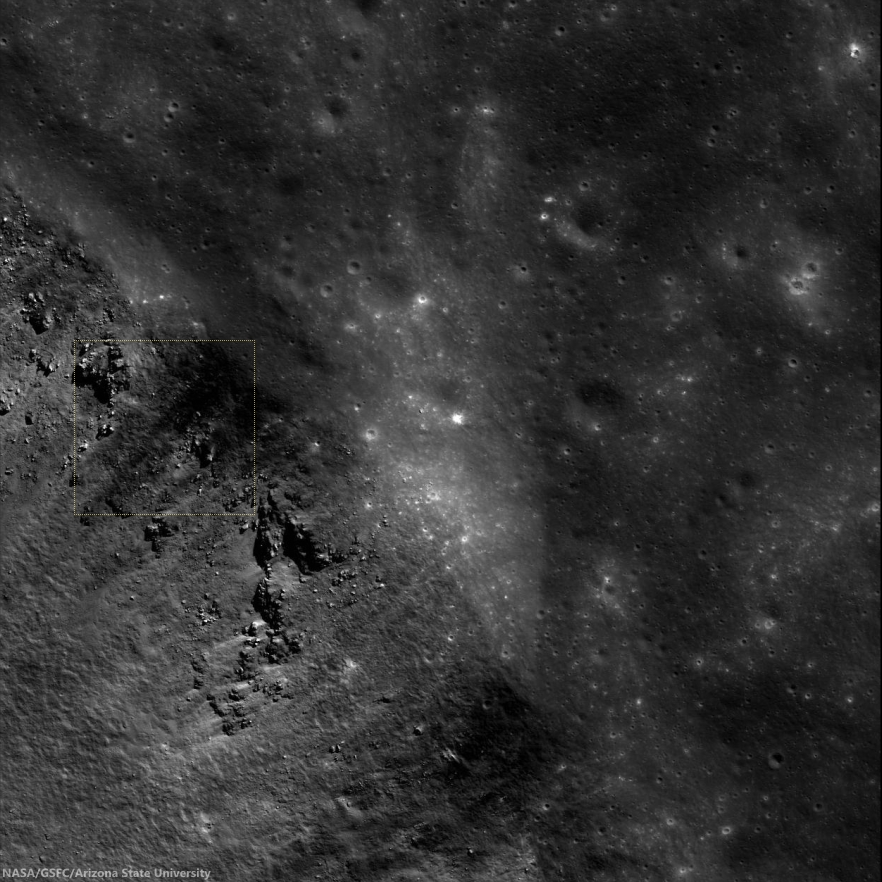
Expanded 3.8 km-wide context for LROC Featured Image released April 15, 2014 - outlined box - northwestern rim of pyroclastic vent, southern frontier Mare Orientale impact basin. Mosaic of left and right frames of LROC NAC observation M1150135366  [NASA/GSFC/Arizona State University].
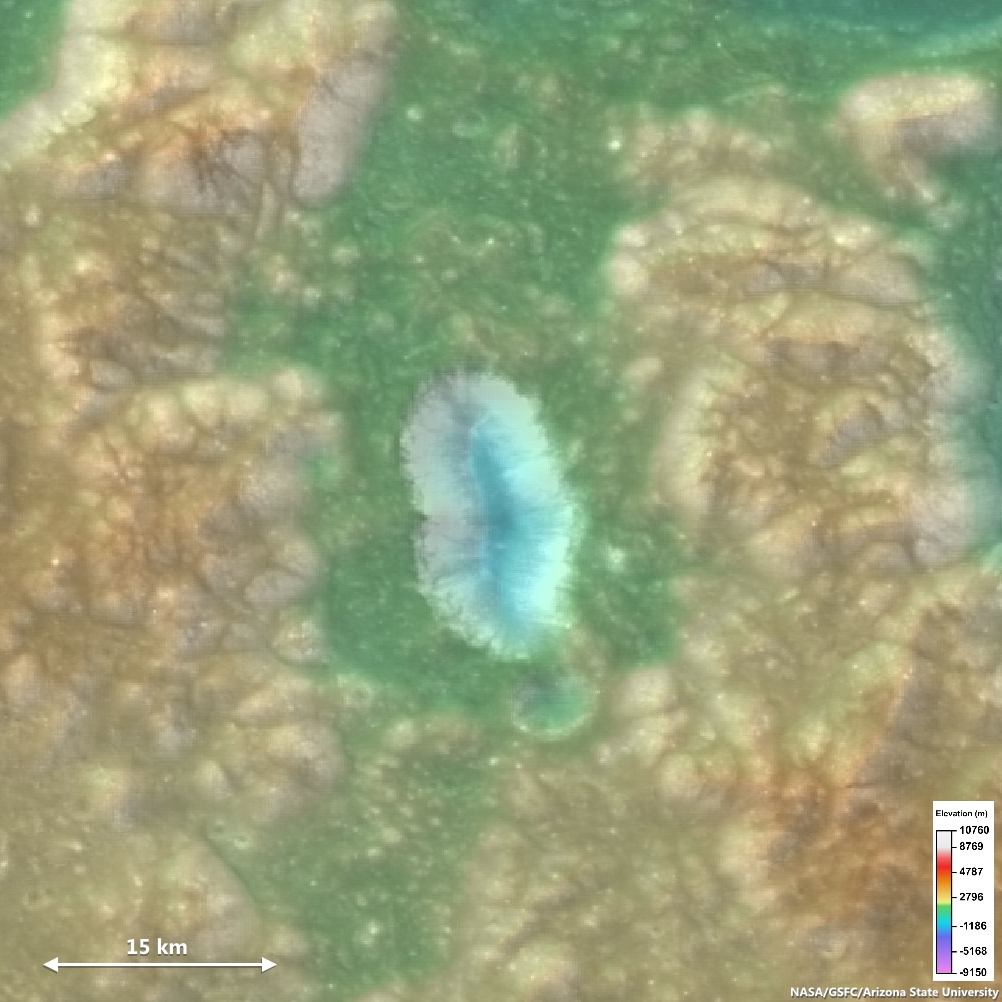
The lack of a discernible crater rim and irregular shape make this depression a suspect (See WAC image below). The walls of the depression are steep-sloped, yet the floor is fairly flat, which is best observed in a color-shaded digital terrain model (DTM). Such reniform depressions are observed in other locations across the Moon, such as Sulpicius Gallus, interpreted to be a pyroclastic source vent.

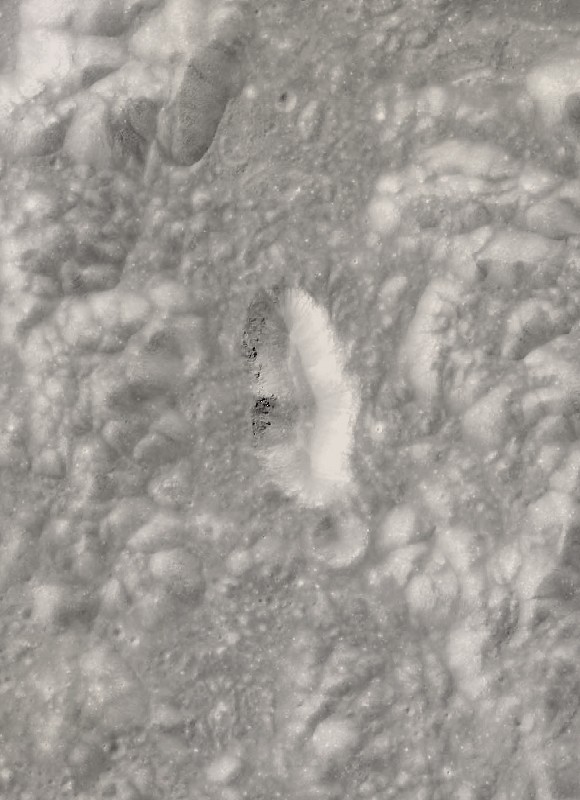
A higher angle of incidence, in this 2.8 x 7.5 km-wide field of view, washes out much of the finer grain albedo, though a look at the larger 40 percent -3760 x 9920- reproduction does reveal much of the detail of the rim, walls, boulder trails and debris-filled floor of the two-kilometer deep "smoke ring vent."  The area of interest on the upper right, also in the LROC Featured Image can be compared. LROC NAC mosaic of the left and right frames of observation M1099502843, LRO orbit 14378, August 13, 2012; illumination incidence angle 45° at 76 cm per pixel resolution, from 72.13 km over 30.11°S, 261.81°E [NASA/GSFC/Arizona State University].
If the kidney-shaped depression is the source of the low reflectance material, it is likely that material was ejected from the source vent at high velocity, creating an umbrella-shaped plume and depositing the dark, fine-grained material in a ring around the vent.

The larger than lunar average - 12.5 x 19.75 km pyroclastic "smoke ring vent," on the southwestern frontier of the Mare Orientale impact basin, is also hub to a regionally distinct 190 km-in diameter ring of darker material that, while not apparent in topographic studies, stands out in all native reflectance photography. Medium resolution Chang'e-2 Global albedo Mosaic [CNSA/CLEP].
Pyroclastic deposits are currently of interest to lunar scientists as a possible resource for future missions to the Moon. Such deposits are rich in hydrogen and helium-3, two potential resources for energy production, and iron and titanium, which have engineering applications.

Elevation study, LROC WAC-derived GLD100 topography in color-coded overlay onto LROC global normalized reflectance data. The high mountains of the concentric Orientale impact basin ring, where the vent is nested, offers a high vantage. Elevations range over 4000 meters in 10 km [NASA/GSFC/Arizona State University].
LROC WAC normalized reflectance 643 nm, of the low-reflectance pyroclastic annulus on the southwest Orientale impact basin. The annulus is approximately 180 km in diameter [NASA/GSFC/Arizona State University].
The necessary capabilities for utilizing resources such as these in-situ, or on site, are currently under development. In-situ resource utilization (ISRU) is critical to the future of exploration of areas that would otherwise be beyond our reach, both physically and financially.

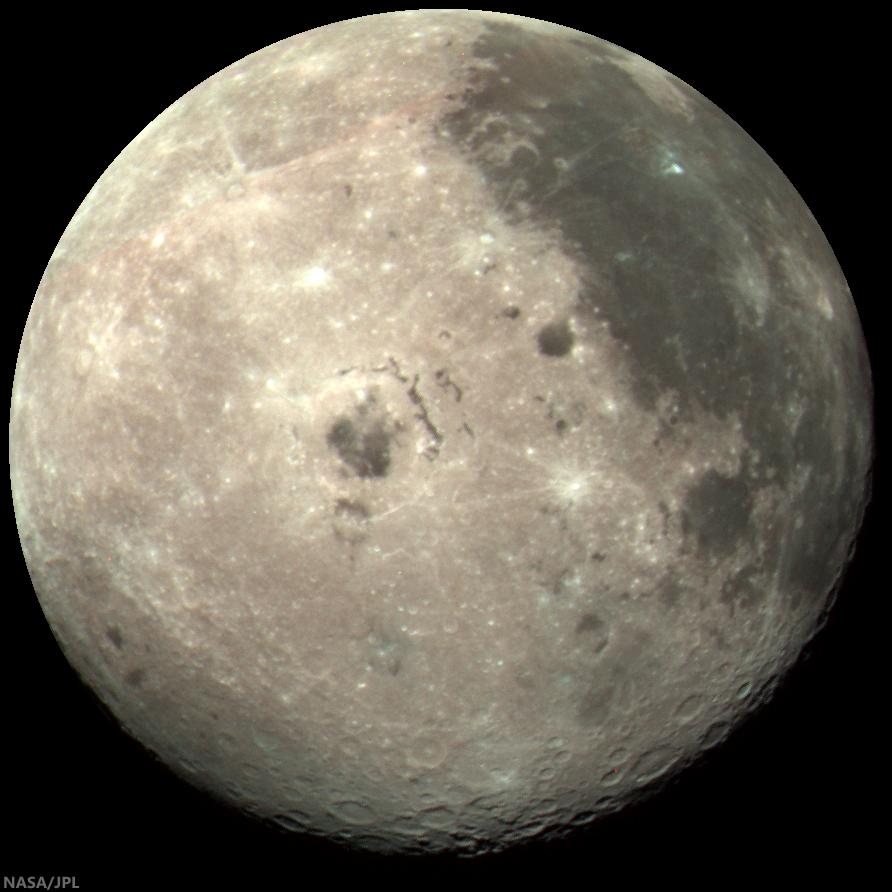
Another opportunity to display this stacked three-color image of the Moon's western hemisphere, which features Mare Orientale so prominently and demonstrates that the pyroclastic annulus south-southwest of its central plain, is large and prominent enough to be photographed from more than half a million kilometers away. In this case, captured by the Jovian probe Galileo at 1735 UT, December 9, 1990 [NASA/JPL].
Do some investigating of your own with the full NAC, HERE.

Related Posts:
Pyroclastics and an unnamed Procellarum vent
Source vent for Rima Prinz I
Craters on the Schrödinger pyroclastic cone
Morphology and distribution of volcanic vents in the Orientale basin from Chandrayaan-1
Unassuming volcanic vent north of Aristarchus Plateau
New pyroclastic structures identified using LROC data
A dark cascade at Sulpicius Gallus
Hyginus and pyroclastics
Layer of pyroclastics in Sinus Aestuum
Lavoisier Pyroclastics
Pyroclastic Excavation
Pyroclastic Trails
Pyroclastic Vent at Orientale DTM

Tuesday, February 19, 2013

Water found in the Apollo 15 'Genesis Rock'

Called the "Genesis Rock," Apollo 15 sample of unbrecciated anorthosite was thought to be a piece of the moon's primordial crust. In a paper published online February 17 in Nature Geoscience a University of Michigan researcher and colleagues report traces of water have been found in the sample [NASA/Johnson Space Center].
Jim Erickson
University of Michigan News Service

Traces of water have been detected within the crystalline structure of mineral samples from the lunar highland upper crust obtained during the Apollo missions, according to a University of Michigan researcher and his colleagues.

The lunar highlands are thought to represent the original crust, crystallized from a magma ocean on a mostly molten early Moon. The new findings indicate the early Moon was wet and that water there was not substantially lost during the Moon's formation.

The results seem to contradict the predominant lunar formation theory -- that the Moon was formed from debris generated during a giant impact between Earth and another planetary body, approximately the size of Mars, according to U-M's Youxue Zhang and his colleagues.

"Because these are some of the oldest rocks from the Moon, the water is inferred to have been in the Moon when it formed," Zhang said. "That is somewhat difficult to explain with the current popular Moon-formation model, in which the Moon formed by collecting the hot ejecta as the result of a super-giant impact of a Martian-size body with the proto-Earth.

"Under that model, the hot ejecta should have been degassed almost completely, eliminating all water," Zhang said.

A paper titled "Water in lunar anorthosites and evidence for a wet early Moon" was published online February 17 in the journal Nature Geoscience. The first author is Hejiu Hui, postdoctoral research associate of civil & environmental engineering & Earth sciences at the University of Notre Dame. Hui received his doctorate at U-M under Zhang, a professor in the Department of Earth and Environmental Sciences and one of three co-authors of the Nature Geoscience paper.

The Genesis Rock presented itself in situ on top of a pedestal, "as though it had been waiting for someone to retrieve it." Apollo 15 Dave Scott and Jim Irwin, aware on sight of the sample's potential value, were careful to photograph the find both before and after retrieval. AS15-86-11670 [NASA/ALSJ].
Over the last five years, spacecraft observations and new lab measurements of Apollo lunar samples have overturned the long-held belief that the Moon is bone-dry. In 2008, laboratory measurement of Apollo lunar samples by ion microprobe detected indigenous hydrogen, inferred to be the water-related chemical species hydroxyl, in lunar volcanic glasses. In 2009, NASA's Lunar Crater Observation and Sensing satellite, known as LCROSS, slammed into a permanently shadowed lunar crater and ejected a plume of material that was surprisingly rich in water ice.

Hydroxyls have also been detected in other volcanic rocks and in the lunar regolith, the layer of fine powder and rock fragments that coats the lunar surface. Hydroxyls, which consist of one atom of hydrogen and one of oxygen, were also detected in the lunar anorthosite study reported in Nature Geoscience.

In the latest work, Fourier-transform infrared spectroscopy was used to analyze the water content in grains of plagioclase feldspar from lunar anorthosites, highland rocks composed of more than 90 percent plagioclase. The bright-colored highlands rocks are thought to have formed early in the Moon's history when plagioclase crystallized from a magma ocean and floated to the surface.

The infrared spectroscopy work, which was conducted at Zhang's U-M lab and co-author Anne H. Peslier's lab, detected about 6 parts per million of water in the lunar anorthosites.

"The surprise discovery of this work is that in lunar rocks, even in nominally water-free minerals such as plagioclase feldspar, the water content can be detected," said Zhang, James R. O'Neil Collegiate Professor of Geological Sciences.

"It's not 'liquid' water that was measured during these studies but hydroxyl groups distributed within the mineral grain," said Notre Dame's Hui. "We are able to detect those hydroxyl groups in the crystalline structure of the Apollo samples."

The hydroxyl groups the team detected are evidence that the lunar interior contained significant water during the Moon's early molten state, before the crust solidified, and may have played a key role in the development of lunar basalts. "The presence of water," said Hui, "could imply a more prolonged solidification of the lunar magma ocean than the once-popular anhydrous Moon scenario suggests."

The researchers analyzed grains from ferroan anorthosites 15415 and 60015, as well as troctolite 76535. Ferroan anorthosite 15415 is one the best known rocks of the Apollo collection and is popularly called the Genesis Rock because the astronauts thought they had a piece of the Moon's primordial crust. It was collected on the rim of Spur Crater (Science Station 7) during the Apollo 15 mission.

Rock 60015 is highly shocked ferroan anorthosite collected near the lunar module during the Apollo 16 mission. Troctolite 76535 is a coarse-grained plutonic rock collected during the Apollo 17 mission.

Co-author Peslier is at Jacobs Technology and NASA Johnson Space Center. Fourth author of the Nature Geoscience paper, Clive R. Neal, is a professor of civil and environmental engineering and earth sciences at the University of Notre Dame.

Wednesday, October 17, 2012

Water from the Sun

The Sun exudes a constant stream of hydrogen, called the "solar wind."
Paul D. Spudis
Smithsonian Air & Space

New data returned from a fleet of orbiting satellites changes our perceptions of the history and processes of the Moon.  Concentrated at both lunar poles, and to date the most striking discovery, is the documentation of the presence of large amounts of water.  Though this water has been confirmed by several differing techniques (from multiple missions), we remain uncertain about its source.  Two principal origins have been proposed: 1) water added by the in-fall of water-bearing meteorites and comets during the impact bombardment of the Moon; and 2) the manufacture of water from hydrogen implanted in the lunar soil by the wind from the Sun.

A recent discovery may shed some new light on the origin of lunar water.  Researchers conducting detailed examination of tiny fragments of glass in soil returned by the Apollo astronauts found the molecule hydroxyl (OH) present in the glass.  Interestingly, the isotopic composition of these OH molecules indicates the bulk of the hydrogen comes from the Sun, not from cometary and asteroidal impacts.

The Moon has no atmosphere and no global magnetic field.  As a result, the solar wind – the stream of atoms and molecules constantly emitted by the Sun – directly impinges upon the lunar surface.  Most of this solar wind consists of hydrogen, either in the form of neutral atoms or positively charged ions (i.e., protons).   After it encounters the Moon, this spray of hydrogen has a complex fate, with at least some of it being implanted into the lunar dust.  In a process called adsorption, many of the hydrogen atoms stick to the surfaces of the dust grains.  The amount of adsorbed hydrogen varies by position and chemical composition around the Moon, but it can be present in quantities ranging from less than 10 to over 100 parts per million (ppm).

Impact glass is a major component of lunar regolith – up to 60% by weight of the soil at some landing sites.  The constant bombardment of the lunar surface by microscopic meteorites crushes and grinds up the surface rock, continually mixing the outer layer of the Moon.  When a micrometeorite strikes a rock, it forms a micro-crater (wholly melting the surface beneath this pit) and creates a clear, chemically homogeneous glass particle.  However, when a micrometeorite strikes lunar soil instead of rock, its energy is converted mostly into heat.  This flash heating creates a mixture of melt and mineral debris called agglutinate glass.

The new work details results of analyses of agglutinates returned from several lunar landing sites.  Their study measured both the amounts of hydroxyl present and its isotopic composition.  A normal atom of hydrogen is a single proton and an electron.  But in a rare form of hydrogen, called deuterium, the nucleus contains both a proton and a neutron.  The ratio of this form of “heavy hydrogen” to “normal” hydrogen is unique for different materials throughout the Solar System.  By tracking the D/H ratio in the sample, one can assign a source origin to the measured hydrogen.

When the lunar agglutinate glasses were studied, it was found that their D/H ratios indicated that most of the hydrogen in the hydroxyl molecules came from the Sun and not from cometary or meteoritic sources.  However, the source of the hydrogen is not completely solar, as the D/H ratios suggest some mixing with a subordinate component of either lunar or cometary origin.  The authors of this study suggest that the hydroxyl found on the Moon was created when a small impact flash heated the soil, releasing the adsorbed hydrogen and chemically reducing the metallic oxides in the soil into native metal (found as extremely tiny grains on the surfaces of the agglutinates) and hydroxyl molecules.  Multiplied by billions, such a process could account for the generation of water on the lunar surface.  Subsequent migration of these molecules toward cooler-than-average areas of the Moon (i.e., the higher latitudes, up to and including the poles) may have created the polar ice deposits found by numerous techniques.  In the view of the authors of this study, lunar water comes mostly (but not entirely) from the Sun.  This constant process, occurring on the sunlit hemisphere of the Moon, could create an enormous reservoir of hydroxyl molecules (in motion due to their thermal instability), slowly but constantly moving toward the poles.

If such a process occurs on the Moon, one might expect the accumulation of water in every location where water is stable (i.e., within every permanently dark and cold region near both poles).  But it appears that ice at the poles is not uniformly distributed, occurring in high concentration in some areas while absent in others.  This pattern suggests that the source of polar water might be controlled by a non-equillibrium process, such as episodic bombardment by asteroids and comets.  In fact, both solar wind-produced and cometary water may be present at the poles, but until the ice there is actually analyzed for its D/H content, we cannot be certain of its origin.  Such a measurement does not require the return of a polar ice sample to the Earth.  It could be made remotely in situ on the Moon with a properly instrumented robotic spacecraft.

It is important to emphasize that although the quantities of water generated by this process are potentially very large, the hydroxyl in agglutinate glass should not be considered an economic resource.  These molecules occur globally but at very low levels of concentration (tens of ppm).  Even if this water is the primary and ultimate source reservoir of lunar water, the migration of the molecules and their subsequent collection by the cold traps near the poles serve as a concentrating mechanism, where ice accumulates in large quantities, confined within small areas — the classic definition of an ore body.

What a change has occured in the mindset the lunar science community in the past few years!  From a bone-dry lump of rock in space to a complex, still mysterious body with a dynamic hydrological cycle.  It’s clear that many more discoveries about our Moon and its resources have yet to be revealed.  The more we learn about the Moon, the greater the range of processes we must account for and the more subtle and complex its history becomes.

Originally published at his Smithsonian Air & Space blog The Once and Future Moon, Dr. Spudis is a senior staff scientist at the Lunar and Planetary Institute. The opinions expressed are those of the author and are better informed than average.

Thursday, September 24, 2009

Lunar Weather: many miles wide, 2 mm deep

Chart highlighting the calibration observations by Deep Impact of the northern polar regions of the moon on June 9. At left is a reference albedo map from Clementine while the other images are different representations of Deep Impact data, including measurements of brightness, temperature, and the strength of a signature for water and hydroxyl. The water signature varies significantly across the lunar surface but, while the strength of the water signature is not correlated with any terrain type it is highly dependent on temperature. Since successfully carrying out a spectacular impact experiment on comet Tempel 1 July 4, 2005, Deep Impact spacecraft has been on an extended mission, called "EPOXI," which will culminate in a flyby of comet Hartley 2 on November 4 2010. The spacecraft observed the moon for calibration purposes on several occasions en route to its second cometary encounter. [NASA/JPL-Caltech/University of Maryland]

Short-range 'lunar hydrology'

Observations from NASA's Deep Impact mission of the moon's north pole June 2 and 9, 2009 revealed changes in the amounts of water and hydroxyl. In the week between these datasets, the moon rotated 90 degrees. A volcanic mare terrain (labeled 'M') is observed in the morning on June 2 and at local noon by June 9 and a highland unit ('H') begins at noon and rotates to evening by June 9. Deep Impact observed a significant change in the strength of a water and hydroxyl signature as the moon rotated around. The highland unit has a weaker signal near noon (red) and a stronger signal by evening (blue). Taken together the data show a "systematic" change in water loss from morning to noon, recovery in the afternoon and return to "steady state" by evening. This daytime cycle suggests that hydrogen ions in the solar wind may be a source for re-hydration. [NASA/JPL-Caltech/University of Maryland]