Showing posts with label Chandrayaan-2. Show all posts

Saturday, August 17, 2013

ISRO Chandrayaan-2 will go without Roscosmos

India's follow-up to its highly successful first lunar orbiter, Chandrayaan-2, together with a small remotely-operated rover landed on the Moon by a Russian spacecraft, had previously been delayed to 2013 and 2016 [ISRO/IKI].
P. Sunderarajan
The Hindu

"Chandrayaan 2 was originally envisaged to be a joint mission between ISRO (Indian Space Research Organisation) and the Russian Federal Space Agency, Roscosmos....Following the failure of the Russian-led interplanetary mission, Phobos-Grunt, a sample return mission to Phobos, one of the moons of Mars, the Russian agency reviewed their inter-planetary missions and decided to increase the mass of the moon lander...The Russian agency consequently suggested to ISRO two opportunities for launching of its Chandrayaan 2 rover - either 2015 or 2017 aboard Soyuz, the Russian spacecraft with a rider that the 2015 opportunity could involve mass limitation for the rover and entitle a higher risk....In the wake of these inputs, the ISRO conducted a high level review of the Chandrayaan 2 programme under the chairmanship of Prof. U.R.Rao. The study recommended that India could itself realise a lander module in a few years and that it could go in for the mission on its own."

Read the stories HERE, HT to "Spacetoday.net"

Thursday, September 13, 2012

Rogozin presses Russian lunar base, Chandrayaan-2 delayed by Proton and Phobos-Grunt investigations

As Russia’s Deputy Prime Minister Dmitry Rogozin continues to deployment of a manned base lunar base 'by 2020,' ISRO declines comment on Chandrayaan-2 delay 'until 2016' India's follow-up to its successful first lunar orbiter, together with a small remotely operated rover landed on the Moon by a Russian spacecraft had previously been delayed to 2013 and 2013 [ISRO/IKI].
According to Russian and Indian sources, Russian Prime Minister Dmitry Rogozin continues to lobby for  a permanent station on the lunar surface "before 2020," calling it an "over-arching task," a "super goal," or очень задача for the Russian state, "stimulating the development of science and industry."

Reports followed an interview recorded on Vesti FM Radio earlier this month.

“Russian cosmonauts learned to work in orbit and gained needed experience there," Rogozin said. "Why shouldn't they try to build a full-scale lunar base to set the groundwork for further leaps in science?”

Indian press reports have covered the interview in context with little more information than previously known about Russia's planned role in Chandrayaan-2. Indian Space Research Organisation (ISRO) chief K. Radhakrishan recently declined comment on reports that the Chandrayaan-2 lunar orbiter, lander and rover mission will now be unavoidably delayed until 2016.

"For Chandrayaan-2, Russia has to provide the lander, and India will build the lunar orbiter and rover," Radhakrishan said. "Russia has said they would come to us with a decision (regarding their grunt-class Luna-Resurs lander) after their reviews.”

Russia is reviewing their inter-planetary missions in light of recent set-backs, particularly following the November failure of Phobos-Grunt  and, more recently, after the failure of Sino-Russian vehicle that was tied to a faulty Proton booster.

The results of at least one such investigation, into the Proton failure, were reported out September 12, according to Anatoly Zak of RussianSpaceWeb.com.

Chandrayaan-2 had already been delayed until 2014, planned for launch on India's troubled Geosynchronous Satellite Launch Vehicle (GSLV).  Radhakrishnan confirmed ISRO will prepare the booster, the lunar orbiter and rover, but he declined comment on a report from Russia that India’s second lunar mission must be delayed until at least 2016.

Lev Zelyony, head of the Russian Space Research Institute (IKI), said in February the Luna-Resurs lander might not be ready before 2016.

“There were plans to launch the Luna-Glob and Luna-Resurs missions in 2015,” Zelyony told RIA Novosti in February. “But dates may have to be moved, because the NPO Lavochkin-design for the ill-fated Phobos-Grunt vehicle are integral also to Russia's planned unmanned lunar projects and "clearly need to be reviewed.”

Saturday, April 28, 2012

Chandrayaan-II: ISRO Annual Report

Russian Luna Glob lander with ISRO rover segment of Chandrayaan-2 configuration [ISRO/IKI].
According to the just released India Space Research Organisation (ISRO) Annual Report (PDF) plans still call for India's second lunar mission Chandrayaan-2 to consist of an Orbiter and Rover integrated to a Russian lander.

In February published reports confirmed a goal for launching Chandrayaan-2 in 2013 were push back to at least 2014 (See "Chandrayaan-2 may miss 2013 launch date," February 21).

"It is an Indo-Russian collaborative mission," according to the wide-ranging Report. "The scientific objectives of the mission are to further improve our understanding of the origin and evolution of the Moon using instruments on-board an Orbiter together with in-situ analysis of samples and studies of lunar regolith by both remote and direct analysis.

"India and Russia are cooperating to realize a joint unmanned moon mission with India responsible for launch," the Orbiter and Rover and Russia responsible for the Lander. "Significant progress has been made in the past year," according to the Report, "wherein both sides discussed Orbiter-Lander-Rover configuration" and joint mission operations.

"Indian instruments on both the Chandrayaan-2 Orbiter and Rover have been finalized, and both nations are working to launch Chandrayaan-2 in 2014 using India’s GSLV booster.

Chandrayaan-2 Orbiter Craft (OC)

The Chandrayaan-2 Orbiter configuration has been changed from a 12 to 13k design after additions to the payload capacity of India's indigenous Geosynchronous Satellite Launch Vehicle (GSLV), enabled by larger propellant tanks.

The Chandrayaan-2 mission outline was revised to inject the vehicle bus into a lower initial orbit (170 X 16980 km) and higher lift-off weight of 3200 kg. Propulsion system has been adapted to increase fuel capacity.

"Other completed activities" related to Chandrayaan-2, according to the Report, were "finalization of electrical and mechanical interfaces, payload interfaces; preliminary design reviews of bus systems; power, attitude control amd telemetry electronics, tracking and command, RF and data handling systems, thermal control upgrades and propulsion."
Prototype testbed of Chandrayaan-2 lunar
rover, August 2010
[ISRO].
Chandrayaan lunar rover

The ISRO Annual Report appears confident tasks related to the development of the Chandrayaan-2 lunar rover that have been completed include configuration of Rover and instrument payload, and Preliminary Design Review of all subsystems on both the Orbiter and Rover. 

A Lunar Terrain Test Facility has been set up at the Maratahalli Campus in Bangalore, an integration and testing facility for spacecraft larger than 4 tons, where testing in micro-gravity and lunar surface simulations will soon begin..

The Chandrayaan-2 Orbiter and Russian-GK Lander Craft (LC) together with the LC and Rover interfaces were finalized this past year in three face-to-face meetings with Russian delegations, "apart from regular mail communication and teleconferences," according to the Annual Report. 

Landing site identification "has been initiated," and future workflow schedules "have been "worked out."

Monday, April 9, 2012

Russian Academy plans Lunokhod-3 and 4

Schematic representation of the Luna-LD-Rover concept, as presented to the Lunar Exploration Analysis Group (LEAG) annual meeting in 2010. The overall robust rover and experiments, designed for long-duration exploration through several lunar days and nights, builds on the successful Lunokhod scenarios [Institute for Space Research - Moscow].
The Russian Academy of Sciences has prepared early plans for two Lunokhod-class unmanned lunar rovers, "Lunokhod 3 and Lunokhod-4," to “work the Moon” between 2020 and 2023, this according to a document obtained by the news agency RIA Novosti. A stationary “landing station” is pegged for 2024 “as the first steps to form the future manned lunar base” sometime later.

As the heart of the Soviet Union, Russia was the first and only nation to deploy unmanned rovers on the Moon, Lunokhod-1 in 1970 and Lunokhod-2 in 1973.

Russia completed the last soft landing and sample-return mission on the Moon, Luna 24, in 1976.

The Luna-Glob polar lander, together with its Russian orbiter, originally planned for 2012, and the Luna Resurs polar lander, with India's Chandrayaan-2 orbiter and mini-rover were planned for 2013. Set backs caused by systemic problems, highly manifested in the Phobos-Grunt failure, have resulted in a national reexamination of Russia's unmanned and manned space exploration plans, beyond participation in the International Space Station [IKI].
Missions originally developed for 2012 and 2013, Luna-Resurs and Luna-Glob, are apparently to be pushed back to after 2015. Whether India will continue to participate in those early missions is a question still up in the air. In February the India Space Research Organisation (ISRO) postponed indefinitely the Chandrayaan-2 lunar orbiter and rover combination. India’s rover was designed to be ferried to the surface on Luna-Resurs.

“Under the document," obtained by RIA Novosti, core aims of the Russian scientists are to study polar regions of the Moon and gas-dust exosphere,” according to the April 7 news account. An overall goal of the Academy is to collect samples “and find the most comfortable areas for lunar base deployment.

“The lunar rovers and the landing station will form first elements of space infrastructure for a lunar testing area with prospects of deployment of Russia’s lunar base.”

Tuesday, February 21, 2012

Chandrayaan-2 may miss 2013 launch date

The hybrid Indo-Russian lunar lander with rover segment of ISRO's Chandrayaan-2 mission has been planned for 2013. Problems with the Sub-continent's indigenous heavy-booster are reported to be the cause [ISRO].

Kumar Chellappan
DNA, Mumbai
HT / Robert Zimmerman


If the estimates of space experts are anything to go by, India’s tryst with moon, Chandrayaan-2, may not happen as scheduled in 2013. Prime reason, cited by those in the know, is country’s inability to perfect the cryogenic engine technology.

“Unless you have the cryogenic engine technology, you will not be considered a space faring nation,” K Sasikumar, former head of Liquid Propulsion Centre of Indian Space Research Organization (ISRO) told DNA.

India has perfected the Polar Satellite Launch Vehicle (PSLV) with which it can put only small satellites into the Low Earth Orbit, which is roughly 900 km from the earth. “We need heavy Geosynchronous Satellite Launch Vehicles (GSLV) for injecting heavy communication satellites weighing more than one tonne into the Geo-Synchronous Orbit (GSO), which is 36,000 km from the earth,” said Sasikumar.

Chandrayaan-2 project director Mylswamy Annadurai, however, refused to comment on the issue. “I am not authorized to speak to the media on the project,” he said.

Prototype of Chandrayaan-2 rover, as developed by August 2010.
Though ISRO tried to launch GSLV with an indigenously developed cryogenic engine in 2010, it plunged into the Bay of Bengal. India has launched seven GSLVs from Satish Dhavan Space Centre at Sriharikotta. Six of them were powered by cryogenic engines from Russia.

Though ISRO chairman K Radhakrishnan claimed indigenous cryogenic engine would complete ground tests, a senior ISRO scientist said it will take years for us to fully operationalise and integrate the technology to the GSLV. “It is not an easy job. The fuel is liquid hydrogen and oxidant is liquid oxygen. You have to pump both liquid hydrogen and oxygen to create the energy and thrust needed to lift the heavy mission from the gravitational pull and put the payload into GSO,” said Nambi Narayanan, former chief of India’s cryogenic program.

Both Nambi Narayanan and Sasikumar had to leave ISRO following the 1993 spy scandal following which the cryogenic engine programme suffered a major setback.

“We don’t have right persons in right places in ISRO. No action has been taken over the FAC report [Failure Analysis Committee which went into the failures of two successive GSLV missions in 2010 submitted their findings and recommendations to the ISRO in early 2011] ,” said G Madhavan Nair, former ISRO chairman and an FAC member. He said the Antrix-Devas deal has been projected as a scam only as a diversionary tactic. “Till we perfect the cryogenic technology, we have to pay ARIANE, the European Space Consortium at French Guiana through our nose,” he said.

It is also said nations such as the United States, France, Japan and China do not want India to come up with its engines as they do not want India to challenge their monopoly in launch business. The US charges more than $50,000 per kg to launch a space craft while India would be able to bring down the cost to $18,000 per kg.

Friday, September 3, 2010

Chang'e-2 sets stage for future Moon missions


China's second lunar orbiter Chang'e-2 began as back up for Chang'e-1 (2007-2009). Scheduled for a possible October launch, Chang'e-2 should arrive sooner, orbit the Moon closer and gather better data. If all goes well the vehicle should allow rehearsal opportunities for China's first soft landing on the Moon in 2013, and a better camera on Chang'e-2 may gather 1 meter resolution photographs of preferred landing sites.

China's unmanned space program has only one deep space target: the Moon. The United States may be preparing to abandon manned exploration of the lunar surface but the new era of international lunar exploration, a 'second moon race,' continues. India, Russia and China may each have achieved soft landings there before the U.S. deploys the first, if any, of planned nodes for an International Lunar Network (ILN). After Chandrayaan-2 and Chang'e-3, Chang'e-4 may return the first lunar samples to Earth since the Soviet's Luna 24 in 1976.

From Xinhua -- China's second lunar probe, Chang'e-2, will transition much faster than its predecessor, reaching lunar orbit in a shorter period of time, a top Chinese space scientist told Xinhua Friday.

China launched Chang'e-1 from Sichuan October 24, 2007. The first of China's planned unmanned lunar missions ended a 16-month mission March 1, 2009 when it was intentionally de-orbited into Mare Fecunditatis.

"It is estimated Chang'e-2 can reach lunar orbit within five days, compared to 13 days, 14 hours and 19 minutes for Chang'e-1," Ouyang Ziyuan, chief scientist at the China Lunar Exploration Project, told Xinhua.

"China had not been to Moon before Chang'e-1 so we were very prudent and adjusted its transfer orbit in a very slow manner. It traveled 2.06 million kilometers before lunar orbit insertion," Ouyang said. "It's different now. We are more certain about the launch and can send Chang'e-2 directly to the moon, and we have also planned the transfer orbit to reach the Moon within five days."

Plans call for Chang'e 2 to orbit 100 km closer to the moon with a higher resolution camera, he said.

According to China's three-phase lunar exploration 'road map,' the country will first launch the Chang'e-2 and afterward soft-land Chang'e-3 on the moon in 2013 and, in 2017, Chang'e-4 will return a lunar sample to Earth.

Experts have speculated the Chang'e-2 mission will allow China to begin mastering soft-landing techniques for Chang'e-3 and 4, short of terminal descent. Careful lowering of its orbit to rehearse everything short of terminal descent that otherwise might begin after passing perilune could allow low passes over an intended target and an opportunity to take high-resolution photography.


Public mock-up of the China Lunar Exploration Program (CLEP) Chang'e-4, in development for a soft landing on the Moon in 2013. China's methodical dual-track developmental plans, its manned and unmanned (lunar), space programs seem devoted more to engineering design capability over science [Xinhua].

Friday, August 13, 2010

Proposed GLXP rule changes inspire concern

Updated September 15, 2010 1825 UT

Google Lunar X-Prize (GLXP) team SELENOKHOD in Russia demonstrates a test-bed prototype of the lunar rover the group hopes will win a minimum $20 million purse. However, Russian resources now committed to a planned 2013 joint Russian & Indian lunar mission has put a strain on their timetable [Selenokhod].

Peter J. Brown
Asia Times Online

Government space agencies are taking a closer look at the Google Lunar X Prize (GLXP) contest, an international competition to safely land a rover on the moon. Several GLXP teams include space researchers and engineers in Asia on their rosters, and NASA is rolling out a program that might provide US GLXP teams with a $30 million market for their mission data. Other countries may not sit still for long in light of this development.

That is the good news. The not so good news is that as the result of a proposed GLXP rule change, the $20 million GLXP grand prize could be reduced by $5 million if a government-backed lunar mission successfully lands and deploys a rover in advance of any of the 21 GLXP teams accomplishing the same feat. All GLXP teams must be 90% privately funded.

According to the original set of GLXP rules, the grand prize would be awarded to the team that first landed a rover on the Moon and subsequently able to travel at least 500 meters while simultaneously transmitting data and a live TV signal back to Earth. The deadline has been December 31, 2012. If that objective was not achieved, however, a GLXP team could still win a reduced grand prize of $15 million if it fulfilled all requirements by December 2014.

Now, under the proposed so-called GLXP "Master Team Agreement" (MTA), revised rules, including the $5 million cut described above, are taking shape. All remaining prizes, including a $5 million second prize and several bonus prizes, would be unaffected.

Under proposed changes to contest rules, the 2012 deadline is pushed ahead three years to December 31, 2015. However, even that deadline might be extended by the California-based X Prize Foundation (XPF).

Several countries, including the European Space Agency (ESA), are planning to conduct lunar landings over the coming decade. The joint Indian Space Research Organization (ISRO)-Russian Federal Space Agency (Roskosmos) Chandrayaan-2 orbiter and rover / Luna-Resource lunar lander scheduled for 2013, appears first in line.

"Almost every space agency is talking about missions to the lunar surface these days. Putting fixed calendar dates on them is very difficult, though," said William Pomerantz, senior director of space prizes at the XPF.

"We are excited about and are following developments on other fronts, including China's Chang'e 3, Japan's SELENE-2, The Indo-Russian Luna-Resource /Chandrayaan-2, ESA's MoonNEXT, a variety of potential NASA robotic missions and possibly the UK's MoonLite, along with eventual nodes of the proposed International Lunar Network (ILN)."

"At this point, it's difficult to say with certainty which will be which," said Pomerantz

Read the full article, HERE.

Monday, August 9, 2010

Chandrayaan-2 rover prototype


Prototype of the ISRO Chandrayaan-II lunar rover, under development at IIT-Kanpur. The Mechanical Engineering Department there has been given the task of constructing the rover's imaging and control systems [IIT-Kanpur].

Pradeep Mohandas
Parallel Spirals

Perhaps for the first time, and hopefully not the last time, the Indian Space Research Organisation (ISRO) is involving under-graduate and post-graduate students in the development of a major space mission. (I am planning to do a story on this for the Moon Miners Manifesto India Quarterly this October and will add more details, when possible.

India's Minister of State for Science & Technology and Earth Sciences, Prithviraj Chavan, confirmed in India's Parliament ISRO engineers are developing and building Chandrayaan-II, together with Russia. India's second lunar mission will consist of an Indian orbiter and a Russian lander ferrying an Indian lunar rover, all equipped with scientific instruments.

The only constant in this chatter of news stream is that Chandrayaan-II will fly in the first quarter of 2013.

Read the article, HERE.

Wednesday, August 4, 2010

Luna-Resource & Chandrayaan-2 in 2013

Updated September 15, 2010 1826 UT

Rough notional view of Russia's Luna-Resource lunar lander deploying India's Chandrayaan-2 rover, India's second lunar mission now anticipated in 2013. The Russian lander will carry an IGN-10K neutron generator designed to confirm the presence of water, apparently in vapor form, directly detected by India's Moon Impactor Probe (MIP) near the Moon's south pole in November 2008. [LPRG].

Joel Raupe
Lunar Pioneer

August 3 – The Hindustan Times reports the unmanned Russian lunar lander Luna-Resource, after ferrying and supporting the lunar rover segment of India's Chandrayaan-2 mission, will be an entire stationary mission in its own right, equipped with a neutron generator designed to confirm a presence of water at the Moon’s high latitudes, most likely within the still unsampled 4 billion-year-old South Pole-Aitken (SPA) impact basin.

India’s flag-carrying Moon Impact Probe (MIP), deployed from Chandrayaan-1 in November 2008, appears to have directly detected water in vapor form imoments before its intentional impact near Shackleton crater and the Moon’s south pole.

Chandrayaan-1 was launched by the Indian Space Research Organisation (ISRO) October 22, 2008 and inserted into a polar orbit around the Moon the following November 12.

India's first lunar orbiter completed 3,400 revolutions during 312 days, until all contact was abruptly lost, May 19, 2009. The Moon Impact Probe (MIP) separated from the larger vehicle and soon afterward impacted near Shackleton crater at the Moon's South Pole, not long after Chandrayaan was successfully inserted into lunar orbit.

In 2013, the Indo-Russian Chandrayaan-2 / Luna-Resource (ISRO/Roscosmos) 1,000 kg lunar payload is slated for launch from Sriharikota on the sub-continent’s eastern coast. The six-wheeled ISRO rover, accompanying the Russian lander, is expected to weigh 58 kg.

The Indian rover is designed to operate for a year, traveling 150 kilometers at speeds of 300 meters per (Earth) day, primarily powered by solar energy and juggling the incidence of almost continuous sunlight in and around permanently shadowed regions (PSR's) near the lunar South Pole.

In 2012, the Russian lunar orbiter mission Luna-Glob is being developed to carry four Japan-built impactor-seismographer probes.

The Hindustan Times quotes Yevgeny Bogolyubov, deputy chief designer at All-Russian Scientific Research Institute of Automation (VNIIA), confirming Roscosmos plans "to send to the Moon (Luna Resource) bearing a neutron generator developed by our institute to study the lunar surface.” A similar neutron generator would, he said, eventually be used to study the surface of Mars.

The Press Trust of India reports a "short listing" of instruments to be carried on the Chandrayaan-2 orbiter and rover vehicles launched together with Luna-Resource were to be selected in Bangalore on August 3.

According to ISRO Telemetry Tracking and Command Network (ISTRAC) director S.K. Shivakumar, individual Chandrayaan-2 scientific instruments would weigh between 30 and 35 kg.

Tuesday, March 16, 2010

LROC: The Soviet lunar sampling missions


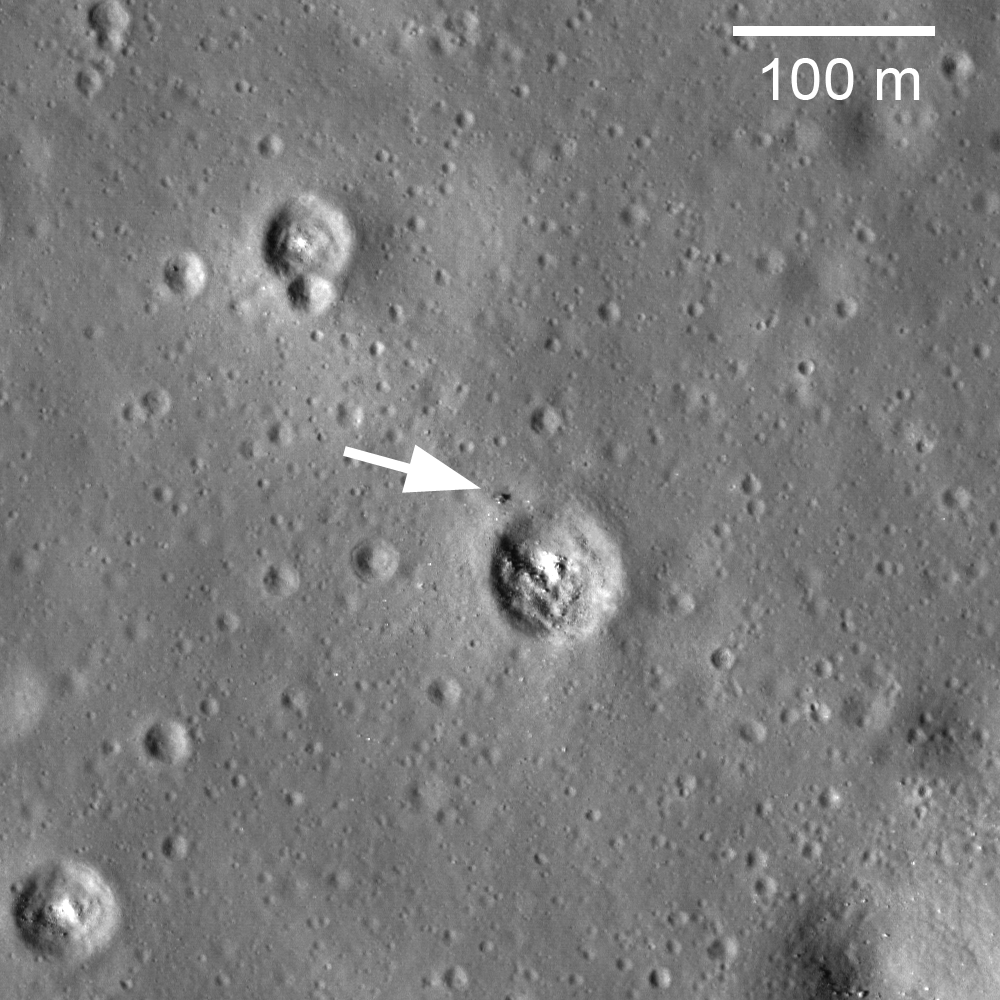
On February 21, 1972, Luna 20 soft landed in the rugged highlands between Mare Fecunditatis and Mare Crisium. The next day a sample return capsule blasted off carrying 55 grams of lunar soil. The Luna 20 descent stage is clearly visible in LROC Narrow-Angle Camera image M119482862RE [NASA/GSFC/Arizona State University].

Mark Robinson
LROC News System

The Soviet Union successfully executed three robotic sample return missions as part of the Cold War competition with the United States. The first mission, Luna 16, returned a small sample (101 grams) from Mare Fecunditatis in September of 1970, a time between the US Apollo 12 and 14 manned landings. A year and half later (February 1972) Luna 20 returned 55 grams of soil from the Apollonius highlands region. Explore the Luna 20 landing site.

Luna 16 and 20 were very similar in design and sampling method. A drill at the end of the sampling arm collected soil from a few tens of cm below the surface. The arm then placed the sample into the return capsule on top of the vehicle. The distinctive shadow seen in the LROC image of Luna 20 is most likely that of the sampling arm. The Luna 20 sample contained minerals similar to those sampled by the US Apollo 16 astronauts two months later from the Cayley plains (8°58"S, 15°30"E).

In October of 1974 Luna 23 set down on Mare Crisium, however technical difficulties prevented it from successfully acquiring a sample. Undeterred, the Soviets tried again in August of 1976, this time with much better luck. Luna 24 was designed to auger over 2 meters into the lunar soil thus collecting a better section and a larger sample, 170 grams. The positions of Luna 23 and 24 were not well constrained and are reported as within several hundred meters of each other. From the new NAC images we can accurately measure the distance between the two landers to be about 2400 meters. However the absolute position of the landers is only know to about 500 meters accuracy. As the LRO mission ephemeris improves, the Luna absolute positions should be known to better than 100 meters. Scroll around in a mosaic of two NAC high Sun images (M111185087L,R) and find Luna 23 and Luna 24. Look for a few very bright pixels near Luna 24; they may be small pieces of material blown off the descent stage as the ascent staged blasted off towards Earth.

The successful Soviet Luna sample return missions returned small, but important, samples from three locations on the Moon. In this new era of lunar exploration several countries plan to soft land on the Moon in the near future, the first soft-landed spacecraft since Luna 24. India and Russia plan to launch a lander and rover called Chandrayaan 2 in 2013. The Chinese Chang'e lunar exploration program also plans a soft landing in 2013. Though NASA currently has no firm plans for a future lunar landing (robotic or crewed), it is considering a sample return mission from the lunar far side as a part of its New Frontiers program.

Tuesday, February 9, 2010

Tubular structures on lunar surface, ideal landing sites

R. Ramachandran
The Hindu

Remnant tubular structures or tunnel-like formations from lunar volcanic flows in the past, which extend a couple of kilometres on the moon’s surface, could serve as ideal landing as well as human settlement sites for future lunar missions, including Chandrayaan-II, according to some new findings from India’s Chandrayaan-1.

These findings were reported on Monday at the Sixth Chandrayaan-1 Scientific Meeting being held at the Physical Research Laboratory (PRL) here.

Data from the Terrain Mapping Camera (TMC), one of the Indian instruments on-board the spacecraft, has revealed one such volcanic tube in the Oceanus Procellarum area of the moon (central longitude 58.317 deg. W and latitude 14.111 deg. N). The remnants of volcanic tubes on the moon whose roofs have capsized and a trench or valley is created is called a rille system, which is a groove or long narrow depression on the lunar surface. The volcanic tube identified by the TMC comprises two cobra hood-shaped rilles, the longer one measuring 3.65 km in NE-SW direction and the smaller one measuring 0.73 km. The interesting feature is that these rilles seem connected by an intermediate stretch of a two km-long and 360-metre-wide uncollapsed portion (see picture), which seems to be the roof of the lava tube that did not collapse for some reason, said A. S. Arya of the Indian Space Research Organisation’s Space Applications Centre (SAC), Ahmedabad, who described the findings at the meeting.

More significantly, the uncollapsed part is very close to the surface, only 160 metre below. Its hollow interiors could be safe spots for lunar habitation, or even parking lunar landers for protection from the harsh impacts of interplanetary material, meteorite showers, solar wind and radiation. “For future missions aimed at creating permanent base stations and human settlements on the moon, there is a need to identify such locales that have survived the onslaught of the past impacts and would provide safe shelters to human beings on the moon,” Dr. Arya said. For instance, the Japanese mission Kaguya discovered a vertical hollow structure, but that is not suitable for habitation, Dr. Arya said. In a horizontal tubular structure, however, any lunar vehicle can just move along the rille into the tunnel structure for safe parking.

But the TMC findings could even become the starting point for identifying suitable locations for immediate missions such as Chandrayaan-II, which plans to land two lunar rovers, said M. Annadurai, Project Director, Chandrayaan-1 and Chandrayaan-II. Chandrayaan-II has set itself the ambitious goals of sustaining the two rovers in the harsh lunar environment for as long as six months. All previous missions have landed in the sunlit area and have not been able to survive beyond a few weeks. “We need to see how Chandrayaan-1 data can be used from an engineering point of view in terms of site terrain information and soil interactions to know where to land our rovers from this perspective,” Dr. Annadurai said.

Like Chandrayaan-1, its follow-up mission, which is likely to be flown during 2012-13, will also focus mostly on the higher lunar latitudes, Dr. Annadurai said. “From an engineering point of view, we need to look at the rovers spending longer night hours. For optimal power utilisation, they will function in the hibernation mode when there is no sunlight for generating power,” he said. “So a suitable site could be the edge of some crater or a site near such volcanic tubes where they can retreat for hibernation. But a cross comparison of data from different Chandrayaan-1 experiments can tell us much more than just the TMC data. And such a trend has been evident at this meeting.”

With Russia already part of the project, Chandrayaan-II is also likely to have international collaboration, especially with all the principal investigators of the various experiments keen on carrying the work forward by collaborating among themselves in the future.

Friday, November 27, 2009

India (ISRO) looks for more indigenous content for Chandrayaan-2

Doug Messier
Parabolic Arc

India is looking to put more domestically produced instruments on its Chandrayaan-II moon mission. The country’s first lunar spacecraft contained 11 instruments, six of which were supplied by foreign organizations.

Mylswamy Annadurai, Project Director of Chandrayan Mission II, ISRO, on Monday said that there would be more indigenous components in country’s second moon mission…"

Sunday, November 8, 2009

Whispers of Chandrayaan II

Chandrayaan-II ready by 2012-2013

Bangalore - (PTI) Chandrayaan-II, under development to help in analysis of mineral composition and to undertake terrain mapping of the Moon, will be completed by 2012-13, Project Director of Chandrayaan Dr M. Annadurai said Saturday.

"The Rs 425 crore project will be completed by 2012-13. As opposed to Chandrayaan-1, which was a moon orbiter, in Chandrayaan-2 two moon rovers will actually land on the lunar surface," Annadurai said, inaugurating the Sixth National Student Conference at University Visveswaraya College of Engineering.

"Chadrayaan-II will consist of a landing platform with two moon rovers, one from India and one from Russia, which will land on the moon and move on wheels on the lunar surface, pick up samples of soil or rocks, do a chemical analysis and send the data to the spacecraft orbiting above," Annadurai said.

Monday, September 28, 2009

India's Chandrayaan II under development

Kautilya Singh
Indian Express

Though the Chandrayan-I mission ended prematurely this August, work is already underway for India's second mission, and mission planners at the Indian Space Research Organisation (ISRO) working in the project have enlisted professors at the Indian Institute of Technology-Kanpur (IIT-K) to help develop India’s first lunar rover.

Roscosmos, the Russian Federal Space Agency, has already partnered with ISRO to aid development of the Chandrayaan II robotic lunar lander.

Meanwhile, ISRO asked IIT-K to develop and test three components of the lunar rover, now scheduled to be launched to the Moon in 2012.

Of "eight major components" of the rover, according to ISRO, three components assigned to IIT-K include "development and testing of computer vision-based autonomous 3D map generation system, kinematic traction control, and control and motor dynamics of the six wheels of the vehicle."

K. S. Vnkatesh, associate professor of IIT-K's electrical engineering department, is working on the visual navigation project, and Ashish Dutta, associate professor of mechanical engineering, has been assigned responsibility for development and validation of the "kinematic traction control" component.

Sunday, August 16, 2009

India completes Chandrayaan II design

Chandrayaan II - From an early concept (ISRO) - The Russian Space Agency Roscosmos and the Indian Space Research Organisation reportedly collaborated on design work for India's first lunar soft-lander. The last vehicle to safely land on the lunar surface was Luna 24, which retrieved 170 gm of regolith from the western Mare Crisium in August 1976.

Kerala Latest News - Bangalore - India has completed the design of Chandrayaan-2, its next mission to the moon - in collaboration with Russia; a Lander and rover which can collect and analyze samples of the lunar regolith.

“Right now, the design has been completed. We had a joint review with Russian scientists here,” G Madhavan Nair told reporters. Dr. Nair is chair of the Indian Space Research Organization.

Based in Bangalore, ISRO reports Chandrayaan-2 will consist of an orbital vehicle, lunar lander and rover. The target for the lander-rover will be determined by flight dynamics and data returned from Chandrayaan-1, now parked in a 200 km orbit, launched from Sriharikota October 22, 2008.

While ISRO develops an orbiter, Roscosmos will build the Chandrayaan lander and rover. ISRO says additional science payloads from international scientific community will be hosted by the mission

“Next, now that design has been completed, we will go towards prototype building, which will be taken up next year,” Nair said.

Sunday, July 5, 2009

Landing rover biggest challenge for ISRO

Chandrayaan-II in development

Kolkata, India - After a successful pioneering lunar mission, the shielded landing of a rover on the moon for the proposed Chandrayaan-II project has emerged as the main challenge before the Indian Space Research Organisation (ISRO).

"The biggest impediment for this project is ensuring the safe landing of the rover on the lunar surface. Since the moon doesn't have an atmosphere, utilising parachutes will not be possible, so we are exploring other alternatives," ISRO chairman and Chandrayaan architect Gopalan Madhavan Nair said here on Saturday.

He was in the city to receive the MP Birla Memorial Award 2009 for exceptional achievement in the fields of astronomy, astrophysics, space science and allied disciplines.

One of the prime objectives of Chandrayaan-II is to land a motorised rover on the surface of the moon. The custom-designed rover would explore the lunar surface, pick up samples of soil or rocks, do on-site chemical analysis and send the data to the mother craft Chandrayaan II which will be orbiting above. Subsequently, the data would be transmitted to the earth.

Despite earlier reports suggesting that India's second lunar excursion would take place in 2012, Nair said the launch would take an extra year, possibly due to the problems with impact management of the rover. "Chandrayaan II should be launched by 2013," he said. With an eye on augmenting the Indian Meteorological Department's (IMD) forecasting system, Isro is also looking to launch a geostationary satellite to be used for weather forecasting, Nair said.

"This satellite will allow for an improved insight into reading cloud shifts and changing monsoon patterns, and will be handed over to IMD after its launch. We expect this project to be ready in another 2-3 years," he said.

Read the Article HERE.

Monday, March 16, 2009

Taylor Dinerman examines ISRO

The latest weekly essential weekly issue of The Space Review:

Taylor Dinerman takes a no-nonsense look at "Chandrayaan 2 and the evolution of India's space program," in the March 16 release of that 'periscope up into reality' called The Space Review:

India’s space program has come a long way since it was established in 1962 as the Indian National Committee on Space Research (INCOSPAR). Its successor, the Indian Space Research Organisation (ISRO), was set up in 1969, and six years later their first satellite, Aryabhata, was launched. Since then ISRO has matured into one of the “Big Three” Asian space agencies, alongside China’s CNSA and Japan’s JAXA. It is a significant partner in many international space projects.
Read more HERE.

Meanwhile: The Hindu reports ISRO's first Manned space mission in 2017 will likely be composed of Indian Air Force personnel: Article HERE.

Thursday, March 5, 2009

After the moon, ISRO aims for the sun

Last updated September 15, 2010 1858 UT
The universe is our playground

Harsha Pramod
itexaminer.com

Bengaluru (India)

The silent space surrounding the moon could soon be busy with the movement of active satellites from different countries in its parent planet. The Indian Space Research Organisation’s (ISRO) lunar satellite Chandrayaan-1 is now orbiting in an elliptical orbit over the polar regions of the moon. ISRO launched Chandrayaan-1 (meaning ‘moon craft’) successfully on 22 October 2008, thereby joining the space faring countries in the lunar race. Launched at a cost of about $75 million, Chandrayaan-I will remain in its orbit for about two years. This is especially significant because of the renewed interest in the Earth’s lone satellite after a lull of many decades.

The moon has always been a source of mystery to the human race. It has been associated with mythology and beauty. Being the nearest celestial body, it continues to be a source of great interest to the space scientists. The lunar mission is seen as an important milestone in the space journey.

In the early 1960s the race for the moon was between the US and the USSR. However, the USSR nearly abandoned its lunar mission in the 1970s. Russia is now planning to launch its lunar project ‘Luna-Glob’ in the next few years. The US agency, National Aeronautics and Space Administration’s (NASA’s) Lunar Reconnaissance Orbiter (LRO) and Gravity Recovery and Interior Laboratory (GRAIL) are expected to provide significant information to help plan for an advanced manned lunar mission in the next decade. LRO is scheduled for launch in April this year while GRAIL is planned for 2011.

ISRO is conscious of the fact that although other countries have undertaken space missions, the data is often not shared. So, India launched its own lunar mission. China is also moving ahead in space, with plans to send (three more) robotic explorers to the moon by 2020.

Its first lunar satellite Chang'e-1, named after (the) legendary Chinese moon goddess, impacted the moon this year. In the global scene, India has set an example of international cooperation by carrying foreign payloads on Chandrayaan-1.

Chandrayaan-1 should help ISRO improve technology for future missions (and) could provide information about the availability of Helium-3 on the moon.

Helium-3 is a non-radioactive isotope of helium considered as a comparatively clean fuel for future nuclear fusion reactors.

Riding high on the success of Chandrayaan-I, ISRO plans to launch Chandrayaan-2 in 2012. Chandrayaan-2 will be launched on India’s Geosynchronous Satellite Launch Vehicle (GSLV). The mission has been allocated a budget of $86.6 million (Rs 425 crore). Chandrayaan-2 will comprise a lander and a robotic rover, which will soft land on the moon. The robot will take samples from the lunar surface for analysis and will transmit the data back to the earth. ISRO has already signed a pact with the Russian federal space agency (Roscosmos) for the mission. According to the pact, Roscosmos will be responsible for the Lander/Rover.

While Chandrayaan-1 is yet to unload many of its secrets, ISRO is aggressively pursuing its future projects such as the solar mission, Aditya, a satellite to study solar emissions. With the design in place, the mission will be launched in a couple of years. Aditya is reportedly the first space based solar mission planned to study corona, the sun’s outer layer. There are limitations to studying corona from the earth as it is visible only during solar eclipses. The earth’s atmosphere also scatters sunlight. This makes a space mission to study corona even more significant.

ISRO’s study on a Mars mission is also underway. The orbiter mission to Mars aims to study the Martian atmosphere, weather and solar wind-Mars interactions. According to ISRO, setting up a base in the moon could help future space explorations. A long trip to a celestial body such as the Mars could use the moon as an intermediate base. Mission to Mars is likely to could happen around 2019. Missions to other planets could well become a reality in the long term.

India’s manned mission to space at a cost $2.3 billion (Rs 12,000 crore) could be expected before 2015. While ISRO is not averse to international cooperation, it prefers to be self-reliant. ISRO’s manned mission into space has been approved by the Space Commission and is awaiting the government’s approval.

Asteroid or comet flyby flights could also become future missions. This could study the surface and interior of comet nucleus, composition of dust and gas in the comet, solar radiations and also bring samples of comet dust for study.

NASA is currently in the news for its Kepler mission, which aims to explore outer space for alien life. If all goes well, the mission will be launched in Florida on Friday night, 6 March, local time. The Kepler mission is a $600-million mission in search of habitable planets.

China, the US and Japan are going ahead with major plans for space exploration. Everyone wants a share of the outer space. While ISRO says it is not interested in a space war, it also does not want to be lagging behind in enhancing its competence to explore space. The possibilities awaiting the space explorers could very well challenge human imagination.

Check Out
Chandrayaan-I mission not expensive, says Nair
Chandrayaan 1 launch success
India allocates $86.6 million for Chandrayaan-2
ISRO
PIB
Economic Times

Wednesday, October 15, 2008

India and Russia ink Rover Agreement

Already looking beyond the impending launch of Chandrayaan 1, a week from today, New Dehli's Economic Times and Srinivas Laxman rounds up ISRO's busy, newly ambitious planned activities from Chandrayaan 2 and beyond:

Roscosmos, the Russian Federal Space Agency, will build the lunar rover and India plans to launch Chandrayaan 2, based on an agreement signed in 2007 and recently updated, sometime "between 2010 and 2012."

While development of lunar exploration probes takes less time than similar missions to Mars, for example, plans for the Russian re-entry into the New Space Race remain a little vague:

The rover will weigh between 30 and 100 kg, depending on the kind of landing - a hard or soft one - it will execute on the lunar surface . It will have a one-month life span and operate predominantly on solar power.

Keeping in mind the additional payloads in the spacecraft that could increase the launch weight, the rocket for the second mission will be the three-stage Geo-Synchronous Satellite Launch Vehicle (GSLV). The current version of the rocket can carry payloads of up to two tonnes while the new version - GSLV Mk3 - can fly with payloads weighing four tonnes. The data from the rover will be transmitted to the orbiting spacecraft, which, in turn, will send it to the ground station at Byalalu near Bangalore.

Thursday, September 18, 2008

Chandrayaan 1 according to Calcutta

Test micro-lander is on-board for Chandrayaan 2 lander in 2012.

India’s first moon-bound craft has survived a crucial set of ground tests in Bangalore, demonstrating that it will neither freeze nor roast when it encounters the hostile deep space environment.

For 21 days, the fully-assembled Chandrayaan-1 spacecraft was placed in a large cylindrical vacuum chamber, the shape of a giant pressure cooker, where it was exposed to roast-and-freeze cycles, heated to 120 degrees celsius and cooled to minus 150 degrees celsius.
All onboard instruments and electronics remained intact in the tests that were designed to simulate deep space conditions, a senior scientist at the Indian Space Research Organisation, Bangalore, told The Telegraph.

ISRO hopes to launch Chandrayaan-1 next month and guide it into an orbit 100km above the moon for a two-year mission that will include mapping the entire lunar surface in 3D, searching for minerals, and exploring lunar geology. India’s first lunar mission has cost about Rs 386 crore, of which Rs 100 crore has gone into a new antenna network to communicate with spacecraft on interplanetary missions.

The roast-and-freeze test is routinely subjected to all satellites, including Isro’s weather and communication satellites. Only the conditions of exposure sometimes vary. “Now, vibration tests remain. After that, Chandrayaan-1 will be sent to Sriharikota for launch,” an official said.

India’s Polar Satellite Launch Vehicle will ferry Chandrayaan-1 into space.

Chandrayaan-1 will carry five Indian-made cameras and instruments to study the moon from lunar orbit, while five other instruments designed by scientists in the US and Europe will piggyback on the Indian mission.

“We’re hoping to do research not done before,” said Martin Wieser, a scientist at the Swedish Institute of Space Physics, Kiruna, Sweden, who helped build an instrument called SARA — Sub Kev Atom Reflecting Analyser —, aboard Chandrayaan-1.

ISRO scientists have also placed aboard the spacecraft a moon Impact Probe, a 29kg instrument about twice the size of a shoebox, that will be released to impact onto the moon’s surface after a 20-minute fall.

“The impact probe will test small thrust rockets that will be used to slow down the fall. We’ll require this for future soft landings on the moon,” a senior official at Isro said. Isro is planning to send an unmanned lunar lander in 2012.

Read more HERE.