Showing posts with label Lunar Resources. Show all posts

Sunday, January 5, 2014

Mining the Moon, Fueling the Future

Remote-operated demonstration of in situ resource utilization (ISRU), believed to be a necessary prelude to mining the Moon and gaining a true foothold in space. Should the artist's notional decals have been those of the Peoples Republic of China? [Pat Rawlings].
Paul D. Spudis
The Once and Future Moon
Smithsonian Air & Space

Much of the mass we launch for space missions is what I call “dumb mass” – heavy things like water and fuel that, while absolutely necessary, contain low amounts of information.  Regardless of launch costs, there is no virtue in launching this type of mass from Earth.  Learning to use what we find in space to create new capabilities is a skill that we must master to become “space faring.”  The Moon is in an excellent location relative to Earth; it is a well-stocked laboratory where we can learn and hone these skills.

Press coverage since the December 14 soft landing of China’s Chang’E 3 on the Moon has quoted officials of the Chinese space program as stating their interest is in “mining” the Moon.  The desired commodity usually bandied about is 3He, the light isotope of helium that (in theory) could be used to fuel a “clean” nuclear fusion reaction and generate electrical power here on Earth.  Other possible lunar products mentioned in passing include metals such as titanium and aluminum.  But what exactly is meant when we talk about “mining” the Moon?  What materials on the lunar surface are useful and thus valuable?  Perhaps the term “useful” needs some exposition.

Mining merely means the extraction of some useful product from a planet.  In the context of extraterrestrial mining, useful might mean useful in space, not necessarily useful to import back to the Earth.  For example, right now, there are abundant terrestrial supplies of aluminum.  It makes no economic sense to mine aluminum from the Moon or some other space object for import back to Earth.  However, if we’re in the process of establishing a permanent presence on some extraterrestrial object, several tons of aluminum from local sources might be very handy.   While no one would suggest exporting simple, low-processing materials such as bulk soil (regolith) and aggregate (concrete and adobe) back to Earth, they have uses and thus enormous value on the Moon and in space for local building and other engineering requirements.

The real value of extraterrestrial mining is accessing material outside of Earth’s gravity well and making products that enable and create new capabilities in space and on other worlds.  So far, we have not found any deposits of unknown materials in space that cannot be found on Earth (the “unobtainium” beloved of science fiction writers).  But we have found deposits of common materials that, while having no economic value for return to Earth, have enormous value in space.  Anything that we can find and use on another world means that much less material that has to be launched from the surface of the Earth.  With launch costs of many thousands of dollars per pound, every bit of mass that we can find and use in space is that much less budget-busting dumb mass hauled up from Earth.

I believe that the real game-changer for mining the planets is water.  This most common of substances is the most valuable commodity in space because it has so many uses.  Water is attractive because it is easily transportable in solid or liquid form, but it is massive and thus, expensive to move around in space.  Most of the uses of water in space will probably happen close to the sources from which we extract it, either on the planetary surface or in the space just above and near them.

[Karnik]
Water is required for life in general and in particular, for human life here and in space.  We can drink the water, use it to reconstitute dehydrated food, use it for thermal ballast, and protect ourselves from the hard radiation environment of deep space by jacketing spacecraft and habitats with it.  Water is a simple molecule (H2O) and can be broken into its constituent elements by the process of passing an electrical current through it; we can thus easily “crack” water into its components (hydrogen and oxygen) and store these gases for later use.  The obvious use for this oxygen is to provide breathable air for space habitats.  But additionally, because the water cracking process is reversible, we can take these gases and combine them in fuel cells to create electricity.  This makes for a fascinating possibility; during the day, we can crack water into hydrogen and oxygen using electrical power derived from solar panels and store these products in tanks.  During times when the Sun is not visible (either night on a planet or during eclipse in space), we can re-combine these gases to generate electrical power.  Such a device is called a rechargeable fuel cell (RFC) and can provide continuous electrical power for space vehicles and habitats.  Thus, water becomes a medium for energy storage, being broken apart during daylight and recombined during the night, allowing for continuous and reliable power in space.  The valuable by-product of this process is excess water for life-support and other uses.

The last major use of water is probably the most important in terms of creating new capabilities in space.  When water is broken into its constituent gases and then frozen into liquid (cryogenic form), it becomes rocket fuel.  Liquid hydrogen and oxygen are the most powerful chemical propellant known.  The ability to make rocket fuel in space changes almost everything we know about the economics of spaceflight.  Because of its high cost, anything that we can do to lower the required mass launched from Earth saves money and makes spaceflight more capable.  In the case of missions beyond low Earth orbit, most of the mass of the Earth departure vehicle is fuel.  For a human Mars mission, more than 80% of its total mass is propellant.  Most of that propellant will be used in the rocket burn to leave Earth.  Thus, by obtaining the required propellant from a space-based source and refueling there, the total lift-off weight (cost) from Earth is much lower.

Although hydrogen-oxygen is the most powerful rocket propellant, its use does have some drawbacks.  Hydrogen has a very low boiling point, only about 20° above absolute zero (-253° C).  This extremely low temperature is difficult to generate (i.e., power intensive) so making cryogenic hydrogen is a tough proposition.  Moreover, hydrogen has an extremely low density, so storage tanks for liquid hydrogen are very large and bulky and must be carefully insulated to minimize the “boil-off” of the fuel.  Boil-off is an important problem that must be solved if we are to use space-derived cryogens for propellant; it involves capturing the boiling vapor and condensing it back into liquid form again to prevent its loss to space.

Some argue that since hydrogen is so volatile and difficult to work with, we should focus solely on obtaining oxygen from planetary sources as that gas is 16/18ths (89%) of the mass of water.  Producing liquid oxygen (boiling point of -183° C) is much easier than liquid hydrogen and it is more easily handled and stored.  However, we would still need some type of fuel to burn with this oxidizer; a variety of other substances could be used for rocket fuel, including methane (CH4), ammonia (NH3), sulfur (S) and even powered aluminum (Al).  Interestingly and fortunately for us, all of these substances are found in the deposits of the lunar poles – the most valuable real estate in our Solar System with peaks of near-constant sunlight for power generation.

The real value created by mining the Moon (or any extraterrestrial object) is capability – the ability to move more freely, more often and with more mass in and about cislunar (Earth-Moon) space where most of our national security and economic satellites reside.  By creating an off-planet supply depot, we free ourselves from the tyranny of the rocket equation.  I don’t know if the Chinese see the “problem” this way or not.  But they should.  I believe that eventually, they will.  And so must we.

The Chinese do not appear to be waiting for “magic beans” to lower launch costs.  There are many reasons to believe that those costs have already fallen about as much as they will, barring some major new launch vehicle paradigm.  By holding back and betting on some major new launch breakthrough materializing, the United States could be walking away from a sure thing – leaving the innovation and technology field, and with it the economic and national security benefits that will follow, to countries who recognize the strategic value and potential of the Moon and are already making plans to tap into it.

Originally published December 27, 2013 at his Smithsonian Air & Space blog The Once and Future Moon, Dr. Spudis is a senior staff scientist at the Lunar and Planetary Institute. The opinions expressed are those of the author but are better informed than average.

Some Related Posts:
'A Resolve to mine the Moon' (July 16, 2012)

Wednesday, February 20, 2013

Dark Mantle Deposit (DMD) Excavations

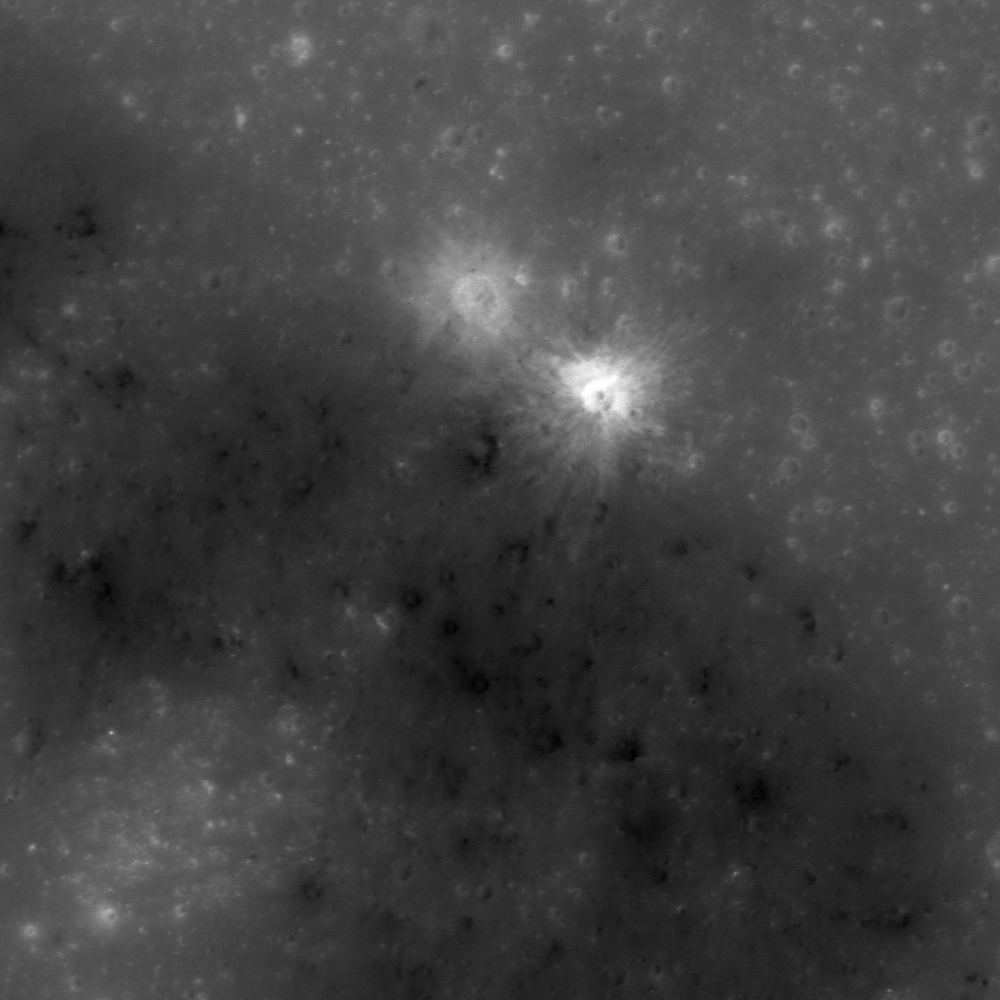
Thin Skin? A patch of Dark Mantle Deposits, prominent albedo features of west and east Sinus Aestuum (southeast of Copernicus) have been over-turned by relatively recent impact, uncovering much brighter material not far below the surface. From LROC Narrow Angle Camera (NAC) observation M1103666930R, orbit 14961, September 30, 2012; resolution 94 cm per pixel. LROC Featured Image center 4.591°N, 344.348°E, field of view above is 545 meters across [NASA/GSFC/Arizona State University].
Hiroyuki Sato
LROC News System

Dark Mantle Deposits (DMDs) are diffuse deposits with a very low albedo, which are the remnants of pyroclastic eruptions. Sinus Aestuum is a DMD near Copernicus crater.

Today's Featured Image (covers) a portion of one of the lowest-reflectance areas in this DMD (see next WAC context images below), about 150 km southeast from Copernicus.

In the opening image, the lowest-reflectance materials are located at the rims and the ejecta of the multiple small craters (less than 20 meters in diameter), indicating that these dark materials are in the shallow subsurface.

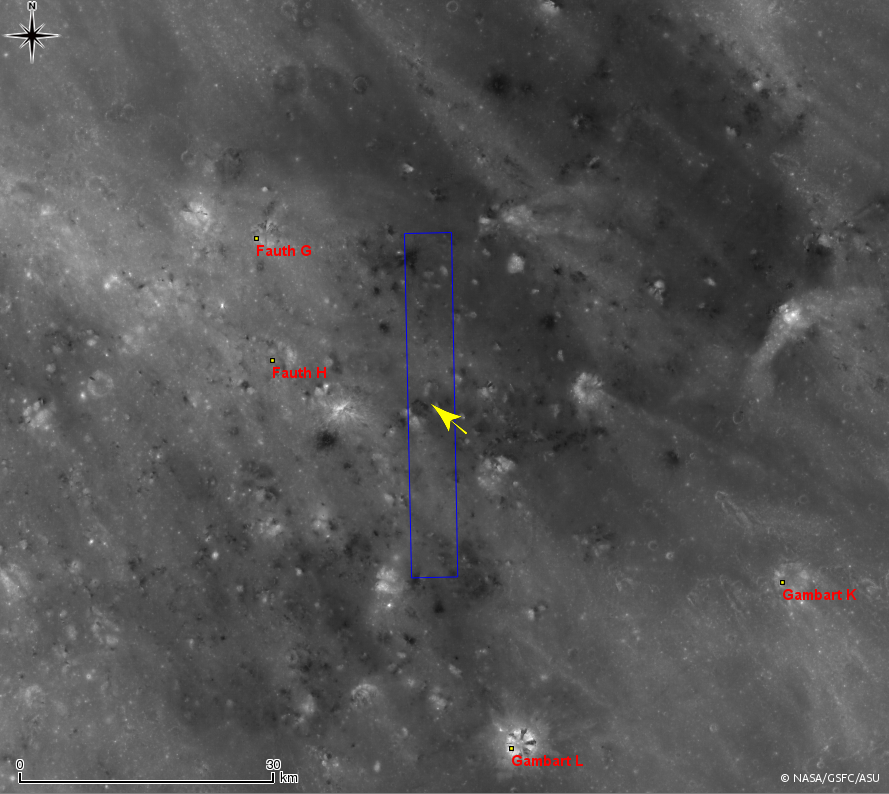
Context view of western Sinus Aestuum and surrounding areas in a LROC Wide Angle Camera (WAC) monochrome mosaic centered on 4.60°N, 344.38°E. The NAC footprint (blue box) and the location of opening image field of view (yellow arrow) are indicated [NASA/GSFC/Arizona State University].
On the other hand, the two craters near the middle of this image display relatively high reflectance materials and do not expose any dark deposits from beneath the surface. That means that the lateral extent of these low-reflectance pyroclastic materials is somewhat discontinuous.  Looking at the ejecta blankets of craters within lunar DMDs is one of the best ways to estimate the extent and thickness of lunar pyroclastic deposits.  In the case of regional DMDs like Sinus Aestuum, the pyroclastic glasses that comprise these deposits represent one of the most accessible lunar resources that could be used by future human explorers to enable extended lunar surface operations.

A higher (sunrise) illumination angle normally emphasizes terrain relief over albedo, and vice versa, though in this full resolution crop from the LROC WAC mosaic (below) the contrast in local albedo are still quite evident [NASA/GSFC/Arizona State University].
The full WAC mosaic covers the western dark mantle deposit field of western Sinus Aestuum, an approximately 150 kilometers wide field of view captured over four sequential orbital passes in December 2011 [NASA/GSFC/Arizona State University].
Explore the DMDs at Sinus Aestuum in full NAC frame yourself, HERE.

Related Posts:
Pyroclastic Trails
Pyroclastics and Vent
Hyginus Crater and Pyroclastics
Pyroclastic Excavation
Rima Bode: Constellation Region of Interest

Unrelated visually, both Lunar Prospector (1998-99) and Japan's SELENE-1 (Kaguya) detected perhaps the highest rates of radioactivity stretching from Fra Mauro to west of Copernicus, represented above in a signature of Thorium. Remote sensing shows a similar, only slightly less prominent detection of Uranium, also.

Wednesday, December 14, 2011

The Path of Exploration

Roald Amundsen, first to the South Pole, 100 years ago today.
Paul D. Spudis
The Once and Future Moon
Smithsonian Air & Space

One of the last major milestones in the history of terrestrial exploration was achieved one hundred years ago today – the attainment of the South Pole by Roald Amundsen and his team on December 14, 1911.  His rival, Robert Falcon Scott and crew, were still more than a month away from the pole and (although denying they were in a race) destined for heartbreaking disappointment when they arrived to find the Norwegian flag flapping in the howling Antarctic wind.

The Amundsen-Scott polar drama time stamps a major shift in our thinking about the meaning of exploration.  This shift in our perception of what it means to explore holds ramifications to today’s debates on space policy.  Traditionally, exploration is a very personal activity.  It involves someone’s decision to see what lies over the next hill.  This act is exploration in its purest sense; it dates from the Stone Age and is principally responsible for humanity’s reach into all corners of the Earth.  This exploration is undirected and random –motivated by the human desire to scratch that unrelenting itch of curiosity.  You finance and outfit yourself and go, while adhering to the maxim, “It is easier to ask for forgiveness than to get permission.”

As society grew and evolved, a different type of exploration emerged.  For difficult or expensive journeys to far corners of the globe, people pooled their knowledge and resources to collectively explore the unknown by creating government-sponsored projects.  Until modern times, such exploration was considered to include not only discovery and initial characterization, but also utilization, exploitation and eventually colonization – all with an eye toward wealth-creation.  By the end of the 19th Century, the regions of the world unclaimed by western powers were all but gone, gobbled up in a frenzy of imperial land-grabs by industrially developed nations.  All that was left were the seas (whose freedom of access for all nations was guaranteed by the British Royal Navy) and the North and South Poles.

The shift of attention to the poles coincided with the rise of science and with it, a significant change in the “exploration” ethic.  It was actually thought at one point in the late 19th Century that all nature had been finally and thoroughly explained.  After numerous failed attempts to find a Northwest Passage to the Pacific north of Canada (economic motivation), expeditions to the polar regions began to focus on scientific observations and measurements (knowledge gathering).  This shift in emphasis also coincided with a global rise of nationalist conscience, the idea that some nations were destined to discover and conquer remote parts of the Earth.  Given the global extent of the British Empire at that time, the English were particularly susceptible to this idea.

These various motivations were threaded together in the early 20th Century as science joined with nationalistic chest-thumping to create government-sponsored scientific expeditions to remote locales.  Important and difficult expeditions requiring teamwork and pooled resources became national exploration efforts.  Science became a fig leaf rationale for realpolitik global power projection.  There was still the occasional “because it’s there” type of expedition to some remote mountain or plateau but most often it was privately financed.

And so we come to the Space Age, which in basic terms has followed the knowledge-gathering template of polar exploration.  A new movement for national power projection in space has yet to fully emerge.  National security may be the only motivator of sufficient political power to launch an earnest, national drive into space.  Traditionally the military conducts exploration in peacetime.  In the late 18th Century, Royal Navy Captain James Cook conducted three expeditions to the Pacific – not for pure science but rather for applied science – to improve navigation for commerce and other purposes.

Perhaps this link to applied science may guide us toward a new understanding of the term “exploration,” or rather, to recover an old meaning that has been lost.  The idea of exploration leading to exploitation (currently tossed aside in the modern equation of exploration and science) could serve as the “new” guiding principle for modern spaceflight.  By making space the singular preserve of science and politics, both are ill served, much to the determent of humanity.  For now, we remain wedded to the template of launch, use, and discard – a modus suitable to an occasional, expensive and limited presence in space but one wholly inappropriate for undertaking the creation of a modern, permanent space faring infrastructure.  Instead, beginning with the creation of a reusable, extensible cislunar space faring system, we should learn how to use space for national interests by using the Moon and its resources.  This will require a long-term research and development project geared to acquiring the understanding and ability to gather and use the resources available to us in space in order to routinely access, explore and exploit cislunar space and the frontier beyond.

This model of a national space program fits the classic understanding of exploration – we go into space as a society and what we do there must have societal value.  Because cislunar space has critical economic and national security value, we need to create a system that can routinely accesses that region of space with robots and people.  Hence, I advocate resource production bases on the Moon, reusable systems, and the build-up of a cislunar spaceflight infrastructure.  Some may not consider this to be “exploration” but the great explorers of history exploited and settled after they found and described.

The attainment of the South Pole one hundred years ago today shifted the meaning of the word exploration and boxed us into an artificial separation of the concepts of discovery and use.  That modern connotation is both arbitrary and historically incorrect.  Exploration includes exploitation and we can exploit the Moon – our nearest planetary neighbor – to create a permanent space faring capability. The development of cislunar space is exploration in the classic sense – a plunge into the unknown:  Can we do this?  How hard is it?  What benefits – beyond those we can recognize now – might we realize from it?   History shows that such undertakings promote new discoveries by opening windows of innovation and generating new streams wealth creation.

Originally published December 14, 2011 at his Smithsonian Air & Space blog The Once and Future Moon, Dr. Spudis is a senior staff scientist at the Lunar and Planetary Institute. The opinions expressed are those of the author and are better informed than average.

Tuesday, November 8, 2011

TSR: Fear of a Chinese Moon

Robert Bigelow, speaking at the ISPCS conference in New Mexico this month, claimed that China is on a path towards taking control of the Moon within 15 years [ISPCS].

Jeff Foust

Robert Bigelow is best known in space circles as the founder of Bigelow Aerospace, the company he created over a decade ago to develop commercial space habitats using expandable (or inflatable) technology licensed from NASA. The Las Vegas-based company has successfully launched two prototype modules, Genesis 1 and 2, to demonstrate the technology and has plans for larger modules and commercial space stations for companies and so-called “sovereign clients”, nations without their own indigenous space programs.

Bigelow’s plans originally generated considerable skepticism in the broader space community. However, as the company won success with its Genesis missions and found interest in its plans from potential customers and even NASA—which sees the demand generated by Bigelow’s commercial habitats as a key part of the broader business case for the agency’s commercial crew plans—Bigelow has gained considerable credibility. Now, he’s using the platform he has as one of the nation’s leading space entrepreneurs to broadcast a warning about an unusual, even quixotic, threat to America’s space ambitions: that China will, in effect, seize the Moon.

Speaking at the International Symposium for Personal and Commercial Spaceflight (ISPCS) in Las Cruces, New Mexico, earlier this month, Bigelow spent very little time talking about his own company and its ambitions.


Why would China do such a thing? Bigelow is convinced that China’s quest for prestige—to demonstrate that it is the most powerful country in the world—will inevitably drive the country to lay claim to the Moon. “China already has a grand national vision,” he said. “Their vision is that China wants to be indisputably number one in the world, measured any way you want to measure.”

That means, he said, not just simply repeating the past achievements of the US in space but moving beyond them. “Why not take the all-important syllogistic next step: ownership, ownership, ownership?” he suggested. Doing so, he said, would generate “global psychological impact” and considerable prestige for the Chinese people. “I think nothing else the Chinese could possibly do in the next 15 years would cause as great a benefit for China,” he said.

He argued that China, with its growing wealth and its historical “ability to maintain focus”, would be in a position to land humans on the Moon and start making claims between 2022 and 2026. “China has an ability to focus and galvanize its programs because of the centralization of the government” that can allow them to stay on that schedule, he told reporters after his ISPCS talk.

One obvious obstacle is the Outer Space Treaty, of which China is a party, which prohibits countries from making territorial claims to the Moon or other celestial bodies. Bigelow suggested, though, that China could work to amend the treaty through the support of countries in Africa and Latin America where China is making major investments. Alternatively, he said, China could simply decide to withdraw from the treaty. Public opinion, he said, won’t be factor. “There isn’t going to be World War Three over this,” he said. “There isn’t going to be a single shot fired.”

Read the full article at The Space Review, HERE.

Friday, October 7, 2011

New map of lunar titanium and Iron presented

The above image accompanying many reports of the LROC titanium and iron survey is everywhere being misidentified as showing the boundary area between Mare Serenitatis and Tranquillitatis. It's not clear why Figures 1 - 4 listed along with the official conference news posting were apparently not released at the news conference reported below. The image above may be a part of a larger global mosaic and looks suspiciously like early WAC color test articles released by LROC more than a year ago. Regardless, the area shown in the image above is interesting enough but shows an area mostly south of the equator and southwest of Copernicus on the Moon's nearside.

Map showing concentration of iron and titanium in Nearside maria. Iron and titanium are part of the mineral ilmenite (FeTiO3 ), which has the ability to capture and retain gases, such as hydrogen and helium, from the solar wind. An isotope of helium, helium-3, can be found in ilmenite and is especially valuable for nuclear power production [NASA/USGS/Community College of Baltimore County].
Paris (AFP) — A new map of the Moon has revealed an abundance of titanium ore that is up to 10 times richer than on Earth, a finding that could one day lead to a lunar mining colony, astronomers said on Friday.

The discovery was made thanks to a camera aboard the US Lunar Reconnaissance Orbiter, which swept the surface of the Moon, scrutinizing it in seven different light wavelengths.

Mark Robinson of Arizona State University, who presented the research at a conference in Nantes, western France with Brett Denevi of Johns Hopkins University in Baltimore, sifted through the data for telltale jumps in the ratio of ultra-violet to visible light.


NASA/USGS/Community College of Baltimore County
They established this signature thanks to rock samples brought back to Earth by Apollo 17 astronauts in 1972 and images of the area around the mission's landing site by the Hubble space telescope.

"Looking up at the Moon, its surface appears painted with shades of grey, at least to the human eye," explained Robinson.

"But with the right instruments, the Moon can appear colorful.

"The maria [lunar plains] appear reddish in some places and blue in others.

"Although subtle, these color variations tell us important things about the chemistry and evolution of the lunar surface. They indicate the titanium and iron abundance, as well as the maturity of a lunar soil."

Titanium is as strong as steel but nearly half as light, which makes it a highly desired -- and also very expensive -- metal.

On Earth, titanium is found, at the very most, in around one percent of similar types of ore. But the new map found abundances in the lunar maria that range from about one percent to 10 percent, the conference organizers said in a press release. In the lunar highlands, abundance was around one percent.

The meeting gathers, for the first time, members of the European Planetary Science Congress and the American Astronomical Society's Division for Planetary Sciences.

The find offers a double potential bounty, they said.

"Lunar titanium is mostly found in the mineral ilmenite, a compound containing iron, titanium and oxygen," they said.

"Future miners living and working on the Moon could break down ilmenite to liberate these elements.

"In addition, Apollo data shows that titanium-rich minerals are more efficient at retaining particles from the solar wind, such as helium and hydrogen. These gases would also provide a vital resource for future human inhabitants of lunar colonies."

The exposed upper 3 centimeters surface of the Moon is turned over, or "gardened" at least once every 2 million years. The visible surface has been estimated to reach "optical maturity," or "OMAT," over the course of 900 million years. Direct and remote examination has confirmed that the Moon's deeper topography retains a high-fidelity record of it's stormy 4.74 billion year history, recording the history of the Solar System and Earth while a continuous make over by solar radiation and heavier elements implanted by cosmic ray bombardment. The abundance of Helium-3 and Helium 4 is thought to be related to the abundance of iron and titanium. From: "Global inventory of Helium-3 in lunar regoliths estimated by a multi-channel microwave radiometer on Chang'E-1," WenZhe Fa and Yaqiu Jin (2010), Chinese Science Bulletin, Vol. 55, No. 35 [Maurice Collins].

Thursday, January 6, 2011

Regolith: The "Other" Lunar Resource


The Pantheon of Rome, a 2000-year old concrete structure.

Paul D. Spudis

The Once & Future Moon
Smithsonian Air & Space

In civil engineering, one of the most important material resources on Earth is “construction aggregate” – the sand, gravel and cement building materials that make up the infrastructure of modern industrial life. Aggregate is easily one of the biggest, most valuable economic resources of all mined terrestrial materials – more so than gold, diamonds, or platinum. We depend on aggregates for many different types of objects; they are the fundamental building block of roads and structures. The use of aggregates in building goes back to ancient civilizations; concrete was used in buildings of ancient Egypt. The Romans devised a recipe for a concrete so durable that the molded arches, walls and self-supporting dome of the Pantheon (made over 2000 years ago) stand today. Aggregates in terrestrial use typically depend on a lime-based cement that bonds the particulate material together. Both lime (CaO) and abundant water are needed to make concrete on Earth.

On this blog and elsewhere I have detailed the importance and significance of water at the poles of the Moon. Water is indeed the most important early product to produce from lunar materials but there are other resources on the Moon. A permanent presence on the Moon will require infrastructure that must by necessity use as much local material as possible. Aggregate materials probably will become the primary building blocks of industrial society off planet, just as it has on the Earth. The composition and conditions of local materials will require some adjustments as to how we use lunar aggregate. A little thought reveals some interesting parallels and differences with terrestrial use.

On Earth, gravel pits are carefully located to take advantage of the sorting and layering produced by natural fluvial (river water-eroded) activity. We harvest gravels from alluvial plains and old river beds, where running water has concentrated rocks, sand and silt into deposits that can be easily excavated, loaded, and transported to sites of construction. The highly variable currents, as well as the velocities of flow of our terrestrial streams and rivers, sort the aggregate by size, creating layers of gravel-sized up to cobble-sized stones for the fastest flowing waters. Finer grained material is likewise concentrated where water speeds are low and sand and silt settles out from the suspended sediment (the “bed load”).

No natural process on the Moon creates such deposits, but the lunar surface rock has already been disaggregated by impact into a chaotic upper surface layer called regolith. Regolith is basically ground-up bedrock; impacts of all sizes constantly pummel the surface, breaking, fracturing and grinding up the Moon’s bedrock. Impact both breaks up and creates rock. An impact will destroy a rock both by shock (catastrophic rupture) and through cratering (fragmentation and excavation). The effect of such destruction is to make “soil,” fine-grained rocky material made up of the mineral grains of the bedrock. But impact also creates heat and this heat can weld small fragments into glass-rich aggregate rocks (regolith breccias) as well as quickly cooled fragments of melt that contain mineral inclusions (agglutinates, or glass). In broad terms, impacts destroy and disaggregate more than they create and weld together. Thus, on a given surface, regolith thickness increases with time – older surfaces have thicker regoliths.

The ground up regolith is a readily available building material for construction on the lunar surface. It is an aggregate in the same sense as on Earth, but with some significant differences. We could make lime and water from the surface materials of the Moon but it is very time and energy intensive. Thus, we must adapt and modify terrestrial practice to take advantage of the unique nature of lunar materials. The fractal grain size in the regolith means that we can obtain any specific size fraction we want through mechanical sorting (raking and sieving). Instead of water-set lime-based cement, we can use glass to cement particulate material together. Regolith can be sintered into bricks and blocks, as well as roads and landing pads, using thermal energy (passive solar, concentrated by focusing mirrors) or microwaves that can melt grain edges into a hard, durable ceramic.

The use of aggregate materials on the Moon will likely be gradual and incremental. Our initial presence on the Moon will be supported almost entirely by materials and supplies brought from Earth. As we gain facility using lunar resources, we can incorporate more and more local materials into structures. Simple, unmodified bulk soil is an early useful product. It can be used to build berms to protect an outpost from the rocket blast of arriving or departing spacecraft and to cover surface assets for thermal and radiation protection. The next phase will be to pave roads and pads to keep down randomly thrown dust and provide good traction for the multitude of wheeled vehicles supporting the outpost. Fabrication of bricks from regolith will allow us to construct large buildings, initially consisting of open, unpressurized workspaces and garages but ultimately, habitats and laboratories. Making glass by melting regolith can produce building materials of extreme strength and durability; anhydrous glass made from lunar soil is stronger than alloy steel with a fraction of its mass.

Eventually, we may be able to export these lunar building materials into space. A major drawback is the gravity well of the Moon – its escape velocity is about 2.38 km/s, smaller than that of the Earth but substantial. To use large quantities of lunar materials for space construction, we need to develop an inexpensive means to get material off its surface. Fortunately, the small size and no atmosphere of the Moon make this possible by literally throwing stuff off the Moon into space. A “mass driver” can launch objects off the lunar surface by accelerating them along a rail track using electromagnetic coils that hurl capsulated material into space at specific velocities and directions. We can collect such thrown material at a convenient location, such as one of the libration points. From there, it is a relatively simple matter to send the material to wherever it is needed in cislunar space.

Water remains the most important first lunar product, but the “other” lunar material regolith is almost as important. Lunar rock and soil will be the paving stones of the Solar System. As once all roads led to Rome, all new roads in cislunar space lead to – and from – the Moon.

Tuesday, December 21, 2010

Can we afford to return to the Moon?

From - From 41st LPSC Album
Can we afford NOT to? Resource map of the north pole of the Moon [from Spudis and Lavoie, in press].

Paul D. Spudis
The Once & Future Moon
Smithsonian Air & Space

We are almost at the end of a year that has seen major changes in our space program. We have in hand a report from a “blue ribbon” Presidential committee that concluded that Project Constellation, the architecture NASA had chosen to implement the Vision for Space Exploration, was not affordable at current funding levels but might be accomplished with an increase in the agency’s budget, on the order of an additional $3 billion per year. The committee presented architectural alternatives to Project Constellation, one of which eliminated the Moon in favor of a “flexible path” that allowed human missions to other destinations (e.g., an L-point, an asteroid) beyond low Earth orbit.

I take issue with several points in the Augustine report and have commented on them at length in several previous posts of this blog. But now that the dust has settled and we have a “new direction” for our space program, its two principal deficiencies are evident. First, by discarding the clear strategic direction provided by the VSE, we have entered an era of uncertainty and aimlessness of purpose in our space program. This institutional drift is reflected in nearly daily stories about NASA – new missions studies, new launch vehicles, the endless personal backbiting amongst the space internet cognoscenti. Second, the assertion of the report that return to the Moon is “unaffordable” is simply wrong. How you go to the Moon and what your mission is there determines cost and all the committee looked at were cost models for the existing program and minor variants on it.

I have made both of these points here and elsewhere and many were quick to challenge me to show how we could go back to the Moon under the conditions and assumptions of the Augustine committee. Rather than shut up, I now put up. I have submitted a paper for publication in the Proceedings of Space Manufacturing 14, the conference in late October sponsored by the Space Studies Institute. My co-author Tony Lavoie and I have developed an architecture that returns America to the Moon with a specific mission in an affordable way. Our paper has now been accepted for publication, so I am posting a pre-print of it on my web site and will summarize our findings here.

One of the biggest problems with NASA’s implementation of the VSE was that they never understood why we were going to the Moon. I base this assertion on their own statements, actions and publications. Early workshops were held by the agency to develop a rationale for lunar return. The Exploration Directorate issued a poster showing six “themes” for lunar return, but no one at the agency could state their mission in one sentence. At a Congressional hearing in 2009, the acting administrator of NASA said the he did not understand what “return to the Moon” meant in terms of mission objectives and activities.

The agency took the position that they were merely transportation agents – that it was up to the various “user” communities to decide that activities were to be undertaken on the Moon. As a matter of fact, the Vision itself very specifically laid out what was to be done on the Moon and even how to approach it. The purpose of lunar return is to learn the skills and develop the technologies we need to live on another world. The Vision specifically mentions that one skill we need to acquire is the use of extraterrestrial resources to make both exploration and human presence permanent and sustainable.

NASA ignored this direction. There are many reasons why they did this, but I believe that the main one was they did not know how to create sustainable human presence on the Moon using its resources and were concerned that such a thing might not be possible. But building large rockets is certainly possible – history documented that. So the VSE morphed into a rocket-building program, an Apollo Redux because that’s what the agency (allegedly) knew how to do. The only problem was that we do not live in the Apollo era and the space program no longer gets 7% of the federal budget.

The approach we take in our new architecture is to: 1) define the mission clearly and directly; and 2) design an architecture that accomplishes the mission in small, incremental and cumulative steps. These last three adjectives are important: Steps must be small to be affordable, not only under existing budgetary constraints but also under possible lower budgets that could be necessitated by national economic conditions in the future. The steps should be incremental, meaning that each step adds some asset or capability and must work in tandem with previous equipment and operations. Finally, the steps must interlock such that the whole is greater than the sum of the parts. The architecture cumulatively increases features and capabilities with time.

We take as our mission the original Vision for Space Exploration. We go to the Moon to establish a permanent human presence there and a reusable, refuelable, and extensible transportation system to support such presence. Once established, we will have a space faring system that can not only routinely access the Moon, but all other points in cislunar space and beyond, including the L-points and near-Earth asteroids.

How do we accomplish all this? One of the principal advantages of the Moon as our first goal beyond LEO is that: 1) it has the material and energy resources we need; and 2) it is both close and accessible. This latter set of attributes is more important than you might think. The closeness of the Moon allows us to directly control and operate robots on the lunar surface; the time-lag between action on Earth and execution on the Moon is only a bit over one second. We can operate machines on the Moon in near real-time. Additionally, we can send space vehicles to the Moon at virtually any time. No other space destination is so easily and readily accessible.

The key to making all this work is the use of teleoperated robotic machines. We go to the Moon robotically first and later with people. These robots are controlled by people on the Earth. They prospect for resources, test techniques, evaluate product yields, set up processing plants, and begin harvesting lunar resources almost immediately. The extracted products are cached on the surface for future use. The entire lunar outpost is set-up and made operational by these robotic machines.

Our architecture is designed so that time is a free variable. We make constant, steady progress toward our goal; in fiscally lean times, we go slower, but we can accelerate the schedule if more money is available. Making individual steps small and incremental permits this approach – we are not waiting for the development or advent of some “magic carpet” piece of equipment to fill a major hole in our plan.

So what’s the bottom line? Our plan creates a fully functional, operating lunar resource outpost capable of manufacturing 150 metric tonnes of water per year. In addition, we develop a reusable space faring system, one fueled by lunar propellant and expandable to support missions to the planets and destinations throughout cislunar space. We do all of this under the budget guidelines provided to the Augustine committee by NASA; total aggregate funding for this program is less than $88 billion (real-year dollars), with peak funding of $7.1 B in Year 11. Although schedule is flexible, we achieve our primary mission goals by the end of year 16. We have had our assumptions, mass estimates and costing examined, reviewed and validated by a variety of space experts, including the Engineering Directorate Mission Analysis Group at NASA’s Marshall Space Flight Center. This program architecture does what Project Constellation did not: it returns America to the Moon with a legacy of real and permanent space faring infrastructure.

In contrast to the current drift of our space program, the original Vision for Space Exploration set a strategic direction and path that made sense, giving us an expanding sphere of human reach beyond low Earth orbit. The idea that America cannot afford space is ludicrous – we have the world’s largest economy and the amount we spend on space is now less than one-half of one percent of the federal budget. But whatever we spend on space, we should expect to get something in return. A lunar outpost and space transportation system gives us a return on our investment; a program of one-off, stunt missions does not.

The path forward into the future is still open to us.

Thursday, October 21, 2010

LRO-Diviner: Widespread water on the Moon

Scientists from NASA’s Diviner Lunar Radiometer Experiment team published research in this week’s issue of Science that points to the widespread presence of water ice in large areas of the lunar south pole.

The Diviner Lunar Radiometer aboard NASA’s Lunar Reconnaissance Orbiter (LRO) has made the first-ever infrared measurements of temperatures in the permanently shadowed craters at the lunar poles. In October 2009, Diviner also made the first infrared observations of a controlled planetary impact when LCROSS, the companion spacecraft to LRO, slammed into one of the coldest of these craters in an experiment to confirm the presence of absence of water ice.
David Paige, Principal Investigator of the instrument, and lead author of one of two Science papers based on its observations, used temperature measurements of the lunar south pole obtained by Diviner to model the stability of water ice both at and near the surface.

“The temperatures inside these permanently-shadowed craters are even colder than we had expected. Our model results indicate that in these extreme cold conditions, surface deposits of water ice would almost certainly be stable,” says Paige, “but perhaps more significantly, these areas are surrounded by much larger permafrost regions where ice could be stable just beneath the surface.”

This lunar ‘permafrost’ would be analogous to the high-latitude terrain found on the Earth and on Mars, where sub-freezing temperatures persist below the surface throughout the year.

“These permafrost regions may receive direct sunlight at certain times of the year, but they maintain annual maximum subsurface temperatures that are sufficiently cold to prevent significant amounts of ice from vaporizing,” says Paige.

Given that these lunar permafrost regions are not in permanent shadow, surface lighting and thermal conditions in these locations would be far more hospitable for humans, which makes them of prime interest for future manned missions to the moon. Subsurface water ice deposits are also likely to be more stable than surface deposits of water ice because they are protected from bombardment by ultraviolet radiation and energetic cosmic particles.

“We conclude that large areas of the lunar south pole are cold enough to trap not only water ice, but other volatile compounds (substances with low boiling points) such as sulphur dioxide, carbon dioxide, formaldehyde, ammonia, methanol, mercury and sodium.”


LRO Diviner Lunar Radiometer Experiment surface temperature map of the south polar region of the Moon. The data were acquired during September and October, 2009 when south polar temperatures were close to their annual maximum values. The map shows the locations of several intensely cold impact craters that are potential cold traps for water ice as well as a range of other icy compounds commonly observed in comets. The approximate maximum temperatures at which these compounds would be frozen in place for more than a billion years is shown next to the scale on the right. The LCROSS spacecraft was targeted to impact one of the coldest of these craters, and many of these compounds, including water, were observed in the LCROSS ejecta plume. Based on an illustration in the journal Science [UCLA/JPL/GSFC/NASA].

LRO Diviner Lunar Radiometer Experiment surface temperature map of the south polar region of the Moon. The data were acquired during September and October, 2009 when south polar temperatures were close to their annual maximum values. The map shows the locations of several intensely cold impact craters that are potential cold traps for water ice as well as a range of other icy compounds commonly observed in comets. The approximate maximum temperatures at which these compounds would be frozen in place for more than a billion years is shown next to the scale on the right. The LCROSS spacecraft was targeted to impact one of the coldest of these craters, and many of these compounds, including water, were observed in the LCROSS ejecta plume. Credit: Based on a figure in the journal Science (UCLA/JPL/GSFC/NASA).

A representative cross-section of these substances was detected by the LCROSS near-infrared spectrometers when its upper stage rocket impacted into Cabeus crater, ejecting a host of material that was previously buried beneath its surface.

The impact site was situated within a permanently-shadowed part of Cabeus with an average annual temperature of 37 K (-393 °F), making it one of the coldest locations near the lunar south pole. Temperature data from Diviner played a key role in the selection of Cabeus as the target for LCROSS, and when it came time for impact, Diviner scientists and engineers made sure that the instrument had a front row seat: Diviner targeted the impact site for 8 orbits spaced roughly 2 hours apart, the closest of which was timed to pass by 90 seconds after impact. It observed an enhanced thermal signal on this and two subsequent orbits.

Paul Hayne, UCLA graduate student and lead author of the second paper appearing in Science, was monitoring the data in real-time as it was sent back from Diviner.

“During the fly-by 90 seconds after impact, all seven of Diviner’s infrared channels measured an enhanced thermal signal from the crater. The more sensitive of its two solar channels also measured the thermal signal, along with reflected sunlight from the impact plume. Two hours later, the three longest wavelength channels picked up the signal, and after four hours only one channel detected anything above the background temperature.”


Diviner brightness temperature measurements of the lunar surface near the LCROSS impact site in Cabeus crater. (A) Before and after images of the LCROSS impact site in each of five different Diviner channels, with the thermal emission from the impact circled in the right-hand column, taken approximately 90 seconds after the Centaur impacted the lunar surface. (B) Pre-impact surface temperatures in Cabeus crater recorded by Diviner indicate the LCROSS impact site ('x') was only 40 degrees Celsius above absolute zero just before the impact . See full-sized illustration, HERE. [Science]

Scientists were able to learn two things from these measurements: firstly, they were able to constrain the mass of material that was ejected outwards into space from the impact crater; secondly, they were able to infer the initial temperature and make estimates about the effects of ice in the soil on the observed cooling behavior.

“Diviner’s solar channel measured scattered sunlight from the impact plume over an area of 140 km2 (54 sq mi). Using this measurement we were able to place constraints on the mass of the cloud at between 1,200 kg and 5,800 kg (2,700 - 12,800 lbs), which is consistent with measurements by the LCROSS Shepherding Spacecraft,” says Hayne. “This is important because the cloud mass is used to estimate the abundance of water observed by the LCROSS spectrometers.”

“In addition, we determined that in order to agree with the data from each of Diviner’s channels, the impact must have heated a region of 30 to 200 m2 (320 – 2150 ft2) to at least 950 K (1250 °F). This concentrated region was surrounded by a larger, lower temperature component that would have included the surrounding blanket of material excavated by the impact.”

Given that ice within soil pore spaces influences cooling because it uses up heat energy in the process of sublimating, and conducts heat more efficiently than lunar soil does, scientists were able to use Diviner’s measurements of cooling at the impact site to place constraints on the proportion of volatiles present.

“The fact that heated material was still visible to Diviner after four hours indicates LCROSS did not hit a skating rink; the ice must have been mixed within the soil,” says Hayne, “we estimate that for an area of 30 to 200 m2, the steaming crater could produce more than enough water vapor to account for what was observed by LCROSS over a four minute period.”

“Although Cabeus crater is typical of the coldest areas on the moon today, we have determined that billions of years ago, smaller craters with steeper walls would have made more favorable cold-traps,” says Paige, “it is therefore possible that the craters which have accumulated the most ice are not the coldest ones.”

The results presented in both papers represent strong evidence in support of the theory that volatiles have been delivered to the moon by impacts by icy bodies from the outer solar system and then ‘cold-trapped’ at the lunar poles.

The research covered here is from two of six papers published in Science by scientists from LCROSS and LRO. The research was funded by NASA.

Monday, July 26, 2010

The Moon, Asteroids, and Space Resources


Totality at Shackleton - In Situ Resource Utilization (ISRU), high on everyone's list of essential learning curves ahead of growing permanent human presence beyond the cradle of Earth points us inevitably to our natural Deep Space Port and harbor, only 1.5 light-seconds away.

Paul D. Spudis
The Once & Future Moon
Smithsonian Air & Space

By abandoning the Moon, the administration’s proposed space policy has left the space community with a huge question mark over the important issue of learning how to harvest and use space resources. Clearly if we don’t go to the Moon with people or machines, there is no way to use the abundant water, metals, and other lunar surface materials to create new capabilities in space. Supporters of the new path suggest instead that we can obtain all the materials we want from near-Earth asteroids, small, rock-like objects that co-orbit the Sun with the Earth. Indeed, some asteroid types appear to contain significant quantities of water, thus offering a possibly rich source of off-planet water.

Water is an extremely useful substance in space. By virtue of its varied utility, water enables extended human presence in space. Besides its obvious role as a sustaining substance for human life (both drinking and providing oxygen for breathing), water is also an excellent material to shield from cosmic radiation and a medium of energy storage, both by thermal storage and also through its use in rechargeable fuel cells, where hydrogen and oxygen are combined at night (producing water and electricity). Stored water is disassociated by solar generated electricity during the day and re-stored as hydrogen and oxygen. Most importantly, water can be converted into liquid hydrogen and liquid oxygen; in this form, it is the most powerful chemical rocket propellant known.

So what are the relative benefits and drawbacks of using asteroidal (not lunar) resources? The biggest advantage of asteroids is that they have extremely low surface gravity. As these objects are simply very large rocks, they don’t have much mass and hence, virtually no surface gravity. A mission to an asteroid is more akin to a rendezvous in space than it is to a planetary landing. The advantage this confers is that vehicles can come and go to a given asteroid without the requirement to expend large amounts of propellant in a landing, with total changes in velocity measured in the few meters to tens of meters per second range. In contrast, a landing on the Moon requires a propulsive burn of over 2200 meters per second, both coming and going. This deep “gravity well” penalty is much smaller than launching from Earth (11,000 meters per second), but is still substantial compared with “dimple” dimensions of asteroid gravity wells.

The asteroids have much to offer for material resources and we will eventually journey to and use many of them. But we have business on the Moon first. Mining the unlimited wealth of the Solar System will become inevitable once we have learned the lessons of how to do this job on our nearest neighbor.
If the propulsive energy of access were the only (or even the main) consideration for resource exploitation, asteroids would win hands down. But there are some other issues to consider. Water is indeed present in the materials of Near-Earth asteroids, but in a chemically bound form. Water molecules fill sites in the crystal structures in rock-forming minerals, bound strongly to its encasing structure. These chemical bonds must be broken to extract the water and that takes energy. On the Moon, water occurs in bound form, but also in its native state as ice in the lunar polar regions. Ice-laden dirt can be scooped up and minimally heated to extract the water. In contrast, it takes 100 to 1000 times more energy to extract a kilogram of water from chemically bound asteroidal minerals than it does to scoop up the “free water” found in the lunar cold traps. The greater quantity of energy needed to extract water from an asteroid is annoying, but can be handled through the use of large solar arrays or even a nuclear reactor to generate copious amounts of electrical power. But both solutions bring significant mass penalties and a nuclear reactor significantly increases cost, both from the technical development it would require and from the hurdles raised by legal and environmental groups it would have to overcome.

A more critical issue is the location of the two resource bodies. The proximity of the Moon is a major boon for its utilization. The Moon is both close and accessible. In terms of closeness, it takes 3 seconds for a radio signal traveling at the speed of light to go the Moon and back. This makes the remote, telepresence operation of lunar robots from Earth feasible. Early steps in the location, surveying and harvesting of demonstration amounts of resources on the Moon can be done remotely with robots controlled from Earth. We do not have this luxury with asteroids.

Asteroids orbit the Sun (like the Earth does) and vary in distance from Earth by tens of millions of miles over the course of a year. At best, asteroids are several tens of light-seconds away and at times, tens of light-minutes. This long radio time-lag means that direct remote operation of robots on asteroids will be cumbersome, if not impossible. For well understood routine tasks, this may not be a serious issue, but space resource utilization is something we have yet to learn. It is unclear whether we will be able to harvest and process asteroid water using remote robots, but it is almost certainly possible to do so with robots on the Moon.

The other aspect of the Moon’s proximity is accessibility, the ability to access a space destination routinely and often. As the Moon orbits the Earth, we can go to and come back from the Moon pretty much at will – launch windows are almost always open. In contrast, because even near-Earth asteroids follow their own paths around the Sun, launch windows are short and come at irregular (albeit predictable) intervals. Round trips to and from asteroids are even more difficult and after multiple weeks to months of travel, loiter times are either very short (on the order of a week or so) or very long (a year or more). This wildly variable duration of access may be handled on a robotic mission, but it precludes any significant human/robot interaction during the materials processing on an asteroid.

Finally, there is the issue of surface gravity. Much of the “dirty work” of resource processing involves separating some substance from another, or extracting something embedded. Having gravity usually makes this an almost trivial step, one that we don’t think about very much – unless we don’t have it. The Moon does indeed have a significant gravity well (about 1/6 that of the Earth) and although this works against us when we want to export product, it works in our favor when we need to process materials. The extremely weak surface gravity of an asteroid is almost microgravity and makes it very difficult to separate materials there without specialized equipment, again adding mass, power, complexity and cost to the processing chain.

In short, there are many considerations to take into account when planning an architecture based on resource exploitation. The seemingly damning case against going to the Moon to harvest material resources largely revolves around its relatively high surface gravity. It takes roughly two tons of water-equivalent liquid hydrogen-liquid oxygen propellant to lift one ton of water to the L1 point, where it can be used to supply and fuel a variety of spacecraft destined for many different places. That same ton of water lifted from the Earth would take over 19 tons of propellant to deliver it. The other side of that coin is that gravity is extremely useful – if not critical – for many materials processing techniques. Gravity can only be artificially created near an asteroid at some expense and mission complexity, whereas on the Moon, it’s a feature that comes for free.

Learning how to access and use space resources is a critical skill for a space faring society – skills and knowledge that will reap rewards right here on Earth. The Moon offers us a school and a laboratory for acquiring this critical knowledge. By virtue of its proximity, accessibility and resource endowments, the Moon satisfies our early space ISRU needs and allows us to create new capabilities to routinely access cislunar space, where all of our economic and national security space assets reside. The asteroids have much to offer for material resources and we will eventually journey to and use many of them. But we have business on the Moon first. Mining the unlimited wealth of the Solar System will become inevitable once we have learned the lessons of how to do this job on our nearest neighbor.


Come and Get It! - Apollo 12 lunar module pilot Alan Bean in what's become one of the iconic Apollo lunar surface mission photographs (Astronomy Picture of the Day, January 21, 2006). Cmdr. Pete Conrad snaps his partner's picture moments after scooping a sampling of extremely course and fine lunar regolith into a bottle designed to seal and retain its native vacuum. All such bottles failed, consistent with the stubborn nature of submicron-sized lunar grains. All that's needed to build and supply future missions beyond the Moon, space stations and orbital fuel depots are now known to exist in situ, on the Moon. Just as no study of Earth can ever be complete without a proper study of the Moon, neither will our understanding of the Solar System. And exploring, studying and eventually living on Mars, the asteroids and all points beyond will ultimately come about because of our Moon, not despite it [AS12-49-7278 - Pete Conrad/NASA/ASU].

Sunday, December 6, 2009

"Quickest way to Mars is through the Moon"


Lot's of work is ahead before even contemplating any logistical path for utilizing lunar volatiles, and other resources, says Apollo 17 veteran Dr. Harrison Schmitt. The former Senator from New Mexico addressed the Austrian Academy of Sciences in Vienna on December 2. [Image Vancouver, 2007]

Xinhua - Discovery of water on the moon might not significantly speed up the establishment of manned stations there, according to someone who has been there, U.S astronaut Harrison H. Schmitt.

Schmitt landed on the moon in 1972 aboard Apollo 17, the last manned mission to touch down on the lunar surface. Being a geologist, he is among an elite group of 12 Americans who are the only people to have walked on the moon to date.

Addressing the Austrian Academy of Sciences here Wednesday about "the origin and history of Moon", he expressed his interest in the recent discovery by U.S. National Aeronautics and Space Administration (NASA) scientists of evidence of water on the moon.

However, he pointed out that that was not enough to promote the establishment of lunar manned station. In his view, the key issue about water on the moon was not its scarcity but rather how to use it.

Schmitt explained there was a lot of hydrogen on the surface of the moon, with which it would be easy to produce water. But there was still no solution to the problem of how to use the frozen water under the very low temperatures that exist there.

Nevertheless, Schmitt believed humankind would finally establish stations on the moon. After all, "the quickest way to Mars is through the Moon," he said.

He said landing on Mars would be the next goal for manned space missions. In order to achieve this goal, people could establish "training camps for young people" on the moon.

During his speech, Schmitt also expressed suspicions about human activities resulting in global warming. In his view, the natural factors, such as solar activity, had a larger impact than the human use of fossil fuels.

Thursday, November 26, 2009

Thanksgiving on the Moon: A Lunar Feast

Paul D. Spudis
The Once and Future Moon
Smithsonian Air & Space

We often hear the Moon described as a lifeless desert, a barren rock in space where nothing can survive. Although the Moon is certainly different from the Earth, it is hardly barren. From the 1970’s through the 1990’s (largely before we knew about the presence of water and other volatiles in the lunar polar regions) the late, lunar scientist Dr. Larry Haskin set forth some basic facts about the chemical composition of the Moon. Larry was a chemist by training and his view was that the Moon has all that we need – just not in the form in which we need it.

Larry wrote a very interesting paper for the 1988 Second Symposium on Lunar Bases. Over the years, I heard him give several different versions of this talk. Initially, he called it “Wine and Cheese from the Lunar Desert” but after deciding that he didn’t want to drive away or offend any teetotalers in his audience, he changed it, first to “Cola and Cheese” and then “Water and Cheese from the Lunar Desert.” Although the liquid varied, the cheese stayed.

Read the Post HERE.

Thursday, November 19, 2009

The Rosetta Stone of the Solar System

The Ocean of Storms, November 19, 1969. Minutes into the first of two EVAs, Apollo 12 lunar module pilot Alan Bean is photographed by Pete Conrad, the fourth and third human beings to walk on another world [NASA].

AFP - The moon, which is once again the focus of an international space race, could hold the key to the birth of our planet some 4.5 billion years ago, and help unlock the oldest secrets of the universe.

Forty years after American Neil Armstrong first walked on the moon, and as the United States aims to return astronauts to Earth's nearest neighbor by 2020, it remains an object of fascination and curiosity.

Friday's announcement that the US space agency has found "a significant amount" of water frozen water deep in the moon's surface will re-ignite mankind's dreams of colonizing Earth's only satellite.

Part of the goal of once again returning to the moon -- some 384,402 kilometers (238,855 miles) from the Earth -- is to learn more about its hidden natural resources.

"The moon still has a great deal of scientific information left to be discovered that relates directly to... our understanding of the history of the Earth and early history of other planets," geologist Harrison Schmitt told AFP earlier this year.

Schmitt landed on the moon in 1972 aboard the Apollo 17, the last manned mission to touch down on the lunar surface. He is among an elite group of 12 Americans who are the only people to have walked on the moon to date.

And as the Earth's natural resources gradually dwindle, some scientists believe the moon could prove a goldmine for future generations.

Among the 382 kilos (842 pounds) of rocks and lunar soil brought back by astronauts from the moon during six Apollo missions is a rock that scientists call "genesis," which dates back to around 4.5 million years ago, about the time when the solar system began.

The moon, which has virtually no atmosphere, is effectively a geological blank slate for scientists because it has not had the contact with water and air that has changed the Earth's surface.

"One reason to go back to the moon is to find out whether there is anything of value to be done there... If the answer is yes, you can do economically valuable things and use local resources," said John Logsdon, a curator at Washington's National Air and Space Museum.

America's new lunar program, dubbed Constellation, was launched in 2004 with the intention of establishing a forward operating station for astronauts as well as to seek evidence of water beneath the moon's ground ice.

President Barack Obama has appointed a commission to review the program's cost and goals. And several other countries, including China and Russia, have announced their ambitions to send missions to the moon, about a four-day trip by space shuttle from Earth.

Schmitt, a former astronaut, noted the moon's soil is rich in helium-3, which comes from the outer layer of the sun and is blown around the solar system by solar winds.

The element is rarely found on Earth, unlike on the moon, where it is heavily accumulated because it is pushed away by the Earth's magnetic poles.

Helium-3 is highly sought for nuclear fusion, and though the technology is still in its infancy, the element "will ultimately be quite valuable on Earth," Schmitt said.

Reserves of helium-3 on the moon are in the order of a million tons, according to some estimates, and just 25 tons could potentially serve to power the European Union and United States for a year.

The moon is also an ideal location for astronauts to prepare and train for long missions into space, including to Mars, according to NASA.