Showing posts with label AIAA. Show all posts

Saturday, November 17, 2012

Technical Readiness

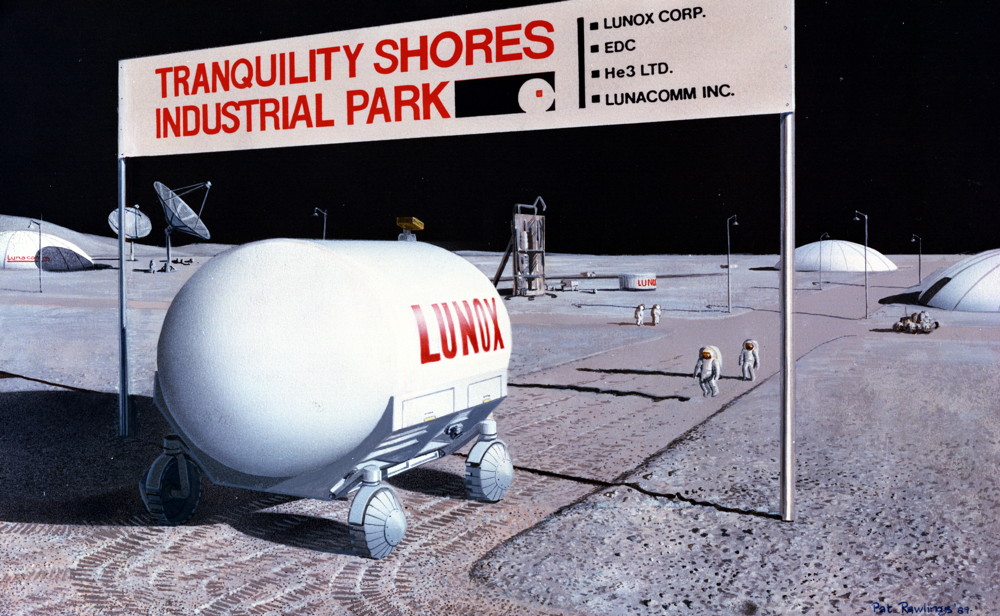
Future industrial activity on the Moon -- science fiction? (Artwork by Pat Rawlings)
Paul D. Spudis
The Once & Future Moon
Smithsonian Air & Space

Space missions are commonly thought of as the ultimate in “high tech.”  After all, rockets blast off into the wild blue yonder, accelerate their payloads to hypersonic and orbital speeds and then operate in zero gravity in the ice-cold, black sky of space.  It requires our best technology to pull off this modern miracle and even then, things can go wrong.  Why would anyone believe that with high technology, sometimes less can be more – that we’re missing a bet by not utilizing current technology.   Like the intellectual tug of war involving man vs. machine, there also is a tug of war between proven technology and high-tech.  Creating these barriers and distinctions is nonsensical.  We need it all.  And we can have it all.

Point in question – in situ resource utilization (ISRU), which is the general term given to the concept of learning how to use the materials and energy we find in space.  The idea of learning how to “live off the land” in space has been around for a long, long time.  Countless papers have been written discussing the theory and practice of this operational approach.  Yet to date, the only resource we have actually used in space is the conversion of sunlight into electricity via arrays of photovoltaic cells.  Such power generation is clearly “mature” from a technical viewpoint, but it had to be demonstrated in actual spaceflight before it became considered as such (the earliest satellites were powered by batteries).

The reason we have not used ISRU is because we’ve spent the last 30 years in low Earth orbit, without access to the material resources of space.  Many ideas have been proposed to use the material resources of the Moon.  A big advantage of doing so is that much less mass needs to be transported from Earth.  The propellant needed to transport a unit of mass from the Earth to the Moon keeps us hobbled to the tyranny of the rocket equation – a constant roadblock to progress.  If it takes several thousand dollars to launch one pound into Earth orbit, multiply that amount times ten to get the cost to put a pound of mass on the Moon.

In the space business, new technologies tend to be viewed with a jaundiced eye.  Aerospace engineers in particular are typically very conservative when it comes to integrating new technology into spacecraft and mission designs, largely on the basis that if we are not careful, missions can fail in a spectacularly dreadful fashion.  To determine if a technology is ready for prime time, NASA developed the Technology Readiness Level (TRL) scale, a nine-step list of criteria that managers use to evaluate and classify how mature a technical concept is and whether the new technology is mission ready.

Resource utilization has a very low TRL level – usually TRL 4 or lower.  Thus, many engineers don’t think of ISRU as a viable technique to implement on a real mission.  It seems too “far out” (more science fiction than science).  Believing that a technology is too immature for use can become a self-fulfilling prophecy, a “Catch-22” for spaceflight:  a technology is too immature for flight because it’s never flown and it’s never flown because it’s too immature.  This prejudice is widespread among many “old hands” in the space business, who wield TRL quite effectively in order to keep new and innovative ideas stuffed in the closet and off flight manifests.

In truth, the idea that the processing and use of off-planet resources is “high technology” is exactly backwards – most of the ideas proposed for ISRU are some of the simplest and oldest technologies known to man.  One of the first ideas advanced for using resources on the Moon involve building things out of bulk regolith  (rocks and soil of the lunar surface).  
Nothing that we plan to do on the Moon involves magic, alchemy or extremely high technology.
This is certainly not high-tech; the use of building aggregate dates back to ancient times, reaching a high level of sophistication under the Romans, who over 2000 years ago built what is still the largest free-supported concrete dome in the world (the Pantheon).  The Coliseum was made of concrete faced by marble.  The Romans also built a complex network of roads, some which remain in use to this day; paving and grading is one of the oldest and most straightforward technologies known.  Odd as it may seem, sand and gravel building material is the largest source of wealth from a terrestrial resource – the biggest economic material resource on Earth.

Recently, interest has focused on the harvesting and use of water, found as ice deposits, at the poles of the Moon.  Digging up ice-laden soil and heating it to extract water is very old, dating back to at least prehistoric times.  This water could contain other substances, including possibly toxic amounts of some exotic elements, such as silver and mercury.  No problem – we understand fractional distillation, a medieval separation technique based on the differing boiling temperatures of various substances.  Again, this concept is not particularly high-tech as only a heater and a cooling column is needed (basically the configuration of an oil refinery).  Some workers have suggested that lunar regolith could be mined for metals, which can then be used to manufacture both large construction pieces and complex equipment.  Extracting metal from rocks and minerals is likewise very old, developed by the ancients and simply improved in efficiency over time.  Processes like carbothermal reduction have been used for hundreds of years. The reactions and yields are well known, and the machinery needed to create a processing stream is simple and easy to operate.

In short, the means needed to extract and use the material wealth of the Moon and other extraterrestrial bodies is technology that is centuries old.  Even advanced chemical processing was largely completely developed by the 19th Century in both Europe and America.  The “new” aspects of ISRU technology revolve around the use of computers to control and regulate the processing stream.  Such control is already used in many industries on Earth, including the new and potentially revolutionary technique of three-dimensional printing.  A key aspect of the old “Faster-Cheaper-Better” idea (one NASA never really embraced) was to push the envelope by relying more on “off-the-wall” ideas, whereby more innovation on more flights would lead to greater capability over time.

Water, Rare Earths and metals are collected and transferred autonomically, using remotely-operated vehicles in a scenario prepared by MIT and presented a gathering of AIAA Houston last spring [John Frassanito & Associates].
Nothing that we plan to do on the Moon involves magic, alchemy or extremely high technology.  Like most new fields of endeavor, we can start small and build capability over time.  The TRL concept was designed as a guideline.  It was not intended as a weapon eliminating possibly game-changing techniques from consideration or to carve out funding territories.  Attitudes toward TRL must change at all levels, from the lowly subsystem to the complete, end-to-end architectural plan.  A critical first step toward true space utilization and for understanding and controlling our destiny there is to recognize and take advantage of the leverage one gets from lunar (and in time planetary) resource utilization.

Originally published at his Smithsonian Air & Space blog The Once and Future Moon, Dr. Spudis is a senior staff scientist at the Lunar and Planetary Institute. The opinions expressed are those of the author and are better informed than average.

Wednesday, June 6, 2012

Human space exploration: asteroids vs. the Moon?

Sunflower solar panel-powered architecture, featuring the LER, Athlete and Chariot vehicles, that were well along in development before Congress and the Obama administration shelved the Constellation program [NASA/John Frassanito & Associates].
Jeff Foust

Two years ago, the Obama Administration changed the direction of the nation’s human spaceflight programs in a number of ways, including the destinations of those efforts. Gone was the goal of the previous administration of a human return to the Moon by 2020, a date that was looking increasingly unrealistic in the eyes of many, including the Augustine Committee that reviewed NASA’s plans in 2009. In its place was something resembling the “flexible path” approach in that committee’s final report, with the Moon replaced as an initial beyond-Earth destination by a near Earth asteroid. President Obama established a 2025 goal for a human mission to an asteroid in a speech at the Kennedy Space Center in April 2010, also setting a goal of a human mission to Mars in the mid-2030s.

From a technical standpoint, a human mission to a near Earth asteroid could be done solely by the United States given both existing capabilities and those under development, like the Orion spacecraft and Space Launch System heavy-lift rocket. Yet, from a financial standpoint, particular in an era of constrained and even declining budgets, it’s likely the US will seek international partners for an asteroid mission, and almost certainly for later missions to Mars. But do the potential partners of the US also want to participate in human asteroid missions?

The recent Global Space Exploration Conference, or GLEX, held in Washington, DC last month by the American Institute of Aeronautics and Astronautics (AIAA) and the International Astronautical Federation (IAF), offered some mixed messages about international interest in human asteroid missions. Some space agency executives instead spoke openly about going back to the Moon, comments that have some support among former NASA officials who believe that human lunar exploration will have greater support internationally.

Perhaps the boldest endorsement of the Moon, and not near Earth asteroids, as the next destination for human exploration came from Vladimir Popovkin, general director of the Russian space agency Roscosmos. Speaking at a plenary session at GLEX on May 22 that featured the leaders or other top officials of six space agencies, Popovkin suggested the Moon, and not the asteroids, was the preferred destination of the Russian space program.

“We arrived at the conclusion that the Moon is supposed to be the next target” for human exploration, Popovkin said through an interpreter. “We’re not trying to convince you that we shouldn’t be doing anything in the area of Mars exploration, asteroid exploration, just that, in our professional opinion, today we have much better chances to come up with very productive and tangible results when concentrating on the Moon.”

Read the in-depth article, HERE.

Thursday, May 24, 2012

Re-release of Iconic Copernicus 'Image of the Century'

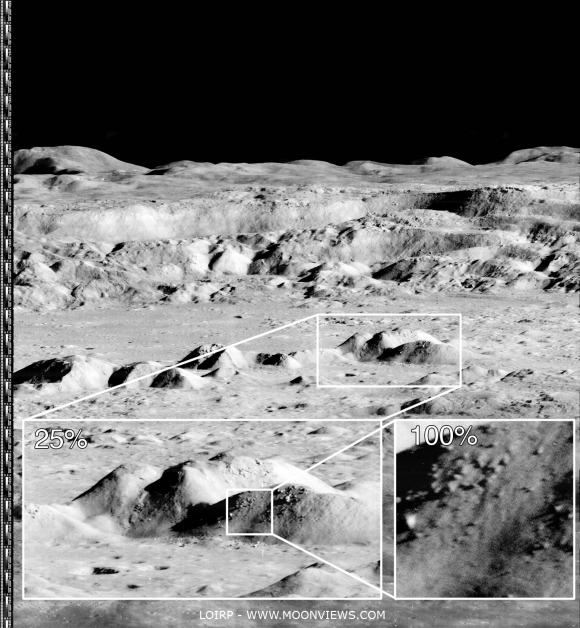
Newly processed high-resolution detail from an unprecedented oblique view of the interior of Copernicus captured by Lunar Orbiter 2, from the "Image of the Century" photographed November 24, 1966. Higher and full resolution images are linked to the Moonviews (LOIRP) announcement, HERE [LOIRP].
Keith Cowing
Lunar Orbiter Image Recovery Project
moonviews.com
NASAWatch.com


Today an iconic image from the initial exploration of the Moon is being re-released showing detail that could not have been seen using technology available at the time the photo was taken. This image features a dramatic view inside the majestic crater Copernicus - a view that left millions in awe when it was first released.

This image was announced at the First Global Space Exploration Conference, co-sponsored by the AIAA and IAF, in Washington, DC.

Between 1966 and 1967 NASA sent five Lunar Orbiter spacecraft to the Moon. Their job was to survey the surface to help determine landing sites for the upcoming Apollo missions. In addition to their recon role, these spacecraft also contributed to the nascent scientific understanding of the Moon. But every once in a while these spacecraft also served as artists, snapping photos of this nearby world in a way that human eyes had never been able to see before.

New magnification possible using the 21st century techniques employed by LOIRP. Higher and full resolution images are linked to the Moonviews (LOIRP) announcement, HERE [LOIRP].
Once such image was taken of crater Copernicus on 24 November 1966 by the Lunar Orbiter 2 spacecraft. What made this photo so unique was the oblique angle it was taken at as well the close proximity of the spacecraft to its target. The image was taken at an altitude of 45 km (27.1 miles) at a distance of approximately 207.7 km (~125 miles) from the center of the crater. Instead of looking down, the spacecraft looked sideways at the Moon.

The bouldered area of the central peaks of Copernicus seen newly sampled at "100 percent" in the image further up were swept up by the Lunar Reconnaissance Orbiter Camera in orbit 909, September 9, 2009; LROC Narrow Angle Camera (NAC) observation M107006443R; resolution 1.15 meters (shown here at 4 meters per pixel) from an altitude of 130.11 kilometers [NASA/GSFC/Arizona State University].
For the first time people saw the Moon as a world with mountains and boulders and other features (some of them strange) that were not apparent from photos where the view was looking straight down. So taken were people at the time that Life Magazine took to calling the photo "The Picture of the Century"

Read about the full details in the original article, HERE.

Thursday, May 3, 2012

AIAA Houston: Develop Cislunar Space Next

Spacecraft departs Earth-Moon L1 node for lunar surface mission [AIAA Houston/John Frassanito & Associates].
Paul D. Spudis
AIAA Houston Horizonscover story

"The real debate should not be about launch vehicles or spacecraft or even destinations, but about the long-term purpose of our civil space program. Different rationales have been proposed, including: scientific knowledge, technology development, creating enthusiasm for science and math education, societal inspiration and many others less tangible. Fundamentally, all of these ration-ales (not all of them mutually exclusive) may have merit to a greater or lesser extent, but in times of national fiscal uncertainty, only those projects providing clear practical value and understandable societal benefit have any reasonable expectation of long-term political and fiscal support."

Read the Horizons cover story, HERE..(PDF)

Controllers on Earth operate and maintain a propellant production plant on the Moon [AIAA/MIT/John Frassanito & Associates].

Wednesday, March 14, 2012

A Potpourri of Lunar Results

Mare inundated interior of Thompson P, part of the larger Mare Ingenii, home of one of the more enigmatic lunar magnetic anomalies and surficial albedo swirls. The tenuous markings and the crustal magnetism are nearly antipodal (on the direct opposite side of the Moon) from Mare Imbrium, the nearside's most easily recognized impact basin. Ingenni is also situated just within the edge of the Moon's oldest, deepest and largest known impact, the South Pole Aitken basin. Did the magnetic field here result from the Imbrium of SPA event, or both? The yellow arrow marks the location of the Ingenni pit crater [NASA/GSFC/LMMP/Arizona State University].
Kelly Beatty
Sky & Telescope

It's been nearly 40 years since astronauts returned the last Apollo samples from the Moon (and 35 since Luna 24 brought back 170 grams from Mare Crisium). Since then several orbiting spacecraft have mapped the lunar surface from top to bottom, repeatedly. So a casual observer might conclude that we've learned everything there is to know about the Moon.

Ha! If anything, questions about how Earth's satellite formed and evolved are more numerous than ever. As evidence, I submit the following summaries of research that's been published in the past few weeks.

Read the full feature article HERE.

Monday, October 11, 2010

Offloading operations using a Heavy-Lift LSMS


Chariot, LSMS-H, and ESA lunar lander offloading operations.

Sharon A. Jefferies, William R. Doggett
John T. Dorsey, Thomas C. Jones &
Michael E. Haddad
NASA Langley & KSC

Jonathan Chrone, Scott Angster
David A. Helton & Darrell L. Caldwell, Jr.
Analytical Mechanics Associates

This study investigates the feasibility of using a heavy-lift variant of the Lunar Surface Manipulator System (LSMS-H) to lift and handle a 12 metric ton payload. Design challenges and requirements particular to handling heavy cargo were examined. Differences between the previously developed first-generation LSMS and the heavy-lift version are highlighted. An in-depth evaluation of the tip-over risk during LSMS-H operations has been conducted using the Synergistic Engineering Environment and potential methods to mitigate that risk are identified. The study investigated three specific offloading scenarios pertinent to current Lunar Campaign studies. The first involved offloading a large element, such as a habitat or logistics module, onto a mobility chassis with a lander-mounted LSMS-H and offloading that payload from the chassis onto the lunar surface with a surface-mounted LSMS-H. The second scenario involved offloading small pressurized rovers with a lander-mounted LSMS-H. The third scenario involved offloading cargo from a third-party lander, such as the proposed ESA cargo lander, with a chassis-mounted LSMS-H. In all cases, the analyses show that the LSMS-H can perform the required operations safely. However, Chariot-mounted operations require the addition of stabilizing outriggers, and when operating from the Lunar surface, LSMS-H functionality is enhanced by adding a simple ground anchoring system.


Lunar Surface Manipulator System (LSMS) naming conventions.

As we consider returning humans to the Moon with a view towards building an outpost to enable a permanent human presence, it is important to consider the means by which lunar surface system elements and other cargo will be offloaded from the lunar lander as well as handled on the surface. In particular, methods to offload heavy cargos, such as surface habitats, from lunar landers and to manipulate that cargo on the surface of the Moon need to be investigated. Previous studies have focused on using a Lunar Surface Manipulator System1 to offload cargo up to ~ 6 metric tons and the All-Terrain Hex-Legged Extra-Terrestrial Explorer (ATHLETE) for offloading cargos up to the maximum lander capacity. In this study, we investigated the use of a Lunar Surface Manipulator System (LSMS) that has been modified to handle a 12 metric ton payload, which is consistent with the estimated mass of the largest payloads currently used in NASA’s Lunar Campaign Analysis.

This study focused on two key areas: a) identifying necessary design modifications to enable the LSMS to handle the heavier cargo mass and to ensure the LSMS could reach all potential cargos from lander, chassis, and surface mounted locations, and b) analyzing payload handling operations with the Heavy-lift LSMS (LSMS-H) to ensure the operations could safely be performed while avoiding a potential tip over situation. As part of the analysis, preliminary calculations were made to identify the safe operation envelope, or tip over boundaries, for several cargo handling scenarios. These initial calculations helped to identify necessary design modifications to expand the safe-operating zone and reduce the likelihood of tip over. The results were then fed into the Synergistic Engineering Environment (SEE). The SEE was used to simulate each offloading scenario, dynamically calculating the system center of gravity (CG) (assuming a constant gravity field) and comparing the CG location to the tip over boundary.

In addition to the operational focus areas described above, this study also sought to understand the correlation between lunar cargo handling equipment and procedures using their terrestrial equivalents, particularly those that may facilitate remote offloading operations without the presence of crew on the lunar surface. As several of the payload handling operations will potentially occur in preparation for crewed missions, it is essential that payload acquisition and release be as simple and safe as possible to reduce risk to lunar equipment. Several benefits are identified that may be realized by incorporating commonality into the development of lunar and terrestrial flight handling hardware and procedures.

Devices for lifting, translating and precisely placing payloads are critical for efficient Earth-based construction operations. Recent and past studies have demonstrated that devices with similar functionality will be needed to support lunar outpost operations.

Download (PDF) the Study, HERE.
American Institute of Aeronautics and Astronautics

Monday, August 9, 2010

The Dust Management Project


Apollo 16 Beta Cloth Sample (69003). Surface contact sampling method. "It appears the uppermost surface is enriched in fine grains compared to the bulk soil," wrote Dr. Sarah Noble. The earliest direct lunar observations showed evidence of active micrometeor "gardening" and/or dynamic electromagnetic charging, levitation and ballistic migration [NASA/JSC/MSFC].

Mark Hyatt (NASA/Glenn) & Sharon Strake (NASA/GSFC)
AIAA, 40th International
Conference on Environmental Systems
Barcelona, 11-15 July 2010

A return to the Moon to extend human presence, pursue scientific activities, use the Moon to prepare for future human missions to Mars, and expand Earth’s economic sphere, will require investment in developing new technologies and capabilities to achieve affordable and sustainable human exploration. From the operational experience gained and lessons learned during the Apollo missions, conducting long-term operations in the lunar environment will be a particular challenge, given the difficulties presented by the unique physical properties and other characteristics of lunar regolith, including dust.

The Apollo missions and other lunar explorations have identified significant lunar dust-related problems that will challenge future mission success. Comprised of regolith particles ranging in size from tens of nanometers to microns, lunar dust is a manifestation of the complex interaction of the lunar surface with multiple mechanical, electrical, and gravitational effects. The environmental and anthropogenic factors effecting the perturbation, transport, and deposition of lunar dust must be studied in order to mitigate it’s potentially harmful effects on exploration systems and human explorers.

The Dust Management Project (DMP) is tasked with the evaluation of lunar dust effects, assessment of the resulting risks, and development of mitigation and management strategies and technologies related to Exploration Systems architectures.


Lotus Coating. Just one dust mitigation strategy examined by the Dust Management Project. An uncoated radiator sample and a Lotus coated radiator sample after contamination with JSC-1 Lunar simulant.

By pursuing an integrated approach of characterization, technology development, and application focus, the DMP has made significant progress in the first three years of implementation.

The project provides coordination and integration of dust related activities in (the NASA Exploration System Mission Directorate) ESMD, with a focus on the dust related challenges associated with long duration lunar missions.

The project has established a comprehensive body of data and experience and defined and filled key gaps in knowledge and capabilities. The project has developed specific technologies useful in the mitigation and control of dust and its effects on systems. New simulants are now becoming available to assess mitigation technologies and approaches as well as perform test and verification of components and systems.

Critical information and technology deliverables will be provided directly to Exploration flight (Lunar Precursor Robotic and Constellation) programs. Lunar dust should be viewed as integrated environmental phenomena, the study of which must employ a coordinated, multidisciplinary approach. The Dust Management Project will certainly include elements exploiting theoretical studies, earth-bound experiments, key measurements conducted by early robotic missions, and development of “best design” rules and specific engineering solutions for systems and their components affected by lunar dust.

Read the paper (pdf), HERE.

Monday, May 31, 2010

Lunar Outpost Life Support Architecture Study Based on a High-Mobility Exploration Scenario


Figure 1. Scenario 12.0.1 Lunar Outpost schematic. Lunar Electric Rovers (LER) are shown without a Portable Utility Pallet (PUP) Larger view available in source and through the image above.

Kevin E. Lange
Jabobs Technology, Inc.

Molly S. Anderson
NASA JSC

International Conference on Environmental Systems
Barcelona, July 11-15, 2010

An American Institute of Aeronautics and Astronautics paper presenting results of a life support architecture study based on a 2009 NASA lunar surface exploration scenario known as Scenario 12.

The study focuses on the assembly complete outpost configuration and includes pressurized rovers as part of a distributed outpost architecture in both stand-alone and integrated configurations. A range of life support architectures are examined reflecting different levels of closure and distributed functionality. Monte Carlo simulations are used to assess the sensitivity of results to volatile high-impact mission variables, including the quantity of residual Lander oxygen and hydrogen propellants available for scavenging, the fraction of crew time away from the outpost on excursions, total extravehicular activity hours, and habitat leakage. Surpluses or deficits of water and oxygen are reported for each architecture, along with fixed and 10-year total equivalent system mass estimates relative to a reference case. System robustness is discussed in terms of the probability of no water or oxygen resupply as determined from the Monte Carlo simulations.

New to the NTRS database, HERE.

Monday, February 15, 2010

Expert: China close to lunar landing capability

Shenzhou-7 roll-out at Jiuquan in northwest China's Gansu Province, September 20, 2008. [Xinhua]

People's Daily - After years of development, China's space technology is close to moon landing capability, said Fu Yiqing, space expert and consultant to the Shanghai Institute of Space Propulsion (SISP).

Fu, also a senior member of American Institute of Aeronautics and Astronautics (AIAA), said this during an interview with reporters form China News Service.

New generations of Chinese taikonauts are studying moon landing technology. Although there is no big problem in the overall technical aspects of moon landing, some details still need to be researched and implemented, said Fu.

Aerospace engines produced by the SISP are the key parts. The orbit of Chang'e II, planned to be launched this year, will be closer to the moon, making preparation for the moon landing.

Fu said China will launch Tiangong 1 space laboratory making a breakthrough in space rendezvous and docking technology; develop the Long March V, large-scale carrier rocket and prepare for launch of space station; launch Chang'e II and Chang'e III satellites and achieve a soft landing of moon's surface; make use of moon rover to explore the moon and provide data for the for the moon base mission.

Besides China, a number of countries are also accelerating the pace of manned space missions. The U.S. plans to "return to the moon" and Europe, Russia, Japan and India have also raised the concept of the moon landings.

Studies have found helium-3 is more abundant on the Moon than on the Earth. It is a variant of the gas used in lasers and refrigerators as well as in balloons. Moon gas could meet earth's future energy demands for thousands of years.

Fu has served as a director designer of engines of Long March III and Long March IV carrier rockets.

Wednesday, September 30, 2009

AIAA panel to discuss Augustine report

Dr. David Livingston of "The Space Show" Will Moderate Internet Radio Broadcast

The American Institute of Aeronautics and Astronautics (AIAA) will host a panel of experts to discuss the implications of the Augustine Commission report, "Review of U.S. Human Space Flight Plans," Scheduled for Monday, October 5 at 2:00 p.m. EDT* as a live, streaming, Internet radio broadcast, the discussion will be moderated by Dr. David Livingston, host of "The Space Show with Dr. David Livingston," and may be accessed at www.thespaceshow.com.

(*Note: Scheduling is subject to the actual release of the final report. As of Oct. 1, the final draft was still under revision, with no release expected 'timed to the end of September.')

The Review of U.S. Human Space Flight Plans Committee, chaired by retired Lockheed Martin CEO Norm Augustine, was established by the Obama administration to evaluate ongoing U.S. human space flight programs, as well as alternatives, and to ensure that future human space flight plans are safe, innovative, affordable, and sustainable. )

The panel will discuss the findings of the report, and the possible future direction of the U.S. space program, as well as the immediate steps NASA might take in fiscal year 2010. Panelists include:

* Frank Culbertson - Former NASA astronaut who completed three space shuttle missions, and managed NASA's "Shuttle-Mir" program, overseeing nine dockings of the shuttle with the former Russian space station. Culbertson is now vice president of business development at Orbital Sciences Corporation.
* Scott "Doc" Horowitz - Former NASA astronaut who completed four space shuttle missions, leaving NASA in 2004 to become director of space transportation and exploration at ATK-Thiokol. Horowitz was NASA's Associate Administrator for Exploration Systems during the George W. Bush administration.
* John Klineberg - Former director of both NASA John H. Glenn Research Center, Cleveland, Ohio, and the NASA Goddard Space Flight Center, Greenbelt, Md., and former CEO of Loral Space Systems.
* Elliot Pulham - President and CEO of The Space Foundation.
* Harrison "Jack" Schmitt - Geologist and NASA's first scientist-astronaut, Schmidt was back-up mission scientist for Apollo 11 lunar module pilot on Apollo 17, the twelfth and last human to set foot on the moon. Schmidt represented New Mexico in the United State Senate from 1975 to 1981.

Listeners can question the panel by calling 1 (866) 687-7223 or by sending e-mail during the program to dmlivings@yahoo.com, drspace@thespaceshow.com, or the thespaceshow@gmail.com.

Listeners can also communicate with panelists through the AOL AIM, ICQ, or Compuserve Chat services using the screen name "spaceshowchat."

(AIAA is the world's largest technical society dedicated to the global aerospace profession. With more than 36,000 individual members worldwide, and 92 corporate members, AIAA brings together industry, academia, and government to advance engineering and science in aviation, space, and defense. For more information, visit www.aiaa.org.

Tuesday, September 15, 2009

New Gemini: Re-Thinking Heavy-Lift


Notional orbital propellant depots
- As millions who have flown to the Moon (without leaving their PC) using the popular DeltaGliderIV add-on to Martin Schweiger's acclaimed and free Orbital Simulator program know, it is "possible" to get there without using a heavy-lift booster. It is "just" possible, that is, though it does take practice and some knowledge of Von Braun's free-return trajectory.

Pulling this stunt off, in real time, for me at least, also requires an off-plain orbit change and subsequent rendezvous and docking with the magically restored Soviet Mir space station, conveniently parked in low-earth orbit, as near as possible to the orbital plain of the Moon.


With a replenished "fuel" tank, using the DeltaGliderIV, a pilot can then line up for trans-lunar injection, just like the Apollo-Saturn IVB configurations of yore, and arrive with a reasonable amount of crew and cargo for the low-energy (~800 m/s) orbital insertion burn behind the Moon, in 90 to 120 hours, again, just like Apollo. It is also possible to land at a precise location on the Moon, breaking orbit for a terminal insertion burn, make a pin-point landing and then return to lunar orbit and afterward accelerate for a two to three day return to Earth, just like Apollo.

Unlike Apollo, I have not succeeded in a direct re-entry at 25,000 mph. Either the vehicle or the pilot can't handle such a hairy maneuver, yet. Instead, I have successfully used what remained of the "vehicle's" fuel to reduce velocity while speeding up through what would otherwise be a hopeless Earth fly-by, from over 11,000 meters per second to the 7700 meters-plus per second velocity of low-earth orbit. I have then subsequently performed the tricky Shuttle-like "standard" re-entry maneuver and dead-weight runway landing.

If Orbital Simulator 2006 can be thought of as Martin Schweiger's "chalk board," a vehicle small enough to fit inside the cargo bay of the Space Shuttle can travel to the Moon, land and return to Earth. Without on-orbit fuel transfer, however, involving a rendezvous with a pre-fueled payload assist (PAM) rocket or a direct fuel transfer, the scenario described definitely requires an expensive, heavy-lift expendable booster.


Admittedly, on-orbit refueling after using more than half of a small vehicle's fuel capacity (to say the least) is science fiction, but no more than orbital rendezvous was equally problematic before the Gemini program (1965-1966). Unlike orbital rendezvous, which the United States, Russia and more recently the ESA have made appear easy, on-orbit refueling would not be a magic act. It requires more than a little appreciation for the delicacies and sensitivities of temperatures and couplings.

Or does it? The Constellation program, in a very real way, already features on-orbit refueling, using the rendezvous and docking with pre-positioned unmanned vehicles launched using unmanned heavy-lift boosters, like the Ariane V, or the Ares V now under development.

Long term, for manned space travel beyond low-Earth orbit to be less than prohibitively expensive, according the Second Augustine commission, may require a step beyond the Apollo-Saturn and Shuttle surplus idea to new, "perhaps" cheaper technologies. These won't be free R&D spin-offs, but the result of a deliberate program, probably as expensive as Gemini, to take orbital rendezvous past a dangerous, though logical, technological hurdle.


From Popular Mechanics and Rand Simberg

"It has long been conventional wisdom, going all the way back to Apollo, that heavy lift was a prerequisite for human exploration beyond low Earth orbit, but this summer has seen several cracks start to appear in that consensus. First, partly as a result of white papers circulated among its members in the last few weeks, the Augustine panel itself has championed the concept of propellant depots. But defenders of the current approach have claimed that the ideas aren't fleshed out, and are too complex and expensive. This week, at the American Institute of Aeronautics and Astronautics annual meeting on space in Pasadena, Calif., several technical papers have more to say on the subject of getting back to the moon with existing launch systems.

"While Boeing and Lockheed Martin can smell the Ares blood in the water, they still both have lucrative contracts for the Constellation program (Orion for Lockheed Martin, and the Ares I upper stage for Boeing), and they can't afford to upset the apple cart unless they know that the program is definitely dead. Three years ago, Lockheed Martin got itself into hot water with the former administrator, Mike Griffin, at the AIAA meeting in San Jose, where they held a joint press conference with Bigelow Aerospace announcing a study to "human rate" the Atlas V to service Bigelow's planned facilities. Griffin reportedly called upper management there to complain about the potential threat these plans posed to maintaining political support for Ares."

Read the full article HERE.