Saturday, January 14, 2012

Shadowed fluffy lunar frost detected in starlight

LRO (in this case the LOLA imaging team) is slowly but certainly stripping away the shadows from the permanently shadowed regions of the Moon. The differences between the water-supporting natures of the rocks deep in the shadowed southern craters Haworth and Shoemaker has been better explained by data collected by LRO's LAMP instrument. From Earth, seen here from a Kaguya HDTV still shot from nearly the same angle in 2008, the shadowed region between the nearside rim of South Pole Aitken basin and 10 km-wide Shackleton (which supports the Moon's south pole on it's rim) can only be measured through "the notch" between Malapert massif on the left and the lofty "Leibnitz beta" massif on the right [NASA/JAXA/LMMP/ILIADS]
San Antonio  New maps produced by the Lyman Alpha Mapping Project (LAMP) aboard NASA's Lunar Reconnaissance Orbiter (LRO) reveal features at the Moon's north and south poles in regions that lie in perpetual darkness. Developed by the Southwest Research Institute (SwRI), the LAMP instrument is sensitive on dim "starlight," specifically the band of electro-magnetic frequencies emitted when hydrogen (which usually travels in pairs) is reduced to a single atom, usually when encountering other forms of radiation.

This Ly-α (Lyman-alpha) spectral line is peculiar to neutral hydrogen, the most basic and abundant element in the universe, is produced by light with a wavelength of 121.4 nm, a frequency below the narrow band of optical frequencies visible to the naked eye. By gathering data revealed by this all-pervasive indirect starlight LAMP can peer into so-called "permanently shadowed regions" (PSRs).

In repeated passes over the lunar poles using this method researchers have able to determine the presence of very fine structure, such as the likely porosity of lunar surface rock or the most likely textures of water frost in super-cold volatile traps, in permanent shadow from the Sun, and only in those places on the Moon not overwhelmed by direct or immediately indirect sunlight.


The LAMP maps show that many PSRs are darker at far-ultraviolet wavelengths and redder than nearby surface areas that receive sunlight. The darker regions are consistent with large surface porosities — indicating "fluffy" soils — while the reddening is consistent with the presence of water frost on the surface.

"Our results suggest there could be as much as 1 to 2 percent water frost in some permanently shadowed soils," says author Dr. Randy Gladstone, an Institute scientist in the SwRI Space Science and Engineering Division. "This is unexpected because naturally occurring interplanetary Lyman-alpha was thought to destroy any water frost before it could accumulate."

The LAMP team estimates that the loss of water frost is about 16 times slower than previously believed. In addition, the accumulation of water frost is also likely to be highly dependent on local conditions, such as temperature, thermal cycling and even geologically recent "impact gardening" in which micrometeoroid impacts redistribute the location and depth of volatile compounds.

Lyman-alpha albedo maps for greater south polar region from the first year of LAMP night-side observations. Initial studies were focused on those areas above 80°N. The white square is the area highlighted in a recent paper comparing what's been discovered about the big differences between the interiors of permanently shadowed neighbors Haworth and Shoemaker craters. "Calibrated photon events" accumulated month by month and divided by model-based illumination baselines show "generally, we find good agreement between UV-dark regions and the coldest shaded craters revealed by the LRO Diviner instrument." Identifying the cause of this albedo darkening required spectral analysis but the likeliest explanation included either the presence of "UV-absorbing volatiles at the surface" and/or "a change in surface properties (e.g., roughness or porosities) at these interesting locations." [Retherford et al., Lunar and Planetary Sciences Conference, (2011)].
Finding water frost at these new locations adds to a rapidly improving understanding of the Moon's water and related species, as discovered by three other space missions through near-infrared emissions observations and found buried within the Cabeus crater by the LCROSS impactor roughly two years ago. During LRO's nominal exploration mission, LAMP added to the LCROSS results by measuring hydrogen, mercury and other volatile gases ejected along with the water from the permanently shaded soils of the Moon's Cabeus crater.

"An even more unexpected finding is that LAMP's technique for measuring the lunar Lyman-alpha albedo indicates higher surface porosities within PSRs, and supports the long-postulated presence of tenuous 'fairy-castle' like arrangements of surface grains in the PSR soils," says co-author Dr. Kurt Retherford, a senior research scientist also in SwRI's Space Science and Engineering Division.

Comparisons with future LAMP maps created using data gathered from the Moon's day side will prove helpful for revealing more about the presence of water frost, as well as the surface porosities of the darker surface features observed. The LAMP team is also eager to apply the Lyman-alpha technique elsewhere on the Moon and on other solar system objects such as Mercury.

No longer terra incognitia, the permanently shadowed interiors and area surrounding the southern polar craters Haworth and Shoemaker have had their elevation unveiled in precise detail, seen here in laser altimetry collected over two years and several thousand polar orbits [NASA/GSFC/LOLA].
LRO's findings are expected to be valuable to the future consideration of a permanent Moon base. The permanently shadowed regions of the Moon are revealing themselves to be some of the most exotic places in the solar system, well worthy of future exploration, says Retherford. Any discovery of water frost and other resources in the area also could reduce the need to transport resources from Earth to a base at the pole.

The paper, "Far-Ultraviolet Reflectance Properties of the Moon's Permanently Shadowed Regions," by G.R. Gladstone, K.D. Retherford, A.F. Egan, D.E. Kaufmann, P.F. Miles, et al., was published in the Jan. 7 issue of the Journal of Geophysical Research. LAMP's principal investigator is Dr. Alan Stern, associate vice president of the SwRI Space Science and Engineering Division.

China's Long March to the Moon

The PRC's planned unmanned lunar
expeditions this decade include a sample
return mission
[CLEP].
Paul D. Spudis
The Once and Future Moon
Smithsonian Air & Space

Controversy quickly followed astonishment with the recent release of a white paper outlining China’s intentions in space.  Sparking particular buzz from the Internet was a statement about human lunar missions being an objective for future Chinese space efforts.  That statement drew comment ranging from sophisticated to simplistic, yet in my opinion, most of the discussion to date neglects the essential point of what this means to humanity’s future in space.

The report lays out China’s plan for missions to the Moon of increasing complexity and capability.   The Chinese orbiters Chang’E 1 (2007) and Chang’E 2 (2010) made global maps of the Moon’s morphology and topography.  The Chang’E spacecraft demonstrated China’s ability to navigate trans-LEO space.  After Chang’E 1’s mapping mission was complete, the spacecraft was deliberately de-orbited to impact the Moon.  However, after surveying a potential landing site for future missions, the Chang’E 2 spacecraft left lunar orbit and was sent to the Earth-Sun L2 point, a stable location 1.5 million km from the Earth.  This maneuver is quite complex and its successful completion demonstrated their capability to maneuver spacecraft throughout cislunar space.  It also lays the groundwork for more complex lunar and planetary missions in the near future.

The white paper reiterates the Chinese strategy of orbiter-lander-sample return for lunar exploration with robotic missions, of which the Chang’E series is the first step.  The paper mentions human spaceflight activities occurring only in low Earth orbit, specifically asserting their determination to conduct an “independent” space exploration program.  Closing remarks in that section of the report have been drawing the most attention: China intends to conduct “studies on a preliminary plan for a human lunar landing.”

In NASA terms, such wording would lead no one to conclude that anything remotely flight-ready was within a decade or two of occurring.  But our way is not their way.  The Chinese clearly are systematically pursuing a series of steps to incrementally increase their flight experience, technology base and operational expertise in low Earth orbit, but in a direction unmistakably toward the Moon and throughout cislunar space.

Despite some pronouncements of military doom – visions of Red Army Space Troopers descending upon us – a war in space does not appear imminent.  Over several pages, the report repeatedly proclaims China’s intention to “peaceably explore and use outer space,” especially in conjunction with an endless series of United Nations mandates, innumerable Moon treaties and international kumbayah.  Perhaps, as Queen Gertrude once observed, they doth protest too much.

Daniell crater 35.39°N, 31.14°E, as photographed from Chang'E 2 in 2010 [CNSA/CLEP].
Military action is not the only possible geopolitical threat on Earth or in space.  Although it is probably too early to tell, the real issue is how serious is China about expanding their sphere of operations beyond low Earth orbit to the Moon.  Currently, their human space program appears to be relatively benign, with simple Earth orbital missions, the construction of a rudimentary space station, crew EVA – all steps and capabilities that a nascent space faring nation must learn and develop.  Their proposed robotic lunar exploration plan likewise makes sense, in that they first orbit and map, then survey in detail to land, rove, explore and return samples.  For each step, a new capability is developed, building on existing ones, with all contributing toward a future strategic position.  Hmmmm – an incremental architecture with cumulative series of small but interlocking stepsWhat a concept!

The reaction of space observers in the West seems bifurcated along the lines of “The sky is falling!” or “Who cares?”  For the former, some note that the Chinese space program is run by their military.  Moreover, the demonstration test of a Chinese anti-satellite weapon in 2007 did not engender the international peaceful good feelings so stridently expressed in the white paper.  Those who read potential danger in Chinese intentions in space are not being unreasonable, even if there appears to be no immediate threat.  For the latter group, nothing that China has done, is doing or ever could do in space would bother them.  ASAT testing?  Any alarm is labeled “hysteria.”  Chinese lunar landings?  So what?  We did that 40 years ago.  These people know not what they don’t know.  Holding such a position is patently naïve.

The real cause for concern is not a Chinese presence in cislunar space or on the Moon, but our absence from it.  Although much has been made of China’s purported movement toward capitalism in recent decades, they still possess an authoritarian political system, one with scant regard for the rule of contract law, copyright, private property and western notions of free market dynamics. Although some may not care whether China conquers the Moon, if they are the only ones on the Moon, they will determine what operational regime and legal template will prevail there.  Advocates of “commercial space” might do well to carefully consider such a scenario – commercial companies are incorporated under national auspices on Earth, pay taxes to terrestrial governments, and are subject to the laws of the country in which they are based.  They will not be free agents either in space or on the Moon.

I argued almost two years ago that there is a new “space race” but that it is quite different in character from the first one.  The outcome of this race will determine what kind of politico-economic paradigm will prevail on the new frontier of space.  One can imagine a situation in which a country establishes a permanent presence on the Moon and maintains control of the resources there.  Yes, the Moon is a big planet, but the valuable concentrations of water lie in small areas near the poles.  Water at the poles of the Moon allow a space faring entity to develop routine access to the entirety of cislunar space, where all of the economic, scientific and security space assets of many countries reside.  Space control in the new century does not refer to “Death Stars” bristling with space weaponry, but to situational awareness, assurance of service, and the defense and maintenance of space-based assets.  Control of cislunar space – meaning in this case the ability to routinely travel throughout its extent and to all the various orbits of cislunar satellites – does not mean to militarize or weaponize space, but rather the permanent presence of a space faring power of a particular ideology or worldview, undeterred by the absence of a competing ideology.

And if some say “So what?” to that, the more fool they.

Originally published January 14, 2012 at his Smithsonian Air & Space blog The Once and Future Moon, Dr. Spudis is a senior staff scientist at the Lunar and Planetary Institute. The opinions expressed are those of the author and are better informed than average.

Friday, January 13, 2012

GRAIL twins to be officially renamed January 17

Follow GRAIL A and B, along with the full range
of robotic probes in orbit and deep space through
the JPL
Eyes on the Solar System web
application
[NASA/JPL].
NASA will host a news conference at 1800 UT, Tuesday, January 17, to announce the names selected from a nationwide student contest for twin spacecraft that will study the moon in unprecedented detail. The event will be held at NASA Headquarters in Washington.

Nine hundred classrooms and more than 11,000 students from 45 states, as well as Puerto Rico and the District of Columbia, participated in the contest that began in October 2011.

The agency's twin Gravity Recovery And Interior Laboratory (GRAIL A/B) spacecraft successfully achieved lunar orbit on New Year's Eve and New Year's Day, respectively. The status of the spacecraft and upcoming plans for science operations also will be discussed.

NASA Television and the agency's website will broadcast the live event.The participants will be John Grunsfeld, associate administrator, Science Mission Directorate, NASA HQ; Leland Melvin, associate administrator for Education, NASA HQ; Maria Zuber, GRAIL principal investigator, MIT, Cambridge, MA & Sally Ride, president and CEO, Sally Ride Science, San Diego along with the teacher and students who submitted the selected contest-winning names for the GRAIL spacecraft.

The event will be carried live on Ustream, with a live chat box available, at: http://www.ustream.tv/nasajpl2 .

For more information about GRAIL, visit: http://grail.nasa.gov/ - http://www.nasa.gov/grail/ or the GRAIL science site at MIT http://moon.mit.edu/.

For NASA TV streaming video, downlink and schedule information, visit: http://www.nasa.gov/nasatv .

NASA's Jet Propulsion Laboratory in Pasadena, CA manages the GRAIL mission for NASA's Science Mission Directorate, Washington. The GRAIL mission is part of the Discovery Program managed at NASA's Marshall Space Flight Center in Huntsville, Ala. Lockheed Martin Space Systems in Denver built the spacecraft. JPL is a division of the California Institute of Technology in Pasadena.

Thursday, January 12, 2012

LROC: Craggy Peak, Impact Melts

Northern slope of one of four central peaks in Hayn crater, on the northern edge of Humboldtianum basin. Downslope direction is from top to bottom (North is down), image field of view is 594 meters, sunlight is from upper left. LROC NAC observation M128754462L, orbit 4108, resolution 0.54 meters from 51.78 kilometers. View the full size LROC Featured Image HERE [NASA/GSFC/Arizona State University].
Hiroyuki Sato
LROC News System

Due to the tremendous energy released by an impact event large portions of the target rock is melted. This impact melt forms distinctive flows and ponds both inside and outside of its parent crater. In many young craters the LROC NAC has captured deposits that look as if they formed yesterday.

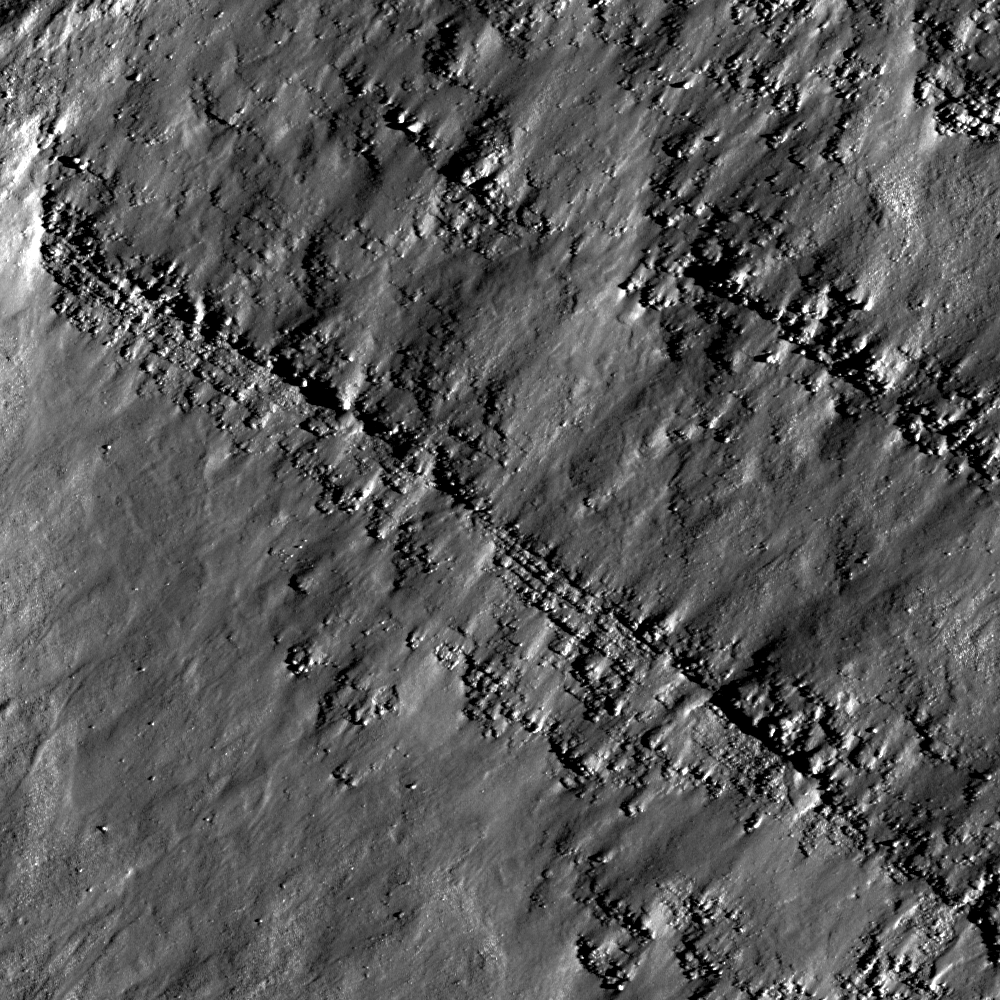
Today's Featured Image is on the northern slope of the Hayn crater central peak. Due to the peak's steepness, it is rough and craggy. In many places on the peak wavy deposits are seen between crags and blocks; these deposits are most likely impact melt. Truly amazing, first the central peak formed then impact melt splashed down and coated it. If this interpretation is correct you can say that the peak formed in matter of a few seconds, quickly enough that melt that was thrown during the impact had not yet landed!  Quantitative measurements of these kind of spectacular outcrops, using new accurate topography from LROC NAC stereo will help reveal how impact craters form.

LROC QuickMap WAC monochrome 125 meter per pixel projection of Hayn and vicinty, centered at 64.34°N, 83.94°E. The yellow arrow indicates the locations of LROC Featured Image field of view [NASA/GSFC/Arizona State University].
Hayn is an exceptionally deep crater because it is situated just within the northern mountainous ring of 550 km-wide Humboldtianum basin, which extends far beyond its deep interior Mare Humboldtianum. The entire basin straddles the 90° east meridian, though Mare Humboldtianum is a nearside basin visible at favorable lunar librations. The floor of Hayn is 4.9 kilometers below global mean elevation and it's northern crater rim is still more than a half kilometer below global mean. The mountain directly north of Hayn, a worn remnant of the Humboldtianum basin rim is 2.3 kilometers above global mean, nearly a seven thousand meter change in elevation over the eighty kilometers between that massif and the center of Hayn. LROC Wide Angle Camera (WAC) 100 meter per pixel digital terrain model, color shaded relief, orthographic projection centered on 60° east [NASA/GSFC/Arizona State University].

Explore the craggy peak and impact melt deposits, both on the peak and the floor of Hayn crater, HERE.

Related Posts:
On the floor of Green M
Splash and flow
Ejecta in Tycho crater
Natural Bridge on the Moon!

Wednesday, January 11, 2012

LROC: Bulging wrinkles at Tsiolkovskiy

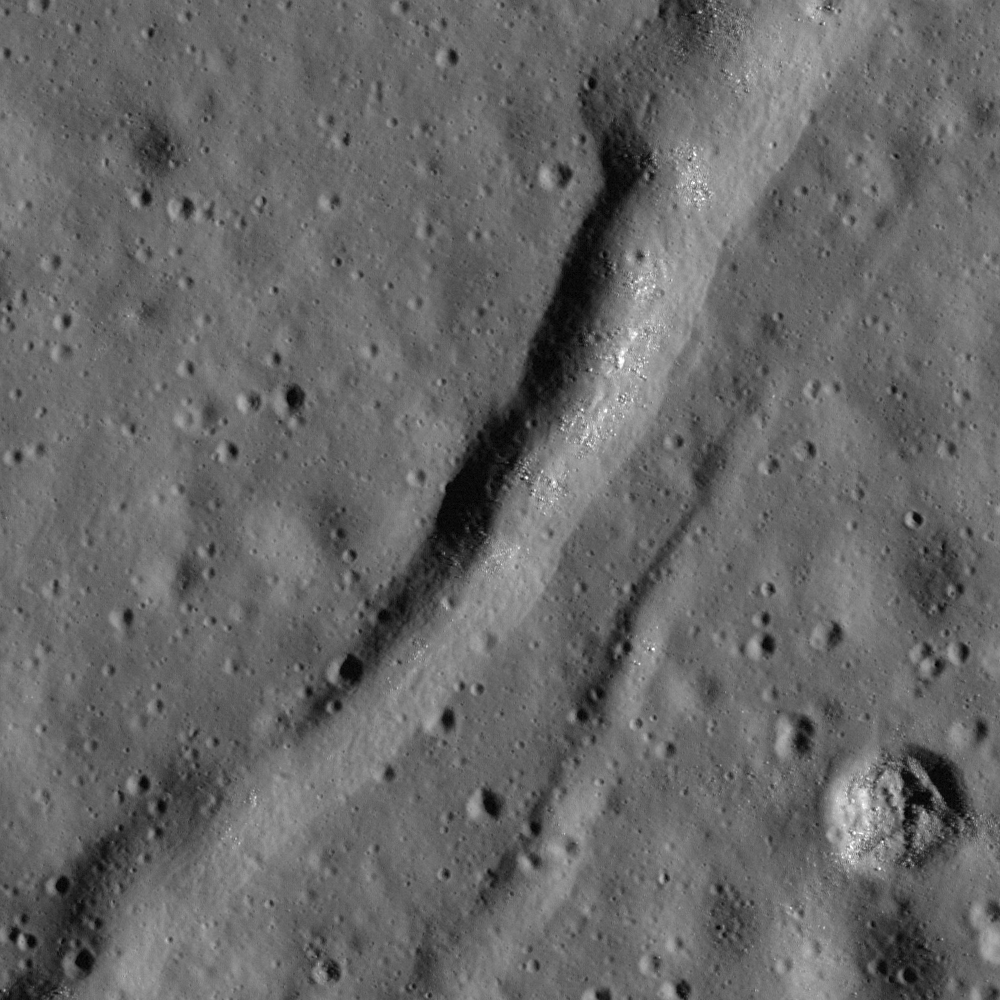
From the complementary left-side frame of the north-northwest interior of Mare Tsiolkovskiy spotlighted January 10, "bulging" and interestingly entwined wrinkle ridges can be seen extending into the prominent farside crater's very flat and expansive floor. Sunlight is from northeast in this slightly "twisted" view of the original Featured Image (which shows a larger field of view 610 meters across) HERE. LROC Narrow Angle Camera (NAC) observation M161475783L, orbit 8930, May 31, 2011, resolution 0.61 meter per pixel from 58.99 kilometers  [NASA/GSFC/Arizona State University].
Hiroyuki Sato
LROC News System

The mare in the Tsiolkovskiy crater looks extremely flat and smooth at first glance. But if you stare carefully, you can find many tectonic features deforming this large plain; extension cracks, classic wrinkle ridges, and special wrinkle ridges that have a convex bulge shape.

Today's Featured Image shows a portion of a narrow "bulging" wrinkle ridge 60 to 100 meters in width, extending in a northeast direction to the edge of the mare. Wrinkle ridges are common in the lunar mare and are believed to be a type of thrust fault. These ridges typically have a steep slope on one side and a shallow slope on the other. In this case, the ridge seems to have a uniform curved shape. Local tectonic conditions such as the thickness of mare, stress direction, and the layer strength affect the final shape of a ridge. Since this ridge has a unique shape, it is now targeted for future NAC stereo imaging. From the new stereo pair, scientists will make a detailed topographic map that will allow tectonic experts to better understand the nature of this feature and add to our knowledge of tectonism on the Moon.

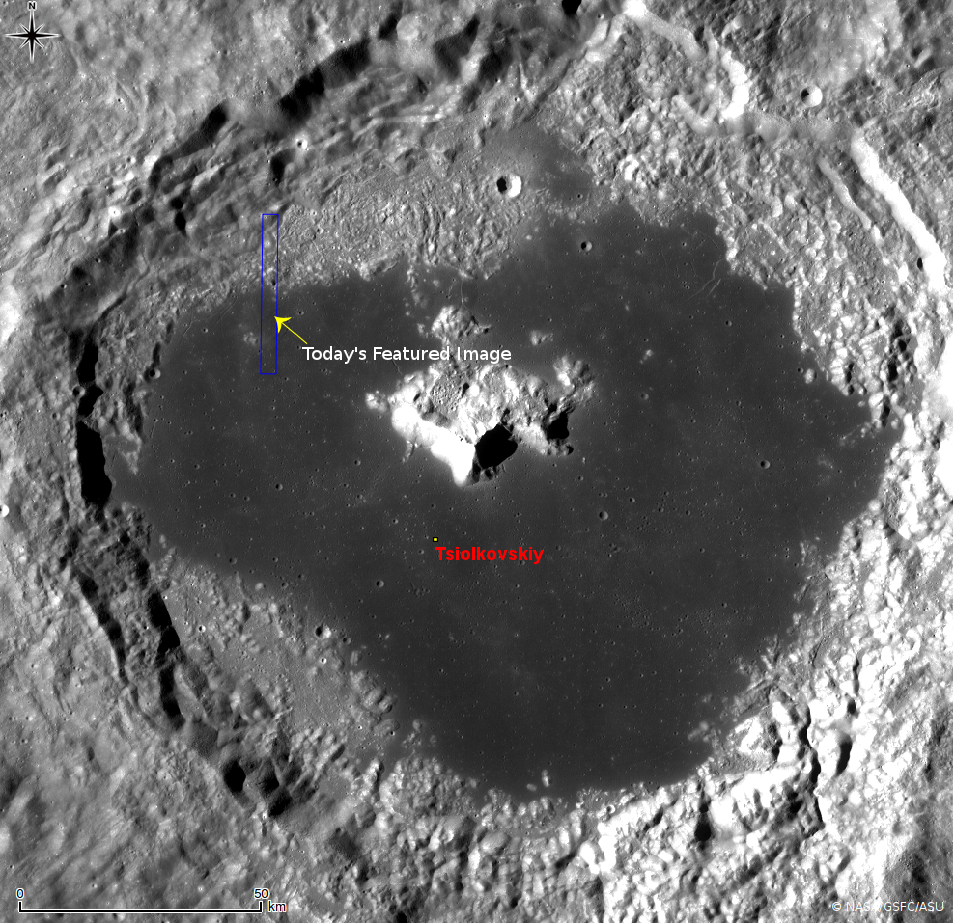
LROC WAC 100 m/pixel monochrome (643 nm) mosaic of the area around northwest Mare Tsiolkovskiy. The area shown at high resolution (white arrow) is near 19.41°S, 127.34°E. View the full-scale WAC context image, and the totality of Tsiolkovskiy's interior HERE   [NASA/GSFC/Arizona State University].

Explore the full length of the "bulging" wrinkle ridge and other nearby tectonic features, HERE.

Related Posts:
Tectonics in Mare Frigoris
Stress and pull
Relative age relationships
Zebra Stripes
Right Angle
Wrinkle ridge in Oceanus Procellarum
Sinuous Chain of Depressions

Tuesday, January 10, 2012

Regolith on Basalt

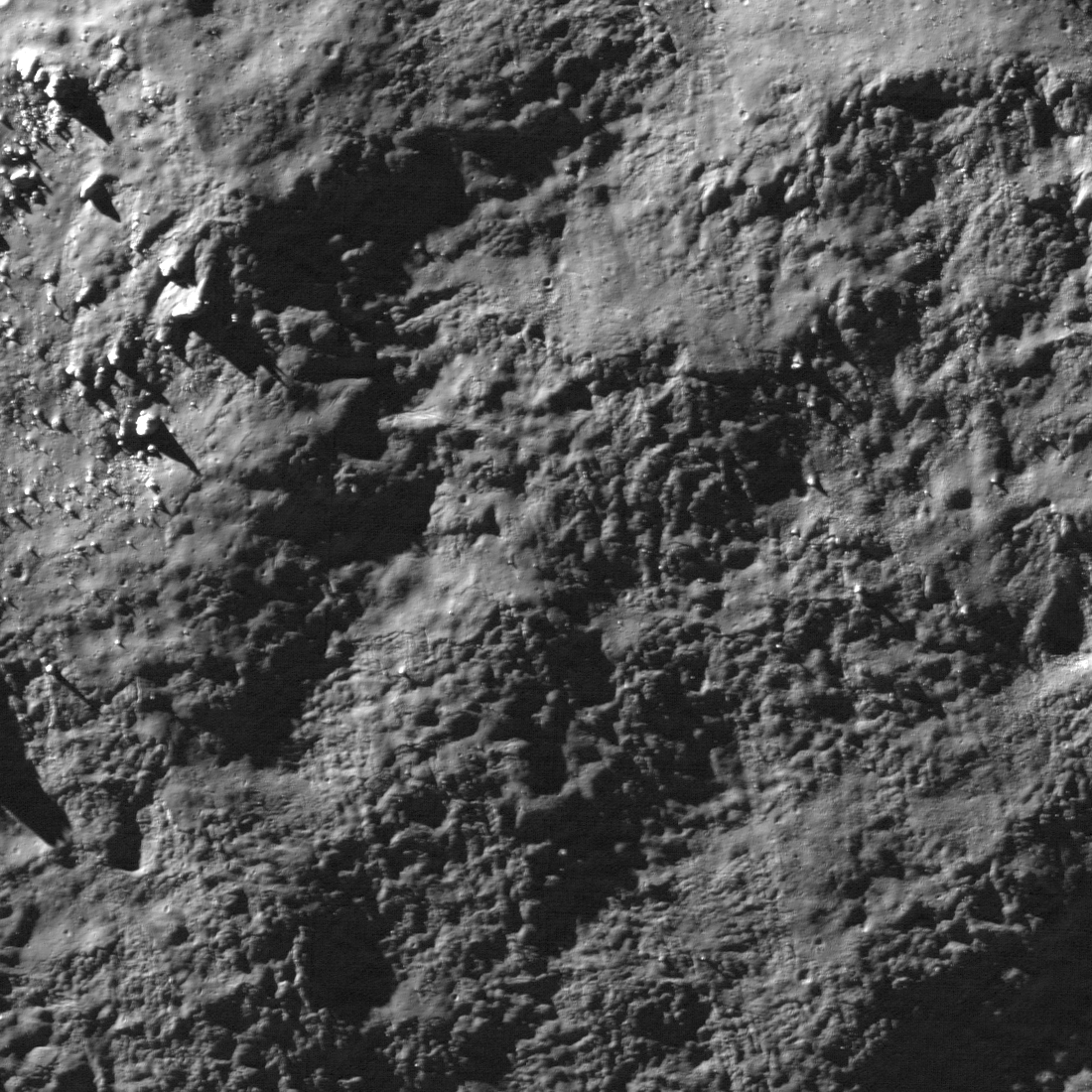
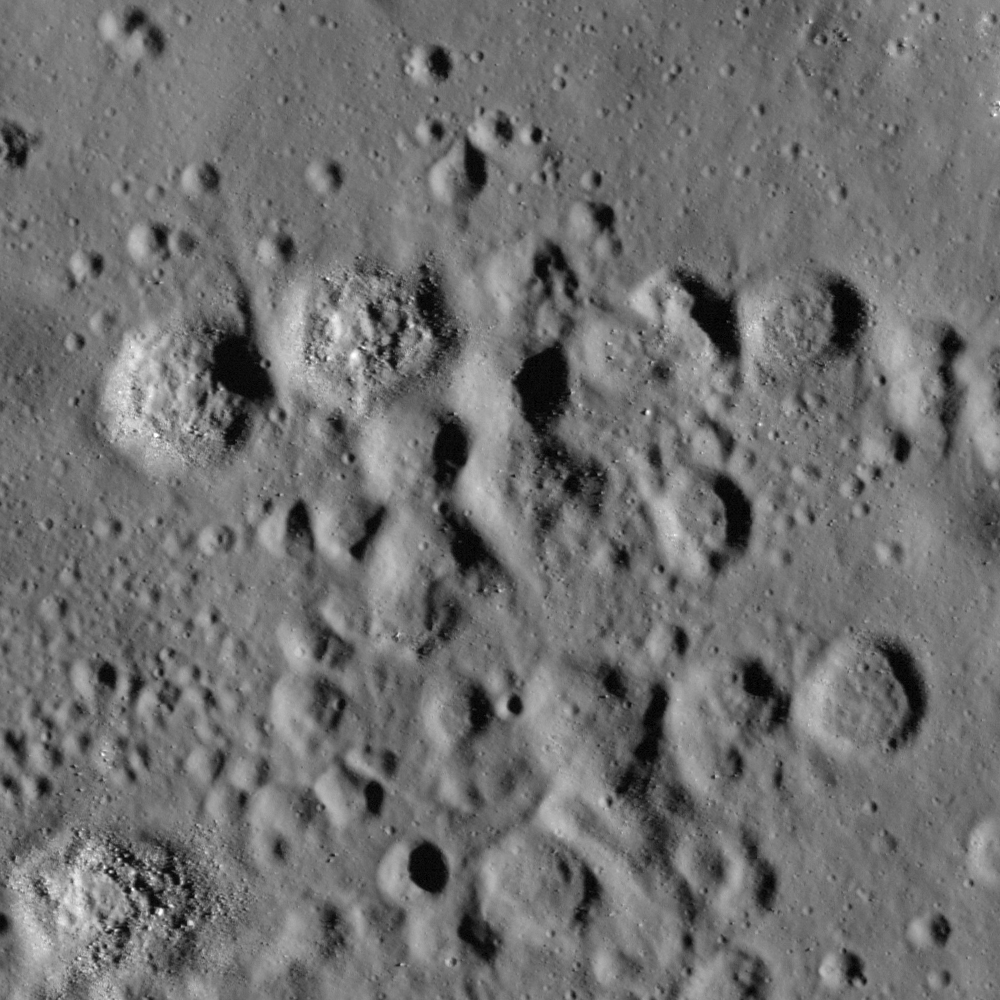
Clusters of possible secondary craters on the north edge of the mare deposits inside Tsiolkovskiy crater. LROC Narrow Angle Camera (NAC) observation M161475783R, LRO orbit 8930, May 31, 2011; incidence angle 67.51° with a resolution of 0.61 meters per pixel from 58.99 km. Image field of view is 610 meters. View the larger LROC Featured Image HERE [NASA/GSFC/Arizona State University].

Hiroyuki Sato
LROC News System

Tsiolkovskiy is a large and spectacular crater on the farside of the Moon (diameter is 180 km). Some time after the impact event that created Tsiolkovskiy, low viscosity lava erupted and flooded the bottom portion of the crater; forming the dark, flat, smooth plain that stands against the bright background of anorthositic highlands.

The age of this mare is estimated, through crater-counting techniques, to be about 3.5 billion years old. The initial solid surface of the solidified lava sheet has slowly been dug up and churned by small impact events. These small impacts build up a layer of loose, crushed rock, similar to a soil on the Earth. On the Moon this layer is called regolth. Today's Featured Image highlights a cluster of relatively young and small craters on the Tsiolkovsiky mare (formed in the regolith). These small craters are probably secondary craters formed as material was thrown out of a nearby primary impact. Did you notice that some of these craters have unusual shapes? Instead of the usual bowl shape of small craters, these examples have very flat floors. Why?

Context for the full LROC NAC frame (rectangle) under the polar orbit of LRO, superimposed on the USG/JAXA digital elevation model and the recently completed Apollo J mission orbital camera survey mosaic in Google Earth [NASA/USGS/JAXA/GSFC/ASU/Google].
Secondary impacts hit the Moon with much lower velocities than primary impacts, so there is less energy (for the same size impactor) available to excavate a crater. Also there is a strength difference between the regolith and the still solid bedrock that it covers. The upper layer is unconsolidated (loose), which is easily excavated and swept out. The lower layer is more solid, and requires more energy to excavate. The flat floor is thus thought to represent the boundary between the regolith and the still solid basalt. By measuring the depth of the flat floor craters, scientists can estimate the depth of the regolith.

LROC Wide Angle Camera (WAC) monochrome 100 meter per pixel mosaic with false-color DLR elevation data (LROC QuickMap) centered over Tsiolkovskiy. The crater's central peak (20.32°S, 128.68°E), at nearly a kilometer above the Moon's mean elevation, rises more than 2000 meters over the mare covered crater floor. [NASA/GSFC/Arizona State University].

Explore these odd craters in the full NAC frame!

Related Posts:
Terraced Craters in Aitken Crater
Fresh Bench Crater in Oceanus Procellarum
Just Another Crater?
Bench Crater in Plato

Monday, January 9, 2012

America's Deep Space Vision:

Former U.S. Senator Harrison "Jack" Schmitt
(R-NM), veteran geologist and Apollo 17 lunar module
pilot during a television interview at Goddard Space
Flight Center, June 3, 2009
Settlement of the Moon and Mars versus asteroid visits

Harrison Schmitt
The Heartland Institute

America’s eroding geopolitical stature, highlighted by the July 21, 2011, end to flights of the United States Space Shuttle, has reached crisis proportions. Obama Administration officials now spin the nebulous thought of Astronauts flying many months to an undetermined asteroid in 2025 as an actual “National Space Policy.”

On the other hand, Republican candidates for President have not yet recognized the importance of international civil space competition in the federal government’s constitutional function to provide for the nation’s “common defense.” Candidates appear to be uninterested in having the United States lead deep space exploration, including the establishment of American settlements on the Moon; or may actually consider Obama’s unfocused proposals as being credible rather than realizing that those proposals would transfer geopolitical dominance to China and control of American space transport to Russia.

Although the Bush Administration and Congress did not follow through with adequate funding, at least the 2004 Vision for Space Exploration put forth by President Bush and approved by Congress was a legitimate formulation of a National Space Policy. It implicitly recognized that America’s best security interests would not be served by being dependent on Russia for access to space or by ceding to China both deep space exploration and access to space resources. Unfortunately, with the acquiescence of Congress in 2010, President Obama cancelled what had become known as NASA’s Constellation Program – a program designed to maintain and expand America’s hard-won position as the world’s leading space-faring nation. Meanwhile, China is building a major new deep space launch facility in Hainan and developing new rockets and spacecraft to take over the exploration of the Moon from the United States and the free world.

A properly funded Constellation Program, would have returned Americans and their partners to the Moon, begun creation of the infrastructure and operational capabilities to settle there and go to Mars and beyond, and provided a timely replacement for the aging Space Shuttle. Assuming that the Obama Administration actually requests authorization and budget authority to implement a human mission to a near-Earth asteroid (NEO), including the required heavy lift rockets, specialized spacecraft, operational infrastructure, and hiring authority, how would such a mission stack up relative to returning to the Moon?

Mars Mission Preparation

Heavy Lift Launch Vehicles & Operational Experience. Both repeated trips to the Moon and an occasional asteroid mission require an Apollo Saturn V-class, heavy lift rocket to escape the Earth’s gravity-well. Lunar exploration and an eventual commercially supported lunar settlement, however, would give a much greater, long-term return on investment of the same taxpayer dollars. Operational experience and multi-generational training gained at a Moon base or settlement is far more relevant to exploration and bases on the gravitationally similar Martian surface (3/8 gravity versus 1/6 gravity) than a mere “rendezvous and docking” with a near zero gravity asteroid.

Physiological Countermeasures. Understanding of the physiological countermeasures to space radiation exposure necessary for travel to Mars can be gained on the Moon sooner and at much lower risk with the added benefit of the future production of lunar water for radiation shielding. Of particular importance is determining whether the Moon’s one-sixth Earth’s gravity triggers physiological re-adaptation after astronauts experience the adverse effects of prolonged exposure to zero gravity during travel to Mars. This cannot be determined on a near zero-gravity asteroid. (The complexity and cost of physiological countermeasures on a Mars mission is critically dependent on knowing if this re-adaptation occurs in one-sixth gravity or not.)

Operational Approaches. Operational approaches for Mars landing and exploration, such as communications delays and lander concepts, can be evaluated and simulated realistically during lunar operations but not during an asteroid mission. Similarly, layered engineering defenses related to planetary biological protection and dust mitigation on Mars can be fully tested at a lunar base or settlement but not during a short visit to an asteroid. In addition, Mars atmospheric entry and descent vehicles and procedures can be tested in the low-density upper atmosphere of Earth more logically as an adjunct to a lunar exploration and settlement program than as part of a single purpose mission to an asteroid. Entry, descent and landing by large spacecraft through the thin but operationally significant Martian atmosphere are challenges for which there currently are no known engineering solutions.

Jack Schmitt occasionally would amuse or frustrate flight controllers watching on live television in Houston by habitually raising his helmet sun visor in order to analyze the true color of lunar samples. His moonwalks were a geologist's dream, and he remains the only professional scientist to visit the lunar surface. Apollo 17 commander Gene Cernan snapped among the very few pictures showing an astronaut's face on the Moon as Schmitt stowed samples of Tracy's Rock, on the slope of North Massif, during their third and final EVA, December 13, 1972 [NASA/JSC/ALSJ].
Commercialization of He-3 and other Lunar Volatiles. Commercial access to the fusion energy resource of the Moon, Helium-3, also opens the potential of interplanetary fusion rockets that would allow continuous acceleration and deceleration between Earth and Mars, thus lowering travel risk to humans exploring deep space. Further, the Helium-3 production by-products of hydrogen, oxygen, and water can significantly lower the cost and risk of deep space travel and space station re-supply. A one-time visit to an asteroid provides no technically or commercially viable alternatives in this arena.

Reduction of Risk for Mars Missions. Programmatically, the transition from a lunar exploration and commercially supported settlement initiative to one focused on Mars landing and exploration would be more straightforward than a one-shot asteroid visit. Lunar exploration overall imposes much lower risk to explorers and mission success than a brief visit to an asteroid and is far more applicable to the reduction of the risks of Mars transit and exploration.

Science

Solar System History. Far more new science related to the early history of the Earth and other planets can be gained through renewed lunar exploration, sampling and analysis than similar activities related to an asteroid. Most asteroid science has been and can be gained from meteorites and multi-spectral imaging by the Hubble and future Webb telescopes. Robotic missions to asteroids, like the Dawn spacecraft now at Vesta, can answer most remaining questions about asteroids, particularly if sample returns are implemented in the future. Finally, the history and evolution of the Sun can be investigated extensively by studies of the long-term variations in solar wind composition and effects recorded in over-lapping layers in the lunar regolith (impact-generated rock debris). Such studies would not be productive on an accessible asteroid.
 Republican candidates for President have not yet recognized the importance of international civil space competition in the federal government’s constitutional function to provide for the nation’s “common defense.”
Astrophysical, Earth and Solar Observatories. A far-side lunar observatory shielded from both solar and terrestrial radio noise would be a boon to observational astronomy; however, no synoptic observational science of other parts of the universe, particularly in radio frequencies, can be conducted in a practical way from an asteroid. Also, a multi-spectral polar Earth observatory at a lunar pole, with simultaneous solar observation, would establish long-term, continuous, full sphere monitoring of weather and climate as well as providing a coherent means of synthesizing more detailed but much less synoptic data gathered from near-Earth satellites. Asteroids, of course, provide no such climate, weather and atmospheric physics-related opportunities.

Resources and Commercial Opportunities

Commercialization of He-3 and other Lunar Volatiles. Terrestrially valuable energy resources, that is, Helium-3 fusion fuel and solar energy, exist on the Moon a short distance from the Earth, but are not a practical option for shipment or transmission from an occasional passing asteroid. In this regard, much is known about the commercial parameters of potential lunar resources; however, little is known about the concentrations, physical and chemical form, or ease of access of potential resources on NEO asteroids. Also, gravity can assist in resource extraction and processing on the Moon but not on a near zero gravity NEO asteroid. Due to communication delays, possible resource mining and processing on an asteroid must be autonomous for relatively short intervals with only periodic human command input. This is unlike resource mining and processing on the Moon where it can be continuous either by human crews or by tele-robotic operation from Earth.

Economics of Lunar vs. Asteroidal Resources. Unlike the available analyses for the energy resources of the Moon, the required financial envelope for potential commercialization of asteroid resources is completely undefined with major questions as to technical practicality. Once Americans permanently established themselves on the Moon, available lunar resources include readily accessible and relatively low cost consumables necessary for operations in space, including water, hydrogen, oxygen, helium, carbon and nitrogen compounds, and food products. Various solid elements and oxides also could support manufacturing of products for use at a lunar settlement or elsewhere in space.

In dissolving Constellation from national space policy among the only vehicles to actually fall by the wayside was the Altair lander concept [NASA].
Tourism. Lunar tourism will eventually become a viable commercial opportunity once launch and support costs are compatible with the heavy lift launch costs required by commercial energy production (about $3000 per 220 pounds); whereas, asteroid tourism, as well as asteroid mining, will remain the stuff of science fiction for the foreseeable future.

Launch Opportunities and Mission Operations

Frequency of Access. For hypothetically possible missions to near-Earth asteroids (NEOs) that cross the orbit of the Earth, very few asteroid rendezvous opportunities exist over time versus essentially continuous opportunities for the Moon. Time for human asteroid exploration will be short because of increasing energy requirement to return as the asteroid moves away from Earth. On the other hand, stay-times on the Moon have no such constraint.

“Rendezvous and Docking” at an NEO. Because of the near zero gravity of an asteroid, an asteroid mission is a “rendezvous and docking” mission requiring very difficult operational procedures in order for astronauts to explore and sample the materials found there. Asteroids in orbit between Mars and Jupiter, such as Vesta currently being imaged by Dawn, require prohibitively long flight times for human visits until new, much more rapid propulsion technology exists.

Education

Stimulation of Learning and Ambition. An asteroid mission would provide flight opportunities to only a few astronauts and thus limit the interest of children and young people in preparing for careers related to space and technology. In contrast, an indefinite commitment to lunar exploration and commercially supported settlement offers a permanent set of career opportunities as a stimulus to STEM education and economic innovation throughout the country. Importantly, the Moon is a destination children and young people can see with their own eyes in the nighttime sky. That sight would become even more inspiring with the knowledge that men, women and families are living and working on the Moon as those youngsters look up to the sky…and to their futures… while other children look up to see Earth.

Leadership and National Security

Lunar exploration and settlement as a precursor to missions to Mars and beyond would be far more productive and practical than a onetime mission to an asteroid. A return to the Moon also constitutes much less risky national policy in the still risky business of deep space exploration.

All public indications are that our Cold War II adversary, China, includes space in its vision of geopolitical dominance as well as in its plans for technological, educational and energy resource advancement. China’s announced long-term space policy is focused on the Moon. The United States stands as the only viable bulwark of freedom on the planet. If the Federal Government ignores this challenge, as well as the commercial energy resources of the Moon and its role as an essential steppingstone to Mars, its constitutional duty to provide for the security of America will be fatally compromised. An asteroid mission constitutes an unacceptable diversion in our broader responsibility to future generations.

Saturday, January 7, 2012

Project Gemini comes to life

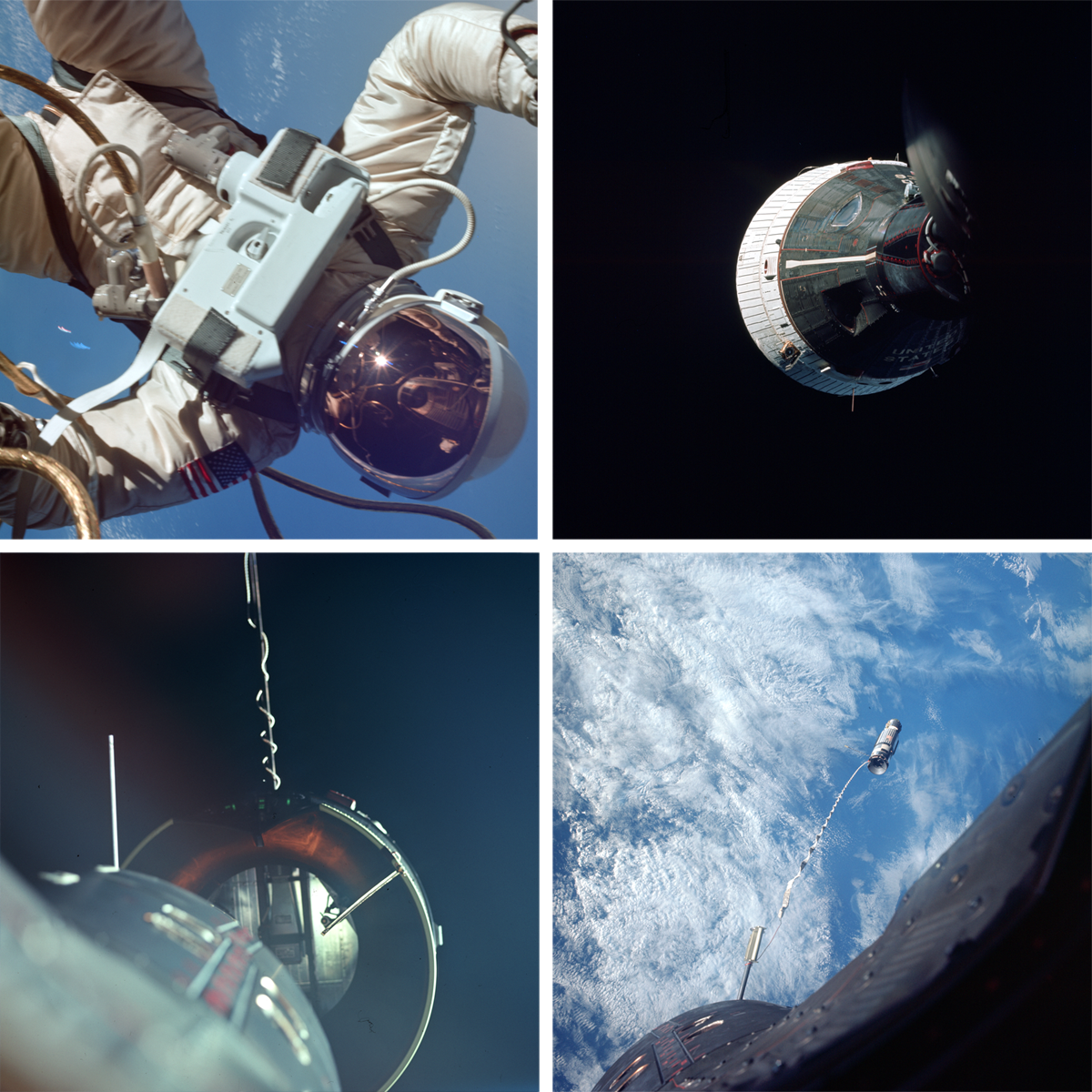
Early in the Space Age, there were some who firmly believed this was simply impossible. Tom Stafford took this picture on the evening of December 15, 1965. He was in the starboard seat of Gemini VI-A, commanded by Mercury veteran Wally Schirra, and in the fifth orbit of a one day flight they successfully rendezvoused with Frank Borman and Jim Lovell on-board Gemini VII. Borman and Lovell had three days remaining on a fourteen day flight, a world record at the time. The successful closed-loop rendezvous of piloted spacecraft was an essential skill that needed proving if the scenario in preparation for Apollo lunar landings was going to work [NASA/JSC/ASU].
Mark Robinson
Principal Investigator
Lunar Reconnaissance Orbiter Camera
Arizona State University


On 23 March 1965, the first of ten crewed Gemini spacecraft was launched carrying it's crew of two astronauts, Gus Grissom and John Young. The NASA Johnson Space Center and the School of Earth and Space Exploration at Arizona State University today proudly unveil the Project Gemini Online Digital Archive. The archive contains the first high-resolution digital scans of the original Gemini flight films, now available in several formats with a click of your mouse.

Project Gemini Highlights - Major milestones of the Gemini flights: Ed White performs the first US spacewalk (upper left), first rendezvous of two crewed spacecraft (upper right), first docking of two spacecraft (lower left), tethering of two spacecraft. Download the full-size commemorative image HERE (lower right) [NASA/JSC/Arizona State University].
Ed White (1930-1967), the first American to walk in space, photographed by Jim McDivitt during the Gemini IV mission [NASA/JSC/Arizona State University].
Project Gemini (1964-1966) was the second United States human spaceflight program, after Project Mercury (1960-1963). The overarching goal was to test systems and operations critical to the Apollo program (1961-1975), conceived with the purpose of "landing a man on the Moon and returning him safely to the Earth". Specific goals of Gemini included: perfecting rendezvous and docking between two crewed spacecraft, successfully undertaking extravehicular activities (space walking), perfecting precise reentry procedures, understanding the effects of the space environment on humans, and testing systems for Apollo. The Gemini spacecraft were launched on modified Titan II intercontinental ballistic missiles (ICBM) to low Earth orbit.

Gemini spacecraft and Titan missile display at NASA's Kennedy Space Center Visitor Complex [M. Robinson].
The successful NASA Gemini missions indeed provided critical space operations experience and directly enabled all American space achievements that followed, in particular the Apollo Moon landings and the first American space station, Skylab (1973-1974). Below is a short list of "firsts" from the Gemini missions.

- First US extravehicular activity (EVA)

- First EVA recovery and return of materials exposed to the space environment for long durations (Agena micrometeorite package)
 
- First use of fuel cells on a spacecraft

- First operation of two crewed US spacecraft simultaneously

- Longest US space mission until Skylab (Gemini 7, nearly two weeks)

- Development of coherent EVA techniques (culminating in Gemini 12)

- First on-orbit rendezvous and docking

- First demonstration of an orbital tether

- First demonstration of the scientific utility of systematic targeted Earth observation--these are some of the earliest color photos of Earth from orbit.

Buzz Aldrin, second seat on the last mission of the program, Gemini XII during his record 5 and one-half hour EVA [NASA/JSC/Arizona State University].
Go to the Project Gemini digital scan archive.

Also visit the ASU Project Mercury digital scan archive, and the Apollo archive.

Fly me to the Moon (JSC 2012)

Full Resolution detail from an image released by NASA/Johnson Space Center in Houston. The International Space Station can be seen in this multiple high-speed exposure as it sails through the line of sight between Houston and the waxing Moon on Wednesday evening, January 4, 2012. At the time of the local flyover ISS was at an altitude of 390.8 kilometers. The NASA JSC photographer captured this view with a Nikon D3S with 600mm lens and 2X converter, Heavy Duty Bogen Tripod with sandbag and trigger cable to minimize vibration. Camera settings were 1/1600 @ f/8, ISO 2500 on High Continuous Burst [NASA].

JSC2012-E-017827 (4 Jan. 2012) --- high res (0.2 M) low res (61 K)

Friday, January 6, 2012

'Significant change' in bombardment timing

Among the things complicating the definitive dating of the familiar nearside basins is each shows signs of having been resurfaced more than once after their violent formation. Researchers progressed rapidly with secondary and primary crater counting and by retracing contours of topography based on the principle of superposition, that newer craters disrupt the old. Direct sampling allowed further for radio-isotope dating. Now high-resolution photography from LRO is allowing the reading of topography under nearly all lighting conditions. Painstaking analysis in years past has recently been renewed, suggesting a need for revision to the age of Serenitatis basin.
"A Significant change in our view of the impact process, and the history of the Earth-Moon system" is offered by three leading planetary scientists following a pain-staking analysis of LROC images of the eastern side of Mare Serenitatis.

Research by three eminent planetary scientists in the American Geophysical Union's Journal of Geophysical Universe will almost certainly cause a revision in generally accepted lunar timescale and ages for the Moon's most familiar basins. This is so primarily because the authors have had much to do with gathering the original evidence for the accepted dating over the past four decades. Based on high-resolution photography returned by the Lunar Reconnaissance Orbiter Camera their most recent work is filling gaps in tried and true methods for reading the story of the Moon (and the Solar System) engraved on the lunar surface.

The wide-ranging effect of the impact that formed Mare Imbrium has been obvious since the invention of the telescope. Just how widespread has been more difficult to determine. This LROC Wide Angle Camera (WAC) mosaic shows the mixed terrain of the Sulpicius Gallus area within and adjacent to the southwest corner of Mare Serenitatis basin. Radial grooving from Mare Imbrium (not shown), testifies clearly as to the violence unleashed by that basin-forming impact. Until very recently it was thought Serenitatis basin must have formed after the Imbrium event.  [NASA/GSFC.Arizona State University].
LROC WAC monochrome (643nm) observation M119645947ME, LRO orbit 2766, February 1, 2010. Astronauts Gene Cernan and Jack Schmitt explored the Taurus Littrow valley, in the hills southeast of Serenitatis in 1972. The forces that shaped South Massif (SM), North Massif (NM) and the Sculptured Hills (SH) were thought to have originated with the Serenitatis impact event. More recent study of LROC imagery, however, appears to show their near final form resulted from the Imbrium basin-forming impact [NASA/GSFC/Arizona State University].
The Taurus Littrow Valley, explored by Cernan and Schmitt of Apollo 17 (White Arrow, 1972) is a crossroads of lunar morphology immediately adjacent to the Serenitatis basin. Geologist astronaut Harrison "Jack" Schmitt, for example, confirmed his theory that the "Tortilla Flat" ray of material he and Capt. Cernan explored during their second EVA was radial to the 109 million year old "recent" Tycho crater.

At Shorty crater an abundance of orange regolith had been naturally excavated, offering evidence of ancient fire fountains deep in in the Moon's primeval past. Still, snuggled near the shore of Mare Serenitatis, it was far from certain if the Sculptured Hills and other mountains around the valley, indeed whether the valley itself, had been sculpted out originally by the force of the Serenitatis or the more distant Imbrium basin-forming impact.

During their third and final EVA, the last walk the Moon on December 13, 1972, Cernan and Schmitt had the opportunity to sample "Tracy's Rock," or 'Split Rock', a hefty boulder that had, at some point in the relatively recent past, rolled down the south-facing wall of North Massif where it partly broke apart near the valley floor. It offered an opportunity to analyze and sample part of the high mountains imaged almost four decades later from LRO.

Tracy's Rock - the split boulder that brought a significant sample of the Sculptured Hills-type mountains, in this case the North Massif down to the Taurus Littrow valley floor, where geologist astronaut Jack Schmitt and Apollo 17 commander Capt. Gene Cernan could sample it during the last walk on the Moon, December 13, 1972. At top, the same boulder heap is seen in LROC NAC observation M165645700RE, orbit 9545, July 18, 2011; resolution 47.7 cm per pixel from 40.6 kilometers [NASA/GSFC/Arizona State University].
Distinguished planetary geologist Don E. Wilhelms, retired from the U.S. Geological Service, Paul D. Spudis of the Lunar and Planetary Institute and LROC principal investigator Mark Robinson of Arizona State co-wrote the study published in late December. They conclude LRO imagery show the Serenitatis basin is relatively old, not young. 

Additionally, "an old Serenitatis means Apollo 17 impact melts may not date the Serenitatis basin," and either the late bombardment theory was less likely or the Moon's morphology is more poorly understood than is generally believed.

"New images from the Lunar Reconnaissance Orbiter Camera show the distribution and geological relations of the Sculptured Hills, a geological unit widespread in the highlands between the Serenitatis and Crisium basins. The Sculptured Hills shows knobby, undulating, radially textured and plains-like morphologies, and in many places is indistinguishable from the similarly knobby Valles Alpes formation, a facies of ejecta from the Imbrium basin.

"The new LROC image data show the Sculptured Hills in the Taurus highlands is Imbrium ejecta, not directly related to the formation of the Serenitatis basin. This occurrence and the geological relations of this unit suggest the Apollo 17 impact melt samples may not be not samples of the Serenitatis basin-forming impact, leaving their provenance undetermined and origin unexplained. If the Apollo 17 melt rocks are Serenitatis impact melt, then up to half the basin and a large crater population on the Moon was created within 30 million year interval around 3.8 billion years ago, in a global impact “cataclysm.”

"Either interpretation significantly changes our view of the impact process and history of the Earth-Moon system."

Abstract and Text (Subscription), HERE.
The Sculptured Hills of the Taurus Highlands:
Implications for the relative age of Serenitatis,
basin chronologies and the cratering history of the Moon
.
JOURNAL OF GEOPHYSICAL RESEARCH
VOL. 116, E00H03, 9 PP., 2011
doi:10.1029/2011JE003903

Tranquillityite found on Earth for first time

Tranquillityite. Last of three minerals isolated on Earth originally identified in samples returned from the Moon in 1969. Researchers report discovery of tranquillityite for the first time on Earth at six sites in Western Australia.
Ben Grubb
Sydney Morning Herald

Australian scientists have discovered a rare mineral previously known only to be found in lunar rock samples and used it to date an Earth rock which formed over a billion years ago.

Named tranquillityite after the Sea of Tranquility, where astronauts landed on the Moon in 1969, researchers discovered the substance in rocks collected from six sites in Western Australia.

Tranquillityite was first discovered in rocks brought back from the moon soon after the first Apollo mission, along with two other substances - armalcolite and pyroxferroite. Both substances were found in Earth rocks within a decade or so of the 1969 Apollo mission but the third, tranquillityite, wasn't found on Earth until now.

Read the full story HERE.

Thursday, January 5, 2012

Then there were five... in lunar orbit

JPL Eyes on the Solar System web-based simulation shows all five American lunar spacecraft and their relative positions a few minutes after GRAIL-B joined GRAIL-A, ARTEMIS P1, ARTEMIS P2, and the LRO in lunar orbit, New Years Day [NASA/JPL Caltech].

Wednesday, January 4, 2012

LROC: Galilaei's layered wall

Layers of material are exposed in Galilei crater's wall, sloping downward to bottom left. Each successive layer provides a step back in time and hints at the process that formed the layers of Oceanus Procellarum basin. LROC Narrow Angle Camera (NAC) observation M160363453LE, LRO orbit 8767, May 18, 2011; incidence angle 53.64° with a resolution of 0.48 meters per pixel from 40.77 kilometers. View the full 500 meter-wide original LROC Featured Image HERE [NASA/GSFC/Arizona State University].
Drew Enns
LROC News System

Impact craters are a great resource for planetary scientists. Craters can be counted and used to age date a surface, they can tell us about the strength of the surface they formed in, and they can tell us about the composition of a surface at depth. Because they also expose bedrock in their crater walls, they can expose exciting geologic features. 

In today's Featured Image, long continuous shelves can be seen in the steep walls of Galilaei crater! How did they form?

Context image of today's Featured Image, located within the white box (at the end of the long arrow). Galilaei crater is located in Oceanus Procellarum north of Reiner Gamma. 32 meter per pix resolution LROC QuickMap view HERE [NASA/GSFC/Arizona State University].

When Galilaei crater formed, the impacting bolide punched through a thick mare basalt. The lines define layers that are consistent in thicknesses and blockiness over large distances. Geologists have studied thick basalt deposits in great detail on the Earth. In most cases the terrestrial examples were formed as many lava flows stacked up one above the other. The layers seen in today's Featured Image are about the same thickness as those found in flood basalts on the Earth and found elsewhere on the Moon. Taken together, these observations favor the lava flow interpretation. Future astronaut geologists will surely visit such layered deposits, and confirm if they really are individual flows or not.

How many layers do you see in the full NAC frame?

Related Posts:
Marius A
Layers near Apollo 15 landing site
Layering in Euler Crater

Sunday, January 1, 2012

GRAIL-B joins New Years dance with GRAIL-A

GRAIL-B was still 6300 kilometers away and closing fast at 2038UT New Years Day and flight directors at JPL prepared for a burn that would begin a tandem flight with GRAIL-A. At the same moment GRAIL-A was reaching the 87.4 km apogee of a highly elliptical third orbit since its own insertion into lunar orbit 30 hours earlier, on New Years Eve. The high precision lunar gravity mapping mission, following five years of preparation, can be followed using NASA's web-based Eyes on the SOLAR SYSTEM GRAIL AT THE MOON module [NASA/JPL].
GRAIL-B performed a 39 minute lunar orbit insertion burn, Sunday afternoon, beginning at 2205 UT. Following the successful insertion of both GRAIL spacecraft mission principal investigator Dr. Maria Zuber of MIT is expected to announce the winners of a contest to formally name GRAIL A and B, having chosen from 20,000 entries submitter by elementary and middle school students.

Follow the story at SpaceflightNOW.

GRAIL-A arrives in lunar orbit

GRAIL-A arrived successfully in lunar orbit, New Years Eve. GRAIL-B is thirty hours behind, scheduled to arrive for the tandem high-precision lunar gravity mapping mission on the first day of 2012, when the United States will have five spacecraft in orbit around the Moon for the first time [NASA].
Read the full story HERE.