Showing posts with label Apollo 11. Show all posts

Sunday, February 8, 2015

Armstrong's treasure of Apollo 11 artifacts found

Neil Armstrong's "McDivitt Bag," filled with priceless souvenirs of the July 1969 first manned expedition to the lunar surface, has been disclosed to the Smithsonian Institute by his widow. Among them, the 16mm DAC camera that captured the landing from the starboard window.
Jesus Diaz
Sploid/gizmodo

These are the contents of a mysterious white bag found hidden in Neil Armstrong's closet: Weird looking lamps, wrenches, utility brackets, sights, and a film camera that later was identified as the one that captured the famous Apollo 11's descent on the Moon's surface. Nobody knew about it, including his widow.

According to NASA, Carol Armstrong sent photos to Allan Needell, curator of the Apollo collection at the Smithsonian's National Air and Space Museum, who immediately knew what was inside: It was a McDivitt Purse full of parts from the Eagle, Apollo 11's Lunar Module:

After Neil Armstrong's death, his widow, Carol, discovered a white cloth bag in a closet, containing what were obviously either flight or space related artifacts. She contacted Allan Needell, curator of the Apollo collection at the Smithsonian's National Air and Space Museum, and provided photographs of the items. Needell, who immediately realized that the bag—known to the astronauts as the Purse - and its contents could be hardware from the Apollo 11 mission, asked the authors for support in identifying and documenting the flight history and purpose of these artifacts. After some research it became apparent that the purse and its contents were lunar surface equipment carried in the Lunar Module Eagle during the epic journey of Apollo 11.

These artifacts are among the very few Apollo 11 flown items brought back from Tranquility Base and, thus, are of priceless historical value. Of utmost importance is the 16mm movie camera with its 10mm lens.

The on-board 16 mm film camera, with which the landing, first steps, and take off of the lunar module Eagle from Mare Tranquillitatis were filmed, has been unearthed in a bag of similarly priceless small artifacts of the epic mission found in Neil Armstrong's closet in Ohio.
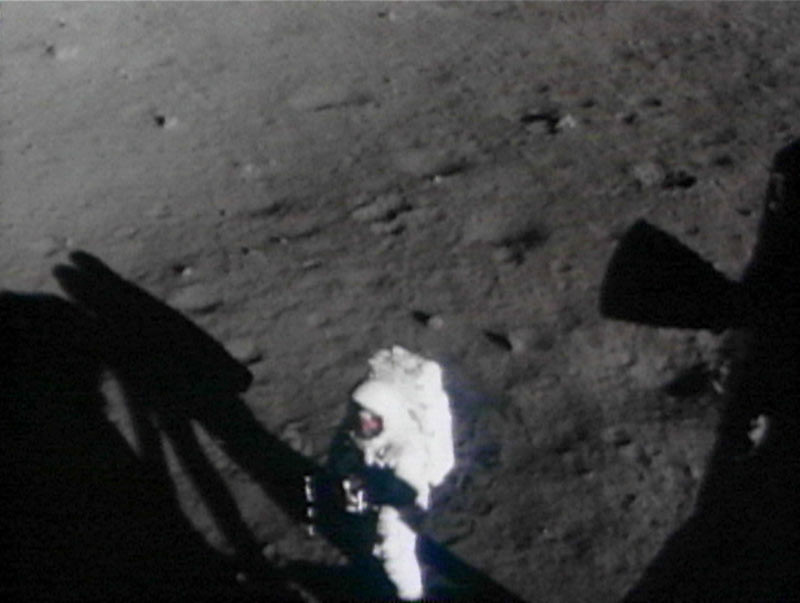
The camera was mounted behind the right forward window of the lunar module and was used to film the final phase of the descent to the lunar surface, the landing, as well as Neil Armstrong's and Buzz Aldrin's activities on the lunar surface including taking the first samples of lunar soil and planting the US flag.

Still from the Apollo 11 16mm DAC film camera shows Armstrong (with visor up) taking his initial, halting steps out onto Mare Tranquillitatis, still tethered to the spacecraft.
Thanks to the Neil Armstrong family, the Apollo 11 purse and its contents are now on loan at the National Air and Space Museum for preservation, research and eventual public display.

Here's a list of everything inside and how it looked inside and outside the Eagle:

Read the full article at sploid.gizmodo, HERE.

Thursday, May 15, 2014

Earth rising

The vastness of space, and the inviting terra firma of Earth and Moon. LROC Featured Image, May 7, 2014. LROC WAC M1145896768C, LRO orbit 20898, February 1, 2014 [NASA/GSFC/Arizona State University].
Paul D. Spudis
The Once and Future Moon
Smithsonian Air & Space

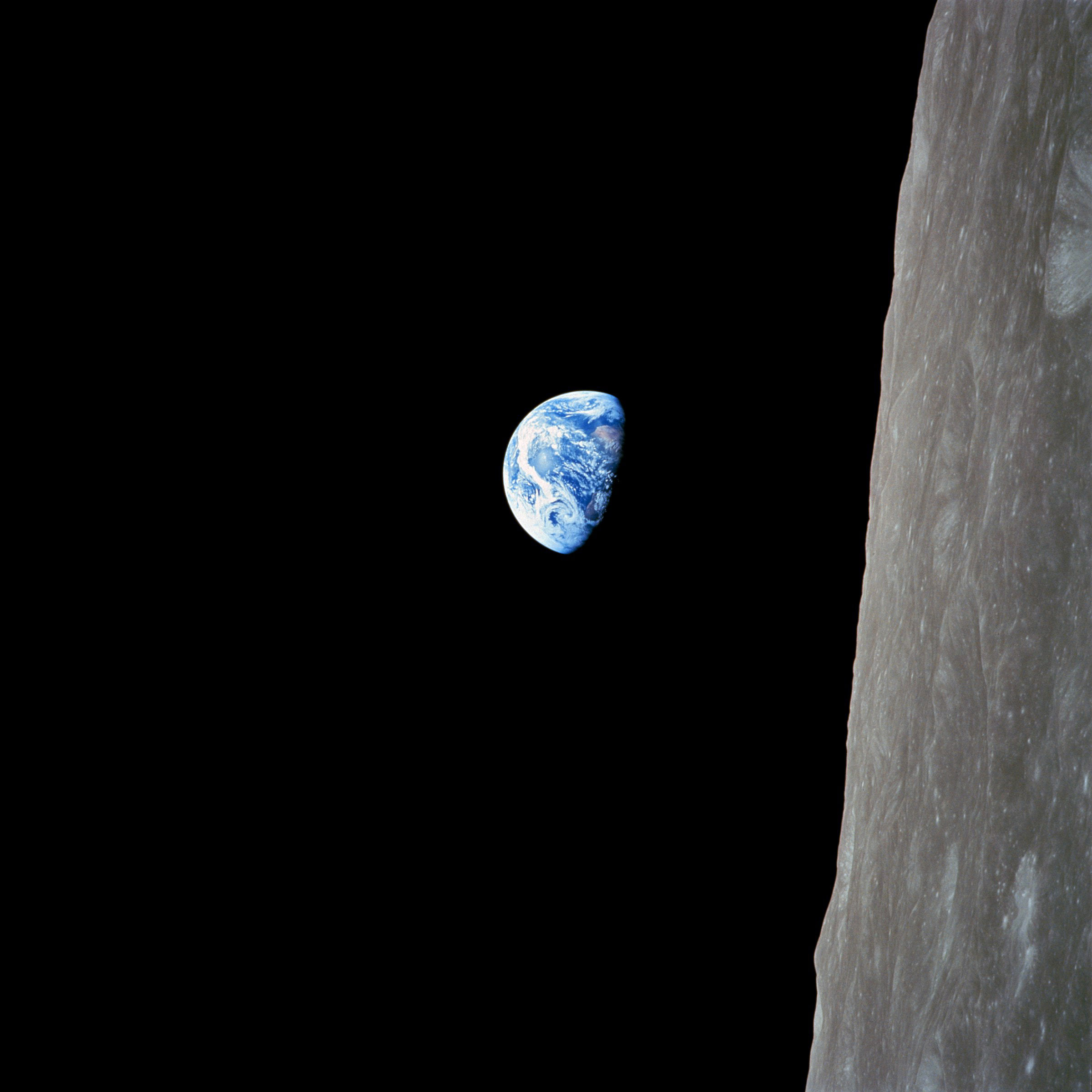
The LRO Camera Team recently released a newly obtained, beautiful image of the Earth above the north pole of the Moon.  In the history of lunar exploration, Earthrise photos have always been widely displayed and admired. Capturing the iconic image of a magnificent blue and white Earth hanging over the barren, gray surface of the Moon is one of the most memorable moments of man’s first flight to the Moon by Apollo 8 in December 1968.

This picture graced the covers of newspapers and magazines everywhere; it inspired a million words of prose and created the modern environmental movement as we know it. Few single images have had such pervasive and lasting power.

Apollo 8's overview effect: Iconic Earthrise image, AS08-14-2383, Bill Anders' serendipitous photograph of Earth as the first manned flight to the Moon swung around from the farside, December 24, 1968 [NASA/JSC].
The Apollo 11 crew landed on the lunar surface a few months after that Earthrise photo was circulated. During this and subsequent missions (all on the central near side of the Moon), it was reported by the media that Earth always appears stationary in the same part of the sky as seen from the Moon’s surface.

In November 1969, the Apollo 12 crew put up a large inverted umbrella antenna to improve communication data rates from the lunar surface; it had to be set-up and aligned, but once pointed at Earth, it remained pointed at it forever.

Simulated time-lapse view of Earth from the vicinity of the Moon's north pole, where the significance of the Moon's libration creates changes in a notional viewers perspective. Earth appears to swing through a Lissajous figure in the sky. Three lunar days are squeezed into 1:45 using Celesta.

Because the Moon orbits the Earth and is in synchronous rotation with its orbital period, we always see the same side.  Hence, there is a near side (the hemisphere we see from Earth) and a far side (the side we cannot see from Earth; it is often mistakenly called the “dark side”).

A consequence of this synchronous rotation is that from the Moon, the Earth appears stationary in the sky, just as the hub of a bicycle wheel remains stationary from the viewpoint of one of its spokes. Thus, while the Sun rises and sets according to the slow rotation rate of the Moon (one complete rotation every 708 hours, half day and half night), the Earth is always in the same spot in the sky. Of course, because it is illuminated by the Sun, it changes its phase on the same timescale as does the Moon as seen from Earth, although reversed (a full Moon on Earth is a new Earth from the Moon and vice versa.)  From the far side of the Moon, one does not see the Earth at all.

Are spectacular views of Earthrise only visible from spacecraft in orbit about the Moon? Not quite.

Two points about the Moon’s orbit make the story a bit more complicated. First, the Moon’s orbit around the Earth is not circular but elliptical, its distance ranging from 363,000 km up to 405,000 km from the Earth. Second, the plane of the Moon’s orbit is inclined about 5 degrees to the ecliptic (the plane of the Earth-Moon system’s orbit around the Sun). These two facts mean that the Moon librates, or “wobbles” both left and right (an effect of its elliptical orbit) and up and down (an effect of the inclination of its orbital plane). These librations are not overwhelmingly significant, but result in some interesting effects around the limb of the Moon – the great circle made up by the 90 degrees east and west longitude lines, including both poles.

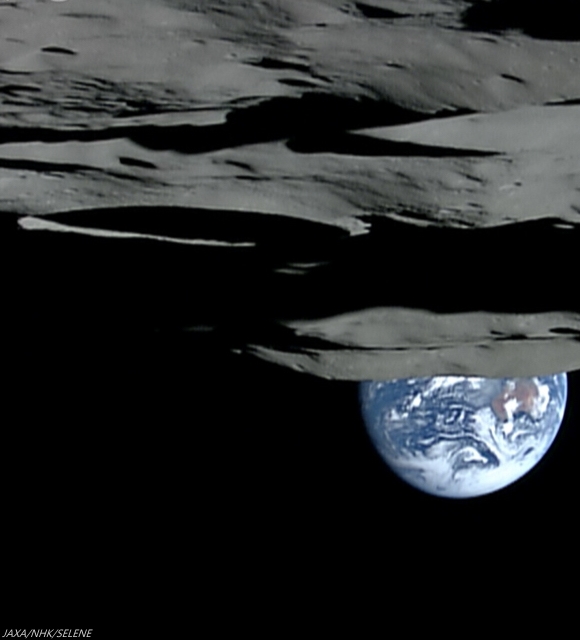
Earthset, from 1080p video captured from Japan's lunar orbiter SELENE-1 (Kaguya) October 31, 2007, as spacecraft and camera, in polar orbit, began its track north from the south pole (on the rim of Shackleton crater, center left) over the Moon's farside, leaving Earth to set behind Malapert massif, a nearside fragment of the rim of immense South Pole-Aitken impact basin [JAXA/NHK/SELENE].
The Earth as seen from the Moon is about 2 degrees in angular width (about 4 times the apparent diameter of the Moon and Sun as seen from Earth). Earth’s disk is roughly equivalent to the size of a quarter held out at arm’s length; the Moon’s apparent disk is pea-sized. Because of the Moon’s longitudinal libration, the “limb” areas near the 90 degree meridians are sometimes visible to Earth and other times not. Thus, the Earth will sometimes appear in the sky and sometimes be hidden below the Moon’s horizon – in other words, an observer along this line of longitude will see an Earthrise and an Earthset.

The longitudinal libration is about 8 degrees, so the observer on the lunar limb would see the Earth slowly rise above the horizon and clear it by its apparent diameter, then slowly sink below the horizon by the same amount. That Earthrise will be slow indeed – it will take a couple of days for the full disk of the Earth to rise above the horizon. This cycle would repeat on a monthly timescale, as the Moon completes one revolution around the Earth.

Similarly, one would also see the Earth rise and set at the poles of the Moon, although to a different magnitude. The polar view is almost completely dominated by the latitudinal libration, caused by the inclination of the Moon’s orbital plane. This variation is about 6.5 degrees (it includes the Moon’s spin axis obliquity of 1.5 degrees) and would vary on a similar monthly timescale. These variations will become important if future lunar inhabitants live at the poles, as I think likely. As the Earth will sometimes be out of direct view, it is likely that we will depend on relay satellites for continuous communication. Polar inhabitants will also see a “different” Sun from what they’re accustomed to on Earth – at the lunar poles, the sun rotates around the horizon, rather than rising and setting.

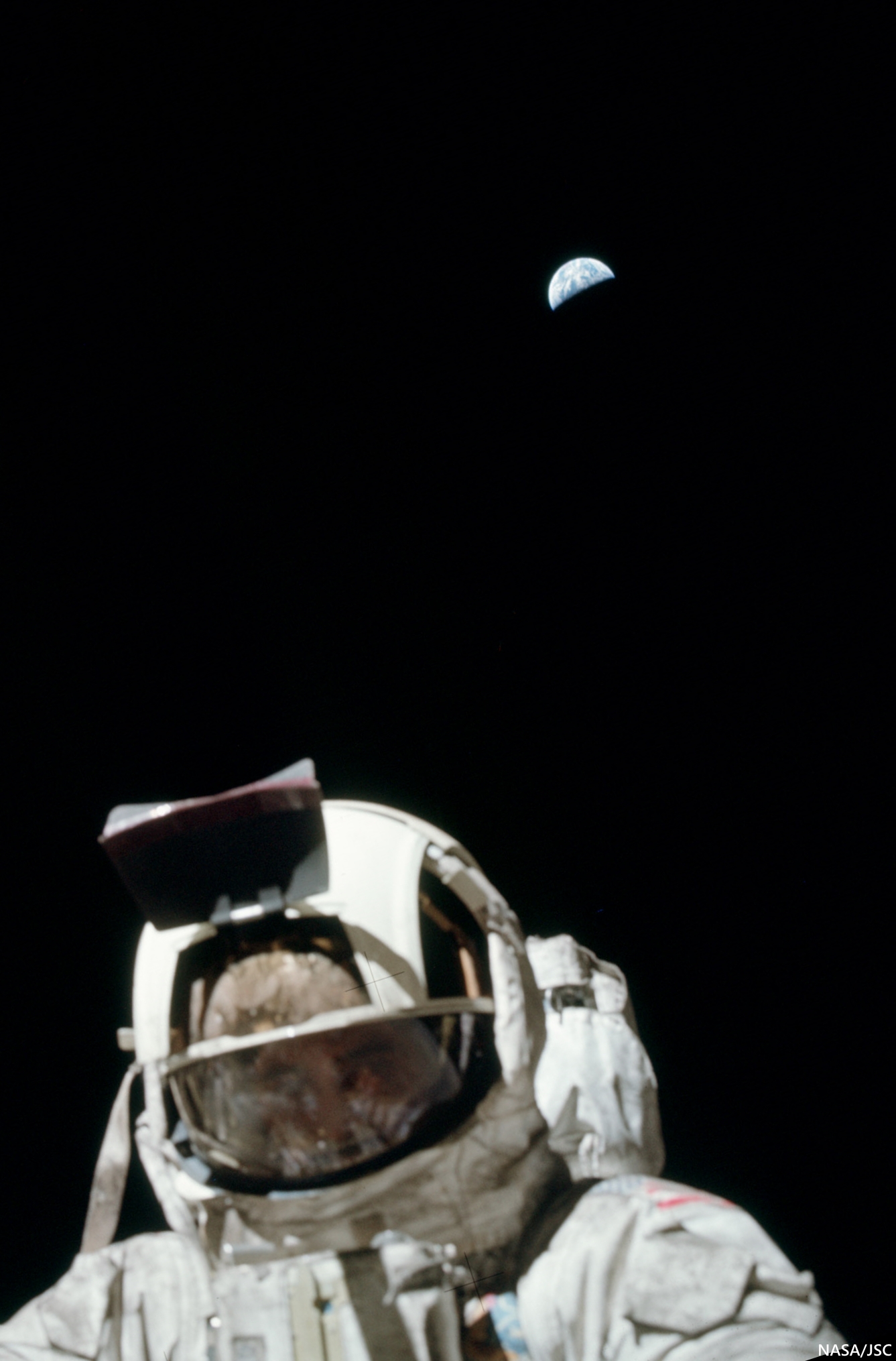
Cernan and Earth. At Taurus Littrow, Earth maintains its position. Ground controllers did occasionally admonished Apollo 17 Cmdr. Gene Cernan's partner Jack Schmidt for lifting his solar visor to get a better look at a rock, from time to time, during the last walks on the Moon. But at this point, however, as he traded poses with Schmidt using Earth as a backdrop, Cernan did briefly lift his visor halfway, allowing posterity an atypical view of an actual human face on the Moon in December 1972 (AS17-134-20471) [NASA/JSC].
Thus, there are places on the Moon from which we can stand and contemplate the sheer beauty and magnificence of a slowly rising Earth. Given the sea change in global perspective provided by the famous Earthrise picture taken by the Apollo 8 crew almost fifty years ago, what societal impacts will occur when a human being stands on the lunar surface and watches the Earth slowly rise above the horizon? I suspect that a similar shift in planetary perspective will occur. If history is any guide, such a shift will have profound psychological and political implications  – both positive and negative – in our reach for the stars.

Dr. Paul D. Spudis is a senior staff scientist at the Lunar and Planetary Institute in Houston. This column was originally published by Smithsonian Air & Space online, and his website can be found at www.spudislunarresources.com. The opinions he expressed here are his own, but these are better informed than most.

Tuesday, November 19, 2013

Lunar Laser Ranging: The Millimeter Challenge

Lunar Laser Range Reflector arrays
The five Lunar Laser Range Reflector (LLR or LLRR) arrays deployed on the lunar surface, one each at the landing sites of Apollo 11, 14 and 15, and also to the Soviet rovers Lunokhod 1 and 2. The sublime accuracy of the decades-long measurements are priceless to astrophysics. Nearside view from "Synthetic View of the Moon," LROC Featured Image released October 15, 2013 [NASA/GSFC/Arizona State University].
T. W. Murphy, Jr.
Center for Astrophysics and Space Sciences
University of California

Lunar laser ranging has provided many of the best tests of gravitation since the first Apollo astronauts landed on the Moon. The march to higher precision continues to this day, now entering the millimeter regime and promising continued improvement in scientific results. This review introduces key aspects of the technique, details the motivations, observables, and results for a variety of science objectives, summarizes the current state of the art, highlights new developments in the field, describes the modeling challenges and looks to the future of the enterprise.

Since 1969, lunar laser ranging (LLR) has provided high-precision measurements of the Earth-Moon distance, contributing to the foundations of our knowledge in gravitation and planetary physics. While being the most evident force of nature, gravity is in fact the weakest of the fundamental forces, and consequently the most poorly tested by modern experiments. Einstein's general relativity, currently our best description of gravity, is fundamentally incompatible with quantum mechanics and is likely to be replaced by a more complete theory in the future. A modified theory would, for example, predict small deviations in the solar system that, if seen, could have profound consequences for understanding the universe as a whole.

Utilizing reflectors placed on the lunar surface by American astronauts and Soviet rovers, LLR measures the round-trip travel time of short pulses of laser light directed to one reflector at a time. By mapping the shape of the lunar orbit, LLR is able to distinguish between competing theories of gravity. Range precision has improved from a few decimeters initially to a few millimeters recently, constituting a relative precision of 10-9 through 10-11. Leveraging the raw measurement across the Earth-Sun distance provides another two orders of magnitude for gauging relativistic effects in the Earth-Moon-Sun system.

The largest of the Apollo lunar laser range reflectors (LLRR) arrays, deployed at Hadley Rille by Scott and Irwin of the Apollo 15 surface expedition in February 1971. The instrument is still a regularly acquired critical part of on-going experimental astrophysics. AS15-85-11468 [NASA/JSC].
As LLR precision has improved over time, the technique has remained at the cutting edge of tests of gravitational phenomenology and probes of the lunar interior, and has informed our knowledge of Earth orientation, precession, and coordinate systems. LLR was last reviewed in this series in 1982; this update describes the key science drivers and findings of LLR, the apparatus and technologies involved, the requisite modeling techniques, and future prospects on all fronts.

Lunokhod 1 rover in its final parking place (38.315°N, 324.992°E) on the surface of Mare Imbrium. LROC Narrow Angle Camera (NAC) observation M175502049RE, orbit 10998, November 9, 2011, resolution 33 cm per pixel. View original Featured Image released March 14, 2012 (with enlarged inset) HERE [NASA/GSFC/Arizona State University].
LLR is expected to continue on its trajectory of improvement, maintaining a leading role in contributions to science. Other recent reviews by Merkowitz (2010) and by Muller, et al. (2012) complement the present one. The Merkowitz review, like this one, stresses gravitational tests of LLR, but with greater emphasis on associated range signals. Next-generation reflector and transponder technologies are more thoroughly covered. The Muller et al. review (for which this author is a co-author) covers a more complete history of LLR, has statistics on the LLR data set, and provides greater emphasis on geophysics, selenophysics, and coordinate systems.

This review is organized as follows: Section 1 provides an overview of the subject; Section 2 reviews the science delivered by LLR, with an emphasis on gravitation; Section 3 describes current LLR capabilities; Section 4 relates recent surprises from LLR, including the finding of the lost Lunokhod 1 reflector and evidence for dust accumulation on the reflectors; Section 5 treats the modeling challenges associated with millimeter-level LLR accuracy; and Section 6 covers possible future directions for the practice of LLR.

Saturday, September 7, 2013

LADEE legacies

LADEE approaches lunar orbit insertion
In planning since 2008, LADEE's reason-for-being emerged from mapping science goals believed essential before any permanent manned presence on the Moon's surface could begin. Fortunately, like LRO, LCROSS and GRAIL, planning and development were well underway and within budget when Congress eventually scrubbed the Constellation brand and manned Altair lander [NASA].
Like "The Blind Men and the Elephant" the most important moving part of many riding along with LADEE to the Moon very much depends on your personal perspective.

What might seem a low-priority mission, accompanied by an appropriate degree of "hype," and has modest fundamental goals under the banner of experimental modular designs and revolutionary high speed communications, - only a 100 day science mission, LADEE has been in development for more than five years. The advanced vehicle also carries with it hopes of some that go back nine times that period, covering a lot of political ground and many changes, even over the relatively short time since its framing and approval.

Gene Cernan's Dusty Spacesuit
Gene Cernan (by Harrison Schmitt) at the close-out of the third and final EVA of Apollo 17, and the last manned visit to the Moon in December 1972. The commander's spacesuit is blackened by exceeding fine lunar dust, more than just a problem of appearances, a real hazard that might have caused hatch and spacesuit seals to fail on a longer surface mission. Constellation planners understood they needed to get a handle on mitigating the hazard posed by omnipresent dust while also gaining an better understanding of the dynamics of a primal airless Moon and its surface before humans return to stay [NASA/JSC].
Few watching the LADEE/Minotaur V launch, critical for Orbital Sciences Corporation, from Wallops Island, are likely to be reminded that the mission owes its existence to the catastrophic loss of Space Shuttle Challenger ten years ago. But it is possible to appreciate the things NASA logically wants emphasized without forgetting LADEE is the beginning of the end of the defunct Constellation program that so many wanted dead and buried in 2009.

LADEE is the last of the unmanned precursor missions once believed essential before "extended human activity" on the Moon could begin. The absolutely remarkable Lunar Reconnaissance Orbiter (LRO) will likely still be orbiting the Moon for a few years after LADEE's mission-terminating guided impact a few months from now, but none of these 21st century American unmanned lunar missions are likely to have have occurred before today without the initial political will put in motion after the report of the Challenger Accident Investigation Board (CAIB).

LRO, LCROSS, GRAIL and now LADEE each owe their reason for being to the loss of a second Space Shuttle and crew in 2003.

LADEE Slides (LEAG 2011 Lunar Exosphere Model (After Halekas))
Very simple schematic of the lunar exosphere. The Moon's surface turned out to be a very dynamic place, after all, with water and exotic metals and volatiles trapped in permanent shadow and also hiding in plain sight [Halekas/LEAG/NASA].
If you've seen the movie footage of Neil Armstrong immediately after setting that first boot on the Moon, backing away from the ladder tethered to the spacecraft then you may have guessed there once was real fear that he might just suddenly disappear in a bog of dust.

Such concern had mostly been dispelled by July 1969, though, after none of the successful unmanned Surveyor landers had encountered anything other than a hard-packed lunar surface. And yet the Moon was correctly presumed to be a very dusty place, constantly "gardened" by micrometeorites (and some not so micro) together with energetic cosmic and solar radiation. Without direct samples, however, no one correctly guessed just how "fine" the dusty powder on the lunar surface could be.

By the time Gene Cernan climbed back into the Apollo 17 lunar module in late 1972 at the end of the program another hazard from this dust had become apparent instead. Rather than sinking into feathery banks of fluffy snowbanks astronauts had to deal instead with a film of electrostatic-charged, clinging and microscopic glassy razor blades. It smelled like gun powder and got into everything, and seemed impossible to clean.

The dark dust of the Moon's immediate surface threatened hatch seals, it scared and tore into spacesuits and, following EVA close-outs became lodged in every conceivable place on an astronaut's body, including up their noses, in their lungs and also lingering in their softest places.

Clearly, "dust mitigation," by then long acknowledged as a real mission and health hazard, came forward as a priority science goal when before new lunar surface expeditions could be carried out. It is accepted as a similar threat to manned travel to Mars, and to the asteroids.

All models of what has become known as a "dynamic" rather than "static" lunar surface include production and trapping of volatile compounds once thought essentially non-existent on the Moon. The speed of this production, it's true dynamics, badly need to be studied before we can return to the Moon with impunity.

Every time an unmanned spacecraft (or a manned lunar module) has landed or taken off from the Moon it's certain some of the dust propelled away by exhaust reaches escape velocity. A larger part of this spiny cloud is put into orbit or on a ballistic path carrying these particles all over the lunar surface. LADEE is designed to establish some natural baseline for this dust before humans start stirring things up. The impact of spacecraft is comparable to the occasional larger natural impact, but hot gas exhaust and its effects is something new.

Painted On Procellarum
The delicate bright dust lanes of the Reiner Gamma "swirl albedo" phenomena, stretching at least 550 km southwest from the dormant volcanic Marius domes to the western frontier of Oceanus Procellarum. Seen here in an LROC WAC mosaic from 2010 under early morning shadows. Detailed laser altimetry confirms little to no topographic component, though it does closely correlate with a well-mapped anomalous crustal magnetic field that must be older than exposure to the Sun and space weathering would allow the surface here to remain so bright. Migration of dust, alternately charged and discharged, dislodged by micro-bombardment is alternately attracted and repelled, here, by the local magnetic field lines, keeping the new dust constantly renewed and gathered no more than a meter or so deep [NASA/GSFC/Arizona State University].
Whether or not this was really a guesstimate or hard science, by the time Congress seriously committed to return to the Moon to stay investigators had acknowledged that a kind of primal state existed there that was worth scientific study for its own sake, before human engaged in any "extended activity." And herein is the compelling interest for funding the LADEE mission. It's one way of discovering the state of the lunar exosphere, its dynamics in and out of Earth's extended magnetic field, under a traveling solar incidence, and through a good sampling of lunar days and nights before things inevitably get busy.

The hyperfast laser-based communications and modular spacecraft design for LADEE will be much talked about in reports about this mission, over the next few days and months. That's "all good," as they say, but it might be worth it to also remember the mission's origins going back before Surveyor or Apollo and also offer at least some thanks to the crew of Columbia. We owe the recent renewed short burst in lunar exploration and our added knowledge of the Moon directly to the loss of that spacecraft and crew.

Lunar Horizon Glow from Clementine (1994)
Another lunar mission (and one of only two American missions to the Moon between 1972 and 2009) was also justified as a test platform for new technologies. Now "lost and gone forever," Clementine (1994) spent a year in lunar orbit operated by both NASA and the U.S. Department of Defense. Here Clementine's star-tracking camera finally definitively photographed the "horizon glow" caught previously in the lunar night from the surface by Surveyor 7 and described by Apollo astronauts in lunar orbit twenty years before. This is the phenomena, believed to be back-lit lunar dust, that LADEE is designed to directly sample [NASA/DOD].
And whenever humans eventually return to the Moon for their inevitable extended stay, they will owe much of their preparation to that spacecraft and crew.

Related Posts:
LADEE Prelaunch Mission Briefing (September 6, 2013)
ESA prepares for LADEE (July 31, 2013)
LADEE arrives at Wallops Island (June 5, 2013)
LADEE ready to baseline dusty lunar exosphere (June 5, 2013)
First laser comm system ready for launch on LADEE (March 16, 2013)
LADEE project manager update (February 6, 2013)
The Mona Lisa test for LADEE communications (January 21, 2013)
Toxicity of lunar dust (July 2, 2012)
Expectations for the LADEE LDEX (March 23, 2012)
The Dust Management Project (August 9, 2010)
LADEE architecture and mission design (July 6, 2010)
DesertRatS testing electrodynamic dust shield (July 5, 2010)
Dust transport and its importance in the origin of lunar swirls (February 21, 2010)
Dust accumulation on Apollo laser reflectors may indicate a surprisingly fast and
more dynamic lunar exosphere
(February 16, 2010)
NASA applies low cost lessons to LADEE (January 18, 2010)
Nanotech advances in lunar dust mitigation (August 19, 2009)
Moon dust hazard influenced by Sun's elevation (April 17, 2009)
LADEE launch by Orbital from Wallops Island (April 14, 2009)
Understanding the activation and solution properties of lunar dust
for future lunar habitation
(March 2, 2009)
Respiratory toxicity of lunar highland dust (January 19, 2009)
Toxicological effects of moon dust (June 25, 2008)
Moon dust and duct tape (April 22, 2008)

Saturday, January 5, 2013

Armstrong did not lie about 'one small step'

Andrew Chaikin
Space.com

Let’s get one thing straight right now: Neil Armstrong was not a liar. But that’s the outrageous accusation made about him in screaming headlines following a new BBC documentary on his life.

The controversy stems from a comment made by Armstrong’s brother Dean, who says in the film that Neil shared his famous "one small step" quotation with him shortly before the mission. The problem, in some people’s minds, is that this seems to conflict with Neil’s own statements over the last 40 years about when and where he composed what became an immortal sentence when he took his first step onto the moon. So let's look at the facts.

Read the full statement, HERE.

Tuesday, September 18, 2012

Aldrin speaks to large crowd in Rockford, Illinois

Buzz Aldrin in Rockford, Illinois, September 17, 2012 [WREX-TV 13].
Matt Groves
WREX 13

An American icon finds his way to the Rockford area to show support for the Winnebago County Salvation Army.

The star struck audience listened to every word as a man who has walked amongst the stars, Buzz Aldrin, gave a detailed account of his lunar landing and life after the spotlight.

"It was 66 year from the Wright brothers to Neil and I landing on the moon," remembered Aldrin.

As Buzz Aldrin recalls his experience before, during and after his moonwalk, some listeners wonder what it was like living during such a monumental moment in American and World history.

Others reach back in their memories pulling out their own special piece of what happened during the first moon landing.

"Everybody seemed happy, everybody seemed to be very excited.  Something that had never been done before was being done.  Didn't realize until years later, the magnitude of that feat," said Rudy Valdez.

Rudy Valdez has met Aldrin before.  He works with many astronauts through United Technologies, formerly Hamilton Sunstrand.

He says Aldrin brings more than just a story to the table.

Read the article and view the video, HERE.

Friday, September 14, 2012

Replay of Armstrong rites at National Cathedral

Neil Armstrong, the first man on the lunar surface, passed away August 25. His remains were interred at sea after private memorials in his native Ohio earlier this month.   On Thursday morning, September 13, Dr. Armstrong's family, his fellow astronauts along with notables in American government attended a state memorial conducted at the National Cathedral in Washington.

C-SPAN in the United States broadcast the service live, and they have scheduled re-plays of that coverage through the weekend and in days following. The entire service is now available on-line HERE, together with past interviews with Dr. Armstrong and other relevant information. The re-play runs 1 hour and 19 minutes.


Tuesday, August 28, 2012

Passing of an Era

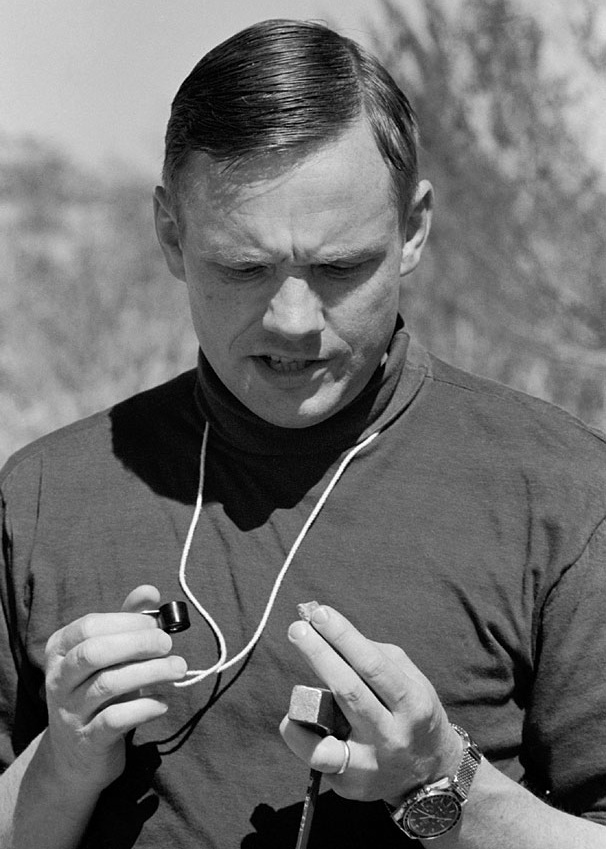
Neil Armstrong examines a sample from the Sierra Madera impact crater, west Texas during geology training for the Apollo program.

Paul Spudis
The Once & Future Moon
Smithsonian Air & Space


Because of his flying career and the life that he led, Neil Armstrong’s passing has many recounting his place in the history of spaceflight and remembering a life well lived.  He holds a special place in our hearts and a unique place in history – and he always will.

I met Neil Armstrong at a conference, an encounter I won’t forget.  A quiet, unassuming man of medium height and build, pleasant and genial, surrounded by a horde of admirers and well-wishers, I could tell he was slightly uncomfortable with (but resigned to) the adulation he received.  In his mind, the 1969 flight of Apollo 11 was simply another professional assignment he flew as a test pilot – the landing on the Moon was of more significance than his first step on it.  He was an aviator, in every sense of that word.  The landing was an accomplishment for humanity – a giant step for mankind.

My glimpses of Neil come not from personal encounters with him, but from others who knew him.  During a discussion several years ago with Dave Scott (Apollo astronaut and Commander of the 1971 Apollo 15 mission), I inquired about an obscure incident during the 1966 flight of Gemini 8 (flown by Neil and Dave).  That mission conducted the first docking of two spacecraft in space and I wanted to know some details of the emergency experienced by the crew on that flight.

The incident had occurred shortly after the docking, when the Gemini-Agena spacecraft began to roll slightly.  The rate of rotation became greater with time and it was evident that something was very wrong.  Neil, as commander, was responsible for “flying” the spacecraft but couldn’t get the rolling under control.  Thinking that the Agena (their unmanned target vehicle) was responsible, the crew made the decision to undock from it (they were out of contact with Mission Control at the time).  As soon as they did, the Gemini spacecraft started to roll and tumble at an ever increasing and alarming rate.  Dave recalled with a chuckle that Neil looked over at him, pointed at the attitude control stick and said “See if you can do anything with it!”  Dave’s recollection of their exchange gave me a glimpse of a very human moment in a life and death situation.  This was serious – if they couldn’t regain control, they would black out from the centrifugal forces in the tumbling vehicle.  Neil kept his cool, activated the re-entry thrusters and soon stabilized the bucking Gemini spacecraft.  The solution saved their lives but ended the mission, sending them home prematurely but safely.

The story of the first lunar landing is well known.  The automatic systems of the Apollo 11 Lunar Module Eagle were targeting the vehicle into a large crater filled with automobile-sized boulders.  Landing there would be disastrous, as the LM would likely topple over on touchdown, eliminating the crew’s ability to liftoff from the Moon and return home.  Taking manual control, Neil (with Mission Control advising the crew they had thirty seconds of fuel left) guided the LM over the hazardous debris field to a safe touchdown a few hundred meters beyond the original landing site.  Tension during the agonizingly long pause in the air-to-ground communications was palpable.  Relief could be heard in Capcom Charlie Duke’s voice as Neil calmly announced that the Eagle had landed.  Yet again, a critical situation expertly handled by a test pilot just doing his job – the calm and collected decision making necessary when flying finicky machines near the edges of their performance envelopes.

Neil’s scientific work on the Moon during his EVA warrants special mention.  Being the first humans to  land on another world, it is understandable that the crew had many ceremonial duties to perform.  Although they had been carefully instructed to stay close to the LM, without informing Mission Control, Neil walked back a hundred meters or so to Little West crater (overflown earlier) to examine and photograph its interior.  Those photos showed the basaltic bedrock of Tranquility Base – documenting that the Eagle had landed amidst ejecta from that crater thereby establishing the provenance of samples collected during the crew’s limited time on the surface.  According to Gene Shoemaker and Gordon Swann, both of the U.S. Geological Survey, Neil was one of the best students of geology among the Apollo astronauts.  Through his work on the Moon, he showed an ability beyond mere mastery of the facts of geology – he intuitively grasped its objectives, as well as the philosophy of the science.  Like every other facet of the mission, Neil understood and took this role seriously.  No matter what topic was addressed or which role was taken, he could always be counted on to turn in his best performance.

Armstrong understood the historic role of being the first man on the Moon but he never succumbed to the siren call of fame.  He could have cashed in on his status but choose a different path.  He was the quintessence of quiet dignity, possessing the “Aw shucks, t’weren’t nothin’” Gary Cooper-ish manner of understated heroism.  After retirement, he lived happily in his home state of Ohio, taught aeronautics (his first love) at the University of Cincinnati, and advised on various engineering topics and problems for both government and industry.  Throughout NASA’s post-Apollo efforts – without fanfare – he often and freely lent his efforts to the space program.  He served his country with honor and dignity.

As a test pilot, Neil routinely showed his ability to make quick, life saving decisions in dangerous situations.  As a senior spokesman for space, he clearly voiced his concern over the dismantling and destruction of our national space program.  Neil understood that our civil space program is a critical national asset, both as a technology innovator and a source of inspiration for the public.  Who would recognize this more clearly than Neil Armstrong?  From long experience, he knew what kinds of government programs worked and what kind didn’t.  He knew his fellow man.  In appearances before Congress in recent years, he outlined specific objections to our current direction in space.  A true patriot, Neil did not hesitate to voice his opinions, whether they aligned with current policy or not.

It’s become cliché to say that Neil Armstrong holds a unique place in history.  On this occasion, we should pause to consider just how singular his place is.  No one – not the first human to Mars nor the first crew to venture beyond the Solar System – will ever achieve the same level of significance as the first human to step onto the surface of another world.  The flight of Apollo 11 was truly a once in a lifetime event – and by that, I mean in the lifetime of humanity.  That first step was indeed one to “divide history,” as the NASA Public Affairs Office put it at the time.

Goodbye, Neil Armstrong – and thank you.  We’ve lost one of our most authoritative and articulate spokesmen for human spaceflight.  I mourn him and share his valid concerns for our dysfunctional national space program.

Originally published at his Smithsonian Air & Space blog The Once and Future Moon, Dr. Spudis is a senior staff scientist at the Lunar and Planetary Institute. The opinions expressed are those of the author and are better informed than average.

"Houston, Tranquility base here."

Apollo 11 landing site, as Armstrong and Aldrin left it some 43 years ago, LROC Narrow Angle Camera (NAC) observation M175124932R , LRO orbit 10942, November 5, 2011; angle of incidence 40.98° at 40 cm per pixel resolution from an altitude of 24 kilometers [NASA/GSFC/Arizona State University].
Mark S. Robinson
Principal Investigator
Lunar Reconnaissance Orbiter Camera
Arizona State University

"Houston, Tranquility base here. The Eagle has landed."

With those words Neil Armstrong let the world know that the Apollo 11 lunar module Eagle had set down safely on the surface of the Moon (20 July 1969). They did it! A nearly impossible task, yet there they were, starkly alone, but in a real sense in front of millions of people back on Earth. Only ten other humans would follow Neil Armstrong and Buzz Aldrin to the lunar surface over the next three years. We have not been back since.

First picture from the surface! First picture taken by a human being on another world. View out the lunar module left window, taken by Armstrong shortly after landing. One of the LM thrusters protrudes into the image at the bottom, scattered light from the Sun appears in the upper left, AS11-37-5449 [NASA].
As we remember Neil Armstrong's many accomplishments after his sudden death this week, it is reassuring  to know that the descent stage of Eagle, and various scientific instruments remain untouched, as though the crew only left yesterday. These artifacts are a reminder that humans can accomplish nearly impossible deeds through cooperation and teamwork.

Armstrong collects contingency sample - Armstrong collecting a contingency sample with a specially prepared scoop on a stick. Frame grab from Johnson Space Center digital scan of 16-mm film [NASA].
Once on the surface, Armstrong and Aldrin set about securing the LM and attending to various chores. After six hours it was finally time for Armstrong to head down the ladder. They only had a brief two and a half hours on the surface to accomplish many tasks. One of the first was obtaining a contingency sample (in case they had to leave in an unexpected hurry). Armstrong adeptly collected the sample with a scoop on a stick. After several scoops, he then carefully poured the soil and small rocks into a bag that he stashed in a hip pocket. Armstrong accomplished these precise operations with almost no time to acclimatize to 1/6th gravity! This and other samples collected by Armstrong and Aldrin would become the most studied geologic samples in history.

Armstrong stowing sample - Armstrong stowing contingency sample. Frame grab from Johnson Space Center digital scan of 16-mm film [NASA].
Shortly after completing the contingency sampling, Armstrong noted the magnificent scene before him: "It has a stark beauty all its own. It's like much of the high desert of the United States. It's different, but it's very pretty out here." Buzz joined Neil on the surface and shortly they raised the United States flag and then unpacked, and setup sophisticated science experiments (Early Apollo Scientifc Experiments Package, EASEP) and collected a comprehensive set of samples (one of the greatest science bonanzas ever!). You can easily find the EASEP hardware in the LROC images, just south of the LM descent stage.


American flag goes up! Armstrong and Aldrin deploying the American flag. Frame grab from Johnson Space Center digital scan of 16-mm film [NASA].
As we remember all that Neil Armstrong accomplished during his storied career, LRO and LROC continue Armstrong's journey, collecting critical measurements that will enable America's return to the Moon.

Listen to noted author Andrew Chaikin recall his conversations with Neil Armstrong.

Jump to the NAC frame showing Tranquility base. Scroll through all the LROC images of this historic site.

Previous Apollo 11 LROC Featured Images:

LROC's First Look at the Apollo Landing Sites
Apollo 11: Second Look
High Noon at Tranquility Base
A Stark Beauty All Its Own

Armstrong crater

Armstrong crater, Sea of Tranquility - LROC Narrow Angle Camera mosaic of Armstrong, the appropriately unassuming 4.2 km-wide crater (before 1970, "Sabine E") 47.1 km northwest of Tranquility Base (or roughly 64 km north by northwest of the much easier to locate landmark crater Moltke) at 1.356°N, 24.941°E.  From a highly reduced combination of sampled lines from LROC NAC M126765005 (LRO orbit 3815, 47 cm resolution from 39.5 km altitude, April 24, 2010) and M172758358 (orbit 10593, 49 cm resolution from 42.6 km altitude, ), both under mid-day full illumination but many lunar days apart [NASA/GSFC/Arizona State University].
The image above does not do justice to the 16000 line by 10000 pixel montage needed to catch all of modest Armstrong crater at the highest resolution possible. Only two people ever had the opportunity to catch such a view, and they were very busy at that brief moment, absorbed with the raw novelty and challenge of arriving at the lunar surface

The information is stored in two standard double 5000 sample by 52224 line LRO NAC photographs now available in the Planetary Data System (PDS).

A new barely-born effort is underway to make the several life-times worth of PDS data more user-friendly. You can call this an experiment, an early part of that effort, and like most experiments it is a failure.

To illustrate that failure better, as an additional tease, below, at full resolution, and at the maximum 580 by 800 window allowable to users of this blog format, is a very small part of that wall-sized product, specifically the part of the Armstrong crater wall at roughly 5 o'clock (or 170° of arc) in the 'thumbnail' above featuring a unusually wide line of darker fine debris flow.

Sound principles of super-positioning seem to indicate Armstrong is an old crater on the main-sequence of lunar crater types, barely large enough to have once supported a floor, now long buried by steady mass wasting. It's a pounded, rounded and well-gardened interior and has none of the great boulders on the rim that would set it apart as relatively young. Still, the interplay of epochs that have etched their passing on the Tranquillitatis basin (if it is a true impact basin) is at least as delightful as clouds in a spring day sky. LROC NAC M126765005L [NASA/GSFC/Arizona State University].

Without the jagged features characteristic of younger similarly-sized craters, craters like South Ray, not yet baked evenly into reddened optical maturity, even the highest resolution segment of the mosaic doesn't invite anyone to go through a similar time-consuming process of creating a wall-sized picture of Armstrong crater. Flight planners did not choose this place on the Moon for its drama.

Site B was selected for the first landing so that first pilot would not have to take control from an over-loaded on-board computer to dodge boulders looming up from the spot where the delicate Lunar Module was trying to land.

The dark-line and notch at "5 o'clock" on the rim of Armstrong (inset at original resolution) is more than a superficial darker debris flow, after all. The relief at angles of illumination unavailable at high-resolution definitely show a notch in the crater rim anatomy, at 60 meters resolution. There is also a stream of secondary cratering that amounts to a ray, perhaps from Theophilus. The white arrow is the landing site of Apollo 11. LROC Wide Angle Camera mosaic (604nm) from several orbital passes July 2011 [NASA/GSFC/Arizona State University].
Fortunately, the relatively small crater is not terribly difficult to spot using a modest telescope, if, in addition, an Earth-bound observer has more than a passing knowledge of the Moon's nearside in general and the Sea of Tranquility in particular.

Bit by slow bit we are gathering information that adds up to a fairly accurate simulation of the Moon, but to experience a truly accurate picture of our own back yard we are also having confirmed what we already knew.
You really have to have been there.

From a 33 percent reduction of a truly spectacular color mosaic of the Moon captured by the "miracle boys of Minsk," Astronominsk, April 6, 2009.

Thursday, August 2, 2012

Tranquility Base at high-resolution before Apollo 11

On Monday, August 1 the Lunar Orbiter Image Restoration Project (LOIRP) released another 'newly retrieved' medium resolution frame 2085 M, originally photographed by Lunar Orbiter II on November 20, 1966, from its vantage point 51.4 kilometers over the southwest Mare Tranquillitatis (0.8°N, 23.7°E).
The Lunar Orbiter Image Restoration Project (LOIRP) has released an image from 1966, showing 'Tranquility Base' before the arrival of Apollo 11, newly-retrieved from once-discarded Lunar Orbiter telemetry tapes using restored and equipment built from scratch to read them.

It was early mid-morning on the Sea of Tranquility and the eventual landing site of Apollo 11 (small blue arrow in the thumbnail image, above) only 32 months later, when Lunar Orbiter II photographed the historic location. 

A very large version of the image, newly retrieved from the original taped telemetry returned from the JPL orbiter, at a digital resolution of 16500 x 18564 pixels (598.3 Mb) is housed at the NASA Lunar Science Institute, HERE. Original reproductions of second-generation photographs, along with image references, are available at the Lunar and Planetary Science Institute, HERE.

A large 1650 x 1856 version is available from the Moonviews.com website, HERE. Detailed full-resolution views of the landing site of Apollo 11 before and after July 20, 1969 are visible in the images below.

A rough outline of the field of view captured by Lunar Orbiter II traced out on the global LROC Narrow and Wide Angle Camera mosaic on the LROC QuickMap web-application, at a resolution of 64 meters. The Apollo 11 landing site is indicated by the red cross [NASA/GSFC/Arizona State University].
The Apollo 11 descent stage (blue arrow) is clearly visible when the LROC QuickMap is reset to 2 meters resolution, a close match to the full resolution close-up on the same area photographed by Lunar Orbiter II a year and eight months before the landing, below
A quick examination of the 16500 x 18564, 600 Mb full resolution version of LO-II-085 shows the landing site and many details of the vicinity familiar to those acquainted with mission details, before the arrival of Apollo 11. Excellent detail for this media, even without teasing out more detail using present-day software [NASA/JPL/LOIRP/NLSI].