Showing posts with label LAMP. Show all posts

Thursday, February 12, 2015

Postdoctoral Researcher positions, SwRI

Far-UV albedos show some agreement with epithermal neutron suppression regions [NASA/GSFC/SwRI].
Erin Rogers, PHR
Sr. Specialist
Employment Operations
Southwest Research Institute

The UV imaging spectrograph group at Southwest Research Institute (SwRI) is seeking postdoctoral planetary scientists to join our team's investigations of a variety of science questions using far-UV observations. 

Topics of study include:
  1. Characterization of volatiles within permanently shaded regions (PSRs) at the lunar poles with the Lyman Alpha Mapping Project (LAMP) imaging spectrograph on the Lunar Reconnaissance Orbiter (LRO); 
  2. Imaging Jupiter's powerful auroral emissions with the Juno UV Spectrograph (UVS)
  3. Studying the atmosphere of Pluto with the New Horizons Alice instrument
  4. Analysis of Hubble campaign observations in search of water vapor plumes on Europa
  5. Instrument development work related to the Jupiter Icy Moons Explorer (JUICE) UVS investigation and other future UV/optical projects in Astrophysics, Planetary Science, Heliophysics, and Earth Sciences.
  • Candidates are encouraged to develop their own additional research projects.

Candidates must have experience with imaging and/or spectroscopy from space-based or ground-based observatories; strong programming skills with Interactive Data Language (IDL) is preferred. A background in scientific analysis and publications related to one or more of the topics listed above is highly desirable. Specific tasks include: analyzing UV spectral imaging datasets; assist with planning future observations; publishing results in peer-reviewed journals and presentations at professional meetings; development of concepts and new technologies for UV/VIS/IR instrumentation and assist ing with flight instrument integration, test and calibration tasks, and leading and/or assisting proposal writing for new business.

All candidates must use the swri.jobs website to prepare and submit applications.  They may reference job number 15-01143 or utilize the following job link:

Tuesday, July 17, 2012

LRO LAMP sharpens Apollo surface helium data

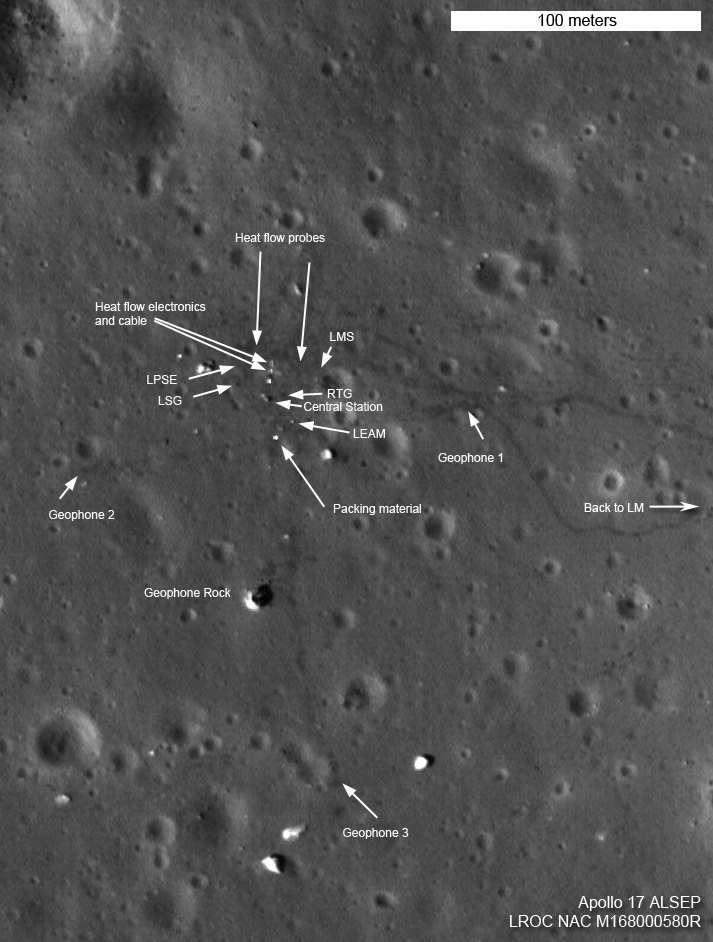
LACE (Lunar Surface Composition Experiment), a.k.a. "Lunar Mass Spectrometer," deployed as part of the Apollo 17 ALSEP (Apollo Lunar Surface Experiment Package) December 11, 1972 and afterward remotely operated and monitored until shutdown in 1977. The experiment housing has been photographed from lunar orbit by the LROC Narrow Angle Camera [Schmitt/AS17-134-20499].
Portions from ScienceDaily July 16, 2012 - The Lunar Atmospheric Composition Experiment (LACE), a spectrometer designed to measure and characterize the thin lunar atmosphere was deployed at Taurus Littrow by Gene Cernan and Harrison Schmitt of Apollo 17. Forty years later, researchers using the Lyman Alpha Mapping Project (LAMP) far ultraviolet spectrograph, on-board LRO have added to those initial measurements to provide the first remotely-sensed measurement of the Moon's gaseous environment at the surface from lunar orbit, specifically the atmospheric concentration of helium.

Aiming LAMP sensors toward the lunar limb, and comparing their readings with measurements of the interstellar background, the authors of work published in Geophysical Research Letters have estimated the helium concentration of the near-surface lunar environment. 

They calculate a density of 7,000 atoms per cubic centimeter at 120° K (-244° F) The earlier LACE observations ranged between 10,000 -- 20,000 and 50,000 atoms per cubic centimeter, depending on the time of day, increasing through the lunar night and decreasing during daylight. The nighttime decrease occurs because the atmosphere cools and contracts, yielding an increased density.

The authors suggest the next steps should involve looking for spatial or temporal variations in lunar atmospheric helium. Such observations could help to determine whether the helium detected is produced locally, by radioactive decay, or if it is formed from trapped and neutralized solar wind.
Apollo 17 ALSEP area (north is up). The LACE instrument is labeled "LMS," for Lunar Mass Spectrometer. Detail from a wider field of view HERE. (See Skimming the Moon, September 8, 2011) [NASA/GSFC/Arizona State University].
Journal Reference: Stern, Retherford, Tsang, Feldman, Pryor &. Gladstone. Lunar atmospheric helium detections by the LAMP UV spectrograph on the Lunar Reconnaissance Orbiter. Geophysical Research Letters, 2012; 39 (12)

Wednesday, June 13, 2012

First atmospheric helium detections by LRO LAMP UV spectrograph

Depicted here are atmospheric emission spectra (black) obtained by LAMP on two dates in late 2011, in units of Rayleighs per angstrom. Each panel’s black line is the spectrum obtained by LAMP when its spectrograph slit was placed 83 deg from the nadir, just above the lunar limb. The red line in each panel is the background spectrum obtained close in time by observing the same patch of sky when it is at the zenith, where any contribution from the lunar atmosphere is minimized. The blue line in each panel is the difference spectrum obtained by subtracting the background from the limb spectrum, revealing native lunar atmospheric emission from He I at 584 Å. 1-sigma error bars are depicted on each curve every 4th spectral point, for reference.
Stern, et al
SWrI*

The LAMP far ultraviolet spectrograph aboard the NASA Lunar Reconnaissance Orbiter (LRO) has been used to search for helium, the lightest noble gas in the tenuous lunar atmosphere. We report here the first detection of lunar atmospheric He by remote sensing, and point to future observations that can address questions about its source, and to a search for native lunar atmospheric argon.

*Southwest Research Institute, Johns Hopkins University, Central Arizona College

Wednesday, February 29, 2012

Postdoctoral Position at SwRI (LRO-LAMP)

Gladstone, et al, (2012)
The Lyman Alpha Mapping Project (LAMP) on the Lunar Reconnaissance Orbiter (LRO) mission is seeking a postdoctoral planetary scientist to join our team's investigations of a variety of lunar science questions using far-UV observations of the lunar surface. 

Topics of study include characterization of permanently shaded regions at the lunar poles, mapping of surface water frost and hydrates, and identifying regional space weathering effects. The far-UV map and spectra analyses to be performed include comparisons with other LRO and lunar datasets for detailed surveys of regions of interest.  Applicants having experience with imaging and/or spectroscopy from space-based observations, and a background in scientific analysis and publication of lunar geology and/or volatiles topics are encouraged to apply. This is a one year limited term position in San Antonio, TX, with extension dependent on availability of funding.

Visit http://www.swri.edu/HR/JobListing.asp and enter Job Code 15-01040 to apply now.  For additional inquiries contact Dr. Kurt Retherford at kretherford@swri.edu.

See also: Postdoctoral Position at UCLA (LRO-DIVINER)

Saturday, January 14, 2012

Shadowed fluffy lunar frost detected in starlight

LRO (in this case the LOLA imaging team) is slowly but certainly stripping away the shadows from the permanently shadowed regions of the Moon. The differences between the water-supporting natures of the rocks deep in the shadowed southern craters Haworth and Shoemaker has been better explained by data collected by LRO's LAMP instrument. From Earth, seen here from a Kaguya HDTV still shot from nearly the same angle in 2008, the shadowed region between the nearside rim of South Pole Aitken basin and 10 km-wide Shackleton (which supports the Moon's south pole on it's rim) can only be measured through "the notch" between Malapert massif on the left and the lofty "Leibnitz beta" massif on the right [NASA/JAXA/LMMP/ILIADS]
San Antonio  New maps produced by the Lyman Alpha Mapping Project (LAMP) aboard NASA's Lunar Reconnaissance Orbiter (LRO) reveal features at the Moon's north and south poles in regions that lie in perpetual darkness. Developed by the Southwest Research Institute (SwRI), the LAMP instrument is sensitive on dim "starlight," specifically the band of electro-magnetic frequencies emitted when hydrogen (which usually travels in pairs) is reduced to a single atom, usually when encountering other forms of radiation.

This Ly-α (Lyman-alpha) spectral line is peculiar to neutral hydrogen, the most basic and abundant element in the universe, is produced by light with a wavelength of 121.4 nm, a frequency below the narrow band of optical frequencies visible to the naked eye. By gathering data revealed by this all-pervasive indirect starlight LAMP can peer into so-called "permanently shadowed regions" (PSRs).

In repeated passes over the lunar poles using this method researchers have able to determine the presence of very fine structure, such as the likely porosity of lunar surface rock or the most likely textures of water frost in super-cold volatile traps, in permanent shadow from the Sun, and only in those places on the Moon not overwhelmed by direct or immediately indirect sunlight.


The LAMP maps show that many PSRs are darker at far-ultraviolet wavelengths and redder than nearby surface areas that receive sunlight. The darker regions are consistent with large surface porosities — indicating "fluffy" soils — while the reddening is consistent with the presence of water frost on the surface.

"Our results suggest there could be as much as 1 to 2 percent water frost in some permanently shadowed soils," says author Dr. Randy Gladstone, an Institute scientist in the SwRI Space Science and Engineering Division. "This is unexpected because naturally occurring interplanetary Lyman-alpha was thought to destroy any water frost before it could accumulate."

The LAMP team estimates that the loss of water frost is about 16 times slower than previously believed. In addition, the accumulation of water frost is also likely to be highly dependent on local conditions, such as temperature, thermal cycling and even geologically recent "impact gardening" in which micrometeoroid impacts redistribute the location and depth of volatile compounds.

Lyman-alpha albedo maps for greater south polar region from the first year of LAMP night-side observations. Initial studies were focused on those areas above 80°N. The white square is the area highlighted in a recent paper comparing what's been discovered about the big differences between the interiors of permanently shadowed neighbors Haworth and Shoemaker craters. "Calibrated photon events" accumulated month by month and divided by model-based illumination baselines show "generally, we find good agreement between UV-dark regions and the coldest shaded craters revealed by the LRO Diviner instrument." Identifying the cause of this albedo darkening required spectral analysis but the likeliest explanation included either the presence of "UV-absorbing volatiles at the surface" and/or "a change in surface properties (e.g., roughness or porosities) at these interesting locations." [Retherford et al., Lunar and Planetary Sciences Conference, (2011)].
Finding water frost at these new locations adds to a rapidly improving understanding of the Moon's water and related species, as discovered by three other space missions through near-infrared emissions observations and found buried within the Cabeus crater by the LCROSS impactor roughly two years ago. During LRO's nominal exploration mission, LAMP added to the LCROSS results by measuring hydrogen, mercury and other volatile gases ejected along with the water from the permanently shaded soils of the Moon's Cabeus crater.

"An even more unexpected finding is that LAMP's technique for measuring the lunar Lyman-alpha albedo indicates higher surface porosities within PSRs, and supports the long-postulated presence of tenuous 'fairy-castle' like arrangements of surface grains in the PSR soils," says co-author Dr. Kurt Retherford, a senior research scientist also in SwRI's Space Science and Engineering Division.

Comparisons with future LAMP maps created using data gathered from the Moon's day side will prove helpful for revealing more about the presence of water frost, as well as the surface porosities of the darker surface features observed. The LAMP team is also eager to apply the Lyman-alpha technique elsewhere on the Moon and on other solar system objects such as Mercury.

No longer terra incognitia, the permanently shadowed interiors and area surrounding the southern polar craters Haworth and Shoemaker have had their elevation unveiled in precise detail, seen here in laser altimetry collected over two years and several thousand polar orbits [NASA/GSFC/LOLA].
LRO's findings are expected to be valuable to the future consideration of a permanent Moon base. The permanently shadowed regions of the Moon are revealing themselves to be some of the most exotic places in the solar system, well worthy of future exploration, says Retherford. Any discovery of water frost and other resources in the area also could reduce the need to transport resources from Earth to a base at the pole.

The paper, "Far-Ultraviolet Reflectance Properties of the Moon's Permanently Shadowed Regions," by G.R. Gladstone, K.D. Retherford, A.F. Egan, D.E. Kaufmann, P.F. Miles, et al., was published in the Jan. 7 issue of the Journal of Geophysical Research. LAMP's principal investigator is Dr. Alan Stern, associate vice president of the SwRI Space Science and Engineering Division.

Thursday, October 21, 2010

Surprising gas from LAMP

From Lunar Pioneer Album 3 -
Southwest Research Institute's LRO/LAMP website, redirected from LRO's main site at Goddard Space Flight Center, remains virtually unchanged since before the launch of LRO, and it's public website (if you can find it) refers to operations in the future. The "Soon" in the "Coming Soon!" above is characteristic of a genuine "ghost site."

EDITOR'S NOTE & OPINION: Out of deep respect for the outstanding, cutting-edge work accomplished by the Southwest Research Institute (SwRI), and because of their contribution to the success of the on-going mission of the Lunar Reconnaissance Orbiter, we're pleased to post the following news release, related to the journal Science publishing research related to the impact of the LCROSS mission, one year ago.

However, of all the experiments and teams contributing to the LRO mission, launched at a huge cost to the American taxpayer, we would be remiss in not expressing our deep displeasure with an apparent complete lack of public outreach by those operating the Lyman-Alpha Mapping Project (LAMP). Of all the LRO instruments, only one other has been more disrespectful of the wider community of proponents of lunar exploration. Only the CRaTER project, whose long publicized website at Boston University has simply disappeared, has done a worse job of keeping the public informed as to their progress.

The Southwest Research Institute's outreach has, since long before LRO/LCROSS was launched on June 18, 2009, kept tantalizing messages posted online advertising features "coming soon," for example, that never arrive, and the team's public information stewardship receives a a failing grade equal at least to that deserved by Boston University and the CRaTER experiment team.

Of all the LRO experiment public outreach efforts, that of the Lunar Reconnaissance Orbiter Camera (LROC) has alone been outstanding, and they deserve to be highly commended.

The Lunar Orbiter Laser Altimeter (LOLA) public information guardians tried, for a time, to make a solid effort and unfortunately also dropped the ball. An LOLA "Image of the Week" feature has now not been undated since the middle of July, in a ridiculous state of affairs, a mocking feature posted on the NASA and GSFC primary LRO public websites.

Diviner and the Mini-RF teams have at least made the effort of keeping citizen-scientists updated, without promising more than they could deliver, and when delivering data products, delivering solid reports. The Russian Institute of Science LEND mission has made results available at least with publicly available monographs and reports.

We take great exception with the presumption expressed by the constant silence out of the Southwest Research Institute and to their apparent contempt for the those interested in the results of their part in the landmark mission of the LRO.
- Joel Raupe
Raleigh, North Carolina

-------
"LRO's LAMP ultraviolet spectrograph observes
LCROSS blast, detects surprising gases in impact plume
"

San Antonio — Oct. 21, 2010 — NASA's Lunar Reconnaissance Orbiter (LRO) and its sophisticated suite of instruments have determined that hydrogen, mercury and other volatile substances are present in permanently shaded soils on the Moon, according to a paper published today in Science.

The Lunar Crater Remote Observation and Sensing Satellite (LCROSS), which launched with LRO, was intentionally crashed onto the Moon's surface Oct. 9, 2009, while LRO instruments watched. About 90 seconds after LCROSS hit the Moon, LRO flew past the debris plume raised by the impact, while the Lyman Alpha Mapping Project (LAMP) and other instruments collected data. Using these data, LAMP team members eventually confirmed the presence of the gases molecular hydrogen, carbon monoxide and atomic mercury, along with smaller amounts of calcium and magnesium, also in gas form.

"We had hints from Apollo soils and models that the volatiles we see in the impact plume have been long collecting near the Moon's polar regions," says Dr. Randy Gladstone, LAMP acting principal investigator, of Southwest Research Institute in San Antonio. "Now we have confirmation."

The point of impact was the Cabeus crater near the lunar south pole. The tiny tilt of the Moon's rotation axis allows the floors of craters near the poles to be permanently shaded from direct sunshine. Without sunlight, temperatures in these areas can be as low as 35 to 100 Kelvin (degrees above absolute zero) – so cold that almost all volatiles that find their way there become trapped. Ongoing micrometeorite impacts cover them with dirt, further isolating them from exposure and possible escape.

LRO's findings are valuable to the future consideration of robotic and manned Moon base locations. Just as the poles have nearby crater floors with permanently shaded regions because of the Moon's orientation to the Sun, they also have nearby mountains and crater rims that are in nearly perpetual sunlight, which would enable the placement and operation of solar-powered systems and equipment. The discovery of water-ice and other resources in the region could also reduce the need to transport resources from Earth for use by astronauts.

"The detection of mercury in the soil was the biggest surprise, especially that it's in about the same abundance as the water detected by LCROSS," says Kurt Retherford, LAMP team member, also of SwRI. "Its toxicity could present a challenge for human exploration."

Developed by Southwest Research Institute, LAMP uses a novel method to peer into the darkness of the Moon's permanently shadowed regions. The ultraviolet spectrograph observes the nightside lunar surface using light from nearby space (and stars), which bathes all bodies in space in a soft glow. This Lyman-alpha glow is invisible to human eyes, but visible to LAMP as it reflects off the Moon. Analyses of the emissions, in collaboration with other LRO instruments, help determine lunar surface properties.

Following the LCROSS impact observations, LAMP continues its investigation of the ultraviolet reflectance properties and composition of the lunar surface and the composition of the lunar atmosphere. Since the conclusion of a one-year reconnaissance mission under NASA's Exploration Systems Mission Directorate, the Science Mission Directorate has assumed oversight of more in-depth investigations for the science instruments. During the science investigation, LAMP will shift into more detailed evaluations of the Moon's atmosphere and its variability.

The paper, "LRO-LAMP Observations of the LCROSS Impact Plume," by G.R. Gladstone, D.M. Hurley, K.D. Retherford, P.D. Feldman, W.R. Pryor, J.-Y. Chaufray, M. Versteeg, T.K. Greathouse, A.J. Steffl, H. Throop, J.W. Parker, D.E. Kaufmann, A.F. Egan, M.W. Davis, D.C. Slater, J. Mukherjee, P.F. Miles, A.R. Hendrix, A. Colaprete, and S.A. Stern, was published in the Oct. 22 issue of Science.

Thursday, September 17, 2009

LRO confirms Prospector

Shackleton Rim. A first public release of this most detailed image from the LROC Narrow Angle Camera (NAC) shows the Rim of Shackleton Crater, immediately adjacent to the South Pole of the Moon.

LRO: Moon's South Polar region 'cold, frosty,
and hydrogen-rich,' even outside it's lingering shadows -
just as pluckly Lunar Prospector 'seemed to show'
ten years ago.


From Andrew Gaddis, LROC News System at Arizona State, "on September 15, LRO successfully executed its Mission Orbit Insertion (MOI) propulsive maneuver which established the nominal mission orbit. This means the LRO cameras are now in a 50km polar mapping orbit of the Moon, which will result in higher resolution images."

Preliminary estimates from LRO's Diviner Radiometer, measuring thermal emmissions, show the Moon's Pemanently Darkened Regions (PDRs) as "perhaps the coldest regions in the Solar System" and "well able to support" trapped volatiles like hydrogen.

Some areas within the Moon's PDR's hover at 35 degrees K, and are easily among the coldest regions in the Solar System, and certainly as cold as anything known to naturally occur within the inner solar system. (This testifies to the low thermal conductivity of the materials that make up the Moon's surface, and how long these PDR's have escaped direct contact from solar energy.)

In additon, LRO Russian-built LEND neutron spectrometer, after only 60 days of operation, has already confirmed the hydrogen signatures found at the 30 kilometer wide, 1 meter deep resolution demonstrated by the Lunar Prospector survey in 1999.

As with Lunar Prospector, LRO finds an abundance of hydrogen within Permanently Darkened Craters inside the Moon's polar PDRs, and also the same hydrogen abundance found by Lunar Prospector outside the Moon's PDR's, at higher latitudes.

The hydrogen detection signature discovered by LRO's LEND discovered within Cabaeus A was a factor in the choice of this crater as the target for the LCROSS impact on October 9.

The most sensitive of LRO's experiments, the Lyman-Alpha Mapping Project (LAMP), an "extrodinarily sensitive UV detector, sensitive to frost," was the last experiment switched on as LRO neared it's mapping orbit within the past week. During passes over Faustini and Cabeus A LAMP detected "a distinct darkening" on the crater floors, "possibly due either to a surface texture effect" or the frost the experiment was designed to detect on the Moon's surface.

The LRO's Cosmic ray detetor, CRaTER, is working "very well," having shown the expected rain of GCR's coming into the inner Solar System from outside, as expected during the present unusually deep solar minimum. The detector also showed the shadowing by the Moon of half the Cosmos during close passes by the Moon's South Pole in it's commissioning orbit.